Carolyn’s Shade Gardens is a retail nursery located in Bryn Mawr, PA, specializing in showy, colorful, and unusual plants for shade. The only plants that we ship are snowdrops within the US. For catalogues and announcements of local events, please send your full name, mailing address, and cell number to carolyn@carolynsshadegardens.com and indicate whether you are interested in snowdrops, hellebores, and/or hostas. Click here to get to the home page of our website for catalogues and information about our nursery and to subscribe to our blog.
 ‘Winter’s Joy’ Fall-blooming Hardy Camellia
My nursery specializes in herbaceous flowering plants for shade. However, although no shade garden is complete without trees, shrubs, and vines, our local nurseries seem to ignore woody plants for shade. To fill this gap, I offer my customers shade-loving woodies from a wholesale grower whose quality meets my exacting standards. As in Woody Plants for Shade Part One and Woody Plants for Shade Part Two, I thought my blog readers who are not customers might be interested in learning about the woody plants that I would recommend they add to their shade gardens. And doing an article in addition to the customer offering allows me to add more information so customers might be interested also.
This summer was tough on plants. I lost several shrubs that I planted this spring. That is why fall is the best time to plant. The soil temperature is elevated for good root development through December, but new plants don’t have to contend with scorching temperatures, severe drought, or an excess of rain. The plants that I add in the fall are always the most successful in my garden.
Included in my offering are three evergreen shrubs, five deciduous shrubs, and one vine. Of the nine plants I have chosen, three are native. Please read my article My Thanksgiving Oak Forest to see why I think planting native plants is crucial to our environment. My article New Native Shade Perennials for 2011 explains why I think native cultivars are valuable native plants. With that introduction, here are the plants I am offering highlighted in green:
 The fall-blooming camellia ‘Winter’s Snowman’ shines in the winter sun.
If you have been reading my blog, you know that I love camellias, especially fall-blooming varieties. There is nothing like going outside on a cold November or December day and being greeted by large showy flowers backed by gorgeous evergreen leaves. Camellias really light up the shadiest parts of my garden during the time of year when flowers are most appreciated. For more information on and some beautiful photographs of fall-blooming hardy camellias, see my articles Fall-blooming Camellias Part 1 and Fall-blooming Camellias Part 2.
 ‘Winter’s Snowman’ blooming in December
In a very shady place on the terrace outside my front door, I have a ‘Winter’s Snowman’ fall-blooming hardy camellia. At maturity, it will reach six feet. Its semi-double white flowers glow when displayed against the glossy evergreen leaves in November and December. It is a vigorous plant with a narrow upright habit. Although it is fully hardy in our area, I have sheltered it from winter sun and our winter winds, which come from the northwest.
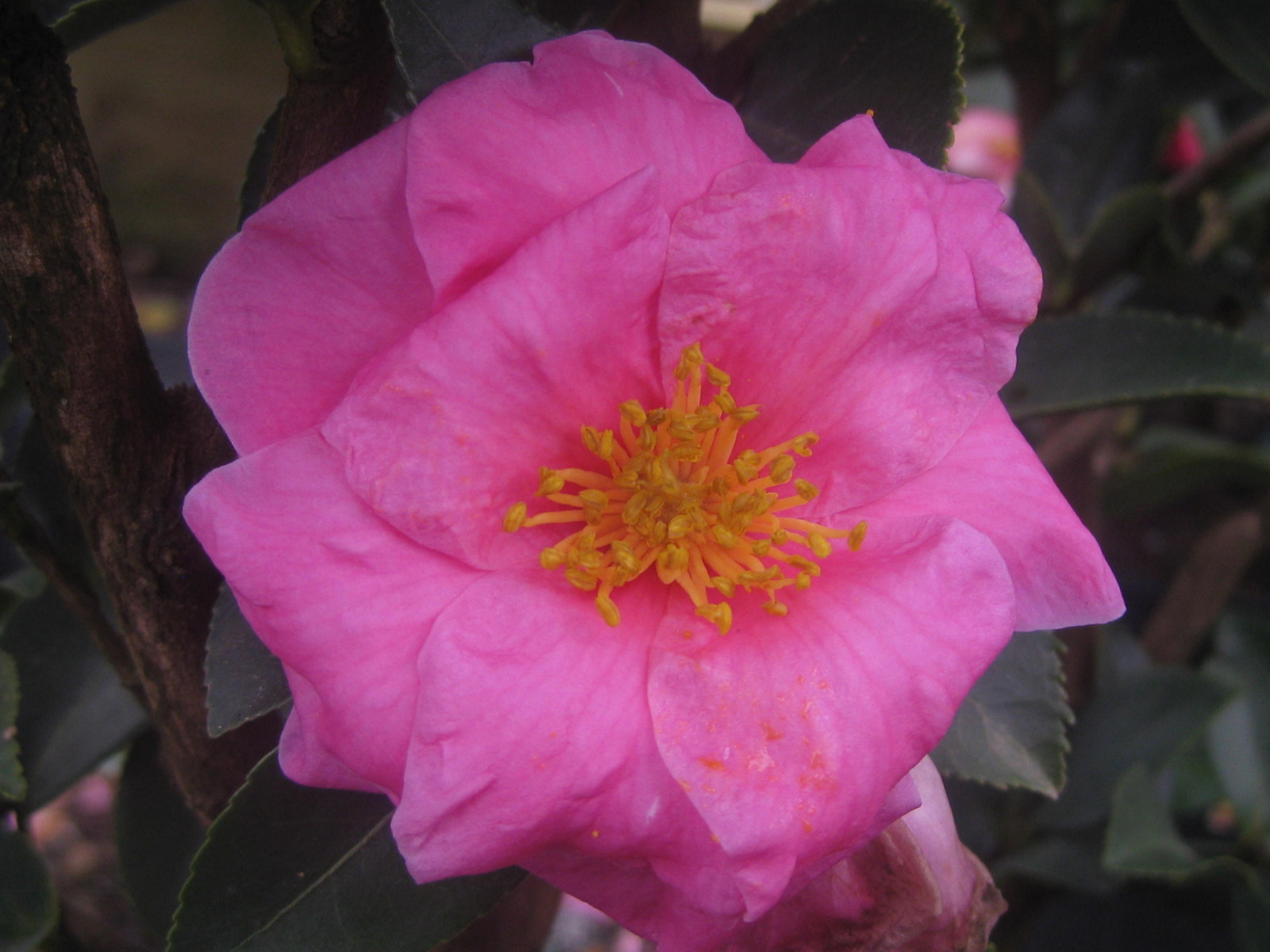 ‘Winter’s Joy’ fall-blooming camellia
In a similarly sheltered and shady location outside my back door along the path to my compost “pit”, I have planted another fall-blooming camellia. ‘Winter’s Joy’ fall-blooming hardy camellia has semi-double, fuchsia-pink flowers elegantly displayed against glossy evergreen leaves in November and December. It is a vigorous plant with a narrow upright habit, reaching six feet at maturity. Right now both these fall-blooming camellias are covered with buds. I can’t wait for the display to begin.
 ‘Winter’s Joy’ is loaded with buds just waiting to produce its showy flowers, and look at that immaculate foliage.
I really like leatherleaf viburnums. They are evergreen, deer resistant, grow in full shade, have lovely flowers and foliage, and are big enough to screen unsightly views. The plants I have in my garden are the straight species Viburnum rhytidophyllum and that’s what I intended to offer to my customers. However, when I saw ‘Dart’s Duke’ lantanaphyllum viburnum (what a name!), V. x rhytidophyllum ‘Dart’s Duke’, and did some research, I realized it is a superior plant for foliage, flowers, berries, and vigor. A comparison of the nursery stock confirmed this.
 ‘Dart’s Duke’ showing its majestic leaves and reblooming to produce some of its very large flowers for fall.
‘Dart’s Duke’ grows to 8’ tall by 8’ wide in full sun to full shade. It has very large, 6 to 10”, showy white flowers in May and can rebloom in the fall. The flowers are followed by very nice red fruit. The beautiful, clean dark green, leathery evergreen foliage is deer resistant and winter tough. It is a Pennsylvania Horticultural Society Gold Medal Plant for 2012, one of only four plants honored.
 ‘Early Amethyst’ beautyberry is dispalying its amazing purple berries right now at Carolyn’s Shade Gardens.
‘Early Amethyst’ beautyberry, Callicarpa dichotoma ‘Early Amethyst’, has attractive pink flowers in spring. But the real show is in the fall when huge amounts of unbelievably colored purple berries run down the center of the beautifully layered branches. When the leaves drop, the persistent berries are even more showy though they are attractive to birds. Beautyberry reaches 4’ tall by 4′ wide in sun to part shade and is deer resistant. I have grown this plant successfully in part shade for years. If desired, it can be cut back in spring, but I usually leave mine alone. Beautyberry is a Pennsylvania Horticultural Society Gold Medal Plant and Missouri Botanical Garden Plant of Merit.
 Paper Bush, Edgeworthia chrysantha
Paper bush, Edgeworthia chrysantha, is a rare and unusual shrub that has just been discovered by collectors within the last few years. However, it has so many great ornamental features that it is sure to become very popular. Its very fragrant clusters of tubular bright yellow flowers bloom from January to March. The buds, which form in the fall, are as ornamental as the flowers. They remind me of the tassels on the corners of Victorian pillows. Paper bush has an elegant and symmetrical upright, branching habit, growing to 6’ tall in part to full shade with protection from winter winds. It is an exquisite and rare shrub that is ornamental 365 days of the year in my garden.
 The buds of paper bush are ornamental all winter.
 The unusual fragrant flowers of paper bush
 The flowers of ‘Preziosa’ sawtooth hydrangea start out a lovely pink and mature to a bright maroon.
‘Preziosa’ sawtooth hydrangea, Hydrangea serrata ‘Preziosa’, produces numerous lovely pink, small, mophead-like flowers in June and July, which darken with age to a gorgeous maroon (see link below for photo). The flowers are reliably pink and don’t turn blue. The beautiful burgundy fall color of the leaves and stems only adds to the show. ‘Preziosa’ reaches 4’ tall and wide in part to full shade. The Hydrangea serrata species is one that thrives in full shade. Unlike many hydrangeas, ‘Preziosa’ is very tolerant of the cold temperatures in our zone 6. For a raving review of ‘Preziosa’ and more cultural information (note that the winter protection recommended is for zone 5), click here.
 The leaves of ‘Preziosa’ sawtooth hydrangea have already started to turn burgundy.
 This photo shows the berries on my ‘Red Sprite’ winterberry holly right now—they get much larger as the season progresses, but the show is already breathtaking.
One of my all time favorite native plants is winterberry holly, Ilex verticillata. It grows wild all over the island in Maine where my family vacations and is always covered with berries in the fall. Here in Pennsylvania, my preferred winterberry holly cultivar is Ilex verticillata ‘Red Sprite’. It produces copious amounts of very large red berries on relatively compact plants that never need pruning. The birds love the berries too, but they leave enough behind for it to remain extremely showy late into the winter. ‘Red Sprite’ reaches 5’ tall in sun to part shade and is wet site and salt tolerant, and deer resistant. All hollies require a male pollinator, in this case ‘Jim Dandy’, for good fruit set. Winterberry is native to the entire eastern half of North America, including Pennsylvania.
 The flowers and foliage of native ‘Cool Splash’ southern bush honeysuckle, Diervilla sessifolia ‘Cool Splash’
‘Cool Splash’ southern bush honeysuckle is a native shrub whose bold green and white variegation really stands out in the shade. Its honeysuckle-shaped yellow flowers appear in July and August with rebloom in the fall. ‘Cool Splash’ grows to 4’ tall and wide in sun to part shade. It is tough, cold hardy, and deer resistant, and integrates well into perennial borders. This species is native to the southeastern U.S., but a closely related species, D. lonicera, is native to Pennsylvania. It is one of four plants honored with a gold medal by the Pennsylvania Horticultural Society in 2011. Nan Ondra at the blog Hayfield has written an excellent profile of this native shrub (with many photos), click here .
 In late spring and early summer, ‘John Clayton’ trumpet honeysuckle is covered with these delightful tubular yellow flowers attractive to hummingbirds.
I love vines, and one of my first acquisitions was the native ‘John Clayton’ trumpet honeysuckle, Lonicera sempervirens ‘John Clayton’. It is my most vigorous trumpet honeysuckle vine, completely covering the lattice under my deck. Its bright yellow tubular flowers are beloved by hummingbirds in late spring and early summer and rebloom through fall, forming attractive red berries. ‘John Clayton’s’ semi-evergreen, bright green leaves remain attractive through the season. It reaches 10’ in sun to part shade. It is deer resistant and very low maintenance. Trumpet honeysuckle is native to the eastern U.S., including Pennsylvania.
I grow most of these plants in my gardens so I know you can’t go wrong by adding them to yours! If you are a customer, see Nursery Happenings below for details on how to order these wonderful shade plants. If not, now you have some plants to ask for at your local independent nursery.
For a great video demonstration of how to plant a shrub put together by my cousin, Jay MacMullan, at the blog Landscape Design and Gardening Resource Guide, click here.
Carolyn
Notes: Every word that appears in orange on my blog is a link that you can click for more information. If you want to return to my blog’s homepage to access the sidebar information (catalogues, previous articles, etc.), just click here.