Carolyn’s Shade Gardens is a retail nursery located in Bryn Mawr, PA, specializing in showy, colorful, and unusual plants for shade. The only plants that we ship are snowdrops within the US. For catalogues and announcements of local events, please send your full name, mailing address, and cell number to carolyn@carolynsshadegardens.com and indicate whether you are interested in snowdrops, hellebores, and/or hostas. Click here to get to the home page of our website for catalogues and information about our nursery and to subscribe to our blog.
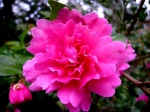
 Spring-blooming camellia ‘Pink Icicle’
For years, my customers have been asking for woody plants for shade—trees, shrubs, and vines—in addition to the perennials I sell. I now have a wholesale woody plant nursery with the quality and selection I needed to be able to offer them at Carolyn’s Shade Gardens. I have just sent out my first 2012 list. To view the catalogue, click here. However, I thought my blog readers who are not customers might be interested in learning about the plants that I would recommend they add to their shade gardens. And doing an article allows me to add more information and explain why I chose the plants I included so customers might be interested also.
 Spring-blooming camellia ‘April Tryst’
The offer focuses on winter- and early spring-blooming plants, evergreens, and fragrance. Included are three camellias, six other shrubs, and one vine. Four of the plants I have chosen are evergreen, and seven bloom in the off season: late winter or early spring. This reflects my desire to see gardeners expand their gardens’ season beyond spring and summer to become a year round paradise for them to enjoy. With that introduction, here are the plants I am highlighting:
 The buds are just starting to expand on ‘April Snow’ camellia.
I included three hardy camellias for their spectacular early season flowers and elegant evergreen leaves. These camellias, along with many other cultivars, have been bred to be fully cold hardy in the mid-Atlantic U.S, zones 6B and 7A. Nevertheless all camellias benefit from being sited to shelter them from winter wind, which comes from the northwest. They also maintain their lustrous dark green leaves in better shape if they are sheltered from winter sun. For more information on cold hardy camellias for our area, click here.
 ‘April Snow’ spring-blooming camellia
Camellia x ‘April Snow’ is a spring-blooming hardy camellia with gorgeous plump buds opening to large pure white rose-form double flowers in April and May. It has large glossy dark evergreen leaves. It is 5’ tall and 4′ wide, growing in part to full shade. It is part of the April series of exceptionally hardy camellias developed by Dr. Clifford Parks of North Carolina.
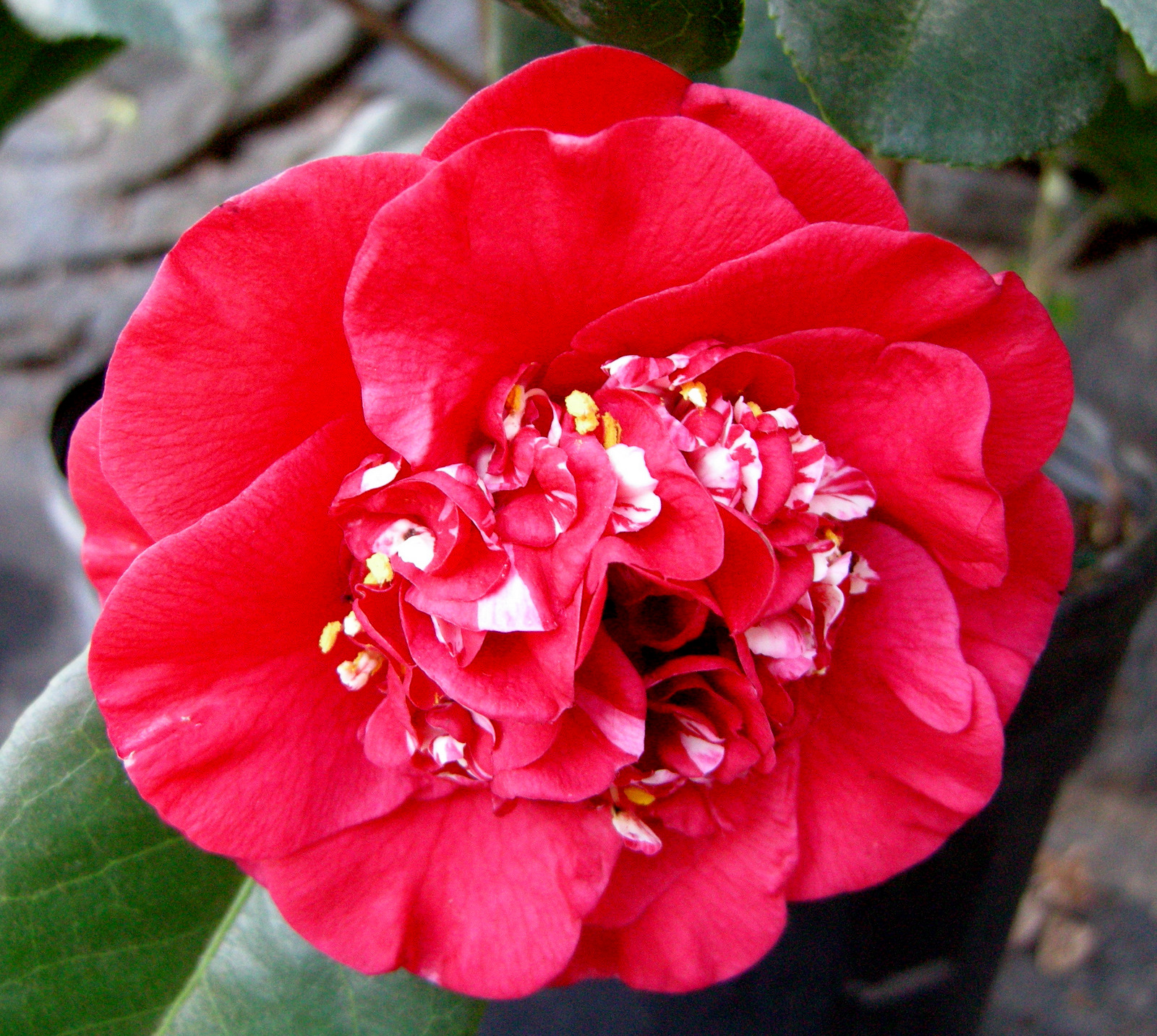 ‘April Tryst’
‘April Tryst’ is very similar to ‘April Snow’, reaching 5′ tall and 4′ wide at maturity and sporting lustrous dark evergreen leaves in part to full shade However, it blooms earlier, in March and April, and has knock-your-socks-off red anemone form flowers. It is also part of the April series of exceptionally cold hardy camellias. ‘April Tryst’ was starting to bloom in Charles Cresson’s garden during our recent Winter Interest Seminars, and Charles highly recommends it.
 ‘Pink Icicle’
Spring-blooming camellia ‘Pink Icicle’ has very large, peony form, shell pink flowers that glow when displayed against the glossy evergreen leaves. It blooms in March and April in part to full shade. It has a compact and upright growth habit and was selected by Dr. William Ackerman at the U.S. National Arboretum.
 Japanese mahonia, Mahonia japonica
 amazingly fragrant flowers of Japanese mahonia
The final evergreen plant is Japanese mahonia, Mahonia japonica. Aside from being evergreen, this was the most fragrant plant in the Cresson garden during the Winter Interest Seminars, and there was plenty of competition. In February and March, extremely fragrant yellow flowers on 8” racemes cover Japanese mahonia. The evergreen leaves are a dark glossy green with a finer texture than other mahonias, and they rarely get damaged in winter. The glaucous blue fruit in early summer attracts birds. Japanese mahonia grows to 6′ tall and 3′ wide in moist, well-drained soil. It is also deer resistant. For more information, click here.
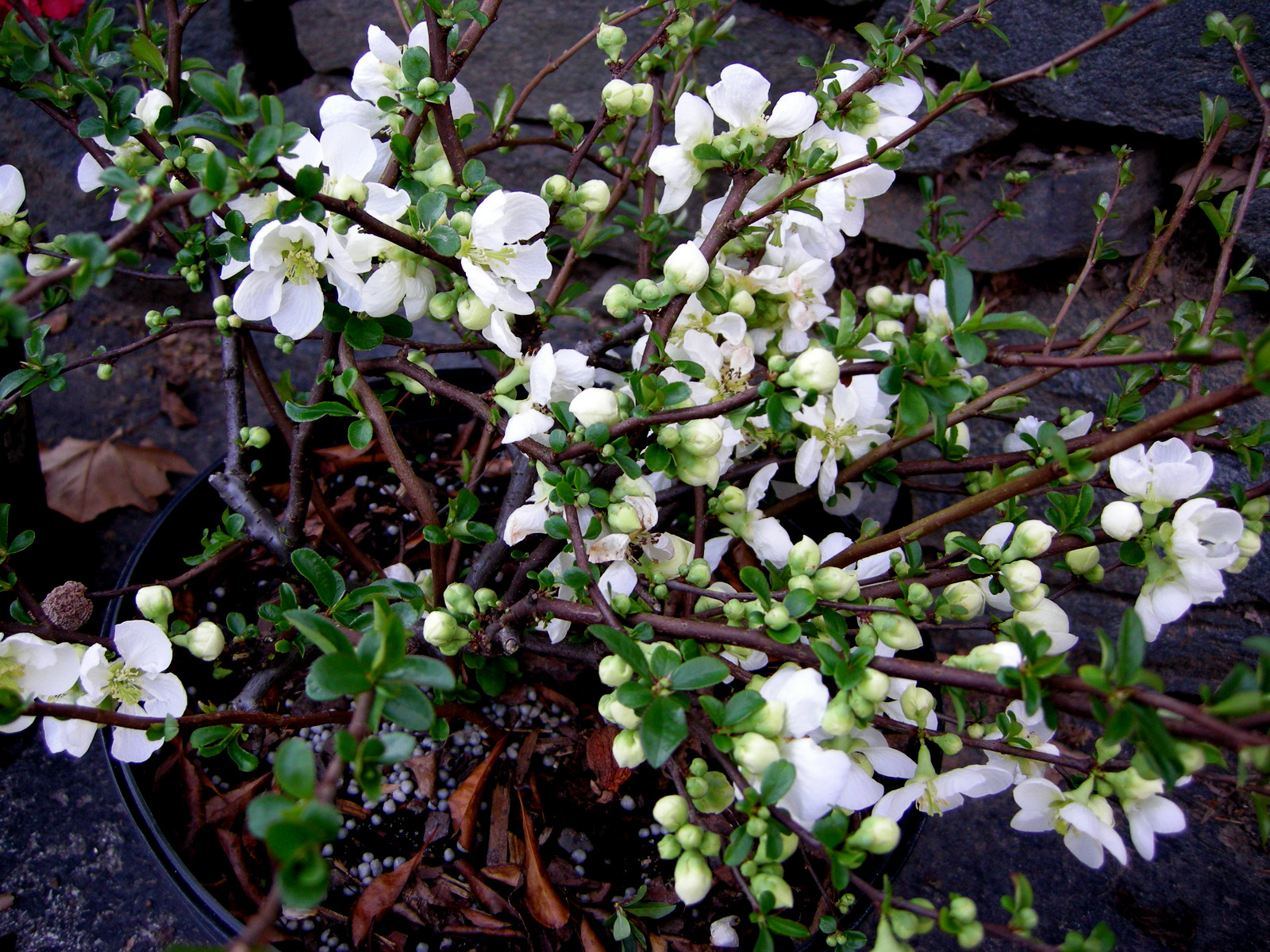 ‘Jet Trail’ flowering quince
There are five deciduous shrubs in the offer, including two flowering quinces. Now I love the early flowers, beautiful colors, and deer resistance of quince, but it is difficult to fit a 10′ plus tall and wide shrub covered with lethal thorns into the garden. That’s why I was excited when new low and compact quinces that won’t dominate your garden were introduced. They are not marketed as thornless, but I can’t find any thorns on mine. As an added benefit, the leaves remain healthy all summer.
 ‘Texas Scarlet’ flowering quince
‘Jet Trail’ and ‘Texas Scarlet’ flowering quince, Chaenomeles x superba, are identical plants other than their flower color, growing 3’ tall and 3’ wide in sun to part shade. They produce multitudes of very showy white or coral red flowers in March, which are beautifully displayed by the elegant branching structure. The glossy dark green leaves stay ornamental through the season. The yellow fruit is wonderfully fragrant. Both cultivars will grow well in clay soil and drought conditions. For more information, click here
 Spike winter hazel, Corylopsis spicata
Spike winter hazel, Corylopsis spicata, is the elegant shrub with the unusual yellow flowers that everyone admires in my garden in early spring. Dangling panicles of very fragrant, lemon yellow flowers cover this graceful shrub in March and April before the foliage. The bold-textured leaves emerge burgundy and age to a lovely blue-green. Winter hazel grows to 8′ tall and 6′ wide in full sun to part shade. It takes average garden soils and is deer resistant; for more information, click here.
 The lovely dusty blue leaves of native ‘Blue Shadow’ fothergilla.
 ‘Blue Shadow’ has honey-scented bottlebrush flowers. Photo courtesy of the Missouri Botanical Garden.
 fall color of fothergilla
Native ‘Blue Shadow’ fothergilla, Fothergilla x intermedia, has stunning ornamental attributes three seasons a year. In March and April, it is covered with honey-scented white bottlebrush flowers. Its gorgeous dusty blue leaves provide an unusual color and texture for the shade garden. In the fall, the foliage turns lovely shades of yellow, orange, and red. ‘Blue Shadow’ grows to 4′ tall and 3′ wide in full sun to part shade. It is native to the southeastern U.S., wet site tolerant, and deer resistant. For more information, click here.
 Snowball flowers of ‘Cayuga’ Koreanspice viburnum
‘Cayuga’ Koreanspice viburnum, Viburnum x ‘Cayuga’, is a cross between a smaller Koreanspice viburnum (V. carlesii) and the fragrant snowball viburnum (V. x carlcephalum) introduced by the U.S. National Arboretum. It has the best attributes of both. In April and May, striking pink buds open to abundant, fragrant, large white snowball flowers. It has a compact habit with dark green leaves that change to orange-red in the fall. It grows to 6′ tall by 5′ wide in full sun to part shade. ‘Cayuga’ tolerates a wide range of soils and is deer resistant. For more information, click here.
 Climbing hydrangea, photo courtesy of the Missouri Botanical Garden.
The final plant in the offer is a vine. Climbing hydrangea, Hydrangea anomala subsp. petiolaris, is really the best vine for shade with 365 days of ornamental value. Its lustrous, dark green leaves are neat and attractive all season before turning a buttery yellow in the fall. In June and July, fragrant 8” wide hydrangea-like white flowers layer over the leaves. The exquisite exfoliating cinnamon bark provides winter interest. Climbing hydrangea is self-attaching and reaches 30 to 50′ at maturity in part to full shade. It is a Missouri Botanical Garden Plant of Merit. For more information, click here.
I grow most of these plants in my gardens so I know you can’t go wrong by adding them to yours! If you are a customer, see Nursery Happenings below for details on how to order these wonderful shade plants by noon on March 26. If not, now you have some plants to ask for at your local independent nursery. If you would like to read about the other woody plants I have recommended for shade, see Part 1, Part 2, and Part 3.
Carolyn
Notes: Every word that appears in orange on my blog is a link that you can click for more information. If you want to return to my blog’s homepage to access the sidebar information (catalogues, previous articles, etc.) or to subscribe to my blog, just click here.