Archive for July, 2012

Landscape Problem Solved

Posted in How to, landscape design, native plants, Shade Shrubs with tags , , , , , on July 25, 2012 by Carolyn @ Carolyns Shade Gardens

Carolyn’s Shade Gardens is a retail nursery located in Bryn Mawr, PA, specializing in showy, colorful, and unusual plants for shade.  The only plants that we ship are snowdrops and miniature hostas.  For catalogues and announcements of events, please send your full name, location, and phone number (for back up use only) to carolyn@carolynsshadegardens.com.  Click here to get to the home page of our website for catalogues and information about our nursery and to subscribe to our blog.

20120724-154006.jpg‘Invincibelle Spirit’ and ‘Incrediball’ smooth hydrangeas massed at the Coastal Maine Botanical Gardens.

Three things came together recently to help me solve a landscaping problem that had bothered me for years. First, I was reading one of my favorite blogs called Conrad Art & Glass Gardens authored by Larry Conrad. In a recent post he talked about his favorite combinations including one achieved by massing white and pink smooth hydrangeas. I have been interested in smooth hydrangea, H. arborescens, because it is very shade tolerant. I also like it because it is a native plant found through out much of the eastern United States, including Pennsylvania. The well known cultivar ‘Annabelle’ with very large white mophead flowers was discovered in the wild in the 1960s. It grows well in Maine and has proven to be quite deer resistant on the island where my family vacations.

20120724-185734.jpgWhite and pink smooth hydrangeas massed in Larry Conrad’s Wisconsin garden.

The second thing that brought me to this post was a landscaping dilemma at my family’s house in Maine. There is a perennial garden planted by the previous owners next to the front door. However, no one who uses the house wants to garden there. The native landscape is so beautiful we don’t need any added ornamentals. I had been wondering where to try Larry’s beautiful combination, and this neglected garden seemed the perfect place. I bought three pink and two white smooth hydrangea with the intention of emptying the bed and letting them fill it in.

20120724-195423.jpgSmooth hydrangeas at the entrance to the children’s garden at the Coastal Maine Botanical Gardens.

The third contributor to this post was a visit to the Coastal Maine Botanical Gardens in Boothbay Harbor, Maine. Donna from Garden Walk Garden Talk came to visit me in Maine, and I had to show her this gorgeous garden (among other Maine delights). In the fall of 2010 I wrote about my first visit to CMBG, and I will write a longer post about my recent visit later but right now we are discussing hydrangeas. Imagine my delight when we approached the CMBG children’s garden and found the hydrangea combination I intended to use lining the entrance. My project now had a professional seal of approval, and I couldn’t wait to get home and start digging.

20120725-113605.jpgInvincibelle Spirit’ smooth hydrangea at CMBG

There was a choice of which smooth hydrangea cultivars to use. The biggest determining factor was which plants looked the healthiest at the nursery where I bought them. Although smooth hydrangeas are extremely tough, taking both dry and wet soils, clay, drought, heat, shade, rocky soil, and almost anything else you can throw at them, I have found them difficult to establish if you don’t start with vigorous specimens. There are two pink-flowered cultivars: ‘Bella Anna’ and ‘Invincibelle Spirit’, which has been on the market longer. I have been told that ‘Belle Anna’ is an improvement on ‘Invicibelle Spirtit’, but the plants looked weaker and I don’t think you can improve on the ‘Invincibelle Spirit’ specimens at CMBG in the photo above.

20120725-113851.jpg‘Incrediball’ smooth hydrangea at CMBG

For the white smooth hydrangeas, I had a choice of tried-and-true ‘Annabelle’ and an improved version called ‘Incrediball’, which has even larger, to 12″, globular flowers. Although I wasn’t after larger flowers, I chose ‘Incrediball’ because the flowers are whiter than ‘Annabelle’, which has some lime in it, and because ‘Incrediball’s’ stems have been selected for thickness to avoid flopping when it rains.

20120725-120518.jpg‘Invincibelle Spirit’ and ‘Incrediball’ at CMBG

All the smooth hydrangea cultivars grow to around 3 to 5′ wide and 3 to 5′ tall in zones 3 to 9. They flower from June to September, but the dried flowers heads are quite beautiful through fall. They perform best in part shade, but will grow in full sun with consistent moisture. The straight species grows in full shade. They bloom on new wood so pruning in late winter is recommended to encourage vigorous new stem growth.
20120725-122157.jpg

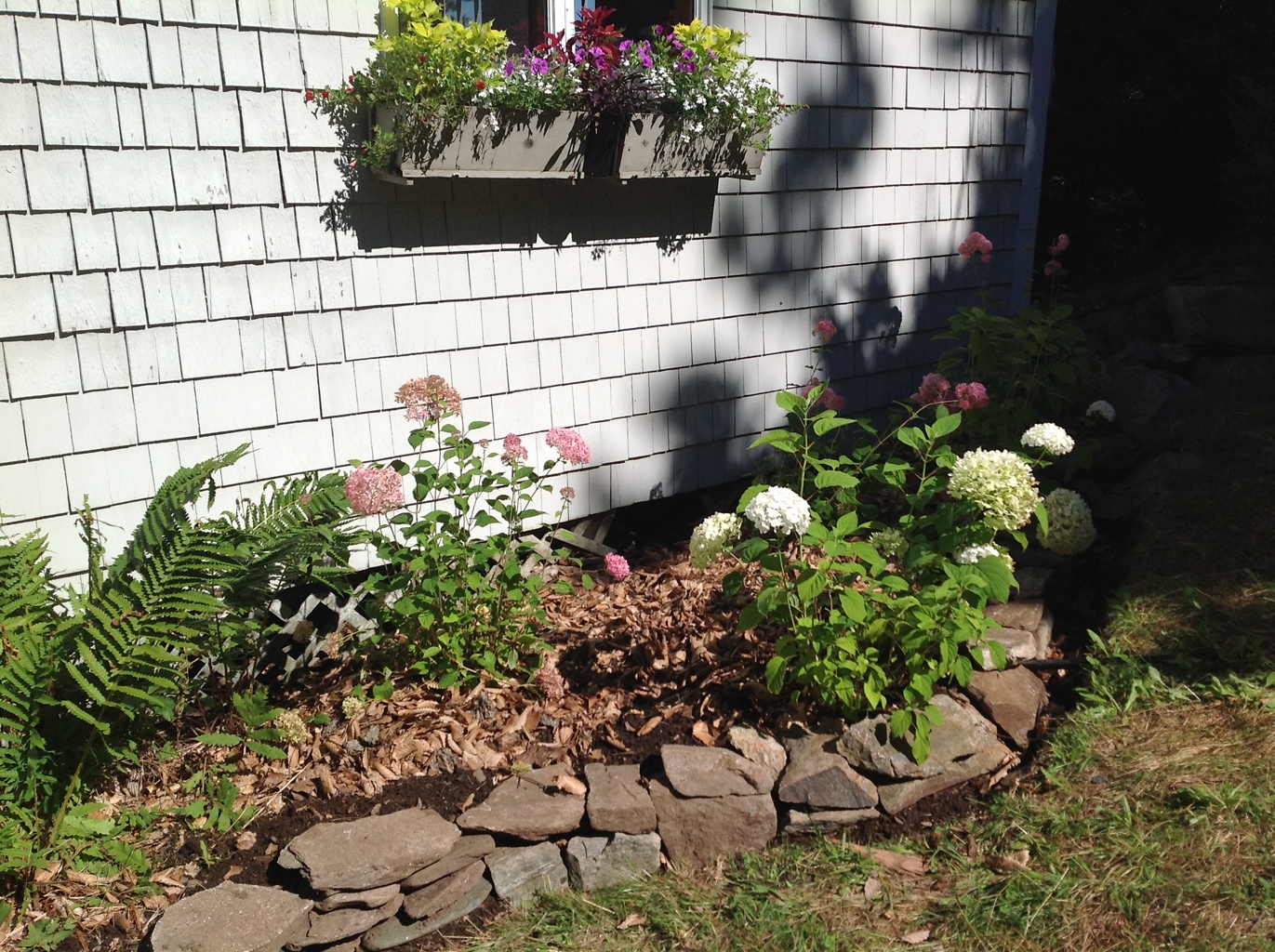
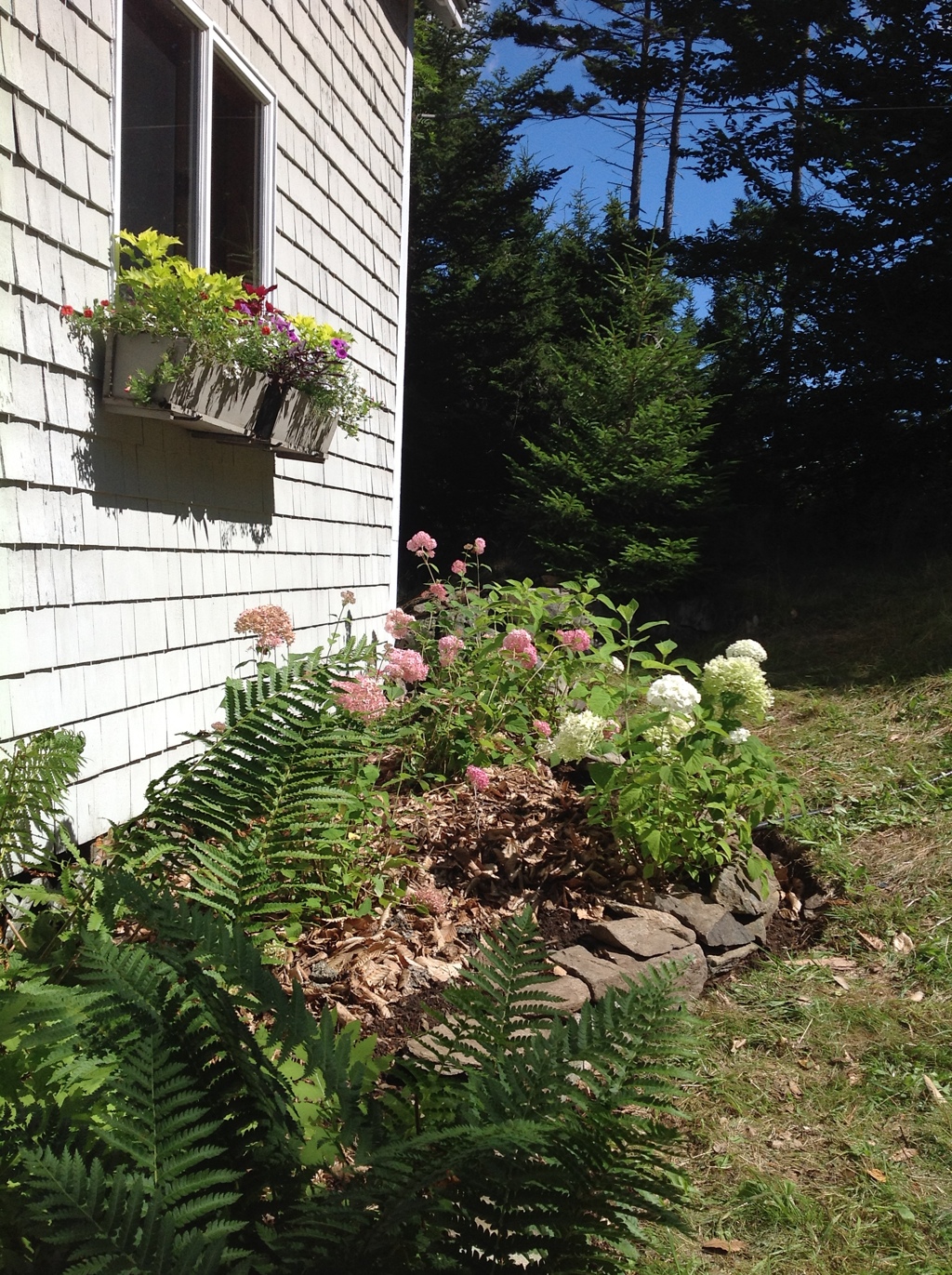
20120725-122305.jpgMy newly planted smooth hydrangeas

As you can see from the two photos above, my new hydrangeas have been planted. I anticipate that they will fill in the whole bed and crowd out weeds. I am still working on the wall but am quite happy with it so far. I hope the trench along the front will allow us to keep the nasty, tenacious grass out of the bed. If I get really ambitious, I am going to fill the trench with mussel shells from the beach.

* * * * *

This post is my second experiment with publishing a post directly from my recently acquired “new” iPad. Although it was a little easier this time and I mastered bold captions and links, I still had to call Donna in Niagara Falls to help me. I also took the final two photos with the iPad, and I think they turned out quite well. I am very impressed with the camera function on the new iPad, but you can’t truly appreciate the incredible resolution unless you have a very good screen on your computer, which I don’t. I think I would recommend an iPad just for looking at photos, that is if you can afford it. We don’t have internet access at the house in Maine so portability was a big factor for me. But the major reason I got it, 3G/4G capability is a huge disappointment, which I will explain at a later date.

Carolyn

Nursery Happenings: The nursery is closed until the fall. Thanks for a great spring season!

If you are within visiting distance and would like to receive catalogues and information about customer events, please send your full name and phone number to carolynsshadegardens@verizon.net. Subscribing to my blog does not sign you up to receive this information.

Facebook: Carolyn’s Shade Gardens has a Facebook page where I post single photos, garden tips, and other information that doesn’t fit into a blog post. You can look at my Facebook page here or click the Like button on my right sidebar here.

Notes: Every word that appears in orange on my blog is a link that you can click for more information. If you want to return to my blog’s homepage to access the sidebar information (catalogues, previous articles, etc.) or to subscribe to my blog, just click here.
Row Your Way to Color with Annuals

Posted in annuals, container gardening with tags , , , , , , , , on July 14, 2012 by Carolyn @ Carolyns Shade Gardens

Carolyn’s Shade Gardens is a retail nursery located in Bryn Mawr, PA, specializing in showy, colorful, and unusual plants for shade.  The only plants that we ship are snowdrops and miniature hostas.  For catalogues and announcements of events, please send your full name, location, and phone number (for back up use only) to carolyn@carolynsshadegardens.com.  Click here to get to the home page of our website for catalogues and information about our nursery and to subscribe to our blog.

20120713-164710.jpg

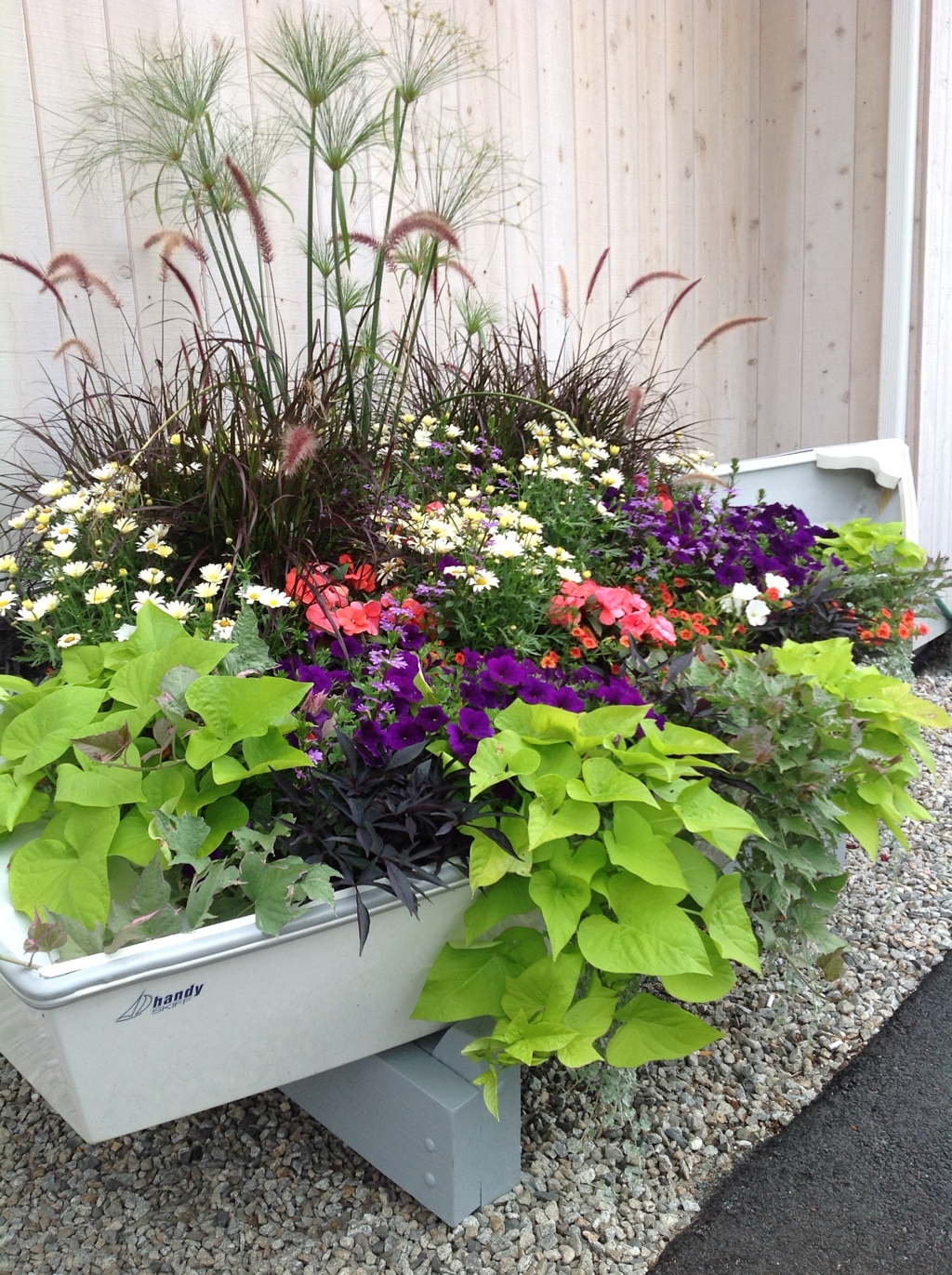
When considering containers for colorful annuals, you have an ocean of choices. Sure elegantly glazed ceramic bowls or terra cotta pots straight from Crete are wonderful, but the palette available is much, much wider as the photo shows. Any vessel that will hold soil and provide adequate drainage is fair game. Although I am not fond of used bathroom fixtures, I have been known to grab other people’s trash off the side of the road. Two of my favorites for use at my family’s house in Maine are discarded granite ware clam steamers and old wooden lobster traps.

20120713-165533.jpg

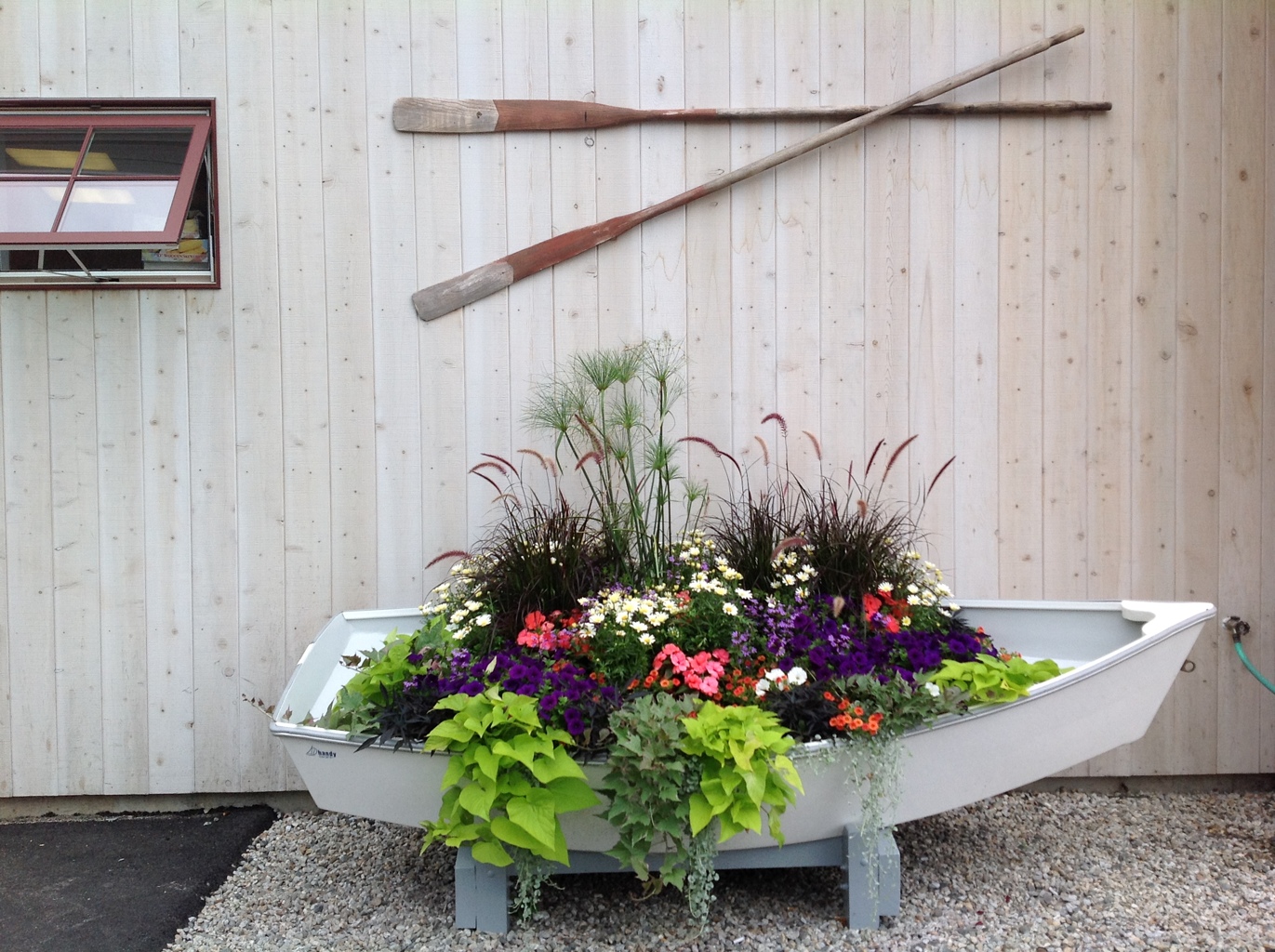
I found this very creative planting in a dinghy at Handy Boat Marina in Falmouth Foreside, Maine. Everything about it shows careful thought by a skilled designer: the plant selection, the container, the plant arrangement, and the setting. The window color is carefully incorporated, and the wall color, oars, and gravel all add to the charm.

20120713-170328.jpg

20120713-170422.jpg

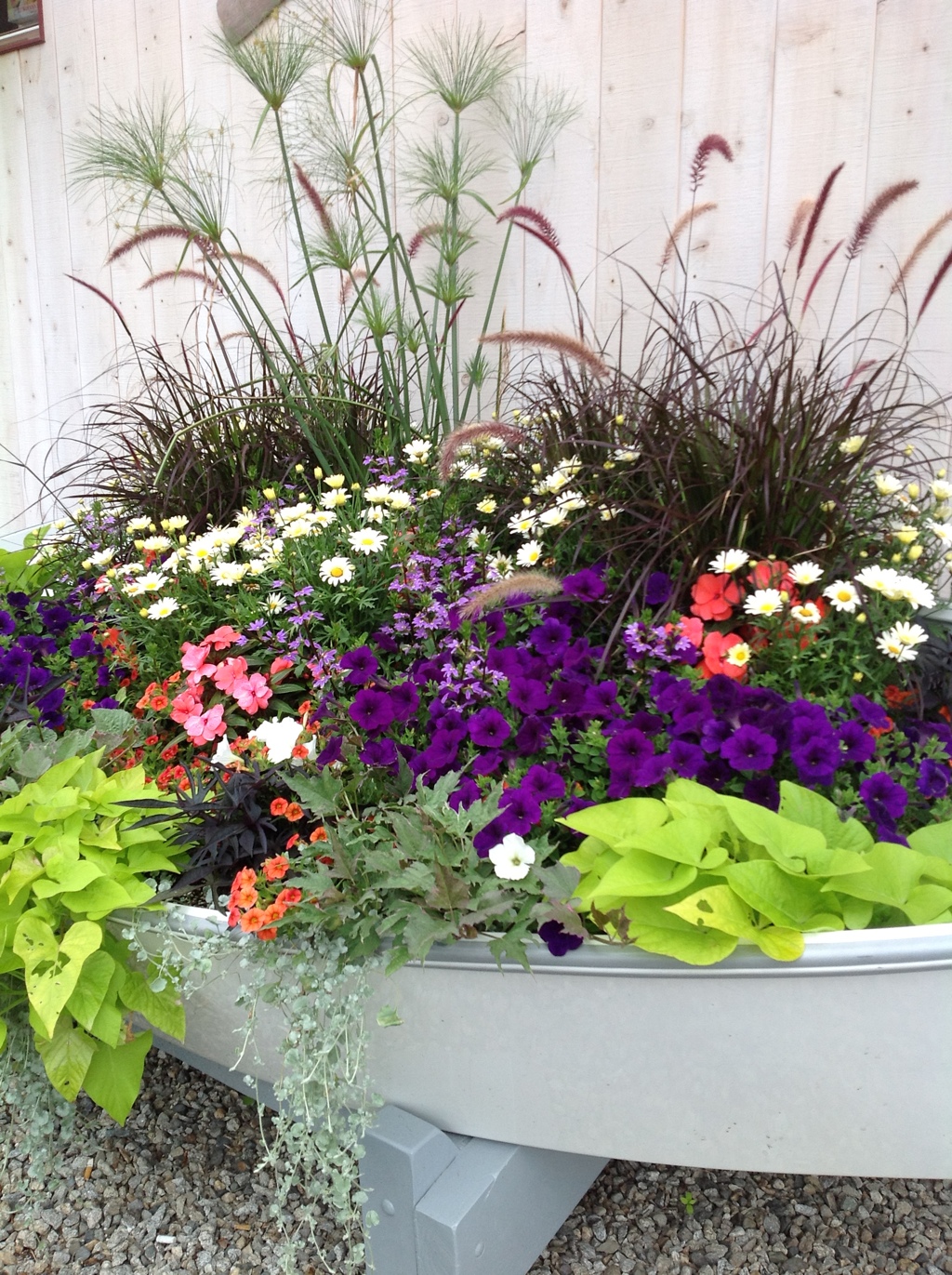
One design trick that really makes this planting work is cramming a lot of annuals into the available space. The season for annuals in the northeast is short, especially in Maine. You don’t want to waste time looking at a half-filled container while the planting “fills in”. Spending the extra money on additional annuals to make the container ornamental from the start is worth it. Or better yet, grow your own from seed.

20120713-170855.jpg

The designer has also used the classic “spillers, fillers, and thrillers” method of filling containers. Spilling out the front are purple, chartreuse, and tricolor sweet potato vines and silvery licorice plant. Filling out the body of the boat are orange million bells, purple and white petunias, annual begonias, angelonia, and white daisies. In the back are purple fountain grass and papyrus.

You can get great ideas by keeping your eyes open for creative containers whenever you are out cruising around. You may not have a spare dinghy available, but I am sure there is something suitable in your attic.

* * * * *

This post is another experiment with my recently acquired “new” iPad, this time attempting to post on my blog directly from the iPad. I discovered that you can’t upload photos to a post using the WordPress site like you would when using a computer. The only way to do it is to download the WordPress app and use it to post from the iPad. However, so far, I have found that this app is not very user friendly. Since there are supposedly six new blogs being started every five minutes, I suggest that WordPress and Apple get on the ball to make blogging easier from an iPad. In the meantime, I won’t know what this post will look like until I hit the publish button.

Carolyn

Nursery Happenings: The nursery is closed until the fall. Thanks for a great spring season!

If you are within visiting distance and would like to receive catalogues and information about customer events, please send your full name and phone number to carolynsshadegardens@verizon.net. Subscribing to my blog does not sign you up to receive this information.

Facebook: Carolyn’s Shade Gardens has a Facebook page where I post single photos, garden tips, and other information that doesn’t fit into a blog post. You can look at my Facebook page here or click the Like button on my right sidebar here.

Notes: Every word that appears in orange on my blog is a link that you can click for more information. If you want to return to my blog’s homepage to access the sidebar information (catalogues, previous articles, etc.) or to subscribe to my blog, just click here.
Historic Bartram’s Garden

Posted in garden to visit, native plants, Uncategorized with tags , , , , , , , , , , , , , , , , , on July 6, 2012 by Carolyn @ Carolyns Shade Gardens

Carolyn’s Shade Gardens is a retail nursery located in Bryn Mawr, PA, specializing in showy, colorful, and unusual plants for shade.  The only plants that we ship are snowdrops and miniature hostas.  For catalogues and announcements of events, please send your full name, location, and phone number (for back up use only) to carolyn@carolynsshadegardens.com.  Click here to get to the home page of our website for catalogues and information about our nursery and to subscribe to our blog.

John Bartram House, Philadephia, Pennsylvania, US


“Whatsoever whether great or small ugly or handsom sweet or stinking…every thing in the universe in their own nature appears beautifull to mee.”

John Bartram 1740


For Mother’s Day this May, I was surprised with a picnic and visit to Bartram’s Garden in Philadelphia, Pennsylvania, US, the oldest surviving botanic garden in North America.  Prominent Philadelphia Quakers, John Bartram (1699-1777) and his son William (1739-1823) were the most important American plant explorers of the 18th century, traveling south to Florida, west to the Mississippi, and north to Lake Ontario.  They introduced more than 200 native plants into cultivation.  By mid-century, their 102 acre garden (now 45 acres) contained the most extensive collection of North American plants in the world.

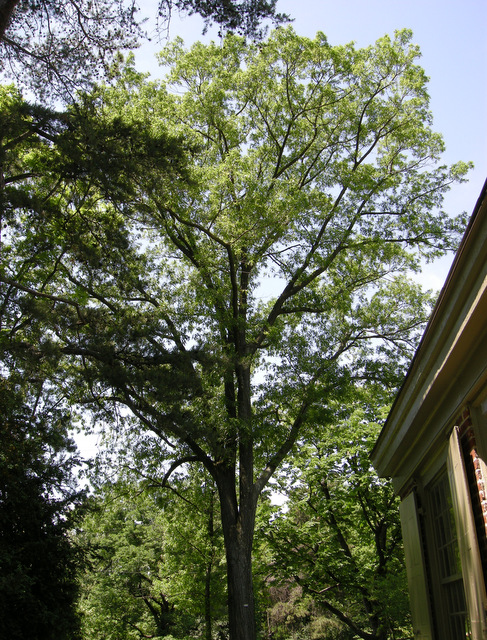
Native Bartram oak, Quercus x heterphylla, a rare hybrid between red oak, Quercus rubra, and willow oak, Quercus phellos, discovered by John Bartram.

…the Botanick fire set me in such A flame as is not to be quenched until death or I explore most of the…vegitative treasures in No. America.”

John Bartram 1761


The intrepid Bartrams shared their discoveries with scientists throughout America and Europe, especially England.  John Bartram’s discoveries were considered so important that he was appointed Royal Botanist by King George III.  Bartram founded the American Philosophical Society in Philadelphia with his friend and colleague Benjamin Franklin.  In addition, he started a thriving seed and plant business with his lists appearing in London publications as early as the 1750s.  In 1783, Bartram published the first American nursery catalogue.  [Historical information and quotes courtesy of Bartram’s Garden.]

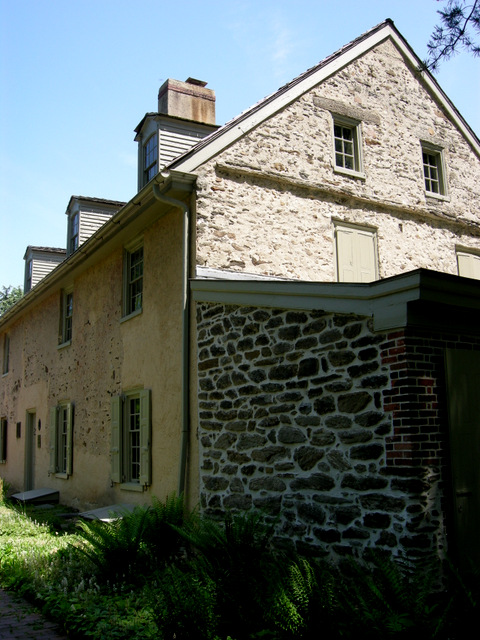
John Bartram purchased his farm in 1728 and completed this portion of the stone house in 1731.


The house and gardens are a National Historic Landmark and have been well preserved despite their location in a very developed part of Philadelphia. Fortunately, they were acquired by the city in 1891 and became part of the public park system.  The property is on the banks of the Schuylkill River and is a joy to visit both to see the historic buildings and to wander through the peaceful gardens.  I would visit Bartram’s Garden just to see the specimen trees.   I am going to take you on a short photographic tour below, but I highly recommend an actual visit.

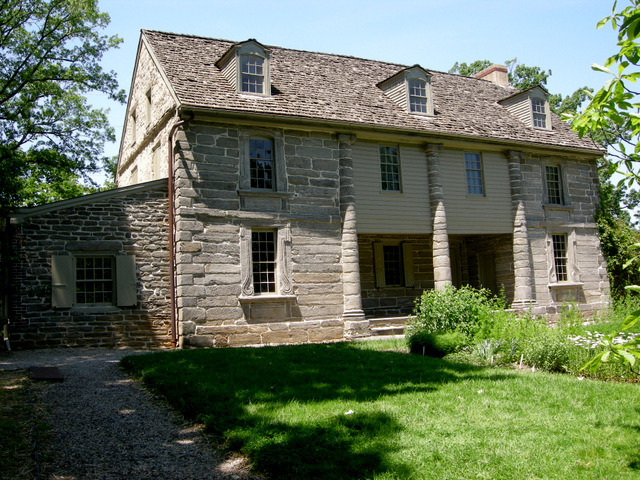
This formal façade, which faces the gardens, was added between 1758 and 1770.


Close up of the façade


Carved stone window in the facade


This pristine example of a two-level Pennsylvania bank barn was built in 1775.


Stone watering trough


John Bartram’s first experimental garden


Looking from the house towards the kitchen and stables


Walking along the wooden boardwalk by the river


The foundation of this simple mill based on an ancient European design was carved from the bedrock next to the river.


Apples were crushed in the circular trench by a wooden wheel.


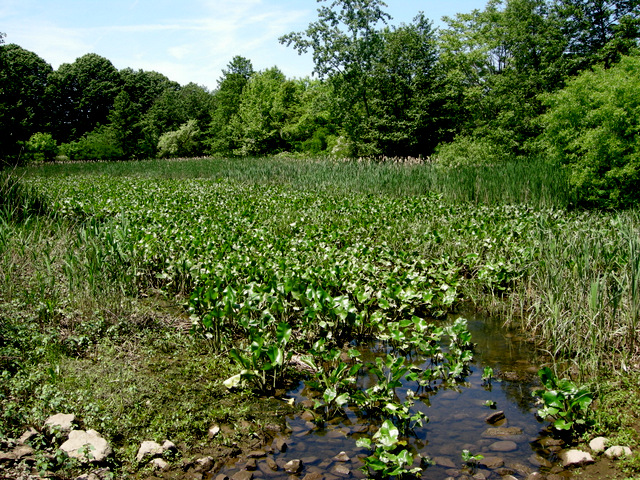
There are some very beautiful wetlands on the shores of the river.


If you love trees, and especially specimen trees as I do, you don’t want to miss seeing the huge mostly native trees at Bartram’s Garden.  I include photos of some of them below, but they are so large that it is hard to get a good photograph.  You have to see them in person to truly appreciate their magnificence.


The oldest ginkgo tree, G. biloba, in North America planted by William Bartram in 1785.


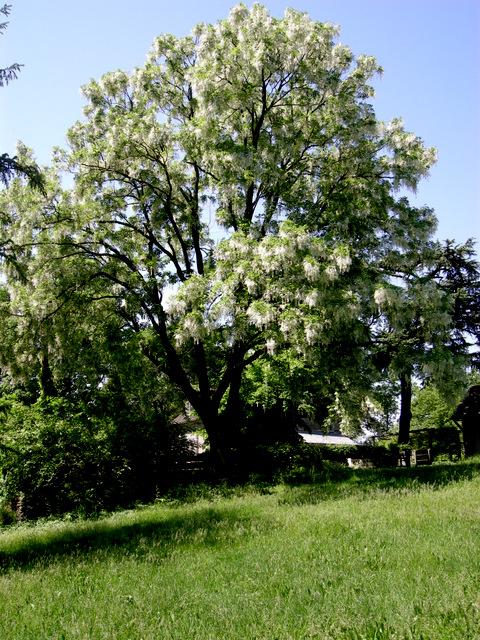
Luckily there was a field below this amazing American yellowwood, Cladrastis kentukea, so I could get a photo of the whole tree.


The house next to the yellowwood gives it some scale.  We were fortunate to catch it in full bloom.


Yellowwood flowers


Under the yellowwood tree


American beech, Fagus grandifolia


Native willow oak, Quercus phellos


Native common hackberry, Celtis occidentalis


Bartram’s Garden is a public park and is open all year for self-guided tours except city-observed holidays.  I hope you have the chance to visit.


Carolyn

Nursery Happenings:  The nursery is closed until the fall.  Thanks for a great spring season!

If you are within visiting distance and would like to receive catalogues and information about customer events, please send your full name and phone number to carolynsshadegardens@verizon.net.  Subscribing to my blog does not sign you up to receive this information.

Facebook:  Carolyn’s Shade Gardens has a Facebook page where I post single photos, garden tips, and other information that doesn’t fit into a blog post.  You can look at my Facebook page here or click the Like button on my right sidebar here.

Notes: Every word that appears in orange on my blog is a link that you can click for more information.  If you want to return to my blog’s homepage to access the sidebar information (catalogues, previous articles, etc.) or to subscribe to my blog, just click here.