New Snowdrops for 2024: Part One

Posted in bulbs for shade, snowdrops, winter garden, winter interest with tags , , , , , , , , , , , , , , , , , , , , , , , , on November 26, 2023 by Carolyn @ Carolyns Shade Gardens

‘Anglesey Candlelight’ has an orange glow on its inner segments (photo by Chris Ireland-Jones, thanks Chris!).  

Fall color has been glorious this year and continues on for a little while longer.  It has also been a great fall for working outside, and I have been busily cleaning out around the snowdrops and checking their stakes and their labeling.  Each clump then gets a small layer of compost and a thin covering of ground leaves.  They will also be fertilized with liquid fish emulsion.  It has been very dry but that thankfully ended this week with 2″ of much needed rain.

As usual, the 2024 Snowdrop Catalogue will be posted on our website in the first half of December.  Meanwhile, this post will give everyone an advance look (sorry, no advance orders) at some of the special, new snowdrops that will be available in the catalogue.  Enjoy!

Nursery News:  Carolyn’s Shade Gardens is a retail nursery located in Bryn Mawr, PA, specializing in showy, colorful, and unusual plants for shade.  The only plants that we ship are snowdrops within the US.  For catalogues and announcements of local events, please send your full name, mailing address, and cell number to carolyn@carolynsshadegardens.com and indicate whether you are interested in snowdrops.  Click here to get to the home page of our website for catalogues and information about our nursery and to subscribe to our blog.
.

In February, Michael and I toured Anglesey Abbey, near Cambridge, England.  It is one of the most visited National Trust properties, and I can see why after experiencing its beautiful winter gardens.  We were given a private tour by Senior Gardener David Jordan, the resident snowdrop expert among other responsibilities.  The tour included the extensive snowdrop collection where we saw ‘Anglesey Candlelight’ for the first time.

.

I am a sucker for a snowdrop with a face and find ‘Anglesey Candlelight’ charming (photo taken at Avon Bulbs 2/2023).

‘Anglesey Candlelight’ is a very rare snowdrop with large flowers featuring an expressive face and a tinge of pale orange on its inner segments.  Its leaves are a light, lettuce green.  David Jordan spotted it about ten years ago while out looking for unique snowdrops among the thousands of specimens in the garden.  He noticed its light green leaves and moved it to the collection area for evaluation.  When it flowered the next year, he saw the orange shade on the inners and “named it ‘Anglesey Candlelight’ as it described the flower and the way it glows like a candle.” 

If you go to England during snowdrop time, I highly recommend visiting Anglesey Abbey, click here.  Be aware that to see the specialist collection of rare snowdrops, you need to book a guided tour far in advance.  Thank you, David, for one of the best snowdrop days we have ever spent!

.‘Phil Cornish’ is one of the most highly praised inverse poculiform snowdrops (photo from Anne Repnow, Some Snowdrops, thanks Anne!)

In 2017, we had the great pleasure of visiting the well known galanthophile and discoverer of many fine snowdrops Phil Cornish in his Gloucestershire garden.  The much sought after snowdrop ‘Phil Cornish’ was discovered there in 2002.  It is an inverse poculiform (all the segments are inners) with the classic pagoda shape and G. plicatus ‘Trym’ as a parent.   This upright and early-flowering selection has stunning markings: almost all green inner segments and outers heavily marked with a dark green heart at the apex and a paler green patch at the base.

.

‘Phil Cornish’ has the classic pagoda shape (photo from Anne Repnow, Some Snowdrops).

‘Phil Cornish’ is highly praised in my favorite snowdrop reference Some Snowdrops: A Photographic Ramble by Anne Repnow.  It was also profiled as a favorite in the January 2023 Gardens Illustrated article on snowdrops in Margery Fish’s garden at East Lambrook Manor, click here, (scroll to the end for their top picks).  The photos in the article are taken by photographer Jason Ingram and are quite lovely—be sure and scroll down to see ‘Phil Cornish’.

.

‘Daphne’s Scissors’ sparkles in the winter sun (photo taken at Carolyn’s Shade Gardens 3/2015).

‘Daphne’s Scissors’ is a cultivar of G. elwesii, the giant snowdrop.  English galanthophile Daphne Chappell found it in her garden in Chedworth, Gloucestershire, in 1985.  She named it for the scissor-shaped inner segment mark.  It is an upright plant with large flowers.  Evidently, the presence of the bold green mark on the outer segments varies in England, but on my plants it is present every year (see photo below).

.

‘Daphne’s Scissors’ thrives in my garden (photo taken at Carolyn’s Shade Gardens 2/2023).

.

‘Franz Josef’ shows its strong, emerald green markings (photo taken at Carolyn’s Shade Gardens 2/2022).

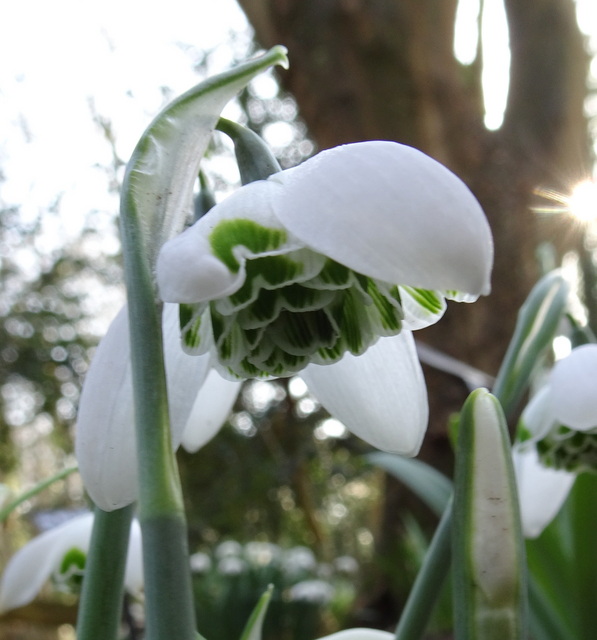
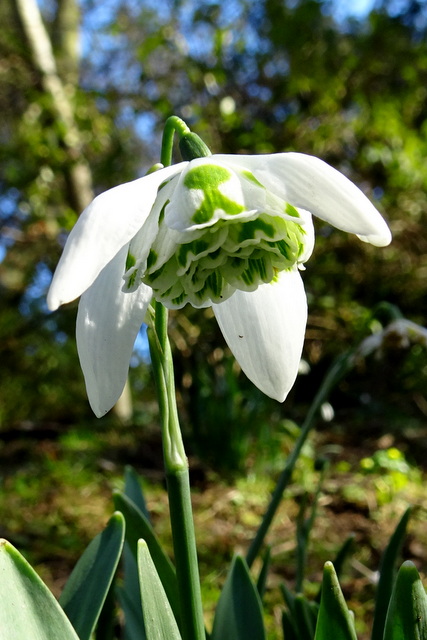
‘Franz Josef’ has eye-catching, very large and full double flowers with inner segments tightly packed to bursting.  The narrow outer segments with bold green tips fully expose the deep emerald green cross on the inners.  Its elongated and cone-shaped ovary (the cap above the flower) is also unusual.

.

Avon Bulbs featured ‘Franz Josef’ in its gold-medal winning display at the RHS Show in February 2017 (photo taken at RHS Show 2/2017)

This neat and handsome double is a cultivar of the giant snowdrop, G. elwesii.  Although it was discovered by Michael Dreisvogt in a Munich Park in 1999, it remains rare.

.

‘George Elwes’ (photo taken at Carolyn’s Shade Gardens 2/2023)

The snowdrop bible names ‘George Elwes’ the “finest” G. elwesii x G. plicatus hybrid (Snowdrops: A Monograph of Cultivated Galanthus by Matt Bishop, Aaron Davis, and John Grimshaw Timber Press 2006, page 265).  It earns this praise because it is a tall and upright snowdrop with large flowers.  The long, elegant outer segments compliment perfectly the fully green inner segments.  I especially like the long curved spathe encircling the ovary (the cap above the flower).  It was selected in 1979 by my dear friend Carolyn Elwes at Colesbourne Park and named after her late son.

.

Snowdrop expert Alan Street considered ‘George Elwes’ special enough to give it a prominent location in the Avon Bulbs display at the February 2018 Royal Horticultural Society Show (photo taken at the RHS Show 2/2018).

.

Look for another post profiling more new snowdrops soon.

.

Blogs are a lot more fun for everyone, especially the writer, when readers leave comments.  Scroll down to the end of the page to the box where it says “Leave a Reply” and start typing—-it’s easy!

Carolyn

.

Note: Every word that appears in orange on my blog is a link that you can click for more information. If you want to return to my blog’s homepage to access the sidebar information (catalogues, previous articles, etc.) or to subscribe to my blog, just click here.
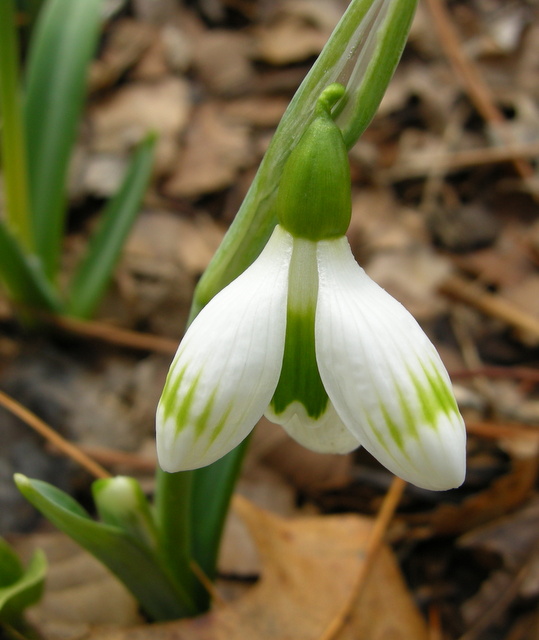
Wandlebury Ring

Posted in garden to visit, snowdrops, winter garden, winter interest with tags , , , , , , , , , , , , , , on November 19, 2023 by Carolyn @ Carolyns Shade Gardens

The stable block at Wandlebury Ring was built for James II in the late 17th century and later housed the famous Godolphin Arabian.

On our way back from Bennington Lordship (to read about that garden, click here), Michael and I visited Wandlebury Ring, an Iron Age hillfort outside Cambridge in the Gog Magog Hills, Cambridgeshire.  The hillfort was constructed by an ancient British tribe in 400 BC and later inhabited by the Romans.  In the late 17th century, the inner ramparts and ditch, which circled the fort, were leveled to make way for racing stables for King James II.  A mansion and gardens were also constructed, but all that remains now is the stable block and the fort’s deep, encircling outer ditch.  The site is now a country park owned by Cambridge Past, Present & Future.  For more historical details, click here .

Nursery News:  Carolyn’s Shade Gardens is a retail nursery located in Bryn Mawr, PA, specializing in showy, colorful, and unusual plants for shade.  The only plants that we ship are snowdrops within the US.  For catalogues and announcements of local events, please send your full name, mailing address, and cell number to carolyn@carolynsshadegardens.com and indicate whether you are interested in snowdrops.  Click here to get to the home page of our website for catalogues and information about our nursery and to subscribe to our blog.

.

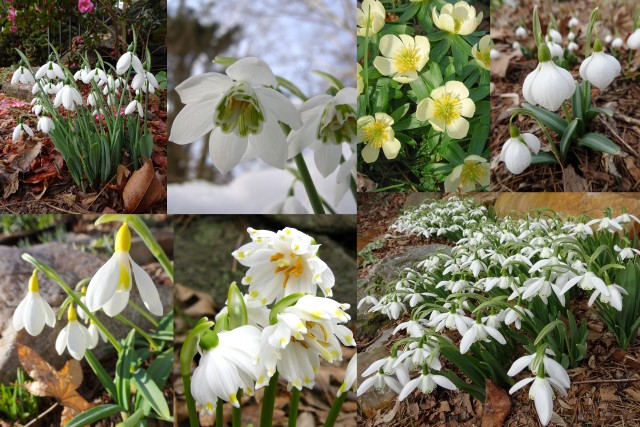
The very famous yellow snowdrop ‘Wendy’s Gold’ was first observed in the park in 1974 by Bill Clark, the Warden of Wandlebury Ring, but wasn’t introduced until the early 1990s.  It is a beautiful, bright yellow in our winter sunshine and vigorous in my garden.

Although the history of Wandlebury Ring is quite interesting, the real reason for our visit was to see the naturalized G. plicatus that thrives inside the Ring.  It is from this population that Bill Clark, the Warden of Wandlebury Ring from 1973 to 1998, selected the iconic ‘Wendy’s Gold’, which is named for his wife.  The famous ‘Wendy’s Gold’ was later followed by further, well known yellow selections: ‘Bill Clark’ and ‘Wandlebury Ring’.

.

‘Bill Clark’ is an even brighter yellow, which colors the scape, spathe, and pedicel.  However, it is not as vigorous as ‘Wendy’s Gold’ in my garden.

.

The last of the famous trio, ‘Wandlebury Ring’.  I don’t grow this snowdrop so the photo was taken in England where lack of winter sun often makes yellow snowdrops have an olive caste.

Wandlebury Ring is a beautiful setting in which to view snowdrops, which occur in sweeps around the mature trees inside the walls:

.

Michael stands in a field of Galanthus plicatus with the wall of Wandlebury Ring in the background.

.

The setting is very natural with thousands upon thousands of snowdrops in among the grass and winter aconites.

.

G. plicatus exhibiting its very distinctive pleated leaves with a whitish center stripe.

.

A large beech surrounded by winter aconite and G. plicatus.

.

.

Bill and Wendy Clark still live at Wandlebury Ring.  I have corresponded with Bill extensively about the history of the yellow G. plicatus at Wandlebury, which is fascinating.  Unfortunately, unforeseen events prevented us from getting together when Michael and I were there.   However, Bill still roams the area looking for unusual snowdrops and sent me photos of his recent discoveries:

.

A snowdrop with four outer segments instead of the usual three.

.

A very elegant snowdrop with twin flowers.

.

A new yellow clone.

Thank you, Bill, for the help you have given me in untangling the origins of the Wandlebury snowdrops—you are an inspiration.  This post is dedicated to you!

.

Blogs are a lot more fun for everyone, especially the writer, when readers leave comments.  Scroll down to the end of the page to the box where it says “Leave a Reply” and start typing—-it’s easy!

Carolyn

.

Note: Every word that appears in orange on my blog is a link that you can click for more information. If you want to return to my blog’s homepage to access the sidebar information (catalogues, previous articles, etc.) or to subscribe to my blog, just click here.

Snowdrops and History at Benington Lordship Gardens

Posted in garden to visit, snowdrops, winter garden, winter interest with tags , , , , , , , , , , on November 11, 2023 by Carolyn @ Carolyns Shade Gardens

Benington Lordship is a Georgian manor house constructed in the 1700s near the ruins of a Norman castle built around 1130.

Michael and I have traveled to England many times for work and pleasure, but we had never been to Cambridge.  In February 2023, we spent four nights there touring the city and visiting snowdrop venues.  It is a wonderful city and a great place to visit gardens.  We packed a lot in, including Benington Lordship Gardens in Benington, East Hertfordshire, which is about 45 minutes from Cambridge.

Nursery News:  Carolyn’s Shade Gardens is a retail nursery located in Bryn Mawr, PA, specializing in showy, colorful, and unusual plants for shade.  The only plants that we ship are snowdrops within the US.  For catalogues and announcements of local events, please send your full name, mailing address, and cell number to carolyn@carolynsshadegardens.com and indicate whether you are interested in snowdrops.  Click here to get to the home page of our website for catalogues and information about our nursery and to subscribe to our blog.

As you come up the drive, the first thing you see is the Folly built in 1832 with snowdrops on the left cascading down the hill to the moat.

Benington Castle was originally built around 1130 by the de Valogne family.  It was destroyed in 1212 leaving only the bottom courses of the keep.  In the 1700s, the Caesar family built a Georgian manor house, Benington Lordship, adjacent to the ruins of the Norman castle keep.  In 1832, the Folly was added to join the manor house to the Norman ruins.  It consists of a neo-Norman two-story gatehouse with an arch and two circular towers plus a wall and a summer house.

.

The Folly joins the manor house—on the right side, you can just see the tower—to the Norman ruins.

.

Looking through the arch towards the interior courtyard.

.

Detail on the arch

.

The gatehouse viewed from inside the courtyard.

.

The summer house—as you can see, snowdrops are everywhere in the gardens.

.

To the untrained eye, the gatehouse looks quite authentic down to the crumbling towers.

.

The actual Norman ruins are in the back left of the snowdrop and aconite bed with the gatehouse peeking out behind them.

There is no brochure explaining the history of Benington Castle so it wasn’t until I researched Benington Lordship that I understood the provenance of all the buildings.  For history buffs, Historic England gives a very detailed account of the site here.

.

After viewing the Folly, we descended some stone steps into the moat.

.

The moat is a narrow path with both of its very steep sides filled to the brim with snowdrops.

.

The snowdrops are mostly G. nivalis, the common snowdrop, and its double form ‘Flore Pleno’.

.

The back wall of the moat.

.

Double common snowdrop, G. nivalis ‘Flore Pleno’

.

There were some beautiful vistas of snowdrops mixed with winter aconite, Eranthis hyemalis.

.

A lovely clump of G. plicatus, sometimes called Crimean snowdrop.

Although there was an area of the garden with named snowdrop cultivars, there was nothing that you won’t see in more impressive collections.  It is the picturesque buildings and the snowdrops lining the moat and surrounding the Norman ruins that made Benington Lordship worth visiting.  For details about visiting during snowdrop season, click here.

.

Blogs are a lot more fun for everyone, especially the writer, when readers leave comments.  Scroll down to the end of the page to the box where it says “Leave a Reply” and start typing—-it’s easy!

Carolyn

.

Note: Every word that appears in orange on my blog is a link that you can click for more information. If you want to return to my blog’s homepage to access the sidebar information (catalogues, previous articles, etc.) or to subscribe to my blog, just click here.
Wisley’s Winter Garden

Posted in garden to visit, landscape design, Shade Shrubs, shrubs for winter, winter, winter garden, winter interest with tags , , , , , , , , , , , , , , on November 5, 2023 by Carolyn @ Carolyns Shade Gardens

At Wisley, red-flowered hybrid witch hazel ‘Ruben’ provides a vivid contrast to a gold needled conifer and blooming heath.

The day after we visited the Savill Garden last February, we faced a long drive to Avon Bulbs in the south of England.  However, at the suggestion of John Anderson, we decided we would visit RHS Garden Wisley, the flagship of the Royal Horticultural Society’s gardens on our way.  When we arrived, we had one hour for touring the 240 acre garden and decided to do the Winter Walk though we wish we had had more time to visit other areas.  

Nursery News:  Carolyn’s Shade Gardens is a retail nursery located in Bryn Mawr, PA, specializing in showy, colorful, and unusual plants for shade.  The only plants that we ship are snowdrops within the US.  For catalogues and announcements of local events, please send your full name, mailing address, and cell number to carolyn@carolynsshadegardens.com and indicate whether you are interested in snowdrops.  Click here to get to the home page of our website for catalogues and information about our nursery and to subscribe to our blog.

Hybrid witch hazel ‘Pallida’ with a blue needled, creeping juniper.

The Wisley website provides an excellent overview of the the highlights of the Winter Walk with in depth descriptions and photos of 10 locations.  Included at the end is a Winter Walk planting list with clickable entries containing photos and details about each plant.  You can read it here.  During our hurried visit, I captured a random sample, which I will share below.

.

The amazing silver buds of ‘Winter Liebe’ edgeworthia underplanted with winter-blooming daffodils.

.

I was very impressed with the witch hazels at Wisley, here the hybrid ‘Harry’.  They provide a multitude of brightly colored flowers in the winter landscape.

.

A closeup of the flowers on ‘Harry’.

.

Shrub dogwoods are grown for their winter branch color, here bloodtwig dogwood, Cornus sanguinea ‘Magic Flame’.

.

Conifers provide a great contrast in the winter garden, here hybrid witch hazels ‘Pallida’ and ‘Robert’ with a blue spruce.

.

Although snowdrops were not a focus of the garden, they were sprinkled through out, adding a cheerful white accent, here ‘Sibbertoft No 2’.

.

The garden featured plenty of hellebores, including ‘Anna’s Red’ from the Frostkiss series.

.

Frostkiss ‘Molly’s White’

.

Hybrid witch hazel ‘Vesna’ with a small variegated shrub, maybe a euonymus, providing a beautiful contrast.

.

This Japanese pink pussy willow ‘Mount Aso’ really stood out.

.

The white stems of  ‘Winter Lightning’ with the woven branches of golden willow ‘Yelverton’.

.

The woven branches of golden willow ‘Golden Ness’ edge the pond.

.

A gorgeous combination of hybrid witchhazel underplanted with ‘Ice ‘n’ Roses White’ hybrid hellebore.

.

A close up of hellebore ‘Ice ‘n’ Roses White’, which is early blooming and a great performer in my garden.

.

The winter garden at Wisley is well worth visiting if you are in England in February.

.

Blogs are a lot more fun for everyone, especially the writer, when readers leave comments.  Scroll down to the end of the page to the box where it says “Leave a Reply” and start typing—-it’s easy!

Carolyn

.

Note: Every word that appears in orange on my blog is a link that you can click for more information. If you want to return to my blog’s homepage to access the sidebar information (catalogues, previous articles, etc.) or to subscribe to my blog, just click here.
The Savill Garden in Winter

Posted in garden to visit, landscape design, winter, winter interest with tags , , , , , , , , , , , , on October 29, 2023 by Carolyn @ Carolyns Shade Gardens

Bright colors from bark, leaves, and flowers are everywhere at the Savill Garden on a bleak February 1.

My earliest snowdrops, Galanthus bursanus, are blooming, but before I get caught up in that mania, I thought I would devote a post to a gorgeous winter garden we visited in England.  On February 1, 2023, Michael and I arrived at Heathrow Airport in London and went directly to the Savill Garden.  We were there at the invitation of John Anderson, Keeper of the Gardens for Windsor Great Park, the 5,000 acres of gardens surrounding Windsor Castle.  John graciously took the morning off to show us around.

Nursery News:  Carolyn’s Shade Gardens is a retail nursery located in Bryn Mawr, PA, specializing in showy, colorful, and unusual plants for shade.  The only plants that we ship are snowdrops within the US.  For catalogues and announcements of local events, please send your full name, mailing address, and cell number to carolyn@carolynsshadegardens.com and indicate whether you are interested in snowdrops.  Click here to get to the home page of our website for catalogues and information about our nursery and to subscribe to our blog.

.

Around every corner at the Savill Garden is a beautiful vista featuring plants grown to provide color in winter, here pollarded golden willow stems.

The 35 acre Savill Garden was commissioned in 1932 by George V and created by Eric Savill.  Along with several other gardens, Savill is part of Windsor Great Park, which is held by the Crown Estate.  This means that, although the king or queen does not personally own the garden, it is theirs as long as they wear the crown.  John Anderson reported to Queen Elizabeth II and now to King Charles III, and, as avid gardeners, the queen and king have both been involved with planning at Savill.  For more on the Windsor Great Park and the Savill Garden, please read my post about John Anderson’s trip to Winterthur by clicking here.

.

.

As you enjoy the photos below, think about incorporating some of the amazing winter interest plants into your own garden: 

.

Giant rhubarb, Gunnera sp., is covered with its own large leaves for winter protection.

.

The garden features many forms of shrub dogwoods grown for their winter branch color, including bloodtwig dogwood, Cornus sanguinea ‘Anny’s Winter Orange’.

.

A close up of the trunk of one of the birches in the first photo, showing the incredibly white bark of ‘Silver Shadow’ Himalayan birch paired with the flowers and winter green foliage of Helleborus x sternii “Blackthorn Strain”.

.

Tartarian dogwood, Cornus alba ‘Sibirica’

.

‘Magic Flame’ bloodtwig dogwood surrounded by the broad purple leaves of bergenia, flowering heath, and a winter-blooming daffodil.

.

On the other side of ‘Magic Flame’ are the ornamental canes of ‘Golden Vale’ white-stemmed bramble.

.

‘Phoenix’ snakebark maple, a cross between our native tree and a Chinese relative.

.

The garden features many different forms of witchhazel, including ‘Diane’ above.

.

Snowdrops are sprinkled around the garden, here with the many bright shades of chartreuse that light up this area.

.

A form of Acer tegmentosum, striped maple, called ‘Valley Phantom’.

.

Early-blooming hellebores, here Helleborus foetidus, are massed through out the winter garden.

.

‘Sauwala White’ Himalayan birch

.

A glimpse out towards the rest of the Savill Garden, which would be worth visiting anytime but is spectacular in winter!

.

Thanks to John Anderson for spending so much time outside with us on a very cold winter day (photo of Carolyn and John).


.

Blogs are a lot more fun for everyone, especially the writer, when readers leave comments.  Scroll down to the end of the page to the box where it says “Leave a Reply” and start typing—-it’s easy!

Carolyn

.

Note: Every word that appears in orange on my blog is a link that you can click for more information. If you want to return to my blog’s homepage to access the sidebar information (catalogues, previous articles, etc.) or to subscribe to my blog, just click here.
New Snowdrops for 2023: Part Two

Posted in bulbs for shade, snowdrops, winter interest with tags , , , , , , , , , , , , , , on November 26, 2022 by Carolyn @ Carolyns Shade Gardens

Galanthus Rosemary BurnhamAlthough the flowers are closed obscuring the full green inner mark, I think this photo gives the best view of the ethereal combination of ‘Rosemary Burnham’s’ emerald green ovary, bluish leaves, and outer segments fully washed in pale green.  

We seem to have survived our flirtation with temperatures usually found in the depths of winter and have returned to more normal November weather.  As expected, the fall-blooming snowdrops were not bothered by the 30 degree days and 20 degree nights—it was the humans who huddled inside 😊.

This is part two of a two-part post on the new snowdrops that will be offered in our 2023 Snowdrop Catalogue.  To read part one, click here.  As usual, the catalogue will be posted on our website in the first half of December.  Meanwhile, this post will give everyone an advance look (sorry, no advance orders) at five more special, new snowdrops that will be available for order in December.  Enjoy!

Nursery News:  Carolyn’s Shade Gardens is a retail nursery located in Bryn Mawr, PA, specializing in showy, colorful, and unusual plants for shade.  The only plants that we ship are snowdrops within the US.  For catalogues and announcements of local events, please send your full name, mailing address, and cell number to carolyn@carolynsshadegardens.com and indicate whether you are interested in snowdrops.  Click here to get to the home page of our website for catalogues and information about our nursery and to subscribe to our blog.
.

Galanthus Rosemary Burnham-001Although a single flower is lovely, I agree with Anne Repnow (Some Snowdrops, page 80) that a clump of ‘Rosemary Burnham’ is quite impressive—seen here in the Avon Bulbs display at the RHS Show.

‘Rosemary Burnham’, a cultivar of G. elwesii, is considered one of the finest virescent (green-shaded) snowdrops ever selected.  The outer segments are covered in pale green lines from the apex to the base, resulting in a beautiful green wash effect.  They spread wide to display the entirely dark green inner segments.  The effect is very striking when combined with the wide blue-green leaves characteristic of G. elwesii.  It is a rare North American snowdrop found by Rosemary Burnham in the early 1960s in an abandoned garden in Burneby near Vancouver, British Columbia, and named for her by Don Armstrong. 

.

Galanthus reginae-olgae 'Cambridge' Cresson photoThe substantial flowers of fall-blooming ‘Cambridge’.

‘Cambridge’ is a particularly robust selection of the fall-flowering species G. reginae-olgae subsp. reginae-olgae.  It has thick-textured, pointed, and ridged outer segments.  Its substantial flowers, which are large for a reginae-olgae, bloom a little later than the species—in our area in late October—when its leaves are just emerging.  It was collected on the island of Corfu and given to the Cambridge Botanic Garden in the early 1960s.  It was named and exhibited for the first time in 1989.  Our plants originated from stock given to Charles Cresson in 2000 by John Grimshaw. 

.

Galanthus 'Colossus' plicatus‘Colossus’ flowering at Colesbourne Park where it was selected.

‘Colossus’ has everything a collector could want in a G. plicatus cultivar.  The large flowers with thick stems tower over the beautiful, broad, arching leaves characteristic of plicatus, making for a statuesque and arresting habit.  The plant is robust and vigorous.   I especially treasure it because it is early blooming, sometimes by Christmas in my garden (photo below).

.

Galanthus 'Colossus' plicatus‘Colossus’ blooming on 12/23/15 in my garden

‘Colossus’ was selected in 1982 by Lady Carolyn Elwes at Colesbourne Park, which is the source of my stock.  After some initial confusion about its name, it was listed and sold by Phil Cornish in 1999 as ‘Colossus’.  It is a very popular snowdrop in the UK, appearing as #14 on a list put together by Avon Bulbs.

.

Galanthus Betty Hansell IMG_1028This photo gives a great view of ‘Betty Hansell’s’ unusual boat-shaped, pointed outer segments and prominent dark green mark.

‘Betty Hansell’ is a very distinctive and large double snowdrop, producing a fine regular flower with a neat rosette.  It is set apart by its narrow, boat-shaped, pointed outer segments with green tips.  Because of the long claw (the neck attaching the outer segment to the ovary), the outers stay parted to reveal the heavily dark green-marked inners.  It produces two flower scapes when settled and happy.  ‘Betty Hansell’ was found in 1994 near Hainford in Norfolk by Robert Marshall and named for his aunt.

.

Galanthus Warwickshire Gemini IMG_8505 ‘Warwickshire Gemini’ displaying its twin flowers

When choosing snowdrops for my own collection, I seek out cultivars with unique and eye-catching qualities like extra large flowers, yellow coloring, or an interesting form.  Of the many traits a snowdrop can have, twin flowers (two flowers and pedicels on the end of each scape) are very rare.  ‘Warwickshire Gemini’ is an exceptionally large form of G. elwesii with bold blue-gray leaves and twin flowers on each scape when settled. 

‘Warwickshire Gemini’ was discovered by plantswoman Noreen Jardine in her garden.  She named it and planted it at Hill Close Gardens in Warwickshire from where it was eventually introduced and distributed (information provided by Neil Munro, Head Gardener, Hill Close Gardens).

.

Blogs are a lot more fun for everyone, especially the writer, when readers leave comments.  Scroll down to the end of the page to the box where it says “Leave a Reply” and start typing—-it’s easy!

Carolyn

.

Note: Every word that appears in orange on my blog is a link that you can click for more information. If you want to return to my blog’s homepage to access the sidebar information (catalogues, previous articles, etc.) or to subscribe to my blog, just click here.

New Snowdrops for 2023: Part One

Posted in bulbs for shade, snowdrops, winter interest with tags , , , , , , , , , , , , , , , , on November 19, 2022 by Carolyn @ Carolyns Shade Gardens

Galanthus June Boardman‘June Boardman’ combines a bright yellow ovary with an inner mark that is lime green at the apex and pale yellow near the base.  Photo from Anne Repnow author of Some Snowdrops: A Photographic Ramble. 

We are on a roller coaster ride as far as the weather goes with last week in the 70s, and this week very cold with Sunday night dipping to 21 degrees with a daytime high of 35.  Having been a farmer for 30 years, I should be used to this, but I always worry about my little snowdrops trying to form their roots. The fall-bloomers remain undaunted though: G. reginae-olgae is almost finished, ‘Barnes’ is in full, glorious bloom, and ‘Potter’s Prelude is opening flowers.  I can see the tips of many more pushing through.

As usual, the 2023 Snowdrop Catalogue will be posted on our website in the first half of December.  Meanwhile, this post will give everyone an advance look (sorry, no advance orders) at some of the special, new snowdrops that will be available in the catalogue.  Enjoy!

Nursery News:  Carolyn’s Shade Gardens is a retail nursery located in Bryn Mawr, PA, specializing in showy, colorful, and unusual plants for shade.  The only plants that we ship are snowdrops within the US.  For catalogues and announcements of local events, please send your full name, mailing address, and cell number to carolyn@carolynsshadegardens.com and indicate whether you are interested in snowdrops.  Click here to get to the home page of our website for catalogues and information about our nursery and to subscribe to our blog.
.

While there are many yellow cultivars of G. plicatus, ‘June Boardman’ (photo at the top) is a rare G. plicatus hybrid.  Several sources say it is a seedling of ‘Atkinsii’, and it certainly has the elegant, long, slender flowers and graceful habit that make ‘Atkinsii’ unique.  Also unusual, and I think quite beautiful, is the bright yellow ovary combined with a lime green inner mark paling to a lovely yellow at the base.  The pedicel and spathe are tinged yellow, and the habit is very upright. 

‘June Boardman’ is one of several plicatus seedlings found by distinguished horticulturist Bill Boardman in his Bergh Apton garden ‘Garden in an Orchard’ and is named for his wife (Bergh Apton Newsletter, Issue No. 137, Feb-March 2015).

.

Galanthus reginae-olgae, Lamium 'Shell Pink'We haven’t offered Galanthus reginae-olgae in 11 years so I am considering it new for the purposes of this post.

The hard-to-find species G. reginae-olgae subsp. reginae-olgae is the earliest to bloom of all the snowdrops in most gardens—in my garden it flowers in  early to mid-October—providing a very welcome extension of the snowdrop season into early fall.  Its flowers are similar to the common snowdrop, G. nivalis, with a single green mark on the inner segment, but its upright habit gives it a very distinct look. 

.

Galanthus reginae-olgae Cresson photoGalanthus reginae-olgae in Charles Cresson’s Swarthmore, Pennsylvania, garden.

G.  reginae-olgae was named in 1876 in honor of Queen Olga of Greece, the grandmother of Prince Philip.  It was originally collected in Greece and grows throughout the Balkans and Italy, making it more tolerant of hotter and drier weather than other snowdrops.  However, it can be finicky so I am pleased to offer plants from Charles Cresson, who got his stock from a local Delaware Valley garden where it had flourished for many years unlike other forms of this species.  It is one of 28 snowdrops that has received the Royal Horticultural Society Award of Garden Merit.

For more information on G. reginae-olgae and other early-blooming snowdrops, click here.

.

Galanthus 'Rodmarton' ‘Rodmarton’ originated at Rodmarton Manor in Gloucestershire, one of my favorite snowdrop venues.

‘Rodmarton’ has eye-catching, very large and full double flowers on vigorous, and easy-to-grow plants.  The outer segments have faint green lines at the tip, while the inners are boldly marked in deep emerald green.  It is one of the tallest double hybrids to result from a cross between G. plicatus and G. nivalis ‘Flore Pleno’ and one of the earliest to flower.  It was selected in the mid 1970s by Mary Biddulph in her garden Rodmarton Manor in the village of Rodmaton, Gloucestershire, the home of many fine snowdrops.

.

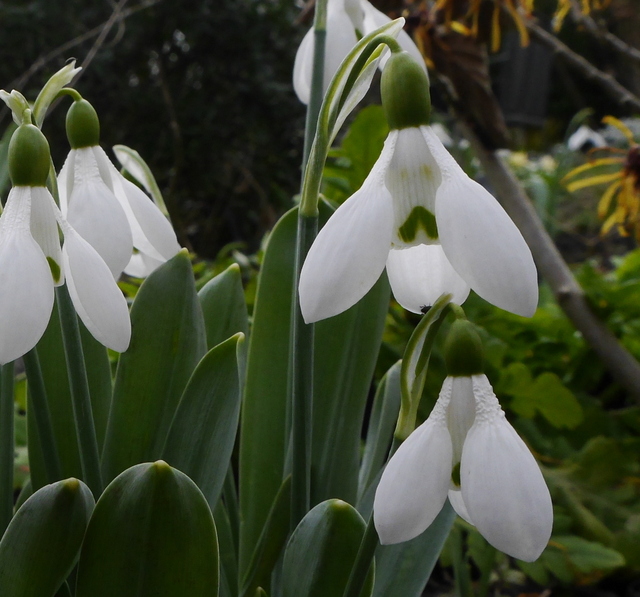
Galanthus Scissors-001‘Scissors’ in Charles Cresson’s garden

G. plicatus cultivars are a favorite of mine as they usually have substantial flowers on big plants with beautiful leaves so I am always happy to add another like ‘Scissors’ to my garden.  The snowdrop bible calls ‘Scissors’ “a fine G. plicatus seedling … [with] long, shapely outer segments … [and a] very apt name” (Snowdrops: A Monograph of Cultivated Galanthus by Matt Bishop, Aaron Davis, and John Grimshaw (Timber Press 2006, page 157).  The name fits because the green inner mark resembles a pair of old-fashioned scissors, clearly visible due to the long claws (where the outer segment attaches to the ovary).  It was selected in 1988 by Reverend Richard Blakeway-Phillips (1919-2012), an avid snowdrop collector and exhibitor.

.

Galanthus 'Walker Canada'‘Walker Canada’ in the Avon Bulbs display at the 2017 Royal Horticultural Society Show at Vincent Square.

I have long been intrigued by this snowdrop as, when I travel to England during snowdrop season, I invariably get asked if I am Canadian and any relationship to ‘Walker Canada’.   However, it was love at first sight when I finally saw it at the 2017 RHS Show.  It is a gorgeous, substantial, beautifully proportioned, large-flowered snowdrop with the elegant folded leaves characteristic of G. plicatus

.

Galanthus 'Walker Canada'G. plicatus ‘Walker Canada’

‘Walker Canada’s’ origins are a mystery.  When snowdrop legend Richard Nutt died in 2002, it was found in a cold frame in his garden at Great Barfield near a faded and barely legible label saying “Walker Canada,” and that’s all we know about it!

Look for another post soon profiling more new snowdrops.

.

Blogs are a lot more fun for everyone, especially the writer, when readers leave comments.  Scroll down to the end of the page to the box where it says “Leave a Reply” and start typing—-it’s easy!

Carolyn

.

Note: Every word that appears in orange on my blog is a link that you can click for more information. If you want to return to my blog’s homepage to access the sidebar information (catalogues, previous articles, etc.) or to subscribe to my blog, just click here.

New Snowdrops for 2022: Part Two

Posted in bulbs for shade, snowdrops, winter interest with tags , , , , , , , , , , , , , , , on November 20, 2021 by Carolyn @ Carolyns Shade Gardens

Galanthus EA Bowles‘E. A. Bowles’  is in a class by itself, shown here at Carolyn’s Shade Gardens.

Our current snowdrop catalogue is on line here.

Thank you to my readers for the enthusiastic response to my first post on the new snowdrops that Carolyn’s Shade Gardens will offer in its 2022 Snowdrop Catalogue.  To read that post, click hereThe catalogue will be posted on our website in the first half of December, but here is an advance look (sorry, no advance orders) at more of the special, new snowdrops that will be available.  Enjoy!
Nursery News:  Carolyn’s Shade Gardens is a retail nursery located in Bryn Mawr, PA, specializing in showy, colorful, and unusual plants for shade.  The only plants that we ship are snowdrops within the US.  For catalogues and announcements of local events, please send your full name, mailing address, and cell number to carolyn@carolynsshadegardens.com and indicate whether you are interested in snowdrops.  Click here to get to the home page of our website for catalogues and information about our nursery and to subscribe to our blog.
.

.Galanthus EA Bowles-001‘E.A. Bowles’ caused a sensation in 2011 when it sold for the highest recorded price ever paid for a snowdrop.

‘E.A. Bowles’ invites the use of every over-the-top adjective in the snowdrop lexicon and, if I was forced to pick a favorite snowdrop, this would be it.  It towers over other snowdrops and produces gigantic, magnificent, pure white flowers that are perfectly poculiform, meaning all six segments are outer segments.  It blooms very late in the season and, with its height and flower size, could easily be mistaken for a white daffodil.  It is a G. plicatus cultivar, and its broad, shiny green leaves only add to the allure.

.

Galanthus EA Bowles‘E.A. Bowles’ prominently featured in the Avon Bulbs display at the 2018 RHS Show.

‘E.A. Bowles’ was discovered  in 2002 by North Yorkshire snowdrop expert Michael Myers at Myddelton House, Enfield, Middlesex, the former home and garden of famous plantsman E.A. Bowles (1865-1954).  Its status as an outstanding snowdrop was immediately apparent, and it received a Royal Horticultural Society Award of Garden Merit.  In 2011, it was the first snowdrop to receive significant attention from the non-gardening press when it fetched the then mind boggling price of £357 at auction.

.

Galanthus The Wizard‘The Wizard’

‘The Wizard’s’ lighter green, heart-shaped markings on the large outer segments paired with the almost completely green inner segments result in an enchanting snowdrop.  It has the traditional, pagoda-like shape of an inverse poculiform, where all the outer segments have been replaced by a whorl of inners, and a tall, upright habit with the lovely leaves characteristic of a G. plicatus

It was discovered by snowdrop expert Alan Street in the copse at Avon Bulbs and first offered for sale in 2014.  Although there are many ‘Trym’-like snowdrops available now, ‘The Wizard’ cast its spell over Anne Repnow and was included in her new book profiling only 90 out of over 2,500 named snowdrop cultivars.  For a review of her wonderful book, click here.

Galanthus Mrs Thompson 333‘Mrs. Thompson’s’ erratic behavior is highly prized in the snowdrop world.

‘Mrs. Thompson’ defies snowdrop norms.  Uniformity is usually highly prized among snowdrop collectors, but, paradoxically, this snowdrop’s erratic behavior has made it more desirable.  Along with an elegant and stately classic flower, when well established, it also produces twins (two flowers with separate pedicels on the same scape), fused flowers, and flowers with 4, 5, or even 6 outer segments.  Rather than detracting from the beauty of the clump, these quirks make ‘Mrs. Thompson’ enchanting.

.

Galanthus Mrs. ThompsonThe left flower has five outer segments instead of the usual three, and the right flower is composed of two fused flowers on the same scape.

‘Mrs. Thompson’ was discovered by Mrs. N.G. Thompson of Red House, Escrick, York, and was sent by her to the RHS Scientific Committee, chaired by E.A. Bowles, for consideration in 1950.

.

Galanthus 'Cordelia'‘Cordelia’ produces a very neat, green rosette.

‘Cordelia’ is a beautiful and elegant double snowdrop originated prior to 1954 by English plantsman Heyrick Greatorex as part of his famous series of large and vigorous double snowdrops, resulting from his crosses of G. plicatus with G. nivalis ‘Flore Pleno’.  He named his doubles after characters in Shakespeare’s plays—here the youngest daughter in King Lear.

.

Galanthus 'Cordelia'‘Cordelia’ at Carolyn’s Shade Gardens

‘Cordelia’ is one of the lesser known but more easily identifiable Greatorex doubles due to its large, variable,  green inner marking, superior height, and very uniform and neat rosette.  It thrives in my garden!

.

Galanthus 'Phantom'‘Phantom’ produces two types of flowers.  One is the very lovely, pure white poculiform shown above.  This is the flower form that appears if only one flower is produced.

.

Galanthus 'Phantom'This is ‘Phantom’s’ other flower type: a spooky looking snowdrop with markings configured like G. plicatus subsp. byzantinus.

‘Phantom’ is a very mysterious snowdrop of unknown origin and previously unknown configuration.  When established, it produces two very different flowers from the same bulb. 

The first is a beautiful, large, pure white, six-petaled poculiform like ‘E.A. Bowles’.  The second is a flower with basal and apical markings on the inner segments like G. plicatus subsp. byzantinus.  The markings on the second flower resemble large and elongated eyes and a down-turned mouth, very phantom-like, which may have contributed to the name.

.

Galanthus 'Phantom'Both types of flowers appear on this beautiful specimen shown by Avon Bulbs at the 2017 RHS Show.

The mystery continues with ‘Phantom’s’ origin.  It was introduced in 2015 by Alan Street at Avon Bulbs, but the collector from whom he thought he got it denies giving it to him.

.

Blogs are a lot more fun for everyone, especially the writer, when readers leave comments.  Scroll down to the end of the page to the box where it says “Leave a Reply” and start typing—-it’s easy!

Carolyn

.

Note: Every word that appears in orange on my blog is a link that you can click for more information. If you want to return to my blog’s homepage to access the sidebar information (catalogues, previous articles, etc.) or to subscribe to my blog, just click here.

Some Snowdrops by Anne Repnow

Posted in bulbs for shade, snowdrops, winter interest with tags , , , , , , , , , , , , , , , , on November 17, 2021 by Carolyn @ Carolyns Shade Gardens

img032An unassuming title for a wonderful book.  The snowdrop pictured on the cover is ‘Wol Staines’ from Glen Chantry in England, a nursery that I dream of visiting.

Our current snowdrop catalogue is on line here.

Last fall, I received my copy of Some Snowdrops: A Photographic Ramble by Anne C. Repnow (Davidia Press 2020) and  immediately read it cover-to-cover twice.  Although COVID certainly had something to do with that, I was also captivated by the excellent photographs and comprehensive descriptions.  I want to share this first-rate book with you in time for you to purchase it for use as a reference during the upcoming snowdrop season.

Nursery News:  Carolyn’s Shade Gardens is a retail nursery located in Bryn Mawr, PA, specializing in showy, colorful, and unusual plants for shade.  The only plants that we ship are snowdrops within the US.  For catalogues and announcements of local events, please send your full name, mailing address, and cell number to carolyn@carolynsshadegardens.com and indicate whether you are interested in snowdrops.  Click here to get to the home page of our website for catalogues and information about our nursery and to subscribe to our blog.
.

.img033The book starts with some beautiful landscape photos of snowdrops, this one taken at Brechin Castle in Scotland.

Anne Repnow gardens near Heidelberg, Germany.  She started her career in scientific publishing but during that time took courses in horticulture and landscape design.  Ten years ago she followed her love of gardening into a new career as a garden designer.  Along the way she managed to accumulate 500 snowdrop cultivars in her own garden.  Anne organizes the German snowdrop event Snowdrop Days in Luisenpark.  There is no mention of photography in her bio but the photographs speak for themselves.

.

img042‘Godfrey Owen’ comes into bloom early in the main season for snowdrops, generally the second half of January in my garden.  It is one of my favorites and has received the coveted Royal Horticultural Society Award of Garden Merit.

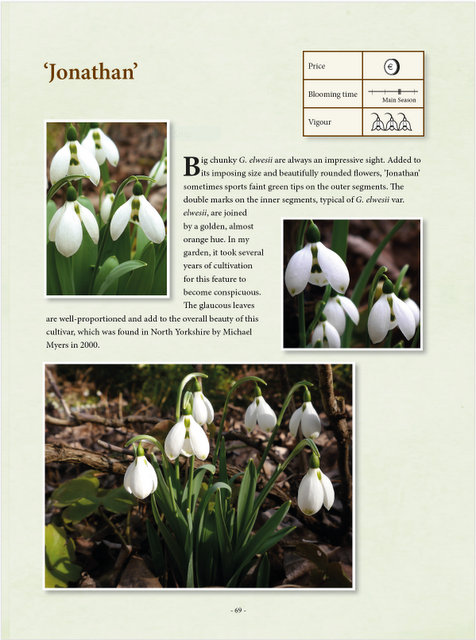
The heart of the book is descriptive profiles of 90 Galanthus cultivars illustrated with nearly 280 well-chosen phtographs.  Each snowdrop gets its own page with a full paragraph of description, including an explantion of its markings, an account of its discovery, and a focus on why it is in the book.  For ‘Godfrey Owen’ above, Repnow mentions its exceptional beauty and unusual petal configuration of six inners and six outers.  She also provides a chart with an approximation of bloom time, a ranking of vigor, and a relative price.

.

img041‘Wasp’ is a snowdrop that you would recognize anywhere without a label due to its long, narrow, wing-like outer segments and the striped inner segements resembling a thorax.

For this post, I have scanned four pages from Repnow’s book profiling snowdrops that will appear in our 2022 Snowdrop Catalogue: ‘Godfrey Owen’, ‘Wasp’, ‘Three Ships’, and ‘Standing Tall’, which brings me to another reason I love this book.  Repnow does not just focus on snowdrops that are new and relatively unavailable to American gardeners, although there is definitely a large number of those, but includes many snowdrops that are  available in the US.  Eleven cultivars in the book are in our 2022 catalogue, while an additional 14 have been offered previously by Carolyn’s Shade Gardens.  This is not a book for dreamers, but for gardeners who want to grow snowdrops.

.

img038‘Standing Tall’ is an American snowdrop selected by bulb expert Charles Cresson and introduced exclusively by Carolyn’s Shade Gardens in 2013.  Its upright habit, height, and mid-December bloom time make it an outstanding snowdrop.

Some Snowdrops includes a wide diversity of snowdrops selected in the UK and all over the rest of Europe and even covers some North American snowdrops.  She profiles ‘Green Bear’ and ‘Rosemary Burnham’ from British Columbia and ‘Potter’s Prelude’ and ‘Standing Tall’ from the US.

.

img040‘Three Ships’ is another favorite available in our 2022 catalogue.  Its distinctive, large, round and seersuckered outer segments along with its Christmas bloom time earned it a rare Royal Horticultural Society Award of Garden Merit.

If you would like to purchase Anne Repnow’s book, which I highly recommend, you can get it from Barnes and Noble here or Amazon here. Anne tells me that the next installment More Snowdrops is in the works—I can’t wait.

.

In my last post I described six snowdrops that Carolyn’s Shade Gardens is offering for the first time in our 2022 Snowdrop Catalogue.  To read the post, click hereFour snowdrops from the catalogue are profiled in this post.  Look for an upcoming post with five more new snowdrops.

.

Blogs are a lot more fun for everyone, especially the writer, when readers leave comments.  Scroll down to the end of the page to the box where it says “Leave a Reply” and start typing—-it’s easy!

Carolyn

.

Note: Every word that appears in orange on my blog is a link that you can click for more information. If you want to return to my blog’s homepage to access the sidebar information (catalogues, previous articles, etc.) or to subscribe to my blog, just click here.

New Snowdrops for 2022: Part One

Posted in bulbs for shade, snowdrops, winter interest with tags , , , , , , , , , , , , , , , , , on November 13, 2021 by Carolyn @ Carolyns Shade Gardens

Galanthus Midas‘Midas’ has yellow marks on the outer segments, something entirely new to the snowdrop world.

Our current snowdrop catalogue is on line here.

Getting outside in the fall to clean out and mulch my snowdrop beds always lift my spirits as we sink into winter.  Seeing the little green tips beginning to push through the soil is a sign of renewal when the light is fading, the temperature is dropping, and the rest of the garden is dying back. 

When inside, I am busy drafting the 2022 Snowdrop Catalogue, which will be posted on our website in the first half of December.  While my loyal snowdrop customers wait to receive their catalogue notification, this post will give everyone an advance look (sorry, no advance orders) at some of the special, new snowdrops that will be available.  Enjoy!

Nursery News:  Carolyn’s Shade Gardens is a retail nursery located in Bryn Mawr, PA, specializing in showy, colorful, and unusual plants for shade.  The only plants that we ship are snowdrops within the US.  For catalogues and announcements of local events, please send your full name, mailing address, and cell number to carolyn@carolynsshadegardens.com and indicate whether you are interested in snowdrops.  Click here to get to the home page of our website for catalogues and information about our nursery and to subscribe to our blog.
.

.Galanthus 'Midas'Alan Street at Avon Bulbs sent me this photo of ‘Midas’ in 2017, the year it was introduced.  I couldn’t believe my eyes—here was a swarm of one of the world’s rarest snowdrops!

‘Midas’ was discovered in February 2011 by snowdrop expert Alan Street in the famous Avon Bulbs copse of trees where many unusual and popular snowdrops have originated.  It was found in close proximity to ‘Blonde Inge’ and ‘Trym’, its presumed parents.  A few days later Avon hosted the famous Immortals Luncheon for the exclusive group of people for whom snowdrops have been named.  As the immortals would be exploring the copse with their eagle eyes, ‘Midas’ was ignominiously concealed under a pot.  Avon introduced it for sale in 2017.

.

Galanthus Midas

.

‘Midas’ has many fine qualities:  Like ‘Blonde Inge’, its ovary is green while its markings are yellow, a very pleasing combination.  Like ‘Trym’ and its numerous progeny, it is an inverse poculiform, meaning its outer segments have been replaced by a whorl of inners. But what makes ‘Midas’ really special are the yellow markings on the outer segments in addition to the inners.

‘Midas’ is a so-called color change snowdrop—it comes out green and changes to yellow—so plant it where it gets some sun to bring out the beautiful, warm golden color.  As an x valentinei, it has the expected vigor of a hybrid snowdrop.

.

Galanthus plicatus 'Augustus'‘Augustus’ is classically elegant and award-winning.

‘Augustus’s striking, rounded and quilted flowers with emerald green inner segments stand out in any snowdrop collection.  Its blooms sit atop robust and perky plants, unbeatable when massed.  It has the folded leaves of a G. plicatus but with unusually wide, bright green leaves with a distinct broad silver channel in the center.

.

Galanthus Augustus‘Augustus’ is very striking in a group, here in Hilary and Hugh Purkess’s garden “Welshway”.

‘Augustus’ was found by famous plantswoman Amy Doncaster in the garden of Lewis Palmer at Headbourne Worthy, Winchester, and named prior to 1976 for E.A. (Edward Augustus) Bowles.  It has received the coveted Royal Horticultural Society Award of Garden Merit, given to only 28 snowdrops out of the over 2,500 in cultivation.

.

Galanthus 'Cowhouse Green'‘Cowhouse Green’, shown here at Carolyn’s Shade Gardens.

‘Cowhouse Green’ is a virescent or green-shaded snowdrop.  Gorgeous apple green shading covers the apical half of the outer segments and lightly washes the inner segments—it glows in my garden at dusk.  It is instantly recognizable for its ethereal coloring, tall flower scapes, and elegantly curved flower stems (pedicels).  It was found by French horticulturist Mark Brown in the late 1980s in the garden of Susan Cowdy at Rushmere, The Lee, Buckinghamshire, in an area near Cowhouse Field.

.

Galanthus Desdemona‘Desdemona’ is a Greatorex double snowdrop.

‘Desdemona’ was selected by Heyrick Greatorex from his crosses of G. plicatus with G. nivalis ‘Flore Pleno’.  He named his vigorous selections for Shakespeare characters, here Othello’s wife in the Shakespeare tragedy of the same name.  ‘Desdemona’ is one of the largest and strongest Greatorex doubles and considered one of the best for garden display.

.

Galanthus Desdemona‘Desdemona’ at Evenley Wood Garden in Northhamptonshire, a snowdrop venue well worth visiting.

.

Galanthus Moses Basket MacLennan2‘Moses Basket’ cannot be mistaken for any other snowdrop.  Many thanks to Margaret and David MacLennan, holders of the UK National Collection of Galanthus (Scientific), for the wonderful photo.

‘Moses Basket’ is a very unique cultivar of G. elwesii with two pale spots resembling eyes in the middle of the inner segments and very small dark green marks at the apex.  What makes this snowdrop so special is that when well established the claws (the narrow section at the base of the outer segments) pull the outers in to form a basket with the two eyes peeking out (is that Moses?). 

It was discovered in 2004 at Anglesey Abbey in Cambridgeshire by the Assistant Head Gardener David Jordan.  The snowdrop was named for the grandson of a longtime visitor to Anglesey Abbey and refers to the basket that floated the biblical baby Moses down the Nile.

.

Galanthus Rodmarton Arcturus‘Rodmarton Arcturus’ at the famous snowdrop destination Rodmarton Manor in England.

‘Rodmarton Arcturus’: In February 2018, I was given a tour of the snowdrops at Rodmarton Manor in Gloucestershire by the owner, Simon Biddulph, who showed me this snowdrop, which he selected and named for the brightest star in the northern celestial hemisphere.  At the time, I called it one of the most impressive snowdrops I have ever seen, click here.  My superlatives have been born out by none other than Matt Bishop, the author of the snowdrop bible, who describes it in his catalogue as “one of the ten cultivars which I would take with me if sent to live on a desert island”.

.

Galanthus Rodmarton ArcturusAn enviable clump of ‘Rodmarton Arcturus’ in the garden of snowdrop expert Ronald Mackenzie.

‘Rodmarton Arcturus’ has enormous, globular,  thick-textured, seersuckered flowers with wide, rounded petals like a spoon and a dark green apical inner marking diffusing to two eye-like spots—an absolute standout!  The excellent habit and attractive, glaucous, blue-green leaves with slight pleating, indicating G. plicatus parentage, complete the package.

.

Blogs are a lot more fun for everyone, especially the writer, when readers leave comments.  Scroll down to the end of the page to the box where it says “Leave a Reply” and start typing—-it’s easy!

Carolyn

.

Note: Every word that appears in orange on my blog is a link that you can click for more information. If you want to return to my blog’s homepage to access the sidebar information (catalogues, previous articles, etc.) or to subscribe to my blog, just click here.

%d bloggers like this: