Carolyn’s Shade Gardens is a retail nursery located in Bryn Mawr, PA, specializing in showy, colorful, and unusual plants for shade. The only plants that we ship are snowdrops and miniature hostas. For catalogues and announcements of events, please send your full name, location, and phone number (for back up use only) to carolyn@carolynsshadegardens.com. Click here to get to the home page of our website for catalogues and information about our nursery and to subscribe to our blog.
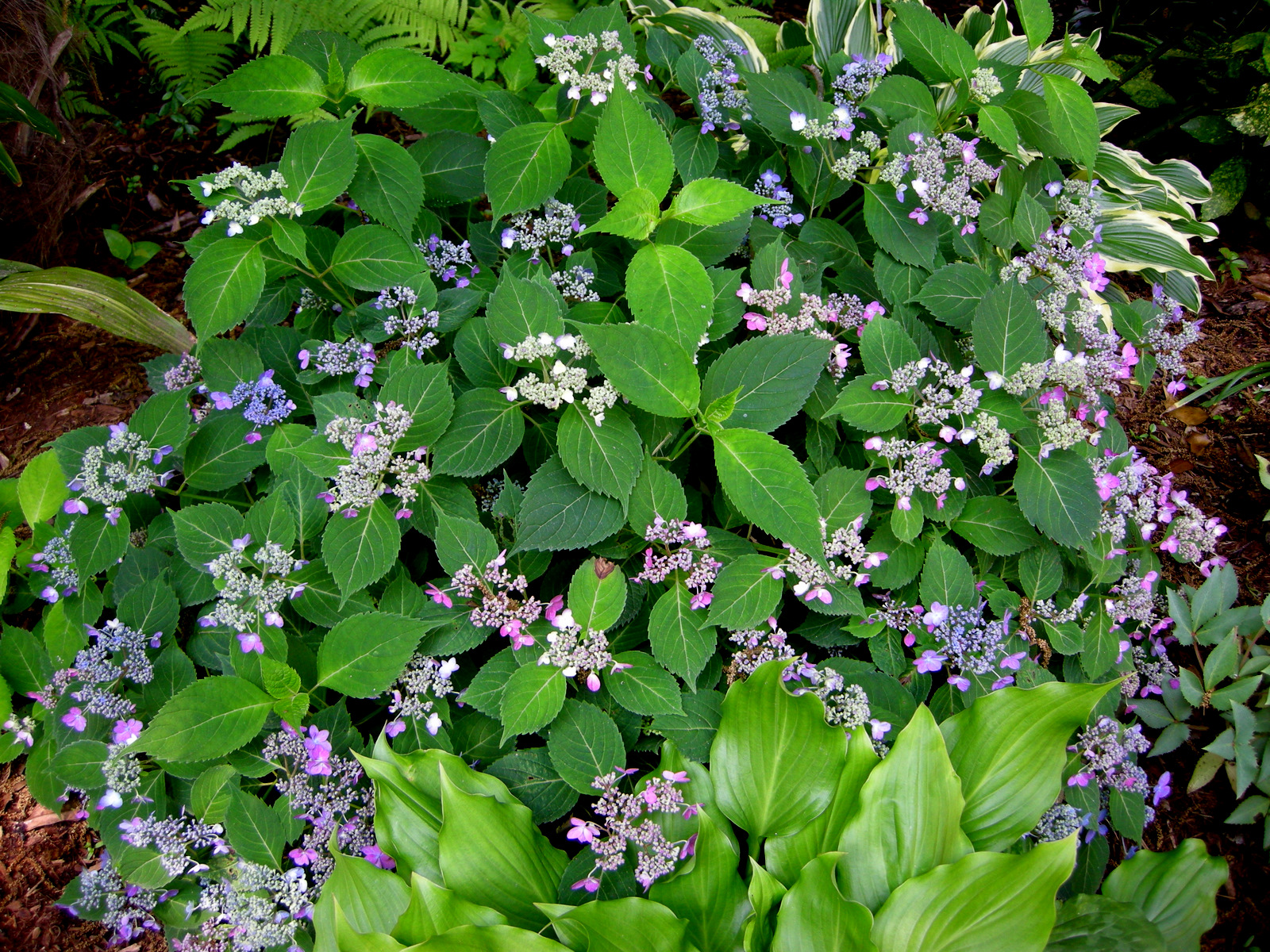
 Blue includes purple (most “blue” flowers are purple), here hydrangea relative, perennial Chinese deinanthe, D. caerulea.
I am not a trained landscape designer. Although I did take two landscape design courses at the Temple University Ambler School of Horticulture, it didn’t stick. I still don’t plan my gardens ahead of time but instead operate by gut instinct. I can hear true garden designers like Allan at allanbecker.gardenguru and Donna at Garden Walk Garden Talk sighing all the way from Montreal and Niagara Falls, respectively. It helps that I really know plants–their heights, habits, textures, blooms, cultural requirements, etc.–but I still do a lot of shifting around and replacing in my gardens that could probably be avoided by a little advance planning.
 ‘Jack Frost’ brunnera, B. macrophylla ‘Jack Frost’, is a star performer in my silver and blue garden for its true blue flowers and silvery blue leaves.
One technique that has really helped improve my garden’s design (and avoid all the rearranging) is theme gardens. I know what you are thinking, here’s where she drags out photos of her “white garden” ala Vita Sackville-West. Well, I don’t have a strictly white garden, but I do have color theme gardens. My sunniest area is a chartreuse, orange, and purple garden, my main perennial bed focuses on peach, pink, gold, and purple, near the woodland there is a gold and yellow garden, around the deck is a moon garden (plants that are ornamental at night, mostly white), and across from the deck is my silver and blue garden, which I want to share with you today.
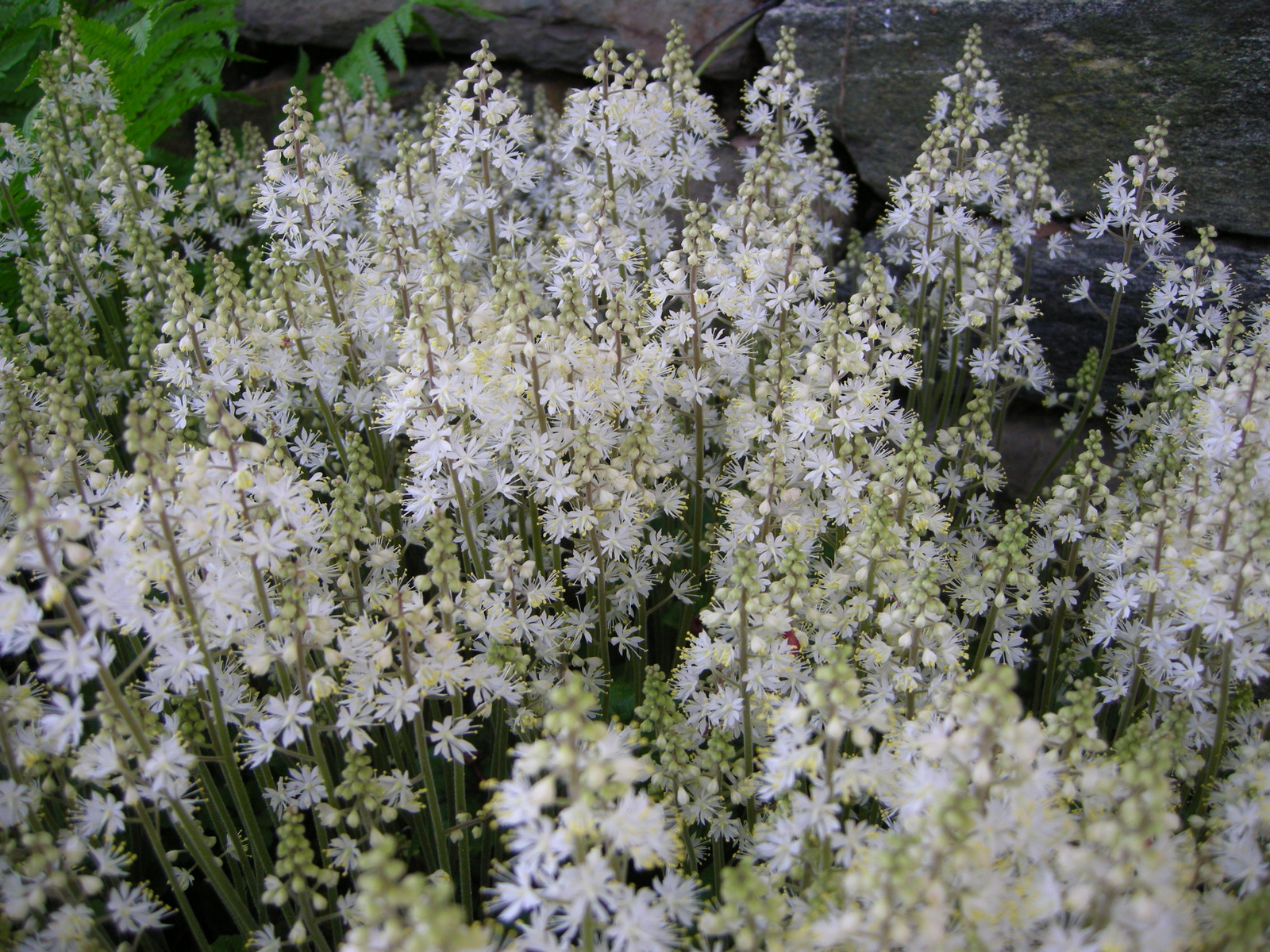 Silvery fragrant flowers of native ‘Brandywine’ foamflower, Tiarella cordifolia ‘Brandywine’, an excellent groundcover whose shiny green leaves turn red in the fall.
Why limit myself that way? Because having a theme helps me decide what plants belong in a particular garden and what plants don’t. It provides a unifying factor. I find it much easier to achieve a cohesive whole if I know why each plant is there, and color themes force me to consider each addition carefully. And it must work because those are the gardens I get the most compliments on from customers and garden tours.
 A massive native Kentucky coffeetree is the focal point of the garden, which is surrounded by white pine needle paths. Because the tree is so big, I had to climb up on the roof to get shots of the bed. This photo shows you all the gardens in the area.
My silver and blue garden surrounds a native Kentucky coffeetree, Gymnocladus dioicus, that may be over 100 years old. It is approaching 100 feet tall and is 8 feet in circumference. Luckily it does not have extensive surface roots. The bed is an oval 12 feet wide and 20 feet long. It started with leftover plants from one of my fall nursery sales, which happened to be silver and blue. As part of my quest to eliminate all the grass on my back hill, I planted the leftover plants at the base of the Kentucky coffeetree, and my silver and blue garden was born. I have been adding to it for about five years, and now it is quite mature.
 This photo shows the overall design of the bed. Despite its simple look, there are actually over 25 plant varieties.
One important caveat before I get to the plants, I rarely plant less than five of any one perennial (even with shrubs, I normally plant three). My customers are always asking me how to have a garden like mine. Near the top of the list, somewhere after compost, is quantity. You need a lot of the same plant to make it show up in your garden. One does not work, three is barely sufficient, five achieves critical mass, and seven is optimal (obviously this depends somewhat on the size of the plant, the bed, and your garden as a whole).
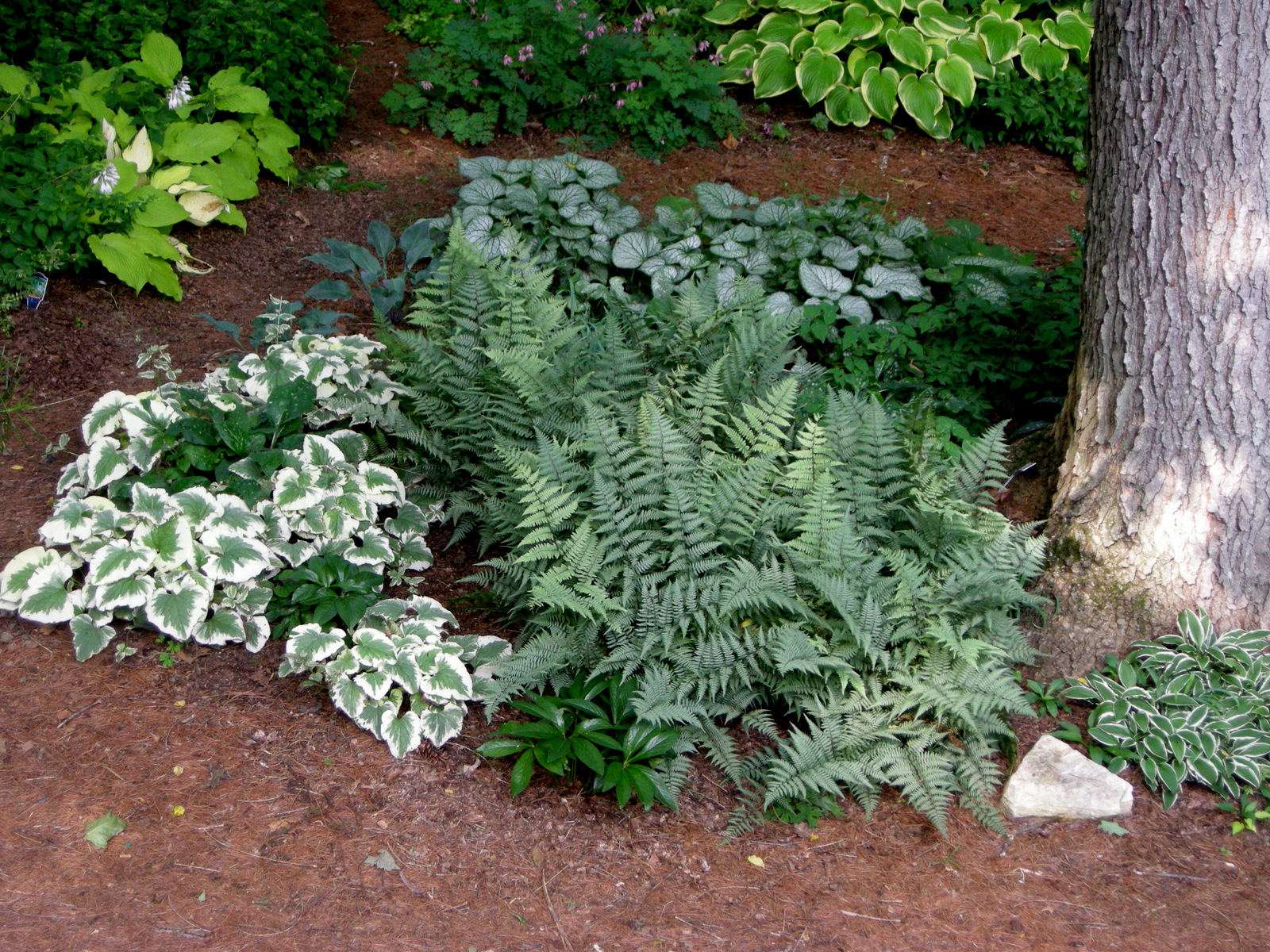 Northern end of the bed dominated by large patches of ‘Dawson’s White’ and ‘Jack Frost’ brunnera and ghost fern.
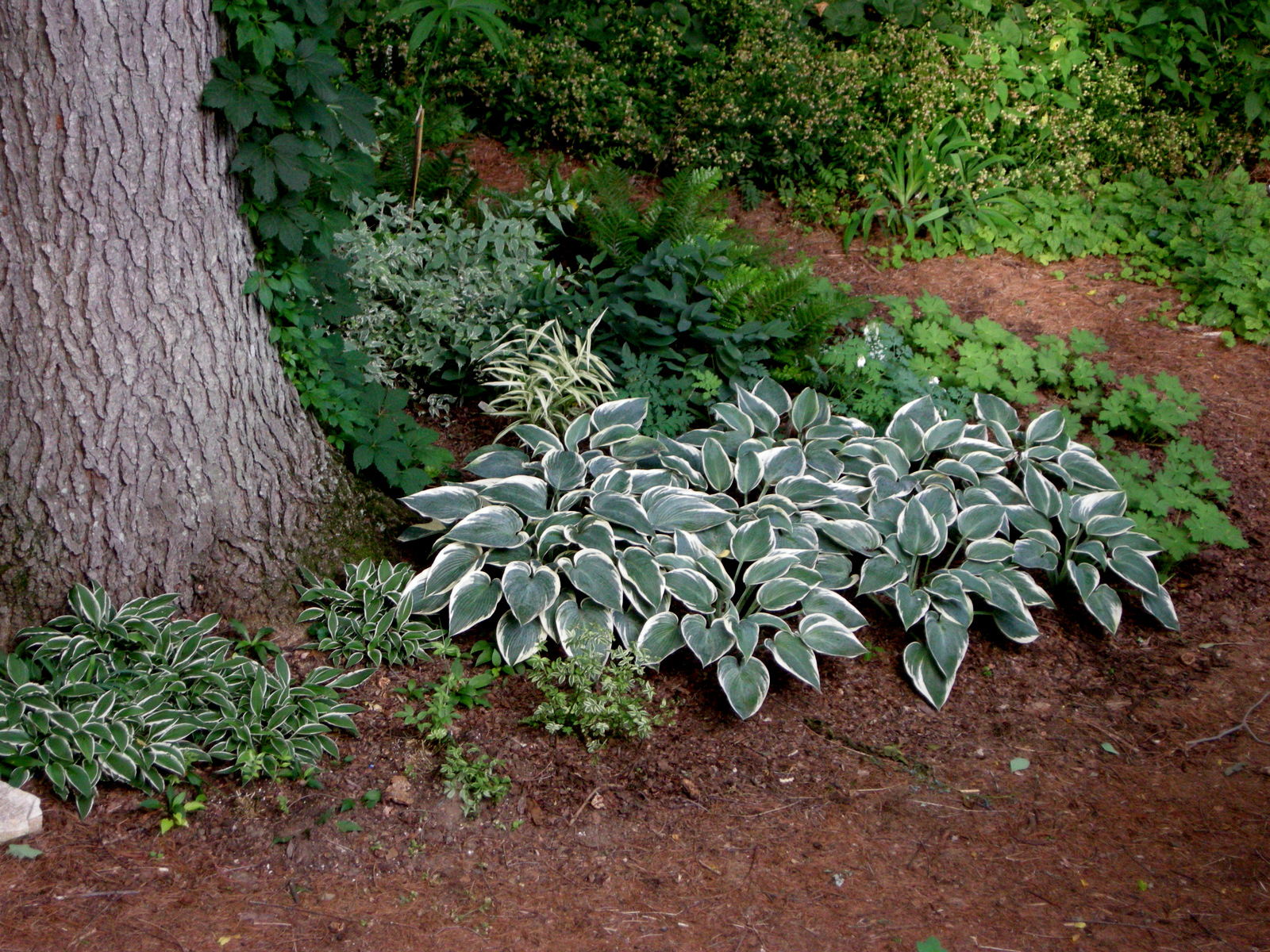 Southern end of the bed with Hosta ‘Ginko Craig’ and ‘El Nino’, variegated Japanese kerria, K. japonica ‘Variegata’, and white-flowered bigroot hardy geranium, G. macrorrhizum ‘Album’.
The theme of the bed is silver (also incorporating white) and blue (also including lighter shades of purple). I find that most flowers labeled blue really are a shade of purple. The colors are provided by the flowers and, probably more importantly, the foliage. Again, blue leaves are in reality bluish green. I included some plants that don’t fit the theme for contrast. Here are some closeups of the bed and some more photos of the individual plants:
 Click any photo to enlarge. A close up of the north end revealing some of the lesser players. Between the two types of brunnera, Hosta ‘Blueberry Cobbler’ with very blue leaves and gorgeous blueberry purple stems and native sedge ‘Bunny Blue’, Carex laxiculmus ‘Bunny Blue’. Around the ‘Dawson’s White’, a lungwort seedling, Pulmonaria sp., with silver spots and deep blue flowers, and double white-flowered hybrid hellebore ‘Double Integrity’, H. x hybridus ‘Double Integrity’.
 Looking around the back side of the bed reveals Chinese deinanthe (flower pictured in first photo) behind the kerria; native variegated northern sea oats, Chasmanthium latifolium ‘River Mist’ to the left; blue-leafed and white-flowered dwarf Solomon’s seal, Polygonatum falcatum ‘Pumilum’ in front;and blue-leafed native white wild bleeding-heart, Dicentra eximia ‘Aurora’, in the foreground.
 White and silver variegated foliage really shows up in a shade garden: clockwise from upper left, ‘Dawson’s White’ brunnera, ‘El Nino’ hosta (very blue), ‘River Mist’ northern sea oats, and ‘Ginko Craig’ hosta.
 ‘Lilafee’ barrenwort, Epimedium grandiflorum ‘Lilafee’, provides gorgeous purple flowers in April (the yellow corydalis is an interloper).
 Providing blue tones, clockwise from upper left: ‘Bunny Blue’ sedge, Japanese kerria ‘Variegata’, ‘Bertram Anderson’ lungwort with blue flowers and silver leaves, and dwarf Solomon’s seal ‘Pumilum’.
 The blue flowers of brunnera are beautiful for a long time in late spring.
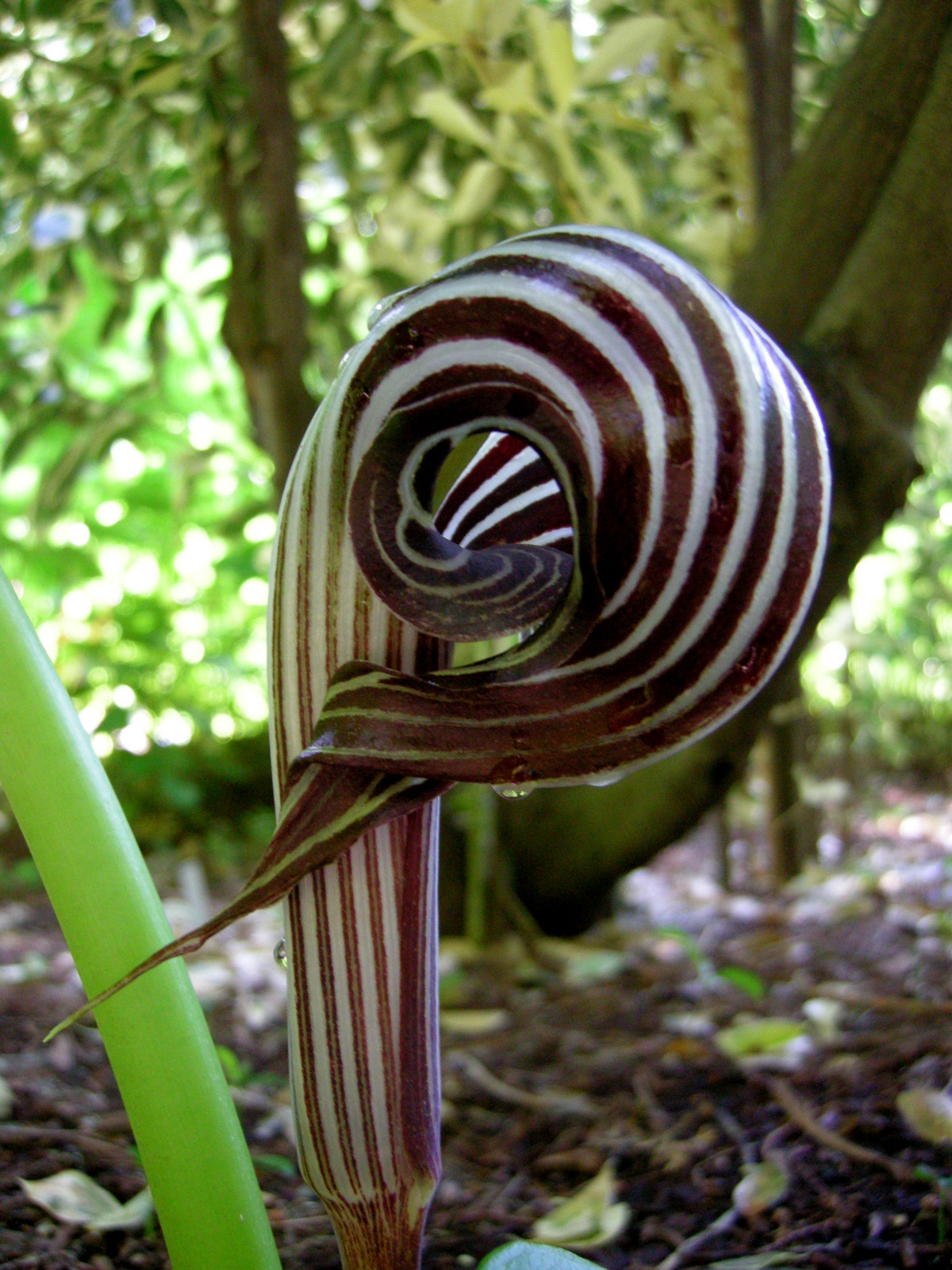
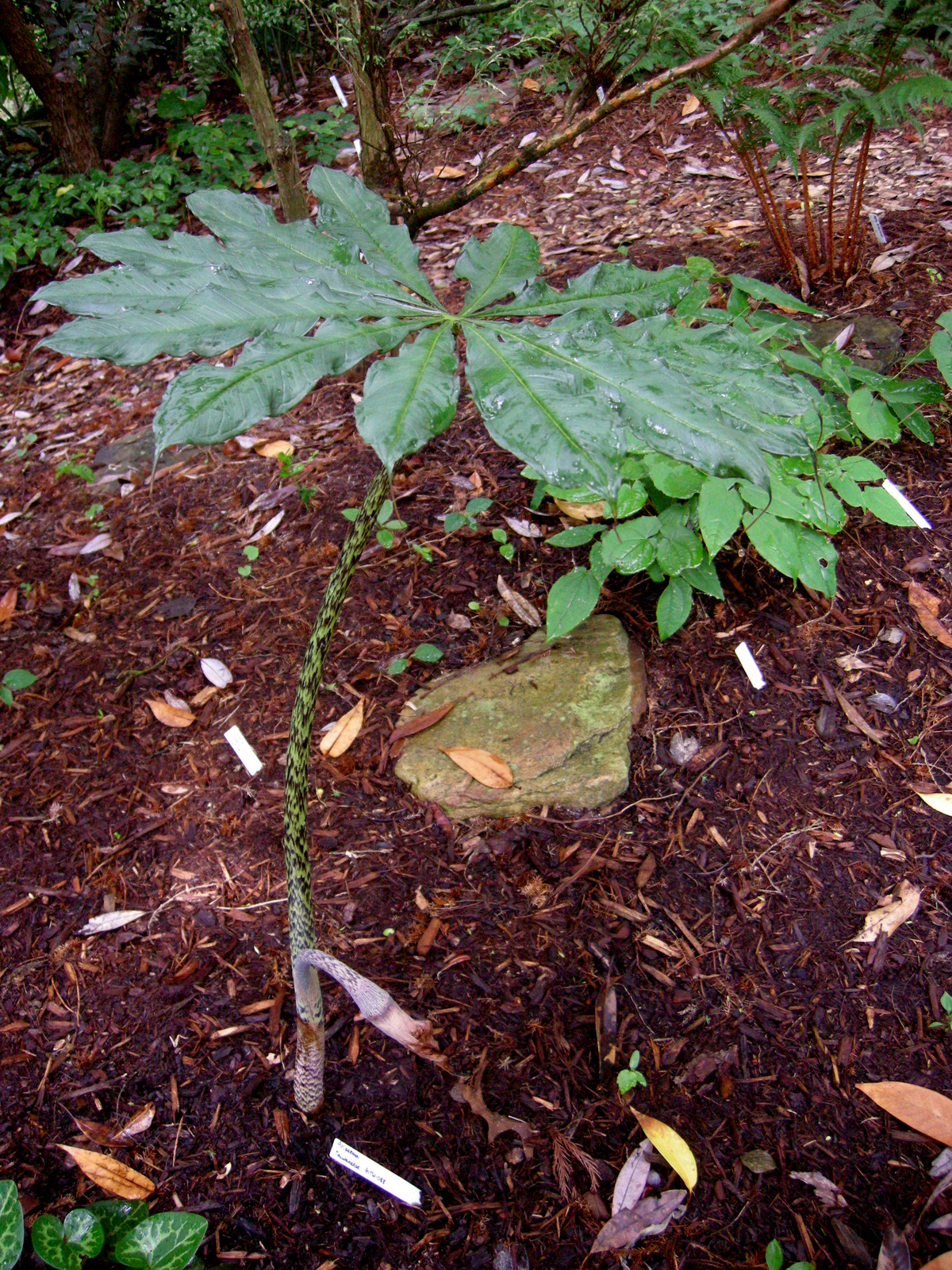
 Relief from too much variegation is provided by clockwise from upper left: evergreen tassel fern, Polystichum polyblepharum, evergreen hybrid hellebore, H. x hybridus, Asian jack-in-the-pulpit, Arisaema consanguineum, and native Virginia creeper, Parthenocissus quinquefolia, which climbs the Kentucky coffeetree.
 The color scheme is carried across the pine needle path to the garden surrounding the deck.
In placing the plants in the bed, consideration was given to cultural conditions (soil type, i.e. dry, and light availability), height, bloom time, texture, and habit, but the primary factor was silver and blue color. The result is a garden with almost year round interest and plants that work together to make the whole more lovely than the sum of its parts.
Carolyn
Notes: Click on any photo to enlarge. Every word that appears in orange on my blog is a link that you can click for more information. If you want to return to my website’s homepage to access the sidebar information (catalogues, previous articles, etc.), just click here.
Nursery Happenings: The nursery is closed until it cools off in the fall around the middle of September. If you are on my customer email list, look for an email. If not, sign up by sending an email to carolynsshadegardens@verizon.net with your name and phone number.