Archive for 2011

The Weird and the Wonderful

Posted in garden to visit, Shade Perennials with tags , , , , on July 5, 2011 by Carolyn @ Carolyns Shade Gardens

Nursery News:  Carolyn’s Shade Gardens is a retail nursery located in Bryn Mawr, PA, specializing in showy, colorful, and unusual plants for shade.  The only plants that we ship are snowdrops within the US.  For catalogues and announcements of local events, please send your full name, mailing address, and cell number to carolyn@carolynsshadegardens.com and indicate whether you are interested in snowdrops, hellebores, and/or hostas.  Click here to get to the home page of our website for catalogues and information about our nursery and to subscribe to our blog.

.
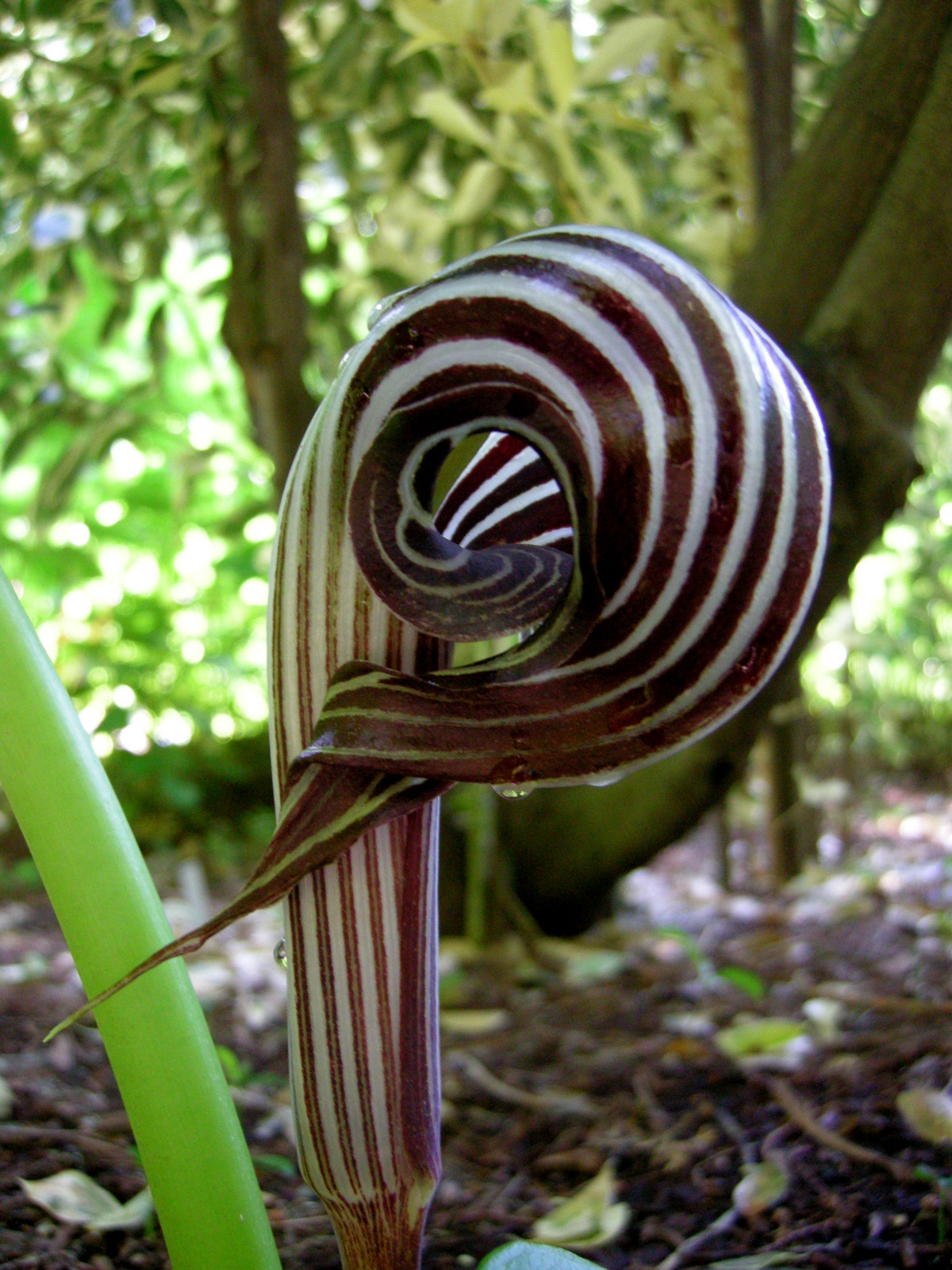
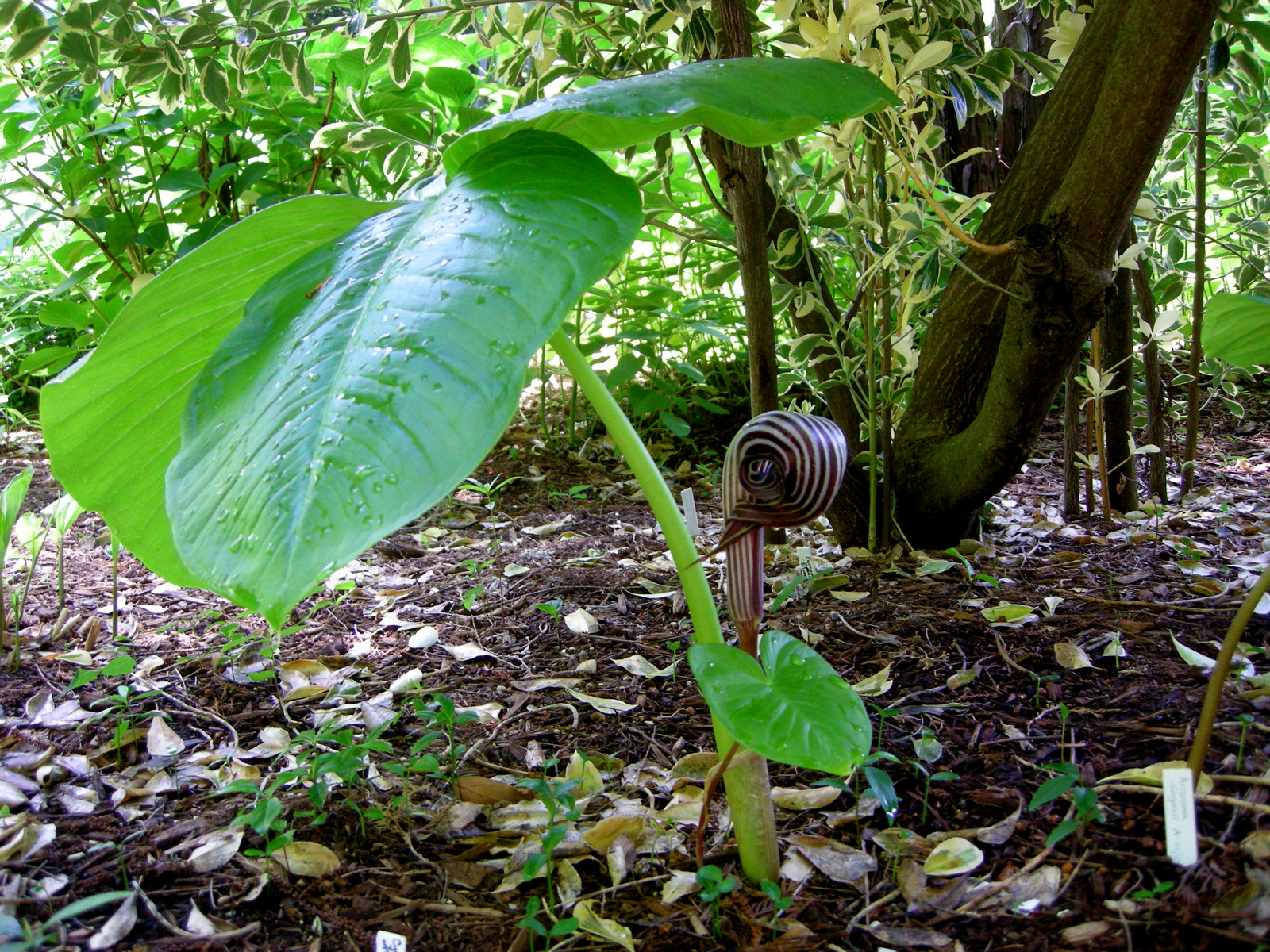
The flowers of Farges’s cobra lily (Asian jack-in-the-pulpit), Arisaema fargesii, are spectacular.

Our recent trip to North Carolina for my son’s college graduation (see North Carolina and Duke Gardens) included a visit to Plant Delights Nursery just south of Raleigh.  Plant Delights is a mail order nursery started in 1988 and specializing in new and rare perennials, including many shade plants like jack-in-the-pulpits, wild ginger, mayapples, and toad-lilies.  The sales area is quite large and well laid out and, of course, purchases were made.  But the real reason I visited was to spend time in what Plant Delights calls the Juniper Level Botanic Gardens, a five acre display garden featuring the weird and wonderful plants they sell plus additional plants that are being trialed.

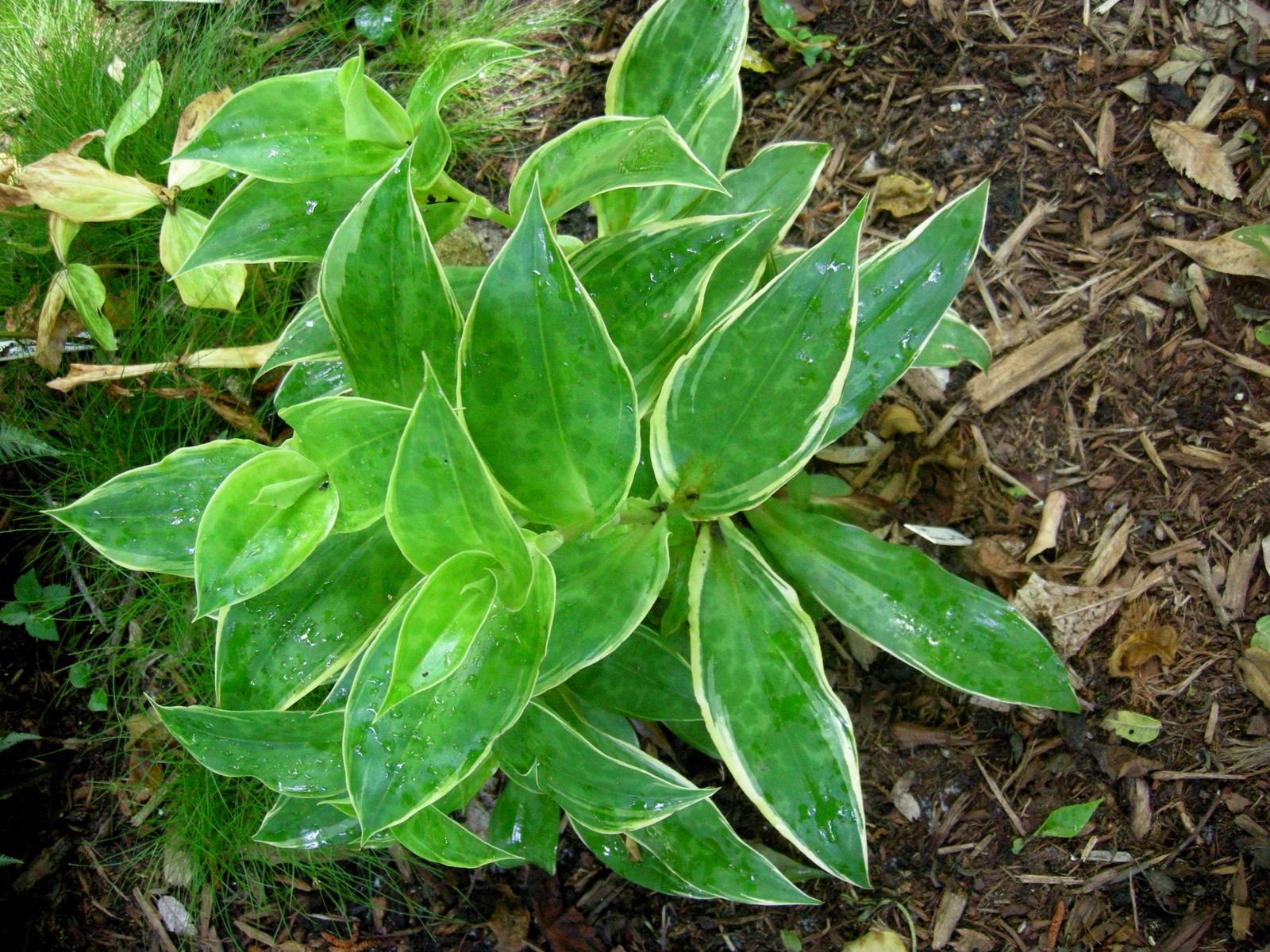
Golden variegated bush ivy, x Fatshedera lizei ‘Annemieke’, which I have never seen before, evidently resulted from a cross between a houseplant and ivy (not hardy in zone 6 unfortunately).

Michael and I spent over two hours in the shade section of the gardens (we never made it to the sunny side) admiring and photographing all the amazing plants displayed there.  I have to thank Michael who was by my side the whole time viewing (with suitable comments) every plant I pointed out and patiently recording the botanical name of every plant I photographed.  He even pointed out some of his own and never said don’t you think we should be going.  That’s dedication.
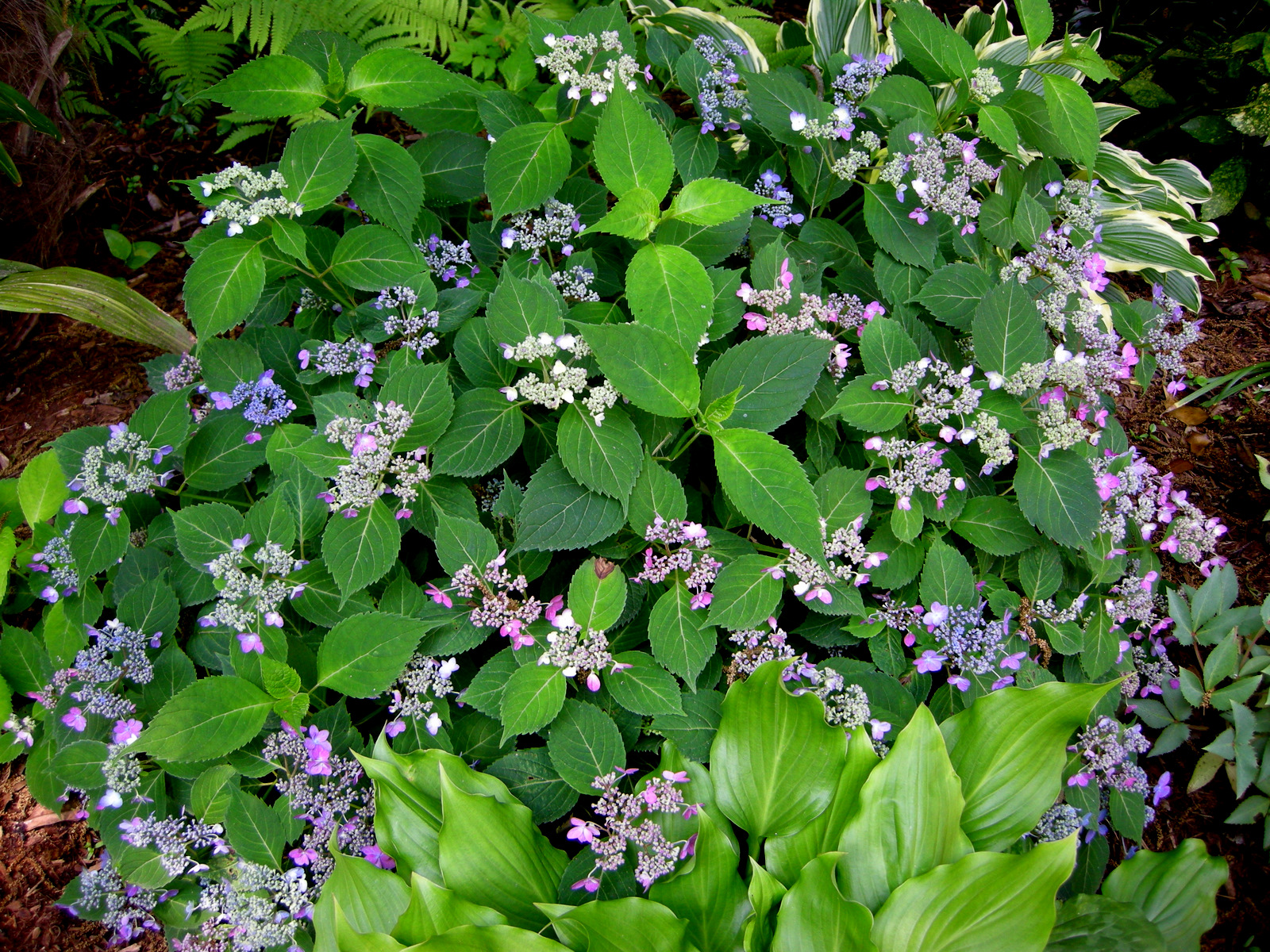
This lacecap hydrangea, H. serrata ‘Burgundy Edge’, was growing literally in the dark.

I love jack-in-the-pulpits, both native and Asian, and Plant Delights must have the best collection in the U.S.  Here are some of my favorites:

I didn’t realize that there were variegated forms of our native jack-in-the-pulpit, Arisaema triphyllum, but I saw two at Plant Delights: ‘Black Jack’ above and a white variegated cultivar called ‘Starburst’.
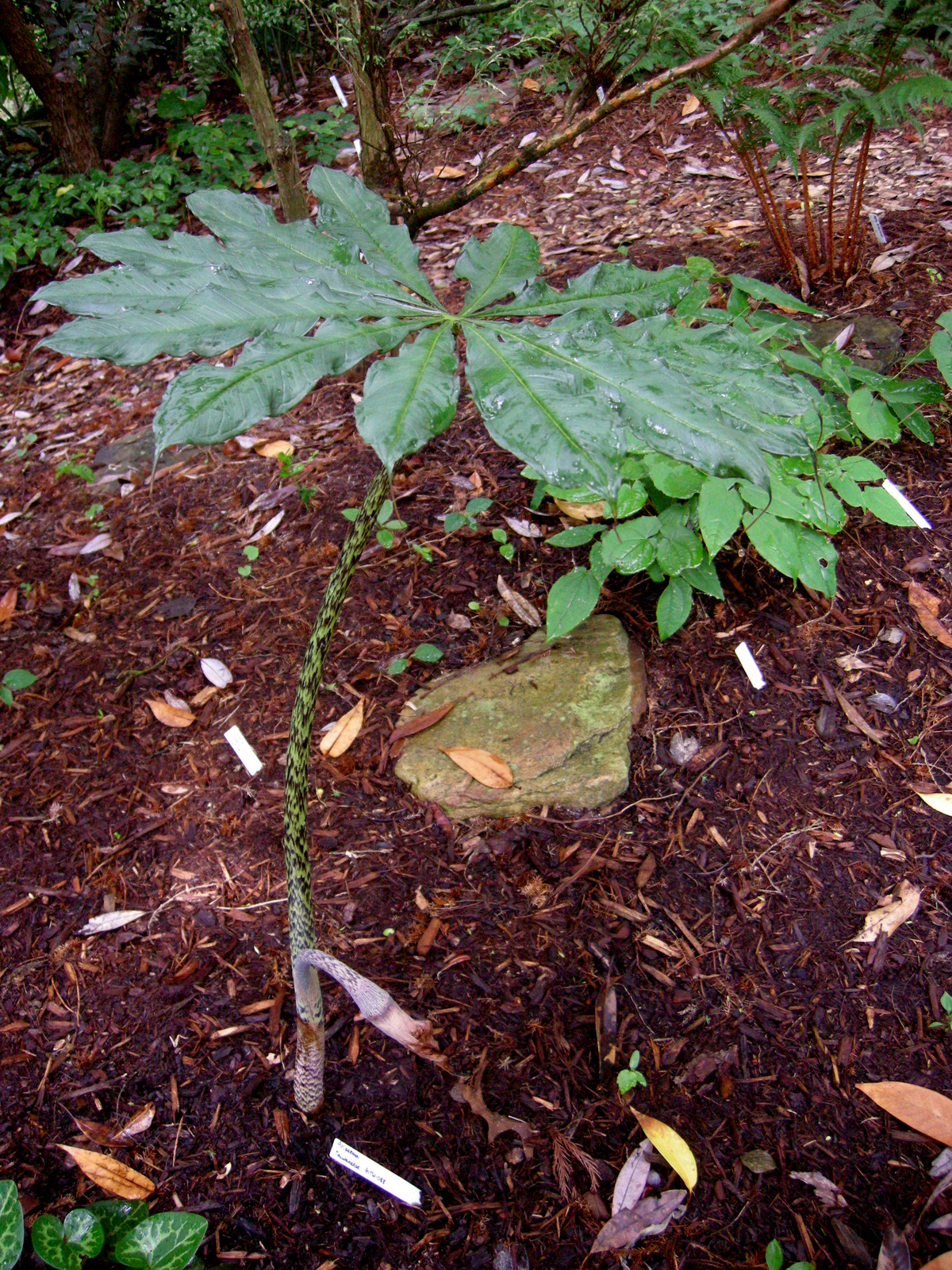
Taiwan cobra lily, Arisaema taiwanense

Jack-in-the-pulpit cross, Arisaema formosanum x consanguineum
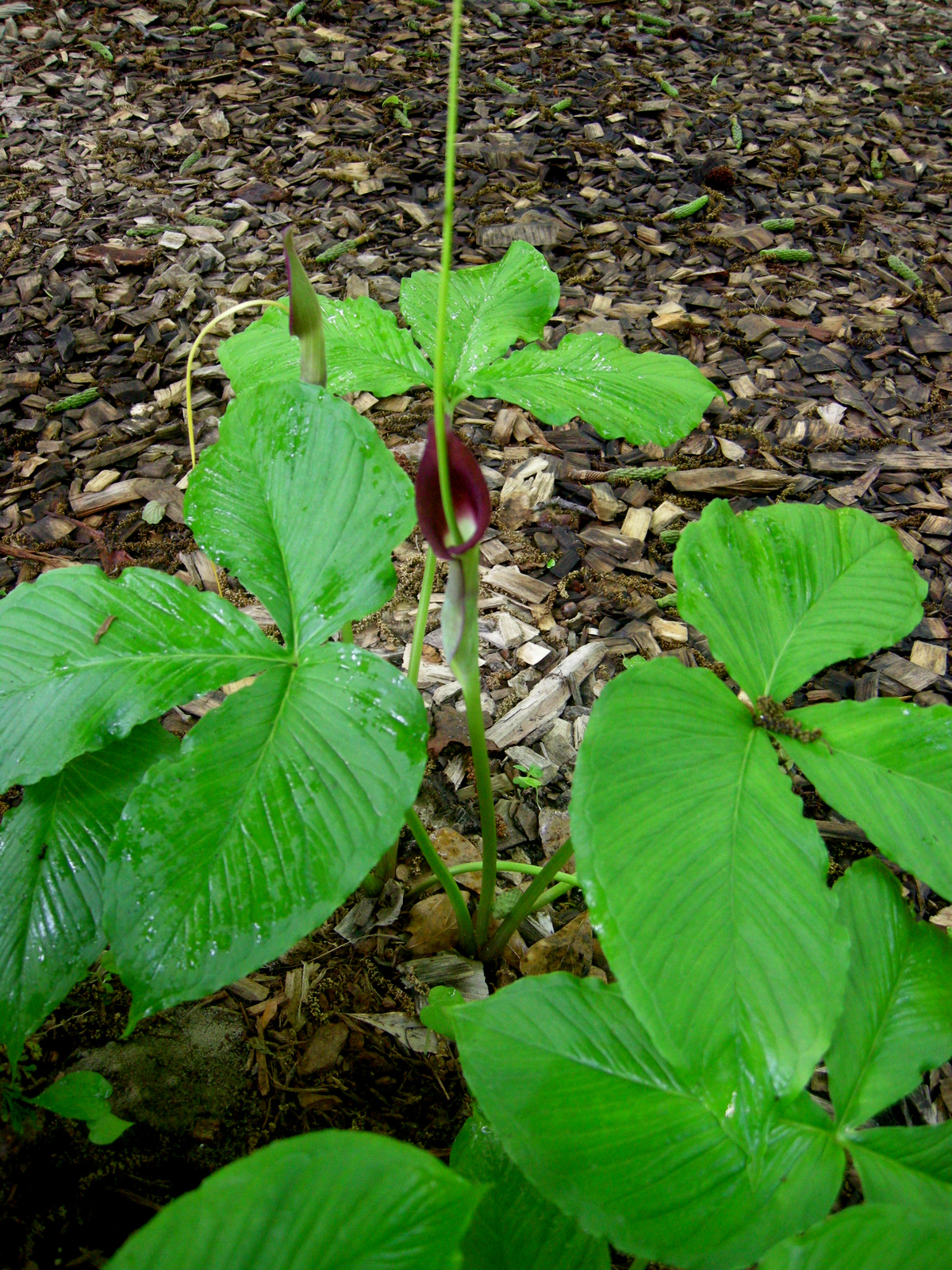
Pinellia tripartita ‘Atropurpurea’

.

Arisaema thunbergii

Arisaema thunbergii ‘Wakayama’

Farges’s cobra lily, Arisaema fargesii, a close up of the flower appears at the beginning of the article.

The leaves of Japanese cobra lily, Arisaema ringens, are immense.
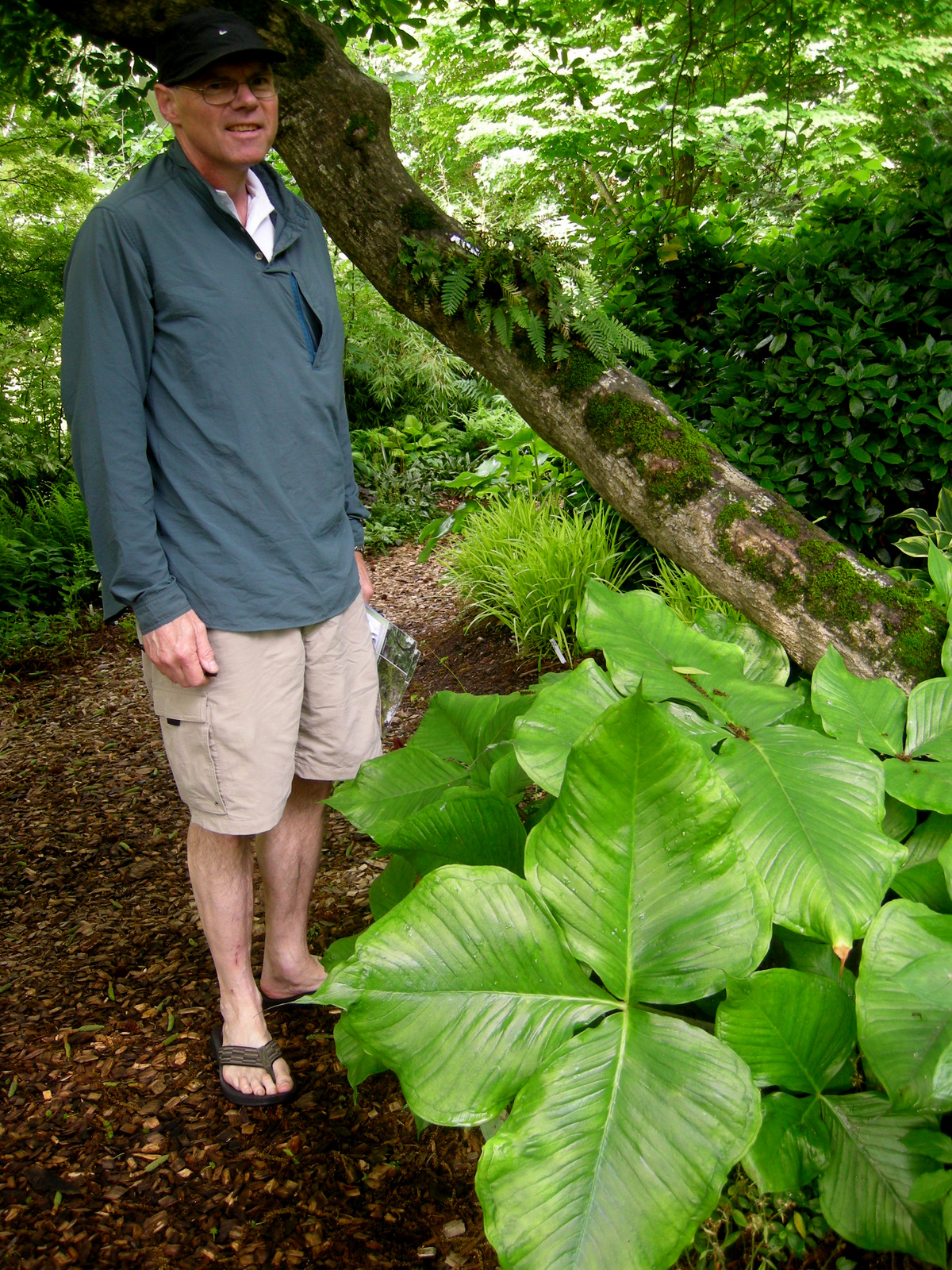
Here is Michael standing next to Arisaema ringens for scale.

I can’t imagine that Plant Delights’ collection of another of my favorites, mayapples, Podophyllum sp., can be surpassed:
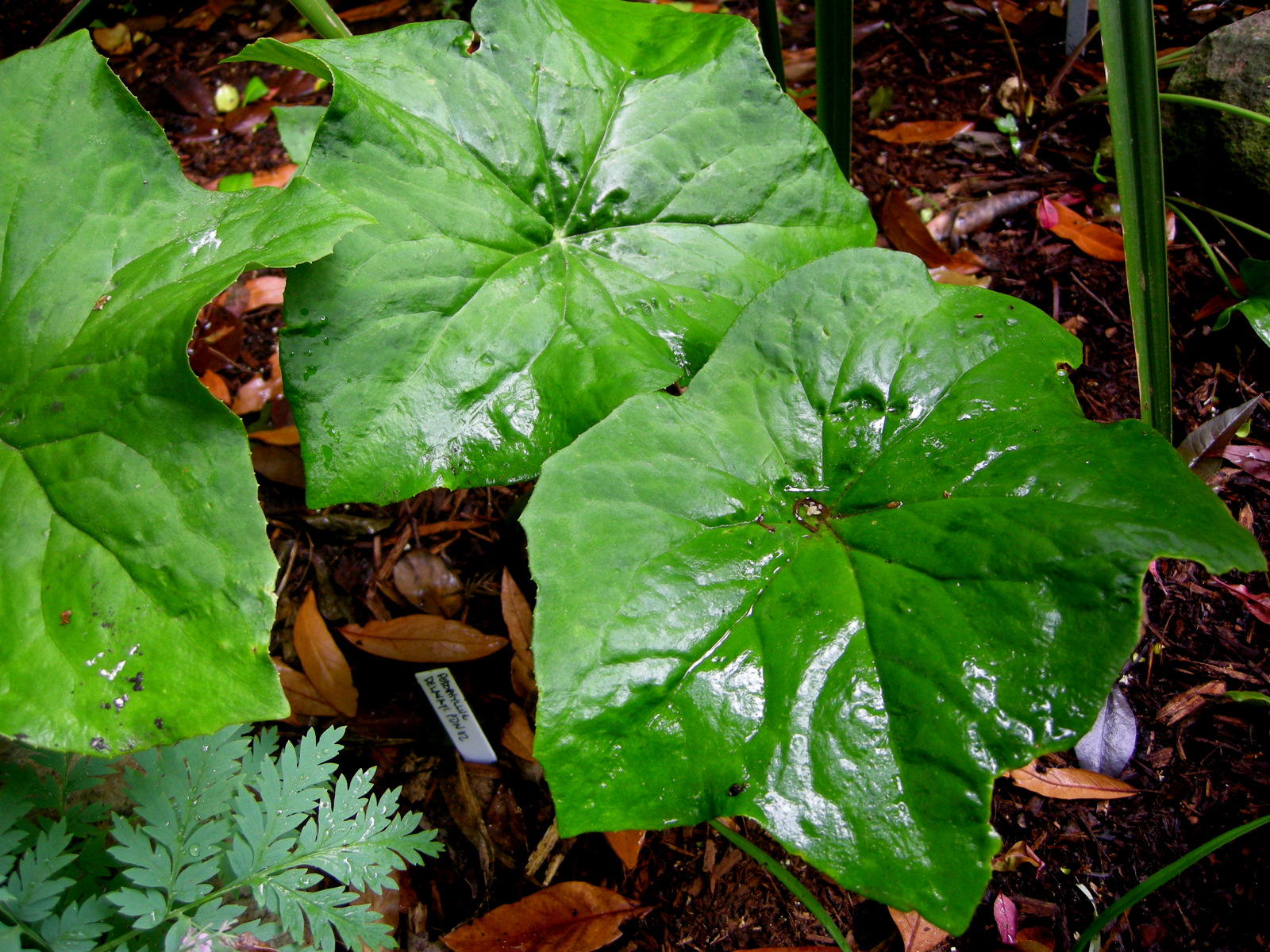
Chinese mayapple, Podophyllum delavayi

Chinese mayapple, Podophyllum versipelle

I had never seen the flowers of Podophyllum ‘Spotty Dotty’.
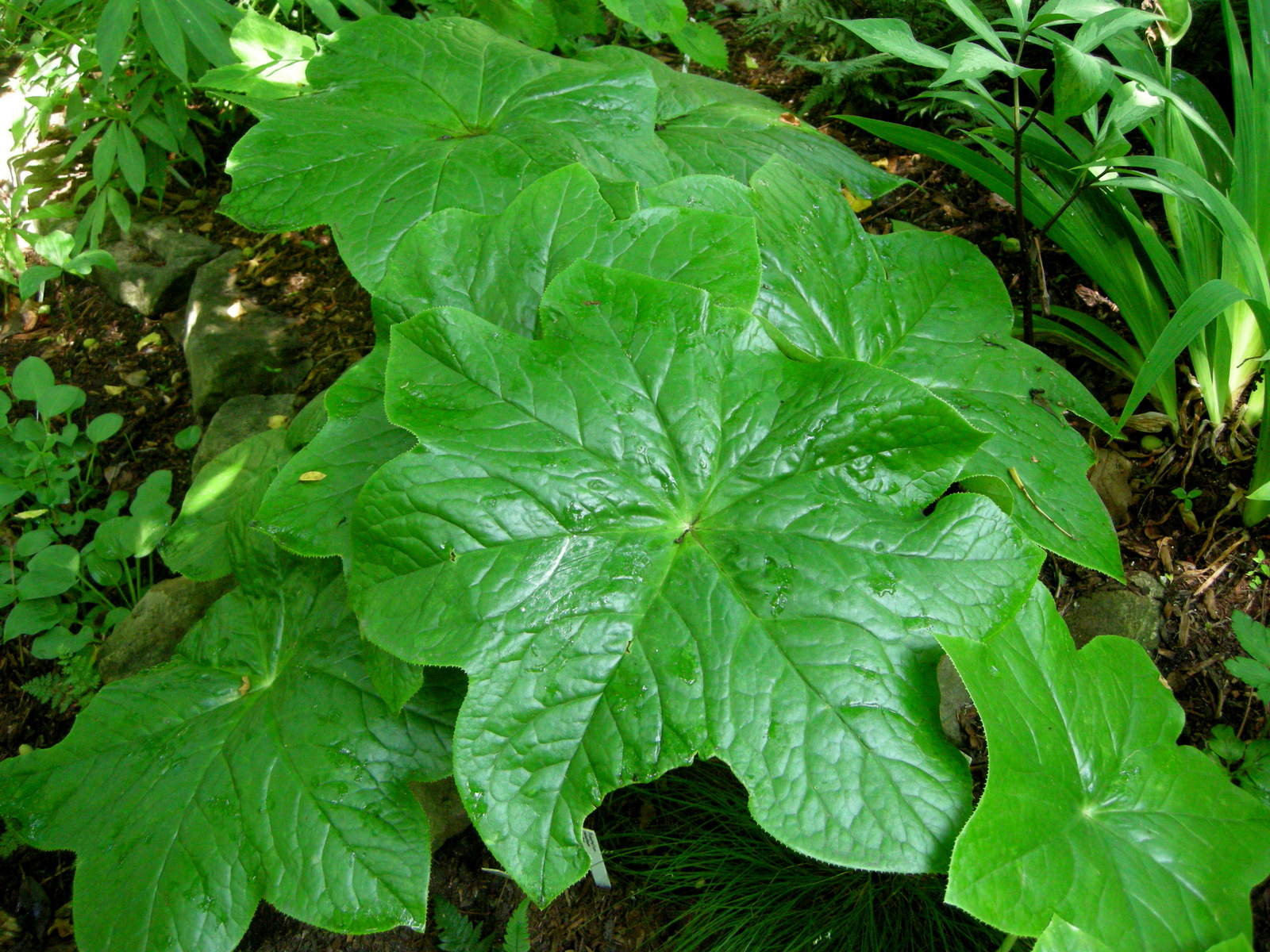
Chinese mayapple, Podophyllum pleianthum
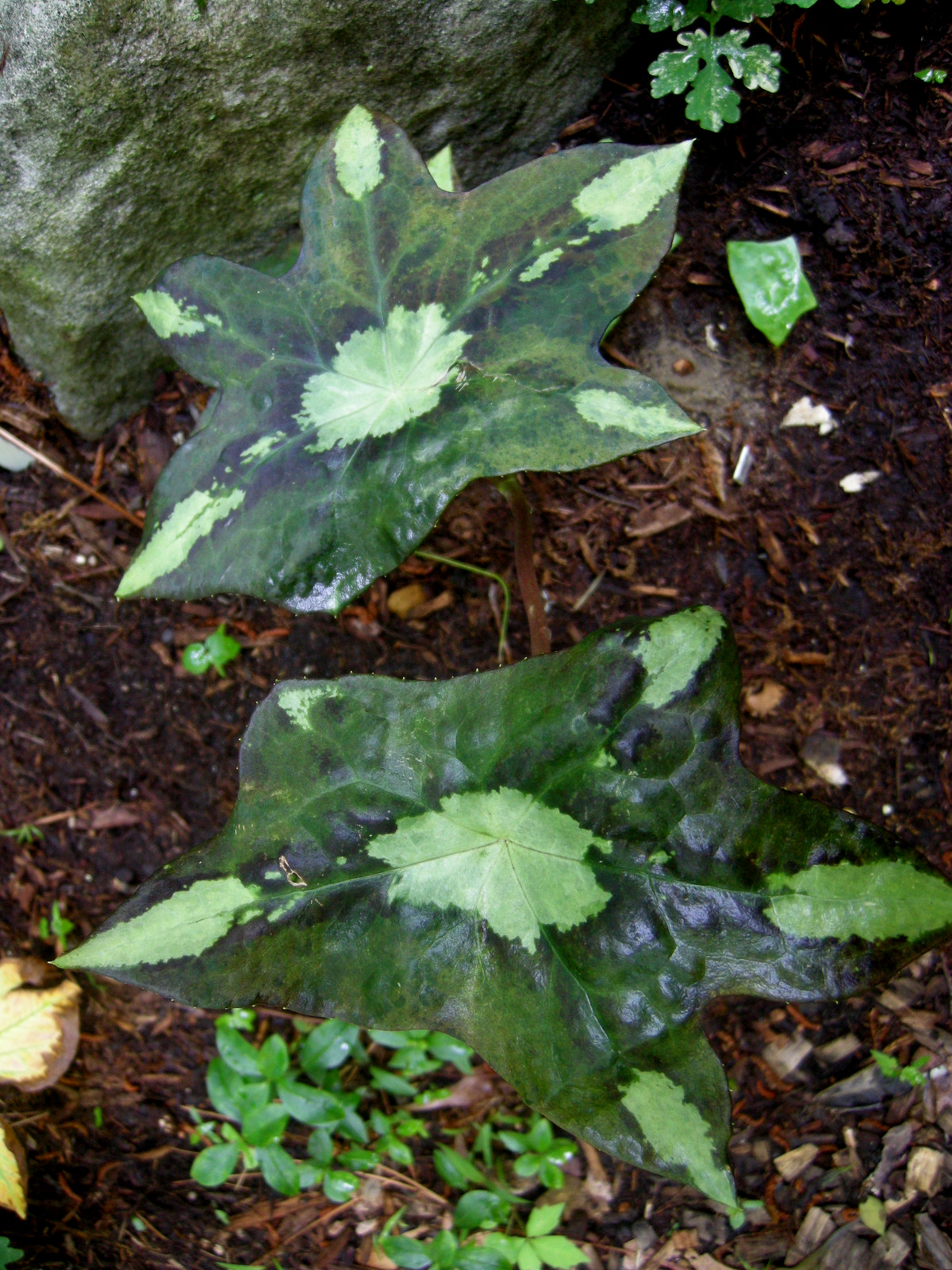
Chinese mayapple, Podophyllum difforme, looks like it should be growing on Mars.

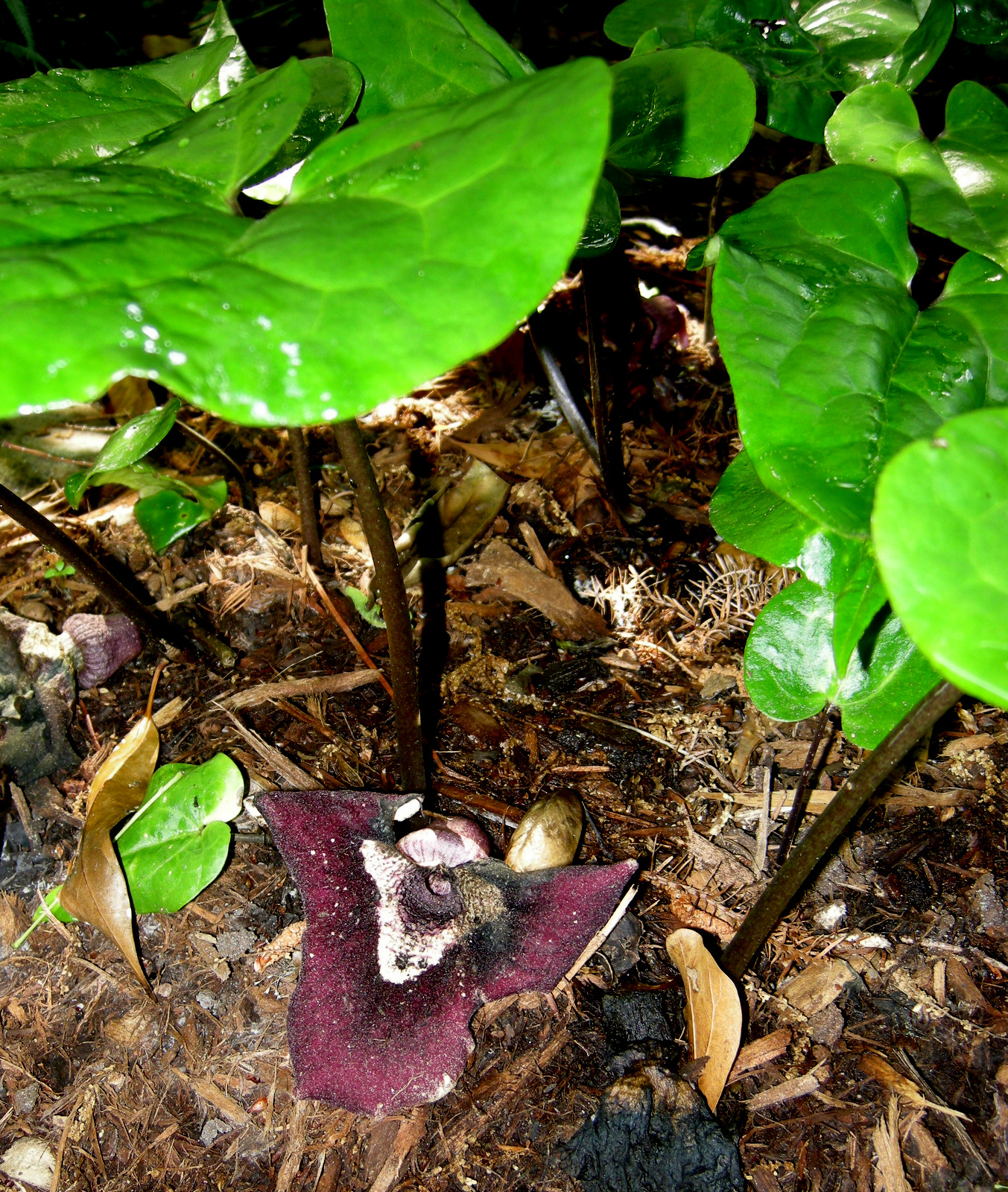
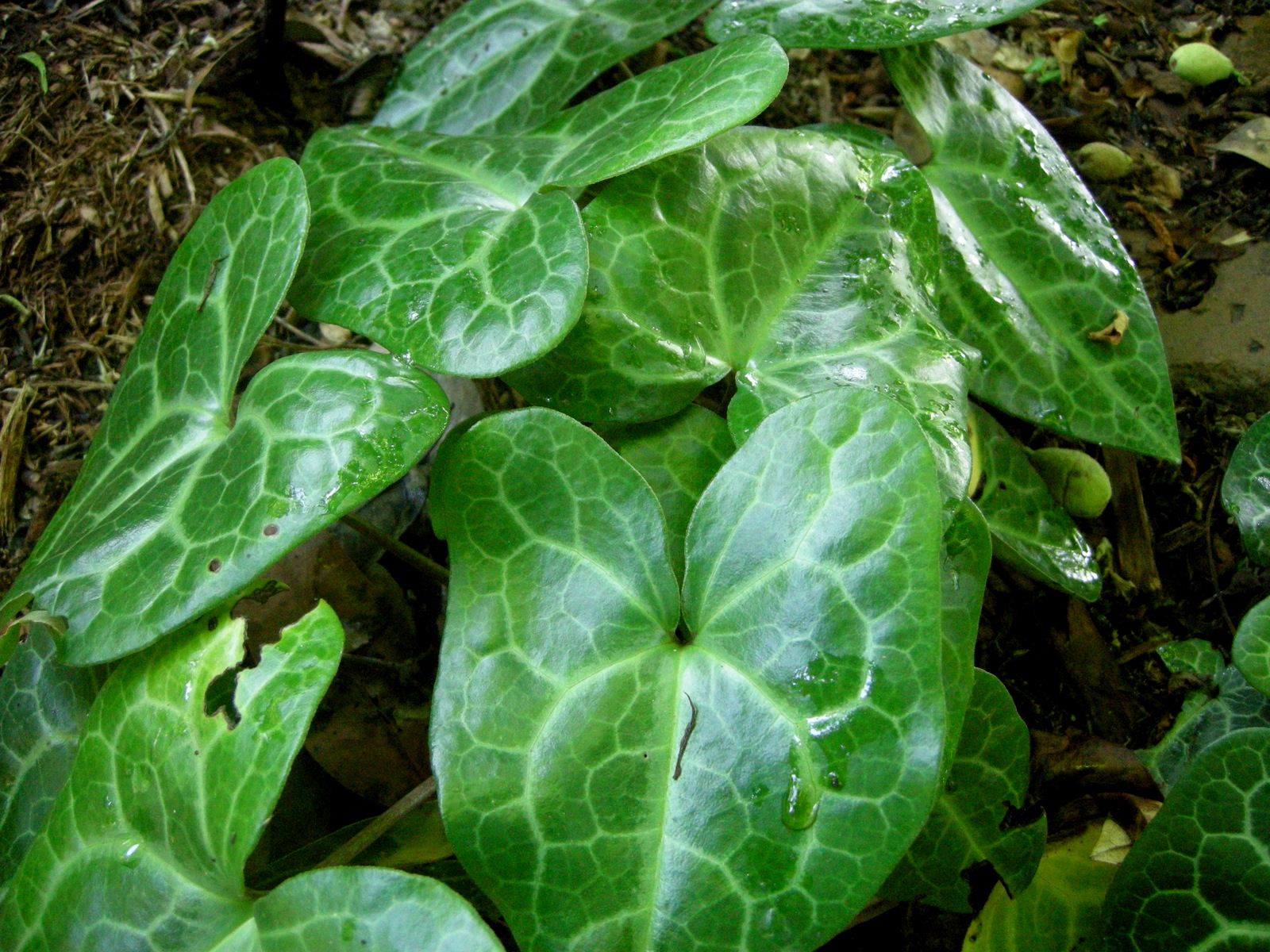
Plant Delights also has a comprehensive collection of wild gingers:
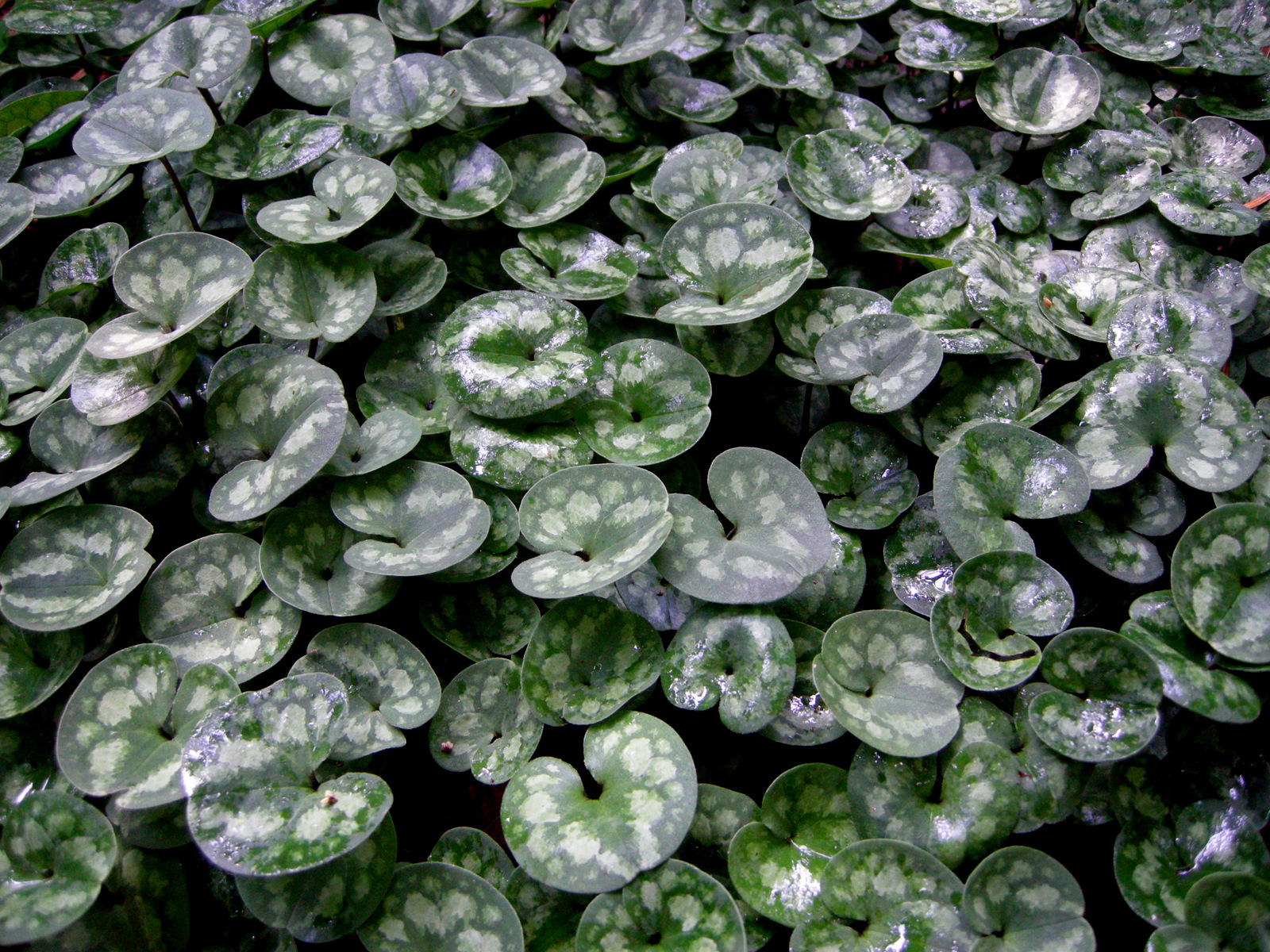
I wish my ‘Galaxy’ wild ginger, Asarum takaoi ‘Galaxy’, would grow like this.

Asarum takaoi ‘Sekkyo’

Asarum kumageanum

The flower of Asarum nobilissimum

Asarum maximum ‘Shell Shocked’

I found a number of other weird and wonderful shade plants that I would like to add to my gardens:
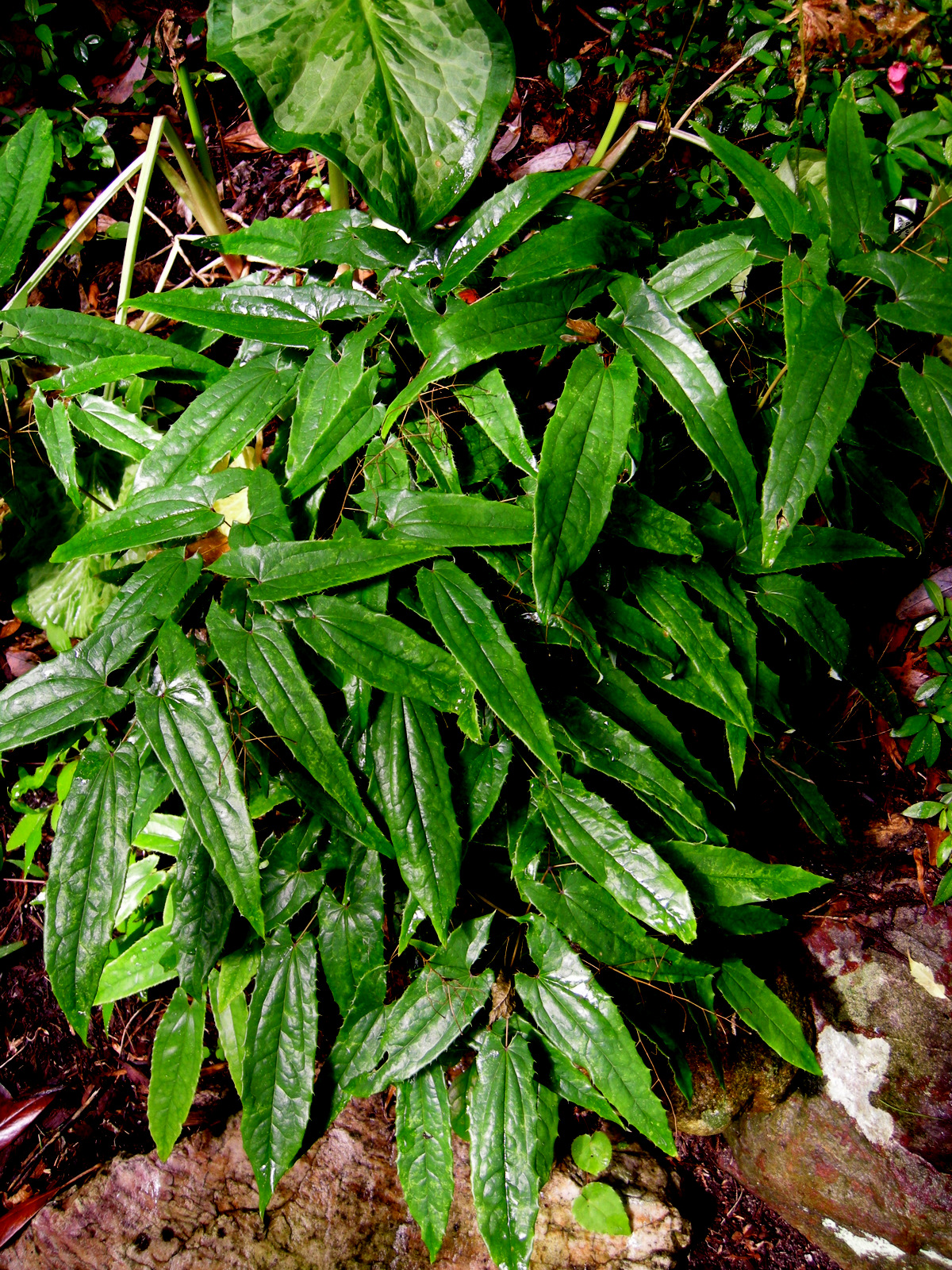
Barrenwort, Epimedium fargesii

Toad-lily, Tricyrtis ‘Lunar Eclipse’

Very rare Paris species labeled “Wavy Leaf”
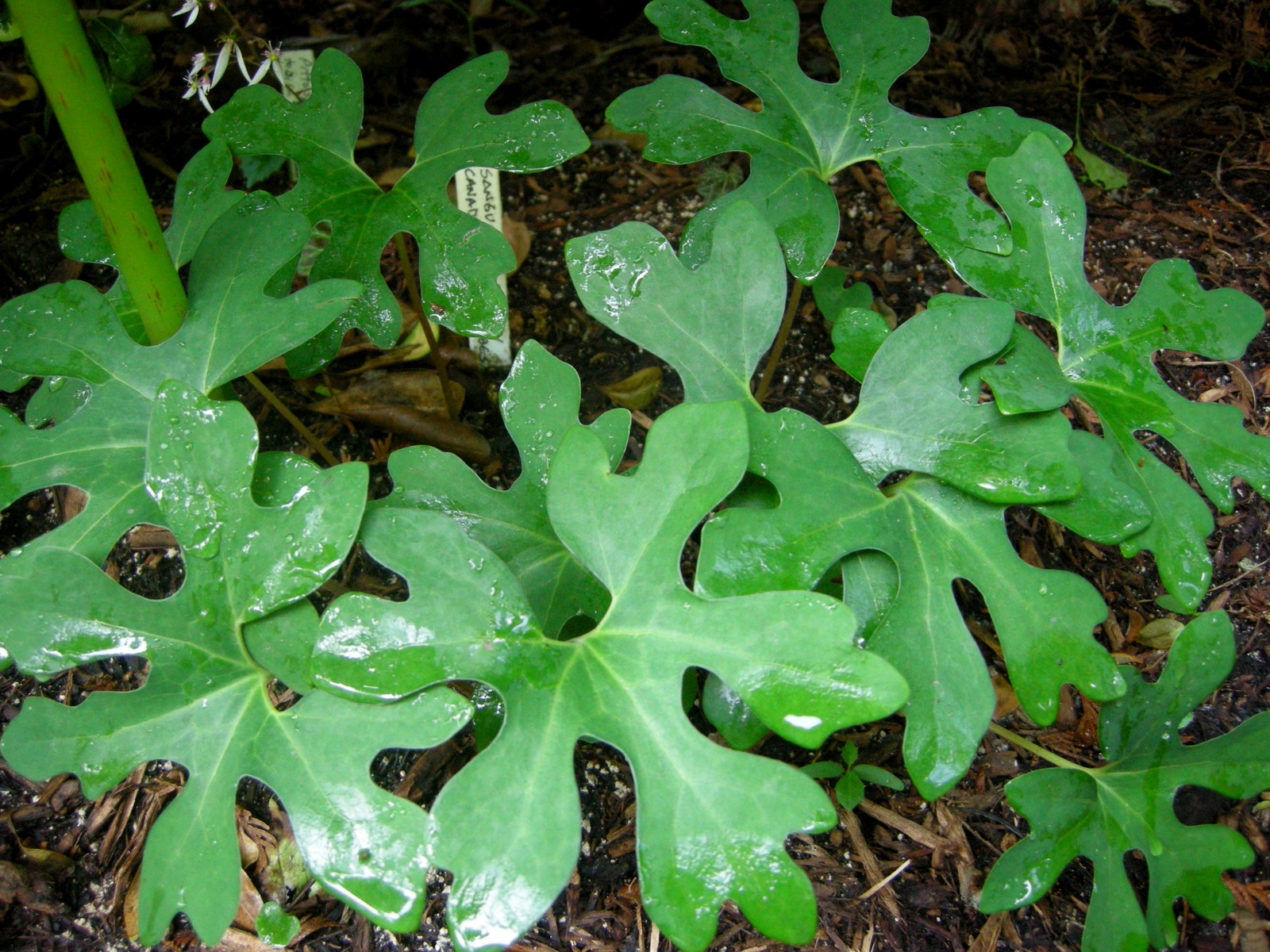
Native bloodroot, Sanguinaria canadensis “Deep Lobes”
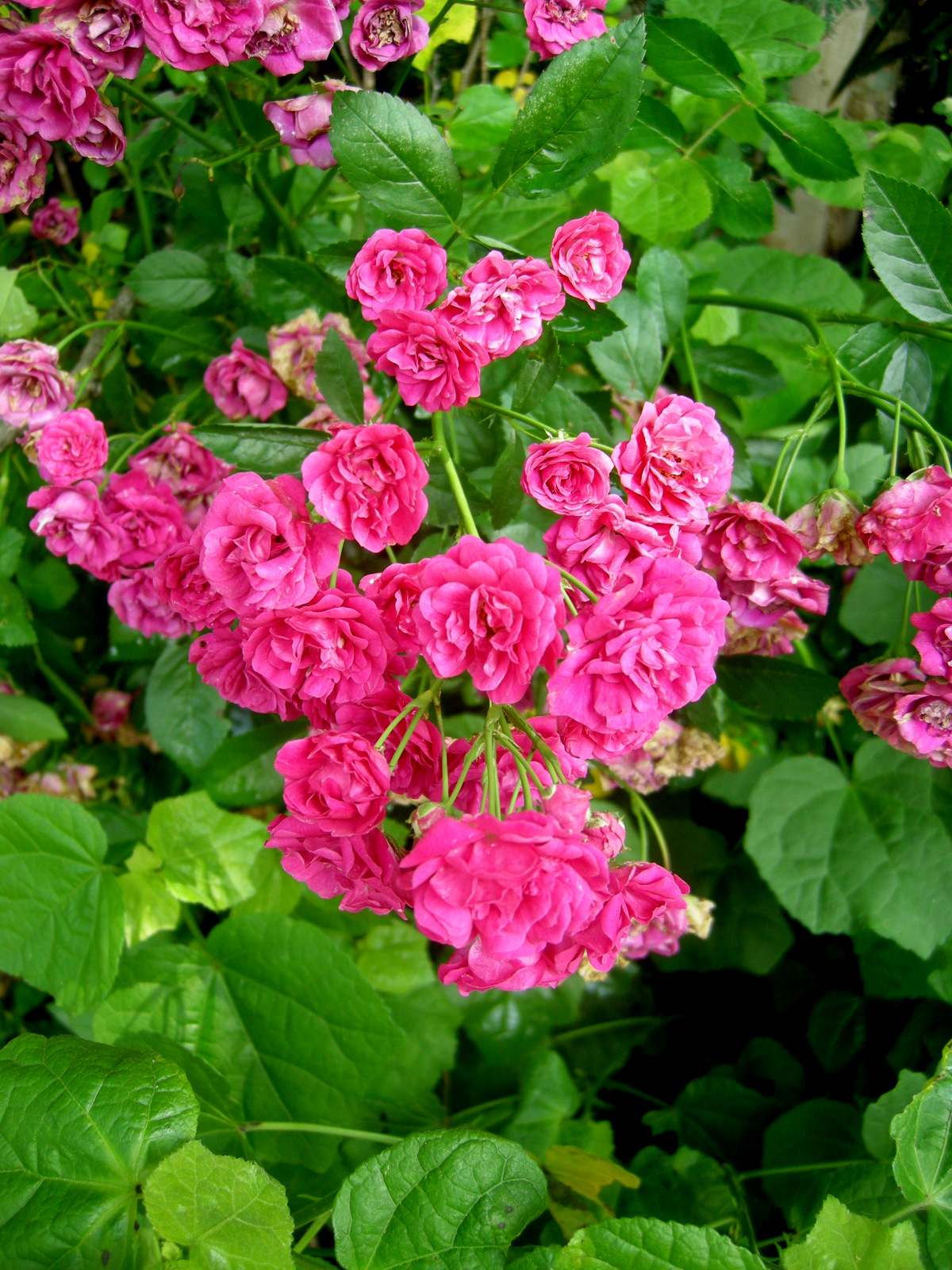
Rosa ‘Verdun’ was covered with flowers in full shade.
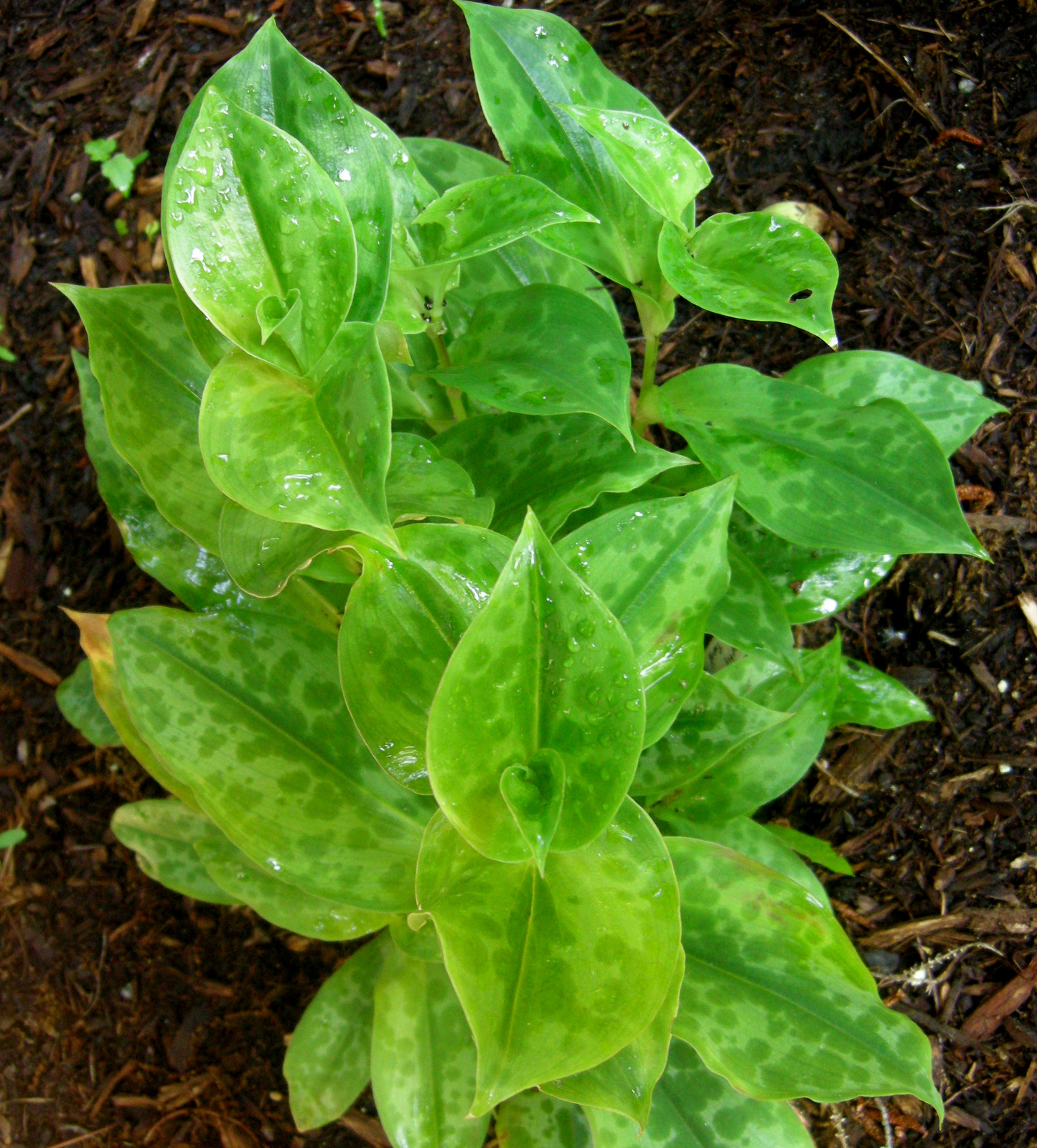
Toad-lily, Tricyrtis ‘Lemon Twist’

I was finally able to purchase a shredded umbrella plant, Syneilesis aconitifolia, which I have been coveting for years!

If you are in the area, I highly recommend that you visit the Juniper Level Botanic Gardens.  Plant Delights is open eight weekends a year for garden visits.  Their website lists the dates.  If you can’t visit then, you can always make an appointment.

Carolyn

Notes: Click on any photo to enlarge.  Every word that appears in orange on my blog is a link that you can click for more information.  If you want to return to my blog’s homepage to access the sidebar information (catalogues, previous articles, etc.), just click here.
 

North Carolina and Duke Gardens

Posted in garden to visit with tags , , on June 28, 2011 by Carolyn @ Carolyns Shade Gardens

Carolyn’s Shade Gardens is a retail nursery located in Bryn Mawr, PA, specializing in showy, colorful, and unusual plants for shade.  The only plants that we ship are snowdrops and miniature hostas.  For catalogues and announcements of events, please send your full name, location, and phone number (for back up use only) to carolyn@carolynsshadegardens.com.  Click here to get to the home page of our website for catalogues and information about our nursery and to subscribe to our blog.

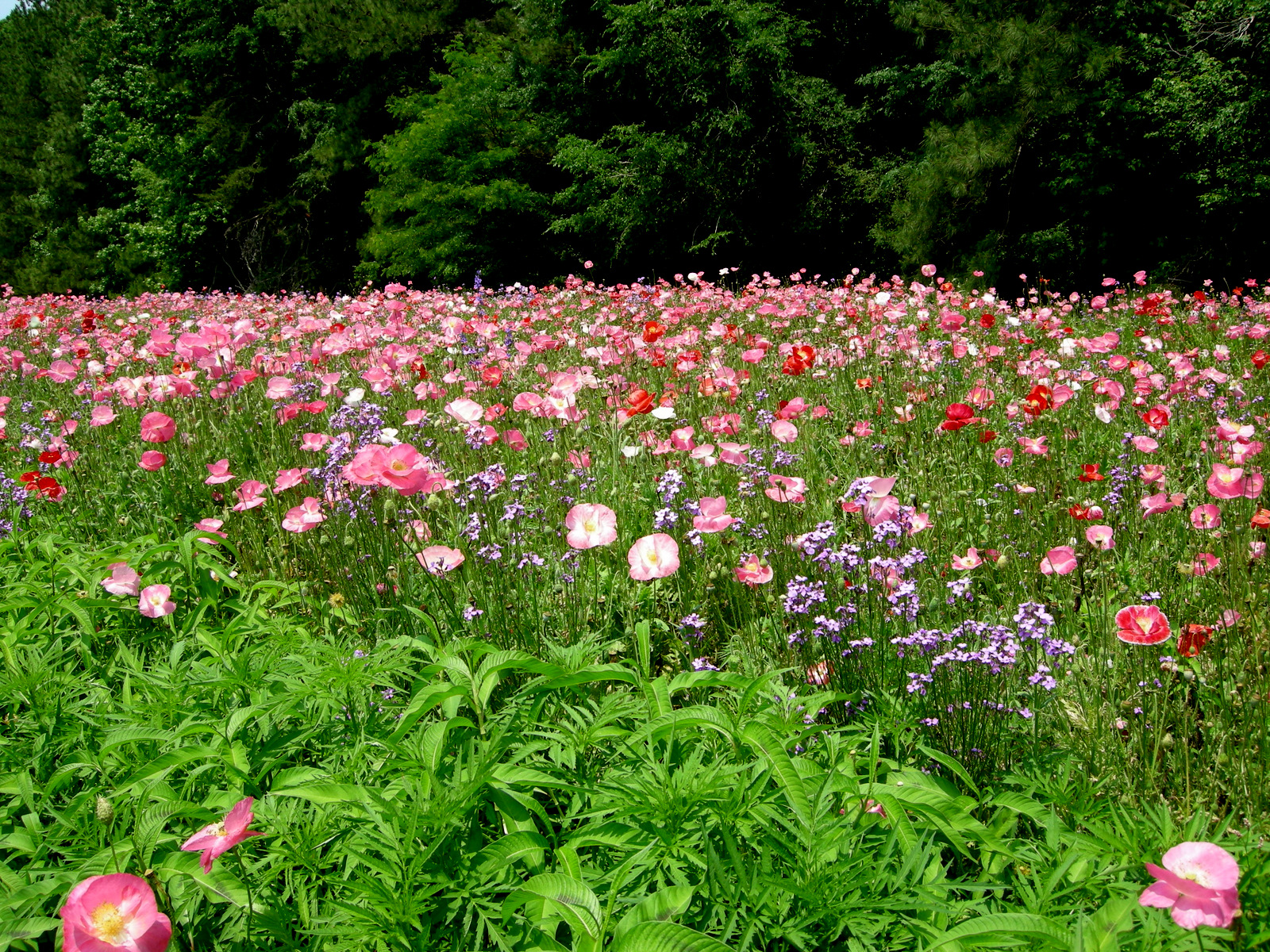
The interstate plantings of the North Carolina Highway Department are so beautiful that they could cause traffic accidents from the gawking of speeding gardeners.

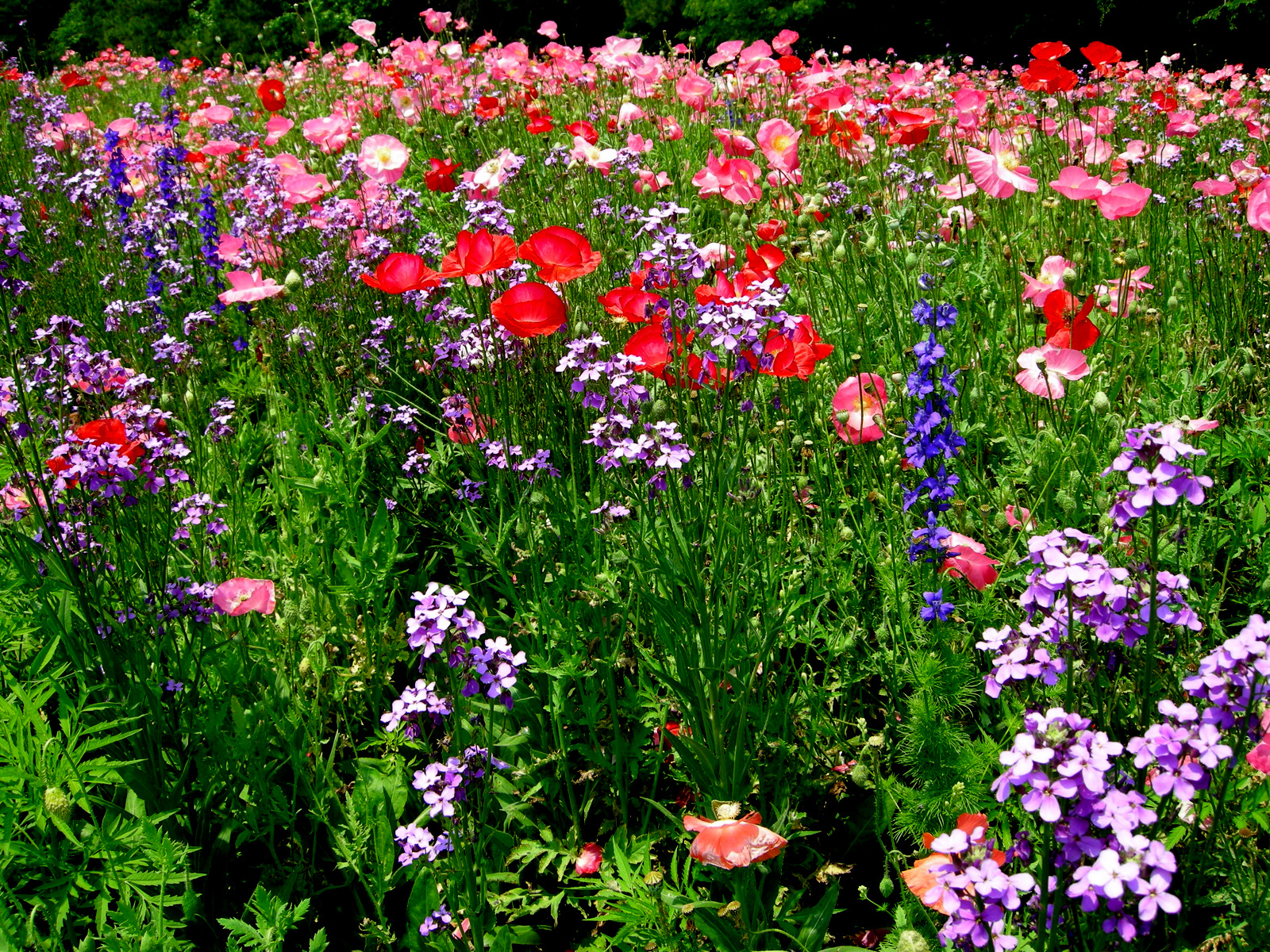
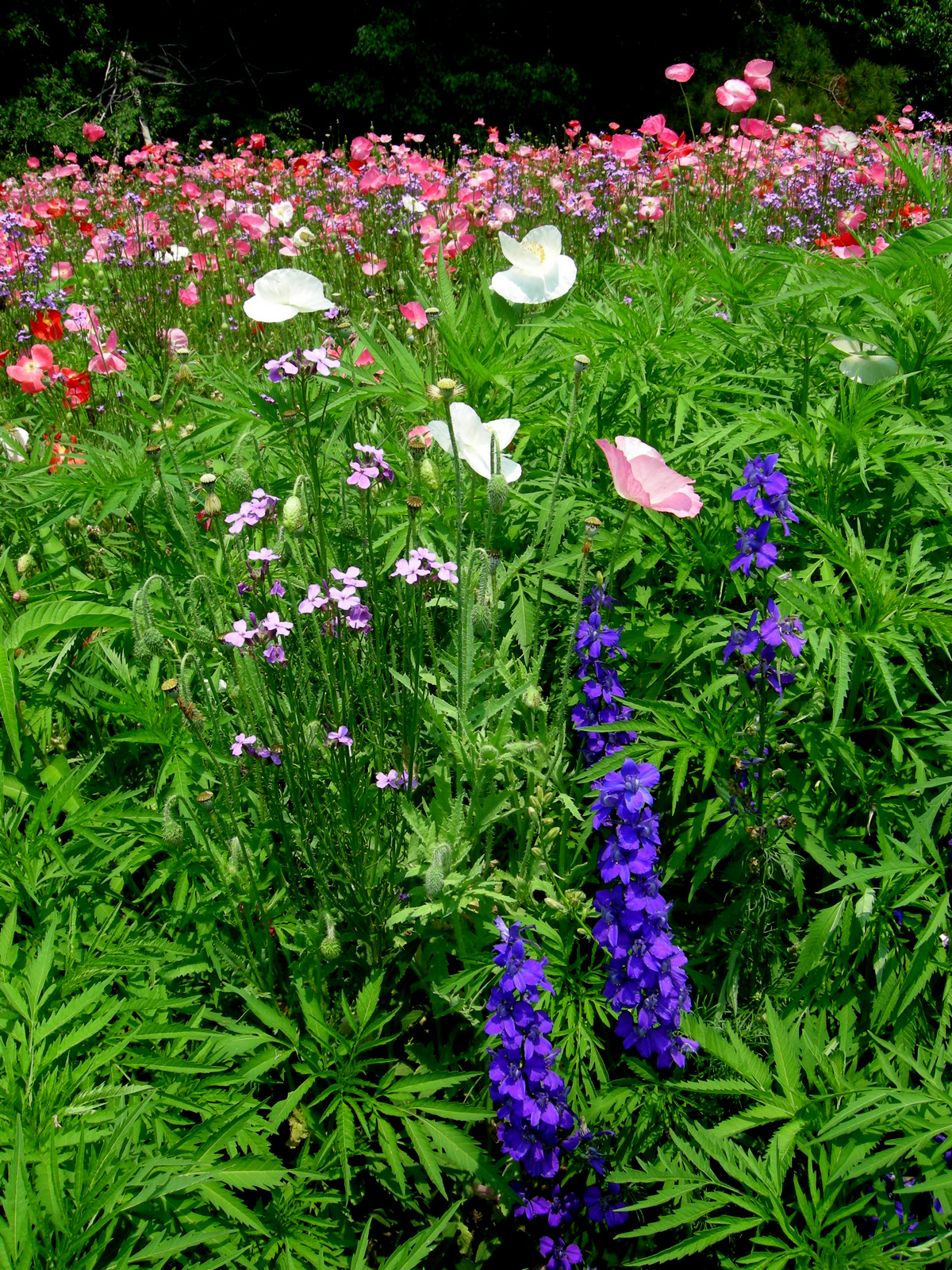
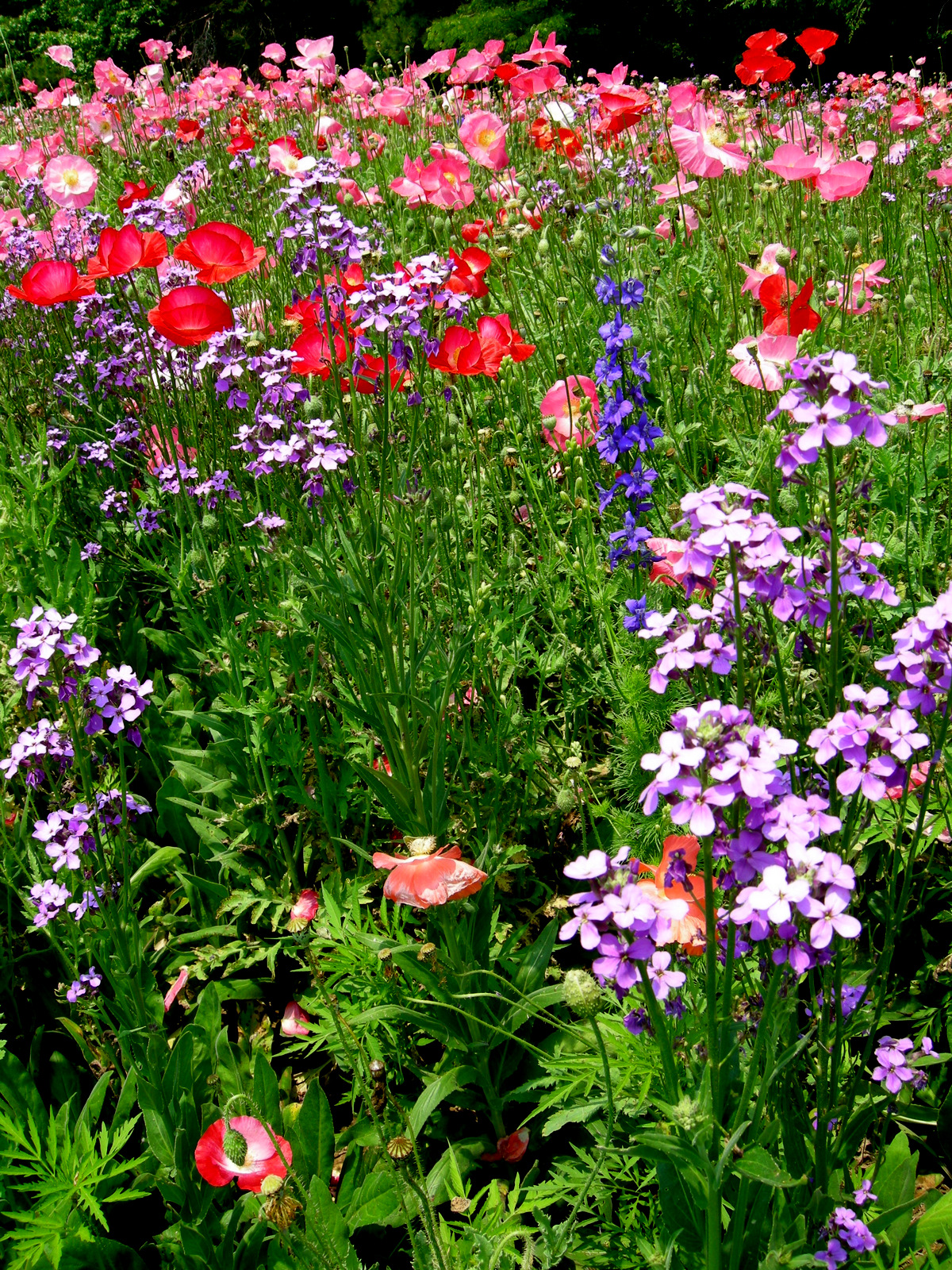
My oldest son just graduated from Elon University, in Elon, North Carolina.  My husband and I decided to make the graduation trip a mini-vacation so we spent four nights in Elon with two days dedicated to plants (of course).  Traveling to gardens around North Carolina is a pleasure due to the amazing roadside plantings installed by the highway department.  Instead of vast expanses of boring grass like we have in Pennsylvania, North Carolinians are treated to colorful displays of poppies, dame’s rocket, and larkspur.  Of course, it was an interstate so getting to the side to photograph the flowers was a hair-raising experience.  However, we made it:

One of our garden visiting days was spent at the Sarah P. Duke Gardens in Durham, North Carolina.  Duke Gardens is situated on 55 acres adjacent to Duke University’s West Campus and the Duke University Medical School.  The gardens opened in 1939, and today are comprised of four main areas: the historic terraced gardens, the native plant garden, the Asiatic Arboretum, and the Doris Duke Center for information and education.  We toured all four areas and found fascinating plants and enchanting sights everywhere we turned.

The first area, the Doris Duke Center and Gardens, encompasses the visitors’ center with educational facilities, a gift shop, and formal areas for events.  There was a wedding going on when we were there in the lovely gardens out back so we didn’t explore this part of the garden as much as we might have.

Behind the Doris Duke Center is a shady spring woodland garden.

Next to the woodland is a very interesting multi-level bog garden.

The second area, known as the Historic Gardens, is accessed down an impressive walk bordered by an allee of trees.  This area is the oldest and most formal part of the gardens with Italianate terraces full of annuals and perennials, a wisteria-covered pergola, a fish pool, a rock garden, and much more.  We ate lunch in the small shaded courtyard of the charming Terrace Cafe.

Formal entrance walk to the Historic Gardens.

The entrance walk leads to the rose garden.

The South Lawn area was filled with picnickers and surrounded by majestic southern magnolias, M. grandiflora, in full bloom.  As a northerner, I was captivated by the size and beauty of these trees, which were everywhere in NC.

The flower buds of southern magnolias are huge.

The flowers are breathtaking.

The rock garden area in the Historic Gardens.

The Iris Walk and Bridge.

I love these textures and colors.


The Terrace Cafe is in an elegant stone building surrounded by lovely shade gardens.  Out back is a  stone courtyard with outdoor seating.

The third area of Duke Gardens, and my favorite, is the H.L. Blomquist Garden, featuring over 900 species of regional natives.  The plants are very well-labeled and displayed, making it an excellent resource for gardeners interested in adding natives to their landscape.  The shady paths meander through lovely stands of  trees and shrubs underplanted with shade-loving groundcovers.

The gatehouse at the entrance of the H.L. Blomquist Garden.

Path on the hillside above the Blomquist Pavilion.

There were many mature loblolly pines, Pinus taeda.

The bark of loblolly pines is gorgeous.

This is the biggest oakleaf hydrangea, H. quercifolia, I have ever seen.

I was especially taken with this shady groundcover known as beetleweed, Galax urceolata.

I also wish this wild ginger or heartleaf, Hexastylis lewisii, would grow as a groundcover in my garden.

Duke Gardens is huge and by the time we got to the fourth area, the W.L. Culberson Asiatic Arboretum, we were pretty hot and tired so not many photos were taken.  There are over 1.300 Asian species and cultivars in this collection.

A great blue heron looks for fish in the Asiatic Arboretum’s large pond with the red Ayamebashi or Iris Bridge in the background.

The shrub collection in the Asiatic Arboretum is extensive with many I had never seen before, including this large spider azalea, Rhododenron macrosepalum.

I was captivated by the orange flowers and evergreen-looking leaves on this pomegranate, Punica granatum ‘Madame Lagrelle’ (thanks for the ID help) .

I wanted to include a close up of the flowers for my good friend Donna at Garden Walk Garden Talk.  I think she may want to plant this shrub next to her orange iris!

I hope you have enjoyed your virtual tour of the Sarah P. Duke Gardens.  If you are ever in North Carolina, it is definitely worth a real visit.  I have added a link to my sidebar under Places to Visit so you will always be able to find it.

Carolyn


Notes: Click on any photo to enlarge.  Every word that appears in orange on my blog is a link that you can click for more information.  If you want to return to my blog’s homepage to access the sidebar information (catalogues, previous articles, etc.), just click here.


Nursery Happenings:  The nursery is closed until it cools off in the fall around the middle of September.  If you are on my customer email list, look for an email.  If not, sign up by sending an email to carolynsshadegardens@verizon.net with your name and phone number.

Supporting Sustainable Living: Part Two

Posted in green gardening, organic gardening, sustainable living with tags , , , , on June 21, 2011 by Carolyn @ Carolyns Shade Gardens

Carolyn’s Shade Gardens is a retail nursery located in Bryn Mawr, PA, specializing in showy, colorful, and unusual plants for shade.  The only plants that we ship are snowdrops and miniature hostas.  For catalogues and announcements of events, please send your full name, location, and phone number (for back up use only) to carolyn@carolynsshadegardens.com.  Click here to get to the home page of our website for catalogues and information about our nursery and to subscribe to our blog.

My efforts to establish native Indian pink, Spigelia marilandica, have really paid off.  Nevertheless, I covet this six-year-old stand at Chanticleer.

In my articles My Thanksgiving Oak Forest and Supporting Sustainable Living: Part One, I explained that sustainable living is very important to me, and I have supported it through planting and promoting native plants like the Indian pink pictured above, gardening organically, not watering, replenishing the soil, composting, eliminating lawn, and initiating and running an invasive plant removal program, among other activities.  I also explained that I am uniquely placed to have a wider impact through my interactions with gardeners at my nursery.

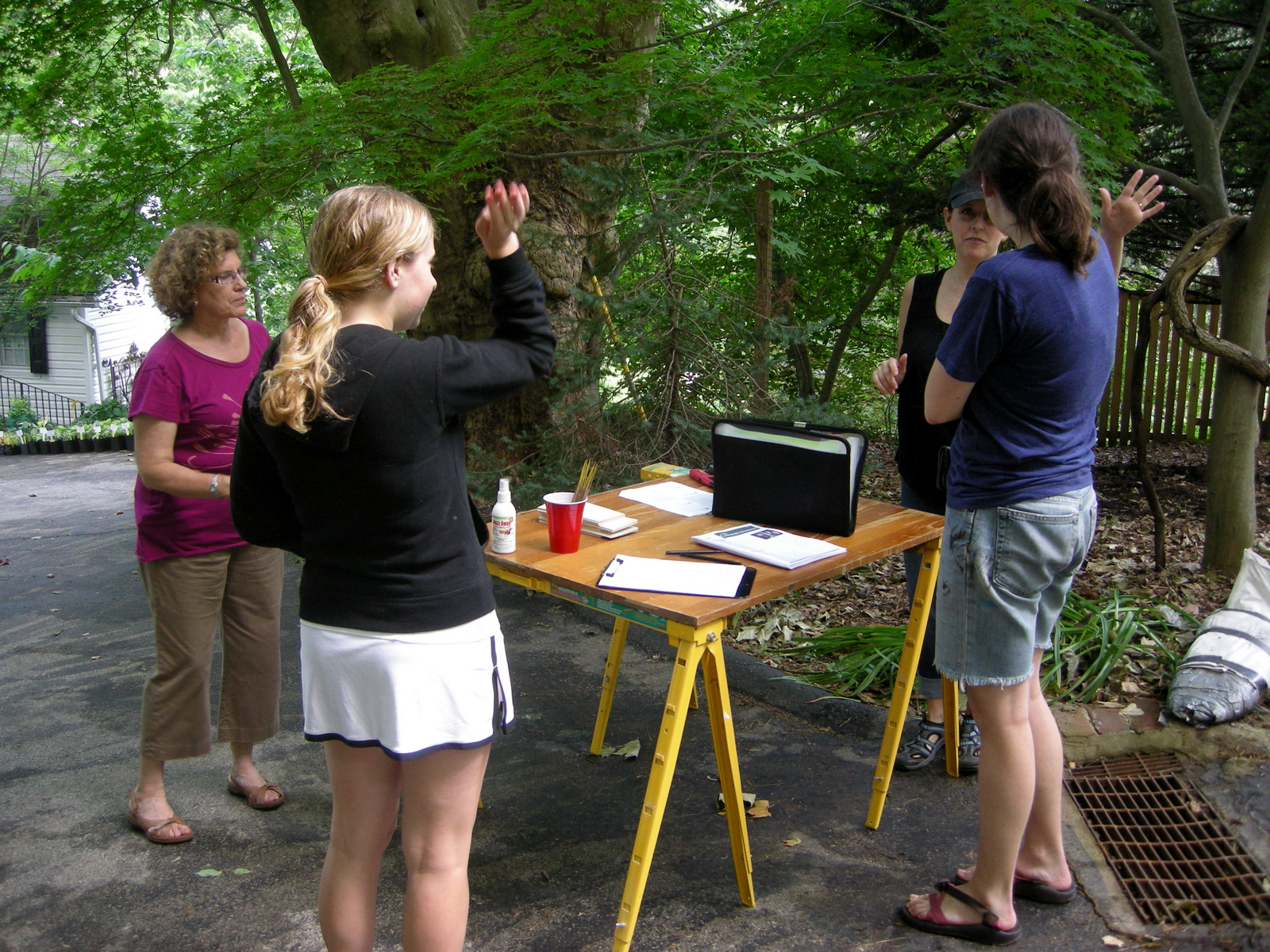
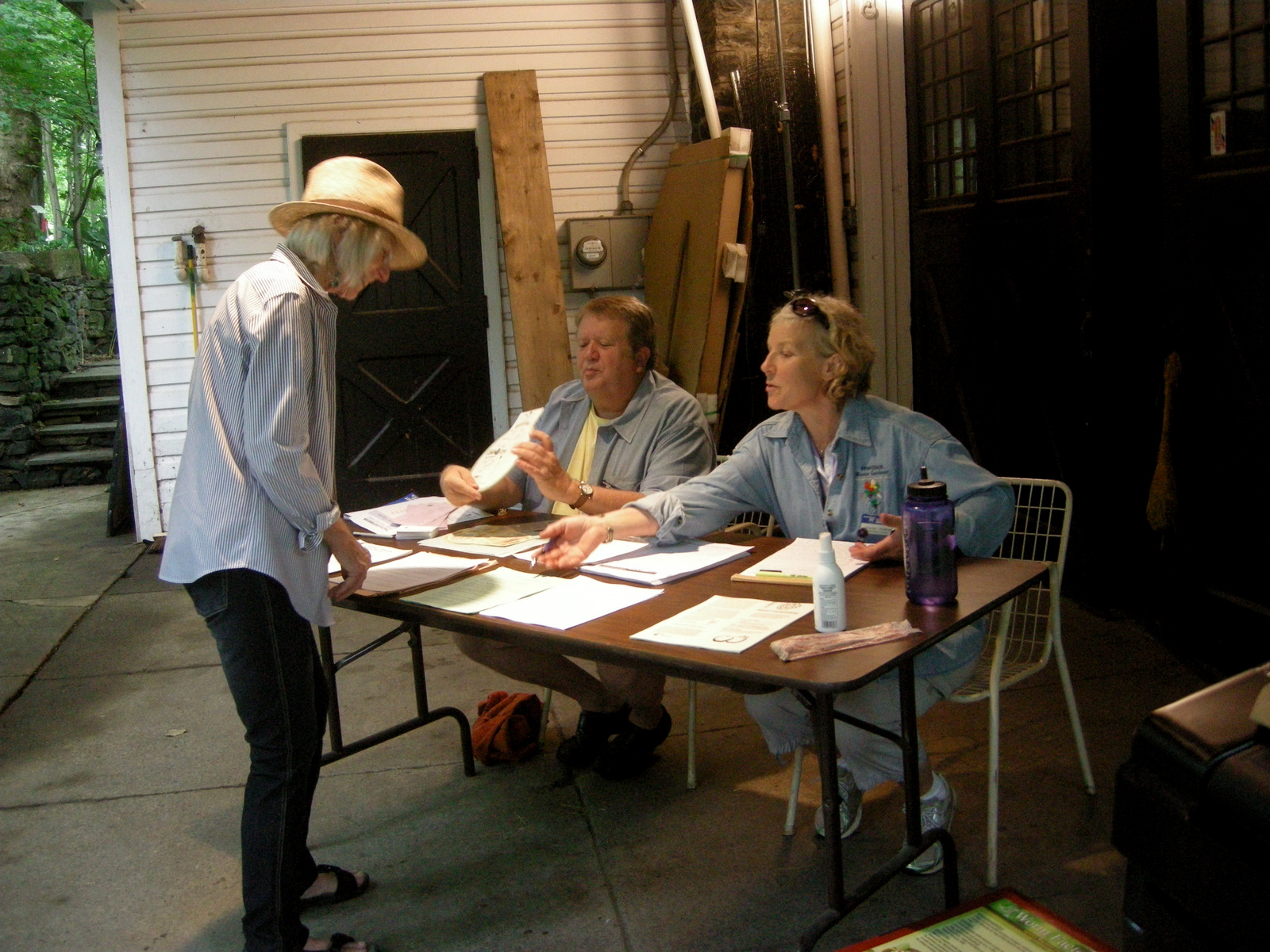
The check in table at the Conservancy event.  These young women came specifically to talk with the Lyme disease expert.

In my article Powered By Compost, I described a composting event to be held at my nursery sponsored by the Radnor Conservancy (dedicated to the preservation of open space) to raise township residents’ awareness of the magical powers of compost.  Reader response to this article was very high so I thought everyone might like to find out how the event went.  I also wanted to highlight my latest venture into sustainability–honeybees.

In Radnor Township where I live, we are blessed with the best free municipal compost in the whole area, if not the whole state of Pennsylvania.  The first station at the Conservancy event showed how to transport township compost to your home without renting a truck or messing up your car.  I thought their solution was very clever:

Event organizers demonstrate loading compost into a minivan.

The vehicle is protected from the compost by a blue tarp (how could we function without those?) attached to the side of the van with large orange wood clamps.

There was a lot of interest in the Conservancy’s method of transporting compost.

Two Master Gardeners from the Penn State Cooperative Extension Service were busy all day explaining composting using an outdoor bin and indoor composting with red worms.  They brought sample bins for attendees to explore:

Penn State Master Gardeners under the carport of our carriage house explaining bin composting.

My husband Michael was stationed in the manure pit profiled in Powered By CompostHe explained our laissez faire method of producing compost by piling up kitchen waste, leaves, and garden refuse in the pit and turning it about three times a year.  Participants were very interested:

Michael explains that composting does not have to be complicated to another set of interested attendees.

Michael has had Lyme disease seven times with serious long term implications for his health so the prevention information provided by Doug Fearn, president of the Lyme Disease Association of Southeastern Pennsylvania, was especially near and dear to my heart.  This is an unpublicized epidemic in the U.S. and should be taken very seriously:

Doug Fearn explaining various Lyme disease prevention techniques.

As promised, delicious refreshments of homemade brownies and chocolate chip cookies accompanied by mint iced tea were provided on my deck:

A fun and informative afternoon was had by all!

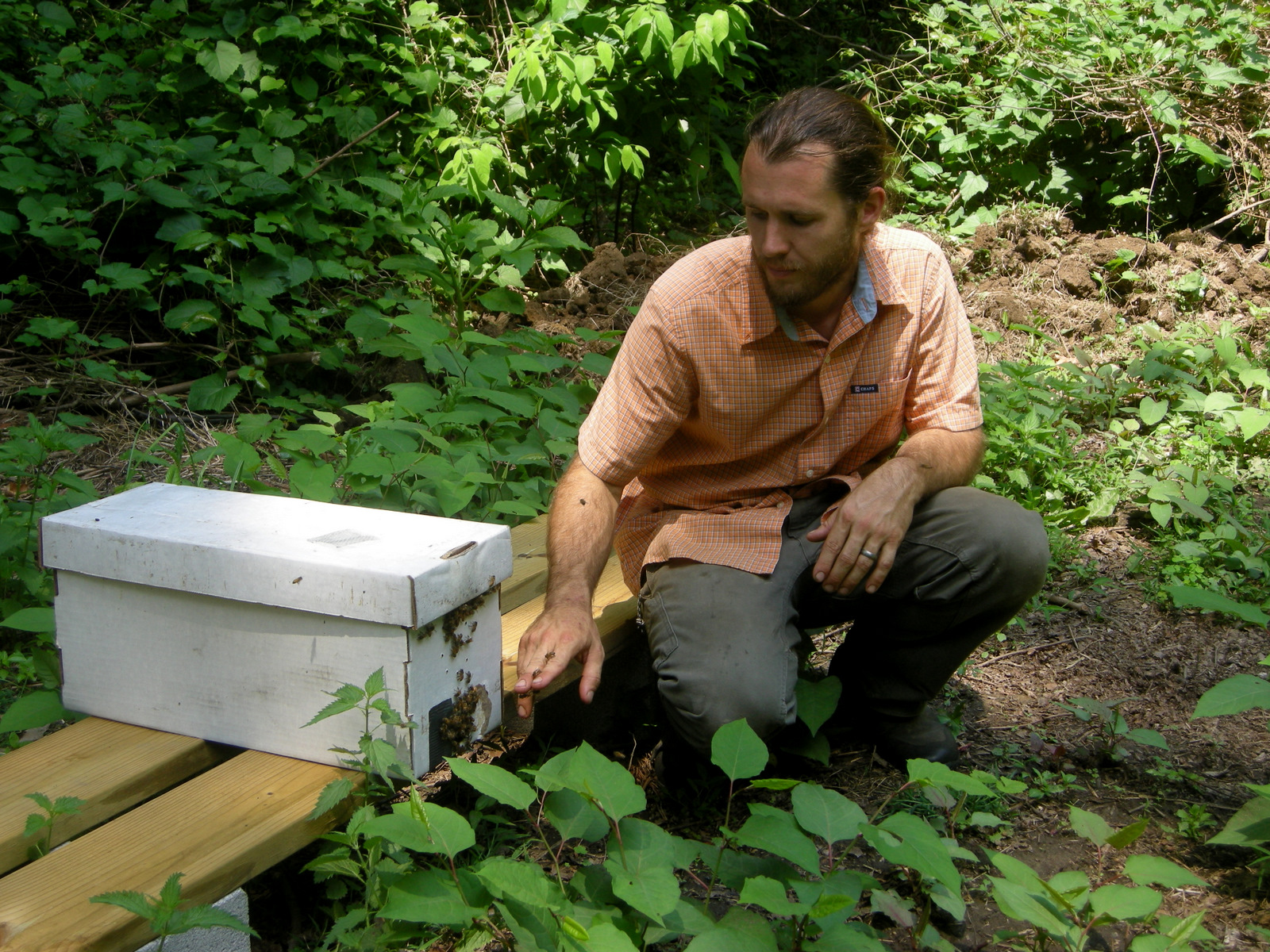
Trey Flemming from Two Gander Farm and the Bryn Mawr Farmer’s Market places the first hive at Carolyn’s Shade Gardens.

The other “sustainable” event at Carolyn’s Shade Gardens lately was the arrival of the first hive of honeybees.  I have been trying unsuccessfully for quite a while to convince Michael that beekeeping was in his future.  Knowing when to pick up my marbles and go home, I switched my efforts to finding a local beekeeper who might want to place hives at Carolyn’s Shade Gardens.  This spring I sold plants at my town’s growers’ farmer’s market, the Bryn Mawr Farmer’s Market, and met Trey Flemming, a beekeeper and farmer from Two Gander Farm in Fleetwood, Pennsylvania.

Trey demonstrates the docility of his bees.

I purchased some delicious honey that Trey produces from an invasive nonnative plant that I constantly battle, Japanese knotweed.  Having a quarter acre of this noxious invader, I thought Trey might be interested in placing some hives here, and he was.  This week the first of three hives arrived.  Trey will market this honey at the Bryn Mawr Farmer’s Market as local Bryn Mawr honey, and I will receive five pounds of honey and the gratification of supporting a local farmer: a win, win situation if there ever was one!

The bees crawl in and out of the hive and over Trey’s hand with their future nectar source, Japanese knotweed, in the foreground.

I am so thrilled to be given the opportunity to support the Radnor Conservancy, composting, and a local farmer.  It just takes the accumulation of small efforts by each of us to contribute to sustainable living in a big way.

Carolyn

Notes: Every word that appears in orange on my blog is a link that you can click for more information.  If you want to return to my website’s homepage to access the sidebar information (catalogues, previous articles, etc.), just click here.
Nursery Happenings: The nursery is closed until it cools off in the fall around the middle of September.  If you are on my customer email list, look for an email.  If not, sign up by sending an email to carolynsshadegardens@verizon.net with your name and phone number.

June GBBD: Baby It’s Hot Outside

Posted in Garden Blogger's Bloom Day, landscape design, native plants, Shade Shrubs with tags , , on June 14, 2011 by Carolyn @ Carolyns Shade Gardens

Carolyn’s Shade Gardens is a retail nursery located in Bryn Mawr, PA, specializing in showy, colorful, and unusual plants for shade.  The only plants that we ship are snowdrops and miniature hostas.  For catalogues and announcements of events, please send your full name, location, and phone number (for back up use only) to carolyn@carolynsshadegardens.com.  Click here to get to the home page of our website for catalogues and information about our nursery and to subscribe to our blog.

Yes, it really is that color: herbaceous peony ‘America’.

Even though it is not technically summer yet, we have been hit with weather that my twenty-year-old son informed me is more suitable for August.   Six of the last eleven days (as of June 10) have been over 90 degrees, and on June 9 it topped 97 degrees (36 degrees C).  Nevertheless, we have reached the middle of the month when I encourage each of you to walk around your garden and assess what you need to add to make early summer an exciting time in your landscape.  Do you need more flowering trees, shrubs, and vines to give you a reason to stroll in your garden?  Could your garden benefit from more perennials that bloom in June after the spring rush?

Native hybrid false indigo, Baptisia x variicolor ‘Twilite Prairieblues’, provides a cool oasis for the eyes.


Spiny bear’s breeches, Acanthus spinosus

Make a list and take photographs so that when you are shopping for plants you know what you need and where it should go.  It’s beautiful outside now that the temperatures have dropped back into the 70s and low 80s (June 11), and you never know what you might find waiting in your garden like the jaw-droppingingly beautiful red peony (photo at top), which I photographed during my own  inventory.

Clematis ‘Warsaw Nike’ on an antique church gate.

Native hummingbird magnet Indian pink, Spigelia marilandica.

June 15 is Garden Blogger’s Bloom Day for June when gardeners around the world show photos of what’s blooming in their gardens (follow the link to see  photographs from other garden bloggers assembled by Carol at May Dreams Gardens).  Here are  some more highlights from my June stroll through Carolyn’s Shade Gardens:

Sicilian honey lily, Nectaroscordium siculum ssp. bulgaricum, just appeared in my garden one day, but I am glad it did.

Readers really enjoyed my photos of woody plants–trees, shrubs, and vines–so I have been photographing every woody plant that has come into bloom since May 15.  Most have finished blooming now due to the excessively hot temperatures, but I am including them anyway.  Let’s start with the trees.  You know by now that I love magnolias so here are my last three:

Oyama magnolia, M. sieboldii, was still in bud on May 15, but came into bloom shortly thereafter.  It is a great tree for part shade.

I can’t decide whether I like the bud just before it opens or the flower better.

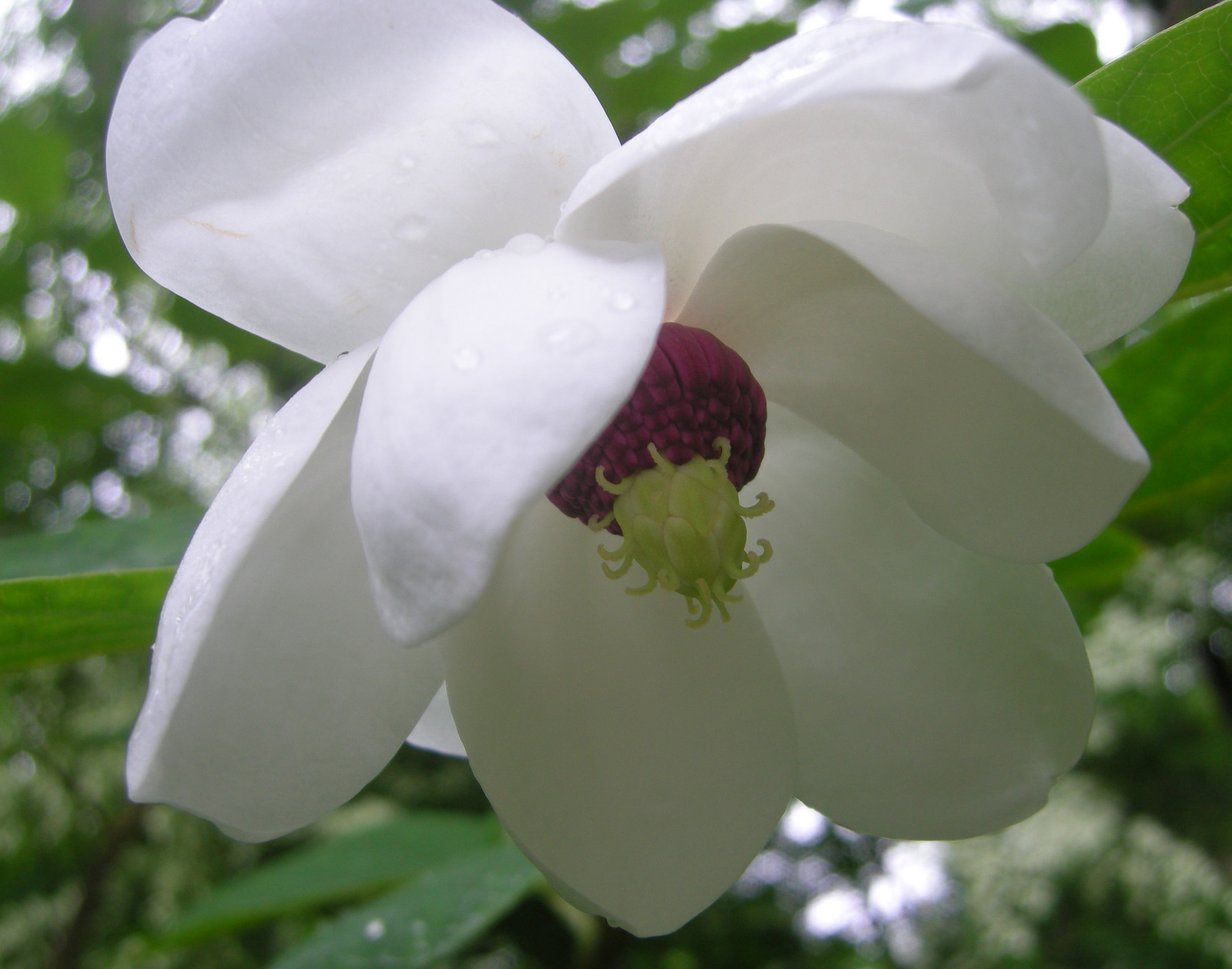
The gorgeous flowers point down and are best viewed from below.

Native sweetbay magnolia, M. virginiana, also grows in the shade.

The flowers of sweetbay magnolia have the best fragrance of any magnolia I grow.

My native southern magnolia, M. grandiflora, will never compare to specimens growing in the south, but it is still a beautiful evergreen tree suitable for part shade.

Southern magnolia starts blooming in mid-June.

I am also a huge fan of dogwoods and extend their season by growing lots of different kinds:

Native pagoda dogwood, Cornus alternifolia, suckers to form a colony.

The flowers of pagoda dogwood produce beautiful pink-stemmed blue berries loved by birds.

The Rutger’s hybrid dogwood, Cornus x ‘Constellation’, is a cross between Kousa dogwood and our native flowering dogwood.

‘Constellation’ flowers between its two parents–great for extending the dogwood season– and is disease resistant.

Kousa dogwood, Cornus kousa, flowers the latest of all my dogwoods.

The flowers of kousa dogwood are followed by very showy cherry-like fruit.

I have a very old golden-chain tree, Laburnum wateri, which I love but really should replace.


June is a great month for shrubs:

The shrub rose ‘Westerland’ is truly magical.  The deep red buds open to this gorgeous apricot flower, which ages to a peachy pink.

Rugosa roses are completely foolproof, just requiring occasional pruning.  Clockwise from upper left:  Rosa rugosa ‘Polar Ice’, ‘Hansa’, ‘Alba Plena’, ‘Alba’.

I guess Knock Out roses are considered passe in rose circles, but I can’t help thinking I am going to my first prom every time I look at ‘Blushing Knock Out’.

Native oakleaf hydrangea, H. quercifolia, nestled in full shade at the base of my huge black walnut.

Oakleaf hydrangeas are ornamental 365 days a year, but nothing is more spectacular than their gigantic conical flowers.

Peonies remind me of my childhood, and I love their fragrance.  Clockwise from upper left: ‘Coral Fay’, unknown, unknown (dug from a friend’s grandmother’s garden), ‘Raspberry Sundae’.

Clockwise from upper left: ‘Cheddar Cheese’, ‘Sarah Bernhardt’, ‘Angel Cheeks’, ‘Karl Rosenfeld’.

Linden viburnum, V. dilataum

The flowers of my linden viburnum never produce berries.

Redvein enkianthus, E. campanulatus, grows in full shade.

The exotic flowers of redvein enkianthus cover the shrub completely.

Chinese sweetshrub, Sinocalycanthus chinensis, grows in full shade too.

Its flowers are plentiful and gorgeous but not fragrant like our native.

Native hybrid sweetshrub, Calycanthus x ‘Hartlage Wine’, is a cross between the Chinese sweetshrub above and our native.

Its flowers and foliage are more beautiful than its parents, but it has no fragrance.  Still it is one of my top five favorite shrubs.

Old-fashioned weigela, W. florida ‘Wine and Roses’, has deep burgundy leaves.  It flowers later than my other weigela cultivars.

The showy pink flowers of ‘Wine and Roses’.


Vines are a favorite of mine:

Clematis clockwise from upper left: ‘Warsaw Nike’, ‘General Sikorski’, solitary clematis (C. integrifolia, really a perennial not a vine), alpine clematis (C. alpina ‘Stolwijk Gold’).  I grow ‘General Sikorski’ up through my ‘Yellow Bird’ magnolia, and I grow gold-leafed ‘Stolwijk Gold’ up the ‘General Sikorski’–you can never have too many vines.

American wisteria, W. frutescens ‘Amethyst Falls’, flowers after the Asian varieties.

The tightly packed flowers of ‘Amethyst Falls’ American wisteria.

I adopted this vine as a tiny plant at a rock garden society sale.  It turned out to be a rare hardy jasmine,  Jasminum x stepanense.  Two years later it was covered with these fragrant pale pink trumpets–what a deal!

The charming flowers of hardy jasmine vine.

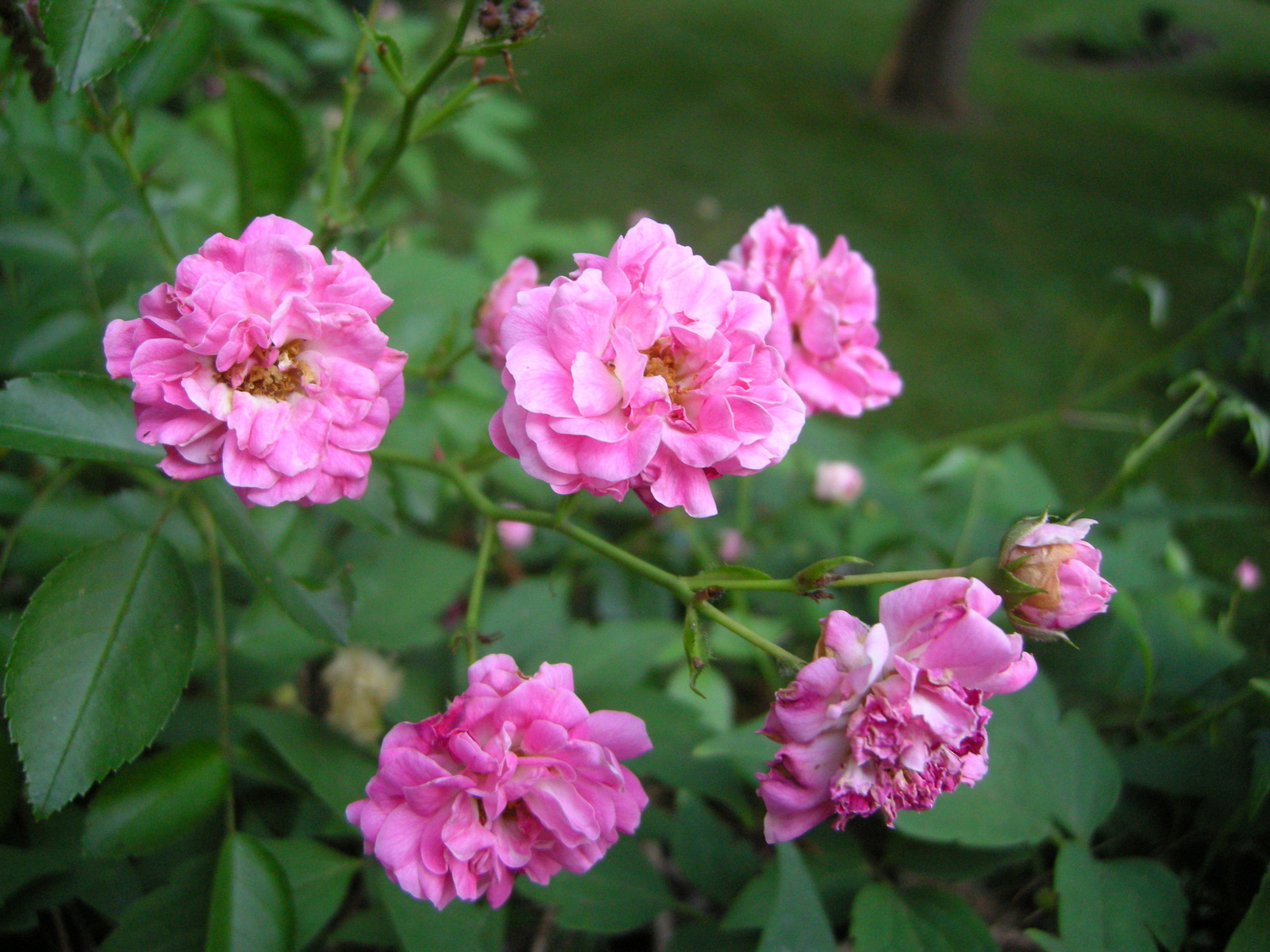
This climbing rose with a multitude of small pink flowers in bloom right now came without a name.  I grow it around and through my anemone clematis, C. montana var. rubens, which flowers earlier.  If anyone knows the name of the rose, please let me know.

A few scenes of the flower beds in June:

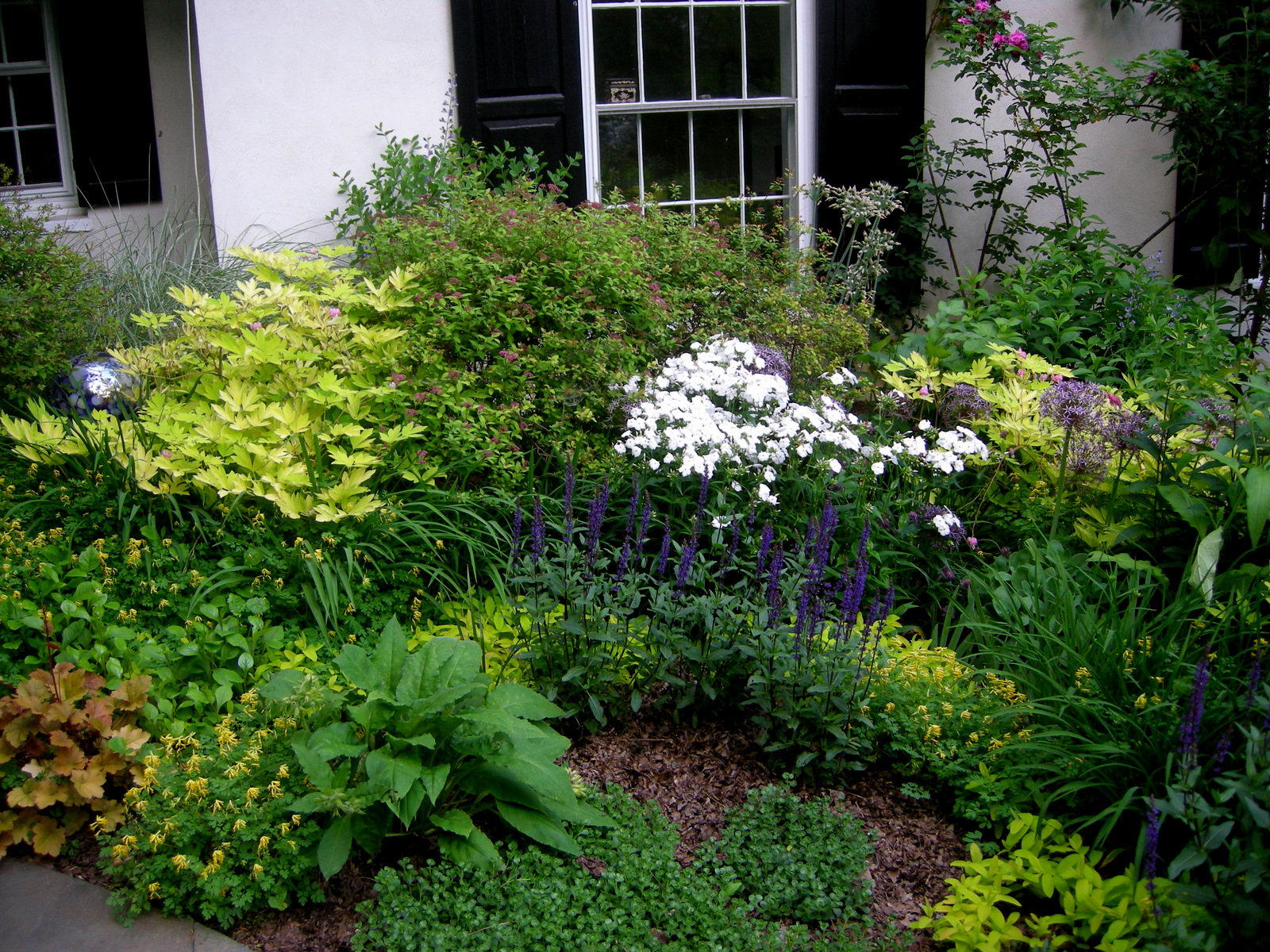
Main sunny perennial border: not a full day but as sunny as it gets at Carolyn’s Shade Gardens.

The shady gold garden under a 120-year -old London plane tree.

Our cat Otto enjoying the wall garden.

Please let me know in a comment/reply what flowers are blooming in your spring garden.  If you participated in GBBD, please provide a link so my nursery customers can read your post.

Carolyn

Notes: Every word that appears in orange on my blog is a link that you can click for more information.  If you want to return to my website’s homepage to access the sidebar information (catalogues, previous articles, etc.), just click here.

Nursery Happenings: The nursery is closed until it cools off in the fall around the middle of September.  If you are on my customer email list, look for an email.  If not, sign up by sending an email to carolynsshadegardens@verizon.net with your name and phone number.

Powered by Compost

Posted in green gardening, How to, organic gardening, Shade Gardening with tags , on June 5, 2011 by Carolyn @ Carolyns Shade Gardens

Carolyn’s Shade Gardens is a retail nursery located in Bryn Mawr, PA, specializing in showy, colorful, and unusual plants for shade.  The only plants that we ship are snowdrops and miniature hostas.  For catalogues and announcements of events, please send your full name, location, and phone number (for back up use only) to carolyn@carolynsshadegardens.com.  Click here to get to the home page of our website for catalogues and information about our nursery and to subscribe to our blog.

Some of my gardens powered by compost.

Compost is king in my garden.  It is the only thing I use: no other soil amendments and no fertilizers.  All the beautiful plants and lush growth are powered by compost.  I am frequently asked where I get my compost and how I use it.  This post will answer those questions and highlight an exciting compost-centered event taking place in my gardens this Sunday.

The soil at the top is from my back slope ruined by erosion caused by misguided lawn attempts and chemicals.  The soil at the bottom is from the undisturbed woods less than 10′ away.

The pre-existing soil at Carolyn’s Shade Gardens is (was) terrible (see top photo above).  I am on the side of a hill where the previous owners had tried to grow grass for years.  The soil was hard and depleted by the use of lawn chemicals and by erosion.  Terraces were constructed down one side of the house and filled with rocky infertile soil.  Construction rubble from additions to the house in the 1950s and 1960s was dumped in what is now my woodland garden.  The soil in the beds on the back side of the house was compacted by their former use as a carriage path.  Finally, the whole property was used as a dump (pre-trash collection) by the estate of which it was formerly a part so the beds are full of glass, old slate from roof replacements, refuse from coal burning furnaces, and miscellaneous trash.  Digging can be quite an adventure!

This is a photo from 1995 showing the debris that came out of one relatively small planting hole at Carolyn’s Shade Gardens.  Click on any photo to enlarge.

Given the deplorable condition of the existing soil, compost is essential.  It reaches my plants in four different ways.  First, whenever I create a new bed in my gardens, I spread 4 to 6 inches of compost on top of the soil and dig it into the bed, removing all the rocks and debris.  I use the rocks to line the paths in my woodland garden.  One visitor asked me where I got my rocks, and, finding out they came from the beds, told me how lucky I was.  I feel about as lucky as the early farmers in New England must have felt when they built all those rock walls around their fields.

The rocks lining the paths in the woodland garden.

Second, even though the beds are prepared with compost, I add compost to the hole every time I plant a plant.  I mix the existing soil half and half with compost.  Third, as explained in Fall Clean-up, I grind all the leaves in the fall and use them to mulch my beds.  This mulch breaks down over the course of the year to make a thick compost layer on top of the existing soil.  Leaves that fall on the lawn are ground up in place and left there to fertilize the grass as described in Leaves on the Lawn. Finally, I don’t clean the leaves out of most of my beds: they are left there to act as mulch and form more compost.

The current state of the depleted back slope.

I use a lot of compost because I also need it to pot all the plants that I grow to sell at my nursery.  Where does it all come from?  We produce a lot of it ourselves in a simple, easy, and nontechnical way.  I get frustrated with the articles written about composting because they make it sound like you need to follow complex procedures and buy expensive equipment to produce compost.  All those procedures and equipment merely speed the process up (and possibly make it neater), but all you need to produce compost is a pile.  It helps if you turn it occasionally, but even that is not necessary if you are willing to wait for it to break down naturally.

The path to our compost pit.

Our “garage” is really the carriage house and the stable for the estate that used to be here.   There is even a metal grain bin on the second floor with chutes and levers to bring the grain to the first floor.  The horses that pulled the carriages produced manure (no surprise there), which was deposited in a manure pit behind the stable.  Back then, they built everything to last so the manure pit is a 12 foot square enclosure surrounded on four sides by 7 foot tall stone walls.

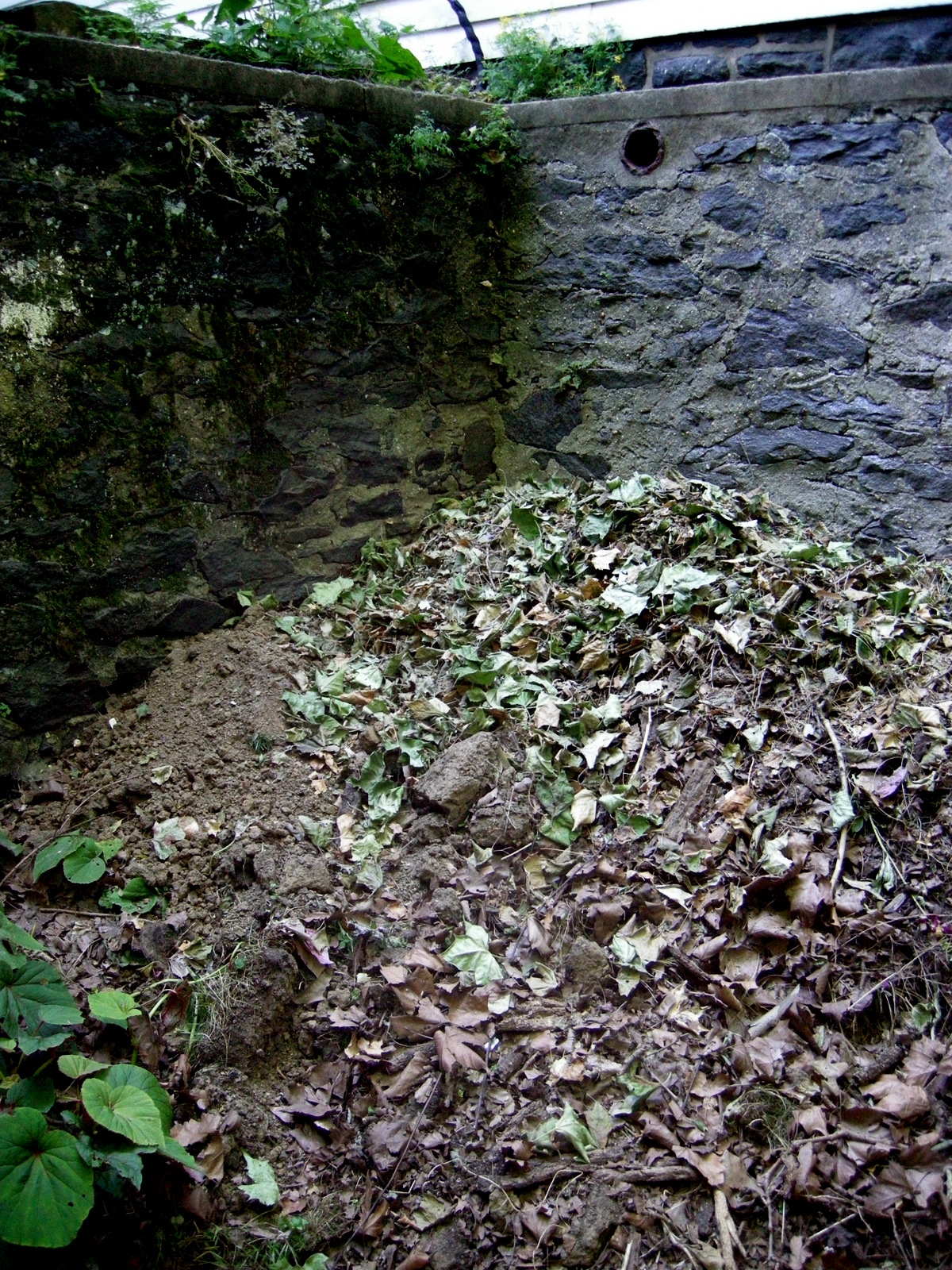
The left side of the compost pit where we are currently throwing kitchen and garden refuse.

We throw all our garden and kitchen refuse into this pit, including leaves, sod, noninvasive weeds, ashes, small sticks, etc.  There is no organized layering process–whenever there’s something to go in, it’s thrown on top of the pile, hopefully, but not always, on the side of the pile currently being built up.  The other side contains the compost being used.  My husband turns the pile thoroughly about three times a year, and that’s it: no complicated procedures or equipment required!

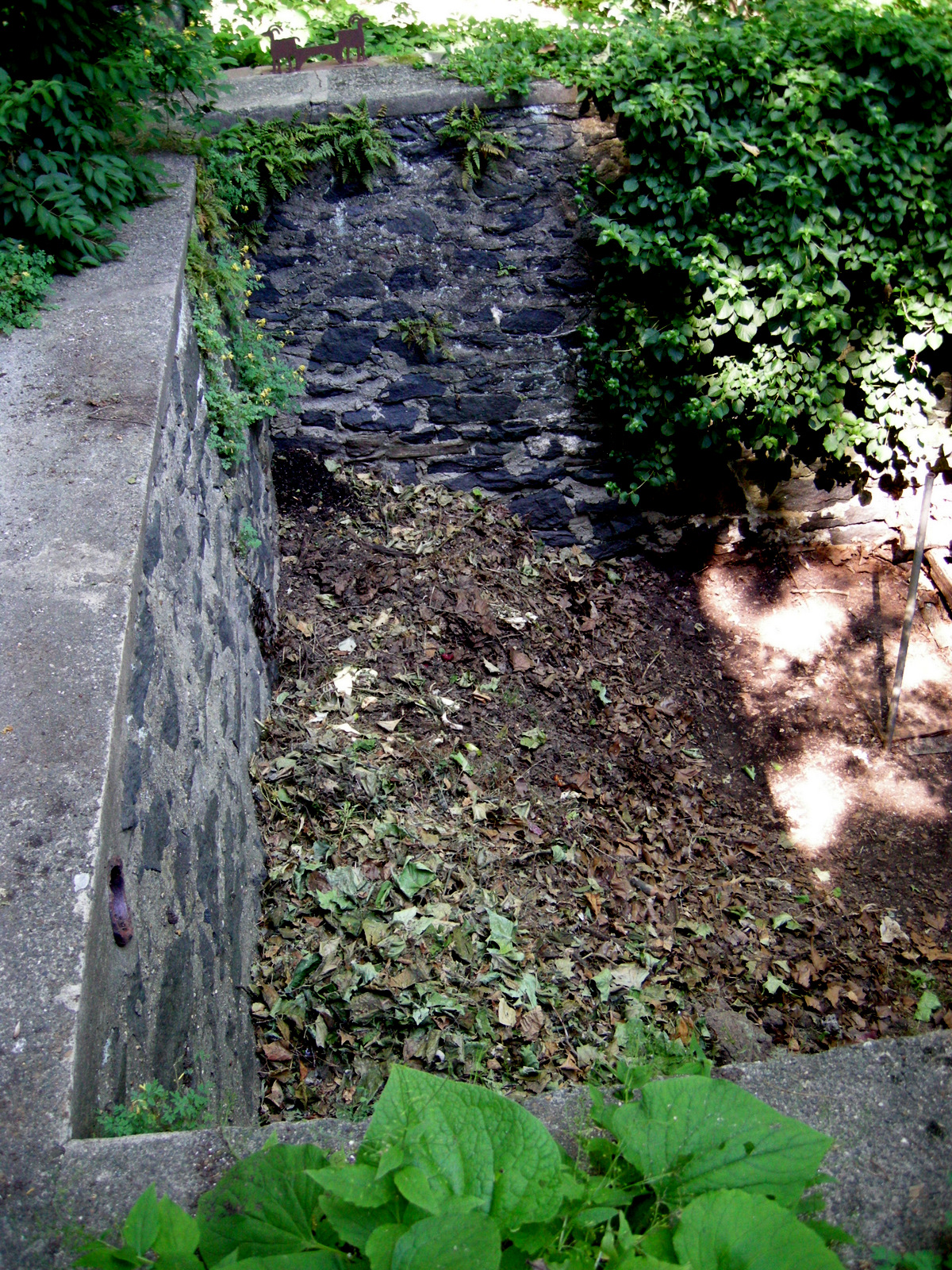
Top view of the manure pit we use for producing compost.  It is “decorated” with self-sown fern-leafed and yellow corydalis and a large climbing hydrangea.

However, despite the size of this operation, it does not produce nearly enough compost for Carolyn’s Shade Gardens.  We are very fortunate that our township produces excellent compost from the leaves that residents put by the side of the road in the fall to be removed.  Personally, I think removing the leaves from your property is crazy, but for selfish reasons I am glad people do it.  We get truckloads of the township’s beautiful compost to supplement our own.

One of the newest beds powered by compost.

As I explained in Supporting Sustainable Living, I am uniquely placed to encourage sustainable gardening practices as I promote and sell native plants at my nursery,  answer my customers’ requests for advice, and give tours of my gardens to horticultural groups.  Sustainable living is very important to me as I described in My Thanksgiving Oak Forest.  So when the Radnor Conservancy, dedicated to promoting open space in my township,  asked me to speak, I thought why not go farther and offer my gardens as a venue for a fund raising and educational event.

Rose and peony beds

The creative people at the Conservancy came up with the theme “Dirt … lots of it!”, an afternoon devoted to educating people about compost on Sunday, June 12, from 3 to 5 pm at Carolyn’s Shade Gardens.  Here is the flyer:

If you come, and I hope you will, you will find various “stations” throughout my gardens staffed by knowledgeable Master Gardeners able to answer any question you have about composting.  They will demonstrate outdoor composting, indoor composting with worms, composting equipment and tools, grinding leaves for mulch, and how to transport township compost easily and cleanly to your home.  You will be able to order discount compost bins, and information on lyme disease and its prevention will be provided.

Main perennial border

As you find out everything you ever wanted to know about composting, you can stroll through my beautiful gardens and shop for plants in my nursery area.  And best of all, delicious refreshments will be provided.  As directed in the flyer above,  if possible, please register  in advance for the event with the Conservancy by calling them at 610-688-8202 or emailing them at radnor.conservancy@comcast.net.  You can also show up without registering.  The event is open to everyone, not just Radnor Township residents.  I hope to see you there.

Carolyn

Just a note to say thanks to John at Macgardens and his wife Beth who visited Carolyn’s Shade Gardens during my open house on Saturday.  Meeting fellow garden bloggers is so fun because they immediately feel like old friends.  If any other garden bloggers are in the area, please stop by.

Notes: Every word that appears in orange on my blog is a link that you can click for more information.  If you want to return to my blog’s homepage to access the sidebar information (catalogues, previous articles, etc.), just click here.

Nursery Happenings: I will have my traditional closing weekend open hours this Saturday, June 11, from 9 am to 3 pm and Sunday, June 12, from 10 am to noon.  You don’t need to make an appointment, and you can park in the driveway.  You can also shop for plants during the Radnor Conservancy  event on Sunday, June 12, from 3 to 5 pm.  But remember you can make an appointment to shop 24/7 by sending me an email at carolynsshadegardens@verizon.net.  There is  still a great selection of hostas, ferns, astilbes, hardy geraniums, and summer and fall blooming shade plants available.

Larger Hostas

Posted in container gardening, hosta, Shade Gardening, Shade Perennials with tags , , , , , , , , , , , , on May 30, 2011 by Carolyn @ Carolyns Shade Gardens

Carolyn’s Shade Gardens is a retail nursery located in Bryn Mawr, PA, specializing in showy, colorful, and unusual plants for shade.  The only plants that we ship are snowdrops and miniature hostas.  For catalogues and announcements of events, please send your full name, location, and phone number (for back up use only) to carolyn@carolynsshadegardens.com.  Click here to get to the home page of our website for catalogues and information about our nursery and to subscribe to our blog.

.

Hosta Teeny-weeny Bikini' at Carolyn's Shade GardensHosta ‘Teeny-weeny Bikini’: I couldn’t resist including one more miniature.

In my recent article Miniature (& Small) Hostas, I explained my evolving relationship with hostas and how my collecting tendencies had led me to miniature hostas for space reasons.  I display these little treasures in special ways in containers, in my rock garden, or as groundcover in order to highlight their small stature.  However, for specimen plants and variety of leaf color, there is nothing like a larger hosta.  They come in an an infinite number of combinations of colors, heights, widths, leaf shapes, flowers, and habits.  There is a medium to large hosta for every garden condition, both as the star of the show and a lovely backdrop for your other perennials and shrubs.  In this article, I want to highlight some of my favorite larger hostas as well as some cultivars that are new to me.

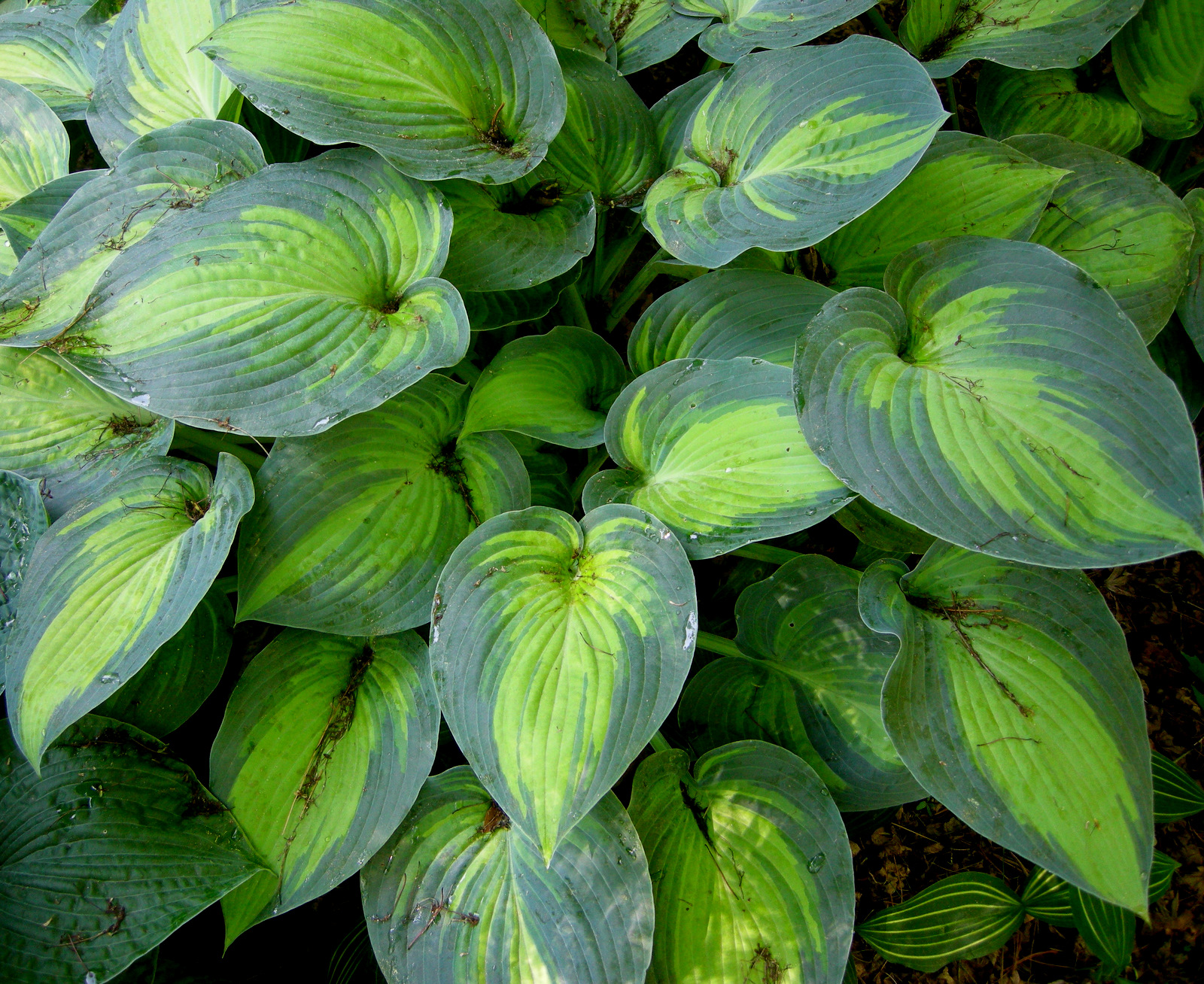
Mature Hosta tokudama ‘Flavocircinalis

Leaf of mature ‘Flavocircinalis’

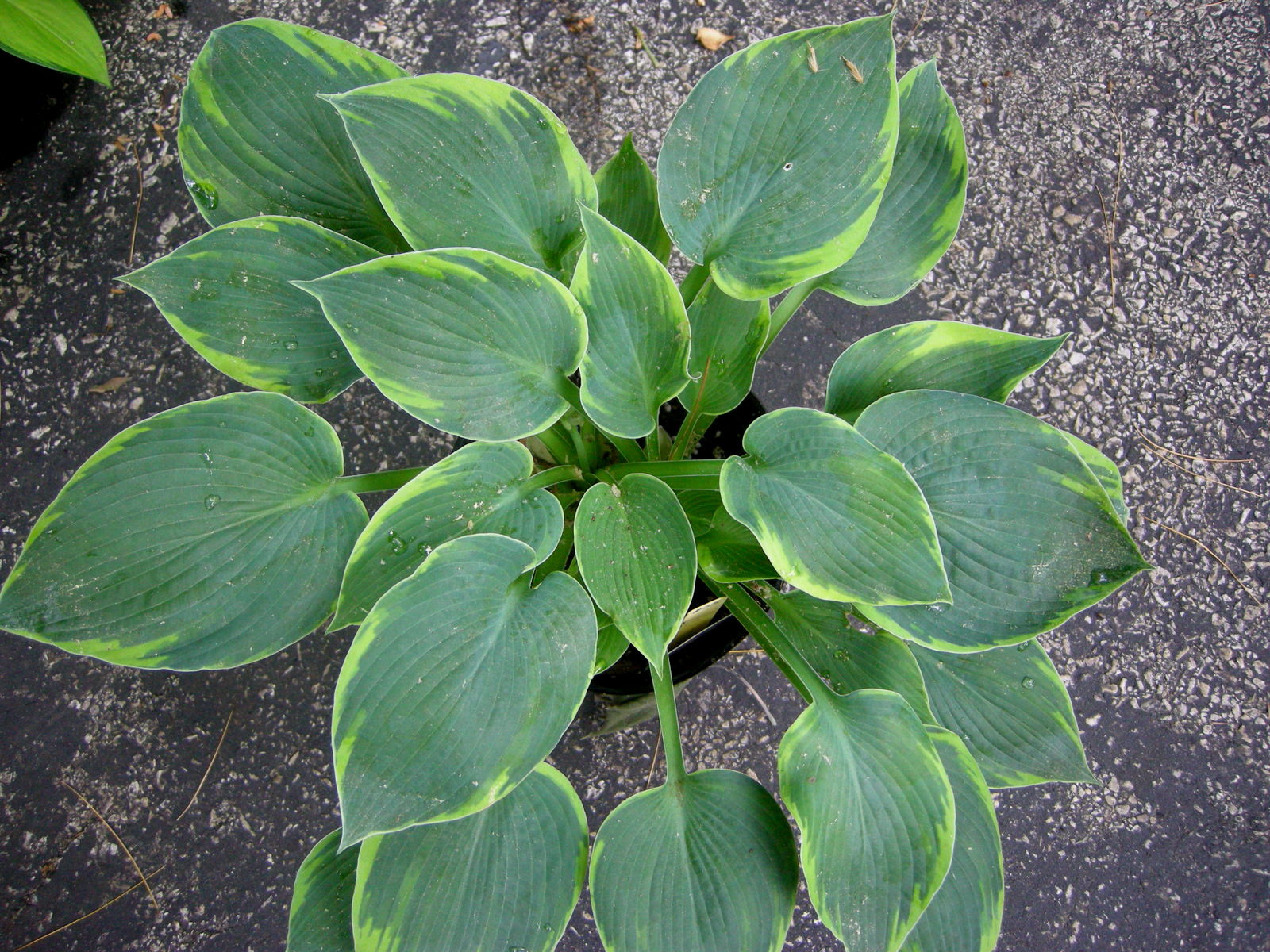
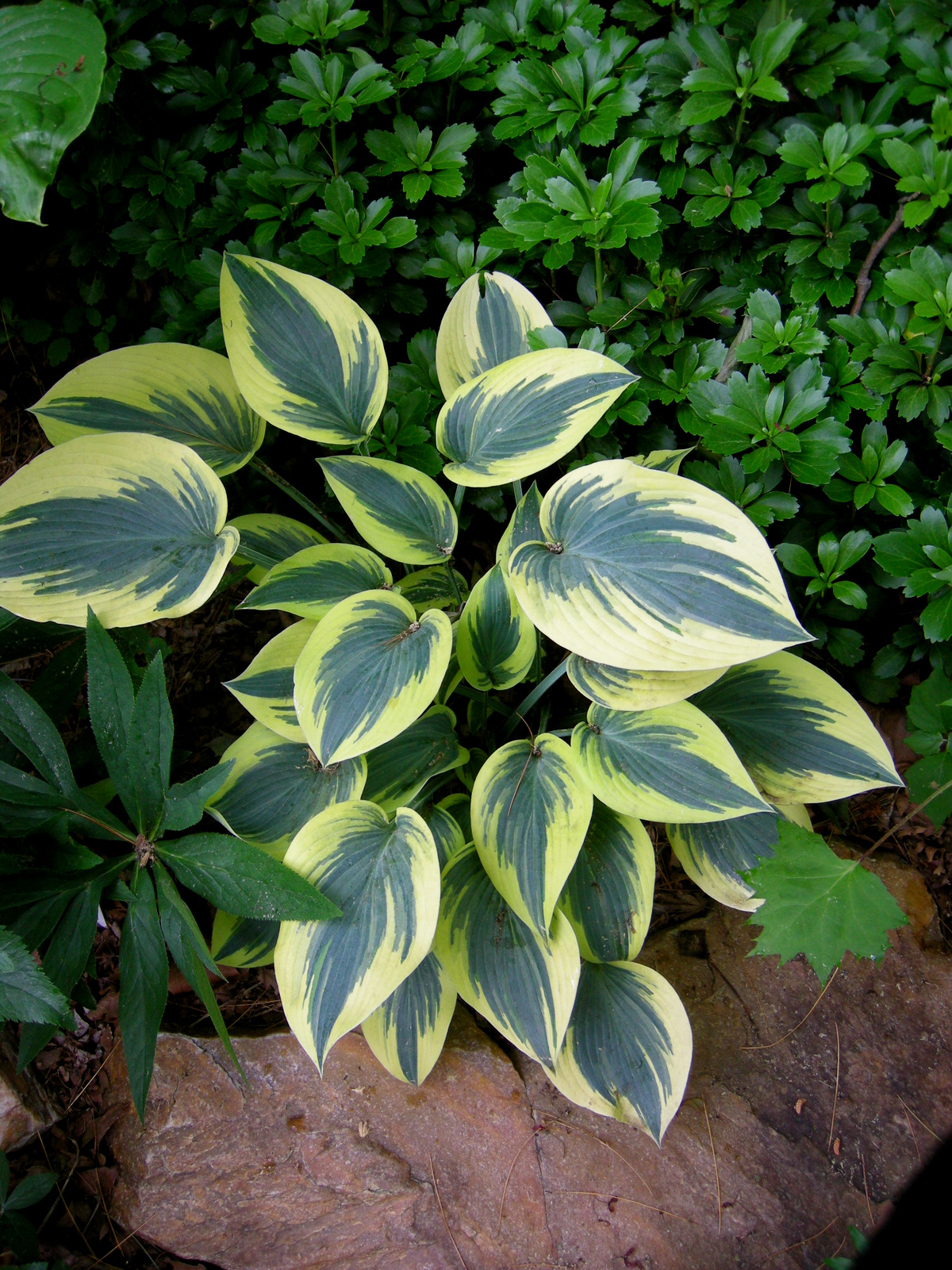
Before I get to the plants, however, I want to explain something that took me a while to figure out.  Larger leaf hostas do not look like themselves in a nursery pot because they take one to two years to mature and reach their full size and coloration.  Immature plants will have different shaped leaves, usually pointed, and will not display the intricate color patterns that you can expect on the plant in your garden.   Compare the photos of Hosta tokudama ‘Flavocircinalis’ above and below. That is why at Carolyn’s Shade Gardens, I always encourage customers to look at the mature hostas in the display gardens before making their choices.

Immature plant of ‘Flavocircinalis’

Immature leaf of ‘Flavocircinalis’

Here is a taste of some of my favorite and best-selling larger hostas.  You can view well established specimens of these cultivars in my display gardens:

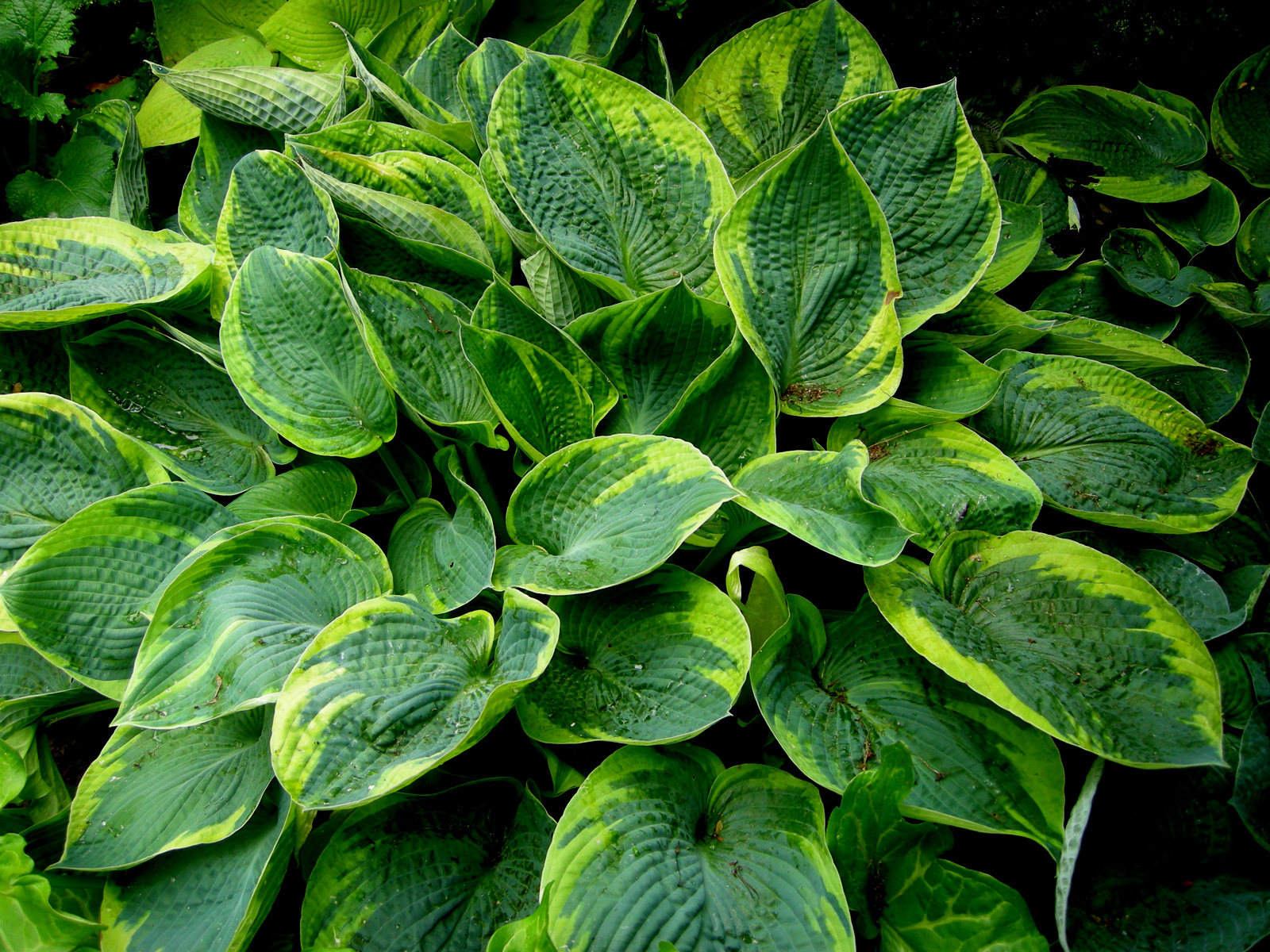
Hosta ‘June’ was the American Hosta Growers Association 2001 Hosta of the Year with good reason and is the most popular hosta with my customers.

The beautiful leaf coloration of ‘June’.

‘First Frost’ is the 2010 Hosta of the Year.

The leaves of ‘First Frost’ emerge with bright yellow leaf margins, which age to cream (in photo above) and set off its very blue center.

‘Great Expectaions’ is my second biggest selling hosta and has one of the most beautiful habits of any large hosta.

The elegant leaf coloration of ‘Great Expectations’.

‘Earth Angel’ is the 2009 Hosta of the Year and is as large and glorious as its parent ‘Blue Angel’ but with a cream margin.

‘Earth Angel’ is the first giant blue hosta with a contrasting border.  The leaves can reach 18″ x 12″ and a specimen can be 5′ wide.

Hosta tokudama is my favorite of all species hostas and ‘Aureonebulosa’ is my favorite cultivar of the many tokudama offspring.

The cupped and heavily puckered texture of  ‘Aureonebulosa’ is typical of the tokudama group.

‘Fragrant Bouquet’ is the 1998 Hosta of the Year and has fragrant flowers.

‘Fragrant Bouquet’s’ light green leaves really stand out in the shade, and it retains its yellow margins all season.

When I visit hosta collections and displays, some plants always stand out.  I look for these plants in the trade to add to my own gardens and offer to my customers.  Here are some of the cultivars I was able to add this year:

‘Touch of Class’ is a close relative of ‘June’ but with a wide blue border enclosing a central gold stripe.  It has an excellent habit and great slug resistance.

‘Liberty’ is the Hosta of the Year for 2012.  You can see both the yellow coloration of its new leaves and the wide cream margins of its older leaves in the photo above.  For a great shot of its coloration, see both the header and wordless Wednesday photo at Pat and Jim’s Gardening Adventure.

‘Paradigm’ is the 2007 Hosta of the Year.  For a much better photo of its leaves and habit, check out these photos of all the Hostas of the Year, by clicking here.  The American Hosta Growers Association has only picked 17 hostas to be Hosta of the Year out of an estimated 6,000 hosta cultivars in the trade so this accolade is quite a meaningful honor.

‘Fragrant Queen’ is a fragrant hosta boasting very substantial rounded leaves with wide white margins.

I have coveted ‘Brother Stefan’ every time I have seen it.  For a much better photo, showing its coloration, texture, and habit, click here.

Just a few ideas for using larger hostas in your garden:

Left to right: ‘Flavocircinalis’, the species H. tokudama, and ‘June’ massed in front of a Japanese holly.

Left to right: ‘Frances Williams’, ‘Abiqua Drinking Gourd’, ‘Kabitan’, and ‘Earth Angel’.

‘Great Expectations’ displayed as a specimen with other hostas, ferns, epimediums, violets, and hardy geraniums.

A specimen ‘Fragrant Bouquet’ with yellow waxbells, hardy gernaium, and ‘Luxuriant’ bleeding-heart.

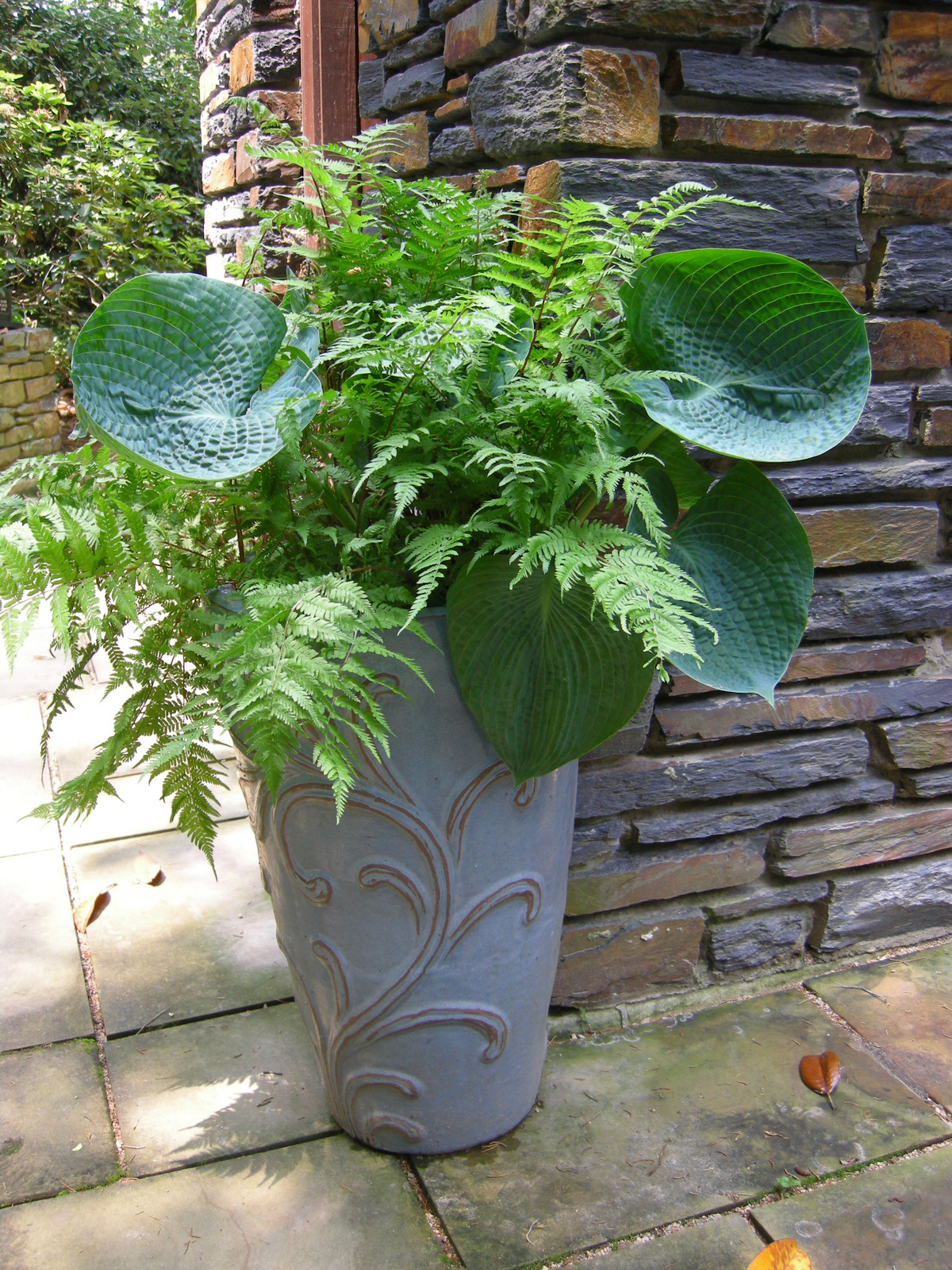
A simple but elegant container planting at Duke Gardens in Durham, North Carolina.

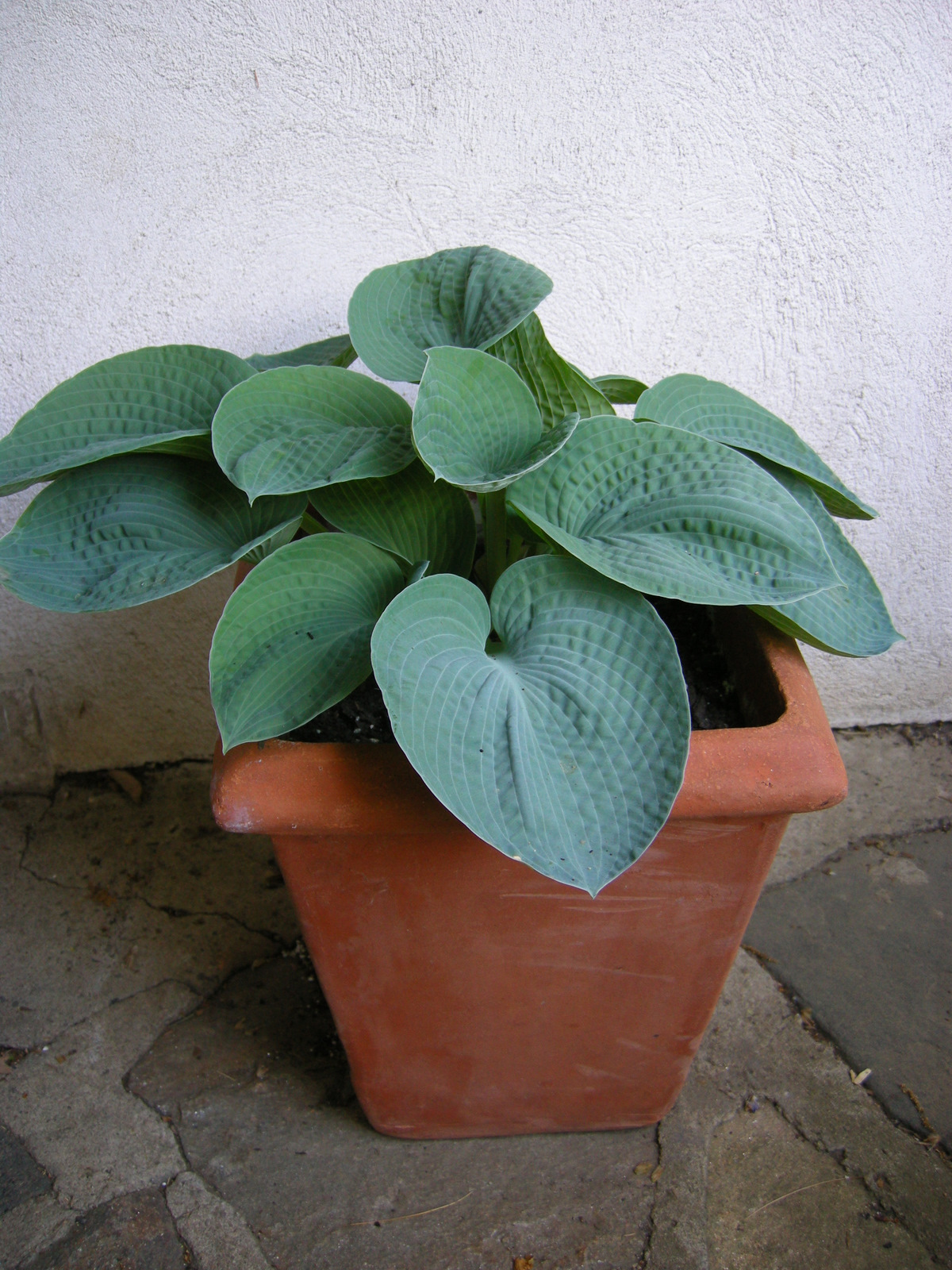
A rare Hosta tokudama by itself in a container on my front porch.

Colorful foliage is a fun and essential part of the shade garden.  I hope I have introduced you to some new and intriguing larger hostas that you can add to your shade.

Carolyn

For two more articles on hostas, click here:

Miniature (& Small) Hostas

Hostas for Fall

Notes: Every word that appears in orange on my blog is a link that you can click for more information.  If you want to return to my blog’s homepage to access the sidebar information (catalogues, previous articles, etc.) or to subscribe to my blog, just click here

When I want information about hostas, I go to the Hosta Library and My Hosta Database to find photos and comprehensive written descriptions.  I have added both these sites to my sidebar under Plant Information so you will always be able to find them.

Woody Plants for Shade Part 2

Posted in landscape design, native plants, New Plants, Shade Shrubs with tags , , , , , , , , , , , , , , , , on May 23, 2011 by Carolyn @ Carolyns Shade Gardens

Carolyn’s Shade Gardens is a retail nursery located in Bryn Mawr, PA, specializing in showy, colorful, and unusual plants for shade.  The only plants that we ship are snowdrops and miniature hostas.  For catalogues and announcements of events, please send your full name, location, and phone number (for back up use only) to carolyn@carolynsshadegardens.com.  Click here to get to the home page of our website for catalogues and information about our nursery and to subscribe to our blog.

The very showy flowers of redvein enkianthus, Enkianthus campanulatus ‘Princeton Red Bells’.

My nursery specializes in herbaceous flowering plants for shade.   However, although no shade garden is complete without trees, shrubs, and vines, our local nurseries seem to ignore woody plants for shade.  To fill this gap, I offer shade-loving woodies from a wholesale grower whose quality meets my exacting standards.  To view the catalogue, click here.   As in Woody Plants for Shade Part One, I thought my blog readers who are not customers might be interested in learning about the woody plants that I would recommend they add to their shade gardens.  And doing an article in addition to the catalogue allows me to add more information so customers might be interested also.

Included in my offering are six shrubs and two vines.  Of the eight plants I have chosen, five are native.  Please read my article My Thanksgiving Oak Forest to see why I think planting native plants is crucial to our environment.  My article New Native Shade Perennials for 2011 explains why I think native cultivars are valuable native plants.  With that introduction, here are the plants I am highlighting:

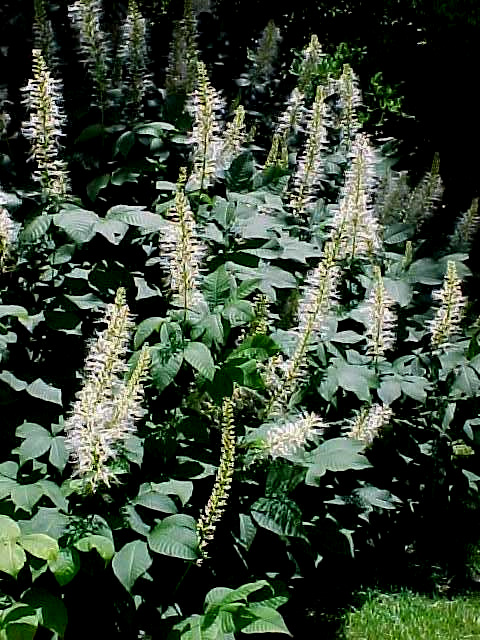
Native bottlebrush buckeye, Aesculus parviflora

Native bottlebrush buckeye is a wonderful shrub for making a majestic stand in full shade.  I grow it deep in my woods, and it performs beautifully.   It grows to 10’ tall in  full sun to full shade in any location and soil type.  It is also deer resistant.  The  creamy white flowers on long upright brush-like panicles in early summer and the bold textured leaves give it a dramatic tropical look.  It has excellent yellow fall color and attracts hummingbirds.

The lovely yellow fall color of bottlebrush buckeye.

Bottlebrush buckeye is native to parts of the eastern US, including Pennsylvania.  It is a Pennsylvania Horticultural Society Gold Medal Plant, click here for details.  It is also a Missouri Botanical Garden Plant of Merit, click here  for details (photos courtesy of the Missouri Botanical Garden Plant Finder).


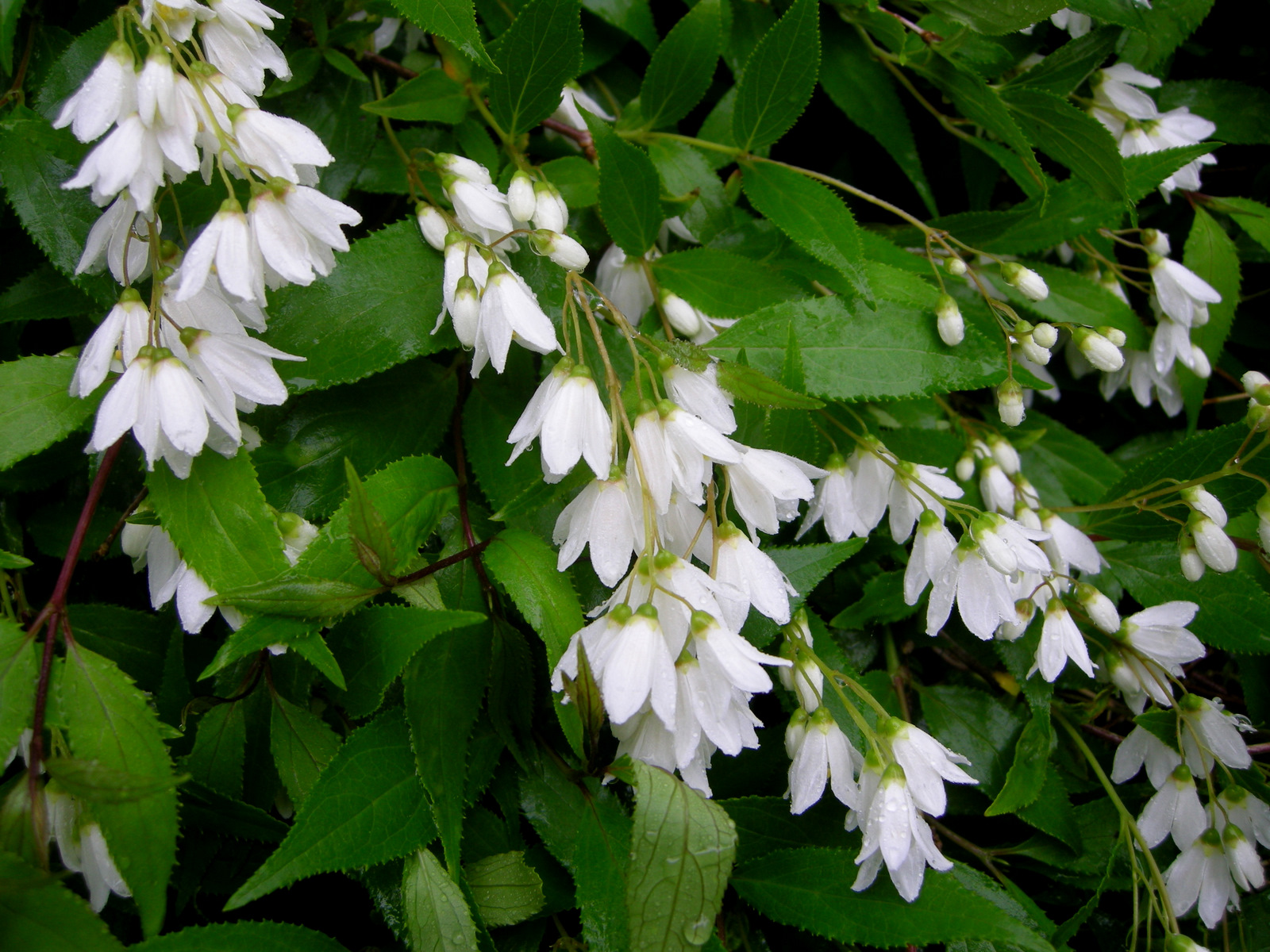
 Dwarf slender deutzia, Deutzia gracilis ‘Nikko’

‘Nikko’ dwarf slender deutzia is another shrub that can grow anywhere from  full sun to full shade and is deer resistant.  In April and May, it is covered with delicate white flowers, and the fine-textured and neat green leaves turn purple in the fall.  This deutzia makes an excellent specimen, growing 2’ tall by 5’ wide, or a superior flowering groundcover for shade.  I grow it in full shade at the base of my winterberry hollies.  It is native to Japan and is a Pennsylvania Horticultural Society Gold Medal Plant, click here for details.

I use ‘Nikko’ dwarf slender deutzia as a groundcover in full shade under winterberry hollies.


Redvein enkianthus, Enkianthus campaulatus ‘Princeton Red Bells’

In May ‘Princeton Red Bells’ redvein enkianthus is covered with a multitude of spectacular deep red, pendant bell-like flowers.  Its elegantly arranged blue-green leaves turn an excellent dark red in the fall.  It has a very unique and graceful habit (see photo of species below) and grows to 8’ tall by 4’ wide in full sun to full shade.  It is deer resistant and likes average to moist soil, although I grow it in my dry woodland.  It is native to Japan.  For more information about the species, click here.

This photo of the straight species of redvein enkianthus growing in my woodland shows its elegant habit and abundance of flowers.  The flowers of ‘Princeton Red Bells’ are much more eye-catching.


The amazing flowers of native smooth hydrangea, Hydrangea arborescens ‘Annabelle’.

Native ‘Annabelle’ smooth hydrangea has won numerous awards for its very showy, huge (up to 1’) snowball flowers, which appear from June into September.  It grows 5’ tall by 5’ wide in part to full shade (full sun is not recommended).  It is supposed to be deer resistant for a hydrangea.  A gentle pruning in late spring produces optimum growth.

‘Annabelle’ produces copious, long lasting flowers.

Smooth hydrangea is native to the eastern U.S., including Pennsylvania.  It is a Pennsylvania Horticultural Society Gold Medal Plant, click here for details.  It is also a Missouri Botanical Garden Plant of Merit, click here for details (photos courtesy of the Missouri Botanical Garden Plant Finder).


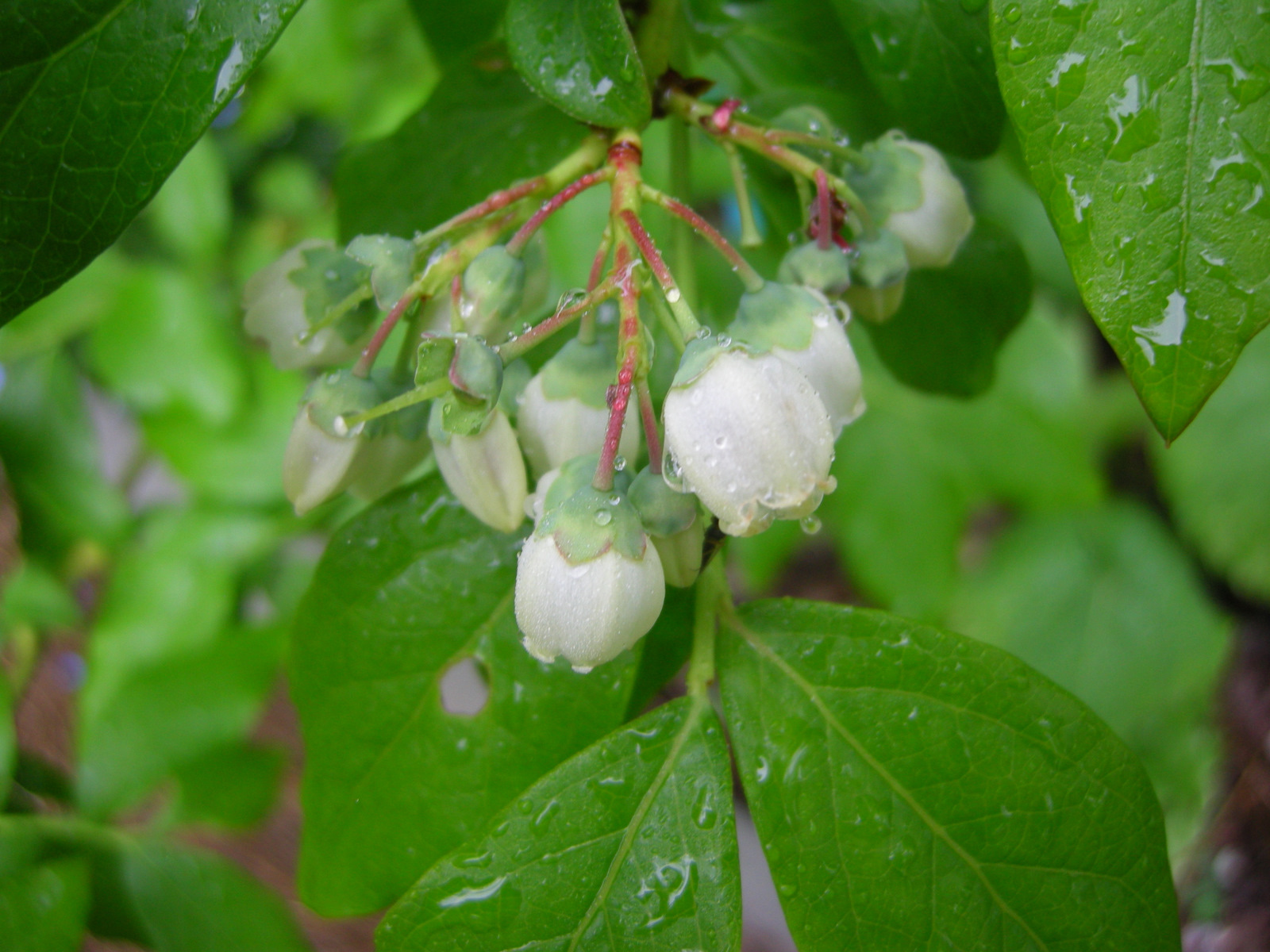
The gorgeous and delicious fruit of native northern highbush blueberry, Vaccinium corymbosum ‘Jersey’.

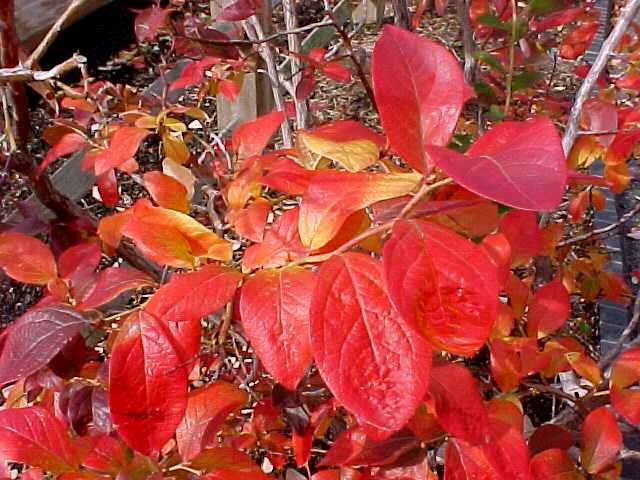
Gardeners might not think of northern highbush blueberry as an ornamental, but it has everything you could want in a shrub.   Its pretty bell-shaped white flowers appear in May and are followed by delicious and beautiful powder blue fruit in summer.  It has excellent scarlet fall color and is native and wet site tolerant.  What more could you ask for?  It grows to 6’ tall in full sun to part shade.

The flowers of northern highbush blueberry

Northern highbush blueberry is native to all of eastern North America, including Pennsylvania.  I am offering two cultivars: ‘Jersey’ is an early midseason producer, and ‘Berkley’ is late midseason.  Planting two different cultivars produces better fruit.  For more information, click here  (photos of berries and fall color courtesy of the Missouri Botanical Garden PlantFinder).

The fall color of northern highbush blueberry.


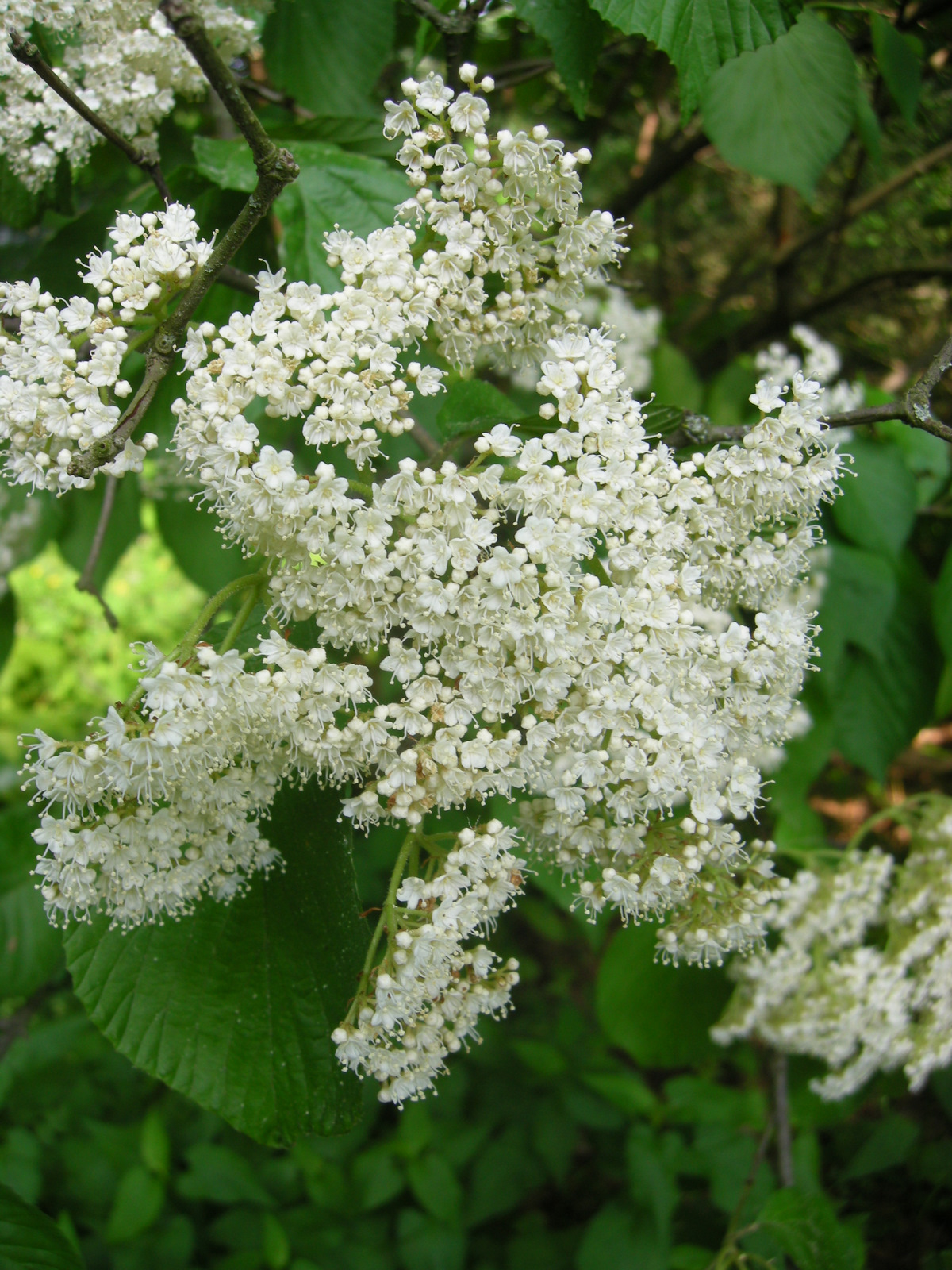
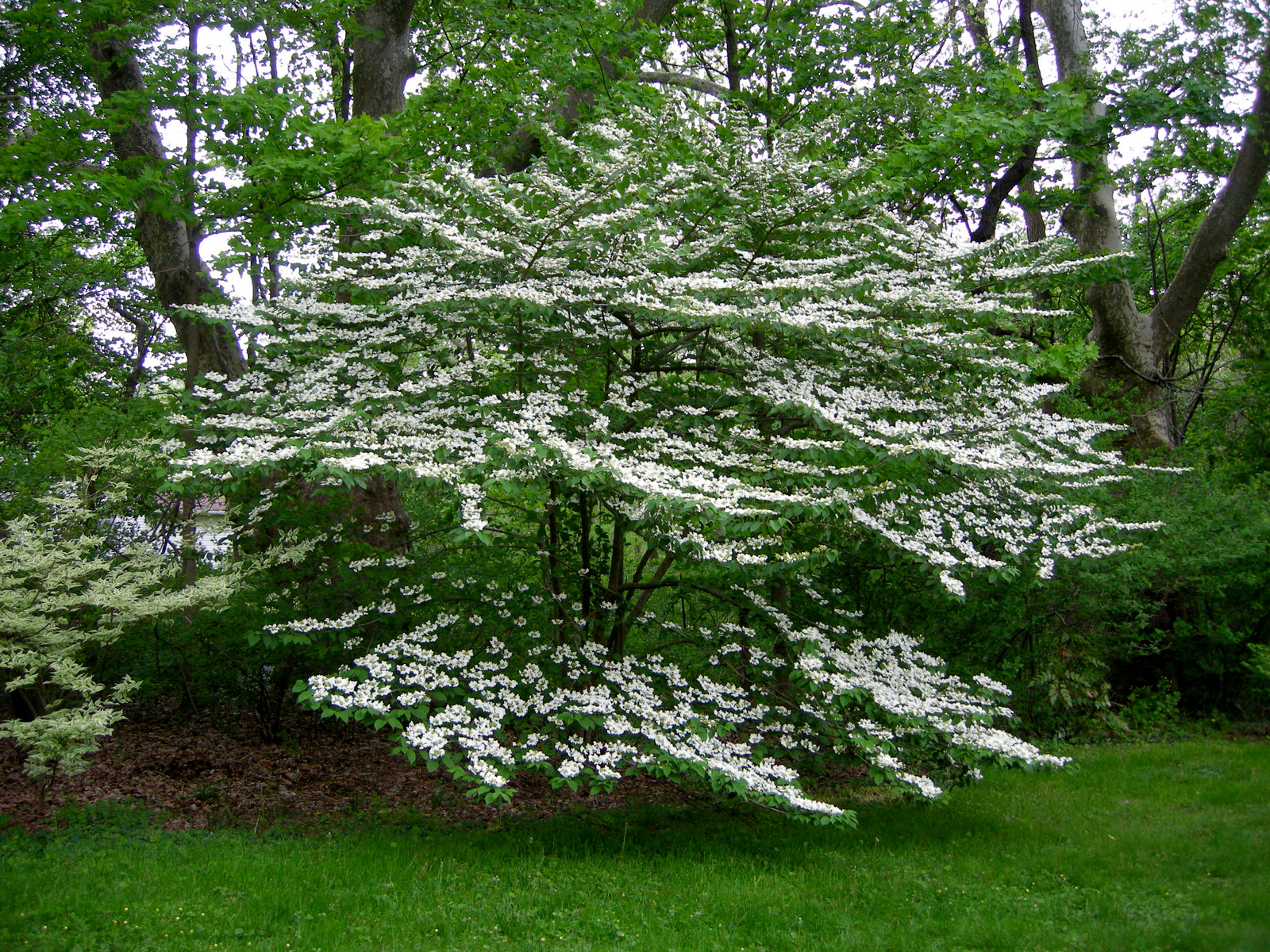
Doublefile viburnum, Viburnum plicatum var. tomentosum

My doublefile viburnum, pictured above, is one of the showiest and most talked about plants in my display gardens.  ‘Mariesii’ is a superior cultivar of doublefile viburnum.  Its large, white lacecap flowers in May and June and elegant, pleated medium green leaves are an unbeatable combination.  It grows quickly up to 12’ tall and 10’ wide in part to full shade and is deer resistant.   It is native to China and Japan.  For more information, click here.

The flowers of doublefile viburnum.


Native trumpet honeysuckle, Lonicera sempervirens ‘Crimson Cascade’

Native ‘Crimson Cascade’ trumpet honeysuckle produces bright coral red tubular flowers that invite hummingbirds from miles around in late spring and reblooms through fall.  Its shiny dark green leaves with red stems remain attractive through the season.  It is native to all of eastern North America, including Pennsylvania.  I grow mine mixed with my wisteria on my front porch and in an even shadier location along my front stairs.

Trumpet honeysuckle climbs my Chinese wisteria and blooms before, during, and after the wisteria is done.


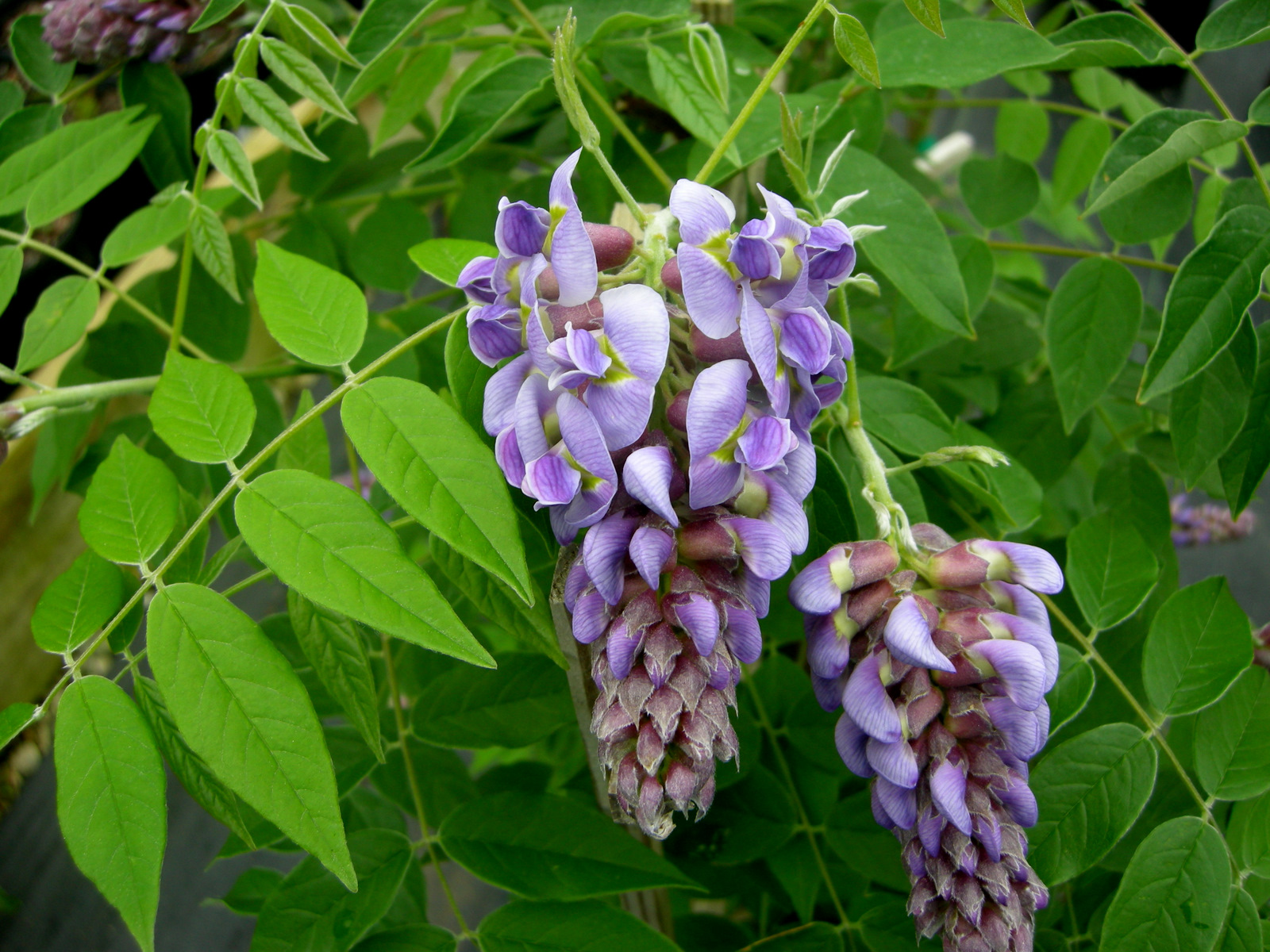
Native American wisteria, Wisteria frutescens ‘Amethyst Falls’

The copious fragrant, lavender-blue flower clusters of  Amethyst Falls’ American wisteria are almost as beautiful in bud as in bloom from June to August.  This wisteria has fine-textured attractive foliage and is less rampant than Asian wisteria.  It grows to 20′ at maturity in full sun to part sun (it is technically not a shade plant).  It is native to the eastern U.S., including Pennsylvania.  ‘Amethyst Falls’ is a Pennsylvania Horticultural Society Gold Medal Plant,  click here for details.

The flowers and foliage of American wisteria.


I grow every one of these shrubs and vines in my gardens so I know you can’t go wrong by adding them to yours!  If you are a customer, you have until May 25 to place an order by clicking here.  If not, now you have some plants to ask for at your local independent nursery.

Carolyn


Notes: Every word that appears in orange on my blog is a link that you can click for more information.  If you want to return to my blog’s homepage to access the sidebar information (catalogues, previous articles, etc.), just click here.

Nursery Happenings: Orders for woody shade plants will be accepted until  noon on Wednesday, May 25.  We will have our traditional open hours over Memorial Day Weekend on Saturday from 9 am to noon and Sunday from noon to 3pm.  You don’t need an appointment, just show up.  But remember you can make an appointment to shop 24/7 by sending me an email at carolynsshadegardens@verizon.net.  There is  still a great selection of hostas, ferns, and hardy geraniums.

May GBBD: An Embarrassment of Riches

Posted in Garden Blogger's Bloom Day, Gardening Gone Wild Photo Contest, landscape design, native plants, Shade Shrubs with tags , , , , , , on May 15, 2011 by Carolyn @ Carolyns Shade Gardens

Carolyn’s Shade Gardens is a retail nursery located in Bryn Mawr, PA, specializing in showy, colorful, and unusual plants for shade.  The only plants that we ship are snowdrops and miniature hostas.  For catalogues and announcements of events, please send your full name, location, and phone number (for back up use only) to carolyn@carolynsshadegardens.com.  Click here to get to the home page of our website for catalogues and information about our nursery and to subscribe to our blog.

English primrose, Primula x polyantha ‘Cherry Pinwheels’, from Garden Vision Epimediums, one of my favorite nurseries.

Spring is with us in all its glory, and we have reached the middle of the month when I encourage each of you to walk around your garden and assess what you need to add to make mid-spring an exciting time in your landscape.  Do you need more flowering trees, shrubs, and vines to give you a reason to stroll in your garden?  Could your garden benefit from more flowers that bloom in May?

Late-blooming European wood anemone, Anemone nemorosa ‘Blue Eyes’: can you see its blue eye peeking out?

Make a list and take photographs so that when you are shopping for plants you know what you need and where it should go.  It’s beautiful outside, and you never know what you might find hiding in your garden like the cheerful English primrose (photo at top), which I discovered during my own  inventory.  Come visit Carolyn’s Shade Gardens to find even more inspiring ideas!

Whipporwill flower, Trillium cuneatum

Today is Garden Blogger’s Bloom Day for May when gardeners around the world show photos of what’s blooming in their gardens (follow the link to see  photographs from other garden bloggers assembled by Carol at May Dreams Gardens).  Here are  some more highlights from my mid-May stroll through Carolyn’s Shade Gardens, but to see it all you will have to visit.

Japanese roof iris, Iris tectorum, in my gold garden.
Readers really enjoyed my photos of trees and shrubs on April’s GBBD so I have been photographing every woody plant that has come into bloom since then.  Some have finished blooming now, but most are in bloom.  Let’s start with the trees:

Saucer magnolia, Magnolia x soulanginana: this magnolia was done blooming in the beginning of May, but magnolias are my favorite tree so I had to include it!

Flower of saucer magnolia


Ornamental crabapple, Malus species: this is my only ornamental crabapple and was here when we moved in so I am not sure of the variety.


Flower of the ornamental crabapple (also done now)


Kwanzan cherry, Prunus serrulata ‘Kwanzan’: also here when we moved in.

Flower of Kwanzan cherry (done flowering)


Native Carolina silverbell, Halesia caroliniana ‘Rosea’: a beautiful small flowering tree with amazing orange-streaked bark.


Native flowering dogwood, Cornus florida ‘Cherokee Brave’

Flower of ‘Cherokee Brave’ flowering dogwood


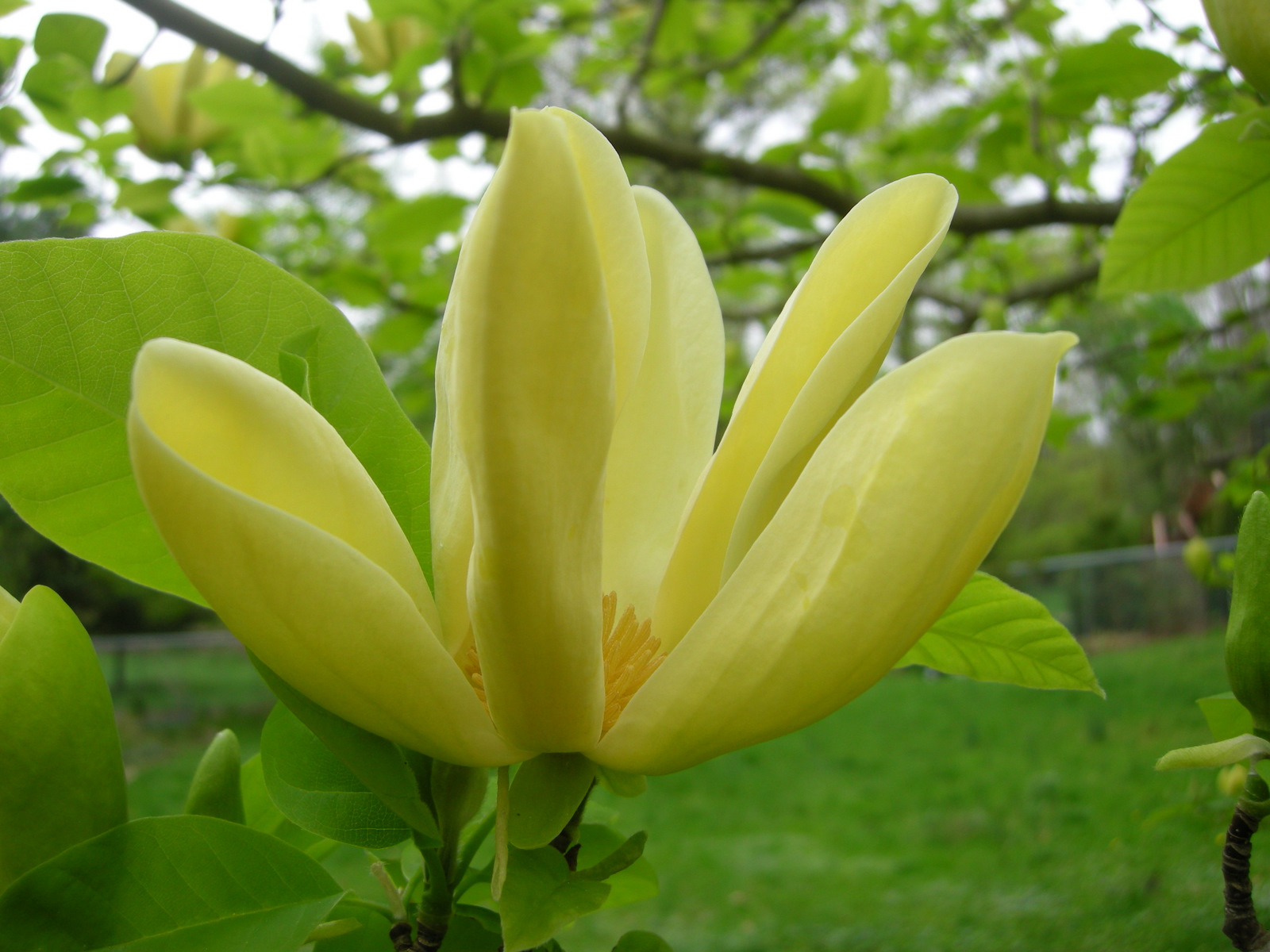
Native cucumber magnolia, Magnolia acuminata ‘Yellow Bird’

Flower of ‘Yellow Bird’ cucumber magnolia


Native green hawthorn, Crataegus viridis ‘Winter King’: I thought it would be fun to see what this tree looks like from inside our house.

Flower of ‘Winter King’ hawthorn: it also has beautiful red berries.


Native pagoda dogwood, Cornus alternifolia ‘Golden Shadows’, with native vine Carolina jessamine, Gelsemium sempervirens ‘Margarita’, and native (to the U.S.) camassia, Camassia leichtlinii ‘Caerulea’.


Wilson’s magnolia, Magnolia wilsonii: a real favorite because it grows and flowers in the shade.  I can’t show you the whole tree because a London plane tree branch fell on it and destroyed its shape.


Oyama magnolia, Magnolia sieboldii, has flowers similar to M. wilsonii but does not tolerate as much shade and blooms later.  Both trees should be planted so that you can view the flowers from below.

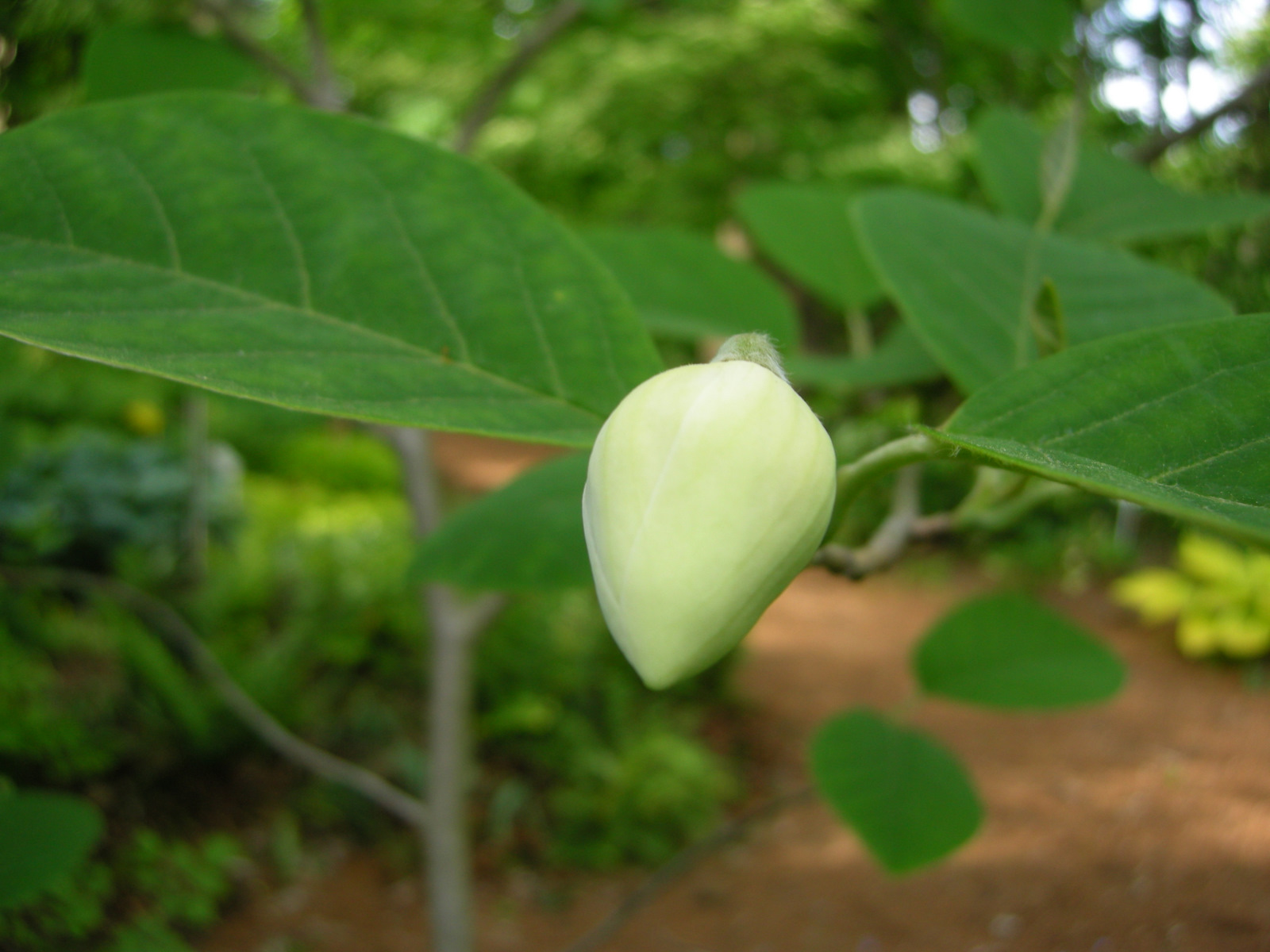
I love the buds of both these magnolias: they look like eggs hanging on the tree.


Are you ready for a few shrubs?

This is the biggest doublefile viburnum, Viburnum plicatum var. tomentosum, I have ever seen, and it started as a 3″ sprig.

Flower of doublefile viburnum


Dwarf Korean lilac, Syringa meyeri ‘Palibin’, with ‘Winter King’ hawthorn in the background.

Flower of ‘Palibin’ dwarf Korean lilac


Old-fashioned weigelas, Weigela florida ‘My Monet’ and ‘Variegata’, with Hosta ‘Stained Glass’

Flower of old-fashioned weigela ‘Variegata’


Tree peonies, Paeonia suffruticosa, take more shade than herbaceous peonies.  These plants did not come with names other than the color.


How about some vines?

My husband’s dedication to training this Chinese wisteria, Wisteria sinensis, across our front porch has really paid off.  I have  a native wisteria too, but it isn’t in bloom yet.

We grow the Chinese wisteria entwined with native honeysuckle, Lonicera sempervirens ‘Blanch Sandman’, and they both reach the second story.  This photo is for Tina at In the Garden who also has this combination.


The view out our dining room window of the pink anemone clematis, Clematis montana var.  rubens, growing on the deck railing.  This is a very vigorous and long-blooming clematis that does well in part shade.

The flowers of pink anemone clematis start out pale pink (above) and deepen in color as they age.


A few scenes of the flower beds in mid-May:

The garden surrounding our deck with Spanish bluebells, Scilla campanulata ‘Excelsior’, variegated Solomon’s seal, Polygonatum odoratum ‘Variegatum’, and white old-fashioned bleeding-heart, Dicentra spectabilis ‘Alba’, in bloom.


The view from upstairs of our main perennial border by the front door.


The woodland garden in mid-May with native hybrid sweetshrub, Calycanthus raulstonii ‘Hartlage Wine’ in bloom in the upper left.


This post is dedicated to my husband, Michael, who plants most of the plants and does all the dirty jobs at Carolyn’s Shade Gardens.


Please let me know in a comment/reply what flowers are blooming in your spring garden.  If you participated in GBBD, please provide a link so my nursery customers can read your post.

Carolyn

Notes: Every word that appears in orange on my blog is a link that you can click for more information.  If you want to return to my blog’s homepage to access the sidebar information (catalogues, previous articles, etc.), just click here.

Nursery Happenings: We expect to have our traditional open hours over Memorial Day Weekend, but remember you can make an appointment to shop 24/7 by sending me an email at carolynsshadegardens@verizon.net.  Saturday was one of my best open houses ever (thanks to everyone who came), but there is  still a great selection of hostas, ferns, and hardy geraniums.

Miniature (& Small) Hostas

Posted in hosta, How to, landscape design with tags , , , , , , , , , , , , , , , , , , , , , , , , , , , , , , , , , , , , on May 9, 2011 by Carolyn @ Carolyns Shade Gardens

Carolyn’s Shade Gardens is a retail nursery located in Bryn Mawr, PA, specializing in showy, colorful, and unusual plants for shade.  The only plants that we ship are snowdrops within the US.  For catalogues and announcements of local events, please send your full name, mailing address, and cell number to carolyn@carolynsshadegardens.com and indicate whether you are interested in snowdrops, hellebores, and/or hostas.  Click here to get to the home page of our website for catalogues and information about our nursery and to subscribe to our blog.

.

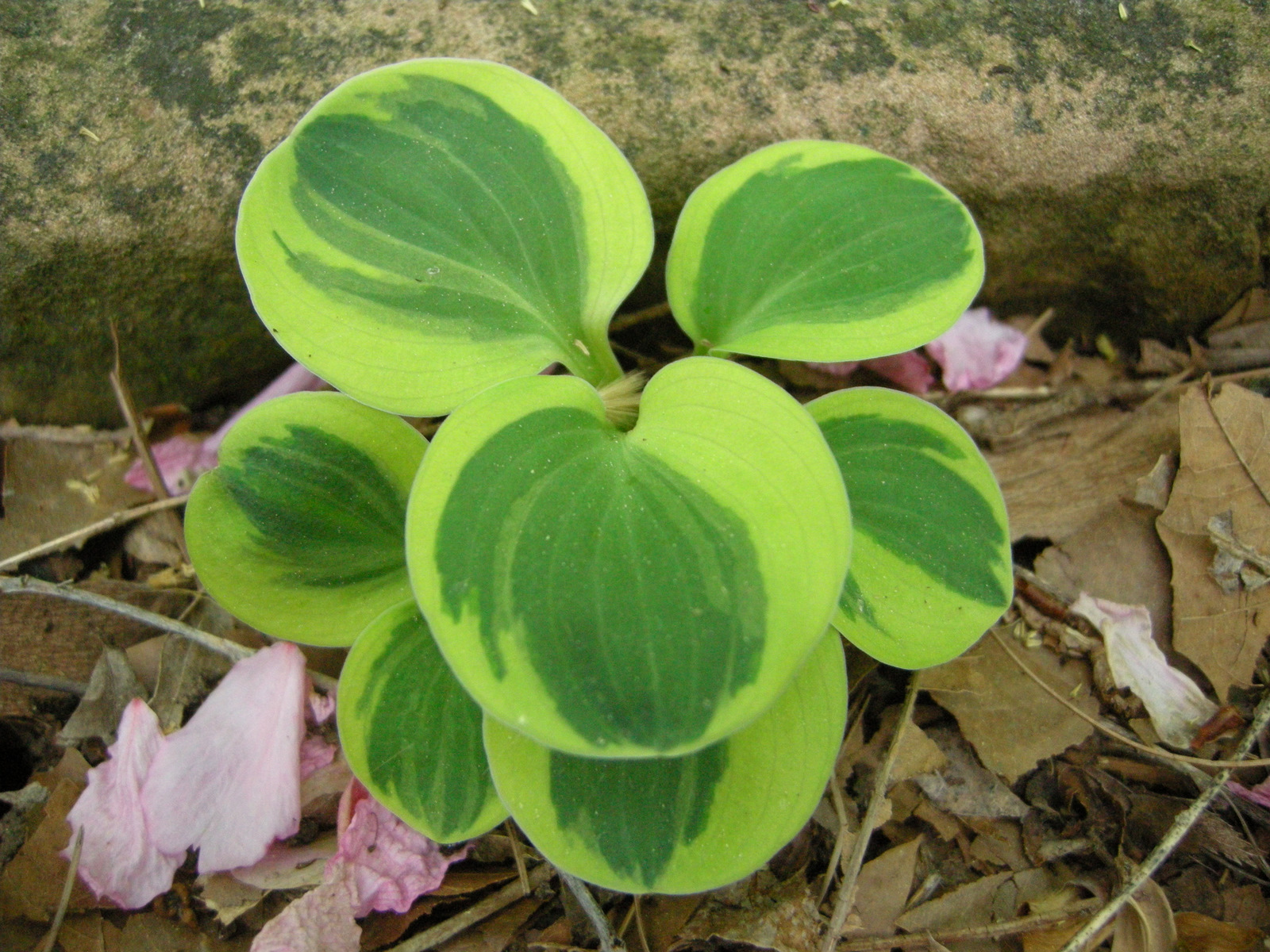
'Holy Mouse Ears'‘Holy Mouse Ears’: the miniature hostas in the mouse ears series are my favorites.

I am in stage four of my relationship with hostas.  I have noticed that many of my customers go through these stages too.  Stage one was when I was a new gardener.  I discovered hostas and loved them because they are easy to grow and to divide to make more.  I had the green one, the green and white one, the blue one, the variegated one, and the gold one.  If you know hostas, you can probably guess fairly easily which varieties I had.  I still love these hostas and have large patches of them in my gardens.

‘Lakeside Cupcake’ was a new small hosta for me in 2010 and is a strong grower.

During stage two, I became more “sophisticated”.  Hostas were too easy to grow, too ordinary, and multiplied too quickly for my control-oriented gardening style.  Besides I wanted flowers, flowers, and more flowers, and hostas just didn’t fit the bill.  I didn’t like them anymore.  How could people collect such a boring and ordinary plant?

“Carolyn’s Gold”: I selected this miniature hosta from a chance seedling that appeared in my gardens.  It is the brightest gold I have ever seen.

I rediscovered hostas in stage three when I got beyond flowers and realized how important foliage is to the garden, especially the shade garden.  I learned that hostas did not come in just the five basic varieties but in an infinite number of combinations of colors, heights, widths, leaf shapes, flowers, and habits.  Somewhere I read that there are 6,000 hosta cultivars.  I wanted them all so I began to collect hostas. 

‘Blue Mouse Ears’ is the miniature hosta that started the mouse ears family.  Not only is it shaped like a mouse ear, but it feels like one too (all in my imagination because I have never felt a mouse ear).  It was designated the 2008 Hosta of the Year by the American Hosta Growers Association–a very high honor.

I entered stage four about the time that my hosta acquisitions topped 100 cultivars.  This is just a modest assemblage because you really aren’t considered a hosta collector until you have over 500 varieties in your garden.  But I was running out of room.  Besides I am not a true collector of any group of plants because I am not satisfied with one of any perennial in my garden.  I need at least five, but preferably seven, of any plant to make an impact.  Many hostas are quite large, and five ‘Blue Angel’, ‘Sum and Substance’, or ‘Sagae’, which are favorites of mine, with six foot wide clumps and 15″ leaves, take up a lot of room.  Were my collecting days over?

Clockwise from upper left: small ‘Blonde Elf’  and miniatures ‘Little Wonder’, ‘Rock Princess’, and a hosta sold to me as ‘Little Blue’.

That’s when I discovered miniature hostas.  The American Hosta Society defines  miniature hostas as having a leaf no larger than 4 sq. in.   The discovery of miniature hostas allowed me to indulge my passion for collecting hostas, which only got worse in stage four, without taking up all the space in my garden.  And they are so incredibly cute and have such adorable names: ‘Holy Mouse Ears’, ‘Pixie Vamp’, ‘Blonde Elf’, ‘Mighty Mouse’, ‘Alakazaam’, ‘Cookie Crumbs’, ‘Rock Princess’.  How can you resist?

‘Mighty Mouse’ is one of the newer members of the mouse ears family.

I remain firmly mired in stage four and don’t know what comes after it, maybe Hostas Anonymous.  But in the meantime, I want to show you some of my favorite miniatures (see photos above and below) and suggest some ideas for displaying miniature and small hostas.

‘Little Treasure’ is new to me this year and has a unique leaf shape and blue-green color.

Because they are so little, most miniature and small hostas can’t be thrown into the garden willy-nilly but benefit from some planning to show them off.  Many also require specialized growing conditions, but those cultivars don’t survive at Carolyn’s Shade Gardens where nothing gets fussed over.  I display my absolute favorite miniature hostas in their own container to really highlight them.  An added benefit is that  hostas multiply more rapidly in containers:

I have shown this photo of ‘Crumb Cake’ before, but it demonstrates how a single unusual plant in a container can be so pleasing.  ‘Crumb Cake’ and all the other hostas pictured in containers in this post also do well in the ground–a requirement for inclusion at Carolyn’s Shade Gardens.


‘Pixie Vamp’: This miniature has elegant mahogany-colored flower scapes that match this container.  I leave all these pots outside all winter.  Hostas overwinter fine as long as their containers can be left outside without cracking.


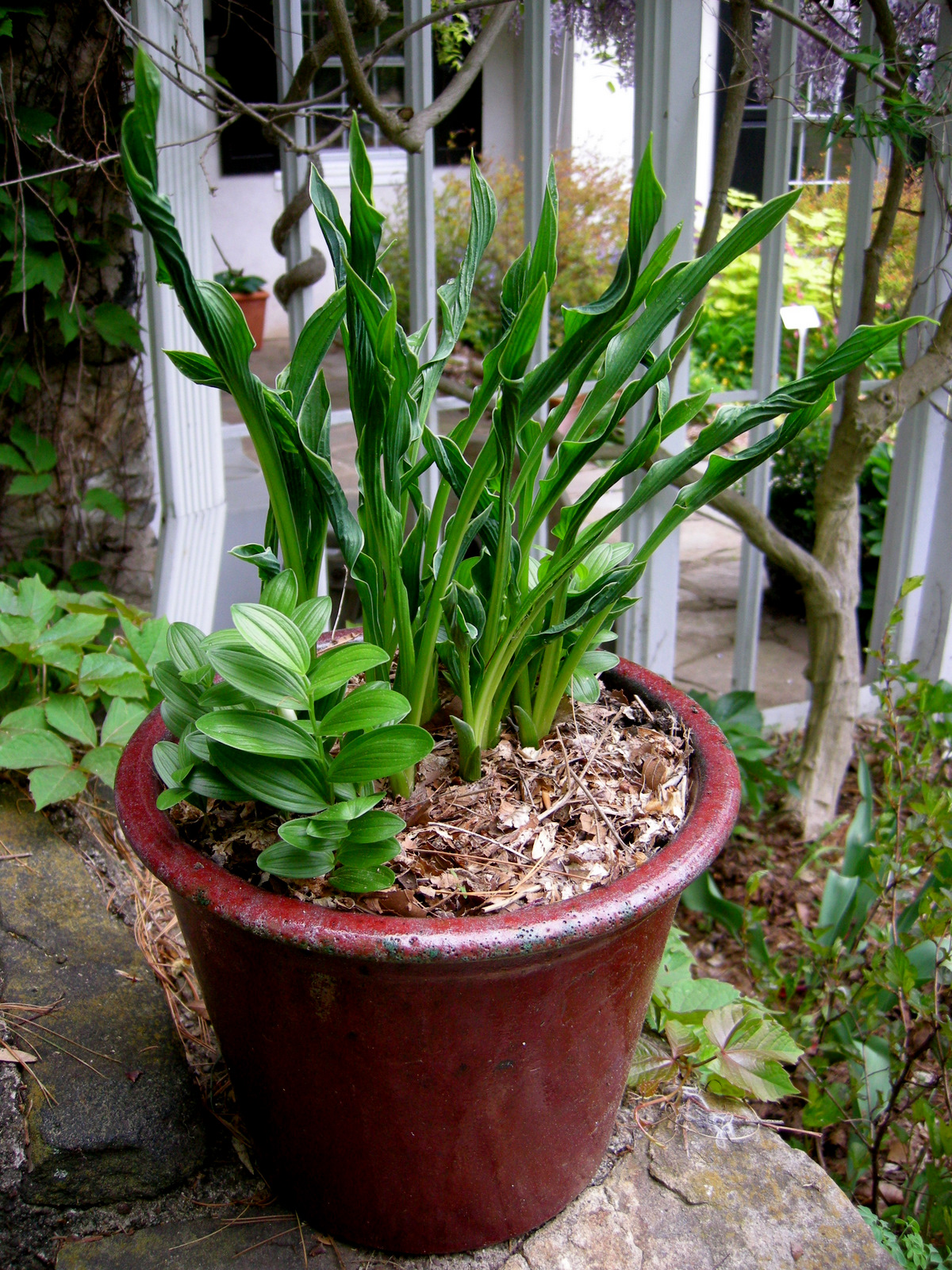
I think ‘Praying Hands’, the 2011 Hosta of the Year, looks best in a container.  It reminds me of pitcher plants without the hassle of creating a bog.  Pictured here with dwarf Solomon’s seal, Polygonatum humile, another plant that thrives over the winter in containers.


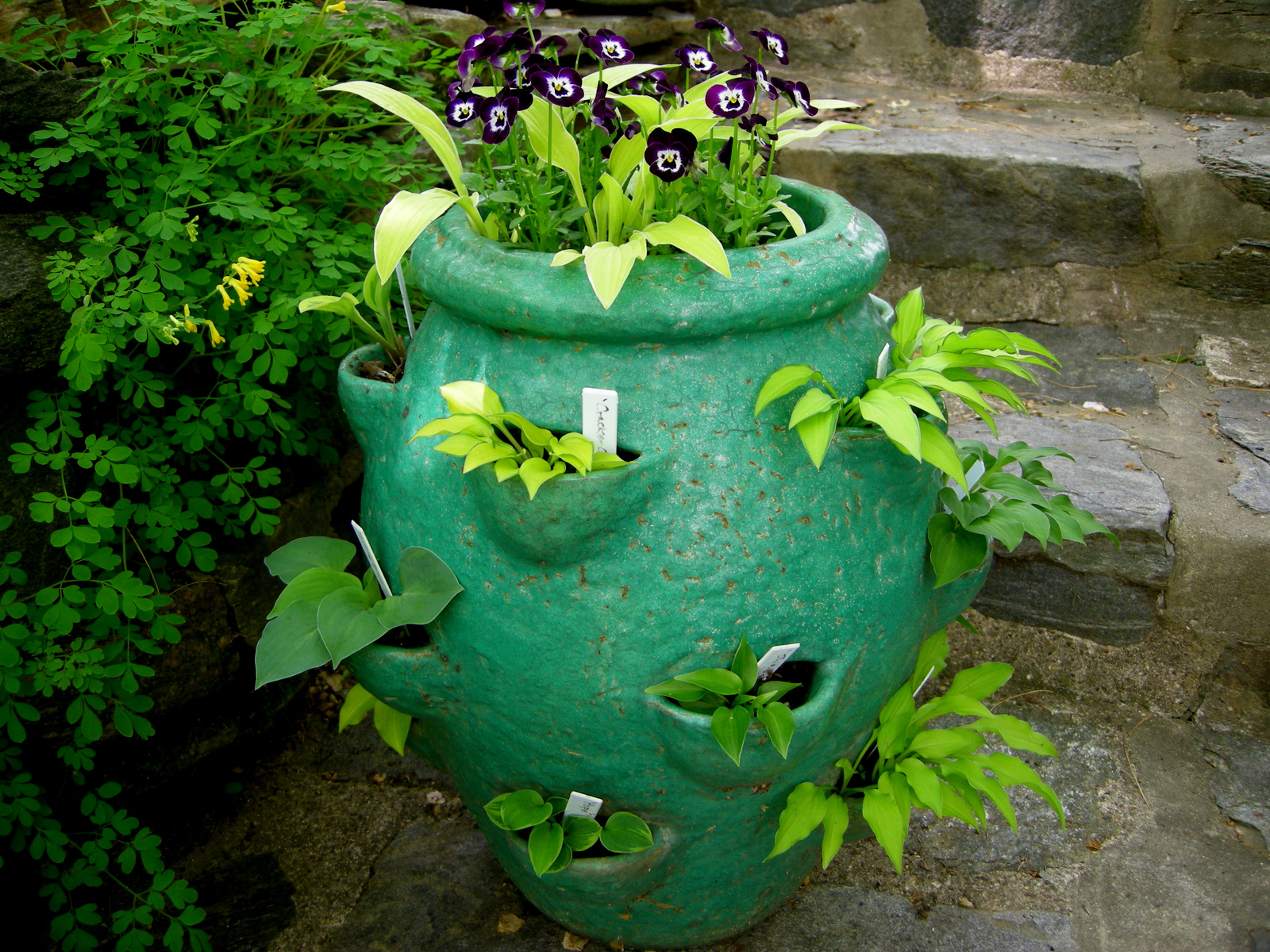
“Carolyn’s Malex Two” is another hosta I selected that grows so slowly in the ground that I have never sold it.  Its position in the top of my antique strawberry pot highlights its delicate coloring and allows it to multiply faster than it would in the ground.


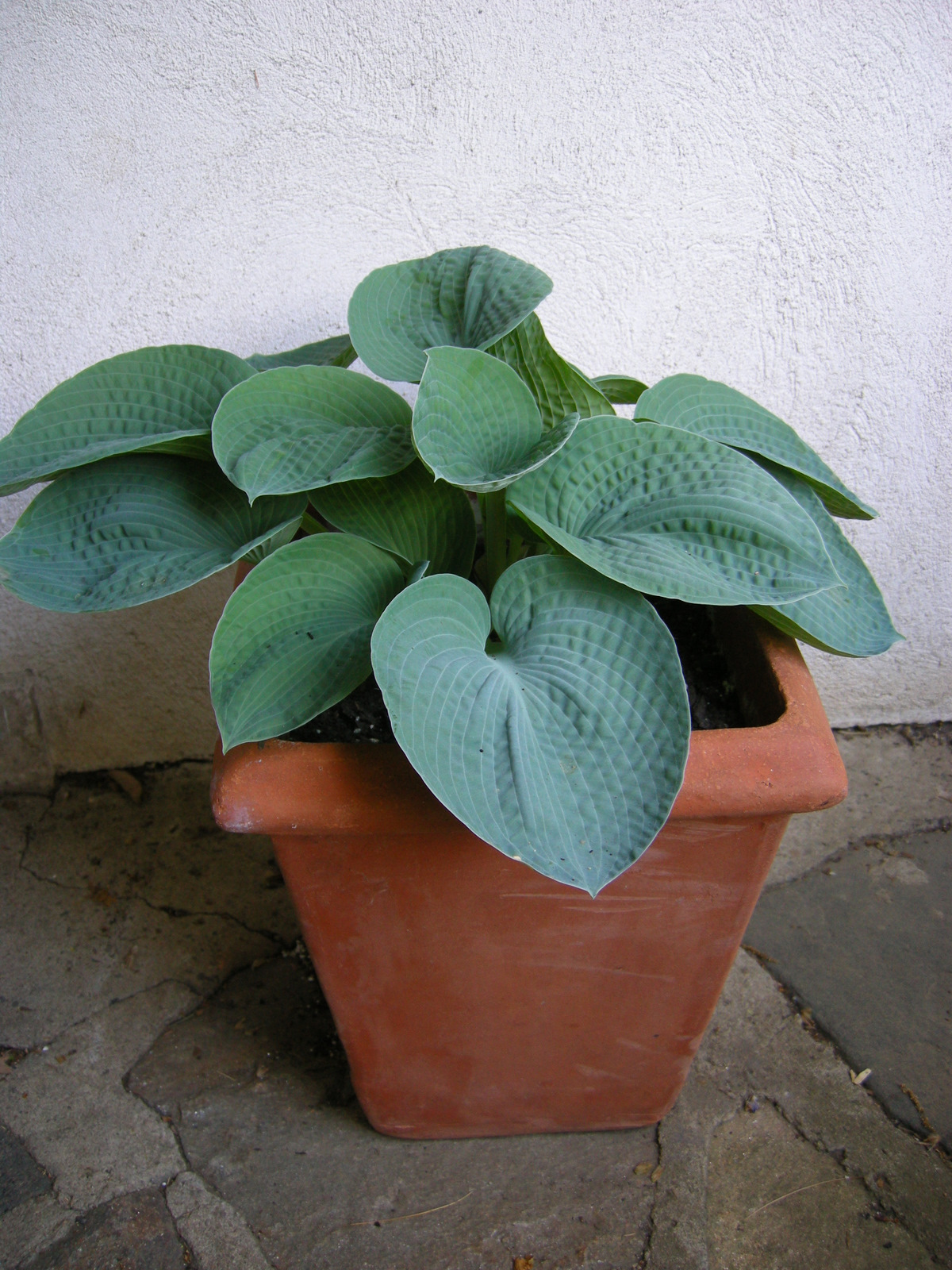
The straight species Hosta tokudama has the bluest leaves of any hosta and lives in this terra cotta container on my porch.


You don’t necessarily have to buy containers for your hostas.  ‘Hanky Panky’, a very unusually colored small hosta, has grown for years in my old dogwood stump.


‘Alakazaam’ has found a home in the chiseled out knot hole of a weathered sycamore branch.  My youngest son crafted this “container” for me for Mother’s Day.


Several miniature hostas can be combined in a larger container:

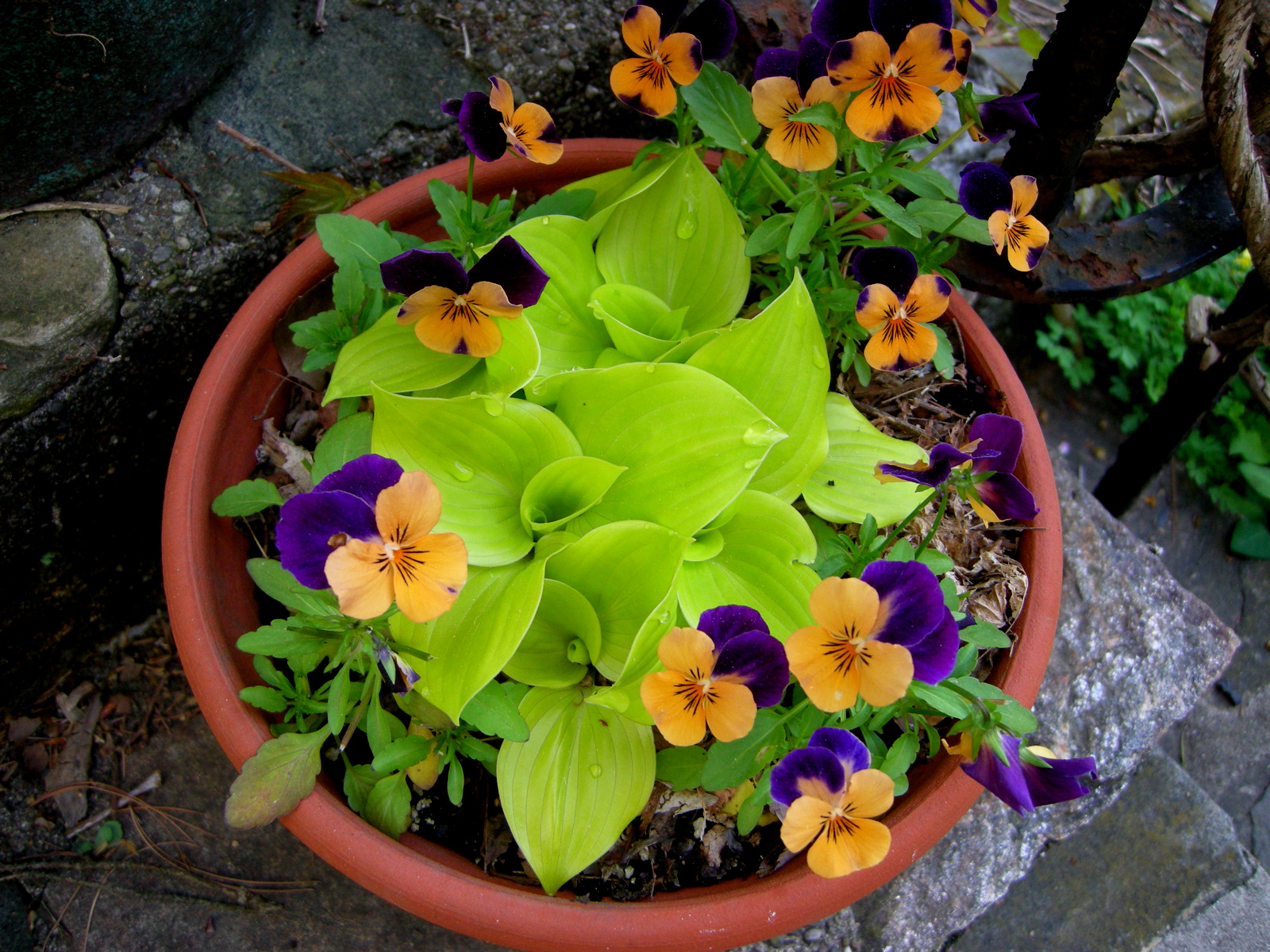
This dish, which I leave out all winter even though it is terra cotta (don’t do this at home!), contains the miniatures  (clockwise from upper left) ‘Cracker Crumbs’, ‘Shiny Penny’, and ‘Shining Tot’ with ‘Praying Hands’, sedum, hens and chicks, rosularia, and miniature dianthus.


My antique strawberry pot has 16 pockets with a different miniature hosta in each one.  Pictured are (top row left to right) ‘Cameo’, ‘Cracker Crumbs’, and ‘Twist of Lime’, (middle row) ‘Little Blue’, ‘Shining Tot’, and ‘Porter’, and (bottom row) ‘Shiny Penny’, ‘Hope, and “Carolyn’s Tiny Gold”.


My husband gave me this antique trough for our anniversary.  It is a perfect setting for my mouse ears collection.  Pictured are (front left to right) ‘Holy Mouse Ears’ and ‘Mouse Trap’, (center) ‘Blue Mouse Ears’, and (back) ‘Green Mouse Ears’, ‘Mighty Mouse’, and ‘Frosted Mouse Ears’, all with dwarf Solomon’s seal.


Hostas thrive between rocks and in rock gardens:

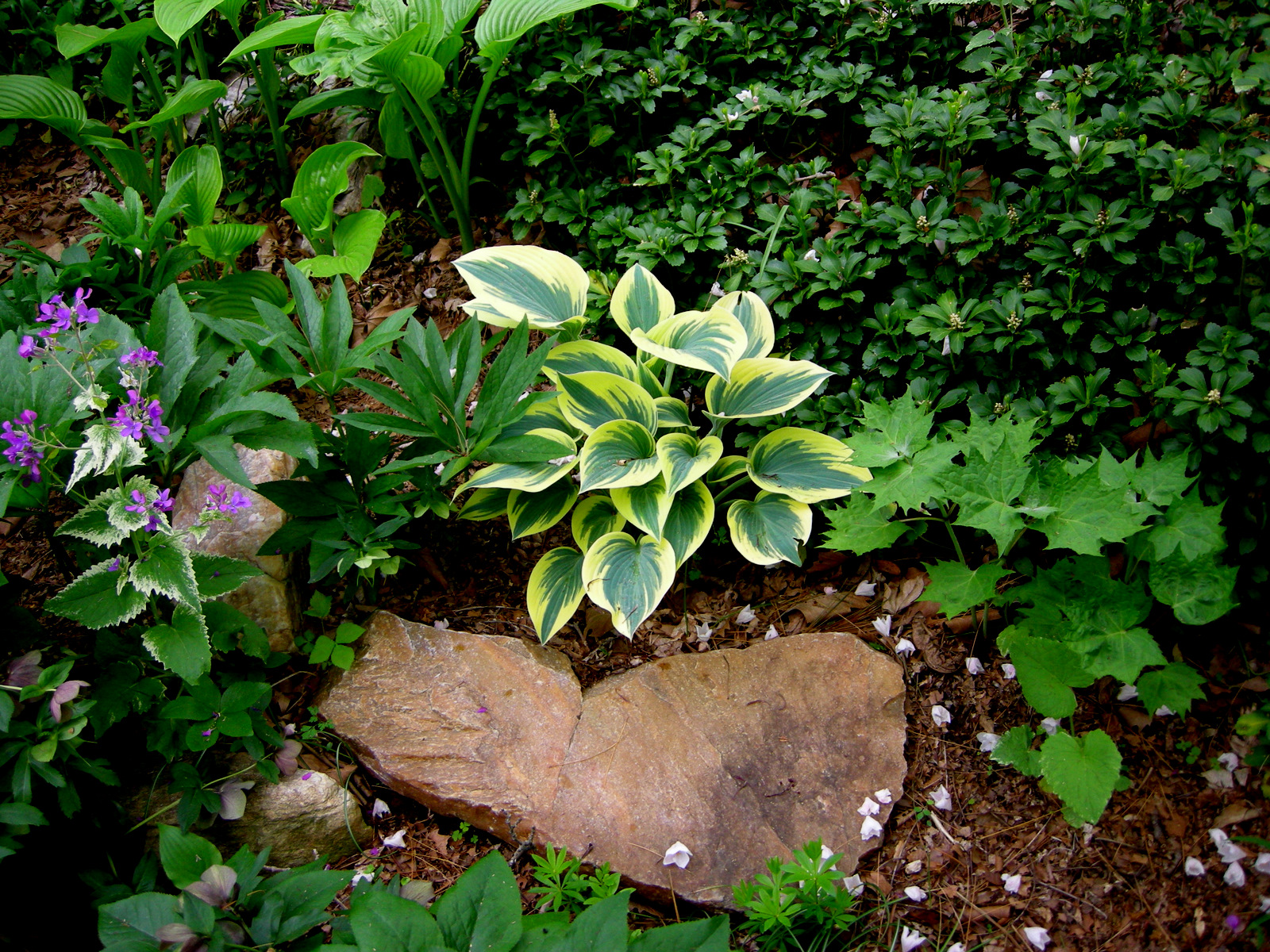
The 2010 Hosta of the Year ‘First Frost’ in my rock garden with (left to right) variegated money plant (Lunaria annua ‘Alba Variegata’), Helleborus cyclophyllus, and yellow wax-bells (Kirengoshoma palmata).


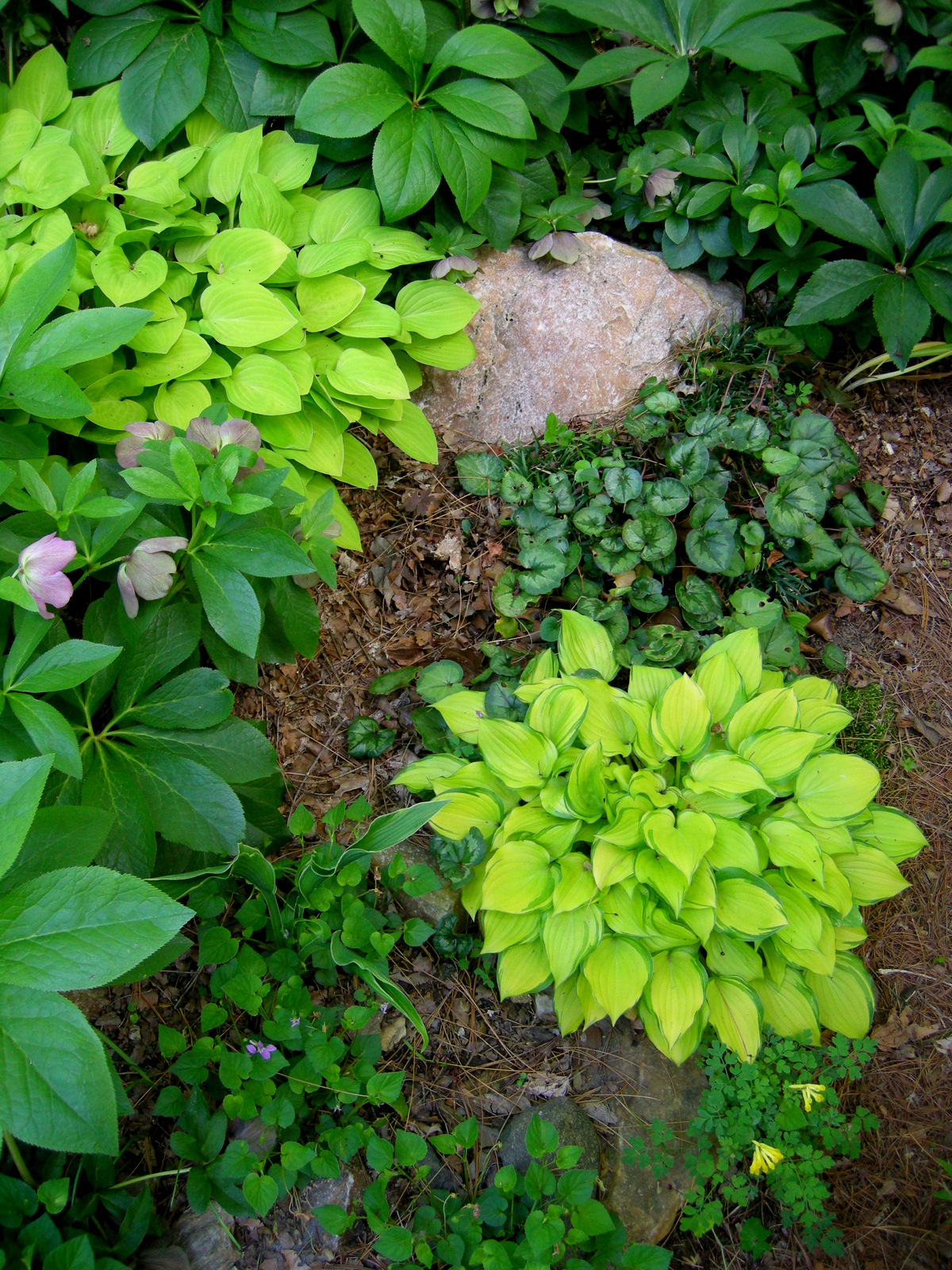
‘Little Aurora’ (upper left) and ‘Cookie Crumbs’ (lower right) in my rock garden with (left to right) ‘Red Lady’ hellebores (Helleborus x hybridus ‘Red Lady’), pink violets (Viola species), and spring-blooming hardy cyclamen (Cyclamen coum).


Miniature and small hostas can be massed for maximum effect and to create groundcover:

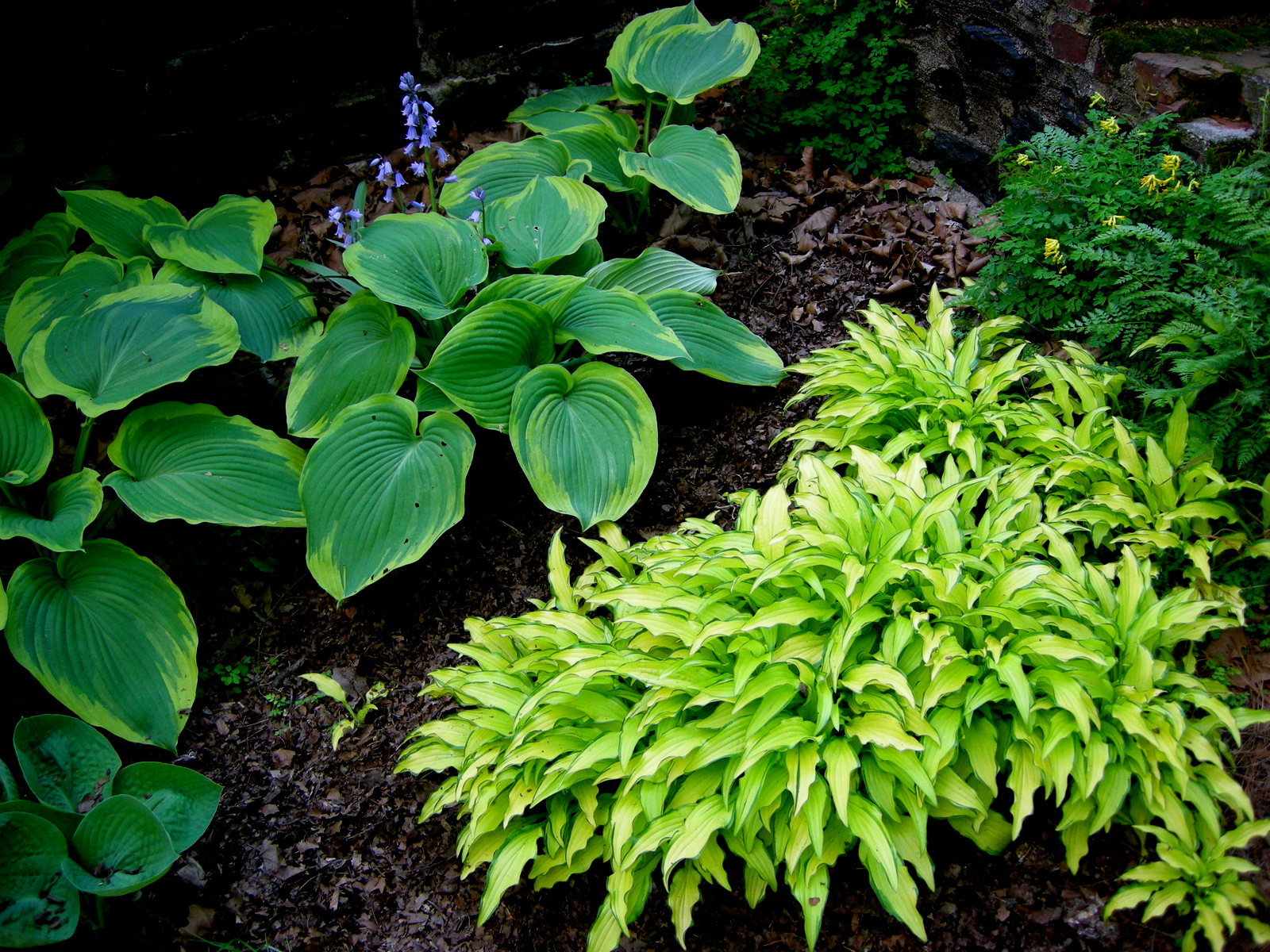
‘Kabitan’ (lower right) massed with (left to right) ‘Abiqua Drinking Gourd’, 2009 Hosta of the Year ‘Earth Angel’, Spanish bluebells (Scilla campanulata ‘Excelsior’), yellow corydalis (Corydalis lutea), and fern-leafed corydalis (Corydalis cheilanthifolia).


“Carolyn’s Gold” (lower left) and ‘Lemon Lime’ (upper right) used as groundcover.


‘Twist of Lime’ (lower right) massed with (left to right) sweet violet (Viola odorata), red epimedium (Epimedium x rubrum), and ‘Fantasy Island’.


I hope I have given you some good ideas for using miniature and small hostas in your garden.  I would be very interested to hear in a comment/reply which miniatures you like and how you use them.

Carolyn

For two more articles on hostas, click here:

Larger Hostas

Hostas for Fall


Notes: Every word that appears in orange on my blog is a link that you can click for more information.  If you want to return to my blog’s homepage to access the sidebar information (catalogues, previous articles, etc.) or to subscribe to my blog, just click here.

Letting Go Part 1: The Lawn

Posted in garden essay, green gardening, landscape design, organic gardening with tags on May 2, 2011 by Carolyn @ Carolyns Shade Gardens

Carolyn’s Shade Gardens is a retail nursery located in Bryn Mawr, PA, specializing in showy, colorful, and unusual plants for shade.  The only plants that we ship are snowdrops and miniature hostas.  For catalogues and announcements of events, please send your full name, location, and phone number (for back up use only) to carolyn@carolynsshadegardens.com.  Click here to get to the home page of our website for catalogues and information about our nursery and to subscribe to our blog.

This photo and the next four all show beds created from former lawn at Carolyn’s Shade Gardens.

WARNING:  This post could be hazardous to your lawn or at least your relationship with your spouse.  It contains lawn profanity as well as intense language and strong opinions and recommends graphic violence to your lawn.  Drug use is discussed, and nudity is recommended.  Read at your own risk.
Depending on how you look at it, I was always ahead of the curve on the lawn issue.  When we bought our property in 1983, I already had it in for the lawn, which encompassed most of our 2 acres.  At the time I didn’t know that “advanced” gardeners were supposed to get rid of their lawn.  I just thought it was a ridiculous waste of garden space and resources like water and very high maintenance: it had to go.  Plus there was never any question of using chemicals to keep it green and weed free as we have been organic from day one.

In 2001, I read this tongue-in-cheek discussion between God and St. Francis and renewed my efforts to eliminate our lawn (click to enlarge):

This clever but provocative piece was printed in the Spring 2001 newsletter of The Friends of Casco Bay, Maine.  It also supports my practice of leaving leaves in my garden beds, see my post Fall Clean-Up.

To me, as pointed out by this article, the whole concept of lawn is inherently ridiculous even before you get to the environmental issues.

Then the scientific evidence kicked in.  Chemically treated lawns are a scientifically documented toxic hazard to your pets.  There is lots of information out there about the cancer causing hazards of commonly used lawn chemicals, for example, see The Truth About Cats, Dogs, and Lawn Chemicals.  After reading this would you let any family member, especially your children, walk on a chemically treated lawn?  

This whole hillside was an eroded, chemically dependent lawn when we moved in.

Lawn chemicals are a major contaminant of the Chesapeake Bay, which is the largest and most biologically diverse estuary in the U.S.  For more information, read this article by the Chesapeake Bay Program by clicking here.  A White Paper produced by a diverse group of scientists and policy experts for the Chesapeake Bay Watershed Project outlines the damage being done and recommends encouraging “consumers to question aesthetics-based behaviors (i.e., desire for visually attractive lawns or produce) in lieu of decision-making based on human health and ecological concerns.”  Phrased that way, it is amazing there is any question what the right path is.

The death warrant for my lawn as most Americans know it was sealed in stone in 2007 when I read an article by Doug Tallamy in which he pointed out the dangers of this non-native monoculture to our native flora and fauna.  It is sobering to consider that we have planted 40 million acres of lawn in the U.S. and that every weekend we mow an area eight times the size of New Jersey.  According to the U.S. EPA, “Operating a typical gasoline-powered lawn mower for one hour produces the same amount of smog-forming hydrocarbons as driving an average car almost 200 miles under typical driving conditions.”  Mowing accounts for 5% of air pollution in the U.S (click here for more details).  In Bringing Nature Home, Tallamy explains quite eloquently how our home gardens are the last bastion of space where we can promote biodiversity through planting native plants.  My lawn just did not fit into this scheme.

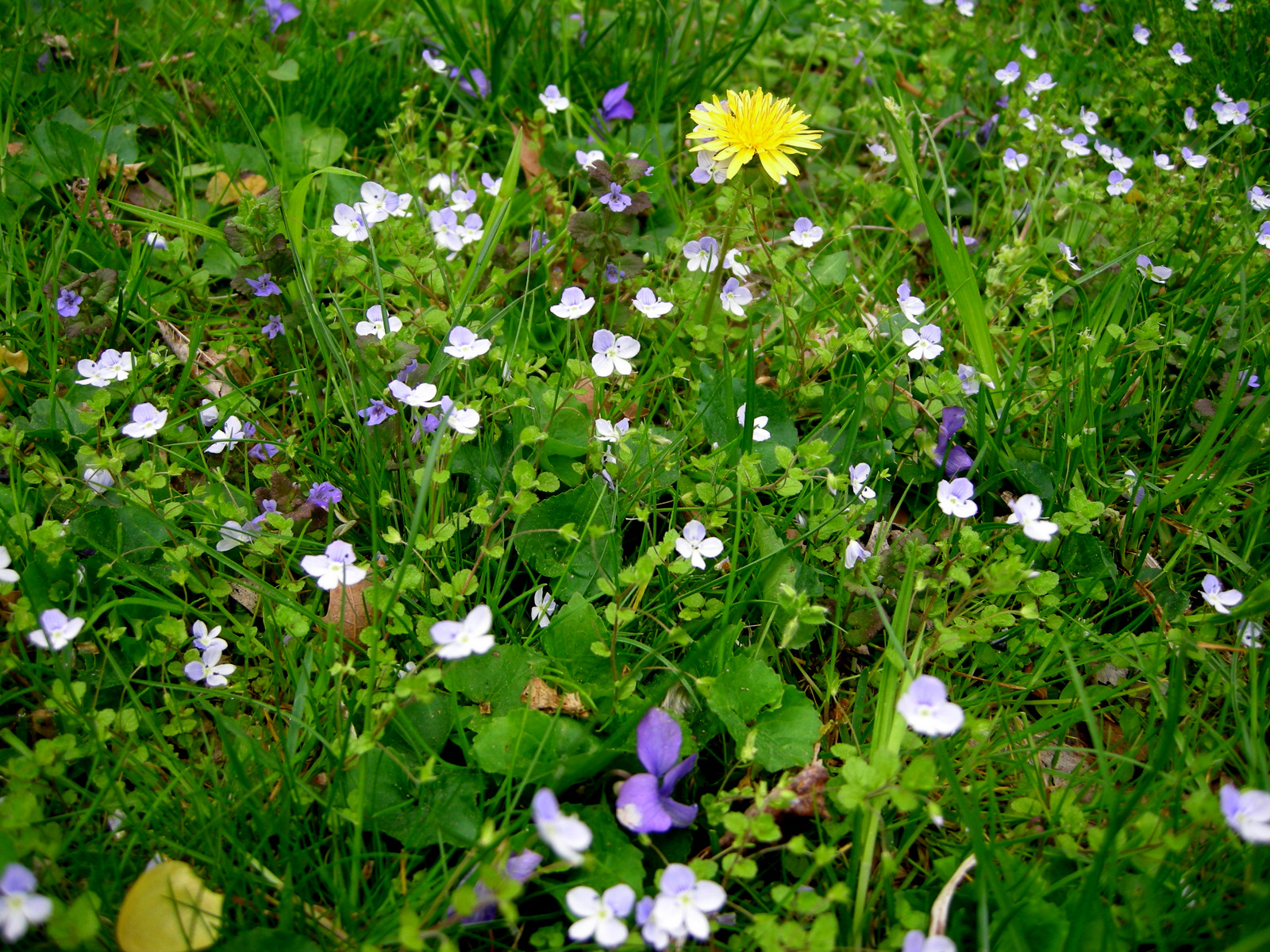
Lawn veronica, Veronica filiformis, grows throughout my lawn.  It is so beautiful that I wish it would completely replace the lawn.

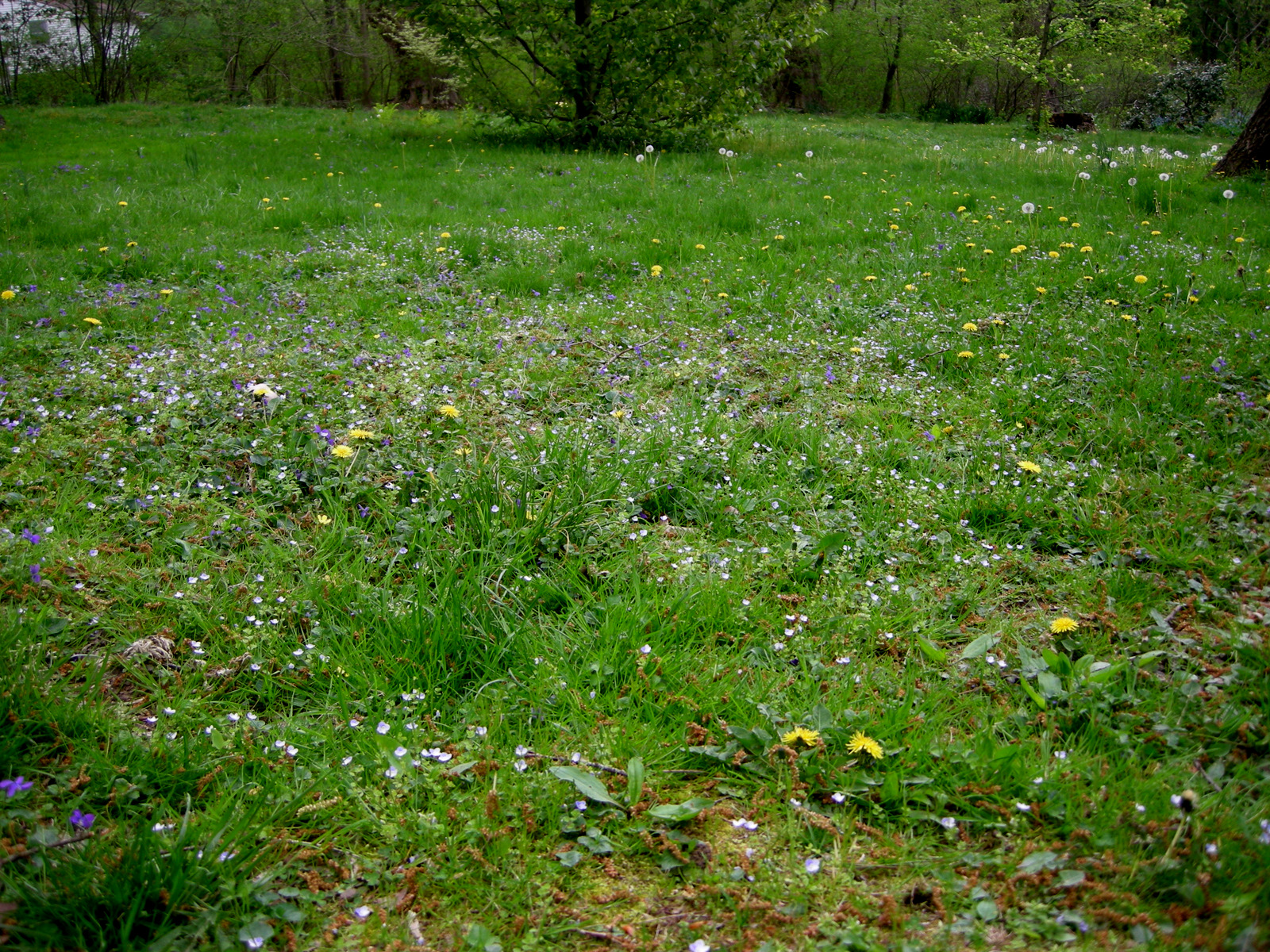
But now that I had eliminated all the lawn I could, what to do about the lawn that remains?  I still have a large grassy area  where my children play, which though not chemically treated is still a monoculture.  This is where the real horror starts: I let it go wild.  I let every “weed” that you are probably trying to remove from your lawn grow there.  And you know what?  It’s beautiful.  All spring, until we mow, it is filled with pretty “wildflowers” covered with bees, butterflies, and beetles, and visited by birds among other local fauna.  Then, when it’s mowed, it is a green expanse like a lawn “should be”.

The photos above and below show some of the “wildflowers” that grow in my lawn:

Common blue violets, Viola papilionacea (sororia)


Japanese painted fern, Athyrium niponicum ‘Pictum’


Wild strawberries, Fragaria species


Common snowdrop, Galanthus nivalis


Native PA white violets, Viola striata


Winter aconite, Eranthis hyemalis


Ground ivy, Glechoma hederacea: I consider this a noxious weed when it appears in my beds, but it is very pretty in the lawn.


Dandelion, Taraxacum officinale


Most of the plants in my lawn are not native.  I consider half of them weeds if they appear in garden beds.  But in the lawn they are beautiful.  You probably don’t see them this way–most people don’t.  I have retrained my eye.  When I see an expanse of weed-free bright green grass, I don’t think what a beautiful law, I think toxic wasteland.

Here is what my lawn looks like in early spring:

This next photo is not for the faint-of-heart:

Creating more “wildflowers” in my lawn.


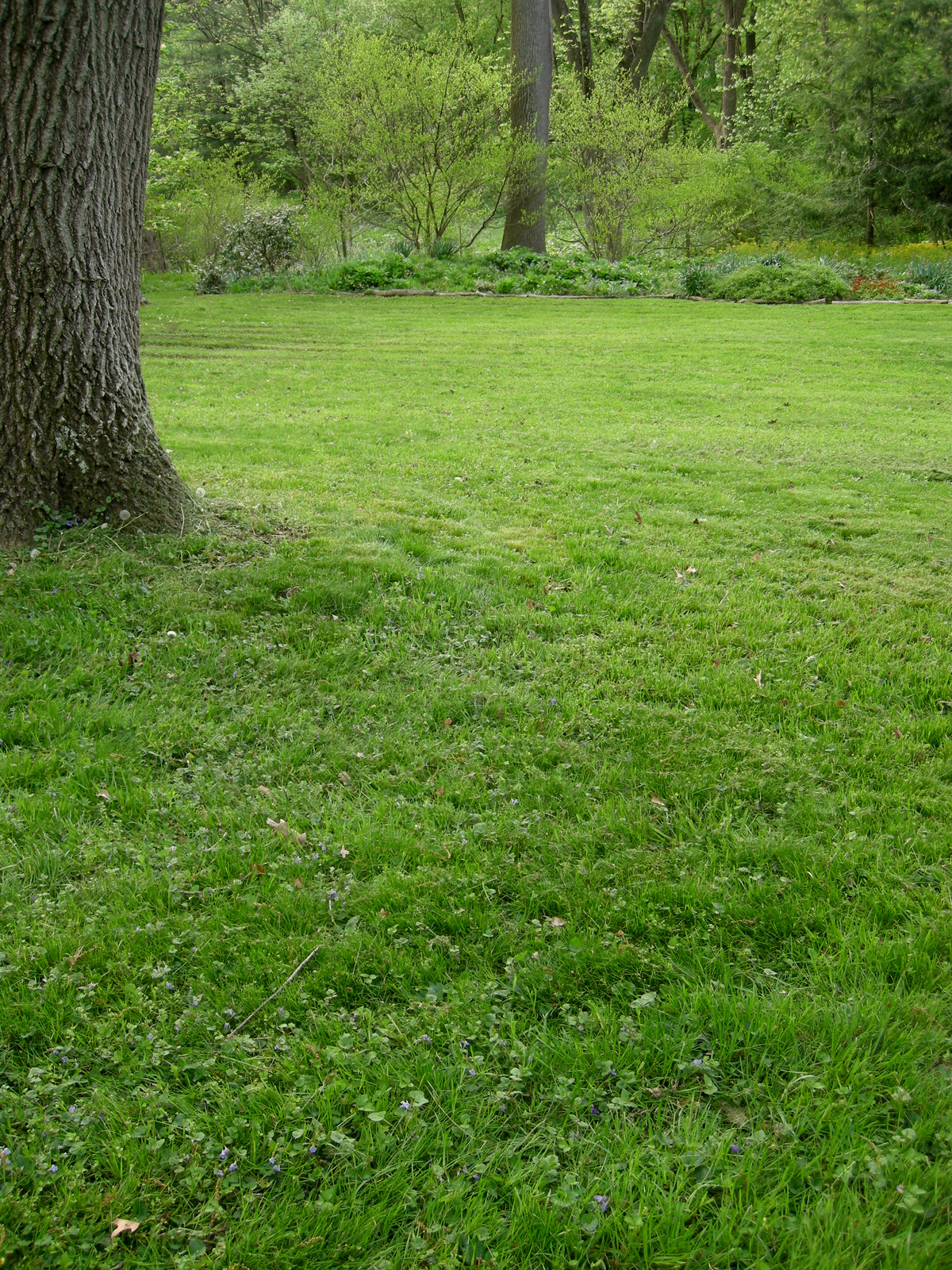
And here is what the same area looks like once it is mowed:

This is all the lawn I need.  Though it is a large area, I think I would do the same thing if my lawn was smaller.

Carolyn

Notes: Every word that appears in orange on my blog is a link that you can click for more information.  If you want to return to my blog’s homepage to access the sidebar information (catalogues, previous articles, etc.), just click here.

Nursery Happenings: Look for Carolyn’s Shade Gardens at the Bryn Mawr Farmer’s Market on Saturday, May 7, from 9 am to 1 pm .  My next open house sale, featuring hostas, ferns, and hardy gernaiums is Saturday, May 14, from 10 am to 3 pm.