Archive for October, 2012

Your Most Precious Garden Resource

Posted in Fall, Fall Color, green gardening, How to, organic gardening, sustainable living with tags , , , , on October 25, 2012 by Carolyn @ Carolyns Shade Gardens

Carolyn’s Shade Gardens is a retail nursery located in Bryn Mawr, PA, specializing in showy, colorful, and unusual plants for shade.  The only plants that we ship are snowdrops and miniature hostas.  For catalogues and announcements of events, please send your full name, location, and phone number (for back up use only) to carolyn@carolynsshadegardens.com.  Click here to get to the home page of our website for catalogues and information about our nursery and to subscribe to our blog.

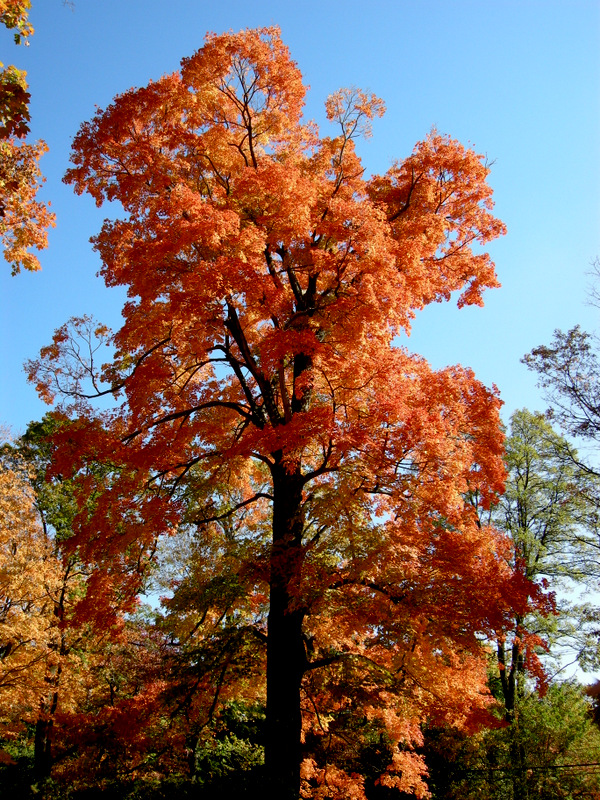
Yes, the sky is really this blue and the trees are really this red during fall in the northeastern US.

Fall in Pennsylvania (mid-Atlantic US) is a big picture time of year.  For a good two months, everywhere you go there are gorgeous vistas like the one above as the leaves change color before dropping.  The show is long-lasting because the leaves turn at different times, starting in my garden with the American hornbeam’s golden yellow hue, progressing through the bright red tones of maples and native dogwoods, and ending with the burgundy and orange of hydrangeas and viburnums.

The soil is deep and very fertile in my area, allowing trees to grow to gigantic size.  And after the color show, the leaves fall and create what I consider my most precious garden resource.  Those leaves are what nature supplies for free to protect and improve the soil year after year.  That is why it is so disturbing to see many area residents collecting their leaves and putting them by the side of the road to be removed by their municipality.


Here at Carolyn’s Shade Gardens we use every leaf that falls to improve our soil either by leaving them in the beds or by grinding them and using them as mulch.  A detailed description of our methods can be found in Shade Gardening in Fall: Fall Clean-up.  In addition, up to 18″ of leaves can be ground up and left on the lawn with beneficial results as described in Shade Gardening in Fall: Leaves on the Lawn.  There is a video by the Scott Lawn Care Company in the second post to show to your doubting spouse.

In early October, about 35 Carolyn’s Shade Gardens customers attended two Low Maintenance Gardening Seminars given by my husband Michael during which he demonstrated how to grind leaves for mulch.  For the benefit of my far flung readers  and in the hope of converting more gardeners to this practice, I thought I would show you step-by-step photographs of the process.  Michael is the reluctant star of the do-it-yourself guide below.

Step One:  Gather the leaves from an area where they can’t be left to decompose on their own.  Michael is removing leaves from the pine needle paths on our back hill using a tarp.  All leaves in the beds will remain in place as mulch and eventually compost.
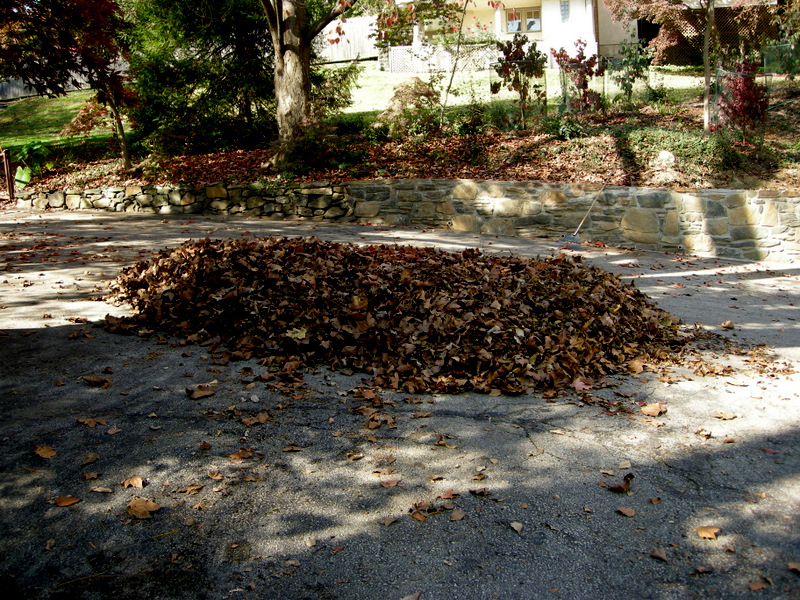
Step Two:  Take the leaves to a level area like your lawn or driveway.  Our driveway is closest to the back hill so Michael took the leaves there for grinding.

As you can see in the photo, we use a standard lawnmower to grind our leaves.  We recommend wearing steel-toed footwear, ear protection (see photo below), and, if appropriate, eye protection when using a lawnmower.


Step Three:  Grind the leaves to the required consistency.  Michael usually goes over them twice, but you can make them as fine or as coarse as you want.
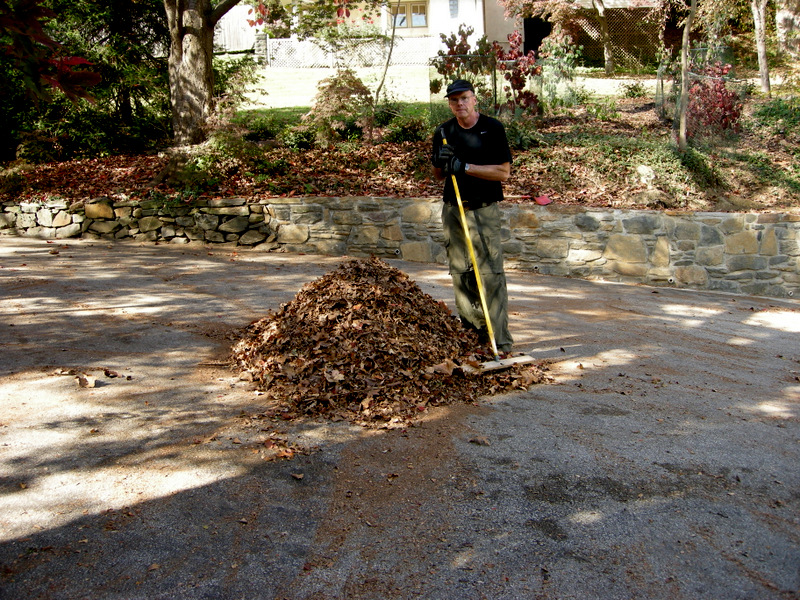

A large amount of leaves becomes a manageable pile after grinding.


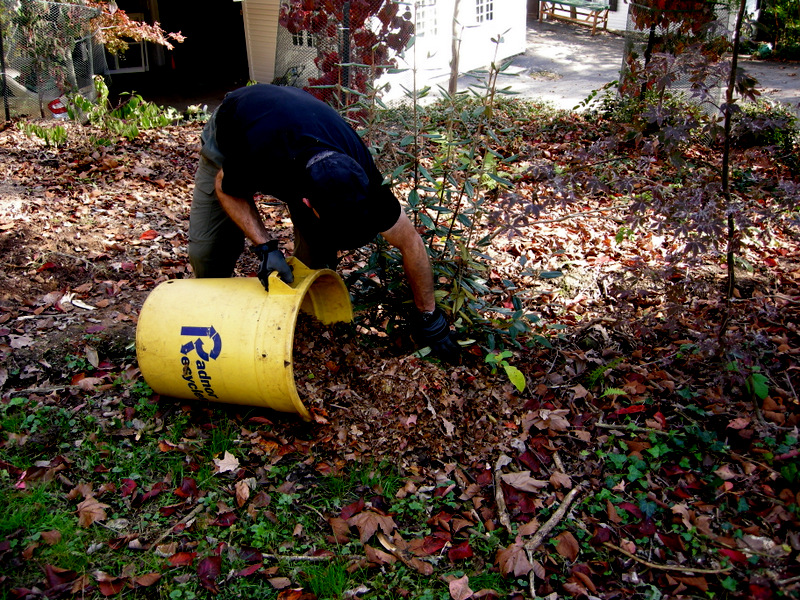
Step Four:  Gather your free mulch into a container for easy transportation and application.  Michael is using a township recycling barrel.


Step Five:  Spread the mulch in your garden.  Here Michael uses it around the base of newly planted viburnums.

I hope I have made this process look as easy as it really is.  Once you try it and see the beneficial results for your soil, you too will be a convert.

Carolyn


Nursery Happenings:  Carolyn’s Shade Gardens is done for the fall.  Thanks for a great year.  See you in spring 2013.

If you are within visiting distance and would like to receive catalogues and information about customer events, please send your full name and phone number to carolynsshadegardens@verizon.net.  Subscribing to my blog does not sign you up to receive this information.

Facebook:  Carolyn’s Shade Gardens has a Facebook page where I post single photos, garden tips, and other information that doesn’t fit into a blog post.  You can look at my Facebook page here or click the Like button on my right sidebar here.

Notes: Every word that appears in orange on my blog is a link that you can click for more information.  If you want to return to my blog’s homepage to access the sidebar information (catalogues, previous articles, etc.) or to subscribe to my blog, just click here.
 

Fall-blooming Hardy Cyclamen

Posted in bulbs for shade, evergreen, Fall, Fall Color, groundcover, Shade Gardening, Shade Perennials, winter interest with tags , , , , on October 17, 2012 by Carolyn @ Carolyns Shade Gardens

Carolyn’s Shade Gardens is a retail nursery located in Bryn Mawr, PA, specializing in showy, colorful, and unusual plants for shade.  The only plants that we ship are snowdrops and miniature hostas.  For catalogues and announcements of events, please send your full name, location, and phone number (for back up use only) to carolyn@carolynsshadegardens.com.  Click here to get to the home page of our website for catalogues and information about our nursery and to subscribe to our blog.

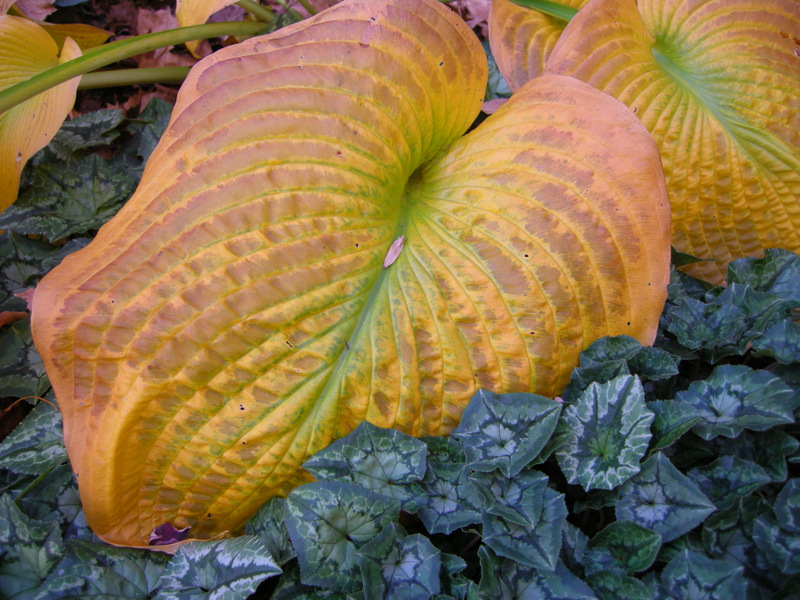
Fall-blooming hardy cyclamen, C. hederifolium,  used as a groundcover under Hosta ‘Blue Angel’ 11/13/10.

My last post on hardy begonias sparked such interest and comments that I thought I would profile another unusual star performer for fall.  Like the begonia, I learned about hardy cyclamen at a course I took at Longwood Gardens in Kennett Square, PA, this one on bulbs in 1995.   And just like the begonia, I couldn’t believe that there was a plant that looked like my florist cyclamen house plant but grew outside and came back every year.  I talked about hardy cyclamen in my post on More Flowering Wintergreen Groundcovers for Shade, but I want to profile it in more detail here and include more photos.

Fall-blooming hardy cyclamen

There are several species of hardy cyclamen, but the two that are usually available are fall-blooming Cyclamen hederifolium and spring-blooming Cyclamen coum.  I have them both and love them, but if you are just starting out, the fall-blooming variety is much easier to grow.  Cyclamen coum requires the kind of excellent drainage rarely found in mid-Atlantic gardens.  I grow mine most successfully in my rock garden and also less abundantly between tree roots.

Hardy cyclamen begins to bloom in the fall before its leaves re-emerge from summer dormancy.

The life cycle of hardy cyclamen is unusual.  I guess you could say it begins in September when dozens of small pink flowers begin to bloom before the leaves emerge.  Each flower is on a separate 4 ” stem and looks just like a miniature florist cyclamen flower with gorgeous reflexed petals.  The flowers continue to be produced abundantly in succession through out the months of September and October and sometimes for parts of August and November too.  They are said to be fragrant, but I have never noticed a scent.

I would grow hardy cyclamen just for the flowers, but the leaves are spectacular.  They emerge slowly as the flowers are blooming in late September and take several weeks to reach their full size.  “Variable” is an understatement to describe their wonderful shapes, patterns, and colors.  They can be round to lance-shaped, lobed or entire, serrated or smooth edged, dark green to silver.  And the patterns on the leaves are indescribable, I will just have to show you….


Now that you have seen how gorgeous the leaves are, you will be able to truly appreciate another of their wonderful qualities: they stay green and fresh all winter!  The photos above were taken in November but I could just as easily have captured their glory in March.  Instead of going dormant in the winter like most of our plants, hardy cyclamen goes dormant for a few months during the summer.

White hardy cyclamen, C. hederifolium ‘Album’

There is a lovely white cultivar of fall-blooming hardy cyclamen called ‘Album’.  Some of mine have pure white flowers and others have white with a pink blotch.  It is just as hardy as the parent species and seeds around my garden readily.

Hardy cyclamen growing between roots at the base of  tree.

Hardy cyclamen is native to western Turkey, eastern Europe, including Albania, Bulgaria, and the Balkans, and southern Europe, including France, Italy, and Greece.  It is  a woodland plant that requires good drainage and shade.  In fact it thrives on summer drought in dry shade.  Although it likes to grow between tree roots and rocks, I have success with it in any shaded eastern facing, dry location.  As you can see from the photo below, my plants seed prolifically and eventually fill in to make a solid mat of groundcover.

Seedlings emerging in a new location across from an established patch with no help from me.  I have a feeling that ants move the seeds around.

Hardy cyclamen grows from a corm, which reportedly can reach the size of a dinner plate when old.  There are growing points all over the top of the corm.  If you try starting the plant this way, plant the corms with no more than 1″ of soil on top plus a very light mulch of leaf litter.  I have never done this because I have read many times that dried corms do not establish well and are often collected from the wild.  I started all my patches from established potted plants and that is how I sell hardy cyclamen at my nursery.  Look for it in my 2013 Snowdrop Catalogue.

The top of corms (about 2 1/2″ wide) of hardy cyclamen with the leaves starting to emerge.  The corms are spherical when younger.

The bottom of the corms—this side down.

The hardiness zone information for hardy cyclamen is inconsistent.  Some sources say USDA zones 7 to 9.  The Missouri Botanical Garden plant finder lists it for zones 5 to 9, while other sources say it grows successfully in upstate NY in zone 4.  You will just have to try it.  For all my UK readers, hardy cyclamen received an Award of Garden Merit from the Royal Horticultural Society.

Carolyn

P.S.  When I pushed the Publish button, I found out that this is my hundredth post—kind of exciting!!!

Nursery Happenings:  Carolyn’s Shade Gardens is done for the fall.  Thanks for a great year.  See you in spring 2013.

If you are within visiting distance and would like to receive catalogues and information about customer events, please send your full name and phone number to carolynsshadegardens@verizon.net.  Subscribing to my blog does not sign you up to receive this information.

Facebook:  Carolyn’s Shade Gardens has a Facebook page where I post single photos, garden tips, and other information that doesn’t fit into a blog post.  You can look at my Facebook page here or click the Like button on my right sidebar here.

Notes: Every word that appears in orange on my blog is a link that you can click for more information.  If you want to return to my blog’s homepage to access the sidebar information (catalogues, previous articles, etc.) or to subscribe to my blog, just click here.


Hardy Begonias for Fall Color

Posted in Fall Color, Shade Gardening, Shade Perennials with tags , , , , on October 8, 2012 by Carolyn @ Carolyns Shade Gardens

Carolyn’s Shade Gardens is a retail nursery located in Bryn Mawr, PA, specializing in showy, colorful, and unusual plants for shade.  The only plants that we ship are snowdrops and miniature hostas.  For catalogues and announcements of events, please send your full name, location, and phone number (for back up use only) to carolyn@carolynsshadegardens.com.  Click here to get to the home page of our website for catalogues and information about our nursery and to subscribe to our blog.

The fall-blooming flowers of hardy begonia, B. grandis.

In 1991, I took a perennial plants course at Longwood Gardens in Kennett Square, PA, and was introduced to many wonderful plants that I have since planted in my garden (hellebores being one of them).  One of the most fascinating was hardy begonia or Begonia grandis.  I just couldn’t believe that there was a plant that looked just like my angel wing begonia house plant but grew outside and came back every year.


I can’t remember where I finally located a plant, but hardy begonias soon found their way to my garden and have been multiplying and spreading ever since.  I have noticed that my nursery customers have the same reaction that I did: what is that plant—is an annual?  So I thought I would introduce it to all my readers and recommend it for inclusion in your gardens.


When I say they are like a begonia house plant, I am not kidding.  They grow from tuberous roots and have fleshy succulent stems.  Their leaves are 3 to 6″ long and shaped like an angel’s wing with green on top and red highlights underneath.

The flowers are pale pink and clustered in loose bunches with deep pink stalks.  They bloom from September into November depending on when we get a frost.  The ovary, which persists when the flowers drop, is bright pink, three-winged, and very attractive.

Self-sown hardy begonias in my compost pit

Hardy begonia is native to China and Japan.  It is an upright plant growing to 2 to 3 feet in part to full shade.  Ideally it likes organic, moist soil, but my experience is that it grows anywhere in the shade.  It spreads all over the place at Carolyn’s Shade Gardens and is easily removed by yanking on the stem.  However, I rarely find it in a place I don’t want it.  It has even formed a very nice stand in my compost pit.  The only trick to growing it is that it comes up very late—mid-May in the mid-Atlantic—so you need to remember where it is.

White hardy begonia, B. grandis ‘Alba’


There is a lovely white cultivar of hardy begonia called ‘Alba’.  It has pure white flowers with pale pink stalks.  It is just as hardy as the parent species and seeds around my garden readily.


Hardy begonia looks great everywhere in my garden.  However, I prize it for growing between all my hostas on my back hill.  When the hostas look ratty, it springs up looking fresh and elegant and blooms its heart out.

White hardy begonia growing between hostas.

Before I start an avalanche of emails asking for this plant, I am sold out for the year at the nursery.  However, I always have it available in the spring so look for it in 2013.

Carolyn

Nursery Happenings:  Carolyn’s Shade Gardens is done for the fall.  Thanks for a great year.  See you in spring 2013.

If you are within visiting distance and would like to receive catalogues and information about customer events, please send your full name and phone number to carolynsshadegardens@verizon.net.  Subscribing to my blog does not sign you up to receive this information.

Facebook:  Carolyn’s Shade Gardens has a Facebook page where I post single photos, garden tips, and other information that doesn’t fit into a blog post.  You can look at my Facebook page here or click the Like button on my right sidebar here.

Notes: Every word that appears in orange on my blog is a link that you can click for more information.  If you want to return to my blog’s homepage to access the sidebar information (catalogues, previous articles, etc.) or to subscribe to my blog, just click here.