Nursery News: Carolyn’s Shade Gardens is a retail nursery located in Bryn Mawr, PA, specializing in showy, colorful, and unusual plants for shade. The only plants that we ship are snowdrops and miniature hostas. For catalogues and announcements of events, please send your full name, location, and phone number (for back up use only) to carolyn@carolynsshadegardens.com. Click here to get to the home page of our website for catalogues and information about our nursery and to subscribe to our blog.
.
 Clockwise from upper left: Pink Swamp Azalea, ‘Popcorn’ Snowball Bush, Oakleaf Hydrangea, Coastal Doghobble in winter, Carolina Jessamine, ‘Jet Trail’ Quince.
Because shade gardens are not composed solely of perennials, I offer woody plants—shrubs, trees, and vines—to my customers several times a year. I want them to have a reliable source for large and healthy specimens, but I also want to make available woody plants for shade that are wonderful but hard-to-find. I am in the middle of an offer right now, and customers need to let me know if they want to order by Sunday, April 27. To see the 2014 Spring Shrub Offer, click here.
When I do these offers, I also do a post describing the plants in more detail. These posts are some of the most popular I have ever written. In fact, Woody Plants for Shade Part 2 is number four for all time views and Woody Plants for Shade Part 1 is number eight. If you want to read about all the plants I have recommended, I have included links at the end of this post. So let’s get to the plants that I am recommending this time, starting with three evergreen shrubs.
.
 Unfortunately, the only shot I have of ‘Wintergreen’ boxwood shows it in a container, but at least you can see its loose habit and delicate leaves.
‘Wintergreen’ Korean or little leaf boxwood, Buxus microphylla var. koreana, is a very useful shrub for hedges, edging, achieving a somewhat formal look, and adding evergreen interest to your garden. At 2 to 4′ tall and 3 to 5′ wide, it doesn’t take up a lot of space. As an added bonus, ‘Wintergreen’s’ small dark evergreen leaves maintain their green color in the winter unlike most boxwoods, which turn an ugly bronze-yellow. The loose, rounded habit is easily pruned for use as a hedge. It grows in part to full shade and is deer and disease resistant. After this winter it is nice to know that ‘Wintergreen’ is extremely hardy to zone 4.
.
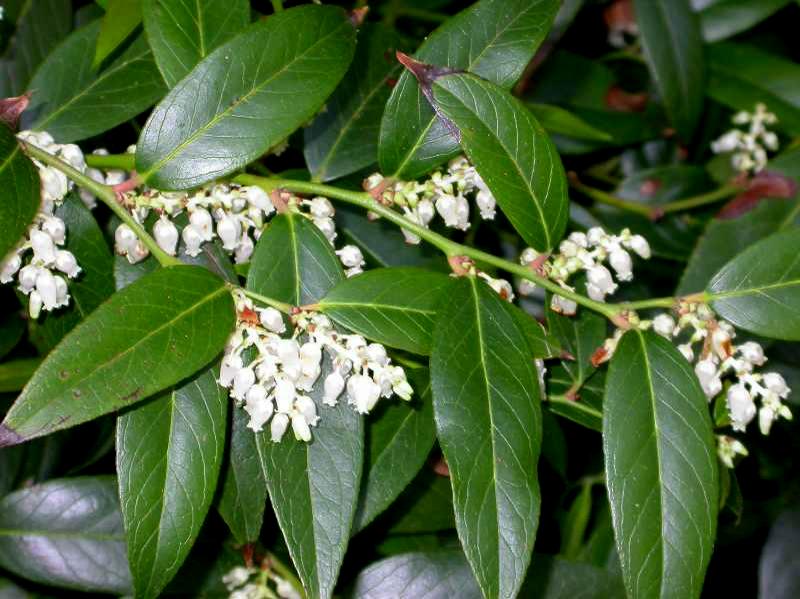 Coastal doghobble’s shiny evergreen leaves display its lovely, fragrant flowers beautifully. Photo courtesy of the Missouri Botanical Garden Plant Finder.
.
 The winter foliage of coastal doghobble.
Coastal doghobble, Leucothoe axillaris, is native to the southeastern U.S., starting just south of Pennsylvania. It has showy, arching clusters of white, fragrant flowers in May. The glossy evergreen leaves have excellent burgundy fall color. Coastal doghobble looks great even after a hard winter unlike the more commonly available doghobble, L. fontanesiana, which always looks ratty to me. It is deer resistant and grows 2 to 4′ tall and 3 to 5′ wide in part shade. Evidently it was given the name doghobble by bear hunters because bears could crash through it but dogs would become entangled.
.
 ‘Goshiki’ osmanthus has a beautiful blend of colors in its leaves and a wonderful fragrance.
‘Goshiki’ variegated holly tea olive, Osmanthus heterophyllus, has dramatic, holly-like evergreen leaves that emerge reddish bronze and change to a lovely blend of cream, gold, and green, lighting up dark corners. Its delicious fragrance perfumes the garden in November when it blooms. The prickly foliage repels deer. My osmanthus came through this winter looking spectacular with no browning. ‘Goshiki’ grows to 6′ tall and 4′ wide in full sun to full shade. It received the coveted Pennsylvania Horticultural Society Gold Medal Award as an outstanding shrub for our area.
That covers the evergreens, now for the deciduous shrubs:
.
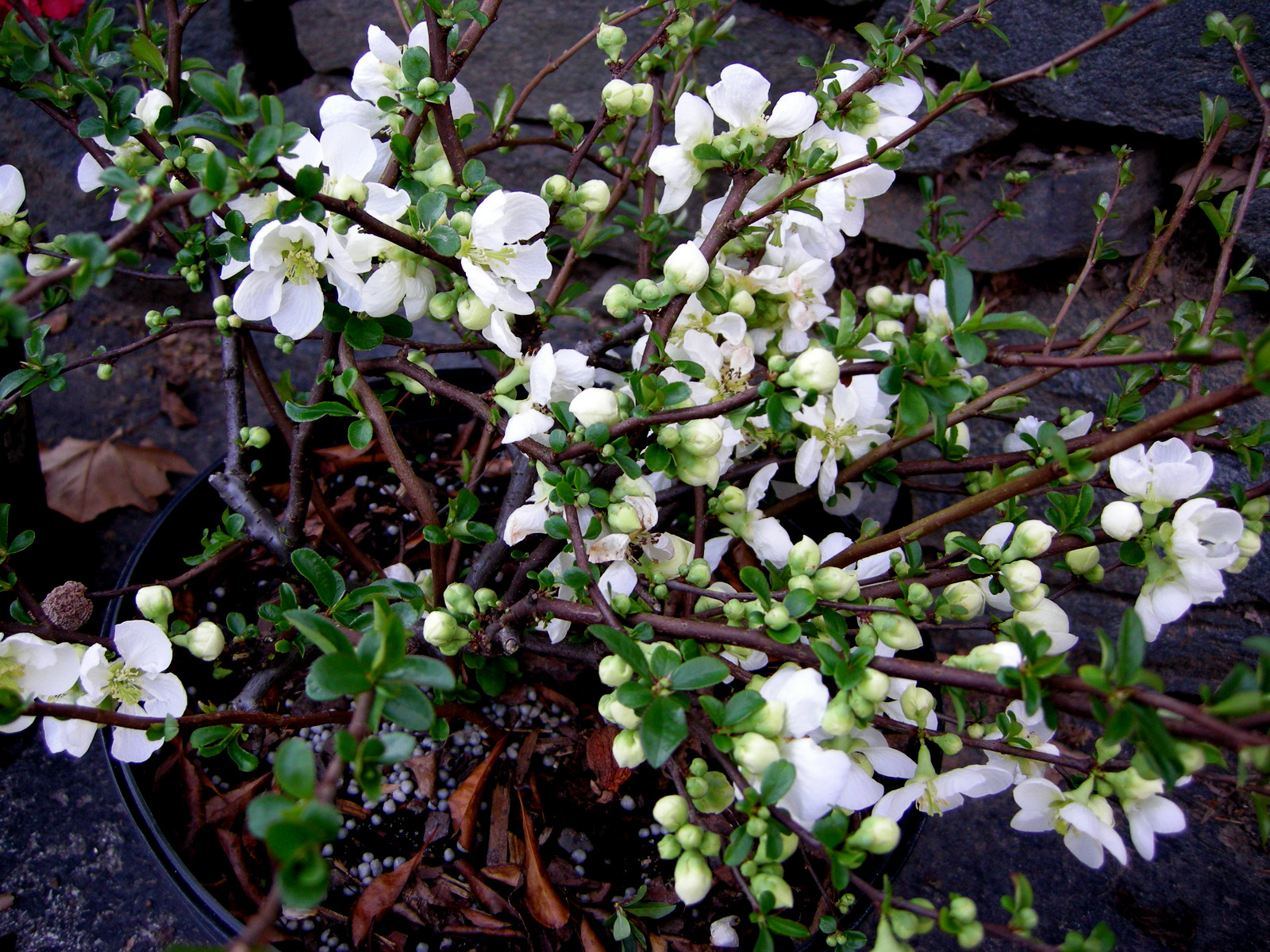 ‘Jet Trail’ quince, Chaenomeles x superba, is loaded with buds and showy, pure white flowers every March (April this year!) and it only grows to 3′ tall and 3′ wide. I have profiled it before so for all the details, click here.
.
 Native ‘Ellen Huff’ oakleaf hydrangea, Hydrangea quercifolia, has all the four season attributes of my favorite shrub—ornamental bark, beautiful fall color, bold-textured leaves, and gorgeous, long-lasting flowers—plus a vigorous habit and great branching structure. For more details, click here to read my profile of oakleaf hydrangeas.
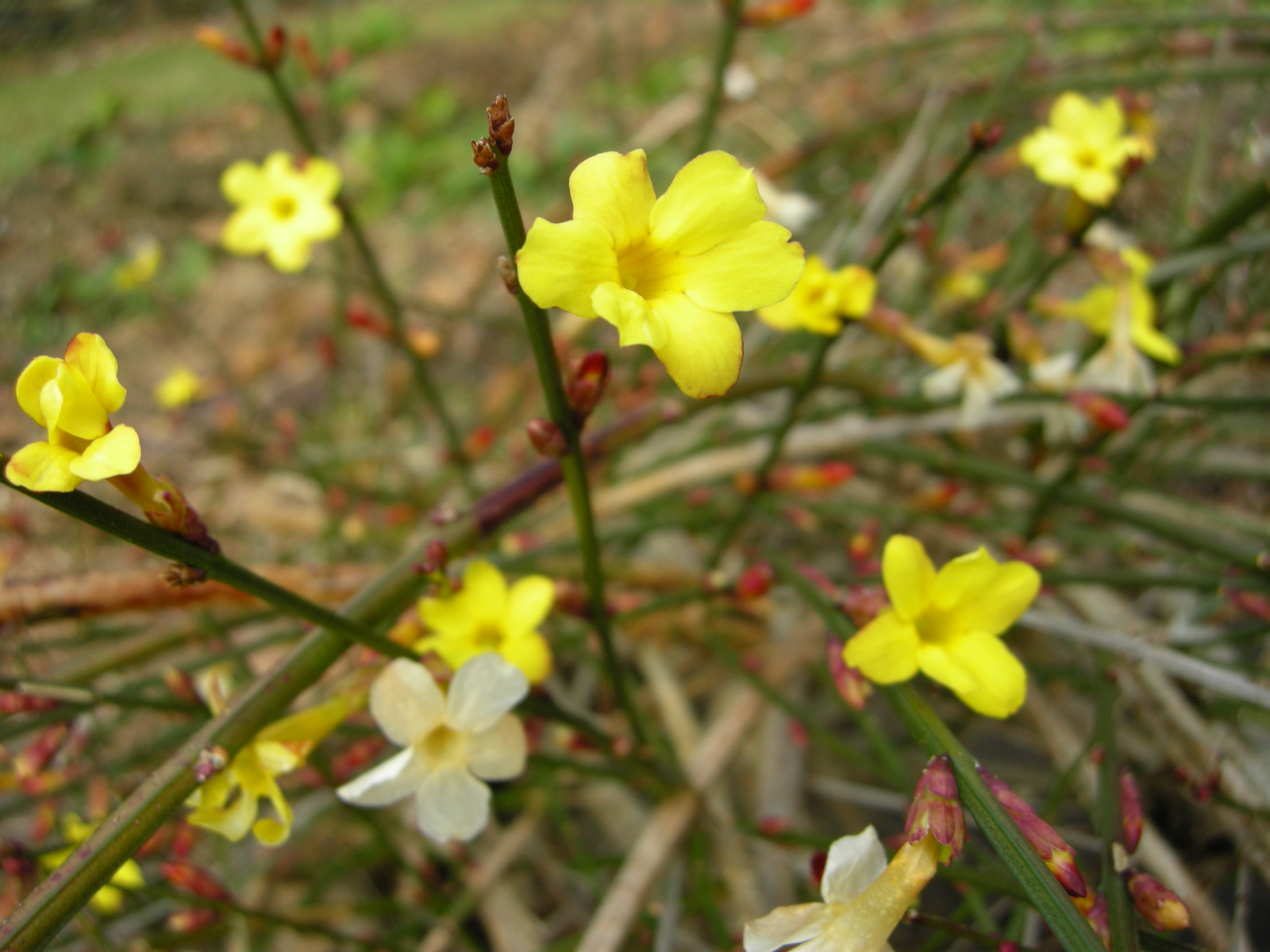 A close up of winter jasmine’s lovely yellow flowers.
.
 I grow winter jasmine trailing over my terrace walls and enjoy its flowers all winter.
Although Winter jasmine, Jasminum nudiflorum, requires full sun, I am offering it because so many customers have asked for it after seeing my plants trailing off my terraces. The soft yellow flowers open during warm spells throughout the winter and then prolifically in February and March (April this year) for a very long season. The graceful, arching stems are dark green providing great winter interest. The shiny dark green leaves have an unusual delicate texture. When planted in a flat area, winter jasmine spreads to make an effective ground cover. It is tough, adaptable, and deer resistant, growing to 3′ tall and 6′ wide in average garden soils.
.
 Swamp azaleas usually have white flowers, but ‘Betty Cummins’ has lovely deep pink blooms.
‘Betty Cummins’ pink swamp azalea, Rhododendron viscosum, is a rare deep pink flowered form of our native swamp azalea. Swamp azalea grows wild from Maine to Florida, and this particular form was found in New Jersey. It blooms in early summer and has a wonderful spicy, clove-like scent. The deciduous, lustrous deep green leaves turn an attractive orange to maroon in fall. ‘Betty Cummins’ grows to 6′ tall and 5′ wide in part shade. It is wet site tolerant and attracts hummingbirds and butterflies.
.
 ‘Popcorn’ Japanese snowball bush is loaded with round white flowers earlier in the season than most other shrubs.
.
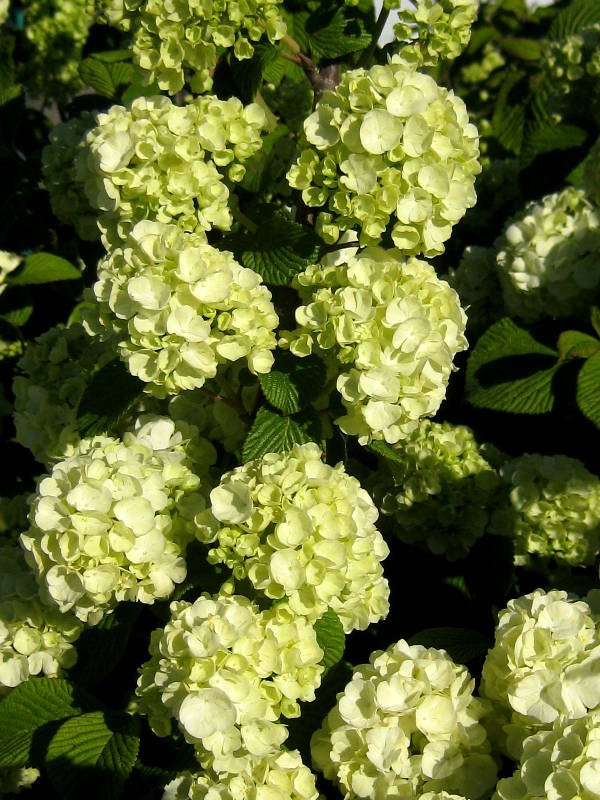 A close up of ‘Popcorn’s’ flowers: although it looks like an hydrangea, it is actually a viburnum.
‘Popcorn’ Japanese snowball bush, Viburnum plicatum, has 3″ round blooms that open lime green and mature to pure white, putting on a stunning show for a full month in April and May. The dark leathery green leaves turn burgundy red in fall. ‘Popcorn’ has a lovely upright, tiered, and compact habit. It grows to 5 to 8′ tall and 4 to 7′ wide in full sun to part shade, but it tolerates full shade. It is deer resistant and heat and drought tolerant.
.
 ‘Margarita’ Carolina jessamine grows on a fence in part shade. It is native to the southeastern U.S. and has received a Pennsylvania Horticultural Society Gold Medal Award as an outstanding vine for our area. To see my previous profile, click here.
.
 A close up of ‘Margarita’s’ fragrant yellow flowers.
.
Those are the nine woody shade plants that I am currently offering to my customers. If you want to read about more trees, shrubs, and vines for you shady garden, here are links to all my previous posts:
Carolyn
Nursery Happenings: Our third sale featuring native plants and wildflowers is Saurday, April 26, from 10 am to 3 pm. Customers on our list will get an email with all the details. You can sign up to receive emails by sending your full name and phone number to carolynsshadegardens@verizon.net. The 2014 Spring Shrub Offer is here, and orders must be received by April 27.
Carolyn’s Shade Gardens is a local retail nursery in Bryn Mawr, Pennsylvania, U.S., zone 7a. The only plants that we mail order are snowdrops and miniature hostas and only within the US.
If you are within visiting distance and would like to receive catalogues and information about customer events, please send your full name and phone number to carolynsshadegardens@verizon.net. Subscribing to my blog does not sign you up to receive this information.
Facebook: Carolyn’s Shade Gardens has a Facebook Page where I post single photos, garden tips, and other information that doesn’t fit into a blog post. You can look at my Facebook page here or click the Like button on my right sidebar here.
Notes: Every word that appears in orange on my blog is a link that you can click for more information. If you want to return to my blog’s homepage to access the sidebar information (catalogues, previous articles, etc.) or to subscribe to my blog, just click here.