Archive for the evergreen Category

January GBBD: Hellebores on Parade

Posted in Camellias, evergreen, Garden Blogger's Bloom Day, garden to visit, hellebores, Shade Perennials, Shade Shrubs, snowdrops, winter, winter interest with tags , , , , , , , , , , , , , , , , , on January 11, 2012 by Carolyn @ Carolyns Shade Gardens

Carolyn’s Shade Gardens is a retail nursery located in Bryn Mawr, PA, specializing in showy, colorful, and unusual plants for shade.  The only plants that we ship are snowdrops within the US.  For catalogues and announcements of local events, please send your full name, mailing address, and cell number to carolyn@carolynsshadegardens.com and indicate whether you are interested in snowdrops, hellebores, and/or hostas.  Click here to get to the home page of our website for catalogues and information about our nursery and to subscribe to our blog.
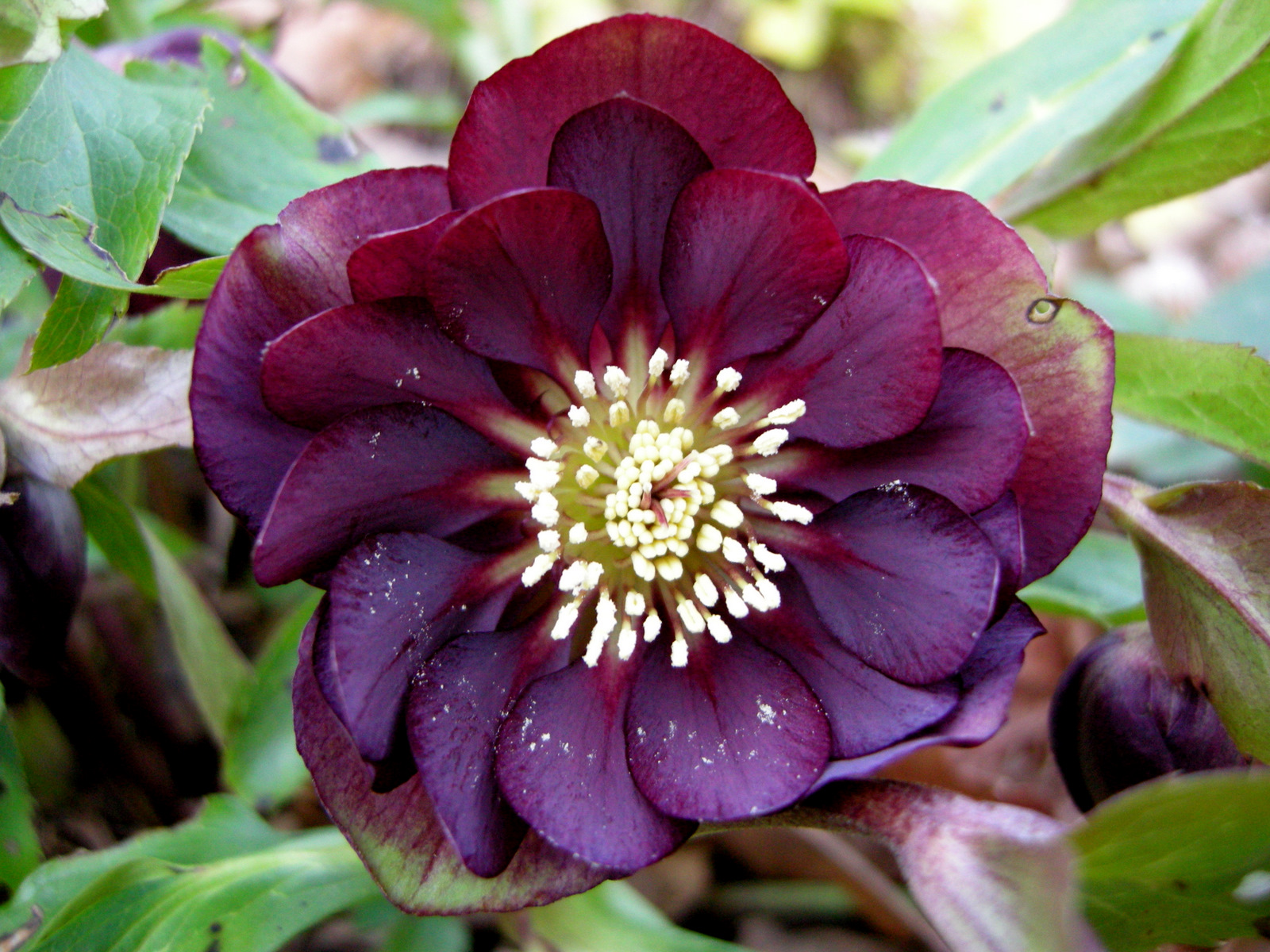
I have had this gorgeous double purple hellebore in my garden for several years but it has never bloomed this early.  Photo 1/7/12

It is the middle of the month and time to participate in Garden Blogger’s Bloom Day hosted by May Dreams Gardens (link available on December 15) where gardeners from all over the world publish photos of what’s blooming in their gardens.  I participate because it is fun and educational for me to identify what plants make my gardens shine at different times of the year.  This month I hope that my nursery customers and blog readers will get some ideas for plants to add to their own gardens to extend their season through winter.

My garden is located in Bryn Mawr (outside Philadelphia), Pennsylvania, U.S., in zone 6B.


‘Mrs. Betty Ranicar’ is usually one of my first hybrid hellebores to bloom but this is early even for her.

Last January, the whole garden was under snow, and I didn’t even participate in GBBD.  This year couldn’t be more different with 7 days in the 50s (10C) and 6 days at 60 degrees (16C) or above since December 15.  Frankly, I find it extremely worrisome, but it means that I didn’t have to go searching for plants peaking between December 15 and January 15.  There are a few other plants worth featuring, but my hellebores are all blooming early so I call this post Hellebores on Parade.  For the benefit of my customers, I will note which hellebores will be for sale at Carolyn’s Shade Gardens (CSG) this spring.
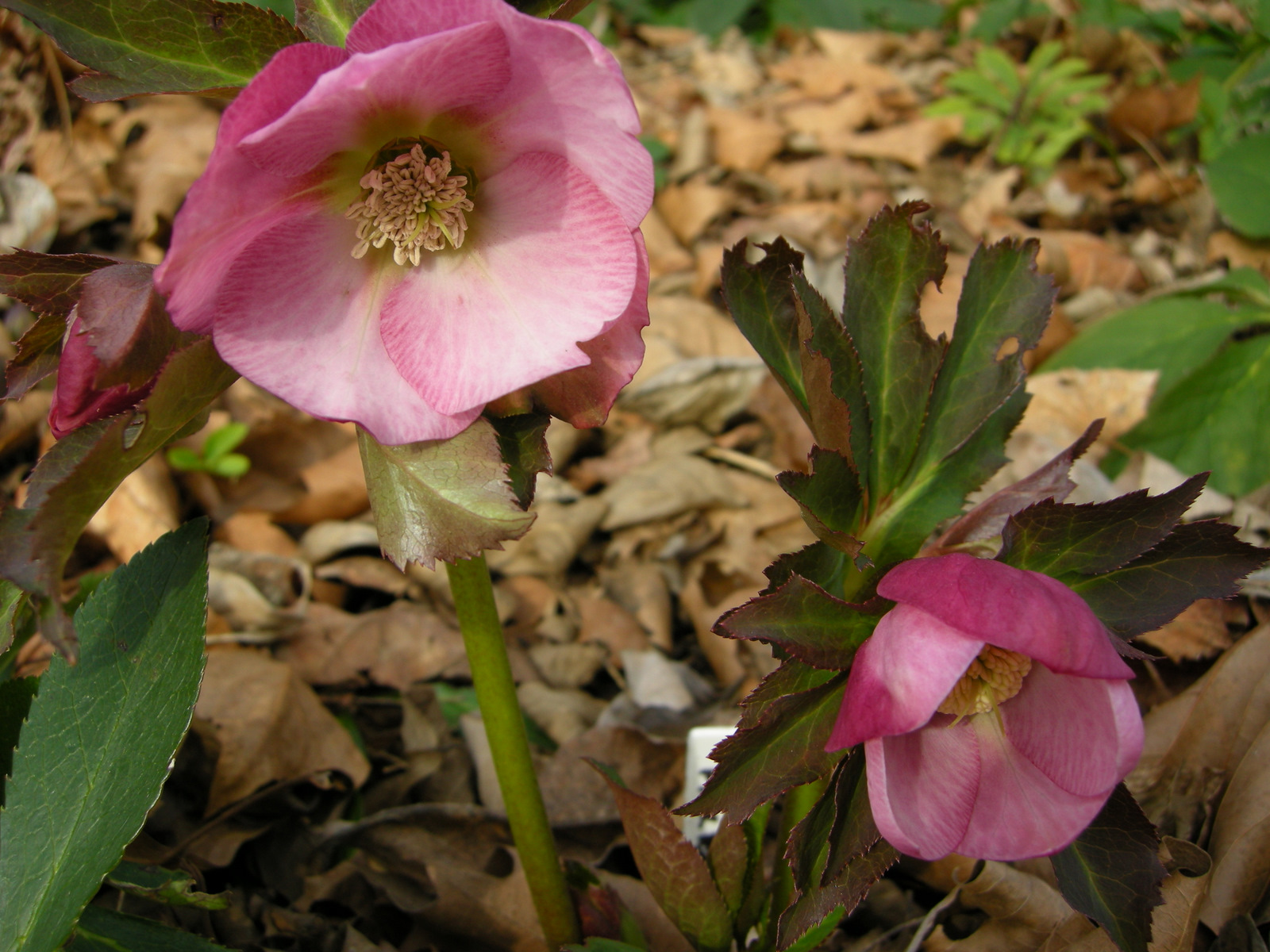
 

‘Pink Tea Cup’ has the best pink color of any hybrid hellebore and was the first to come into bloom this season ( for sale at CSG this spring).  Photo 1/9/12
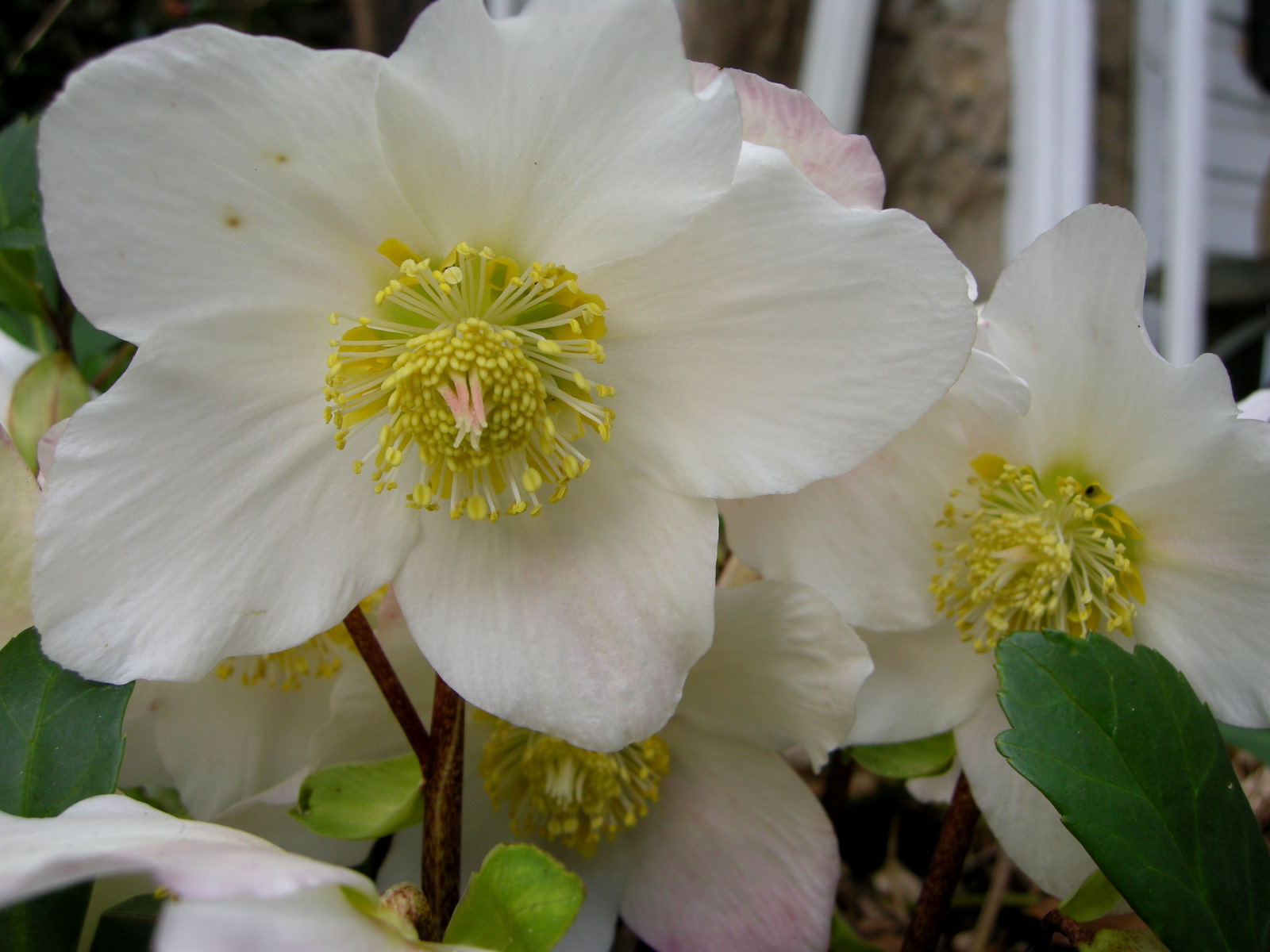
 

‘Jacob’ Christmas rose just keeps going and going with new white flowers appearing and mixing with the older pink flowers for a gorgeous effect, see below (for sale at CSG).  Photo 12/31/11


‘Jacob’ Christmas rose with Camellia x ‘Winter’s Joy’.  Photo 1/2/12
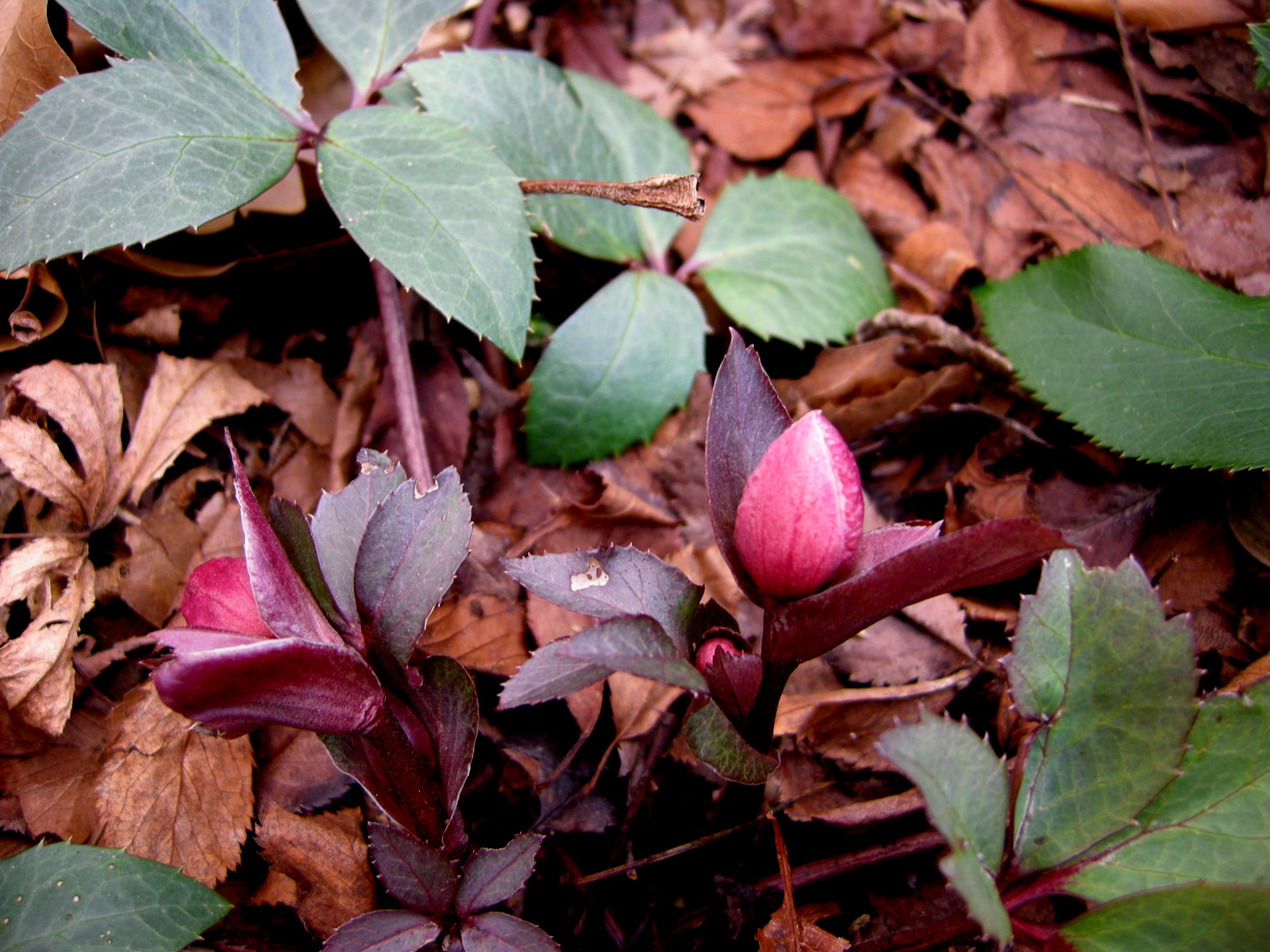
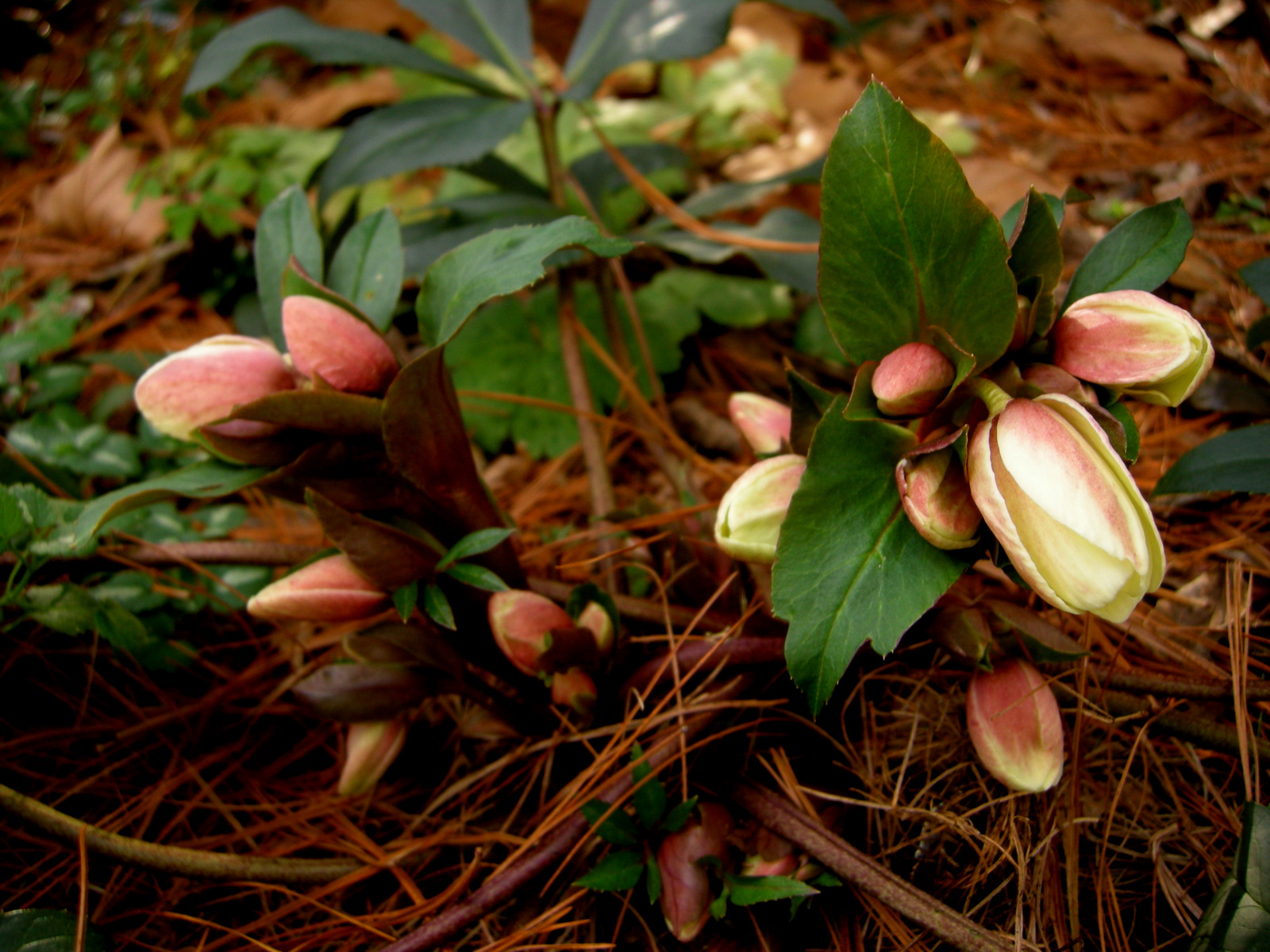
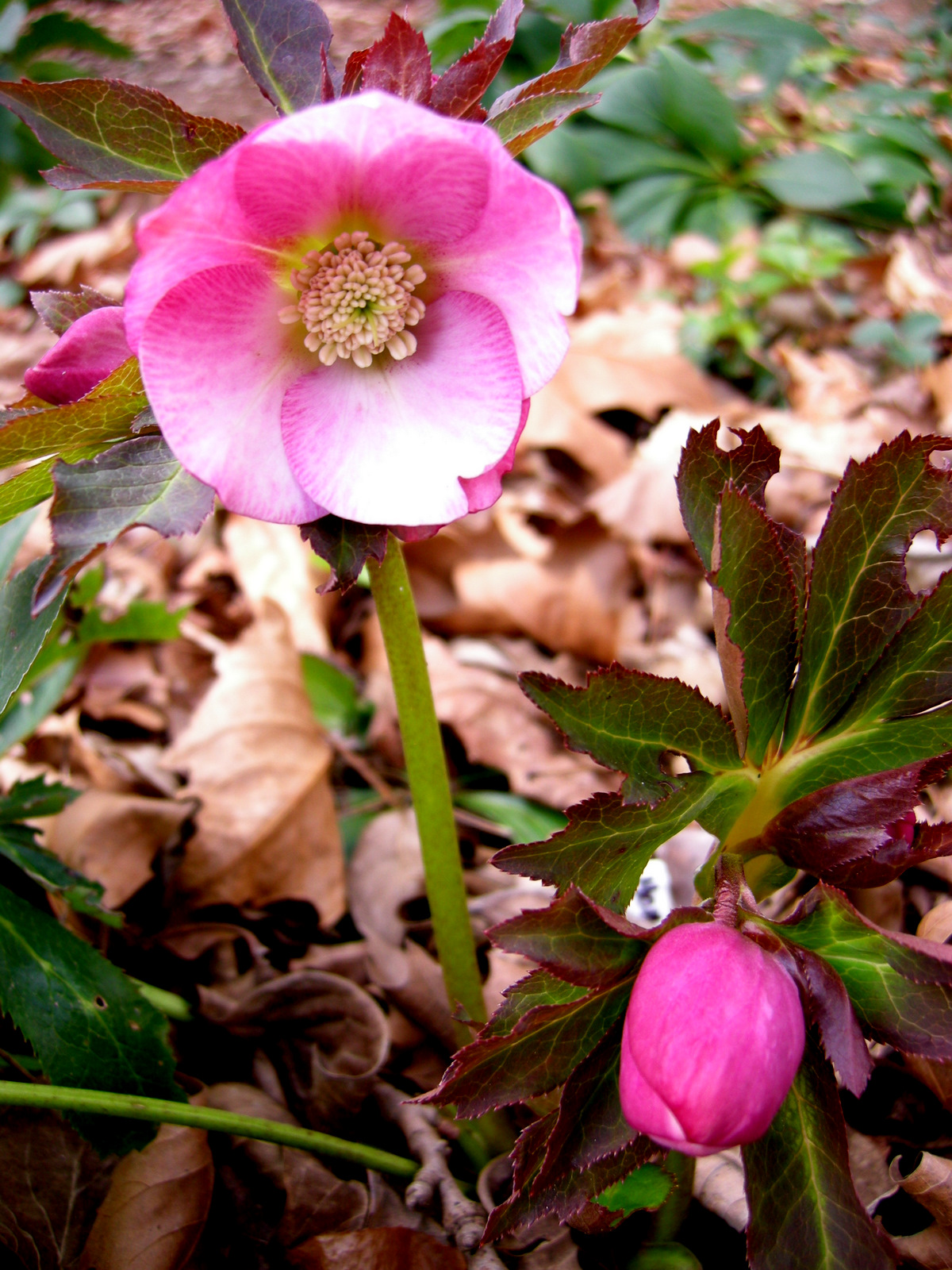
Flowers are emerging on the hellebore species cross ‘HGC Pink Frost’ (for sale at CSG).  Notice the dark red to burgundy highlights on the leaves and stems and the amazing color of the buds.  As noted in Cutting Back Hellebores, I leave the foliage on to make a nice backdrop for the flowers.  Photo 12/31/11
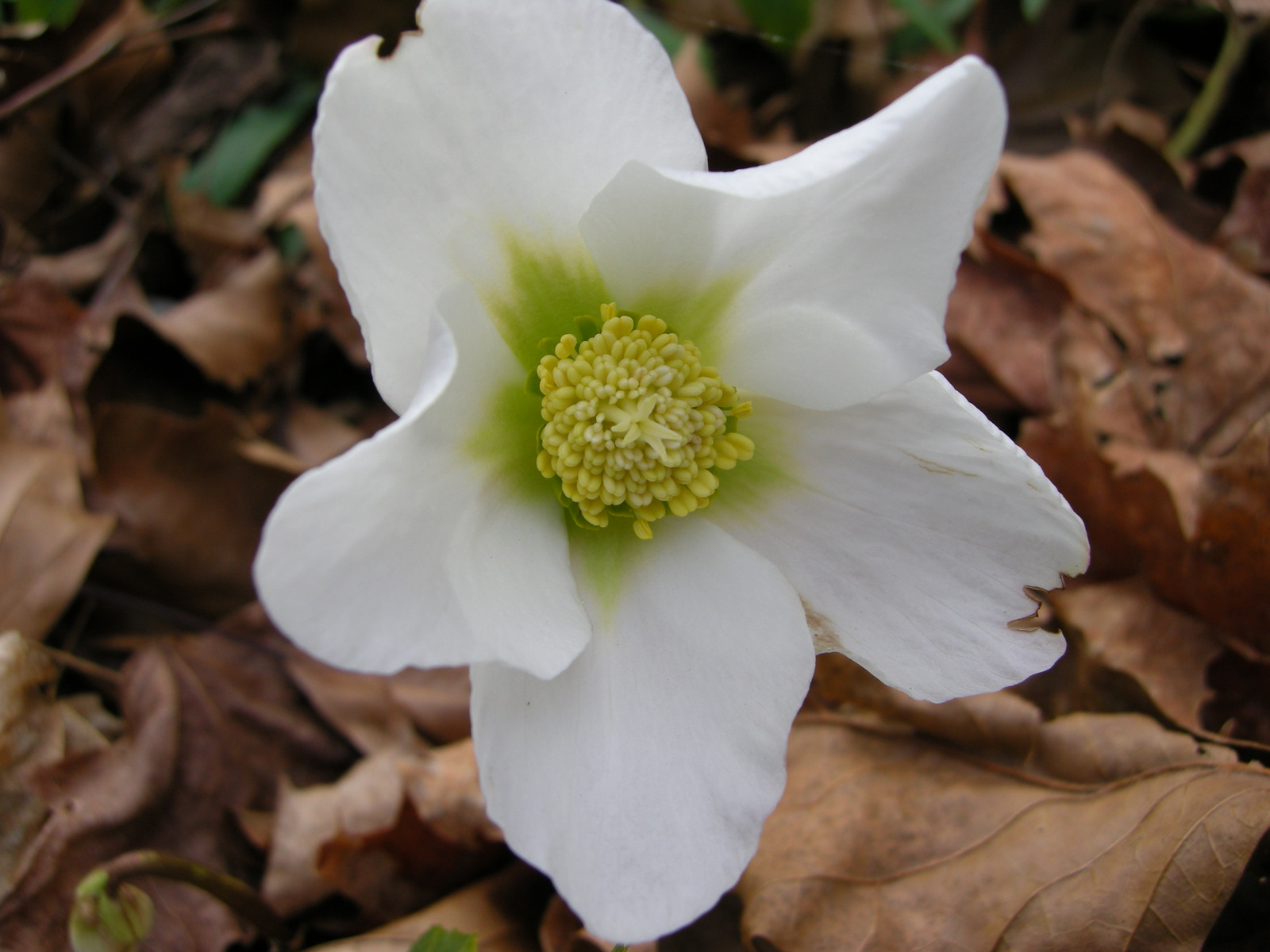
 

‘Praecox’ Christmas rose is also blooming at least a month earlier than usual.  Photo 12/31/11
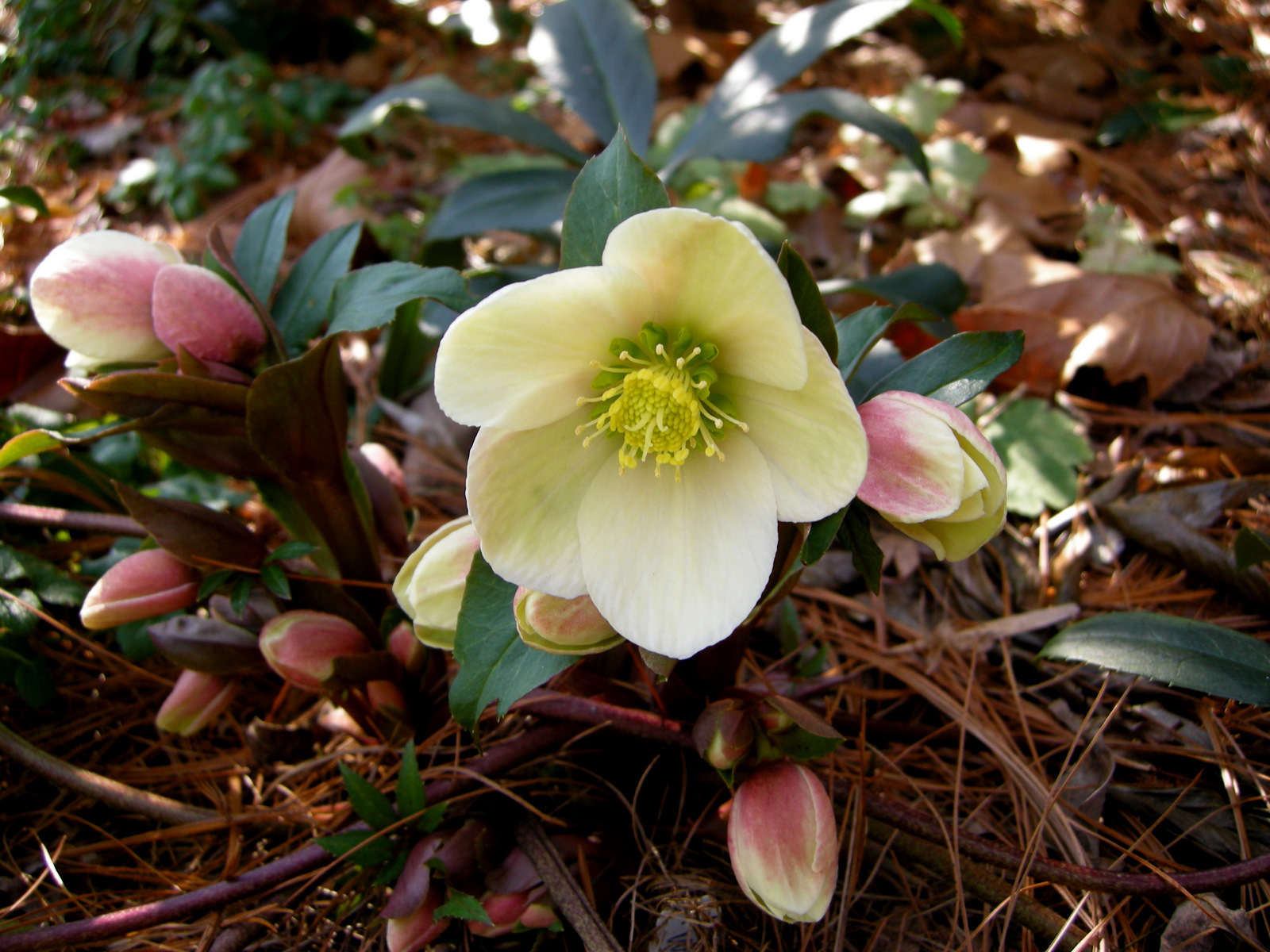
 

The hellebore species cross ‘HGC Winter’s Song’ is now fully in bloom.  Photo 1/10/12
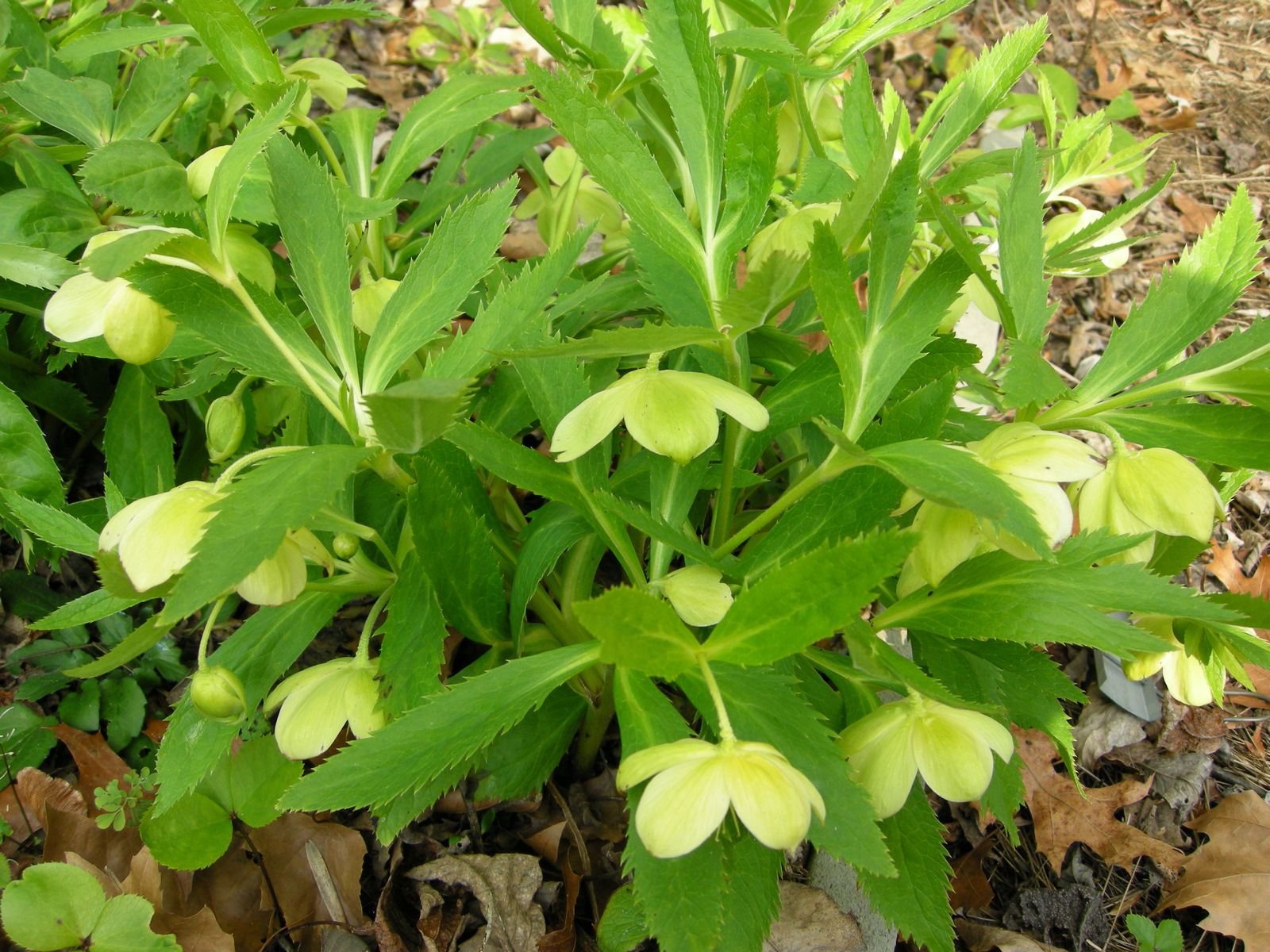
The rare species Helleborus dumetorum (no common name) continues to bloom (for sale at CSG).  It is deciduous so all the “leaves” in the photo are actually flower bracts.  The leaves will come up later.  Photo 12/31/11
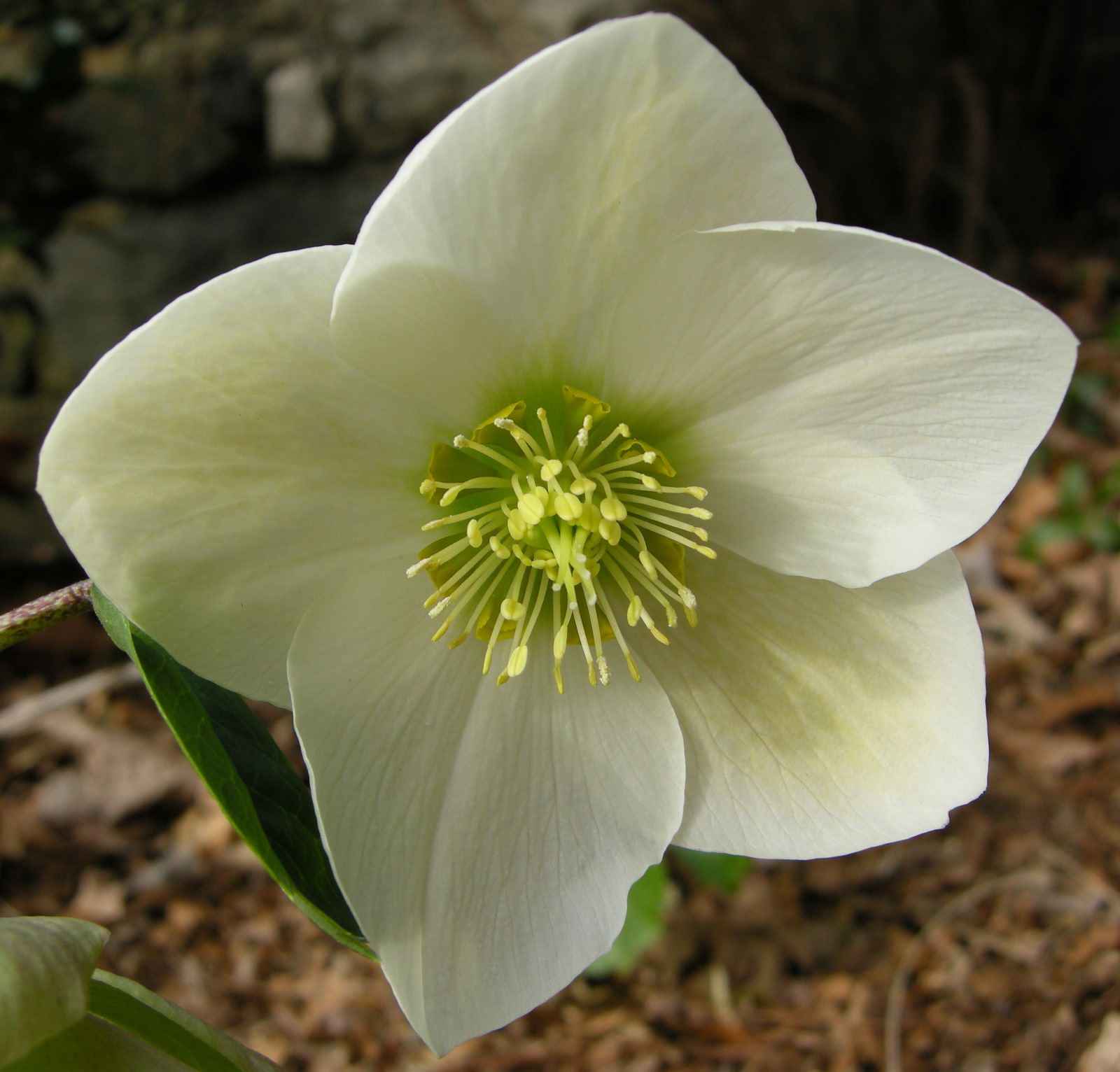
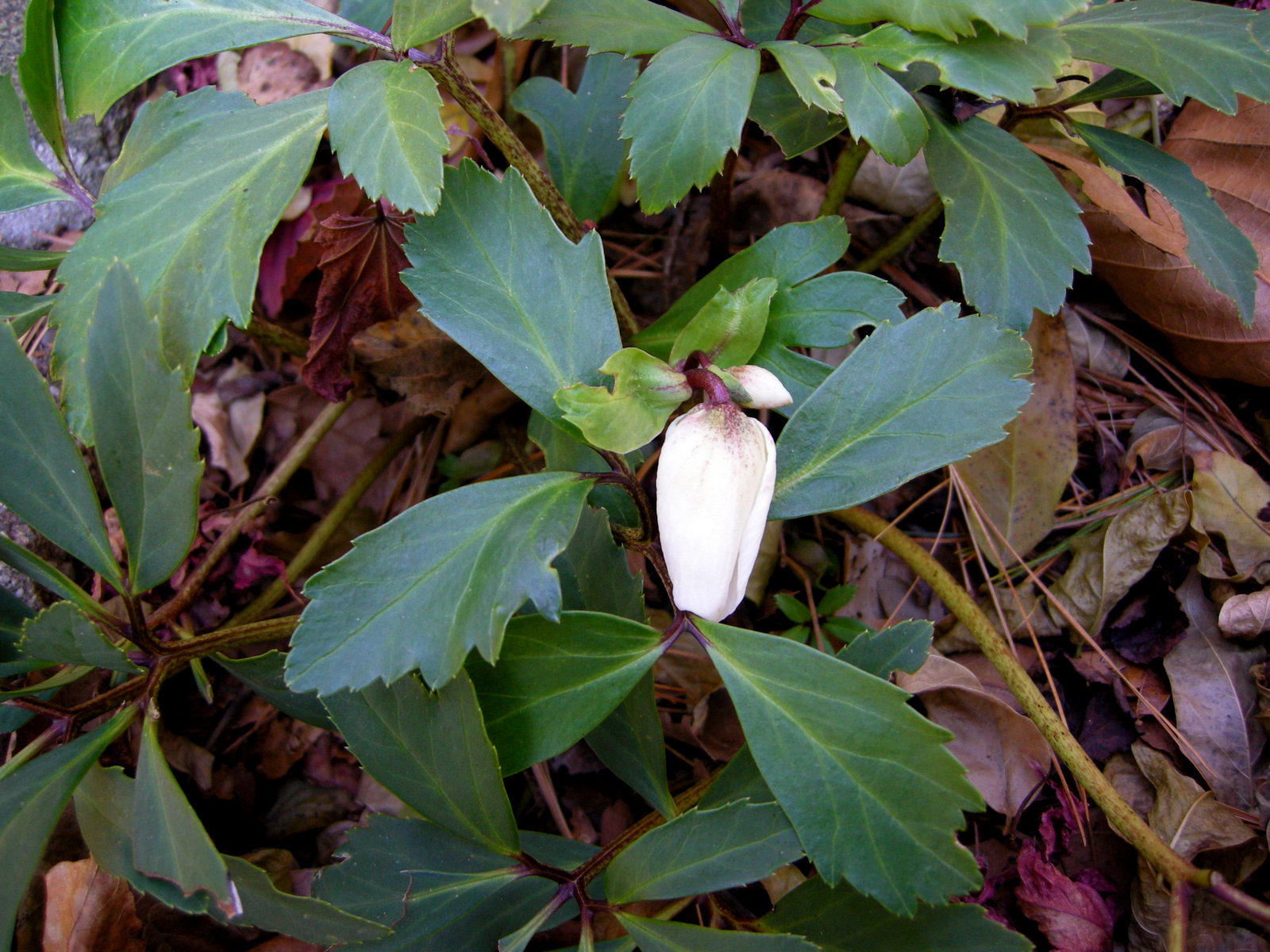
This beautiful, pure white, outward-facing hellebore called ‘Snow White’ (aka ‘Snow Bunting’) is an extremely rare cross between hybrid hellebore and Christmas rose—something that was thought to be impossible (for sale at CSG).  Photo 1/9/12
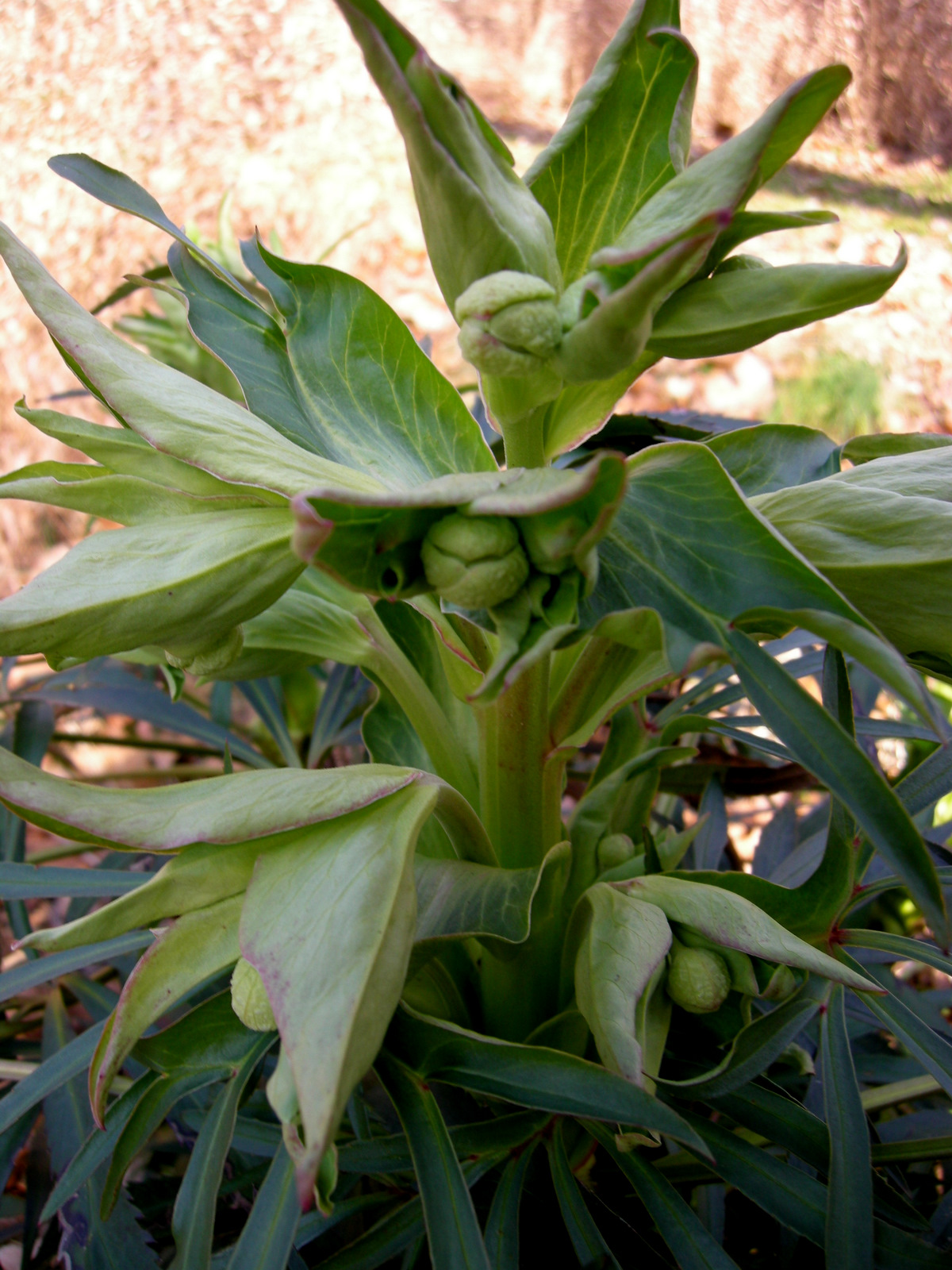
 

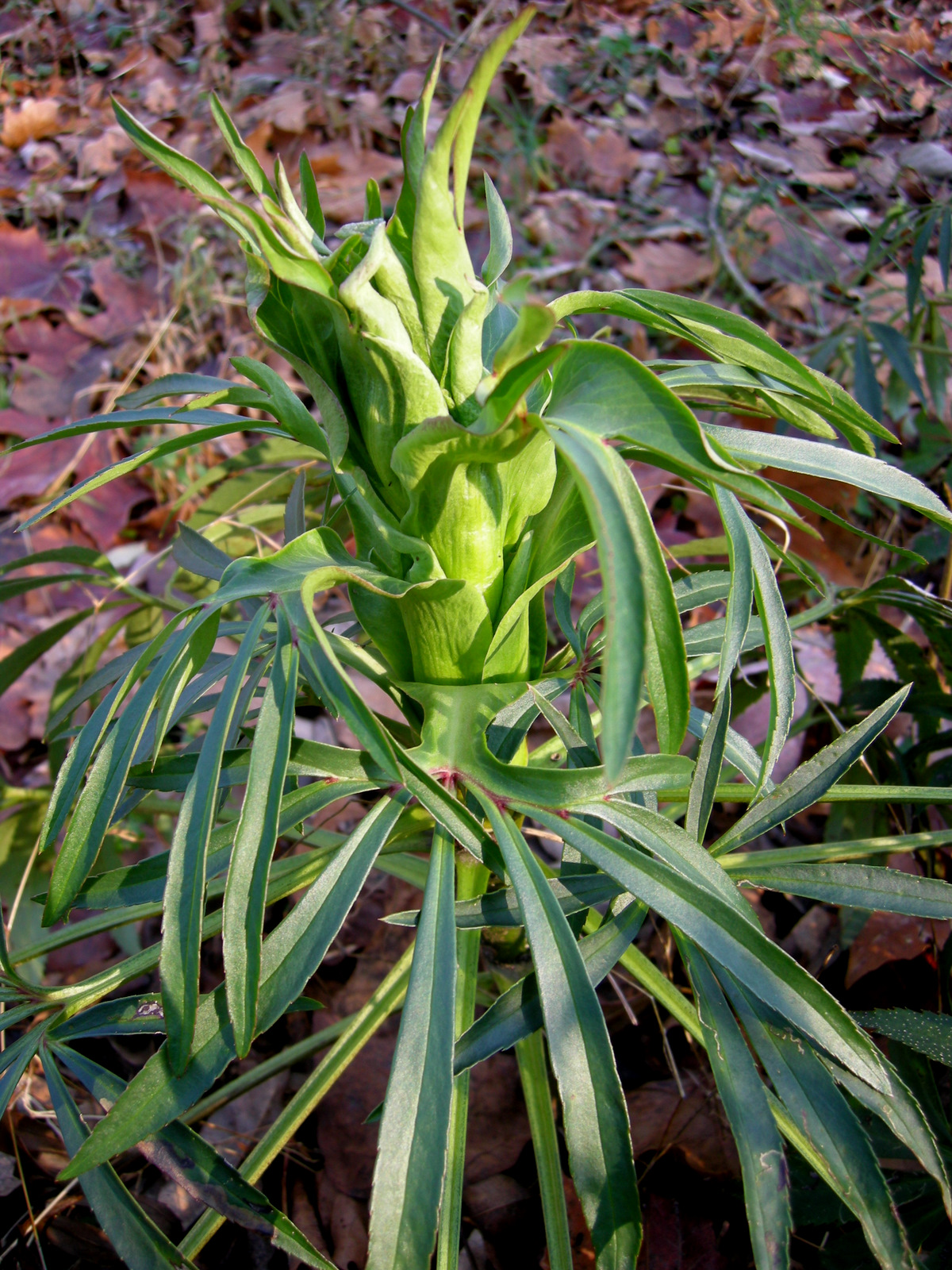
The lighter chartreuse buds of bearsfoot hellebore, H. foetidus, are becoming more prominent and will remain ornamental through May (for sale at CSG).  Photo 1/10/12
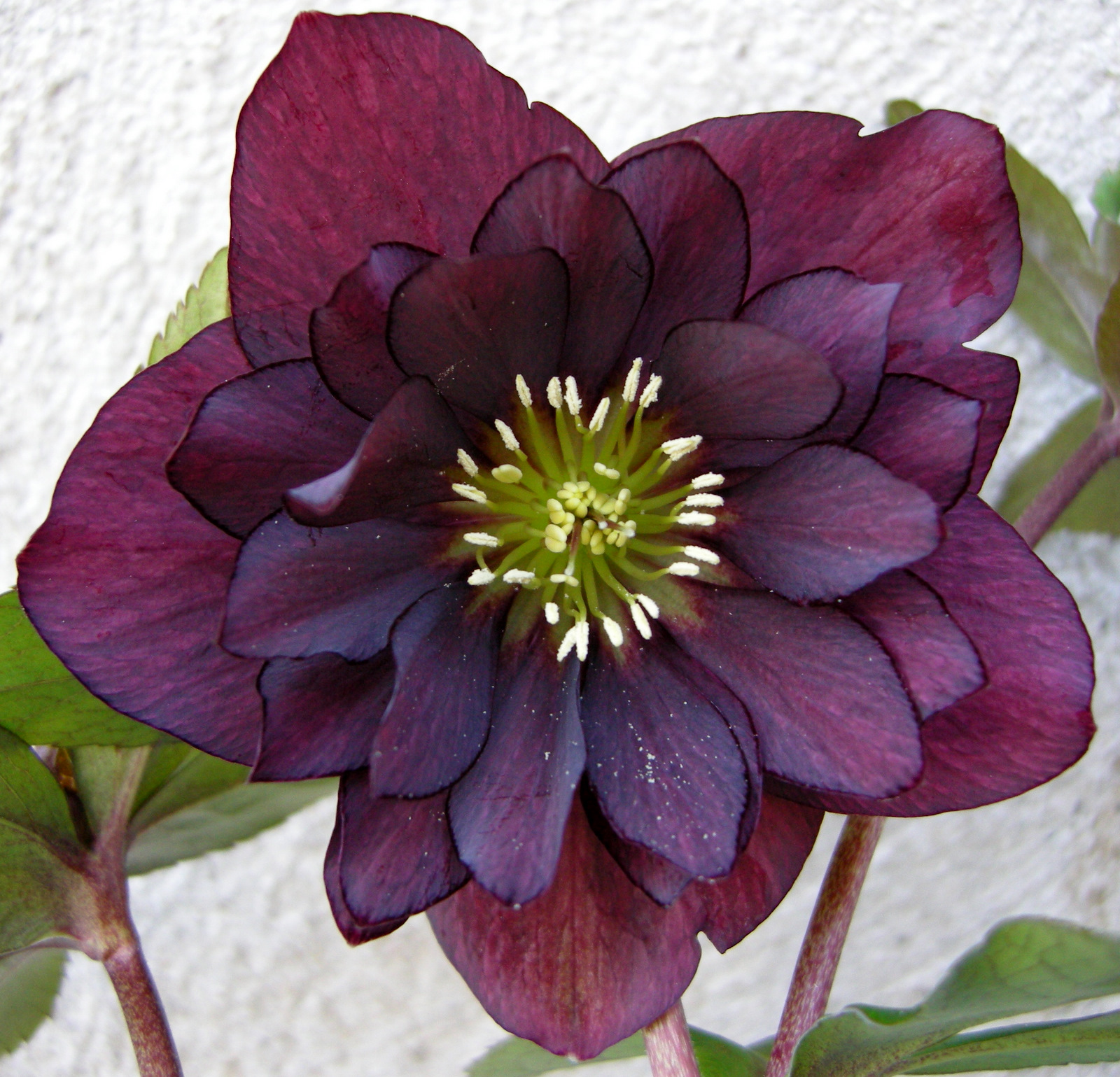
 

Helleborus x "Double Purple"Another look at the hybrid hellebore “Double Purple” (for sale at CSG).  Photo 1/7/12

My new favorite this year, hellebore species cross ‘HGC Cinnamon Snow’ (for sale at CSG).  I like it so much that I decided to put it in a basket by my front door.  Photo 1/9/12

There are some other plants looking great in my garden besides hellebores.  Most of the fall-blooming camellias still have viable buds but no flowers open to show you.  They will continue to bloom if the weather cooperates.  Here are the non-hellebore stars:
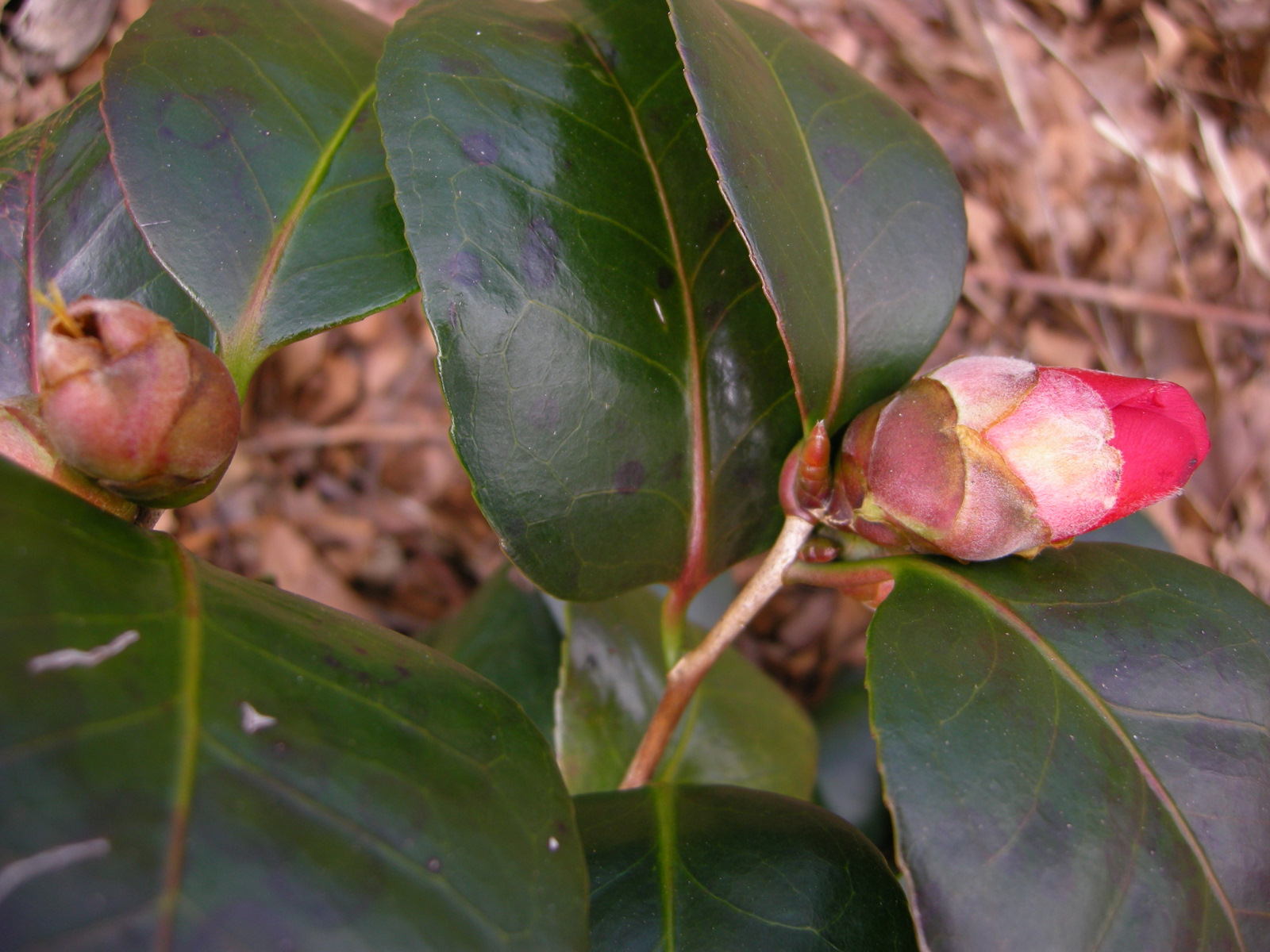
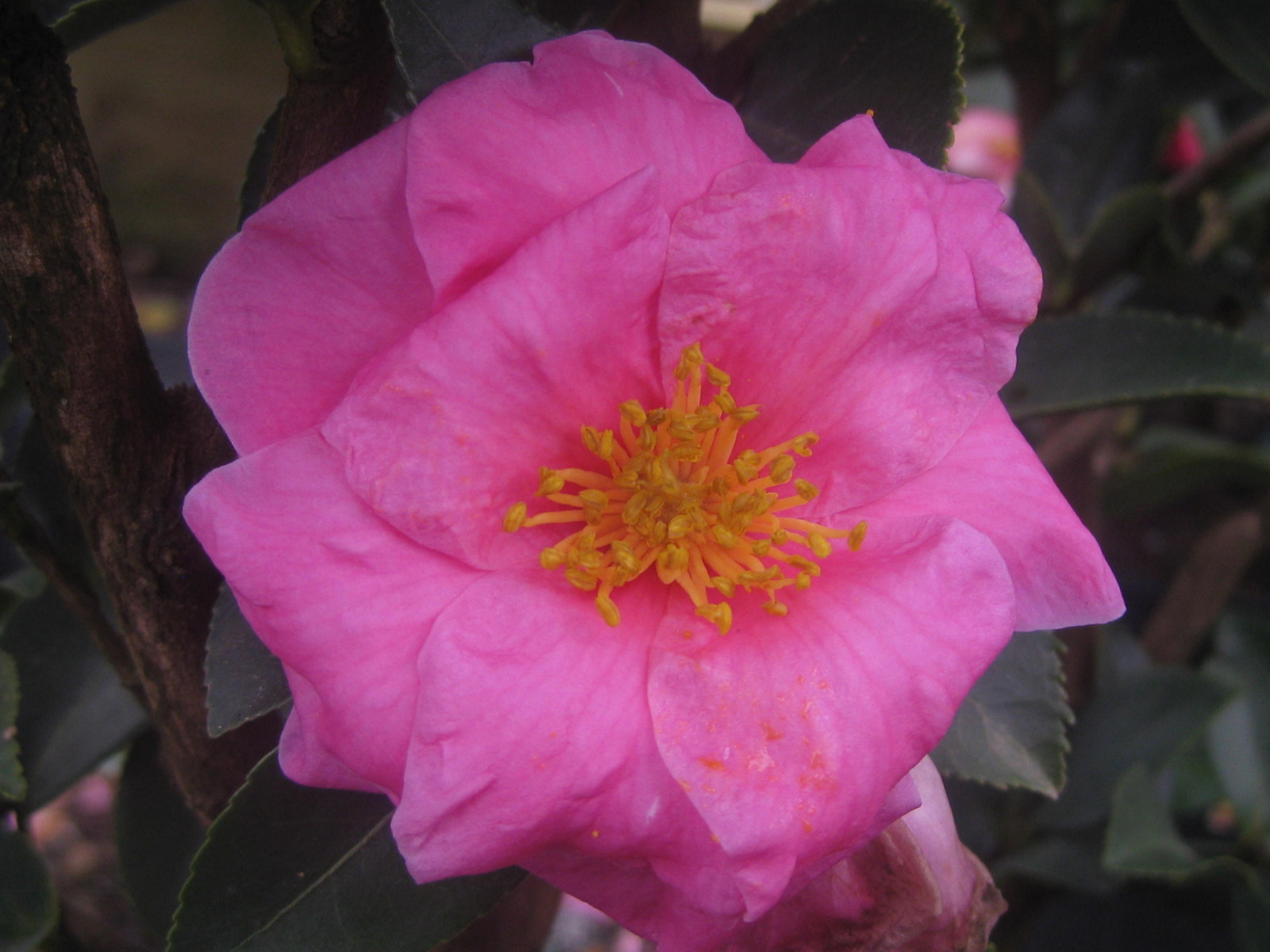
My un-named Korean Camellia japonica, which blooms in the spring and fall, continues to produce flowers.  Photo 1/9/12

Camellia x ‘Elaine Lee’ also has buds, and look at those shiny leaves.  Photo 1/10/12
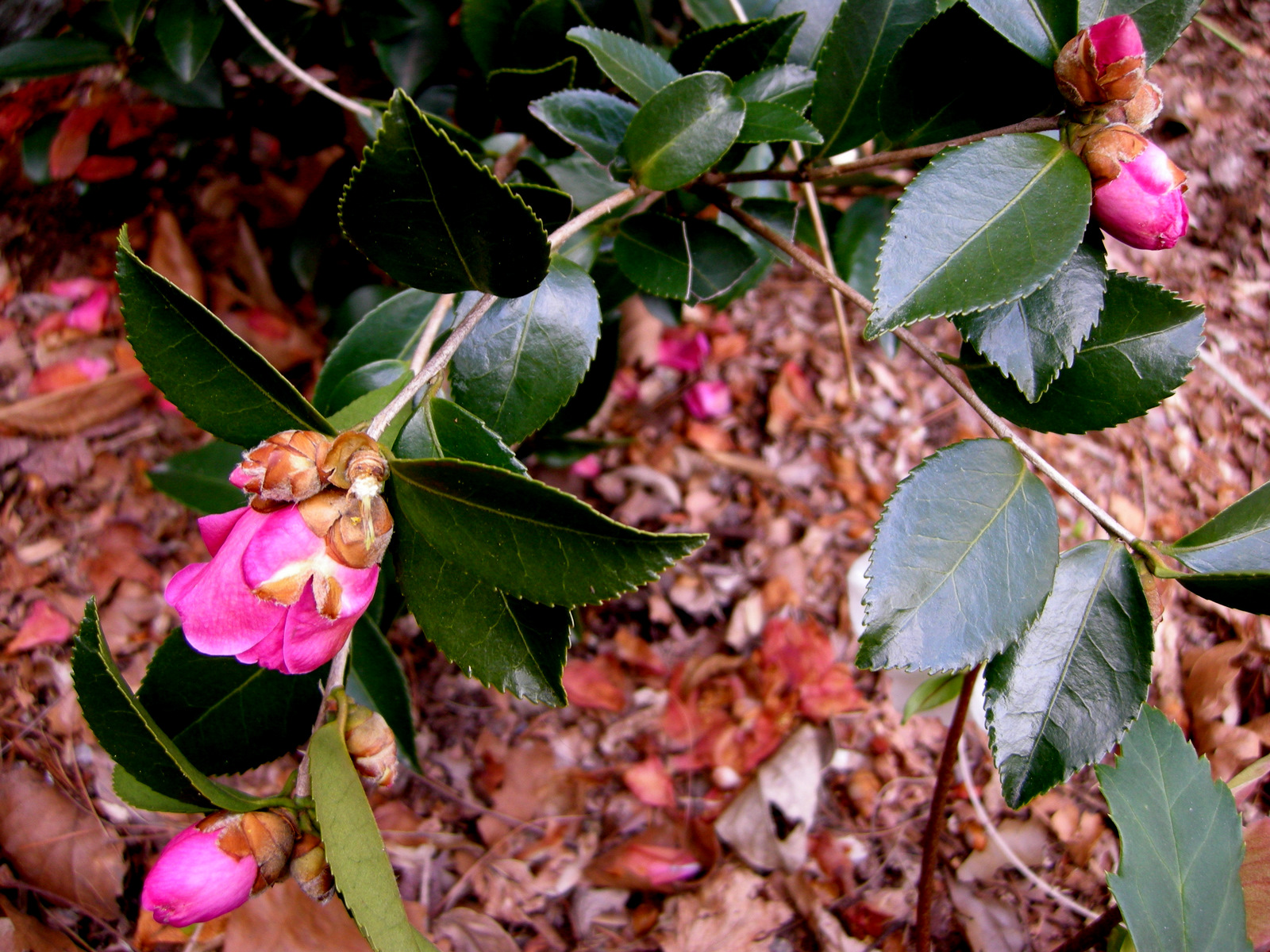
Camellia x ‘Winter’s Joy’ has been flowering since October and is still covered with buds but none are open right now.

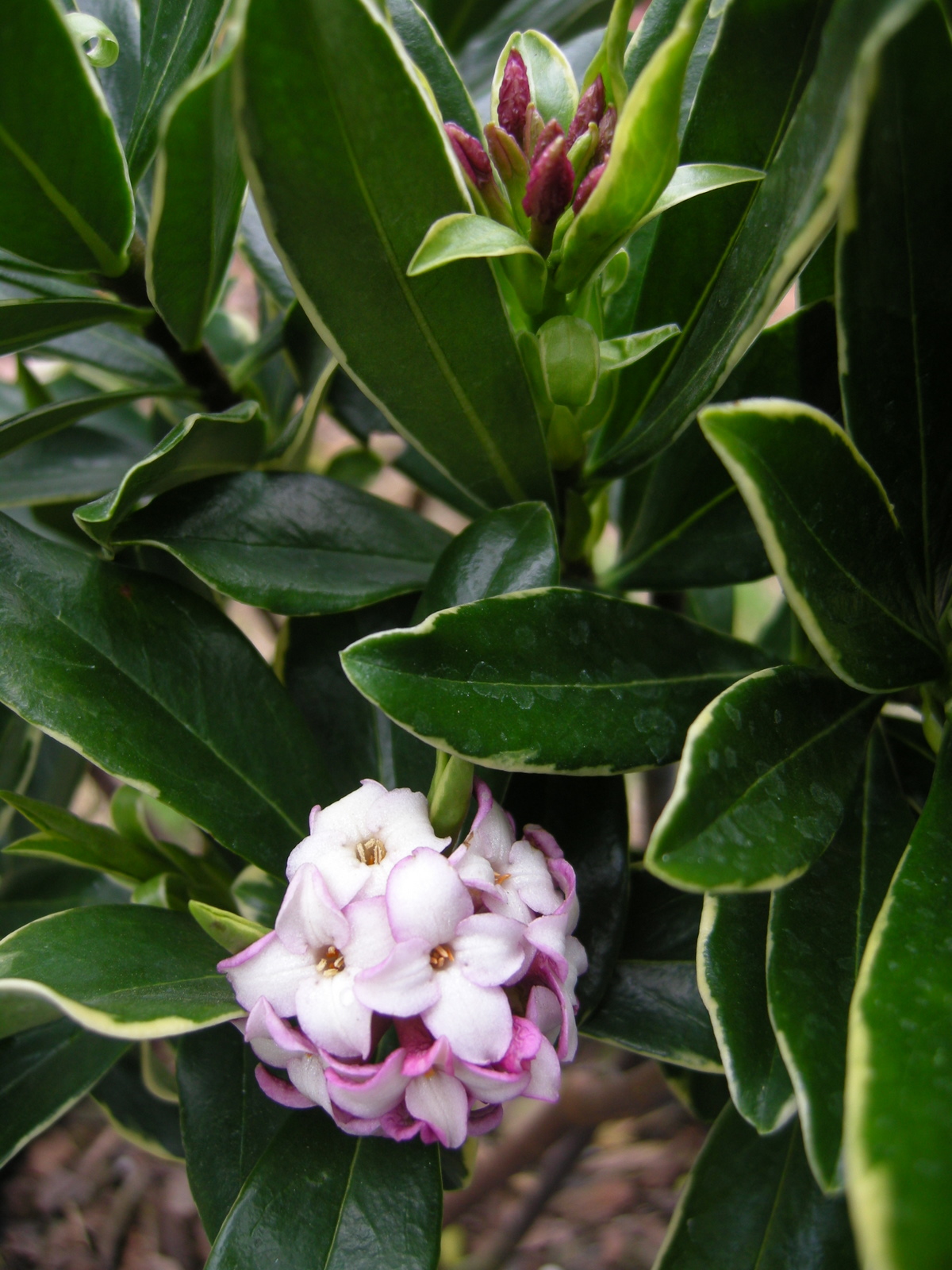
The buds on my variegated winter daphne, D. odora ‘Aureomarginata’, are coloring up early.  It is the sole survivor of five shrubs I put in this spring.  Although I gave them excellent drainage, they just couldn’t tolerate all the rain we had in August and September.  One by one they wilted from too much water and died, while this one remained healthy.  Photo 1/9/12
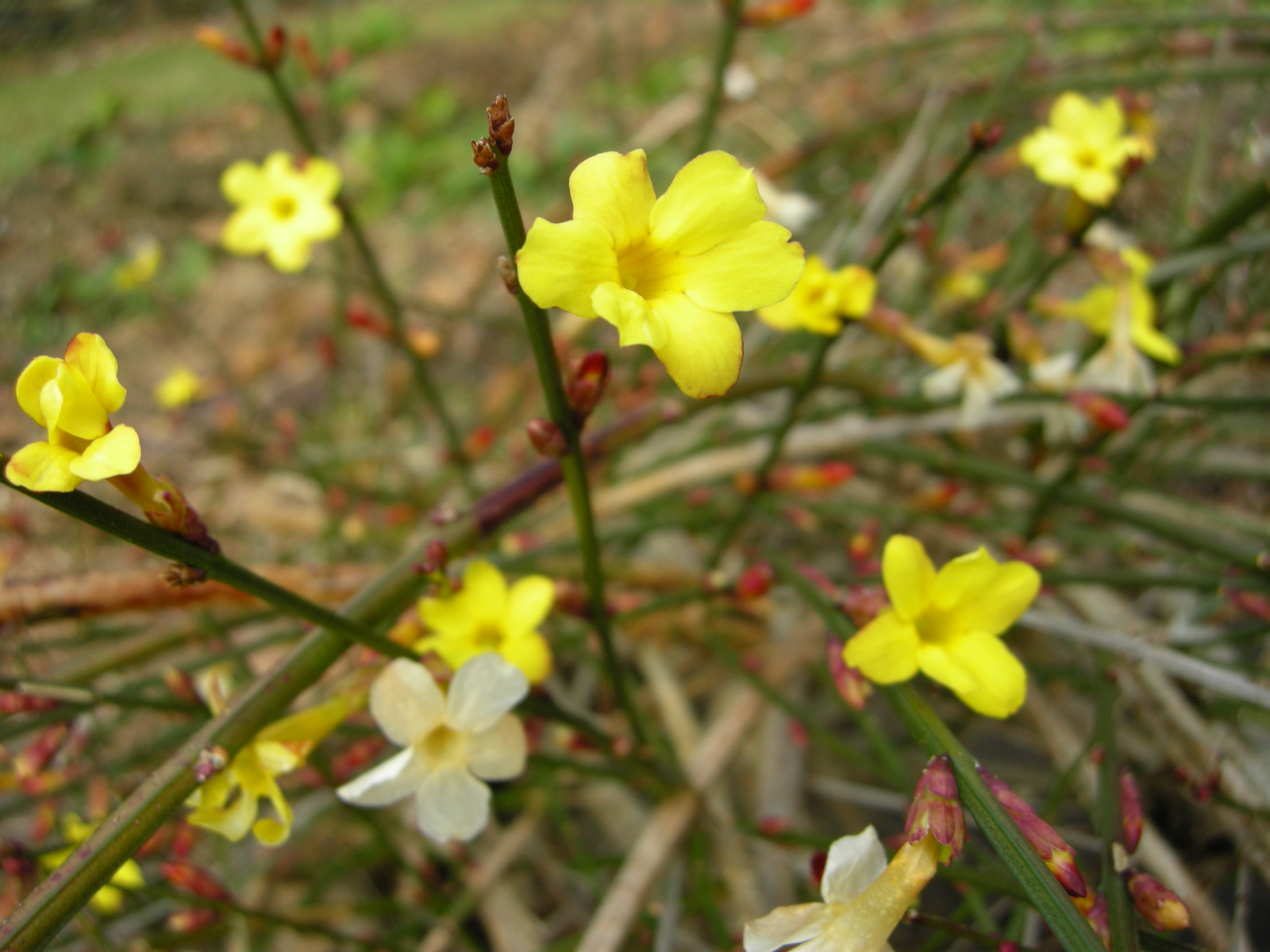
If we have cold weather, winter jasmine, Jasminum nudiflorum, blooms in February, but right now it is opening flowers continuously.  Photo 1/10/12
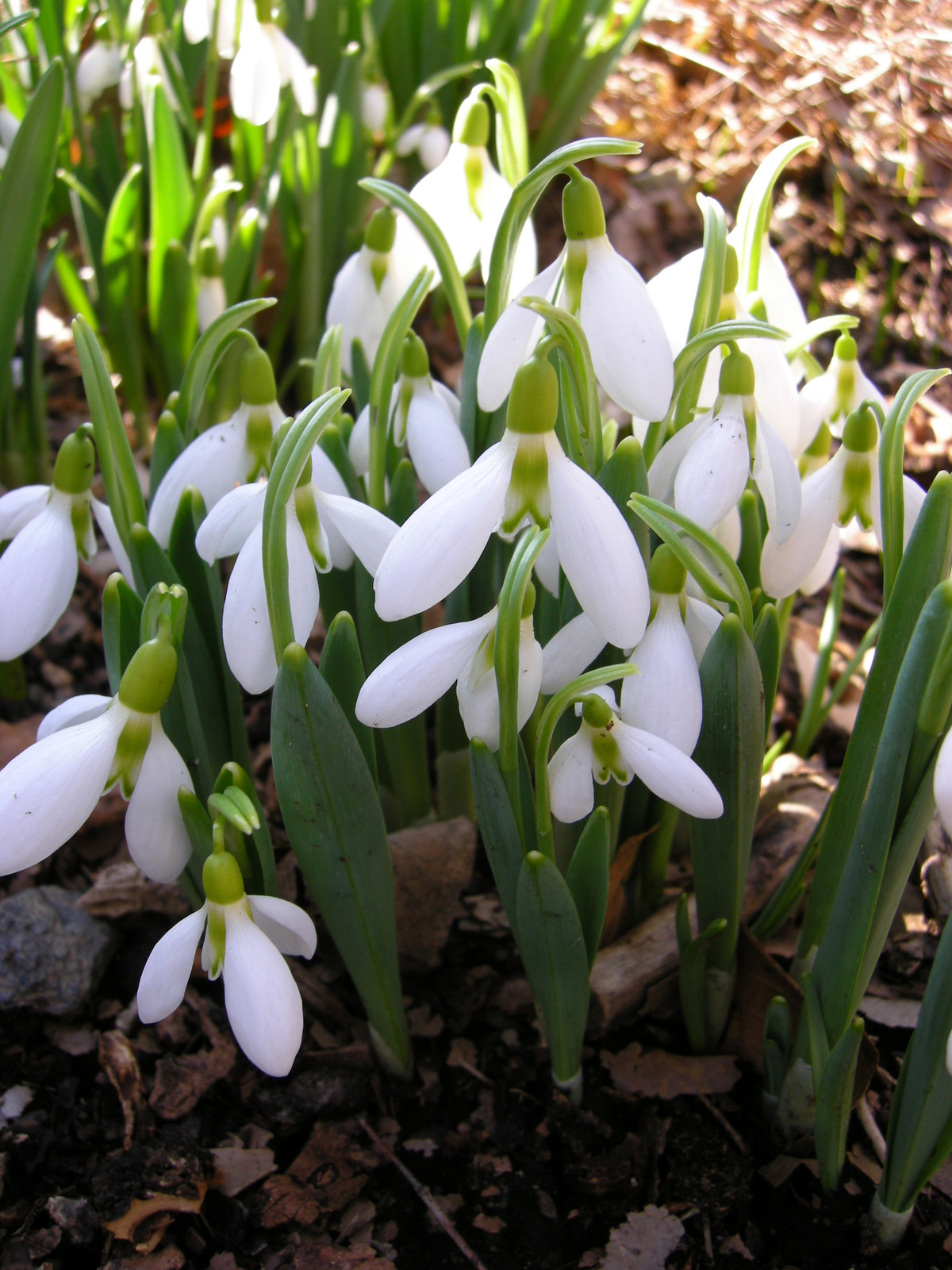
Galanthus elwesiiThe only snowdrop in bloom right now is the giant snowdrop, Galanthus elwesii (for sale at CSG).  Photo 1/9/12

My fall-flowering snowdrop ‘Potter’s Prelude’ has finished blooming, but I wanted to show you its beautiful leaves (for sale at CSG).  Photo 1/1/12

On New Year’s Day, my husband and I went walking in the Pinetum at the Haverford College Arboretum, a wonderful local treasure.  We saw two unusual conifers with great texture that I wanted to share:
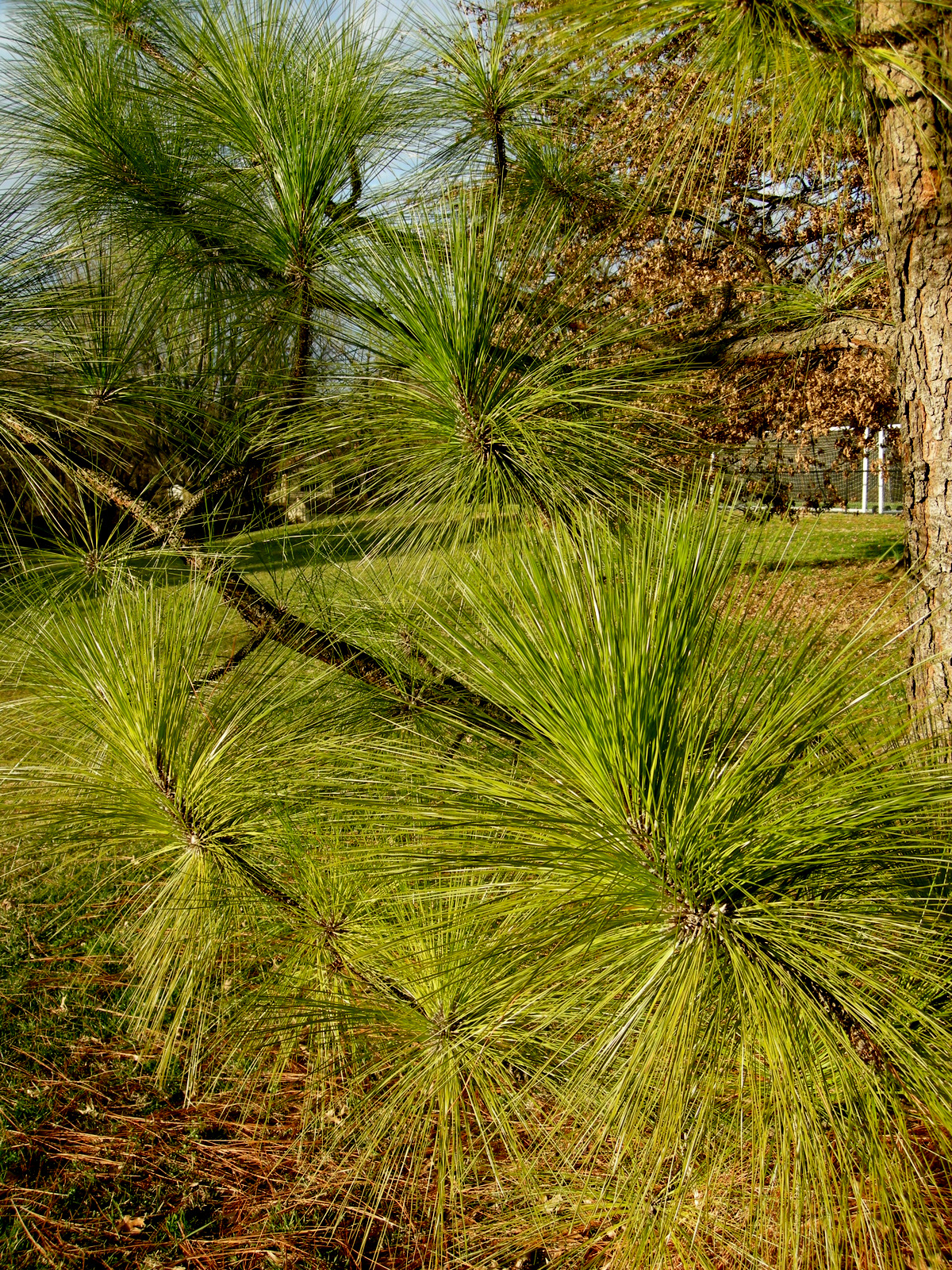
 

Longleaf pine, Pinus palustris, is native from Virginia to Texas but is not usually found around here.
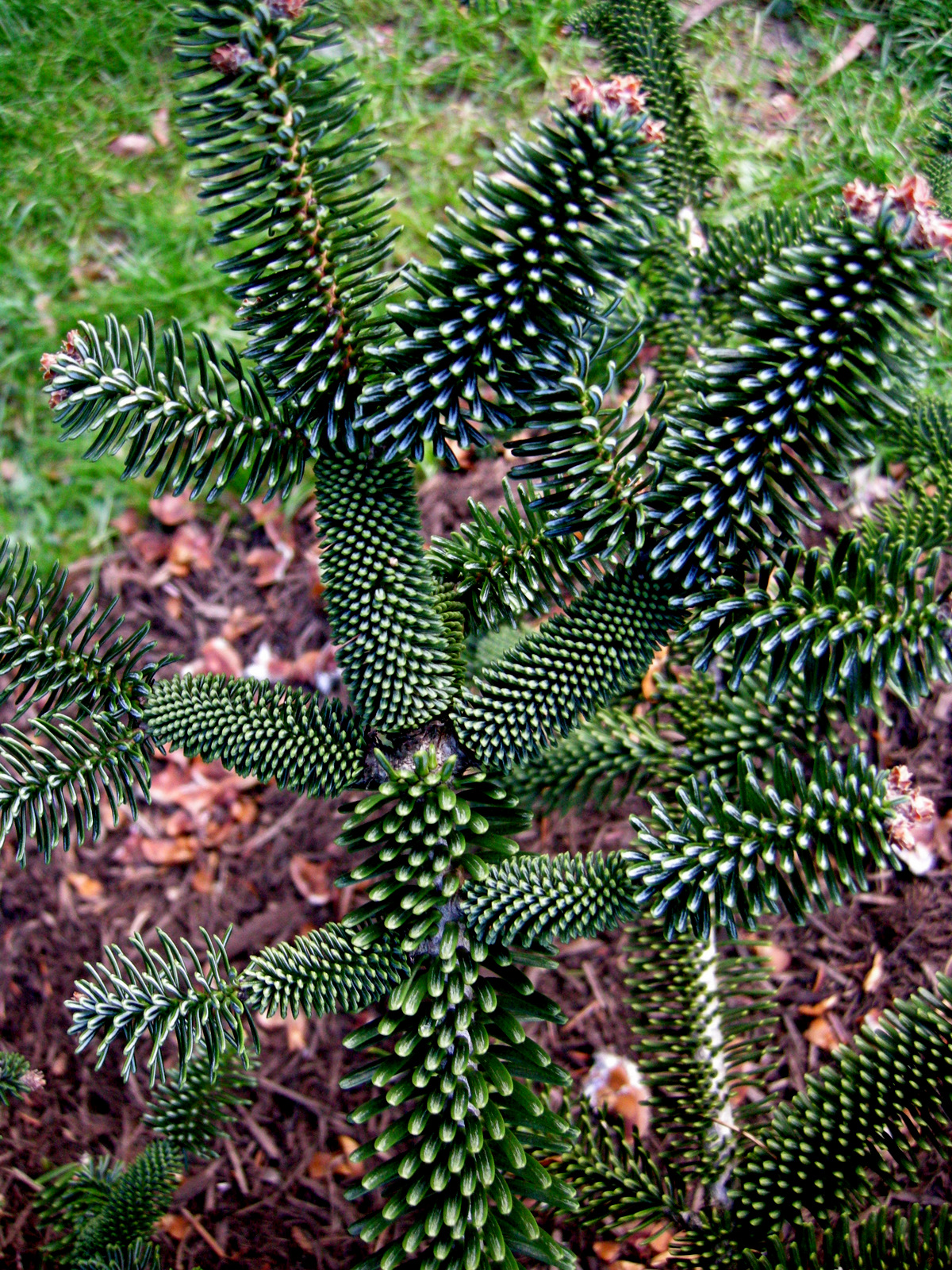
 

I love firs, and the texture of this Algerian fir, Abies numidica, really stood out.

I dedicate this post to Bob Stewart, my friend and horticulturalist extraordinaire, who died on December 16, 2011.  Bob and his wife Brigitta started the amazing nursery Arrowhead Alpines in Fowlersville, MI.  If you haven’t visited their site, you should by clicking here.  Bob will be greatly missed.

Carolyn

Notes: Every word that appears in orange on my blog is a link that you can click for more information.  If you want to return to my blog’s homepage to access the sidebar information (catalogues, previous articles, etc.) or to subscribe to my blog, just click here.
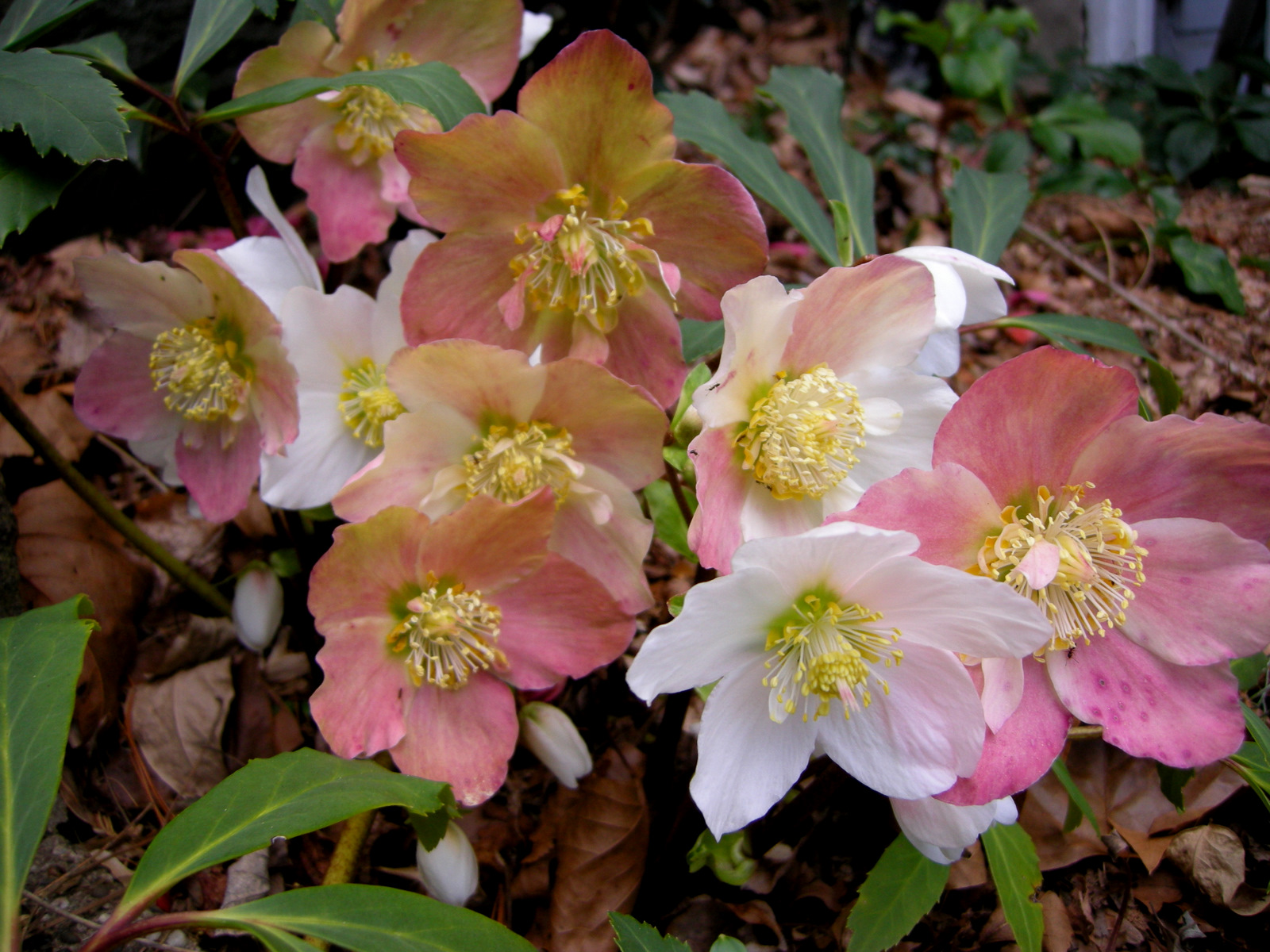
Cutting Back Hellebores

Posted in evergreen, hellebores, Shade Perennials, winter interest with tags , , , , , , , , , , , , , , on January 4, 2012 by Carolyn @ Carolyns Shade Gardens

Carolyn’s Shade Gardens is a retail nursery located in Bryn Mawr, PA, specializing in showy, colorful, and unusual plants for shade.  The only plants that we ship are snowdrops within the US.  For catalogues and announcements of local events, please send your full name, mailing address, and cell number to carolyn@carolynsshadegardens.com and indicate whether you are interested in snowdrops, hellebores, and/or hostas.  Click here to get to the home page of our website for catalogues and information about our nursery and to subscribe to our blog.

‘Jacob’ Christmas rose, Helleborus niger ‘Jacob’, right now in my garden.  It always starts blooming in the fall, see Hellebores for Fall.  Photo 1/1/12

I usually don’t think about cutting back my hellebores until mid-February when the flower stalks begin to extend up through the old leaves.  However, here in southeastern Pennsylvania, we have had unusually mild weather during December—10 days over 50 degrees (10 C) and 8 days at 60 degrees (16C).  Hellebores that don’t usually bloom until February are coming into bloom now.  It seems like a good time to explain the ins and outs of cutting back the old leaves on hellebores.  This is done for aesthetic reasons and is not necessary for the health of the plant.


This beautiful hybrid hellebore, H. x hybridus ‘Pink Tea Cup’, is fully out right now.  It usually blooms in February.  Photo 12/31/11

The genus Helleborus contains about 15 species, and decisions about how to care for them require some knowledge of exactly which hellebores you have and how they grow.  The most commonly available hellebores are hybrid hellebores, Helleborus x hybridus (the Royal Horticultural Society approved name, previously called Lenten rose),  with the large, showy, nodding flowers in an amazing range of colors.  For some beautiful photos, check out my articles An Ode to Seed Strain Hellebores and Double Hellebores.  Christmas rose, Helleborus niger, is also regularly found in gardens: for photos see Christmas Rose: The Perfect HelleboreBoth hybrid hellebores and Christmas roses produce leaves and flowers on separate stems (botanists call them acaulescent) so cutting back the leaves has no affect on the flowers.  The questions is when to cut.

If there is a “common” hellebore, then the un-named hybrid hellebore above would be it.  I couldn’t even begin to count the number of flowers on this one plant.  No leaves are visible yet, what you are seeing are bracts on the flower stems.  Photo 3/21/11


I do not cut back the leaves of hybrid hellebores in the fall because they are very pretty through the winter.

Hybrid hellebores have attractive leaves that stay green all winter (wintergreen), adding interest to the winter garden, so I leave them on as long as they look nice.  They are not evergreen though so the old leaves should be cut off when they become unsightly in late winter.  It is easiest to do this when the flower buds are still at the soil level and the old leaf stems and new flower stems are not yet intermingled.

This photograph illustrates the new flower stems emerging among the old leaf stems, which will be cut off February 15.  Usually the leaves are standing up causing old and new to mingle, but also providing some protection from cold weather.  Photo 12/31/11


In addition to winter interest, I also leave the old leaves on to protect the flower buds should we experience very cold weather in January and early February.  For southeastern Pennsylvania, this could be as low as -5 degrees (-21C).  I cut back my hybrid hellebores around February 15.  The same rules apply for the nine species hellebores that are the parents of hybrid hellebores (see The Sex Lives of Hellebores) should you have them in your garden.


This straight species Christmas rose is blooming right now in my garden—it has never bloomed before March in the almost 15 years I have had it.  Notice the lack of leafy bracts on the stem.  Photo 12/31/11


Christmas roses have very clean and elegant, blue-green leaves.

Christmas roses have even more beautiful wintergreen leaves.  Although you can cut them back without affecting the flowers (they are acaulescent), my considerations for this hellebore are somewhat different.  The flower stems of hybrid hellebores contain the buds and also leaf-like bracts, which provide a pleasing green backdrop for the blooming flowers (see photo of pink hybrid above).  Christmas rose flower stems have no bracts so if you cut off all the leaves, to me, the plant looks naked when it blooms.  As long as the leaves remain halfway decent, I leave them on until later in the season to serve as a frame for the flowers.  The leaf and flower stems do not intermingle so cutting them later is not a problem.

The buds of bearsfoot hellebore, H. foetidus, emerge from the top of the leaf stem in the fall.  For more photos of this spectacular hellebore, see Hellebores for Fall.  Photo 12/2/10

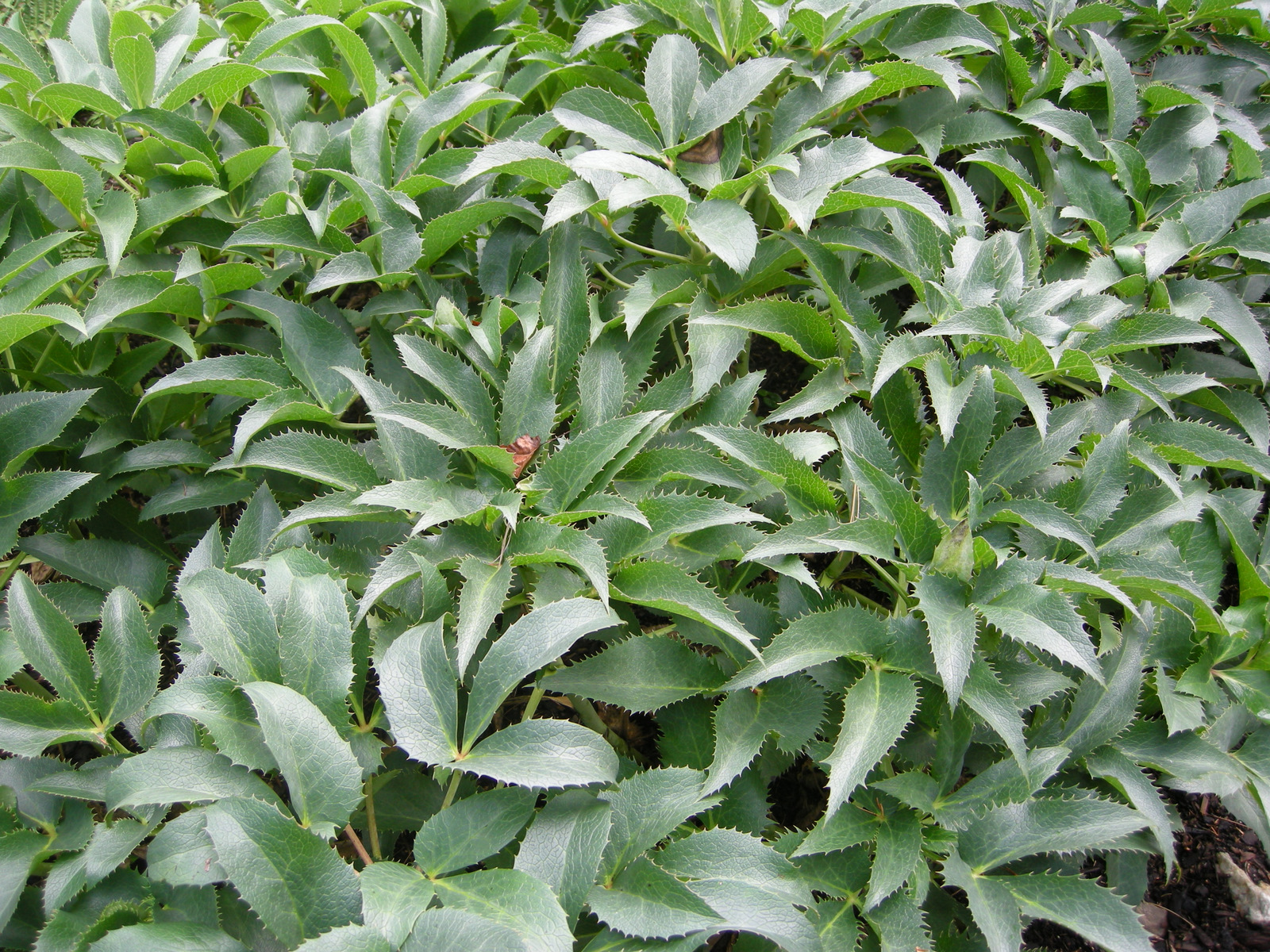
There are two more wintergreen hellebore species that make their way into hellebore lovers’ gardens: Corsican hellebore, Helleborus argutifolius, and bearsfoot hellebore, Helleborus foetidus.  Botanists call these species caulescent because the flowers are not separate but are on the end of the leaf stem.  You cannot cut off the leaf stem until after the plant has flowered because you will be removing the flower buds.  And if you cut off the individual leaves, you are left with a long, ugly stalk, typically 2-3′, with the flowers at the tip.

I grow Corsican hellebore, H. argutifolius, as much for its gorgeous wintergreen leaves as for its flowers.

In mild winters when the leaves remain attractive, this is not a problem.  It is also usually not a problem for bearsfoot hellebore whose leaves remain pristine during very cold winters.  However, Corsican hellebore leaves are easily damaged, and I often make the decision to sacrifice the flowers and cut the plants back to the ground rather than look at their unsightly leaves while they bloom.  I grow this species equally for its foliage, and new growth springs up very quickly when the old stems are removed.

H. x ericsmithii ‘Winter’s Song’ in my garden right now—much earlier than normal for this species cross.  Notice the leafy bracts surrounding the flowers.  Photo 12/31/11


H. x ballardiae ‘Pink Frost’ displaying the pink color inherited from its parent H. lividus.  Photo 3/21/11

That pretty much covers care and maintenance of the hybrid hellebores and the available species hellebores.  However, a large group of gorgeous species crosses are beginning to appear in local gardens (especially if the gardener has been shopping at Carolyn’s Shade Gardens), and I want to let you know how to care for them.  These plants are generally the progeny of Christmas rose crossed with Corsican hellebore and/or Helleborus lividus (not hardy here) to produce elegant outward-facing flowers and silver-marbled leaves often with red highlights and stems.  The most familiar crosses are H. x ericsmithii (‘Silvermoon’, ‘Winter’s Song’), H. x nigercors (‘Honeyhill Joy’, ‘Green Corsican’), and H. x ballardiae (‘Pink Frost’).


H. x nigercors ‘Green Corsican’: all the Christmas rose crosses have copious amounts of large, very desirable outward-facing flowers.  Photo 3/21/11

The Christmas rose crosses grow differently than either of the two groups discussed above.  Their leaves are one of their best features, and I cut them back only if they are unsightly.   They do have leaves and flowers on the same stems so you cannot cut the stems back to the base if cutting is necessary.  However, the plants are generally short, 12 to 15″, and produce such an abundance of flowers that cutting off individual leaves from the main stem does not leave an ugly stalk.  In addition, the flowers usually have leafy bracts to frame their beauty.

Our 2010-2011 winter was very hard on hellebore leaves.  However, even though I cut almost all the damaged leaves off these H. x ericsmithii ‘Silvermoon’ plants, they still look beautiful.  Photo 3/24/11

I hope I have answered all your questions about cutting back hellebores.  If not, feel free to seek clarification in a comment.  You are probably wondering what I will do this year when the hellebores are blooming early.  I have decided that discretion is the better part of valor so no leaves will be removed until mid-February.

Carolyn

If you would like to look at my photos all year round, please consider buying my 2012 calendar, available worldwide.  For details, click here.  It is 25% off through January 6, 2012, with the code ONEMORETHING at checkout.

This is part of a series of articles on hellebores, one of the specialties of my nursery.  Here are links to the other articles:

Part One        Hellebores for Fall

Part Two       An Ode to Seed Strain Hellebores

Part Three   Christmas Rose: The Perfect Hellebore

Part Four      Dividing Hybrid Hellebores

Part Five       The Sex Lives of Hellebores

Part Six          Double Hellebores

Part Seven   Cutting Back Hellebores

Notes: Every word that appears in orange on my blog is a link that you can click for more information.  If you want to return to my blog’s homepage to access the sidebar information (catalogues, previous articles, etc.) or to subscribe to my blog, just click here.
Fall-blooming Camellias Part 3

Posted in Camellias, evergreen, Fall Color, Shade Shrubs with tags , , , , , , , , on November 10, 2011 by Carolyn @ Carolyns Shade Gardens

Carolyn’s Shade Gardens is a retail nursery located in Bryn Mawr, PA, specializing in showy, colorful, and unusual plants for shade.  The only plants that we ship are snowdrops within the US.  For catalogues and announcements of local events, please send your full name, mailing address, and cell number to carolyn@carolynsshadegardens.com and indicate whether you are interested in snowdrops, hellebores, and/or hostas.  Click here to get to the home page of our website for catalogues and information about our nursery and to subscribe to our blog.

Unnamed camellia developed by William Ackerman who has hybridized many wonderful fall-blooming camellias for the U.S. National Arboretum.  For an article about his camellia introductions, click here.

Last December I wrote two popular articles about fall-blooming camellias.  Fall-blooming Camellias Part 1 explains that these camellias are fully hardy and easy to grow in the mid-Atlantic U.S. and shows photos of my plants.  It also has links to more information.  Part 2 covered my visit to the gardens of camellia expert Charles Cresson in Swarthmore, Pennsylvania, whose camellia collection includes over 60 specimens.  This week I visited Charles’s gardens again, about a month earlier than last time, to view and photograph more camellias (I am an addict now).  In this article, I want to share that visit with you.  On Garden Blogger’s Bloom Day, I will show photos of my own plants in bloom.


Camellia x ‘Snow Flurry’ is one of the earliest flowering fall-bloomers of the Ackerman hybrids with an arching habit and anemone to peony form flowers.

During my time in Charles’s garden, I revisited some of my favorite camellias pictured in my post last December, including ‘Snow Flurry’ above and the cranberry-flowered camellia and ‘Winter’s Snowman’ pictured below.

Cranberry-flowered camellia (not introduced for sale): fall-blooming camellias are loaded with buds right now and will continue to bloom over the next two months, depending on the weather.  Even if the open flowers are frozen during a cold spell, the remaining buds will open when the weather warms.

A close up of the cranberry-flowered camellia pictured above (not introduced)

The large, semi-double flowers of the Ackerman hybrid Camellia x ‘Winter’s Snowman’ really stand out in November and December.  ‘Winter’s Snowman’ has an upright, narrow habit.

Camellia x ‘Winter’s Snowman’:  If you look at my post from last December, you will see that ‘Winter’s Snowman’ can have both the semi-double flower pictured there and the anemone form flower above.  Both  are gorgeous.

Because I visited earlier in the season this year, I was able to photograph seven additional camellias:

Camellia x ‘Winter’s Star’ is an October and November blooming Ackerman hybrid with single flowers and an upright form.

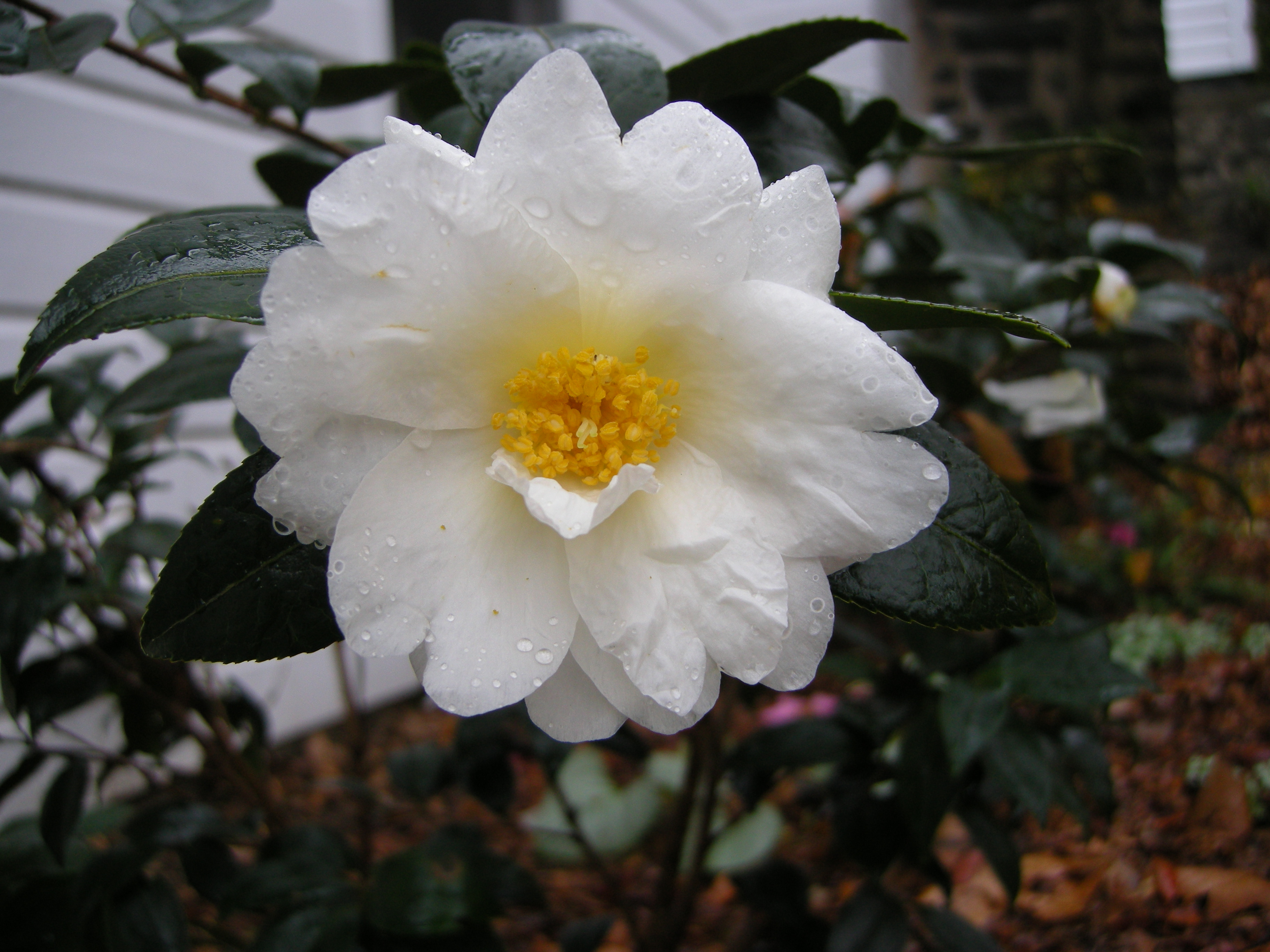
This is a lovely semi-double white camellia hybridized by Charles but not introduced for sale or named.

Camellia x ‘Winter’s Interlude’ is a November and December blooming Ackerman hybrid with anemone form flowers and an upright spreading habit.

This camellia, which Charles grew from cuttings given to him by North Carolina State University, is very beautiful, but has not been introduced for sale.

A close up of the lovely pale pink flower on the North Carolina State camellia pictured above.

Camellia x ‘Moon Festival’ has unusually large flowers with a crepe paper texture, but is hardy only to zone 7.

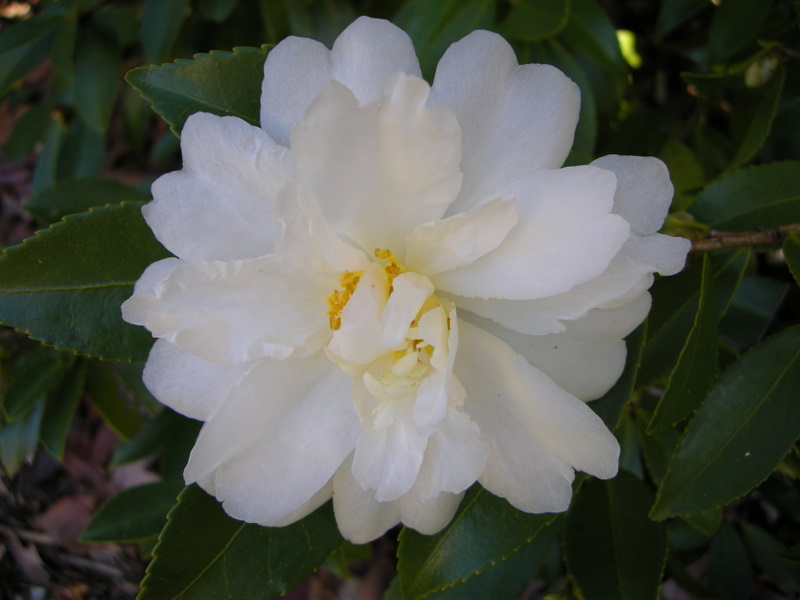
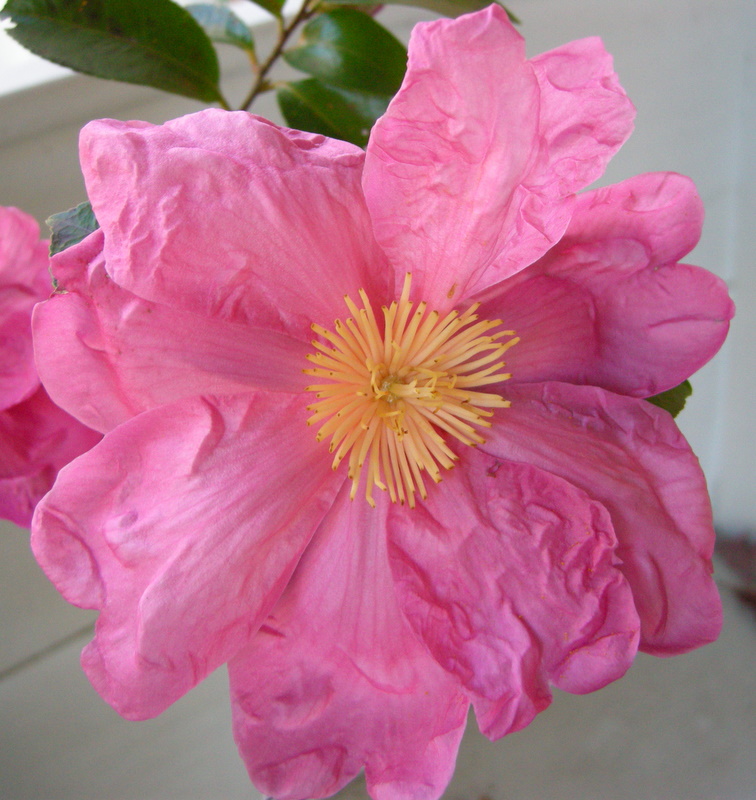
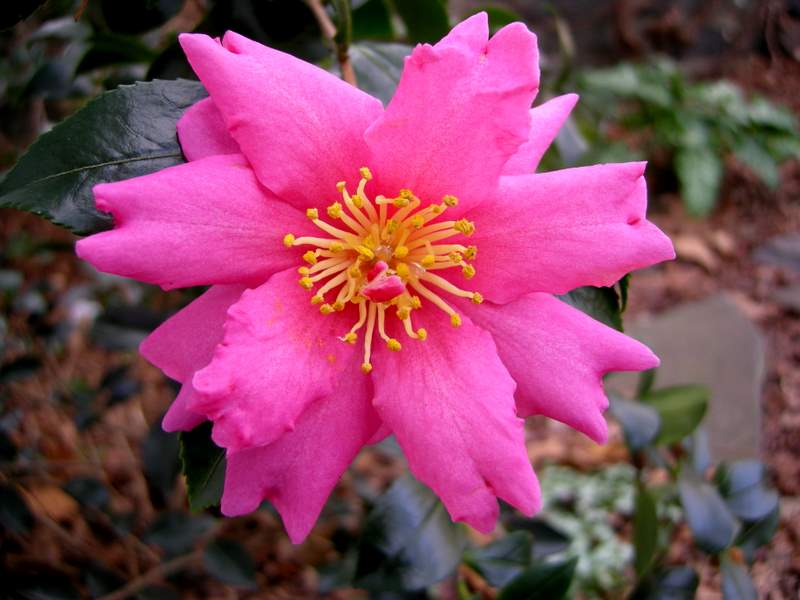
Charles and I both love this unnamed Ackerman hybrid pictured above and at the top of the post.  We were thinking of potential names like “Winter’s Halo” or “Inner Glow”.  Do you think it should be introduced?

Camellia x ‘Carolina Moonmist’ was developed by the J.C. Raulston Arboretum of NCSU with single pink flowers.

Camellia x ‘Carolina Moonmist’: Charles feels that this camellia is too late-blooming for our area because many of the buds won’t open before it is too cold.  ‘Winter’s Star’ is a much better alternative.

I tried to remain focused on camellias for the whole visit, but the garden is so beautiful that some other plants snuck in, and I have to share them:

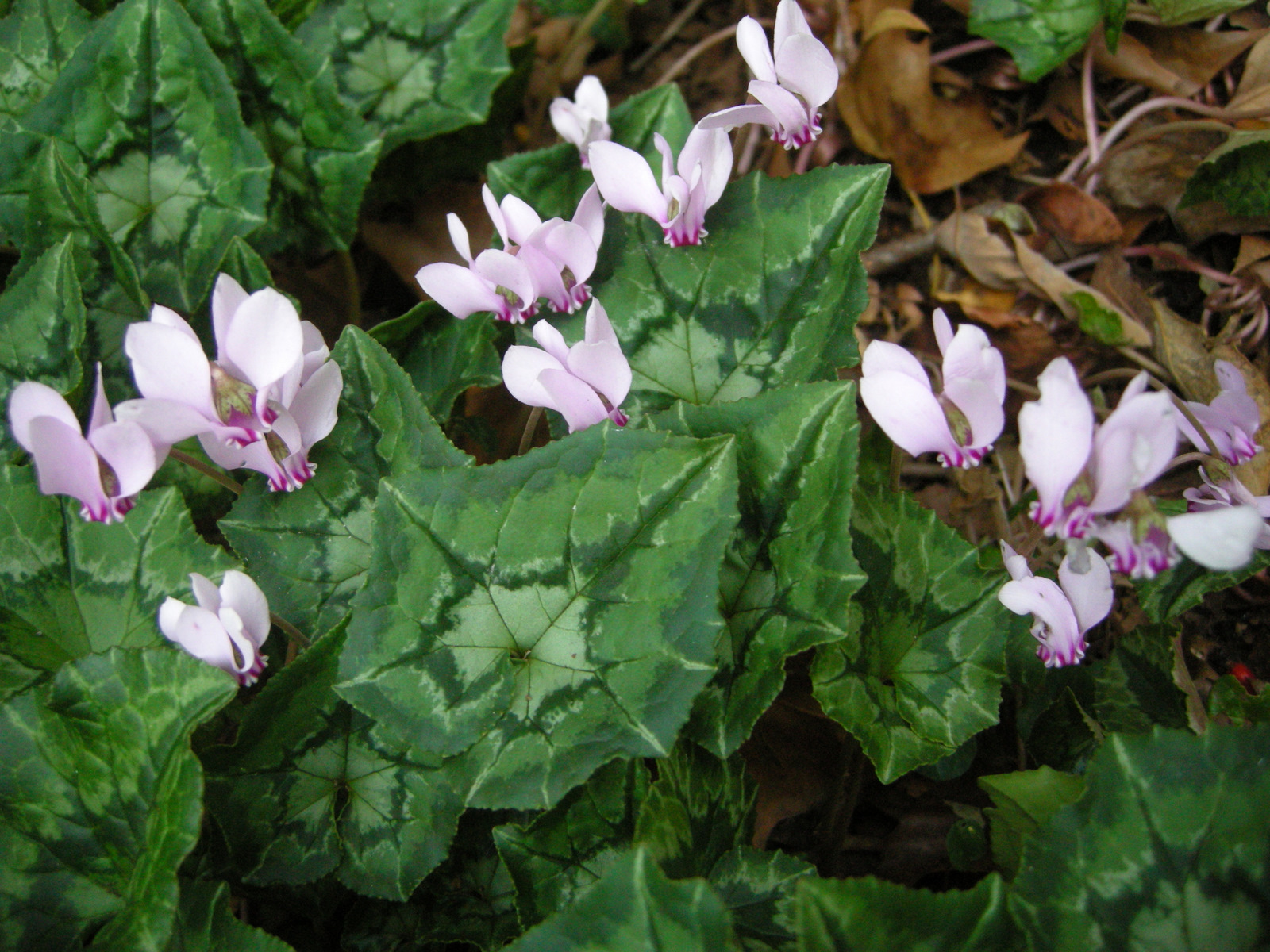
Fall-blooming hardy cyclamen seedling, C. hederifolium, growing at the base of a massive tree trunk.

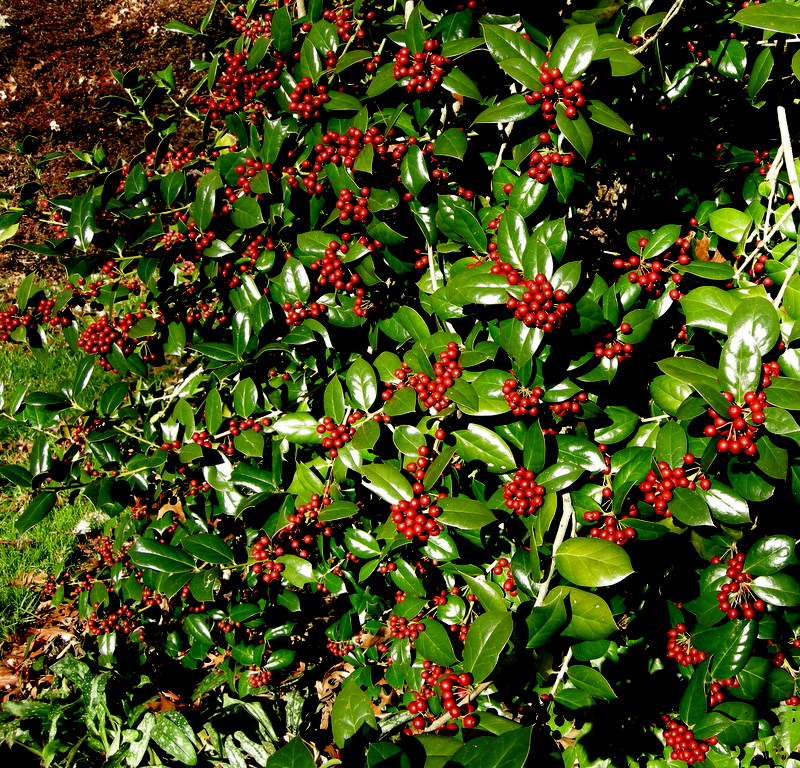
Chinese holly, Ilex cornuta

Japanese maple, Acer palmatum ‘Ornatum’

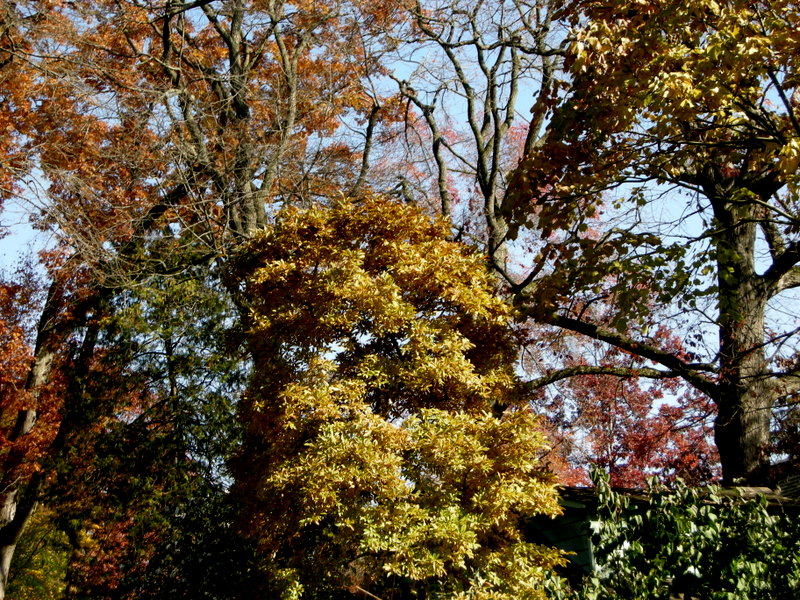
The fall color of star magnolia, M. stellata.

The fall color of bald cypress, Taxodium distichum.

We are so lucky in this part of the world to have such massive trees with gorgeous fall color.

Enjoy,  Carolyn

Notes: Every word that appears in orange on my blog is a link that you can click for more information.  If you want to return to my blog’s homepage to access the sidebar information (catalogues, previous articles, etc.) or to subscribe to my blog, just click here.
More Flowering Wintergreen Ground Covers for Shade

Posted in evergreen, Fall, groundcover, Shade Perennials, winter interest with tags , , , , , , , , , , , , on October 27, 2011 by Carolyn @ Carolyns Shade Gardens

Carolyn’s Shade Gardens is a retail nursery located in Bryn Mawr, PA, specializing in showy, colorful, and unusual plants for shade.  The only plants that we ship are snowdrops within the US.  For catalogues and announcements of local events, please send your full name, mailing address, and cell number to carolyn@carolynsshadegardens.com and indicate whether you are interested in snowdrops, hellebores, and/or hostas.  Click here to get to the home page of our website for catalogues and information about our nursery and to subscribe to our blog.

‘Album’ fall blooming hardy cyclamen, C. hederifolium ‘Album’, has white flowers, shown here blooming before the leaves on September 28, 2011, and spreads to form a ground cover that stays green through the winter.

In my article Flowering Wintergreen Ground Covers for Shade, I explained that I treasure evergreen ground covers that are presentable through winter because, here in the mid-Atlantic (US), we go through long periods of winter weather that are just plain cold without the compensation or covering of snow when any patch of green is prized.  Ground covers, especially those that maintain a presence through winter, make a garden look mature and cut down on the labor of weeding and the expense of mulch. Yes, you can plant the evergreen  triumvirate of vinca, ivy, and pachysandra.  But I want more: beautiful flowers and foliage too.  Just like the four in my original article, all four of the shady ground covers described below have prominent places at Carolyn’s Shade Gardens.

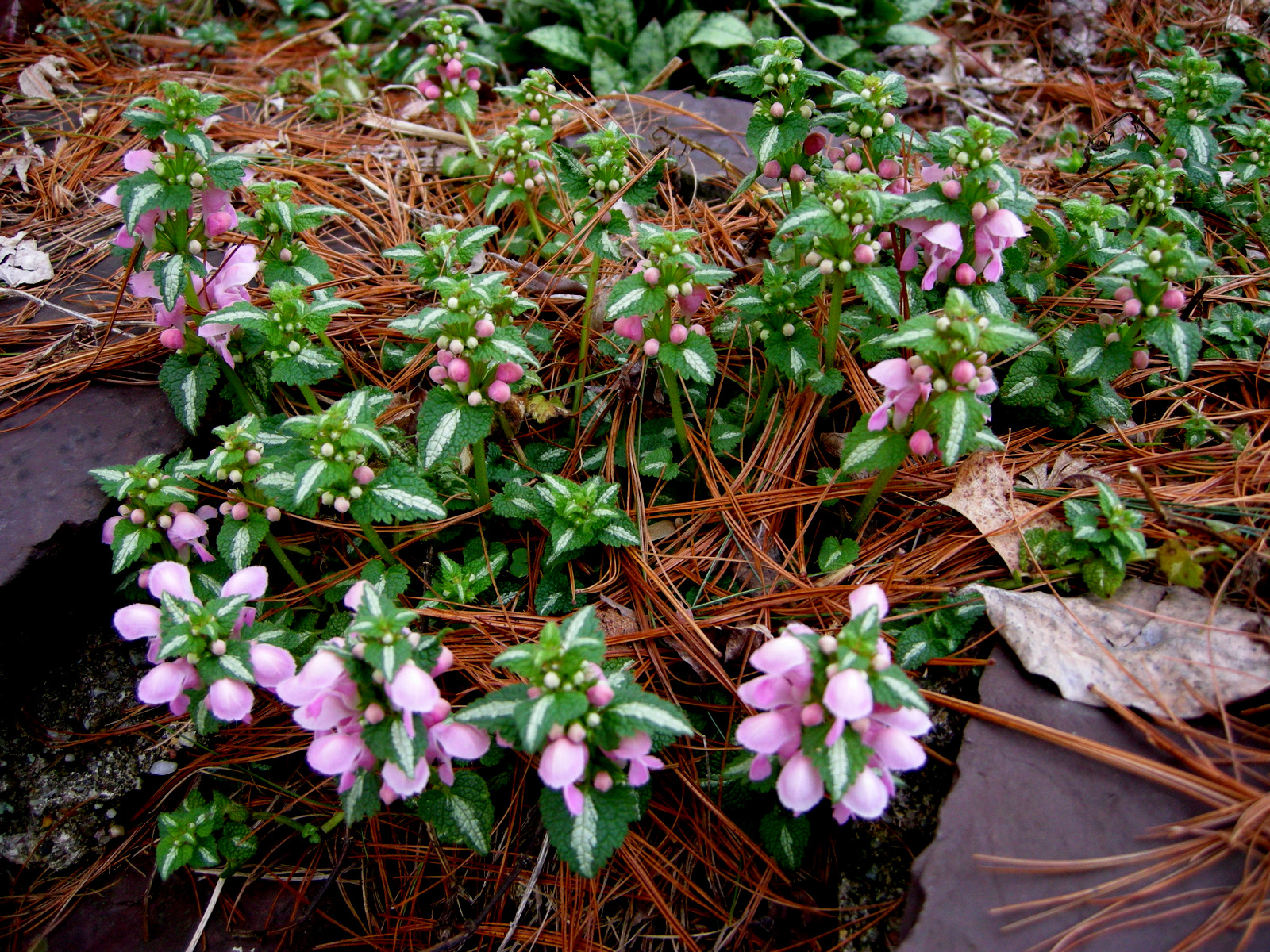
‘Shell Pink’ spotted dead nettle (I prefer to call it lamium), Lamium maculatum ‘Shell Pink’, still blooming at the end of November 2010.

Lamium ‘Shell Pink’ is a versatile wintergreen ground cover with gorgeous flowers from April to November.  It is the only lamium cultivar that blooms this long–all the others have a season of bloom in the spring.  I grow mine under the shade of a white pine (photo above and below) and also in a sunny area in front of my peonies.  ‘Shell Pink’s’ leaves stay neat and tidy all winter.

The first flush of blooms on ‘Shell Pink’ lamium in early April 2011.

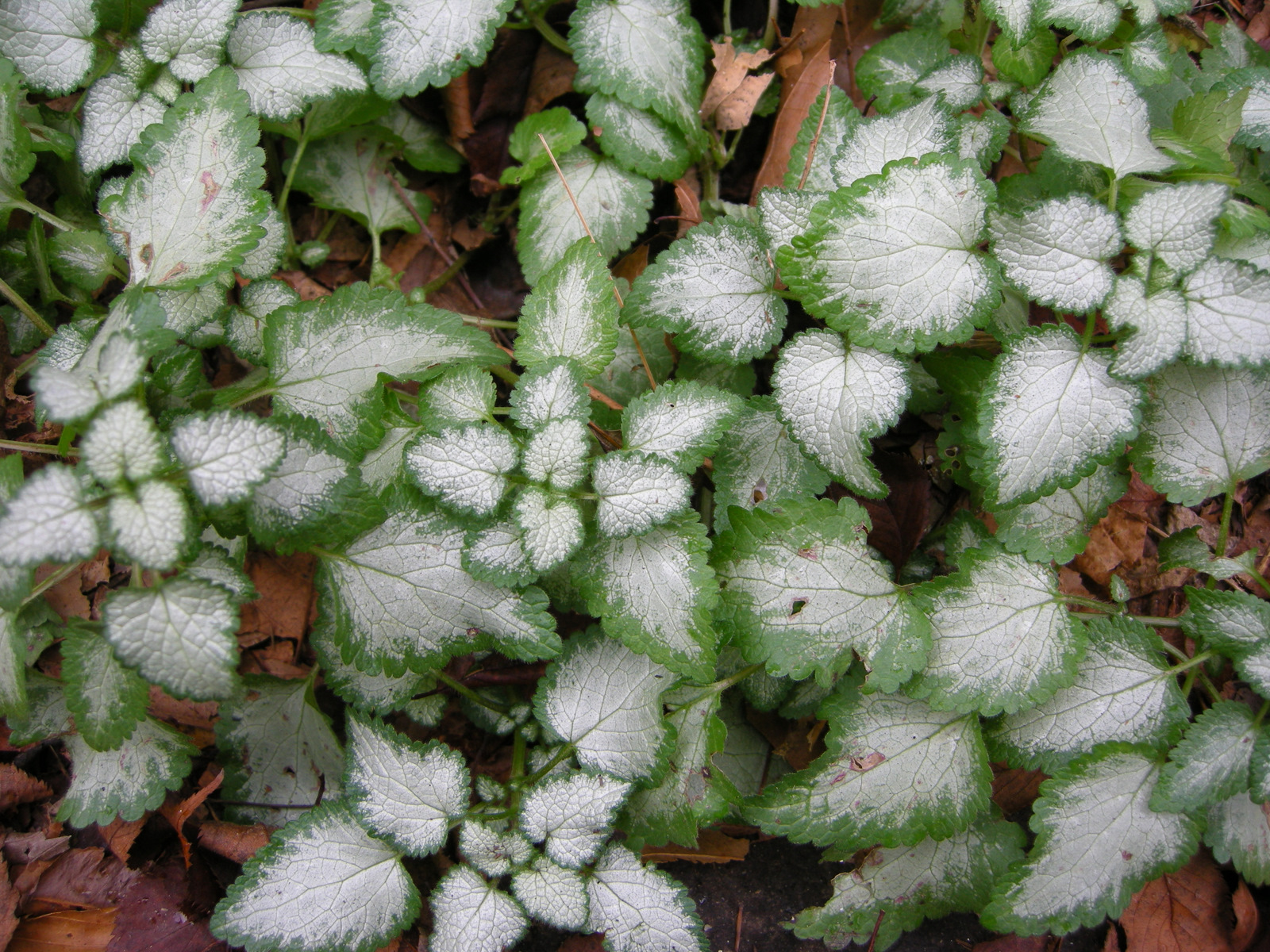
Lamium maculatum is native to Europe and temperate Asia.  It quickly creeps to form 4 to 8″ tall patches of wintergreen leaves even in open full shade in zones 3 to 8.  It doesn’t seem to care if the soil is moist or dry but likes to be well-drained.  On ‘Shell Pink’, the first flush of flower buds emerges in early April to be followed by successive waves of blooms into November.  It fills in around surrounding plants without overwhelming them.  My deer have never touched it.  Lamium also makes a great container plant and overwinters outside in pots.  The only other cultivar I recommend is ‘Purple Dragon’ with bright purple flowers and solid silver leaves (photo below).

Although ‘Purple Dragon’ lamium only blooms in the spring, it’s silver leaves are quite ornamental in their own right.  Photo December 2010.

In anticipation of comments telling me that lamium is “invasive”, let me say three things.  First, it is a ground cover so it is supposed to spread and cover large areas.  A plant isn’t invasive because it spreads too much—the gardener has just planted it in the wrong place.  To me, it’s invasive if you can’t remove it when you want to either because you can never get it all (goutweed, lesser celandine) or it seeds so prolifically that you can’t remove all the seedlings (garlic mustard).  Second, the straight species, Lamium maculatum, may be invasive so don’t plant it.  Third, many times when gardeners say this they are talking about yellow archangel, Lamiastrum galeobdolon, a plant with yellow flowers and silver leaves that is invasive.  Lamiums don’t have yellow flowers.  Thanks for listening!

Fall-blooming hardy cyclamen, C. hederifolium, in full bloom in late October 2010.

Although spring-blooming hardy cyclamen, C. coum, is finicky and hard to grow, fall-blooming hardy cyclamen will thrive in most shady locations as long as it is well-drained.  The flowers start to bloom in September and October before the leaves break dormancy.  Then its gorgeous, intricately patterned wintergreen leaves emerge and remain pristine all winter until they go dormant in early summer.  Mine happily naturalize in east-facing shady locations.

Cyclamen hederifoliumImagine large patches of this fall-blooming hardy cyclamen foliage all through winter–absolutely stunning!  Photo in late November 2010.

Hardy cyclamen is native to wooded areas and rocky hillsides of southern Europe and Turkey.  It forms 4 to 6″ tall mats of leaves, which remain highly ornamental through winter in zones 5 to 9.  It is very tolerant of soil conditions as long as it is well-drained and, once established,  grows well in full dry shade.  My deer leave it alone.


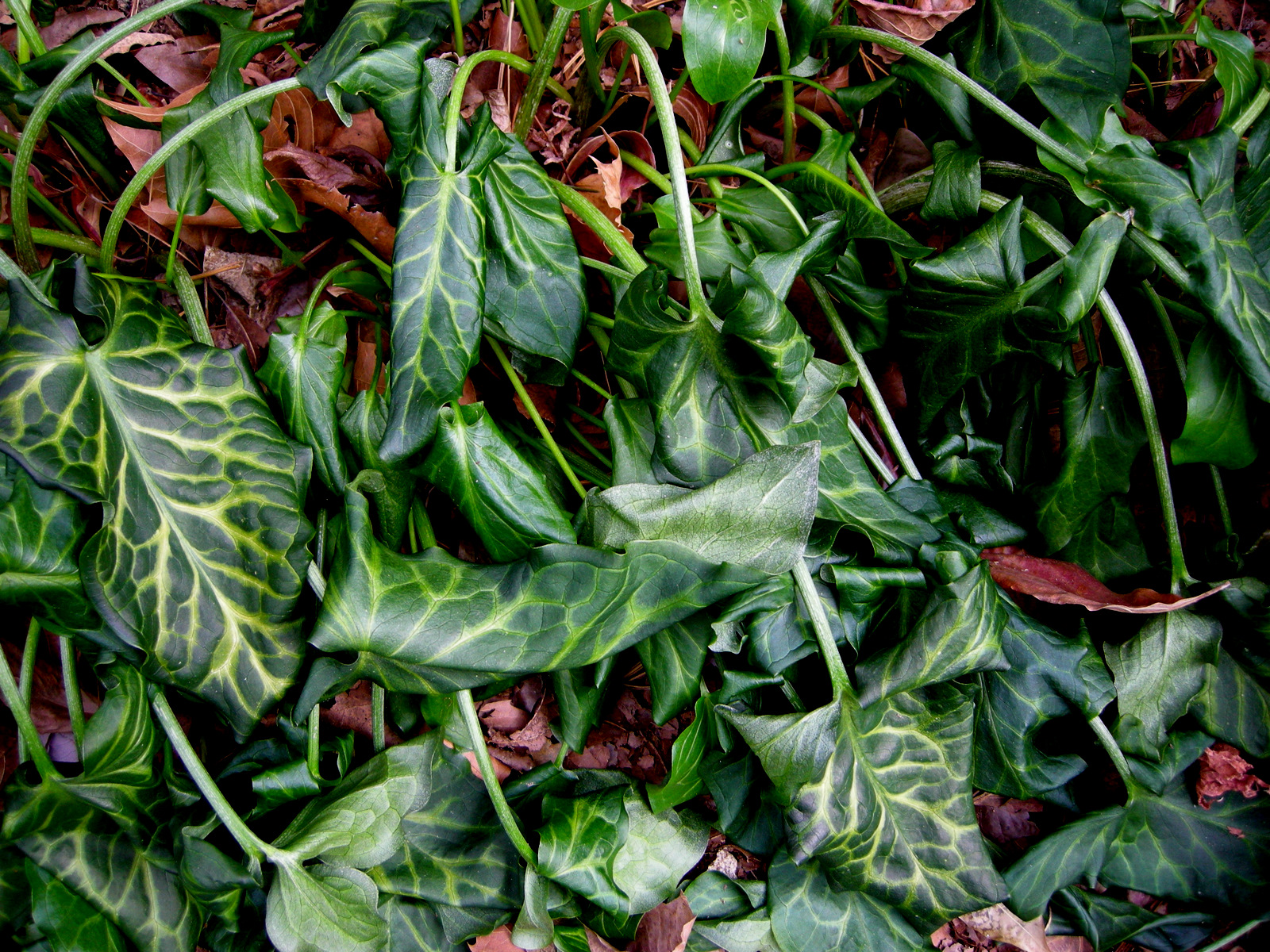
‘Pictum’ Italian arum, Arum italicum ‘Pictum’, used as a ground cover around hellebores and hostas along my front walk so I can admire it all winter.  Photo October 20, 2011.


This is what happens to Italian arum during really cold weather.  No matter how many times I have witnessed it, I am always amazed when it stands back up and looks as if nothing has happened.  Photo December 2010.

I have featured Italian arum photos on my blog many times but that’s because I think it is such a great plant.  The leaves emerge in September and remain immaculate through the winter.  If the weather is really cold, it wilts to the ground (see photo above), only to perk up again as soon as temperatures recover.  I have it planted by my front walk so I can enjoy its spotless, highly ornamental leaves all winter.  I also use it to cover areas where I cut back ratty hostas in the fall (see my article Hostas for Fall).  In May and June, it blooms with a pale green hood-like spathe covering a yellow spadix like our native jack-in-the-pulpit.  Bright orange berries appear in summer.  Several wonderful cultivars are available, including ‘Gold Rush’, which emerges in the spring with golden venation, and ‘Tiny Tot’, a miniature.

‘Gold Rush’ Italian arum in November 2010.  Italian arum cultivars have superior markings.

Arum italicum 'Tiny Tot'/'Tiny Tot' Italian Arum‘Tiny Tot’ Italian arum in February of 2009.

Italian arum is native to Europe.  It grows 12 to 18″ tall in zones 6 to 9.  It thrives in any soil in almost full sun to full shade and is tolerant of drought.  Deer do not bother it.  In the 20 years that I have been growing it, it has spread politely to other areas of my garden, but occasionally I have heard that it can become an aggressive spreader.  Lyn from The Amateur Weeder reports that it is invasive in Australia.  Please consult local experts to see if there is a problem where you garden.


‘Sulphureum’ epimedium, E. x versicolor ‘Sulphureum’, used as a ground cover in front of hardy begonia, B. grandis.  Photo October 20, 2011.

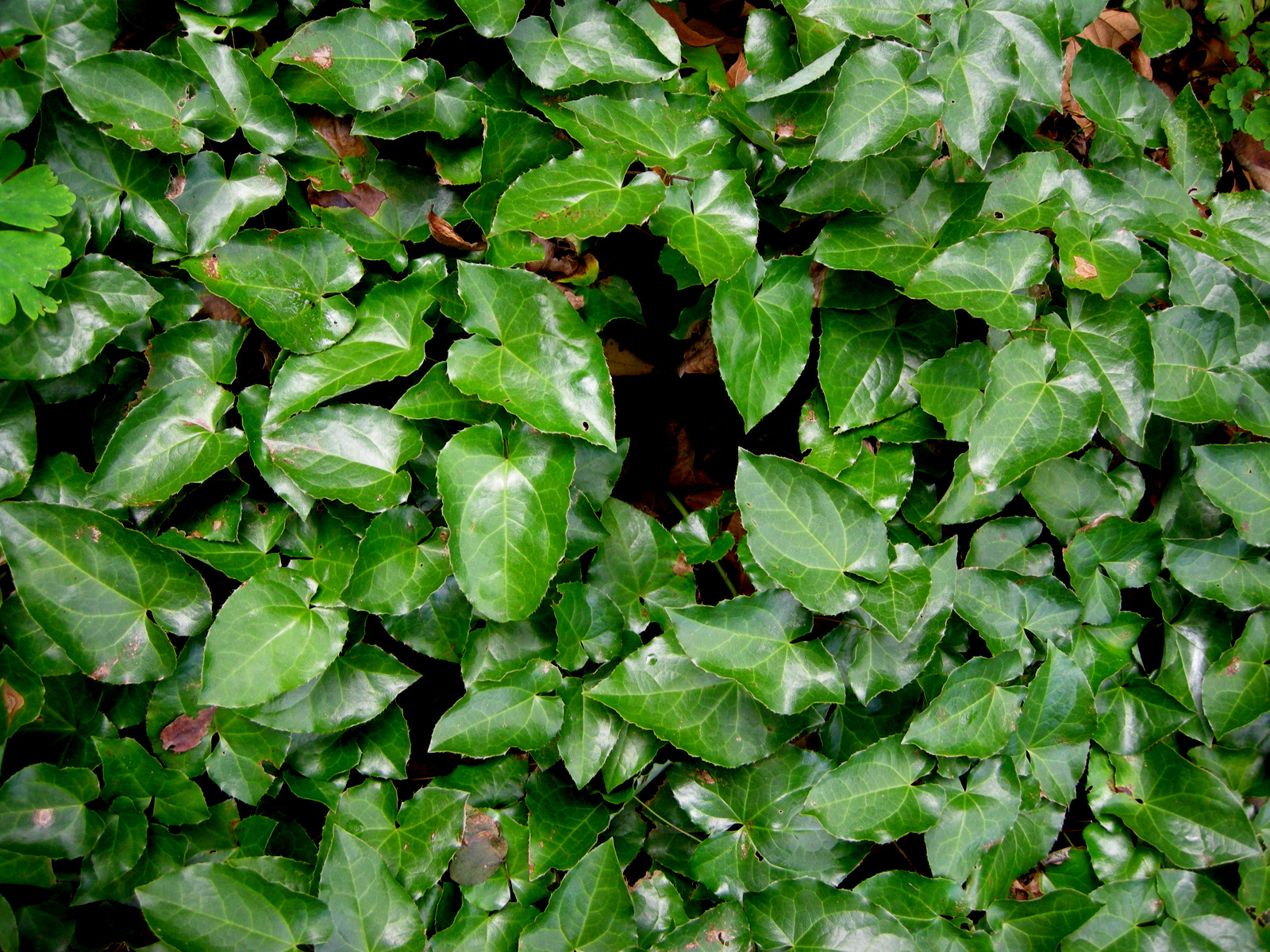
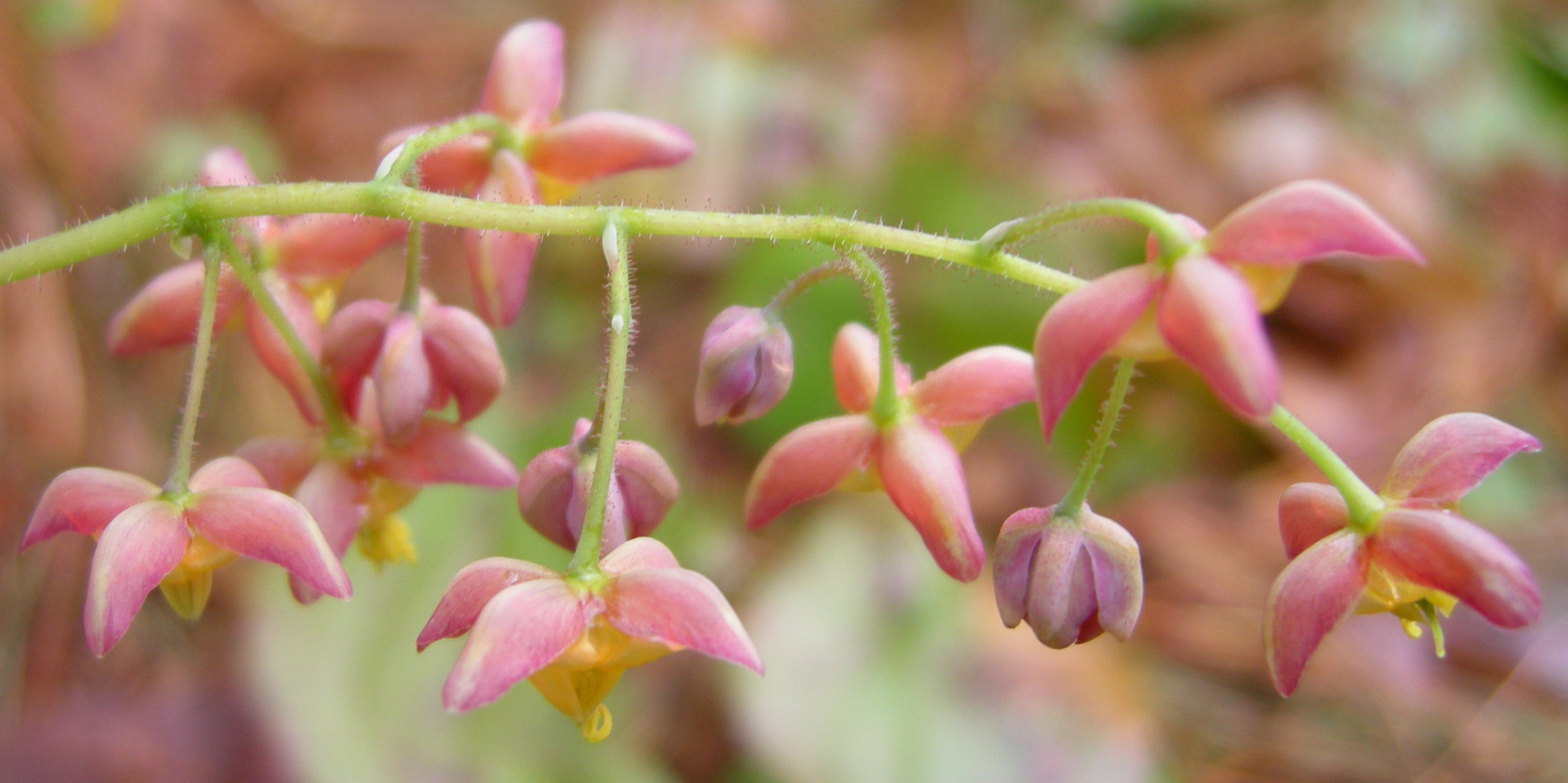
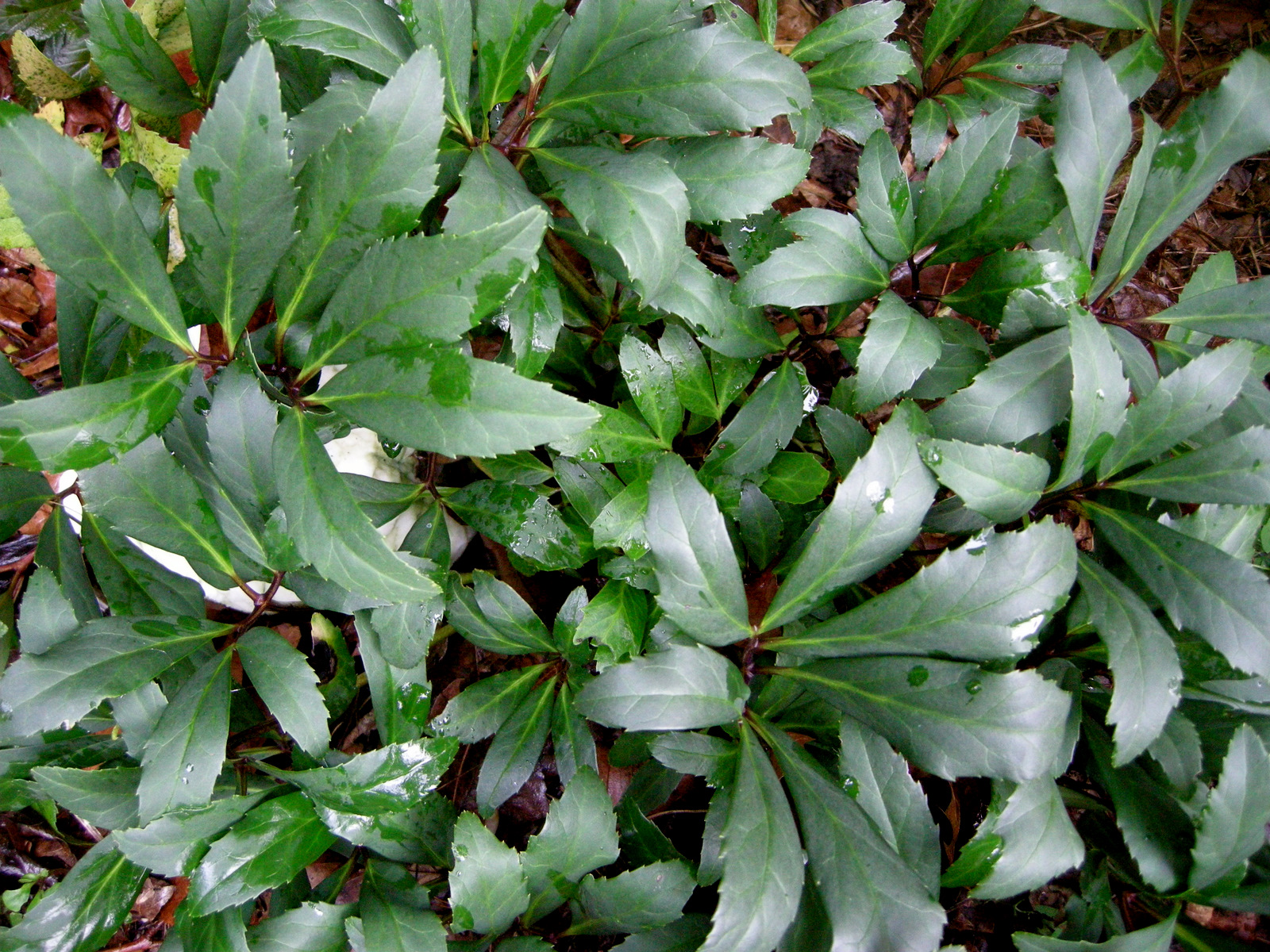
I love epimediums.  In fact, I love them so much that they are one of the few plants I allow myself to collect with 30 varieties in my garden.  Their small but copious spring flowers are beautiful and unusual coming in white, pink, yellow, orange, red,  purple, and bicolors.  I also prize their leaves which are often shiny and wing-shaped, sporting spiky edges or colored splotches or lovely venation.  Many epimediums are deciduous and clump-forming.  In this article, I want to profile a few that have wintergreen leaves and spread to make a ground cover.

The fastest growing epimedium by far is ‘Sulphureum’.  It spreads at a medium rate to form a large patch (see photo above).  Its two-tone yellow flowers  look like miniature daffodils in early April.

E. x rubrum is the second fastest spreader.  It’s leaves are similar to ‘Sulphureum’.  If you can find the cultivar ‘Sweetheart’, pictured above, it has gorgeous flowers.  I sell a good selection of epimediums at my nursery, but I get my unusual epimediums from the Massachusetts nursery, Garden Vision Epimediums (email epimediums@earthlink.net).  They have hundreds of varieties.

‘Frohnleiten’ epimedium, E. x perralchicum ‘Frohnleiten’, is also a fairly quick spreader .  It has gorgeous shiny leaves with an intricate vein pattern and produces bright, sulfur yellow flowers in the spring.

‘Shrimp Girl’ epimedium, E. alpinum ‘Shrimp Girl’, is also a good spreader in my garden, here used as a ground cover in front of ferns and hostas.

The lovely two-tone flowers of ‘Shrimp Girl’ in spring.


I am including ‘Kaguyahime’ epimedium even though it spreads fairly slowly so that you can see how beautiful and unusual the leaves of wintergreen epimediums can be.

Epimediums are native to Europe, Asia, and North Africa.  They reach 6 to 12″ tall, depending on the cultivar, and flower in April.  They grow in part to full shade and can take dry soil once established.  Their creeping roots are impenetrable to weeds.  I cut back all the remaining old foliage in March once I see the new flowers and leaves starting to emerge.  When choosing an epimedium for ground cover, select spreading varieties that have evergreen or semi-evergreen leaves.


Next spring when you are looking for ground covers, I hope you will consider one of the four described above.  In the meantime, leave a comment with the name of your favorite wintergreen ground cover for shade.  In my first article, I profiled golden groundsel, creeping phlox, dwarf sweetbox, and hybrid hellebores as ground covers.  If you want to read about them, click here.

Carolyn

Notes: Every word that appears in orange on my blog is a link that you can click for more information.  If you want to return to my blog’s homepage to access the sidebar information (catalogues, previous articles, etc.) or to subscribe to my blog, just click here

A Few Fall Favorites for Foliage and Fruit

Posted in evergreen, Fall, Fall Color, landscape design, Shade Gardening with tags , , , , , , , , , , , on October 3, 2011 by Carolyn @ Carolyns Shade Gardens

Carolyn’s Shade Gardens is a retail nursery located in Bryn Mawr, PA, specializing in showy, colorful, and unusual plants for shade.  The only plants that we ship are snowdrops within the US.  For catalogues and announcements of local events, please send your full name, mailing address, and cell number to carolyn@carolynsshadegardens.com and indicate whether you are interested in snowdrops, hellebores, and/or hostas.  Click here to get to the home page of our website for catalogues and information about our nursery and to subscribe to our blog.

Italian arum, Arum italicum, goes dormant during the summer and comes up again in September so it is pristine in the fall and through the winter.  All photos were taken at Carolyn’s Shade Gardens this week.

“A Few Fall Favorites for Foliage and Fruit” was inspired by an article in a gardening magazine talking about dressing up your fall garden with mums because everything else is finished and the garden is looking tired.  Reading this sent me rushing for my camera and out the door to prove them wrong (I have a similar response to shade gardening articles that start: “Now you can’t have color in the shade, but….”).  In fact, my indignation has inspired a three-part post, the other two will cover flowers and hostas that look good in fall.  And none of the plants I am highlighting are relying on fall leaf color yet.  So here is some of what is fresh and beautiful in my shady gardens right now:

‘Brigadoon’ St. John’s Wort, Hypericum calycinum ‘Brigadoon’, has gorgeous gold foliage all season.  With the onset of cold weather, it will take on peachy hues.

‘Caramel’ coral bells, Heuchera villosa ‘Caramel’, displays its lovely colors 365 days a year.  The native Heuchera villosa cultivars, including ‘Caramel’, ‘Citronelle’, ‘Bronze Wave’, and ‘Frosted Violet’, are the best coral bells for our area and remain colorful through winter.

‘Aureola’ Japanese forest grass, Hakonechloa macra ‘Aureola’, really comes into its own in the fall when its cascading yellow-variegated foliage shines in full shade.

The foliage palette for shade has been enlarged by the recent introduction of foamy bells, x Heucherella, which is a cross between native foamflower, Tiarella, and native coral bells, Heuchera.  This is ‘Solar Power’.

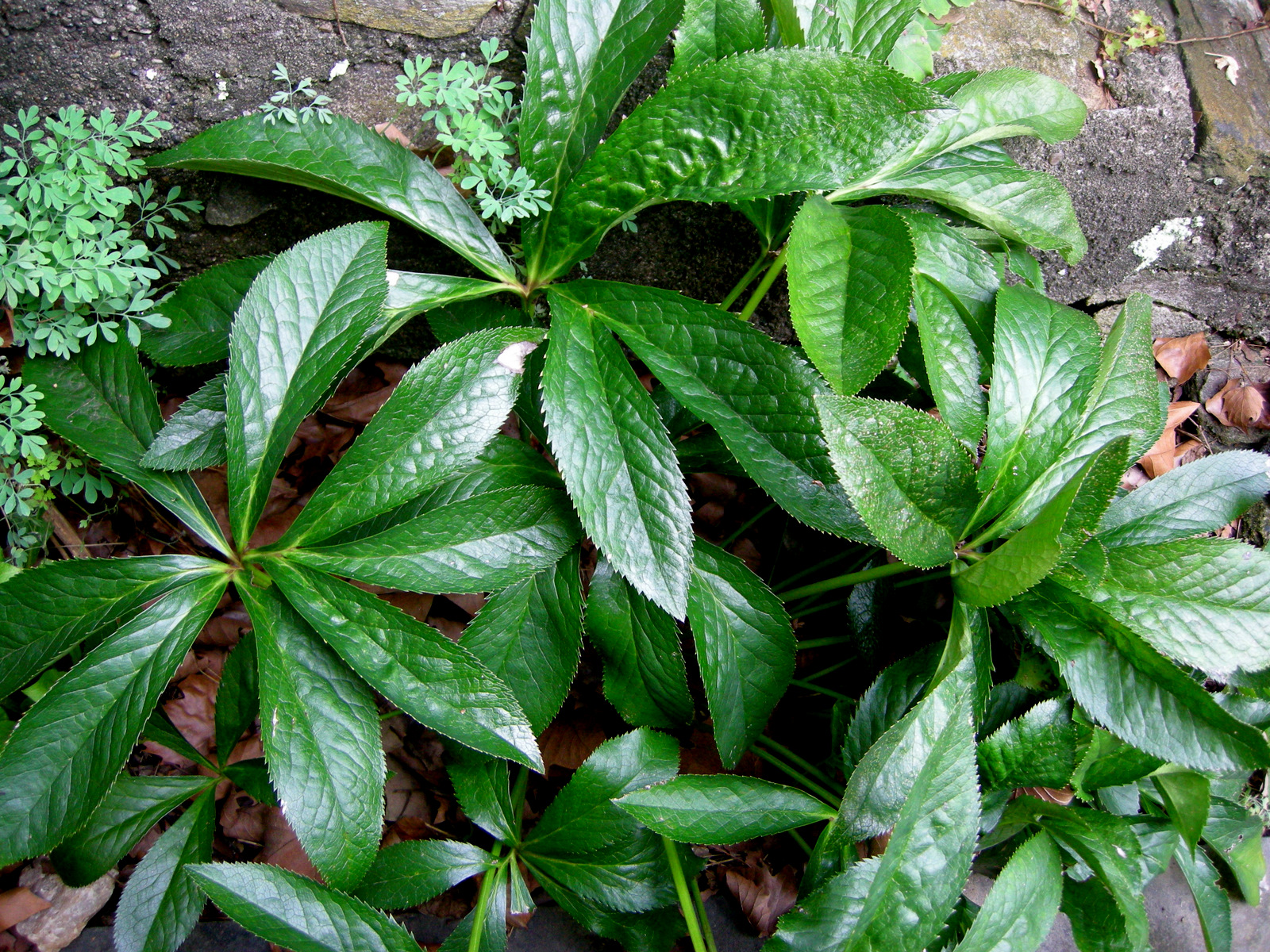
One of the many things I like about hybrid hellebores, Helleborus x hybridus, is that their evergreen leaves stay pristine through whatever summer throws at them.

The evergreen leaves of Christmas rose hellebore, Helleborus niger, are also lovely in the fall.

The leaves of ‘Black Scallop’ ajuga, A. reptans ‘Black Scallop, become darker and darker as fall progresses, ending up a deep mahogany.

‘Diana Clare’ lungwort, Pulmonaria ‘Diana Clare’, is another plant that can take whatever nature dishes out—it shines in full shade.

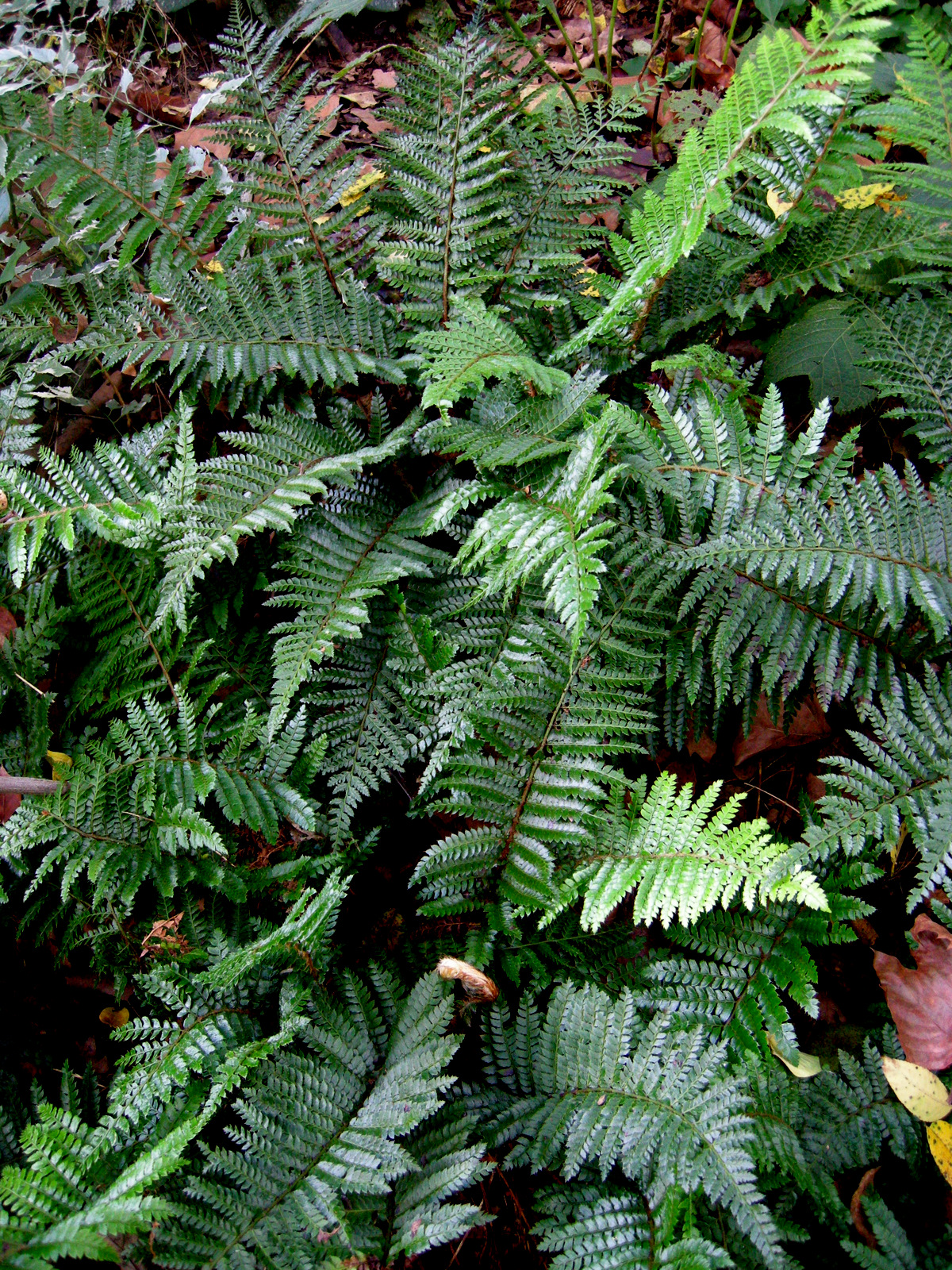
Unlike deciduous ferns that hit the decks in September, evergreen ferns are just getting going, here tassel fern, Polystichum polyblepharum.  To read my article on evergreen ferns for shade, click here.

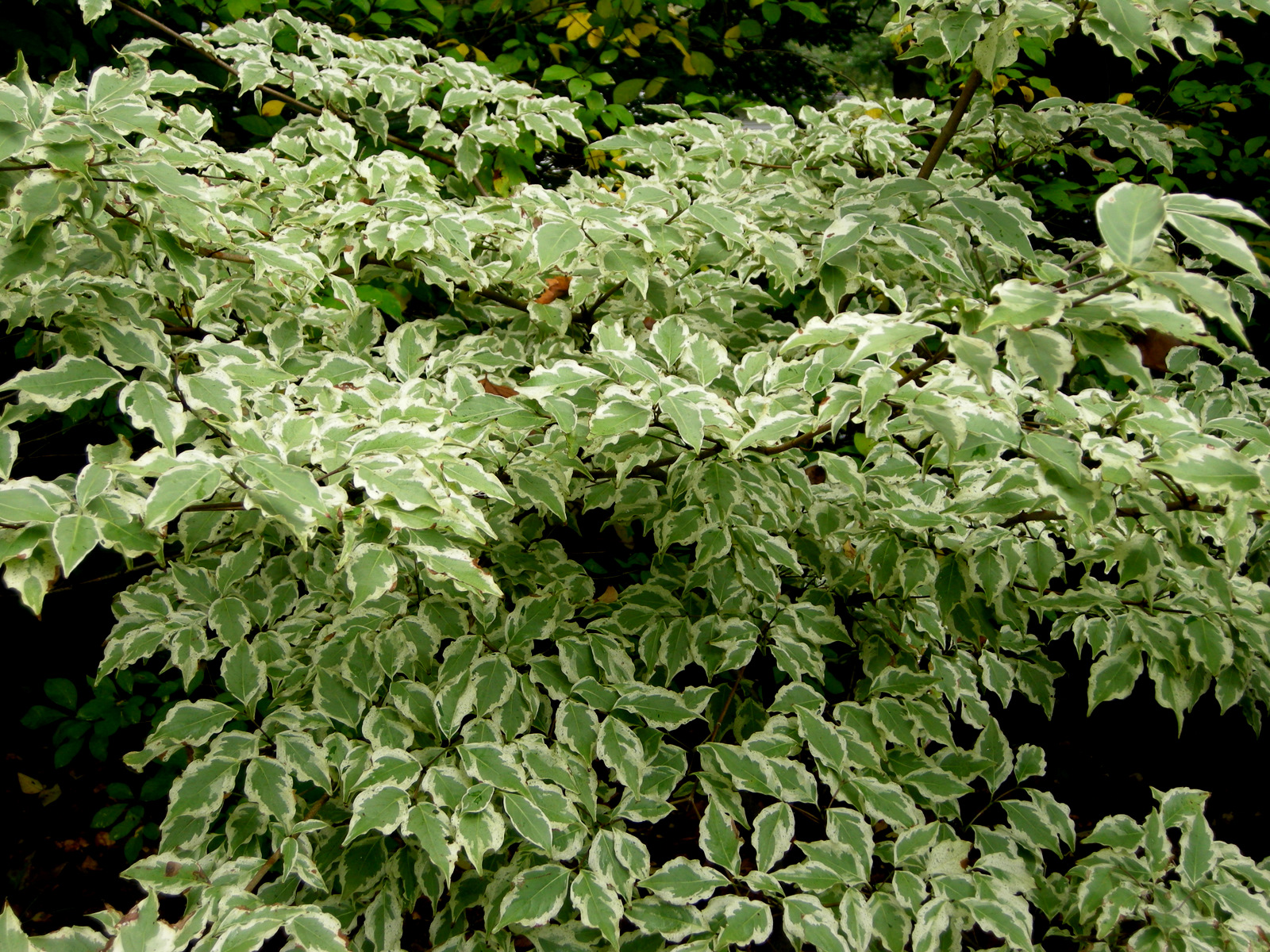
The foliage of ‘Wolf Eyes’ kousa dogwood, Cornus kousa ‘Wolf Eyes’, is beautiful all season, but I especially appreciate it in the fall when other leaves are tattered.


‘Red Sprite’ winterberry holly, Ilex verticillata ‘Red Sprite’, is my favorite of all the native winterberry cultivars because it has a compact habit and produces copious amounts of very large berries.  For more information on this great shrub, click here.

Our native flowering dogwood, Cornus florida, is in full fruit right now.

The striking bright purple berries of ‘Early Amethyst’ beautyberry, Callicarpa dichotoma ‘Early Amethyst’, march evenly down the stems of its beautifully cascading branches.  For more information and a close up photo, click here.

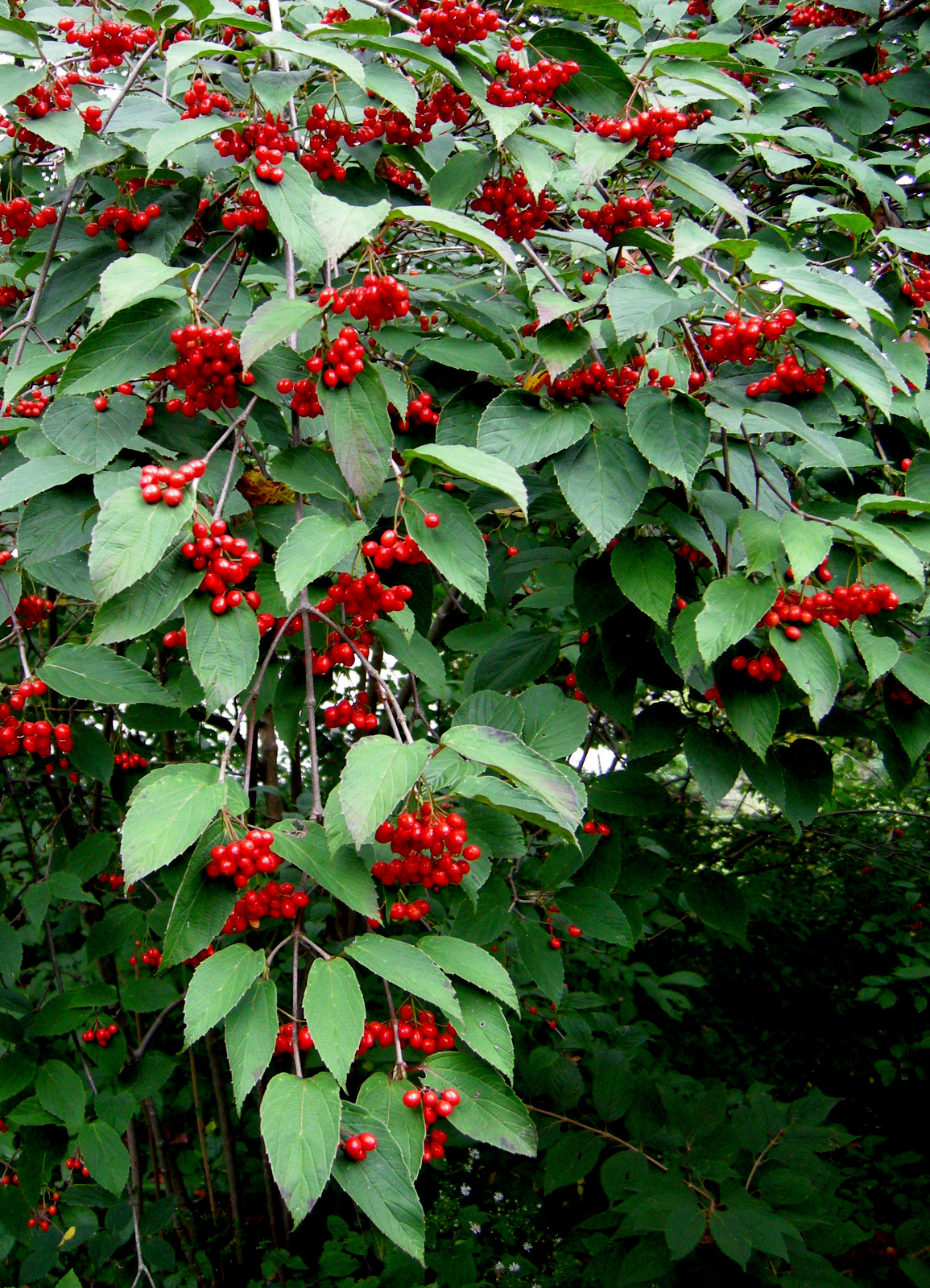
I grow my tea viburnums, Viburnum setigerum, in the shade of massive 150-year-old London plane trees, but it doesn’t stop them from producing their spectacular bunches of shiny red fruit.

The foliage and berries highlighted above, along with many I did not include, make my fall gardens a showplace for my customers and a relaxing retreat for me.  They do not require any dressing up for fall because they are already fully clothed.

Carolyn

Stay tuned for Part 2, A Few Fall Favorites for Flowers, and Part 3, Hostas for Fall.

Notes: Every word that appears in orange on my blog is a link that you can click for more information.  If you want to return to my blog’s homepage to access the sidebar information (catalogues, previous articles, etc.), just click here.

Woody Plants for Shade Part 3

Posted in evergreen, landscape design, native plants, New Plants, Shade Shrubs, shade vines with tags , , , , , , , , , , , , , , , , , on September 27, 2011 by Carolyn @ Carolyns Shade Gardens

Carolyn’s Shade Gardens is a retail nursery located in Bryn Mawr, PA, specializing in showy, colorful, and unusual plants for shade.  The only plants that we ship are snowdrops within the US.  For catalogues and announcements of local events, please send your full name, mailing address, and cell number to carolyn@carolynsshadegardens.com and indicate whether you are interested in snowdrops, hellebores, and/or hostas.  Click here to get to the home page of our website for catalogues and information about our nursery and to subscribe to our blog.

‘Winter’s Joy’ Fall-blooming Hardy Camellia

My nursery specializes in herbaceous flowering plants for shade.   However, although no shade garden is complete without trees, shrubs, and vines, our local nurseries seem to ignore woody plants for shade.  To fill this gap, I offer my customers shade-loving woodies from a wholesale grower whose quality meets my exacting standards.  As in Woody Plants for Shade Part One and Woody Plants for Shade Part Two, I thought my blog readers who are not customers might be interested in learning about the woody plants that I would recommend they add to their shade gardens.  And doing an article in addition to the customer offering allows me to add more information so customers might be interested also.

This summer was tough on plants.  I lost several shrubs that I planted this spring.  That is why fall is the best time to plant.  The soil temperature is elevated for good root development through December, but new plants don’t have to contend with scorching temperatures, severe drought, or an excess of rain.  The plants that I add in the fall are always the most successful in my garden.

Included in my offering are three evergreen shrubs, five deciduous shrubs, and one vine.  Of the nine plants I have chosen, three are native.  Please read my article My Thanksgiving Oak Forest to see why I think planting native plants is crucial to our environment.  My article New Native Shade Perennials for 2011 explains why I think native cultivars are valuable native plants.  With that introduction, here are the plants I am offering highlighted in green:

The fall-blooming camellia ‘Winter’s Snowman’ shines in the winter sun.

If you have been reading my blog, you know that I love camellias, especially fall-blooming varieties.  There is nothing like going outside on a cold November or December day and being greeted by large showy flowers backed by gorgeous evergreen leaves.  Camellias really light up the shadiest parts of my garden during the time of year when flowers are most appreciated.  For more information on and some beautiful photographs of fall-blooming hardy camellias, see my articles Fall-blooming Camellias Part 1 and Fall-blooming Camellias Part 2.


‘Winter’s Snowman’ blooming in December

In a very shady place on the terrace outside my front door, I have a ‘Winter’s Snowman’ fall-blooming hardy camellia.  At maturity, it will reach six feet.  Its semi-double white flowers glow when displayed against the glossy evergreen leaves in November and December.  It is a vigorous plant with a narrow upright habit.  Although it is fully hardy in our area, I have sheltered it from winter sun and our winter winds, which come from the northwest.


‘Winter’s Joy’ fall-blooming camellia

In a similarly sheltered and shady location outside my back door along the path to my compost “pit”, I have planted another fall-blooming camellia.   ‘Winter’s Joy’ fall-blooming hardy camellia has semi-double, fuchsia-pink flowers elegantly displayed against glossy evergreen leaves in November and December.  It is a vigorous plant with a narrow upright habit, reaching six feet at maturity.  Right now both these fall-blooming camellias are covered with buds.  I can’t wait for the display to begin.

‘Winter’s Joy’ is loaded with buds just waiting to produce its showy flowers, and look at that immaculate foliage.

I really like leatherleaf viburnums.  They are evergreen, deer resistant, grow in full shade, have lovely flowers and foliage, and are big enough to screen unsightly views.  The plants I have in my garden are the straight species Viburnum rhytidophyllum and that’s what I intended to offer to my customers.  However, when I saw ‘Dart’s Duke’ lantanaphyllum viburnum (what a name!), V. x rhytidophyllum ‘Dart’s Duke’, and did some research, I realized it is a superior plant for foliage, flowers, berries, and vigor.   A comparison of the nursery stock confirmed this.

‘Dart’s Duke’ showing its majestic leaves and reblooming to produce some of its very large flowers for fall.

‘Dart’s Duke’ grows to 8’ tall by 8’ wide in full sun to full shade.  It has very large, 6 to 10”, showy white flowers in May and can rebloom in the fall.  The flowers are followed by very nice red fruit.  The beautiful, clean dark green, leathery evergreen foliage is deer resistant and winter tough.  It is a Pennsylvania Horticultural Society Gold Medal Plant for 2012, one of only four plants honored.


‘Early Amethyst’ beautyberry is dispalying its amazing purple berries right now at Carolyn’s Shade Gardens.

‘Early Amethyst’ beautyberry, Callicarpa dichotoma ‘Early Amethyst’,  has attractive pink flowers in spring.  But the real show is in the fall when huge amounts of unbelievably colored purple berries run down the center of the beautifully layered branches.  When the leaves drop, the persistent berries are even more showy though they are attractive to birds.  Beautyberry reaches 4’ tall by 4′ wide in sun to part shade and is deer resistant.  I have grown this plant successfully in part shade for years.  If desired, it can be cut back in spring, but I usually leave mine alone.  Beautyberry is a Pennsylvania Horticultural Society Gold Medal Plant and Missouri Botanical Garden Plant of Merit.

Paper Bush, Edgeworthia chrysantha

Paper bush, Edgeworthia chrysantha, is a rare and unusual shrub that has just been discovered by collectors within the last few years.  However, it has so many great ornamental features that it is sure to become very popular.  Its very fragrant clusters of tubular bright yellow flowers bloom from January to March.  The buds, which form in the fall, are as ornamental as the flowers.  They remind me of the tassels on the corners of Victorian pillows.  Paper bush has an elegant and symmetrical upright, branching habit, growing to 6’ tall in part to full shade with protection from winter winds.  It is an exquisite and rare shrub that is ornamental 365 days of the year in my garden.

The buds of paper bush are ornamental all winter.

The unusual fragrant flowers of paper bush

The flowers of ‘Preziosa’ sawtooth hydrangea start out a lovely pink and mature to a bright maroon.

‘Preziosa’ sawtooth hydrangea, Hydrangea serrata ‘Preziosa’, produces numerous lovely pink, small, mophead-like flowers in June and July, which darken with age to a gorgeous maroon (see link below for photo).  The flowers are reliably pink and don’t turn blue.  The beautiful burgundy fall color of the leaves and stems only adds to the show.  ‘Preziosa’ reaches 4’ tall and wide in part to full shade.  The Hydrangea serrata species is one that thrives in full shade.  Unlike many hydrangeas, ‘Preziosa’ is very tolerant of the cold temperatures in our zone 6.  For a raving review of ‘Preziosa’ and more cultural information (note that the winter protection recommended is for zone 5), click here.

The leaves of ‘Preziosa’ sawtooth hydrangea have already started to turn burgundy.

This photo shows the berries on my ‘Red Sprite’ winterberry holly right now—they get much larger as the season progresses, but the show is already breathtaking.

One of my all time favorite native plants is winterberry holly, Ilex verticillata.  It grows wild all over the island in Maine where my family vacations and is always covered with berries in the fall.  Here in Pennsylvania, my preferred winterberry holly cultivar is Ilex verticillata ‘Red Sprite’.  It produces copious amounts of very large red berries on relatively compact plants that never need pruning.  The birds love the berries too, but they leave enough behind for it to remain extremely showy late into the winter.  ‘Red Sprite’ reaches 5’ tall in sun to part shade and is wet site and salt tolerant, and deer resistant.  All hollies require a male pollinator, in this case ‘Jim Dandy’, for good fruit set.  Winterberry is native to the entire eastern half of North America, including Pennsylvania.


The flowers and foliage of native ‘Cool Splash’ southern bush honeysuckle, Diervilla sessifolia ‘Cool Splash’

‘Cool Splash’ southern bush honeysuckle is a native shrub whose bold green and white variegation really stands out in the shade.  Its honeysuckle-shaped yellow flowers appear in July and August with rebloom in the fall.  ‘Cool Splash’ grows to 4’ tall and wide in sun to part shade.  It is tough, cold hardy, and deer resistant, and integrates well into perennial borders.  This species is native to the southeastern U.S., but a closely related species, D. lonicera, is native to Pennsylvania.  It is one of four plants honored with a gold medal by the Pennsylvania Horticultural Society in 2011.  Nan Ondra at the blog Hayfield has written an excellent profile of this native shrub (with many photos), click here .

In late spring and early summer, ‘John Clayton’ trumpet honeysuckle is covered with these delightful tubular yellow flowers attractive to hummingbirds.

I love vines, and one of my first acquisitions was the native ‘John Clayton’ trumpet honeysuckle, Lonicera sempervirens ‘John Clayton’.  It is my most vigorous trumpet honeysuckle vine, completely covering the lattice under my deck.  Its bright yellow tubular flowers are beloved by  hummingbirds in late spring and early summer and  rebloom through fall, forming attractive red berries.  ‘John Clayton’s’ semi-evergreen, bright green leaves remain attractive through the season.  It reaches 10’ in sun to part shade.  It is deer resistant and very low maintenance.  Trumpet honeysuckle is native to the eastern U.S., including Pennsylvania.

I grow most of these plants in my gardens so I know you can’t go wrong by adding them to yours!  If you are a customer, see Nursery Happenings below for details on how to order these wonderful shade plants.  If not, now you have some plants to ask for at your local independent nursery.

For a great video demonstration of how to plant a shrub put together by my cousin, Jay MacMullan, at the blog Landscape Design and Gardening Resource Guide, click here.

Carolyn

Notes: Every word that appears in orange on my blog is a link that you can click for more information.  If you want to return to my blog’s homepage to access the sidebar information (catalogues, previous articles, etc.), just click here.

Woody Plants for Shade Part 1

Posted in evergreen, native plants, Shade Shrubs with tags , , , , , , , , , , , , , on April 1, 2011 by Carolyn @ Carolyns Shade Gardens

Carolyn’s Shade Gardens is a retail nursery located in Bryn Mawr, PA, specializing in showy, colorful, and unusual plants for shade.  The only plants that we ship are snowdrops and miniature hostas.  For catalogues and announcements of events, please send your full name, location, and phone number (for back up use only) to carolyn@carolynsshadegardens.com.  Click here to get to the home page of our website for catalogues and information about our nursery and to subscribe to our blog.

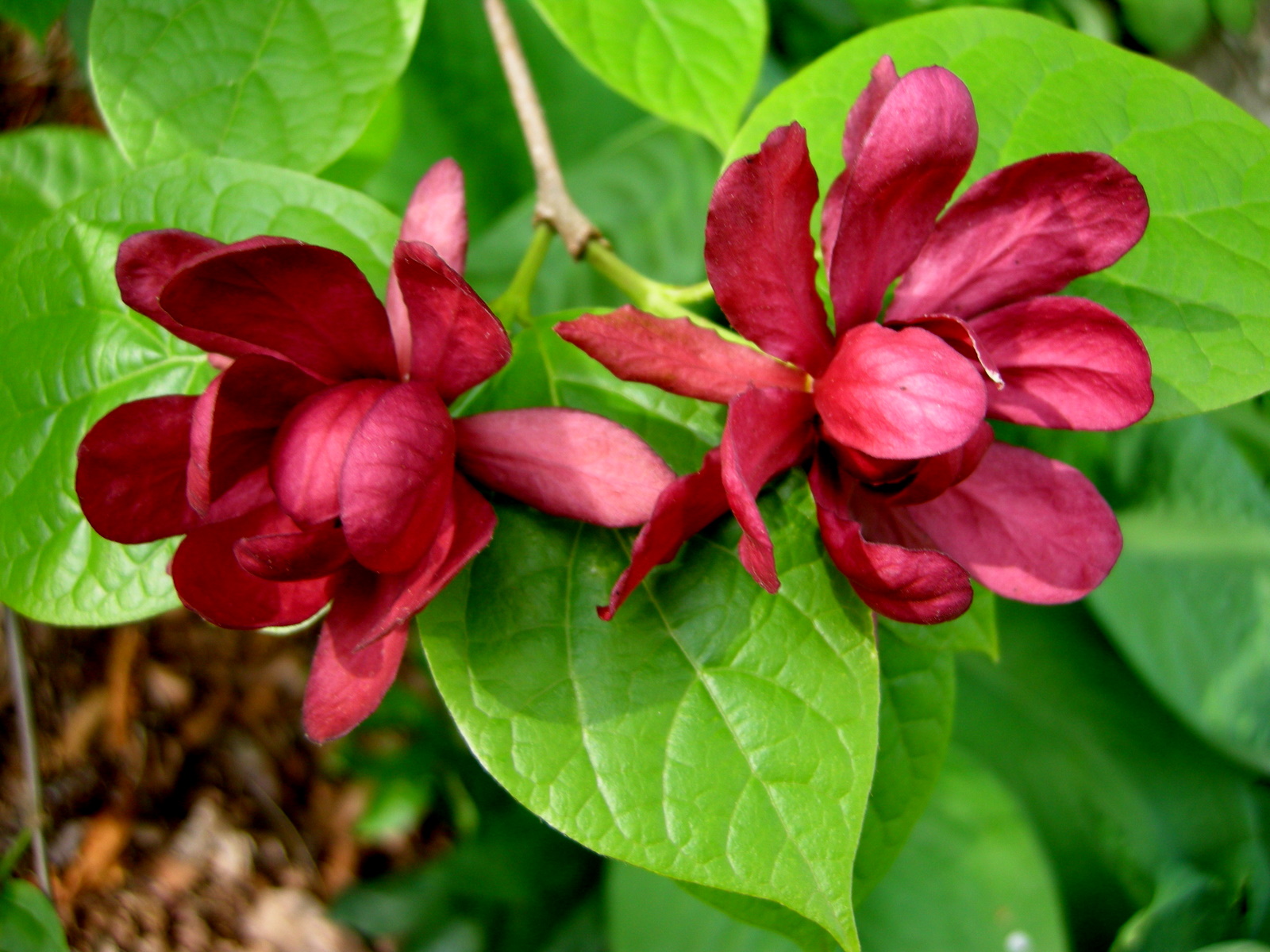
Calycanthus raulstonii ‘Hartlage Wine’ (Native Hybrid Sweetshrub) at Carolyn’s Shade Gardens

For years, my customers have been asking for woody plants for shade—trees, shrubs, and vines—in addition to the perennials I sell.  Last year I found a wholesale woody plant nursery with the quality and selection I needed to be able to offer woody plants at Carolyn’s Shade Gardens.   I put together two offerings in 2010 and have just sent out my first 2011 list.  To view the catalogue, click here.   However, I thought my blog readers who are not customers might be interested in learning about the woody plants that I would recommend they add to their shade gardens.  And doing an article allows me to add more information and explain why I chose the plants I included so customers might be interested also.

Included in my offering are one tree, three camellias, four other shrubs, and one vine.  Of the nine plants I have chosen, five are native.  Please read my article My Thanksgiving Oak Forest to see why I think planting native plants is crucial to our environment.  My article New Native Shade Perennials for 2011 explains why I think native cultivars and hybrids are valuable native plants.

Six of the plants I have chosen are evergreen or semi-evergreen, and four bloom in the off season: fall, winter, or very early spring.   This reflects  my desire to see gardeners expand their gardens’ season beyond spring and summer to become a year round paradise for them to enjoy.  With that introduction, here are the plants I am highlighting:

Magnolia grandiflora ‘Bracken’s Brown Beauty’ (Native Southern Magnolia)

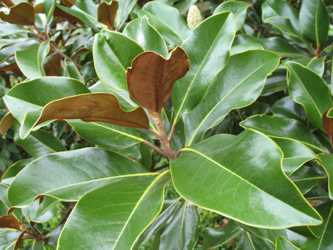
‘Bracken’s Brown Beauty’ is an extremely cold hardy southern magnolia tree perfect for our area (southeastern Pennsylvania, U.S.).  It is said to be even hardier than ‘Edith Bogue’, which I have in my garden and came through our difficult winter in pristine condition.  It grows to 35’ tall at maturity and thrives in sun to partial shade.  The huge fragrant white flowers are beautifully displayed against the glossy dark evergreen leaves in June and July.  The rusty undersides of the leaves are particularly ornamental in this cultivar: I couldn’t take my eyes off it when I saw it on a local garden tour.

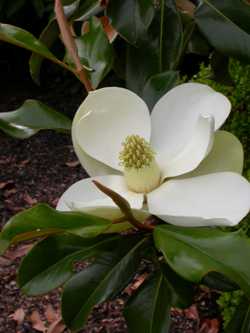
The flower of ‘Bracken’s Brown Beauty’ native southern magnolia

Southern magnolia is native from Maryland south.  ‘Bracken’s Brown Beauty’ is a Pennsylvania Horticultural Society Gold Medal Plant, click  here to see why, and a Missouri Botanical Garden Plant of Merit (photos courtesy of the Missouri Botanical Garden PlantFinder), click here for details.

Camellia x ‘April Blush’ (Spring-blooming Hardy Camellia)

I choose three hardy camellias, all with different characteristics, for their off season flowers and evergreen leaves.  Camellia x ‘April Blush’ is a spring-blooming hardy camellia with gorgeous plump buds opening to semi-double blush-pink flowers in April and May.  It has glossy dark evergreen leaves, which come through the winter unscathed.  It is 5’ tall and grows in part to full shade.  This is the cultivar that I have in my garden, and it is fully cold hardy in our area.

‘April Blush’ spring-blooming hardy camellia coming into bloom in my garden

Camellia x ‘Spring’s Promise’ (Spring-blooming Hardy Camellia)

Camellia x ‘Spring’s Promise’ is a very early spring-blooming hardy camellia that also flowers in the fall for two seasons of interest.  Its single coral-red flowers appear in  March and April displayed beautifully by its glossy dark evergreen leaves.  It was in full bloom in Charles Cresson’s garden during our March 3 winter interest seminar, see Winter Interest Seminars for an additional photo, and Charles highly recommends it.  It is 5’ tall, grows in part to full shade, and is fully hardy in our area.

Camellia x ‘Winter’s Snowman’ (Fall-blooming Hardy Camellia)

Camellia x ‘Winter’s Snowman’ is a fall-blooming hardy camellia.  Its semi-double, anemone form white flowers glow when displayed against its glossy evergreen leaves in November and December.  ‘Winter’s Snowman’ is a vigorous plant with a narrow upright habit.  It grows to 6’ tall, in part to full shade and is fully hardy in our area.  This is another of Charles Cresson’s favorites.

‘Winter’s Snowman’ in the Cresson garden last fall

For more information on fall-blooming hardy camellias, click here to read my article Fall-blooming Camellias Part 1, and here to read Fall-blooming Camellias Part 2.


Calycanthus raulstonii ‘Hartlage Wine’ (Native Hybrid Sweetshrub)

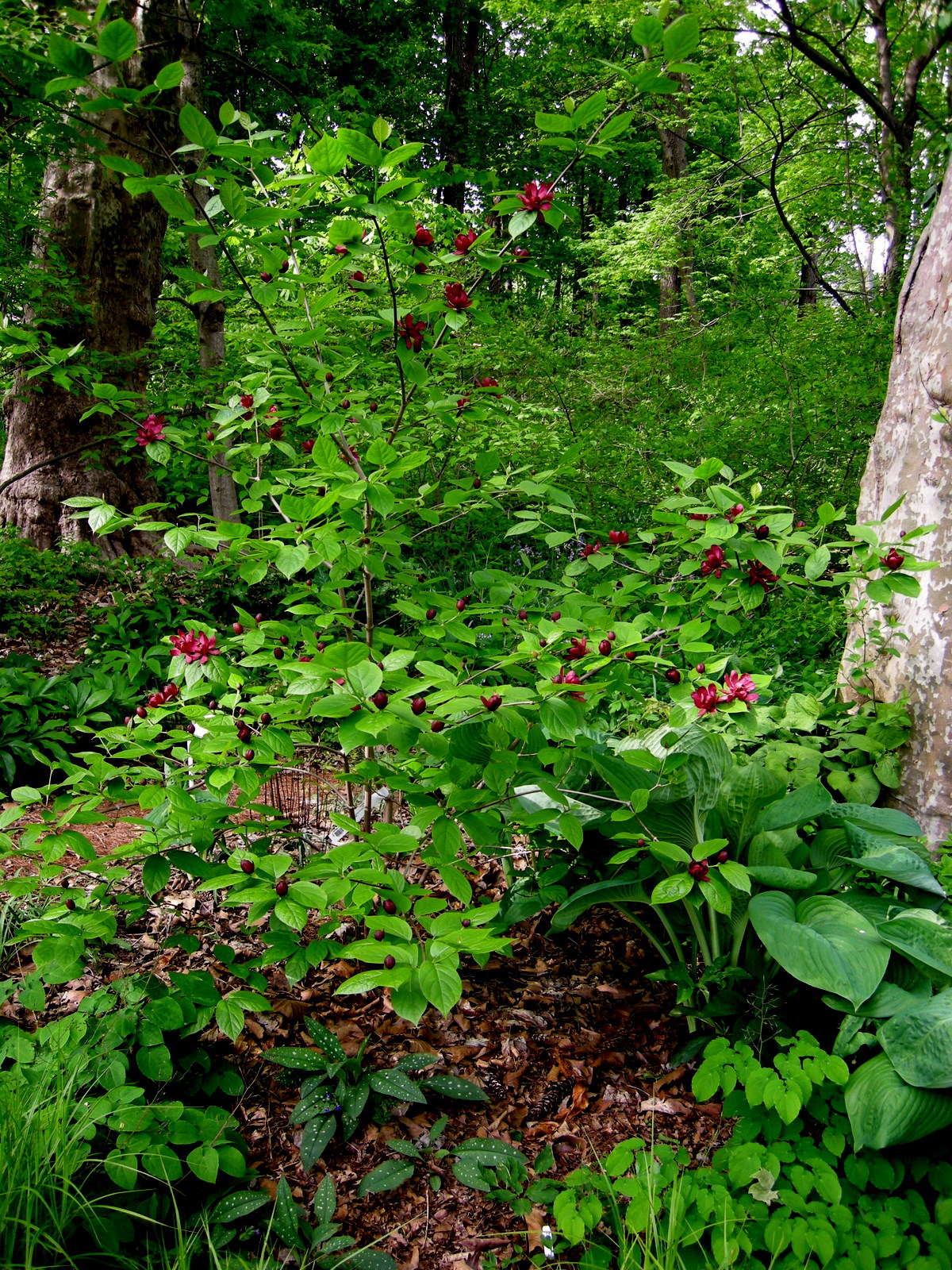
I have chosen four other shrubs for their outstanding ornamental qualities.  Calycanthus raulstonii ‘Hartlage Wine’ is a hybrid between our eastern U.S. native and an Asian sweetshrub and was introduced by the J.C. Raulston Arboretum in North Carolina.  It has breathtaking large wine-red flowers (see photos at the top and above) set off beautifully by the smooth bright green leaves with yellow fall color.   I placed this shrub at the entrance to my woodland garden and my customers are entranced by it as am I.   It grows to 8’ tall and 5’ wide in part to full shade.

‘Hartlage Wine’ native hybrid sweetshrub at the entrance to my woodland garden with pulmonaria, epimedium, and blue hosta

Daphne odora ‘Aureomarginata’ (Variegated Winter Daphne)

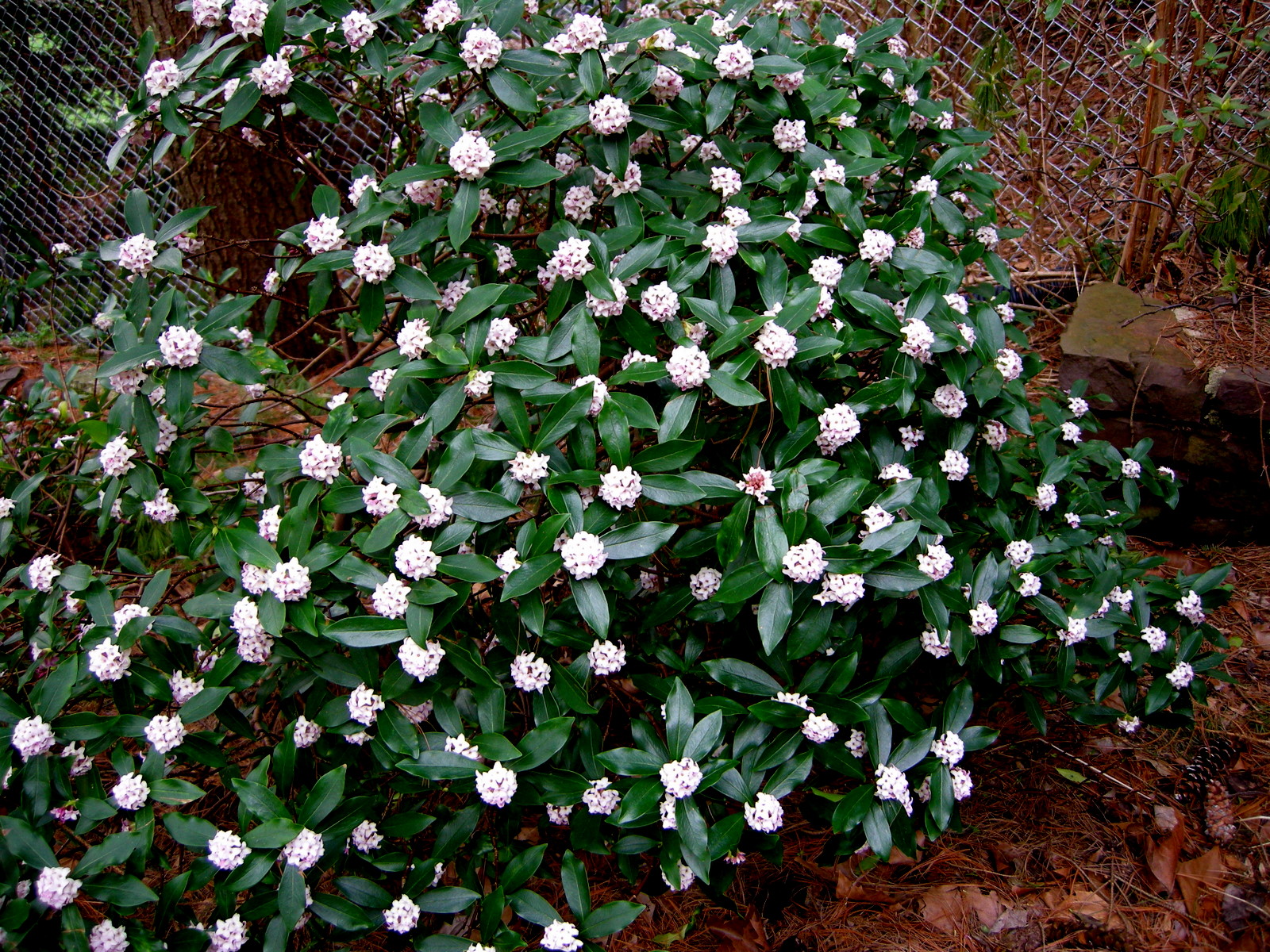
Daphne odora ‘Aureomarginata’, variegated winter daphne, has rose-pink buds opening to extremely fragrant clusters of pale pink flowers in early spring.  Its fine-textured, evergreen leaves are delicately edged in cream.  It grows to 4’ tall and wide in part to full shade.  It should be protected from winter sun and wind by planting it in a sheltered southeastern-facing location.  This is the daphne in my terrace garden that my customers have been asking about for almost 20 years because it perfumes that whole nursery when it blooms!  I am re-planting this year because my very large specimens were killed by falling white pine branches last winter.  Daphnes do not like to be disturbed once planted.

Winter daphne in my garden before the pine branches fell

Fothergilla gardenii (Native Dwarf Fothergilla)

Fothergilla gardenii, native dwarf fothergilla, has fragrant white bottlebrush flowers in April and May.  Its blue-green leaves turn lovely shades of yellow, orange, and red in the fall (see photo below).  It grows to 3’ tall and wide, making it an excellent shrub for small gardens and spaces.  It will grow in any light conditions from full sun to full shade and is wet site tolerant.  It is native to the southeastern US.  Missouri Botanical Garden has chosen dwarf fothergilla as a Plant of Merit (photos courtesy Missouri Botanical Garden PlantFinder), for details click here.

Fall color of native dwarf fothergilla


Hydrangea quercifolia ‘Pee Wee’ (Native Dwarf Oakleaf Hydrangea) photo courtesy of the Missouri Botanical Garden PlantFinder

Hydrangea quercifolia ‘Pee Wee’ produces large, long-lasting, upright pyramids of white flowers in June and July, changing to pink as they age and remaining ornamental into winter.  It is prized for its bold-textured leaves with burgundy-red fall color and cinnamon-colored exfoliating bark.  Walnut tolerant and native to the southeastern US, at 3′ tall it is the perfect native shrub for smaller spaces and smaller gardens.  It grows in any light from full sun to full shade.  If I could have only one shrub for shade, oakleaf hydrangea would be it.

Native dwarf oakleaf hydrangea with native ginger in the woodland at Carolyn’s Shade Gardens

The full size oakleaf hydrangea is a Pennsylvania Horticultural Society Gold Medal Plant, for details click here.

Gelsemium sempervirens ‘Margarita’ (Native Carolina Jessamine) photos above and below courtesy of the Missouri Botanical Garden PlantFinder

Gelsemium sempervirens ‘Margarita’ blooms with copious fragrant, bright yellow, trumpet-shaped flowers in April and May.  The lustrous, dark green leaves are semi-evergreen and provide winter interest.  It is native to the southeastern U.S. and reaches 15’ at maturity in full sun to part shade.  I grow this vine on a lattice trellis along my fence line in part shade and its beauty never fails to provoke comments.  It is a Pennsylvania Horticultural Society Gold Medal Plant, for details click here.

Native Carolina jessamine showing off its abundance of fragrant yellow flowers

I hope I have convinced you that these plants would be excellent additions to your shade garden.  If you are a customer, you have until April 7 to place an order by clicking here.  If not, now you have some plants to ask for at your local independent nursery.

Please leave a comment/reply telling me what other woody plants for shade I might want to offer in the future and describing your experience with them.

Carolyn

Notes: Every word that appears in orange on my blog is a link that you can click for more information.  If you want to return to my blog’s homepage to access the sidebar information (catalogues, previous articles, etc.), click here.

Nursery Happenings: My next nursery event is Bulb and Native Wildflower Day on Saturday, April 9, from 10 am to 2 pm.  My next open house sale features early spring-blooming shade plants and is Saturday, April 16, from 10 am to 3 pm.  For details and directions, click here.

Evergreen Ferns for Shade & Stylish Blogger Award

Posted in evergreen, Shade Gardening, Shade Perennials with tags , , , , , , , , , , on February 24, 2011 by Carolyn @ Carolyns Shade Gardens

Carolyn’s Shade Gardens is a retail nursery located in Bryn Mawr, PA, specializing in showy, colorful, and unusual plants for shade.  The only plants that we ship are snowdrops and miniature hostas.  For catalogues and announcements of events, please send your full name, location, and phone number (for back up use only) to carolyn@carolynsshadegardens.com.  Click here to get to the home page of our website for catalogues and information about our nursery and to subscribe to our blog.

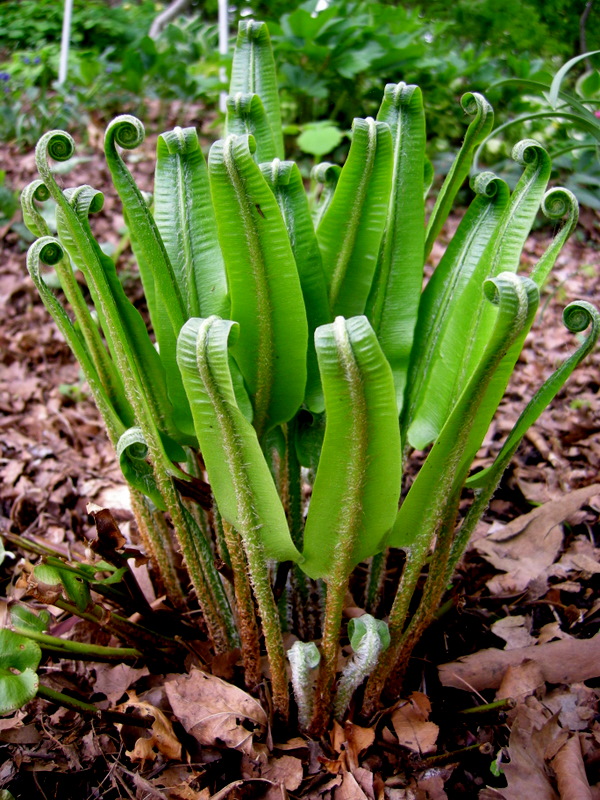
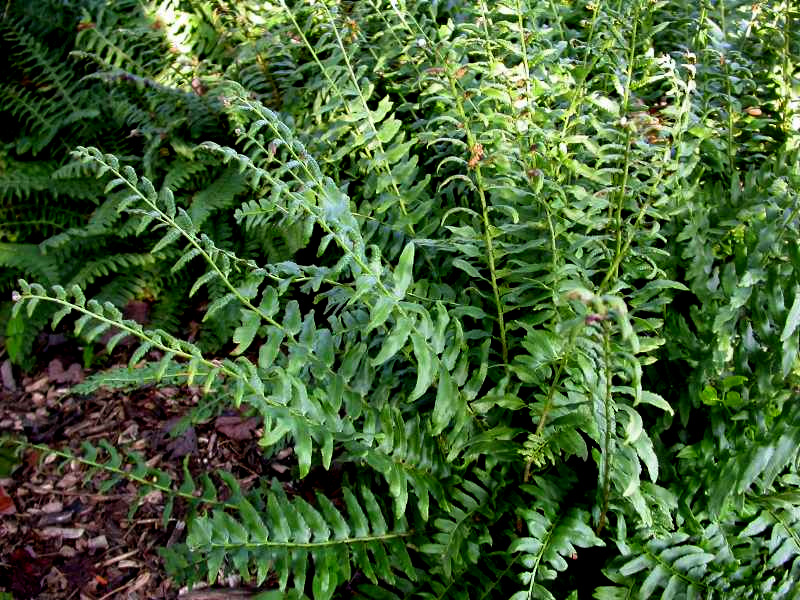
US. native hart’s-tongue fern, Phyllitis scolopendrium, is especially beautiful in my garden in the spring as it unfurls, April 2010

Spring is in the wind here today with unseasonably warm temperatures of almost 70 degrees F (21 C).  The ten day forecast shows more seasonable temperatures with highs in the mid-forties.  Although spring is definitely on the way (it snowed and went down to 10 degrees since I wrote this!), the beauty of snow has been replaced with the grays and browns of late winter, not a look I treasure.  That makes any plants that liven up the gardens very important at this time of year, and evergreen ferns do just that.  Five of my favorites are profiled below.

Hart’s-tongue fern is also very beautiful in the fall, mid-November 2010 with Christmas rose and pulmonaria

Hart’s-tongue fern, Phyllitis scolopendrium (zones 5 to 9), may be my favorite all time fern (today anyway).  It has a very unique look that is absolutely magical when it unfurls in the spring (photo at top), and it maintains its good looks until it disappears under the snow (photo above).  Even now it is quite presentable after our snowy and icy winter with only slight browning.

Although I call it a US native, hart’s tongue fern is actually indigenous to Europe, Asia, and North America, including the mid-Atlantic.  However, according to John Mickel in Ferns for American Gardens, the US variety does poorly in cultivation, and all cultivated material is from the European variety.  It is a clump-forming fern, growing 8 to 16″ tall with shiny, leathery fronds.  It is easy to grow but suffers if over-watered and must be well-drained.  I grow mine in part shade on a slope with plenty of organic matter.  In the wild it is limestone-loving, but I haven’t found this to be necessary in my garden.


Japanese holly fern, Cyrtomium falcatum, makes quite a statement in my mid-November garden

Japanese holly fern, Cyrtomium falcatum (zones 6 to 10), is another favorite of mine.  Individual plants grown as a specimen can be up to 2 feet tall and 3 feet across making quite a bold statement in the garden.  It grows well in the deep shade of my woodland garden where there is more construction rubble than soil as well as on my partly shaded but very open back slope.  Right now it is serving as a backdrop for the giant snowdrops, Galanthus elwesii, that are emerging between its fronds, which have been flattened by snow.

Japanese holly fern is native to Hawaii (do we call it a US native?), southern Africa, and across southern Asia.  Although it is uncommon in the mid-Atlantic, it is quite commonly grown in the southern parts of the US and has naturalized in some areas.  It is clump-forming with an elegant, vase-like habit and 4 to 7″ wide, glossy dark green fronds with toothed pinnae that resemble holly leaves.  It prefers good drainage and organic soil in part to full shade.


U.S. native deer fern, Blechnum spicant, also shines in my mid-November garden

Deer fern, Blechnum spicant (zones 5 to 8), was new to my garden in spring of 2010 so, despite its moist native habitat, it survived  this summer’s record-breaking heat and drought.  The unusual texture provided by its linear segments is a great addition to the border in front of my fall-blooming camellias.  It is in an eastern-facing location with high shade.  Right now, though flattened by the snow and ice, the fronds look almost the same as in the photo above despite our hard winter.

Deer fern is native to moist coniferous forests in the US Pacific Northwest and Europe.  Its two types of fronds are very distinct.  The sterile fronds (pictured above) are 8 to 20″ long, evergreen, and prostrate, while the fountain-like fertile fronds, which emerge in the spring, are 16 to 24″ long,  deciduous, and erect.  It puts on quite a show in the spring.  Deer fern grows in part to full shade in acid soil enriched with organic matter and spreads slowly by short creeping rhizomes.


Tassel fern, Polystichum polyblepharum, growing in dry shade at the base of my Kentucky coffee tree in mid-November

Tassel fern, Polystichum polyblepharum (zones 5 to 8), is a very trouble-free, evergreen fern that I have grown for years.  I found that it does not do well in full shade, but thrives in high shade with dappled light.  It is absolutely gorgeous in the spring, when the reddish, hairy new fronds unfurl  (photo below) and still looks spectacular at the end of a hot dry summer (photo above).  Right now it is flat to the ground exposing its fleecy stems even more.

The bristly new fronds of tassel fern unfurl, photo courtesy of the Missouri Botanical Garden PlantFinder

Tassel fern is native to Japan and southern Korea.  According to Mickel, its species name means “many eyelashes” referring to its bristly, pubescent stems, which are really quite eye-catching even when fully emerged.  Its lustrous dark green fronds form an elegant, vase-like crown 2 feet tall and 2 feet wide.  It makes an excellent specimen.  Grow it in part shade in a well-drained, humus-rich site.


U.S. native Christmas fern, Polystichum acrostichoides, is ornamental 365 days a year in my garden, photo courtesy of the Missouri Botanical Garden PlantFinder

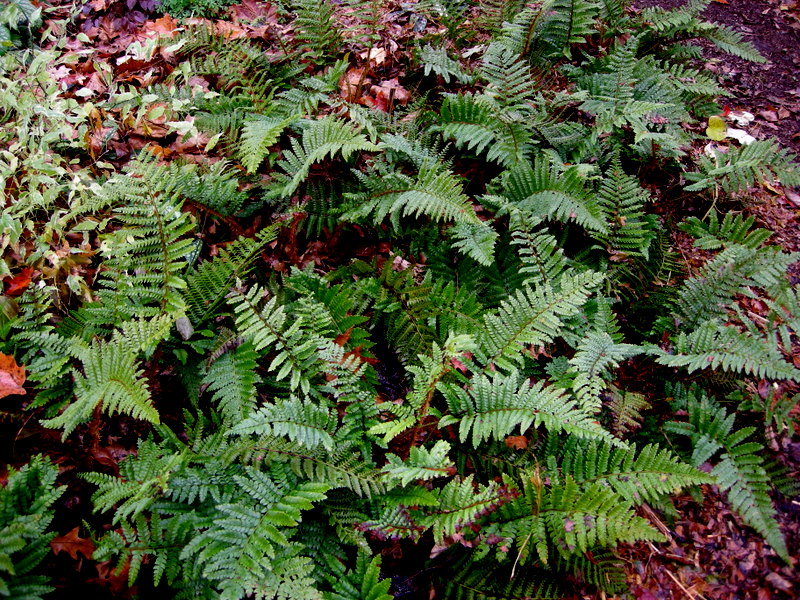
Christmas fern, Polystichum acrostichoides (zones 3 to 9), is without a doubt the best evergreen fern for mid-Atlantic US gardens.  It grows well everywhere in my garden from my deeply shaded woodland to more sunny, rocky slopes.  Right now, although not as upright as the photo above, it is the most presentable evergreen fern after our long, hard winter.

Christmas fern growing an a rocky outcropping in Great Smoky Mountain National Park, Tennessee

Christmas fern is native to the whole eastern half of North America, including all of Pennsylvania.  According to Mickel, its common name arose because it was used by early settlers as Christmas decorations.  The lance-shaped, dark green, leathery fronds provide excellent winter interest.  The two foot tall, fountain-like clumps increase in size over time, forming multiple crowns and making it easy to divide.  Christmas fern is very easy to grow in part shade to full shade and in moist to dry soil and can be used on slopes to prevent erosion.

I hope I have convinced you to go outside and investigate where you can add some evergreen ferns for year round interest.

Please let me know in a comment/reply what evergreen ferns you grow in your garden.

Carolyn


Notes: John Mickel is Curator of Ferns for the New York Botanical Gardens.  His book, Ferns for American Gardens, is an excellent resource discussing over 400 ferns with hundreds of photos.  I have added it to my sidebar under Books so you can always find it.

Every word that appears in orange on my blog is a link that you can click for more information.  If you want to return to my blog’s homepage to access the sidebar information (catalogues, previous articles, etc.), just click here.

Nursery Happenings: I am currently accepting orders for snowdrops, including  mail orders.  For the catalogue and order information, click here.  I am taking reservations for my Hellebore Seminars for the Totally Obsessed.  For the brochure and registration information, click here.  I have three spaces left for the March 6 session of Charles Cresson’s Snowdrops and Other Winter Interest Plants Seminar.  For the brochure and registration information, click here.

I have recently been honored with the Stylish Blogger Award by six different blogs, and I want to thank them for the accolade.  My friends would really laugh to hear the word stylish applied to me as a person, but I am glad I am making up for that with my blog.  I am not following the award rules, but instead letting you know who gave me the award in hopes that you will visit their blogs.  Here are the links and some information to entice you to visit them:

Deb’s Garden: Deb shares her gardening experiences on 3.5 partially wooded acres in Helena, Alabama.

Island Threads: Frances battles the elements on the northern tip of an island off the northwest coast of Scotland.

Orchid de Dangau: Makirimi collects and grows orchids in Malaysia.

Southern Meadows: Karin writes about nature and gardening in northeastern Georgia.

Sweet Bean Gardening: Hanni is developing a cottage garden in Indiana with her two young daughters.

The Suburban Gardener: Lily specializes in lilies and hostas in her shady suburban Chicago, Illinois, garden.


Flowering Wintergreen Ground Covers for Shade

Posted in evergreen, groundcover, Shade Perennials with tags , , , , , , , , on January 1, 2011 by Carolyn @ Carolyns Shade Gardens

Carolyn’s Shade Gardens is a retail nursery located in Bryn Mawr, PA, specializing in showy, colorful, and unusual plants for shade.  The only plants that we ship are snowdrops and miniature hostas.  For catalogues and announcements of events, please send your full name, location, and phone number (for back up use only) to carolyn@carolynsshadegardens.com.  Click here to get to the home page of our website for catalogues and information about our nursery and to subscribe to our blog.

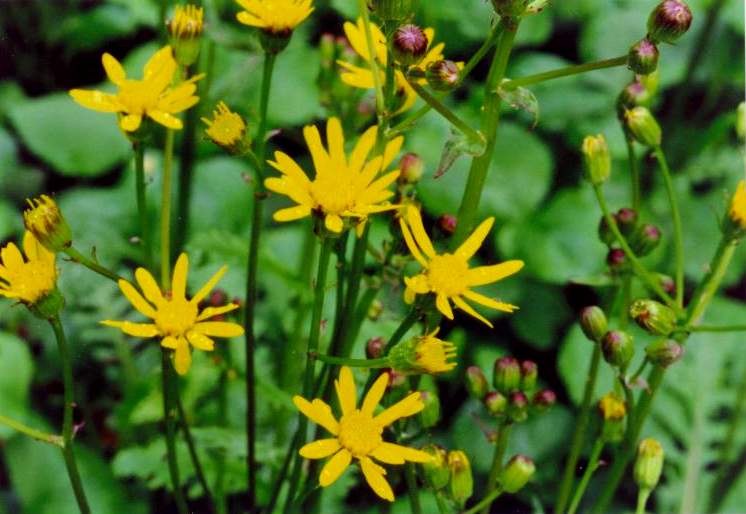
golden groundsel as groundcover in my woodland in spring

Here in the mid-Atlantic (US), we go through long periods of winter weather that are just plain cold without the compensation or covering of snow.  Any patches of exposed ground look barren and downright ugly.  That is why, during this time of year, I treasure any little patch of green, any ground cover that is presentable through the winter.  Yes, I have the usual evergreen  triumvirate of vinca, ivy, and pachysandra.  I can even find good things to say about each of them.  But I want more: native plants, deer resistance, tolerance of dry shade, fragrance, abundant flowers, drought tolerance, and beautiful foliage.  All four of the shady ground covers described below have a majority of these desirable characteristics.

fragrant flowers of native golden groundsel

Our native golden groundsel, Senecio aureus, has to be my favorite all time ground cover.  It spreads as fast and aggressively as any of the reigning three.  It is not a plant to be mingled into your perennial beds: it is a plant for the bare patch—wet, dry, sunny, shady, infertile, clay—where nothing else grows.  Put it behind the garage, around the base of a tree with surface roots, along the bottom of a fence, or in your “hell strip” by the road.  You will be rewarded with evergreen leaves through winter and an abundance of  fragrant flowers suitable for arrangements.

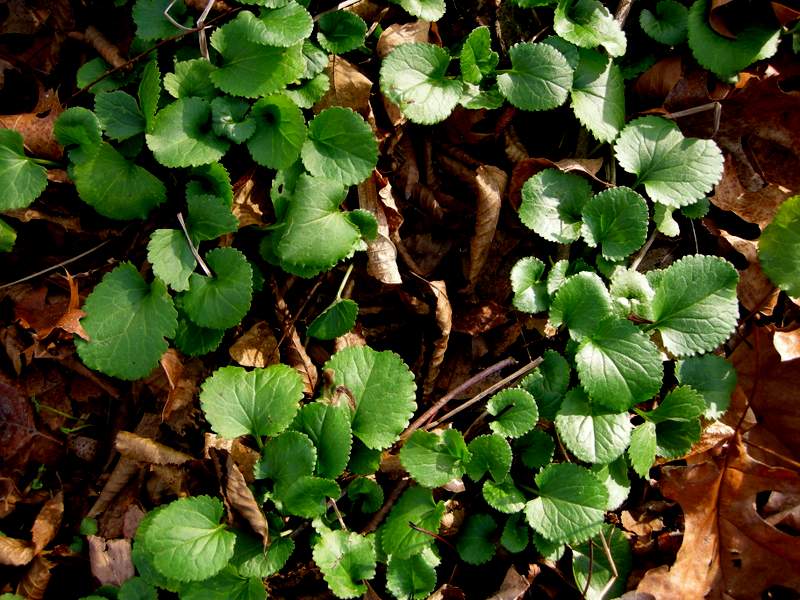
winter foliage of golden groundsel

Golden groundsel is native to meadows and woods of the eastern half of the US.  It quickly creeps to form large, 6″ tall patches of wintergreen leaves even in full dry shade.  In spring, buds emerge bright maroon-purple opening to cheery yellow, 2′ tall fragrant flowers in May.  The new leaves, which appear after the flowers, are large and round, providing a bold texture (see photo at top).  My deer have never touched it.

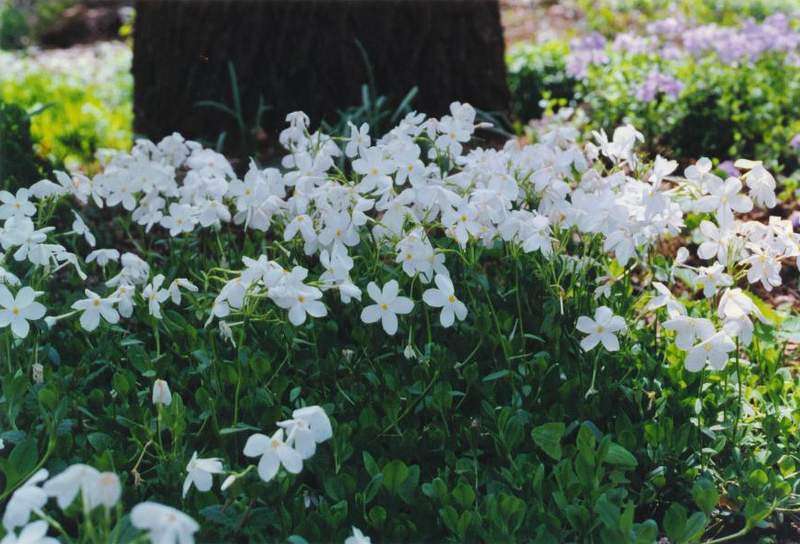
creeping phlox ‘Bruce’s White’ in my woodland in spring

The other native I highly recommend for wintergreen shady ground cover is creeping phlox, Phlox stolonifera.  Not as aggressive as golden groundsel, creeping phlox can be mingled in your perennial beds or used alone under shrubs and trees.  It moves at a medium rate to fill in around surrounding plants without overwhelming them.  Then, from March into May, it is covered with blue, pink, white, or purple flowers.

creeping phlox with foamflower (Longwood Gardens)

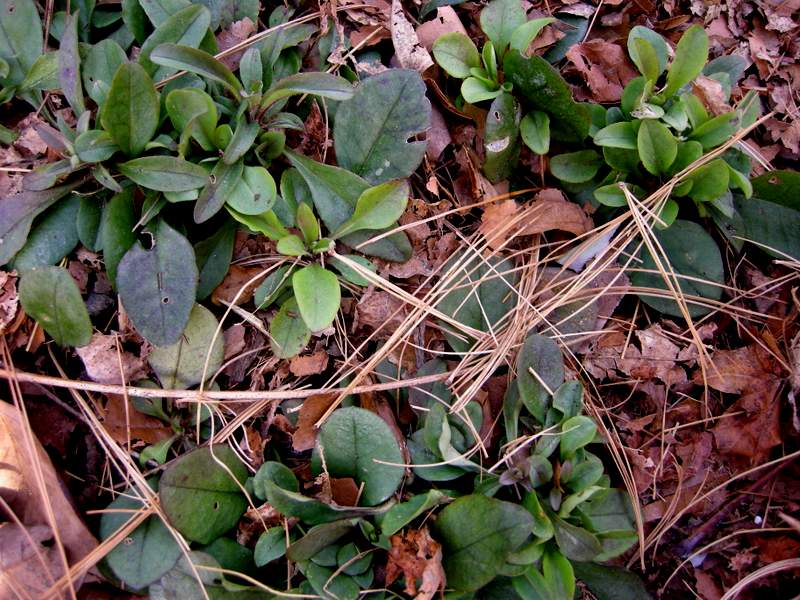
winter foliage of creeping phlox

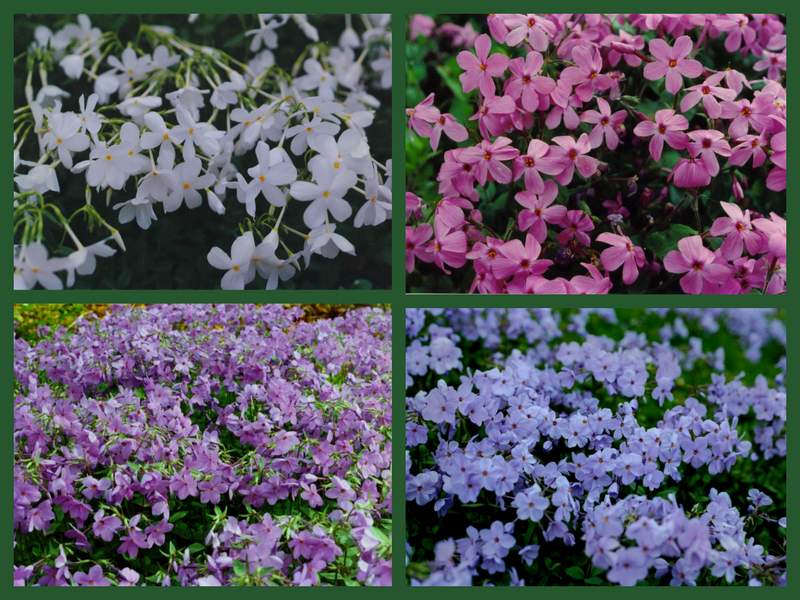
Creeping phlox is native to wooded areas of the eastern US.  The 2 to 3″ tall mat-forming leaves are completely covered by 8″ tall flowers in spring.  It is very tolerant of soil conditions and, once established,  grows well in full dry shade.  My deer leave it alone.  As an added benefit, it comes in white, ‘Bruce’s White’ (photo above), pink, ‘Home Fires’ or ‘Pink Ridge’, pale lavender-blue, ‘Blue Ridge’, or purple, ‘Sherwood Purple’ or ‘Fran’s Purple’.  The purple cultivars are the most vigorous, and I think the most beautiful.

beautiful colors of creeping phlox

For a refined and elegant, truly evergreen ground cover, I recommend dwarf sweetbox, Sarcococca hookeriana var. humilis.  Technically a small shrub, dwarf sweetbox slowly creeps by means of underground stolons to form a 4′ patch over 10 years.  But it is well worth the wait—or if you are impatient, planting it close together—because in February its tiny white flowers produce the most heavenly fragrance for your winter enjoyment.  My patch perfumes my whole garden.

dwarf sweetbox in winter as ground cover under a dogwood

Dwarf sweetbox is native to the western Himalayas in China.  Its stems grow to 18″ with narrow, glossy evergreen leaves and creamy white, extremely fragrant flowers in February in the mid-Atlantic.  It thrives in average soil and part to full shade and, once established, is tolerant of drought.  Deer do not bother it.  It tends to be pricey so I planted very small plants which periodically needed to be poked back into the ground as it roots right below the soil surface.

dwarf sweetbox flowers getting ready to bloom

The final plant that has the characteristics I want in shady wintergreen ground covers is hybrid hellebore, Helleborus x hybridus.  My customers are always asking me what to do with the multitude of seedlings produced by their hybrid hellebores, and here is the answer: move them to a place where you need ground cover.  In three years, you will have 2′ wide plants covered with huge, beautiful flowers from February to May and pristine foliage that remains green all winter—for free!  I have done this under my Kousa dogwood and throughout my woodland, and the result is spectacular.

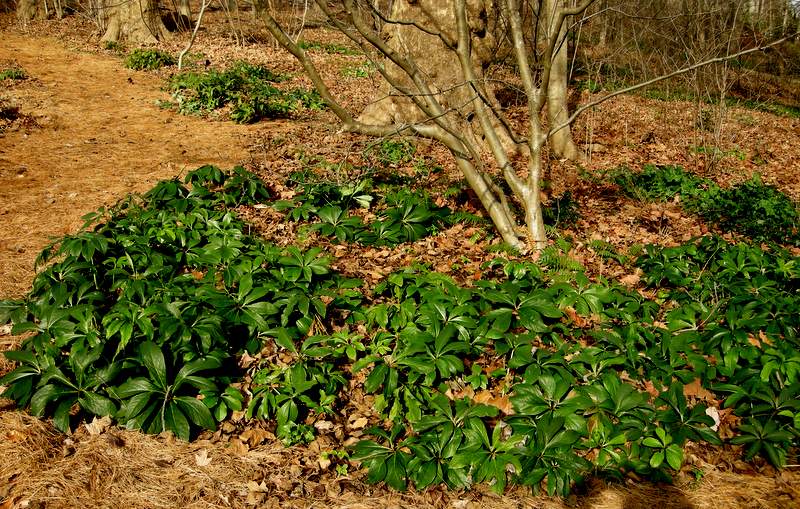
hybrid hellebores in winter as ground cover under Kousa dogwood

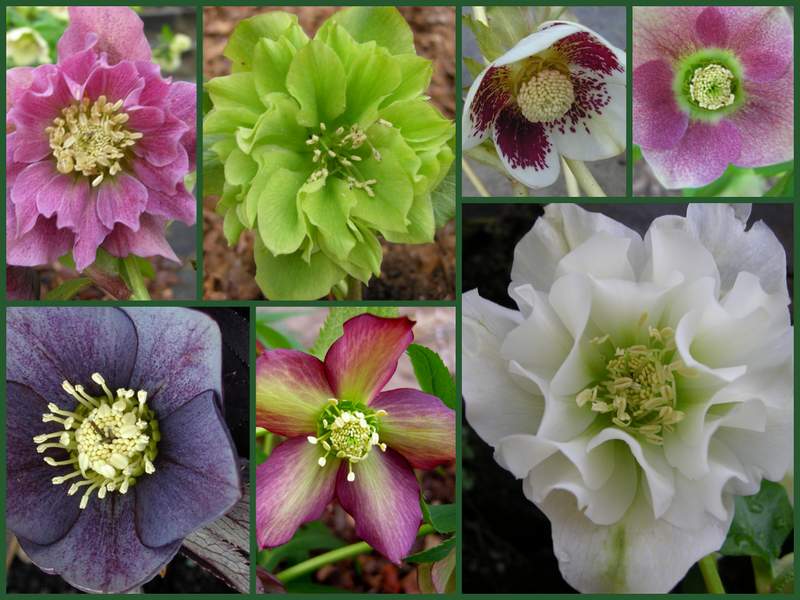
Hybrid hellebores have many different parents mainly native to eastern Europe.  Their wintergreen leaves are 2′ tall and remain ornamental until new leaves appear in spring.  Each plant produces a multitude of large, cup-shaped nodding flowers in many colors ranging from dark purple to pink to white to green with doubles, spots, and picotee edges quite common.  They grow anywhere in any soil and light conditions as long as they are well-drained.  If you want to spoil them, give them organic matter, but no supplemental water is required after they are established even in the worst drought.  They are slightly poisonous so deer do not eat them.

some of the flowers on my ground cover hybrid hellebores

Next spring when you are looking for ground covers, I hope you will consider one of the fantastic four described above.  In the meantime, leave a comment with the name of your favorite wintergreen ground cover for shade.

Carolyn

Notes: Every word that appears in orange on my blog is a link that you can click for more information.  If you want to return to my blog’s homepage to access the sidebar information (catalogues, previous articles, etc.) or to subscribe to my blog, just click here.
Fall-blooming Camellias Part 1

Posted in evergreen, Fall, Fall Color, Shade Shrubs with tags , , , , on December 8, 2010 by Carolyn @ Carolyns Shade Gardens

Carolyn’s Shade Gardens is a retail nursery located in Bryn Mawr, PA, specializing in showy, colorful, and unusual plants for shade.  The only plants that we ship are snowdrops and miniature hostas.  For catalogues and announcements of events, please send your full name, location, and phone number (for back up use only) to carolyn@carolynsshadegardens.com.  Click here to get to the home page of our website for catalogues and information about our nursery and to subscribe to our blog.
Camellia x (Unknown Ackerman Hybrid)

From 1992 to 1997, I earned two Certificates in Ornamental Plants from Longwood Gardens.  Of all the horticultural classes I have taken, these are the best, and I still use the course books as my primary plant reference.  As I worked my way through the 18 required courses from bulbs to perennials to shrubs to vines, I made a mental life list of the plants I wanted in my garden.  Some I added immediately, but others were stored away to be added in the future as I discovered them randomly at the nurseries I visited.  This year, fall-blooming hardy camellias rose to the top of the list.
Camellia oleifera at Carolyn's Shade GardensCamellia oleifera

Bark on Camellia oleifera grown as tree (Cresson garden)

Actually, my flirtation with fall-blooming camellias began about 10 years ago during a tour of the Morris Arboretum when I was given a tiny seedling of their Camellia oleifera (two photos above), which was a cutting of the original and famous ‘Lu Shan Snow’ at the U.S. National Arboretum.  It has grown into quite a large shrub with beautiful cinnamon-colored bark, glossy dark evergreen leaves, and copious single white flowers from late October into December.  It is also completely cold hardy, but not resistant to deer who dined on it voraciously.  There were to be no more camellias in my future until I freed up a space for them inside my deer fence.

fall-blooming camellia 'Winter's Darling' at Carolyn's Shade GardensCamellia x (Unknown Ackerman Hybrid)

This spring I removed several large and ailing boxwoods from a sheltered spot by my patio and simultaneously found a source for specimen camellias—it was a “perfect storm” for my venture into the fall-blooming camellia world.

fall-blooming camellia 'Elaine Lee' at Carolyn's Shade GardensCamellia x ‘Elaine Lee’

I purchased three gorgeous plants.  The first, Camellia x ‘Elaine Lee’ (photos above and bottom), has semi-double white flowers that bloom from November sporadically through January.  It has an upright form with an average growth rate to 5 feet.  The second, Camellia x ‘Winter’s Darling’ (photo below), has miniature, anemone-form deep cerise pink flowers that start at the end of October and continue through December.  It has a moderately upright habit and grows slowly to 3 to 5 feet.  The third is an Ackerman hybrid camellia (photos top, above, and bottom), but I am not sure which cultivar.  It has semi-double deep pink flowers.  All three have beautiful glossy dark evergreen leaves.

Camellia x ‘Winter’s Darling’

These hardy fall-blooming camellias, along with many others, were developed by Dr. William Ackerman at the U.S. National Arboretum by crossing C. oleifera with more ornamental forms to produce superior plants.  They are truly hardy in the mid-Atlantic, but should be sited to protect them from winter sun and our winter winds, which come from the northwest, and mulched in winter.  They prefer a well-drained site in part shade.

fall-blooming camellia 'Elaine Lee' at Carolyn's Shade GardensCamellia x ‘Elaine Lee’

For more information on Dr. Ackerman’s hybrids, read his article “Camellias for Cold Climates”.  For more information on camellias, go to the International Camellia Society’s website.  Stay tuned for my next camellia post which will highlight photographs from my recent visit to a private collection of over 60 camellias.

fall-blooming camellia 'Winter's Darling' at Carolyn's Shade GardensCamellia x (Unknown Ackerman Hybrid)

The U.S. National Arboretum, which is part of the USDA, is the source for many of the best plant breeding programs in the U.S.  It also maintains national collections of plants.  The arboretum is currently planning to deaccession its Azalea and Boxwood Collections as well as part of the Perennial Collection.  In the case of the Azalea Collection, although budget concerns were mentioned, one of the reasons given was that it attracted too many visitors. I may be wrong, but I can’t imagine this happening in the U.K.  If you would like to find out more about this amazing azalea collection and the efforts to save it, go to the Save the Azaleas website.

Carolyn

Note: Every word that appears in orange on my blog is a link that you can click for more information.