Archive for the hosta Category

Beyond Mice

Posted in container gardening, containers for shade, hosta, miniature hosta, Shade Gardening, Shade Perennials with tags , , , , , , , , , , , , on May 3, 2012 by Carolyn @ Carolyns Shade Gardens

Carolyn’s Shade Gardens is a retail nursery located in Bryn Mawr, PA, specializing in showy, colorful, and unusual plants for shade.  The only plants that we ship are snowdrops and miniature hostas.  For catalogues and announcements of events, please send your full name, location, and phone number (for back up use only) to carolyn@carolynsshadegardens.com.  Click here to get to the home page of our website for catalogues and information about our nursery and to subscribe to our blog.

.

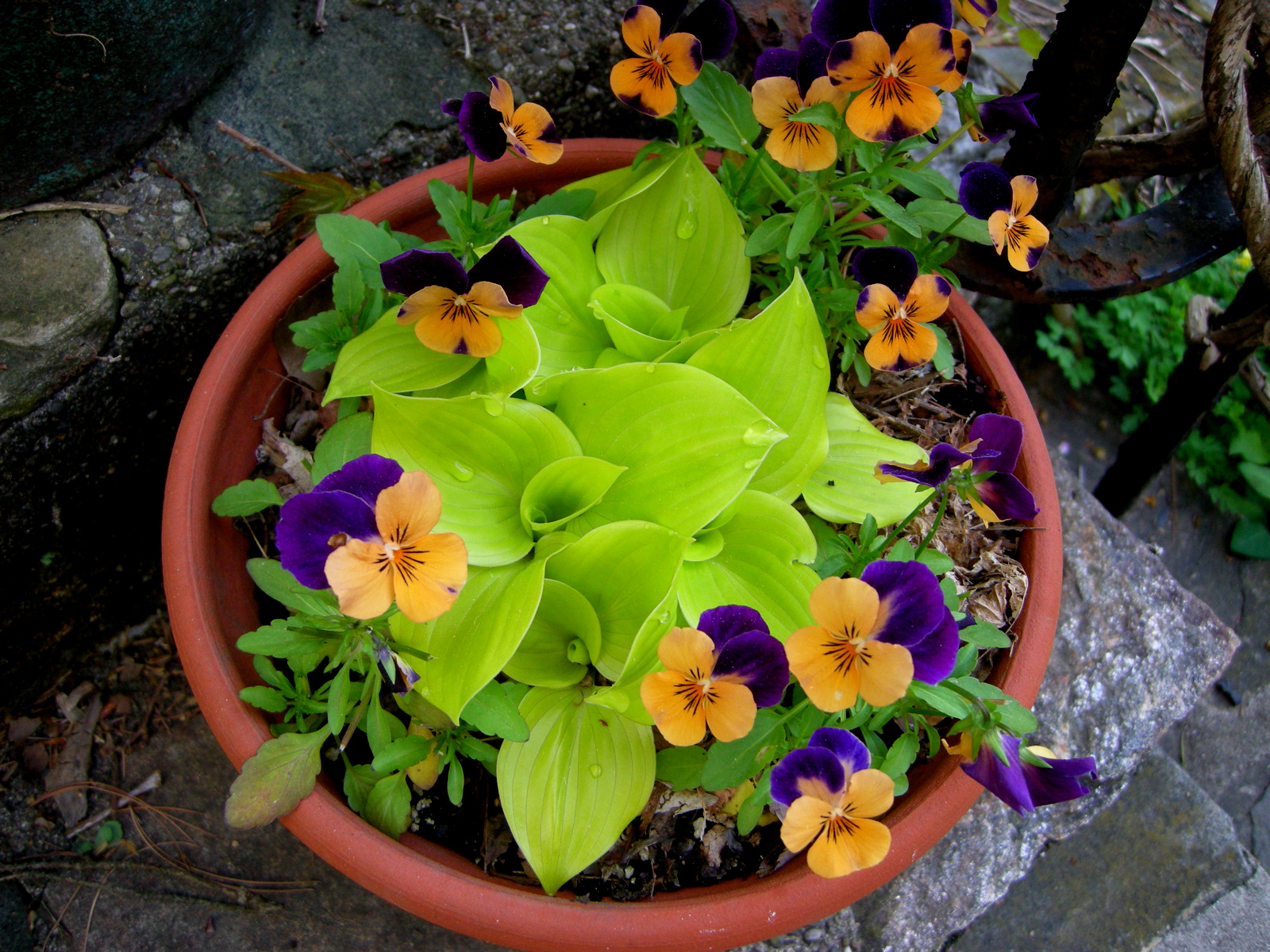
Hosta 'Crumb Cake'I have used this photo of hosta ‘Crumb Cake’ emerging in spring before, but to me it epitomizes the beauty of a miniature hosta in a container.

My nursery specializes in miniature hostas, and I have over 25 varieties available right now, both at the nursery and mail order.  My 2011 post Miniature (& Small) Hostas gives an overview of little hostas and how to use them in the garden.  In my most recent post, I LOVE Mice, I raved about the mouse ears series of hostas.  But there are many desirable miniature hostas “beyond mice” so I thought I would highlight some special favorites.


‘Cracker Crumbs’ is pictured here in my dish garden (full photo below) surrounded by a tiny gray-blue sedum.  It is a miniature hosta 5” tall by 19” wide with leaves 2 1/2” long by 1 1/2” wide.  ‘Cracker Crumbs’ has shiny gold leaves with a bright green wavy margin and pale purple flowers in July.  It quickly forms a dense and rounded mound and makes a great trough or rock garden plant.


‘Itsy Bitsy Spider’ is also pictured in my dish garden (full photo below) with the same sedum and some hens and chickens.  It is a miniature hosta 2 ½” tall by 6” wide with leaves 1 ¾” long by 1 1/4″ wide.  ‘Itsy Bitsy Spider’ has narrow leaves with thick substance and a distinct blue-gray color, and pale lavender flowers in July.  It forms a tight low mound.  This adorable and rare plant is the smallest hosta in my collection.


‘Pixie Vamp’ in my rock garden—what a great name!

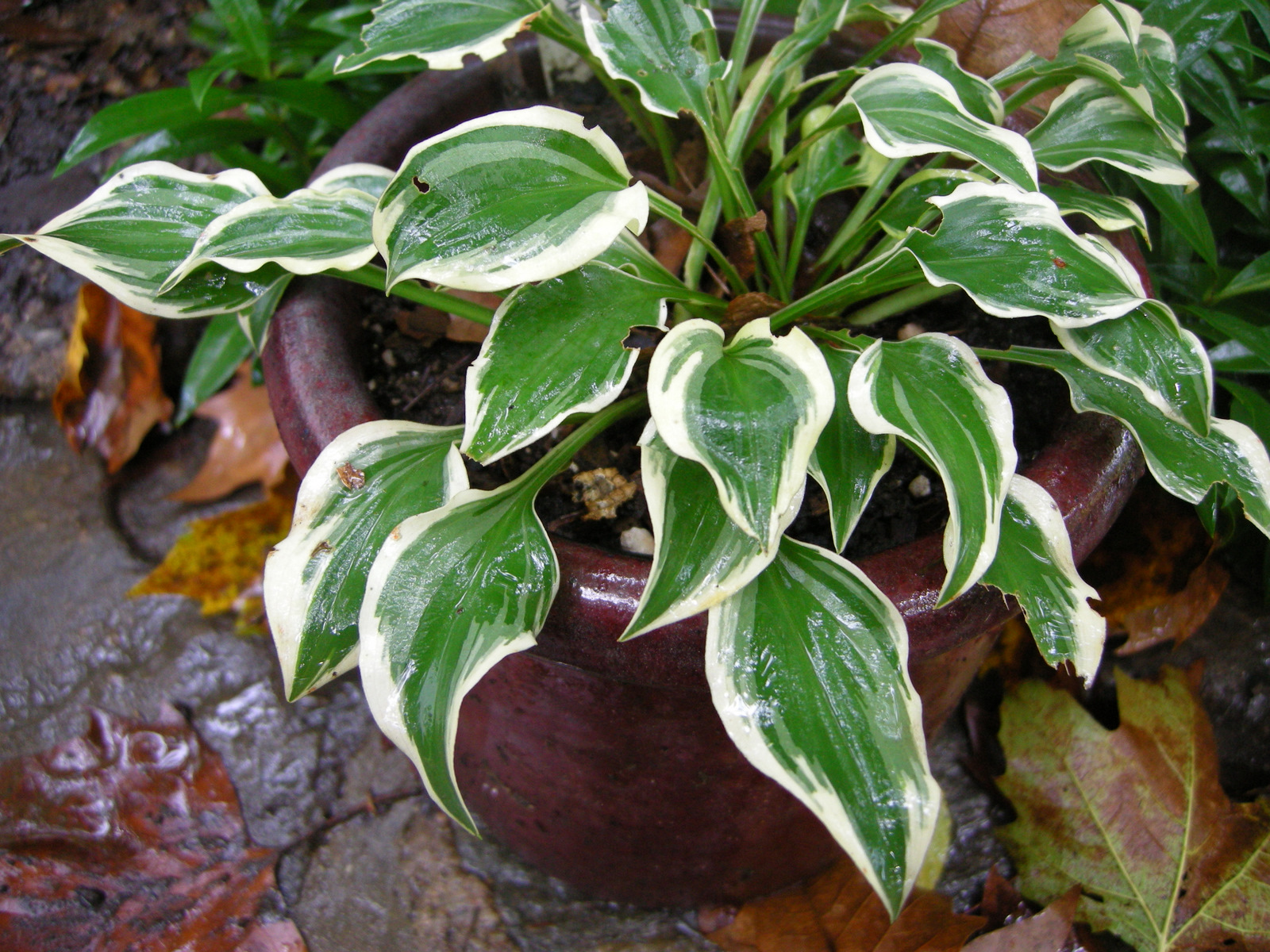
‘Pixie Vamp’ is pictured here in a container with violas.  It is a miniature hosta 7” tall by 16” wide with leaves 3 ½” long by 2 ½” wide.  ‘Pixie Vamp’ has bright green heart-shaped leaves bordered by gold in the spring changing to creamy white.  Its gorgeous mahogany colored stems hold purple flowers in July.  It is excellent in containers.


The very unusual hosta ‘Crumb Cake’ in my rock garden.


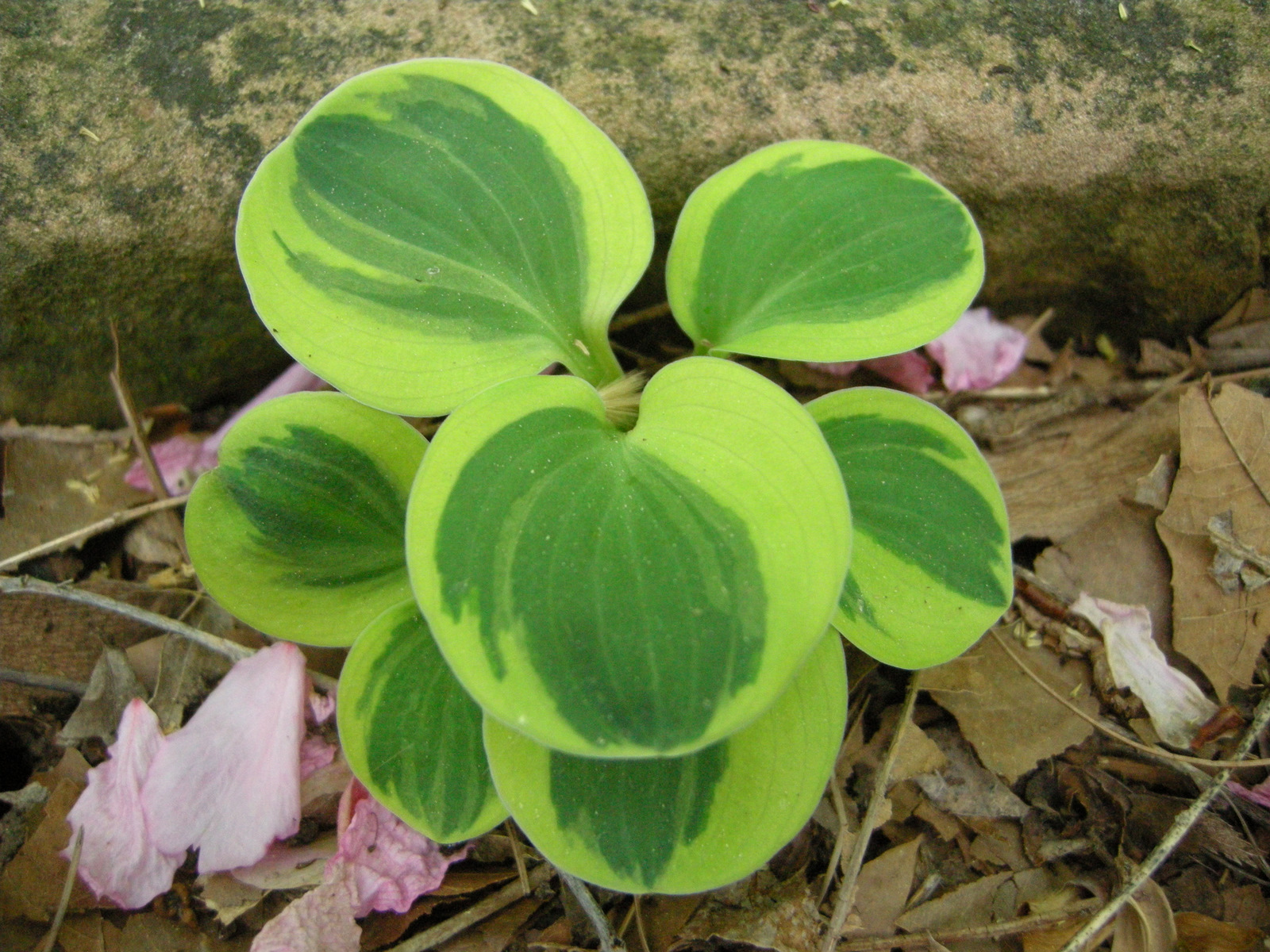
‘Crumb Cake’ is pictured here fully emerged in the same container featured in the first photo in this post.  It is a miniature hosta 5” high by 14” wide with leaves 3” long by 3” wide.  ‘Crumb Cake’ is a recent introduction with very bright honey-gold leaves, which are round with wavy margins.  It is a very unusual looking hosta forming a flat, dense, brightly colored mound.  It has elegant mahogany-colored leaf and flower stems and lavender flowers in July.  It makes an excellent container plant.


‘Alakazaam’ in my rock garden.


‘Alakazaam’ is pictured here in a container made for me by my son.  It is a miniature hosta 5″ tall by 10″ wide with leaves 6 1/2″ long and 3/4″ wide.  ‘Alakazaam’ has bright green leaves with gold ruffled margins changing to creamy white, and lavender flowers in late summer.  Its unusual spiky habit makes it stand out from the crowd no matter where you place it.


‘Surfer Girl’ is pictured here in my rock garden.  It is a miniature hosta 6” tall by 18” wide with leaves 2” long by 1” wide.  ‘Surfer Girl’ has dark green, sharply pointed, deeply rippled leaves reminiscent of ocean waves, and purple flowers in July.  It creeps to fill in a wide area and is excellent for edging the front of a border.  I use it in containers to contrast with gold-leafed minis.


‘Little Sunspot’ in my rock garden. 

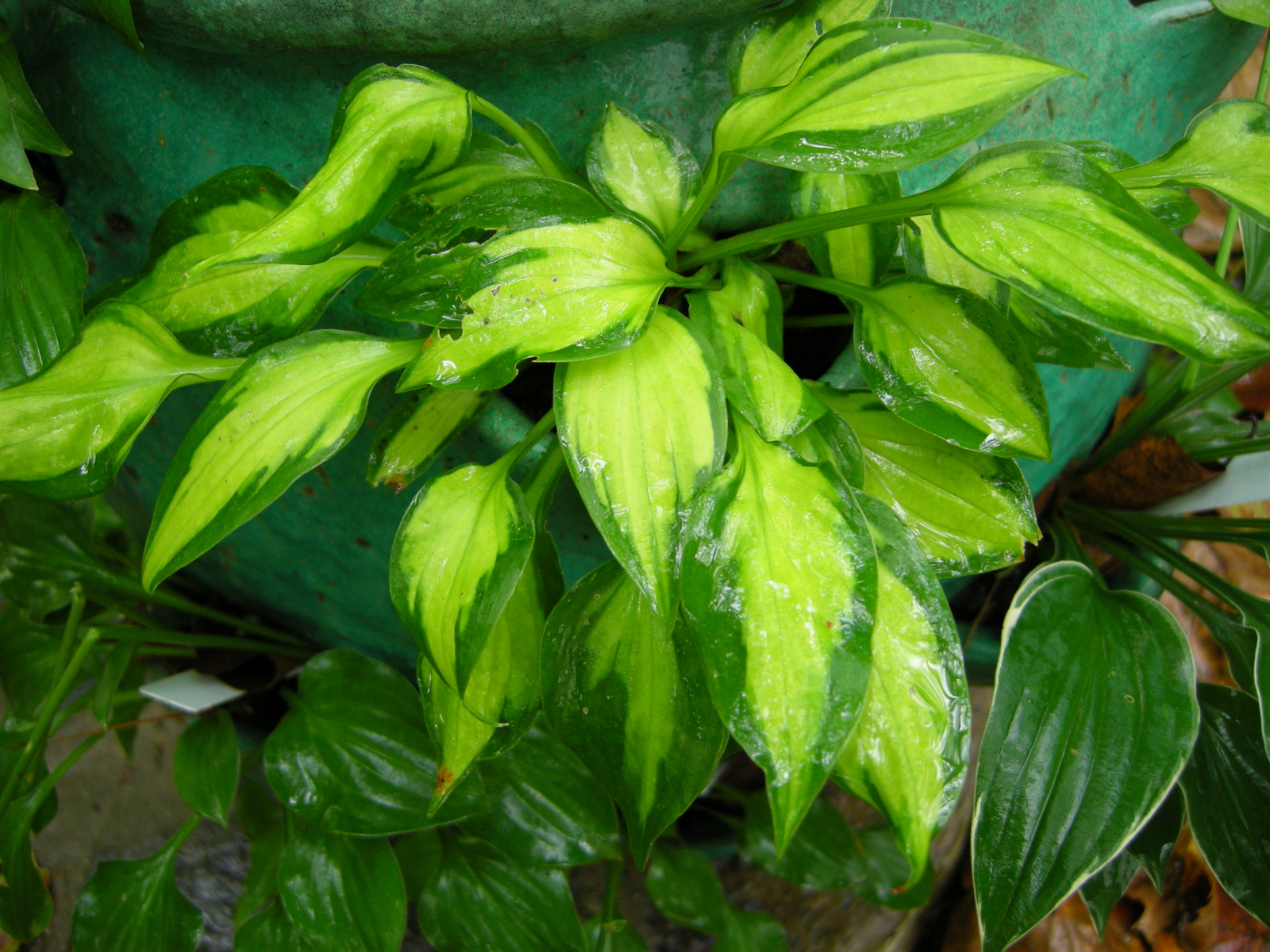
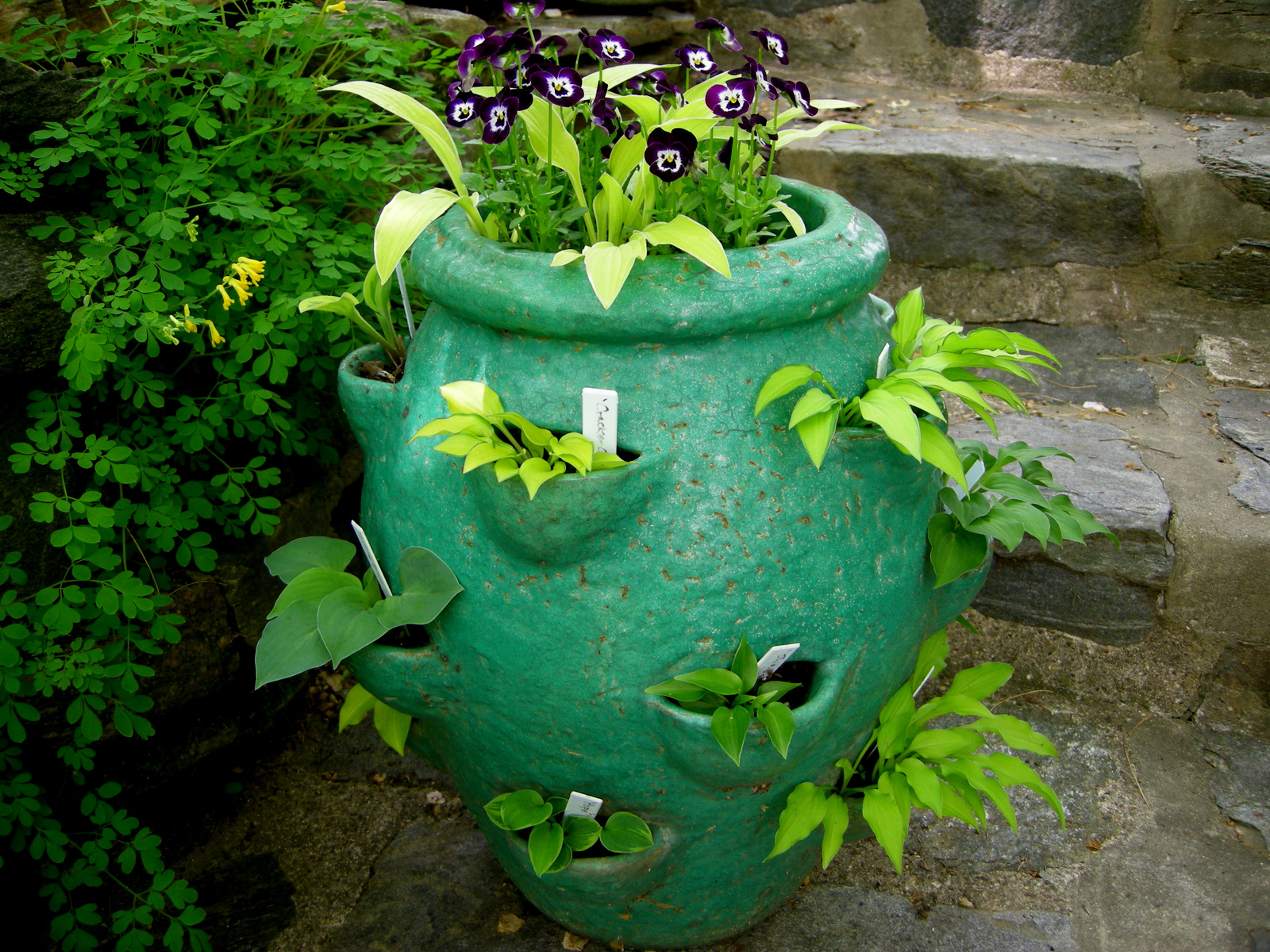
‘Little Sunspot’ is pictured here in my strawberry pot.  It is a small hosta 12″ tall by 12″ wide with leaves 3″ long and 2″ wide.  It has sharply contrasting variegated gold leaves with a wide  dark green margin and purple-striped white flowers in summer.  ‘Little Sunspot’ is great for a rock garden, border, or a container.


‘Twist of Lime’ in my rock garden.

‘Twist of Lime’ is pictured here massed in front of epimediums.  It is a miniature hosta 6” tall by 10” wide with leaves 3” long by 1” wide.  ‘Twist of Lime’ has bright gold leaves with a narrow, dark blue-green wavy margin and many deep violet-striped flowers in July.  It has a beautiful upright habit and is a very fast grower—a favorite of my customers.

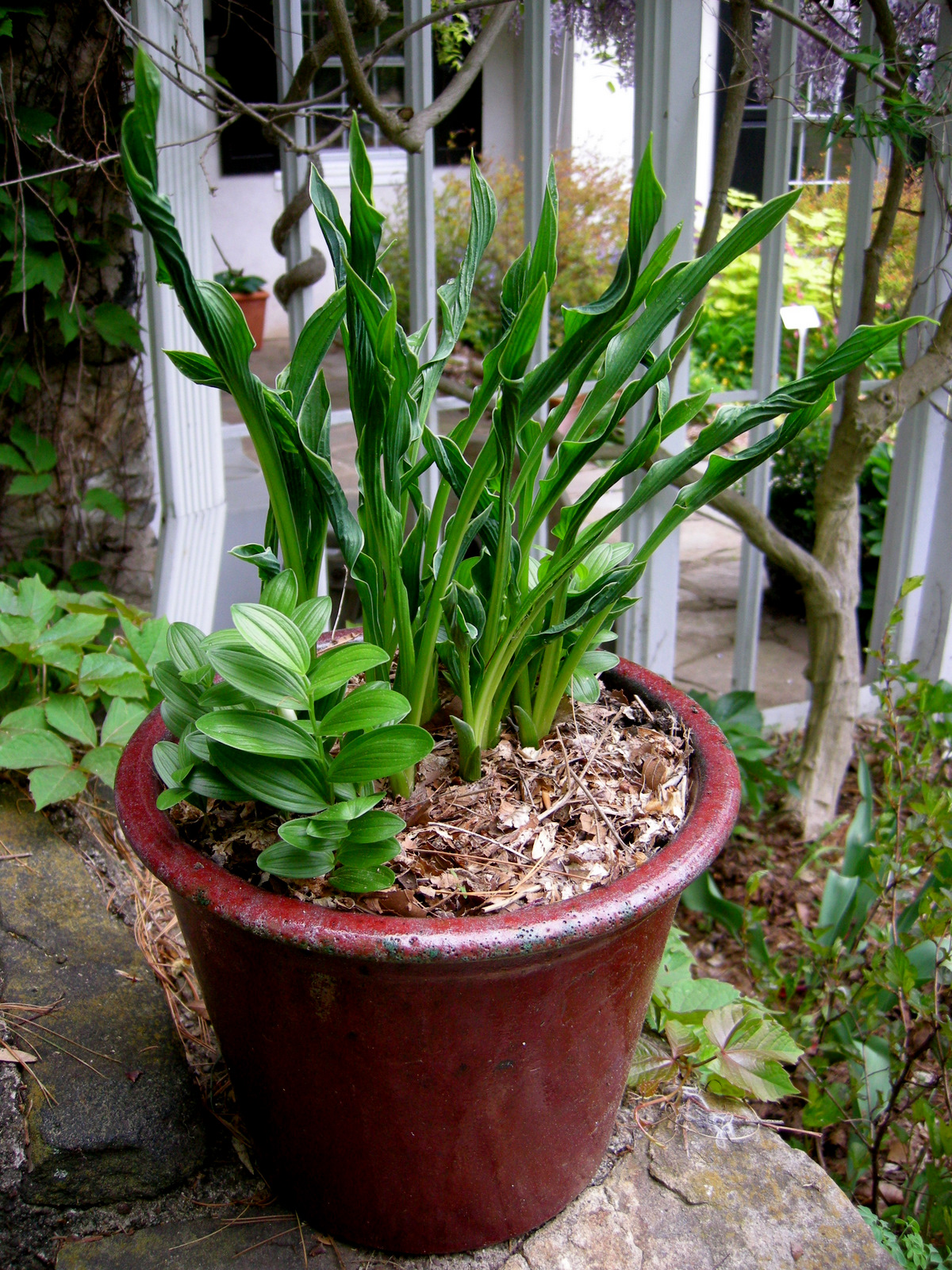
‘Praying Hands’ is pictured here in a container with violas and dwarf Solomon’s seal.  It is a small hosta 16″ tall by 30″ wide with leaves 7″ long and 2″ wide.  ‘Praying Hands’ has waxy and prominently ridged dark emerald green leaves with a narrow gold edge.  It is the most unusual hosta on the market with its folded leaves and vertical, twisty habit reminiscent of a pitcher plant.  It thrives in containers with my plant doubling in size each year.  ‘Praying Hands’ received the prestigious Hosta of the Year Award in 2011.

‘Praying Hands’ provides a vertical accent in my dish garden with miniature hostas ‘Shiny Penny’, ‘Itsy Bitsy Spider’, ‘Cracker Crumbs’, and ‘Shining Tot’ and various companion plants.

Miniature hostas are so much fun.  My next post will be on my new miniature hosta rock garden and feature companion plants to use in containers with your little hostas.

Carolyn

Nursery Happenings: If you are interested in receiving miniature hostas mail order, click here.

If you are within visiting distance and would like to receive catalogues and information about customer events, please send your full name and phone number to carolynsshadegardens@verizon.net.  Subscribing to my blog does not sign you up to receive this information.

Facebook:  Carolyn’s Shade Gardens has a Facebook page where I post single photos, garden tips, and other information that doesn’t fit into a blog post.  You can look at my Facebook page here or click the Like button on my right sidebar here.

Notes: Every word that appears in orange on my blog is a link that you can click for more information.  If you want to return to my blog’s homepage to access the sidebar information (catalogues, previous articles, etc.) or to subscribe to my blog, just click here.

I LOVE Mice

Posted in container gardening, containers for shade, hosta, miniature hosta, Shade Gardening, Shade Perennials with tags , , , , , , , , , on April 25, 2012 by Carolyn @ Carolyns Shade Gardens

Carolyn’s Shade Gardens is a retail nursery located in Bryn Mawr, PA, specializing in showy, colorful, and unusual plants for shade.  The only plants that we ship are snowdrops and miniature hostas.  For catalogues and announcements of events, please send your full name, location, and phone number (for back up use only) to carolyn@carolynsshadegardens.com.  Click here to get to the home page of our website for catalogues and information about our nursery and to subscribe to our blog.

.

'Holy Mouse Ears'It is very hard for me to pick a favorite mouse ears hosta, but I think ‘Holy Mouse Ears’ is it.  The colors in the leaves are magical.

My post Miniature (& Small) Hostas is the most popular article I have ever written for my blog.  In that post, I described how, when I discovered miniature hostas, I reached a new level of hosta addiction.  I try not to purchase (five of) every new miniature hosta I can get my hands on, but it’s a struggle.  Luckily my nursery allows me to mask this addiction as “business development”.  Now I specialize in miniature hostas, and mail order them all over the US.


Hosta ‘Blue Mouse Ears’ is the parent of all the miniature hostas in the mouse ears clan.  It is so special that in 2008, the American Hosta Growers Association named it the Hosta of the Year.

The miniature hosta that really took me over the edge was ‘Blue Mouse Ears’.  It was definitely love at first sight.  I fell for the very blue, very round, very rubbery leaves and the perfectly symmetrical habit.  When ‘Blue Mouse Ears’ emerges from the ground, it is in a cluster so tight it looks like a rose.  It reaches about 6″ in height and scoffs at the idea of slugs as do all the mouse ears hostas.  Most days I stop on my garden ramble to touch its thick leaves.  To me they feel like mouse ears, not that I have ever felt one.

‘Blue Mouse Ears’ emerging in the spring.


‘Blue Mouse Ears’ is a descendant of ‘Blue Cadet’, which is a beautiful small blue hosta with very clean leaves and an elegant habit.  Boy was I in trouble though, because ‘Blue Mouse Ears’ was only the beginning.    As is the nature of hostas, ‘Blue Mouse Ears’ has given rise to a whole family of little mice.  All of them are between 5 and 8″ tall and form a clump about 12″ wide.  Technically, some of them get slightly larger than what the “authorities” consider mini.  Their unique characteristics are their very round rubbery leaves and their symmetrical habits.  However, I may be prejudiced by my love of mice, but I think these little gems have some of the best leaf colors of any hostas on the market.

‘Mouse Trap’ is one of the newer mice to hit the market.  Its bright white leaves with a blue-green border are striking.

Naturally I had to have all the mouse ears hostas in my collection, and my quest began.  I now have seven mice and have located a source for two more, ‘Royal Mouse Ears’ and ‘Calico Mouse Ears’, which I will be ordering shortly.  While researching this post, I found a Rutgers University site with the hysterical name of Hosta Garden Mouse Index.  The photos are not very good, but it seems to list all the mouse ears hostas available.  Apparently my quest will last a while longer.

Photos of three of my mice appear above, and here are the remaining four:

I think ‘Mighty Mouse’ has the cutest name in the mouse ears series.


This early spring photo of ‘Frosted Mouse Ears’ does not do it justice.  It matures to a dark green leaf with a wide white margin.


‘Green Mouse Ears’ is the smallest in the family with very shiny, thick bright green leaves.  Don’t you want to touch it?


‘Mouse Tracks’ is my latest acquisition, and I love its tie dye swirls of yellow, green, and blue.  It is a child of ‘Mighty Mouse’ and very rare.

I haven’t mentioned one of the wonderful features of the mouse ears hostas, their flowers.  Instead of having the long, dangly, out-of-proportion flowers that are produced by some miniatures, the mice have short, fat flowers in proportion to their size as illustrated by the photo below.  I grow them for their flowers too, which is something I can’t say about most hostas.

.

‘Holy Mouse Ears’ in bloom

Of course my mice deserved a special place in the garden where touring customers could view them up close and admire their cuteness (is that a word?).  What better place than the trough that my husband gave me for our anniversary.  My mice nest happily there:

‘Green Mouse Ears’ upper left, ‘Blue Mouse Ears’ middle, ‘Mighty Mouse’ middle right, ‘Mouse Trap’ lower left, ‘Frosted Mouse Ears’ lower right.  The companion plants are dwarf Solomon’s seal and miniature lady fern.


The whole mouse ears family.

It is easy to add mice to your garden, and they will bring a smile to your face for the whole season.

Carolyn’s Shade Gardens specializes in miniature hostas.  I have 25 varieties available at my nursery right now.  I am thinking of starting a mail order business for miniatures.  If you would like to mail order some this year and help me test out my plan, click here (US only).

Carolyn

Nursery Happenings:  If you are interested in receiving miniature hostas mail order, click here.

If you are within visiting distance and would like to receive catalogues and information about customer events, please send your full name and phone number to carolynsshadegardens@verizon.net.  Subscribing to my blog does not sign you up to receive this information.

Facebook:  Carolyn’s Shade Gardens has a Facebook page where I post single photos, garden tips, and other information that doesn’t fit into a blog post.  You can look at my Facebook page here or click the Like button on my right sidebar here.

Notes: Every word that appears in orange on my blog is a link that you can click for more information.  If you want to return to my blog’s homepage to access the sidebar information (catalogues, previous articles, etc.) or to subscribe to my blog, just click here.

Hostas for Fall

Posted in Fall, Fall Color, hosta, landscape design with tags , , , , , , , on October 17, 2011 by Carolyn @ Carolyns Shade Gardens

Carolyn’s Shade Gardens is a retail nursery located in Bryn Mawr, PA, specializing in showy, colorful, and unusual plants for shade.  The only plants that we ship are snowdrops within the US.  For catalogues and announcements of local events, please send your full name, mailing address, and cell number to carolyn@carolynsshadegardens.com and indicate whether you are interested in snowdrops, hellebores, and/or hostas.  Click here to get to the home page of our website for catalogues and information about our nursery and to subscribe to our blog.

.

Hosta 'Remember Me'Hosta ‘Remember Me’ looks absolutely spectacular in the fall when its colors deepen and its pristine leaves shine.  All photos were taken at Carolyn’s Shade Gardens this fall.  Click any photo to enlarge.

In my last two articles, A Few Fall Favorites for Foliage and Fruit and A Few Fall Favorites for Flowers, I explained that, inspired by an article about dressing up your fall garden with mums because everything else is finished, I grabbed my camera and headed outside to prove them wrong.  There was so much going on that I divided the plants into three posts: foliage and fruit, flowers, and hostas.  This is part three highlighting hostas.

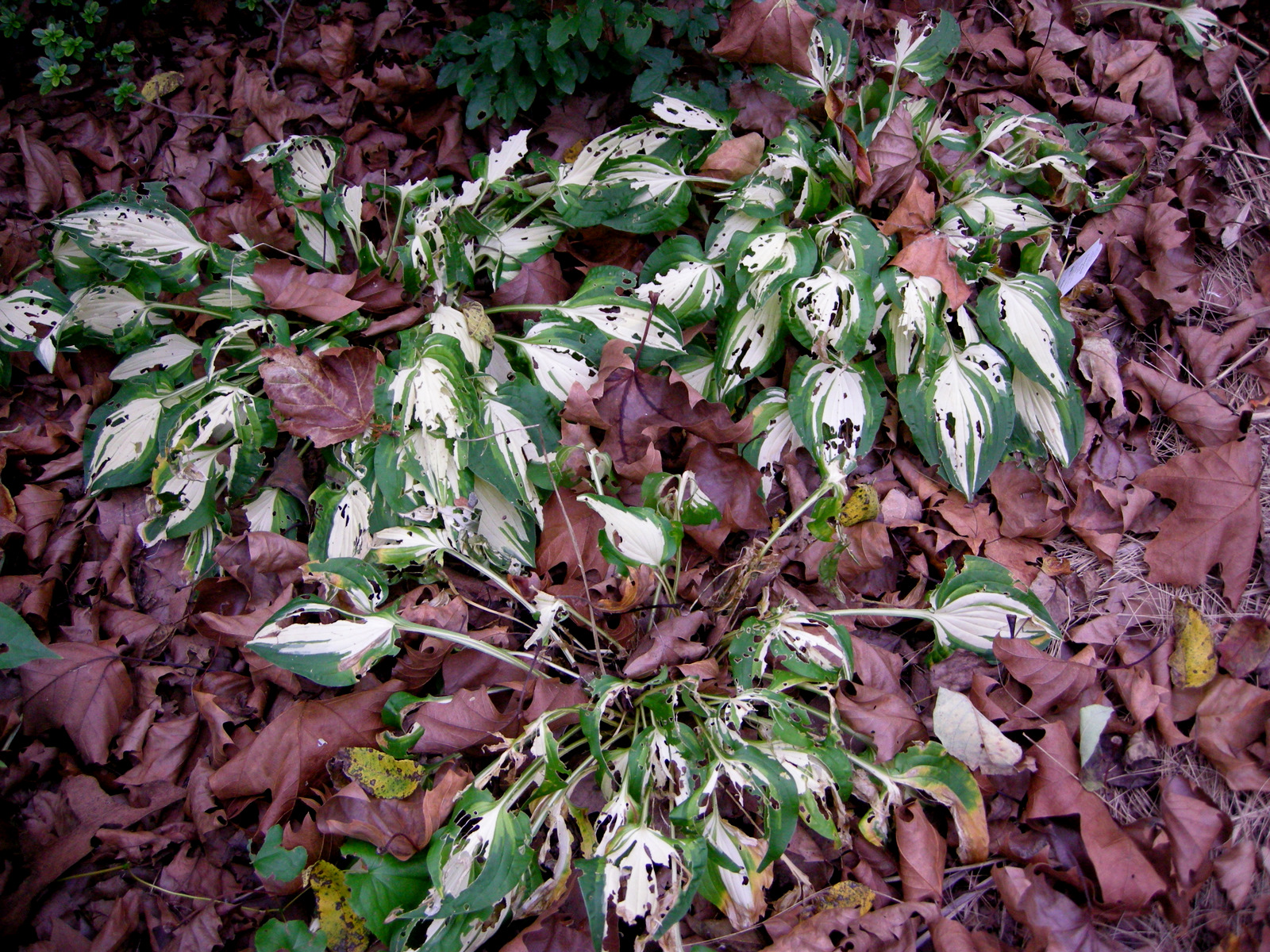
When you choose a hosta for your garden, I am guessing you are not going for this look in fall.

One reason I started what I like to call my free, on line, shade gardening magazine (AKA blog) was to force myself to document my gardening knowledge in photographs and print.  This article is a perfect example.  Every fall I walk around my gardens saying: “I really should photograph the hostas that still look good in the fall,” but I never do it.  This information is very important when choosing hostas especially if you have a small garden and can’t afford to allocate space to a plant that provides no ornamental value for one third of the season like the specimens in the photo above.  So, for the record, here are some of the hostas dressing up my shady gardens right now:

I don’t expect my hostas to look perfect in the fall, although some do.  Even though ‘Frances Williams’ is slightly tattered, its bold colors and stately habit make it a winner in my fall garden.

There is another very important point I would like to make about hostas.  New is not the equivalent of better or even good.  Gardeners will often remark about a hosta like ‘Frances Williams’, which was first registered in 1986, that it is an old hosta with the implication that we should have all moved on by now.  If I had to, I would gladly trade in many of my newer hostas for a plant as unique in habit, leaf shape, and color as ‘Frances Williams’ (even with its tendency to brown slightly at the edges).  The breeders have yet to come up with a new hosta this beautiful and tough.


Like all blue-leaved hostas, Hosta ‘Blue Umbrellas’ turns greener in the fall, but who cares when it looks like this?

Thanks to my commenter Louise Thompson for mentioning slug resistance.  One of the primary reasons that these hostas look so good in the fall is that they are resistant to slugs.  Most of them tend to have thicker leaves that just hold up better to whatever nature throws at them.  Please read my reply to Louise for information about controlling slugs.  I don’t do anything to control slugs except plant resistant hostas. 

Talk about perfect, Hosta ‘Paradise Joyce’.

Hosta ‘El Nino’ in my silver and blue garden.  If you want to see what it looks like in June, click here.

Hosta ‘Stained Glass’, which was the Hosta of the Year for 2006, just glows in the fall.  One way to choose really good hostas is to select cultivars chosen as hosta of the year by the American Hosta Growers Association.  There are over 6,000 (some say 10,000) hosta cultivars out there, and only 17 have received this honor.  I grow 13 of the winners, and they certainly deserved to be chosen.  To see all the winners, click here.

Another “old” hosta, ‘Blue Angel’ was registered in 1986 and, in my opinion, is the best large blue cultivar–outstanding habit, leaves, and white flowers.  It is the parent of ‘Earth Angel’, the 2009 Hosta of the Year.

The long-lasting gold leaves of Hosta ‘Sum and Substance’, the 2004 Hosta of the Year, can reach 2 feet across while the clump can exceed 6 feet in width.

Hosta ‘June’ was the 2001 Hosta of the Year and is the favorite hosta of my nursery customers.  ‘Remember Me’ in the top photo is one of its “children”.

Hosta ‘Halcyon’ registered in 1988, is a beautiful medium-sized blue hosta (aging to green in the fall), but it is also important as the parent of ‘June’, ‘El Nino’, and ‘Paradise Joyce’, among other wonderful cultivars.

Most gold-leaved hostas turn green in the fall, but not ‘Jimmy Crack Corn’.

Hosta ‘Praying Hands’, the 2011 Hosta of the Year, will stay outside in this ceramic container all winter.  I find that ‘Praying Hands’ multiplies much faster in a container than in the ground.


Hosta ‘Paul’s Glory’, the 1999 Hosta of the Year, also looks best in the fall when its bright colors light up the shade.

Hosta ‘Inniswood’ is a 1993 gold-leafed introduction that puts many newer cultivars to shame.

There are many more medium and large hostas that I could have featured as ornamental in the fall including my favorite, Hosta tokudama and all its cultivars.  For more information on larger hostas and how to use them, click here.

Now for some fall stars among the miniatures, my current hosta passion.  For more information on miniature hostas and how to incorporate them into your garden, click here.

If you have read my article on Miniature Hostas, you know I am a sucker for the Mouse Ears series, here Hosta ‘Mighty Mouse’.

Hosta ‘Blue Mouse Ears’ is the 2008 Hosta of the Year.

Hosta ‘Little Sunspot’ is growing in one of the 16 pouches in my strawberry jar.  One look at this collection will show you that all miniatures are not created equal in terms of their fall appearance.

All my hosta containers, including this pot of Hosta ‘Pixie Vamp’, will stay out all winter.

Like all plants, hostas should be chosen to provide ornamental value from the time they come up in the spring until frost.  You can choose any of the hostas above for your garden and be confident of a long season of interest.

Carolyn

This is the third article I have written on hostas.  The first two are:

Miniature (& Small) Hostas

Larger Hostas

Notes: Every word that appears in orange on my blog is a link that you can click for more information.  If you want to return to my blog’s homepage to access the sidebar information (catalogues, previous articles, etc.) or to subscribe to my blog, just click here.

Miniature (& Small) Hostas

Posted in hosta, How to, landscape design with tags , , , , , , , , , , , , , , , , , , , , , , , , , , , , , , , , , , , , on May 9, 2011 by Carolyn @ Carolyns Shade Gardens

Carolyn’s Shade Gardens is a retail nursery located in Bryn Mawr, PA, specializing in showy, colorful, and unusual plants for shade.  The only plants that we ship are snowdrops within the US.  For catalogues and announcements of local events, please send your full name, mailing address, and cell number to carolyn@carolynsshadegardens.com and indicate whether you are interested in snowdrops, hellebores, and/or hostas.  Click here to get to the home page of our website for catalogues and information about our nursery and to subscribe to our blog.

.

'Holy Mouse Ears'‘Holy Mouse Ears’: the miniature hostas in the mouse ears series are my favorites.

I am in stage four of my relationship with hostas.  I have noticed that many of my customers go through these stages too.  Stage one was when I was a new gardener.  I discovered hostas and loved them because they are easy to grow and to divide to make more.  I had the green one, the green and white one, the blue one, the variegated one, and the gold one.  If you know hostas, you can probably guess fairly easily which varieties I had.  I still love these hostas and have large patches of them in my gardens.

‘Lakeside Cupcake’ was a new small hosta for me in 2010 and is a strong grower.

During stage two, I became more “sophisticated”.  Hostas were too easy to grow, too ordinary, and multiplied too quickly for my control-oriented gardening style.  Besides I wanted flowers, flowers, and more flowers, and hostas just didn’t fit the bill.  I didn’t like them anymore.  How could people collect such a boring and ordinary plant?

“Carolyn’s Gold”: I selected this miniature hosta from a chance seedling that appeared in my gardens.  It is the brightest gold I have ever seen.

I rediscovered hostas in stage three when I got beyond flowers and realized how important foliage is to the garden, especially the shade garden.  I learned that hostas did not come in just the five basic varieties but in an infinite number of combinations of colors, heights, widths, leaf shapes, flowers, and habits.  Somewhere I read that there are 6,000 hosta cultivars.  I wanted them all so I began to collect hostas. 

‘Blue Mouse Ears’ is the miniature hosta that started the mouse ears family.  Not only is it shaped like a mouse ear, but it feels like one too (all in my imagination because I have never felt a mouse ear).  It was designated the 2008 Hosta of the Year by the American Hosta Growers Association–a very high honor.

I entered stage four about the time that my hosta acquisitions topped 100 cultivars.  This is just a modest assemblage because you really aren’t considered a hosta collector until you have over 500 varieties in your garden.  But I was running out of room.  Besides I am not a true collector of any group of plants because I am not satisfied with one of any perennial in my garden.  I need at least five, but preferably seven, of any plant to make an impact.  Many hostas are quite large, and five ‘Blue Angel’, ‘Sum and Substance’, or ‘Sagae’, which are favorites of mine, with six foot wide clumps and 15″ leaves, take up a lot of room.  Were my collecting days over?

Clockwise from upper left: small ‘Blonde Elf’  and miniatures ‘Little Wonder’, ‘Rock Princess’, and a hosta sold to me as ‘Little Blue’.

That’s when I discovered miniature hostas.  The American Hosta Society defines  miniature hostas as having a leaf no larger than 4 sq. in.   The discovery of miniature hostas allowed me to indulge my passion for collecting hostas, which only got worse in stage four, without taking up all the space in my garden.  And they are so incredibly cute and have such adorable names: ‘Holy Mouse Ears’, ‘Pixie Vamp’, ‘Blonde Elf’, ‘Mighty Mouse’, ‘Alakazaam’, ‘Cookie Crumbs’, ‘Rock Princess’.  How can you resist?

‘Mighty Mouse’ is one of the newer members of the mouse ears family.

I remain firmly mired in stage four and don’t know what comes after it, maybe Hostas Anonymous.  But in the meantime, I want to show you some of my favorite miniatures (see photos above and below) and suggest some ideas for displaying miniature and small hostas.

‘Little Treasure’ is new to me this year and has a unique leaf shape and blue-green color.

Because they are so little, most miniature and small hostas can’t be thrown into the garden willy-nilly but benefit from some planning to show them off.  Many also require specialized growing conditions, but those cultivars don’t survive at Carolyn’s Shade Gardens where nothing gets fussed over.  I display my absolute favorite miniature hostas in their own container to really highlight them.  An added benefit is that  hostas multiply more rapidly in containers:

I have shown this photo of ‘Crumb Cake’ before, but it demonstrates how a single unusual plant in a container can be so pleasing.  ‘Crumb Cake’ and all the other hostas pictured in containers in this post also do well in the ground–a requirement for inclusion at Carolyn’s Shade Gardens.


‘Pixie Vamp’: This miniature has elegant mahogany-colored flower scapes that match this container.  I leave all these pots outside all winter.  Hostas overwinter fine as long as their containers can be left outside without cracking.


I think ‘Praying Hands’, the 2011 Hosta of the Year, looks best in a container.  It reminds me of pitcher plants without the hassle of creating a bog.  Pictured here with dwarf Solomon’s seal, Polygonatum humile, another plant that thrives over the winter in containers.


“Carolyn’s Malex Two” is another hosta I selected that grows so slowly in the ground that I have never sold it.  Its position in the top of my antique strawberry pot highlights its delicate coloring and allows it to multiply faster than it would in the ground.


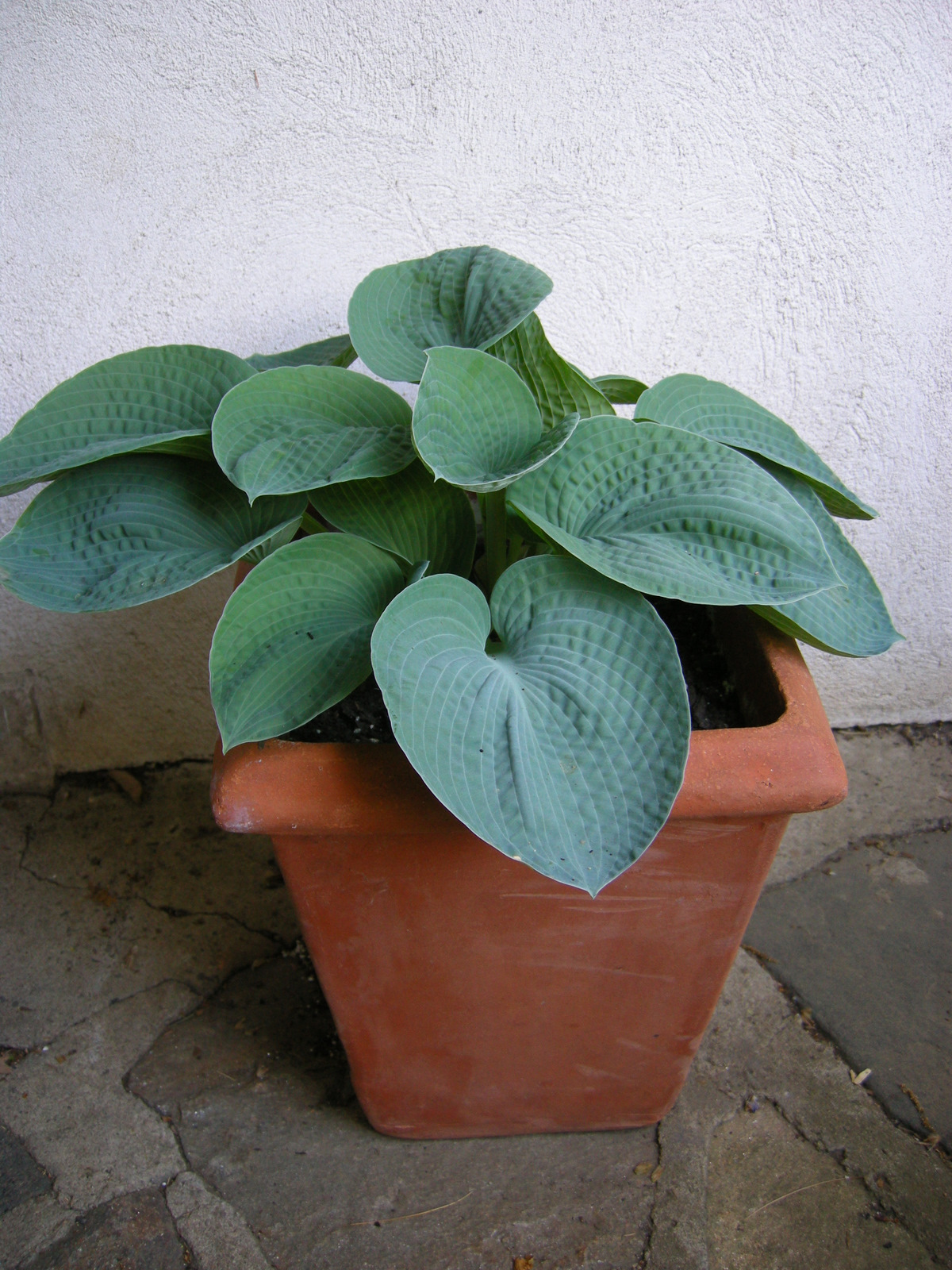
The straight species Hosta tokudama has the bluest leaves of any hosta and lives in this terra cotta container on my porch.


You don’t necessarily have to buy containers for your hostas.  ‘Hanky Panky’, a very unusually colored small hosta, has grown for years in my old dogwood stump.


‘Alakazaam’ has found a home in the chiseled out knot hole of a weathered sycamore branch.  My youngest son crafted this “container” for me for Mother’s Day.


Several miniature hostas can be combined in a larger container:

This dish, which I leave out all winter even though it is terra cotta (don’t do this at home!), contains the miniatures  (clockwise from upper left) ‘Cracker Crumbs’, ‘Shiny Penny’, and ‘Shining Tot’ with ‘Praying Hands’, sedum, hens and chicks, rosularia, and miniature dianthus.


My antique strawberry pot has 16 pockets with a different miniature hosta in each one.  Pictured are (top row left to right) ‘Cameo’, ‘Cracker Crumbs’, and ‘Twist of Lime’, (middle row) ‘Little Blue’, ‘Shining Tot’, and ‘Porter’, and (bottom row) ‘Shiny Penny’, ‘Hope, and “Carolyn’s Tiny Gold”.


My husband gave me this antique trough for our anniversary.  It is a perfect setting for my mouse ears collection.  Pictured are (front left to right) ‘Holy Mouse Ears’ and ‘Mouse Trap’, (center) ‘Blue Mouse Ears’, and (back) ‘Green Mouse Ears’, ‘Mighty Mouse’, and ‘Frosted Mouse Ears’, all with dwarf Solomon’s seal.


Hostas thrive between rocks and in rock gardens:

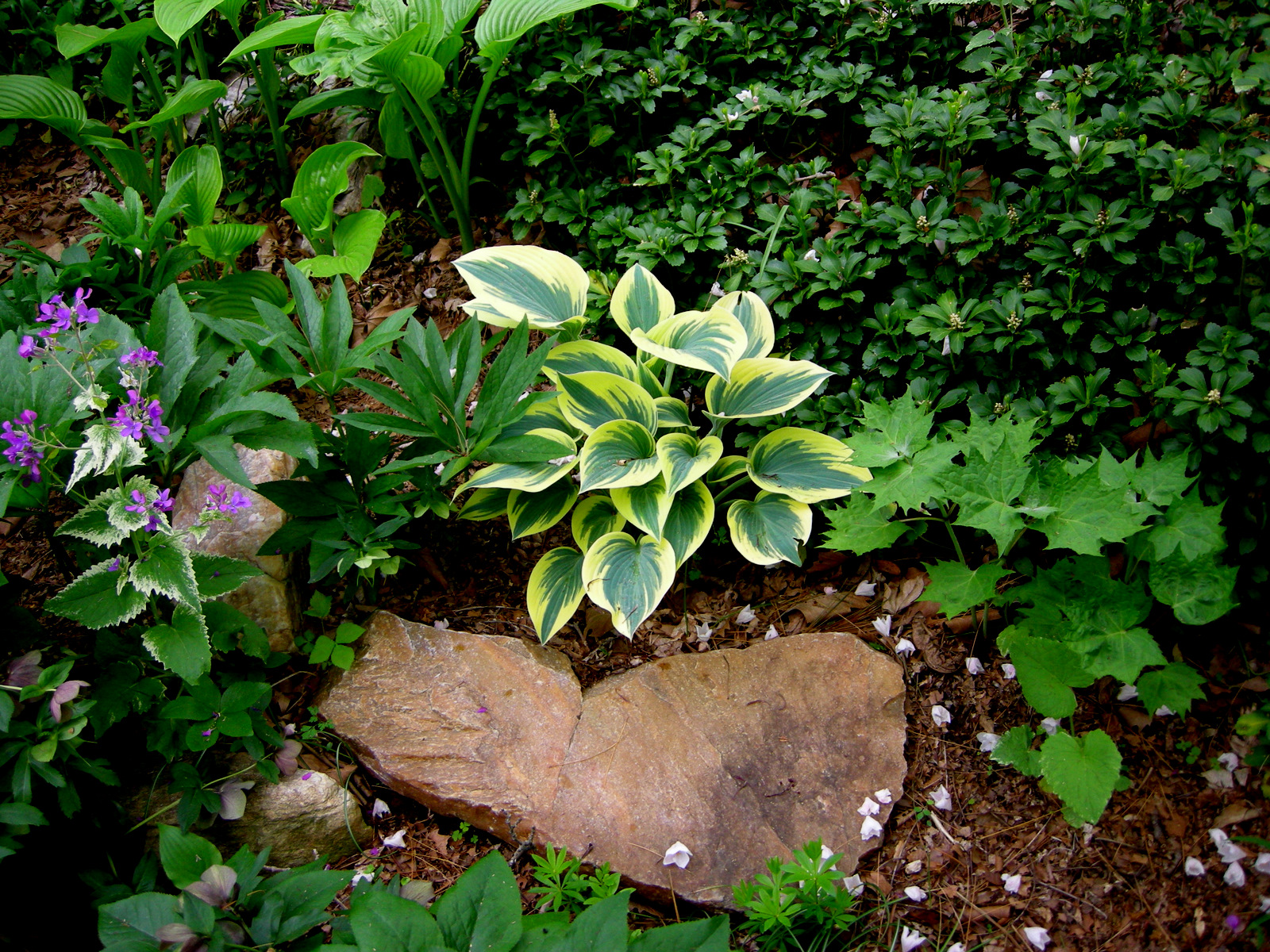
The 2010 Hosta of the Year ‘First Frost’ in my rock garden with (left to right) variegated money plant (Lunaria annua ‘Alba Variegata’), Helleborus cyclophyllus, and yellow wax-bells (Kirengoshoma palmata).


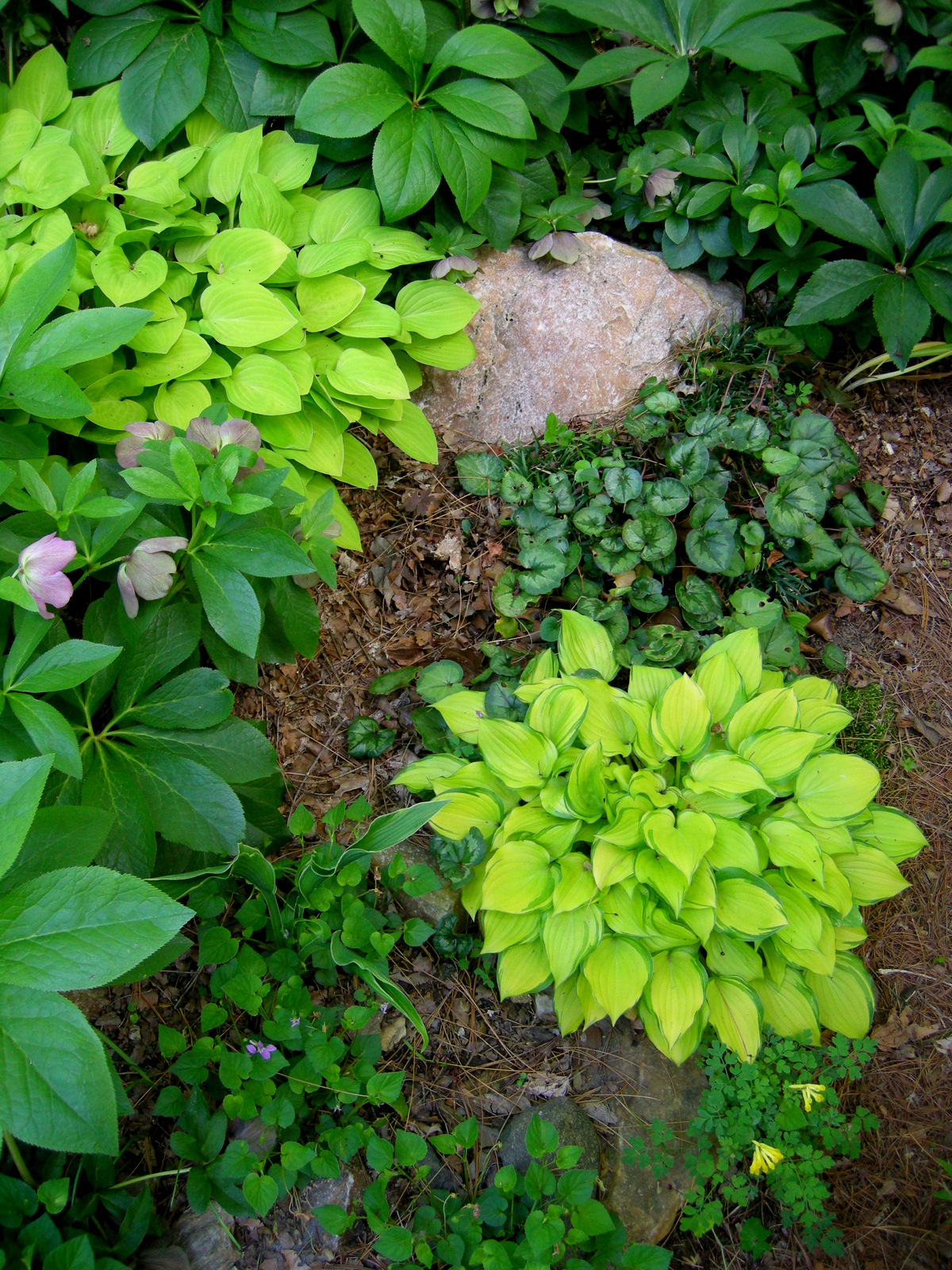
‘Little Aurora’ (upper left) and ‘Cookie Crumbs’ (lower right) in my rock garden with (left to right) ‘Red Lady’ hellebores (Helleborus x hybridus ‘Red Lady’), pink violets (Viola species), and spring-blooming hardy cyclamen (Cyclamen coum).


Miniature and small hostas can be massed for maximum effect and to create groundcover:

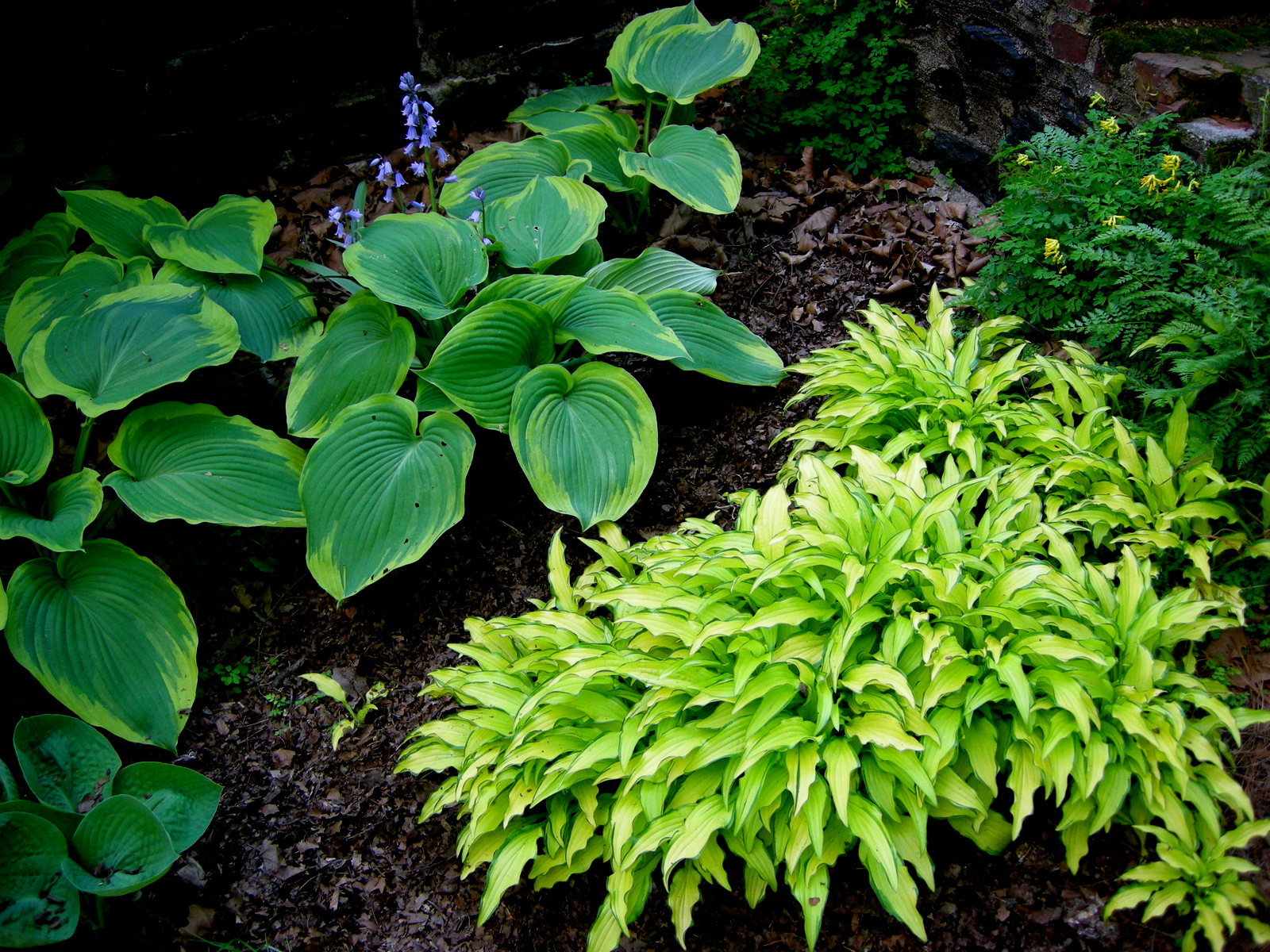
‘Kabitan’ (lower right) massed with (left to right) ‘Abiqua Drinking Gourd’, 2009 Hosta of the Year ‘Earth Angel’, Spanish bluebells (Scilla campanulata ‘Excelsior’), yellow corydalis (Corydalis lutea), and fern-leafed corydalis (Corydalis cheilanthifolia).


“Carolyn’s Gold” (lower left) and ‘Lemon Lime’ (upper right) used as groundcover.


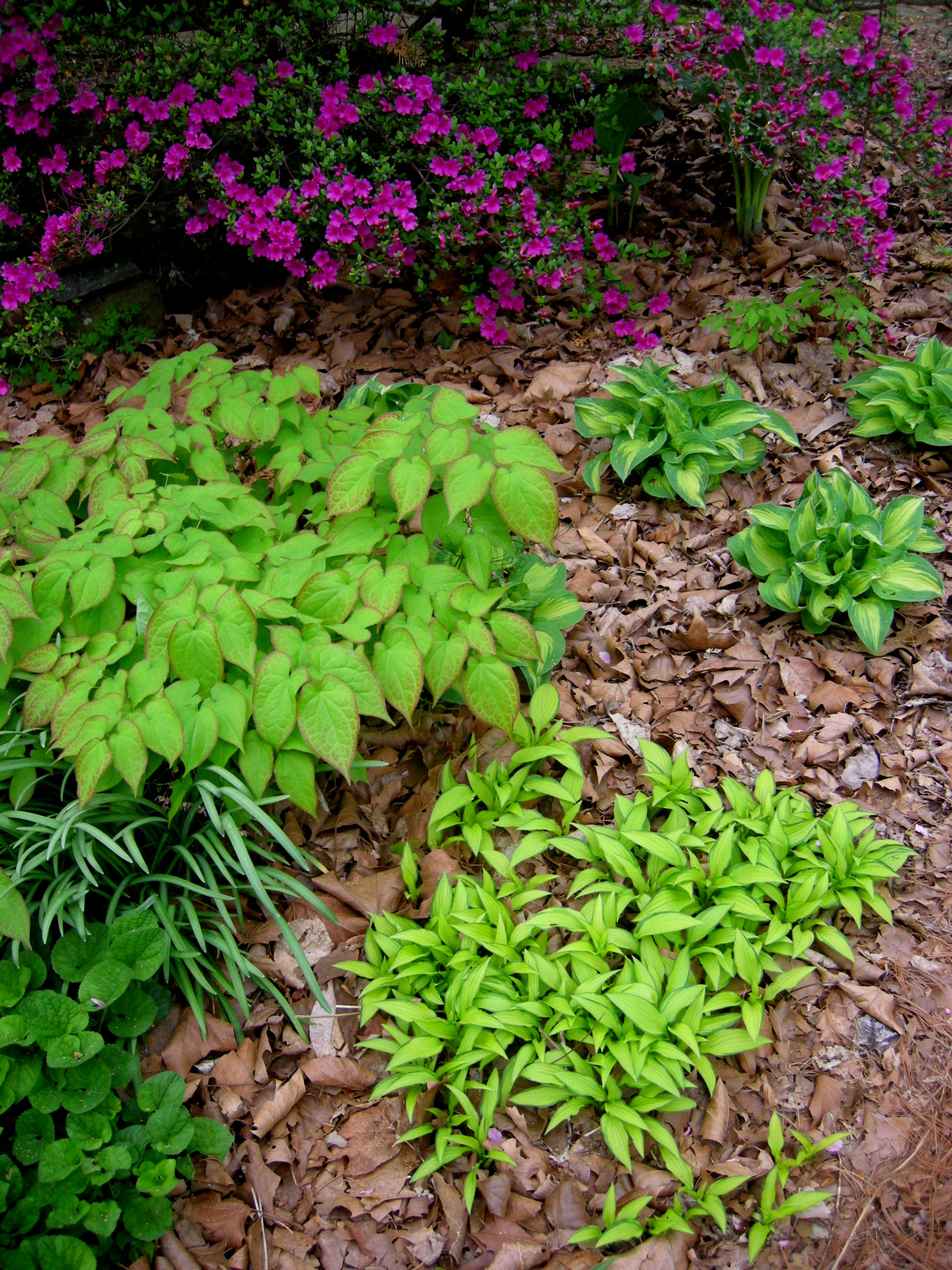
‘Twist of Lime’ (lower right) massed with (left to right) sweet violet (Viola odorata), red epimedium (Epimedium x rubrum), and ‘Fantasy Island’.


I hope I have given you some good ideas for using miniature and small hostas in your garden.  I would be very interested to hear in a comment/reply which miniatures you like and how you use them.

Carolyn

For two more articles on hostas, click here:

Larger Hostas

Hostas for Fall


Notes: Every word that appears in orange on my blog is a link that you can click for more information.  If you want to return to my blog’s homepage to access the sidebar information (catalogues, previous articles, etc.) or to subscribe to my blog, just click here.

Pleasurable Pairings for Spring

Posted in hosta, landscape design, Shade Gardening with tags , , on April 26, 2011 by Carolyn @ Carolyns Shade Gardens

Carolyn’s Shade Gardens is a retail nursery located in Bryn Mawr, PA, specializing in showy, colorful, and unusual plants for shade.  The only plants that we ship are snowdrops and miniature hostas.  For catalogues and announcements of events, please send your full name, location, and phone number (for back up use only) to carolyn@carolynsshadegardens.com.  Click here to get to the home page of our website for catalogues and information about our nursery and to subscribe to our blog.

Annual violas and a hosta I selected called “Carolyn’s Malex II” in a glazed strawberry pot that belonged to my grandfather.  There is a different miniature hosta in each of the 16 pockets, and it stays out all winter with no problems for the pot or the hostas.  Don’t you love the little faces on the violas?
Over the years, through trial and error, I have discovered some fail safe pairings for the spring shade garden.  These plant couples look great together while thriving in the same cultural conditions.  Their flower and leaf colors and textures and their habits compliment each other to make pleasing combinations.  Plus they are all easy to grow, requiring no watering, staking, or general fussing after they are established in good organic soil in part to full shade.

Hostas that come up early in the spring, especially miniature hostas, play nicely with almost every plant and are extremely easy to grow:

This pairing is one of my favorite color combinations in the garden.  Hosta montana ‘Aureomarginata’ comes up much earlier than other large hostas.  Its bright green and yellow leaves serve as the perfect backdrop for the orange and yellow flowers of Epimedium x warleyense.


Almost all my miniature hostas come out in time to join the blooming epimediums.  Here is Epimedium grandiflorum ‘Tama No Gempei’ with Hosta ‘Little Wonder’, but you could choose any epimedium and any miniature hosta for a delightful contrast.


A great full shade combination: Hosta ‘Emerald Tiara’ and Japanese woodland primrose, Primula sieboldii (purple form), thrive under my coral bark maple.  Japanese woodland primrose is a mat-forming primrose for full, dry shade not to be confused with Japanese primrose, Primula japonica, which requires moist conditions.


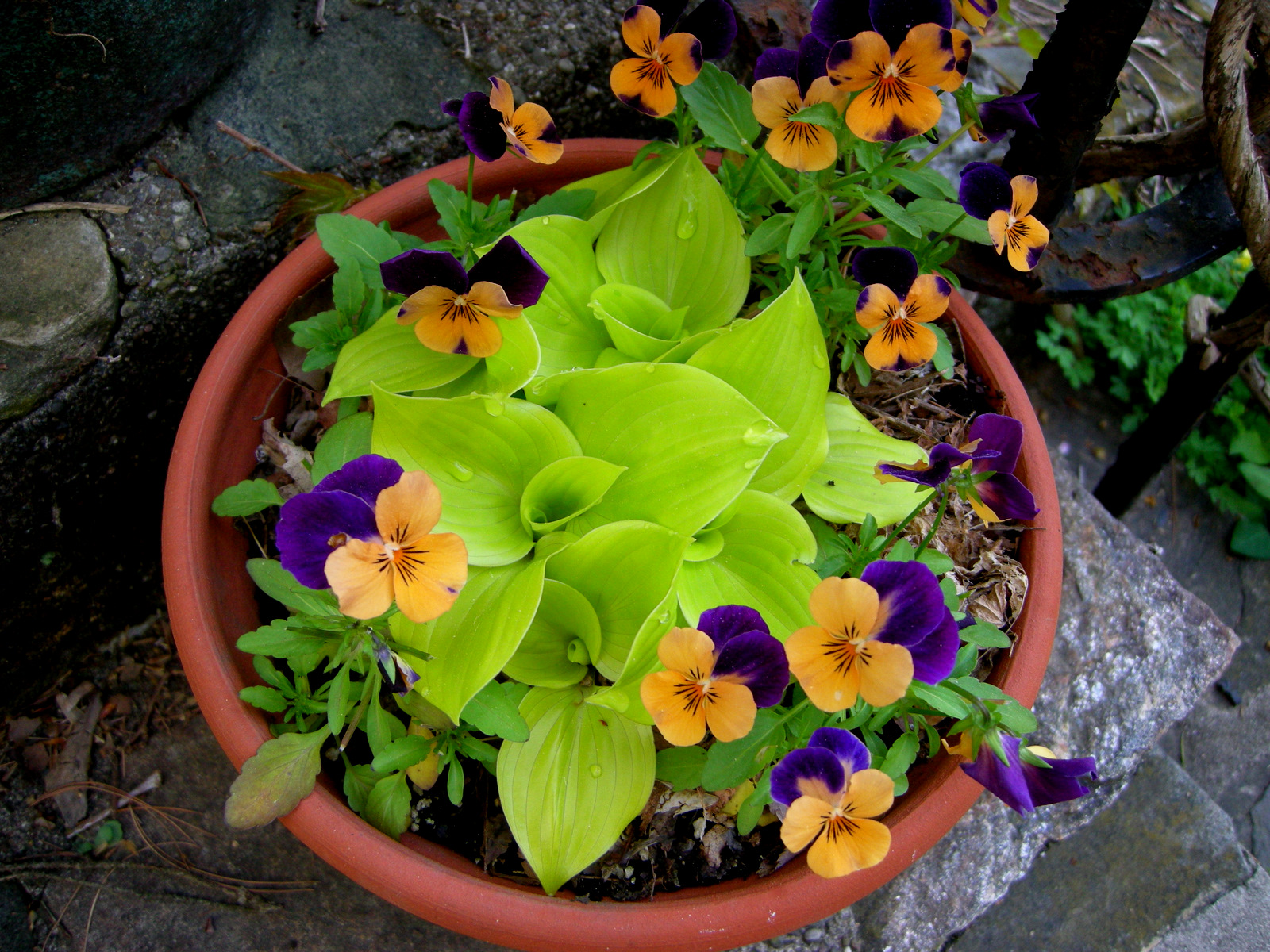
Annual violas and Hosta ‘Crumb Cake’ in a container that stays out all winter.  Small containers are a great way to display choice miniature hostas.


Another plant whose early spring color goes with just about anything is Spiraea japonica ‘Magic Carpet’.  I think I would take this shrub to a dessert island if I had to choose because its deep peach leaves are so gorgeous (and it has fabulous fall color too):

Dwarf spiraea, Spiraea japonica ‘Magic Carpet, with Italian arum, Arum italicum, and PA (Pennsylvania) native coral bells, Heuchera villosa ‘Caramel’.  This is a year round combo because the arum and coral bells remain ornamental through the winter and the spiraea is a solid three-season plant.


‘Magic Carpet’ contrasts nicely with the color and texture of gold-leafed old-fashioned bleeding heart, Dicentra spectabilis ‘Goldheart’.  At first I didn’t like the idea of gold and pink together but with careful pairing ‘Goldheart’ is magnificent.


You can see some of the gold tones starting to emerge in the new leaves on this ‘Magic Carpet’, which is farther from the house.  It looks great with the dark red sedums in this strawberry jar, which also overwinters outside.


‘Magic Carpet’ even pairs well with spider webs.  Every spring I come out one morning to find all the spiraeas covered with webs.


Here are some more great combinations for early spring:

I think that PA native Celandine poppy, Stylophorum diphyllum, goes with everything in spring, but it looks especially beautiful with PA native Virginia bluebells, Mertensia virginica.


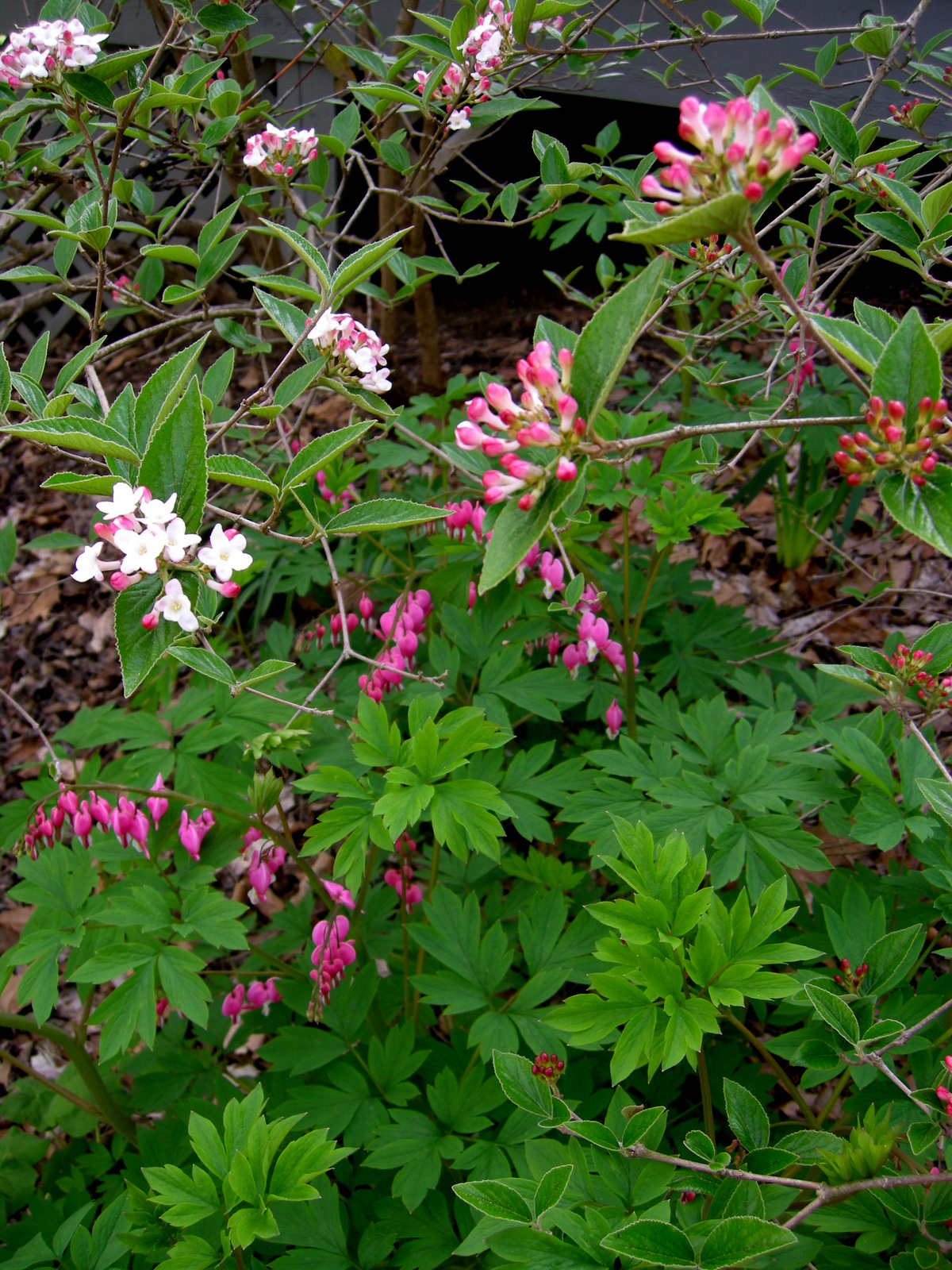
I am always captivated by the color combination of the buds of Burkwood viburnum, V. x burwoodii ‘Mohawk’, and the flowers of old-fashioned bleeding heart, Dicentra spectabilis.  ‘Mohawk’ has fantastic fragrance and spectacular orange-red fall color too.  It is a Pennsylvania Horticultural Society gold medal plant.


The airy bronze foliage and yellow flowers of fern-leafed corydalis, Corydalis cheilanthifolia, perfectly compliment the flower color of this 18th century heirloom primrose, Primula x polyantha ‘Old Brick Reds’.


Pulmonarias (lungwort) go with just about anything too:

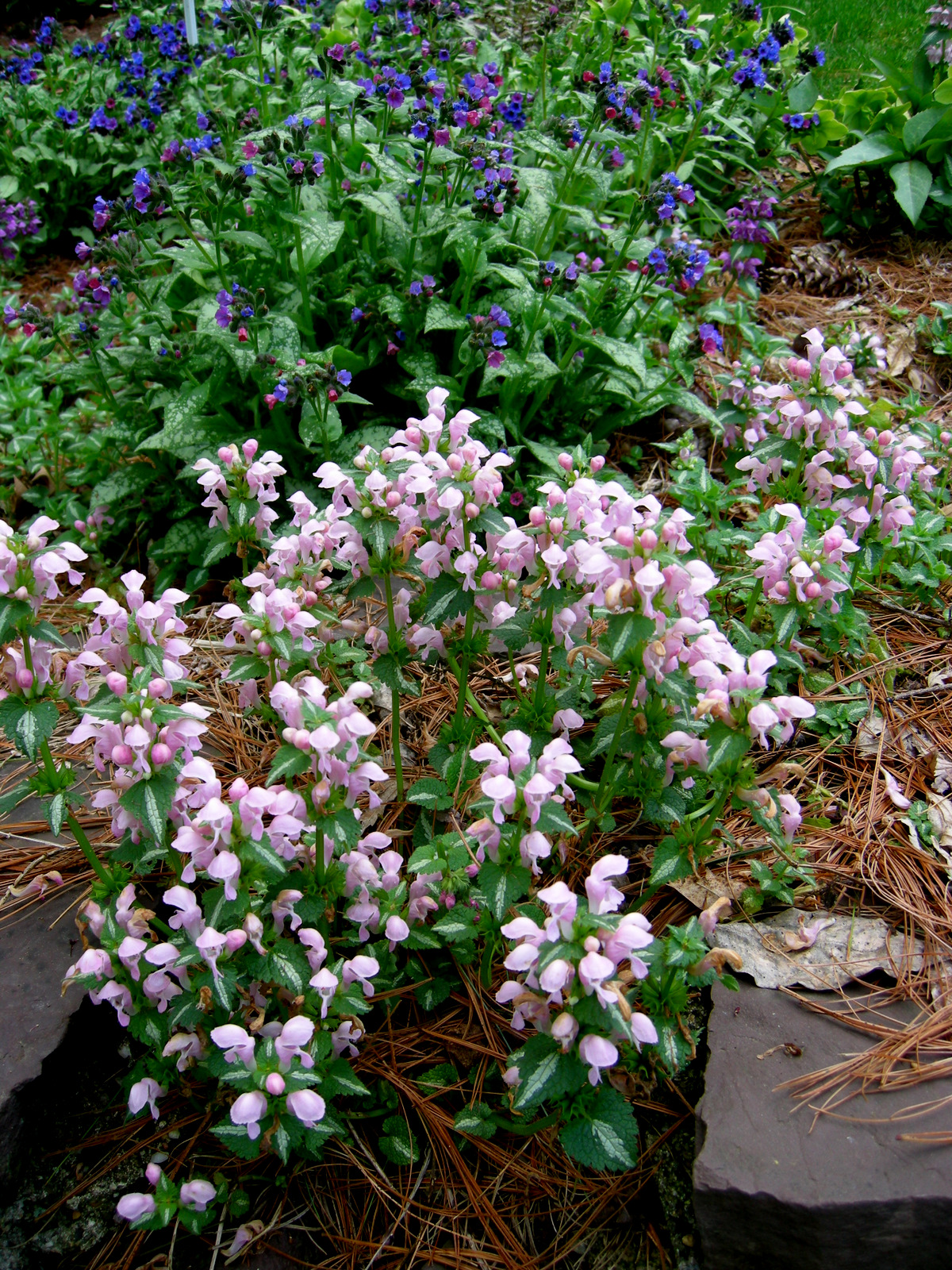
The early blue flowers and narrow silver leaves of Pulmonaria ‘Diana Clare’ with the abundant pink flowers and silver-striped leaves of Lamium maculatum ‘Shell Pink’, which blooms from April until November and has evergreen foliage.  Pulmonarias also keep their beautiful leaves well into the winter.


I have collected over 25 varieties of pulmonaria, but then I let them self sow all over my garden with glorious results.  Above is a pink seedling pulmonaria with very rare Helleborus dumetorum subsp. atrorubens, but any red flowered hybrid hellebore would complete the pair.


More seedling pulmonarias paired with a purple strain of Lamium maculatum ‘Shell Pink’.


PA native wild ginger, Asarum canadense, and PA native dwarf Jacob’s ladder, Polemonium reptans, carpet my woodlands in early spring.  Together they produce a subtle and peaceful beauty.


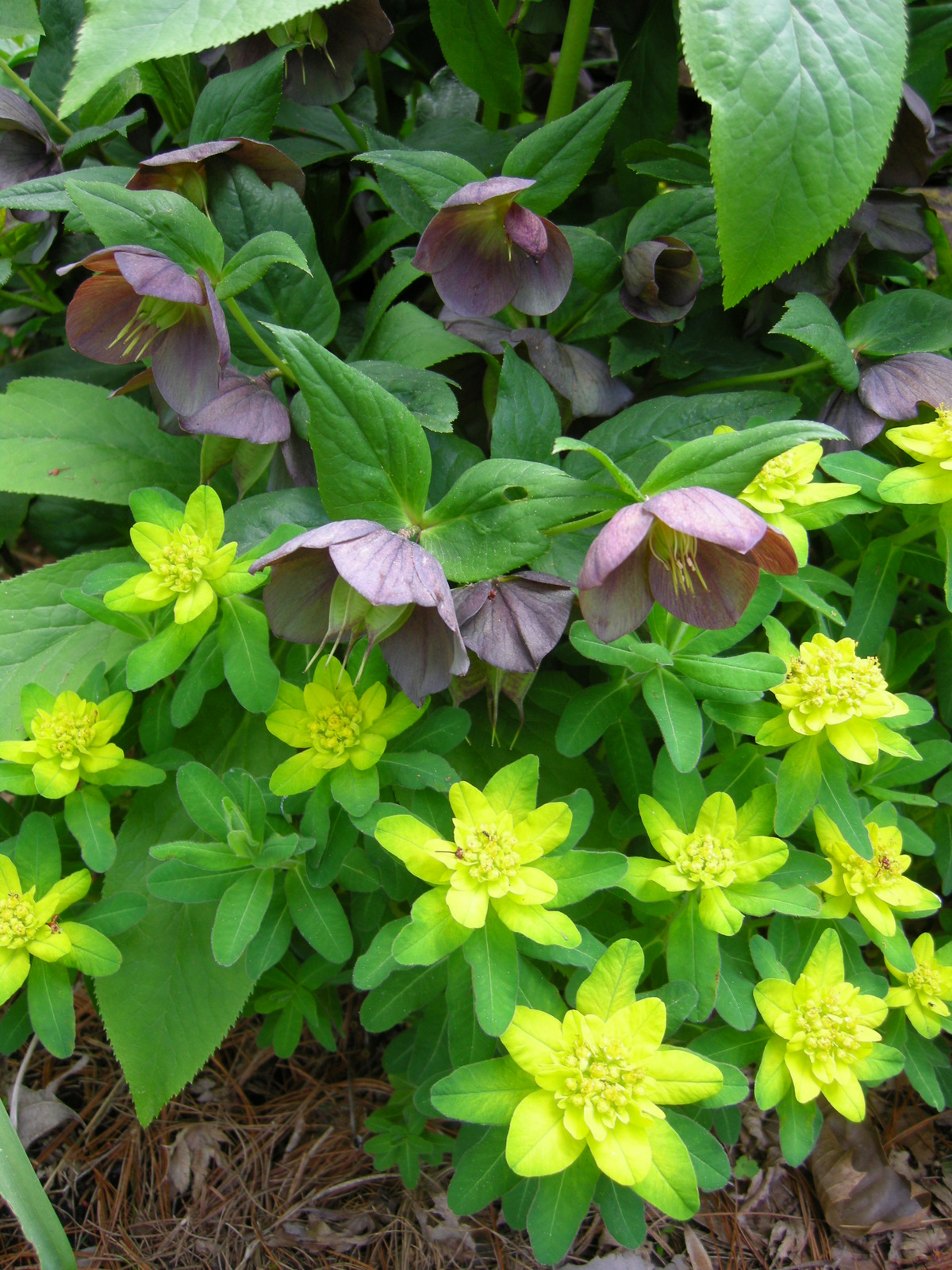
I never thought of cushion spurge, Euphorbia polychroma, as a shade plant but it actually thrives in quite a bit of shade: here with hybrid hellebore, H. x hybridus ‘Metallic Blue Lady’.  I also love the cushion spurge cultivar ‘Bonfire’ with red leaves.


I think this is one of the most beautiful combinations in my early spring garden, and it took me over 50 attempted photographs to capture it on film!  Siberian bugloss, Brunnera macrophylla,  cowslip primrose, Primula veris, and spring starflower, Ipheion uniflorum.


Same as above with Ajuga reptans ‘Metallica’.


I will finish my spring combinations with something for all you sunny gardeners: white stonecrop, Sedum album, with tulip ‘Little Princess’.


I hope I have given you some ideas for creative combinations to add to your spring garden.  Please leave a comment/reply with some favorite pairs from your own garden.

Carolyn

Notes: Every word that appears in orange on my blog is a link that you can click for more information.  If you want to return to my blog’s homepage to access the sidebar information (catalogues, previous articles, etc.), just click here.

Nursery Happenings: My second annual Great Hosta Blowout is going on right now.  For details, click here.  Look for Carolyn’s Shade Gardens at the Bryn Mawr Farmer’s Market on Saturday, May 7, from 9 am to 1 pm .  My next open house sale is Saturday, May 14, from 10 am to 3 pm.