Archive for the How to Category

More Annuals for 2014

Posted in annuals, annuals, container gardening, container gardening, containers for shade, How to, landscape design, shade annuals with tags , , , , , , , , on July 14, 2014 by Carolyn @ Carolyns Shade Gardens

Nursery News:  Carolyn’s Shade Gardens is a retail nursery located in Bryn Mawr, PA, specializing in showy, colorful, and unusual plants for shade.  The only plants that we ship are snowdrops and miniature hostas.  For catalogues and announcements of events, please send your full name, location, and phone number (for back up use only) to carolyn@carolynsshadegardens.com.  Click here to get to the home page of our website for catalogues and information about our nursery and to subscribe to our blog.

.

photo 1

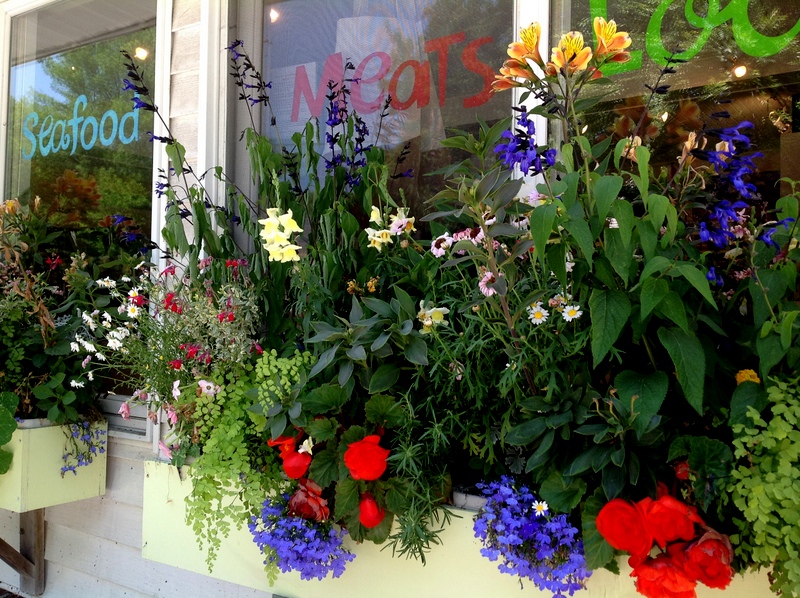
Since I revisited the boat planting last post (click here to see those photos), I thought I would also pay a repeat visit to the window boxes I raved about last year.  To read my 2013 window box post, click here.  They are located at a little market on Main Street in Yarmouth, Maine.  I am happy to say that they did not disappoint, but you can judge for yourself:

.

photo 6

.

photo5

.

photo4.

photo 3

.

photo 7

.

photo 2

Although the plant material and the color combinations are not as wonderfully creative as 2013, I would still be happy to have these window boxes at my house.  I hope they have given you some good ideas for your containers. 

Carolyn

Nursery Happenings: Carolyn’s Shade Gardens is closed for the summer and will reopen in early September.  You can sign up to receive notification emails by sending your full name and phone number to carolynsshadegardens@verizon.net.

Carolyn’s Shade Gardens is a local retail nursery in Bryn Mawr, Pennsylvania, U.S., zone 7a. The only plants that we mail order are snowdrops and miniature hostas and only within the US.

If you are within visiting distance and would like to receive catalogues and information about customer events, please send your full name and phone number to carolynsshadegardens@verizon.net. Subscribing to my blog does not sign you up to receive this information.

Facebook: Carolyn’s Shade Gardens has a Facebook Page where I post single photos, garden tips, and other information that doesn’t fit into a blog post. You can look at my Facebook page here or click the Like button on my right sidebar here.

Notes: Every word that appears in orange on my blog is a link that you can click for more information. If you want to return to my blog’s homepage to access the sidebar information (catalogues, previous articles, etc.) or to subscribe to my blog, just click here.

Row Your Way To Color Revisited Again

Posted in annuals, annuals, container gardening, container gardening, containers for shade, How to, landscape design, organic gardening, product review, shade annuals, sustainable living with tags , , , , , , , on July 9, 2014 by Carolyn @ Carolyns Shade Gardens

Nursery News:  Carolyn’s Shade Gardens is a retail nursery located in Bryn Mawr, PA, specializing in showy, colorful, and unusual plants for shade.  The only plants that we ship are snowdrops and miniature hostas.  For catalogues and announcements of events, please send your full name, location, and phone number (for back up use only) to carolyn@carolynsshadegardens.com.  Click here to get to the home page of our website for catalogues and information about our nursery and to subscribe to our blog.

.

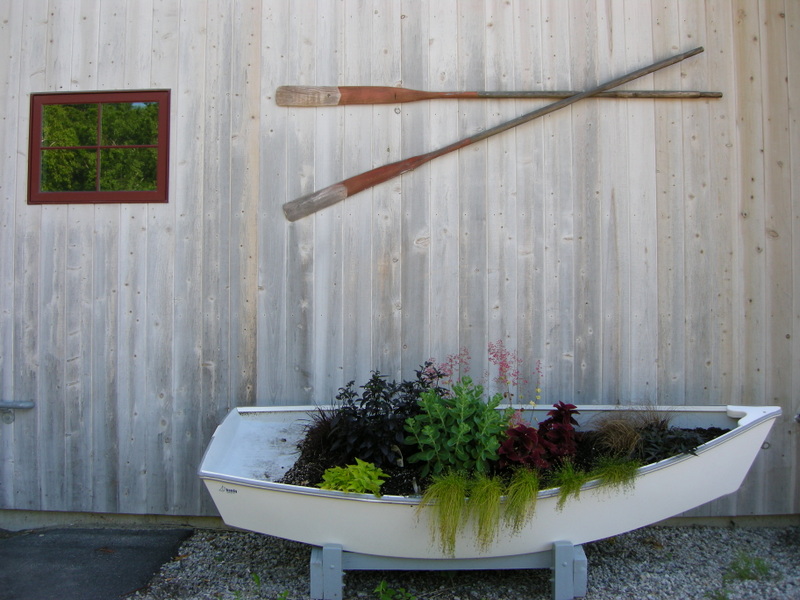
DSCN4634The dinghy planting this year is a disappointment.

Those of you who follow my blog may remember the posts that I wrote in 2013 and 2012 on the creative use of annuals in a dinghy (small rowboat) at a Maine marina.  You can find those posts here and here.  I used the dinghy planting as an example of how the imaginative and thoughtful use of annuals can produce an elegant and striking result.  Unfortunately, the planting this year is not up to the former standards.  Normally I wouldn’t feature it, but I thought it might be illuminating to think about what went wrong.

.

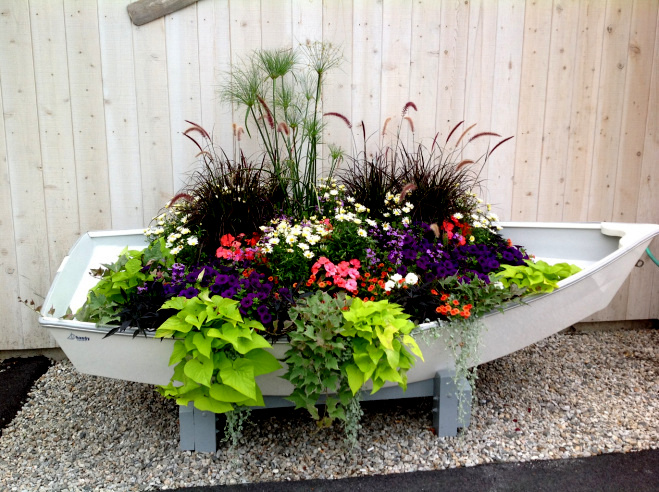
Handy Boat dinghyThe dinghy planting in 2012 was gorgeous.

.

Handy Boat dinghy 32013 was not quite as sophisticated but made up for this with its exuberance.

When comparing the three plantings the first thing you notice is that the colors for 2014 are too subtle.  I love chartreuse and purple, but in a container planting you need some plants that cause passers by to stop and look.  But the bigger problem is that there are not enough plants.  As I pointed out before, containers generally last for one season only and need to be filled to bursting from the beginning.  There is no time to let them fill in as you would with perennial plantings in the ground.

.

Handy Boat dinghy 22013 packed with plants

.

Handy Boat Dinghy 12012

.

DSCN4630This year’s planting shows a lot of bare soil.  The photos for all three years were taken in early July.

Another mistake the designer made was to ignore the classic filler-spiller-thriller formula of planting containers.  The heucherella flowers in the back just don’t provide the necessary height that you need, especially in a container this big, and will be done flowering shortly.  The sedum, coleus, and plectranthus (I think that what it is) will not fill in the middle, and the fibre optic grass and the two sweet potato vines are not spilling over the side enough.

.

DSCN4633 A close up of 2014.

Despite my negative comments, as you can see from the photo above, the habit and colors of the plants go well together.  They would look great crammed into a smaller container situated for close up viewing.  I also always encourage the use of perennials in containers, like the sedum and heucherella here.  In late fall, you can transfer them into the ground and enjoy them in your perennial garden for years to come. 

Looking closely at this dinghy planting in good years and bad has given me a lot of ideas about my own containers.  In fact, I had never seen fibre optic grass and purchased some for my window boxes.  I hope you too will find inspiration for your own containers.

Carolyn

Nursery Happenings: Carolyn’s Shade Gardens is closed for the summer and will reopen in early September.  You can sign up to receive notification emails by sending your full name and phone number to carolynsshadegardens@verizon.net.

Carolyn’s Shade Gardens is a local retail nursery in Bryn Mawr, Pennsylvania, U.S., zone 7a. The only plants that we mail order are snowdrops and miniature hostas and only within the US.

If you are within visiting distance and would like to receive catalogues and information about customer events, please send your full name and phone number to carolynsshadegardens@verizon.net. Subscribing to my blog does not sign you up to receive this information.

Facebook: Carolyn’s Shade Gardens has a Facebook Page where I post single photos, garden tips, and other information that doesn’t fit into a blog post. You can look at my Facebook page here or click the Like button on my right sidebar here.

Notes: Every word that appears in orange on my blog is a link that you can click for more information. If you want to return to my blog’s homepage to access the sidebar information (catalogues, previous articles, etc.) or to subscribe to my blog, just click here.

Do You Know Where Your Mulch Comes From?

Posted in green gardening, How to, landscape design, organic gardening, product review, sustainable living with tags , , , , , , on June 9, 2014 by Carolyn @ Carolyns Shade Gardens

Nursery News:  Carolyn’s Shade Gardens is a retail nursery located in Bryn Mawr, PA, specializing in showy, colorful, and unusual plants for shade.  The only plants that we ship are snowdrops and miniature hostas.  For catalogues and announcements of events, please send your full name, location, and phone number (for back up use only) to carolyn@carolynsshadegardens.com.  Click here to get to the home page of our website for catalogues and information about our nursery and to subscribe to our blog.

.

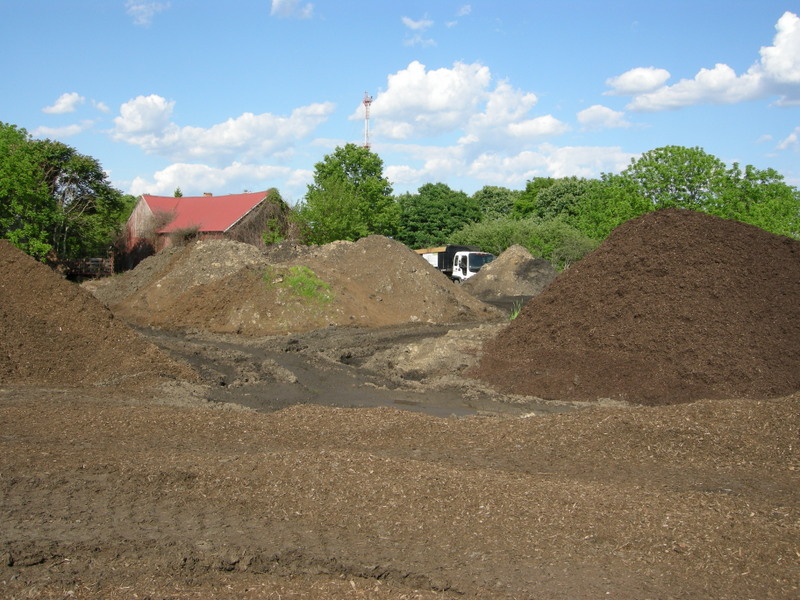
Moriuchi compost 5-25-2014 5-13-29 PMA pile of freshly ground mulch, but what’s in it?

My friend and longtime customer Caroline Moriuchi invited me for a guided tour of her family’s mulch production operation, M&M Mulch in Moorestown, NJ.  I jumped at the chance because I always wondered how mulch was made.  What I learned from my trip plus subsequent research is that if you don’t know what your mulch is made from, you should.

.

Moriuchi compost 5-25-2014 5-07-43 PMAs you can see in this photo, M&M Mulch accepts only wood chips and brush for grinding into their high quality mulch.

M&M Mulch, which is run by Caroline’s son Seiji with the help of his father and brother, has a company policy of using only wood chips from tree services and brush from landscapers for grinding into mulch.  They will not use wooden pallets, scrap lumber, or parts of demolished buildings to produce mulch, although this is common practice in their business.  For this reason, they do not produce red-dyed mulch because it can only be made from processed lumber like pallets.  I am going to show you the Moriuchi’s mulching operation, but first I want to outline some of the dangers from pallets.

.

Moriuchi compost 5-25-2014 5-36-19 PMMulch being ground at M&M Mulch

You should do your own research, but, after reading many articles, I would never use commercially produced mulch without knowing what it was made of.  The best article on the subject is in Natural Life Magazine, to read it click here

Basically, a lot of mulch is made from recycled shipping pallets.  If you drive down Interstate 95, you can see the huge pile of pallets waiting to be ground into mulch near Wilmington, DE.  A high percentage of pallets are contaminated with bacteria, including e coli and listeria, from the food transported on them and from improper storage.  They are often made from “engineered wood” which is treated with formaldehyde. 

The pallets themselves are often treated with dangerous chemicals, although this is being phased out.  If they come in from abroad, they are fumigated with toxic fungicides and pesticides, and toxic substances often spill on pallets during transportation.  Wood scraps and demolished buildings pose similar dangers from toxic applications like lead paint and pressure treated wood. 

Now we get to the fun part, how mulch is made:

.

Moriuchi compost 5-25-2014 5-03-23 PMThe mulch production process starts with this very big machine, the grinder.

.

Moriuchi compost 5-25-2014 5-04-43 PMThe grinder is moved around the production yard using this remote control.

.

Moriuchi compost 5-25-2014 5-35-26 PM  A front end loader is a crucial piece of equipment.

.

Moriuchi compost 5-25-2014 5-35-34 PM The loader scoops up the wood chips and brush from the giant piles waiting to be ground.

.

Moriuchi compost 5-25-2014 5-35-54 PMThe raw material is deposited into a hopper on the grinder.

.

Moriuchi compost 5-25-2014 5-06-46 PMConveyor belts inside the grinder feed the grinding teeth.

.

Moriuchi compost 5-25-2014 5-37-13 PMThe grinder produces a giant pile of mulch, but the process isn’t over because most consumers demand that their mulch be dyed.  I am not sure how this process started or why dark black mulch is considered more attractive than natural brown.  I personally think black-dyed mulch is hideous.

.

Moriuchi compost 5-25-2014 5-16-29 PMThe dyeing machine

.

Moriuchi compost 5-25-2014 5-24-42 PMThese paddles mix the ground wood with carbon black to make it black or iron oxide to make it brown.  M&M does not produce red-dyed mulch because it can only be made from pallets.

.

Moriuchi compost 5-25-2014 5-22-27 PMBlack-dyed mulch emerges from the dyeing machine.

.

Moriuchi compost 5-25-2014 5-22-54 PMBlack-dyed mulch on the right, brown-dyed on the left.

.

Moriuchi compost 5-25-2014 5-23-41 PMBrown-dyed mulch on the right, un-dyed mulch in front and on the left.  I think gardeners should question why they need dyed mulch.

.

Thanks so much to the Moriuchis, especially Seiji who answered all my questions, for the fascinating tour.  If you live near Moorestown, New Jersey, you are very lucky to have a safe source of mulch nearby produced by the fourth generation family farmers at M&M Mulch, 400 Hartford Rd, 856-234-2394.  They deliver free to the Moorestown area and for a fee to other parts of New Jersey.  Who knows maybe they can be enticed to cross the river to Pennsylvania!

Carolyn

Nursery Happenings: The 2014 Miniature Hosta Availability for mail order and pick up at the nursery is here.   Your final chance to shop at Carolyn’s Shade Gardens will be during our open hours on Friday, June 13, and Saturday, June 14, from 10 am to 2 pm.  We close on June 15 and reopen around September 15.  You can sign up to receive notification emails by sending your full name and phone number to carolynsshadegardens@verizon.net.

Carolyn’s Shade Gardens is a local retail nursery in Bryn Mawr, Pennsylvania, U.S., zone 7a. The only plants that we mail order are snowdrops and miniature hostas and only within the US.

If you are within visiting distance and would like to receive catalogues and information about customer events, please send your full name and phone number to carolynsshadegardens@verizon.net. Subscribing to my blog does not sign you up to receive this information.

Facebook: Carolyn’s Shade Gardens has a Facebook Page where I post single photos, garden tips, and other information that doesn’t fit into a blog post. You can look at my Facebook page here or click the Like button on my right sidebar here.

Notes: Every word that appears in orange on my blog is a link that you can click for more information. If you want to return to my blog’s homepage to access the sidebar information (catalogues, previous articles, etc.) or to subscribe to my blog, just click here.

Letting Go Part 2: Naturalizing Bulbs

Posted in bulbs for shade, How to, landscape design, my garden, Shade Perennials, snowdrops with tags , , , , , , , , , , , , , , , , , , , , , , , , , , , , , , , , on April 10, 2014 by Carolyn @ Carolyns Shade Gardens

Nursery News: Carolyn’s Shade Gardens is a retail nursery located in Bryn Mawr, PA, specializing in showy, colorful, and unusual plants for shade.  The only plants that we ship are snowdrops and miniature hostas.  For catalogues and announcements of events, please send your full name, location, and phone number (for back up use only) to carolyn@carolynsshadegardens.com.  Click here to get to the home page of our website for catalogues and information about our nursery and to subscribe to our blog.

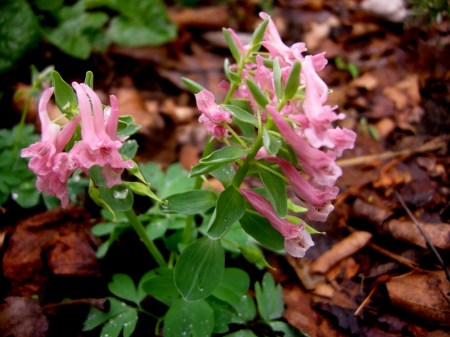
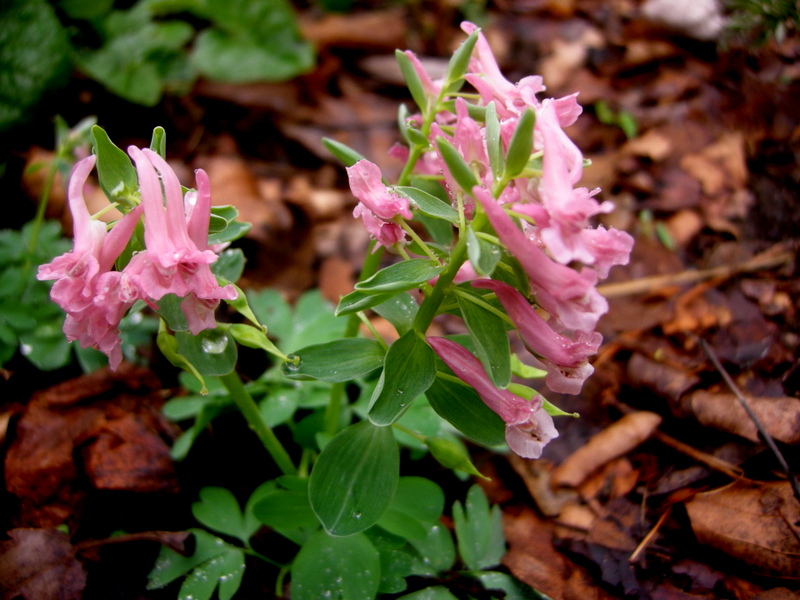
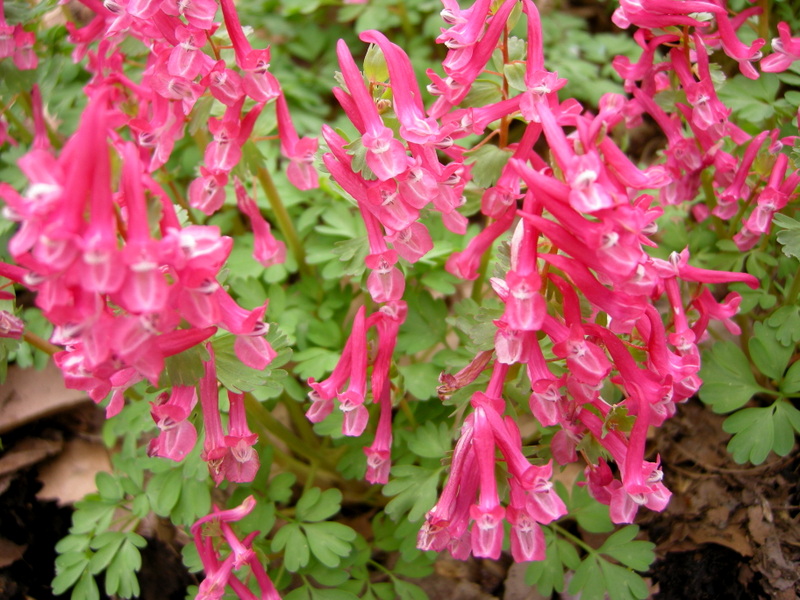
Corydalis solidaWhen I stopped trying to keep all my Corydalis solida separate and let the colors hybridize, this is what I got.

In May of 2011, I wrote a post titled Letting Go Part 1: The Lawn.  It is a well-documented discussion of why gardeners should get rid of their lawns and let what lawn remains go “natural”.  At the time I intended to write another article about letting go of garden beds, but time got away from me.  

 .
Galanthus nivalis, Crocus tommasinianusCommon snowdrops, Galanthus nivalis, and snow crocus, C. tommasinianus, naturalized in Charles Cresson’s meadow—a wonderful combination for late winter.

I was inspired to get back to the topic by reading a gorgeous book on bulbs given to me by one of my customers.  Not to digress, but I have the nicest customers who constantly send me articles, bring homemade food, send beautiful cards and letters sometimes hand drawn (one customer is a professional calligrapher), and write complimentary and encouraging emails.  Thanks to you all.

.

Buried Treasures.

This book was no ordinary gift but a 400 page hardcover book with over 300 color plates.  It is called Buried Treasures and was written by Janis Ruksans.  Ruksans is an internationally famous nurseryman and plant explorer with a mail order nursery specializing in unusual bulbs and located in Latvia.  He has introduced hundreds of bulbs and one of his focuses is Corydalis solida (first photo), which happens to be one of my favorite plants.

.
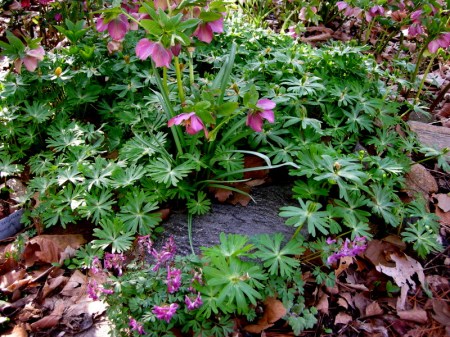
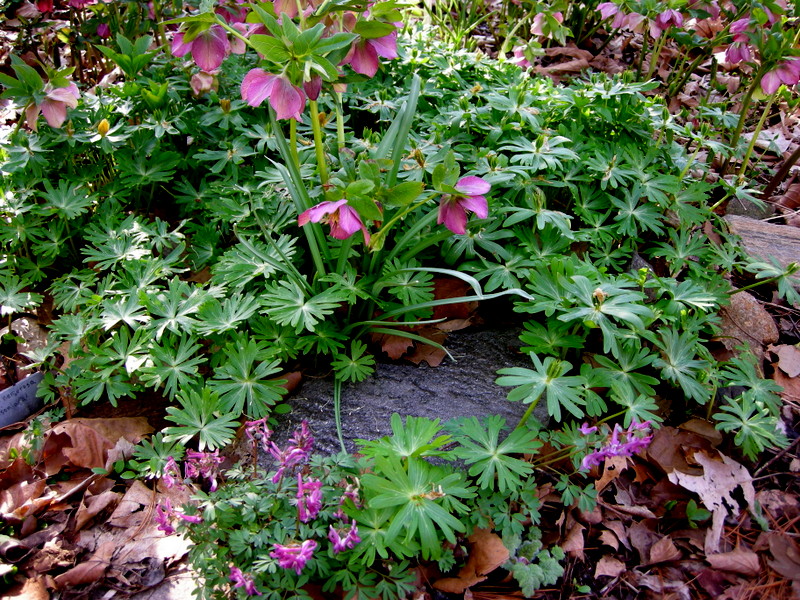
Eranthis hyemalis, Corydalis solidaWinter aconite, Eranthis hyemalis, naturalized with corydalis and hybrid hellebores.

.

Eranthis hyemalisWinter aconite in bloom in February.

As I read his book, I was struck by what he said about naturalizing bulbs:

“There are two different kinds of naturalization.  The first kind occurs when you plant your bulbs so they will look as natural as possible.  The second kind is the real thing, which will happen only if your bulbs start to reproduce by self-sowing.… Some of the most beautiful displays happen in spots where bulbs … have been left to develop naturally.”

As simple as this statement appears, many gardeners have trouble applying this concept to their gardens because it requires letting go.  You are no longer in control of where plants appear and how they combine with each other.  I know because it took me years to embrace it myself.

.

Scilla mischtschenkoana, Dicentra cucullariaTubergen squill, Scilla mischtschenkoana, on the left and Dutchman’s breeches, Dicentra cucullaria, spread randomly at Carolyn’s Shade Gardens.

However, once I let go of deciding where bulbs (and many perennials) could grow, I believe that my garden reached a whole new level of interest and beauty.  Ruksans’s book inspired me to write this post about the bulbs, including tubers, corms, and other bulb allies, that spread well in my garden.  If you feel inclined to let go, here are some of the bulbs that work the best.

.

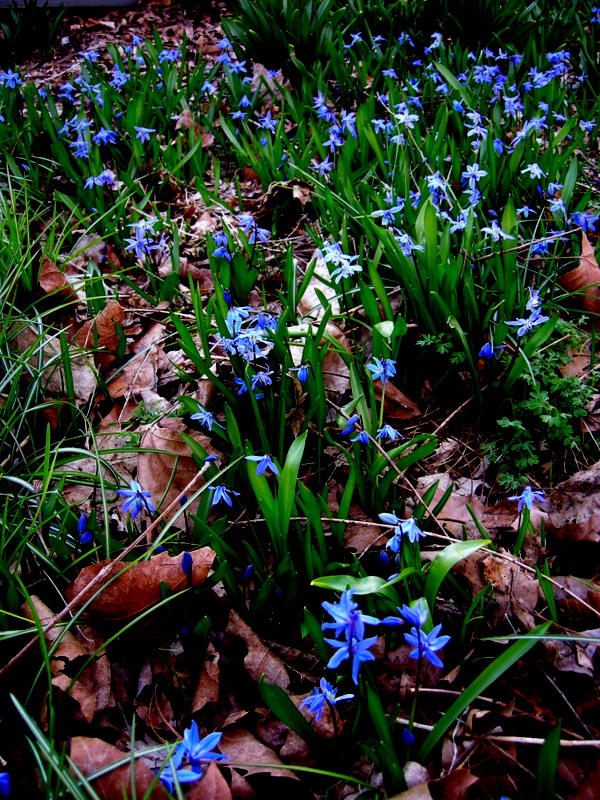
Scilla sibericaSiberian squill, Scilla siberica, provides a splash of early brilliant blue and moves all over the garden, even into the lawn.

.

Puschkinia scilloidesStriped-squill, Puschkinia scilloides, is pale blue and spreads beneath my winterhazel.
.

Puschkinia scilloidesA close up shot better shows off striped-squill’s elegance. 

.
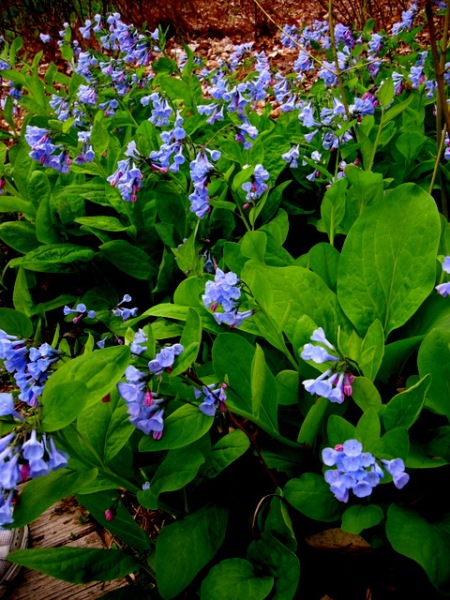
Mertensia virginicaThere are hardly any beds in my garden that do not sport Virginia bluebells, Mertensia virginica, in early spring.  All I planted was the original clump given to me by a good friend many years ago.

.

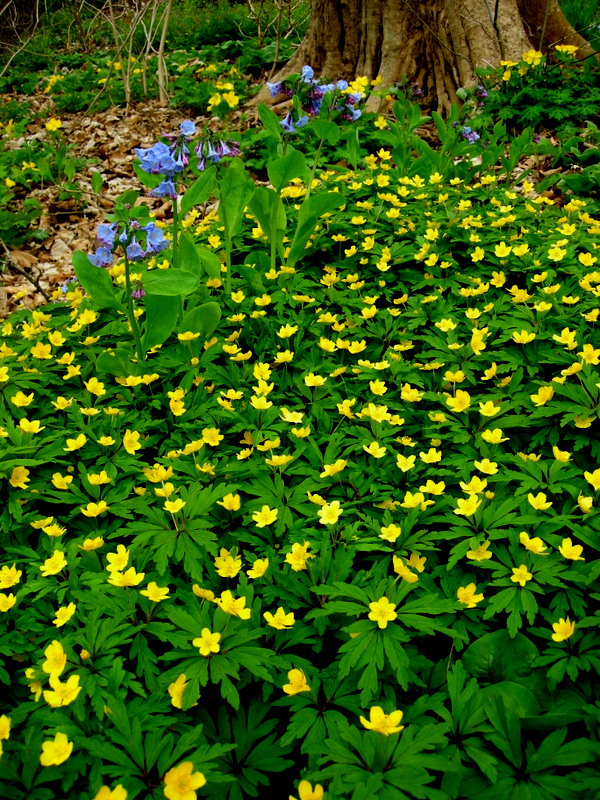
Anemone ranunculoides, Mertensia virginicaWood anemones, including Anemone ranunculoides pictured above with Virginia bluebells, have been allowed to form gigantic patches in my woodland.

.

Anemone nemorosa 'Alba Plena'European wood anemones, A. nemorosa, are a favorite, including ‘Alba Plena’.

.

Anemone ranunculoides, Anemone nemorosa 'Vestal'My woodland with wood anemones and bluebells.

.

Chionodoxa forbesiiGlory-of-the-snow, Chionodoxa forbesii, is everywhere even the formal beds by the front door.  It doesn’t take up any “room” because it goes dormant and perennials can be planted right in it.

.

Chionodoxa forbesii 'Pink Giant'‘Pink Giant’ is the pink cultivar of glory-of-the-snow, and it too plants itself wherever it wants.

The most wonderful result of my new relaxed approach came from Corydalis solida, a plant with no real common name.  It is a bulbous corydalis, which comes up very early in spring and dies back shortly after flowering.  Unlike the colorful herbaceous corydalis that never come back due to our hot summers, this corydalis returns year after year without fuss and even self-sows.  Here are a few of its cultivars:

.
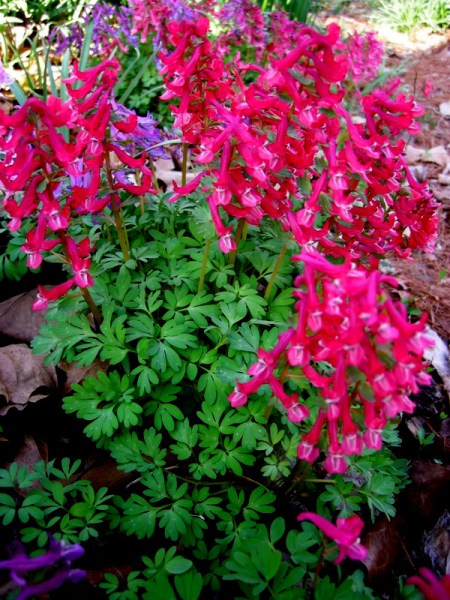
Corydalis solida 'George P. Baker'‘George P. Baker’

.

Corydalis solida subsp. incisaC. solida subsp. incisa

.

Corydalis solida 'Blushing Girl'‘Blushing Girl’ selected by Jans Ruksans.

.
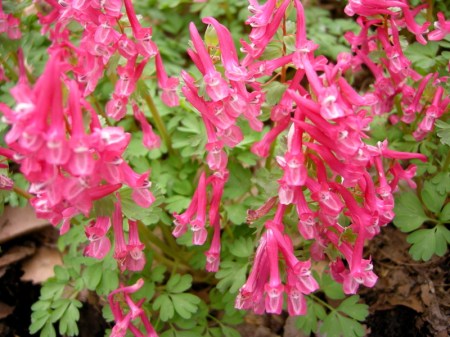
Corydalis solida 'Beth Evans'‘Beth Evans’

All four cultivars are very beautiful in their own right, and at first I kept them separate so they would stay pure.  However, when I let go and nature took its course, the results were amazing.  Now I have a rainbow of corydalis.

.

Corydalis solida seedling 4-3-2011 7-36-54 PMCordalis solida left to its own devices.

Although I have a large garden, this is not a technique limited to big spaces.  Any garden bed full of perennials or any area beneath trees and shrubs is perfect for naturalizing bulbs.  Just give them a free hand after you get them started.

Carolyn

Nursery Happenings: Our third sale is Saurday, April 26, from 10 am to 3 pm.  Customers on our list will get an email with all the details.  You can sign up to receive emails by sending your full name and phone number to carolynsshadegardens@verizon.net.  Coming soon is a shrub offer.  If you have any shrubs you want, please email me at carolynsshadegardens@verizon.net

Carolyn’s Shade Gardens is a local retail nursery in Bryn Mawr, Pennsylvania, U.S., zone 7a. The only plants that we mail order are snowdrops and miniature hostas and only within the US.

If you are within visiting distance and would like to receive catalogues and information about customer events, please send your full name and phone number to carolynsshadegardens@verizon.net. Subscribing to my blog does not sign you up to receive this information.

Facebook: Carolyn’s Shade Gardens has a Facebook Page where I post single photos, garden tips, and other information that doesn’t fit into a blog post. You can look at my Facebook page here or click the Like button on my right sidebar here.

Notes: Every word that appears in orange on my blog is a link that you can click for more information. If you want to return to my blog’s homepage to access the sidebar information (catalogues, previous articles, etc.) or to subscribe to my blog, just click here.

Hellebore Leaves

Posted in hellebores, How to, Shade Perennials, winter, winter interest with tags , , , , , , , on March 13, 2014 by Carolyn @ Carolyns Shade Gardens

Nursery News: Carolyn’s Shade Gardens is a retail nursery located in Bryn Mawr, PA, specializing in showy, colorful, and unusual plants for shade.  The only plants that we ship are snowdrops and miniature hostas.  For catalogues and announcements of events, please send your full name, location, and phone number (for back up use only) to carolyn@carolynsshadegardens.com.  Click here to get to the home page of our website for catalogues and information about our nursery and to subscribe to our blog.

.

Helleborus 'Ballerina Ruffles'This beautiful, newly introduced double hellebore called ‘Ballerina Ruffles’ will be available at the hellebore sale on March 29.

One certain sign of spring at Carolyn’s Shade Gardens is when I start getting calls and emails about hellebore leaves.  Since so many of my customers have questions about this, I thought I would write a quick post on the subject.  For a longer post with a detailed explanation of hellebore maintenance as applied to the various types of hellebores you might have in your garden, please read Cutting Back Hellebores.

.

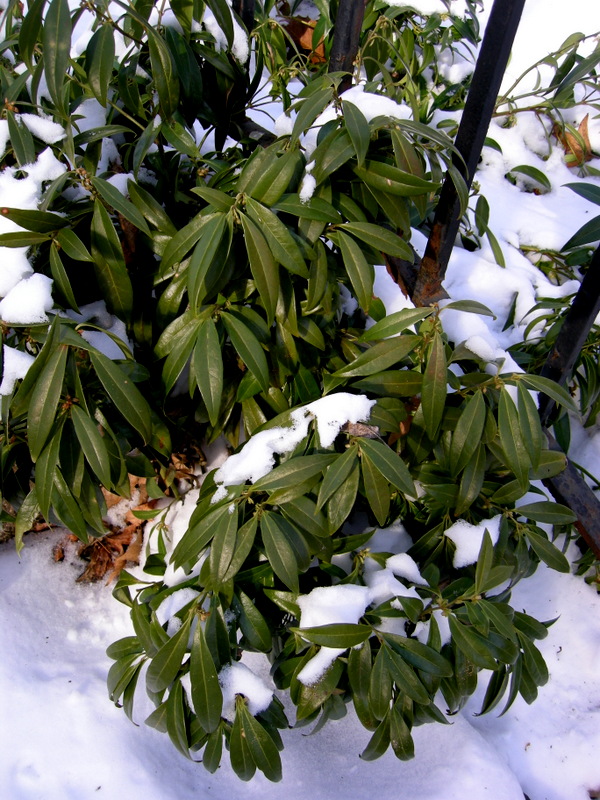
DSCN3715Sweet box (Sarcococca) is a true evergreen shrub and still looks beautiful after our hard winter.

The question I get from my customers this time of year is: “What’s wrong with my hellebores, the leaves look terrible?”  The answer is that although hellebores are often called evergreen, they are actually an herbaceous perennial and lose their foliage every year just like a peony or a coneflower.  Unlike a peony, hellebore leaves last through most of the winter adding ornamental interest to the winter garden.  Hellebore foliage is winter green not evergreen.  Eventually the leaves fade and are replaced with fresh new growth.

.

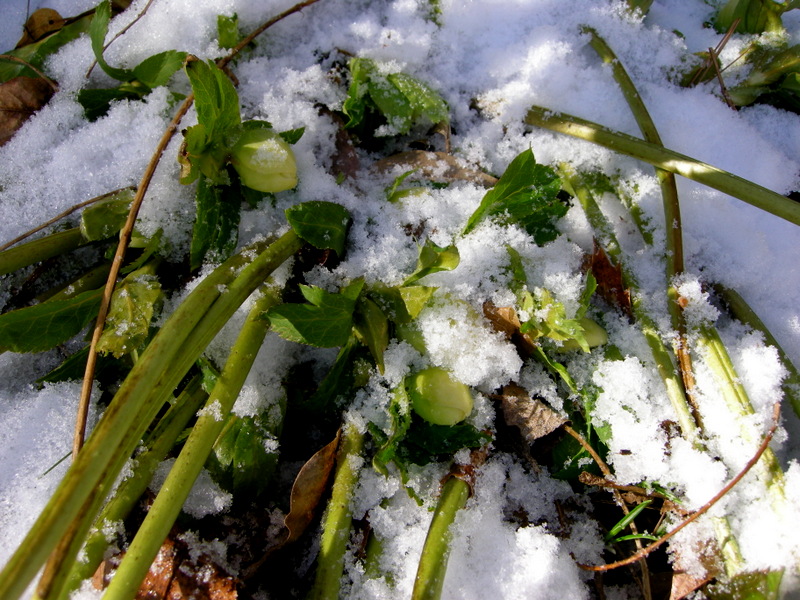
DSCN3713-001A typical hellebore in my garden right now.

In mild winters, hellebore leaves will still look fresh and green in March.  But in harsh winters like the one we just experienced, hellebore foliage will look like the photo above.  No matter what the leaves look like though, you should cut them off at the base in late winter before the flowers start to emerge.  I usually recommend mid-February but that was impossible this year.  I am cutting them back now as they emerge from the snow.  I want to get the job done before the new flower stems mingle with the old leaf stems.  If that happens it is hard to remove the leaves without unintentionally chopping off flowers.

.

DSCN3710Just trace the leaf back to the base of the plant and cut it off.

.

DSCN3727A close up of the base of the plant with the old leaves and the new buds.

So the answer is there is nothing wrong with your hellebores.  Despite the awful winter and frigid temperatures, they will bloom as beautifully as ever.  They just need a little maintenance.  But before you get chopping, please read the more detailed directions in Cutting Back Hellebores.

.

DSCN3711As soon as the snow melted, snow crocuses burst into bloom, a sure sign of spring.
.

DSCN3723Snowdrops are equally as determined to get blooming and have been covered with honeybees on warmer days.

That is about all that is going on at Carolyn’s Shade Gardens right now.  If you have ordered snowdrops, I am hoping to start shipping as early as next week.  Although it is supposed to go down to 20 degrees tonight, the ten-day forecast predicts warmer weather.  Let’s keep our fingers crossed!

Carolyn

Nursery Happenings: Our first open house sale featuring a huge variety of hellebores is scheduled for Saturday, March 29, from 10 am to 3 pm.  Customers will get an email with details.

Carolyn’s Shade Gardens is a local retail nursery in Bryn Mawr, Pennsylvania, U.S., zone 7a. The only plants that we mail order are snowdrops and miniature hostas and only within the US.

If you are within visiting distance and would like to receive catalogues and information about customer events, please send your full name and phone number to carolynsshadegardens@verizon.net. Subscribing to my blog does not sign you up to receive this information.

Facebook: Carolyn’s Shade Gardens has a Facebook Page where I post single photos, garden tips, and other information that doesn’t fit into a blog post. You can look at my Facebook page here or click the Like button on my right sidebar here.

Notes: Every word that appears in orange on my blog is a link that you can click for more information. If you want to return to my blog’s homepage to access the sidebar information (catalogues, previous articles, etc.) or to subscribe to my blog, just click here.

Low Maintenance Garden Part 2: Techniques

Posted in How to, my garden, sustainable living with tags , , , , , , , , , on December 1, 2013 by Carolyn @ Carolyns Shade Gardens

Carolyn’s Shade Gardens is a retail nursery located in Bryn Mawr, PA, specializing in showy, colorful, and unusual plants for shade.  The only plants that we ship are snowdrops and miniature hostas.  For catalogues and announcements of events, please send your full name, location, and phone number (for back up use only) to carolyn@carolynsshadegardens.com.  Click here to get to the home page of our website for catalogues and information about our nursery and to subscribe to our blog.

.Magnolia kobus 'Wada's Memory'‘Wada’s Memory’ magnolia provides plenty of leaves for Michael’s leaf grinding efforts plus some gorgeous fall color.

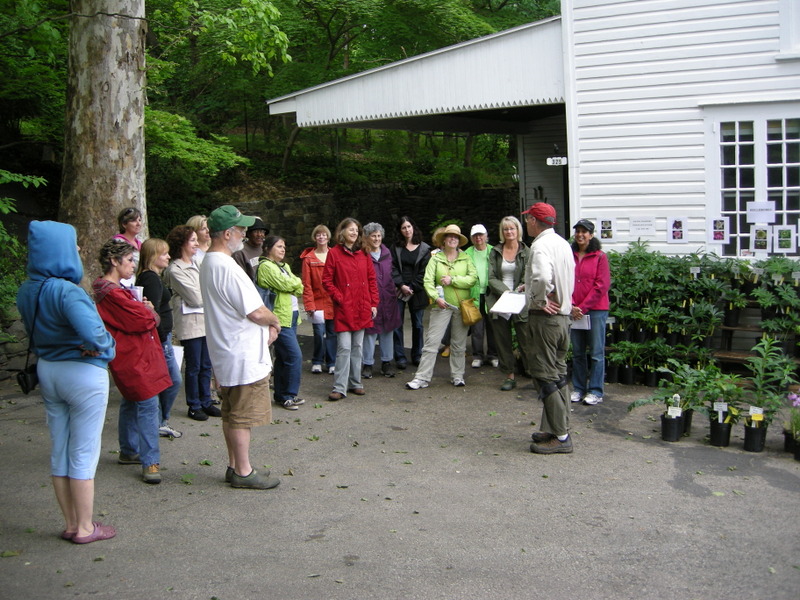
My husband Michael and I have spent 30 years perfecting our gardening techniques at Carolyn’s Shade Gardens, and we are always happy to pass on what we have learned to our nursery customers.  In spring 2012, Michael developed a series of seminars to demonstrate our methods to our customers right here at the nursery.  This post is Part 2 of a two part series explaining what goes on at Michael’s seminars.  Part 1 detailed the tools that we recommend to make garden maintenance easy.  You can read it by clicking here.

.

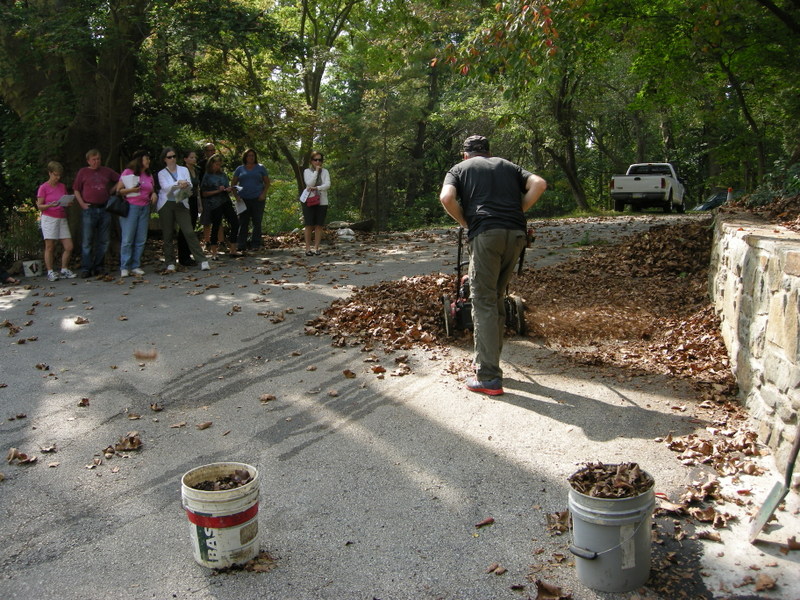
DSCN3368Michael with a typical pile of leaves ready for grinding into mulch.

We believe that the most valuable asset on our property is the leaves that fall from our trees.  Leaves are what nature provides for free to protect and improve your soil.  Removing and disposing of your leaves outside your own property is the worst thing that you can do to your garden.  During his seminar, Michael demonstrates how we handle the massive quantity of leaves that fall from our 35 plus large deciduous trees.  Basically we leave them in place to decompose on their own, grind them on the lawn to help it grow, and grind them into mulch for our garden beds.

  .

DSCN2935Michael demonstrates leaf grinding to seminar attendees.

For a step-by-step guide to grinding your leaves to use for mulch, please read my post Your Most Precious Garden Resource by clicking here.  For a video by Scotts Lawn Care showing how to grind leaves on your lawn, click here.  A recent Michigan State University study has shown that grinding up to 18″ of leaves on your lawn and leaving them there is beneficial to your lawn.  For more information on how we handle leaves in our beds in the fall, click here.

.

DSCN2936Michael demonstrates how he uses the ground leaves for mulch in our gardens.

.

Our other secret weapon is compost, which we make ourselves and also get from the township.  No bed is created and no plant is planted without adding a large amount of this “black gold”.  Michael shows seminar attendees what good compost should look like and demonstrates how we go about composting.  For more information on how we use compost in our garden, read my post Powered by Compost by clicking here.

.

DSCN2933During the tool session at the beginning of the seminar, Michael talks about what an important tool compost is.

.

DSCN2943Every seminar includes a trip to our compost area and a demonstration of composting techniques.

Many other important gardening jobs are explained in detail with live demonstrations…..

.

DSCN7137Planting a perennial using a shovel or an auger attachment to a drill.

.

DSCN7138Edging beds to keep out weeds and present a manicured look.

.

DSCN2939 Planting a shrub, here Michael shows how it is important to loosen the roots on the outside of the rootball.

.

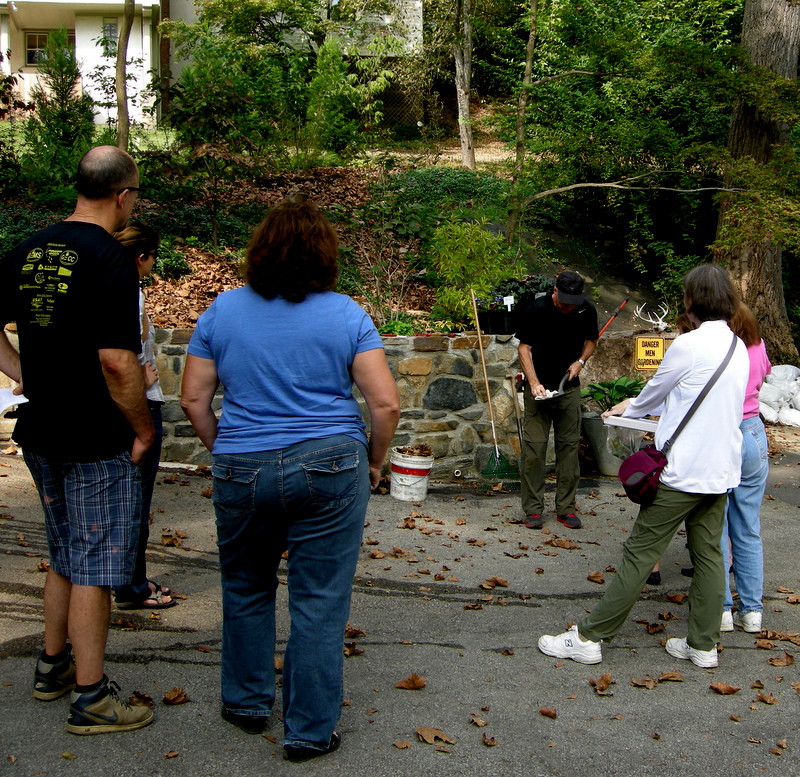
DSCN7141Every session ends with a question and answer period during which attendees can ask about any gardening task that interests them.

.

These are just some of the topics covered in a typical seminar.  Other subjects include deer management, invasive plant removal, winter interest, container planting, and many more.

Carolyn

.

Carolyn’s Shade Gardens is a local retail nursery in Bryn Mawr, Pennsylvania, U.S., zone 6b. The only plants that we mail order are snowdrops and miniature hostas and only within the US.

If you are within visiting distance and would like to receive catalogues and information about customer events, please send your full name and phone number to carolynsshadegardens@verizon.net. Subscribing to my blog does not sign you up to receive this information.

Nursery Happenings: Carolyn’s Shade Gardens is closed for the winter.  Please visit my Etsy Shop to purchase photo note cards suitable for all occasions by clicking here.  Look for the 2014 Snowdrop Catalogue in early January.

Facebook: Carolyn’s Shade Gardens has a Facebook Page where I post single photos, garden tips, and other information that doesn’t fit into a blog post. You can look at my Facebook page here or click the Like button on my right sidebar here.

Notes: Every word that appears in orange on my blog is a link that you can click for more information. If you want to return to my blog’s homepage to access the sidebar information (catalogues, previous articles, etc.) or to subscribe to my blog, just click here.

Low Maintenance Garden Part 1: Tools

Posted in How to, my garden, sustainable living with tags , , , , , , , , on November 18, 2013 by Carolyn @ Carolyns Shade Gardens

Carolyn’s Shade Gardens is a retail nursery located in Bryn Mawr, PA, specializing in showy, colorful, and unusual plants for shade.  The only plants that we ship are snowdrops and miniature hostas.  For catalogues and announcements of events, please send your full name, location, and phone number (for back up use only) to carolyn@carolynsshadegardens.com.  Click here to get to the home page of our website for catalogues and information about our nursery and to subscribe to our blog.

Note Card Images note card images

Before I get to the post, I want to let all my readers know that I have set up a shop on Etsy, a website featuring vintage and handmade goods, called CarolynsShadeGardens so you can use your credit card to purchase my photo note cards.  Click here to visit the shop and see the note cards available.   You can also click on the permanent link I have placed on the right sidebar of this website.

The cards come individually or in sets and are perfect for birthday greetings, expressions of sympathy, thank you notes, and for communicating with friends the old-fashioned way. The card sets make great gifts for the holidays especially useful for hostess presents, last minute gifts, and for the friend who has everything.

.

DSCN2937Michael demonstrates edging using an edger with a long handle.

Nursery customers always comment on the amount of work it must take to maintain our display gardens and marvel at how Michael and I do it with no additional help.  At this point in our lives, we are wondering that ourselves, but that’s another story.  However, part of the answer is that over our 30 years of gardening here we have developed many techniques to keep maintenance to a minimum while using sustainable, organic methods. 

In spring 2012, we developed a series of seminars to teach these techniques to our customers.  For readers who can’t attend, I thought I would show you what goes on during Michael’s Low Maintenance Garden Seminars.

  .

DSCN2929Michael shows off his all round favorite tool, a digging tool from Gempler’s discussed below.

Each seminar begins with a review of essential tools and their maintenance.  When Michael visits customers’ gardens in his capacity as garden coach, he often finds that they are making do with inadequate garden tools.  Having the right tool allows gardeners to perform maintenance jobs easily and efficiently.  Michael and I both have our favorites, and he demonstrates them during his seminar and tells attendees where to purchase them.

.

DSCN3405Michael’s favorite tool, a Gempler’s Professional 12″ Digging Tool.  It is similar to a Japanese farmer’s knife, but it has a hand guard for protection, which is essential for the safe use of this type of tool.  He uses it for weeding, planting, cutting, and many other jobs.  I prefer a skinny-headed trowel for weeding and a rabbiting spade for planting.

.

Originally, I was going to cover everything in one post, but as I started to write I found a lot to say about tools.  I was inspired to take individual photos of some of the important tools because Michael and I feel so strongly that they are the best.  The actual garden maintenance part of the seminars will be covered in Part 2.
.

DSCN3402Michael and I both would not be without Felco No. 2 Pruners.  My father bought me this pair over 30 years ago when he found me using some Kmart knock offs.  With infrequent sharpenings, they work as well as they did when I got them.

.

DSCN2922Michael demonstrates the use of our Dramm watering wand.  We have one of these wands on the end of each hose on our property and find it indispensable for all watering tasks.  I met the Dramm representative at a conference recently and told her that we promoted the wands at our seminars.  She nicely sent six wands to raffle off at our fall seminars this year, and six happy attendees went home with a new tool.  We hope to continue this with Dramm and other manufacturers at future seminars.  The hose to which the wand is attached is made by Flexogen and is the only kind we use—heavy duty and kink resistant.

.

DSCN3400For branches too thick for pruners, we use this folding hand saw also made by Felco.  It fits in your back pocket but handles very large branches while being easy to maneuver in tight spaces.

.

DSCN2931Tool maintenance, especially keeping tools clean and sharp, is very important.  Here Michael cleans and sharpens the pointed blade of our long-handled shovel, which is the shovel we both use for digging and shoveling.  The long handle is essential for the leverage you need to get the job done easily no matter what size you are and without bending over.

.

DSCN3401   These Corona ComfortGel Floral Snips are the tool I always have with me in the garden.  They are small enough to cut herbaceous leaves but rugged enough to handle woody stalks and small branches.  The gel handles are comfortable, and the blades spring open and closed smoothly.

.

DSCN3403Michael and I both think it is very important to protect your knees when you are kneeling down weeding or planting.  We both wear strap on kneepads.  I prefer the soft kind made by Kneelons pictured above while Michael likes the hard shell type sold for doing tile work.

.

Other tools we recommend: I dig all the perennials I grow and sell with a rabbiting spade, which is just the right size to slip easily between other plants that I do not want to disturb.  Long-handled loppers are useful for leverage when pruning bigger branches.  We also consider a heavy duty, very sharp, folding serrated knife essential for dividing plants.  I never head out into the garden to weed without my large or small Bosmere weeding bag (they call it a tip bag).  These bags are very light but durable and their sides don’t sag.

We could recommend many other tools—this won’t surprise you if you have been here and seen our garage—but these are the most important tools that help make our garden low maintenance.

Carolyn

.

Carolyn’s Shade Gardens is a local retail nursery in Bryn Mawr, Pennsylvania, U.S., zone 6b. The only plants that we mail order are snowdrops and miniature hostas and only within the US.

If you are within visiting distance and would like to receive catalogues and information about customer events, please send your full name and phone number to carolynsshadegardens@verizon.net. Subscribing to my blog does not sign you up to receive this information.

Nursery Happenings: Carolyn’s Shade Gardens is closed for the winter.  Please visit my Etsy Shop to purchase photo note cards suitable for all occasions by clicking here.  Look for the 2014 Snowdrop Catalogue in early January.

Facebook: Carolyn’s Shade Gardens has a Facebook Page where I post single photos, garden tips, and other information that doesn’t fit into a blog post. You can look at my Facebook page here or click the Like button on my right sidebar here.

Notes: Every word that appears in orange on my blog is a link that you can click for more information. If you want to return to my blog’s homepage to access the sidebar information (catalogues, previous articles, etc.) or to subscribe to my blog, just click here.

Your Most Precious Garden Resource

Posted in Fall, Fall Color, green gardening, How to, organic gardening, sustainable living with tags , , , , on October 25, 2012 by Carolyn @ Carolyns Shade Gardens

Carolyn’s Shade Gardens is a retail nursery located in Bryn Mawr, PA, specializing in showy, colorful, and unusual plants for shade.  The only plants that we ship are snowdrops and miniature hostas.  For catalogues and announcements of events, please send your full name, location, and phone number (for back up use only) to carolyn@carolynsshadegardens.com.  Click here to get to the home page of our website for catalogues and information about our nursery and to subscribe to our blog.

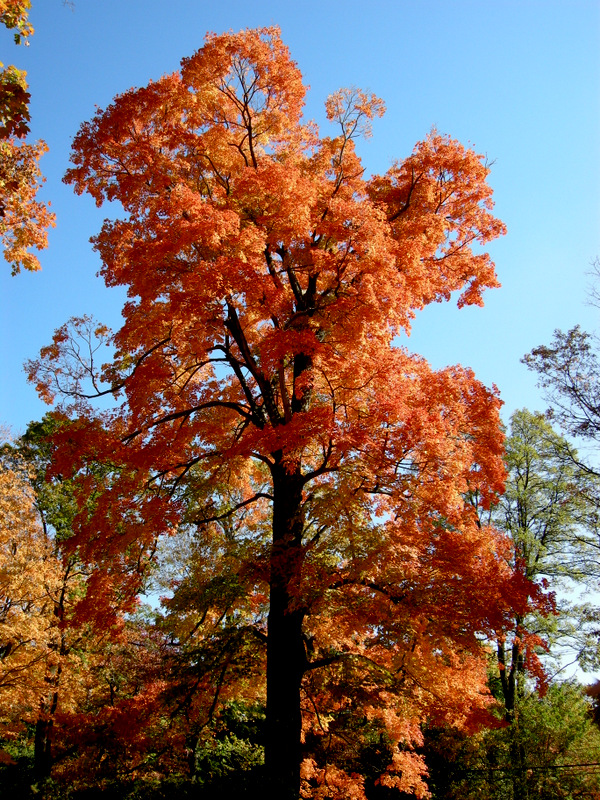
Yes, the sky is really this blue and the trees are really this red during fall in the northeastern US.

Fall in Pennsylvania (mid-Atlantic US) is a big picture time of year.  For a good two months, everywhere you go there are gorgeous vistas like the one above as the leaves change color before dropping.  The show is long-lasting because the leaves turn at different times, starting in my garden with the American hornbeam’s golden yellow hue, progressing through the bright red tones of maples and native dogwoods, and ending with the burgundy and orange of hydrangeas and viburnums.


The soil is deep and very fertile in my area, allowing trees to grow to gigantic size.  And after the color show, the leaves fall and create what I consider my most precious garden resource.  Those leaves are what nature supplies for free to protect and improve the soil year after year.  That is why it is so disturbing to see many area residents collecting their leaves and putting them by the side of the road to be removed by their municipality.


Here at Carolyn’s Shade Gardens we use every leaf that falls to improve our soil either by leaving them in the beds or by grinding them and using them as mulch.  A detailed description of our methods can be found in Shade Gardening in Fall: Fall Clean-up.  In addition, up to 18″ of leaves can be ground up and left on the lawn with beneficial results as described in Shade Gardening in Fall: Leaves on the Lawn.  There is a video by the Scott Lawn Care Company in the second post to show to your doubting spouse.

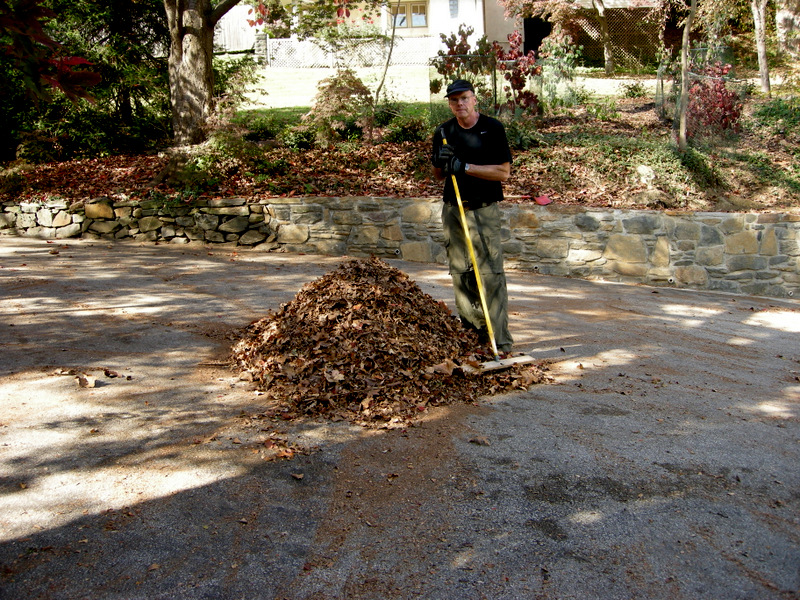
In early October, about 35 Carolyn’s Shade Gardens customers attended two Low Maintenance Gardening Seminars given by my husband Michael during which he demonstrated how to grind leaves for mulch.  For the benefit of my far flung readers  and in the hope of converting more gardeners to this practice, I thought I would show you step-by-step photographs of the process.  Michael is the reluctant star of the do-it-yourself guide below.

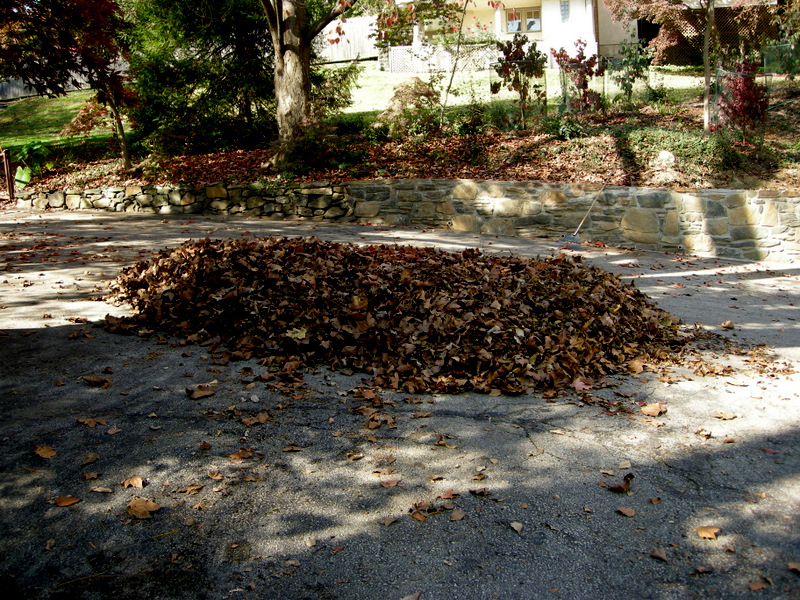
Step One:  Gather the leaves from an area where they can’t be left to decompose on their own.  Michael is removing leaves from the pine needle paths on our back hill using a tarp.  All leaves in the beds will remain in place as mulch and eventually compost.

Step Two:  Take the leaves to a level area like your lawn or driveway.  Our driveway is closest to the back hill so Michael took the leaves there for grinding.

As you can see in the photo, we use a standard lawnmower to grind our leaves.  We recommend wearing steel-toed footwear, ear protection (see photo below), and, if appropriate, eye protection when using a lawnmower.


Step Three:  Grind the leaves to the required consistency.  Michael usually goes over them twice, but you can make them as fine or as coarse as you want.


A large amount of leaves becomes a manageable pile after grinding.


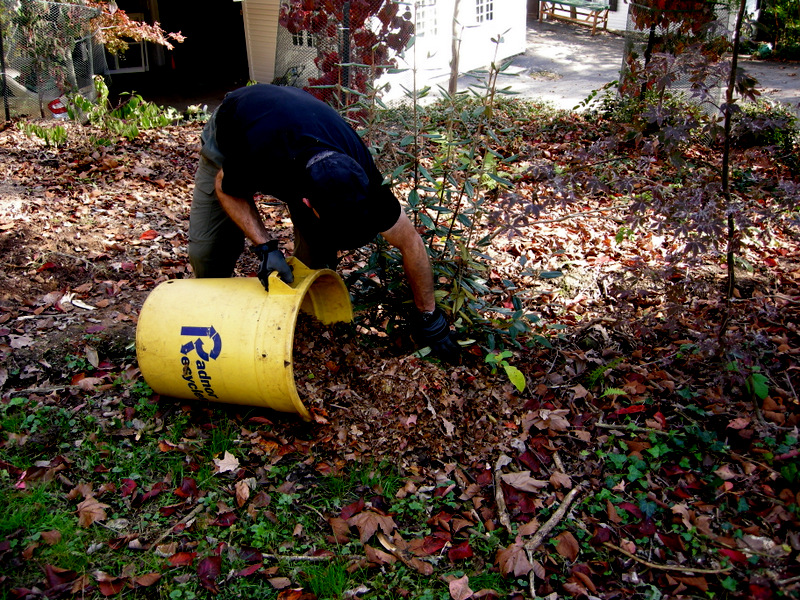
Step Four:  Gather your free mulch into a container for easy transportation and application.  Michael is using a township recycling barrel.


Step Five:  Spread the mulch in your garden.  Here Michael uses it around the base of newly planted viburnums.

I hope I have made this process look as easy as it really is.  Once you try it and see the beneficial results for your soil, you too will be a convert.

Carolyn


Nursery Happenings:  Carolyn’s Shade Gardens is done for the fall.  Thanks for a great year.  See you in spring 2013.

If you are within visiting distance and would like to receive catalogues and information about customer events, please send your full name and phone number to carolynsshadegardens@verizon.net.  Subscribing to my blog does not sign you up to receive this information.

Facebook:  Carolyn’s Shade Gardens has a Facebook page where I post single photos, garden tips, and other information that doesn’t fit into a blog post.  You can look at my Facebook page here or click the Like button on my right sidebar here.

Notes: Every word that appears in orange on my blog is a link that you can click for more information.  If you want to return to my blog’s homepage to access the sidebar information (catalogues, previous articles, etc.) or to subscribe to my blog, just click here.


Natural Rock Garden Seating

Posted in garden to visit, How to, landscape design with tags , , on August 9, 2012 by Carolyn @ Carolyns Shade Gardens

Carolyn’s Shade Gardens is a retail nursery located in Bryn Mawr, PA, specializing in showy, colorful, and unusual plants for shade.  The only plants that we ship are snowdrops and miniature hostas.  For catalogues and announcements of events, please send your full name, location, and phone number (for back up use only) to carolyn@carolynsshadegardens.com.  Click here to get to the home page of our website for catalogues and information about our nursery and to subscribe to our blog.

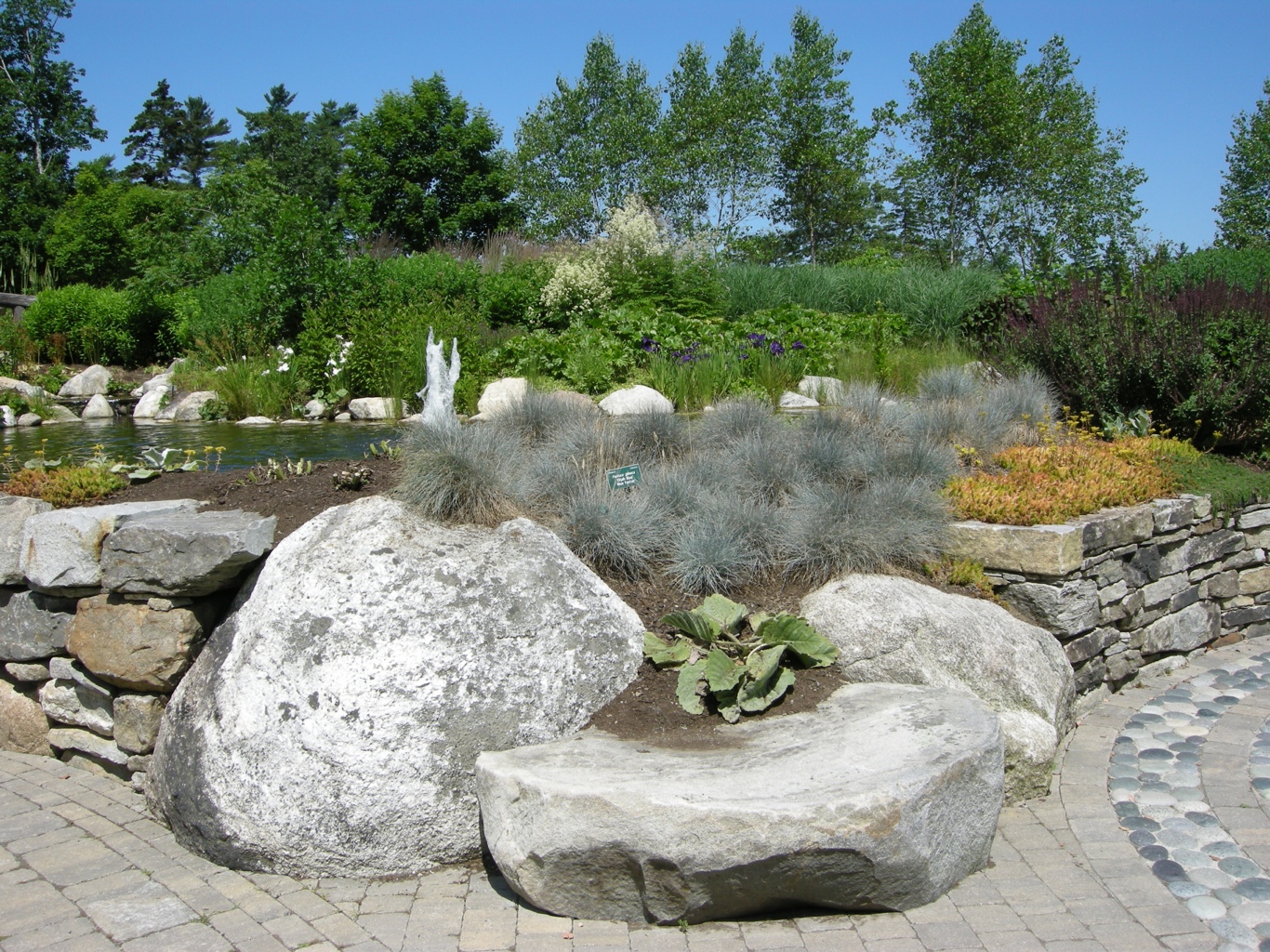
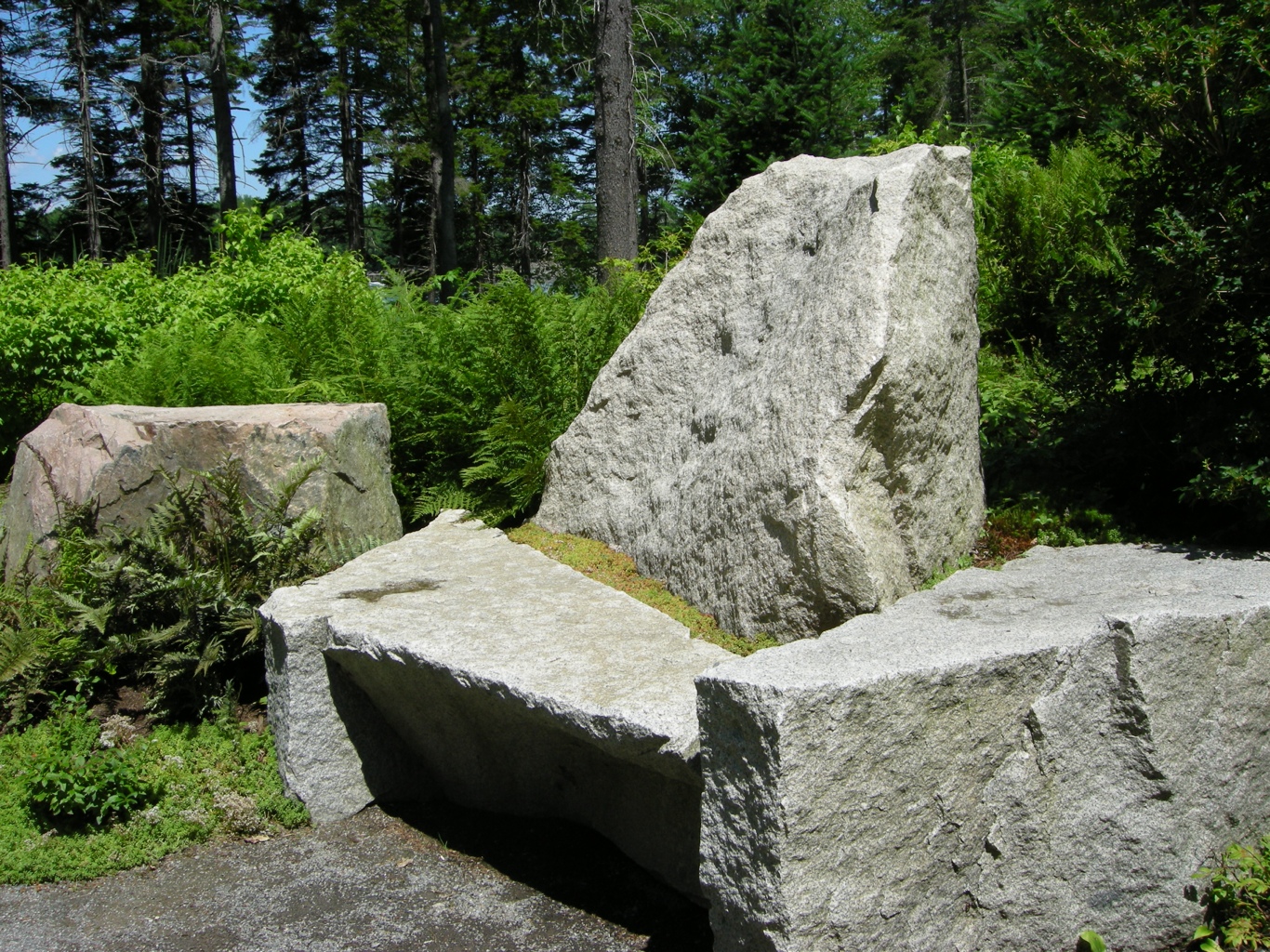
20120805-144035.jpgNatural rock seating in the Rose and Perennial Garden at the Coastal Maine Botanical Gardens.

As I mentioned in my previous post on hydrangeas, I visited the Coastal Maine Botanical Gardens (CMBG) in July with Donna from Garden Walk Garden Talk. This wasn’t my first visit, and if you want to read my original post click here. This visit was more focused because I came with a mission. I am designing an island in a public road and was looking for ideas for natural rock seating.

20120805-150252.jpg
CMBG Lerner Garden of the Five Senses

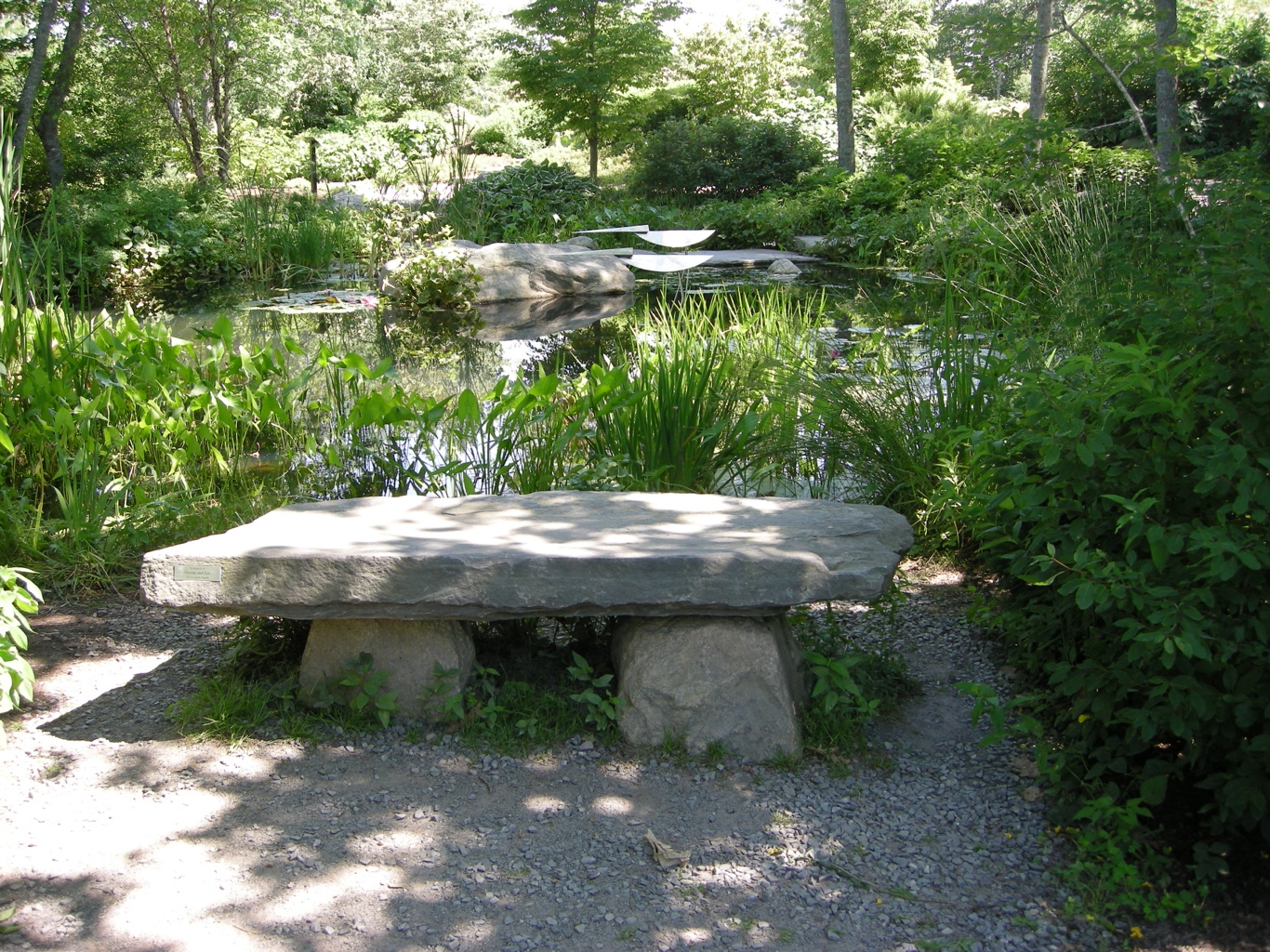
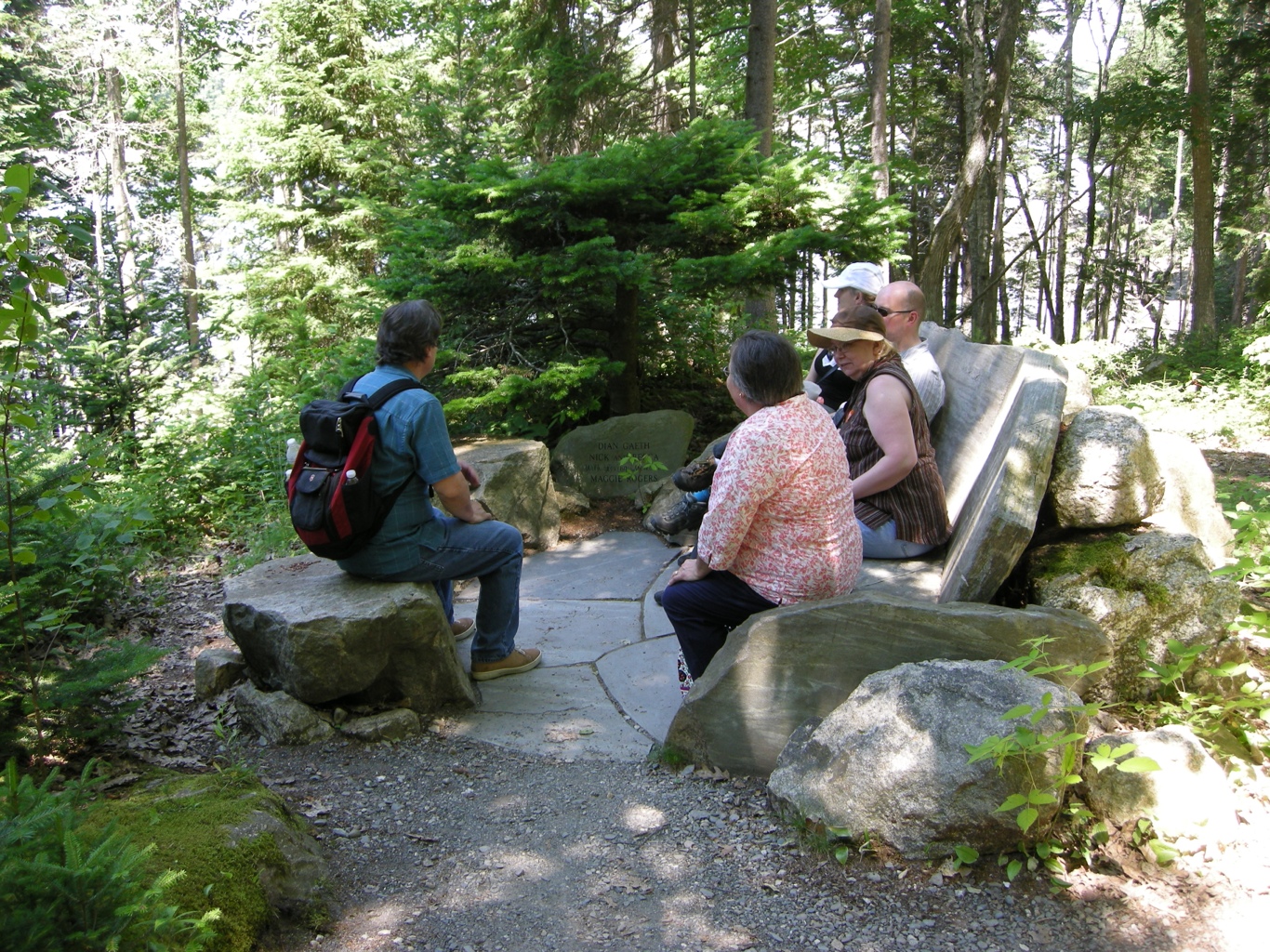
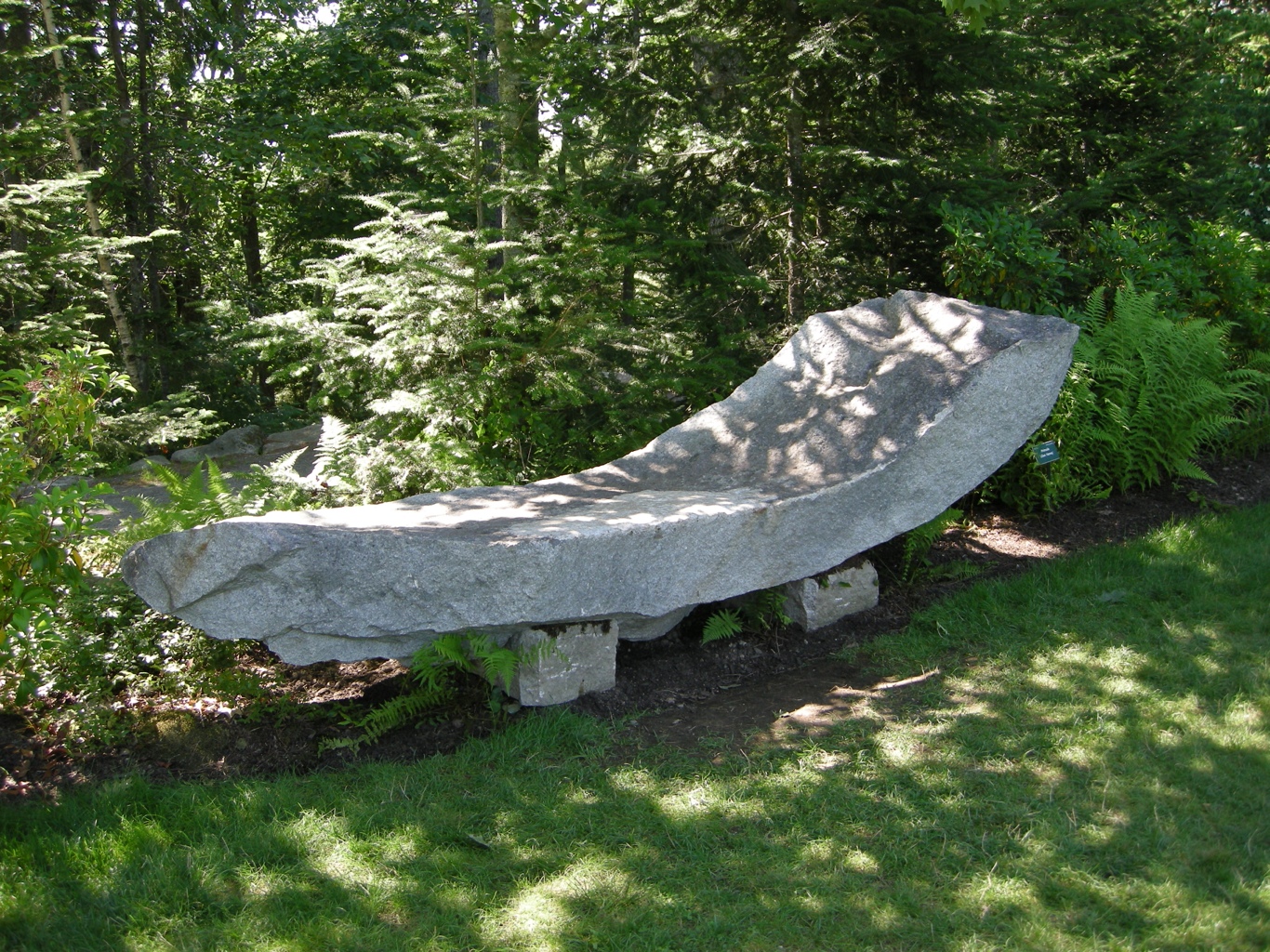
If you are looking for ways to incorporate boulders and rocks into your garden, there is no better place to get design ideas than CMBG. The whole garden is full of gorgeous stones, most of them from Maine quarries and some found on the site. Finding stones on site is easy when you are on the Maine coast—the ground has more rocks than soil. But to create such unusual and well integrated garden seating takes talent. I want to share my photographs with you in case you are looking to create natural seating in your own garden.

20120808-144213.jpg

Seating in both public and private gardens should be sited in a way that directs visitors to an important view or encourages them to enjoy a new perspective while they sit. When choosing rock, I am partial to rounded boulders, fully integrated into the landscape to the point where you almost can’t see them. However, this approach would not be appropriate in a public botanical garden where you want tired visitors to be able to easily locate a resting spot. The following photos were all taken at the CMBG and show a variety of ways to use rock as garden seating:

20120808-145304.jpg

20120808-145417.jpg

20120808-145517.jpg

20120808-145621.jpg

20120808-145741.jpg

20120808-145939.jpg

20120808-150040.jpg

20120808-150159.jpg

20120808-150327.jpgThis simple bench provides an overlook of the Slater Forest Pond, which was full of frogs and dragonflies.

20120808-150522.jpgThis is a full couch and chairs positioned along the beautiful Shoreland Trail.

All the seating shown above is quite beautiful and appropriate to the site, but I wanted to save some of my favorite designs for last:

20120808-150914.jpgThis single boulder is so well integrated into its site both by the other rocks and the sedum growing around it.

20120808-151144.jpgAgain a boulder that looks like the designers built the other hardscape around it in the Lerner Garden of the Five Senses.

20120808-151422.jpg

20120808-151541.jpg

20120808-151700.jpgWhat a wonderful place to sit and enjoy the water view along the Shoreland Trail.

20120808-152207.jpg

20120808-152328.jpgThe rocks look like they could have just fallen into place to create this obviously comfortable “couch” in the Giles Rhododendron Garden.

20120808-152633.jpgA natural chaise lounge near the Cleaver Event Lawn and Garden.

I came away from my visit to the Coastal Maine Botanical Gardens with some great ideas for my road design project and with renewed respect for this wonderful Maine garden treasure.

Carolyn

Nursery Happenings: The nursery is closed until the fall. Thanks for a great spring season!

If you are within visiting distance and would like to receive catalogues and information about customer events, please send your full name and phone number to carolynsshadegardens@verizon.net. Subscribing to my blog does not sign you up to receive this information.

Facebook: Carolyn’s Shade Gardens has a Facebook page where I post single photos, garden tips, and other information that doesn’t fit into a blog post. You can look at my Facebook page here or click the Like button on my right sidebar here.

Notes: Every word that appears in orange on my blog is a link that you can click for more information. If you want to return to my blog’s homepage to access the sidebar information (catalogues, previous articles, etc.) or to subscribe to my blog, just click here.

Landscape Problem Solved

Posted in How to, landscape design, native plants, Shade Shrubs with tags , , , , , on July 25, 2012 by Carolyn @ Carolyns Shade Gardens

Carolyn’s Shade Gardens is a retail nursery located in Bryn Mawr, PA, specializing in showy, colorful, and unusual plants for shade.  The only plants that we ship are snowdrops and miniature hostas.  For catalogues and announcements of events, please send your full name, location, and phone number (for back up use only) to carolyn@carolynsshadegardens.com.  Click here to get to the home page of our website for catalogues and information about our nursery and to subscribe to our blog.

20120724-154006.jpg‘Invincibelle Spirit’ and ‘Incrediball’ smooth hydrangeas massed at the Coastal Maine Botanical Gardens.

Three things came together recently to help me solve a landscaping problem that had bothered me for years. First, I was reading one of my favorite blogs called Conrad Art & Glass Gardens authored by Larry Conrad. In a recent post he talked about his favorite combinations including one achieved by massing white and pink smooth hydrangeas. I have been interested in smooth hydrangea, H. arborescens, because it is very shade tolerant. I also like it because it is a native plant found through out much of the eastern United States, including Pennsylvania. The well known cultivar ‘Annabelle’ with very large white mophead flowers was discovered in the wild in the 1960s. It grows well in Maine and has proven to be quite deer resistant on the island where my family vacations.

20120724-185734.jpgWhite and pink smooth hydrangeas massed in Larry Conrad’s Wisconsin garden.

The second thing that brought me to this post was a landscaping dilemma at my family’s house in Maine. There is a perennial garden planted by the previous owners next to the front door. However, no one who uses the house wants to garden there. The native landscape is so beautiful we don’t need any added ornamentals. I had been wondering where to try Larry’s beautiful combination, and this neglected garden seemed the perfect place. I bought three pink and two white smooth hydrangea with the intention of emptying the bed and letting them fill it in.

20120724-195423.jpgSmooth hydrangeas at the entrance to the children’s garden at the Coastal Maine Botanical Gardens.

The third contributor to this post was a visit to the Coastal Maine Botanical Gardens in Boothbay Harbor, Maine. Donna from Garden Walk Garden Talk came to visit me in Maine, and I had to show her this gorgeous garden (among other Maine delights). In the fall of 2010 I wrote about my first visit to CMBG, and I will write a longer post about my recent visit later but right now we are discussing hydrangeas. Imagine my delight when we approached the CMBG children’s garden and found the hydrangea combination I intended to use lining the entrance. My project now had a professional seal of approval, and I couldn’t wait to get home and start digging.

20120725-113605.jpgInvincibelle Spirit’ smooth hydrangea at CMBG

There was a choice of which smooth hydrangea cultivars to use. The biggest determining factor was which plants looked the healthiest at the nursery where I bought them. Although smooth hydrangeas are extremely tough, taking both dry and wet soils, clay, drought, heat, shade, rocky soil, and almost anything else you can throw at them, I have found them difficult to establish if you don’t start with vigorous specimens. There are two pink-flowered cultivars: ‘Bella Anna’ and ‘Invincibelle Spirit’, which has been on the market longer. I have been told that ‘Belle Anna’ is an improvement on ‘Invicibelle Spirtit’, but the plants looked weaker and I don’t think you can improve on the ‘Invincibelle Spirit’ specimens at CMBG in the photo above.

20120725-113851.jpg‘Incrediball’ smooth hydrangea at CMBG

For the white smooth hydrangeas, I had a choice of tried-and-true ‘Annabelle’ and an improved version called ‘Incrediball’, which has even larger, to 12″, globular flowers. Although I wasn’t after larger flowers, I chose ‘Incrediball’ because the flowers are whiter than ‘Annabelle’, which has some lime in it, and because ‘Incrediball’s’ stems have been selected for thickness to avoid flopping when it rains.

20120725-120518.jpg‘Invincibelle Spirit’ and ‘Incrediball’ at CMBG

All the smooth hydrangea cultivars grow to around 3 to 5′ wide and 3 to 5′ tall in zones 3 to 9. They flower from June to September, but the dried flowers heads are quite beautiful through fall. They perform best in part shade, but will grow in full sun with consistent moisture. The straight species grows in full shade. They bloom on new wood so pruning in late winter is recommended to encourage vigorous new stem growth.

20120725-122157.jpg

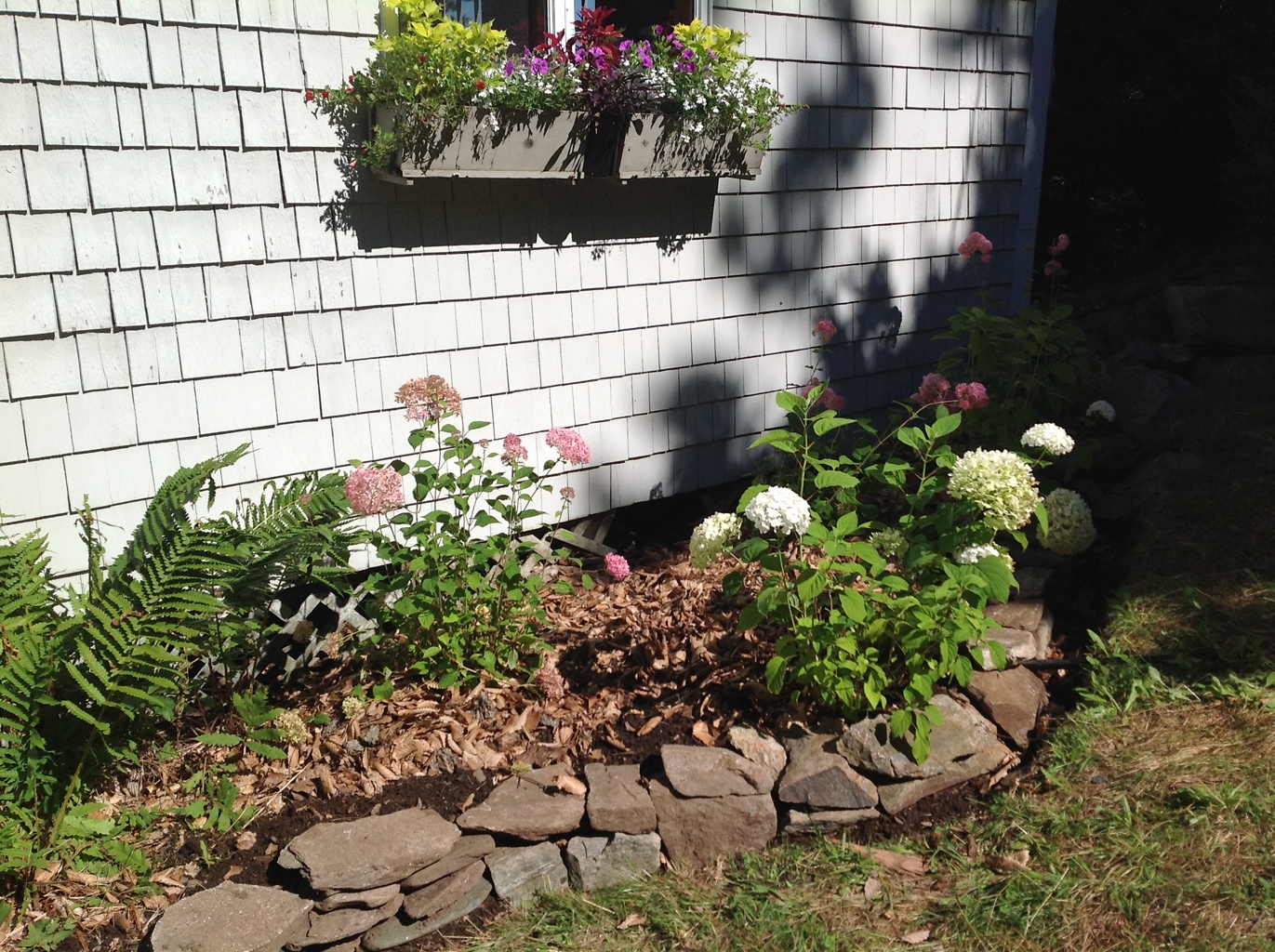
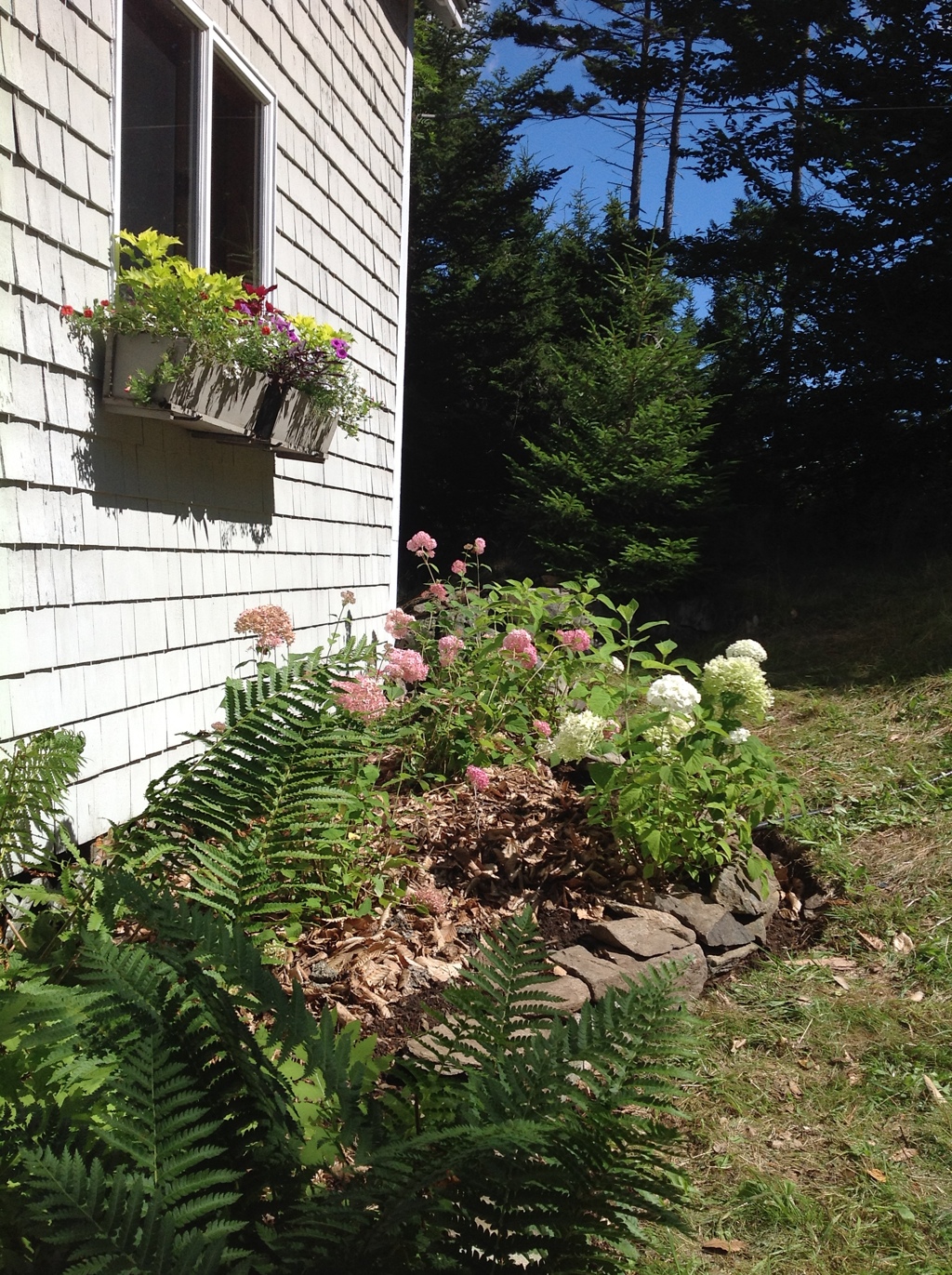
20120725-122305.jpgMy newly planted smooth hydrangeas

As you can see from the two photos above, my new hydrangeas have been planted. I anticipate that they will fill in the whole bed and crowd out weeds. I am still working on the wall but am quite happy with it so far. I hope the trench along the front will allow us to keep the nasty, tenacious grass out of the bed. If I get really ambitious, I am going to fill the trench with mussel shells from the beach.

* * * * *

This post is my second experiment with publishing a post directly from my recently acquired “new” iPad. Although it was a little easier this time and I mastered bold captions and links, I still had to call Donna in Niagara Falls to help me. I also took the final two photos with the iPad, and I think they turned out quite well. I am very impressed with the camera function on the new iPad, but you can’t truly appreciate the incredible resolution unless you have a very good screen on your computer, which I don’t. I think I would recommend an iPad just for looking at photos, that is if you can afford it. We don’t have internet access at the house in Maine so portability was a big factor for me. But the major reason I got it, 3G/4G capability is a huge disappointment, which I will explain at a later date.

Carolyn

Nursery Happenings: The nursery is closed until the fall. Thanks for a great spring season!

If you are within visiting distance and would like to receive catalogues and information about customer events, please send your full name and phone number to carolynsshadegardens@verizon.net. Subscribing to my blog does not sign you up to receive this information.

Facebook: Carolyn’s Shade Gardens has a Facebook page where I post single photos, garden tips, and other information that doesn’t fit into a blog post. You can look at my Facebook page here or click the Like button on my right sidebar here.

Notes: Every word that appears in orange on my blog is a link that you can click for more information. If you want to return to my blog’s homepage to access the sidebar information (catalogues, previous articles, etc.) or to subscribe to my blog, just click here.