Archive for the How to Category

Groundcovers, Thinking Outside the Box

Posted in garden to visit, groundcover, How to, landscape design, native plants, Shade Gardening, Shade Perennials, Shade Shrubs with tags , , , , , , , , , , , , , , , , , , , , , , , , , , , , , , , on June 11, 2012 by Carolyn @ Carolyns Shade Gardens

Carolyn’s Shade Gardens is a retail nursery located in Bryn Mawr, PA, specializing in showy, colorful, and unusual plants for shade.  The only plants that we ship are snowdrops and miniature hostas.  For catalogues and announcements of events, please send your full name, location, and phone number (for back up use only) to carolyn@carolynsshadegardens.com.  Click here to get to the home page of our website for catalogues and information about our nursery and to subscribe to our blog.

Part of the Idea Garden at Longwood Gardens

I recently visited Longwood Gardens in Kennett Square, Pennsylvania.  I have no hesitancy in saying that Longwood is one of the premier gardens in the world and should be on everyone’s life list.  However, there is so much there that it is difficult to post about it.  Also, “familiarity breeds contempt.”  I hold two Certificates in Ornamental Horticulture from Longwood and have taken a total of 18 courses to earn them.  Each course involved a minimum of 8 visits to the gardens so you can see that I have spent a lot of time there.  If you are local, these courses are the absolute best plant education available.

Italian Water Garden, viewed while resting in the shade.

Because I have spent so much time at Longwood, I didn’t photograph the usual sights or even visit the fabulous four acre indoor conservatory (with one exception mentioned below).  As a shade gardener I headed straight for Peirce’s Woods, which is seven acres devoted to shady plants native to the eastern U.S. deciduous forest.  I hoped to augment my library of photographs and get some ideas of plants to sell at the nursery and add to my own gardens.  I wasn’t disappointed.

The straight species of smooth hydrangea, H. arborescens, lined the very shady paths by the lake.  I think it is more appropriate to a woodland garden than the cultivated forms like ‘Annabelle’.

Smooth hydrangea has a lovely flower whose size is in keeping with other native woodland plants.

While walking through Peirce’s Woods, I returned to the thoughts I have been having lately about groundcovers.  This time of year, with the weeds running rampant, my customers are more interested in groundcovers.  But it is clear from their questions that they mean plants that form runners to creep and cover the ground.  The classic examples are vinca, ivy, and pachysandra.  However, my definition of groundcover is much broader than this and includes any plant massed to effectively choke out weeds.

Native maidenhair fern, Adiantum pedatum


When you look at the masses of native maidenhair fern above, you are probably thinking that’s all very nice that Longwood uses masses of these fairly pricey, non-creeping plants as groundcover, but I could never afford that quantity of plants.  However, think of the alternative: weeds and the hours if not days it takes to remove them, not to mention how their presence detracts from the look of your garden as well as your satisfaction with it.  Your time is valuable, and you wouldn’t be reading my blog if the look of your garden wasn’t important to you.

Native semi-evergreen coralbells, Heuchera villosa, often sold as the cultivar ‘Autumn Bride’, has gorgeous white flowers in the fall.

Yes, you can use mulch to keep down the weeds.  However, commercial shredded hardwood mulch is not attractive, is generally not produced sustainably, and requires a significant time investment to apply it.  Most importantly, it requires a monetary outlay every year because it must be re-applied every spring.  Perennial plants are initially more expensive to buy and plant but once they are there, you never have to do anything again.  It is kind of like buying a compact fluorescent light bulb versus the bulbs we grew up with.

Here are some more plants that Longwood uses in masses to make effective groundcovers:

Mexican feather grass, Nassella tenuissima


Native evergreen Christmas fern, Polystichum acrostichoides

Native semi-evergreen coralbells, Heuchera villosa purple form.

Shredded umbrella-plant, Syneilesis aconitifolia: I can only dream of achieving this in my garden, and, yes, it is very expensive.

Native hay-scented fern, Dennstaedtia punctiloba, creeps to fill in large areas.

This bellflower, Campanula takesimana, was growing and apparently self-sowing in dense shade on the hillside near the Chimes Tower.

Fall-blooming yellow waxbells, Kirengoshoma palmata, is more like a shrub than a perennial but it dies to the ground ever year.

Native coralbells, Heuchera villosa ‘Caramel’, is my favorite heuchera and retains its lovely color 365 days a year.

Giant butterbur, Petasites japonicus, grows in dense shade and covers a lot of ground.

Lavender mist meadow-rue, Thalictrum rochebrunianum

Native sensitive fern, Onoclea sensibilis, does creep.

Shrubs can be used as groundcover also, two examples from Longwood:

The straight species of oakleaf hydrangea, H. quecifolia, gets quite large and spreading.

Native southern bush honeysuckle, Diervilla sessifolia, suckers to form a colony.

Lastly, I want to show you why I briefly visited the conservatories:  groundcover for walls, the new fern wall at Longwood.  It is worth a visit just to see it:

This is a beautiful hallway containing individual restrooms, and the walls are totally covered in ferns.

Some of the ferns are quite large, and all are healthy and beautiful.

I hope I have convinced you to think outside the box and mass all kinds of unusual plants as groundcovers.  You will have more time to enjoy a better looking garden and save money in the long run.

Carolyn

Nursery Happenings:  This coming weekend we will have our final open hours at the nursery on Saturday, June 16, from 9 am to 2 pm, and Sunday, June 17, from 11 am to 1 pm.  We close on June 17 until September.  Customers on my email list will receive an email with details.

If you are within visiting distance and would like to receive catalogues and information about customer events, please send your full name and phone number to carolynsshadegardens@verizon.net.  Subscribing to my blog does not sign you up to receive this information.

Facebook:  Carolyn’s Shade Gardens has a Facebook page where I post single photos, garden tips, and other information that doesn’t fit into a blog post.  You can look at my Facebook page here or click the Like button on my right sidebar here.

Notes: Every word that appears in orange on my blog is a link that you can click for more information.  If you want to return to my blog’s homepage to access the sidebar information (catalogues, previous articles, etc.) or to subscribe to my blog, just click here.

Havahart® This Holiday Season

Posted in How to, organic gardening, product review, sustainable living with tags , , , , , on December 21, 2011 by Carolyn @ Carolyns Shade Gardens

Carolyn’s Shade Gardens is a retail nursery located in Bryn Mawr, PA, specializing in showy, colorful, and unusual plants for shade.  The only plants that we ship are snowdrops within the US.  For catalogues and announcements of local events, please send your full name, mailing address, and cell number to carolyn@carolynsshadegardens.com and indicate whether you are interested in snowdrops, hellebores, and/or hostas.  Click here to get to the home page of our website for catalogues and information about our nursery and to subscribe to our blog.

The woodchuck we caught was a lot cuter than I expected.  He looked and acted like he was trying out for a part in Wind in the Willows.

Last spring Havahart®, the manufacturer of live animal traps, contacted me regarding a potential product review.  Their representative expressed an interest in having a review appear on my blog because I advocate gardening  organically.  He thought my customers would be interested in their humane traps and other products.  Havahart® would send me any of their products for free, and I could try it out and say anything I wanted about it.


Never one to go half way, my husband baited the trap with a whole cabbage.

We had previously used small Havahart® traps to catch and release chipmunks, which were tearing down our 10 foot stone walls with their tunnels.  We were very pleased with the results, but our current cat has the chipmunk problem well under control.  Now we were being plagued by a woodchuck (AKA groundhog)—the most persistent animal pest I know.  For the review, we chose the Havahart® One-Door Groundhog & Raccoon Trap.

The trap is set with the door open and the cabbage behind the trigger pad.

Our current woodchuck was living under our deck so we placed the trap near his entrance and exit hole.  The trap door is held open by a trigger rod attached to a trigger pad and snaps shut when the woodchuck presses the tilted trigger pad on his way to the bait.  We didn’t have to wait long—two days later a sad little face greeted me when I checked the trap.  I expected a vicious varmint, and what I got was Beatrix Potter’s Mrs. Tiggy-Winkle.  You will notice that he ate the whole cabbage.

Success occurred immediately.

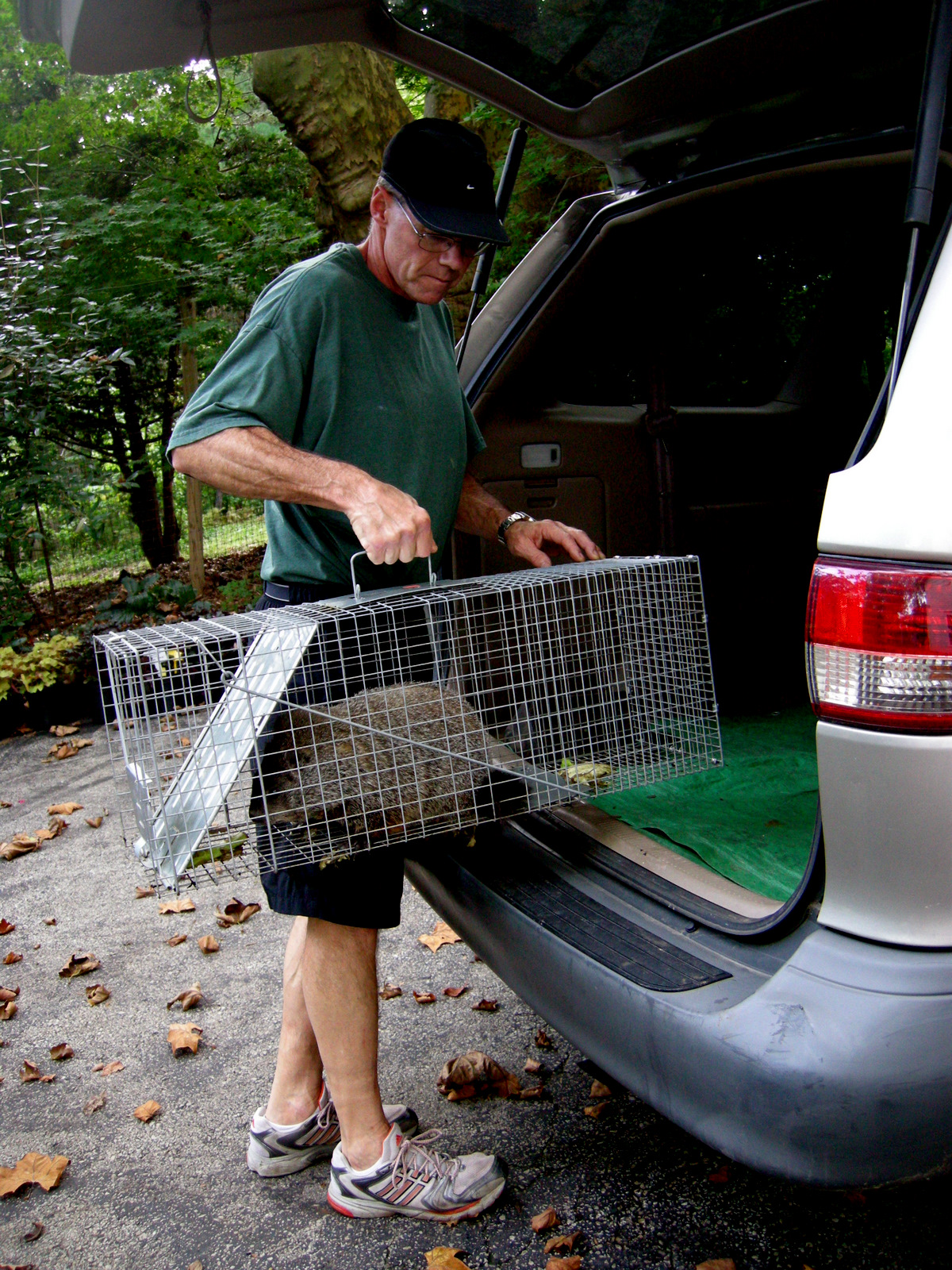
I felt so sorry for the little guy that we decided an immediate transport and release was necessary.  It was easy to carry the cage to our van and place it on a tarp in the back.  The woodchuck remained passive during this ordeal.

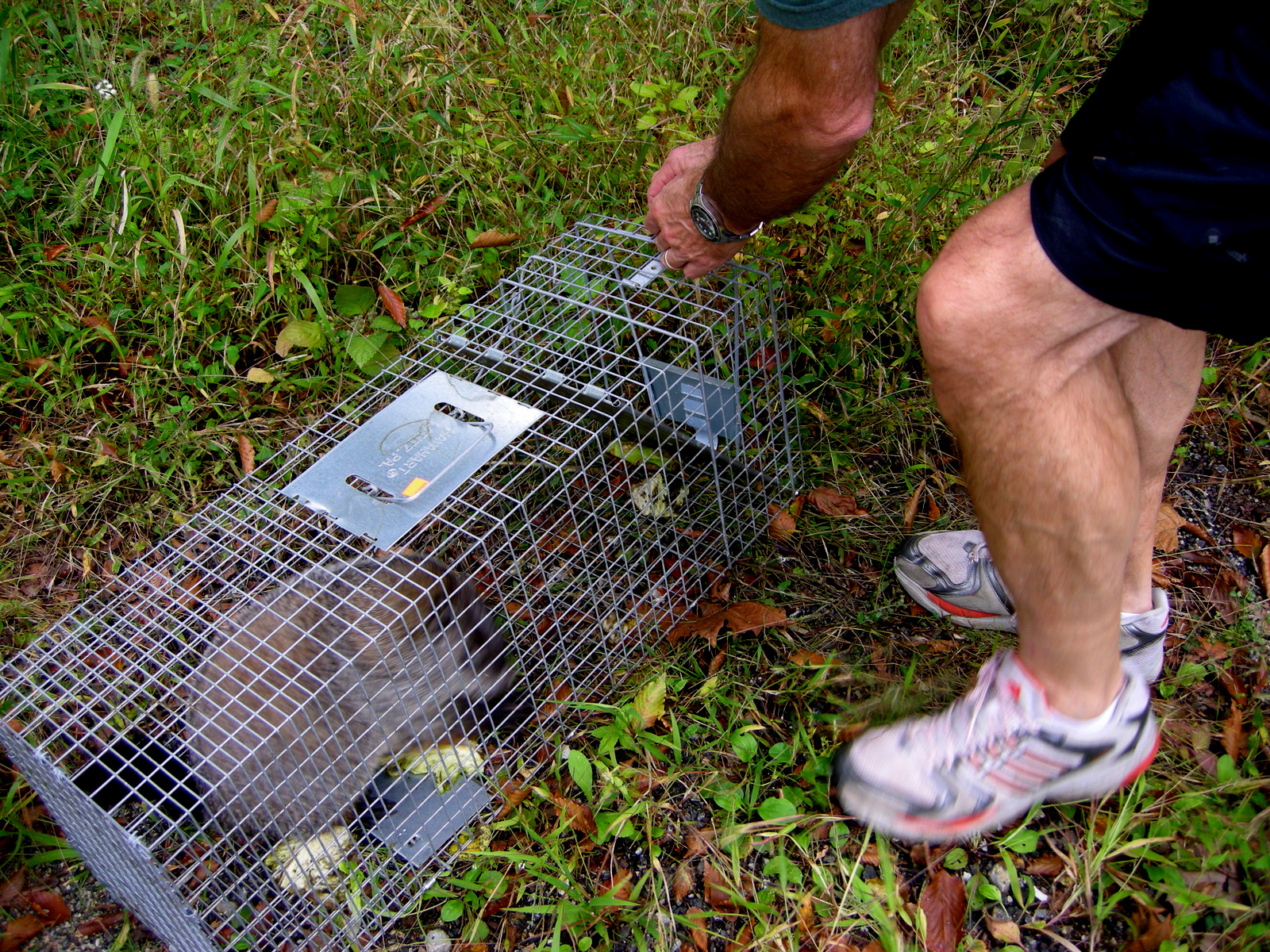
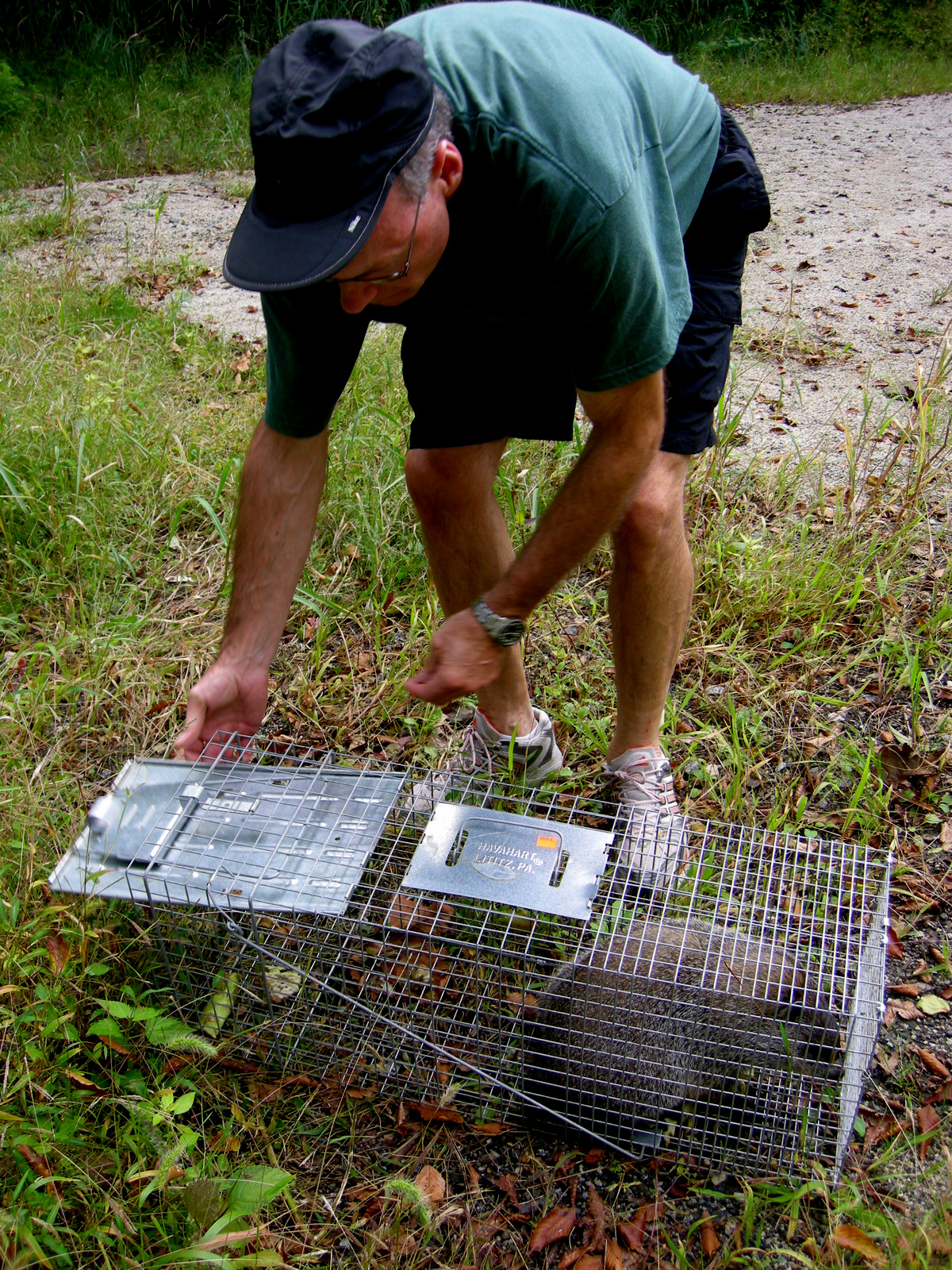
As recommended by Havahart®, we drove to “an isolated location five to ten miles away,” insuring that the woodchuck would not return to our property.  We stopped the car, unloaded the trap, and prepared to release our little friend—that was when the fun began.  The fat little woodchuck sat firmly on the trigger pad preventing the door from being released into the open position.  Even when my husband manually opened the door and held it open, the woodchuck would not leave the trap.

While my husband holds the trap open, the woodchuck resolutely faces the back of the cage refusing to vacate his new found home.  Thanks to my customer, Ben Hayward, for pointing out that my husband should not have had his fingers near the cage opening without wearing protective gloves.  See my reply to Ben’s comment about why the gloves didn’t make the trip.

I wish I had a video of what happened next because it would be hysterical.  Without warning me, my husband picked up the whole trap, tipped it perpendicular to the ground, and shook the woodchuck out right at my feet.  If only I could say that I stood my ground like a brave photographer, risking an angry woodchuck to get THE photo.  But instead I turned and ran for the car as fast as I could, convinced that the woodchuck would climb the nearest upright object, which was me.  I regained my senses just in time to get this photo of the little woodchuck fleeing for the hinterlands.

Overall I think Havahart® traps are very useful for humanely removing unwanted animals from your property.  And upon reading the manual to write this article, it does recommend inserting a stick through the cage to prop the door open.  That would have solved the problem with our unusually passive and docile woodchuck who seemed happy to live in the trap indefinitely as long as we fed him cabbage.  However, I do not think I would want to get my hands that close to the cage (see photos above) with a more aggressive animal inside it.

Happy Holidays,  Carolyn

Notes: Every word that appears in orange on my blog is a link that you can click for more information.  If you want to return to my blog’s homepage to access the sidebar information (catalogues, previous articles, etc.) or to subscribe to my blog, just click here.

Powered by Compost

Posted in green gardening, How to, organic gardening, Shade Gardening with tags , on June 5, 2011 by Carolyn @ Carolyns Shade Gardens

Carolyn’s Shade Gardens is a retail nursery located in Bryn Mawr, PA, specializing in showy, colorful, and unusual plants for shade.  The only plants that we ship are snowdrops and miniature hostas.  For catalogues and announcements of events, please send your full name, location, and phone number (for back up use only) to carolyn@carolynsshadegardens.com.  Click here to get to the home page of our website for catalogues and information about our nursery and to subscribe to our blog.

Some of my gardens powered by compost.

Compost is king in my garden.  It is the only thing I use: no other soil amendments and no fertilizers.  All the beautiful plants and lush growth are powered by compost.  I am frequently asked where I get my compost and how I use it.  This post will answer those questions and highlight an exciting compost-centered event taking place in my gardens this Sunday.

The soil at the top is from my back slope ruined by erosion caused by misguided lawn attempts and chemicals.  The soil at the bottom is from the undisturbed woods less than 10′ away.

The pre-existing soil at Carolyn’s Shade Gardens is (was) terrible (see top photo above).  I am on the side of a hill where the previous owners had tried to grow grass for years.  The soil was hard and depleted by the use of lawn chemicals and by erosion.  Terraces were constructed down one side of the house and filled with rocky infertile soil.  Construction rubble from additions to the house in the 1950s and 1960s was dumped in what is now my woodland garden.  The soil in the beds on the back side of the house was compacted by their former use as a carriage path.  Finally, the whole property was used as a dump (pre-trash collection) by the estate of which it was formerly a part so the beds are full of glass, old slate from roof replacements, refuse from coal burning furnaces, and miscellaneous trash.  Digging can be quite an adventure!

This is a photo from 1995 showing the debris that came out of one relatively small planting hole at Carolyn’s Shade Gardens.  Click on any photo to enlarge.

Given the deplorable condition of the existing soil, compost is essential.  It reaches my plants in four different ways.  First, whenever I create a new bed in my gardens, I spread 4 to 6 inches of compost on top of the soil and dig it into the bed, removing all the rocks and debris.  I use the rocks to line the paths in my woodland garden.  One visitor asked me where I got my rocks, and, finding out they came from the beds, told me how lucky I was.  I feel about as lucky as the early farmers in New England must have felt when they built all those rock walls around their fields.

The rocks lining the paths in the woodland garden.

Second, even though the beds are prepared with compost, I add compost to the hole every time I plant a plant.  I mix the existing soil half and half with compost.  Third, as explained in Fall Clean-up, I grind all the leaves in the fall and use them to mulch my beds.  This mulch breaks down over the course of the year to make a thick compost layer on top of the existing soil.  Leaves that fall on the lawn are ground up in place and left there to fertilize the grass as described in Leaves on the Lawn. Finally, I don’t clean the leaves out of most of my beds: they are left there to act as mulch and form more compost.

The current state of the depleted back slope.

I use a lot of compost because I also need it to pot all the plants that I grow to sell at my nursery.  Where does it all come from?  We produce a lot of it ourselves in a simple, easy, and nontechnical way.  I get frustrated with the articles written about composting because they make it sound like you need to follow complex procedures and buy expensive equipment to produce compost.  All those procedures and equipment merely speed the process up (and possibly make it neater), but all you need to produce compost is a pile.  It helps if you turn it occasionally, but even that is not necessary if you are willing to wait for it to break down naturally.

The path to our compost pit.

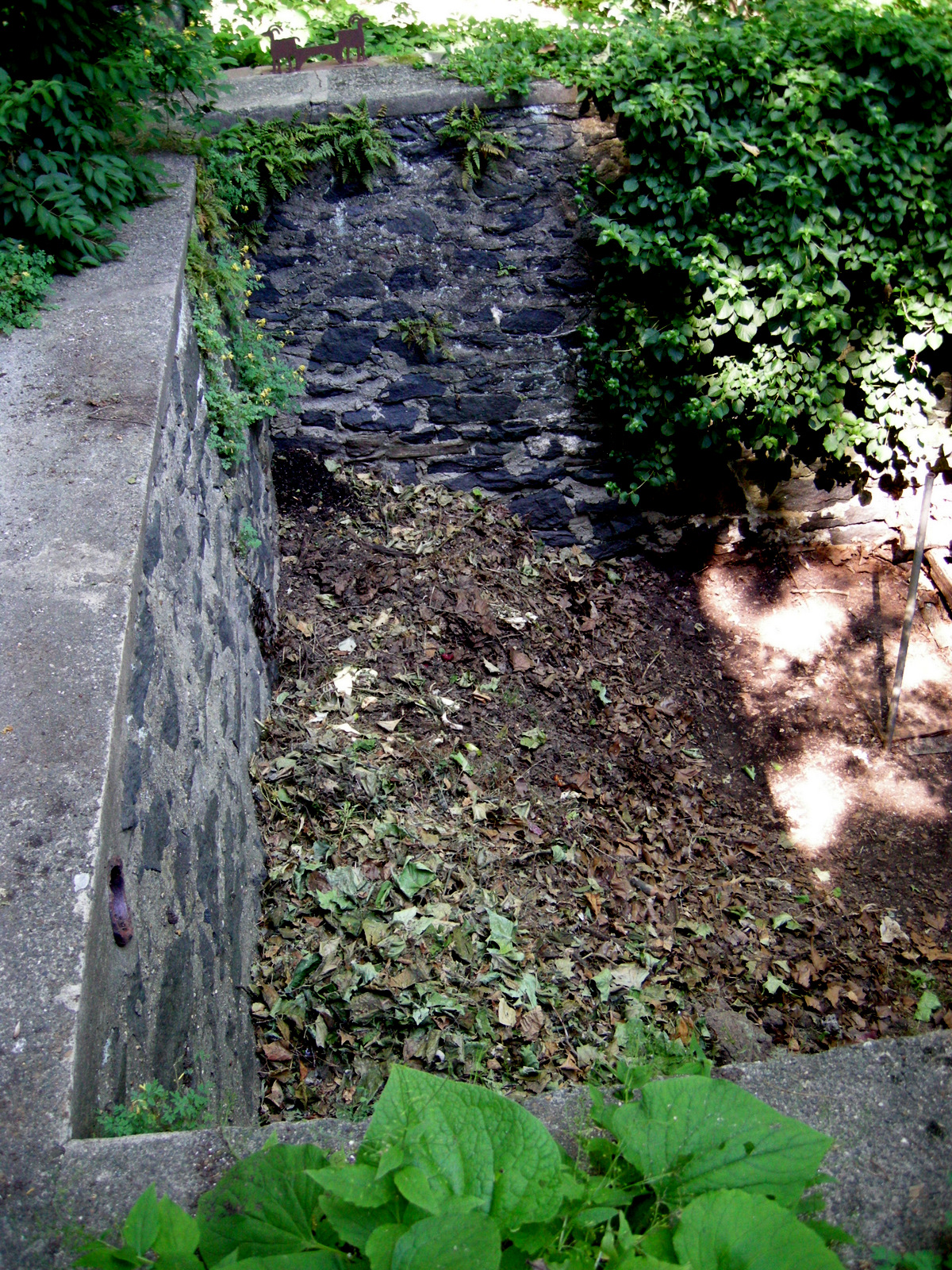
Our “garage” is really the carriage house and the stable for the estate that used to be here.   There is even a metal grain bin on the second floor with chutes and levers to bring the grain to the first floor.  The horses that pulled the carriages produced manure (no surprise there), which was deposited in a manure pit behind the stable.  Back then, they built everything to last so the manure pit is a 12 foot square enclosure surrounded on four sides by 7 foot tall stone walls.

The left side of the compost pit where we are currently throwing kitchen and garden refuse.

We throw all our garden and kitchen refuse into this pit, including leaves, sod, noninvasive weeds, ashes, small sticks, etc.  There is no organized layering process–whenever there’s something to go in, it’s thrown on top of the pile, hopefully, but not always, on the side of the pile currently being built up.  The other side contains the compost being used.  My husband turns the pile thoroughly about three times a year, and that’s it: no complicated procedures or equipment required!

Top view of the manure pit we use for producing compost.  It is “decorated” with self-sown fern-leafed and yellow corydalis and a large climbing hydrangea.

However, despite the size of this operation, it does not produce nearly enough compost for Carolyn’s Shade Gardens.  We are very fortunate that our township produces excellent compost from the leaves that residents put by the side of the road in the fall to be removed.  Personally, I think removing the leaves from your property is crazy, but for selfish reasons I am glad people do it.  We get truckloads of the township’s beautiful compost to supplement our own.

One of the newest beds powered by compost.

As I explained in Supporting Sustainable Living, I am uniquely placed to encourage sustainable gardening practices as I promote and sell native plants at my nursery,  answer my customers’ requests for advice, and give tours of my gardens to horticultural groups.  Sustainable living is very important to me as I described in My Thanksgiving Oak Forest.  So when the Radnor Conservancy, dedicated to promoting open space in my township,  asked me to speak, I thought why not go farther and offer my gardens as a venue for a fund raising and educational event.

Rose and peony beds

The creative people at the Conservancy came up with the theme “Dirt … lots of it!”, an afternoon devoted to educating people about compost on Sunday, June 12, from 3 to 5 pm at Carolyn’s Shade Gardens.  Here is the flyer:

If you come, and I hope you will, you will find various “stations” throughout my gardens staffed by knowledgeable Master Gardeners able to answer any question you have about composting.  They will demonstrate outdoor composting, indoor composting with worms, composting equipment and tools, grinding leaves for mulch, and how to transport township compost easily and cleanly to your home.  You will be able to order discount compost bins, and information on lyme disease and its prevention will be provided.

Main perennial border

As you find out everything you ever wanted to know about composting, you can stroll through my beautiful gardens and shop for plants in my nursery area.  And best of all, delicious refreshments will be provided.  As directed in the flyer above,  if possible, please register  in advance for the event with the Conservancy by calling them at 610-688-8202 or emailing them at radnor.conservancy@comcast.net.  You can also show up without registering.  The event is open to everyone, not just Radnor Township residents.  I hope to see you there.

Carolyn

Just a note to say thanks to John at Macgardens and his wife Beth who visited Carolyn’s Shade Gardens during my open house on Saturday.  Meeting fellow garden bloggers is so fun because they immediately feel like old friends.  If any other garden bloggers are in the area, please stop by.

Notes: Every word that appears in orange on my blog is a link that you can click for more information.  If you want to return to my blog’s homepage to access the sidebar information (catalogues, previous articles, etc.), just click here.

Nursery Happenings: I will have my traditional closing weekend open hours this Saturday, June 11, from 9 am to 3 pm and Sunday, June 12, from 10 am to noon.  You don’t need to make an appointment, and you can park in the driveway.  You can also shop for plants during the Radnor Conservancy  event on Sunday, June 12, from 3 to 5 pm.  But remember you can make an appointment to shop 24/7 by sending me an email at carolynsshadegardens@verizon.net.  There is  still a great selection of hostas, ferns, astilbes, hardy geraniums, and summer and fall blooming shade plants available.

Miniature (& Small) Hostas

Posted in hosta, How to, landscape design with tags , , , , , , , , , , , , , , , , , , , , , , , , , , , , , , , , , , , , on May 9, 2011 by Carolyn @ Carolyns Shade Gardens

Carolyn’s Shade Gardens is a retail nursery located in Bryn Mawr, PA, specializing in showy, colorful, and unusual plants for shade.  The only plants that we ship are snowdrops within the US.  For catalogues and announcements of local events, please send your full name, mailing address, and cell number to carolyn@carolynsshadegardens.com and indicate whether you are interested in snowdrops, hellebores, and/or hostas.  Click here to get to the home page of our website for catalogues and information about our nursery and to subscribe to our blog.

.

'Holy Mouse Ears'‘Holy Mouse Ears’: the miniature hostas in the mouse ears series are my favorites.

I am in stage four of my relationship with hostas.  I have noticed that many of my customers go through these stages too.  Stage one was when I was a new gardener.  I discovered hostas and loved them because they are easy to grow and to divide to make more.  I had the green one, the green and white one, the blue one, the variegated one, and the gold one.  If you know hostas, you can probably guess fairly easily which varieties I had.  I still love these hostas and have large patches of them in my gardens.

‘Lakeside Cupcake’ was a new small hosta for me in 2010 and is a strong grower.

During stage two, I became more “sophisticated”.  Hostas were too easy to grow, too ordinary, and multiplied too quickly for my control-oriented gardening style.  Besides I wanted flowers, flowers, and more flowers, and hostas just didn’t fit the bill.  I didn’t like them anymore.  How could people collect such a boring and ordinary plant?

“Carolyn’s Gold”: I selected this miniature hosta from a chance seedling that appeared in my gardens.  It is the brightest gold I have ever seen.

I rediscovered hostas in stage three when I got beyond flowers and realized how important foliage is to the garden, especially the shade garden.  I learned that hostas did not come in just the five basic varieties but in an infinite number of combinations of colors, heights, widths, leaf shapes, flowers, and habits.  Somewhere I read that there are 6,000 hosta cultivars.  I wanted them all so I began to collect hostas. 

‘Blue Mouse Ears’ is the miniature hosta that started the mouse ears family.  Not only is it shaped like a mouse ear, but it feels like one too (all in my imagination because I have never felt a mouse ear).  It was designated the 2008 Hosta of the Year by the American Hosta Growers Association–a very high honor.

I entered stage four about the time that my hosta acquisitions topped 100 cultivars.  This is just a modest assemblage because you really aren’t considered a hosta collector until you have over 500 varieties in your garden.  But I was running out of room.  Besides I am not a true collector of any group of plants because I am not satisfied with one of any perennial in my garden.  I need at least five, but preferably seven, of any plant to make an impact.  Many hostas are quite large, and five ‘Blue Angel’, ‘Sum and Substance’, or ‘Sagae’, which are favorites of mine, with six foot wide clumps and 15″ leaves, take up a lot of room.  Were my collecting days over?

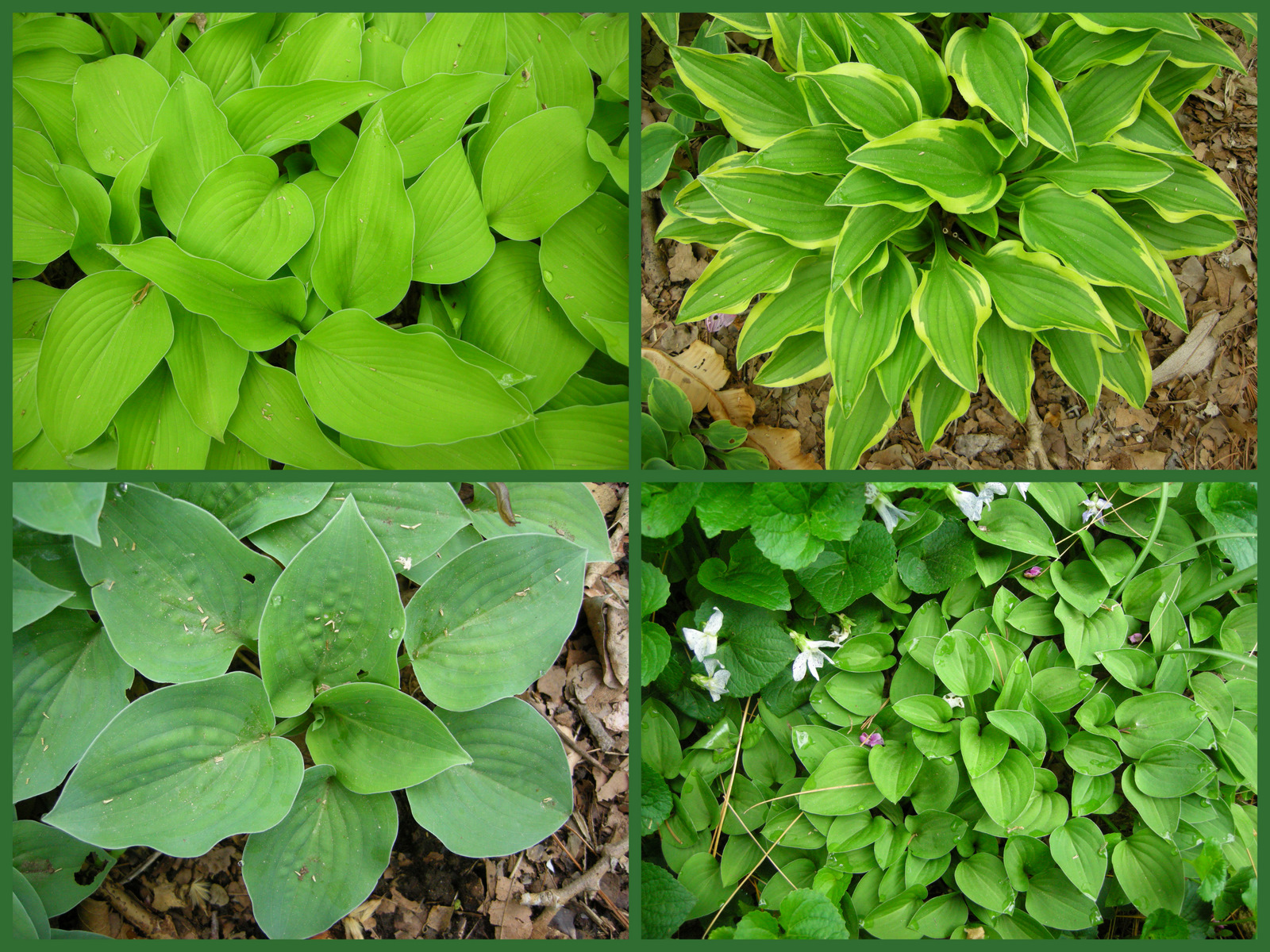
Clockwise from upper left: small ‘Blonde Elf’  and miniatures ‘Little Wonder’, ‘Rock Princess’, and a hosta sold to me as ‘Little Blue’.

That’s when I discovered miniature hostas.  The American Hosta Society defines  miniature hostas as having a leaf no larger than 4 sq. in.   The discovery of miniature hostas allowed me to indulge my passion for collecting hostas, which only got worse in stage four, without taking up all the space in my garden.  And they are so incredibly cute and have such adorable names: ‘Holy Mouse Ears’, ‘Pixie Vamp’, ‘Blonde Elf’, ‘Mighty Mouse’, ‘Alakazaam’, ‘Cookie Crumbs’, ‘Rock Princess’.  How can you resist?

‘Mighty Mouse’ is one of the newer members of the mouse ears family.

I remain firmly mired in stage four and don’t know what comes after it, maybe Hostas Anonymous.  But in the meantime, I want to show you some of my favorite miniatures (see photos above and below) and suggest some ideas for displaying miniature and small hostas.

‘Little Treasure’ is new to me this year and has a unique leaf shape and blue-green color.

Because they are so little, most miniature and small hostas can’t be thrown into the garden willy-nilly but benefit from some planning to show them off.  Many also require specialized growing conditions, but those cultivars don’t survive at Carolyn’s Shade Gardens where nothing gets fussed over.  I display my absolute favorite miniature hostas in their own container to really highlight them.  An added benefit is that  hostas multiply more rapidly in containers:

I have shown this photo of ‘Crumb Cake’ before, but it demonstrates how a single unusual plant in a container can be so pleasing.  ‘Crumb Cake’ and all the other hostas pictured in containers in this post also do well in the ground–a requirement for inclusion at Carolyn’s Shade Gardens.


‘Pixie Vamp’: This miniature has elegant mahogany-colored flower scapes that match this container.  I leave all these pots outside all winter.  Hostas overwinter fine as long as their containers can be left outside without cracking.


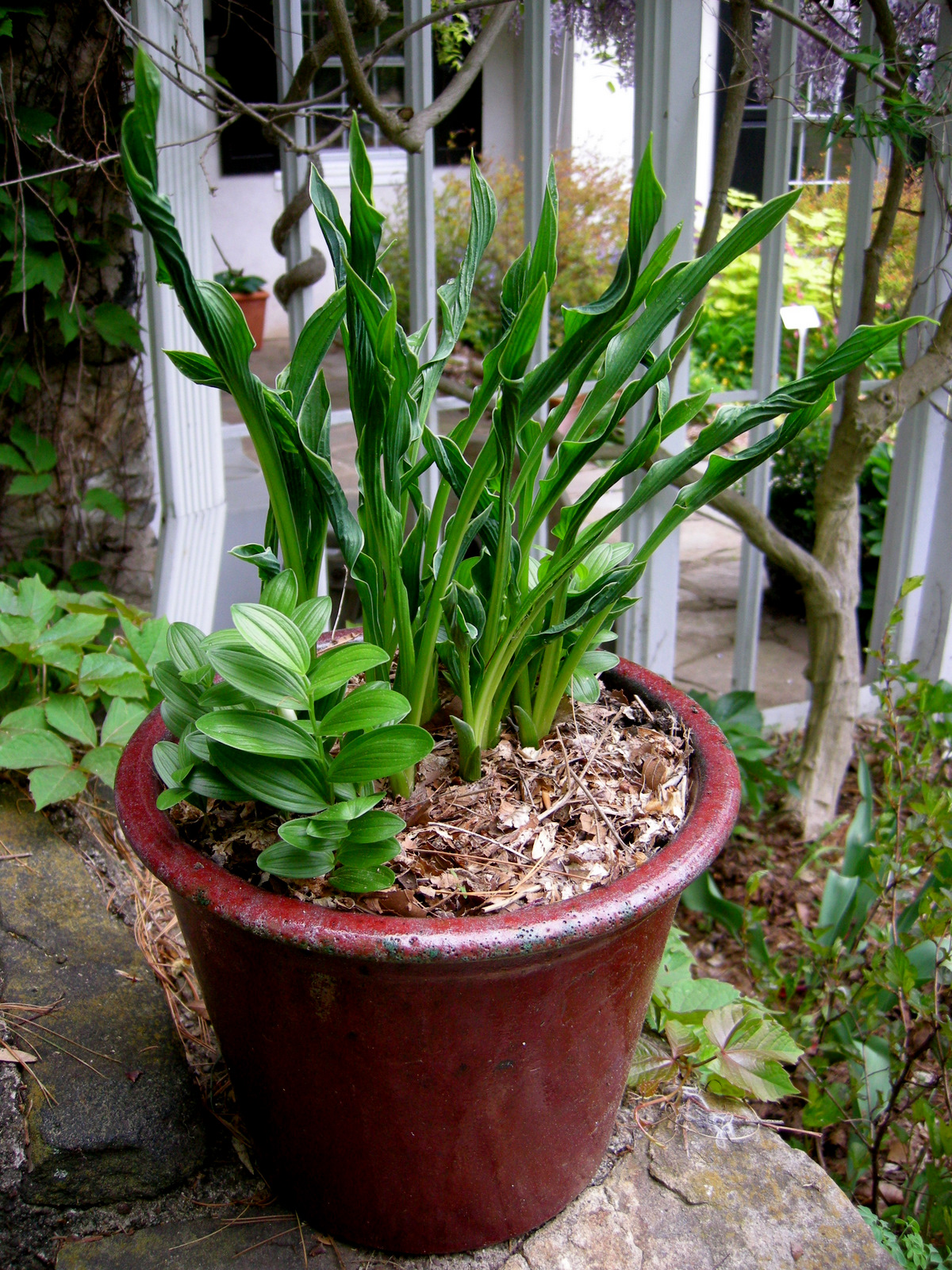
I think ‘Praying Hands’, the 2011 Hosta of the Year, looks best in a container.  It reminds me of pitcher plants without the hassle of creating a bog.  Pictured here with dwarf Solomon’s seal, Polygonatum humile, another plant that thrives over the winter in containers.


“Carolyn’s Malex Two” is another hosta I selected that grows so slowly in the ground that I have never sold it.  Its position in the top of my antique strawberry pot highlights its delicate coloring and allows it to multiply faster than it would in the ground.


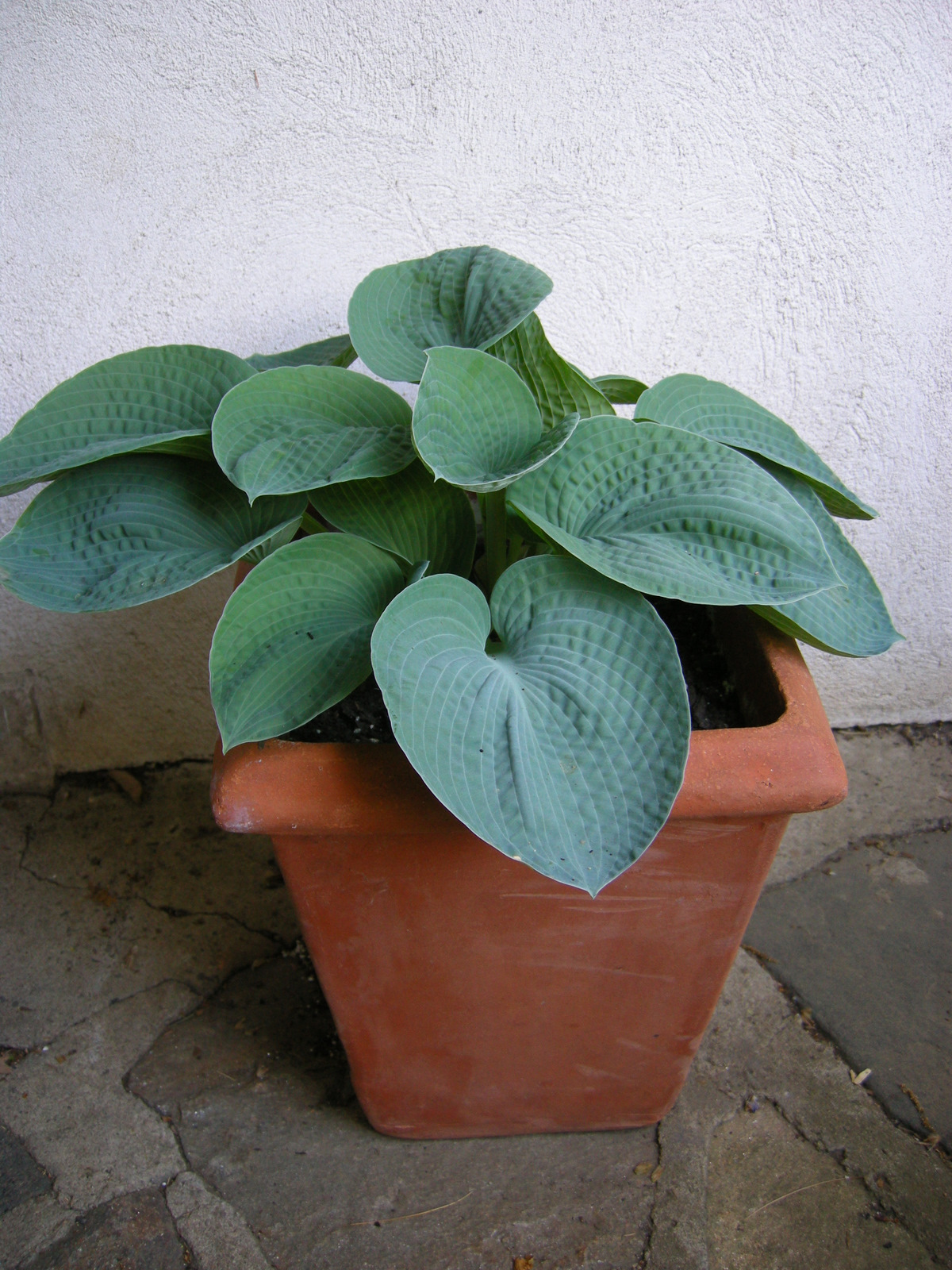
The straight species Hosta tokudama has the bluest leaves of any hosta and lives in this terra cotta container on my porch.


You don’t necessarily have to buy containers for your hostas.  ‘Hanky Panky’, a very unusually colored small hosta, has grown for years in my old dogwood stump.


‘Alakazaam’ has found a home in the chiseled out knot hole of a weathered sycamore branch.  My youngest son crafted this “container” for me for Mother’s Day.


Several miniature hostas can be combined in a larger container:

This dish, which I leave out all winter even though it is terra cotta (don’t do this at home!), contains the miniatures  (clockwise from upper left) ‘Cracker Crumbs’, ‘Shiny Penny’, and ‘Shining Tot’ with ‘Praying Hands’, sedum, hens and chicks, rosularia, and miniature dianthus.


My antique strawberry pot has 16 pockets with a different miniature hosta in each one.  Pictured are (top row left to right) ‘Cameo’, ‘Cracker Crumbs’, and ‘Twist of Lime’, (middle row) ‘Little Blue’, ‘Shining Tot’, and ‘Porter’, and (bottom row) ‘Shiny Penny’, ‘Hope, and “Carolyn’s Tiny Gold”.


My husband gave me this antique trough for our anniversary.  It is a perfect setting for my mouse ears collection.  Pictured are (front left to right) ‘Holy Mouse Ears’ and ‘Mouse Trap’, (center) ‘Blue Mouse Ears’, and (back) ‘Green Mouse Ears’, ‘Mighty Mouse’, and ‘Frosted Mouse Ears’, all with dwarf Solomon’s seal.


Hostas thrive between rocks and in rock gardens:

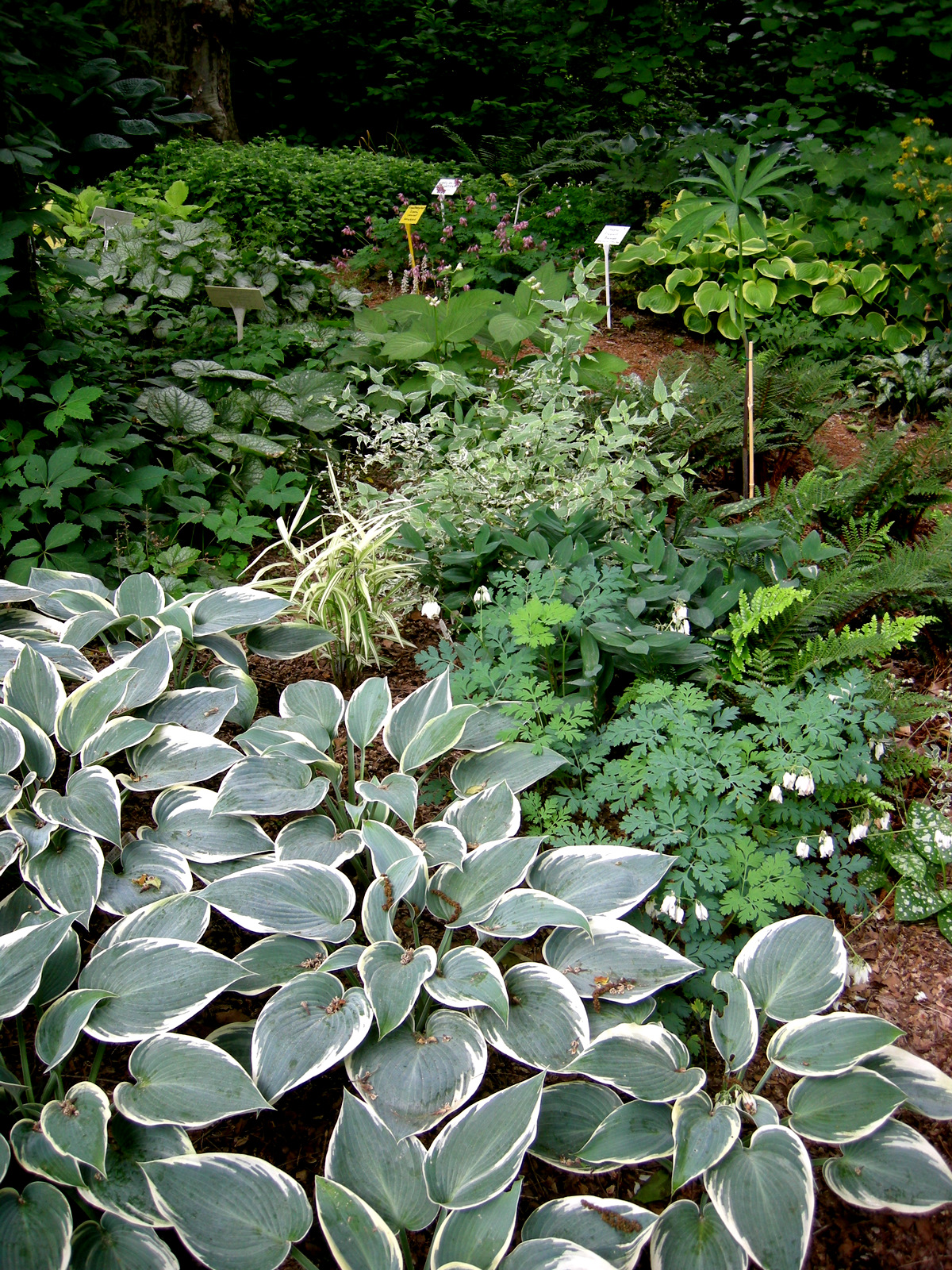
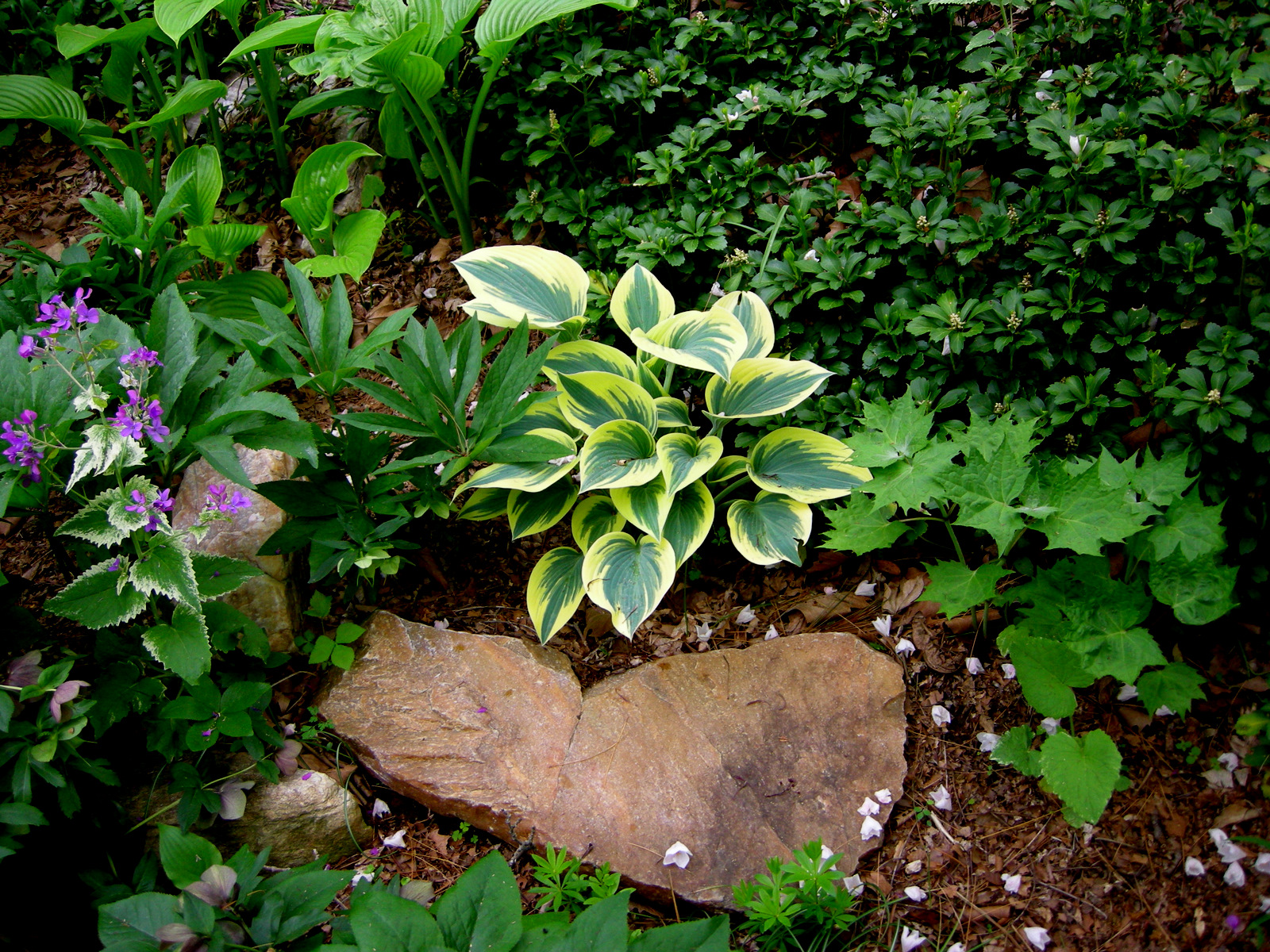
The 2010 Hosta of the Year ‘First Frost’ in my rock garden with (left to right) variegated money plant (Lunaria annua ‘Alba Variegata’), Helleborus cyclophyllus, and yellow wax-bells (Kirengoshoma palmata).


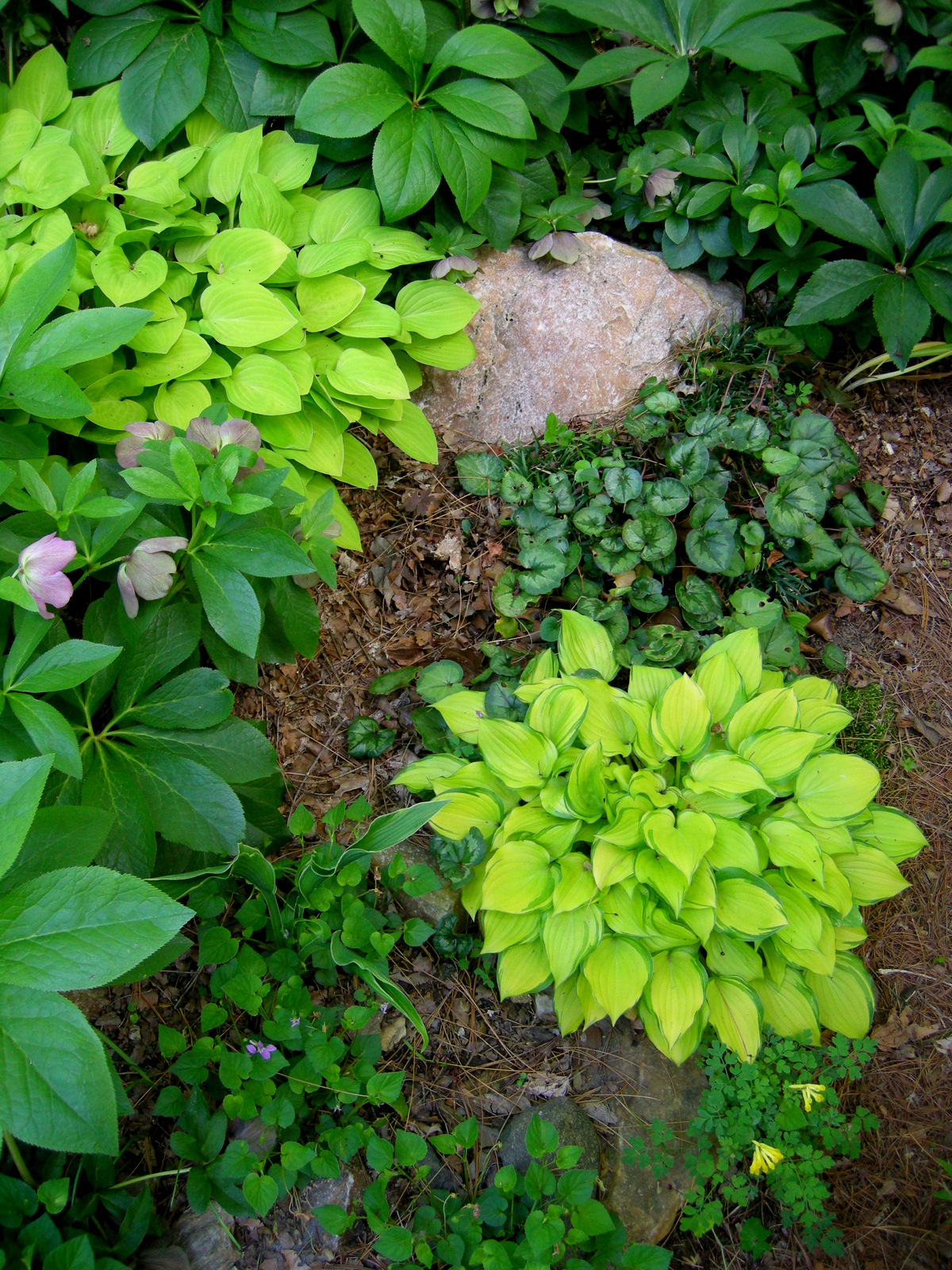
‘Little Aurora’ (upper left) and ‘Cookie Crumbs’ (lower right) in my rock garden with (left to right) ‘Red Lady’ hellebores (Helleborus x hybridus ‘Red Lady’), pink violets (Viola species), and spring-blooming hardy cyclamen (Cyclamen coum).


Miniature and small hostas can be massed for maximum effect and to create groundcover:

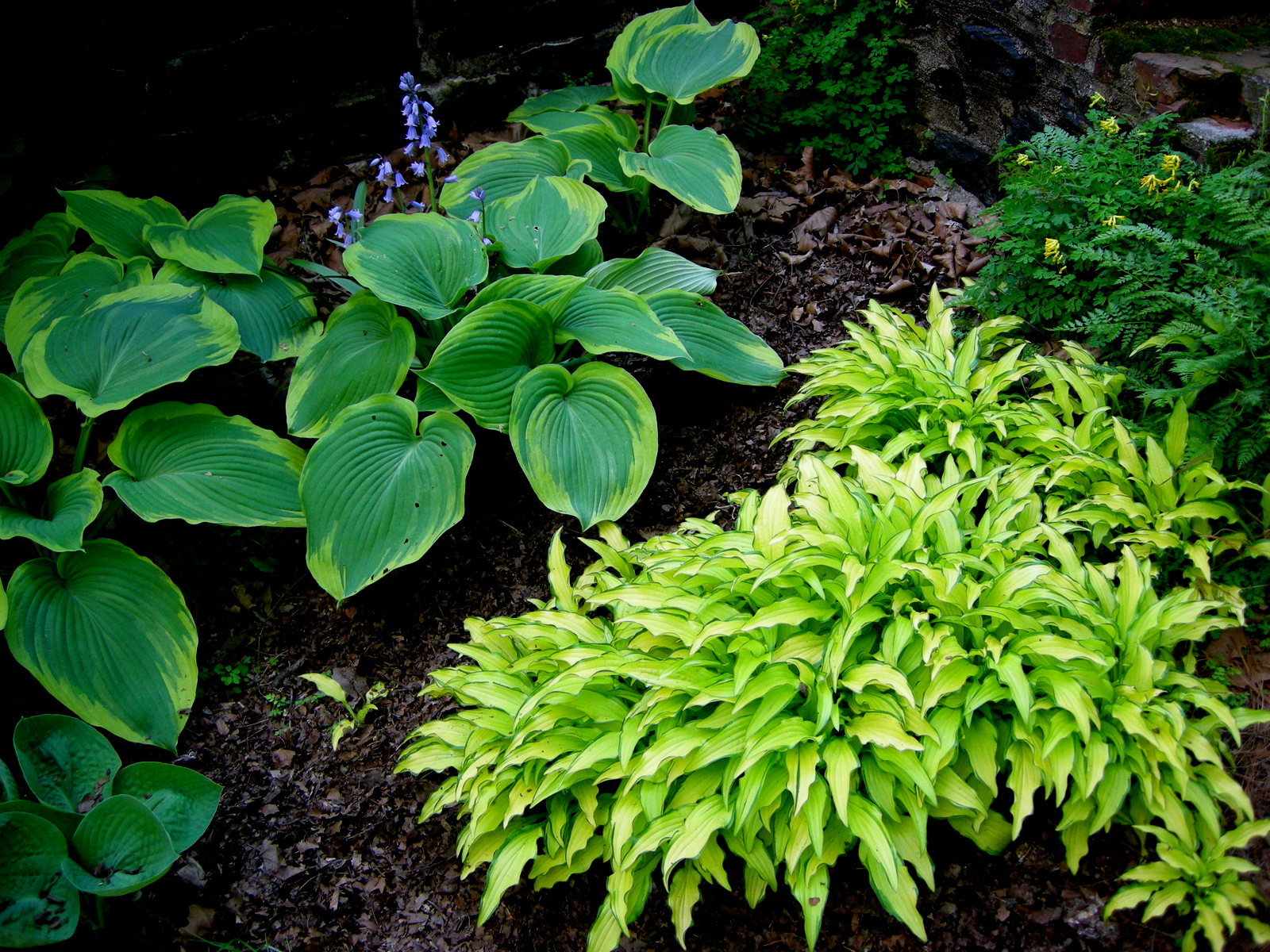
‘Kabitan’ (lower right) massed with (left to right) ‘Abiqua Drinking Gourd’, 2009 Hosta of the Year ‘Earth Angel’, Spanish bluebells (Scilla campanulata ‘Excelsior’), yellow corydalis (Corydalis lutea), and fern-leafed corydalis (Corydalis cheilanthifolia).


“Carolyn’s Gold” (lower left) and ‘Lemon Lime’ (upper right) used as groundcover.


‘Twist of Lime’ (lower right) massed with (left to right) sweet violet (Viola odorata), red epimedium (Epimedium x rubrum), and ‘Fantasy Island’.


I hope I have given you some good ideas for using miniature and small hostas in your garden.  I would be very interested to hear in a comment/reply which miniatures you like and how you use them.

Carolyn

For two more articles on hostas, click here:

Larger Hostas

Hostas for Fall


Notes: Every word that appears in orange on my blog is a link that you can click for more information.  If you want to return to my blog’s homepage to access the sidebar information (catalogues, previous articles, etc.) or to subscribe to my blog, just click here.

Dividing Hybrid Hellebores

Posted in hellebores, How to, Shade Perennials with tags , , on March 8, 2011 by Carolyn @ Carolyns Shade Gardens

Carolyn’s Shade Gardens is a retail nursery located in Bryn Mawr, PA, specializing in showy, colorful, and unusual plants for shade.  The only plants that we ship are snowdrops and miniature hostas.  For catalogues and announcements of events, please send your full name, location, and phone number (for back up use only) to carolyn@carolynsshadegardens.com.  Click here to get to the home page of our website for catalogues and information about our nursery and to subscribe to our blog.

Spring Planting Issue 2006, Horticulture Magazine

Back when I was writing for gardening magazines, I authored an article for Horticulture on dividing hybrid hellebores.  I suggested the topic because so many gardeners think hybrid hellebores are difficult to grow and wouldn’t think of dividing them.  Nothing could be further from the truth: they are easy to grow and propagate by division.

Horticulture photo shoot in my woodland

Hybrid hellebores are an ideal plant with their large flowers, which are ornamental in the mid-Atlantic from February (and sometimes earlier) to May, substantial wintergreen leaves, and resistance to deer.  For photographs of the full range of their colors, please read my article An Ode to Seed Strain Hellebores by clicking here.

Horticulture photo shoot at my potting bench

Reproduced below is my step-by-step guide to dividing a hybrid hellebore.  You probably can’t read the fine print so I will narrate the high points to go with the photos.

Hybrid hellebores are expensive relative to other perennials because it takes three to five years for them to bloom.  An economical way to increase your supply is to divide your own desirable plants.  The method outlined below can also be applied to all species hellebores except Majorcan hellebore (Helleborus lividus), Corsican hellebore (H. argutifolius), and bearsfoot hellebore (H. foetidus).  However, the most beautiful hybrid hellebore specimens in my garden are my large clumps that have never been divided.  They are four feet across and have hundreds of flowers.  I only divide a hellebore if  it is so special that I can’t replicate it without division.

For your first experience with dividing a hellebore, select a plant with between five and ten flowers, older plants are too woody.  I always divide my hellebores as they are coming into bloom because each flower represents a potential division.  Insert your spade in a circle all the way around the plant and pry it out of the ground as shown in the photos for steps 1 and 2.  Shake it to remove excess soil and then wash away the remaining soil to reveal the extensive root system as shown in step 3.

Before you attempt any cuts, please make sure you have a heavy duty knife that is very sharp, preferably with serrations on some portion of the blade.  Hellebores have very extensive, woody root systems and dividing them with an inadequate tool can be dangerous.  Make your cuts where you see natural divisions in the root system as shown in the photo for step 4, including some roots, woody rhizome, and flower stems in each division.  For your first attempt, separate your plant into no more than three divisions.

Plant your new divisions in full shade to almost full sun.  Dig the hole as shown in the photo for step 5 and mix the existing soil with an equal amount of compost before replanting.  Firmly tamp down the soil, water well, and mulch with ground leaves.  Although you should water until frost for the first season, hybrid hellebores require no supplemental water once established even in droughts.  I never water or fertilize my hellebores, but I do apply ground leaves yearly.

These  are some of the hybrid hellebores that I think are so special that I would consider dividing them

This is the method I use to divide almost all plants, not just hellebores.  I often read in gardening books that you should cut off a portion of the plant while it’s still in the ground and wonder if the writer has ever tried that method.  Only by digging the whole plant up can you avoid injury to the plant by viewing the unique way each individual plant needs to be divided.

Since writing this, I discovered that none other than the famous Gertrude Jekyll and I agree on this point.  In 1898, in Wood and Garden, she wrote: “I never divide things by brutally chopping them across with the spade….The only safe way [to divide a Christmas rose] is to wash the clumps well out and look carefully for the points of attachment, and cut them either with knife or chisel….”

Please let me know in a comment/reply about your experiences with dividing hybrid hellebores.

Carolyn

This is part of a series of articles on hellebores, one of the specialties of my nursery.  Here are links to the other articles:

Part One        Hellebores for Fall

Part Two       An Ode to Seed Strain Hellebores

Part Three   Christmas Rose: The Perfect Hellebore

Part Four      Dividing Hybrid Hellebores

Part Five       The Sex Lives of Hellebores

Part Six          Double Hellebores

Part Seven   Cutting Back Hellebores

Notes: Every word that appears in orange on my blog is a link that you can click for more information.  If you want to return to my blog’s homepage to access the sidebar information (catalogues, previous articles, etc.), just click here.

Nursery Happenings: I am currently accepting orders for snowdrops, including  mail orders.  For the catalogue and order information, click here.  I am taking reservations for my March 18 & 19 Hellebore Seminars.  For the brochure and registration information, click here.  The March 6 session of Charles Cresson’s Snowdrops and Other Winter Interest Plants Seminar has been rescheduled for March 13 and has a few spaces left.  For the brochure and registration information, click here.
Shade Gardening in Fall: Leaves on the Lawn

Posted in Fall, How to, organic gardening with tags , , on November 18, 2010 by Carolyn @ Carolyns Shade Gardens

Carolyn’s Shade Gardens is a retail nursery located in Bryn Mawr, PA, specializing in showy, colorful, and unusual plants for shade.  The only plants that we ship are snowdrops within the US.  For catalogues and announcements of local events, please send your full name, mailing address, and cell number to carolyn@carolynsshadegardens.com and indicate whether you are interested in snowdrops, hellebores, and/or hostas.  Click here to get to the home page of our website for catalogues and information about our nursery and to subscribe to our blog.
leaves after storm at Carolyn's Shade Gardens

The wind blew so hard here the other night that I felt like Dorothy whirling towards Oz.  All the remaining leaves came down and covered the gardens in a blanket of fall colors. The lawn is especially thick with leaves because it surrounds a huge red oak, which always holds its foliage to the end. In my recent article on fall clean-up, my fourth clean-up priority was grinding the leaves on the lawn with the mower and leaving them in place.  I want to elaborate on that in response to readers’ questions.

I subscribe to a blog by TheGardenLady, where I often find practical advice I can apply in my own gardens.  According to a video by Scotts Lawn Care  posted on TheGardenLady blog, a recent Michigan State University study has shown that grinding up to 18″ of leaves on your lawn and leaving them there is beneficial to your lawn.  I have been doing this for years, but now this practice has an official stamp of approval and scientific research behind it.  However, I garden completely organically and do not put chemicals on my lawn.  The compost produced by the leaves as they break down is enough, no further fertilizer is required.

I hope you will try this new method of fall leaf clean up this weekend when you are dealing with the results of our storm.

Carolyn

November GBBD: Make a Spring Shopping List Now

Posted in Fall, Fall Color, Garden Blogger's Bloom Day, How to with tags , , , , , , , , , , , , , , , on November 15, 2010 by Carolyn @ Carolyns Shade Gardens

Carolyn’s Shade Gardens is a retail nursery located in Bryn Mawr, PA, specializing in showy, colorful, and unusual plants for shade.  The only plants that we ship are snowdrops within the US.  For catalogues and announcements of local events, please send your full name, mailing address, and cell number to carolyn@carolynsshadegardens.com and indicate whether you are interested in snowdrops, hellebores, and/or hostas.  Click here to get to the home page of our website for catalogues and information about our nursery and to subscribe to our blog.

'Warsaw Nike' clematis at Carolyn's Shade GardensThis Clematis ‘Warsaw Nike’ decided to produce one final flower in mid-November

Now is the time to walk around your garden and assess what you need to add to make late fall a peak time in your landscape.  Do you need more trees and shrubs with brilliant fall color?  Could your garden benefit from more plants that bloom later in fall?  Make a list and take photographs so that when you are shopping next spring you know what you need and where it should go.  As an added benefit, you can enjoy each miraculous discovery like the Clematis ‘Warsaw Nike’ pictured above, which I found during my own fall inventory.

If you need ideas, visit local arboretums and gardens.  I always find a trip to the Morris Arboretum near Chestnut Hill, PA, highly inspirational and informative.  I have added a permanent category to my sidebar for places to visit and get ideas.

Today is Garden Blogger’s Bloom Day for November (follow the link to see fall  photographs from other garden bloggers).  Here are a few more highlights from my mid-November stroll through Carolyn’s Shade Gardens:

'Potter's Prelude' snowdrops at Carolyn's Shade GardensFall-blooming Snowdrops ‘Potter’s Prelude’

Disanthus at Carolyn's Shade GardensDisanthus cercidifolius

fall-blooming hardy cyclamen at Carolyn's Shade GardensFall-blooming Hardy Cyclamen

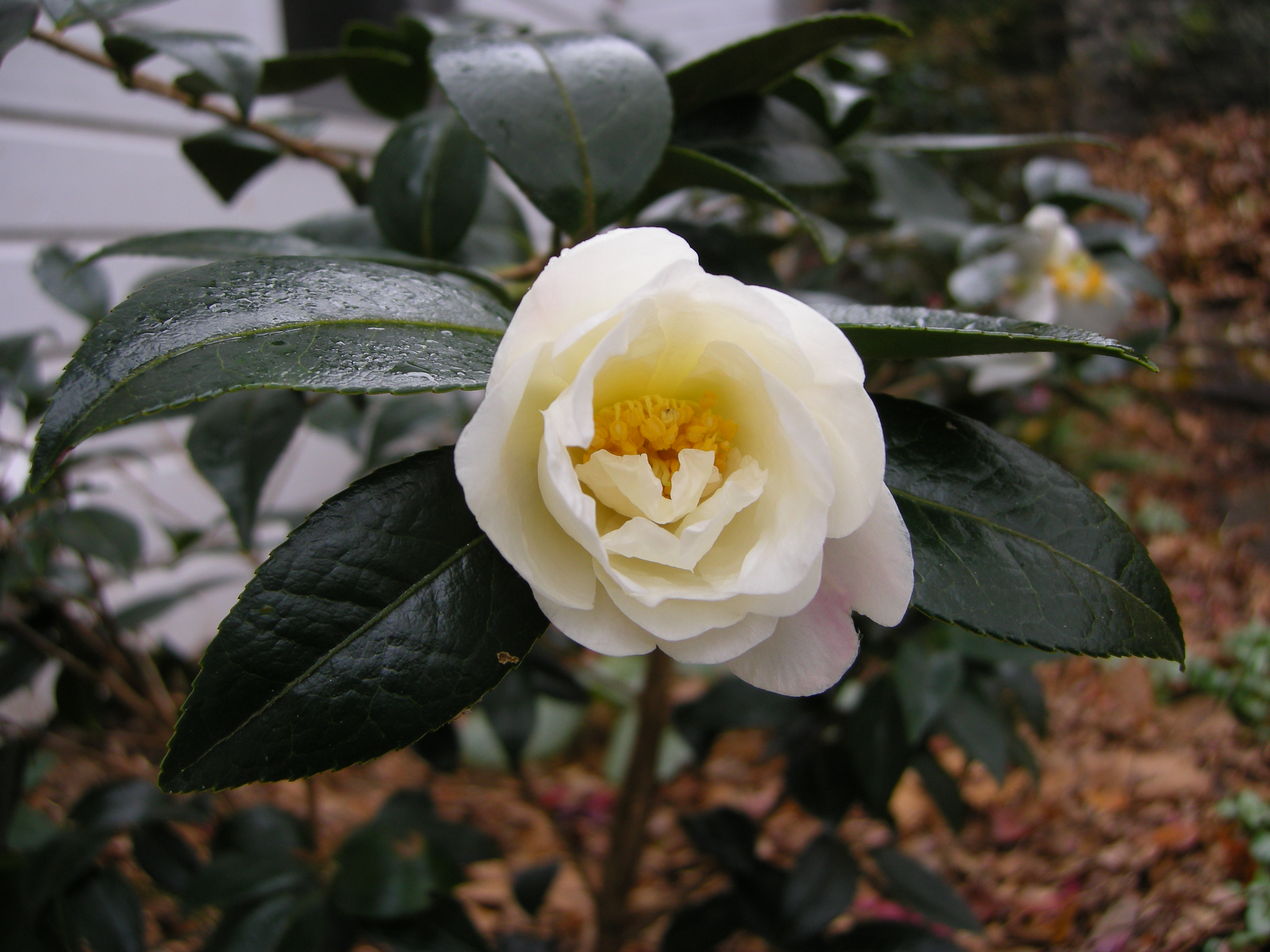
fall-blooming camellia 'Elaine Lee' at Carolyn's Shade GardensFall-blooming Camellia ‘Elaine Lee’

fall-blooming camellia 'Winter's Darling' at Carolyn's Shade GardensAckerman Hybrid Fall-blooming Camellia

'Rozanne' hardy geranium at Carolyn's Shade GardensHardy Geranium ‘Rozanne’

Kousa dogwood at Carolyn's Shade GardensKousa Dogwood

holly osmanthus at Carolyn's Shade GardensHolly Osmanthus ‘Sasaba’

black fountain grass at Carolyn's Shade Gardens‘Moudry’ Black Fountain Grass

'Magic Carpet' spiraea at Carolyn's Shade Gardens‘Magic Carpet’ Spiraea

toad-lily 'Sinonome' at Carolyn's Shade GardensToad-lily ‘Sinonome’

'Gold Rush' Italian arum at Carolyn's Shade Gardens‘Gold Rush’ Italian Arum

Carolyn

Shade Gardening in Fall: Fall Clean-up

Posted in Fall, How to, Shade Gardening with tags , , , on November 13, 2010 by Carolyn @ Carolyns Shade Gardens

Carolyn’s Shade Gardens is a retail nursery located in Bryn Mawr, PA, specializing in showy, colorful, and unusual plants for shade.  The only plants that we ship are snowdrops and miniature hostas.  For catalogues and announcements of events, please send your full name, location, and phone number (for back up use only) to carolyn@carolynsshadegardens.com.  Click here to get to the home page of our website for catalogues and information about our nursery and to subscribe to our blog.

fern bench at Carolyn's Shade GardensI always feel a tension around the time of the first expected killing frost.  Everything in the garden is at its fall peak so I don’t want a frost to ruin it.  But I have a lot of work to do outside before it gets truly cold so I want a killing frost to take it all down.  First thing every morning I look out my bedroom window to see if the much dreaded, much desired frost has occurred.

I clean all my beds out in fall because I am too busy with nursery business to do it in spring.  Just like all my gardening, my fall clean-up has evolved from intensive interference to minimal maintenance.  There have been many epiphanies on this journey, but one of two quintessential ah-ha moments occurred during a 1995 visit to Montrose Nursery in NC (now closed).  They were raking the leaves out of their beds, grinding them up, and throwing them back in, even over the crowns of the perennials.

unground leaves at Carolyn's Shade GardensLeaves on my driveway awaiting grinding

ground leaves at Carolyn's Shade GardensLeaves after grinding with lawn mower

I always knew that my leaves were one of my most valuable garden assets.  I never put them out for the township to collect (I grew up in a family where my father collected other people’s leaves to use in his garden).  However, from 1995 on, I have ground my leaves and used them for mulch as nature intended.  The soil in my beds is incredible because of this practice.

I should mention that it’s actually my husband who grinds the leaves so my other great epiphany occurred last fall when he had shoulder surgery and only ground a small amount of leaves for mulch.  Where to use this precious commodity?

In solving this problem, I developed a priority list for fall clean-up. I no longer hand-clean and mulch all my beds, and my workload has been reduced by about 75%.

First Priority: Only the formal beds on the terraces outside my front door and around the back patio need intensive hand-cleaning and my precious mulch in fall.  Those are the beds closest to the house and the parts of the garden I view all winter from inside.

Patio beds at Carolyn's Shade GardensPatio beds before fall clean-up

patio bed at Carolyn's Shade GardensPatio beds after fall clean-up

Patio Area Carolyn's Shade Gardens Early SpringPatio beds in very early spring

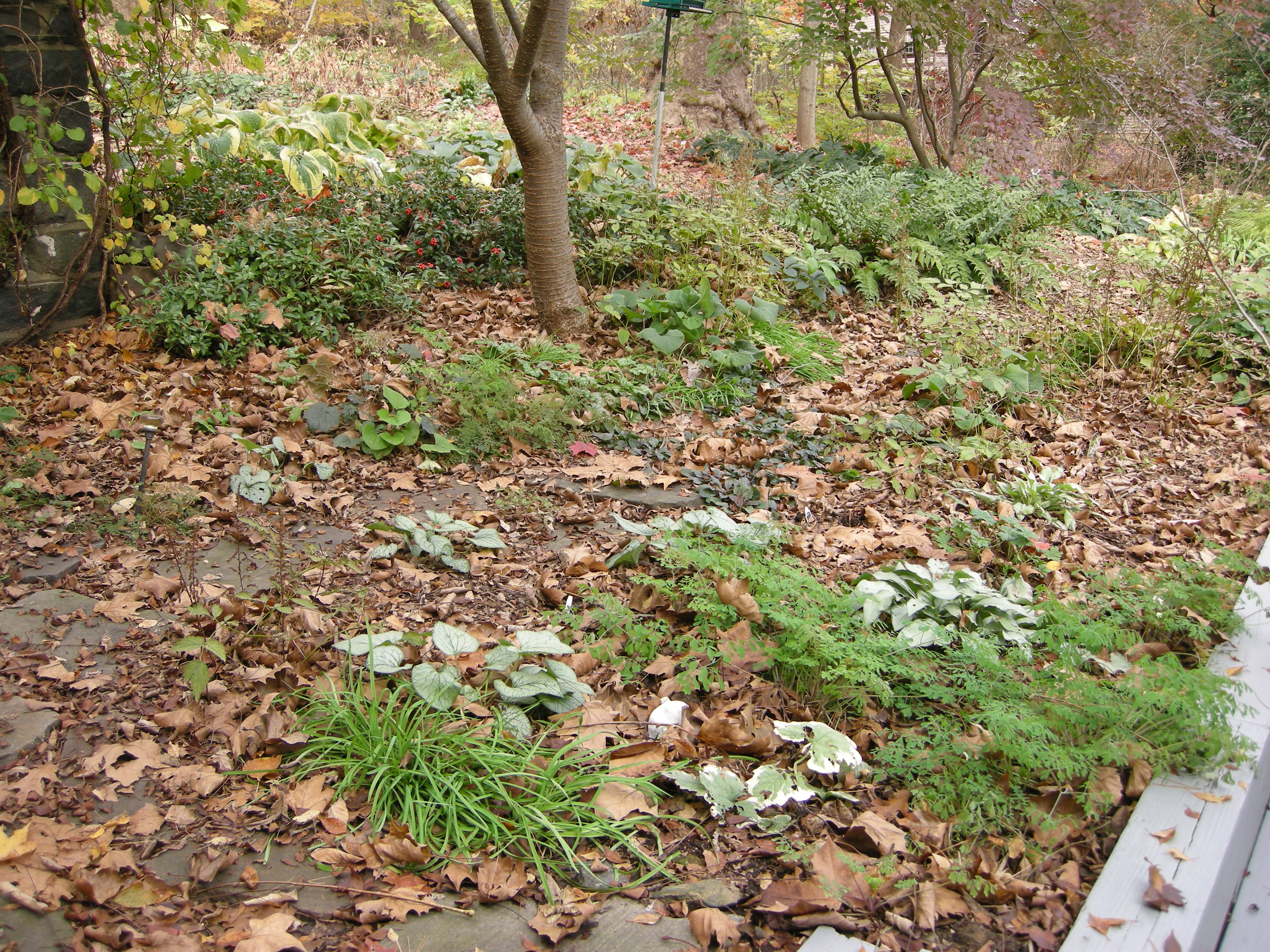
Second priority: Beds near the formal areas are cleaned and mulched along the front only.  I remove old plants from the whole bed but no leaves, which are left to act as mulch and break down on their own.

Third priority: The majority of my garden (my woodland gardens, hosta and epimedium hillside, meadow, and the production beds where I grow plants to sell) receive little to no attention.  I merely rake the paths and cut back very noticeable plants like hostas.  The leaves in the beds are left as mulch.  In spring, I remove any still visible dead plants.

hosta hill at Carolyn's Shade GardensHosta Hill before fall clean-up

Hosta Hill at Carolyn's Shade GardensHosta Hill after fall clean-up

Hosta Hill in spring

Fourth and final priority:  Leaves on the lawn are ground up by the lawn mower and left in place.

Carolyn's Shade Gardens Fall 2010Tree cover at Carolyn’s Shade Gardens

Lest you think this works because my leaf cover is light, you should know that I have 15 one-hundred-year-old London plane trees and many full-grown native black walnuts, ash,  sugar maples, tulip poplars, and oaks—just to mention the most numerous large trees (photo above).  The leaf drop is stupendous, but this system works.  Not only is it less labor intensive, but it’s better for the garden and it’s beautiful.

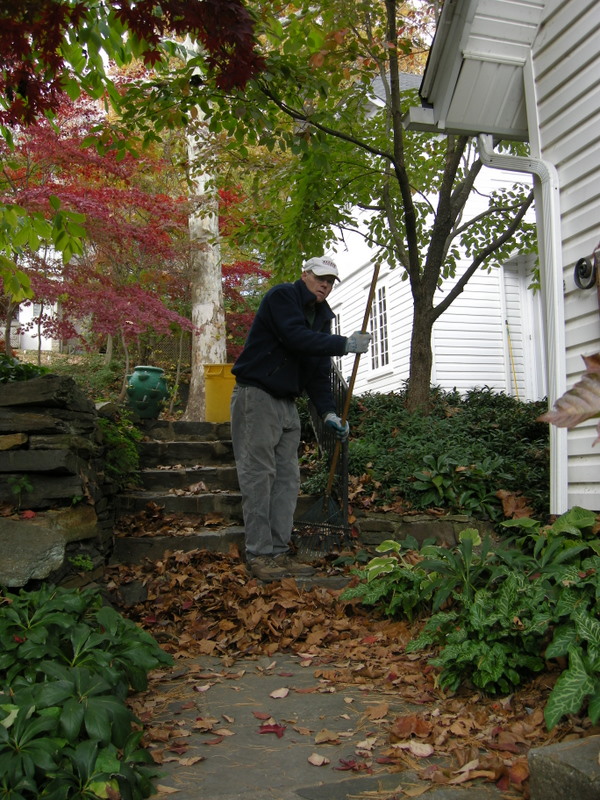
My favorite labor-saving device, my husband, Michael:

Fall at Carolyn's Shade Gardens

Carolyn