Archive for the Shade Gardening Category

Snowdrops or the Confessions of a Galanthophile

Posted in bulbs for shade, Fall Color, Shade Gardening, snowdrops with tags , , , , , , , , , , , , , , , , , on November 22, 2010 by Carolyn @ Carolyns Shade Gardens

Carolyn’s Shade Gardens is a retail nursery located in Bryn Mawr, PA, specializing in showy, colorful, and unusual plants for shade.  The only plants that we ship are snowdrops within the US.  For catalogues and announcements of local events, please send your full name, mailing address, and cell number to carolyn@carolynsshadegardens.com and indicate whether you are interested in snowdrops, hellebores, and/or hostas.  Click here to get to the home page of our website for catalogues and information about our nursery and to subscribe to our blog.

Common Snowdrop at Carolyn's Shade GardensCommon Snowdrop, Galanthus nivalis

Our current snowdrop catalogue is on line here, and we are currently taking orders.

I have always loved snowdrops. I loved them so much that I set my seasonal clock by them.  When they bloomed, it was spring no matter what the calendar said. When we purchased our property in 1983, it came with thousands of common snowdrops, Galanthus nivalis. Many of my original snowdrops are on an open south-facing hill and often start to bloom at the beginning of February.  That’s when spring began for me.  When they bloomed, I would put on my warmest set of work clothes, head out to the garden, and leave the winter doldrums behind.
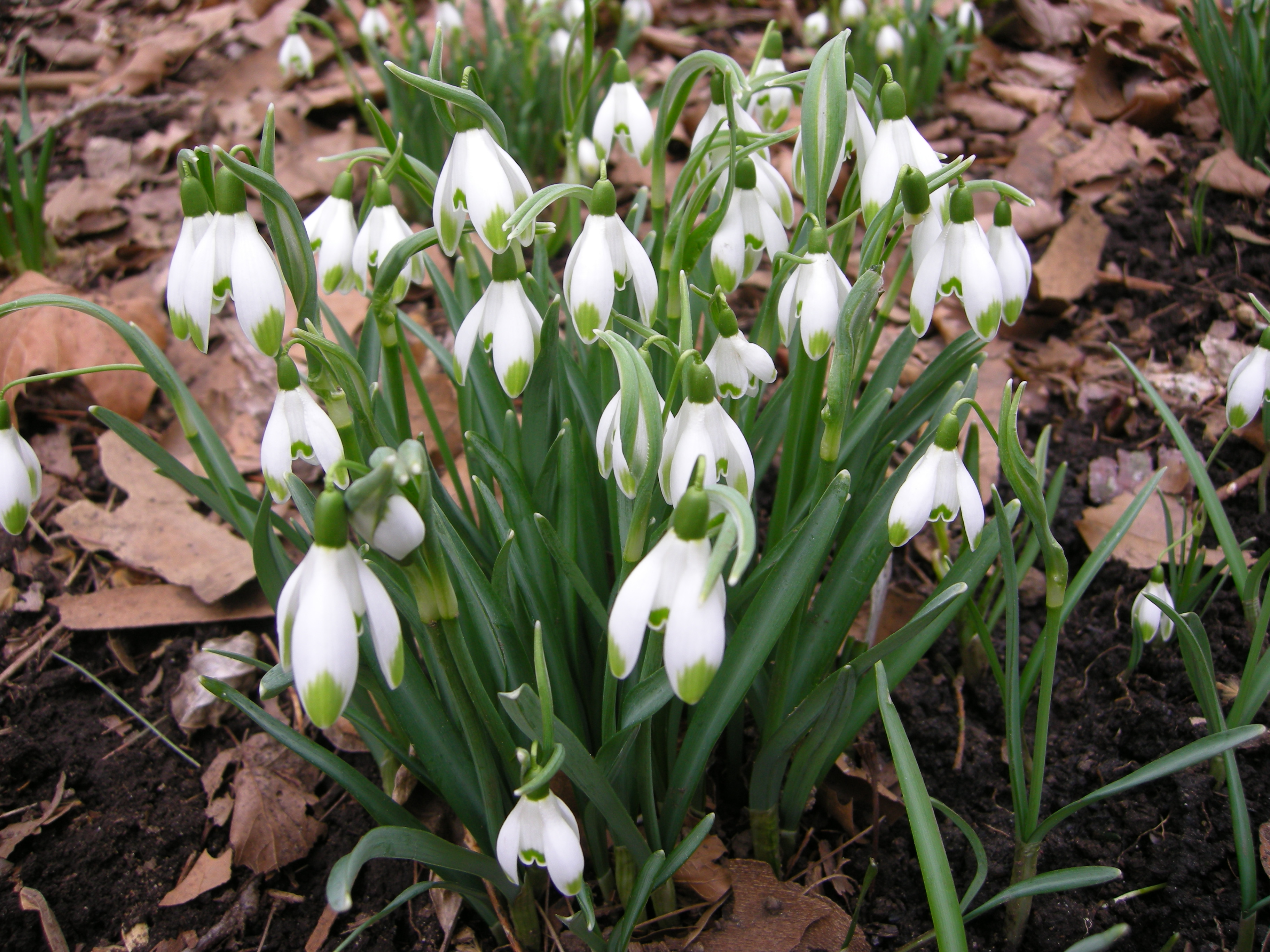
'Viridi-apice' snowdrops at Carolyn's Shade GardensGreen-tipped Snowdrop, Galanthus nivalis ‘Viridi-apice’

That was before I became a galanthophile, a British word describing gardeners obsessed with snowdrops.  In my pre-galanthophile days, I thought (and I shudder to put this in writing) that once you had the double ‘Flore Pleno’, and the giant G.  elwesii, and the green-tipped ‘Viridi-apice’, and the glossy green-leafed G. woronowii, you pretty much had the snowdrop field covered.  The rest all looked the same, didn’t they?  What were all those collectors getting so excited about?

But one day, I realized the error of my ways and was seized by the galanthophile obsession to collect every snowdrop cultivar I could get my hands on.  Actually, it didn’t really happen in a day—more like years.  It started with reading the snowdrop sections in the (old) Heronswood catalogues.  Dan Hinkley was a master at plant descriptions, and I ordered a few new cultivars each year.  However, my fate as a galanthophile was sealed when I visited the garden of  famous regional plantsman Charles Cresson during snowdrop season.  Charles can make you see and appreciate the finest distinctions in plants, and he is so generous with his treasures.
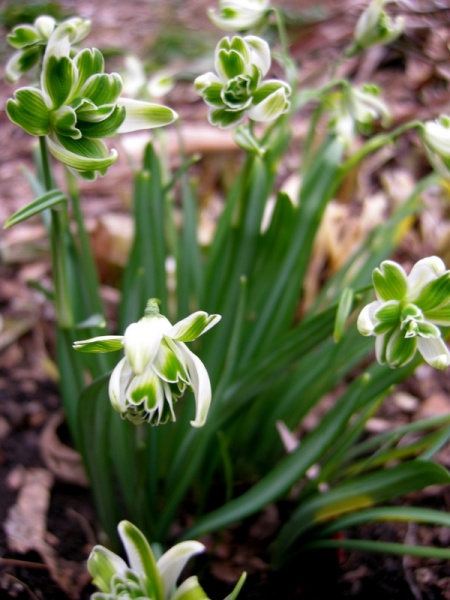
Galanthus nivalis 'Blewbury Tart' at Carolyn's Shade GardensGalanthus ‘Blewbury Tart’

Now I had the wild up-facing double ‘Blewbury Tart’, and ‘Magnet’ with the fishing line stem, and the drop-pearl earring shaped ‘Atkinsii’, and  the classic ‘S. Arnott’, and the rabbit-eared ‘Sharlockii’, and …. they all looked different to me.  I only have 25 varieties though, hardly qualifying me to join the International Galanthophile Society if there is one.  Luckily (or unluckily) unusual snowdrops are rarely offered for sale in the U.S. saving me from creating a system to keep track of hundreds of snowdrop cultivars in my garden.  The British snowdrop “bible”, Snowdrops: A Monograph of Cultivated Galanthus by Matt Bishop, et al., describes 500 cultivars and is sadly out-of-date number-wise.

snowdrop 'Magnet' at Carolyn's Shade GardensGalanthus ‘Magnet’

But why am I talking about snowdrops in fall?  Because two of the unusual varieties I have been able to collect bloom in fall.  This wreaked havoc with my “start of spring” clock, which I had to reset to recognize the wonderful fragrance of sweet box as the beginning of spring.  But this inconvenience has been more than outweighed by allowing me to start my snowdrop season in early October with the blooming of Galanthus reginae-olgae.
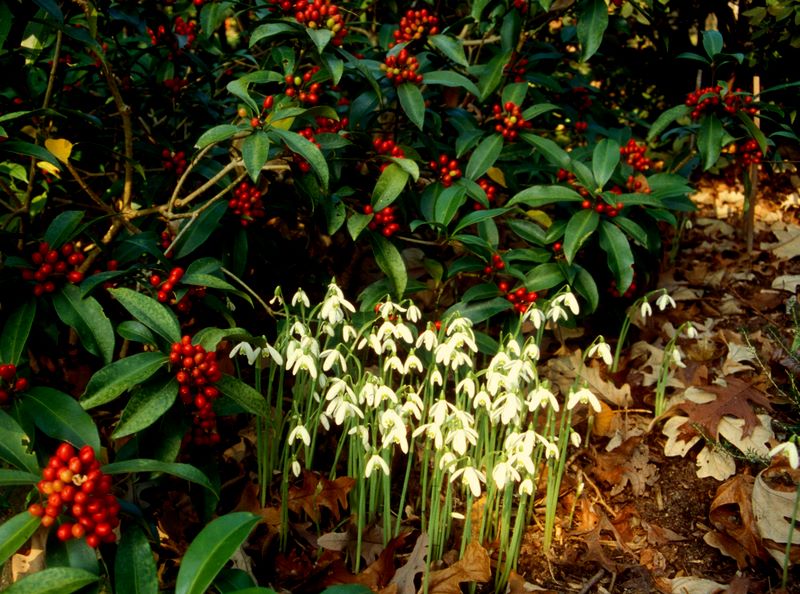
October blooming Galanthus reginae-olgae, photo Charles Cresson

Galanthus reginae-olgae, a species snowdrop which has no handy common name, starts blooming in my garden in early to mid-October and continues for about four weeks.  It looks very much like the common snowdrop, G. nivalis, with a single green spot on its inner petals.  Its most significant identifying feature is its bloom time as it is the first species to flower in the garden.   It is not particularly robust in my garden, but I love it in October.

fall-blooming snowdrop 'Potter's Prelude' at Carolyn's Shade GardensNovember blooming Galanthus ‘Potter’s Prelude’

Just as G. reginae-olgae is winding down, the first blooms of Galanthus elwesii var. monostichus ‘Potter’s Prelude’ are opening in early November.  It continues to flower, sometimes into January, when the straight species, G. elwesii, takes over.  ‘Potter’s Prelude’ is a free-flowering and vigorous snowdrop in my garden with wide recurving blue-green leaves.  It has large blossoms equal in size to the best cultivars of the giant snowdrop, G. elwesii.
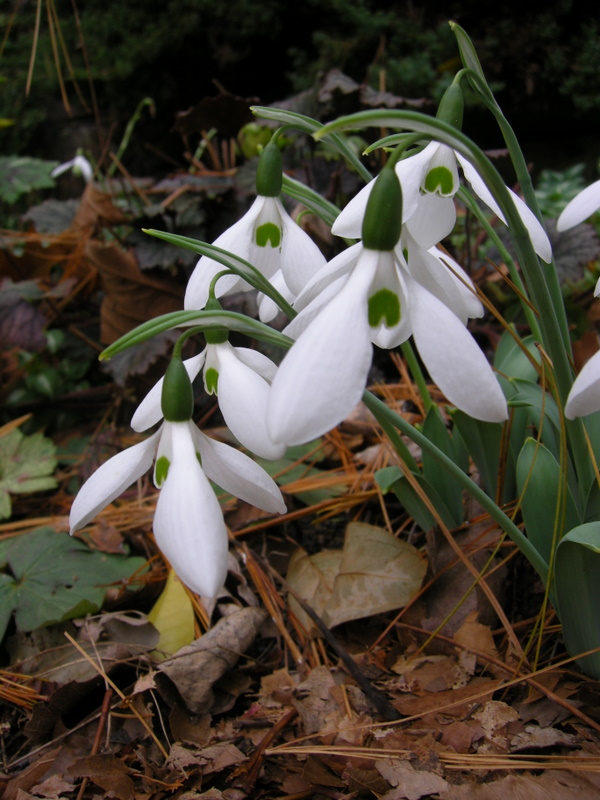
fall-blooming snowdrop 'Potter's Prelude' at Carolyn's Shade GardensNovember blooming Galanthus ‘Potter’s Prelude’

‘Potter’s Prelude’ was selected by Jack Potter, former curator of the Scott Arboretum, and named and registered by Charles Cresson.  Charles has generously allowed me to include ‘Potter’s Prelude’ for sale in my February snowdrop catalogue and given me enough plants to enjoy good-sized clumps in late fall in my own garden.

Carolyn

Shade Gardening in Fall: Fall Clean-up

Posted in Fall, How to, Shade Gardening with tags , , , on November 13, 2010 by Carolyn @ Carolyns Shade Gardens

Carolyn’s Shade Gardens is a retail nursery located in Bryn Mawr, PA, specializing in showy, colorful, and unusual plants for shade.  The only plants that we ship are snowdrops and miniature hostas.  For catalogues and announcements of events, please send your full name, location, and phone number (for back up use only) to carolyn@carolynsshadegardens.com.  Click here to get to the home page of our website for catalogues and information about our nursery and to subscribe to our blog.

fern bench at Carolyn's Shade GardensI always feel a tension around the time of the first expected killing frost.  Everything in the garden is at its fall peak so I don’t want a frost to ruin it.  But I have a lot of work to do outside before it gets truly cold so I want a killing frost to take it all down.  First thing every morning I look out my bedroom window to see if the much dreaded, much desired frost has occurred.

I clean all my beds out in fall because I am too busy with nursery business to do it in spring.  Just like all my gardening, my fall clean-up has evolved from intensive interference to minimal maintenance.  There have been many epiphanies on this journey, but one of two quintessential ah-ha moments occurred during a 1995 visit to Montrose Nursery in NC (now closed).  They were raking the leaves out of their beds, grinding them up, and throwing them back in, even over the crowns of the perennials.

unground leaves at Carolyn's Shade GardensLeaves on my driveway awaiting grinding

ground leaves at Carolyn's Shade GardensLeaves after grinding with lawn mower

I always knew that my leaves were one of my most valuable garden assets.  I never put them out for the township to collect (I grew up in a family where my father collected other people’s leaves to use in his garden).  However, from 1995 on, I have ground my leaves and used them for mulch as nature intended.  The soil in my beds is incredible because of this practice.

I should mention that it’s actually my husband who grinds the leaves so my other great epiphany occurred last fall when he had shoulder surgery and only ground a small amount of leaves for mulch.  Where to use this precious commodity?

In solving this problem, I developed a priority list for fall clean-up. I no longer hand-clean and mulch all my beds, and my workload has been reduced by about 75%.

First Priority: Only the formal beds on the terraces outside my front door and around the back patio need intensive hand-cleaning and my precious mulch in fall.  Those are the beds closest to the house and the parts of the garden I view all winter from inside.

Patio beds at Carolyn's Shade GardensPatio beds before fall clean-up

patio bed at Carolyn's Shade GardensPatio beds after fall clean-up

Patio Area Carolyn's Shade Gardens Early SpringPatio beds in very early spring

Second priority: Beds near the formal areas are cleaned and mulched along the front only.  I remove old plants from the whole bed but no leaves, which are left to act as mulch and break down on their own.

Third priority: The majority of my garden (my woodland gardens, hosta and epimedium hillside, meadow, and the production beds where I grow plants to sell) receive little to no attention.  I merely rake the paths and cut back very noticeable plants like hostas.  The leaves in the beds are left as mulch.  In spring, I remove any still visible dead plants.

hosta hill at Carolyn's Shade GardensHosta Hill before fall clean-up

Hosta Hill at Carolyn's Shade GardensHosta Hill after fall clean-up

Hosta Hill in spring

Fourth and final priority:  Leaves on the lawn are ground up by the lawn mower and left in place.

Carolyn's Shade Gardens Fall 2010Tree cover at Carolyn’s Shade Gardens

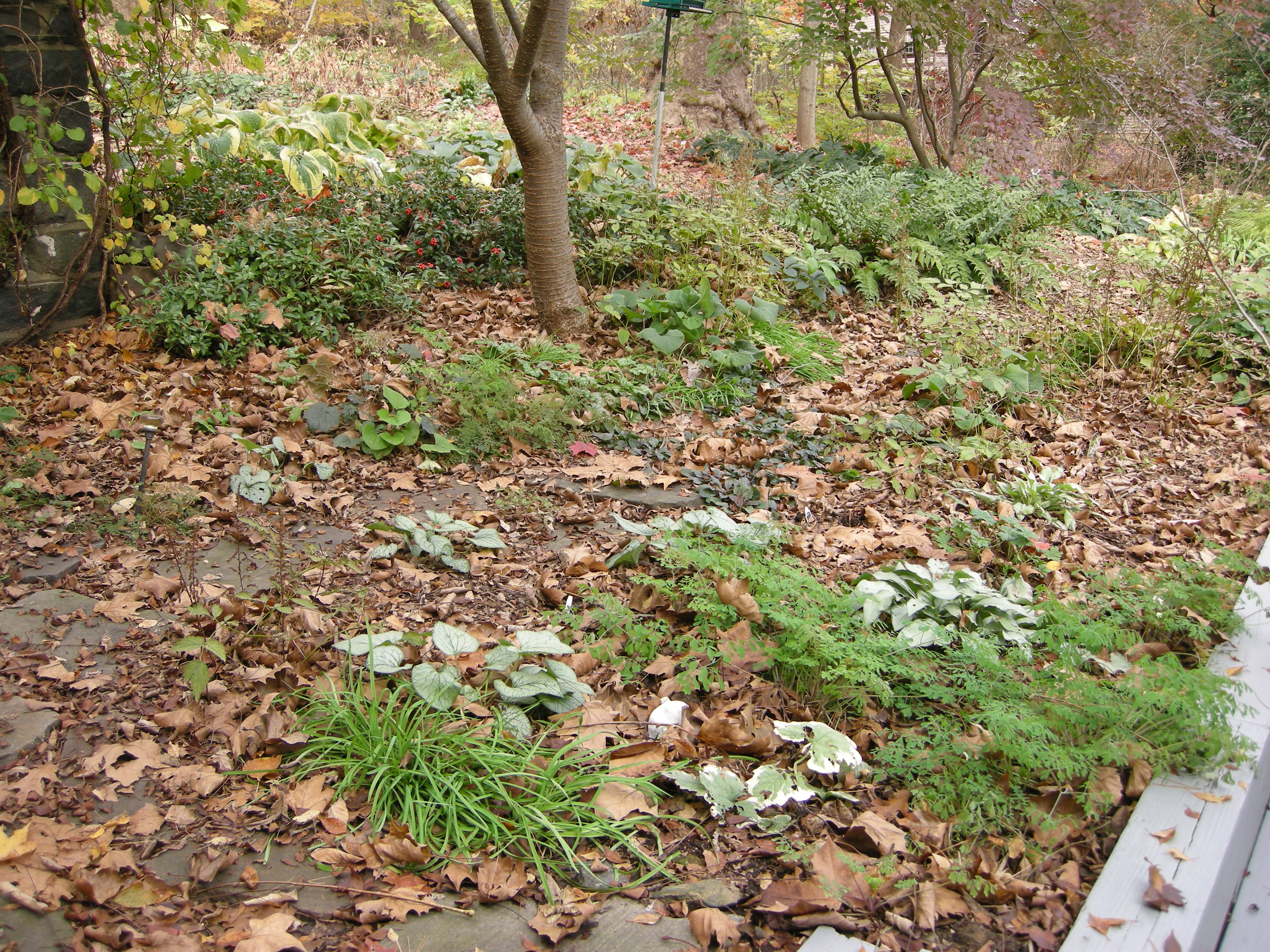
Lest you think this works because my leaf cover is light, you should know that I have 15 one-hundred-year-old London plane trees and many full-grown native black walnuts, ash,  sugar maples, tulip poplars, and oaks—just to mention the most numerous large trees (photo above).  The leaf drop is stupendous, but this system works.  Not only is it less labor intensive, but it’s better for the garden and it’s beautiful.

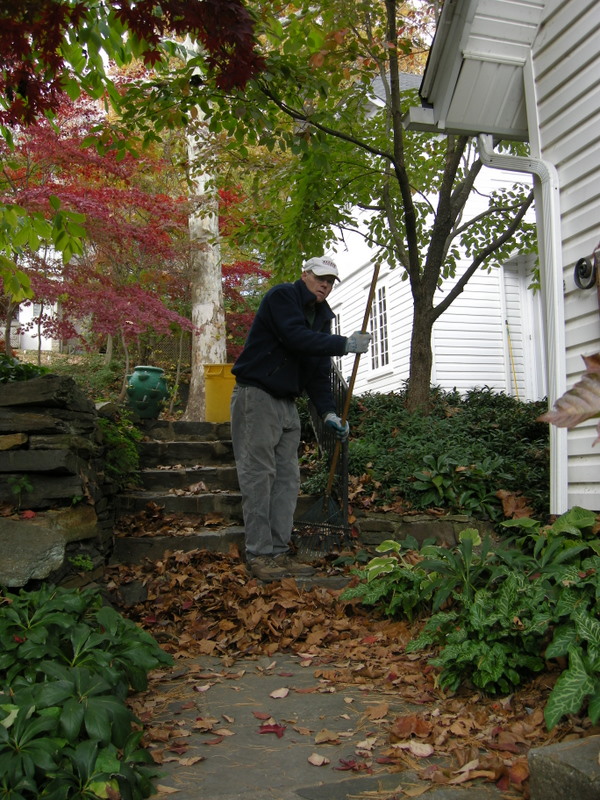
My favorite labor-saving device, my husband, Michael:

Fall at Carolyn's Shade Gardens

Carolyn

Shade Gardening in Fall: Coral Bark Maple

Posted in Fall, Fall Color, Shade Gardening with tags , , , , on November 10, 2010 by Carolyn @ Carolyns Shade Gardens

Carolyn’s Shade Gardens is a retail nursery located in Bryn Mawr, PA, specializing in showy, colorful, and unusual plants for shade.  The only plants that we ship are snowdrops within the US.  For catalogues and announcements of local events, please send your full name, mailing address, and cell number to carolyn@carolynsshadegardens.com and indicate whether you are interested in snowdrops, hellebores, and/or hostas.  Click here to get to the home page of our website for catalogues and information about our nursery and to subscribe to our blog.

Sugar Maple

I have a love/ hate relationship with fall.  I try to take joy in the fall colors and the plants that come into their own in fall.  But I can’t quite ignore the feeling, even though it’s wrong, that the garden is dying.  And, I have to admit that, although I like snow, I don’t like cold and that’s what fall is heading towards.

I think that is why plants that turn beautiful fall colors like the sugar maple pictured above and those that bloom in winter have always been a priority for me.  The riot of color distracts me.  I can rearrange my mental state by viewing winter blooms as the start of  spring (more about that in a later post).  So, to improve my mental state right now, I want to mention a shade tree that has outstanding fall color as well as year round interest.


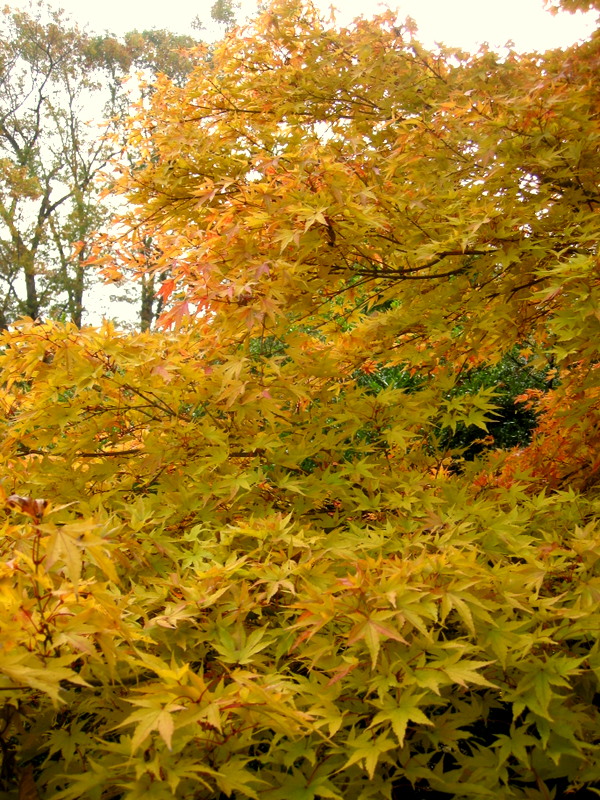
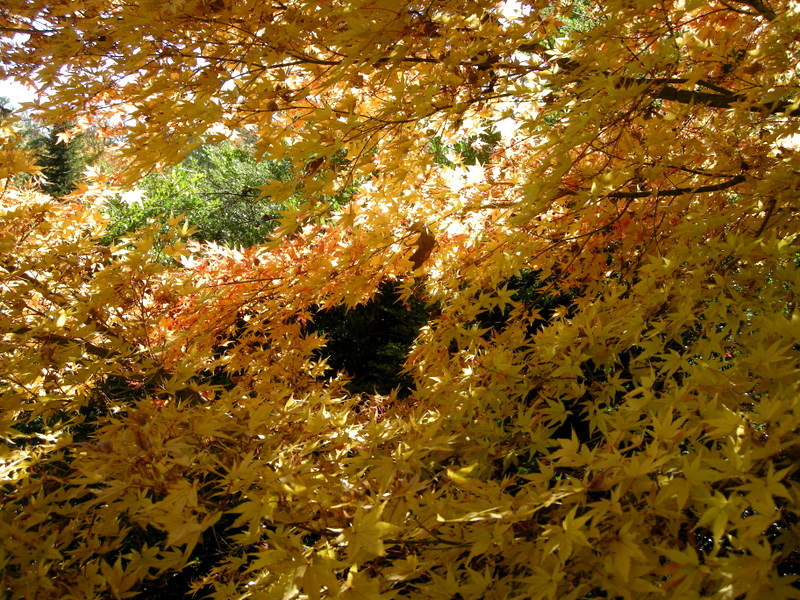
The four photographs above are of coral bark Japanese maple (Acer palmatum ‘Sango-kaku’).  Once you have your splashy sugar maple, you should make room for this elegant tree.  Although rightfully famous for its dazzling  coral-red bark in late winter and spring, I think it should be equally prized for its long-lasting apricot-gold fall color.  I can’t take my eyes off it this time of year especially when the sun shines through it—it’s magical!

Culturally it is a 20-25′ understory tree with an elegant, spreading vase shaped habit.  Easy to grow in part to more shade.  It is also readily available in nurseries around the mid-Atlantic area.

Some other trees at Carolyn’s Shade Gardens with amazing fall color:  flowering dogwood (native), kousa dogwood, Rutger’s hybrid dogwoods (native hybrid), pagoda dogwood (native), other Japanese maple species and cultivars, American hornbeam (native), red maple (native), ‘Okame’ cherry, Yoshino cherry, and Katsura.

Please send me a comment/leave a reply with the names of your favorite trees for fall color.

For more information on the coral bark maple and any other plant you want to know about, I highly recommend the Plant Finder provided by the Missouri Botanical Garden‘s Kemper Center for Home Gardening.  I have added this site to my favorites and use it frequently to get information on plants I am researching.  I have provided a permanent link to this wonderful site under Plant Information on my sidebar so you will always be able to find it.

Carolyn

More Information on Toad-lilies

Posted in Fall Color, Shade Gardening, Shade Perennials with tags , , , on November 7, 2010 by Carolyn @ Carolyns Shade Gardens

Carolyn’s Shade Gardens is a retail nursery located in Bryn Mawr, PA, specializing in showy, colorful, and unusual plants for shade.  The only plants that we ship are snowdrops within the US.  For catalogues and announcements of local events, please send your full name, mailing address, and cell number to carolyn@carolynsshadegardens.com and indicate whether you are interested in snowdrops, hellebores, and/or hostas.  Click here to get to the home page of our website for catalogues and information about our nursery and to subscribe to our blog.

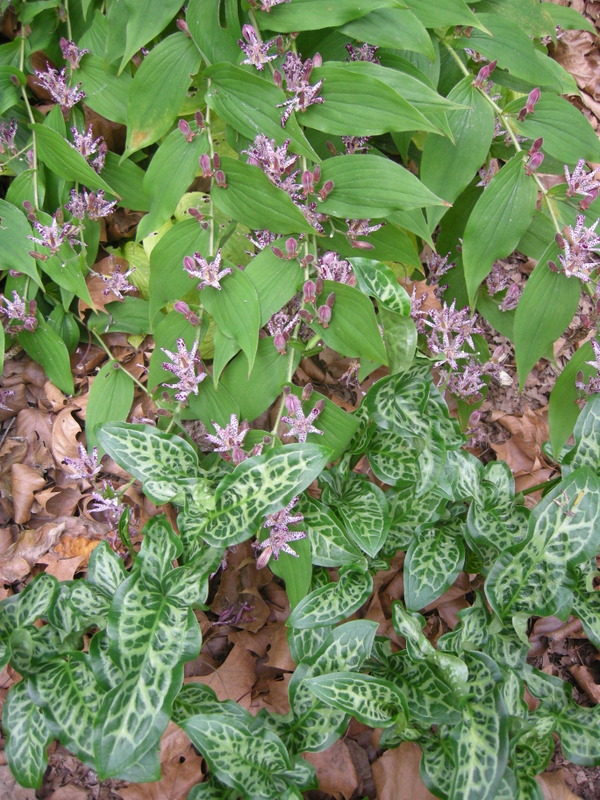
toad-lily 'Sinonome' with Italian arum 'Tiny Tot'

I am excited that my readers seem to be very interested in toad-lilies.  Keep the questions and observations coming!  The most comprehensive information on toad-lilies can be found in the Chicago Botanic Garden Plant Evaluation Notes for Tricyrtis.  This evaluation program is an excellent source of information on the many plant groups that have been evaluated.  I have posted a permanent link to the site under Plant Information on my sidebar so you will always be able to find it.

The photo above is of the toad-lily ‘Sinonome’ with  ‘Tiny Tot’ Italian arum.

Finally, I want to credit my friend and gardener extraordinaire, Beverly Fitts, with the blog header photo and the photo of the dovecote in my first post.  Thanks, Beverly.

Carolyn

Shade Gardening in Fall: Toad-lily

Posted in Fall, Fall Color, Shade Gardening, Shade Perennials with tags , , , on November 4, 2010 by Carolyn @ Carolyns Shade Gardens

Carolyn’s Shade Gardens is a retail nursery located in Bryn Mawr, PA, specializing in showy, colorful, and unusual plants for shade.  The only plants that we ship are snowdrops within the US.  For catalogues and announcements of local events, please send your full name, mailing address, and cell number to carolyn@carolynsshadegardens.com and indicate whether you are interested in snowdrops, hellebores, and/or hostas.  Click here to get to the home page of our website for catalogues and information about our nursery and to subscribe to our blog.

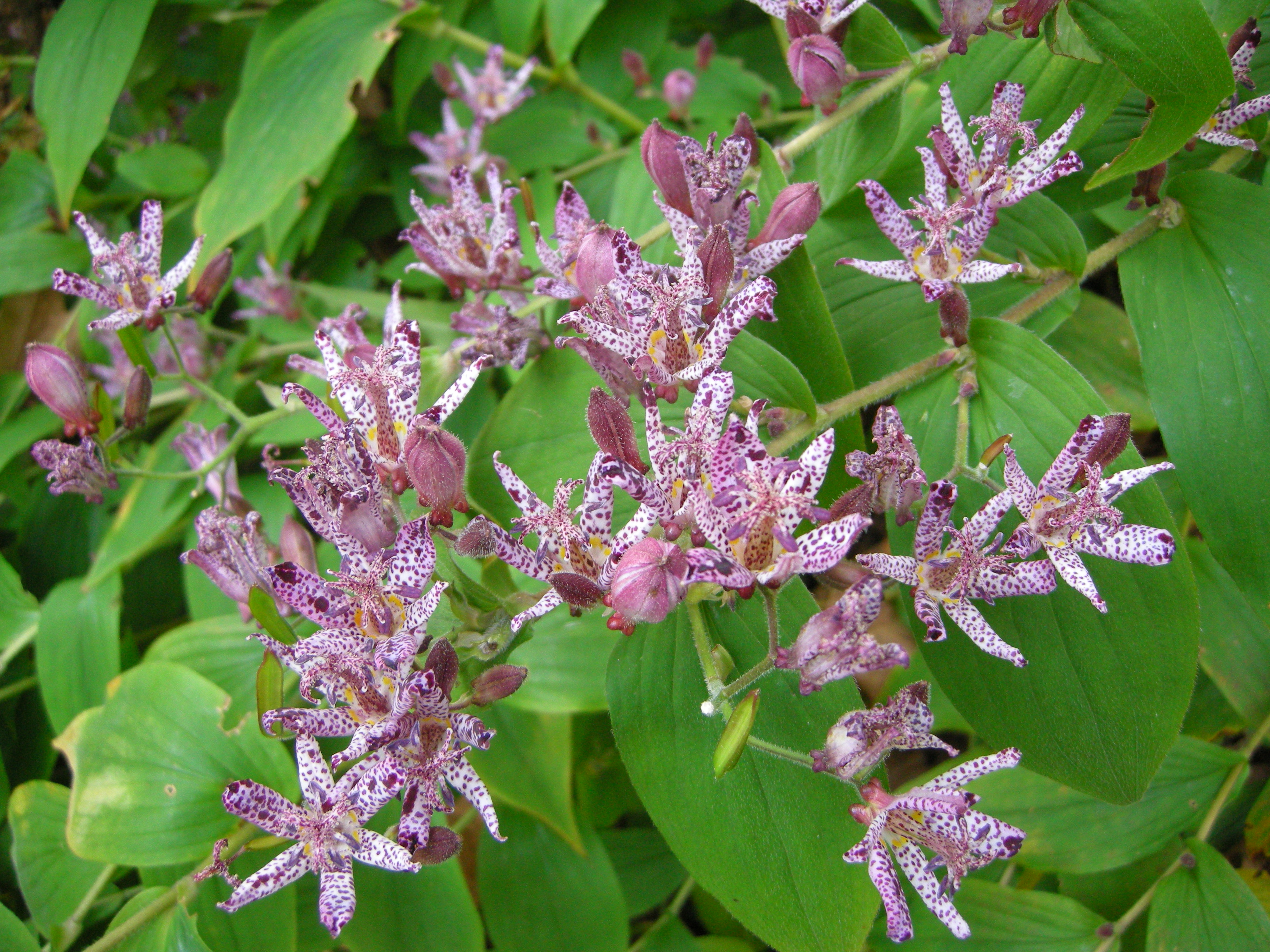
'Sinonome' toad-lily

I love toad-lilies and have grown more than a dozen cultivars— some successfully, some not.  For several reasons, my favorite by far is ‘Sinonome’.  If you haven’t already fallen for it after seeing its photo above I will tell you why ‘Sinonome’ is so desirable.

First and foremost ‘Sinonome’ blooms in October and November when almost every other flower is done, and I am waiting for hellebores.  The gracefully arching 3′ stems are loaded from top to bottom with ruby-purple spotted orchid-like flowers.  As a bonus, its deep green, shiny leaves are quite ornamental and appear in early spring, unlike many fall bloomers that take their time coming out of the ground.

‘Sinonome’ is very easy to grow in part to full shade and takes dry conditions.  I have it growing in three places: on a steep slope with high shade, at the base of a London plane tree in dense dry shade, and under an American hornbeam in a full shade bed filled with surface roots.  It thrives in all these locations.  Unfortunately, my deer like it.

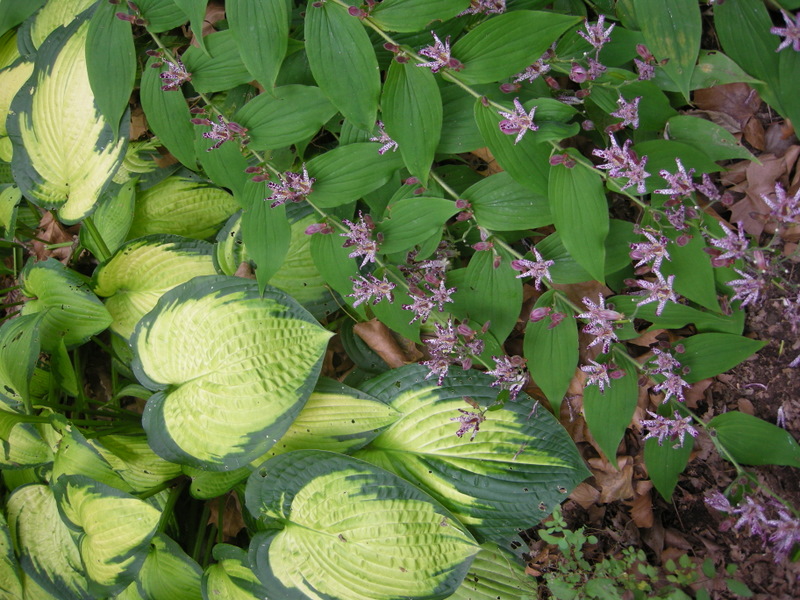
toad-lily 'Sinonome' with 'Paul's Glory' hosta

Companion Plants:  My ‘Sinonome’ is planted with hosta cultivars that still look good in late fall, like ‘Paul’s Glory’ in the photo.  I also have it paired with Italian arum, which re-emerges in fall looking fresh and beautiful, maiden hair and other ferns, and hellebores.  It makes a great specimen all on its own, filling the space of a small shrub.

Other Toad-lilies:  If you want to branch out from ‘Sinonome’, try ‘Empress’ with similar flowers but an upright habit.  I also like Tricyrtis ‘White Towers’, a smaller plant with white flowers, and Tricyrtis latifolia, another smaller plant but with yellow spotted flowers.  All these toad-lilies have thrived for many years in my garden while others have died.  I believe that many poorly selected toad-lilies have been introduced; either that or they just don’t like the mid-Atlantic.

Culture:  Aside from part to full shade, all toad-lilies need to thrive is good drainage.  Even though most authorities say they need moist soil, I have never lost a toad-lily to drought, and I never water them—even this past summer (my plants are more loaded down with blooms than ever before).  I have had toad-lilies die from poor drainage though.  As always, they benefit from compost added at planting and from being mulched with ground leaves.

Carolyn

Carolyn’s Shade Gardens Blog

Posted in Shade Gardening, Uncategorized with tags on November 3, 2010 by Carolyn @ Carolyns Shade Gardens

Carolyn’s Shade Gardens is a retail nursery located in Bryn Mawr, PA, specializing in showy, colorful, and unusual plants for shade.  The only plants that we ship are snowdrops within the US.  For catalogues and announcements of local events, please send your full name, mailing address, and cell number to carolyn@carolynsshadegardens.com and indicate whether you are interested in snowdrops, hellebores, and/or hostas.  Click here to get to the home page of our website for catalogues and information about our nursery and to subscribe to our blog.

I am very excited to announce that I am starting a blog on shade gardening.  One of the frustrating parts of my business is not being able to tell my customers  and others all the interesting things that I have learned about shade gardening over the 18 years I have been in business (and the 35 years I have been gardening).  My open house sales are too busy.  Emails are too cumbersome (and possibly unwanted).  However, almost every day, I think of something that I have learned, observed, or experienced and want to pass on to others.

Now I can post these observations on my blog.  Interested gardeners can subscribe to my blog by clicking the “sign me up!” button on the sidebar.  Don’t worry, you can easily unsubscribe.  Please comment on as many posts as you can so I know what you like and please recommend my blog to everyone you know.

Thanks, Carolyn