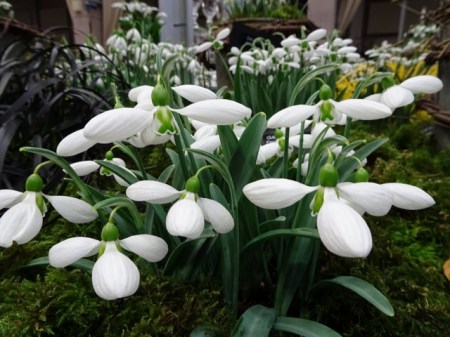
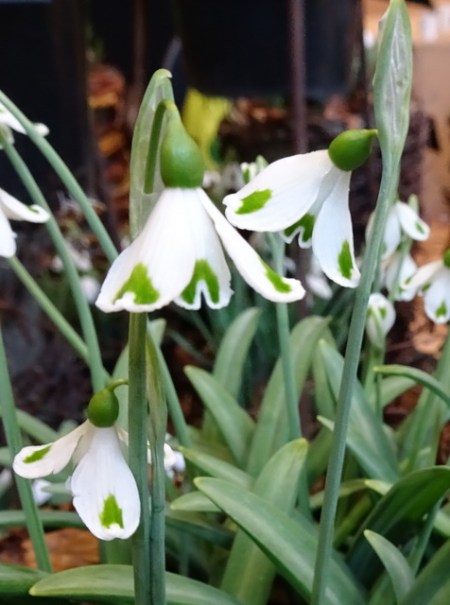
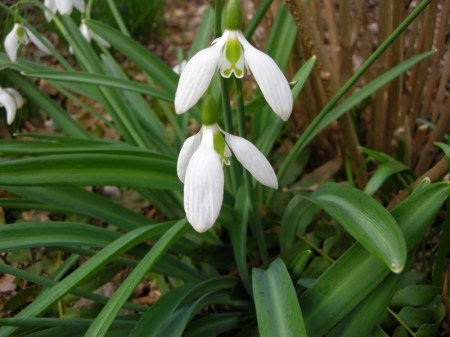
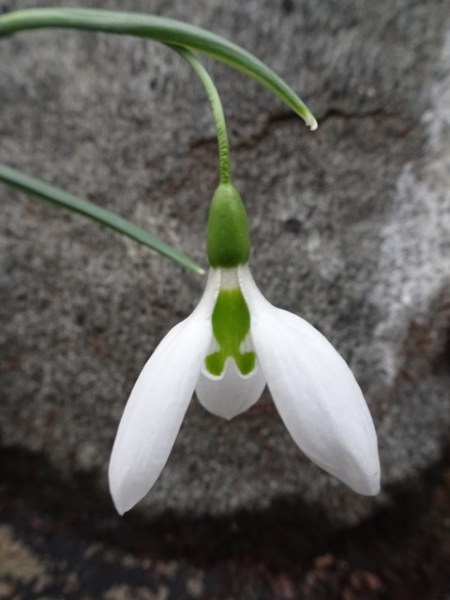
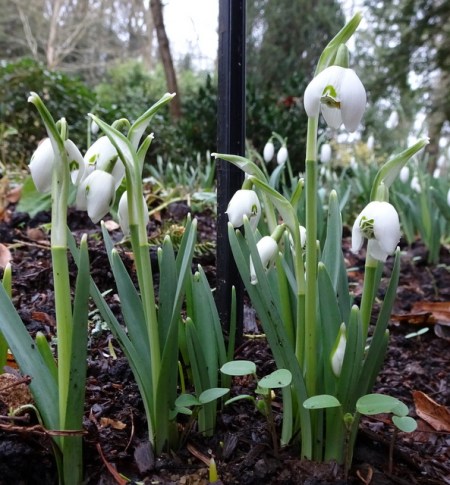
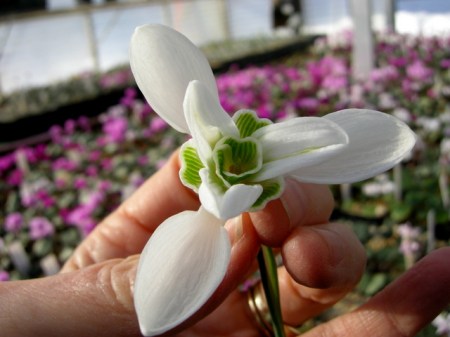
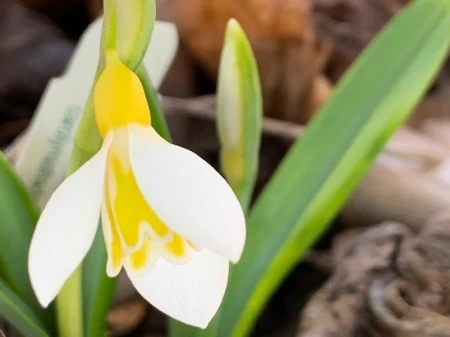
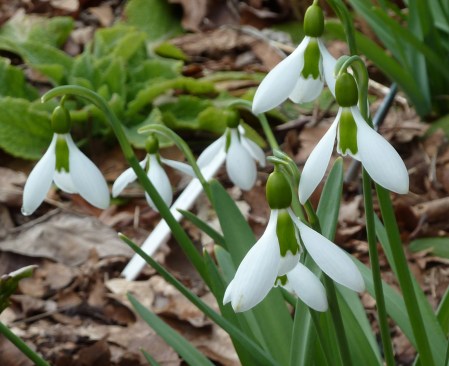
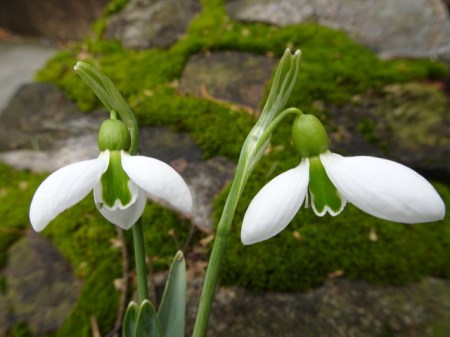
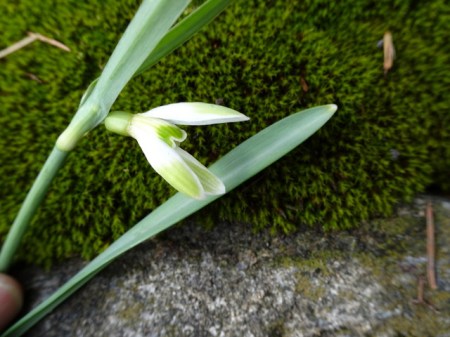
 ‘June Boardman’ combines a bright yellow ovary with an inner mark that is lime green at the apex and pale yellow near the base. Photo from Anne Repnow author of Some Snowdrops: A Photographic Ramble.
Our current snowdrop catalogue is on line here.
We are on a roller coaster ride as far as the weather goes with last week in the 70s, and this week very cold with Sunday night dipping to 21 degrees with a daytime high of 35. Having been a farmer for 30 years, I should be used to this, but I always worry about my little snowdrops trying to form their roots. The fall-bloomers remain undaunted though: G. reginae-olgae is almost finished, ‘Barnes’ is in full, glorious bloom, and ‘Potter’s Prelude is opening flowers. I can see the tips of many more pushing through.
As usual, the 2023 Snowdrop Catalogue will be posted on our website in the first half of December. Meanwhile, this post will give everyone an advance look (sorry, no advance orders) at some of the special, new snowdrops that will be available in the catalogue. Enjoy!
Nursery News: Carolyn’s Shade Gardens is a retail nursery located in Bryn Mawr, PA, specializing in showy, colorful, and unusual plants for shade. The only plants that we ship are snowdrops within the US. For catalogues and announcements of local events, please send your full name, mailing address, and cell number to carolyn@carolynsshadegardens.com and indicate whether you are interested in snowdrops. Click here to get to the home page of our website for catalogues and information about our nursery and to subscribe to our blog.
.
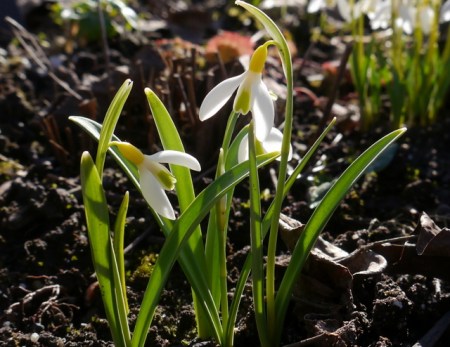
While there are many yellow cultivars of G. plicatus, ‘June Boardman’ (photo at the top) is a rare G. plicatus hybrid. Several sources say it is a seedling of ‘Atkinsii’, and it certainly has the elegant, long, slender flowers and graceful habit that make ‘Atkinsii’ unique. Also unusual, and I think quite beautiful, is the bright yellow ovary combined with a lime green inner mark paling to a lovely yellow at the base. The pedicel and spathe are tinged yellow, and the habit is very upright.
‘June Boardman’ is one of several plicatus seedlings found by distinguished horticulturist Bill Boardman in his Bergh Apton garden ‘Garden in an Orchard’ and is named for his wife (Bergh Apton Newsletter, Issue No. 137, Feb-March 2015).
.
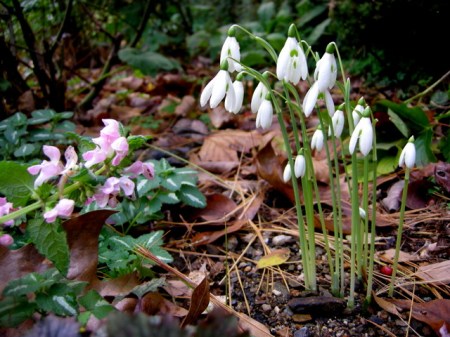 We haven’t offered Galanthus reginae-olgae in 11 years so I am considering it new for the purposes of this post.
The hard-to-find species G. reginae-olgae subsp. reginae-olgae is the earliest to bloom of all the snowdrops in most gardens—in my garden it flowers in early to mid-October—providing a very welcome extension of the snowdrop season into early fall. Its flowers are similar to the common snowdrop, G. nivalis, with a single green mark on the inner segment, but its upright habit gives it a very distinct look.
.
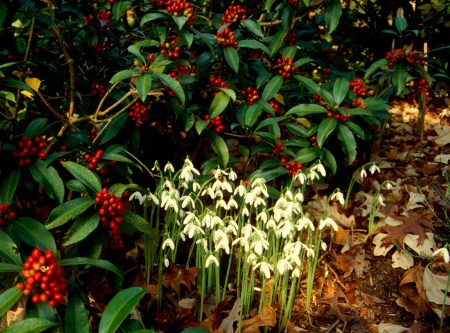 Galanthus reginae-olgae in Charles Cresson’s Swarthmore, Pennsylvania, garden.
G. reginae-olgae was named in 1876 in honor of Queen Olga of Greece, the grandmother of Prince Philip. It was originally collected in Greece and grows throughout the Balkans and Italy, making it more tolerant of hotter and drier weather than other snowdrops. However, it can be finicky so I am pleased to offer plants from Charles Cresson, who got his stock from a local Delaware Valley garden where it had flourished for many years unlike other forms of this species. It is one of 28 snowdrops that has received the Royal Horticultural Society Award of Garden Merit.
For more information on G. reginae-olgae and other early-blooming snowdrops, click here.
.
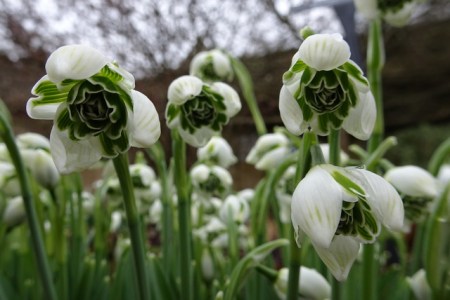 ‘Rodmarton’ originated at Rodmarton Manor in Gloucestershire, one of my favorite snowdrop venues.
‘Rodmarton’ has eye-catching, very large and full double flowers on vigorous, and easy-to-grow plants. The outer segments have faint green lines at the tip, while the inners are boldly marked in deep emerald green. It is one of the tallest double hybrids to result from a cross between G. plicatus and G. nivalis ‘Flore Pleno’ and one of the earliest to flower. It was selected in the mid 1970s by Mary Biddulph in her garden Rodmarton Manor in the village of Rodmaton, Gloucestershire, the home of many fine snowdrops.
.
 ‘Scissors’ in Charles Cresson’s garden
G. plicatus cultivars are a favorite of mine as they usually have substantial flowers on big plants with beautiful leaves so I am always happy to add another like ‘Scissors’ to my garden. The snowdrop bible calls ‘Scissors’ “a fine G. plicatus seedling … [with] long, shapely outer segments … [and a] very apt name” (Snowdrops: A Monograph of Cultivated Galanthus by Matt Bishop, Aaron Davis, and John Grimshaw (Timber Press 2006, page 157). The name fits because the green inner mark resembles a pair of old-fashioned scissors, clearly visible due to the long claws (where the outer segment attaches to the ovary). It was selected in 1988 by Reverend Richard Blakeway-Phillips (1919-2012), an avid snowdrop collector and exhibitor.
.
 ‘Walker Canada’ in the Avon Bulbs display at the 2017 Royal Horticultural Society Show at Vincent Square.
I have long been intrigued by this snowdrop as, when I travel to England during snowdrop season, I invariably get asked if I am Canadian and any relationship to ‘Walker Canada’. However, it was love at first sight when I finally saw it at the 2017 RHS Show. It is a gorgeous, substantial, beautifully proportioned, large-flowered snowdrop with the elegant folded leaves characteristic of G. plicatus.
.
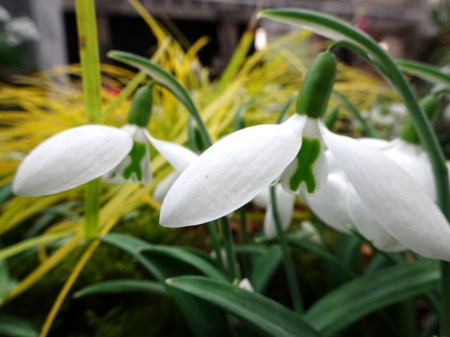 G. plicatus ‘Walker Canada’
‘Walker Canada’s’ origins are a mystery. When snowdrop legend Richard Nutt died in 2002, it was found in a cold frame in his garden at Great Barfield near a faded and barely legible label saying “Walker Canada,” and that’s all we know about it!
Look for another post soon profiling more new snowdrops.
.
Blogs are a lot more fun for everyone, especially the writer, when readers leave comments. Scroll down to the end of the page to the box where it says “Leave a Reply” and start typing—-it’s easy!
Carolyn
.
Note: Every word that appears in orange on my blog is a link that you can click for more information. If you want to return to my blog’s homepage to access the sidebar information (catalogues, previous articles, etc.) or to subscribe to my blog, just click here.
 ‘E. A. Bowles’ is in a class by itself, shown here at Carolyn’s Shade Gardens.
 ‘E.A. Bowles’ caused a sensation in 2011 when it sold for the highest recorded price ever paid for a snowdrop.
 ‘E.A. Bowles’ prominently featured in the Avon Bulbs display at the 2018 RHS Show.
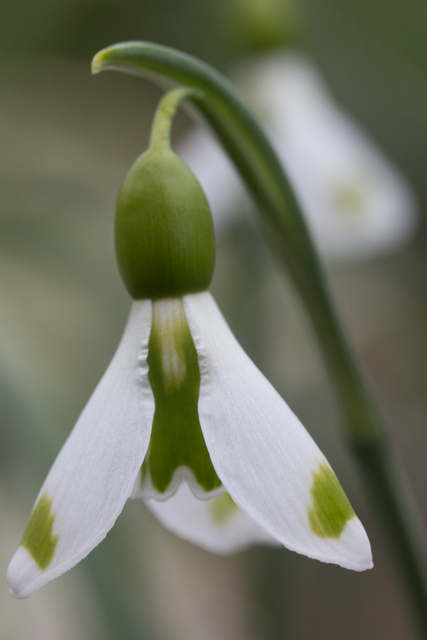 ‘The Wizard’
 ‘Mrs. Thompson’s’ erratic behavior is highly prized in the snowdrop world.
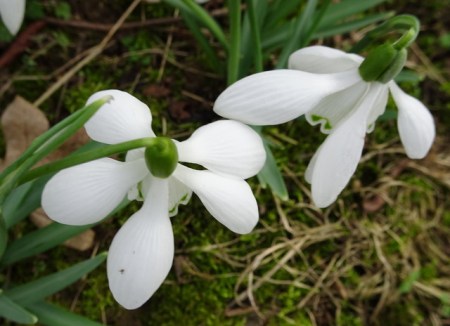 The left flower has five outer segments instead of the usual three, and the right flower is composed of two fused flowers on the same scape.
 ‘Cordelia’ produces a very neat, green rosette.
 ‘Cordelia’ at Carolyn’s Shade Gardens
 ‘Phantom’ produces two types of flowers. One is the very lovely, pure white poculiform shown above. This is the flower form that appears if only one flower is produced.
 This is ‘Phantom’s’ other flower type: a spooky looking snowdrop with markings configured like G. plicatus subsp. byzantinus.
 Both types of flowers appear on this beautiful specimen shown by Avon Bulbs at the 2017 RHS Show.
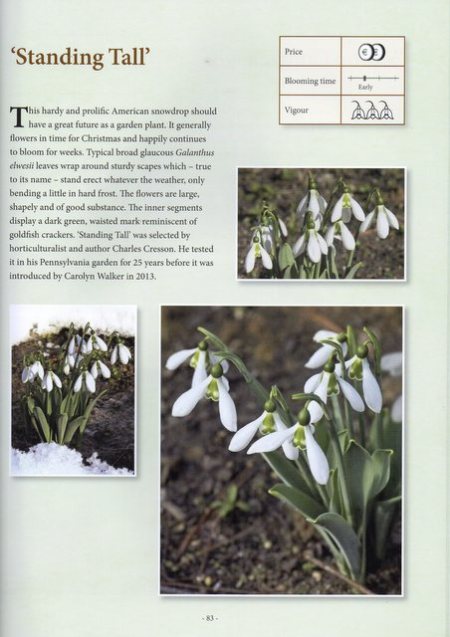
 An unassuming title for a wonderful book. The snowdrop pictured on the cover is ‘Wol Staines’ from Glen Chantry in England, a nursery that I dream of visiting.
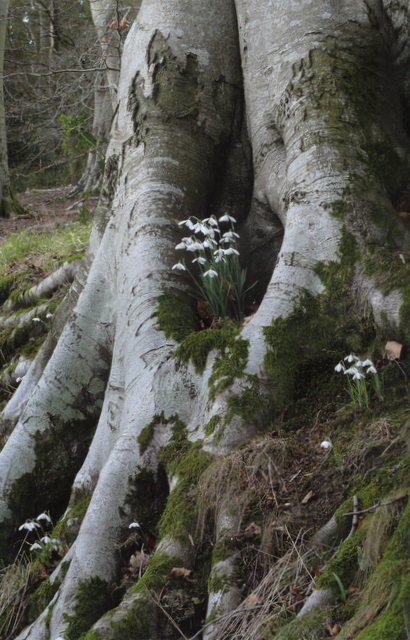 The book starts with some beautiful landscape photos of snowdrops, this one taken at Brechin Castle in Scotland.
 ‘Godfrey Owen’ comes into bloom early in the main season for snowdrops, generally the second half of January in my garden. It is one of my favorites and has received the coveted Royal Horticultural Society Award of Garden Merit.
 ‘Wasp’ is a snowdrop that you would recognize anywhere without a label due to its long, narrow, wing-like outer segments and the striped inner segments resembling a thorax.
 ‘Standing Tall’ is an American snowdrop selected by bulb expert Charles Cresson and introduced exclusively by Carolyn’s Shade Gardens in 2013. Its upright habit, height, and mid-December bloom time make it an outstanding snowdrop.
 ‘Three Ships’ is another favorite available in our 2022 catalogue. Its distinctive, large, round and seersuckered outer segments along with its Christmas bloom time earned it a rare Royal Horticultural Society Award of Garden Merit.
 ‘Midas’ has yellow marks on the outer segments, something entirely new to the snowdrop world.
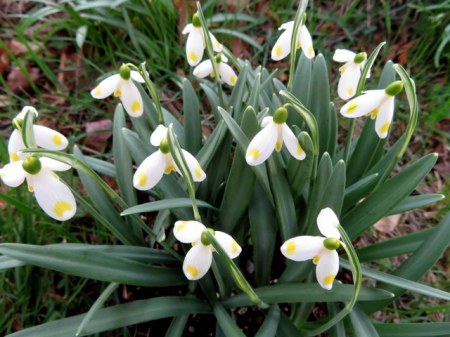 Alan Street at Avon Bulbs sent me this photo of ‘Midas’ in 2017, the year it was introduced. I couldn’t believe my eyes—here was a swarm of one of the world’s rarest snowdrops!
 ‘Augustus’ is classically elegant and award-winning.
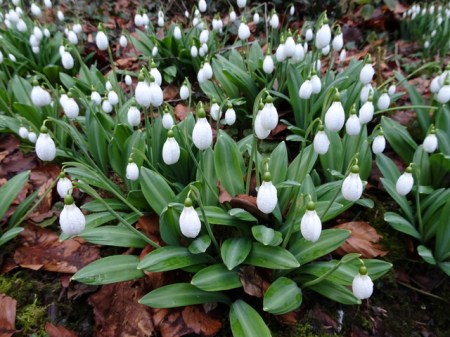 ‘Augustus’ is very striking in a group, here in Hilary and Hugh Purkess’s garden “Welshway”.
 ‘Cowhouse Green’, shown here at Carolyn’s Shade Gardens.
 ‘Desdemona’ is a Greatorex double snowdrop.
 ‘Desdemona’ at Evenley Wood Garden in Northhamptonshire, a snowdrop venue well worth visiting.
 ‘Moses Basket’ cannot be mistaken for any other snowdrop. Many thanks to Margaret and David MacLennan, holders of the UK National Collection of Galanthus (Scientific), for the wonderful photo.
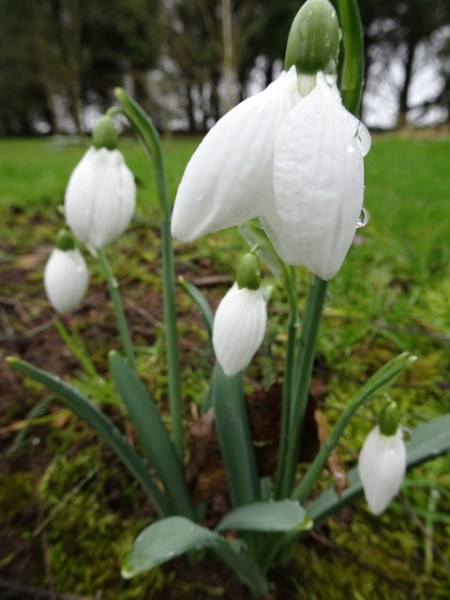 ‘Rodmarton Arcturus’ at the famous snowdrop destination Rodmarton Manor in England.
 An enviable clump of ‘Rodmarton Arcturus’ in the garden of snowdrop expert Ronald Mackenzie.