Archive for the winter Category

New Snowdrops for 2024: Part Three

Posted in bulbs for shade, snowdrops, winter, winter garden, winter interest with tags , , , , , , , , , , , , , , , on December 3, 2023 by Carolyn @ Carolyns Shade Gardens

It was this view of a sweeping stand of ‘Marjorie Brown’ at Glen Chantry Nursery in England that made it a must for my collection (photo taken at Glen Chantry 2/2023).

Our current snowdrop catalogue is on line here.

Seeing the emerging green tips appearing in almost every snowdrop location in our garden never gets old.  The anticipation and promise that those tips represent propel me happily through fall garden chores.  In addition, ‘Three Ships’ celebrated the emerging season by “sailing in” almost three weeks early on November 26.

This is part three of a three-part post on the new snowdrops that will be offered in our 2024 Snowdrop Catalogue.  To read part one, click here, and part two, click here.  As usual, the catalogue will be posted on our website in the first half of December.  Meanwhile, this post will give everyone an advance look (sorry, no advance orders) at five more special, new snowdrops that will be available for order in December.  Enjoy!

Nursery News:  Carolyn’s Shade Gardens is a retail nursery located in Bryn Mawr, PA, specializing in showy, colorful, and unusual plants for shade.  The only plants that we ship are snowdrops within the US.  For catalogues and announcements of local events, please send your full name, mailing address, and cell number to carolyn@carolynsshadegardens.com and indicate whether you are interested in snowdrops.  Click here to get to the home page of our website for catalogues and information about our nursery and to subscribe to our blog.
.

‘Marjorie Brown’ has large, well-rounded flowers and very blue leaves (photo taken at Winterthur 3/2019).

‘Marjorie Brown’ is a G. elwesii cultivar with clear white, large, round, well-proportioned flowers.  It is late-blooming and vigorous, forming large bulbs.  Its leaves are wide with a very distinct bluish tinge compared to other giant snowdrops, G. elwesii.  According to Snowdrops, which calls it “highly garden-worthy” (Snowdrops: A Monograph of Cultivated Galanthus by Matt Bishop, Aaron Davis, and John Grimshaw Timber Press 2006, page 176), Ruby Baker found it in a flower arrangement entered in a March 1987 flower show.  The exhibitor, Marjorie Brown, told Ruby that the flowers were from bulbs purchased in 1958 from Van Tubergen.

.

‘Fenstead End’ in a snowstorm at North Green Snowdrops (taken 2/2017)

I first saw ‘Fenstead End’ when I visited John Morely at North Green Snowdrops during a snowstorm in February 2017.  I admired its long, tapering outer segments and bright green coloring, but the flowers weren’t open (to read about that visit, click here).

. ‘Fenstead End’ puts a smile on my face every time I see it (photo taken at the RHS Show 2/2017)

Later that month, at the RHS Show in London, I saw it with its outer segments raised up to reveal the lovely, white-edged bright green skirt underneath (see the flower in the upper left of the photo for the full effect).  I had to have it for my collection!  It was discovered by Charles Grey-Wilson in Fenstead End, Suffolk, in 1987.

.

‘Trumpolute’ is rarely offered for sale (photo taken at Anglesey Abbey 2/2023).

‘Trumpolute’ has large, boldly marked and gracefully recurved outer segments.  The bright green outer markings are repeated on the inner segments.  It has the classic pagoda shape of an inverse poculiform snowdrop (all the segments are inners) and resulted from a cross between G. plicatus ‘Trym’ and G. elwesii.  It was found at North Green Snowdrops in 2001 by John Morley who gave it its name because the flowers look like ‘Trumps’ and the leaves are convolute (wrapped around each other, also called supervolute).

.

‘Big Eyes’ peer out from between the outer segments (photo from Chris Ireland-Jones).

‘Big Eyes’ has beautifully rounded, balloon-like flowers, reminding me of one of my favorites, ‘Melanie Broughton’.  Because the outers are spoon-shaped with long claws (claws attach the outer segments to the ovary), you can see the two large eyes looking out with the down-turned mouth below. 

.

‘Big Eyes’ (photo from Chris Ireland-Jones)

When my dear friend Alan Street saw it for the first time he proclaimed “what big eyes you have!” just like Little Red Riding Hood and so it was named.  It is a hybrid between the common snowdrop, G. nivalis, and the Crimean snowdrop, G. plicatus.  Alan found it in a naturalized colony in Berkshire around 2000.

.‘John Gray’s’ outstandingly large flowers (photo taken at Colesbourne Park 2/2023)

‘John Gray’ is a member of the much sought after Mighty Atom Group.  It has huge flowers on widely arching pedicels (flower stems), causing it to dip towards the ground.  This very beautiful, early-blooming snowdrop was selected by famous horticulturist E.B. Anderson for its “outstandingly large flower” from the Benhall, Suffolk, garden of John Gray in 1951 (Seven Years or Sixty Years of Gardening by E.B. Anderson, Joseph Publishing 1973).  It was first offered for sale by the Giant Snowdrop Company in 1967.  It is one of only 28 snowdrops to receive an Award of Garden Merit from the Royal Horticultural Society. 

.

Blogs are a lot more fun for everyone, especially the writer, when readers leave comments.  Scroll down to the end of the page to the box where it says “Leave a Reply” and start typing—-it’s easy!

Carolyn

.

Note: Every word that appears in orange on my blog is a link that you can click for more information. If you want to return to my blog’s homepage to access the sidebar information (catalogues, previous articles, etc.) or to subscribe to my blog, just click here.

New Snowdrops for 2024: Part Two

Posted in bulbs for shade, snowdrops, winter, winter garden, winter interest with tags , , , , , , , , , , , , , , , on November 28, 2023 by Carolyn @ Carolyns Shade Gardens

One of ‘Miss Prissy’s’ best attributes is that the flowers face outward so you can see the inner segments (all photos in this post were taken by me at Avon Bulbs 2/2023).

Our current snowdrop catalogue is on line here.

I travel to England to view snowdrops in person rather than relying on on line photos to choose what to offer in my catalogue.  I am looking not only for snowdrops that stand out for their markings, but also for cultivars that are vigorous and beautiful whether rare or not.  All the snowdrops in this post stood out when I photographed the hundreds of snowdrops in bloom at Avon Bulbs in Somerset last February!

This is part two of a three-part post on the new snowdrops that will be offered in our 2024 Snowdrop Catalogue.  To read part one, click here.  As usual, the catalogue will be posted on our website in the first half of December.  Meanwhile, this post will give everyone an advance look (sorry, no advance orders) at five more special, new snowdrops that will be available for order in December.  Enjoy!

Nursery News:  Carolyn’s Shade Gardens is a retail nursery located in Bryn Mawr, PA, specializing in showy, colorful, and unusual plants for shade.  The only plants that we ship are snowdrops within the US.  For catalogues and announcements of local events, please send your full name, mailing address, and cell number to carolyn@carolynsshadegardens.com and indicate whether you are interested in snowdrops.  Click here to get to the home page of our website for catalogues and information about our nursery and to subscribe to our blog.
.

‘Miss Prissy’ also has green tips on the outers.

‘Miss Prissy’ is a very neat, outward-facing double snowdrop.  The outer segments have prominent green tips and the inner segments are very green with sparkling white edges.  It is a hybrid between the giant snowdrop, G. elwesii, and the double common snowdrop, G. nivalis ‘Flore Pleno’, selected by Stephen Jackson and registered in 2017.  It is named after the spinster hen in the Looney Tunes cartoon.

. ‘Excelsis’

‘Excelsis’ arrived in my garden by mistake last year, and I was so taken with it that I ordered more so I could include it in the catalogue this year.  International snowdrop expert Alan Street discovered ‘Excelsis’ as a seedling at Avon Bulbs in 2015.  He was immediately dazzled by its long, shapely outer segments and the heavenly marked green inners, hence the name.  A dark green V extending from the apex joins a lighter green V from the base, creating an elegant and unusual mark.

.

‘Excelsis’ has an unusual inner mark.

.

‘Big Bertha’ is rarely offered for sale.

‘Big Bertha’ has huge, round flowers with dark green tips on the ballooning outer segments and a prominent dark green mark on the inners.  Its habit is distinct with widely splayed leaves at ground level and very upright flowers and scapes (flower stalks).  All these characteristics together make it instantly recognizable in the garden. 

.

‘Big Bertha’s habit is very upright.

‘Big Bertha’ is a vigorous cultivar of the giant snowdrop, G. elwesii.  It was discovered around 2004  in a bulk purchase of bulbs by Gill Richardson, Manor Farm, Lincolnshire.

.

‘Washfield Colesbourne’

I saw ‘Washfield Colesbourne’ for the first time at Avon Bulbs during my February 2023 trip to England and had to have it.  As Gardens Illustrated says in its January 2023 article, click here, it is tall and majestic with large flowers and incredibly dark green inner segments.  The snowdrop bible calls it a “magnificent hybrid” (Snowdrops: A Monograph of Cultivated Galanthus by Matt Bishop, Aaron Davis, and John Grimshaw Timber Press 2006, page 266).

.

A group of ‘Washfield Colesbourne’ really stands out.

‘Washfield Colesbourne’ was found at Elizabeth Strangman’s famous Washfield Nursery in Hawkhurst, Kent.  It is a seedling of the snowdrop ‘Colesbourne’, and much more vigorous than its parent.

.

‘Ivy Cottage Corporal’

‘Ivy Cottage Corporal’ has long, elegant, and full outer segments.  The inners are boldly marked with the double chevron insignia found on a British corporal’s uniform.  It is a vigorous hybrid and produces many flowers.  Probably a G. nivalis x G. plicatus cross, it was discovered by Michael Broadhurst in 2013.

.

‘Ivy Cottage Corporal’ displays its well-shaped outer segments.

‘Ivy Cottage Corporal’ is highly praised in my favorite snowdrop reference Some Snowdrops: A Photographic Ramble by Anne Repnow.  It was also profiled as a favorite in the January 2023 Gardens Illustrated article on snowdrops in Margery Fish’s garden at East Lambrook Manor, click here.  The photos in the article are taken by photographer Jason Ingram and are quite lovely—be sure and scroll down to see ‘Ivy Cottage Corporal’.

.

Look for Part Three of this post profiling five more new snowdrops from our 2024 catalogue soon.

.

Blogs are a lot more fun for everyone, especially the writer, when readers leave comments.  Scroll down to the end of the page to the box where it says “Leave a Reply” and start typing—-it’s easy!

Carolyn

.

Note: Every word that appears in orange on my blog is a link that you can click for more information. If you want to return to my blog’s homepage to access the sidebar information (catalogues, previous articles, etc.) or to subscribe to my blog, just click here.

Wisley’s Winter Garden

Posted in garden to visit, landscape design, Shade Shrubs, shrubs for winter, winter, winter garden, winter interest with tags , , , , , , , , , , , , , , on November 5, 2023 by Carolyn @ Carolyns Shade Gardens

At Wisley, red-flowered hybrid witch hazel ‘Ruben’ provides a vivid contrast to a gold needled conifer and blooming heath.

The day after we visited the Savill Garden last February, we faced a long drive to Avon Bulbs in the south of England.  However, at the suggestion of John Anderson, we decided we would visit RHS Garden Wisley, the flagship of the Royal Horticultural Society’s gardens on our way.  When we arrived, we had one hour for touring the 240 acre garden and decided to do the Winter Walk though we wish we had had more time to visit other areas.  

Nursery News:  Carolyn’s Shade Gardens is a retail nursery located in Bryn Mawr, PA, specializing in showy, colorful, and unusual plants for shade.  The only plants that we ship are snowdrops within the US.  For catalogues and announcements of local events, please send your full name, mailing address, and cell number to carolyn@carolynsshadegardens.com and indicate whether you are interested in snowdrops.  Click here to get to the home page of our website for catalogues and information about our nursery and to subscribe to our blog.

Hybrid witch hazel ‘Pallida’ with a blue needled, creeping juniper.

The Wisley website provides an excellent overview of the the highlights of the Winter Walk with in depth descriptions and photos of 10 locations.  Included at the end is a Winter Walk planting list with clickable entries containing photos and details about each plant.  You can read it here.  During our hurried visit, I captured a random sample, which I will share below.

.

The amazing silver buds of ‘Winter Liebe’ edgeworthia underplanted with winter-blooming daffodils.

.

I was very impressed with the witch hazels at Wisley, here the hybrid ‘Harry’.  They provide a multitude of brightly colored flowers in the winter landscape.

.

A closeup of the flowers on ‘Harry’.

.

Shrub dogwoods are grown for their winter branch color, here bloodtwig dogwood, Cornus sanguinea ‘Magic Flame’.

.

Conifers provide a great contrast in the winter garden, here hybrid witch hazels ‘Pallida’ and ‘Robert’ with a blue spruce.

.

Although snowdrops were not a focus of the garden, they were sprinkled through out, adding a cheerful white accent, here ‘Sibbertoft No 2’.

.

The garden featured plenty of hellebores, including ‘Anna’s Red’ from the Frostkiss series.

.

Frostkiss ‘Molly’s White’

.

Hybrid witch hazel ‘Vesna’ with a small variegated shrub, maybe a euonymus, providing a beautiful contrast.

.

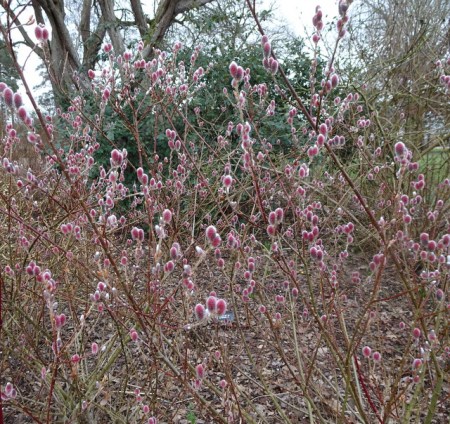
This Japanese pink pussy willow ‘Mount Aso’ really stood out.

.

The white stems of  ‘Winter Lightning’ with the woven branches of golden willow ‘Yelverton’.

.

The woven branches of golden willow ‘Golden Ness’ edge the pond.

.

A gorgeous combination of hybrid witchhazel underplanted with ‘Ice ‘n’ Roses White’ hybrid hellebore.

.

A close up of hellebore ‘Ice ‘n’ Roses White’, which is early blooming and a great performer in my garden.

.

The winter garden at Wisley is well worth visiting if you are in England in February.

.

Blogs are a lot more fun for everyone, especially the writer, when readers leave comments.  Scroll down to the end of the page to the box where it says “Leave a Reply” and start typing—-it’s easy!

Carolyn

.

Note: Every word that appears in orange on my blog is a link that you can click for more information. If you want to return to my blog’s homepage to access the sidebar information (catalogues, previous articles, etc.) or to subscribe to my blog, just click here.

The Savill Garden in Winter

Posted in garden to visit, landscape design, winter, winter interest with tags , , , , , , , , , , , , on October 29, 2023 by Carolyn @ Carolyns Shade Gardens

Bright colors from bark, leaves, and flowers are everywhere at the Savill Garden on a bleak February 1.

My earliest snowdrops, Galanthus bursanus, are blooming, but before I get caught up in that mania, I thought I would devote a post to a gorgeous winter garden we visited in England.  On February 1, 2023, Michael and I arrived at Heathrow Airport in London and went directly to the Savill Garden.  We were there at the invitation of John Anderson, Keeper of the Gardens for Windsor Great Park, the 5,000 acres of gardens surrounding Windsor Castle.  John graciously took the morning off to show us around.

Nursery News:  Carolyn’s Shade Gardens is a retail nursery located in Bryn Mawr, PA, specializing in showy, colorful, and unusual plants for shade.  The only plants that we ship are snowdrops within the US.  For catalogues and announcements of local events, please send your full name, mailing address, and cell number to carolyn@carolynsshadegardens.com and indicate whether you are interested in snowdrops.  Click here to get to the home page of our website for catalogues and information about our nursery and to subscribe to our blog.

.

Around every corner at the Savill Garden is a beautiful vista featuring plants grown to provide color in winter, here pollarded golden willow stems.

The 35 acre Savill Garden was commissioned in 1932 by George V and created by Eric Savill.  Along with several other gardens, Savill is part of Windsor Great Park, which is held by the Crown Estate.  This means that, although the king or queen does not personally own the garden, it is theirs as long as they wear the crown.  John Anderson reported to Queen Elizabeth II and now to King Charles III, and, as avid gardeners, the queen and king have both been involved with planning at Savill.  For more on the Windsor Great Park and the Savill Garden, please read my post about John Anderson’s trip to Winterthur by clicking here.

.

.

As you enjoy the photos below, think about incorporating some of the amazing winter interest plants into your own garden: 

.

Giant rhubarb, Gunnera sp., is covered with its own large leaves for winter protection.

.

The garden features many forms of shrub dogwoods grown for their winter branch color, including bloodtwig dogwood, Cornus sanguinea ‘Anny’s Winter Orange’.

.

A close up of the trunk of one of the birches in the first photo, showing the incredibly white bark of ‘Silver Shadow’ Himalayan birch paired with the flowers and winter green foliage of Helleborus x sternii “Blackthorn Strain”.

.

Tartarian dogwood, Cornus alba ‘Sibirica’

.

‘Magic Flame’ bloodtwig dogwood surrounded by the broad purple leaves of bergenia, flowering heath, and a winter-blooming daffodil.

.

On the other side of ‘Magic Flame’ are the ornamental canes of ‘Golden Vale’ white-stemmed bramble.

.

‘Phoenix’ snakebark maple, a cross between our native tree and a Chinese relative.

.

The garden features many different forms of witchhazel, including ‘Diane’ above.

.

Snowdrops are sprinkled around the garden, here with the many bright shades of chartreuse that light up this area.

.

A form of Acer tegmentosum, striped maple, called ‘Valley Phantom’.

.

Early-blooming hellebores, here Helleborus foetidus, are massed through out the winter garden.

.

‘Sauwala White’ Himalayan birch

.

A glimpse out towards the rest of the Savill Garden, which would be worth visiting anytime but is spectacular in winter!

.

Thanks to John Anderson for spending so much time outside with us on a very cold winter day (photo of Carolyn and John).


.

Blogs are a lot more fun for everyone, especially the writer, when readers leave comments.  Scroll down to the end of the page to the box where it says “Leave a Reply” and start typing—-it’s easy!

Carolyn

.

Note: Every word that appears in orange on my blog is a link that you can click for more information. If you want to return to my blog’s homepage to access the sidebar information (catalogues, previous articles, etc.) or to subscribe to my blog, just click here.

Hellebores for Early Color

Posted in evergreen, hellebores, my garden, Shade Perennials, winter, winter interest with tags , , , , , , , , , , , , on April 5, 2020 by Carolyn @ Carolyns Shade Gardens

A customer sent me this lovely photo of hellebores she purchased from Carolyn’s Shade Gardens (thanks, Jane).

This is the third in a series of posts on early-blooming plants, which include Trees and Shrubs for Early Color, click here to read, and Bulbs for Early Color, click here to read. I have revived my blog to provide a few moments of beauty to my readers all over the globe during the worldwide health crisis.

I am dedicating this post to Jeremy and Fran T. at Trader Joe’s and all the brave people who are staffing our grocery stores so we can continue to buy food as COVID-19 keeps us indoors.  In the face of their dedication, any sacrifice that we are asked to make seems trivial.  Stay home to save lives.

Nursery News:  Carolyn’s Shade Gardens is a retail nursery located in Bryn Mawr, PA, specializing in showy, colorful, and unusual plants for shade.  The only plants that we ship are snowdrops within the US.  For catalogues and announcements of local events, please send your full name, mailing address, and cell number to carolyn@carolynsshadegardens.com and indicate whether you are interested in snowdrops.  Click here to get to the home page of our website for catalogues and information about our nursery and to subscribe to our blog.

.Hybrid hellebores, H. x hybridus, are my favorite hellebores because of their color range and variations in flower forms.  Although the inside of the  nodding flowers are often difficult to see without flipping them over, each flower is like a gift when I raise it into view.  And the back of the flowers are often as pretty as the inside.  The photo above shows a rare anemone form with an extra layer of ruffles around the center of the flower.  It does not have a name and cannot be purchased.  All the anemone form hellebores in our garden were discovered among the hundreds of single-flowered forms we sell each year.

The photos in this post are of hellebores, one of the specialties of Carolyn’s Shade Gardens nursery.  Hellebores bloom anytime from January to March, depending on the weather—some even start in the fall.  They are easy to grow in well-drained soil in light conditions ranging from almost full sun to almost full shade.  Their leaves are evergreen and deer resistant. 

.

Another anemone form flower.  If you want one for yourself, check all the flowers whenever you see hellebores for sale and you may find one.  I found this among thousands of singles at one of our wholesale suppliers.

.

Hybrid hellebores or Lenten roses with nodding flowers and plainer green leaves come in a wide range of colors including the highly sought after black, yellow, and orange-tinged cultivars as well as fully double flowers.  Many of the hybrid hellebores in our garden are unnamed or no longer available. If known, I am giving cultivar names as well as alternate cultivars that are similar in color and form.

Christmas rose types have desirable outward-facing flowers and often more interesting marbled leaves, but their color range is limited to white, pink, and red and the shades in between, and they do not come in doubles.

.

A double-flowered hybrid hellebore called ‘Peppermint Ice’ in the Winter Jewels Series.

.

a close up of ‘Peppermint Ice’

 .

‘Dark and Handsome’, a double-flowered hellebore in the Wedding Party Series.  Dark-flowered hellebores are very striking in the garden but need to be carefully sited so they show up.

.

Light-colored hellebores, especially those with white flowers like double-flowered ‘Sparkling Diamond’ in the Winter Jewels Series, stand out in the landscape.

.When hybrid hellebores are happy, they produce dozens of flowers on very large plants.  For optimal viewing, site them where you walk in the winter.  This unnamed clump is on the hill above the stone wall along our drive, allowing us to look up into the flowers.

.an old cultivar called ‘Single Black’

.‘Cherry Blossom’ in the Winter Jewels Series sometimes has a dark ruffle around the center but can also be fully single or fully double.

.

‘Cotton Candy’ in the Winter Jewels Series

.

A customer sent me this photo of hybrid hellebores displayed beautifully in her garden (thanks, Mary).

.

‘Glenda’s Gloss’ is a Christmas rose-type hellebore and a new addition to the FrostKiss Series.  All hellebores in this series are upright with outward-facing flowers and gorgeous marbled leaves.  They are the result of a complicated cross including Christmas rose, hybrid hellebores, and H. lividus.

.

The new leaves of ‘Glenda’s Gloss’ are painted with pink and silver.  The leaves of all FrostKiss hellebores gradually fade over the summer to bright green with gold marbling and remain ornamental all winter unlike hybrid hellebores, which can become unsightly.

‘

A customer photo of ‘Molly’s White’ purchased recently at Carolyn’s Shade Gardens.  It is a very early-blooming member of the Frostkiss series and is almost identical to FrostKiss ‘Moondance’, which blooms a little later (thanks, Martin).

.

A customer photo of ‘Ice N’ Roses Red’ purchased at Carolyn’s Shade Gardens last spring.  The Ice N’ Roses Series results from a complicated cross of Christmas rose and hybrid hellebores plus two other hellebore species, resulting in very robust plants with outward-facing flowers (thanks, John).

.

‘Shooting Star’ is another product of crosses between hellebore species, this time Christmas rose, Corsican hellebore, and H. lividus.  Its delicate pink flowers fading to darker pink face outwards.

.

I love green-flowered hellebores.  The photo shows pulmonaria with the faded flowers of ‘Honeyhill Joy’, the result of a cross between Christmas rose and Corsican hellebores.  Christmas roses, H. niger, have outward-facing, pure white flowers and bloom very early in our garden.  They are done now.  Although Corsican hellebores, H. argutifolius, are hardy in our area, I don’t consider them a good garden plant as the flowers appear on the end of last year’s ratty leaf stalks.

.

Another customer photo showing bearsfoot hellebore, H. foetidus, in her garden.  I love this hellebore species with its clusters of bright chartreuse flowers topping the spidery dark evergreen leaves.  The plants can be short-lived but usually reseed themselves before they disappear (thanks, Mary).

.

You can provide inspiration to me and other readers by posting comments about your own favorite hellebores.  Blogs are a lot more fun for everyone, especially the writer, when they are interactive.  Scroll down to the end of the page to the box where it says “Leave a Reply” and start typing—-it’s easy!

Carolyn

Notes: Every word that appears in orange on my blog is a link that you can click for more information. If you want to return to my blog’s homepage to access the sidebar information (catalogues, previous articles, etc.) or to subscribe to my blog, just click here.

Bulbs for Early Color

Posted in bulbs for shade, my garden, Shade Perennials, snowdrops, winter, winter interest with tags , , , , , , , , , , , , , , , , , , , , , , , , , on April 1, 2020 by Carolyn @ Carolyns Shade Gardens

‘Viridapice’ snowdrops (photo sent to me by the amazing Joan L)

Your comments on my last post, Trees and Shrubs for Early Color, click here to read, inspired me to write more with the goal of giving readers a bright spot during what is one of the grimmest times in our nation’s history. Please encourage all your gardening friends to read my blog.  And let’s make it even more interactive.  Leave comments about your experiences with the plants profiled or recommend similar plants and ask questions, nothing is too basic.  There is a wealth of knowledge in the gardening community that we can all share here.

The photos below are of flowering bulbs that provide late winter and very early spring color.  They are easy to grow, inexpensive to buy, and multiply readily.

I am dedicating this post to New York City Police Officer Tim G., whom we have known his whole life, and his fellow officers who continue to serve even though over 900 of them have tested positive for coronavirus.  And to the 11,000 health care workers who have contracted the virus in Spain.  In the face of their dedication, any sacrifice that we are asked to make seems trivial.  Stay home to save lives.

Nursery News:  Carolyn’s Shade Gardens is a retail nursery located in Bryn Mawr, PA, specializing in showy, colorful, and unusual plants for shade.  The only plants that we ship are snowdrops within the US.  For catalogues and announcements of local events, please send your full name, mailing address, and cell number to carolyn@carolynsshadegardens.com and indicate whether you are interested in snowdrops.  Click here to get to the home page of our website for catalogues and information about our nursery and to subscribe to our blog.

.It is not going to surprise anyone who reads this blog that snowdrops, Galanthus, are my favorite bulb—I explain why in my post Classic Snowdrops, click here to read.  This is ‘Kite’, a large and elegant snowdrop that has the unique ability to produce twin flowers (two flowers on one stem).

.

Yes, snowdrops can be yellow.  A customer sent me this photo of the lovely ‘Wendy’s Gold’.

.

.

Everytime it gets warm enough during the winter for honeybees to fly, they swarm onto the snowdrops.  This honeybee on ‘Straffan’ has collected an impressive amount of bright orange pollen.

.

Winter-blooming hardy cyclamen, C. coum, starts blooming in early January and often continues through March.  This photo shows our last blooming stand on March 24.

 .

The winter aconite, Eranthis hyemalis, along our woodland path flowers in February.  It is interplanted with common snowdrops, G. nivalis, which in this photo taken February 12 are not open yet.

.

Siberian squill, Scilla siberica, blooms in the most amazing color of blue in February and March.  It is still in bloom today.

.White Siberian squill, S. siberica ‘Alba’, is less common and really stands out in the winter landscape.

.‘Beth Evans’ corydalis (top of photo), C. solida, also known as fumewort, blooms through out March.  It is shown here with ‘Shell Pink’ lamium, which usually blooms in April but flowered early this year.

.Although we started with named cultivars of Corydalis solida, like ‘Beth Evans’ above, it has seeded through out our gardens in a multitude of beautiful colors.  It is a bulbous corydalis and much more reliable than the herbaceous coydalis in blues and purples, which look glorious in pots but can’t withstand our hot summers.  It goes dormant very quickly after it flowers.

.

In the last post, I showed glory-of-the-snow, Chionodoxa forbesii, under our star magnolis.  Its sky blue flowers look up and have an elegant white center.

.

Glory-of-the-snow comes in pink too, C. forbesii ‘Pink Giant’.

.

I especially like this white glory-of-the-snow, C. luciliae ‘Alba’, because it shows up so well in the winter garden.

.

‘Charmer’ Greek windflower, Anemone blanda, was new for us last year and is quite striking and unusual.  We have had the blue and white forms seeding happily in our woodland for years.

.

Two-toned grape hyacinth, Muscari latifolium, combines pale and dark blue in a single flower.  There are many forms of grape hyacinth, but this is my favorite.

.

A harbinger of things to come, Anemone x seemanii, European wood anemone, blooms in March, earlier than all my other wood anemones, which generally flower in April.  I hope to include more of them in a later post.

.

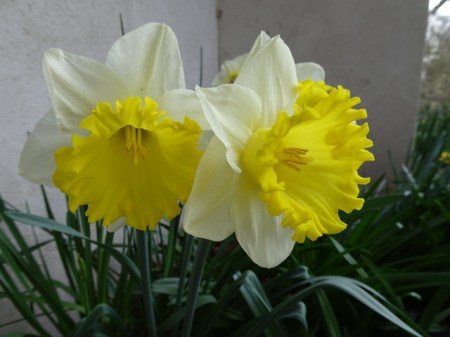
I have dozens of varieties of daffodils, Narcissus, planted all over the garden.  I am enjoying them more than ever this year, especially this early-blooming form right outside my front door whose name is lost in the mists of time.

My intent is to post on the blog more than once a week.  You can provide inspiration to me and other readers by posting comments about your own experience with these plants or other late winter bulbs.  Blogs are a lot more fun for everyone, especially the writer, when they are interactive.  Scroll down to the end of the page to the box where it says “Leave a Reply” and start typing—-it’s easy!

Carolyn

Notes: Every word that appears in orange on my blog is a link that you can click for more information. If you want to return to my blog’s homepage to access the sidebar information (catalogues, previous articles, etc.) or to subscribe to my blog, just click here.
Trees and Shrubs for Early Color

Posted in my garden, Shade Shrubs, Shade trees, winter, winter interest with tags , , , , , , , , , , , , , , , , , , , , , , , on March 29, 2020 by Carolyn @ Carolyns Shade Gardens

The fragrant, rose-pink double flowers of ‘Peggy Clarke’ flowering apricot, Prunus mume, have been a sensation at Carolyn’s Shade Gardens since early March.

Blogging is a lot of work, and 2020 marks my tenth year of providing quality content to my readers all over the globe.  It requires so much computer time that I have been taking a break since last October to dedicate more hours to my plant nursery and my own garden.  However, with coronavirus spreading quickly through the US and my own state of Pennsylvania, I have been wracking my brain for a way that I could contribute without leaving my home.  I hope that reviving my blog will give readers, and especially my wonderful customers in the beleaguered mid-Atlantic area, a brief moment of pleasure in the terrifying world we have entered. 

The photos below are of trees and shrubs that provide late winter and very early spring color.  They are electrifying in my garden when everything else is still winter brown.

I am dedicating this post to my high school friend Adrienne’s sister who is currently struggling to beat corona in New York and to all the healthcare workers and other personnel on the front lines, who are risking their own lives to keep us healthy.  Sty home to save lives.

Nursery News:  Carolyn’s Shade Gardens is a retail nursery located in Bryn Mawr, PA, specializing in showy, colorful, and unusual plants for shade.  The only plants that we ship are snowdrops within the US.  For catalogues and announcements of local events, please send your full name, mailing address, and cell number to carolyn@carolynsshadegardens.com and indicate whether you are interested in snowdrops.  Click here to get to the home page of our website for catalogues and information about our nursery and to subscribe to our blog.

.‘Peggy Clarke’ is a gorgeous small tree with a vased-shaped habit, sited here in a west-facing location near our front door for optimal late-winter viewing.

.

Winter jasmine, Jasminum nudiflorum, cascades off the corner of our terrace, but I have also seen it grown as a groundcover.  It normally opens a few flowers during warm days in January and February; however, we have had such a mild winter that it has been flowering for about five months.  The photo shows the last few blooms as the leaves start to open.

.

.

Our star magnolia, M. stellata, is often damaged by frost, but I wouldn’t be without its glorious masses of early, pure white flowers.

.

We have planted a field of blue glory-of-the-snow, Chionodoxa forbesii, under the star magnolia, and the combination is beautiful.  I couldn’t get a satisfactory shot of the two together, but you can see the magnolia trunk in the background.

 .

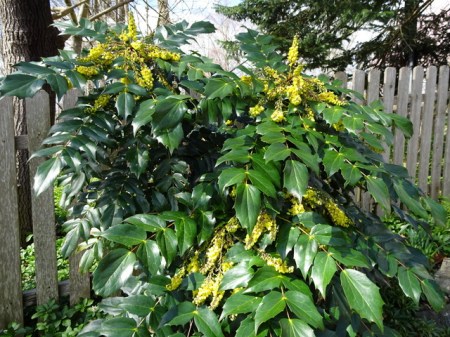
Another shrub that has been blooming off and on since late fall is evergreen Japanese mahonia, M. japonica.  This mahonia is the best species for garden use as its leaves remain pristine and its flowers are a lovely shade of yellow in large sprays.

.

If Cornelian cherry dogwood, Cornus mas, bloomed later in the season, it would be overshadowed by many other small flowering trees.  However, its fresh, yellow-green flowers stand out in the stark late winter landscape.

.‘Okame’ cherry, Prunus x incam ‘Okame’, viewed here from an upstairs window, provides shade for our deck and is the earliest blooming cherry with very long-lasting flowers.

.Under the ‘Okame’ cherry, by the edge of the deck is a dwarf Japanese maple, Acer palmatum ‘Yatsubusa Kiyohime’.  Its leaves come out very early and are a striking combination of red and bronze.

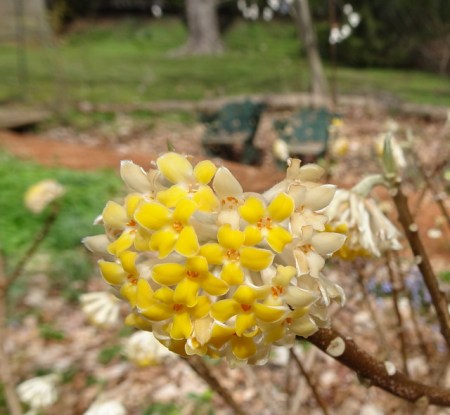
.Our edgeworthia opens its fragrant yellow and white flowers in late winter.  This shrub has four seasons of ornamental interest with beautiful flowers, cinnamon-colored bark, tropical leaves, and, my favorite, copious silver buds like tassels on Victorian cushions starting in November.

.

Edgeworthia flower

.

Yulan magnolia, M. denudata, is a relatively rare, early-blooming magnolia with large, goblet-like white flowers.  Again, it can get damaged by late frosts but is well worth having in the years like this one when it is magnificent.

.

Yulan magnolia flower

.

Buttercup winter hazel, Corylopsis pauciflora, is an early-blooming, fine-textured shrub with elegant, butter yellow flowers.

.

‘Texas Scarlet’ dwarf flowering quince gives an eye-catching punch of color in what can still be a dreary winter landscape.  It stays quite small and doesn’t have thorns like regular quinces.

My intent is to post on the blog more than once a week.  You can provide inspiration to me and other readers by posting comments about your own experience with these plants or other late winter trees and shrubs.  Blogs are a lot more fun for everyone, especially the writer, when they are interactive.  Scroll down to the end of the page to the box where it says “Leave a Reply” and start typing—-it’s easy!

Carolyn

Notes: Every word that appears in orange on my blog is a link that you can click for more information. If you want to return to my blog’s homepage to access the sidebar information (catalogues, previous articles, etc.) or to subscribe to my blog, just click here.
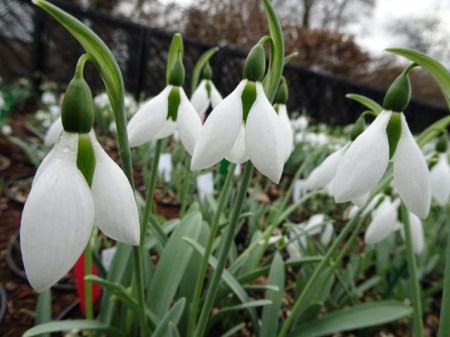
Terrain Visits Our Snowdrops

Posted in bulbs for shade, garden to visit, my garden, snowdrops, winter, winter interest with tags , , , , , , , , , , , , on March 21, 2019 by Carolyn @ Carolyns Shade Gardens

Our 2020 Snowdrop Catalogue is on line here, and we are currently taking orders.

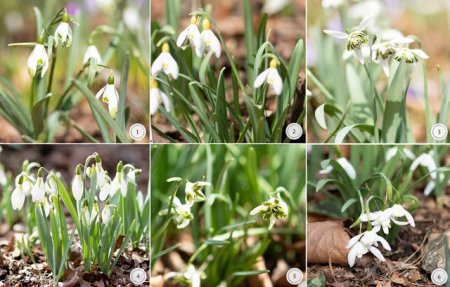
The creative team from Terrain put together this beautiful snowdrop collage after their photo shoot at Carolyn’s Shade Gardens.  Before reading further, see if you can guess the name of each snowdrop.

Unbeknownst to us, Carolyn’s Shade Gardens has quite a following at Terrain, the home and garden-related arm of URBN, which also owns Urban Outfitters and Anthropologie and is headquartered in Philadelphia, Pennsylvania, very near us.  Members of Terrain’s marketing department contacted us recently to find out if they could visit our gardens and photograph snowdrops.  Of course, I am always happy to host anyone who admires snowdrops!

Nursery News:  Carolyn’s Shade Gardens is a retail nursery located in Bryn Mawr, PA, specializing in showy, colorful, and unusual plants for shade.  The only plants that we ship are snowdrops and miniature hostas.  For catalogues and announcements of events, please send your full name, location, and cell number (for back up use only) to carolyn@carolynsshadegardens.com.  Click here to get to the home page of our website for catalogues and information about our nursery and to subscribe to our blog.


Terrain has a charming store in the old Styers greenhouses in Glen Mills, Pennsylvania.

I asked Terrain’s Brand Writer Megan Parry to describe Terrain for readers who have never experienced it.  Here’s what she said:

Terrain is a garden, home, and outdoor lifestyle brand deeply rooted in nature. Our seven store locations are inspired by the idea of merging house and garden to create an experience for the senses, catering to customers with a curated assortment of plants for all seasons, as well as inspired items for the home and garden. Situated in a luxurious indoor-outdoor environment, our on-site nurseries are flanked by cafes and garden terraces, providing the ideal environment to host events and workshops.

Michael and I have visited Terrain’s Glen Mills, Pennsylvania, location many times.  We love to walk around the beautiful grounds and eat at the delicious Terrain Cafe.  Terrain has a new location in Devon, PA, as well as stores in Maryland, Connecticut, and California.  I have even written a blog post about visiting the Longwood Gardens orchid show and eating at Terrain to cure cabin fever.  To read it, click here.

.

The Terrain Cafe not only has delicious food, but it is also housed in a scenic and beautifully decorated greenhouse.

After their visit, the Terrain team composed a blog post about my interest in snowdrops and featuring the collage at the top of the post.  To read their post, click here.  You can discover if you correctly identified the six snowdrops in the collage and find out more information about each variety.  To end this post, I will show you some close ups of the snowdrop varieties selected for the collage.

.

Number One is ‘Viridapice’.  ‘Viridapice’ is the banner at the top of my website/blog.

.

Number Two is ‘Spindlestone Surprise’.

.

Number Three is ‘Ballerina’.

.

Number Four is the snowdrop species Galanthus elwesii, also known as the giant snowdrop.  Its shape and markings are variable.  This collage shows some of the many forms it has taken in our garden.

.

Number 5 is ‘Blewbury Tart’.

.

Number Six is ‘Lady Beatrix Stanley’.

.

Thank you to Cat, Adelyn, Laura, and Megan from Terrain for making this such a fun experience for us.  You mentioned coming back later in the season, and you are most welcome!

Carolyn

Nursery Happenings: You can sign up to receive catalogues and emails about nursery events by sending your full name, location, and cell number (for back up contact use only) to carolyn@carolynsshadegardens.com.  Subscribing to my blog does not sign you up to receive this information.  Please indicate if you will be shopping at the nursery or are mail order only.

Carolyn’s Shade Gardens is a local retail nursery in Bryn Mawr, Pennsylvania, U.S., zone 6b/7a. The only plants that we mail order are snowdrops and miniature hostas and only within the US.

Facebook: Carolyn’s Shade Gardens has a Facebook Page where I post single photos, garden tips, and other information that doesn’t fit into a blog post. You can look at my Facebook page here or click the Like button on my right sidebar here.

Notes: Every word that appears in orange on my blog is a link that you can click for more information. If you want to return to my blog’s homepage to access the sidebar information (catalogues, previous articles, etc.) or to subscribe to my blog, just click here.

Winterthur Bank to Bend 2019

Posted in bulbs for shade, garden to visit, Garden Tour, snowdrops, winter, winter interest with tags , , , , , , , , , , , , , , , , , , , , , , , , , , , , on March 12, 2019 by Carolyn @ Carolyns Shade Gardens

The opening photo for John Anderson’s lecture on Saturday at Winterthur was quite arresting, and the remaining slides were equally as beautiful.

On Saturday, Michael and I attended the annual Bank to Bend lecture at Winterthur Gardens in Delaware, U.S.  The event honors Henry Francis du Pont’s walk from bank to bend to celebrate the gorgeous bulb display on the March Bank.  That walk was beautiful on Saturday as you will see below. 

The lecture was delivered by John Anderson, the Keeper of the Queen’s Gardens of Windsor Great Park, a very big job as the gardens host 6 million visitors a year.  His lecture showed us some arresting views of the Savill and Valley Gardens, totaling over 900 acres, and how they have changed over time as well as his reasoning behind those decisions.   The Queen is Anderson’s boss and there has been a garden here for a thousand years, so any changes must be well thought out.

Anderson is also in charge of the gardens at Frogmore House, which is HM the Queen’s private residence and garden at Windsor.  After the lecture, we had a delicious lunch and walked around Winterthur for three hours.  It was heavenly.

I hope you will enjoy our journey through photos:

Nursery News:  Carolyn’s Shade Gardens is a retail nursery located in Bryn Mawr, PA, specializing in showy, colorful, and unusual plants for shade.  The only plants that we ship are snowdrops and miniature hostas.  For catalogues and announcements of events, please send your full name, location, and cell number (for back up use only) to carolyn@carolynsshadegardens.com.  Click here to get to the home page of our website for catalogues and information about our nursery and to subscribe to our blog.


The Savill Garden hosts an outstanding magnolia collection.

.

The rose garden at Savill has recently been renovated to make it more attractive to visitors and visually interesting.

.

Frogmore House and Gardens, HM the Queen’s private residence and garden at Windsor.

.

Frogmore was also the location of Prince Harry and Meghan Markle’s wedding reception. Anderson described the incredibly tight security arrangements this entailed.

.

Our intrepid group left to right: Carol Long, Curator of the Winterthur Garden; Charles Cresson, local horticultural authority and educator; John Anderson, Keeper of the Queen’s Gardens at Windsor Great Park; Linda Eirhart, Director of Horticulture at Winterthur; and Michael Drennan, co-owner of Carolyn’s Shade Gardens.  They are posed in front of Winterthur’s dawn redwood, Metasequoia glytostroboides, part of the original collection of these trees in the 1940s.

.

The dawn redwood was a sight to behold against the beautiful blue sky on Saturday.

.

We spent most a lot of our three-hour walk admiring Winterthur’s incredible trees, many of which are champions.  John wanted his photo taken with this massive Sargent’s cherry, Prunus sargentii.

.

He also wanted to record his visit to the champion tulip tree or tulip poplar, Liriodendron tulipifera, by the Winterthur mansion.

.

The Winterthur March Bank was glorious, covered with winter aconite, snowdrops, adonis, and leucojum.

.

Nothing like a blue sky to show off winter aconite, Eranthis hyemalis, to perfection.

.

The Amur adonis, A. amurensis, was also peaking.

.

There were massive drifts of the giant snowdrop, Galanthus elwesii.  I have never seen G. elwesii growing as well as it does at Winterthur.

.

And then you come across something even more special: this little clump of three giant snowdrops that have solid green inner segments and are at least three times the size of a normal giant snowdrops.  Normal size on the right with the giants on the left and behind.  A form well worth naming!

.

Charles Cresson spotted this three-headed spring snowflake, Leucojum vernum.  I have seen twin heads but never three.  Let’s hope it’s stable.

.

Isn’t it gorgeous!

.

This was one of the best “horticultural” days that I have ever spent.  Thank you to Winterthur, John Anderson, my mentor Charles Cresson, and my wonderful husband Michael for making it happen.

Carolyn

Nursery Happenings: You can sign up to receive catalogues and emails about nursery events by sending your full name, location, and cell number (for back up contact use only) to carolyn@carolynsshadegardens.com.  Subscribing to my blog does not sign you up to receive this information.  Please indicate if you will be shopping at the nursery or are mail order only.

Carolyn’s Shade Gardens is a local retail nursery in Bryn Mawr, Pennsylvania, U.S., zone 6b/7a. The only plants that we mail order are snowdrops and miniature hostas and only within the US.

Facebook: Carolyn’s Shade Gardens has a Facebook Page where I post single photos, garden tips, and other information that doesn’t fit into a blog post. You can look at my Facebook page here or click the Like button on my right sidebar here.

Notes: Every word that appears in orange on my blog is a link that you can click for more information. If you want to return to my blog’s homepage to access the sidebar information (catalogues, previous articles, etc.) or to subscribe to my blog, just click here.

The 2019 Snowdrop Season Part Two

Posted in bulbs for shade, my garden, snowdrops, winter, winter interest with tags , , , , , , , , , , , , , , , , , , , , , on March 6, 2019 by Carolyn @ Carolyns Shade Gardens

‘Wendy’s Gold’ is an elegant beauty.  It has taken me eight years to capture on film the graceful look and beautiful stature of this snowdrop.

In my last post The 2019 Snowdrop Season Part One, I showed some of my snowdrop photos that really communicate the essence of that particular selection.  To read it, click here.  I explained that there is nothing I like better than roaming around our garden photographing my collection and focusing on the differences that make each snowdrop so special.  The cold weather we have been experiencing is prolonging the snowdrop season, and many have yet to bloom.  Here are some more of my other recent captures:

Nursery News:  Carolyn’s Shade Gardens is a retail nursery located in Bryn Mawr, PA, specializing in showy, colorful, and unusual plants for shade.  The only plants that we ship are snowdrops and miniature hostas.  For catalogues and announcements of events, please send your full name, location, and cell number (for back up use only) to carolyn@carolynsshadegardens.com.  Click here to get to the home page of our website for catalogues and information about our nursery and to subscribe to our blog.


‘Wendy’s Gold’ in a group.  It is a good multiplier for me in a sloped location in my rock garden that gets deciduous shade.  I am currently trying it in two other locations.  There is a lot of variability in the growth rate of different snowdrops in different cultural conditions, and I am constantly experimenting.

.

Galanthus reginae-olgae, sometimes called Queen Olga’s snowdrop as it was named after Queen Olga of Greece, blooms around October 15 in my garden.  During this unusual 2018-2019 season, the flowers lasted forever—this photo was taken December 3.  It received a coveted Award of Garden Merit from the Royal Horticultural Society (“RHS AGM”), one of only 28 snowdrops to do so.

.

‘Three Ships’ never disappoints and always sails in around Christmas.  However, it is very slow to multiply.  RHS AGM

.

On the other hand, ‘Faringdon Double’ blooms between Christmas and New Years and is a vigorous multiplier.  It took five years of attempts to portray all it charms in this photo.

.

‘John Gray’ is an early snowdrop with very large flowers.  It was selected by avid gardener John Gray of Suffolk, England, and rescued from his garden, along with the famous ‘Mighty Atom’, and named by renowned horticulturist Bertram Anderson after Gray died in 1951.  RHS AGM

.

‘Merlin’, along with the other iconic snowdrops ‘Magnet’, ‘Galatea’, and ‘Robin Hood’, were all selected by James Allen, called by the book The Galanthophiles “one of the greatest of all galanthophiles.”  I have found its particular combination of large bright white outer segments with bright green inner segments edged in white to be particularly difficult to show on film.  After nine years of trying, I am happy with this photo.  Although other snowdrops have come along with solid green inners, I do not think ‘Merlin’ has met it’s match.  RHS AGM

.

‘Starling’ is a much more recent introduction selected by my friend the internationally famous snowdrop expert Alan Street at Avon Bulbs in England.  Its name means little star.  In my garden it is very vigorous, with a mass of roots and a large clump of leaves on each plant.

.

‘Mrs. Macnamara’ is tall, elegant, and very early, making it stand out in the garden.  It originated from Dylan Thomas’s mother-in-law and was named for her by John Morley of North Green Snowdrops.  RHS AGM

.

‘Bill Clark’ is new to me, and I particularly sought it out so that I can compare it to ‘Wendy’s Gold’ and ‘Madelaine’.  All three are Galanthus plicatus, the Crimean snowdrop species, with bright yellow flowers.  It is named after the Warden of Wandlebury Ring, an Iron Age hillfort located in Cambridgeshire, England, where ‘Bill Clark’ was discovered.

.

‘Bertram Anderson’ has very large flowers and a classic beauty rarely surpassed.  It was selected from the Somerset garden of famous horticulturist E.B. (Bertram) Anderson after his death in 1971 and named for him.  RHS AGM

.

‘Puck’ is a little cutey, named after the character in A Midsummer’s Night’s Dream, with a quirky nature and three extra segments, making it semi-double.

.

It is difficult to name the particular charms of ‘Brenda Troyle’, but it is one of the most complimented snowdrops in my garden.  It was selected by William Thompson before his death in 1898 and sent to famous galanthophile Samuel Arnott, who named it.  Thompson was an expert beekeeper and probably grew snowdrops because they are one of the earliest flowers to attract honeybees.

.

Honeybees have declined alarmingly in recent years, and if you want to help support them, snowdrops are a great flower to plant.  As soon as the temperature gets above freezing, the bees go foraging and during the winter snowdrops are one of the few flowers available.  My snowdrops are always covered with bees.

.

Both these photos were taken by my customer Helen J. in Tennessee.  Thanks, Helen!

.

Even in the freezing weather we are experiencing right now in the mid-Atlantic, I look out my kitchen window at this beautiful stand of ‘S. Arnott’.  It is considered by many the one snowdrop they would grow if they had to pick.  It was a seedling raised by the famous galanthophile Samuel Arnott.  RHS AGM

.

Much of the historical information about these snowdrops, which I find fascinating, came from the recently published, excellent book The Galanthophiles by Jane Kilpatrick and Jennifer Harmer.

There are many more snowdrop varieties still waiting to open in my garden.

Carolyn

Nursery Happenings: You can sign up to receive catalogues and emails about nursery events by sending your full name, location, and cell number (for back up contact use only) to carolyn@carolynsshadegardens.com.  Subscribing to my blog does not sign you up to receive this information.  Please indicate if you will be shopping at the nursery or are mail order only.

Carolyn’s Shade Gardens is a local retail nursery in Bryn Mawr, Pennsylvania, U.S., zone 6b/7a. The only plants that we mail order are snowdrops and miniature hostas and only within the US.

Facebook: Carolyn’s Shade Gardens has a Facebook Page where I post single photos, garden tips, and other information that doesn’t fit into a blog post. You can look at my Facebook page here or click the Like button on my right sidebar here.

Notes: Every word that appears in orange on my blog is a link that you can click for more information. If you want to return to my blog’s homepage to access the sidebar information (catalogues, previous articles, etc.) or to subscribe to my blog, just click here.