The Sochi Snowdrop

Posted in bulbs for shade, Shade Perennials, snowdrops, winter, winter interest with tags , , , , , , , , , , , , , , , , , , , on January 16, 2014 by Carolyn @ Carolyns Shade Gardens

Carolyn’s Shade Gardens is a retail nursery located in Bryn Mawr, PA, specializing in showy, colorful, and unusual plants for shade.  The only plants that we ship are snowdrops to the US only.  For catalogues and announcements of local events, please send your full name, mailing address, and cell number to carolyn@carolynsshadegardens.com and indicate whether you are mail order only.  Click here to get to the home page of our website for catalogues and information about our nursery and to subscribe to our blog.

Galanthus woronowii Cresson GardenGalanthus woronowii

Our current snowdrop catalogue is on line here.

The over 1,000 types of cultivated snowdrops all originated from just 20 snowdrop species found in the wild and making up the genus Galanthus. This post is the second in a series of posts profiling the important  snowdrop species, which are all great garden plants in their own right. 

In the first post I discussed the common snowdrop, G. nivalis, and you can read that post by clicking here.  I have written a lot of other articles about snowdrops, covering among other topics their ornamental characteristics, fascinating history, the importance of provenance, and profiling many cultivars.  For links to all my previous snowdrop posts, click here.  In this post, I will discuss G. woronowii.

Much of the information in this post comes from Snowdrops: A Monograph of Cultivated Galanthus by Matt Bishop et al. (Griffin Press 2006) which is absolutely indispensable if you are researching or collecting snowdrops.  I have also used documents produced by Kew Gardens and the Tbilisi Botanical Garden in the Country of Georgia.

.
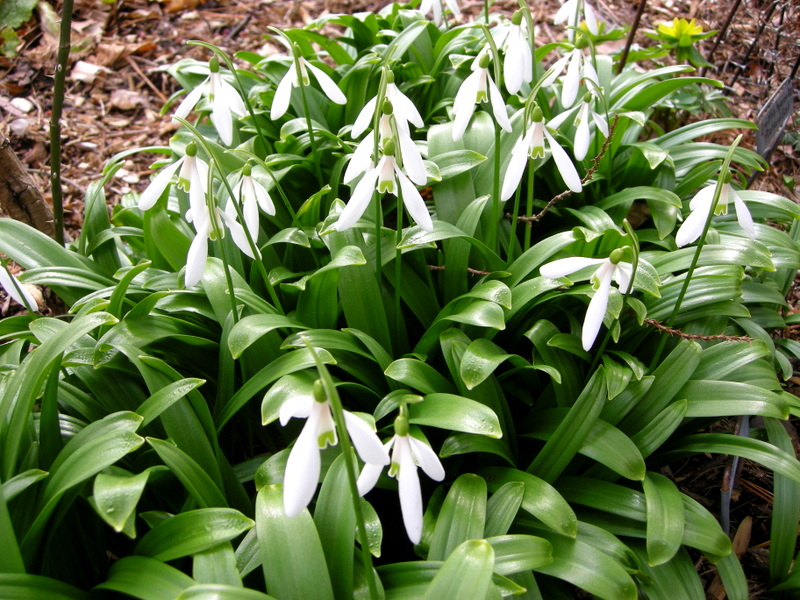
Galanthus woronowii Cresson GardenGalanthus woronowii

Although a few sources have randomly assigned the common names green snowdrop, Russian snowdrop, and Woronow’s snowdrop to G. woronowii, it really has no regularly used common name.  So why am I calling it the Sochi snowdrop?  Because in the early 20th century, Russian botanist A.S. Losina-Losinskaya collected a new species of snowdrop in southern Russia around Sochi on the eastern shore of the Black Sea.  In 1935, he named these snowdrops Galanthus woronowii in honor of Georg Jurii Nikolaewitch Woronow (1874-1931).  Several sources confirm that G. woronowii is still abundant in the mountains and forests above Sochi, the resort town on the Black Sea where Russia is hosting the 2014 Winter Olympics beginning February 7.

.

G. woronowii CressonG. woronwii‘s glossy, bright green leaves sparkle in the rain.

G. woronowii is found in northeastern Turkey, Georgia, and southern Russia mainly around the eastern part of the Black Sea.  For a map of its range, click here for a report by Georgia’s Tbilisi Botanical Garden.  It grows in an extraordinary variety of habitats from deciduous and even evergreen woods to rocky slopes, cliff ledges, and river banks.  It thrives in both shallow rocky soil and deep organic loam in areas with cold winters and abundant precipitation.  According to Kew Gardens, Georgia harvests 15 million G. woronowii bulbs every year for export to the western European horticultural trade.  Kew along with Tbilisi and the CITES* authorities have been monitoring this harvest from wild populations and cultivated sites, click here.

*Convention on International Trade in Endangered Species, which covers snowdrops.

.Galanthus woronowiiG. woronowii flower showing the small mark on the inner segment

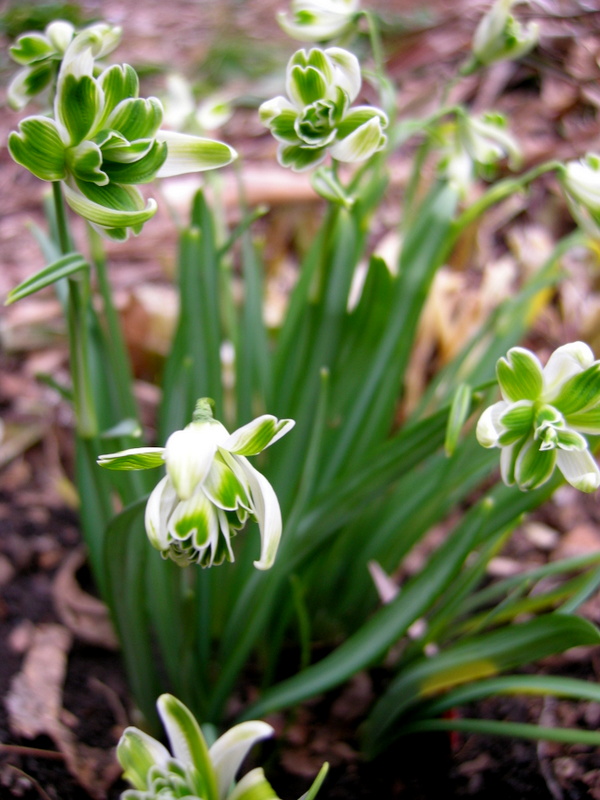
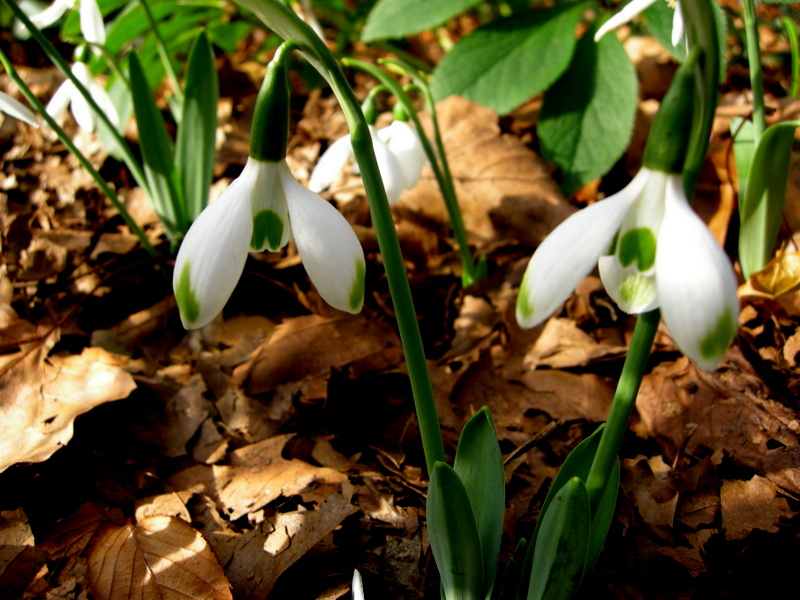
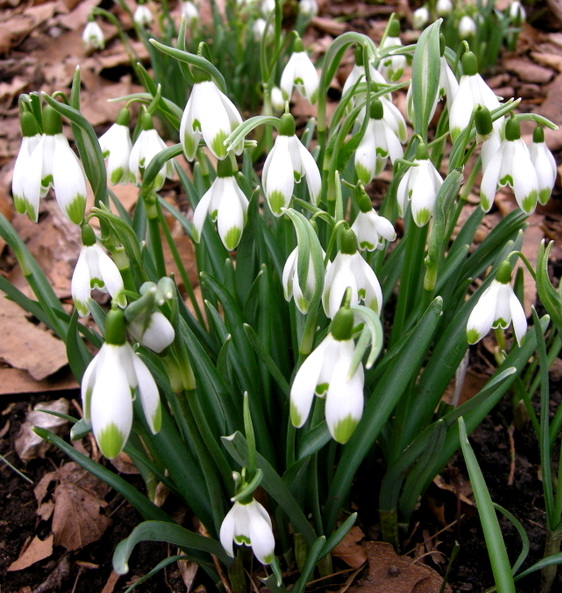
G. woronowii is grown for its beautiful, glossy green leaves and lovely white flowers.  It is the only commonly available snowdrop to have bright green leaves as opposed to the blue-gray leaves of the other common species.  The leaves persist longer than other snowdrop foliage and form a lovely but temporary, thick and attractive groundcover.  The flowers, which have a small green mark covering one third or less of the inner segments, are the last snowdrops to bloom in my garden in late March and early April.  I really appreciate the way they extend the end of the snowdrop season. 

..

Galanthus woronowiiThe fold in the center of the leaf is clearly visible in this photo.

The identification of G. woronowii is confused in the horticultural trade where it is often called G. ikariae, a much less common snowdrop from the Aegean Islands of Greece.  However, while G. woronowii has light, glossy green leaves folded in the center and a small green mark on the flower, G. ikariae has dark, matt green leaves and a mark covering more than half the inner segment.  I have been told that all the G. ikariae sold in the U.S. is actually G. woronowii.

  .
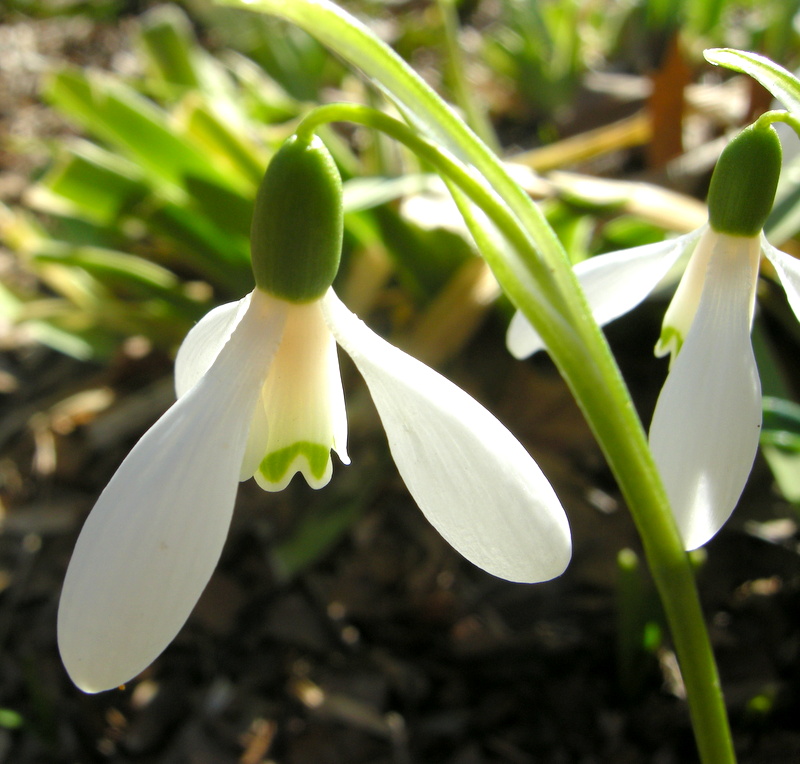
Galanthus woronowiiClose up of G. woronowii flower.  I always recognize G. woronowii by the pollen glowing through the top half of the translucent white inner segments, although I don’t know if this is unique.

Unlike the other three more common snowdrop species, G. nivalis, G. elwesii, and G. plicatus, not many cultivated plants have been selected from G. woronowii, possibly because it only became available in large numbers in the 1990s.  Snowdrops lists only ‘Green Flash’ selected for its green marks on its outer as well as its inner segments.  Other sources add ‘Cider with Rosie’, ‘Green Woodpecker’, and ‘Boschhoeve’, all with green marks on their outers. 

Nevertheless, a cultivar of G. woronowii has caused more excitement than any other snowdrop when, on February 16, 2012, one bulb sold for 725 pounds ($1,185) on eBay, surpassing the previous record of around 360 pounds ($508).  G. woronowii ‘Elizabeth Harrison’ appeared as a seedling in a Scottish garden and is named after the owner.  It is considered so special because instead of the usual green ovary (the “cap” to which the petals are attached) and segment marks, ‘Elizabeth Harrison’s’ are an intense yellow, looking beautiful with the bright green leaves.  For the U.K. Telegraph story on ‘Elizabeth Harrison’ and a photo, click here; for today’s story in the Telegraph about another snowdrop, ‘Humpty Dumpty’, reaching 195 pounds, click here

I won’t be adding ‘Elizabeth Harrison’ to my collection anytime soon, but I do treasure the patch of G. woronowii in my garden.

Carolyn

.

Note: Every word that appears in orange on my blog is a link that you can click for more information. If you want to return to my blog’s homepage to access the sidebar information (catalogues, previous articles, etc.) or to subscribe to my blog, just click here.
The Un-Common Snowdrop

Posted in bulbs for shade, Shade Perennials, snowdrops, winter, winter interest with tags , , , , , , , , , , , , , , , , , , , , , , on January 5, 2014 by Carolyn @ Carolyns Shade Gardens

Carolyn’s Shade Gardens is a retail nursery located in Bryn Mawr, PA, specializing in showy, colorful, and unusual plants for shade.  The only plants that we ship are snowdrops to the US only.  For catalogues and announcements of local events, please send your full name, mailing address, and cell number to carolyn@carolynsshadegardens.com and indicate whether you are mail order only.  Click here to get to the home page of our website for catalogues and information about our nursery and to subscribe to our blog.

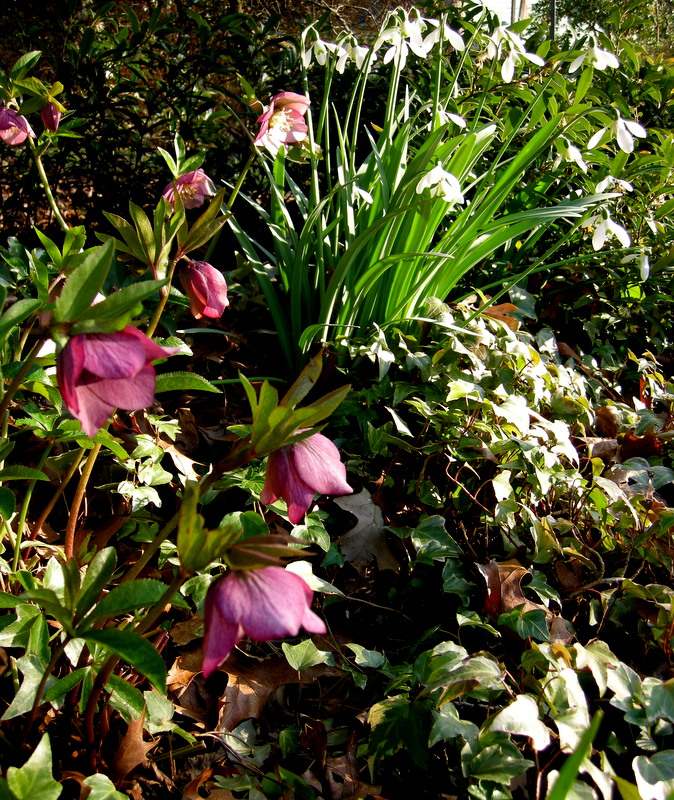
Hybrid hellebore & G. 'Brenda Troyle'All snowdrops are great companions for hellebores.

Our current snowdrop catalogue is on line here.

I have written a lot of articles about snowdrops, covering among other topics their ornamental characteristics, fascinating history, the importance of provenance, and profiling many cultivars.  For links to all my previous snowdrop posts, click here.  I have never, however, talked in detail about any of the snowdrop species from which cultivated snowdrops, now numbering over 1,000, have been selected.  I hope this post will be the first in a series discussing each of the more important snowdrop species.

Much of the information in this post comes from Snowdrops: A Monograph of Cultivated Galanthus by Matt Bishop et al. (Griffin Press 2006) which is absolutely indispensable if you are researching or collecting snowdrops.

.

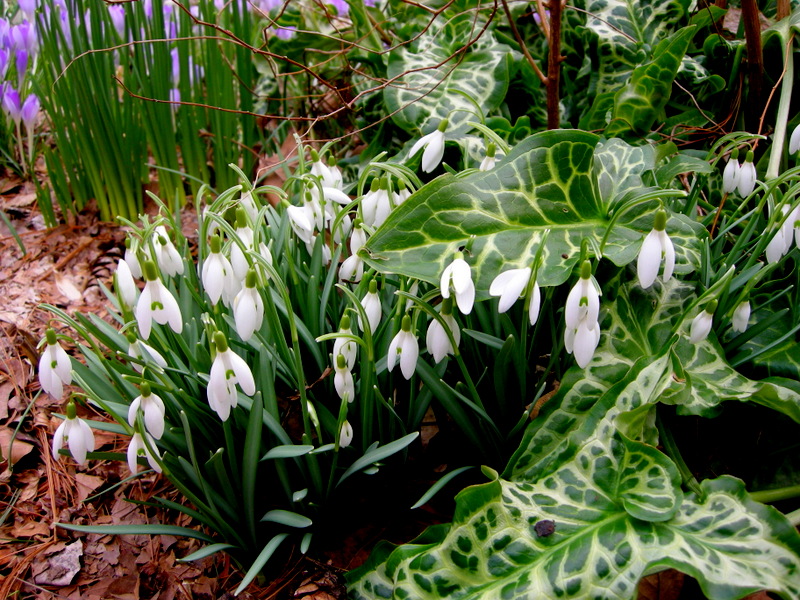
Galanthus nivalis & Arum italicum 'Pictum'Common snowdrops pair well with snow crocus (just visible in the background) and really bring out the silver patterning on the leaves of Italian arum, which look fresh all winter.

.

G. nivalis and C. coum 'Rose'Common snowdrops are a wonderful companion for the leaves and flowers of winter-blooming hardy cyclamen.

.

Galanthus nivalis & Heuchera 'Creme Brulee'Common snowdrops look great paired with native coral bells, many of which keep their bright leaf colors all winter.

Brian Capon in his very handy book Botany for Gardeners defines a species as a “group of individuals sharing many characteristics and interbreeding freely.”  Generally these individuals are growing in the wild and have a defined native range.  There are 20 types of snowdrops that meet this definition and constitute the genus Galanthus, but only three of them have given rise to most of the named snowdrops: G. nivalis, G. elwesii, and G. plicatus

Here I want to discuss Galanthus nivalis otherwise known as the common snowdrop although it is by no means common in any sense of the word and would be one of the first snowdrops I would add to my collection if I had to start over.  In fact, it has received a coveted Award of Garden Merit from the Royal Horticultural Society.

.

G. nivalis CressonCommon snowdrops naturalize quickly in the mid-Atlantic U.S. generally by producing bulb offsets.

.

The common snowdrop has the largest native range of any snowdrop species and is the species most widely grown by gardeners.  It is native to western, central, and southern Europe from France to the part of Turkey in Europe.  It was first mentioned in print in the 16th century when it was already being grown as an ornamental plant. 

Linnaeus named it Galanthus nivalis in 1753.  According to another fascinating book, Plant Names Explained (Horticulture 2005), gala means milk, -anthus means -flowered, and nivalis means snowy or snow-like.  Common snowdrops fill our gardens here at Carolyn’s Shade Gardens, which is part of an old estate called Wayside dating back to the 1600s (we live in Wayside Cottage which formerly housed the gardener).

.

Galanthus nivalis/Common SnowdropGalanthus nivalis, the common snowdrop

Common snowdrops are generally 4 to 6 inches tall.  The narrow, straplike leaves are green with a glaucous center stripe giving an overall gray-blue appearance.  The flowers have three outer petal-like segments and three smaller inner segments.  They are pure white with a bright green v-shaped mark around the notch (called a sinus) on the apex of the inner segments. 

Common snowdrops flower here in February and March no matter what the weather and prefer moist deciduous woods with deep organic soil.  However, they are not picky about cultural conditions and will naturalize freely in a wide range of garden settings, including the dry woods of Carolyn’s Shade Gardens.  They pair beautifully with native coral bells, snow crocus, Italian arum, hardy cyclamen, and hellebores.

.

Galanthus nivalisA natural mutation at Carolyn’s Shade Gardens, if you look closely these flowers have four outer segments (petals).

Because common snowdrops generally spread through bulb offsets rather than seed, the flowers in colonies are theoretically identical.  However, natural variations occur as you can see from the photo above where the flowers have four outer segments.  Often these mutations are not stable and do not persist as was the case with the flowers pictured.  However, sometimes ornamentally interesting and stable changes occur, and, if they are noticed by a sharp-eyed galanthophile, they enter cultivated gardens and even become a named cultivar available for sale.

  .

G. 'Flore Pleno'A clump of double common snowdrops

.

Galanthus nivalis 'Flore Pleno'double common snowdrop

I want to highlight three cultivars of the common snowdrop to give you an idea of the range available.  The double common snowdrop, Galanthus nivalis ‘Flore Pleno’ (or sometimes G. n. f. pleniflorus ‘Flore Pleno’), is the oldest known snowdrop cultivar, first illustrated in 1703 and described in a prominent gardener’s dictionary in 1731.  Although it is sterile, it spreads vigorously from bulb offsets and is tolerant of a wide range of cultural conditions.  I have been told that in England it is often more abundant than the straight species. 

‘Flore Pleno’ has a lovely flower and has the advantage of being less expensive than the rest of the double snowdrops available so it is great for naturalizing.  It is the parent with G. plicatus of the Greatorex double series of snowdrops to which ‘Dionysus’, ‘Hippolyta’, ‘Ophelia’, and several other double snowdrops belong.  ‘Flore Pleno’ was also given an Award of Garden Merit by the RHS.

.

G. 'Viridapice'the green-tipped snowdrop ‘Viridapice

.

G. 'Viridiapice'‘Viridiapice’

One of my favorite snowdrops is the green-tipped common snowdrop, Galanthus nivalis ‘Viridapice’.  It was originally found near an old farmhouse in northern Holland by a member of the Hoog family, owners of the venerable but now defunct Dutch bulb nursery Van Tubergen.  It is a vigorous and large-flowered snowdrop characterized by a beautiful and strikingly prominent green marking on the apex of the outer segments and a large single mark on the inner segments. 

Unfortunately,  the name ‘Viridapice’ was applied over the years to a number of different green-tipped common snowdrops, some of which are quite inferior.  I acquired my strain from the old Heronswood Nursery in Kingston, Washington, and I am happy to report that it is a superior strain and one of the best naturalizers in my garden.

.

Galanthus nivalis 'Blewbury Tart'the double common snowdrop ‘Blewbury Tart’

.

Galanthus nivalis 'Blewbury Tart'‘Blewbury Tart’

Finally, I want to highlight a newer cultivar of the common snowdrop, because I love it and because it was discovered by the only person I know who is more excited about snowdrops than me, Alan Street of Avon Bulbs in England.  In 1975, Alan noticed ‘Blewbury Tart’ in a churchyard in the village of Blewbury in Oxfordshire, England, where he grew up, and collected it with the permission of  Vicar Hugh Pickles. The famous galanthophile Primrose Warburg helped to name it because she called it Blewbury Muffin when Alan gave it to her, thus inspiring the name ‘Blewbury Tart’.  

I asked Alan if there was a special anecdote that I could relate here.  He told me that when he first exhibited it in 1985, a prominent British journalist said it looked like a “squashed fly on a windscreen”.   Nevertheless Avon offered it for sale in 1992.  It is an unruly double with an outward-facing dark green inner rosette encircled by three narrow outer segments.  It looks like it is having a bad hair day and always makes me smile when I see it.  Alan relates that another prominent British galanthophile, Ruby Baker, considers it a favorite.

*   *   *

Although I don’t expect most gardeners to share my obsession, whenever I write about snowdrops I hope to communicate some of the enthusiasm that snowdrops arouse.  Maybe you will add them to your garden this year!  All four snowdrops profiled are available from Carolyn’s Shade Gardens.

Carolyn

.

Note: Every word that appears in orange on my blog is a link that you can click for more information. If you want to return to my blog’s homepage to access the sidebar information (catalogues, previous articles, etc.) or to subscribe to my blog, just click here.
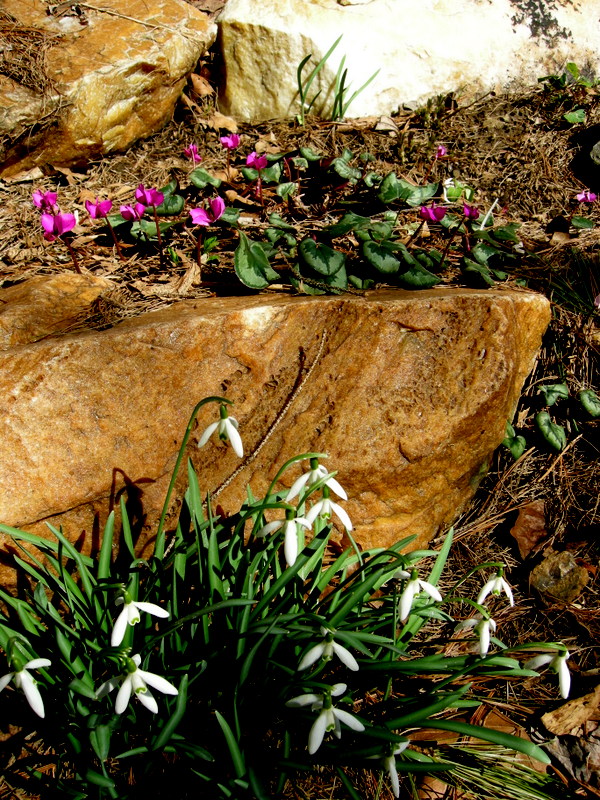
Longwood Christmas and a Surprise

Posted in garden to visit, winter, winter interest with tags , , , on December 29, 2013 by Carolyn @ Carolyns Shade Gardens

Nursery News: Carolyn’s Shade Gardens is a retail nursery located in Bryn Mawr, PA, specializing in showy, colorful, and unusual plants for shade.  The only plants that we ship are snowdrops and miniature hostas.  For catalogues and announcements of events, please send your full name, location, and phone number (for back up use only) to carolyn@carolynsshadegardens.com.  Click here to get to the home page of our website for catalogues and information about our nursery and to subscribe to our blog.

Snow storm 12-10-2013 12-10-2013 4-14-049Carolyn’s Shade Gardens in the snow

Starting in late November this year, we had five snow storms before Christmas.  I like snow but was already feeling a little cabin crazy when an email arrived from Longwood Gardens offering a great deal on a renewal of my long-expired membership.  We usually visit Longwood for a special event, but it struck me that the Longwood Gardens conservatories are a great place to go for a walk in the winter.  Renewal was easy, and Michael and I headed to Longwood bright and early the next day to test out our new indoor walking venue.

.

Longwood Xmas 2013 12-19-2013 1-34-24 PM.

Longwood Xmas 2013 12-19-2013 11-17-49 AMTopiary Garden

.

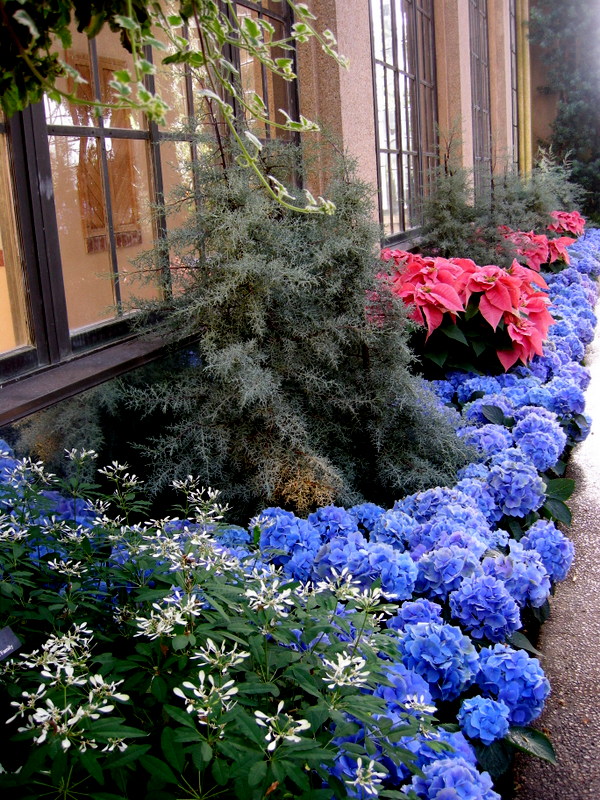
Longwood Xmas 2013 12-19-2013 1-41-01 PMGreat use of dried hydrangea flowers along the front entrance gate.  I almost got killed taking the photo so I wouldn’t recommend stopping there.

.

Longwood Xmas 2013 12-19-2013 1-28-14 PMCreative containers outside the cafe where we ate lunch.  The food is very good, especially the soups and chilis, and members get a discount.

There is plenty to see outside at Longwood even in the winter as you can tell from the above photos.  However, it was quite cold that day so we headed for the four acres of indoor conservatories.  We intend to go back in January in the late afternoon and evening to see the outdoor Christmas display.  If you haven’t done that, you are in for a treat.  For photos of the lights at night and tips for visiting, read my post A Longwood New Year’s Eve.

Mid-morning on a bright and sunny day turned out to be a bad time to photograph the conservatories so I don’t have as many photos to show you.  You will have to go yourself to see all the sights:

  .

Longwood Xmas 2013 12-19-2013 11-24-51 AM.

Longwood Xmas 2013 12-19-2013 11-28-33 AM.

Longwood Xmas 2013 12-19-2013 11-27-55 AM.

Longwood Xmas 2013 12-19-2013 12-50-47 PM.

Longwood Xmas 2013 12-19-2013 11-47-08 AM.

Longwood Xmas 2013 12-19-2013 11-46-57 AM

.

Longwood Xmas 2013 12-19-2013 11-44-22 AM.

Longwood Xmas 2013 12-19-2013 11-44-11 AM

.

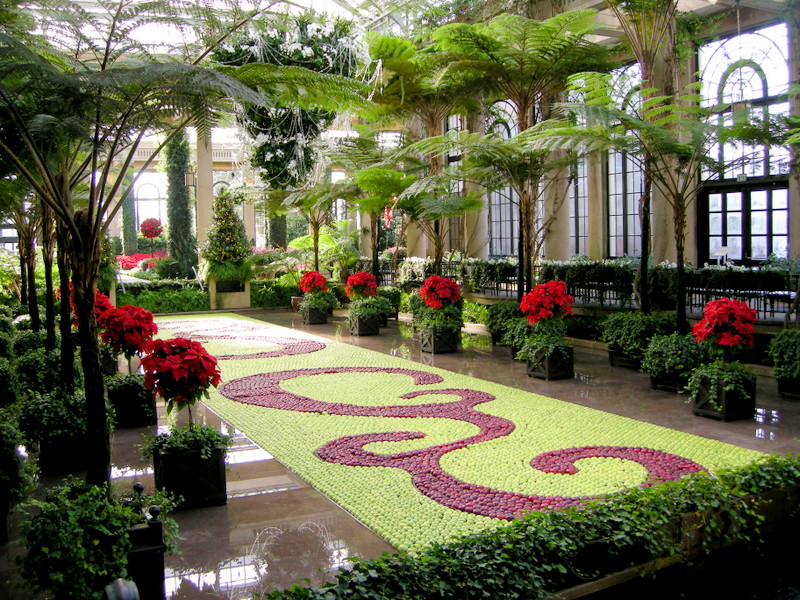
Longwood Xmas 2013 12-19-2013 11-33-20 AMThe Exhibition Hall featured an elaborate and beautiful tapestry composed of 18,540 Granny Smith and Rome apples floating in 4″ of water and kept in place by a hidden structural form fabricated in house.

.

Longwood Xmas 2013 12-19-2013 11-40-21 AM Christmas rose hellebores lined the edges of the floor.

.

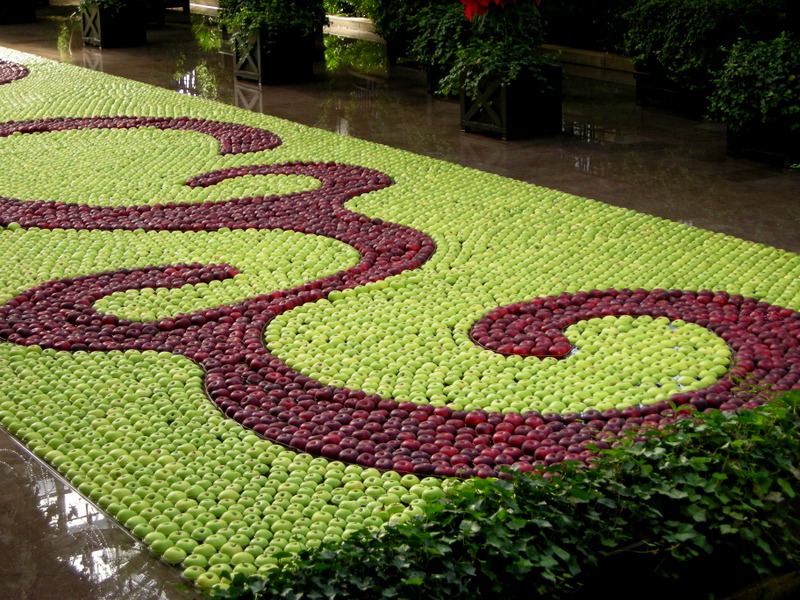
Longwood Xmas 2013 12-19-2013 11-33-51 AMA close up of the apples, which came from a local grower and will be donated to a local farm for cattle feed.

.

Longwood Xmas 2013 12-19-2013 11-51-08 AM

.

Longwood Xmas 2013 12-19-2013 12-41-31 PM.

Longwood Xmas 2013 12-19-2013 11-55-15 AM

.

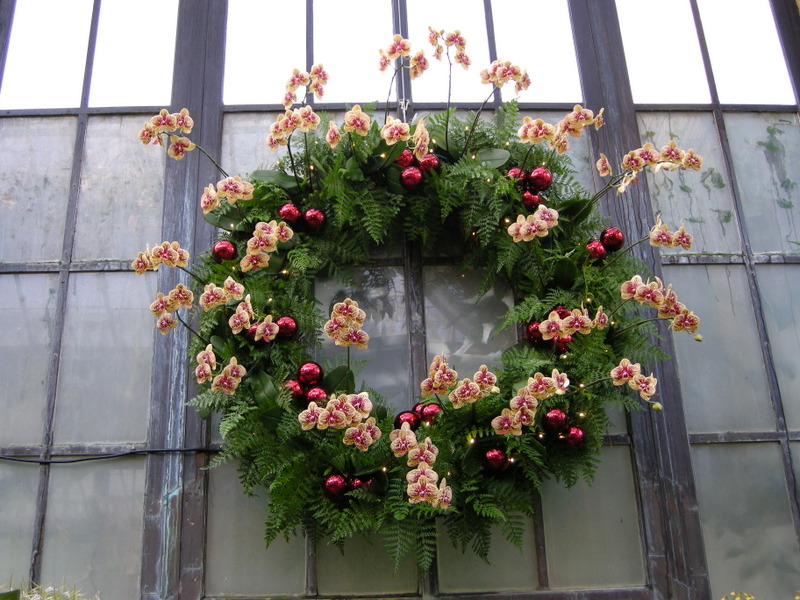
Our surprise occurred as we were admiring this wreath in the back corridor of the greenhouses.  We ran into our friend Scottie Pennett who works at Longwood as a grower for the conservatories.  She is in charge of several of the antique glass greenhouses actually used by the DuPont family and offered us an impromptu behind the scenes tour.

.

Longwood Xmas 2013 12-19-2013 12-03-59 PMScottie in one of her greenhouses.  On the left you can see a standard she is growing for a future display.  Weights have been tied to the branches to make them cascade down.

The attention to detail that is required for these plants is amazing.  Each one is individually groomed and manipulated to achieve the desired effect.  Plants are started as long as three to five years before the time that the actual display for which they are intended appears in the conservatory.  Scottie also trials plants that she thinks will be effective additions to future displays and presents them to the designers for consideration.  It is amazing to think that a plant that you breeze by in the conservatories might have begun from a cutting in Scottie’s greenhouse five years before.

.

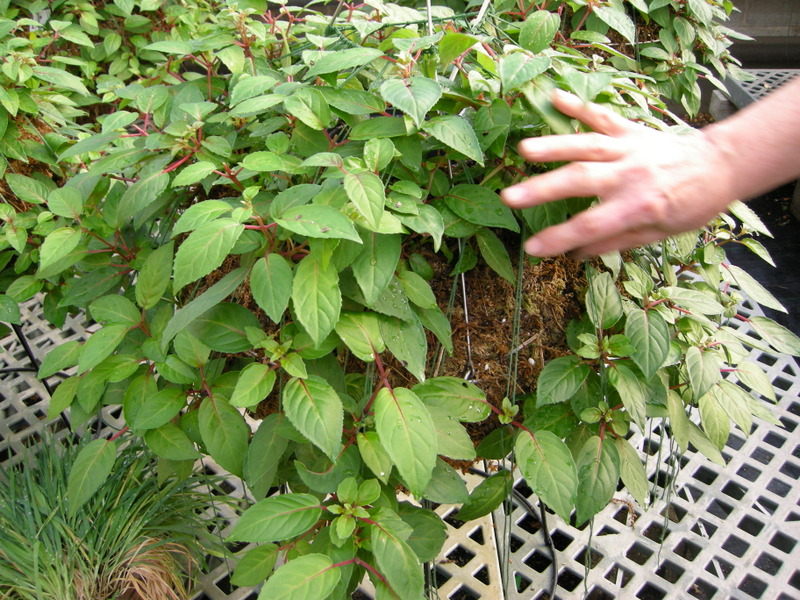
Longwood Xmas 2013 12-19-2013 11-59-36 AMA fuchsia basket where each branch needs to be tied down with string to give it the proper shape.

.

Longwood Xmas 2013 12-19-2013 12-04-18 PMAnother plant being tied to a frame to give it the proper look.

.

Thanks, Scottie, after our tour we had a much deeper appreciation for your work and that of all the other Longwood employees who produce such a gorgeous show in the conservatories year after year.  The Longwood Christmas display will continue through January 12.

Happy New Year,

Carolyn

.

Carolyn’s Shade Gardens is a local retail nursery in Bryn Mawr, Pennsylvania, U.S., zone 7a. The only plants that we mail order are snowdrops and miniature hostas and only within the US.

If you are within visiting distance and would like to receive catalogues and information about customer events, please send your full name and phone number to carolynsshadegardens@verizon.net. Subscribing to my blog does not sign you up to receive this information.

Nursery Happenings: The 2014 Snowdrop Catalogue, featuring snowdrops and other winter interest plants like cyclamen and hellebores, is on the sidebar, and we are taking orders.  To access the catalogue, please click here.  Please visit my Etsy Shop to purchase photo note cards suitable for all occasions by clicking here.

Facebook: Carolyn’s Shade Gardens has a Facebook Page where I post single photos, garden tips, and other information that doesn’t fit into a blog post. You can look at my Facebook page here or click the Like button on my right sidebar here.

Notes: Every word that appears in orange on my blog is a link that you can click for more information. If you want to return to my blog’s homepage to access the sidebar information (catalogues, previous articles, etc.) or to subscribe to my blog, just click here.
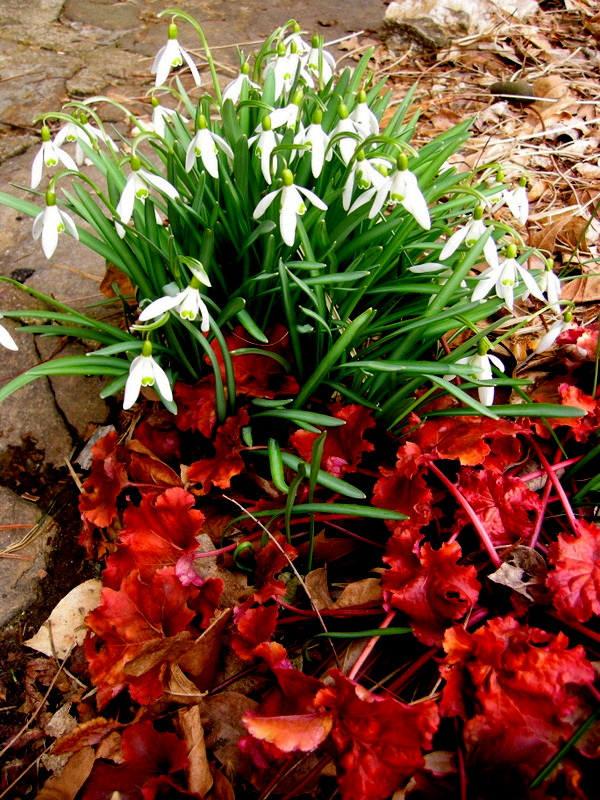
Season’s Greetings from CSG

Posted in Uncategorized on December 22, 2013 by Carolyn @ Carolyns Shade Gardens

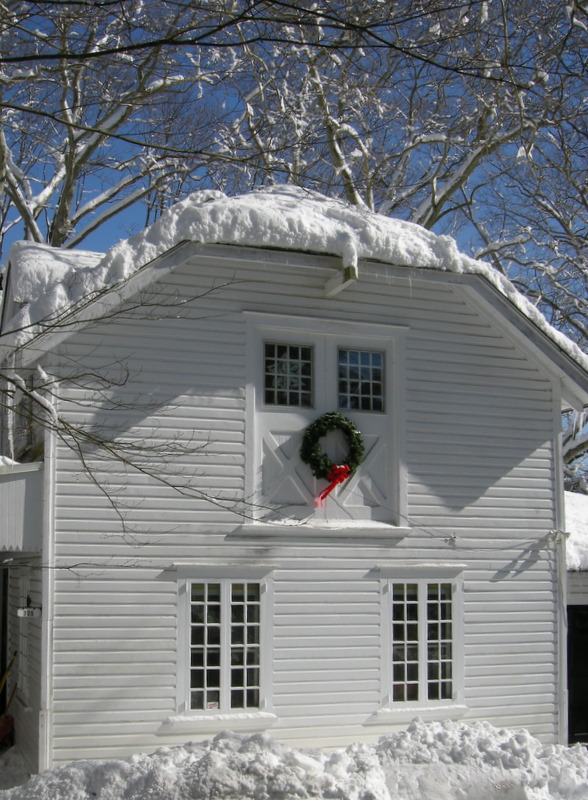
carriage house at Carolyn's Shade Gardens

As 2013 comes to an end,

I want to wish my readers all over the world

Happy Holidays, Merry Christmas,

and Happy New Year

from Carolyn’s Shade Gardens

.

Nursery Happenings: Carolyn’s Shade Gardens is a retail nursery located in Bryn Mawr, PA, specializing in showy, colorful, and unusual plants for shade.  The only plants that we ship are snowdrops and miniature hostas.  For catalogues and announcements of events, please send your full name, location, and phone number (for back up use only) to carolyn@carolynsshadegardens.com.  Click here to get to the home page of our website for catalogues and information about our nursery and to subscribe to our blog.

Carolyn’s Shade Gardens is a local retail nursery in Bryn Mawr, Pennsylvania, U.S., zone 6b. The only plants that we mail order are snowdrops and miniature hostas and only within the US.

If you are within visiting distance and would like to receive catalogues and information about customer events, please send your full name and phone number to carolynsshadegardens@verizon.net. Subscribing to my blog does not sign you up to receive this information.

Facebook: Carolyn’s Shade Gardens has a Facebook Page where I post single photos, garden tips, and other information that doesn’t fit into a blog post. You can look at my Facebook page here or click the Like button on my right sidebar here.

Notes: Every word that appears in orange on my blog is a link that you can click for more information. If you want to return to my blog’s homepage to access the sidebar information (catalogues, previous articles, etc.) or to subscribe to my blog, just click here.
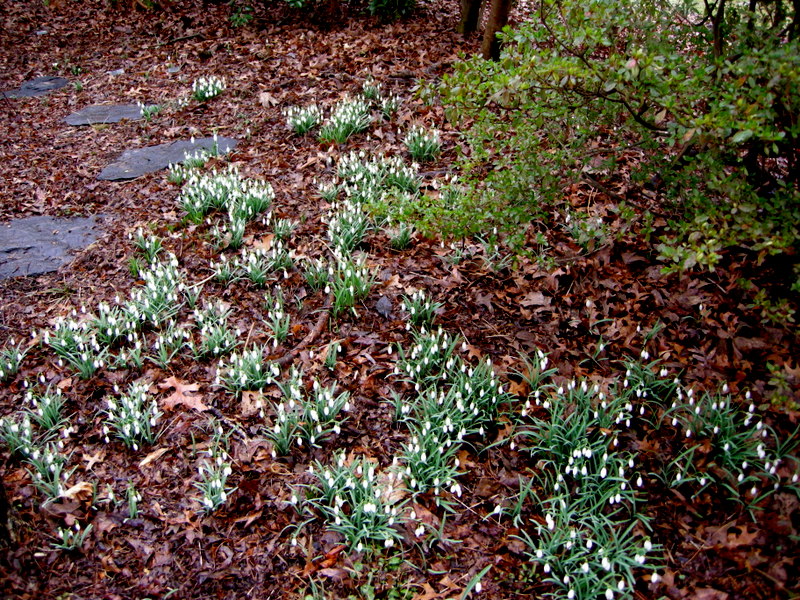
Fall 2013 Snowdrops and Camellias

Posted in Camellias, evergreen, Fall, Shade Shrubs, snowdrops, winter, winter interest with tags , , , , , , , , , , , , , , on December 11, 2013 by Carolyn @ Carolyns Shade Gardens

Nursery Happenings: Carolyn’s Shade Gardens is a retail nursery located in Bryn Mawr, PA, specializing in showy, colorful, and unusual plants for shade.  The only plants that we ship are snowdrops and miniature hostas.  For catalogues and announcements of events, please send your full name, location, and phone number (for back up use only) to carolyn@carolynsshadegardens.com.  Click here to get to the home page of our website for catalogues and information about our nursery and to subscribe to our blog.

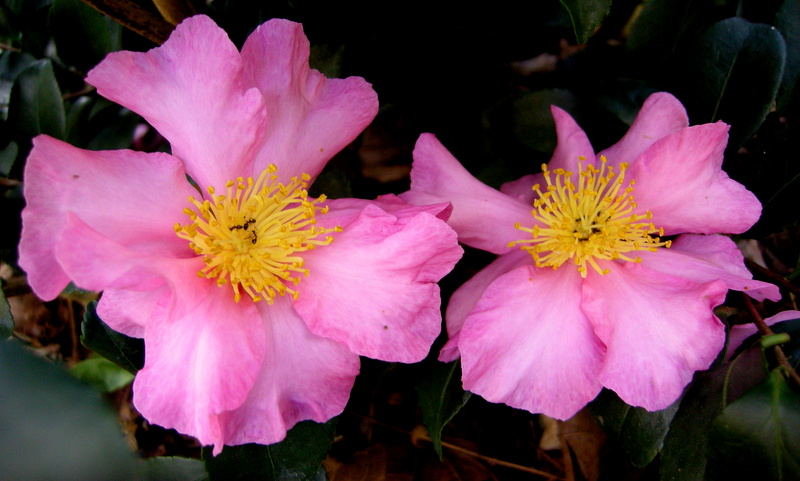
Camellia x 'Long Island Pink'‘Long Island Pink’ fall-blooming hardy camellia

As my garden begins to quiet down in the second half of fall, two of my favorite plants come into their full glory.  One is fall-blooming hardy camellias, and the other is fall-blooming snowdrops.  Both are quite rare, at least in the U.S., but both are quite easy to grow and look wonderful together.  And the key to my appreciation of them is that late fall, November and December, is their main season.  When other plants are succumbing to frost, camellias and snowdrops begin their show with a fresh and pristine look.

.

Galanthus elwesii Hiemalis GroupThis fall-blooming form of the giant snowdrop selected at Carolyn’s Shade Gardens began flowering on November 1 this year and will be offered in the 2014 Snowdrop Catalogue.  Technically it is called Galanthus elwesii var. monstictus Hiemalis Group CSG-01, what a mouthful.

.

Galanthus elwesii Novemnber bloomingAnother shot of my fall-blooming snowdrops showing how they are nestled in among evergreen hellebores and Japanese holly ferns to highlight the pure white flowers.

I readily admit that I am a snowdrop addict—a galanthophile.  And I can even understand how some gardeners fail to get excited about these little white flowers in the spring.  However, in November and December when even the hardy cylcamen are done, snowdrops are so bright and cheerful that the winter doldrums disappear the minute I see them.  You can even have flowers beginning in mid-October by planting the earliest blooming species Galanthus reginae-olgae.  For more on fall-blooming snowdrops, click here.

  .

Galanthus elwesii green-tippedAnother fall-blooming giant snowdrop selected here at Carolyn’s Shade Gardens for it’s early November bloom time and green-tipped outer segments.  It received high praise recently when I posted photos on the Scottish Rock Garden Club Galanthus Forum, even the UK galanthophiles with access to hundreds of cultivars were impressed.  Hopefully it will multiply quickly and someday I can offer it for sale.

I am working on the 2014 Snowdrop Catalogue right now and will have it posted on the website before January 1.  There are a lot of exciting cultivars available for 2014, but unfortunately they are in very short supply so if you are interested, order early.  I have written quite a few blog posts and articles about snowdrops.  You can find them all compiled in the post New Feature Article on Snowdrops by clicking here.

.

Camellia Winter's Snowman‘Winter’s Snowman’ fall-blooming camellia has gorgeous, shiny, dark evergreen leaves.

.

Camellia Winter's Snowman‘Winter’s Snowman’ produces two types of flowers on the same plant: the anemone-form flowers on the right and the more open semi-double flowers on the left.

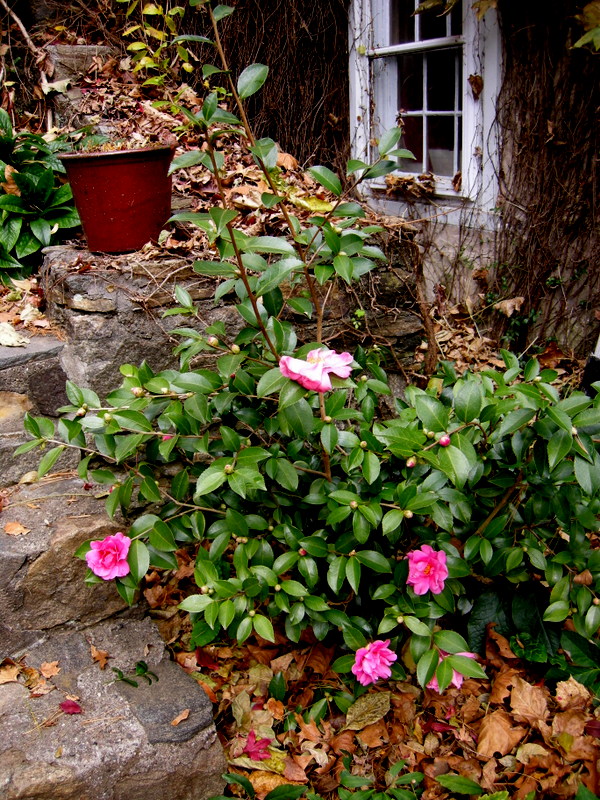
Like the snowdrops above, fall-blooming camellias are outstanding in November and December when their large and colorful flowers are shown off to perfection by their shiny evergreen leaves.  However, they bring even more to the garden because unlike the ephemeral snowdrops, camellias are shrubs that provide the beauty of their evergreen leaves and lovely habit year round.

.

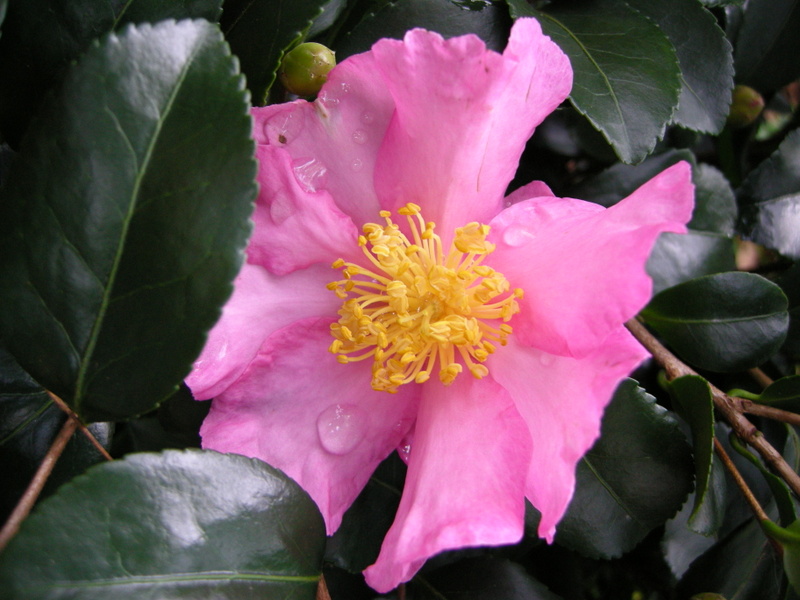
Camellia sasanqua Nokoriko‘Nokoriko’ is new to my garden this year, and I love its unusual flower color.  Although it is said to be hardy in zone 6, it is a selection from the species Camellia sasanqua, which is not always hardy in our area.  Only time will tell.

.

I have written a lot about fall-blooming camellias and featured photos of dozens of plants that are hardy in zones 6 and 7.  All my articles are compiled in the blog post New York Times Photos where I provided a link to my camellia photos that appeared in that newspaper.   To see those photos and read more about camellias, click here. If you are looking for information about or photos of a particular hardy camellia cultivar, type the name into the Search My Website area on the sidebar of my home page (if the sidebar is not on the right, click here).

.

Camellia Arctic SnowThis photo of  ‘Arctic Snow’ gives an idea of how many buds each camellia can produce.

.

Camellia Arctic Snow‘Arctic Snow’ flower

The one drawback to fall-blooming camellias is that if we have unseasonably cold weather, below 25 degrees F (-3.8 C) or so, any open flowers can be frozen and ruined.  This happened this year during the last week of November when the temperature dropped to an official 21 degrees F (-6 C) but was actually 18 degrees in my garden and as low as 12 degrees elsewhere.  However, the unopened buds on my plants didn’t freeze, and the flowers continued to open.  We are now experiencing another bout of colder than normal weather, and I am not sure the buds will make it through unscathed this time.

.

Camellia Long Island Pink ‘Long Island Pink’

.

Camellia x 'Long Island Pink'A close up of ‘Long Island Pink’ and its beautiful leaves.

.

Usually I visit other gardens to show you camellias.  However, this year I am highlighting the cultivars that I grow myself.  Enjoy the photos and keep warm during the extra chilly weather we are experiencing.

.

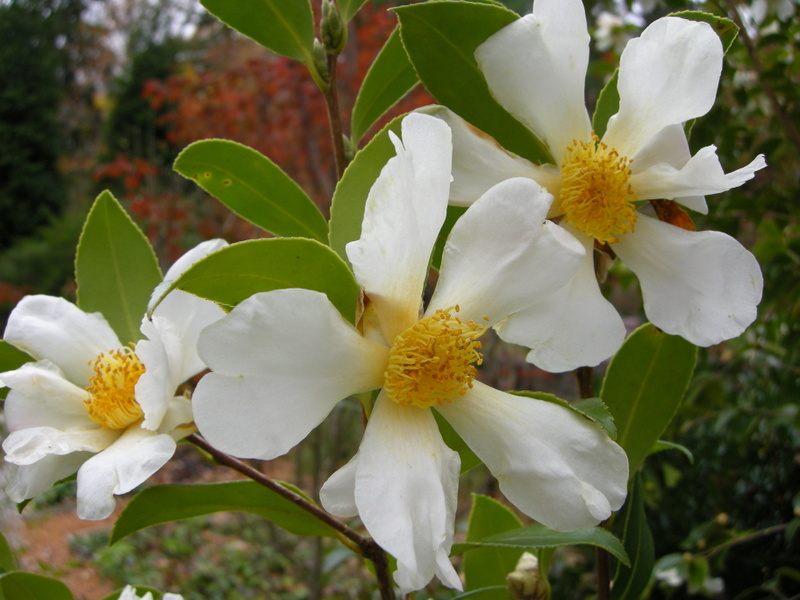
Camellia olifera Lu Shan SnowThe oldest camellia in my garden is ‘Lu Shan Snow’, a Camellia oleifera cultivar and the hardy camellia used by Dr. Ackerman at the US National Arboretum to develop many modern hardy camellia cultivars.

.

Camellia olifera Lu Shan Snow‘Lu Shan Snow’

.

Camellia Winter's Joy‘Winter’s Joy’ is one of my favorites because it produces so many buds and flowers.

.

Camellia Winter's Joy‘Winter’s Joy’

.

Camellia Winter's Star White‘Winter’s Star White’

.

Camellia x 'Winter's Darling'‘Winter’s Darling’

.

Camellia x 'Elaine Lee'‘Elaine Lee’

Carolyn

.

Carolyn’s Shade Gardens is a local retail nursery in Bryn Mawr, Pennsylvania, U.S., zone 6b. The only plants that we mail order are snowdrops and miniature hostas and only within the US.

If you are within visiting distance and would like to receive catalogues and information about customer events, please send your full name and phone number to carolynsshadegardens@verizon.net. Subscribing to my blog does not sign you up to receive this information.

Facebook: Carolyn’s Shade Gardens has a Facebook Page where I post single photos, garden tips, and other information that doesn’t fit into a blog post. You can look at my Facebook page here or click the Like button on my right sidebar here.

Notes: Every word that appears in orange on my blog is a link that you can click for more information. If you want to return to my blog’s homepage to access the sidebar information (catalogues, previous articles, etc.) or to subscribe to my blog, just click here.

Low Maintenance Garden Part 2: Techniques

Posted in How to, my garden, sustainable living with tags , , , , , , , , , on December 1, 2013 by Carolyn @ Carolyns Shade Gardens

Carolyn’s Shade Gardens is a retail nursery located in Bryn Mawr, PA, specializing in showy, colorful, and unusual plants for shade.  The only plants that we ship are snowdrops and miniature hostas.  For catalogues and announcements of events, please send your full name, location, and phone number (for back up use only) to carolyn@carolynsshadegardens.com.  Click here to get to the home page of our website for catalogues and information about our nursery and to subscribe to our blog.

.Magnolia kobus 'Wada's Memory'‘Wada’s Memory’ magnolia provides plenty of leaves for Michael’s leaf grinding efforts plus some gorgeous fall color.

My husband Michael and I have spent 30 years perfecting our gardening techniques at Carolyn’s Shade Gardens, and we are always happy to pass on what we have learned to our nursery customers.  In spring 2012, Michael developed a series of seminars to demonstrate our methods to our customers right here at the nursery.  This post is Part 2 of a two part series explaining what goes on at Michael’s seminars.  Part 1 detailed the tools that we recommend to make garden maintenance easy.  You can read it by clicking here.

.

DSCN3368Michael with a typical pile of leaves ready for grinding into mulch.

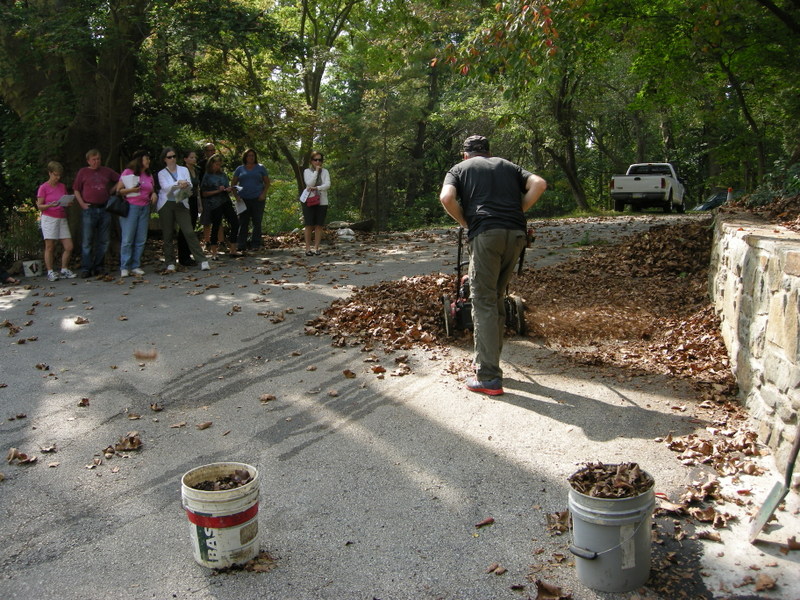
We believe that the most valuable asset on our property is the leaves that fall from our trees.  Leaves are what nature provides for free to protect and improve your soil.  Removing and disposing of your leaves outside your own property is the worst thing that you can do to your garden.  During his seminar, Michael demonstrates how we handle the massive quantity of leaves that fall from our 35 plus large deciduous trees.  Basically we leave them in place to decompose on their own, grind them on the lawn to help it grow, and grind them into mulch for our garden beds.

  .

DSCN2935Michael demonstrates leaf grinding to seminar attendees.

For a step-by-step guide to grinding your leaves to use for mulch, please read my post Your Most Precious Garden Resource by clicking here.  For a video by Scotts Lawn Care showing how to grind leaves on your lawn, click here.  A recent Michigan State University study has shown that grinding up to 18″ of leaves on your lawn and leaving them there is beneficial to your lawn.  For more information on how we handle leaves in our beds in the fall, click here.

.

DSCN2936Michael demonstrates how he uses the ground leaves for mulch in our gardens.

.

Our other secret weapon is compost, which we make ourselves and also get from the township.  No bed is created and no plant is planted without adding a large amount of this “black gold”.  Michael shows seminar attendees what good compost should look like and demonstrates how we go about composting.  For more information on how we use compost in our garden, read my post Powered by Compost by clicking here.

.

DSCN2933During the tool session at the beginning of the seminar, Michael talks about what an important tool compost is.

.

DSCN2943Every seminar includes a trip to our compost area and a demonstration of composting techniques.

Many other important gardening jobs are explained in detail with live demonstrations…..

.

DSCN7137Planting a perennial using a shovel or an auger attachment to a drill.

.

DSCN7138Edging beds to keep out weeds and present a manicured look.

.

DSCN2939 Planting a shrub, here Michael shows how it is important to loosen the roots on the outside of the rootball.

.

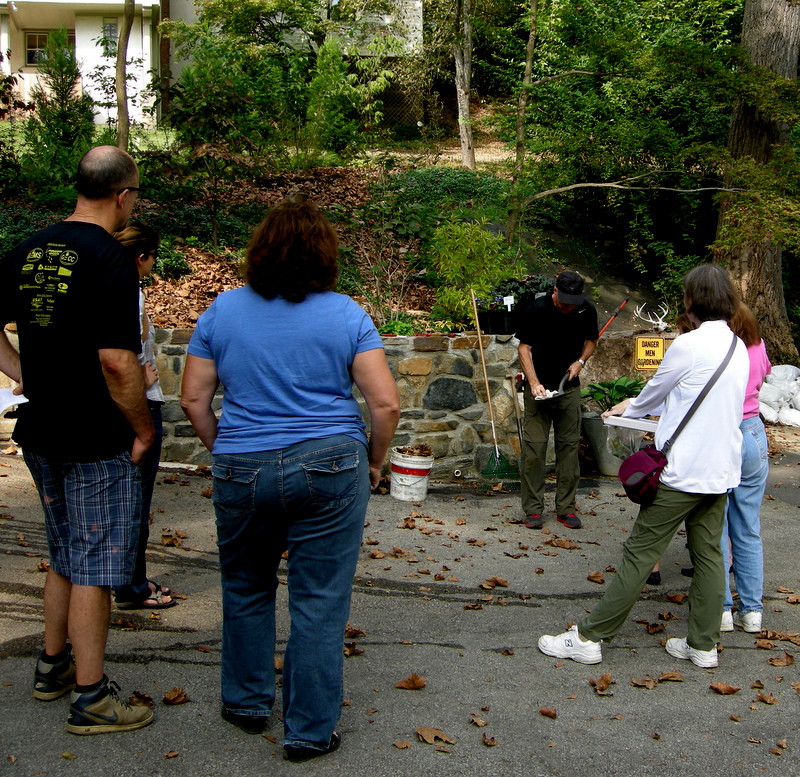
DSCN7141Every session ends with a question and answer period during which attendees can ask about any gardening task that interests them.

.

These are just some of the topics covered in a typical seminar.  Other subjects include deer management, invasive plant removal, winter interest, container planting, and many more.

Carolyn

.

Carolyn’s Shade Gardens is a local retail nursery in Bryn Mawr, Pennsylvania, U.S., zone 6b. The only plants that we mail order are snowdrops and miniature hostas and only within the US.

If you are within visiting distance and would like to receive catalogues and information about customer events, please send your full name and phone number to carolynsshadegardens@verizon.net. Subscribing to my blog does not sign you up to receive this information.

Nursery Happenings: Carolyn’s Shade Gardens is closed for the winter.  Please visit my Etsy Shop to purchase photo note cards suitable for all occasions by clicking here.  Look for the 2014 Snowdrop Catalogue in early January.

Facebook: Carolyn’s Shade Gardens has a Facebook Page where I post single photos, garden tips, and other information that doesn’t fit into a blog post. You can look at my Facebook page here or click the Like button on my right sidebar here.

Notes: Every word that appears in orange on my blog is a link that you can click for more information. If you want to return to my blog’s homepage to access the sidebar information (catalogues, previous articles, etc.) or to subscribe to my blog, just click here.
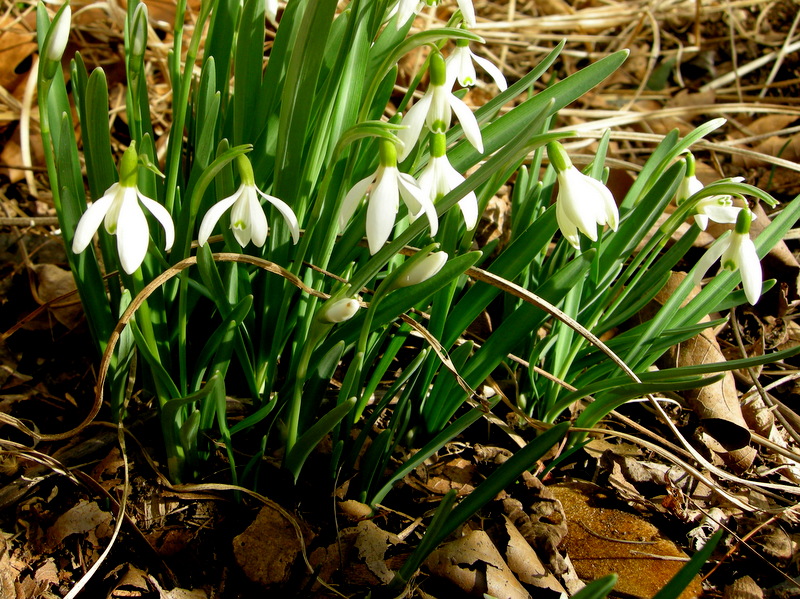
Low Maintenance Garden Part 1: Tools

Posted in How to, my garden, sustainable living with tags , , , , , , , , on November 18, 2013 by Carolyn @ Carolyns Shade Gardens

Carolyn’s Shade Gardens is a retail nursery located in Bryn Mawr, PA, specializing in showy, colorful, and unusual plants for shade.  The only plants that we ship are snowdrops and miniature hostas.  For catalogues and announcements of events, please send your full name, location, and phone number (for back up use only) to carolyn@carolynsshadegardens.com.  Click here to get to the home page of our website for catalogues and information about our nursery and to subscribe to our blog.

Note Card Images note card images

Before I get to the post, I want to let all my readers know that I have set up a shop on Etsy, a website featuring vintage and handmade goods, called CarolynsShadeGardens so you can use your credit card to purchase my photo note cards.  Click here to visit the shop and see the note cards available.   You can also click on the permanent link I have placed on the right sidebar of this website.

The cards come individually or in sets and are perfect for birthday greetings, expressions of sympathy, thank you notes, and for communicating with friends the old-fashioned way. The card sets make great gifts for the holidays especially useful for hostess presents, last minute gifts, and for the friend who has everything.

.

DSCN2937Michael demonstrates edging using an edger with a long handle.

Nursery customers always comment on the amount of work it must take to maintain our display gardens and marvel at how Michael and I do it with no additional help.  At this point in our lives, we are wondering that ourselves, but that’s another story.  However, part of the answer is that over our 30 years of gardening here we have developed many techniques to keep maintenance to a minimum while using sustainable, organic methods. 

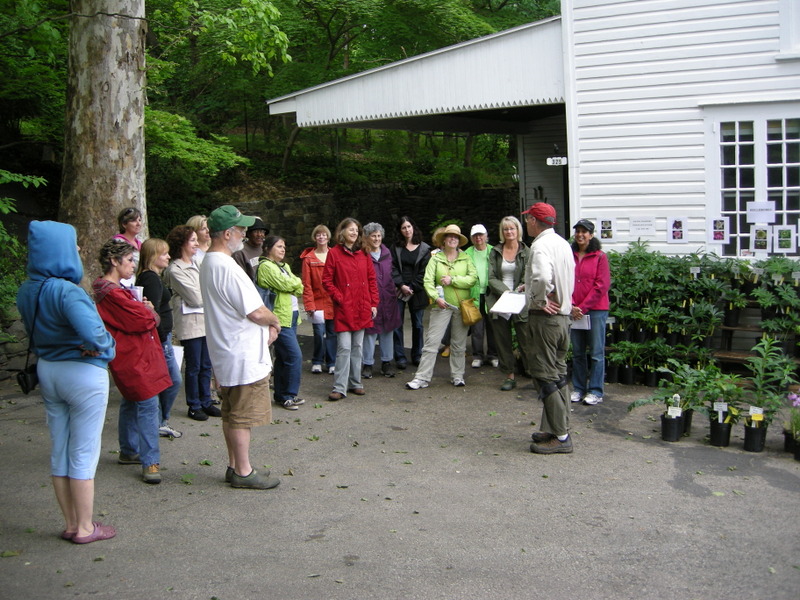
In spring 2012, we developed a series of seminars to teach these techniques to our customers.  For readers who can’t attend, I thought I would show you what goes on during Michael’s Low Maintenance Garden Seminars.

  .

DSCN2929Michael shows off his all round favorite tool, a digging tool from Gempler’s discussed below.

Each seminar begins with a review of essential tools and their maintenance.  When Michael visits customers’ gardens in his capacity as garden coach, he often finds that they are making do with inadequate garden tools.  Having the right tool allows gardeners to perform maintenance jobs easily and efficiently.  Michael and I both have our favorites, and he demonstrates them during his seminar and tells attendees where to purchase them.

.

DSCN3405Michael’s favorite tool, a Gempler’s Professional 12″ Digging Tool.  It is similar to a Japanese farmer’s knife, but it has a hand guard for protection, which is essential for the safe use of this type of tool.  He uses it for weeding, planting, cutting, and many other jobs.  I prefer a skinny-headed trowel for weeding and a rabbiting spade for planting.

.

Originally, I was going to cover everything in one post, but as I started to write I found a lot to say about tools.  I was inspired to take individual photos of some of the important tools because Michael and I feel so strongly that they are the best.  The actual garden maintenance part of the seminars will be covered in Part 2.

.

DSCN3402Michael and I both would not be without Felco No. 2 Pruners.  My father bought me this pair over 30 years ago when he found me using some Kmart knock offs.  With infrequent sharpenings, they work as well as they did when I got them.

.

DSCN2922Michael demonstrates the use of our Dramm watering wand.  We have one of these wands on the end of each hose on our property and find it indispensable for all watering tasks.  I met the Dramm representative at a conference recently and told her that we promoted the wands at our seminars.  She nicely sent six wands to raffle off at our fall seminars this year, and six happy attendees went home with a new tool.  We hope to continue this with Dramm and other manufacturers at future seminars.  The hose to which the wand is attached is made by Flexogen and is the only kind we use—heavy duty and kink resistant.

.

DSCN3400For branches too thick for pruners, we use this folding hand saw also made by Felco.  It fits in your back pocket but handles very large branches while being easy to maneuver in tight spaces.

.

DSCN2931Tool maintenance, especially keeping tools clean and sharp, is very important.  Here Michael cleans and sharpens the pointed blade of our long-handled shovel, which is the shovel we both use for digging and shoveling.  The long handle is essential for the leverage you need to get the job done easily no matter what size you are and without bending over.

.

DSCN3401   These Corona ComfortGel Floral Snips are the tool I always have with me in the garden.  They are small enough to cut herbaceous leaves but rugged enough to handle woody stalks and small branches.  The gel handles are comfortable, and the blades spring open and closed smoothly.

.

DSCN3403Michael and I both think it is very important to protect your knees when you are kneeling down weeding or planting.  We both wear strap on kneepads.  I prefer the soft kind made by Kneelons pictured above while Michael likes the hard shell type sold for doing tile work.

.

Other tools we recommend: I dig all the perennials I grow and sell with a rabbiting spade, which is just the right size to slip easily between other plants that I do not want to disturb.  Long-handled loppers are useful for leverage when pruning bigger branches.  We also consider a heavy duty, very sharp, folding serrated knife essential for dividing plants.  I never head out into the garden to weed without my large or small Bosmere weeding bag (they call it a tip bag).  These bags are very light but durable and their sides don’t sag.

We could recommend many other tools—this won’t surprise you if you have been here and seen our garage—but these are the most important tools that help make our garden low maintenance.

Carolyn

.

Carolyn’s Shade Gardens is a local retail nursery in Bryn Mawr, Pennsylvania, U.S., zone 6b. The only plants that we mail order are snowdrops and miniature hostas and only within the US.

If you are within visiting distance and would like to receive catalogues and information about customer events, please send your full name and phone number to carolynsshadegardens@verizon.net. Subscribing to my blog does not sign you up to receive this information.

Nursery Happenings: Carolyn’s Shade Gardens is closed for the winter.  Please visit my Etsy Shop to purchase photo note cards suitable for all occasions by clicking here.  Look for the 2014 Snowdrop Catalogue in early January.

Facebook: Carolyn’s Shade Gardens has a Facebook Page where I post single photos, garden tips, and other information that doesn’t fit into a blog post. You can look at my Facebook page here or click the Like button on my right sidebar here.

Notes: Every word that appears in orange on my blog is a link that you can click for more information. If you want to return to my blog’s homepage to access the sidebar information (catalogues, previous articles, etc.) or to subscribe to my blog, just click here.

Winterthur Part 3: A Walk in the Woods

Posted in Fall, garden to visit with tags , , , , , , on November 6, 2013 by Carolyn @ Carolyns Shade Gardens

Carolyn’s Shade Gardens is a retail nursery located in Bryn Mawr, PA, specializing in showy, colorful, and unusual plants for shade.  The only plants that we ship are snowdrops and miniature hostas.  For catalogues and announcements of events, please send your full name, location, and phone number (for back up use only) to carolyn@carolynsshadegardens.com.  Click here to get to the home page of our website for catalogues and information about our nursery and to subscribe to our blog.

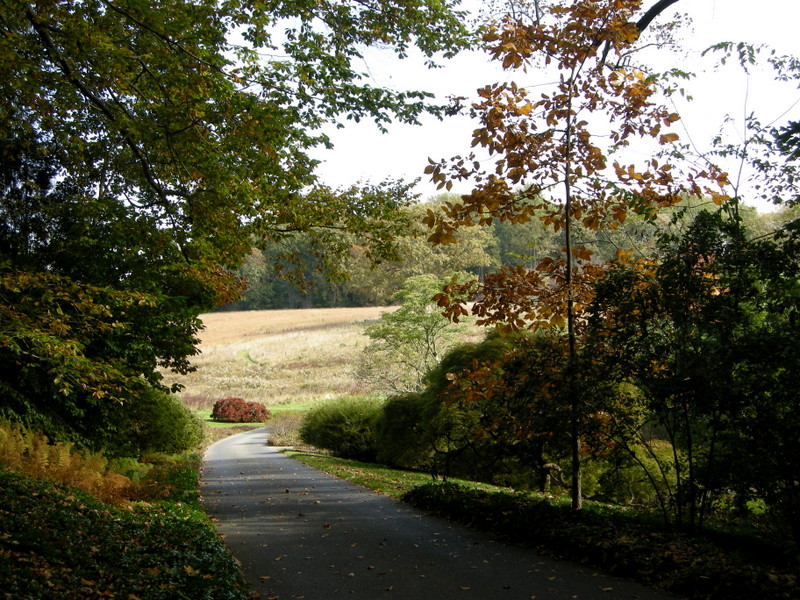
Winterthur Fall 2013-028 Paved paths meander through Winterthur’s majestic woods.

Winterthur in Delaware is the outstanding Philadelphia (Pennsylvania, US) area garden that I am profiling this year. For links to gardens profiled in previous years and background on Winterthur itself, read my first post on Winterthur in late winter by clicking here.  Posts about my visit in late May profiled the Peony Garden, click here, and the Quarry Garden, click here.  

.

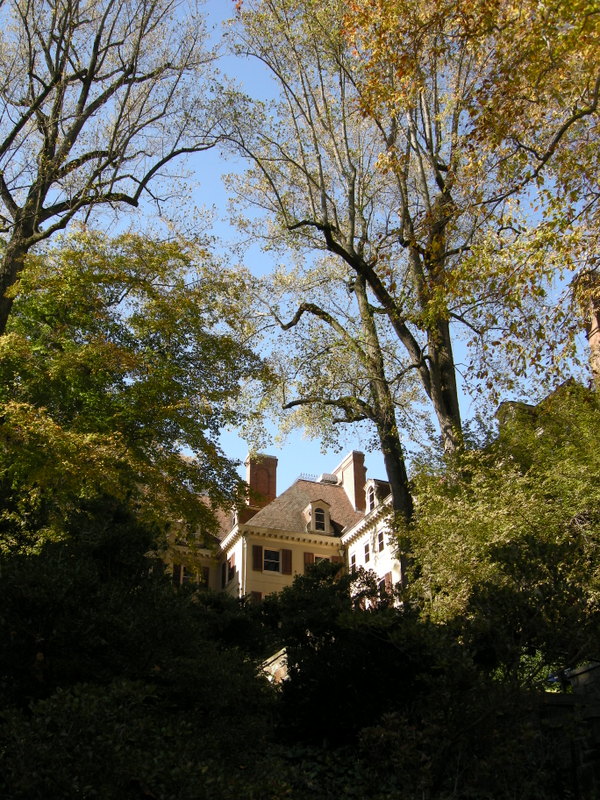
Winterthur Fall 2013-005The Winterthur house, which is now a museum of  American decorative art, is framed on all sides by huge trees.

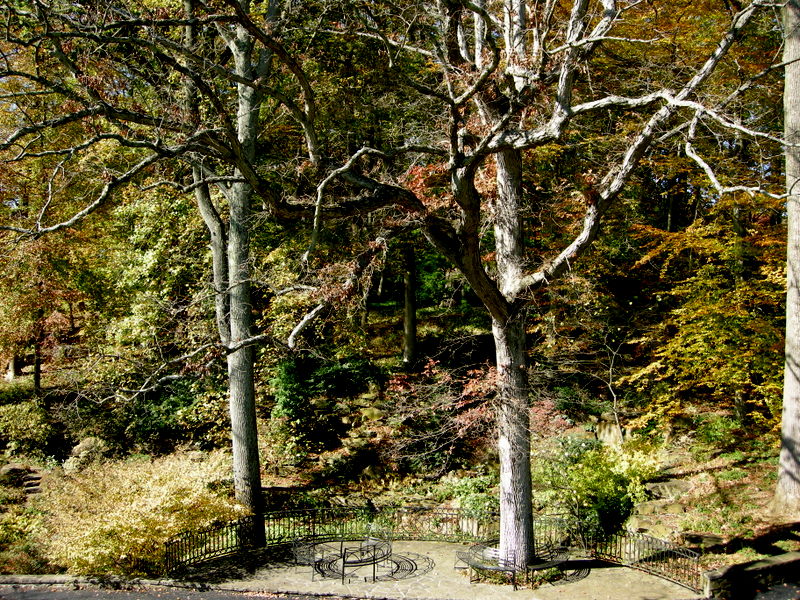
The gardens at Winterthur are bursting with flowers starting with snowdrops and other early bloomers in February and continuing through spring and summer.  By the time Michael and I visited at the very end of October, the focus had shifted to the magnificent woods.  We thoroughly enjoyed our peaceful walk during which we had the garden pretty much to ourselves.  My only regret is that we were about a week too early for fall color.  The trees turned so late this year that I was convinced that fall color was never coming.  Despite my pessimism it did arrive as you will see in an upcoming post.

  .

Winterthur Fall 2013-003.

Enjoy your virtual stroll through the Winterthur gardens, but don’t skip the end where I highlight two unusual sights.

.

Winterthur Fall 2013-010

.

Winterthur Fall 2013-006.

Winterthur Fall 2013-018.

Winterthur Fall 2013-004.

Winterthur Fall 2013-007.

Winterthur Fall 2013-013Whenever you head out of the woods, you find gorgeous views of the surrounding countryside, much of it part of the Winterthur property.

.

Winterthur Fall 2013-014The Quarry Garden in fall.

.

Winterthur Fall 2013-015Approaching the house from the other side.

.

Winterthur Fall 2013-020.

Winterthur Fall 2013-023.

Winterthur Fall 2013-024.

Winterthur Fall 2013-026.

Winterthur Fall 2013-025.

Metasequoia glyptostroboidesMichael standing next to a very large dawn redwood, Metasequoia glyptostroboides.

.

As we walked through the gardens, we happened upon the dawn redwood pictured above.  It is a very large specimen planted in 1951, but dawn redwoods are quite common in public gardens in our area—there is even one at Carolyn’s Shade Gardens.  What drew me to it was the sprays of male cones, which covered the whole tree and were quite beautiful.  I have never seen a dawn redwood “in bloom”.  Dawn redwoods are deciduous conifers with male and female cones on the same plant (monoecious).  Technically they don’t have flowers although many sources mistakenly refer to the cones as flowers.

.

Metasequoia glyptostroboides.

Metasequoia glyptostroboides.

liriodendron tulipiferaMichael standing next to one of the many very large tulip poplars, Lirodendron tulipifera, at Winterthur.

.

Tulip poplars are one of the most common native trees in our area and like all the trees around here they grow to be quite large in our fertile, deep soil.  Winterthur has dozens if not hundreds of large tulip trees.  However, when we visit we always make an effort to hike out to the “William Penn Poplar”, which is not in the official garden but instead on a trail that leads off the parking lot into Chandler Woods.  According to the Winterthur arborist, it is likely that this tree was in existence when William Penn first visited his lands here in 1682.  No matter how large I remember this tree being, it always amazes me how big it actually is.  Just compare the final photo with the picture above.  The actual measurements are 152′ tall and 209″ in circumference.

.

Liriodendron tulipifera.

Liriodendron tulipifera.

If Chanticleer is the most creative garden in our area, and Longwood is the most diverse and entertaining, in my opinion, Winterthur is the most purely beautiful garden and well worth a visit any time of year.

Carolyn

.

Carolyn’s Shade Gardens is a retail nursery located in Bryn Mawr, Pennsylvania, U.S., zone 6b. The only plants that we mail order are snowdrops and miniature hostas and only within the US.

If you are within visiting distance and would like to receive catalogues and information about customer events, please send your full name and phone number to carolynsshadegardens@verizon.net. Subscribing to my blog does not sign you up to receive this information.

Nursery Happenings: Carolyn’s Shade Gardens is closed for the winter.  Look for the 2014 Snowdrop Catalogue in early January.

Facebook: Carolyn’s Shade Gardens has a Facebook Page where I post single photos, garden tips, and other information that doesn’t fit into a blog post. You can look at my Facebook page here or click the Like button on my right sidebar here.

Notes: Every word that appears in orange on my blog is a link that you can click for more information. If you want to return to my blog’s homepage to access the sidebar information (catalogues, previous articles, etc.) or to subscribe to my blog, just click here.

Berries for Fall

Posted in Fall, Fall Color, my garden, native plants, Shade Gardening, Shade Shrubs, winter interest with tags , , , , , , , , , , , , on October 30, 2013 by Carolyn @ Carolyns Shade Gardens

Carolyn’s Shade Gardens is a retail nursery located in Bryn Mawr, PA, specializing in showy, colorful, and unusual plants for shade.  The only plants that we ship are snowdrops and miniature hostas.  For catalogues and announcements of events, please send your full name, location, and phone number (for back up use only) to carolyn@carolynsshadegardens.com.  Click here to get to the home page of our website for catalogues and information about our nursery and to subscribe to our blog.

Callicarpa dichotoma 'Early Amethyst'‘Early Amethyst’ beautyberry, Callicarpa dichotoma

For fall and winter ornamental interest, you can’t beat berries.  They are incredibly showy and last much longer than flowers.  They attract birds to my garden when they come in flocks to feast on the bounty—sometimes sooner than I would like.  And this year seems to be the best year ever for fruit production.  All my berry producing plants are loaded.  Is it because of all the rain we had this summer?  Or does it portend a hard winter like the presence of lots of acorns?  Who knows, but I am enjoying them and want to share some of my favorites with you.

.

Ilex verticillata 'Red Sprite'‘Red Sprite’ winterberry holly, Ilex verticillata

.

Ilex verticillata 'Red Sprite''‘Red Sprite’

.

Winterberry holly is a must for fall interest.  It is a native deciduous holly that grows in sun to part shade and is salt and wet site tolerant.  Just remember that like all hollies, it requires a male and female plant to produce fruit.  ‘Red Sprite’ is more compact than most winterberries at five feet tall and four feet wide, it never needs pruning.  My plants drape down over the wall of one of my terraces and are stunning this time of year.  ‘Red Sprite’ produces more profusely than most winterberries, and its berries are larger and very showy.  Unfortunately the robins know this too, and they sweep in and strip the bush in one day.

.

Callicarpa dichotoma 'Early Amethyst'‘Early Amethyst’ beautyberry

.

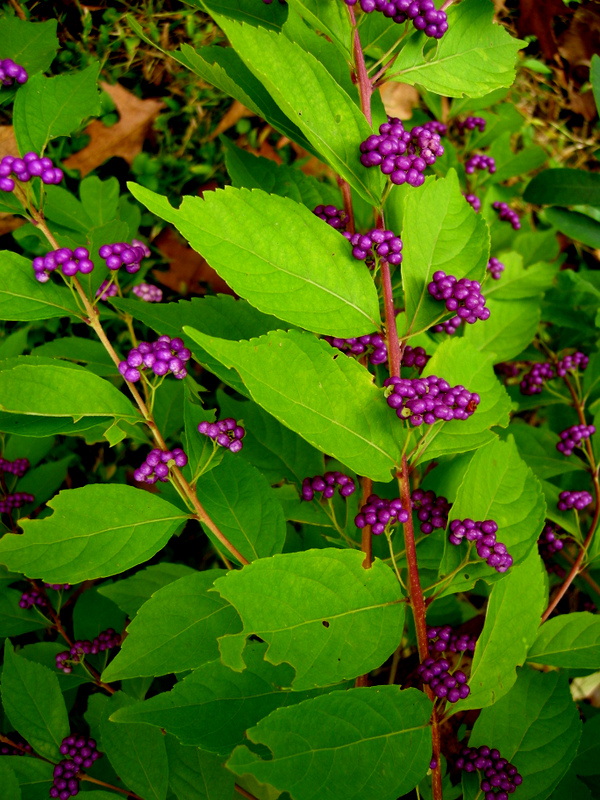
Callicarpa dichotoma 'Early Amethyst'The fruit clusters of Callicarpa dichotoma, an Asian native, are held away from the branch on a stalk, whereas the fruit of C. americana (photo below) surrounds the branch.

.

The fruit of beautyberries, both native and non-native, is such a striking purple color that it stops people in their tracks.  I have written about ‘Early Amethyst’ before in Woody Plants for Shade Part 3 so you can go there for all the details.  ‘Early Amethyst’ is a much more fine-textured plant than the American native and fits well in a mixed border.  In the last few years, I have cut my plants back to 12 to 24″ in the spring, and they have grown back to produce a 5 to 6′ plant with a beautiful habit (see top photo).

 . 

Begonia grandishardy begonia, B. grandis

.

Begonia grandishardy begonia

.

No, hardy begonias do not produce fruit.  But the persistent seed pods and pink stems remain quite ornamental after the flowers drop off.  They decorate my whole back hillside.  For more information on hardy begonias, read this post Hardy Begonias for Fall Color.

.

Crataegus viridis 'Winter King'‘Winter King’ green hawthorn, Crataegus viridis

.

Cratageus viridis 'Winter King'‘Winter King’ hawthorn

.

I have had my ‘Winter King’ hawthorn for over 15 years, and it has never produced like this.  It has a prime position outside my living room windows, and the view is amazing.  Green hawthorn is a native plant adaptable to many locations and soil types.  ‘Winter King’ is said to reach 30′ tall and 25′ wide in sun to part sun, although my mature plant is smaller.  In the spring, fluffy white flowers cover the tree, and its silver bark is also attractive.  ‘Winter King’ is a Pennsylvania Horticultural Society gold medal plant.  For more information, read the PHS write up.

.

Callicarpa americanaAmerican beautyberry, Callicarpa americana, it is difficult to get a good distance shot of the fruit when the leaves are still on.  However, they will drop shortly and the berries will persist.

.

Callicarpa americanaThe fruit of American beautyberry surrounds the branch.

.

I have been looking for American beautyberry to add to my garden for almost 20 years and just installed three shrubs last fall.  Although I have the Asian variety and like it, there is something about the color (blackberry purple?) and placement of the larger berries on the American variety that I find more attractive.  As with a lot of North American plants, it is less refined and bigger than its Asian counterpart so not suitable for a mixed border.  For more information, go to Woody Plants for Shade Part 9.

.

Symphoricarpos x doorenbosii Amethyst‘Amethyst’ coral berry, Symphoricarpos x doorenbosii, I must have taken 25 photos in an attempt to show you how beautiful this shrub is even from a distance but could not get one that does it justice.

.

Symphoricarpos x doorenbosii 'Amethyst'‘Amethyst’ coral berry

.

New to me this fall, ‘Amethyst’ coral berry has everything I am looking for in a shrub.  It is a cross between two Pennsylvania native shrubs, and it grows to 3 to 5′ tall with a similar spread in part shade but is full shade tolerant.  It is deer resistant and the gorgeous and unusual bright pink berries are attractive to birds.  For more information, go to Woody Plants for Shade Part 9.

.

I have highlighted just a few of the plants that are making my fall garden as enjoyable as my spring display.  Enjoy the remaining warm days of fall and pray for rain.  Meanwhile, all new plantings and drought susceptible established plants should be watered deeply twice a week.

Carolyn

.

Carolyn’s Shade Gardens is a retail nursery located in Bryn Mawr, Pennsylvania, U.S., zone 6b. The only plants that we mail order are snowdrops and miniature hostas and only within the US.

If you are within visiting distance and would like to receive catalogues and information about customer events, please send your full name and phone number to carolynsshadegardens@verizon.net. Subscribing to my blog does not sign you up to receive this information.

Nursery Happenings: Carolyn’s Shade Gardens is closed for the winter.  Look for the 2014 Snowdrop Catalogue in early January.

Facebook: Carolyn’s Shade Gardens has a Facebook Page where I post single photos, garden tips, and other information that doesn’t fit into a blog post. You can look at my Facebook page here or click the Like button on my right sidebar here.

Notes: Every word that appears in orange on my blog is a link that you can click for more information. If you want to return to my blog’s homepage to access the sidebar information (catalogues, previous articles, etc.) or to subscribe to my blog, just click here.
Maine in Early Fall

Posted in Fall, Maine, native plants, Shade Gardening with tags , , , , , , , , , on October 21, 2013 by Carolyn @ Carolyns Shade Gardens

Carolyn’s Shade Gardens is a retail nursery located in Bryn Mawr, PA, specializing in showy, colorful, and unusual plants for shade.  The only plants that we ship are snowdrops and miniature hostas.  For catalogues and announcements of events, please send your full name, location, and phone number (for back up use only) to carolyn@carolynsshadegardens.com.  Click here to get to the home page of our website for catalogues and information about our nursery and to subscribe to our blog.

DSCN2774These photos look so much more beautiful on my iPad than on my lower resolution laptop that I hope you can all view them on a device with high screen resolution.

This blog post is dedicated to the 139 people who have voted for Carolyn’s Shade Gardens so far.  Thank you so much.

Before I get to the rest of the photos, I am asking for your help.  My husband and I are making long range plans to ensure the sustainability of Carolyn’s Shade Gardens into its third decade.  As we get older and are less able to do hard physical labor, we need employees to help us with the core business and we need to expand into less labor intensive operations.  To enable this to happen, we have applied for a Mission Main Street Grant.  The application process requires that we get 250 votes from our customers.  We need you to vote for us as described below.

Votes are being authenticated through Facebook Connect so to vote you must be a Facebook user and you must log into your Facebook account.  You will receive an automatic message generated by Facebook stating that the grantor will receive your public profile and friends list.  This is for the purpose of vote authentication only, they will not store or share your information as it says below the Vote Now button.  To vote for Carolyn’s Shade Gardens, click here and click the Vote Now button.  Whether you are a local customer, someone who has ordered snowdrops or miniature hostas mail order, a Facebook follower, or one of my far flung blog readers, I hope that you will think that it is worthwhile supporting our sustainability efforts and vote now.

[As of Sunday, October 27, at 4:30 pm, we have 139 votes and really need 111 more!]

Now for more photos of the beautiful coast of Maine:

.

DSCN2781.

I have gotten so much positive feedback from my customers saying that they loved my blog posts from Maine.  However, looking back I realized that all my Maine posts this summer were about cultivated plants and gardens.  Although the gardens are gorgeous, the most beautiful parts of Maine, and the reason you should visit Maine, are the wild areas.  This post contains photos of the Maine coast taken in mid-September, the nicest time to visit the state (I should work for the tourist bureau!).  If readers want more, I can do a subsequent post with photos from mid-October.

.

DSCN2777.

DSCN2775.

DSCN2785.

DSCN2772.

DSCN2788.

DSCN2779.

DSCN2783.

DSCN2784.

I thought I would also use this post to show the results, one year later, of the changes that I made to my family’s garden in Maine as described in my July 2012 post Landscape Problem Solved.  In that post, I explained how I removed an unwanted perennial garden and replaced it with native smooth hydrangeas, H. arborescens, in pink and white.  Here are the results one year later:

.

Hydrangea arborescens 'Incrediball' & 'Invincible Spirit'The white-flowered cultivar is ‘Incrediball’ and the pink one is ‘Invincible Spirit’.

.

DSCN2767Although both cultivars are beautiful, ‘Invincible Spirit’ flopped every time it rained and eventually didn’t recover, while ‘Incrediball’ stood straight on its extra sturdy stems through torrential rains.  Its flowers remain upright as of today, and it has continued to produce new pure white blooms.

You constantly tell me how much you enjoy my blog, and the positive feedback is very much appreciated because the blog is a lot of work.  Now I need you to help me by voting for Carolyn’s Shade Gardens today.  Just clickhere and vote now.

Thanks, Carolyn

.

Carolyn’s Shade Gardens is a retail nursery located in Bryn Mawr, Pennsylvania, U.S., zone 6b. The only plants that we mail order are snowdrops and miniature hostas and only within the US.

If you are within visiting distance and would like to receive catalogues and information about customer events, please send your full name and phone number to carolynsshadegardens@verizon.net. Subscribing to my blog does not sign you up to receive this information.

Nursery Happenings: Carolyn’s Shade Gardens is closed for the winter.  Look for the 2014 Snowdrop Catalogue in early January.

Facebook: Carolyn’s Shade Gardens has a Facebook Page where I post single photos, garden tips, and other information that doesn’t fit into a blog post. You can look at my Facebook page here or click the Like button on my right sidebar here.
Notes: Every word that appears in orange on my blog is a link that you can click for more information. If you want to return to my blog’s homepage to access the sidebar information (catalogues, previous articles, etc.) or to subscribe to my blog, just click here.