2026 Snowdrop Catalogue
 Clockwise from upper left: beautiful double ‘Lady Beatrix Stanley’, X-marked, tall & elegant ‘Xmas’, very green, outward-facing ‘Blewbury Tart’, classic ‘Atkinsii’, ‘Magnet displays its fishing line, solid green inner mark on ‘George Elwes’, lovely plicate leaves and early flower of ‘Colossus’.
All plants in the 2026 Snowdrop Catalogue are sold out. If you wish to get emails announcing our 2027 Snowdrop Catalogue, which comes out in December 2026, (and you are not already on the list), please send the following required information: your full name, your mailing address for USPS, and your cell number to carolyn@carolynsshadegardens.com and indicate that you want the snowdrop catalogue.
2026 Snowdrop Catalogue
Carolyn’s Shade Gardens has been selling snowdrops since 1992, transferring our passion for this fascinating plant to more customers throughout the US every year. We sell our snowdrops (plus some leucojums and eranthis) in late winter as growing plants because that is the best way to insure vigorous and healthy snowdrops in our climate. You will also be able to identify and enjoy the flowers immediately as they will be mature and, with some exceptions, blooming when you receive them. Finally, unlike dormant bulbs, by seeing the bulbs in growth, you will know right away that the plants are disease free and safe to add to your existing collection instead of isolating them for a year.
All plants are mail order only: there will be no option for picking up at the nursery. Prices are for one plant unless indicated, and quantities are limited. Before ordering, please check this online catalogue, which will be updated regularly to indicate current availability, to make sure the snowdrop you want is not marked sold out. You are welcome to include a couple of substitutions in case your first choices are not available and you don’t make the minimum purchase requirement of $89, otherwise we do not substitute for sold out plants.
How To Order: Please read all the directions carefully. Please send an email to carolyn@carolynsshadegardens.com (not my long unused Verizon address) and include the plant names, quantities, your name, cell number, mailing address for USPS, and substitutions if desired (we never substitute unless specifically requested). Please include all the required information even if you think we have it. Our minimum order is $89 and an $18 charge will be added for packing and shipping your plants USPS Priority Mail (additional shipping charges for Priority Mail Express and/or for insurance will be added for larger orders). Supplies are limited so order early.
Within 24 hours, you will receive an email acknowledging your order and confirming availability, which will be followed in a few days with a second email specifying the amount owed to be paid by check or money order. If you do not receive an initial acknowledgment, we did not receive your order. Another email in late February or early March will let you know when the plants are ready for shipment.
Snowdrops will be shipped with all soil removed, which we do to make sure the bulbs are healthy, and should be planted outside immediately unless the ground is frozen or, if necessary, potted up and stored in a well lit, cool but not freezing location—you do not want the roots to freeze in the pots—until planted. Please note that if you live in a colder climate like northern New England or the upper Midwest, you may receive your snowdrops before you can plant them outside.
We offer no guarantee other than that each plant is true to name and healthy when it leaves here.
* * * * *
Carolyn’s Snowdrop Articles: Snowdrops are desirable plants for three reasons: their early bloom time, ornamental characteristics, and their fascinating histories. For more on this, read the feature article I wrote for the Hardy Plant Society Newsletter called “Confessions of a Galanthophile” by clicking here. I have written many other articles about snowdrops, and you can find links to most of them by clicking here. Read my cover article on snowdrops in the Jan/Feb 2016 issue of Fine Gardening magazine by clicking here.
Reference Books: The comprehensive snowdrop encyclopedia A Gardener’s Guide to Snowdrops: Second Edition by Freda Cox (Crowood Press 2019) contains short descriptions of almost every snowdrop on our list. The descriptive information below comes from many sources: Some Snowdrops: A Photographic Ramble and Some More Snowdrops, by Anne C. Repnow (Davidia Press 2020 & 2024); A Plant Lover’s Guide to Snowdrops by Naomi Slade (Timber Press 2014); The Galanthophiles: 160 Years of Snowdrop Devotees by Jane Kilpatrick and Jennifer Harmer (Orphans Publishing 2018); and Snowdrops: A Monograph of Cultivated Galanthus by Matt Bishop, Aaron Davis, and John Grimshaw (Griffin Press 2006, sadly out-of-print, referred to below as Snowdrops).
* * * * *
RHS AGM signifies a Royal Horticultural Society Award of Garden Merit, given to only 28 snowdrops out of the over 2,500 plus in cultivation.
UK Popularity List refers to an Avon Bulbs survey of British galanthophiles resulting in a list of their all-time 25 favorite snowdrops.
For more information about and photos of some of the snowdrops offered below, which are new to the catalogue this year, click here, here, and here. Please note that ‘Early Bird’, ‘Poculi Perfect’, and ‘Selina Cords’ are no longer in the catalogue.
Photos appear above the descriptions.
* * * * *
GALANTHUS
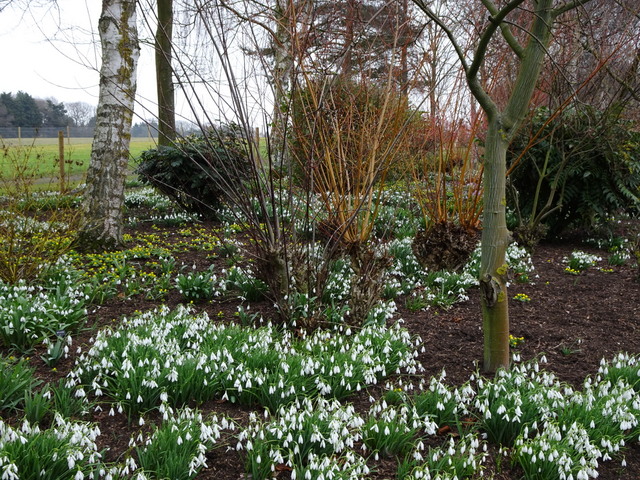
Common snowdrops, Galanthus nivalis, are naturalized throughout our garden, and we still can’t have enough. The wonderfully honey-scented, white flowers appear by the thousands from February through March and are our personal signal that winter is ending. By adding more unusual varieties, we have extended our snowdrop bloom season from October into March.
Cultural Information: Snowdrops are the best plants for consistent winter interest in the garden. A great companion plant for camellias, hellebores, winter aconite, spring snowflake, hardy cyclamen, and other winter-blooming plants, snowdrops grow in part shade to full deciduous shade (not evergreen shade) and are usually not picky about soil. They are deer resistant and summer dormant. Plant them about 3″ deep and 3 to 6″ apart and fertilize with organic fish/seaweed emulsion All varieties offered do well in the Delaware Valley, USDA zones 6 and 7; gardeners outside that area should do their own research into hardiness.
.
All the snowdrops, aconites, and leucojums listed below are sold out.
.
 .
.
 ‘Atkinsii’ (classic single snowdrop): Snowdrops describes ‘Atkinsii’ as having “elegant elongated flowers that suggest the drop-pearl earrings of Elizabeth I”—a true English classic; selected in the 1860s by James Atkins of Gloucestershire, it is a large-flowered, tall, and upright cultivar valued for its early bloom and particularly sweet fragrance; gorgeous swathes of ‘Atkinsii’ adorn Painswick Rococo Garden in February, click here; page 16 in Some Snowdrops by Anne Repnow; RHS AGM; #9 on UK Popularity List; $29 available
.
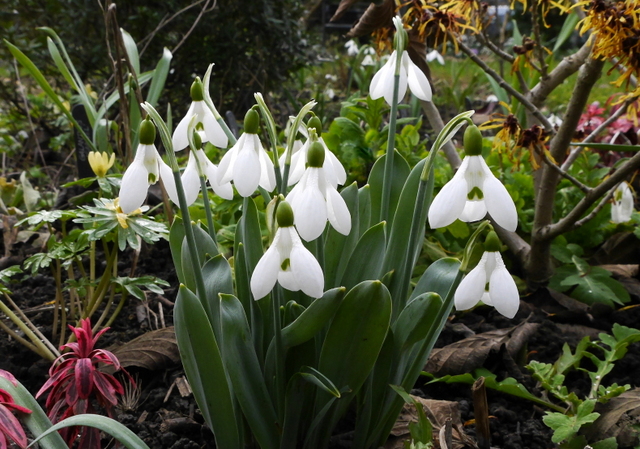 New ‘B and B Duncan’ (Irish snowdrop, G. elwesii): late-blooming cultivar of the giant snowdrop, G. elwesii, with large, rounded outer segments held out like spoons on long claws; it grows prolifically and is especially prized for its beautiful scent; originally from well known Irish garden designer Helen Dillon, it was evaluated for over 25 years at Altamont Gardens in County Carlow, Ireland, and introduced at the 2024 Annual Irish Snowdrop Gala; named for Brian Duncan, an RHS and American Daffodil Society award-winning daffodil breeder, and his wife Betty; $65 sold out
.
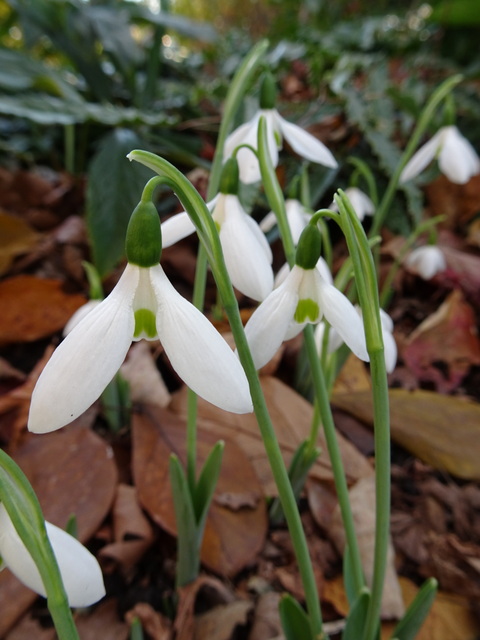 ‘Barnes’ (fall-blooming snowdrop, G. elwesii var. monostictus Hiemalis Group): lovely, fall-flowering (October/November here) cultivar of the giant snowdrop with well-formed outer segments and a heart-shaped mark on the inners; considered by many to be the earliest blooming and best of the Hiemalis Group, it is dependable and vigorous; the name ‘Barnes’ originates from E.P. Barnes, a surgeon in Northampton, who selected an early-flowering form of G. elwesii and sent it to Oliver Wyatt, possibly in 1928; after 1973, a group of snowdrops labeled ‘Barnes’ was discovered at Wyatt’s home in Suffolk; page 19 in Some More Snowdrops by Anne Repnow; RHS AGM; $45 sold out
.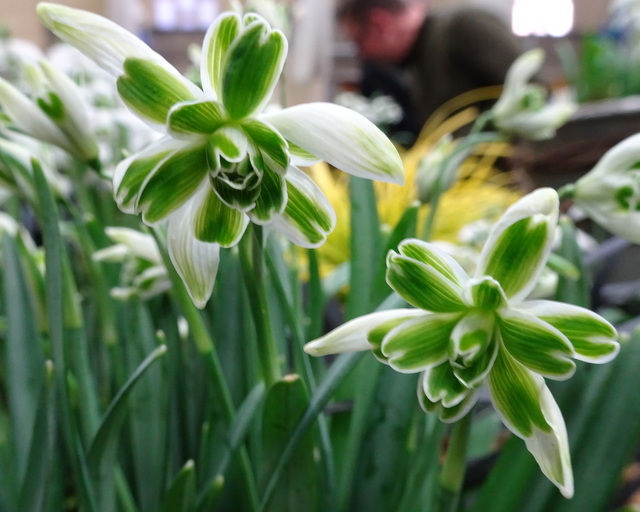 ‘Blewbury Tart’ (unique double snowdrop, G. nivalis): outstanding and distinctive outward-facing double snowdrop with three narrow outer segments clasping the inner dark green tart-like rosette; multiplies rapidly; another amazing discovery (and his earliest) by international snowdrop expert Alan Street in a churchyard in his hometown of Blewbury, Oxfordshire, in 1975; our stock came from the old Heronswood Nursery in Kingston, WA; page 23 in Some More Snowdrops by Anne Repnow; #25 on UK Popularity List; $35 sold out
.
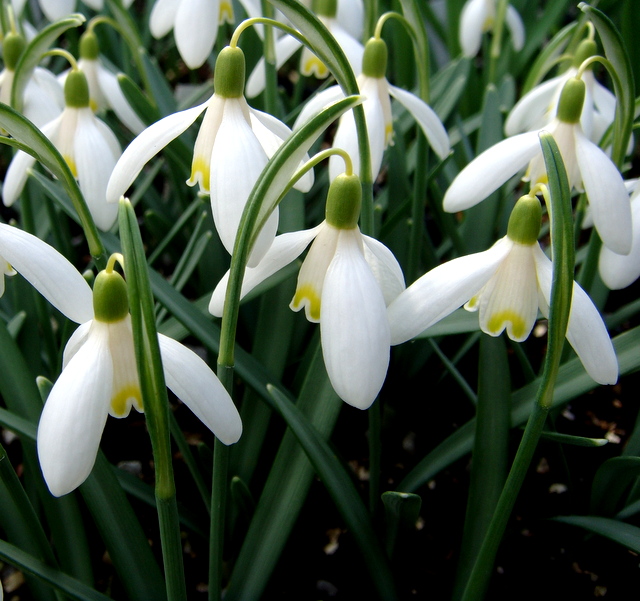 ‘Blonde Inge’ (yellow snowdrop, G. nivalis): this is the first snowdrop to have yellow markings on its inner segments while the ovary (the cap above the petal-like segments) remains green—a very beautiful combination; vigorous snowdrop that grows rapidly to form an impressive clump; emerges green and turns yellow with sunlight, a so-called ‘color change snowdrop’; found by Nicholas Topp in 1977 in a cemetery near Cologne, Germany, and introduced to the UK in 1993; the name comes from the lyrics of a German foxtrot; $45 sold out
.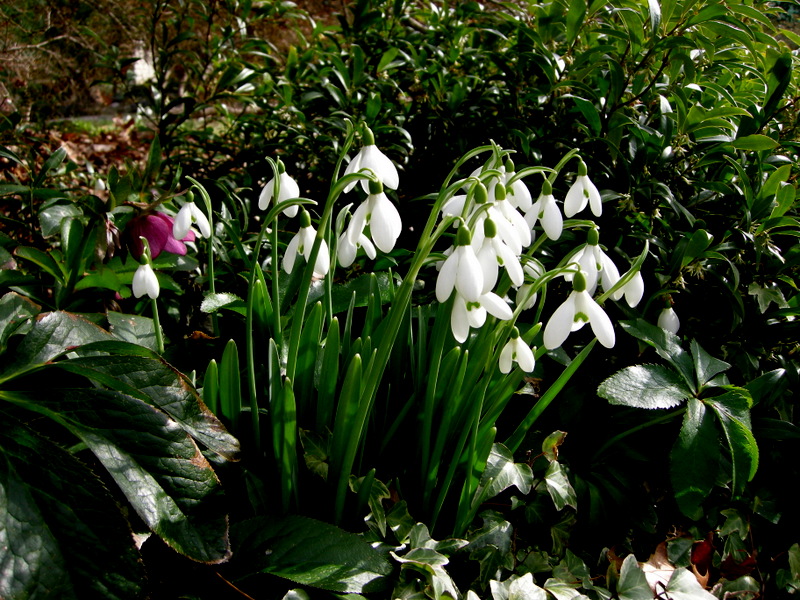 ‘Brenda Troyle’ (classic single snowdrop): When bulb expert Charles Cresson gives winter garden tours, ‘Brenda Troyle’ is always one of the most complimented snowdrops; attendees admire the well-proportioned, rounded flowers with large, flared and cupped outer segments; ‘Brenda Troyle’ is also renowned for its strong fragrance of honey and its garden vigor; #24 on UK Popularity List; 2 for $35 (normally $25 each,1 order is 2 plants) sold out
.
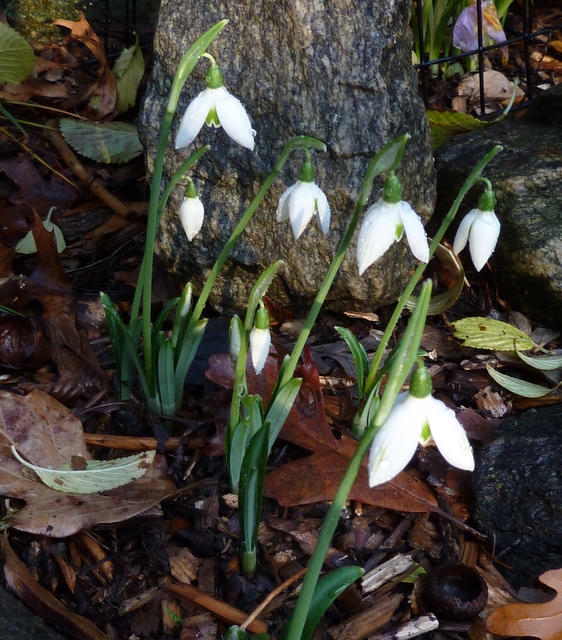 ‘Cambridge’ (fall-flowering snowdrop, G. reginae-olgae subsp. reginae-olgae): a particularly robust selection of the fall-flowering species G. reginae-olgae with thick-textured, pointed, and ridged outer segments; its substantial flowers bloom in our area in late October when its leaves are just emerging; collected on the island of Corfu and given to the Cambridge Botanic Garden in the early 1960s, it was first named and exhibited in 1989; these plants originated from stock given to Charles Cresson in 2000 by John Grimshaw; $49 sold out
.
 New ‘Clare Blakeway-Phillips’ (classic single snowdrop, G. plicatus hybrid): large, rounded outer segments, an almost fully green inner mark, and a shiny, bright lime-green ovary (cap above bloom) make the flower distinct; its splayed, very glaucous leaves perfectly display this vigorous and floriferous snowdrop; collected from the Herfordshire garden of Angela Marchant in the early 1970s by snowdrop enthusiast Reverend Richard Blakeway-Phillips and named after his daughter, it received an RHS Award of Merit in 1976; our stock, as verified by beloved snowdrop expert Alan Street, originated from the garden of Veronica Cross not far from her well known “island”; $52 sold out
.


‘Colossus’ (classic single snowdrop, G. plicatus): planted for its large flowers, tall stature, and robust growth; features the beautiful, pleated, glaucous leaves of the Crimean snowdrop, Galanthus plicatus; early blooming, sometimes by Christmas in my garden (left photo above 12/23/15); selected in 1982 by Lady Carolyn Elwes at Colesbourne Park (right photo above), which is the source of my stock, and named by Phil Cornish in 1999; #14 on UK Popularity List; $49 sold out
.
 ‘Diggory’ (unique single snowdrop, G. plicatus): Though uncommon, this is a snowdrop I would recognize anywhere for its pear-shaped, balloon-like flowers, heavily quilted texture, and large green inner mark visible even when the flower is closed; ‘Diggory’s’ unique look is further enhanced by the elegant pleated leaves characteristic of the Crimean snowdrop, G. plicatus; the snowdrop cultivar most often requested by my customers; found in 1993 by Richard Hobbs and Rosie Steele in a naturalized population of Crimean snowdrops in Norfolk, England, and named for Rosie’s son; page 29 in Some Snowdrops by Anne Repnow; RHS AGM, #4 on UK Popularity List; $79 sold out
. New ‘Elfenkind’ (December blooming hybrid snowdrop): means elfin child and refers to the adorable, clearly visible, elf-like face peeking out from between the outer segments; when the plant is settled the outer segments have green tips; it is a prolific multiplier and easy to grow, blooming around the New Year—mine bloomed on December 19 in 2024; discovered in a batch of bulk Galanthus elwesii in 2018; $65 one per customer sold out
.
 New ‘Frank Lebsa’ (October-blooming, G. elwesii var. monostictus Hiemalis Group): could be the earliest blooming member of the Hiemalis Group in my garden, starting right after G. reginae-olgae; gorgeous markings with the inner dark green mark covering more than half the segment and a bold, lighter green patch on the outer segments; discovered in 1999 by Elisabeth Lebsa in a pot of giant snowdrops at the Dresden flower market and named by her son, snowdrop expert Jörg Lebsa, for his brother; page 40 of Some Snowdrops by Anne Repnow; $85 one per customer sold out
.


‘Franz Josef’ (rare and unique double snowdrop, G. elwesii): eye-catching, very large and full double flowers with inner segments tightly packed to bursting; narrow outer segments with bold green tips fully expose the deep emerald green cross on the inners; this neat and handsome double is a cultivar of the giant snowdrop, G. elwesii, discovered by Michael Dreisvogt in a Munich Park in 1999 and named for a Bavarian politician; page 52 in Some More Snowdrops by Anne Repnow; $75 sold out
. ‘George Elwes’ (classic single snowdrop): Snowdrops names ‘George Elwes’ the “finest” G. elwesii x G. plicatus hybrid, earning this praise because it is a tall and upright snowdrop with large flowers; the long, elegant outer segments compliment perfectly the fully green inner segments; I especially like the extended, curved spathe encircling the ovary (see photo); selected in 1979 by my dear friend Lady Carolyn Elwes at Colesbourne Park and named after her son; $59 sold out
.


‘Godfrey Owen’ (unique six-petaled snowdrop, G. elwesii): one of my top ten favorites with its rare configuration of six longer outer segments and six shorter inner segments—it looks like a snowflake; inner markings are somewhat variable with two small dots at the apex sometimes joined to two smaller dots at the base; an elegant snowdrop that performs well in the garden while standing out from the crowd without a label; discovered in Shrewsbury around 1996 in a population of typical G. elwesii by renowned English galanthophile Margaret Owen and named for her husband; page 44 in Some Snowdrops by Anne Repnow; RHS AGM; $52 sold out
.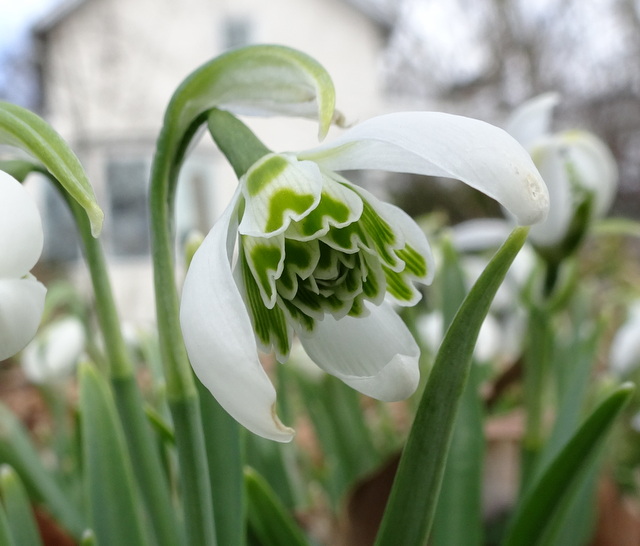 ‘Heffalump’ (unique double snowdrop): a beautiful, full, and neat double whose inner segments and bright green markings are clearly visible because the three outer segments are quite slender; easy and vigorous, one of my favorites!: famous galanthophile Primrose Warburg found it in her garden at South Hayes and named it for her husband whose nickname was Heffalump after the character in A.A. Milne’s Winnie the Pooh; $45 sold out
.
 ‘Jessica’ (green-tipped snowdrop, G. elwesii): prominent green lines on very large, bowl-shaped outer segments combined with the highly visible, darker green mark on the inners make for a desirable and striking snowdrop; when I was fortunate enough to view hundreds of blooming snowdrops in a collector’s greenhouse, ‘Jessica’ was in the handful that really stood out; Snowdrops ranks it “among the finest green-tipped clones of G. elwesii“; found by well known snowdrop explorer Phil Cornish in 1997 near Wroxall, Warwickshire—he considered it so special that he named it for his wife; $65 sold out
.


‘Lady Beatrix Stanley’ (classic & unique double snowdrop): a very dignified, unique, and vigorous double snowdrop with an elegant, tightly packed inner rosette and a distinctive mark split into two dots; grown by Lady Beatrix Stanley (1877-1944) at Sibbertoft Manor in Northhamptonshire, England, and named for her in 1981 by British snowdrop expert Richard Nutt; page 64 in Some Snowdrops by Anne Repnow; RHS AGM; #13 on UK Popularity List; $29 sold out
.


New ‘Lord Lieutenant’ (unique single snowdrop, G. plicatus): big, rounded flowers and the beautiful, pleated leaves characteristic of G. plicatus; easily recognizable because the blooms are held at a sharp angle by the short pedicel (flower stem), looking like they are standing at attention; attractive, bold, dark green, X mark on the inner segments; selected by our dear friend Lady Carolyn Elwes at Colesbourne Park, the magnificent snowdrop destination in England where the right photo was taken; named it in 1999 for her husband Sir Henry Elwes’s long-standing position as the Queen’s representative in Gloucestershire or Lord Lieutenant; page 66 of Some Snowdrops by Anne Repnow; $59 one per customer sold out
.
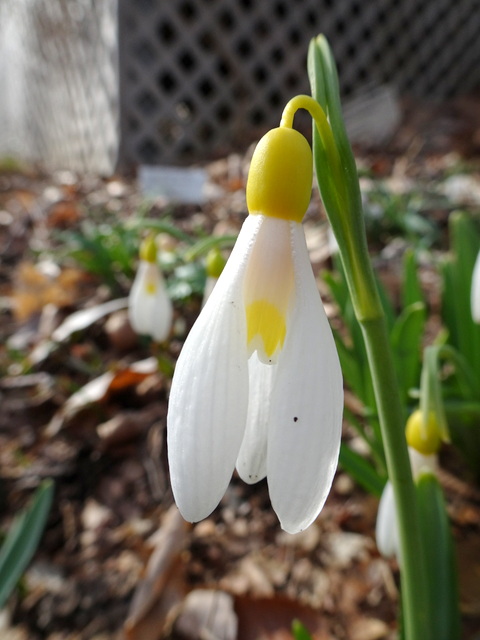 Madelaine’ (yellow snowdrop, G. plicatus): a Crimean snowdrop similar in looks to ‘Wendy’s Gold’ but with an especially ethereal yellow that glows in the late winter sunlight; in our garden, it thrives in an open, sloping, east-facing location, sunnier and drier than most spots where we grow snowdrops; found in a group of Scottish snowdrops in 2002 by Joe Sharman of Monksilver Nursery in Cambridge; my favorite and most vigorous yellow (‘Treasure Island’ is in the running though!); page 73 in Some More Snowdrops by Anne Repnow; $82 sold out
. ‘Magnet’ (classic single snowdrop): descriptions of ‘Magnet’, my favorite classic snowdrop, are a joy to read, and I can see why after having it in my garden; the stems of the large, sweetly scented flowers are long and thin causing them to sway in the slightest breeze and setting ‘Magnet’ apart from all other snowdrops (no magnifying glass needed); selected in the 1880s, it may have been named ‘Magnet’ after the child’s fishing game with magnets and sticks; Snowdrops says it defines garden-worthiness and is a mainstay of snowdrop collections throughout the world; RHS AGM; #2 on UK Popularity List; $25 sold out
. ‘Modern Art’ (green-tipped, hybrid snowdrop): green shading at the base and bold streaking on the tip of the outer segments puts ‘Modern Art’ in the elite virescent snowdrop group; the unusually shaped, large, green mark almost covering the inner segments is also quite attractive; its very vertical appearance caused by the upward pointing spathe and downward pointing outer segments is quite distinctive; discovered and named in 1959 by renowned plantsman EB Anderson; page 71 in Some Snowdrops by Anne Repnow; $55 sold out
.
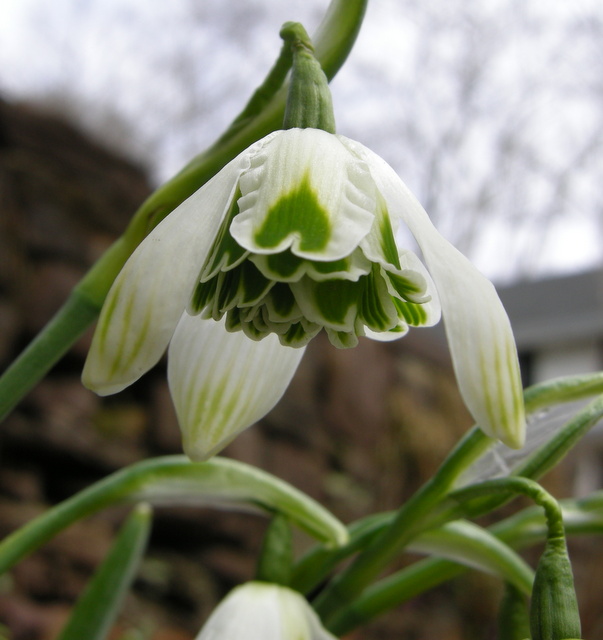 ‘Ophelia’ ex Carolyn’s Shade Gardens (Greatorex double snowdrop): ‘Ophelia’ is the best snowdrop in the series of doubles selected by Heyrick Greatorex; vigorous and early with rounded, tightly double flowers and a very prominent, broad, dark green u-shaped marking at the base of the inner segments; often produces a second flower stem, making it quite long-blooming; these plants are a very large-flowered, superior form given to me many years ago by a customer; $35 sold out
.
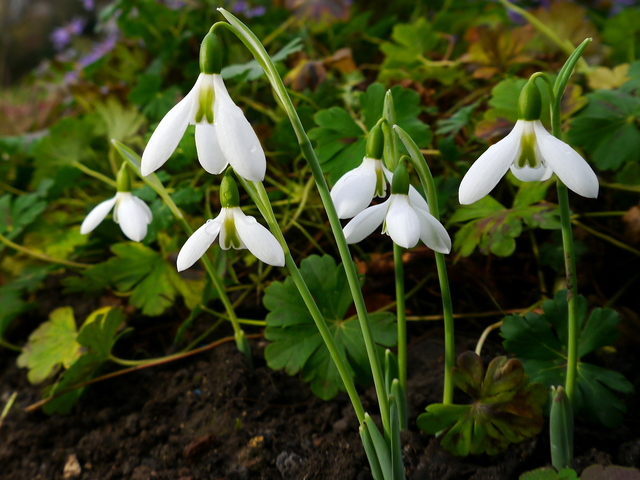 New ‘Peter Gatehouse’ (October blooming snowdrop, G. elwesii Hiemalis Group): fall-bloooming, cultivar of the giant snowdrop, Galanthus elwesii; easy to recognize for its elegant, large flowers featuring a distinctive olive green X lightening towards the base on its inner segments and its long, shapely outers; blooms in mid-October here in southeastern Pennsylvania; prolific bloomer with an upright habit and a spathe (the bud sheath) that points upwards; given to Washfield Nursery in England in 1994 by Peter Gatehouse and named after him; page 87 of Some More Snowdrops by Anne Repnow; $55 sold out
.


New ‘Prestwood White’ (poculiform snowdrop, Galanthus nivalis): tiny and rare poculiform snowdrop meaning all the segments are outers and approximately the same length; pure white with an occasional inconspicuous green dot on the inners; carefree and vigorous grower; found by the famous horticulturist John Massey of Ashwood Nurseries in Kingswinford, England, about four miles along the canal from the nursery in a wild population of G. nivalis; originally called “John’s Poculiformis” but later named and sold as ‘Prestwood White’; John Massey is the source of our stock; $62 sold out
. ‘Rodmarton’ (double snowdrop): eye-catching, very large and full double flowers on tall, vigorous, and easy-to-grow plants; the outer segments have faint green lines at the tip, while the inners are boldly marked in deep emerald green; this early flowering double resulted from a cross between G. plicatus and G. nivalis ‘Flore Pleno’; selected by Mary Biddulph in her garden Rodmarton Manor in the village of Rodmaton, Gloucestershire, the home of many fine snowdrops; $52 sold out
. ‘S. Arnott’ (classic single snowdrop): large rounded, sweetly scented flowers with a heart-shaped green mark, pictured here at Colesbourne Park, the famous snowdrop destination in England; Snowdrops describes ‘S. Arnott’ as the “classic snowdrop…. a first-class garden plant with an unquestionable constitution, admired by everyone,” a must have for snowdrop collections; considered the ‘desert island snowdrop’—the snowdrop that collectors would choose if they were limited to one—and named for an early galanthophile, Samuel Arnott (1852-1930); RHS AGM, #1 on UK Popularity List; $29 sold out
.
 ‘Starling’ (double snowdrop): the short pedicel (stem) causes the flower to face outward giving a direct view of its cluster of star-like, dark green inner segments, hence star-ling, meaning young star; the outer segments are long, pointed, and boat-shaped, and the overall effect is lovely; Alan Street thought ‘Starling’ bloomed longer than any other snowdrop, and I find it one of the most distinctly different snowdrops to be selected in years; found by Alan in the famous copse at Avon Bulbs in the early 2000s and may be a cross between G. elwesii and ‘Hill Poe’; page 102 in Some More Snowdrops by Anne Repnow; $49 sold out
.
 New ‘Treasure Island’ (yellow snowdrop, G. x valentinei): probably the largest flowered yellow snowdrop available in the trade—it is impossible to overstate how impressive and beautiful this magnificent snowdrop is; Matt Bishop calls it the “finest of all hybrid yellow snowdrops”; huge flowers with stunning yellow marks held well above elegant leaves; famous galanthophile Veronica Cross in Herefordshire had an area of her garden called Treasure Island where she told everyone she “kept her treasures”; many fine snowdrops originated there so I can only surmise that this was the best as it received the name ‘Treasure Island’; discovered by Veronica Cross and introduced in 2015; for me it is very vigorous, producing five flowers the year after I planted it (can’t promise this will happen in your garden!); page 104 of Some More Snowdrop by Anne Repnow; $159 one per customer sold out
.
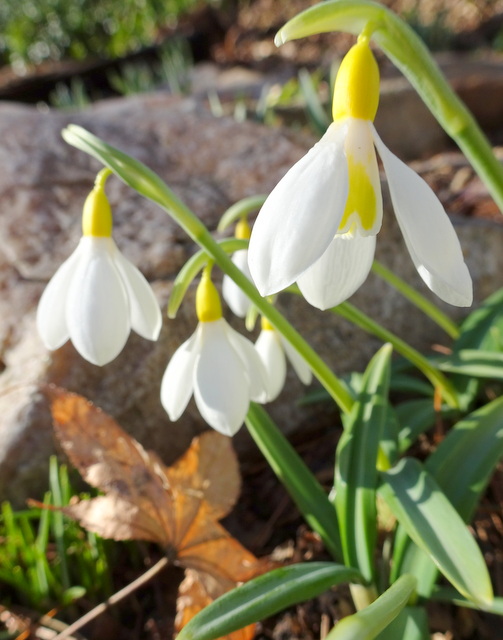 ‘Wendy’s Gold’ (yellow snowdrop, G. plicatus): this superb and vigorous snowdrop with large and vivid yellow markings is one of the most sought after cultivars; beautiful, wide pleated leaves with folded margins make a lovely backdrop for the striking flowers; originally discovered in 1974 by Bill Clark, Warden of the UK National Trust property Wandlebury Ring, an Iron Age Fort near Cambridge; in 1985, Joe Sharman’s mother saw the snowdrop at Wandlebury, and Joe (Monksilver Nursery) encouraged Clark to pursue introduction; the tale of this snowdrop as related to me by the wonderful Bill Clark is fascinating but suffice it to say here that it was introduced and named for Bill Clark’s wife; page 99 in Some Snowdrops by Anne Repnow; #5 on UK Popularity List; $82 sold out
.


‘Xmas’ (December-blooming snowdrop, G. elwesii): a gardener at the U.S. Botanic Garden in Washington, DC, selected an unusual X-marked and early-blooming plant from a bed of ordinary G. elwesii; many gardeners later, I received a plant and named it ‘Xmas’; its very large and beautiful flowers with long, bowl-shaped outer segments have a distinct X mark on the inner segments; better yet, in the Delaware Valley, they bloom in December when there is often a lull in snowdrop activity, lasting at least two weeks longer than ‘Three Ships’; plants multiply vigorously and reach an impressive height and stature once established—snowdrop expert Alan Street was impressed; thanks to Holly Schmizu, former Executive Director of the USBG, for helping me bring to light this American selection from an iconic American garden; introduced in 2015 by Carolyn’s Shade Gardens; $55 Sold Out
.
* * * * *
ERANTHIS (winter aconite)
Like the Leucojum vernum below, I purchased dried eranthis bulbs many times and even soaked them overnight with no success in the garden. It wasn’t until a wonderful friend brought me some growing plants that I was finally successful. The two cultivars listed below came from seeds given to me by friends—it took over five years for them to reach flowering size.
Cultural Information: Growing instructions are the same as for snowdrops (see Cultural Information at the beginning), but plant them 2″ deep instead of 3″. The plants multiply well, but you can also collect the seeds when ripe and sprinkle them to increase your patch. The winter aconites below come true from seed but, as mentioned, take five years to reach flowering size. The plants offered here are flowering size and in bloom depending on when they are shipped. Great companion for snowdrops!
.
 Eranthis hyemalis ‘Orange Glow’ (rare golden orange winter aconite cultivar): very similar to the species (technically the leaves are finer and the flowers are a little bigger, Cilicus Group) but with orange tinted golden flowers; discovered in 1950 by Jens Ole Pedersen in a nursery in Holbæk, Denmark; I received seeds from Germany in 2014 and flowering began in 2019, now I finally have enough to sell; $42 sold out
.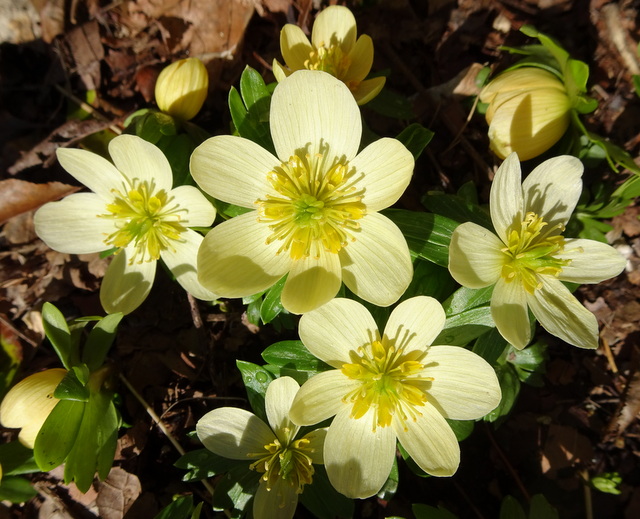 Eranthis hyemalis ‘Schwefelglanz’ (rare pale yellow winter aconite cultivar): very similar to the species but with pastel yellow flowers; a very useful color in the winter garden, looks spectacular paired with yellow snowdrops or witchhazel; selected by Ruth Treff of Darmstadt, Germany, in 1985 and introduced in 1997; these plants are from seeds received from Germany in 2014 and first flowered in 2019; $42 sold out
.
* * * * *
LEUCOJUM (spring snowflake)
The only way to introduce the rarely available spring snowflake into your garden successfully is as a growing plant—all my attempts with dried bulbs have failed—so I am excited to offer this wonderful relative of the snowdrop to my customers available ‘in the green’.
Cultural Information: Growing instructions are the same as for snowdrops (see Cultural Information at the beginning), but they can also grow in very moist situations.
.
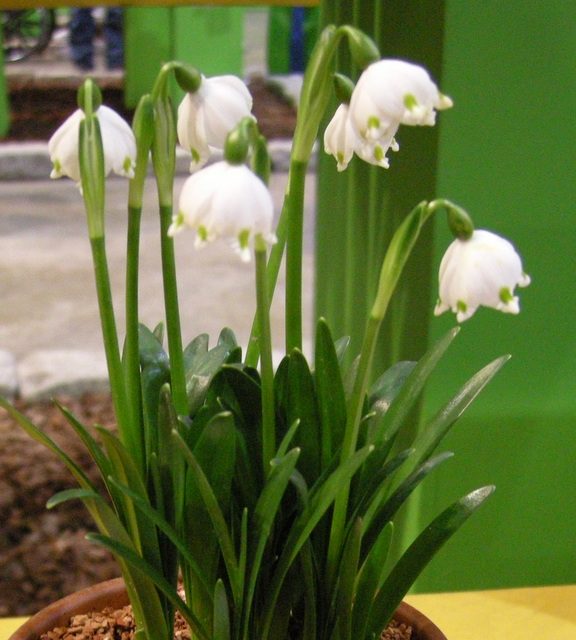 Leucojum vernum var. vernum (spring snowflake): Spring snowflake’s six petals (technically tepals) are of equal length, forming nodding white bells with green to greenish yellow tips, which are quite beautiful set off by the bright green strap-like leaves; it blooms in March and April and grows to 10 to 12″ tall in part to deciduous shade in average to moist soil, even thriving in clay; naturalizes readily in shady woodland conditions and on the March bank at Winterthur; RHS AGM; $39 sold out
.


New Leucojum vernum var. carpathicum (rare Carpathian snowflake): one of two established varieties of Leucojum vernum, the spring snowflake, but with yellow spots instead of the typical green; Carpathian snowflakes have six tepals (petals) of equal length forming a nodding white bell with beautiful yellow marks on the tips; bloom in March and April, naturalizing well and producing attractive, bright green strap-like leaves; they grow naturally in the Carpathian Mountains, which spread from Austria in an arc to Romania; $59 sold out
.
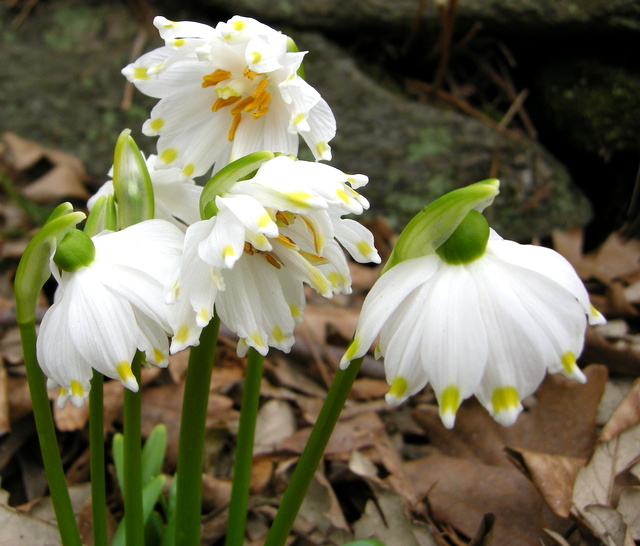 Leucojum vernum var. carpathicum ‘Gertrude Wister’ (semi-double spring snowflake): ‘Gertrude Wister’ is so unique because spring snowflakes normally have 6 petals, while this form averages 12 or more suggesting that two flowers have fused together to form one large and attractive, semi-double flower; discovered by well known bulb authority Gertrude Wister in the 1960s in her garden on the Swarthmore College campus, she gave it to bulb expert Charles Cresson who named it after her; introduced in 2014 by Carolyn’s Shade Gardens; $79 sold out
* * * * *
Instructions for ordering are at the beginning of the catalogue.