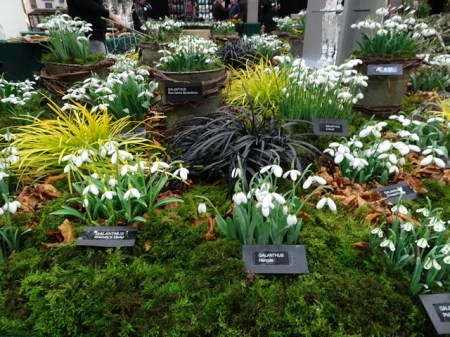
Archive for Alan Street

New Snowdrops (& an Eranthis) for 2025: Part Two

Posted in bulbs for shade, snowdrops, winter, winter garden, winter interest with tags , , , , , , , , , , , , , , , on November 24, 2024 by Carolyn @ Carolyns Shade Gardens


‘Richard Bish’ is a very rare and stunning double winter aconite or Eranthis (photo taken 2/14/24 at Carolyn’s Shade Gardens).

Seeing the emerging green tips appearing in almost every snowdrop location in our garden never gets old.  The anticipation and promise that those tips represent propel me happily through fall garden chores.  In addition, ‘Standing Tall’ celebrated the emerging season by coming into bloom three weeks early on November 17.

This is part two of a two-part post on the new snowdrops plus a leucojum and an eranthis that will be offered in our 2025 Snowdrop Catalogue.  To read part one, click here.  The catalogue will be posted on our website on December 1, 2024, and details will be sent to our snowdrop customer list shortly.  Meanwhile, this post will give everyone an advance look (sorry, no advance orders) at four more special, new snowdrops and an eranthis/winter aconite that will be available for order in December.  Enjoy!

Nursery News:  Carolyn’s Shade Gardens is a retail nursery located in Bryn Mawr, PA, specializing in showy, colorful, and unusual plants for shade.  The only plants that we ship are snowdrops within the US.  For catalogues and announcements of local events, please send your full name, mailing address, and cell number to carolyn@carolynsshadegardens.com and indicate whether you are interested in snowdrops.  Click here to get to the home page of our website for catalogues and information about our nursery and to subscribe to our blog.

.

When ‘Richard Bish’s’ flowers are closed you can clearly see the green stripes on the outer petals.

Eranthis hyemalis ‘Richard Bish’ is a very rare, winter aconite cultivar.  It has beautiful double-flowers with elegant rounded petals (technically sepals) as you can see from the photo at the beginning of this post.  The inner petals are a warm bright yellow while the outer row has intriguing green stripes (see photo directly above).  I received seeds from bulb expert Charles Cresson in 2018 and finally have a few to sell.  ‘Richard Bish’ was found by Karl Kristensen in the English garden of Richard Bish and named in his honor.

.

‘Dodo Norton has one of the largest snowdrop flowers.

‘Dodo Norton’ has huge, thickly textured flowers on long pedicels (the stem attaching the flower to the scape) but short scapes—it looks like a very dwarf ‘Mighty Atom.  The cupped outer segments are puckered to produce a seersucker effect, and the inners are boldly marked.  It was found in the famous ditch in the former garden of well known horticulturist Margery Fish at East Lambrook Manor and named in 2000 for a previous owner of the property.  Anne Repnow profiles it on page 31 of Some Snowdrops.

.

‘Kildare’, a virescent or green-shaded snowdrop, is one of the most elegant flowers in my garden (photos taken 3/6/22 at Carolyn’s Shade Gardens).

‘Kildare’ is an unmistakable snowdrop with long, tapering and pointed outer segments marked with lovely pale green lines extending halfway to the base (top of the flower).  The inner segments are almost entirely bright green fading toward the base.  It is usually one of the last snowdrops to bloom in my garden.

.

‘Kildare’ has gorgeous markings.

‘Kildare is a hybrid cross discovered by the famous snowdrop hunters Ruby and David Baker in 1995 when they got lost in County Kildare on a snowdrop tour of Ireland.  Anne Repnow profiles it on page 63 of Some Snowdrops.

.

‘Bitter Lemons’ joins an august group of rare inverse poculiform yellow snowdrops (photo from RB Snowdrops and used with the permission of Richard Bashford).

‘Bitter Lemons’ is one of the few yellow snowdrops, along with ‘Midas’ and ‘Golden Fleece’, that has yellow markings on both the inner and outer segments.  It is a so-called ‘color change’ snowdrop like ‘Blonde Inge’, opening a lemony lime and aging to lemony yellow.  It blooms one month before ‘Midas’.  International snowdrop expert Alan Street discovered ‘Bitter Lemons’ in the famous copse at Avon Bulbs and introduced it in 2019.  Anne Repnow profiles it on page 21 of Some Snowdrops

.

‘White Swan displays its elegant double flowers against the bright blue winter sky at Carolyn’s Shade Gardens.

‘White Swan’ is a large and elegant double snowdrop originated prior to 1954 by English plantsman Heyrick Greatorex who crossed Galanthus plicatus, with the double common snowdrop, Galanthus nivalis ‘Flore Pleno’.  It is the rarest of the resulting doubles with the largest flowers on very tall stems.  It increases vigorously in my garden, especially with regular division.

.

We were very impressed by the large stand of ‘White Swan’ at Thenford Arboretum in England where the wonderful Emma Thick gave us a private tour.  You can see its bold mark and neat and regular flower.

.

Blogs are a lot more fun for everyone, especially the writer, when readers leave comments.  If you are reading this post in the WordPress email (white background), just reply to the email to comment.  If you are reading the post on my blog (black background, recommended for better viewing), scroll down to the end of the page to the box where it says “Leave a Reply” and start typing—-it’s easy!

Carolyn

.

Note: Every word that appears in orange on my blog is a link that you can click for more information. If you want to return to my blog’s homepage to access the sidebar information (catalogues, previous articles, etc.) or to subscribe to my blog, just click here.

New Snowdrops (& a Leucojum) for 2025: Part One

Posted in bulbs for shade, snowdrops, winter garden, winter interest with tags , , , , , , , , , , , , , , , , , , , , , on November 20, 2024 by Carolyn @ Carolyns Shade Gardens

‘Dryad Gold Sovereign’ features beautiful yellow markings and a huge flower.

To access our current snowdrop catalogue, click here.

I have been importing snowdrops from England and growing them on for my customers since 2013.  My imports for catalogue sales always focused on the more well known and readily available cultivars, but every year I purchased single bulbs of a small number of rare and expensive cultivars to add to my own collection.  I am excited that this year I will finally be selling limited quantities of those choice snowdrops.

As usual, the 2025 Snowdrop Catalogue will be posted on our website in the first half of December.  Meanwhile, this post will give everyone an advance look (sorry, no advance orders) at some of the special, new snowdrops that will be available in the catalogue.  Enjoy!

Nursery News:  Carolyn’s Shade Gardens is a retail nursery located in Bryn Mawr, PA, specializing in showy, colorful, and unusual plants for shade.  The only plants that we ship are snowdrops within the US.  For catalogues and announcements of local events, please send your full name, mailing address, and cell number to carolyn@carolynsshadegardens.com and indicate whether you are also interested in snowdrops.  Click here to get to the home page of our website for catalogues and information about our nursery and to subscribe to our blog.
.

‘Dryad Gold Sovereign’, pictured at the top, resulted from an intentional cross of ‘Wendy’s Gold’ with G. nivalis “Sandersii Group” by expert hybridizer Anne Wright from Dryad Nursery in England.  Her aim was to produce vigorous snowdrops with bright yellow flowers.  After 12 years of rigorous assessment, Anne selected the yellow snowdrops in the Dryad Gold Group.

‘Dryad Gold Sovereign’ is recognized as the best in the group and, in Anne’s own words, it is “quite simply my favourite of all the snowdrops I grow.”  It is early-blooming, before most yellows, and produces large (twice the size of ‘Primrose Warburg’), well-proportioned, long-lasting, bright yellow flowers on sturdy, upright stems.  It performs exceptionally well in the garden.  You can read Anne’s own description of this elegant snowdrop by clicking here. You can also read Anne Repnow’s profile on page 41 of Some More Snowdrops.

.
‘Herzilien’ holds its outer segments wide so you can easily see the little green hearts on the inners.

‘Herzilien’ means little sweetheart in German, referring to the marking on the inner segments and its tendency to bloom on Valentine’s Day.  The long claws joining the outer segments to the narrow, conical ovary hold the outer segments wide to display the perfectly shaped heart on the inner segments.  On page 55 of Some Snowdrops, Anne Repnow praises this snowdrop for its “astonishing vigor and floriferousness”.  It was selected around 2000 by Arthur Winkelmann after growing on seeds he received from a gardening friend in Russia.

.‘Joe Spotted’ is easily recognized in the garden.

‘Joe Spotted’ has beautiful markings and an excellent habit.   The outer segments feature a large olive green diamond, while the inner segments have a big, dark green apical mark and two pale green ‘eyes’ at the base—as I have said before, I am a sucker for a snowdrop with a face!  The gorgeously marked flowers are enhanced by the snowdrop’s tall, upright habit. 

.

When the flowers are closed, you especially notice the very upright habit, here at Glen Chantry nursery in England.

‘Joe Spotted’ is praised as a strong grower and very fine plant.  Spotted in galanthophile David Bromley’s Shropshire garden by Joe Sharman, the owner of Monksilver Nursery in England.  You can read Anne Repnow’s profile on page 60 in Some Snowdrops.

.

‘Titania’ features large, double flowers on upright, vigorous plants, pictured here at Colesbourne Park in England, which is the source of my stock.

‘Titania’ is a beautiful and elegant double snowdrop originated prior to 1954 by English plantsman Heyrick Greatorex as part of his famous series of large and vigorous doubles named after characters in Shakespeare’s plays—here the Queen of the Fairies in A Midsummer Night’s Dream.  ‘Titania’ is one of the rarer but more easily identifiable Greatorex doubles due to its neat and regular double flowers with a prominent horseshoe mark at the base of the inner segments.  As you can see from the photo, it multiplies well in the garden.

.

‘Ingrid Bauer’s’ large flowers have a very unique inner mark.

‘Ingrid Bauer’ has large and elegantly shaped flowers with the long outer segments held wide to reveal a very unique X mark on the inner segments.  The mark is composed of a pale green upper part and a very dark green lower part, making this snowdrop instantly recognizable in the garden.  An easy and prolific snowdrop selected by the famous German galanthophile Rudi Bauer and named for his wife in 2007.

.

‘Null Punkte’ is the whitest spring snowflake.

‘Null Punkte’ is a spring snowflake or Leucojum vernum.  Its name means zero points in German and refers to the lack of green or yellow on the tips of the petals (tepals), making it the whitest spring snowflake.  The flowers in my garden occasionally have a slight bit of green (see far left of left flower in photo), but they get whiter as they mature. 

.

‘Null Punkte’ growing under a shrub in Charles Cresson’s Swarthmore, Pennsylvania, garden.

‘Null Punkte’ is a good grower but not fast—I received a plant in 2013 and just have a few to sell now.  It was discovered in a park in Schleswig-Holstein, Germany, and named by Ingo Kaczmarek as a reference to point-giving in the Eurovision Song Contest.  For more information about Leucojum with descriptions and photos of many cultivars, click here.

.

Look for another post profiling more new snowdrops (& an Eranthis) soon.

.

Blogs are a lot more fun for everyone, especially the writer, when readers leave comments.  If you are reading the post in the WordPress email (white background), just reply to the email to comment.  If you are reading the post on my blog (black background, better formatting), scroll down to the end of the page to the box where it says “Leave a Reply” and start typing—-it’s easy!

Carolyn

.

Note: Every word that appears in orange on my blog is a link that you can click for more information. If you want to return to my blog’s homepage to access the sidebar information (catalogues, previous articles, etc.) or to subscribe to my blog, just click here.

My Favorite Snowdrops

Posted in bulbs for shade, snowdrops, winter, winter garden, winter interest with tags , , , , , , , , , , , , , , , , , , , , on January 2, 2024 by Carolyn @ Carolyns Shade Gardens

‘Trumps’: has it all—vigorous, unique, beautiful; selected at the nursery of the wonderful John Morley, more here.

For our current Snowdrop Catalogue, click hereIf you want to be notified about the next snowdrop catalogue, please send your full name, mailing address, and cell number to carolyn@carolynsshadegardens.com, and specify snowdrops.

I have considered writing this post many times, but always felt that picking my favorite snowdrop is like choosing your favorite child.  I always tell my three sons that I don’t have a favorite—I love them all equally but for different reasons.  However among my snowdrops, I do have favorites, and I know the reasons, which I will share with you along with photos of some of my most-liked Galanthus.

Nursery News:  Carolyn’s Shade Gardens is a retail nursery located in Bryn Mawr, PA, specializing in showy, colorful, and unusual plants for shade.  The only plants that we ship are snowdrops within the US.  For catalogues and announcements of local events, please send your full name, mailing address, and cell number to carolyn@carolynsshadegardens.com and indicate whether you are interested in snowdrops.  Click here to get to the home page of our website for catalogues and information about our nursery and to subscribe to our blog.

.

Diggory’:  totally unique flower; beautiful pleated leaves with a stripe; multiplies well.

I have a modest collection of snowdrops by English standards and even compared to many of the larger American collections.  This is intentional—although I have an extensive wish list in my head, I want to build my collection slowly and knowledgeably.  This allows time to care for the existing collection, including dividing, fertilizing, mulching, relocating, disease prevention, record keeping, and labeling, etc.    My current project is to have each snowdrop in two locations in my garden: an heir and a spare so-to-speak.

. ‘Viridapice’:  tall and elegant with beautiful green markings; vigorous and easy.

When Snowdrops: A Monograph of Cultivated Galanthus by Bishop, Davis, and Grimshaw was reprinted in 2006, it covered around 500 named snowdrop cultivars.  It was possible, if you could locate them, to have all these snowdrops in your garden.  When the second edition of A Gardener’s Guide to Snowdrops by Freda Cox was published in 2019, it described 2,400 named cultivars.  Freda Cox’s companion volume More Snowdrops, issued in May 2023, profiles over 700 additional cultivars.  It is not possible, nor do I think it is advisable, to collect all the existing snowdrops.  A collector must be discriminating.  To help you with your choices, I have come up with six reasons why I prize a snowdrop over many other contenders.

.

‘Godfrey Owen’: absolutely unique and beautiful from above and below; vigorous and early-blooming; selected by famous galanthophile Margaret Owen and named for her husband.

First, the flower must be beautiful and/or interesting.  Among other characteristics I consider is the flower shape and size.  I am partial to large, rounded flowers with spoon shaped outer segments.  Although I generally prefer single flowers, in peonies for example, I also like double snowdrops—although many galanthophiles look down on them—because they bloom longer and, for me, are more often purely beautiful.  The texture of the outer segments varies, and I am drawn to thick texture, which means the flower lasts longer, and I favor a pleated look.  The color and placement of the marks is very important.  I am partial to yellow snowdrops, dark emerald green marks, two-tone inner marks, and marks on the outer segments, especially virescent (green-shaded) outers.

.‘Madelaine’: the best and most vigorous yellow in my garden—there are many yellows but a lot do not multiply well; selected by the famous Joe Sharman at Monksilver Nursery.

Second, every snowdrop on my favorites list must be easy to grow and must multiply vigorously in my garden wherever I decide to place it.  I do not treasure a snowdrop that doesn’t grow well for me no matter how much it thrives in other people’s gardens.  And there will be no coddling of a picky snowdrop no matter how beautiful or rare.  I will, however, move a snowdrop to a new location if it is doing OK but not thriving, if I have time….

.‘Fly Fishing’: the name chosen by my sadly missed friend Alan Street is perfect; would recognize it anywhere; very vigorous.

Third, I must be able to recognize a favorite snowdrop without looking at the label, not only in my garden but in larger collections.  This is a tall order in a field of over 3,100 named cultivars, many of which have very little to set them apart.  However, through a combination of flower shape and markings, leaves, habit, and bloom time, all my favorites stand out.

.‘Xmas’: large, elegant, upright flowers with gracefully curved spathes and wide blue leaves; early bloomer; selected at the US Botanic Garden and named by Carolyn’s Shade Gardens.

Fourth, the habit and individual parts of a snowdrop can add greatly to its desirability.  I am partial to tall and upright snowdrops with large flowers held well above the leaves.  My favorite leaves are wide and generally blue, which is characteristic of Galanthus elwesii, but I also love the elegantly pleated foliage of Galanthus plicatus, especially if there is a pronounced white stripe. Ovaries (the little cap above the flower) with pleasing and compatible shapes, spathes (the bud covering) that arch elegantly over the flower, and pedicels (the flower stem) that hold the flower just so can add to a snowdrop’s allure.

.

‘Potter’s Prelude’: large and elegant flowers; best November-blooming snowdrop in my garden; named by my dear friend Charles Cresson.

Fifth, I lean toward snowdrops that bloom early, especially in November and December.  As I describe more fully in my post December Blooming Snowdrops, click here to read, this is the time of year when I can most appreciate flowers of all kinds and not many snowdrops bloom then so the ones that do stand out.  I would consider this a purely personal consideration, but it is a preference shared by the majority of my customers so I have to think it is widespread.

.

‘Lady Beatrix Stanley’:  beautiful; no other double has the two elegant dots on the inner segments; multiplies rapidly; grown by Lady Beatrix Stanley (1877-1944) at Sibbertoft Manor.

Finally, I love snowdrops with history behind them: who selected them, where, why?  Unlike most other plants, we can often answer these questions about snowdrops and our relation to the plant is the richer for this added dimension.  That is why I always provide snowdrop history in my catalogue and in blog post profiles of new snowdrops.

.

The snowdrops pictured above were chosen from the favorites in my collection because they illustrate the points I am making and meet most if not all of my criteria.  However, I grow many more snowdrops that qualify as favorites and could have been included here.  And I grow others that don’t make the grade, usually due to their slow growth, but which I still treasure.

.

Blogs are a lot more fun for everyone, especially the writer, when readers leave comments.  Scroll down to the end of the page to the box where it says “Leave a Reply” and start typing—-it’s easy!

Carolyn

.

Note: Every word that appears in orange on my blog is a link that you can click for more information. If you want to return to my blog’s homepage to access the sidebar information (catalogues, previous articles, etc.) or to subscribe to my blog, just click here.

December Blooming Snowdrops

Posted in bulbs for shade, snowdrops, winter, winter garden, winter interest with tags , , , , , , , , , , , , , , , , on December 20, 2023 by Carolyn @ Carolyns Shade Gardens

Galanthus bursanus, the newest snowdrop species, blooms earliest in my collection

For our current Snowdrop Catalogue, click hereIf you want to be notified about the next snowdrop catalogue, please send your full name, mailing address, and cell number to carolyn@carolynsshadegardens.com, and specify snowdrops.

I really appreciate the appearance of the earliest blooming snowdrops in my garden: Galanthus bursanus and Galanthus reginae-olgae and their cultivars, at the beginning of October.  They remind me that the much treasured snowdrop season is starting and will continue through March.  However, there are so many other plants performing then with flowers, berries, fall color, and seeds, not to mention all the work we need to do to get our garden ready for winter that I only notice the October snowdrops in passing.  Likewise, although I love all my snowdrops that begin flowering in January, which is the early main season for snowdrops, there are so many of them. 

It is the snowdrops that reach their peak in December that I most treasure.  I realized that I have never done a post featuring those snowdrops so here I will talk about my four favorites plus a peak at a potential newcomer.

Nursery News:  Carolyn’s Shade Gardens is a retail nursery located in Bryn Mawr, PA, specializing in showy, colorful, and unusual plants for shade.  The only plants that we ship are snowdrops within the US.  For catalogues and announcements of local events, please send your full name, mailing address, and cell number to carolyn@carolynsshadegardens.com and indicate whether you are interested in snowdrops.  Click here to get to the home page of our website for catalogues and information about our nursery and to subscribe to our blog.

.

fall-blooming snowdrop 'Potter's Prelude' at Carolyn's Shade Gardens‘Potter’s Prelude’ is an elegant snowdrop with a bold mark.

‘Potter’s Prelude’, a cultivar of Galanthus elwesii var. monostictus, is a rare American snowdrop selected in the 1960s by Jack Potter, the former Curator of the Scott Arboretum in Swarthmore, Pennsylvania.  It was registered in 2004 by noted regional horticulturist Charles Cresson and introduced in 2010 by Carolyn’s Shade Gardens.

.

This clump of ‘Potter’s Prelude’ is ready for dividing.

‘Potter’s Prelude’ is a free-flowering and vigorous snowdrop with wide, recurving, very blue leaves.  Its flowers are large and elegantly formed with a bold dark green mark.  They begin blooming in mid-November and continue into January with December being their peak.  Be aware that some snowdrops sold under this name are inferior seedlings.  International snowdrop expert Alan Street told me that the flowers shown in the top photo, which he much admired, are far superior to the form circulating in England.  ‘Potter’s Prelude’ is featured 0n page 77 of Anne Repnow’s book Some Snowdrops, an excellent reference guide.

.

‘Standing Tall’

‘Standing Tall’ is an American Galanthus elwesii cultivar selected and named by Charles Cresson.  It was introduced for sale for the first time by Carolyn’s Shade Gardens in 2013.  Although it can reach 12″ tall, it was primarily named for its very upright habit and unmistakable, commanding presence in the garden.  Its name also reflects its ability to flop down when its cold like all snowdrops do and stand back up perfectly straight as if nothing has happened.  My unofficial observations also indicate that it remains upright at much lower temperatures than other snowdrops.

.

‘Standing Tall’ in the Cresson garden.

‘Standing Tall is at its peak right now, although my main patch was divided last year and does not look as full as most years.  However, like all the snowdrops featured in this post, it is very vigorous and will quickly fill back in and look like Charles Cresson’s patch above.  It starts blooming between the the last week of November and the first week of December and continues through January.  It is featured on Page 83 of Anne Repnow’s excellent book Some Snowdrops.

.. ‘Three Ships’ has the very full outer segments sometimes associated with G. plicatus.

‘Three Ships’ is a cultivar of Galanthus plicatus selected in England by the famous John Morley of North Green Snowdrops in Suffolk in 1984.  He named it for the Christmas carol “I Saw Three Ships”.

.

‘Three Ships’ multiplies well in my garden.

‘Three Ships’ is quite striking in the garden and cannot be confused with any other snowdrop. It has an ethereal glow that is whiter than white and large, bowl-like and deeply puckered outer segments with a wide and attractive green mark on the inner segments.  It blooms reliably about a week after ‘Standing Tall’ in mid-December, although I find that this is location specific.  One of my three patches bloomed on November 26 this year, while the other two followed the regular pattern.

.

‘Xmas’ has large and elegant flowers with gracefully curved spathes.

‘Xmas’ was selected many years ago by a gardener at the US National Botanic Garden from a patch of normal Galanthus elwesii growing in the parking lot and passed through many hands to me.  Carolyn’s Shade Gardens first introduced it for sale as ‘Xmas’ in 2016.

.

‘Xmas’ is at least twice the height of ‘Three Ships’, which blooms at the same time.  It is shown here with the flowers of fall-blooming camellia ‘Winter’s Joy’.

‘Xmas’ has very large and beautiful flowers with long, bowl-shaped outer segments and a distinct X mark on the inner segments.  In the Delaware Valley, it usually comes into flower in mid-December at the same time as ‘Three Ships’ and is fully out around the holidays when there is often a lull in snowdrop activity.  It also goes on blooming for about a month after ‘Three Ships’ as its flowers are particularly durable and long lasting.   When my dear friend Alan Street saw this photo he was impressed with the height and fullness of the flowers.  Unfortunately, he never saw ‘Xmas’ in person as it makes quite an impression when you see it in the garden.

. A new December-blooming Galanthus elwesii under consideration.

I have been observing this snowdrop, which appeared in my oldest patch of straight species Galanthus elwesii.  It blooms in late November/early December and has lovely, full flowers with a solid green inner mark from apex to base.  It will take more years of observation and building up stock before I decide if it merits a name.  Meanwhile, I would be grateful if any reader would let me know if they have seen a similar snowdrop blooming in early December.

.

The inner segments are entirely green.

.

The snowdrops profiled here are some of my favorites.  I have lined my front walk with large clumps so I can enjoy them every day this time of year, and all four appear in more than the two standard locations in my garden (one for display and one for back up).  In fact, ‘Xmas’ is in six locations, ‘Potter’s Prelude’ is in five, while the others are in three.

.

Blogs are a lot more fun for everyone, especially the writer, when readers leave comments.  Scroll down to the end of the page to the box where it says “Leave a Reply” and start typing—-it’s easy!

Carolyn

.

Note: Every word that appears in orange on my blog is a link that you can click for more information. If you want to return to my blog’s homepage to access the sidebar information (catalogues, previous articles, etc.) or to subscribe to my blog, just click here.

New Snowdrops for 2024: Part Three

Posted in bulbs for shade, snowdrops, winter, winter garden, winter interest with tags , , , , , , , , , , , , , , , on December 3, 2023 by Carolyn @ Carolyns Shade Gardens

It was this view of a sweeping stand of ‘Marjorie Brown’ at Glen Chantry Nursery in England that made it a must for my collection (photo taken at Glen Chantry 2/2023).

Our current snowdrop catalogue is on line here.

Seeing the emerging green tips appearing in almost every snowdrop location in our garden never gets old.  The anticipation and promise that those tips represent propel me happily through fall garden chores.  In addition, ‘Three Ships’ celebrated the emerging season by “sailing in” almost three weeks early on November 26.

This is part three of a three-part post on the new snowdrops that will be offered in our 2024 Snowdrop Catalogue.  To read part one, click here, and part two, click here.  As usual, the catalogue will be posted on our website in the first half of December.  Meanwhile, this post will give everyone an advance look (sorry, no advance orders) at five more special, new snowdrops that will be available for order in December.  Enjoy!

Nursery News:  Carolyn’s Shade Gardens is a retail nursery located in Bryn Mawr, PA, specializing in showy, colorful, and unusual plants for shade.  The only plants that we ship are snowdrops within the US.  For catalogues and announcements of local events, please send your full name, mailing address, and cell number to carolyn@carolynsshadegardens.com and indicate whether you are interested in snowdrops.  Click here to get to the home page of our website for catalogues and information about our nursery and to subscribe to our blog.
.

‘Marjorie Brown’ has large, well-rounded flowers and very blue leaves (photo taken at Winterthur 3/2019).

‘Marjorie Brown’ is a G. elwesii cultivar with clear white, large, round, well-proportioned flowers.  It is late-blooming and vigorous, forming large bulbs.  Its leaves are wide with a very distinct bluish tinge compared to other giant snowdrops, G. elwesii.  According to Snowdrops, which calls it “highly garden-worthy” (Snowdrops: A Monograph of Cultivated Galanthus by Matt Bishop, Aaron Davis, and John Grimshaw Timber Press 2006, page 176), Ruby Baker found it in a flower arrangement entered in a March 1987 flower show.  The exhibitor, Marjorie Brown, told Ruby that the flowers were from bulbs purchased in 1958 from Van Tubergen.

.

‘Fenstead End’ in a snowstorm at North Green Snowdrops (taken 2/2017)

I first saw ‘Fenstead End’ when I visited John Morely at North Green Snowdrops during a snowstorm in February 2017.  I admired its long, tapering outer segments and bright green coloring, but the flowers weren’t open (to read about that visit, click here).

. ‘Fenstead End’ puts a smile on my face every time I see it (photo taken at the RHS Show 2/2017)

Later that month, at the RHS Show in London, I saw it with its outer segments raised up to reveal the lovely, white-edged bright green skirt underneath (see the flower in the upper left of the photo for the full effect).  I had to have it for my collection!  It was discovered by Charles Grey-Wilson in Fenstead End, Suffolk, in 1987.

.

‘Trumpolute’ is rarely offered for sale (photo taken at Anglesey Abbey 2/2023).

‘Trumpolute’ has large, boldly marked and gracefully recurved outer segments.  The bright green outer markings are repeated on the inner segments.  It has the classic pagoda shape of an inverse poculiform snowdrop (all the segments are inners) and resulted from a cross between G. plicatus ‘Trym’ and G. elwesii.  It was found at North Green Snowdrops in 2001 by John Morley who gave it its name because the flowers look like ‘Trumps’ and the leaves are convolute (wrapped around each other, also called supervolute).

.

‘Big Eyes’ peer out from between the outer segments (photo from Chris Ireland-Jones).

‘Big Eyes’ has beautifully rounded, balloon-like flowers, reminding me of one of my favorites, ‘Melanie Broughton’.  Because the outers are spoon-shaped with long claws (claws attach the outer segments to the ovary), you can see the two large eyes looking out with the down-turned mouth below. 

.

‘Big Eyes’ (photo from Chris Ireland-Jones)

When my dear friend Alan Street saw it for the first time he proclaimed “what big eyes you have!” just like Little Red Riding Hood and so it was named.  It is a hybrid between the common snowdrop, G. nivalis, and the Crimean snowdrop, G. plicatus.  Alan found it in a naturalized colony in Berkshire around 2000.

.‘John Gray’s’ outstandingly large flowers (photo taken at Colesbourne Park 2/2023)

‘John Gray’ is a member of the much sought after Mighty Atom Group.  It has huge flowers on widely arching pedicels (flower stems), causing it to dip towards the ground.  This very beautiful, early-blooming snowdrop was selected by famous horticulturist E.B. Anderson for its “outstandingly large flower” from the Benhall, Suffolk, garden of John Gray in 1951 (Seven Years or Sixty Years of Gardening by E.B. Anderson, Joseph Publishing 1973).  It was first offered for sale by the Giant Snowdrop Company in 1967.  It is one of only 28 snowdrops to receive an Award of Garden Merit from the Royal Horticultural Society. 

.

Blogs are a lot more fun for everyone, especially the writer, when readers leave comments.  Scroll down to the end of the page to the box where it says “Leave a Reply” and start typing—-it’s easy!

Carolyn

.

Note: Every word that appears in orange on my blog is a link that you can click for more information. If you want to return to my blog’s homepage to access the sidebar information (catalogues, previous articles, etc.) or to subscribe to my blog, just click here.

New Snowdrops for 2024: Part Two

Posted in bulbs for shade, snowdrops, winter, winter garden, winter interest with tags , , , , , , , , , , , , , , , on November 28, 2023 by Carolyn @ Carolyns Shade Gardens

One of ‘Miss Prissy’s’ best attributes is that the flowers face outward so you can see the inner segments (all photos in this post were taken by me at Avon Bulbs 2/2023).

Our current snowdrop catalogue is on line here.

I travel to England to view snowdrops in person rather than relying on on line photos to choose what to offer in my catalogue.  I am looking not only for snowdrops that stand out for their markings, but also for cultivars that are vigorous and beautiful whether rare or not.  All the snowdrops in this post stood out when I photographed the hundreds of snowdrops in bloom at Avon Bulbs in Somerset last February!

This is part two of a three-part post on the new snowdrops that will be offered in our 2024 Snowdrop Catalogue.  To read part one, click here.  As usual, the catalogue will be posted on our website in the first half of December.  Meanwhile, this post will give everyone an advance look (sorry, no advance orders) at five more special, new snowdrops that will be available for order in December.  Enjoy!

Nursery News:  Carolyn’s Shade Gardens is a retail nursery located in Bryn Mawr, PA, specializing in showy, colorful, and unusual plants for shade.  The only plants that we ship are snowdrops within the US.  For catalogues and announcements of local events, please send your full name, mailing address, and cell number to carolyn@carolynsshadegardens.com and indicate whether you are interested in snowdrops.  Click here to get to the home page of our website for catalogues and information about our nursery and to subscribe to our blog.
.

‘Miss Prissy’ also has green tips on the outers.

‘Miss Prissy’ is a very neat, outward-facing double snowdrop.  The outer segments have prominent green tips and the inner segments are very green with sparkling white edges.  It is a hybrid between the giant snowdrop, G. elwesii, and the double common snowdrop, G. nivalis ‘Flore Pleno’, selected by Stephen Jackson and registered in 2017.  It is named after the spinster hen in the Looney Tunes cartoon.

. ‘Excelsis’

‘Excelsis’ arrived in my garden by mistake last year, and I was so taken with it that I ordered more so I could include it in the catalogue this year.  International snowdrop expert Alan Street discovered ‘Excelsis’ as a seedling at Avon Bulbs in 2015.  He was immediately dazzled by its long, shapely outer segments and the heavenly marked green inners, hence the name.  A dark green V extending from the apex joins a lighter green V from the base, creating an elegant and unusual mark.

.

‘Excelsis’ has an unusual inner mark.

.

‘Big Bertha’ is rarely offered for sale.

‘Big Bertha’ has huge, round flowers with dark green tips on the ballooning outer segments and a prominent dark green mark on the inners.  Its habit is distinct with widely splayed leaves at ground level and very upright flowers and scapes (flower stalks).  All these characteristics together make it instantly recognizable in the garden. 

.

‘Big Bertha’s habit is very upright.

‘Big Bertha’ is a vigorous cultivar of the giant snowdrop, G. elwesii.  It was discovered around 2004  in a bulk purchase of bulbs by Gill Richardson, Manor Farm, Lincolnshire.

.

‘Washfield Colesbourne’

I saw ‘Washfield Colesbourne’ for the first time at Avon Bulbs during my February 2023 trip to England and had to have it.  As Gardens Illustrated says in its January 2023 article, click here, it is tall and majestic with large flowers and incredibly dark green inner segments.  The snowdrop bible calls it a “magnificent hybrid” (Snowdrops: A Monograph of Cultivated Galanthus by Matt Bishop, Aaron Davis, and John Grimshaw Timber Press 2006, page 266).

.

A group of ‘Washfield Colesbourne’ really stands out.

‘Washfield Colesbourne’ was found at Elizabeth Strangman’s famous Washfield Nursery in Hawkhurst, Kent.  It is a seedling of the snowdrop ‘Colesbourne’, and much more vigorous than its parent.

.

‘Ivy Cottage Corporal’

‘Ivy Cottage Corporal’ has long, elegant, and full outer segments.  The inners are boldly marked with the double chevron insignia found on a British corporal’s uniform.  It is a vigorous hybrid and produces many flowers.  Probably a G. nivalis x G. plicatus cross, it was discovered by Michael Broadhurst in 2013.

.

‘Ivy Cottage Corporal’ displays its well-shaped outer segments.

‘Ivy Cottage Corporal’ is highly praised in my favorite snowdrop reference Some Snowdrops: A Photographic Ramble by Anne Repnow.  It was also profiled as a favorite in the January 2023 Gardens Illustrated article on snowdrops in Margery Fish’s garden at East Lambrook Manor, click here.  The photos in the article are taken by photographer Jason Ingram and are quite lovely—be sure and scroll down to see ‘Ivy Cottage Corporal’.

.

Look for Part Three of this post profiling five more new snowdrops from our 2024 catalogue soon.

.

Blogs are a lot more fun for everyone, especially the writer, when readers leave comments.  Scroll down to the end of the page to the box where it says “Leave a Reply” and start typing—-it’s easy!

Carolyn

.

Note: Every word that appears in orange on my blog is a link that you can click for more information. If you want to return to my blog’s homepage to access the sidebar information (catalogues, previous articles, etc.) or to subscribe to my blog, just click here.
New Snowdrops for 2024: Part One

Posted in bulbs for shade, snowdrops, winter garden, winter interest with tags , , , , , , , , , , , , , , , , , , , , , , , , on November 26, 2023 by Carolyn @ Carolyns Shade Gardens

‘Anglesey Candlelight’ has an orange glow on its inner segments (photo by Chris Ireland-Jones, thanks Chris!).

Our current snowdrop catalogue is on line here.

Fall color has been glorious this year and continues on for a little while longer.  It has also been a great fall for working outside, and I have been busily cleaning out around the snowdrops and checking their stakes and their labeling.  Each clump then gets a small layer of compost and a thin covering of ground leaves.  They will also be fertilized with liquid fish emulsion.  It has been very dry but that thankfully ended this week with 2″ of much needed rain.

As usual, the 2024 Snowdrop Catalogue will be posted on our website in the first half of December.  Meanwhile, this post will give everyone an advance look (sorry, no advance orders) at some of the special, new snowdrops that will be available in the catalogue.  Enjoy!

Nursery News:  Carolyn’s Shade Gardens is a retail nursery located in Bryn Mawr, PA, specializing in showy, colorful, and unusual plants for shade.  The only plants that we ship are snowdrops within the US.  For catalogues and announcements of local events, please send your full name, mailing address, and cell number to carolyn@carolynsshadegardens.com and indicate whether you are interested in snowdrops.  Click here to get to the home page of our website for catalogues and information about our nursery and to subscribe to our blog.
.

In February, Michael and I toured Anglesey Abbey, near Cambridge, England.  It is one of the most visited National Trust properties, and I can see why after experiencing its beautiful winter gardens.  We were given a private tour by Senior Gardener David Jordan, the resident snowdrop expert among other responsibilities.  The tour included the extensive snowdrop collection where we saw ‘Anglesey Candlelight’ for the first time.

.

I am a sucker for a snowdrop with a face and find ‘Anglesey Candlelight’ charming (photo taken at Avon Bulbs 2/2023).

‘Anglesey Candlelight’ is a very rare snowdrop with large flowers featuring an expressive face and a tinge of pale orange on its inner segments.  Its leaves are a light, lettuce green.  David Jordan spotted it about ten years ago while out looking for unique snowdrops among the thousands of specimens in the garden.  He noticed its light green leaves and moved it to the collection area for evaluation.  When it flowered the next year, he saw the orange shade on the inners and “named it ‘Anglesey Candlelight’ as it described the flower and the way it glows like a candle.” 

If you go to England during snowdrop time, I highly recommend visiting Anglesey Abbey, click here.  Be aware that to see the specialist collection of rare snowdrops, you need to book a guided tour far in advance.  Thank you, David, for one of the best snowdrop days we have ever spent!

.‘Phil Cornish’ is one of the most highly praised inverse poculiform snowdrops (photo from Anne Repnow, Some Snowdrops, thanks Anne!)

In 2017, we had the great pleasure of visiting the well known galanthophile and discoverer of many fine snowdrops Phil Cornish in his Gloucestershire garden.  The much sought after snowdrop ‘Phil Cornish’ was discovered there in 2002.  It is an inverse poculiform (all the segments are inners) with the classic pagoda shape and G. plicatus ‘Trym’ as a parent.   This upright and early-flowering selection has stunning markings: almost all green inner segments and outers heavily marked with a dark green heart at the apex and a paler green patch at the base.

.

‘Phil Cornish’ has the classic pagoda shape (photo from Anne Repnow, Some Snowdrops).

‘Phil Cornish’ is highly praised in my favorite snowdrop reference Some Snowdrops: A Photographic Ramble by Anne Repnow.  It was also profiled as a favorite in the January 2023 Gardens Illustrated article on snowdrops in Margery Fish’s garden at East Lambrook Manor, click here, (scroll to the end for their top picks).  The photos in the article are taken by photographer Jason Ingram and are quite lovely—be sure and scroll down to see ‘Phil Cornish’.

.

‘Daphne’s Scissors’ sparkles in the winter sun (photo taken at Carolyn’s Shade Gardens 3/2015).

‘Daphne’s Scissors’ is a cultivar of G. elwesii, the giant snowdrop.  English galanthophile Daphne Chappell found it in her garden in Chedworth, Gloucestershire, in 1985.  She named it for the scissor-shaped inner segment mark.  It is an upright plant with large flowers.  Evidently, the presence of the bold green mark on the outer segments varies in England, but on my plants it is present every year (see photo below).

.

‘Daphne’s Scissors’ thrives in my garden (photo taken at Carolyn’s Shade Gardens 2/2023).

.

‘Franz Josef’ shows its strong, emerald green markings (photo taken at Carolyn’s Shade Gardens 2/2022).

‘Franz Josef’ has eye-catching, very large and full double flowers with inner segments tightly packed to bursting.  The narrow outer segments with bold green tips fully expose the deep emerald green cross on the inners.  Its elongated and cone-shaped ovary (the cap above the flower) is also unusual.

.

Avon Bulbs featured ‘Franz Josef’ in its gold-medal winning display at the RHS Show in February 2017 (photo taken at RHS Show 2/2017)

This neat and handsome double is a cultivar of the giant snowdrop, G. elwesii.  Although it was discovered by Michael Dreisvogt in a Munich Park in 1999, it remains rare.

.

‘George Elwes’ (photo taken at Carolyn’s Shade Gardens 2/2023)

The snowdrop bible names ‘George Elwes’ the “finest” G. elwesii x G. plicatus hybrid (Snowdrops: A Monograph of Cultivated Galanthus by Matt Bishop, Aaron Davis, and John Grimshaw Timber Press 2006, page 265).  It earns this praise because it is a tall and upright snowdrop with large flowers.  The long, elegant outer segments compliment perfectly the fully green inner segments.  I especially like the long curved spathe encircling the ovary (the cap above the flower).  It was selected in 1979 by my dear friend Carolyn Elwes at Colesbourne Park and named after her late son.

.

Snowdrop expert Alan Street considered ‘George Elwes’ special enough to give it a prominent location in the Avon Bulbs display at the February 2018 Royal Horticultural Society Show (photo taken at the RHS Show 2/2018).

.

Look for another post profiling more new snowdrops soon.

.

Blogs are a lot more fun for everyone, especially the writer, when readers leave comments.  Scroll down to the end of the page to the box where it says “Leave a Reply” and start typing—-it’s easy!

Carolyn

.

Note: Every word that appears in orange on my blog is a link that you can click for more information. If you want to return to my blog’s homepage to access the sidebar information (catalogues, previous articles, etc.) or to subscribe to my blog, just click here.

A Day in the Life of an Avon Bulbs Snowdrop

Posted in bulbs for shade, garden to visit, landscape design, snowdrops, winter, winter interest with tags , , , , , , , , , , , , , , , , , , , , , on March 25, 2018 by Carolyn @ Carolyns Shade Gardens

Our current snowdrop catalogue is on line here.

 ‘EA Bowles’ was one of the very lucky snowdrops selected to be displayed on the Avon Bulbs table at the Royal Horticultural Society (RHS) show in February.

My post Exceptional Snowdrops and Gardens: England February 2018 gave an overview of our recent trip to England.  To read it, click here.  As promised, I am going to focus more closely on some of the venues that Michael and I visited:  in this post, Avon Bulbs, one of the most respected snowdrop nurseries in the world.

We visited Avon in February 2018 and 2017 and were very privileged to be hosted during both visits by Alan Street, known through out the snowdrop world for the exceptional snowdrops he has selected and named.  During both years, we also helped set up the Avon exhibit at the Royal Horticultural Society Early Spring Plant Show in London.  For a post about our 2017 RHS experience, read Snowdrops at the Royal Horticultural Society Spring Show by clicking here.

Nursery News:  Carolyn’s Shade Gardens is a retail nursery located in Bryn Mawr, PA, specializing in showy, colorful, and unusual plants for shade.  The only plants that we ship are snowdrops within the US.  For catalogues and announcements of local events, please send your full name, mailing address, and cell number to carolyn@carolynsshadegardens.com and indicate whether you are interested in snowdrops.  Click here to get to the home page of our website for catalogues and information about our nursery and to subscribe to our blog.
.

Alan Street standing among Avon’s free range planting of ‘S. Arnott’.  Alan advises snowdrop enthusiasts to let the flower heads form and drop their seeds, as you never know what you will get.

.

Avon has a beautiful woodland full of “wild” snowdrops plus other winter-blooming plants like the winter aconites, hardy cyclamens, and spring snowflakes in this photo.  They are all allowed to mix and match, which has resulted in some amazing snowdrop selections.

The title of this post should really be “years in the life of an Avon snowdrop” because that’s how long it takes to evaluate, select, and name a truly special snowdrop.  Although Avon propagates many snowdrops selected by others, it has introduced some wonderful cultivars found in the woods on its own property.  I thought you might like to see where and how this happens plus which lucky snowdrops go on to the RHS show.

.

A swarm of ‘Wasp’ in the Avon woods.  The woods are filled with masses of named snowdrops, and, when the bees go from flower to flower, magic happens.

.

A group of seedlings in the Avon woods from the very prolific ‘Trym’, results in….

.….’Trympostor’, first shown by Avon in 2011.

.

The appearance of a seedling like this one pairing a green ovary (the cap at the top of the flower) and yellow markings on the outer segments results in….

.

….the introduction in fall of 2017 of ‘Midas’, a spectacular and ground-breaking snowdrop with yellow on the outers as well as the inners and….

.

…., to be introduced in the near future by Avon, ‘Bitter Lemons’.

.

‘Sprite’, another Avon introduction, seen in the Avon woods.

.

‘Phantom’ also originated at Avon.

.

An un-named seedling currently under evaluation by Avon.

.

Also under evaluation, a yellow ‘Trym’ from Olive Mason.

.

If a woodland seedling looks promising, it might be potted up for further evaluation in the greenhouse.

.

All snowdrops are eventually chipped and grown on in pots in Avon’s production beds.

.

Avon production beds

.

Alan Street holds one of the pots from the production beds.  In it is ‘Alan’s Treat’, which he selected and named—a play on his own name.

.

Plants chosen for sale in the catalogue are individually potted, usually in their third year after chipping, and stored in this cold frame.

.

From the cold frame, they are loaded onto carts for transportation to the various snowdrop venues where Avon sells its plants.  This particular cart is bound for the RHS show and contains snowdrops for sale on the bottom shelf and snowdrops for display on the top two shelves.

.

The Avon truck arrives in London, and Michael helps Alan unload the carts and roll them into Lindley Hall where the snowdrop portion of the RHS show was staged.

.

All the materials are ready for us to create the display.  Unfortunately, the Avon table was in an out-of-the-way corner with poor lighting and a terrible background for photos.  I am not sure what the RHS was thinking!

.There was a three-tier effect with four snowdrops displayed in the metal stands shown to create the upper tier.  It was very hard to get the pots to sit in the stands but perseverance paid off!

.

The middle tier featured pots raised up in attractive metal buckets wrapped in woven vines, here ‘Rosemary Burnham’, a show-stopping virescent (green) snowdrop.

.

The lowest tier pots sat on the table and were covered by leaves, here ‘George Elwes’, a stately snowdrop selected at Colesbourne Park.

.

Alan waters the display while Michael continues to level the pots in the stands.

.

The only way to get an overall photo was to take it from a balcony overlooking the table.

Some snowdrops displayed by Avon at the RHS show in addition to EA Bowles at the top:

.

‘Jade’

.

‘Gloria’, a gorgeous poculiform (all segments are outers) snowdrop.

.

‘Sprite’ is a very eye-catching snowdrop.

.

‘Veronica Cross’

.

‘Moortown’, I think this was my favorite.

.

We are so grateful to Alan Street for sharing his RHS adventure with us among many other things!

Carolyn

.

Note: Every word that appears in orange on my blog is a link that you can click for more information. If you want to return to my blog’s homepage to access the sidebar information (catalogues, previous articles, etc.) or to subscribe to my blog, just click here.

Exceptional Snowdrops and Gardens, England February 2018

Posted in bulbs for shade, flower show, Garden Tour, snowdrops, winter, winter interest with tags , , , , , , , , , , , , , , , , , , , , , , , , , , , , , , , , , , , on March 7, 2018 by Carolyn @ Carolyns Shade Gardens

Our current snowdrop catalogue is on line here.

 The best place to see snowdrops in England is Colesbourne Park in the Cotswolds.

Michael and I traveled to England during snowdrop season again this year.  We stayed with Sir Henry and Lady Carolyn Elwes at Colesbourne Park, called the greatest snowdrop destination in England.  From there we visited Evenley Wood Garden, Ronald Mackenzie at Barn Cottage, Olive Mason at Dial Park, John Massey at Ashwood Nurseries, Alan Street at Avon Bulbs, Simon Biddulph at Rodmarton Manor, and Hilary and Hugh Purkess at Welshway Cottage. 

We also helped set up the Avon Bulbs display at the Royal Horticultural Society Early Spring Plant Fair in London.  Each of these visits will eventually be a blog post, but I wanted to give you a few highlights now.

Nursery News:  Carolyn’s Shade Gardens is a retail nursery located in Bryn Mawr, PA, specializing in showy, colorful, and unusual plants for shade.  The only plants that we ship are snowdrops within the US.  For catalogues and announcements of local events, please send your full name, mailing address, and cell number to carolyn@carolynsshadegardens.com and indicate whether you are mail order only.  Click here to get to the home page of our website for catalogues and information about our nursery and to subscribe to our blog.

.

Glory-of-the-snow on the March Bank at Winterthur.

Before I get to England though, this Saturday, March 10, from 10 am to 3:30 pm, is the annual Winterthur Bank to Bend Event.  It promises to be a great time with a lecture, garden tours, and interesting vendors, including Carolyn’s Shade Gardens.  Here are the details:

Celebrate the first flowers of the year at Winterthur on Saturday, March 10, from 10 am to 3:30 pm. At 11 am, Dr. Peter Zale, Curator of Plants at Longwood Gardens,  will explore Intrinsic Beauty: Snowdrops, Choice Bulbs, and How They Enrich Gardens. From 1 to 2 pm, enjoy guided or self-guided garden tours.  Shop at the specialty sale of rare and unusual plants from Carolyn’s Shade Gardens, RareFind Nursery, and Edgewood Gardens. Garden tours and plant sale are included with admission.  To purchase tickets please call 800.448.3883.

And now for snowdrop highlights from England:

.

Leucojum vernum, spring snowflake, on a stream bank at Evenley Wood Garden.  Although snowdrops generally prefer well-drained sites, leucojum thrives in wet areas.

.One of the rarer Greatorex double snowdrops, ‘Desdemona’, at Evenley Wood.

.

One of my favorite snowdrops of the whole trip, ‘Don Armstrong’ in Ronald Mackenzie’s garden.

.

This snowdrop, also at Ronald Mackenzie’s, has been at the top of my wish list for a while, although it is supposed to be hard-to-grow, ‘Daglingworth’.

.

Michael thinks Olive Mason’s long-pediceled snowdrop, apparently a relation of ‘Fly Fishing’, should be introduced as “Deep Sea Fishing”.

.

As we walked around Dial Park, I pointed out snowdrop after snowdrop with very interesting marks and asked what it was.  Olive Mason’s response: “Oh, it’s just another ‘Trym’ seedling.”  ‘Trym’ seedlings were even growing out of the hedges and between paving stones.

.

A beautiful use of snowdrops in a stumpery in John Massey’s private garden at Ashwood Nurseries.

.

The beautiful and eBay record-setting, yellow Galanthus woronowii ‘Elizabeth Harrison’ in John Massey’s garden.  One plant sold for £725 in 2012.

.

A very pale virescent snowdrop from Andy Byfield, ‘Northern Lights’, seen at Avon Bulbs.

.

A lovely and rare new snowdrop with yellow on the outer segments to be introduced soon by Avon Bulbs as ‘Bitter Lemons’.

.

Again this year, we were privileged to be escorted around Rodmarton Manor and gardens by owner Simon Biddulph.  Rodmarton is one of the best surviving examples of the Arts and Crafts Movement with 8 acres of gardens.

.

Introduced by Simon Biddulph, ‘Rodmarton Arcturus’ is one of the most impressive snowdrops I have ever seen.

.

Another rare and beautiful snowdrop seen at Rodmarton, ‘Celia’s Double’.

.An enchanting scene from Hilary and Hugh Purkess’s garden, Welshway Cottage.

.

The best display of ‘Augustus’ I have ever seen, at Welshway Cottage.

.

Another wonderful snowdrop at Welshway where every scape produces a twin-headed flower, ‘Harewood Twin’.

.

Drifts of ‘S. Arnott’ at Colesbourne Park, the place to go to see massive quantities of snowdrops!

.

Snowdrops cover the hillside above a huge, moss-covered English oak on the shore of the naturally, bright blue Colesbourne lake.

.

‘Under Cherry Plum’ in the Avon Bulbs Royal Horticultural Society Exhibit.

.

‘Philippe Andre Meyer’ in Avon’s exhibit.

.

Such a gorgeous snowdrop and so well-named, ‘Puffin’ from Avon Bulbs.

Each of these venues deserves a post of its own, but for now, all I have time for is a sampler!

Carolyn

.

Note: Every word that appears in orange on my blog is a link that you can click for more information. If you want to return to my blog’s homepage to access the sidebar information (catalogues, previous articles, etc.) or to subscribe to my blog, just click here.
Snowdrops at the Royal Horticultural Society Spring Show

Posted in bulbs for shade, flower show, snowdrops, winter interest with tags , , , , , , , , , , , , , , , , , , on March 15, 2017 by Carolyn @ Carolyns Shade Gardens

The Royal Horticultural Society February Show at Vincent Square in London.

Our current snowdrop catalogue is on line here.

In February, Michael and I went on a two week snowdrop trip to England.  My first two posts on the trip featured cutting edge snowdrops, click here to read it, and our six day stay at Colesbourne Park, click here.  After touring the countryside, we journeyed to London to help Alan Street of Avon Bulbs, one of the most respected snowdrop sellers in the world, “moss up” for the RHS Show at Vincent Square.  When Alan invited us, we weren’t really sure what mossing up involved, but everyone said that it was quite an honor to be asked to participate.  We enjoyed every minute!

Nursery News:  Carolyn’s Shade Gardens is a retail nursery located in Bryn Mawr, PA, specializing in showy, colorful, and unusual plants for shade.  The only plants that we ship are snowdrops to the US only.  For catalogues and announcements of local events, please send your full name, mailing address, and cell number to carolyn@carolynsshadegardens.com and indicate whether you are mail order only.  Click here to get to the home page of our website for catalogues and information about our nursery and to subscribe to our blog.

.

Unfortunately, it was impossible to get one photo of the entire Avon exhibit, but this picture shows about a third of the presentation from one corner.

.

This is what we started with at about 10 am on Monday morning.

“Mossing up” is how Alan refers to setting up the Avon exhibit for the RHS Show.  Starting with the bare boards above, layer upon layer was slowly and carefully added to achieve the finished look of snowdrops displayed in a natural looking, mossy garden.  Although the snowdrops and the materials, including name tags, pieces of styrofoam, newspaper, used net bulb bags, potted plants, rustic wood, dried leaves, and the centerpiece of crystal glasses hand-etched with snowdrops, couldn’t have been better organized, it still took all day to create the masterpiece that was the display.  Here’s how we did it:

.The process started with the careful placement of the largest elements: the shelf for the crystal, the carex and mondo grass, and the metal buckets wrapped in wreaths of rustic woven vines, using thick styrofoam to elevate them.

.

Next Alan Street, Avon’s Nursery Manager and the creative genius behind the exhibit, placed each pot of snowdrops.

.

After the snowdrop pots were placed, Micky Little, Nurseryman at Avon, and my husband Michael, elevated the center of the exhibit by stuffing the spaces between the pots with balls of net bulb bags.  Next we all carefully inserted balled up newspaper between the pots along the edges to serve as a base for the moss.

.

True “mossing up” happened next as Maxine Grice, the Office Administrator at Avon, and all the rest of us surrounded the snowdrops on all four sides of the exhibit with bags and bags of moss very carefully inserted between the pots.

.

Dried leaves covered the area around the center and then lichen covered sticks were carefully added.  Only then did every pot get a label, after which the whole exhibit was reviewed for exposed edges and missing labels.  We finished around 4 pm with Michael using a pump sprayer to slowly moisten all the moss.

.

Another view of the finished exhibit.

When we were done, we had created Alan’s vision of snowdrops naturalized in a woodland setting.  It was gorgeous to behold and deservedly won a gold medal from the Royal Horticultural Society.  Here are some of the individual snowdrops that I thought were especially beautiful in the exhibit:

I have it in my collection now, but for years ‘South Hayes’ was at the top of my list.

.

‘Grave Concern’ has now migrated to the top of my must have snowdrops.

.

A classic snowdrop, ‘Mighty Atom’, with gorgeous rounded petals, my favorite look.

.

‘Trumps’, a vigorous and eye-catching flower.

.

‘Phantom’ is aptly named.

.

A new must-have, ‘Jonathan’, look at those beautiful leaves and large striking flowers.

.

‘Diggory’ is recognizable anywhere.

.

‘Alan’s Treat’ selected by Alan Street and a play on his name.

.

‘Philippe Andre Meyer’ is gorgeous.

.

Another for the acquisition list, ‘Walker Canada’, so elegant.

.

Alan sent me this photo yesterday of his newest and probably his most exciting snowdrop selection ‘Midas’, a yellow-marked snowdrop with a green ovary (the little cap) and extremely rare yellow markings on the outers.   Keep your eyes open for a record-breaking price!

Next year’s RHS Spring Show is scheduled for February 13 and 14, 2018, and we hope to be there to moss up once again.  Thank you so much to Alan, Maxine, and Micky for allowing us to participate in an unforgettable experience.
Carolyn

.

Note: Every word that appears in orange on my blog is a link that you can click for more information. If you want to return to my blog’s homepage to access the sidebar information (catalogues, previous articles, etc.) or to subscribe to my blog, just click here.