Benington Lordship is a Georgian manor house constructed in the 1700s near the ruins of a Norman castle built around 1130.
Michael and I have traveled to England many times for work and pleasure, but we had never been to Cambridge. In February 2023, we spent four nights there touring the city and visiting snowdrop venues. It is a wonderful city and a great place to visit gardens. We packed a lot in, including Benington Lordship Gardens in Benington, East Hertfordshire, which is about 45 minutes from Cambridge.
Nursery News: Carolyn’s Shade Gardens is a retail nursery located in Bryn Mawr, PA, specializing in showy, colorful, and unusual plants for shade. The only plants that we ship are snowdrops within the US. For catalogues and announcements of local events, please send your full name, mailing address, and cell number to carolyn@carolynsshadegardens.com and indicate whether you are interested in snowdrops. Click here to get to the home page of our website for catalogues and information about our nursery and to subscribe to our blog.
 As you come up the drive, the first thing you see is the Folly built in 1832 with snowdrops on the left cascading down the hill to the moat.
Benington Castle was originally built around 1130 by the de Valogne family. It was destroyed in 1212 leaving only the bottom courses of the keep. In the 1700s, the Caesar family built a Georgian manor house, Benington Lordship, adjacent to the ruins of the Norman castle keep. In 1832, the Folly was added to join the manor house to the Norman ruins. It consists of a neo-Norman two-story gatehouse with an arch and two circular towers plus a wall and a summer house.
.
 The Folly joins the manor house—on the right side, you can just see the tower—to the Norman ruins.
.
 Looking through the arch towards the interior courtyard.
.
 Detail on the arch
.
 The gatehouse viewed from inside the courtyard.
.
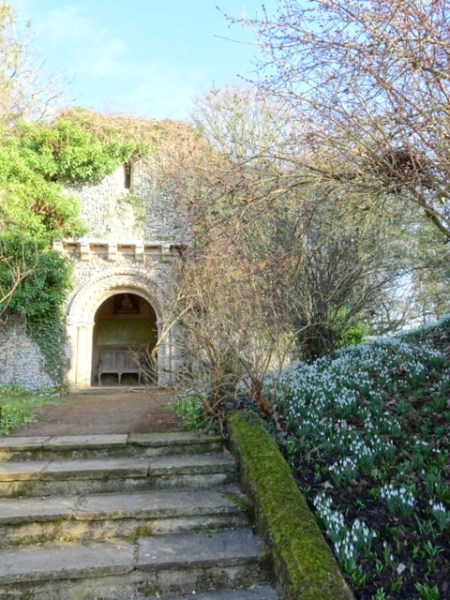 The summer house—as you can see, snowdrops are everywhere in the gardens.
.
 To the untrained eye, the gatehouse looks quite authentic down to the crumbling towers.
.
 The actual Norman ruins are in the back left of the snowdrop and aconite bed with the gatehouse peeking out behind them.
There is no brochure explaining the history of Benington Castle so it wasn’t until I researched Benington Lordship that I understood the provenance of all the buildings. For history buffs, Historic England gives a very detailed account of the site here.
.
 After viewing the Folly, we descended some stone steps into the moat.
.
 The moat is a narrow path with both of its very steep sides filled to the brim with snowdrops.
.
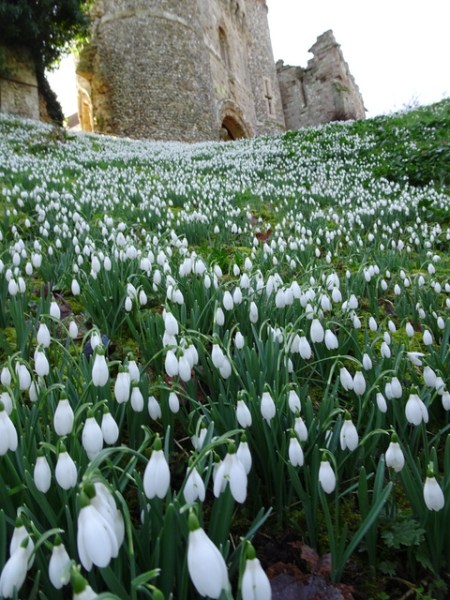 The snowdrops are mostly G. nivalis, the common snowdrop, and its double form ‘Flore Pleno’.
.
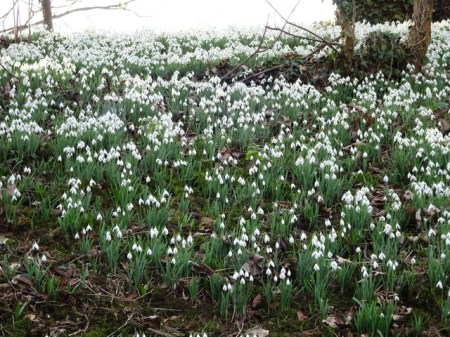 The back wall of the moat.
.
 Double common snowdrop, G. nivalis ‘Flore Pleno’
.
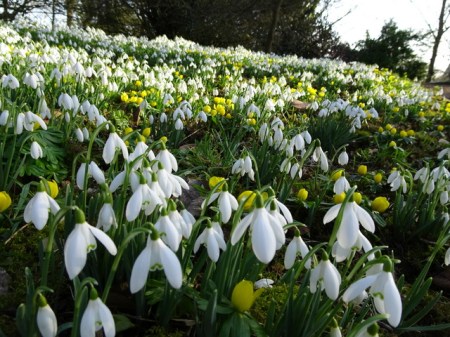 There were some beautiful vistas of snowdrops mixed with winter aconite, Eranthis hyemalis.
.
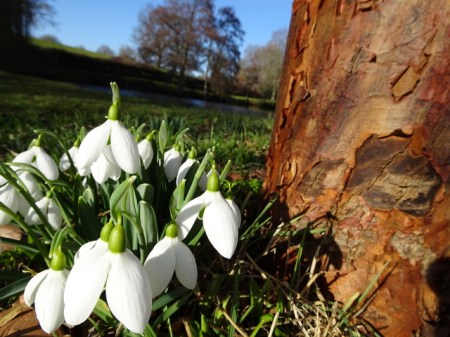 A lovely clump of G. plicatus, sometimes called Crimean snowdrop.
Although there was an area of the garden with named snowdrop cultivars, there was nothing that you won’t see in more impressive collections. It is the picturesque buildings and the snowdrops lining the moat and surrounding the Norman ruins that made Benington Lordship worth visiting. For details about visiting during snowdrop season, click here.
.
Blogs are a lot more fun for everyone, especially the writer, when readers leave comments. Scroll down to the end of the page to the box where it says “Leave a Reply” and start typing—-it’s easy!
Carolyn
.
Note: Every word that appears in orange on my blog is a link that you can click for more information. If you want to return to my blog’s homepage to access the sidebar information (catalogues, previous articles, etc.) or to subscribe to my blog, just click here.