Archive for Carolyn’s Shade Gardens

December 2012 Garden Bloggers Bloom Day

Posted in bulbs for shade, Camellias, hellebores, Shade Gardening, Shade Shrubs, winter, winter interest with tags , , , , , , , , on December 17, 2012 by Carolyn @ Carolyns Shade Gardens

Carolyn’s Shade Gardens is a retail nursery located in Bryn Mawr, PA, specializing in showy, colorful, and unusual plants for shade.  The only plants that we ship are snowdrops and miniature hostas.  For catalogues and announcements of events, please send your full name, location, and phone number (for back up use only) to carolyn@carolynsshadegardens.com.  Click here to get to the home page of our website for catalogues and information about our nursery and to subscribe to our blog.
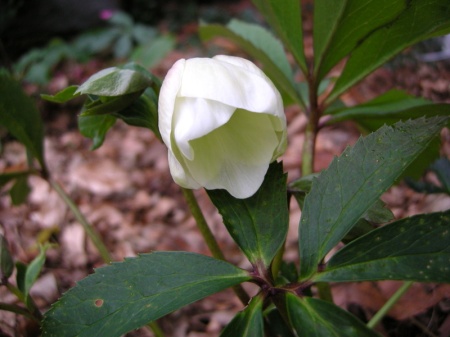
DSCN8663The first of my hybrid hellebores is just about to bloom: Helleborus x ‘Snow White’ (aka ‘Snow Bunting’).

I am two days late for the official Garden Blogger’s Bloom Day.  On the fifteenth of each month garden bloggers from all over the world post photos of what’s blooming in their gardens, and their posts are collected by Carol at May Dreams Gardens.  Nevertheless, I thought it would be fun to see which plants are pretty enough to get me outside in December on a somewhat warm but dreary, rainy day.  I also wanted to add a new twist by allowing myself only one pass through the garden for photos instead of the numerous trips required by a normal post.

Not surprisingly if you read my blog, Italian arum, hellebores, snowdrops, camellias, hardy cyclamen, and coral bells are hogging the show this time of year accompanied by a few others.  Let’s see what we have:
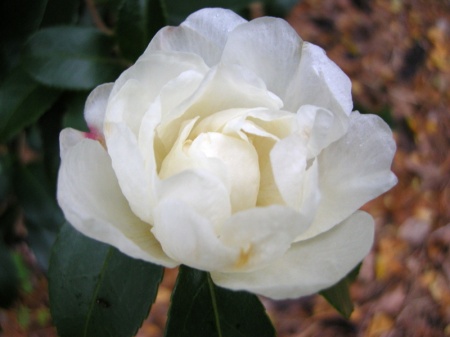
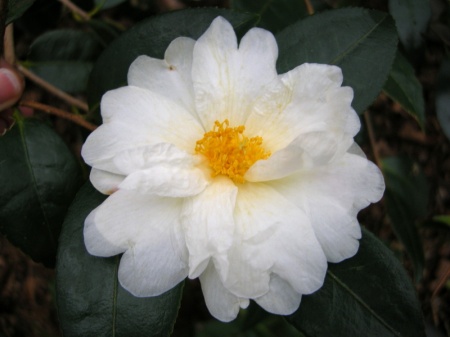
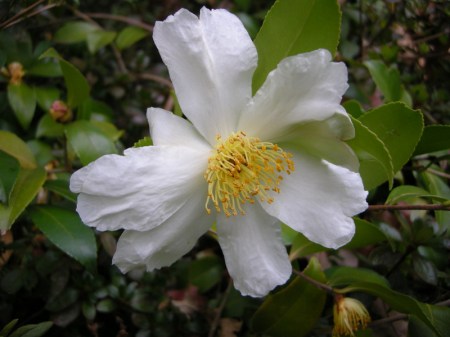
DSCN8642 Fall-blooming camellia ‘Winter’s Snowman’ has been blooming since October and still has buds waiting to open.

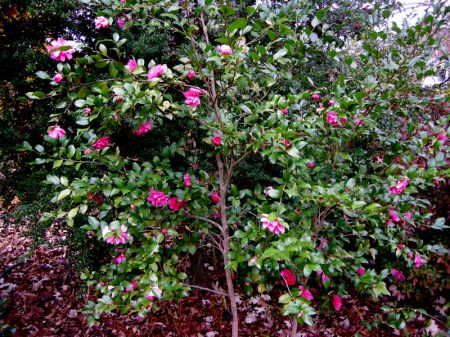
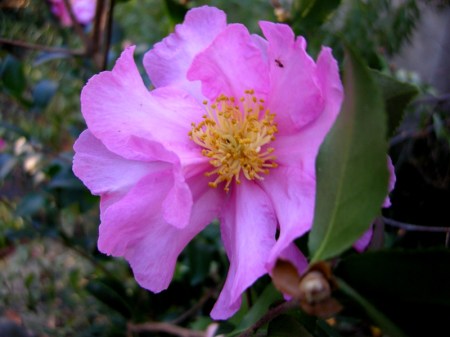
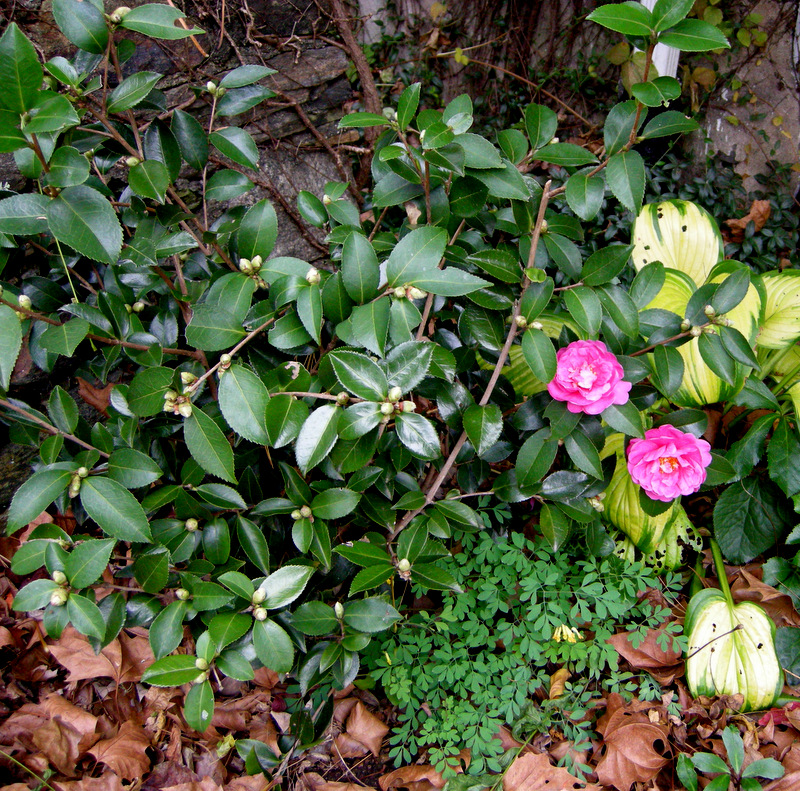
My late fall garden has been immensely improved by the addition of fall-blooming hardy camellias.  All five of mine are blooming now and have plenty of buds left.  For more information on fall-bloomimg camellias, click here.
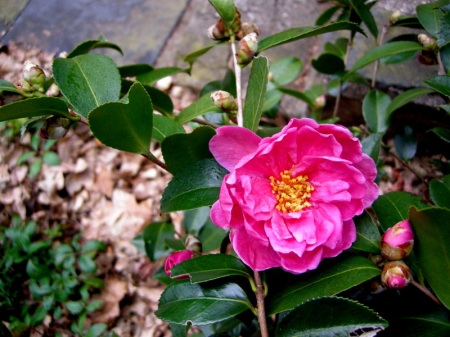
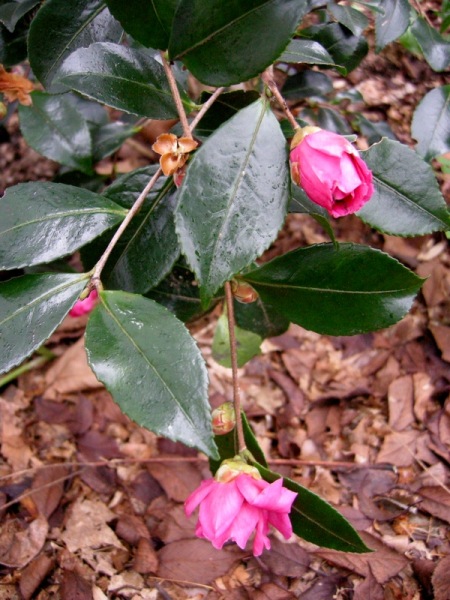
DSCN8641‘Winter’s Joy’

.

DSCN8650‘Lu Shan Snow’

.

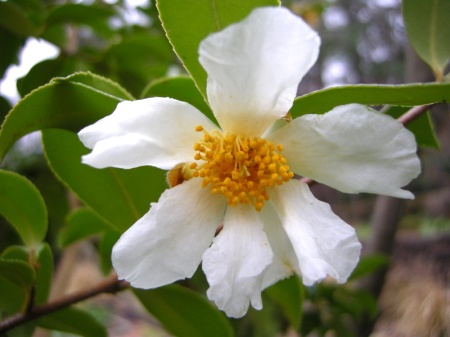
DSCN8656‘Winter’s Darling’

.

DSCN8655‘Elaine Lee’

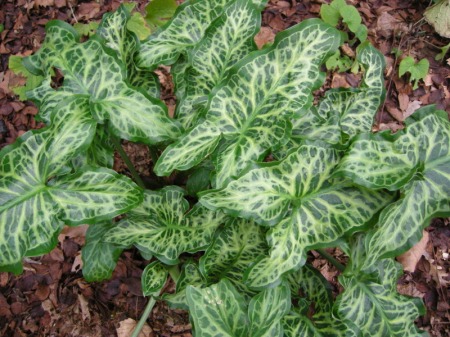
Italian arum is always a highlight this time of year after its fresh foliage emerges from dormancy in early fall:
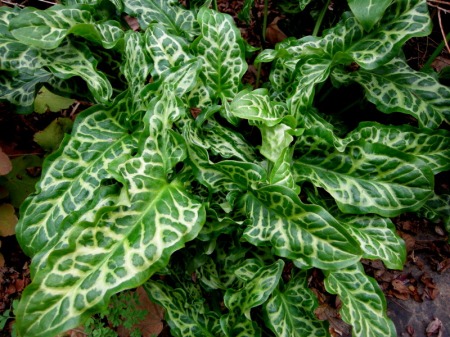
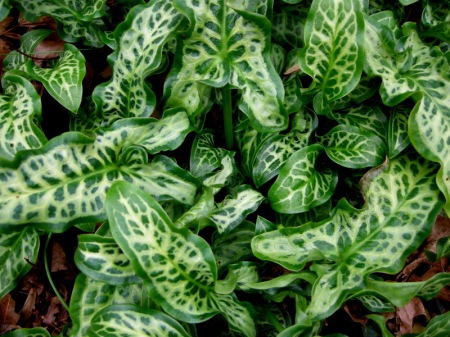
DSCN8645‘Pictum’ Italian arum

.

DSCN8659dwarf Italian arum ‘Tiny Tot’

.

DSCN8654‘Gold Rush’ Italian arum, my favorite

Hellebores are just about to take over as the stars of the garden for the next few months.  For more information on hellebores, click here and follow the links at the end of the post.  If it wouldn’t violate my parameter for this post, I would run out and photograph bearsfoot hellebore and ‘Praecox’ Christmas rose, which are both almost open.  As it is, I have these two hellebores for you:
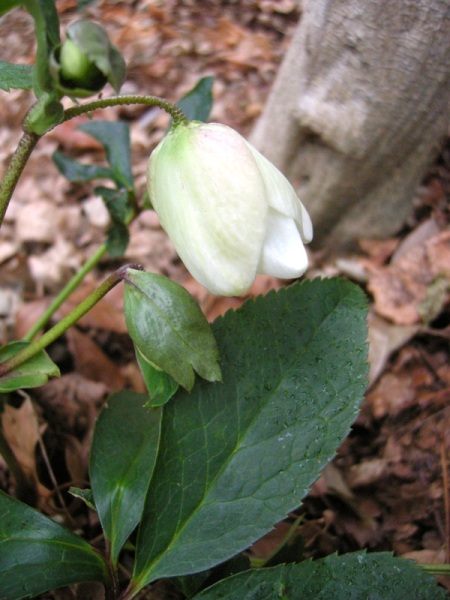
DSCN8662Another shot of the first flower on ‘Snow White’.

.
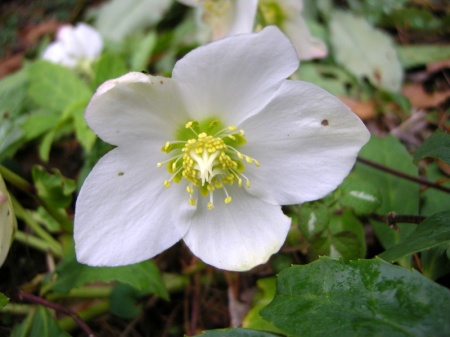
DSCN8643After blooming in October, ‘Josef Lemper’ Christmas rose is at it again and will continue to bloom into spring.

.

My favorite coral bells or heucheras are the cultivars that give me 365 days of colorful foliage, some of which are pictured below.  If I could go back outside, I would add ‘Frosted Violet’ and ‘Bronze Wave’.  I would also include some photographs of pulmonarias, especially ‘Diana Clare’:
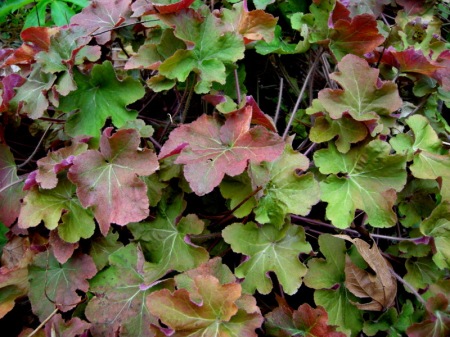
DSCN8646‘Caramel’ heuchera continues to change from one beautiful hue to the next through out the winter.

.
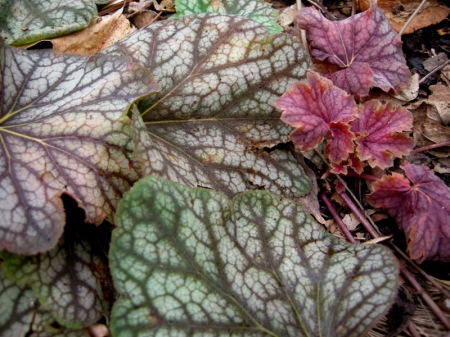
DSCN8652Green Spice’ is new to my garden this year and looks like a winner.

.
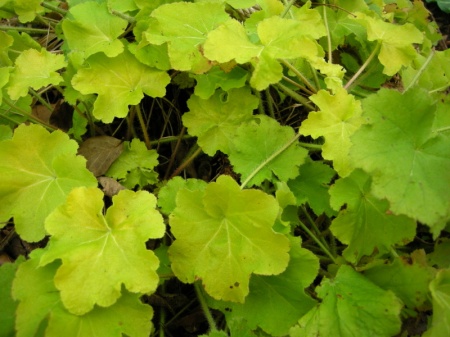
DSCN8653‘Citronelle’ is a customer favorite for brightening dark corners.

You know I couldn’t resist showing you a few snowdrops:
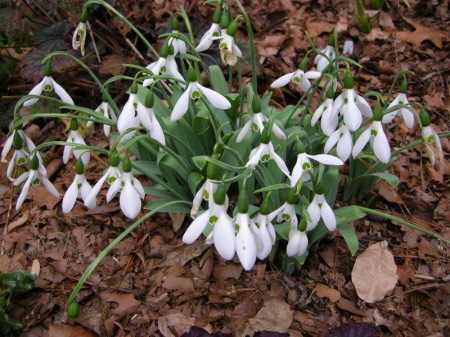
DSCN8640  ‘Potter’s Prelude’, a fall-bloomimg snowdrop cultivar, is getting to the end of its bloom period which began in mid-November.

.
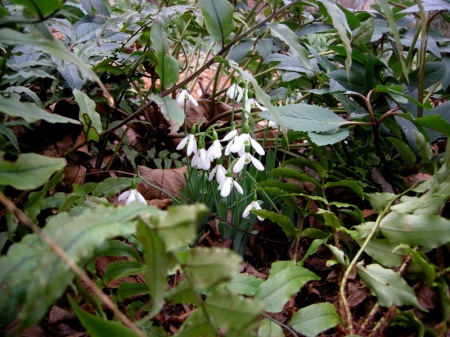
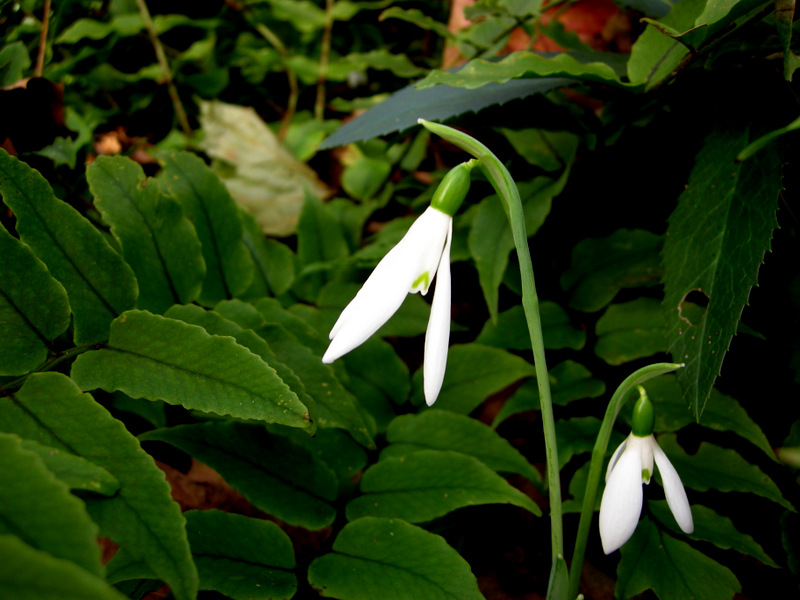
DSCN8658A clump of early blooming giant snowdrops, Galanthus elwesii, hides in the Japanese holly ferns and hellebores.

Except during the heart of the summer when they are dormant, hardy cyclamen are stars in my garden.  I find their highly variable leaf patterns endlessly fascinating.  For more information on hardy cyclamen, click here.
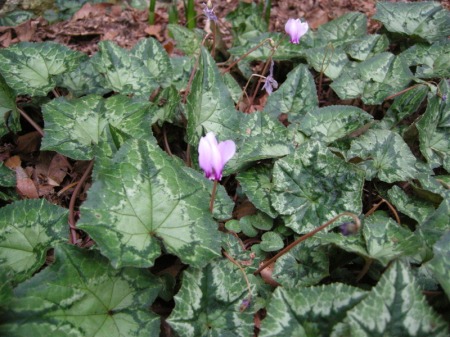
DSCN8660The last few blooms on fall-blooming hardy cyclamen, C. hederifolium, which began blooming at the end of August.

.
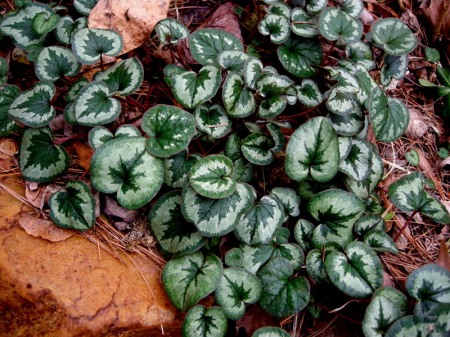
DSCN8661Spring-blooming hardy cyclamen, C. coum, doesn’t need flowers to attract attention.

Here are some more late fall stars that might surprise you:
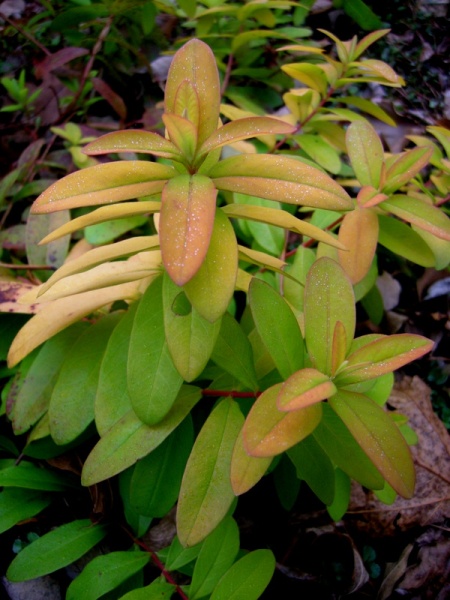
DSCN8639‘Brigadoon’ St. John’s wort always takes on this lovely peach color for the winter.

.
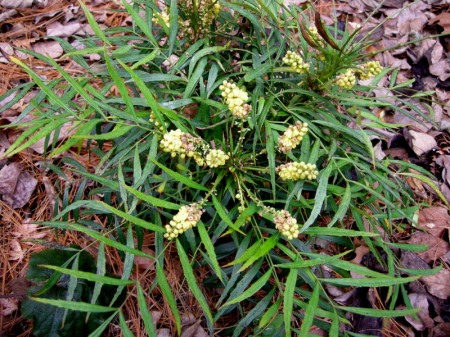
DSCN8644This new mahonia called ‘Soft Caress’ was given to me by the breeders at the Southern Living Plant Collection to trial in my garden.  It is evergreen, blooms now, and is hardy to zone 7.  For more information, click here.  I have high hopes for it because I have since seen it in two other local gardens.

.
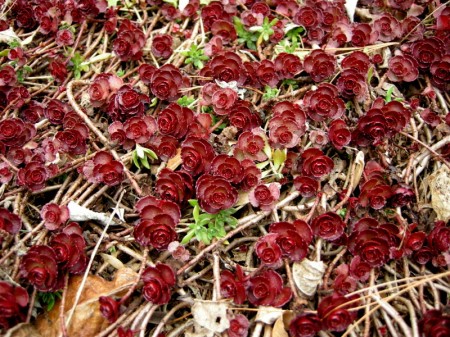
DSCN8648This sedum always turns a lovely burgundy in the fall.  Unfortunately, I don’t know its exact name.

.
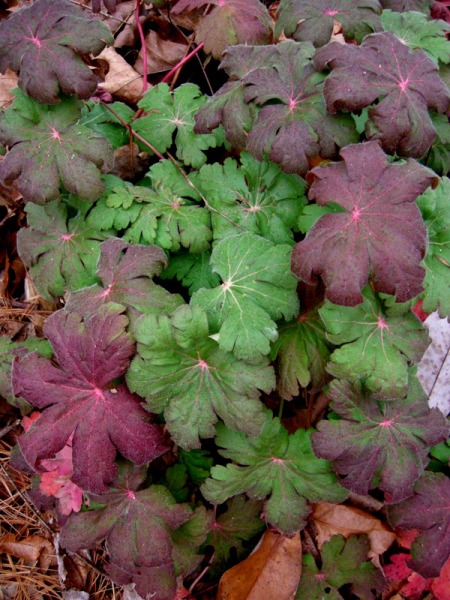
DSCN8651Bigroot geranium, G. macrorrhizum, takes on red and pink tones for the winter.

.
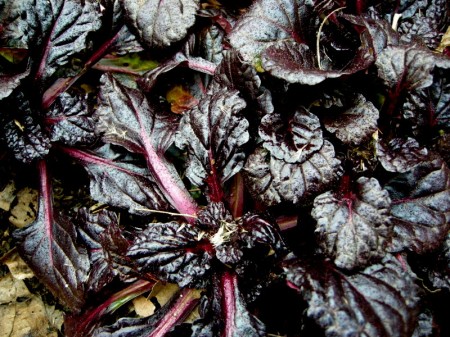
DSCN8649‘Black Scallop’ ajuga has quickly become one of my favorite groundcovers because its dark purple leaves remain shiny and beautiful through the winter.

You may be wondering why I would limit myself to one trip outside for photos for this post.  Every article that you read here takes me at least a full day to compose, including the photography, the research, the writing, and the editing.  I wanted to see if I could cut that back to a few hours and still produce a quality product, and I believe I have been largely successful.  It would only work for a post like this though where no significant supporting research was required. 

Enjoy, Carolyn


Nursery Happenings:  Carolyn’s Shade Gardens is a retail nursery located in Bryn Mawr, PA.  The only plants that we mail order are snowdrops and miniature hostas.  The nursery is closed until spring 2013.  Thanks for a great year.

If you are within visiting distance and would like to receive catalogues and information about customer events, please send your full name and phone number to carolynsshadegardens@verizon.net.  Subscribing to my blog does not sign you up to receive this information.

Facebook:  Carolyn’s Shade Gardens has a Facebook page where I post single photos, garden tips, and other information that doesn’t fit into a blog post.  You can look at my Facebook page here or click the Like button on my right sidebar here.

Notes: Every word that appears in orange on my blog is a link that you can click for more information.  If you want to return to my blog’s homepage to access the sidebar information (catalogues, previous articles, etc.) or to subscribe to my blog, just click here.

 

A Shrub for All Seasons: Edgeworthia

Posted in Fall, Shade Shrubs, winter, winter interest with tags , , , on December 10, 2012 by Carolyn @ Carolyns Shade Gardens

Carolyn’s Shade Gardens is a retail nursery located in Bryn Mawr, PA, specializing in showy, colorful, and unusual plants for shade.  The only plants that we ship are snowdrops and miniature hostas.  For catalogues and announcements of events, please send your full name, location, and phone number (for back up use only) to carolyn@carolynsshadegardens.com.  Click here to get to the home page of our website for catalogues and information about our nursery and to subscribe to our blog.

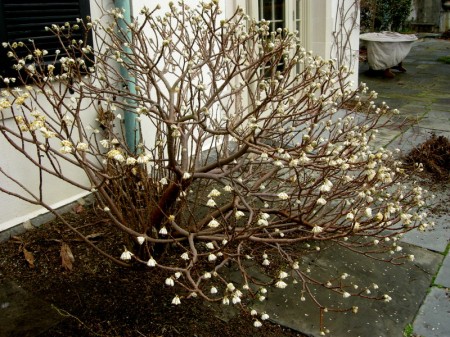
Edgeworthia chrysantha 'Snow Cream' Cresson gardenI love edgeworthia in all its manifestations, but late winter when the buds start to swell has to be my favorite.

Edgeworthia chrysantha also known as paper bush is a collector’s plant.  That means it is rarely seen in public and private gardens and is hard to find at nurseries.  However, I have been able to offer it to my customers in fall 2011 and fall 2012 because my wholesale shrub supplier carries beautiful specimens of it.  I have grown it in my own garden for three years so I decided it was time for a full blown profile of what has become one of my favorite shrubs.

[Note:Carolyn’s Shade Gardens is retail nursery located in Bryn Mawr, PA.  The only plants that we mail order are snowdrops and miniature hostas.]

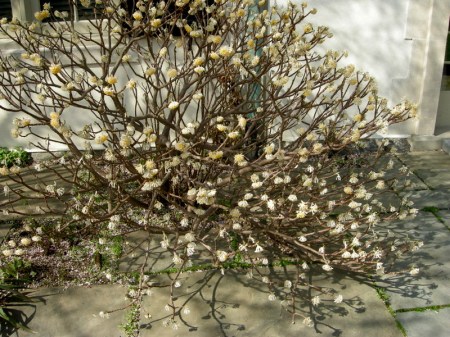
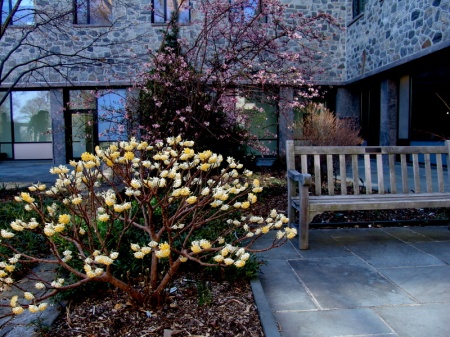
Edgeworthia chrysantha My photos of the whole plant do not do justice to how gorgeous it is, but as I reviewed the on-line literature, I realized that everyone has this problem.  This edgeworthia is pictured in mid-April on the terrace of the main house at Chanticleer gardens in Wayne, Pennsylvania.

Edgeworthia is native to China and was named for Michael Edgeworth (1812 to 1881), a plant collector for the East India Company.  It arrived fairly recently in the US.  My 1990 edition of Michael Dirr’s Manual of Woody Landscape Plants contains no mention of it, and it was not covered in my 1994 Longwood course, Deciduous Flowering Shrubs II.  Although articles state that its common name is paper bush, I have never heard anyone who actually grows it call it anything but edgeworthia.  In China, its bark is used to produce very high quality paper and for various medicinal purposes.  Here it is an unusual and elegant four season ornamental notable for its leaves, buds, flowers, and habit.

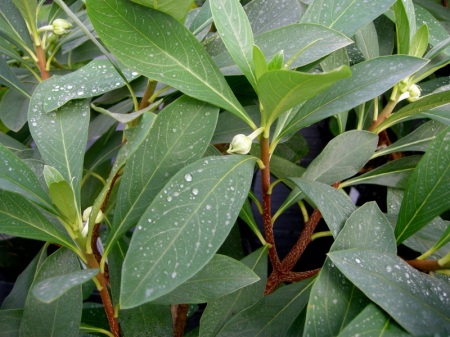
Edgeworthia chrysanthaEdgeworthia’s leaves are large and tropical, and its bark is an unusual reddish-brown.  This photo was taken in September and the highly ornamental buds have formed but have not yet expanded.

Edgeworthia is in the same family as daphne and has even occasionally been called yellow daphne.  It is deciduous and  has large and distinctive leaves.  They are 5 to 6″ long and about 2″ wide, blue-green on the top and silvery green on the bottom.  Although they can turn yellow in fall, you wouldn’t grow edgeworthia for fall color.  The leaves cluster at the tips of the branches giving the shrub a decidedly lush and tropical appearance that really stands out in the garden.  When the leaves drop, they reveal the slender and pliable reddish-brown bark seen above.

Edgeworthia chrysanthaEdgeworthia buds in November as they start to expand.

.

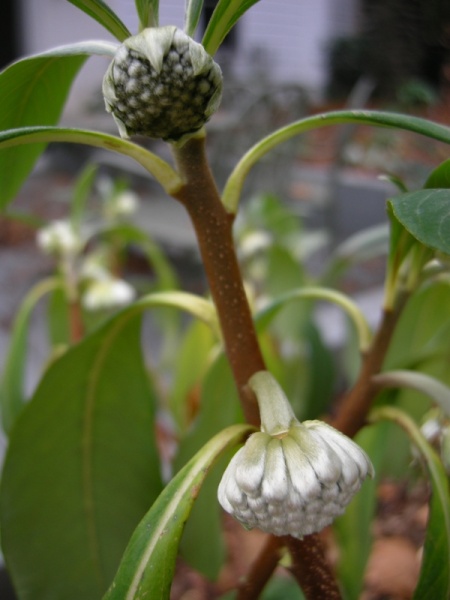
Edgeworthia chrysantha 'Snow Cream' Cresson gardenEdgeworthia buds as they appear through the heart of the winter.

.

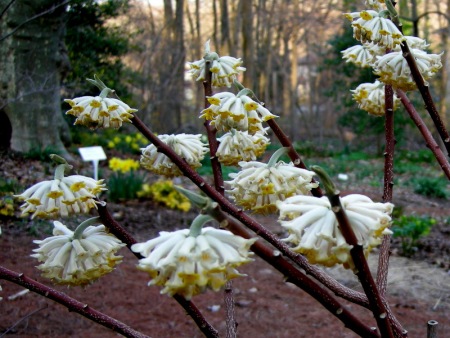
Edgeworthis chrysanthaPlease use your imagination to envision how gorgeous this shrub must be covered with hundreds of the silky silver buds shown in the preceding photo.  This edgeworthia is pictured at the very end of January and is in the Isabelle Cosby Courtyard at the Scott Arboretum at Swarthmore College, Pennsylvania.

My favorite season for edgeworthia is winter when the leaves drop to reveal the buds which form in late summer or early fall depending on where you live.  Each 1″ plus bud resembles an intricately designed tassel on the corner of an elegant Victorian pillow.  The silky hairs glow in the light, and the plant looks like it is covered with hundreds of silver flowers–simply breathtaking.  The falling leaves also reveal edgeworthia’s striking architectural habit.  It is a multi-stemmed shrub that forms an almost perfectly rounded umbrella shape of cinnamon colored branches.

Edgeworthia chrysanthaEdgeworthia’s buds start to open at the beginning of March in our area and as early as January in the south.

.

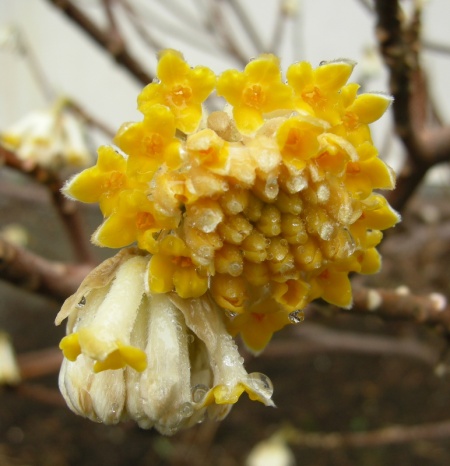
Edgeworthia chrysanthaEdgeworthia’s flowers starting to open.

.

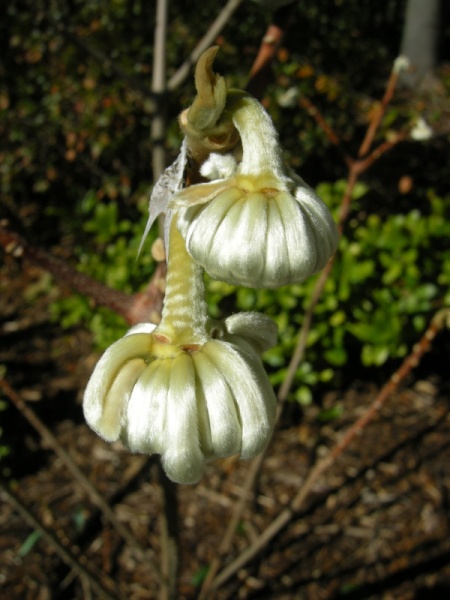
Edgeworthia chrysanthaFully open flowers in my garden in mid-March 2012.  I wish blog posts could include a fragrance button!

Blooming begins in our area in early March and can continue through April.  Each bud expands to reveal 25 to 35 tubular flowers with a silky silver exterior and a bright yellow interior.  That would be ornamental enough but the fragrance is amazing.  I can’t describe it—you will just have to find a specimen and experience it for your self.

Edgeworthia chrysanthaEdgeworthia blooming at the Scott Arboretum (photo taken by Rhoda Maurer and used with the permission of the Scott Arboretum).

I am going to give cultural information for edgeworthia with the caveat that I don’t think the plant has been grown long enough for it to be definitive.  Most sources say that edgeworthia grows in light to partial shade and requires moist, fertile, well-drained organic soil with supplemental water in summer.  I grow mine in an east-facing location with very high shade, but edgeworthias at the Scott Arboretum and Chanticleer are in the sun while Charles Cresson has a relatively old plant in full shade.  My edgeworthias have organic soil but are in a dry location.  This causes the leaves to go limp when it’s hot but doesn’t seem to harm the plants, time will tell.

Zone information is also variable, and the only thing I can guarantee is that specimens have been growing successfully in the Delaware Valley area of Pennsylvania for some time.  If you garden north of here, I suggest you try the plant anyway because we really don’t know how much cold it can take.  Planting in a protected location is often recommended, and all the plants I have seen are in protected spots, but I don’t know if this is necessary.  Mine are more exposed than other local plants so we will see. 

Finally, height and width estimates range all over the place with a consensus probably being 6′ by 6′.  However, the Chanticleer specimen in the sun is much lower and tighter while Charles Cresson’s shady specimen is taller and looser.  One thing is clear though: you won’t regret adding edgeworthia to your garden.

If you are growing edgeworthia, please leave a comment describing your experience with it, especially if you are from an area north of the Delaware Valley.

Carolyn

If you would like more information on edgeworthias, please read my more recent post, Edgworthia Update, and the very helpful reader comments, by clicking here.


Nursery Happenings:  Carolyn’s Shade Gardens is a retail nursery located in Bryn Mawr, PA, specializing in showy, colorful, and unusual plants for shade.  The only plants that we ship are snowdrops and miniature hostas.  For catalogues and announcements of events, please send your full name, location, and phone number (for back up use only) to carolyn@carolynsshadegardens.com.  Click here to get to the home page of our website for catalogues and information about our nursery and to subscribe to our blog.

Facebook:  Carolyn’s Shade Gardens has a Facebook page where I post single photos, garden tips, and other information that doesn’t fit into a blog post.  You can look at my Facebook page here or click the Like button on my right sidebar here.

Notes: Every word that appears in orange on my blog is a link that you can click for more information.  If you want to return to my blog’s homepage to access the sidebar information (catalogues, previous articles, etc.) or to subscribe to my blog, just click here.
 

2012 Fall-blooming Camellias

Posted in Camellias, evergreen, Fall, Fall Color, Shade Shrubs with tags , , , , , , , , , , , , , , on December 2, 2012 by Carolyn @ Carolyns Shade Gardens

Carolyn’s Shade Gardens is a retail nursery located in Bryn Mawr, PA, specializing in showy, colorful, and unusual plants for shade.  The only plants that we ship are snowdrops and miniature hostas.  For catalogues and announcements of events, please send your full name, location, and phone number (for back up use only) to carolyn@carolynsshadegardens.com.  Click here to get to the home page of our website for catalogues and information about our nursery and to subscribe to our blog.

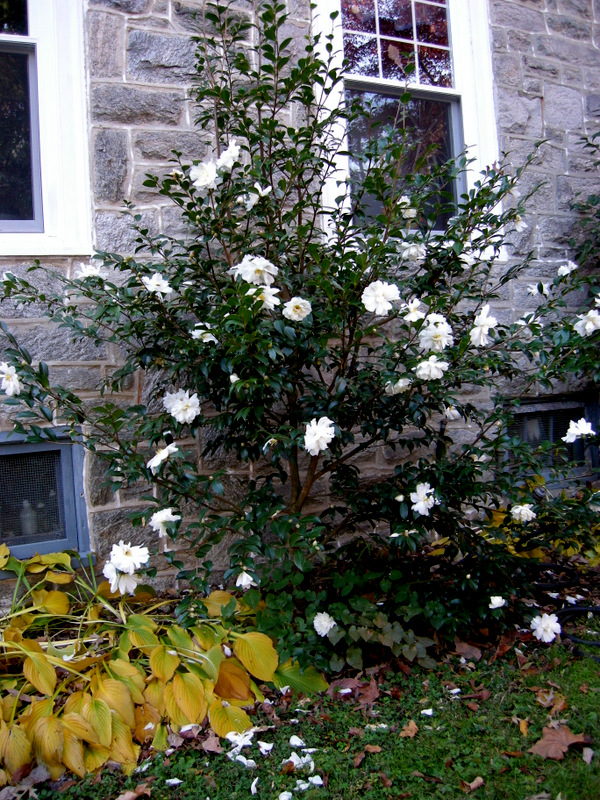
Camellia x 'Winter's Joy'The fall-blooming camellias are flowering in my garden, pictured above is ‘Winter’s Joy’.  I planted this camellia last fall, and it bloomed all through our mild winter.  This year it is once again loaded with buds and began blooming in October.

For the past two falls, I have written posts on fall-blooming camellias, shrubs that have quickly become favorites in my garden.  Who can resist their tough nature, glossy, evergreen leaves, tidy habit, and, best of all, large, elegant flowers from September through December?  To read my posts, click Part One, Part Two, and Part Three.

'Winter's Snowman'‘Winter’s Snowman’ was planted in spring 2011 in dense shade and bloomed sparsely last fall.  This year it is well established and has been covered with flowers since October.

I only have four fall-blooming camellias in my garden: the two pictured above plus ‘Elaine Lee’ and ‘Winter’s Darling’.  My desire to showcase some new varieties on my blog gave me a great excuse to venture forth and visit the camellia collections of two great gardeners, both located in Swarthmore, Pennsylvania.  I spent two glorious afternoons obsessing on camellias with Charles Cresson, whose garden you have visited many times on my blog, and with Keith Robertshaw, a diehard camellia collector and one of my nursery customers.

Camellia x 'Snow Flurry'‘Snow Flurry’, which I have shown you before in the Cresson garden, is having a banner year this year.

The weird weather patterns we have been experiencing have had one good result, camellias are blooming early this year with an abundance of flowers.  I usually find it very difficult to photograph a full camellia shrub.  When I step back far enough to get the whole bush in the photo, the flowers lose their impact even though they look great in person. That was not a problem on my recent trip when cultivars like ‘Snow Flurry’ were bursting with flowers as you can see in the above photo.

Camellia x 'Snow Flurry'‘Snow Flurry’ is the earliest to flower of the cold hardy fall-blooming camellias selected by William Ackerman at the US National Arboretum in Washington, DC.  It is at the top of the list for additions to my garden.

.

Camellia x 'Autumn Spirit'‘Autumn Spirit’ is another cold hardy camellia that blooms early and has produced a plethora of flowers this year.  Early bloomers are desirable because they are guaranteed to bloom even if we have an early winter that freezes the buds on the late bloomers.

.

Camellia x 'Autumn Spirit'‘Autumn Spirit’ was selected by the North Carolina nursery Camellia Forest for its intense color, early bloom, and cold hardiness.

I have featured all four of the camellias shown above in my previous posts.  However, my visits to the Robertshaw and Cresson gardens did yield seven new cold hardy camellias that I haven’t seen before.  If you combine these with the approximately 20 cultivars profiled in my 2010 and 2011 posts, you will have a pretty comprehensive reference library of camellias suitable for the mid-Atlantic area of the US.  Here are the new candidates:

Camellia x 'Survivor'‘Survivor’ is another Camellia Forest introduction producing an abundance of single white flowers in early fall.  If you are in an area north of the mid-Atlantic, you might want to try this very cold hardy camellia which survived -9° F (-22.8° C) in the Camellia Forest Nursery garden.

.

Camellia x 'Long Island Pink'Another camellia in addition to ‘Survivor’ for gardeners who prefer single flowers, ‘Long Island Pink’ is also valued for its large highly polished leaves.  Although it is a cultivar of  C. sasanqua, which is generally considered tender, ‘Long Island Pink’ was selected for cold hardiness from a Long Island, NY, garden.

.

Camellia x 'Polar Ice'‘Polar Ice’ is a cold hardy Ackerman hybrid with anemone form flowers blooming in November and December.

.

Camellia x 'Ashton's Ballet' ‘Ashton’s Ballet’ is an Ackerman hybrid with rose form double flowers blooming in November and December.  It has a compact form and makes a beautiful garden specimen.

.

Camellia x (Ackerman seedling)I am cheating by putting this camellia in the post because you can’t buy it.  It was an Ackerman seedling given to Charles Cresson but never introduced to the trade.  The flowers are huge, gorgeous, and pure white.  I think we need to lobby to have it named! 

.

Camellia x 'Winter's Rose'The Ackerman hybrid ‘Winter’s Rose’ is unusual.  It is a semi-dwarf that grows very slowly and densely with small leaves and flowers, making a great patio plant.  If you don’t have much room, this is the camellia for you.

.

Camellia x 'Winter's Rose'‘Winter Rose’ has an abundance of small delicate shell pink flowers from mid-October to early December.  Charles Cresson pointed out that although the plant is exceedingly hardy, the flowers freeze easily.

.

Camellia x 'Winter's Rose' ‘Winter’s Rose’ seems to be the favorite among commenters so I thought I would add another photo.

.

Camellia x 'Winter's Fire'‘Winter’s Fire’ was present in both gardens and is the most intriguing camellia that I saw during my visits.  The flower color is very unusual, a beautiful mix of red, pink, and coral with contrasting white splotches.  While Keith and Charles both stated that the white was caused by a non-harmful virus and both plants displayed this coloring, I could find no mention of this on the internet.

[Thanks to reader Alisa Brown for answering my question about ‘Winter’s Fire’.   Variegation in camellias caused by a virus is not considered part of the official description of the flower.  You can read more about this by clicking here.]


Camellia x 'Winter's Fire'William Ackerman, who selected ‘Winter’s Fire’, characterizes it as having “spreading growth with a weeping habit.”  In the Robertshaw garden, it was growing like a groundcover.  This photo is taken from above.  I would love to try it cascading over a wall.

.

Camellias in Cresson gardenThis is one corner of the Cresson garden showing ‘Snow Flurry’ on the left and the unnamed white Ackerman plant on the top right intermingled with several other large camellias.  Though it may be hard at first to get used to such big gorgeous flowers in November, as you can see they make for a beautiful fall landscape.


My annual fall camellia hunt is over with seven new specimens bagged.  Now I have a year to determine where I will continue my search next fall.  If you know of any local public or private gardens showcasing camellias please let me know.

Carolyn


Nursery Happenings:  Carolyn’s Shade Gardens is done for the fall.  Thanks for a great year.  See you in spring 2013.

If you are within visiting distance and would like to receive catalogues and information about customer events, please send your full name and phone number to carolynsshadegardens@verizon.net.  Subscribing to my blog does not sign you up to receive this information.

Facebook:  Carolyn’s Shade Gardens has a Facebook page where I post single photos, garden tips, and other information that doesn’t fit into a blog post.  You can look at my Facebook page here or click the Like button on my right sidebar here.

Notes: Every word that appears in orange on my blog is a link that you can click for more information.  If you want to return to my blog’s homepage to access the sidebar information (catalogues, previous articles, etc.) or to subscribe to my blog, just click here.
 

The Maine Coast in Late Fall

Posted in Fall, Fall Color with tags , , , , , , , , on November 23, 2012 by Carolyn @ Carolyns Shade Gardens

Carolyn’s Shade Gardens is a retail nursery located in Bryn Mawr, PA, specializing in showy, colorful, and unusual plants for shade.  The only plants that we ship are snowdrops and miniature hostas.  For catalogues and announcements of events, please send your full name, location, and phone number (for back up use only) to carolyn@carolynsshadegardens.com.  Click here to get to the home page of our website for catalogues and information about our nursery and to subscribe to our blog.

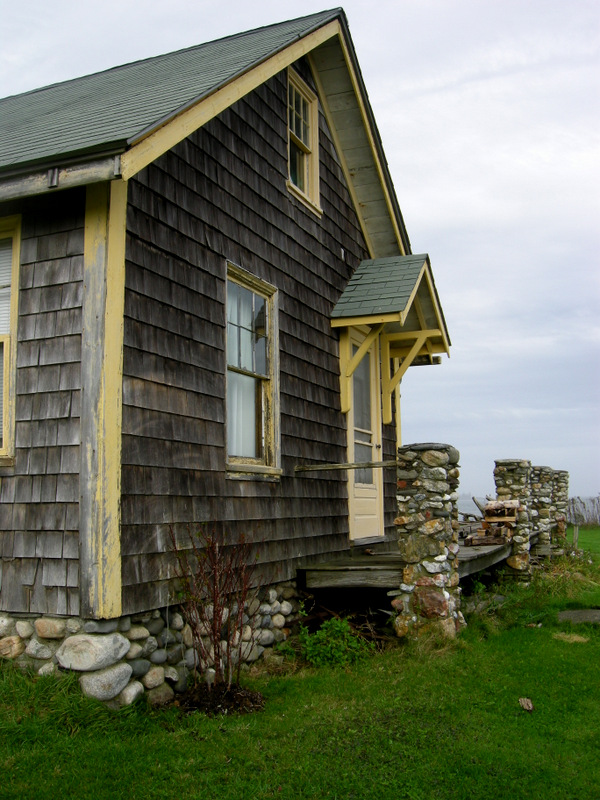
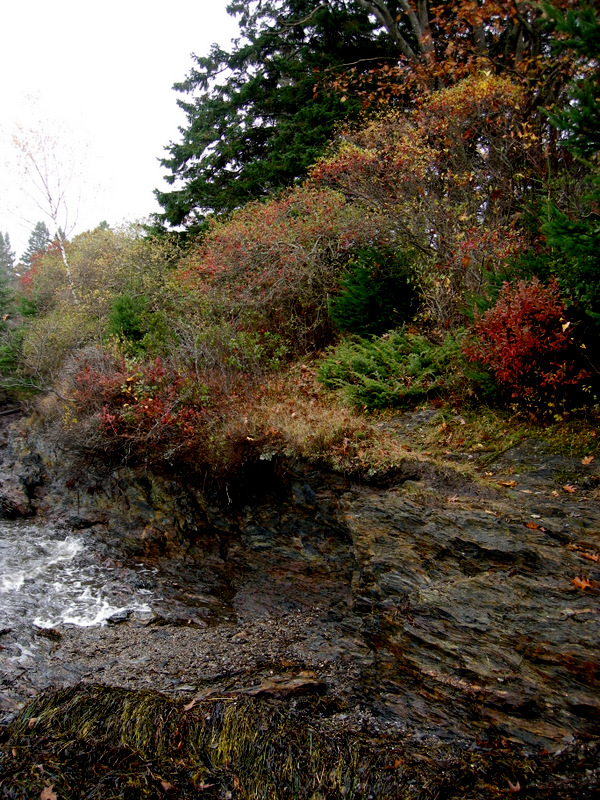
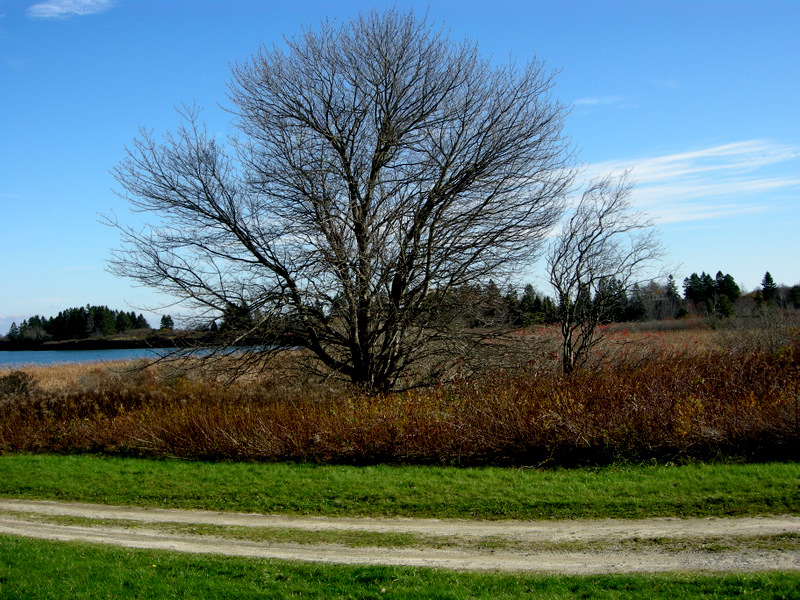
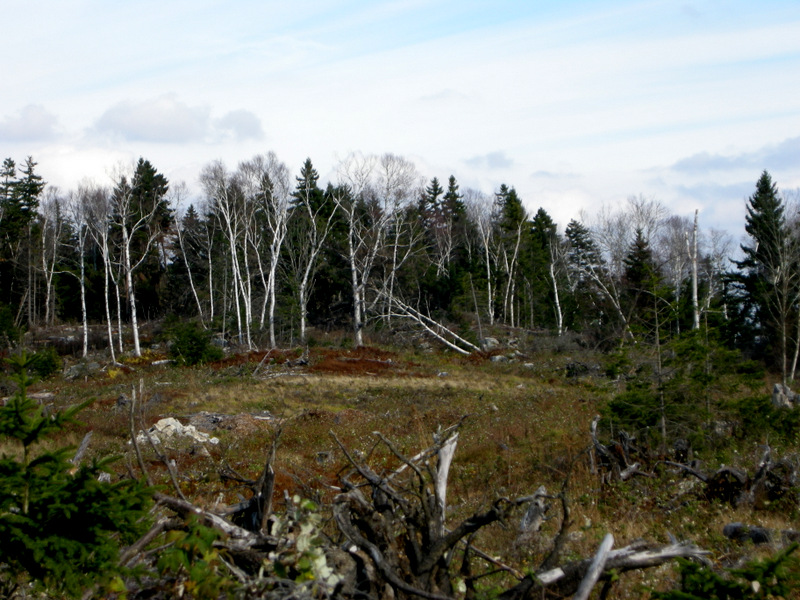
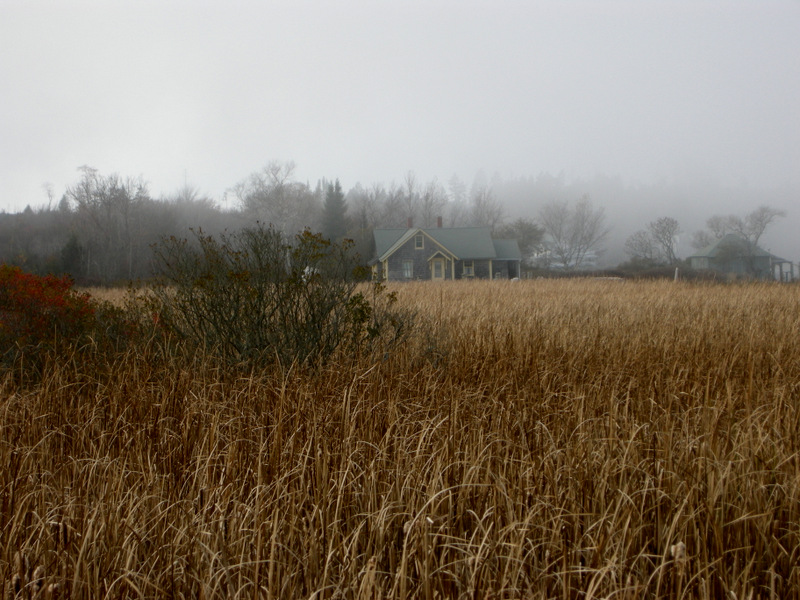
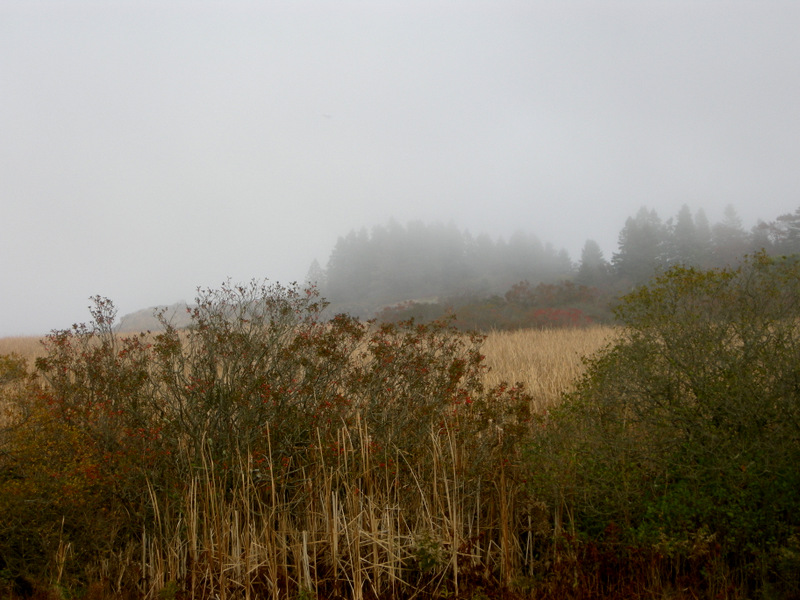
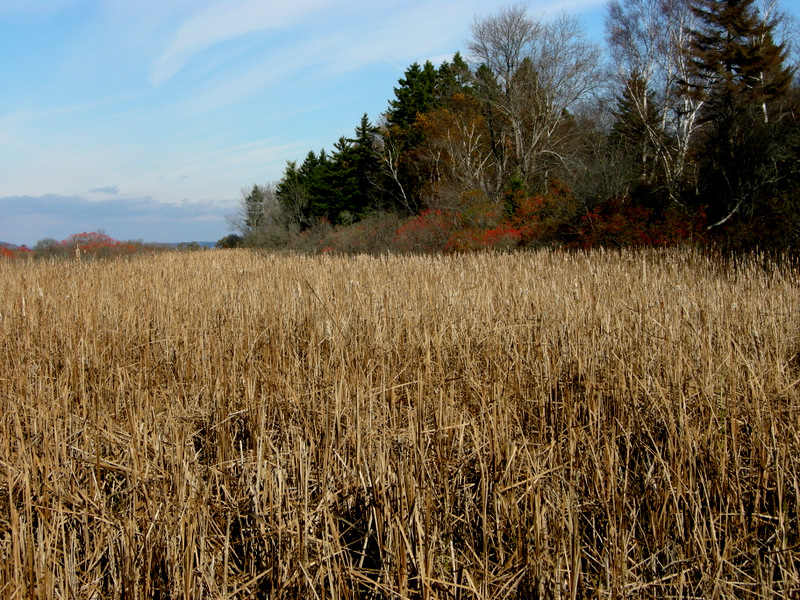
The dramatic fall color of red maples has been replaced with the more subtle color of American beech.  All the photos in this post were taken in and around Cliff Island, Maine, US, located off the coast of Portland in Casco Bay.

I have gotten a lot of comments in person and on line about how much everyone has enjoyed my posts from Maine.  To read my post The Maine Coast and see photos in summer, click here.  I was there again at the end of October so I thought I would show you the coast at a very different time of year.

The bay is empty of boats.

.

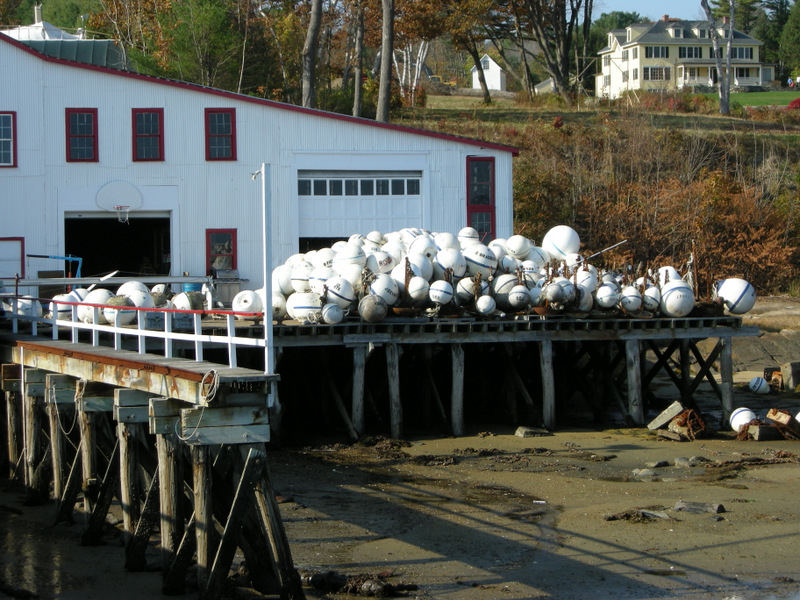
The mooring buoys are stacked on the shore.

.

The summer cottages are closed.

.

.

This is the house where the movie The Whales of August with Betty Davis, Lillian Gish, and Vincent Price was filmed.

.

The ocean loses its benign summer look.

.

The cliffs for which Cliff Island was named.

The landscape of Cliff Island changes too.  Gone are the wildflowers blooming everywhere and even the colorful leaves on the deciduous trees.  The palette narrows to the blue sky, gray fog, green conifers, brown grasses, white bark, red berries.  Everything is more subtle yet every bit as beautiful.

Cattails and winterberry holly

.

winterberry holly

.

.

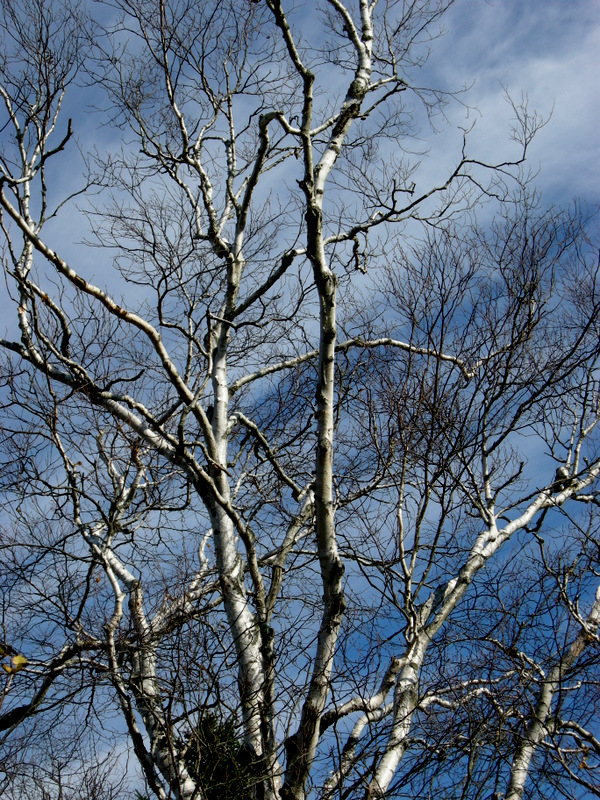
The paper birches glow against the clear blue sky.

.

.

In the fall, I am able to focus on the big picture.  And I have found that the larger landscape contains a design element that comes to the forefront in the stark vistas of fall.  No dotter of individual plants here and there, nature is the queen of massing.  She uses broad bands of color to achieve spectacular results.  I try to imitate this in my garden in Pennsylvania by planting in large swathes and allowing vigorous plants to self-sow.  Of course, the results aren’t as spectacular as this….

.

.

.

.

.

.

.

I am truly blessed to have access to this gorgeous native landscape.  I am glad I can share it with you on my blog.  This post was supposed to be up in time to wish you all a very Happy Thanksgiving so it will have to be belated.

Carolyn


Nursery Happenings:  Carolyn’s Shade Gardens is done for the fall.  Thanks for a great year.  See you in spring 2013.

If you are within visiting distance and would like to receive catalogues and information about customer events, please send your full name and phone number to carolynsshadegardens@verizon.net.  Subscribing to my blog does not sign you up to receive this information.

Facebook:  Carolyn’s Shade Gardens has a Facebook page where I post single photos, garden tips, and other information that doesn’t fit into a blog post.  You can look at my Facebook page here or click the Like button on my right sidebar here.

Notes: Every word that appears in orange on my blog is a link that you can click for more information.  If you want to return to my blog’s homepage to access the sidebar information (catalogues, previous articles, etc.) or to subscribe to my blog, just click here.
 

November GBBD: What’s Peaking Now

Posted in evergreen, Fall, Fall Color, hellebores, snowdrops with tags , , , , , , , , , , , , , , , , , , , , on November 15, 2012 by Carolyn @ Carolyns Shade Gardens

Carolyn’s Shade Gardens is a retail nursery located in Bryn Mawr, PA, specializing in showy, colorful, and unusual plants for shade.  The only plants that we ship are snowdrops and miniature hostas.  For catalogues and announcements of events, please send your full name, location, and phone number (for back up use only) to carolyn@carolynsshadegardens.com.  Click here to get to the home page of our website for catalogues and information about our nursery and to subscribe to our blog.

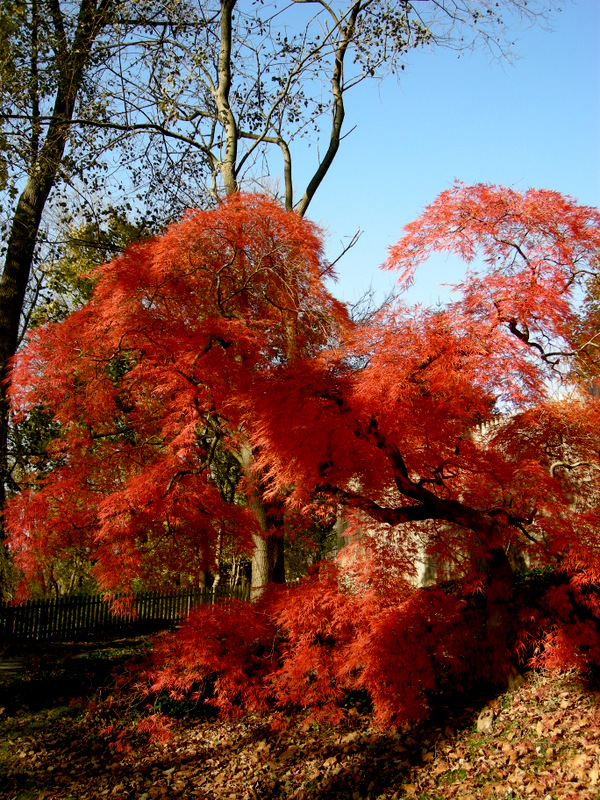
This Japanese maple, Acer palmatum, of unknown origin broke off in the ice and snow in January 2011.  For a photo of it then, click here.  It has recovered beautifully with an even more interesting habit.

I have said before that no matter how much I try to enjoy it, November is not my favorite month.  As I wander around, all I see are plants dying back, work to be done, and time running out.  Last year wasn’t too bad because we had a long warm fall with beautiful weather and plenty going on through the middle of November.  I even called my Garden Bloggers Bloom Day post “Prime Time” (click here to see the show).  This year most gardeners in the mid-Atlantic US agree that fall colors on many plants have been muted and gardens have gone by early.  Even September and October contained few of the clear, crisp, and sunny days we look forward to, and then along came Sandy.

A seedling Japanese maple along my front walk.

Despite the bad fall, there are plants in my garden right now that make a stroll outside worthwhile.  What is it about them that so attracts me?  It is that these plants are reaching their ornamental height right now.  They are not just re-blooming or showing a few flowers on a plant that really peaked earlier like asters or phlox, and they are not producing lovely fall color on a woody that I grow just as much for its flowers like hydrangea or viburnum.  November is the month when they reach the top.

The Japanese maples that seeded around this London plane tree produce a variety of fall colors from yellow to orange to red.

In this post I re-introduce you to some of the plants that show their best side in November and December.  I have written about many of them before, and I will provide links to those posts.  However, I wanted to gather these plants together here to provide a complete reference of fall stars to use during your spring shopping  trips.

‘Shishigashira’ is a gorgeous Japanese maple that just starts to turn in mid-November.  It will eventually become a solid orangey red.

When all the other trees have shown their colors and lost their leaves, Japanese maples are just starting to turn.  Every time I go outside I grab my camera to take one more shot of their eye-catching color.  I think it is their prime ornamental characteristic, especially because of its timing, even though I also appreciate their fine branching structure, delicate leaves, and variety of habits.

Fall-blooming hardy cyclamen, C. hederifolium.

The white and pink flowers of hardy cyclamen.

Fall-blooming hardy cyclamen is dormant in the summer and re-emerges in the fall.  To get all the details, click here to read my recent post on this unusual but easy to grow plant.  For the purposes of this post, what makes it so desirable is that November is its peak when its leaves are fully emerged and provide a stunning backdrop for the flowers.

The basic Italian arum, A. italicum, sometimes called ‘Pictum’.


‘Gold Dust’ Italian arum has much more distinct markings with gold veins.


The leaves of ‘Tiny Tot’ Italian arum are about one-third the size (or less) of the species and very finely marked.


Italian arum’s life cycle is very similar to hardy cyclamen: it goes dormant in the summer and comes up fresh and beautiful to peak in the fall and through the winter.  It makes a great groundcover, and you can read more about it by clicking here.


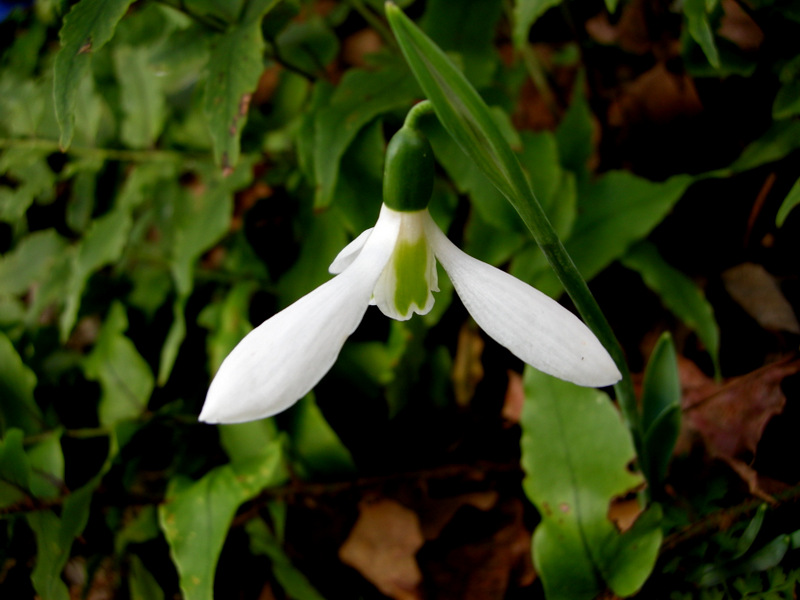
Giant snowdrop, Galanthus elwesii.

A giant snowdrop with unusually long outer segments (petals).

‘Potter’s Prelude’ giant snowdrop, G. elwesii var. monostichus, is just starting to open in mid-November.

I couldn’t write a post this time of year without mentioning fall-blooming snowdrops.  Although we think of snowdrops as blooming in March, there are several species that bloom in the fall, including G. reginae-olgae, which blooms in October and is done now.  Also the giant snowdrop, whose flowers are quite variable, blooms for a long period from November to February so I have included some photos above.  But the king of fall is ‘Potter’s Prelude’, a very robust and vigorous snowdrop that blooms reliably in November.  For more information, click here to read my post on fall-blooming snowdrops.

Christmas rose ‘Josef Lemper’, Helleborus niger

This photo was taken today—as you can see ‘Josef’ Lemper’s’ October flowers have gone by, but a whole new crop of buds are preparing for November.


The Christmas rose ‘Jacob’ begins a month later that ‘Josef Lemper’.  Its buds are just beginning to reach up beyond the leaves.

‘Josef Lemper’ and ‘Jacob’ Christmas roses are also stars in my November garden, producing pure white 3 to 4″ wide flowers set off by smooth evergreen leaves.  Fall is their season, and they produce copious amounts of flowers to cheer up dreary November days.  For more information on fall-blooming hellebores, click here.

Fall-blooming camellia ‘Winter’s Joy’ produces its first two flowers but look at all the buds to come.

The last photo is a teaser because of course fall-blooming camellias play a huge part in my November garden.  As with the other plants profiled, they are not just hanging on into November but instead come into their own then.  Look for an upcoming post featuring my camellias and my recent visit to the garden of a customer who also loves camellias.

All these plants (except the single flower of ‘Josef Lemper’ Christmas rose) are pictured blooming in my garden right now so I am linking to Garden Blogger’s Bloom Day (“GBBD”) hosted by May Dreams Gardens where gardeners from all over the world publish photos of what’s blooming in their gardens.

Carolyn


Nursery Happenings:  Carolyn’s Shade Gardens is done for the fall.  Thanks for a great year.  See you in spring 2013.

If you are within visiting distance and would like to receive catalogues and information about customer events, please send your full name and phone number to carolynsshadegardens@verizon.net.  Subscribing to my blog does not sign you up to receive this information.

Facebook:  Carolyn’s Shade Gardens has a Facebook page where I post single photos, garden tips, and other information that doesn’t fit into a blog post.  You can look at my Facebook page here or click the Like button on my right sidebar here.

Notes: Every word that appears in orange on my blog is a link that you can click for more information.  If you want to return to my blog’s homepage to access the sidebar information (catalogues, previous articles, etc.) or to subscribe to my blog, just click here.


Natural Bridge, Virginia

Posted in garden to visit, native plants with tags , , on November 4, 2012 by Carolyn @ Carolyns Shade Gardens

Carolyn’s Shade Gardens is a retail nursery located in Bryn Mawr, PA, specializing in showy, colorful, and unusual plants for shade.  The only plants that we ship are snowdrops and miniature hostas.  For catalogues and announcements of events, please send your full name, location, and phone number (for back up use only) to carolyn@carolynsshadegardens.com.  Click here to get to the home page of our website for catalogues and information about our nursery and to subscribe to our blog.

Natural Bridge in Virginia

My son Alex is a senior at Roanoke College in Salem, Virginia.  In early October, when we attended parents weekend, we decided to take in some of the local sites.  We had a wonderful visit to the Natural Bridge and the Natural Bridge Caverns just off Interstate 81 about an hour north of Roanoke in the heart of the gorgeous Blue Ridge Mountains.  I highly recommend a stop if you are in the area.

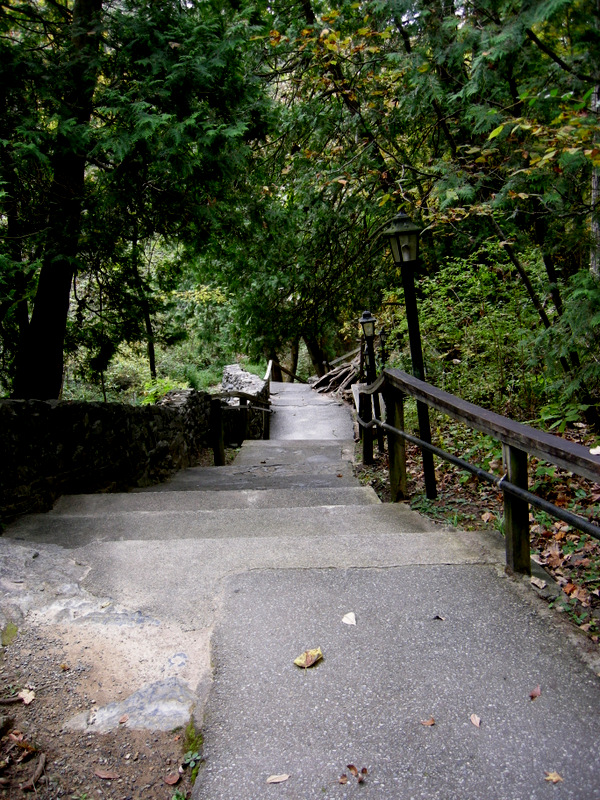
You enter the gorge where the bridge is located down this steep stairway through the woods (or you can take a shuttle bus).

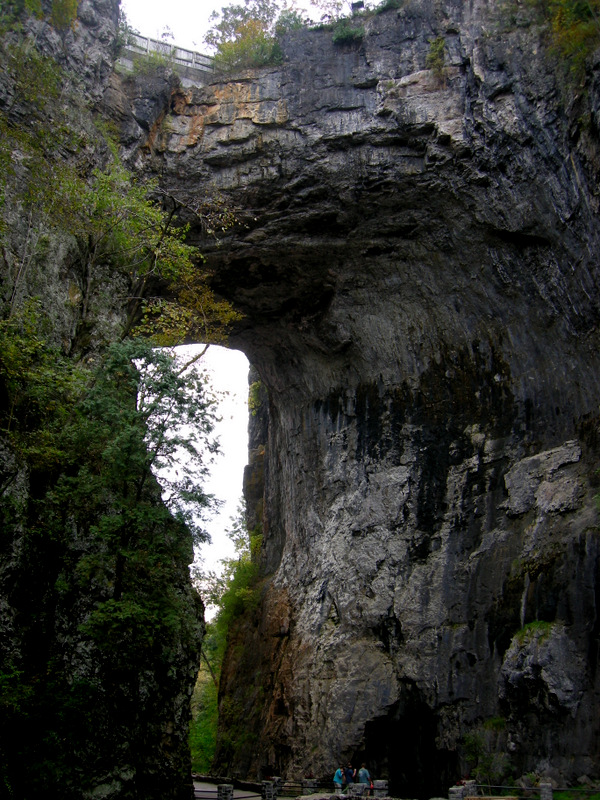
The Natural Bridge was created when an underground cavern, carved by Cedar Creek, a tributary of the James River, collapsed and left behind a span of its rock roof 215 feet high and 90 feet wide.  It is the kind of mammoth natural site that we normally only find in the western US.  The bridge is so big and substantial that Route 11, the state highway, runs across the top of it, and you don’t even notice the road.

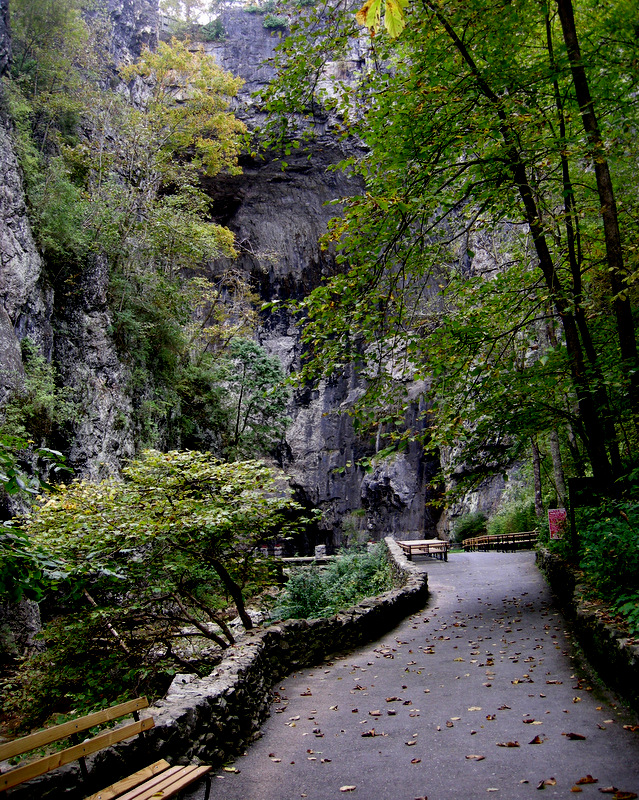
The trail to the bridge is lovely and runs along Cedar Creek, a tributary of the James River.

The Natural Bridge is not only a natural wonder, but it is also a very significant  historic site. It is on the National Register of Historic Places and has been selected from that list of 65,000 to be one of only 2,430 National Historic Landmarks. The Natural Bridge was a sacred site of the Monacan Indians.  In 1750, it was surveyed by George Washington for Lord Fairfax, the owner of the original Virginia land grant of 1649.  In 1774, it was purchased by Thomas Jefferson as part of a 157 acre parcel acquired from King George III for 20 shillings.  Jefferson built a log cabin retreat there and entertained many famous guests.

When you see the Natural Bridge with people in front of it (bottom middle), you get an idea of how gigantic it is.

Like Niagara Falls, the Natural Bridge has been a tourist site since the late 18th century.  An inn was built in 1833, and today there is an on site hotel.  The property has always been privately owned and remains so today.  With tourist dollars a motivation for private owners, the surrounding area is somewhat degraded by unrelated attractions, including a wax museum, live butterfly exhibit, toy museum, and an extensive gift shop.  However the bridge area remains pristine, and the bridge itself is spectacular.  My photos taken on an overcast and dreary day do not do it justice.

Route 11 runs along the top.

The rock walls that line the gorge are very beautiful.

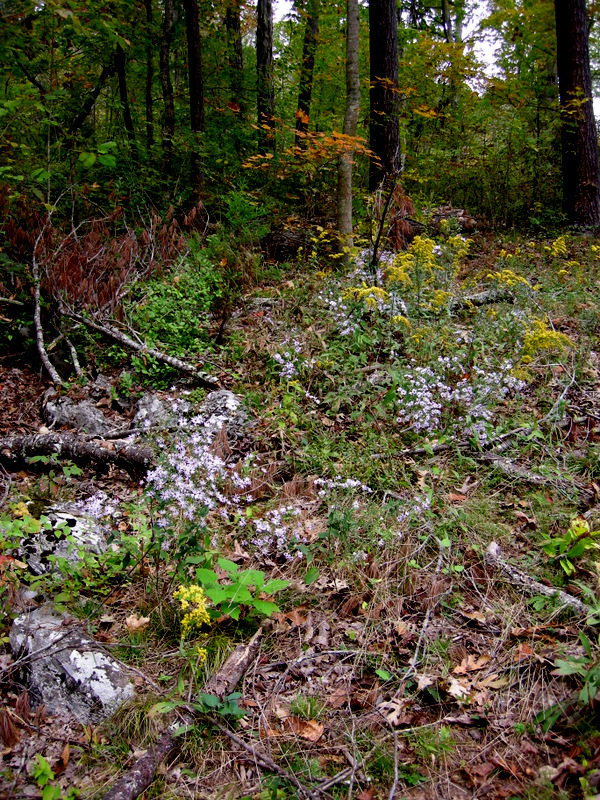
Along the trail we saw a lot of mostly native flora and fauna (I don’t know the exact IDs so no labels except the bird is a great blue heron):


When we were there, we also toured the Natural Bridge Caverns, the deepest caverns on the East Coast.  I didn’t take any photos, but the caverns were as spectacular as the bridge and well worth a visit.

Carolyn


Nursery Happenings:  Carolyn’s Shade Gardens is done for the fall.  Thanks for a great year.  See you in spring 2013.

If you are within visiting distance and would like to receive catalogues and information about customer events, please send your full name and phone number to carolynsshadegardens@verizon.net.  Subscribing to my blog does not sign you up to receive this information.

Facebook:  Carolyn’s Shade Gardens has a Facebook page where I post single photos, garden tips, and other information that doesn’t fit into a blog post.  You can look at my Facebook page here or click the Like button on my right sidebar here.

Notes: Every word that appears in orange on my blog is a link that you can click for more information.  If you want to return to my blog’s homepage to access the sidebar information (catalogues, previous articles, etc.) or to subscribe to my blog, just click here.
 

Your Most Precious Garden Resource

Posted in Fall, Fall Color, green gardening, How to, organic gardening, sustainable living with tags , , , , on October 25, 2012 by Carolyn @ Carolyns Shade Gardens

Carolyn’s Shade Gardens is a retail nursery located in Bryn Mawr, PA, specializing in showy, colorful, and unusual plants for shade.  The only plants that we ship are snowdrops and miniature hostas.  For catalogues and announcements of events, please send your full name, location, and phone number (for back up use only) to carolyn@carolynsshadegardens.com.  Click here to get to the home page of our website for catalogues and information about our nursery and to subscribe to our blog.

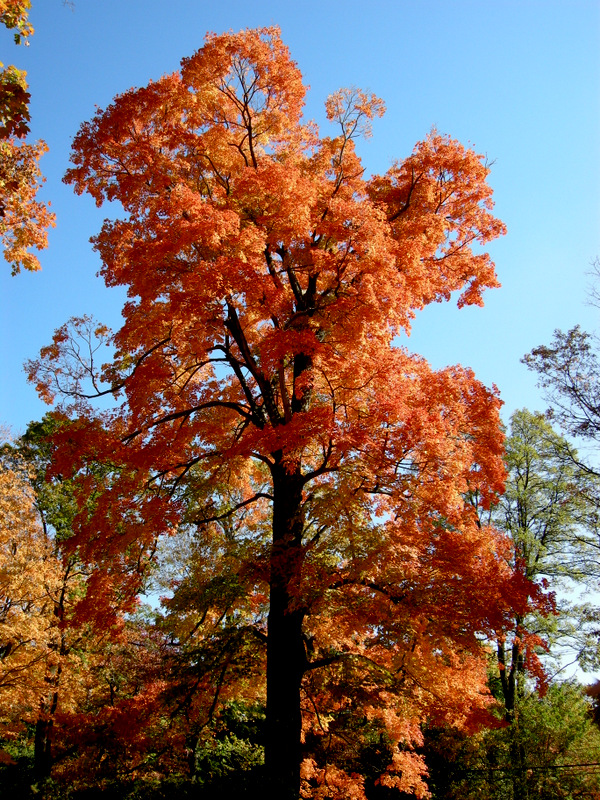
Yes, the sky is really this blue and the trees are really this red during fall in the northeastern US.

Fall in Pennsylvania (mid-Atlantic US) is a big picture time of year.  For a good two months, everywhere you go there are gorgeous vistas like the one above as the leaves change color before dropping.  The show is long-lasting because the leaves turn at different times, starting in my garden with the American hornbeam’s golden yellow hue, progressing through the bright red tones of maples and native dogwoods, and ending with the burgundy and orange of hydrangeas and viburnums.


The soil is deep and very fertile in my area, allowing trees to grow to gigantic size.  And after the color show, the leaves fall and create what I consider my most precious garden resource.  Those leaves are what nature supplies for free to protect and improve the soil year after year.  That is why it is so disturbing to see many area residents collecting their leaves and putting them by the side of the road to be removed by their municipality.


Here at Carolyn’s Shade Gardens we use every leaf that falls to improve our soil either by leaving them in the beds or by grinding them and using them as mulch.  A detailed description of our methods can be found in Shade Gardening in Fall: Fall Clean-up.  In addition, up to 18″ of leaves can be ground up and left on the lawn with beneficial results as described in Shade Gardening in Fall: Leaves on the Lawn.  There is a video by the Scott Lawn Care Company in the second post to show to your doubting spouse.

In early October, about 35 Carolyn’s Shade Gardens customers attended two Low Maintenance Gardening Seminars given by my husband Michael during which he demonstrated how to grind leaves for mulch.  For the benefit of my far flung readers  and in the hope of converting more gardeners to this practice, I thought I would show you step-by-step photographs of the process.  Michael is the reluctant star of the do-it-yourself guide below.

Step One:  Gather the leaves from an area where they can’t be left to decompose on their own.  Michael is removing leaves from the pine needle paths on our back hill using a tarp.  All leaves in the beds will remain in place as mulch and eventually compost.

Step Two:  Take the leaves to a level area like your lawn or driveway.  Our driveway is closest to the back hill so Michael took the leaves there for grinding.

As you can see in the photo, we use a standard lawnmower to grind our leaves.  We recommend wearing steel-toed footwear, ear protection (see photo below), and, if appropriate, eye protection when using a lawnmower.


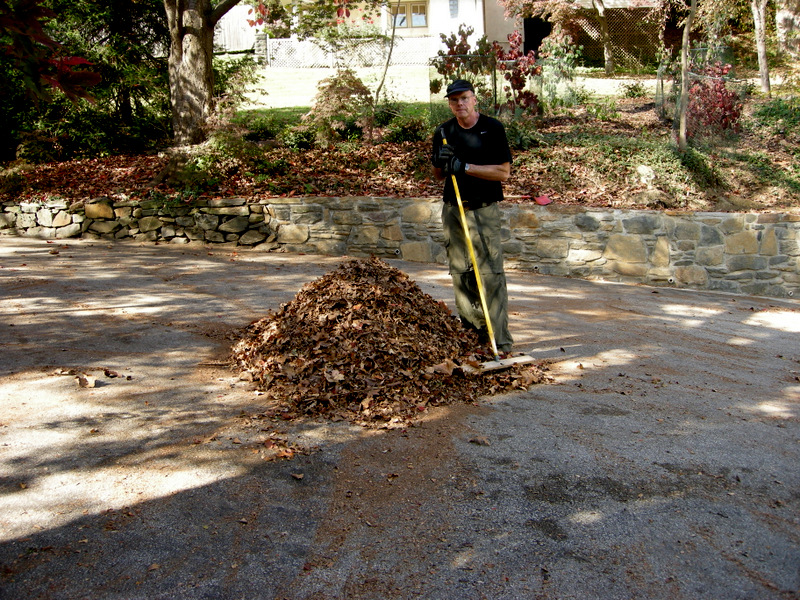
Step Three:  Grind the leaves to the required consistency.  Michael usually goes over them twice, but you can make them as fine or as coarse as you want.


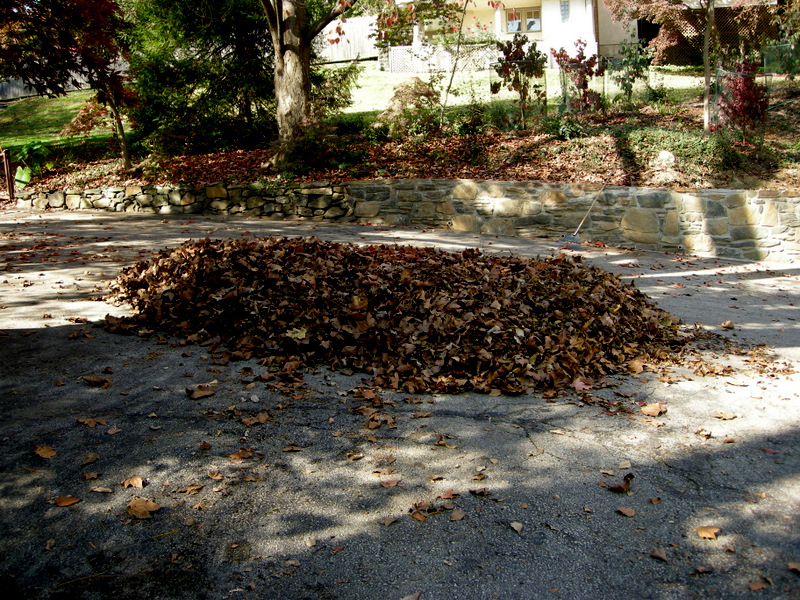
A large amount of leaves becomes a manageable pile after grinding.


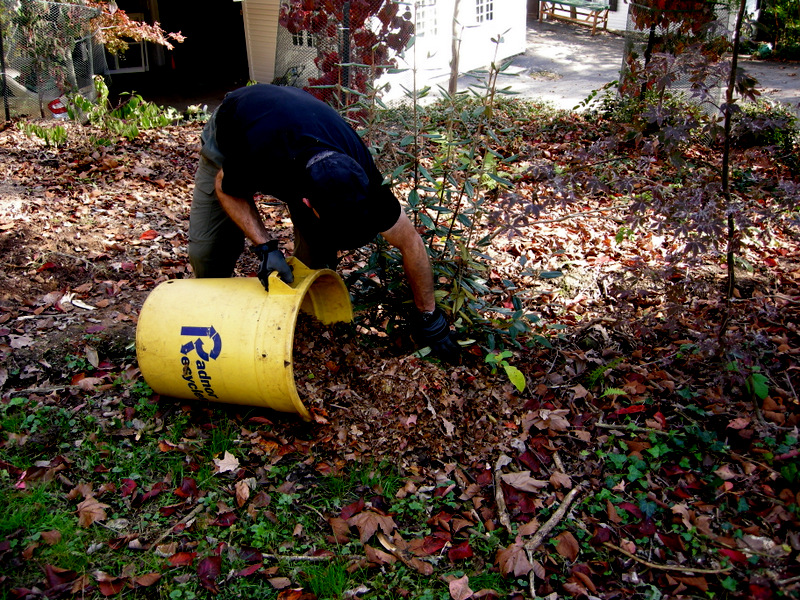
Step Four:  Gather your free mulch into a container for easy transportation and application.  Michael is using a township recycling barrel.


Step Five:  Spread the mulch in your garden.  Here Michael uses it around the base of newly planted viburnums.

I hope I have made this process look as easy as it really is.  Once you try it and see the beneficial results for your soil, you too will be a convert.

Carolyn


Nursery Happenings:  Carolyn’s Shade Gardens is done for the fall.  Thanks for a great year.  See you in spring 2013.

If you are within visiting distance and would like to receive catalogues and information about customer events, please send your full name and phone number to carolynsshadegardens@verizon.net.  Subscribing to my blog does not sign you up to receive this information.

Facebook:  Carolyn’s Shade Gardens has a Facebook page where I post single photos, garden tips, and other information that doesn’t fit into a blog post.  You can look at my Facebook page here or click the Like button on my right sidebar here.

Notes: Every word that appears in orange on my blog is a link that you can click for more information.  If you want to return to my blog’s homepage to access the sidebar information (catalogues, previous articles, etc.) or to subscribe to my blog, just click here.
 

Fall-blooming Hardy Cyclamen

Posted in bulbs for shade, evergreen, Fall, Fall Color, groundcover, Shade Gardening, Shade Perennials, winter interest with tags , , , , on October 17, 2012 by Carolyn @ Carolyns Shade Gardens

Carolyn’s Shade Gardens is a retail nursery located in Bryn Mawr, PA, specializing in showy, colorful, and unusual plants for shade.  The only plants that we ship are snowdrops and miniature hostas.  For catalogues and announcements of events, please send your full name, location, and phone number (for back up use only) to carolyn@carolynsshadegardens.com.  Click here to get to the home page of our website for catalogues and information about our nursery and to subscribe to our blog.

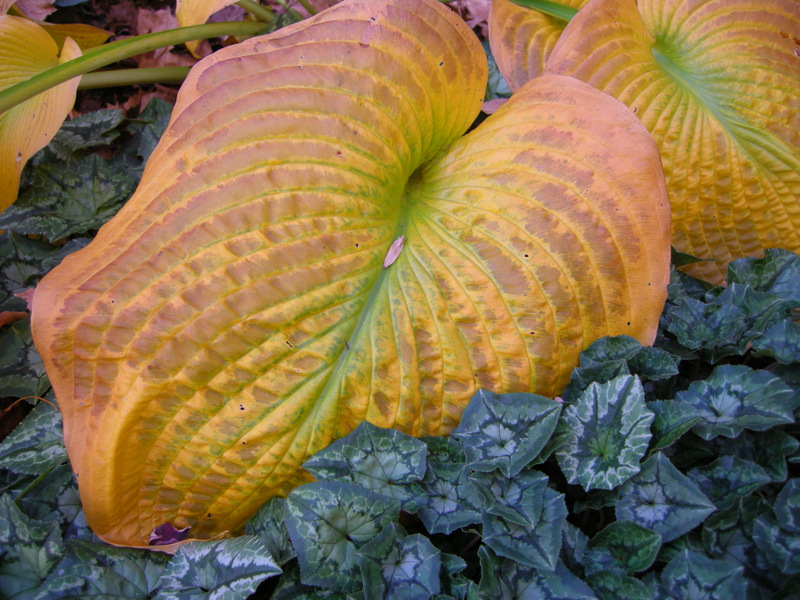
Fall-blooming hardy cyclamen, C. hederifolium,  used as a groundcover under Hosta ‘Blue Angel’ 11/13/10.

My last post on hardy begonias sparked such interest and comments that I thought I would profile another unusual star performer for fall.  Like the begonia, I learned about hardy cyclamen at a course I took at Longwood Gardens in Kennett Square, PA, this one on bulbs in 1995.   And just like the begonia, I couldn’t believe that there was a plant that looked like my florist cyclamen house plant but grew outside and came back every year.  I talked about hardy cyclamen in my post on More Flowering Wintergreen Groundcovers for Shade, but I want to profile it in more detail here and include more photos.

Fall-blooming hardy cyclamen

There are several species of hardy cyclamen, but the two that are usually available are fall-blooming Cyclamen hederifolium and spring-blooming Cyclamen coum.  I have them both and love them, but if you are just starting out, the fall-blooming variety is much easier to grow.  Cyclamen coum requires the kind of excellent drainage rarely found in mid-Atlantic gardens.  I grow mine most successfully in my rock garden and also less abundantly between tree roots.

Hardy cyclamen begins to bloom in the fall before its leaves re-emerge from summer dormancy.

The life cycle of hardy cyclamen is unusual.  I guess you could say it begins in September when dozens of small pink flowers begin to bloom before the leaves emerge.  Each flower is on a separate 4 ” stem and looks just like a miniature florist cyclamen flower with gorgeous reflexed petals.  The flowers continue to be produced abundantly in succession through out the months of September and October and sometimes for parts of August and November too.  They are said to be fragrant, but I have never noticed a scent.

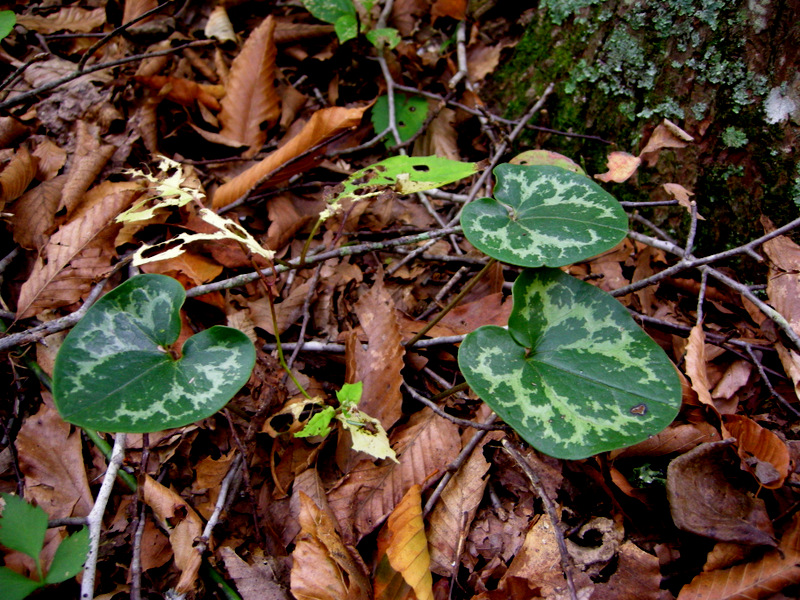
I would grow hardy cyclamen just for the flowers, but the leaves are spectacular.  They emerge slowly as the flowers are blooming in late September and take several weeks to reach their full size.  “Variable” is an understatement to describe their wonderful shapes, patterns, and colors.  They can be round to lance-shaped, lobed or entire, serrated or smooth edged, dark green to silver.  And the patterns on the leaves are indescribable, I will just have to show you….


Now that you have seen how gorgeous the leaves are, you will be able to truly appreciate another of their wonderful qualities: they stay green and fresh all winter!  The photos above were taken in November but I could just as easily have captured their glory in March.  Instead of going dormant in the winter like most of our plants, hardy cyclamen goes dormant for a few months during the summer.

White hardy cyclamen, C. hederifolium ‘Album’

There is a lovely white cultivar of fall-blooming hardy cyclamen called ‘Album’.  Some of mine have pure white flowers and others have white with a pink blotch.  It is just as hardy as the parent species and seeds around my garden readily.

Hardy cyclamen growing between roots at the base of  tree.

Hardy cyclamen is native to western Turkey, eastern Europe, including Albania, Bulgaria, and the Balkans, and southern Europe, including France, Italy, and Greece.  It is  a woodland plant that requires good drainage and shade.  In fact it thrives on summer drought in dry shade.  Although it likes to grow between tree roots and rocks, I have success with it in any shaded eastern facing, dry location.  As you can see from the photo below, my plants seed prolifically and eventually fill in to make a solid mat of groundcover.

Seedlings emerging in a new location across from an established patch with no help from me.  I have a feeling that ants move the seeds around.

Hardy cyclamen grows from a corm, which reportedly can reach the size of a dinner plate when old.  There are growing points all over the top of the corm.  If you try starting the plant this way, plant the corms with no more than 1″ of soil on top plus a very light mulch of leaf litter.  I have never done this because I have read many times that dried corms do not establish well and are often collected from the wild.  I started all my patches from established potted plants and that is how I sell hardy cyclamen at my nursery.  Look for it in my 2013 Snowdrop Catalogue.

The top of corms (about 2 1/2″ wide) of hardy cyclamen with the leaves starting to emerge.  The corms are spherical when younger.

The bottom of the corms—this side down.

The hardiness zone information for hardy cyclamen is inconsistent.  Some sources say USDA zones 7 to 9.  The Missouri Botanical Garden plant finder lists it for zones 5 to 9, while other sources say it grows successfully in upstate NY in zone 4.  You will just have to try it.  For all my UK readers, hardy cyclamen received an Award of Garden Merit from the Royal Horticultural Society.

Carolyn

P.S.  When I pushed the Publish button, I found out that this is my hundredth post—kind of exciting!!!

Nursery Happenings:  Carolyn’s Shade Gardens is done for the fall.  Thanks for a great year.  See you in spring 2013.

If you are within visiting distance and would like to receive catalogues and information about customer events, please send your full name and phone number to carolynsshadegardens@verizon.net.  Subscribing to my blog does not sign you up to receive this information.

Facebook:  Carolyn’s Shade Gardens has a Facebook page where I post single photos, garden tips, and other information that doesn’t fit into a blog post.  You can look at my Facebook page here or click the Like button on my right sidebar here.

Notes: Every word that appears in orange on my blog is a link that you can click for more information.  If you want to return to my blog’s homepage to access the sidebar information (catalogues, previous articles, etc.) or to subscribe to my blog, just click here.
 

Hardy Begonias for Fall Color

Posted in Fall Color, Shade Gardening, Shade Perennials with tags , , , , on October 8, 2012 by Carolyn @ Carolyns Shade Gardens

Carolyn’s Shade Gardens is a retail nursery located in Bryn Mawr, PA, specializing in showy, colorful, and unusual plants for shade.  The only plants that we ship are snowdrops and miniature hostas.  For catalogues and announcements of events, please send your full name, location, and phone number (for back up use only) to carolyn@carolynsshadegardens.com.  Click here to get to the home page of our website for catalogues and information about our nursery and to subscribe to our blog.

The fall-blooming flowers of hardy begonia, B. grandis.

In 1991, I took a perennial plants course at Longwood Gardens in Kennett Square, PA, and was introduced to many wonderful plants that I have since planted in my garden (hellebores being one of them).  One of the most fascinating was hardy begonia or Begonia grandis.  I just couldn’t believe that there was a plant that looked just like my angel wing begonia house plant but grew outside and came back every year.


I can’t remember where I finally located a plant, but hardy begonias soon found their way to my garden and have been multiplying and spreading ever since.  I have noticed that my nursery customers have the same reaction that I did: what is that plant—is an annual?  So I thought I would introduce it to all my readers and recommend it for inclusion in your gardens.


When I say they are like a begonia house plant, I am not kidding.  They grow from tuberous roots and have fleshy succulent stems.  Their leaves are 3 to 6″ long and shaped like an angel’s wing with green on top and red highlights underneath.

The flowers are pale pink and clustered in loose bunches with deep pink stalks.  They bloom from September into November depending on when we get a frost.  The ovary, which persists when the flowers drop, is bright pink, three-winged, and very attractive.

Self-sown hardy begonias in my compost pit

Hardy begonia is native to China and Japan.  It is an upright plant growing to 2 to 3 feet in part to full shade.  Ideally it likes organic, moist soil, but my experience is that it grows anywhere in the shade.  It spreads all over the place at Carolyn’s Shade Gardens and is easily removed by yanking on the stem.  However, I rarely find it in a place I don’t want it.  It has even formed a very nice stand in my compost pit.  The only trick to growing it is that it comes up very late—mid-May in the mid-Atlantic—so you need to remember where it is.

White hardy begonia, B. grandis ‘Alba’


There is a lovely white cultivar of hardy begonia called ‘Alba’.  It has pure white flowers with pale pink stalks.  It is just as hardy as the parent species and seeds around my garden readily.


Hardy begonia looks great everywhere in my garden.  However, I prize it for growing between all my hostas on my back hill.  When the hostas look ratty, it springs up looking fresh and elegant and blooms its heart out.

White hardy begonia growing between hostas.

Before I start an avalanche of emails asking for this plant, I am sold out for the year at the nursery.  However, I always have it available in the spring so look for it in 2013.

Carolyn

Nursery Happenings:  Carolyn’s Shade Gardens is done for the fall.  Thanks for a great year.  See you in spring 2013.

If you are within visiting distance and would like to receive catalogues and information about customer events, please send your full name and phone number to carolynsshadegardens@verizon.net.  Subscribing to my blog does not sign you up to receive this information.

Facebook:  Carolyn’s Shade Gardens has a Facebook page where I post single photos, garden tips, and other information that doesn’t fit into a blog post.  You can look at my Facebook page here or click the Like button on my right sidebar here.

Notes: Every word that appears in orange on my blog is a link that you can click for more information.  If you want to return to my blog’s homepage to access the sidebar information (catalogues, previous articles, etc.) or to subscribe to my blog, just click here.
 

Woody Plants for Shade Part 6

Posted in Camellias, evergreen, Shade Gardening, Shade Shrubs, winter interest with tags , , , , , , , , , , , , , , , , , , , , on September 28, 2012 by Carolyn @ Carolyns Shade Gardens

Carolyn’s Shade Gardens is a retail nursery located in Bryn Mawr, PA, specializing in showy, colorful, and unusual plants for shade.  The only plants that we ship are snowdrops and miniature hostas.  For catalogues and announcements of events, please send your full name, location, and phone number (for back up use only) to carolyn@carolynsshadegardens.com.  Click here to get to the home page of our website for catalogues and information about our nursery and to subscribe to our blog.

‘Early Amethyst’ beautyberry, Callicarpa dichotoma, is available in the current offer but was profiled in a previous woody plant post so I am not describing it here.  However, it is a favorite for fall interest and I wanted to include a photo.  For a full write up of this plant,  go to Woody Plants for Shade Part 3.

My nursery, Carolyn’s Shade Gardens, specializes in perennials for shade with an emphasis on hellebores, unusual bulbs especially snowdrops, hostas particularly miniature hostas, native plants, and ferns.  However, a satisfying shade garden does not consist of just perennials but includes trees, shrubs, and vines.

‘Winter’s Joy’ fall-blooming hardy camellia is another repeat, see this post for details.  I planted one myself last fall, and I would like to add to my previous write up that this camellia has more buds and flowers than any other camellia in my garden.  In 2011, it produced the beautiful flowers pictured above through out the entire winter.  Right now my plant is poised to do it again with hundreds of buds waiting to open.

Despite the need, woody plants for shade are difficult to find in local nurseries.  To fill this gap for my customers, three times a year, I offer woody plants for pre-order.  The plants chosen for the offer are the result of hours of painstaking selection in the shade houses of wholesale nurseries to find the healthiest, most desirable woodies available.


‘Winter’s Snowman’ fall-blooming hardy camellia is another favorite offered previously, see this post for details.  I have written three articles about fall-blooming hardy camellias in general.  If you are interested in finding out more about them, start here Fall-blooming Hardy Camellias Part 3, and you will find links to the first two installments.

 It is now time for my fall 2012 woody offer.  If you are a customer, you should already have gotten an email with all the details.  Blog readers can look at the catalogue on line by clicking here.  My nursery is on site retail sales only.  The only plants I ship are snowdrops in February and miniature hostas later in the season.  However, I hope out-of-town readers will get some good ideas for woody shade plants to look for at their local independent nursery.

The previous three photos are of another repeat: paper bush, Edgeworthia chrysantha, for details click here.  My plants have thrived through the last two hot and dry summers with pristine tropical looking leaves, gorgeous fall-forming buds, and highly fragrant late winter-blooming flowers.  This is truly a shrub with 365 days of interest.

So much for the preliminaries and repeat offerings, let’s get to the new plants.  There are six: three from my favorite group of shrubs, hydrangeas, and three evergreens for winter interest (the camellias are evergreen too).  Here are the details.

Native oakleaf hydrangea, H. quercifolia

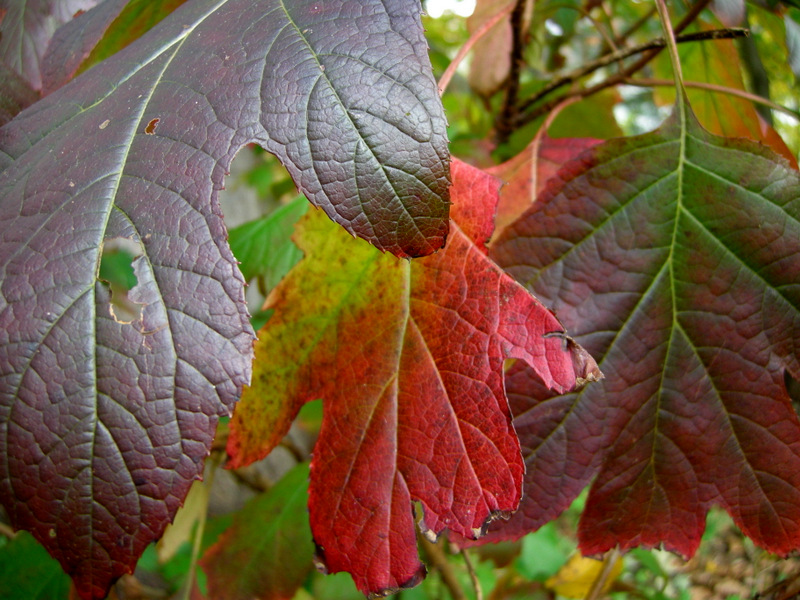
The fall color of oakleaf hydrangea.

Our native oakleaf hydrangea, H. quercifolia, is the best all round shrub for shade—everyone should have at least one!  Huge, long-lasting, upright pyramids of white flowers bloom from May through July. It has bold-textured leaves with heart-stopping burgundy-red fall color, and cinnamon-colored exfoliating bark—a true four season plant. 

The white flowers of ‘Amethyst’ oakleaf hydrangea age to a striking red that does not fade when dried.  Great for flower arranging.

I am offering ‘Amethyst’ native oakleaf hydrangea, a new cultivar selected because  its initially white flowers turn to a striking red color and stay that way.  It grows to 5 to 6’ tall and 5 to 6’ wide in sun to full shade.  It is hardy in USDA hardiness zones 5 to 9, walnut and drought tolerant, and native to the southeastern US.


‘Blue Bird’ sawtooth hydrangea, H. serrata


‘Blue Bird’ sawtooth hydrangea produces lovely blue lacecap flowers starting in June for an extended period.  Acid soil results in the best blue tint.  I also grow it for its beautiful clean bright green leaves through out the season, which are enhanced by red highlights in the fall.  It is very tolerant of cold temperatures avoiding bud and twig dieback in harder winters.  ‘Blue Bird’ reaches 4′ tall and 4′ wide in part to dappled shade and grows in zones 5 to 9.  Sawtooth hydrangea is native to Korea and Japan.

This photo shows ‘Endless Summer’ bigleaf hydrangea, H. macrophylla, right now.  Yes, it is loaded with fresh flowers and buds and has been blooming since late spring.

‘Endless Summer’ bigleaf hydrangea sports very large pink or blue mophead flowers from late spring through summer and well into fall—it’s in full bloom right now as you can see from the photo above.  It represents a recent breakthrough in hydrangeas because it blooms on old and new wood giving it an extended bloom season.  This also means that if the buds formed on old wood the previous season are frozen over the winter, buds will form on new wood as the season progresses.  ‘Endless Summer’s’ large, medium green leaves provide a pleasing backdrop for the flowers.  It grows in zones 4 to 9 and reaches 4′ tall and 4′ wide in part shade.  It is recommended for full sun only with supplemental watering.  Bigleaf hydrangea is native to Japan.

‘Gold Dust’ Japanese aucuba, A. japonica, is an elegant specimen for deep shade.

A close up of the unusual leaves of ‘Gold Dust’ Japanese aucuba—glorious in winter.

‘Gold Dust’ Japanese aucuba’s very shiny, broadleaf evergreen leaves sprinkled with yellow spots make it one of the most vibrant and colorful plants to thrive in dense shade.  I have grown it successfully for many years in several areas of my garden that receive no direct sunlight.  It is very vigorous, disease free, and easy to grow as long as you don’t plant it in the sun.  ‘Gold Dust’ grows to 6 to 8′ tall and 4 to 6′ wide in part to dense full shade and is hardy in zones 7 to 9.  Aucuba is native to Japan, and the variegated form was introduced to the west in 1783.

The fall flowers of ‘Rose Creek’ glossy abelia, A. x grandiflora.

‘Rose Creek’ is a compact form of glossy abelia, great for smaller spaces and smaller gardens.

‘Rose Creek’ is a dense and compact glossy abelia that covers itself in a multitude of wonderfully fragrant, showy white flowers continuously from May through September.   When the flower petals drop off, the rosy pink sepals (bud enclosures) remain and are very eye-catching.  The beautiful, glossy evergreen foliage has pink highlights and turns purple in the fall, providing excellent winter interest.  The stems are  crimson red.  ‘Rose Creek’ grows to 2 to 3′ tall and 3 to 4′ wide in part shade or full sun and is hardy in zones 5 to 9.  It is deer resistant and attracts butterflies and hummingbirds.  Glossy abelia is a cross between two Chinese abelia species.

The incredibly shiny leaves of Prague viburnum, V. x pragense, sparkle in the winter.

This photo of the flower of Prague viburnum was kindly lent to me by Monrovia, for their full plant profile, click here.

Prague viburnum’s pink buds open into large, bouquet-like, creamy white flowers in May followed by glossy, persistent black fruit.  Just as ornamental are its very showy, lustrous, dark evergreen leaves.  Prague viburnum reaches 8′ tall and 6′ wide in full sun to part shade and is hardy in zones 5 to 8.  You can grow it in full shade and the leaves will be gorgeous, but it won’t flower very well.  It is fast growing and deer resistant.  It is a cross between leatherleaf and service viburnums, which are both from China.

I hope you have a space in your garden for at least one of these wonderful shrubs for shade.  For more ideas, check out Woody Plants for Shade Parts 1 to 5 using the links provided below:

Part 1,   Part 2,   Part 3,   Part 4,   Part 5

Carolyn

Nursery Happenings:  Shrub orders are due by noon on Wednesday, October 3.  For the catalogue, click here.  We are offering two sessions of a seminar on low maintenance gardening for fall on Wednesday, October 3, and Friday, October 5, from 10 to 11:30 am.  For the details, click here.  Look for a special offer of double hellebores next week.
If you are within visiting distance and would like to receive catalogues and information about customer events, please send your full name and phone number to carolynsshadegardens@verizon.net.  Subscribing to my blog does not sign you up to receive this information.

Facebook:  Carolyn’s Shade Gardens has a Facebook page where I post single photos, garden tips, and other information that doesn’t fit into a blog post.  You can look at my Facebook page here or click the Like button on my right sidebar here.

Notes: Every word that appears in orange on my blog is a link that you can click for more information.  If you want to return to my blog’s homepage to access the sidebar information (catalogues, previous articles, etc.) or to subscribe to my blog, just click here.