Archive for Carolyn’s Shade Gardens

November GBBD: Prime Time

Posted in Camellias, Fall Color, Garden Blogger's Bloom Day, Shade Perennials, Shade Shrubs with tags , , , , , , , , , , on November 15, 2011 by Carolyn @ Carolyns Shade Gardens

Carolyn’s Shade Gardens is a retail nursery located in Bryn Mawr, PA, specializing in showy, colorful, and unusual plants for shade.  The only plants that we ship are snowdrops within the US.  For catalogues and announcements of local events, please send your full name, mailing address, and cell number to carolyn@carolynsshadegardens.com and indicate whether you are interested in snowdrops, hellebores, and/or hostas.  Click here to get to the home page of our website for catalogues and information about our nursery and to subscribe to our blog.

I think Disanthus cercidifolius (no common name) has the best fall color of any plant in my garden.  It is also in full bloom right now (photo below).

It is the middle of the month and time to participate in Garden Blogger’s Bloom Day hosted by May Dreams Gardens where gardeners from all over the world publish photos of what’s blooming in their gardens.  I participate because it is fun and educational for me to identify what plants make my gardens shine at different times of the year.  I also hope that my customers will get some ideas for plants to add to their own gardens to extend their season well into fall.  I am also joining my friend Donna’s Word for Wednesday theme of texture and pattern at her blog Garden Walk Garden Talk.

My garden is located in Bryn Mawr (outside Philadelphia), Pennsylvania, U.S., in zone 6B.


The re-blooming tall bearded iris ‘Clarence’ is a star performer in my fall garden.  It got knocked over by our unseasonable snow storm so it doesn’t look like this now, but it continues to bloom.

In colder months there is a tendency to include GBBD photos of anything with a flower, and I may do that in January.  But fall is still prime time in my gardens (no hard frost yet) so I am showing here only plants that are at their peak between October 15 and November 15 (I do not take all my photos on November 15).  This means that they bloom now (or are still blooming), have ornamental fruit, or feature exceptional fall color during this period.  For more ornamental ideas for fall, see A Few Fall Favorites for Flowers and A Few Fall Favorites for Foliage and Fruit.

Let’s start with perennials:
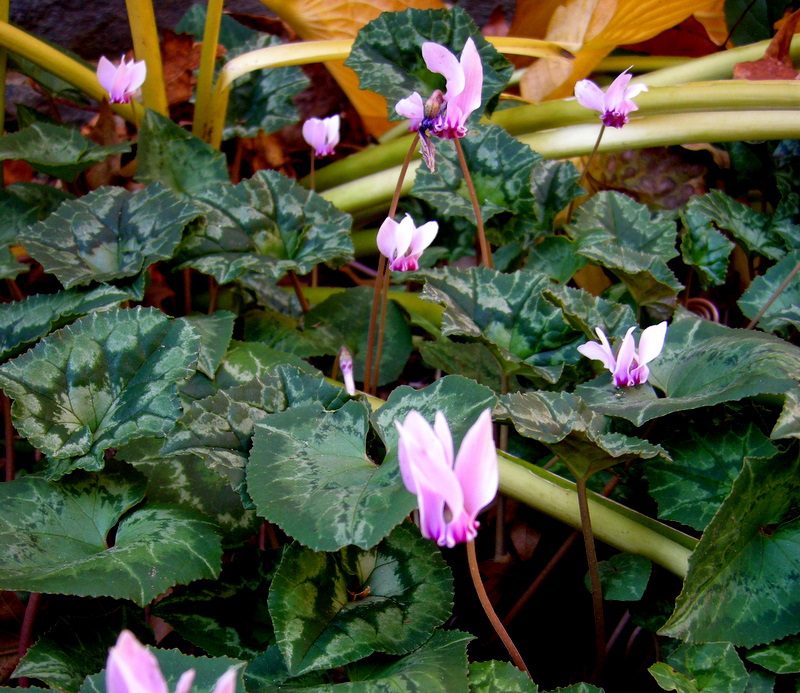
Fall-blooming hardy cyclamen, C. hederifolium, continues to flower through November.
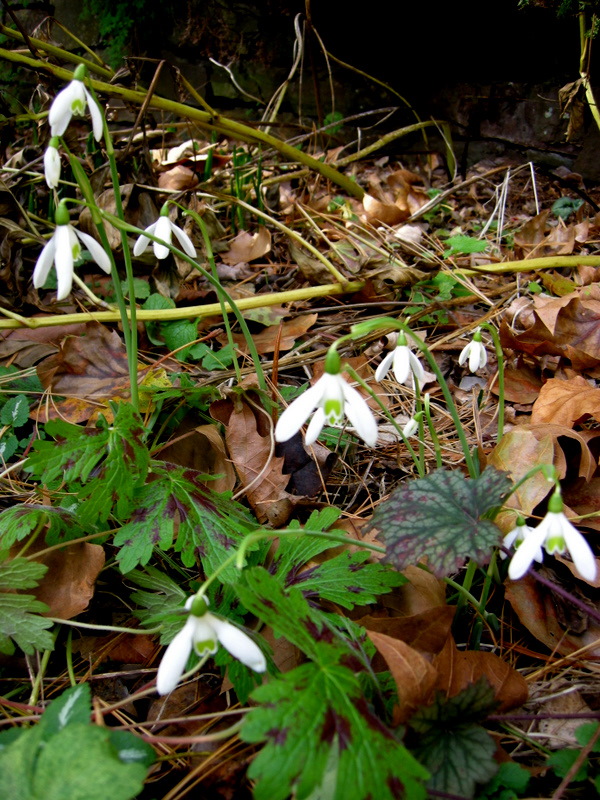
Yes, the snowdrop season has started with Galanthus reginae-olgae, which has been blooming since mid-October.  Fall-blooming ‘Potter’s Prelude’ has just produced its first flowers as has the giant snowdrop, G. elwesii, but they will be featured next month .

When I was touring Chanticleer this spring one of the gardeners gave me a clump of this very late-blooming monkshood, Aconitum sp.  I am not sure what species it is, but I am loving it’s dark violet-blue flowers.
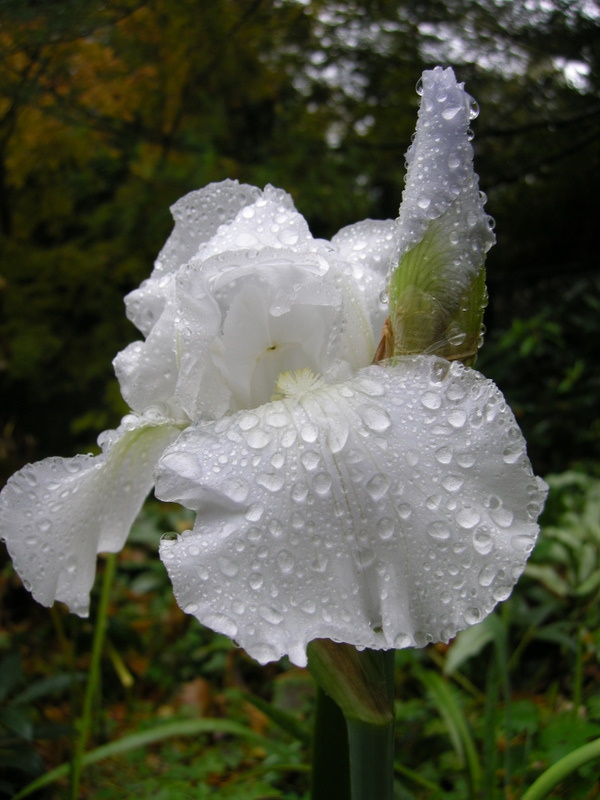
‘Immortality’ is another re-blooming tall bearded iris that puts on a fall show.  I appreciate these flowers much more now when most other showy blooms are gone.

‘Zebrina’ hollyhock mallow, Malva sylvestris ‘Zebrina’, shows up in the most unlikely places in my garden, here my terrace stairs, and produces generous quantities of blooms through fall.
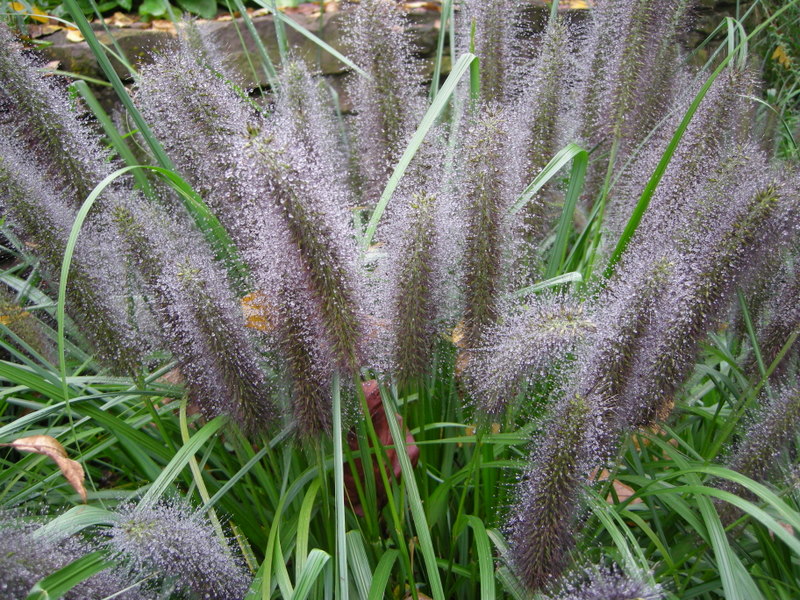
Gorgeous ‘Moudry’ black fountain grass, Pennisetum alopecuroides ‘Moudry’, is one of the most asked about perennials in my fall garden and is well behaved here, but it can spread aggressively in some sites.
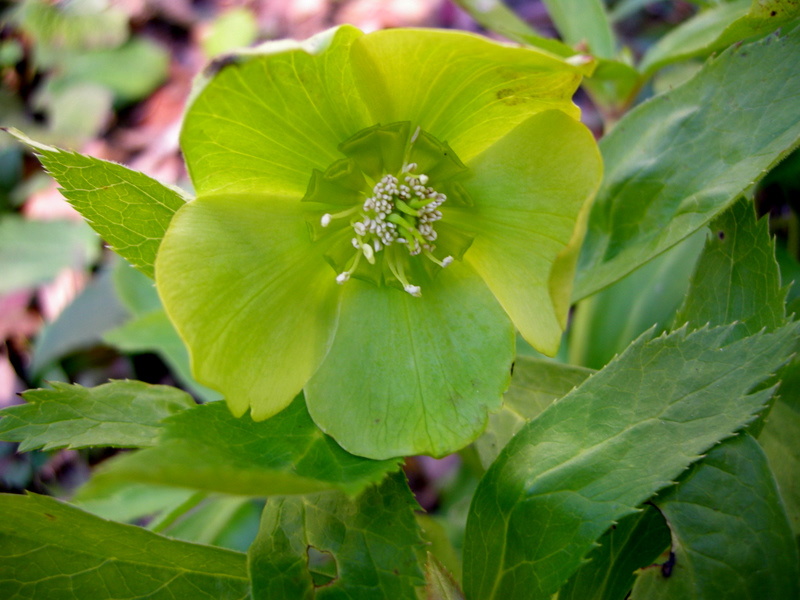
Hellebore season has started too with this little gem that was sold to me as Helleborus dumetorum (no common name), probably mislabeled.  Christmas rose ‘Josef Lemper’ has been blooming for quite a while but has no fresh flowers now.  I will include it next month.

Here are some trees and shrubs that I would grow for their ornamental contribution to the fall garden from flowers or berries:

The award winning hydrangea ‘Limelight’, H. paniculata ‘Limelight’, continues to produce fresh flowers late into fall.
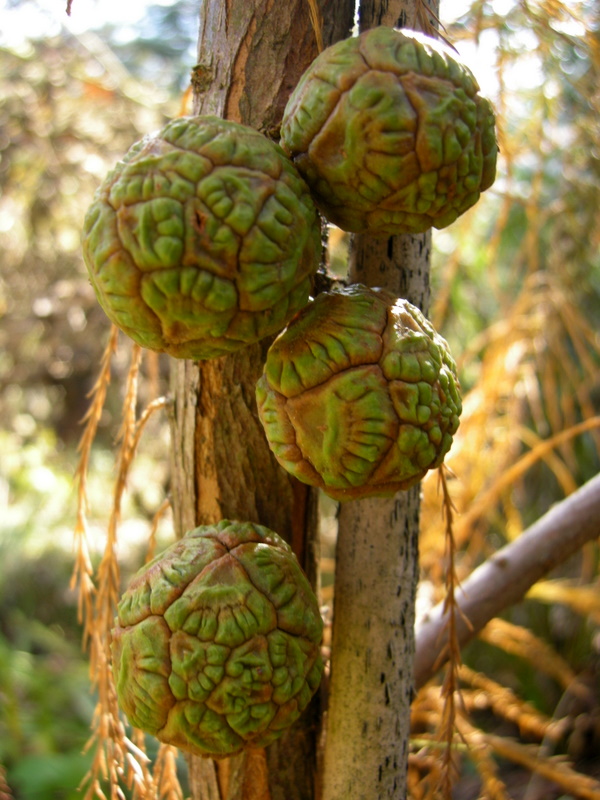
Pond cypress, Taxodium ascendens, is ornamental almost all the time, but I would grow it even if all it did was produce these gorgeous cones.
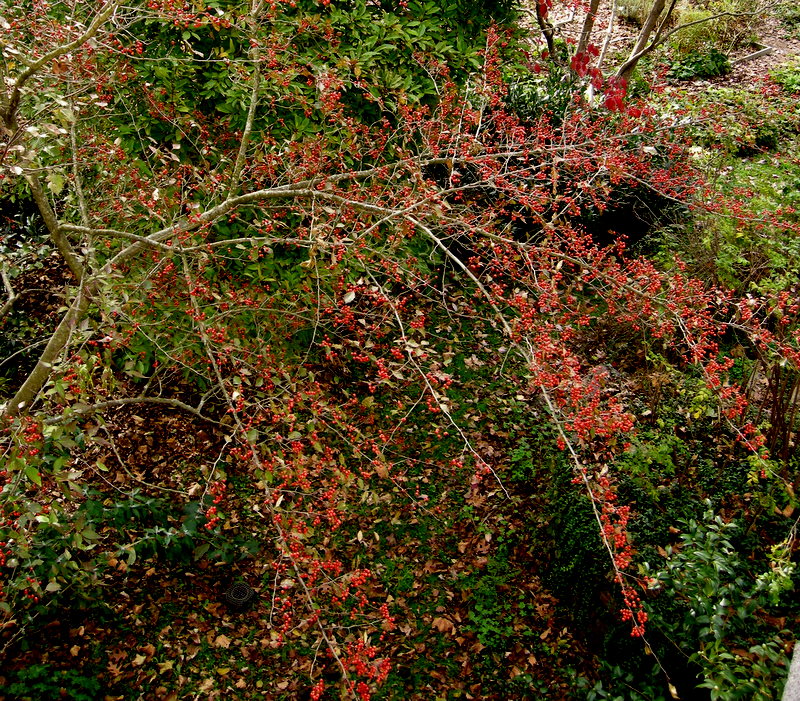
Native green hawthorn ‘Winter King’, Crataegus viridis ‘Winter King’, has produced a bumper crop of berries this year, which the robins are just starting to enjoy.
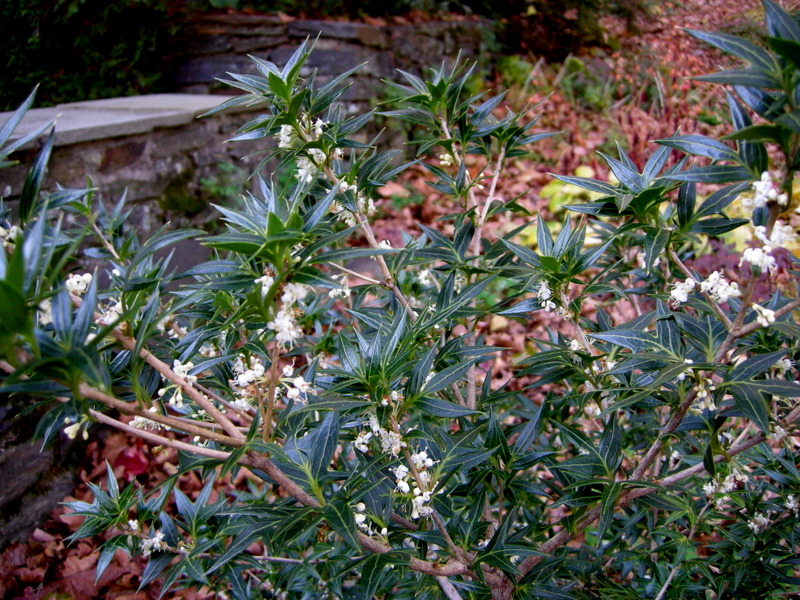
The flowers on my evergreen ‘Sasaba’ holly osmanthus, O. heterophyllus ‘Sasaba’, are small but they make up for their size with their heavenly fragrance which perfumes the whole garden.
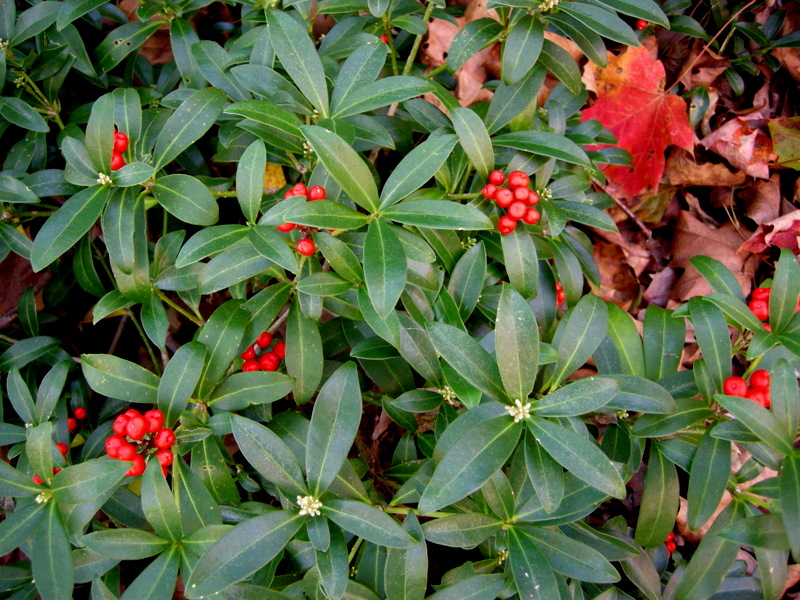
The berries of evergreen Japanese skimmia, S. japonica, persist well into spring.
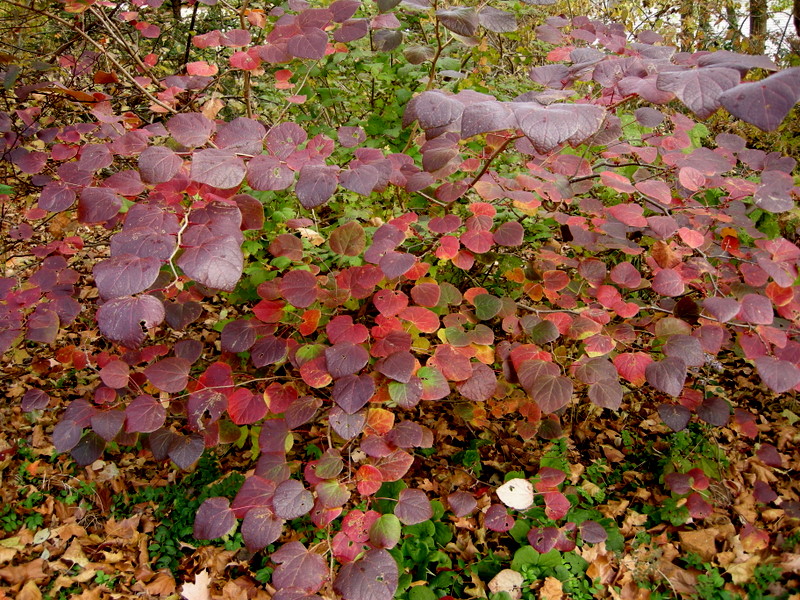
Disanthus cercidifolius is in full bloom right now.
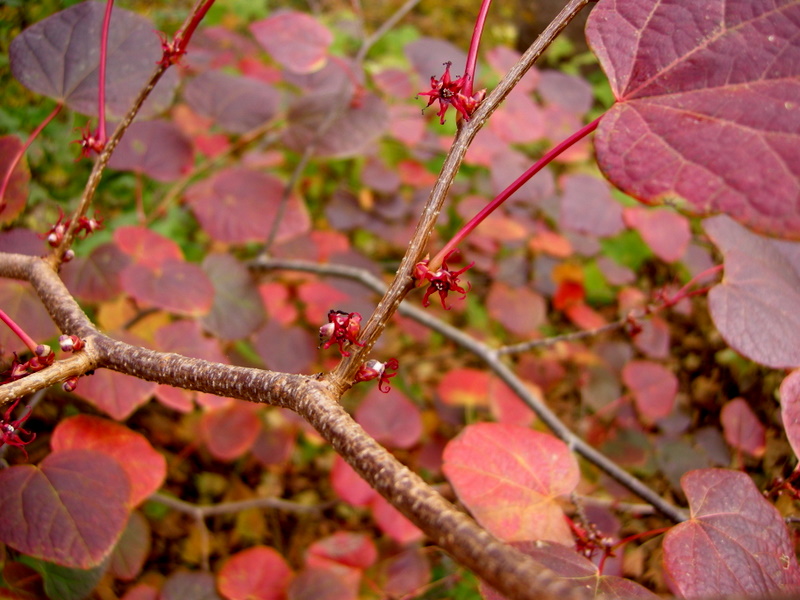
The scarlet flowers are interesting and beautiful, but you have to get quite close to see them.

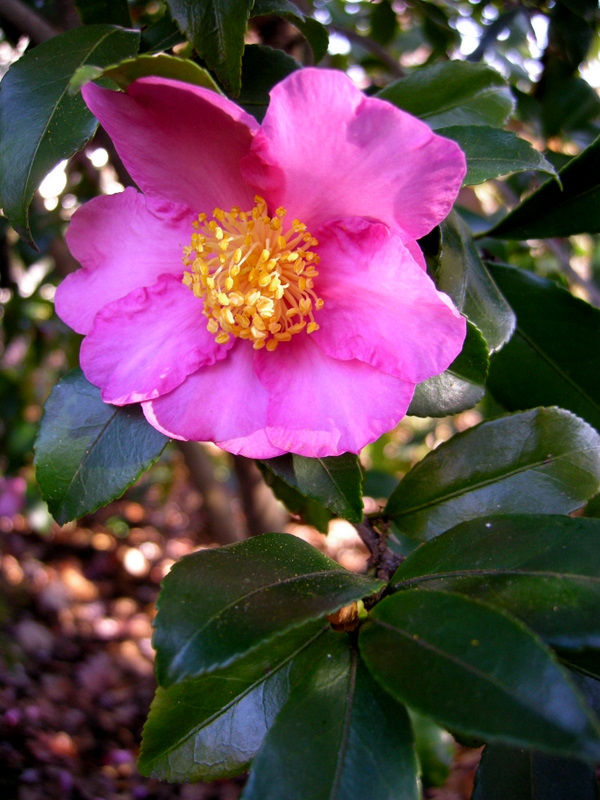
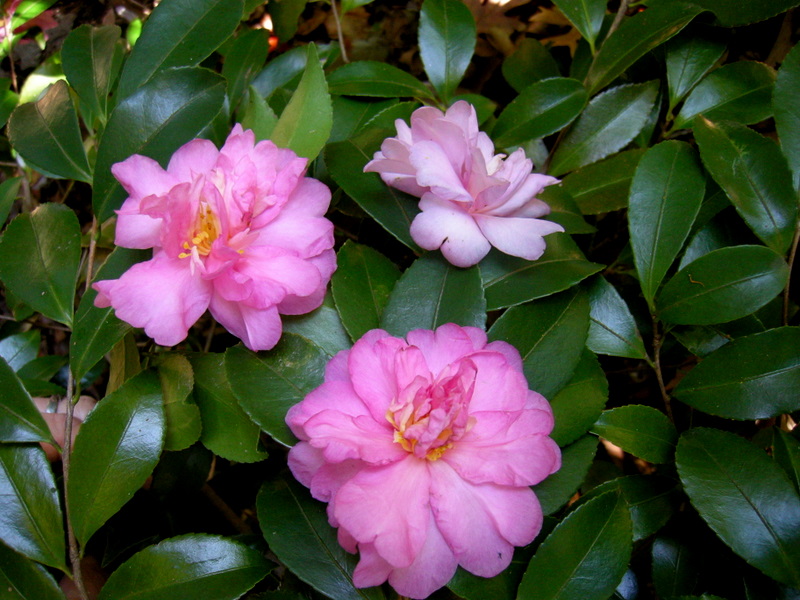
All my fall-blooming camellias are covered with flowers.  The first four pictured below are Ackerman hybrids, which are hardy in zone 6 see Fall-Blooming Camellias Part 1, and the final plant is one of their parents:
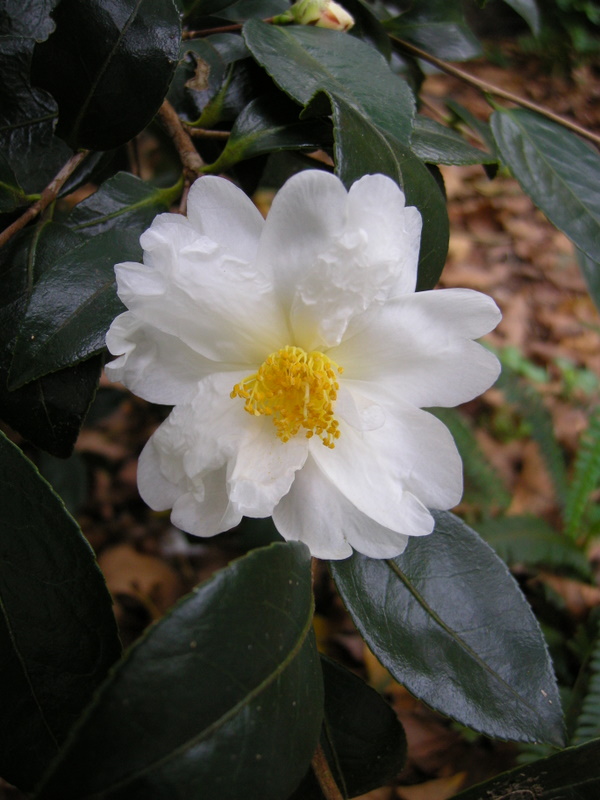
Camellia x ‘Elaine Lee’

Camellia x ‘Winter’s Joy’

Camellia x ‘Winter’s Snowman’

Camellia x ‘Winter’s Darling’

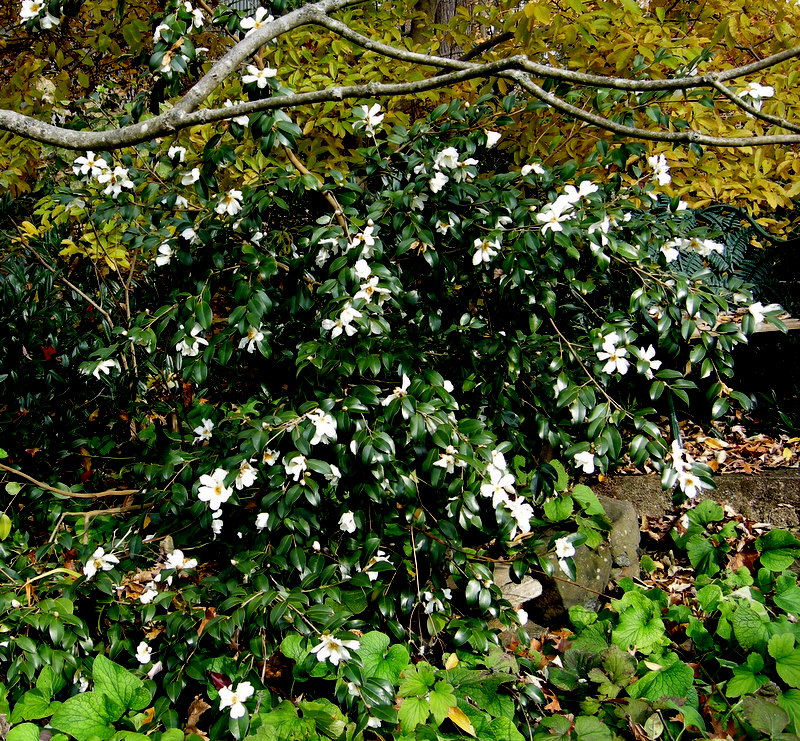
Fall-blooming Camellia oleifera was introduced to the U.S. from China in 1948.  In 1980, Dr. Ackerman at the U.S. National Arboretum noticed that it alone survived the U.S. mid-Atlantic’s cold winters and began crossing it with non-hardy fall-blooming species to produce what are now known as the Ackerman hybrids.  My camellia in the photo above is a seedling from the original C. oleifera ‘Lu Shan Snow’ at the National Arboretum.

There are dozens of plants that are vying to be included on GBBD because of their beautiful fall color.  However, I have decided to showcase only the seven that I think are exceptional, including disanthus pictured above and at the very beginning of the post:
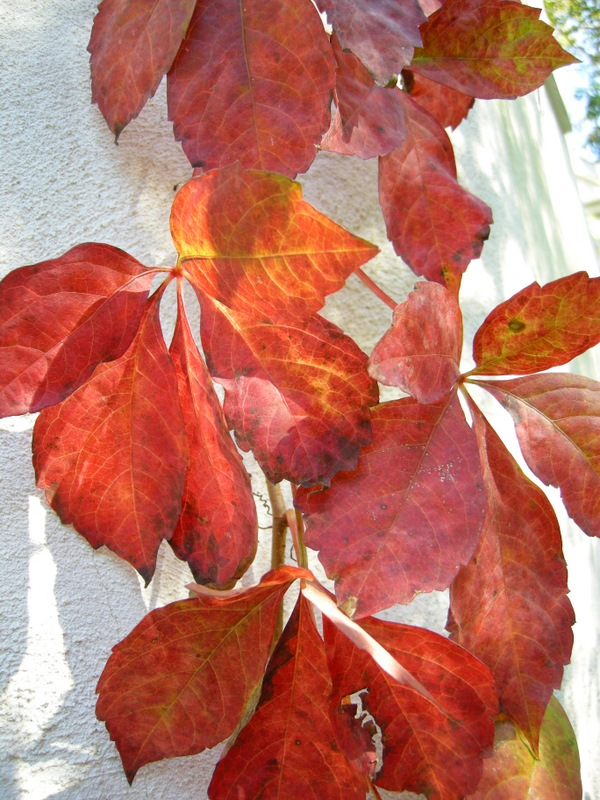
Our Pennsylvania native vine Virginia creeper, Parthenocissus quinquefolia, is underused in gardens especially when you consider its fall look.
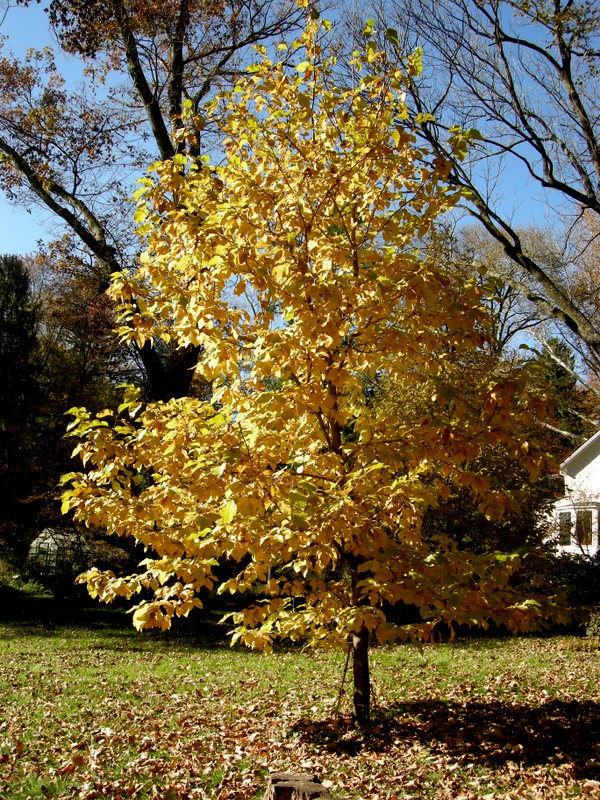
Many magnolias, including star magnolia, turn a lovely yellow in the fall, but native hybrid Magnolia x ‘Yellow Bird’ (named for its yellow flowers) is the most beautiful.
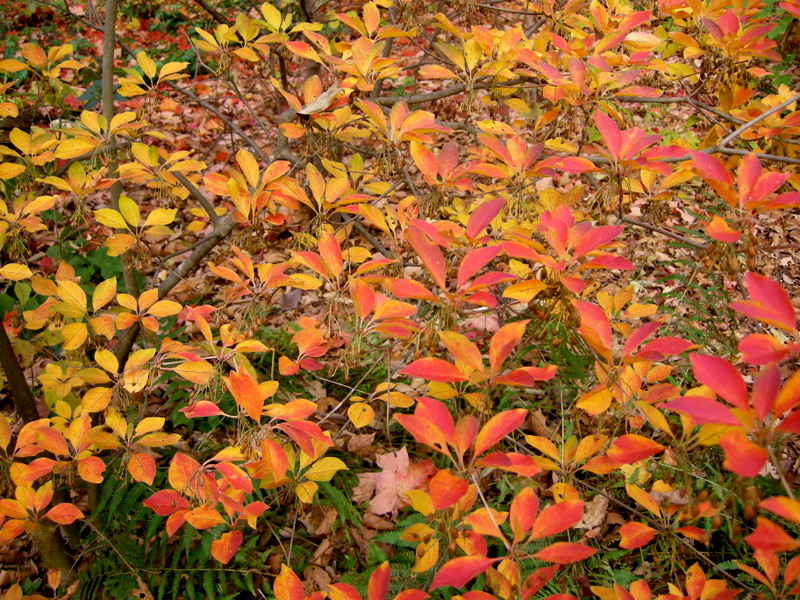
Redvein enkianthus, E. campanulatus

Pennsylvania native oakleaf hydrangea, H. quercifolia, is ornamental 365 days a year, but it definitely reaches one of its peaks in the fall.
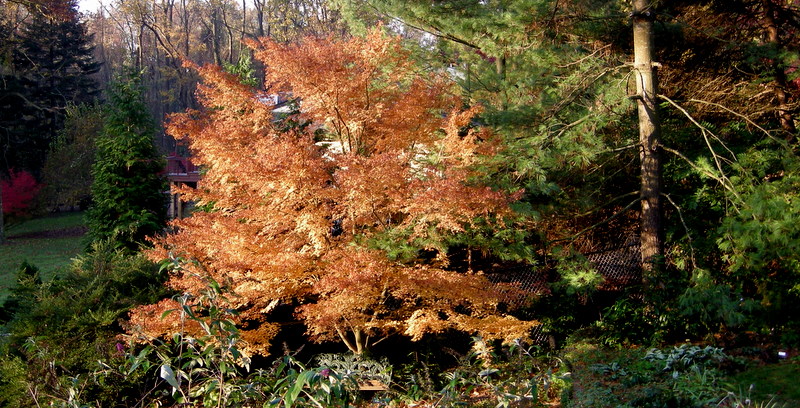
Another woody with 365 days of interest, coral bark maple, Acer palmatum ‘Sango-kaku’, has stunning and long-lasting fall color.  For more information on this lovely tree, read Coral Bark Maple.
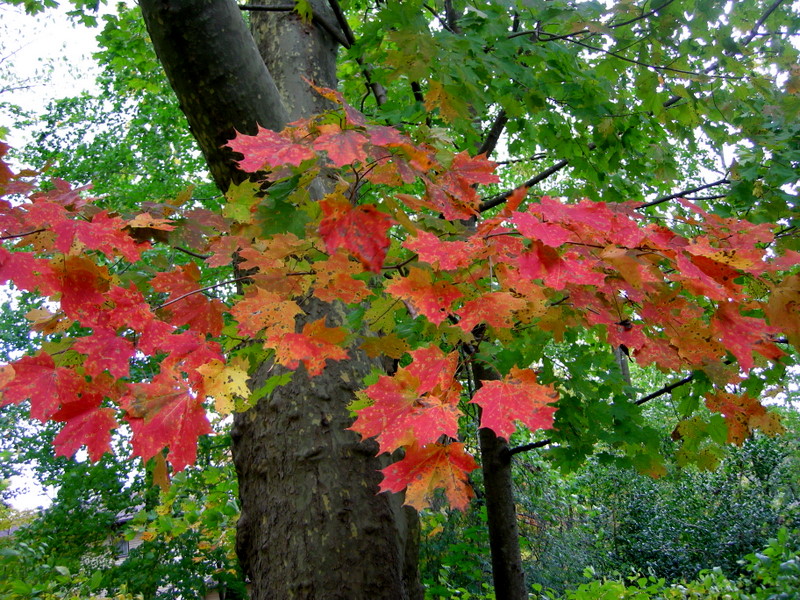
Pennsylvania native sugar maple, Acer saccharum, has gorgeous orange fall color.  Pictured above is a sugar maple tree in my garden that turns red instead of orange.  Sadly, when the iconic Princeton Nursery closed its doors, they had been evaluating it for seven years for possible introduction.

Enjoy your fall,  Carolyn

Notes: Every word that appears in orange on my blog is a link that you can click for more information.  If you want to return to my blog’s homepage to access the sidebar information (catalogues, previous articles, etc.) or to subscribe to my blog, just click here

Fall-blooming Camellias Part 3

Posted in Camellias, evergreen, Fall Color, Shade Shrubs with tags , , , , , , , , on November 10, 2011 by Carolyn @ Carolyns Shade Gardens

Carolyn’s Shade Gardens is a retail nursery located in Bryn Mawr, PA, specializing in showy, colorful, and unusual plants for shade.  The only plants that we ship are snowdrops within the US.  For catalogues and announcements of local events, please send your full name, mailing address, and cell number to carolyn@carolynsshadegardens.com and indicate whether you are interested in snowdrops, hellebores, and/or hostas.  Click here to get to the home page of our website for catalogues and information about our nursery and to subscribe to our blog.

Unnamed camellia developed by William Ackerman who has hybridized many wonderful fall-blooming camellias for the U.S. National Arboretum.  For an article about his camellia introductions, click here.

Last December I wrote two popular articles about fall-blooming camellias.  Fall-blooming Camellias Part 1 explains that these camellias are fully hardy and easy to grow in the mid-Atlantic U.S. and shows photos of my plants.  It also has links to more information.  Part 2 covered my visit to the gardens of camellia expert Charles Cresson in Swarthmore, Pennsylvania, whose camellia collection includes over 60 specimens.  This week I visited Charles’s gardens again, about a month earlier than last time, to view and photograph more camellias (I am an addict now).  In this article, I want to share that visit with you.  On Garden Blogger’s Bloom Day, I will show photos of my own plants in bloom.


Camellia x ‘Snow Flurry’ is one of the earliest flowering fall-bloomers of the Ackerman hybrids with an arching habit and anemone to peony form flowers.

During my time in Charles’s garden, I revisited some of my favorite camellias pictured in my post last December, including ‘Snow Flurry’ above and the cranberry-flowered camellia and ‘Winter’s Snowman’ pictured below.

Cranberry-flowered camellia (not introduced for sale): fall-blooming camellias are loaded with buds right now and will continue to bloom over the next two months, depending on the weather.  Even if the open flowers are frozen during a cold spell, the remaining buds will open when the weather warms.

A close up of the cranberry-flowered camellia pictured above (not introduced)

The large, semi-double flowers of the Ackerman hybrid Camellia x ‘Winter’s Snowman’ really stand out in November and December.  ‘Winter’s Snowman’ has an upright, narrow habit.

Camellia x ‘Winter’s Snowman’:  If you look at my post from last December, you will see that ‘Winter’s Snowman’ can have both the semi-double flower pictured there and the anemone form flower above.  Both  are gorgeous.

Because I visited earlier in the season this year, I was able to photograph seven additional camellias:

Camellia x ‘Winter’s Star’ is an October and November blooming Ackerman hybrid with single flowers and an upright form.

This is a lovely semi-double white camellia hybridized by Charles but not introduced for sale or named.

Camellia x ‘Winter’s Interlude’ is a November and December blooming Ackerman hybrid with anemone form flowers and an upright spreading habit.

This camellia, which Charles grew from cuttings given to him by North Carolina State University, is very beautiful, but has not been introduced for sale.

A close up of the lovely pale pink flower on the North Carolina State camellia pictured above.

Camellia x ‘Moon Festival’ has unusually large flowers with a crepe paper texture, but is hardy only to zone 7.

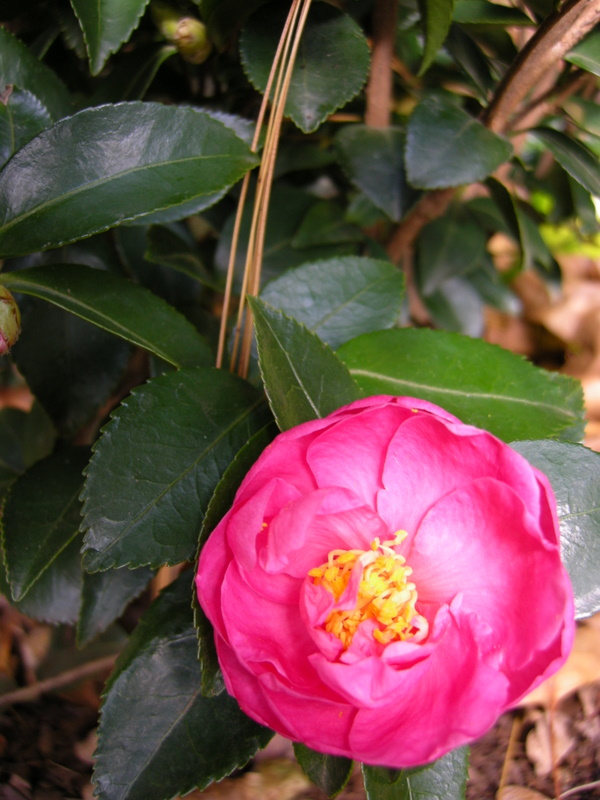
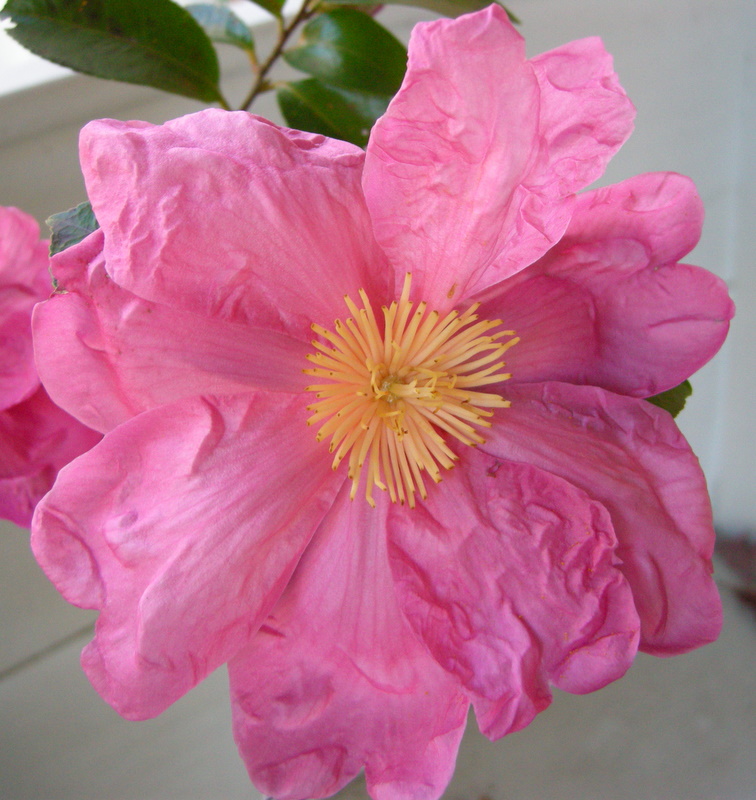
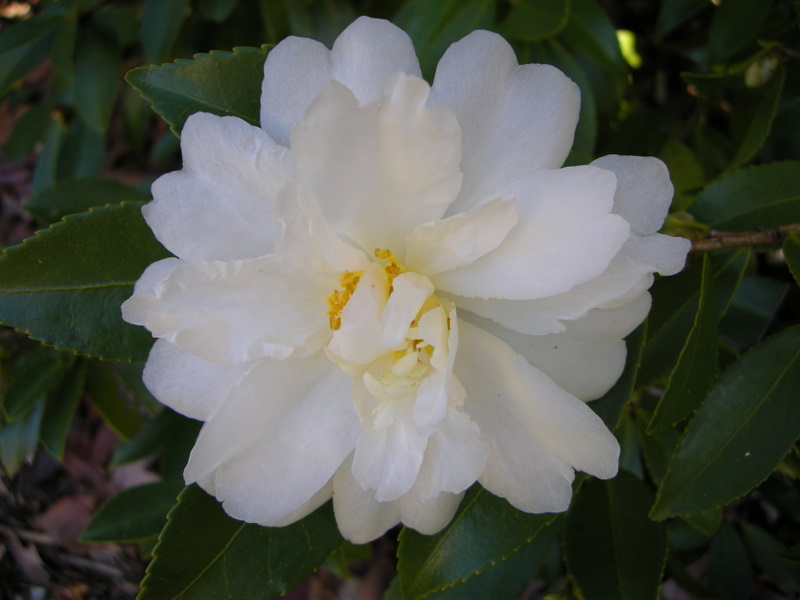
Charles and I both love this unnamed Ackerman hybrid pictured above and at the top of the post.  We were thinking of potential names like “Winter’s Halo” or “Inner Glow”.  Do you think it should be introduced?

Camellia x ‘Carolina Moonmist’ was developed by the J.C. Raulston Arboretum of NCSU with single pink flowers.

Camellia x ‘Carolina Moonmist’: Charles feels that this camellia is too late-blooming for our area because many of the buds won’t open before it is too cold.  ‘Winter’s Star’ is a much better alternative.

I tried to remain focused on camellias for the whole visit, but the garden is so beautiful that some other plants snuck in, and I have to share them:

Fall-blooming hardy cyclamen seedling, C. hederifolium, growing at the base of a massive tree trunk.

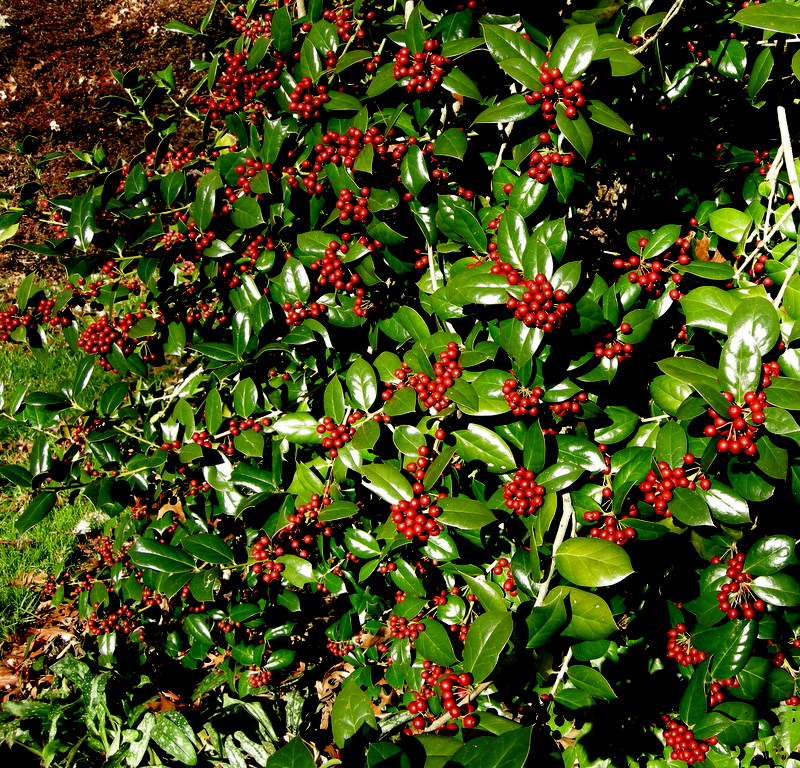
Chinese holly, Ilex cornuta

Japanese maple, Acer palmatum ‘Ornatum’

The fall color of star magnolia, M. stellata.

The fall color of bald cypress, Taxodium distichum.

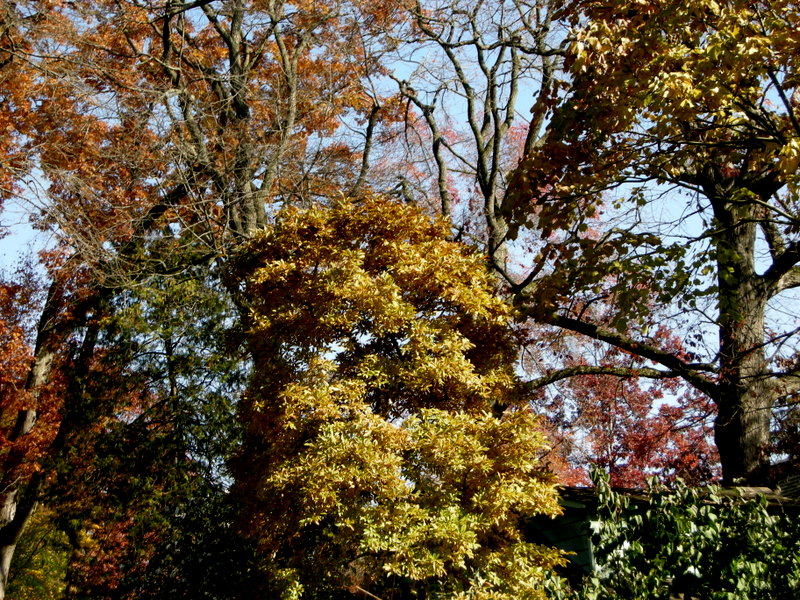
We are so lucky in this part of the world to have such massive trees with gorgeous fall color.

Enjoy,  Carolyn

Notes: Every word that appears in orange on my blog is a link that you can click for more information.  If you want to return to my blog’s homepage to access the sidebar information (catalogues, previous articles, etc.) or to subscribe to my blog, just click here.

Happy Birthday Carolyn’s Shade Gardens

Posted in Uncategorized with tags on November 3, 2011 by Carolyn @ Carolyns Shade Gardens

Carolyn’s Shade Gardens is a retail nursery located in Bryn Mawr, PA, specializing in showy, colorful, and unusual plants for shade.  The only plants that we ship are snowdrops within the US.  For catalogues and announcements of local events, please send your full name, mailing address, and cell number to carolyn@carolynsshadegardens.com and indicate whether you are interested in snowdrops, hellebores, and/or hostas.  Click here to get to the home page of our website for catalogues and information about our nursery and to subscribe to our blog.

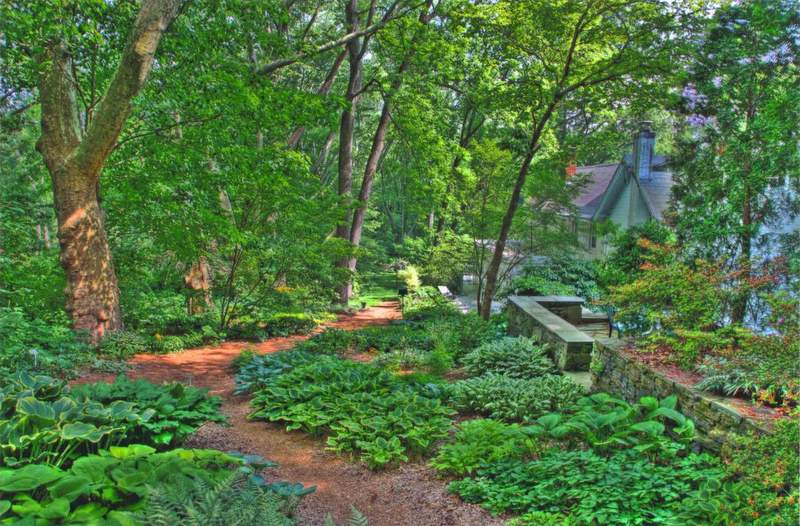
This photo of my display gardens illustrated my first post.

Carolyn’s Shade Gardens’ first article appeared on November 3, 2010, so my blog is one year old today.  When you are one year old, you don’t want to celebrate an anniversary—that’s for adults—you want to celebrate a birthday.  So this is my blog’s first birthday party during which I am going to immodestly and unashamedly (like a one-year-old) celebrate all that my blog has accomplished in the last year, illustrated with some of my favorite collages (click on any collage to enlarge).  You are all invited to celebrate along with me.

Spring flowers at Carolyn’s Shade Gardens

To say that my blog has exceeded my expectations would be an understatement.  Almost every customer who has visited my nursery this year has told me how much they enjoy it.  In addition, in my first year I have had over 81,000 views, and 660 readers are permanent subscribers. 

Epimediums

However, about a week before I started it, I didn’t really know what a blog was or what it could do.  I just knew that I was frustrated because I couldn’t easily communicate to my plant nursery customers all the interesting things that I have learned about shade gardening over the almost 20 years I have been in business (and the 35 years I have been gardening).  I was thinking about a website, but then I realized that a blog is the best of both worlds, an interactive website where I can place basic information that doesn’t change, but also write articles and show photographs of everything that intrigues me about shade gardening.

Primroses at Carolyn’s Shade Gardens

I have published 58 articles in the last year, and when I looked back, I realized that most of them fall into six categories: plant profiles, design, “how to”, places to visit, musings, and sustainability.  As part of the celebration, I want to recap my favorites (I will talk about your favorites later).  To view the actual article, click on the orange link.

Christmas roses, Helleborus niger

If you have been reading this blog and my plant profiles, you know that I love plants and that I am addicted to certain plant groups (genera) about which I won’t shut up.  I am very proud of my six part series on hellebores because, although there is still more to be said about hellebores, a reader will have a very good background on these beautiful, winter-blooming, deer resistant plants after reading my articles. 

I have written a lot about hellebores.

I am also an admitted galanthophile (snowdrop addict) so I enjoyed confessing my love for snowdrops in three parts.  I share a love of hostas with my customers, and it’s fun writing about them, especially the miniaturesCamellias, wintergreen ground covers, and woody plants for shade have also been hot topics.  Finally, I have really enjoyed my Garden Bloggers Bloom Day posts on the fifteenth of the month, highlighting shade plants blooming in my garden.


A galanthophile’s favorite thing

Design articles included Pleasurable Pairings for Spring with some great plant combinations and New Year’s Resolution to Edit the Garden where I urged readers to edit their lives and their gardens.  How to divide hybrid hellebores allowed me to show off an article I wrote for Horticulture magazine and Shade Gardening in Fall: Leaves on the Lawn contains valuable time-saving advice.  Did you know that you can mow up to 18″ of leaves right on your lawn and leave them there? 

Chanticleer, A Pleasure Garden, in Wayne, PA

I have had a lot of fun visiting gardens, nurseries, and horticultural events and writing about my experiences.  The last year included trips to Coastal Maine Botanical Gardens, the Philadelphia International Flower ShowChanticleer, Duke Gardens, and Juniper Level Botanic Gardens, among others. 

Philadelphia International Flower Show

I think I have the most fun writing articles that contain my “musings”.  In I Dream in Latin and Snowdrops: Further Confessions of a Galanthophile, I hope (and thought) I was amusing while discussing some of the intricacies of the plant world.   Readers were intrigued by my unresolved inquiry into whether snowdrops are thermogenic.  My essay on The Joys and Sorrows of Snow struck a chord (and is particularly apropos right now!).  Finally, I was so happy that I was able to communicate my delight in meeting Walter Young of Young’s Perennials in Freeport, Maine. 

Summer flowers at Carolyn’s Shade Gardens

The most important topic covered on my blog, and the one closest to my heart, is sustainability and how all gardeners, including me, can help the environment.  In My Thanksgiving Oak Forest, I described how Doug Tallamy in his book Bringing Nature Home helped me finally understand how important native plants are to our survival.  Part One and Part Two of an article on supporting sustainable living talked about my own efforts in this area.  Powered by Compost, Letting Go: The Lawn, and Fall Clean-up describe some concrete steps everyone can take.


A few of my favorite miniature hostas

Well now you know some of my favorites, but which articles are your favorites?  My blog host, WordPress, has wonderful statistics showing the most viewed posts and the most commented posts.  Views come from three places: my subscribers and customers, other garden bloggers, and Goggle searches, which is probably my biggest source.  My most viewed post by far is Miniature (& Small) Hostas.  The rest of the top five are Evergreen Ferns for Shade, 2011 Snowdrop Catalogue (this is a permanent page not a post), New Shade Perennials for 2011, and New Native Shade Perennials for 2011

European wood anemone, A. nemorosa

Another way of measuring popularity is the number of comments on a post.  However, because most of my comments come from other garden bloggers, most commented usually, but not always, shows which posts they liked the best.  Six out of my top ten most commented posts were written for Garden Bloggers Bloom Day with the most commented being May GBBD: An Embarrassment of Riches.  On GBBD, garden bloggers from all over the world post photos of what’s blooming in their gardens on the blog May Dreams Gardens—it’s a lot of fun.  Setting aside GBBD, articles that many different viewers felt compelled to comment on covered getting rid of your lawn, whether snowdrops are thermogenic, An Ode To Seed Strain Hellebores, miniature hostas, and snow

Green is beautiful.

Which brings me to a completely untintended consequence of my blog—I now communicate on a regular basis with bloggers from all over the U.S. and the world.  I read blogs and get comments from India to Scotland, Australia to Russia, and Jordan to Argentina.  You can click here and run your cursor over the map to see all the locations (my personal favorite is Ascension Island).  Garden bloggers are a really fun group, and I treasure my interactions with them.

Fall flowers at Carolyn’s Shade Gardens

I have three important goals for next year.  First, I would like to improve my photography, particularly my landscape shots.  I will probably need a new camera.  Second, I would like to update the layout of my blog, which terrifies me because I don’t like technology.  Finally, I would like to encourage more comments and questions from my nursery customers.  Just scroll down to the box marked “Leave a Reply” and type something in.  If you are enjoying my blog, you can thank me by using this resource.

Enjoy,  Carolyn

Notes: Every word that appears in orange on my blog is a link that you can click for more information.  If you want to return to my blog’s homepage to access the sidebar information (catalogues, previous articles, etc.) or to subscribe to my blog, just click here.

Shade Gardening in Fall: Fall Clean-up

Posted in Fall, How to, Shade Gardening with tags , , , on November 13, 2010 by Carolyn @ Carolyns Shade Gardens

Carolyn’s Shade Gardens is a retail nursery located in Bryn Mawr, PA, specializing in showy, colorful, and unusual plants for shade.  The only plants that we ship are snowdrops and miniature hostas.  For catalogues and announcements of events, please send your full name, location, and phone number (for back up use only) to carolyn@carolynsshadegardens.com.  Click here to get to the home page of our website for catalogues and information about our nursery and to subscribe to our blog.

fern bench at Carolyn's Shade GardensI always feel a tension around the time of the first expected killing frost.  Everything in the garden is at its fall peak so I don’t want a frost to ruin it.  But I have a lot of work to do outside before it gets truly cold so I want a killing frost to take it all down.  First thing every morning I look out my bedroom window to see if the much dreaded, much desired frost has occurred.

I clean all my beds out in fall because I am too busy with nursery business to do it in spring.  Just like all my gardening, my fall clean-up has evolved from intensive interference to minimal maintenance.  There have been many epiphanies on this journey, but one of two quintessential ah-ha moments occurred during a 1995 visit to Montrose Nursery in NC (now closed).  They were raking the leaves out of their beds, grinding them up, and throwing them back in, even over the crowns of the perennials.

unground leaves at Carolyn's Shade GardensLeaves on my driveway awaiting grinding

ground leaves at Carolyn's Shade GardensLeaves after grinding with lawn mower

I always knew that my leaves were one of my most valuable garden assets.  I never put them out for the township to collect (I grew up in a family where my father collected other people’s leaves to use in his garden).  However, from 1995 on, I have ground my leaves and used them for mulch as nature intended.  The soil in my beds is incredible because of this practice.

I should mention that it’s actually my husband who grinds the leaves so my other great epiphany occurred last fall when he had shoulder surgery and only ground a small amount of leaves for mulch.  Where to use this precious commodity?

In solving this problem, I developed a priority list for fall clean-up. I no longer hand-clean and mulch all my beds, and my workload has been reduced by about 75%.

First Priority: Only the formal beds on the terraces outside my front door and around the back patio need intensive hand-cleaning and my precious mulch in fall.  Those are the beds closest to the house and the parts of the garden I view all winter from inside.

Patio beds at Carolyn's Shade GardensPatio beds before fall clean-up

patio bed at Carolyn's Shade GardensPatio beds after fall clean-up

Patio Area Carolyn's Shade Gardens Early SpringPatio beds in very early spring

Second priority: Beds near the formal areas are cleaned and mulched along the front only.  I remove old plants from the whole bed but no leaves, which are left to act as mulch and break down on their own.

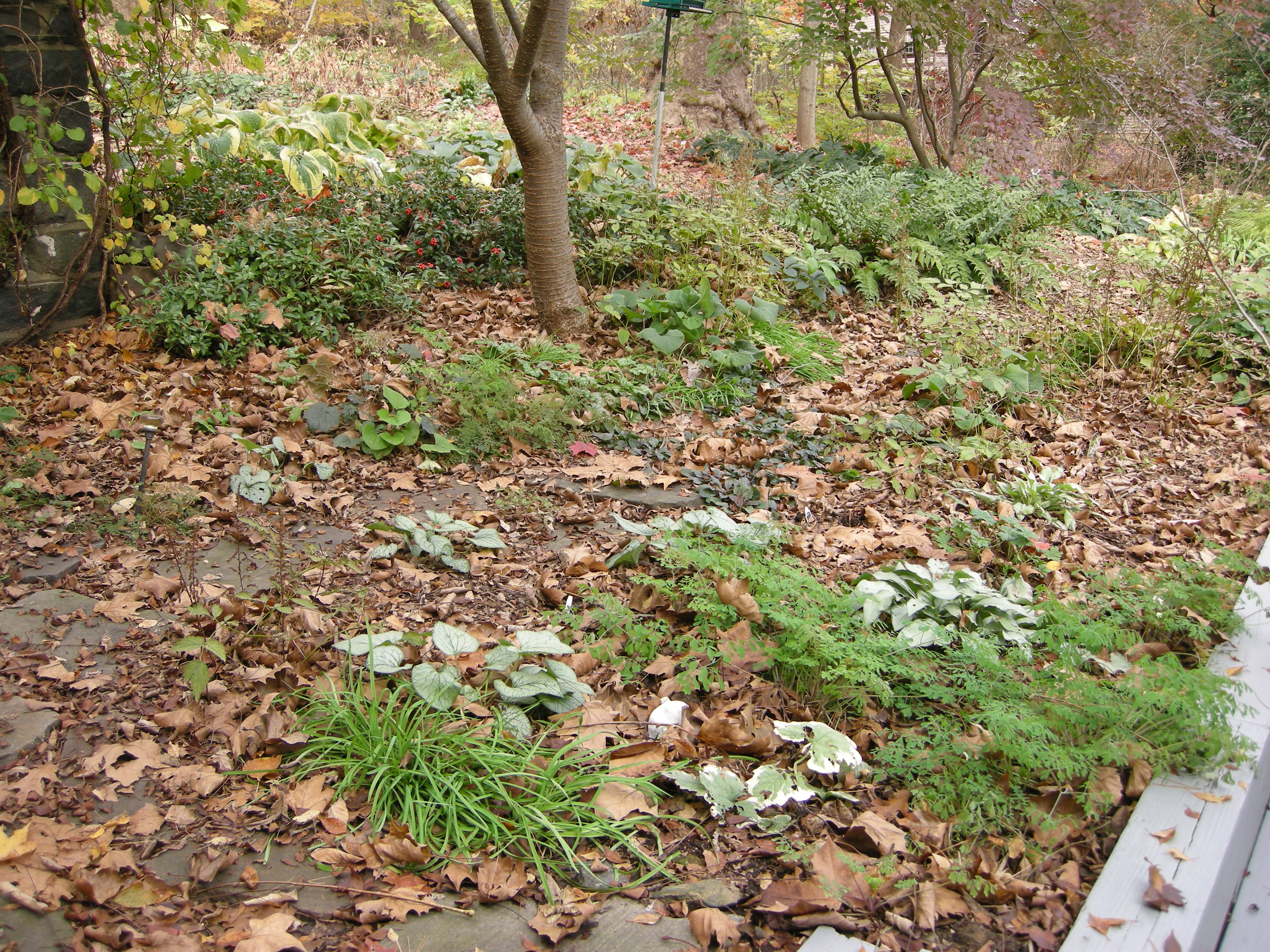
Third priority: The majority of my garden (my woodland gardens, hosta and epimedium hillside, meadow, and the production beds where I grow plants to sell) receive little to no attention.  I merely rake the paths and cut back very noticeable plants like hostas.  The leaves in the beds are left as mulch.  In spring, I remove any still visible dead plants.

hosta hill at Carolyn's Shade GardensHosta Hill before fall clean-up

Hosta Hill at Carolyn's Shade GardensHosta Hill after fall clean-up

Hosta Hill in spring

Fourth and final priority:  Leaves on the lawn are ground up by the lawn mower and left in place.

Carolyn's Shade Gardens Fall 2010Tree cover at Carolyn’s Shade Gardens

Lest you think this works because my leaf cover is light, you should know that I have 15 one-hundred-year-old London plane trees and many full-grown native black walnuts, ash,  sugar maples, tulip poplars, and oaks—just to mention the most numerous large trees (photo above).  The leaf drop is stupendous, but this system works.  Not only is it less labor intensive, but it’s better for the garden and it’s beautiful.

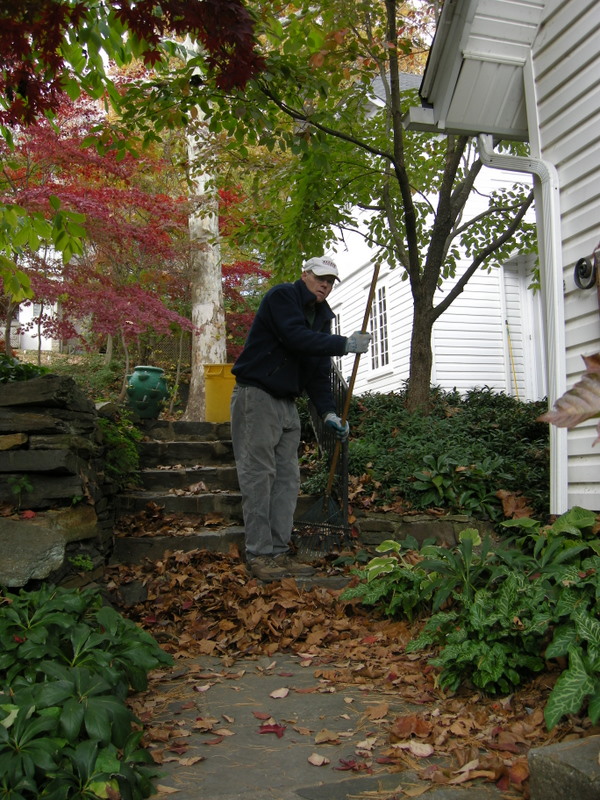
My favorite labor-saving device, my husband, Michael:

Fall at Carolyn's Shade Gardens

Carolyn

Carolyn’s Shade Gardens Blog

Posted in Shade Gardening, Uncategorized with tags on November 3, 2010 by Carolyn @ Carolyns Shade Gardens

Carolyn’s Shade Gardens is a retail nursery located in Bryn Mawr, PA, specializing in showy, colorful, and unusual plants for shade.  The only plants that we ship are snowdrops within the US.  For catalogues and announcements of local events, please send your full name, mailing address, and cell number to carolyn@carolynsshadegardens.com and indicate whether you are interested in snowdrops, hellebores, and/or hostas.  Click here to get to the home page of our website for catalogues and information about our nursery and to subscribe to our blog.

I am very excited to announce that I am starting a blog on shade gardening.  One of the frustrating parts of my business is not being able to tell my customers  and others all the interesting things that I have learned about shade gardening over the 18 years I have been in business (and the 35 years I have been gardening).  My open house sales are too busy.  Emails are too cumbersome (and possibly unwanted).  However, almost every day, I think of something that I have learned, observed, or experienced and want to pass on to others.

Now I can post these observations on my blog.  Interested gardeners can subscribe to my blog by clicking the “sign me up!” button on the sidebar.  Don’t worry, you can easily unsubscribe.  Please comment on as many posts as you can so I know what you like and please recommend my blog to everyone you know.

Thanks, Carolyn