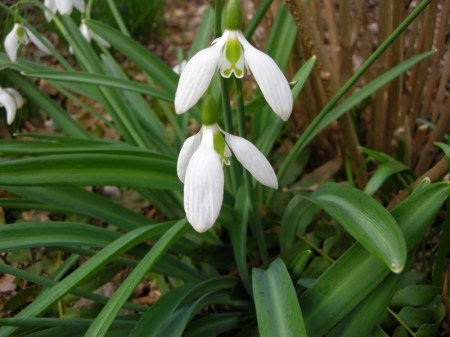
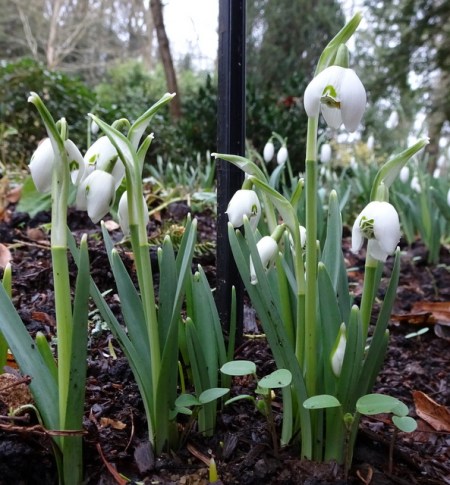
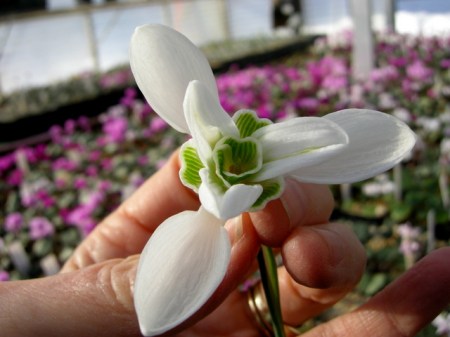
Although the flowers are closed obscuring the full green inner mark, I think this photo gives the best view of the ethereal combination of ‘Rosemary Burnham’s’ emerald green ovary, bluish leaves, and outer segments fully washed in pale green.
Our current snowdrop catalogue is on line here.
We seem to have survived our flirtation with temperatures usually found in the depths of winter and have returned to more normal November weather. As expected, the fall-blooming snowdrops were not bothered by the 30 degree days and 20 degree nights—it was the humans who huddled inside 😊.
This is part two of a two-part post on the new snowdrops that will be offered in our 2023 Snowdrop Catalogue. To read part one, click here. As usual, the catalogue will be posted on our website in the first half of December. Meanwhile, this post will give everyone an advance look (sorry, no advance orders) at five more special, new snowdrops that will be available for order in December. Enjoy!
Nursery News: Carolyn’s Shade Gardens is a retail nursery located in Bryn Mawr, PA, specializing in showy, colorful, and unusual plants for shade. The only plants that we ship are snowdrops within the US. For catalogues and announcements of local events, please send your full name, mailing address, and cell number to carolyn@carolynsshadegardens.com and indicate whether you are interested in snowdrops. Click here to get to the home page of our website for catalogues and information about our nursery and to subscribe to our blog.
.
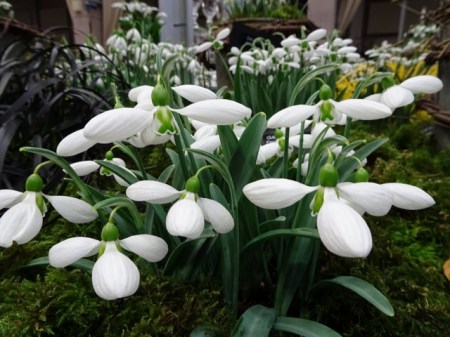
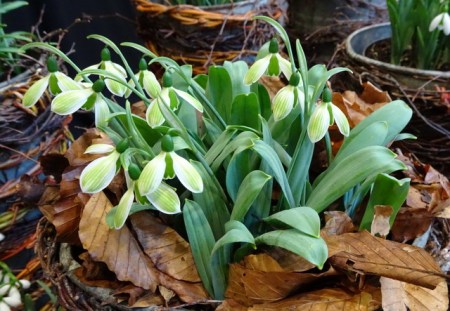 Although a single flower is lovely, I agree with Anne Repnow (Some Snowdrops, page 80) that a clump of ‘Rosemary Burnham’ is quite impressive—seen here in the Avon Bulbs display at the RHS Show.
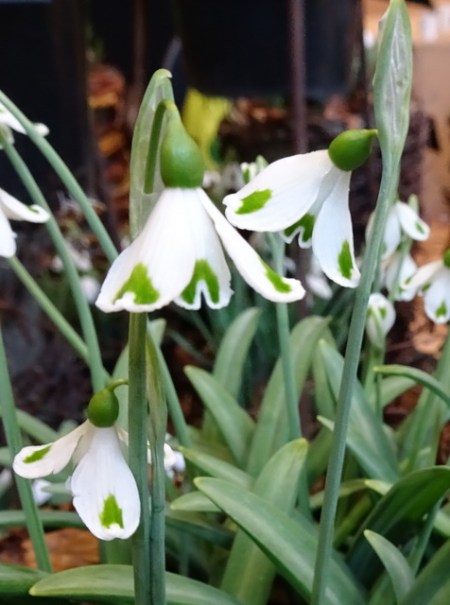
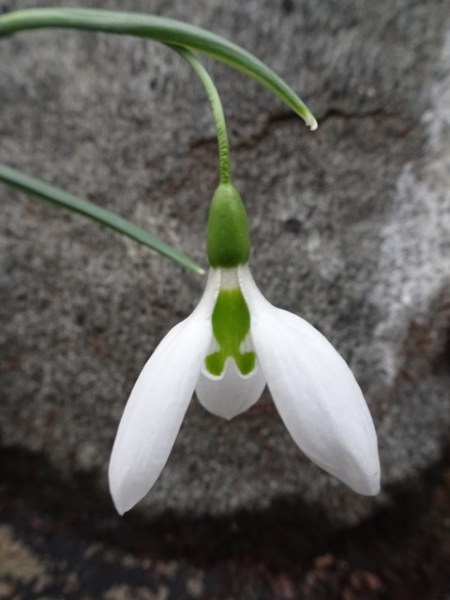
‘Rosemary Burnham’, a cultivar of G. elwesii, is considered one of the finest virescent (green-shaded) snowdrops ever selected. The outer segments are covered in pale green lines from the apex to the base, resulting in a beautiful green wash effect. They spread wide to display the entirely dark green inner segments. The effect is very striking when combined with the wide blue-green leaves characteristic of G. elwesii. It is a rare North American snowdrop found by Rosemary Burnham in the early 1960s in an abandoned garden in Burneby near Vancouver, British Columbia, and named for her by Don Armstrong.
.
 The substantial flowers of fall-blooming ‘Cambridge’.
‘Cambridge’ is a particularly robust selection of the fall-flowering species G. reginae-olgae subsp. reginae-olgae. It has thick-textured, pointed, and ridged outer segments. Its substantial flowers, which are large for a reginae-olgae, bloom a little later than the species—in our area in late October—when its leaves are just emerging. It was collected on the island of Corfu and given to the Cambridge Botanic Garden in the early 1960s. It was named and exhibited for the first time in 1989. Our plants originated from stock given to Charles Cresson in 2000 by John Grimshaw.
.
 ‘Colossus’ flowering at Colesbourne Park where it was selected.
‘Colossus’ has everything a collector could want in a G. plicatus cultivar. The large flowers with thick stems tower over the beautiful, broad, arching leaves characteristic of plicatus, making for a statuesque and arresting habit. The plant is robust and vigorous. I especially treasure it because it is early blooming, sometimes by Christmas in my garden (photo below).
.
 ‘Colossus’ blooming on 12/23/15 in my garden
‘Colossus’ was selected in 1982 by Lady Carolyn Elwes at Colesbourne Park, which is the source of my stock. After some initial confusion about its name, it was listed and sold by Phil Cornish in 1999 as ‘Colossus’. It is a very popular snowdrop in the UK, appearing as #14 on a list put together by Avon Bulbs.
.
 This photo gives a great view of ‘Betty Hansell’s’ unusual boat-shaped, pointed outer segments and prominent dark green mark.
‘Betty Hansell’ is a very distinctive and large double snowdrop, producing a fine regular flower with a neat rosette. It is set apart by its narrow, boat-shaped, pointed outer segments with green tips. Because of the long claw (the neck attaching the outer segment to the ovary), the outers stay parted to reveal the heavily dark green-marked inners. It produces two flower scapes when settled and happy. ‘Betty Hansell’ was found in 1994 near Hainford in Norfolk by Robert Marshall and named for his aunt.
.
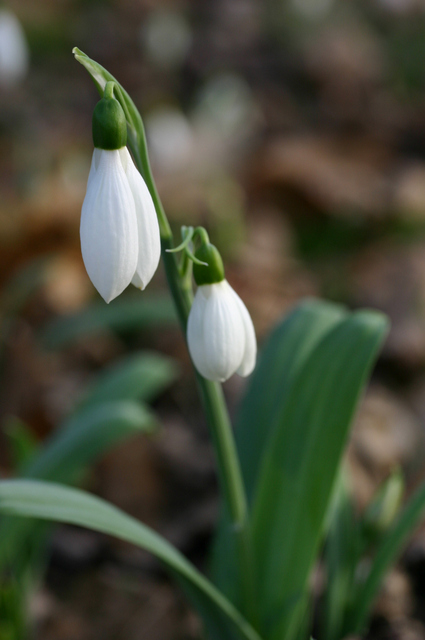 ‘Warwickshire Gemini’ displaying its twin flowers
When choosing snowdrops for my own collection, I seek out cultivars with unique and eye-catching qualities like extra large flowers, yellow coloring, or an interesting form. Of the many traits a snowdrop can have, twin flowers (two flowers and pedicels on the end of each scape) are very rare. ‘Warwickshire Gemini’ is an exceptionally large form of G. elwesii with bold blue-gray leaves and twin flowers on each scape when settled.
‘Warwickshire Gemini’ was discovered by plantswoman Noreen Jardine in her garden. She named it and planted it at Hill Close Gardens in Warwickshire from where it was eventually introduced and distributed (information provided by Neil Munro, Head Gardener, Hill Close Gardens).
.
Blogs are a lot more fun for everyone, especially the writer, when readers leave comments. Scroll down to the end of the page to the box where it says “Leave a Reply” and start typing—-it’s easy!
Carolyn
.
Note: Every word that appears in orange on my blog is a link that you can click for more information. If you want to return to my blog’s homepage to access the sidebar information (catalogues, previous articles, etc.) or to subscribe to my blog, just click here.
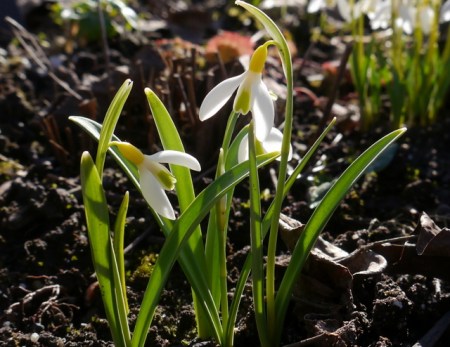 ‘June Boardman’ combines a bright yellow ovary with an inner mark that is lime green at the apex and pale yellow near the base. Photo from Anne Repnow author of Some Snowdrops: A Photographic Ramble.
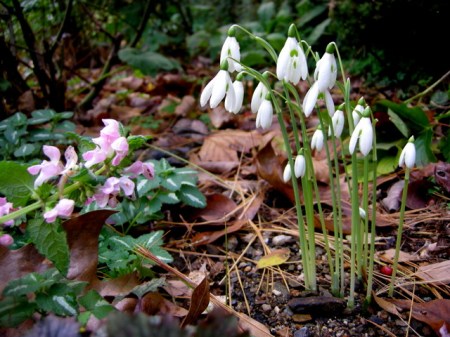 We haven’t offered Galanthus reginae-olgae in 11 years so I am considering it new for the purposes of this post.
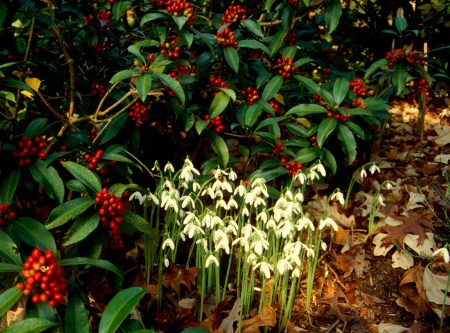 Galanthus reginae-olgae in Charles Cresson’s Swarthmore, Pennsylvania, garden.
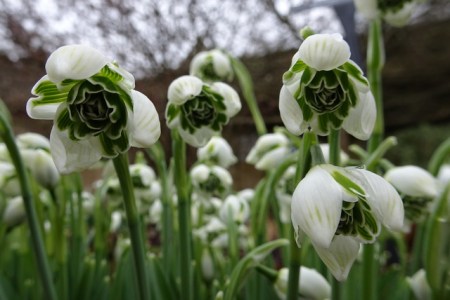 ‘Rodmarton’ originated at Rodmarton Manor in Gloucestershire, one of my favorite snowdrop venues.
 ‘Scissors’ in Charles Cresson’s garden
 ‘Walker Canada’ in the Avon Bulbs display at the 2017 Royal Horticultural Society Show at Vincent Square.
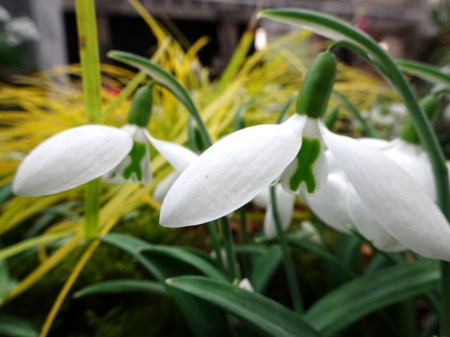 G. plicatus ‘Walker Canada’
 ‘E. A. Bowles’ is in a class by itself, shown here at Carolyn’s Shade Gardens.
 ‘E.A. Bowles’ caused a sensation in 2011 when it sold for the highest recorded price ever paid for a snowdrop.
 ‘E.A. Bowles’ prominently featured in the Avon Bulbs display at the 2018 RHS Show.
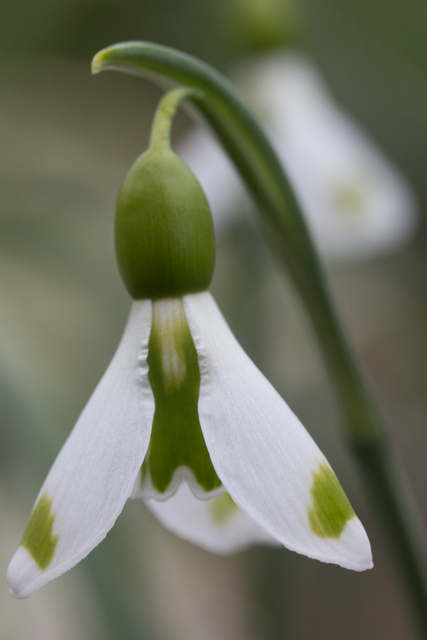 ‘The Wizard’
 ‘Mrs. Thompson’s’ erratic behavior is highly prized in the snowdrop world.
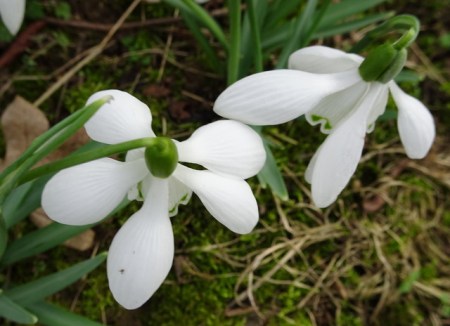 The left flower has five outer segments instead of the usual three, and the right flower is composed of two fused flowers on the same scape.
 ‘Cordelia’ produces a very neat, green rosette.
 ‘Cordelia’ at Carolyn’s Shade Gardens
 ‘Phantom’ produces two types of flowers. One is the very lovely, pure white poculiform shown above. This is the flower form that appears if only one flower is produced.
 This is ‘Phantom’s’ other flower type: a spooky looking snowdrop with markings configured like G. plicatus subsp. byzantinus.
 Both types of flowers appear on this beautiful specimen shown by Avon Bulbs at the 2017 RHS Show.
 An unassuming title for a wonderful book. The snowdrop pictured on the cover is ‘Wol Staines’ from Glen Chantry in England, a nursery that I dream of visiting.
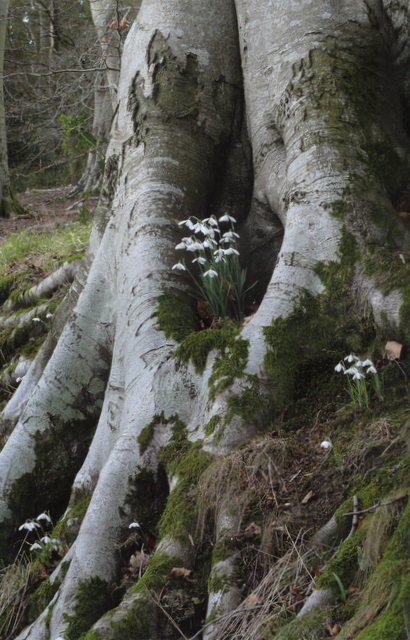 The book starts with some beautiful landscape photos of snowdrops, this one taken at Brechin Castle in Scotland.
 ‘Godfrey Owen’ comes into bloom early in the main season for snowdrops, generally the second half of January in my garden. It is one of my favorites and has received the coveted Royal Horticultural Society Award of Garden Merit.
 ‘Wasp’ is a snowdrop that you would recognize anywhere without a label due to its long, narrow, wing-like outer segments and the striped inner segments resembling a thorax.
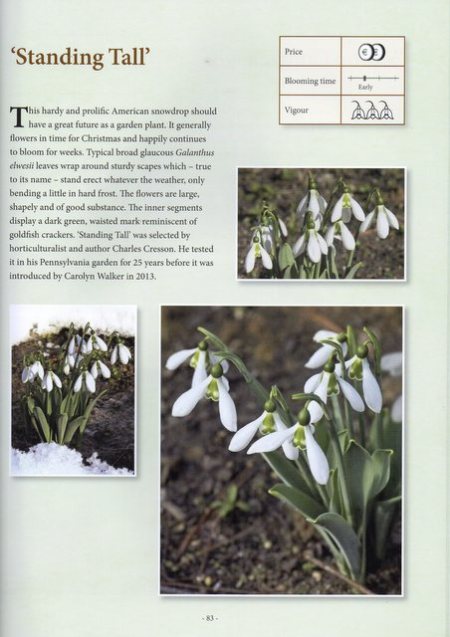 ‘Standing Tall’ is an American snowdrop selected by bulb expert Charles Cresson and introduced exclusively by Carolyn’s Shade Gardens in 2013. Its upright habit, height, and mid-December bloom time make it an outstanding snowdrop.
 ‘Three Ships’ is another favorite available in our 2022 catalogue. Its distinctive, large, round and seersuckered outer segments along with its Christmas bloom time earned it a rare Royal Horticultural Society Award of Garden Merit.
 ‘Midas’ has yellow marks on the outer segments, something entirely new to the snowdrop world.
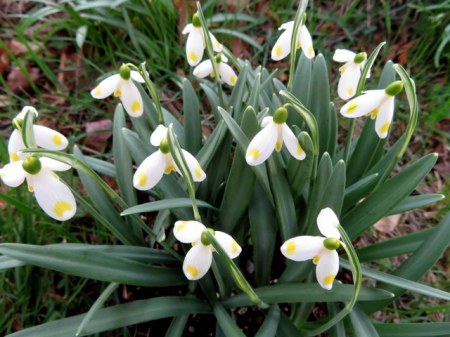 Alan Street at Avon Bulbs sent me this photo of ‘Midas’ in 2017, the year it was introduced. I couldn’t believe my eyes—here was a swarm of one of the world’s rarest snowdrops!
 ‘Augustus’ is classically elegant and award-winning.
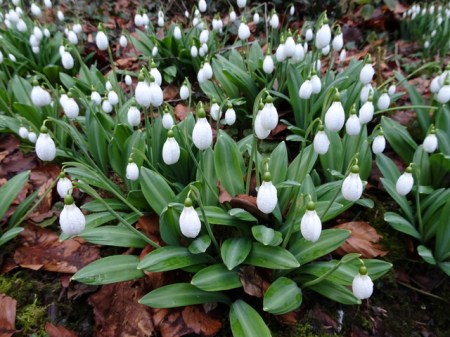 ‘Augustus’ is very striking in a group, here in Hilary and Hugh Purkess’s garden “Welshway”.
 ‘Cowhouse Green’, shown here at Carolyn’s Shade Gardens.
 ‘Desdemona’ is a Greatorex double snowdrop.
 ‘Desdemona’ at Evenley Wood Garden in Northhamptonshire, a snowdrop venue well worth visiting.
 ‘Moses Basket’ cannot be mistaken for any other snowdrop. Many thanks to Margaret and David MacLennan, holders of the UK National Collection of Galanthus (Scientific), for the wonderful photo.
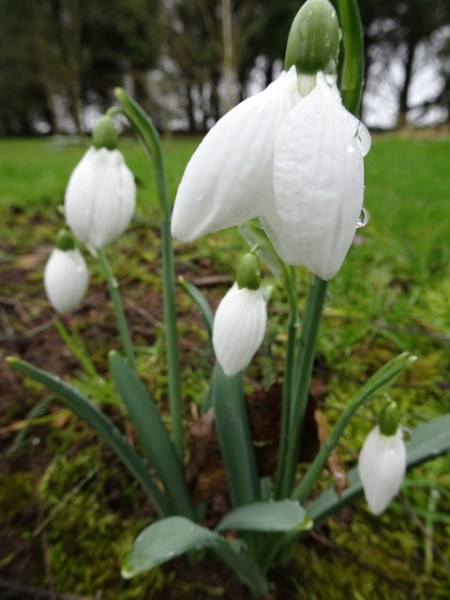 ‘Rodmarton Arcturus’ at the famous snowdrop destination Rodmarton Manor in England.
 An enviable clump of ‘Rodmarton Arcturus’ in the garden of snowdrop expert Ronald Mackenzie.