‘Early Bird’ is easily recognized in the garden as a Galanthus woronowii cultivar but it blooms much earlier than the typical end of February or March. Photo 1/25/25
To see last year’s snowdrop catalogue, click here.
I have been selling snowdrops since I started my nursery in 1991. However, in 2013, I started importing from England cultivars that were hard-to-find in the US and growing them on for my customers. My imports for catalogue sales always focused on cultivars that were well known and readily available in Europe, but every year I purchased single bulbs of a small number of rare and expensive cultivars to add to my own collection. I am excited that once again I will be selling limited quantities of those choice snowdrops.
As usual, the 2026 Snowdrop Catalogue will be posted on our website in the first half of December 2025. Meanwhile, this post will give everyone an advance look (sorry, no advance orders) at some of the special, new snowdrops that will be available in the catalogue. Enjoy!
Nursery News: Carolyn’s Shade Gardens is a specialty nursery located in Bryn Mawr, PA. The only plants that we ship are snowdrops within the US. For catalogues and announcements, please send your full name, mailing address, and cell number to carolyn@carolynsshadegardens.com and indicate you are interested in snowdrops. Click here to get to the home page of our website for catalogues and information about our nursery and to subscribe to our blog.
‘Early Bird’, pictured at the top, is an inverse poculiform (all the segments are inners) cultivar of the snowdrop species Galanthus woronowii, sometimes called the green snowdrop for its shiny green leaves or Woronow’s snowdrop for its namesake, Georg Jurii Nikolaewitch Woronow (1874-1931). Unlike the species though, it has lovely green markings on the outer segments, not just the inners, and the pagoda shape we treasure in ‘Trumps’ and other inverse poculiform snowdrops. Its very wide leaves are bright, shiny, and the beautiful shade of green characteristic of the species. They sparkle in the winter sun and are my favorite snowdrop foliage.
.
 When the flowers are closed, you especially notice ‘Early Bird’s’ lovely wide and shiny green leaves. Photo 1/30/22
Even more unique is ‘Early Bird’s’ bloom time. G. woronowii is usually the last snowdrop to bloom in my garden at the end of February or beginning of March, while ‘Early Bird’ blooms much earlier as you can see from the dates of these photos. It may be the earliest bloomer of its species.
Millions of G. woronowii bulbs are legally harvested in Georgia every year and sold as dried bulbs through European bulb houses mainly located in the Netherlands. A friend selected and named ‘Early Bird’ from a batch purchased in the early 2010s. For more information on the species Galanthus woronowii, you can read my post The Sochi Snowdrop by clicking here.
.
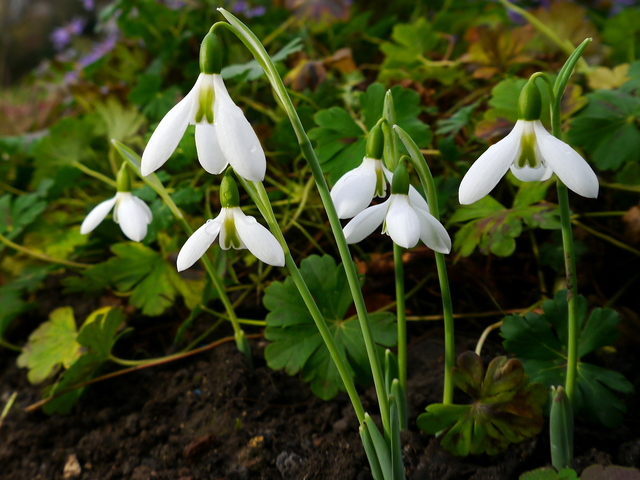 ‘Peter Gatehouse’ is a stately fall-blooming snowdrop with a distinctive inner mark.
‘Peter Gatehouse’ is a member of the Hiemalis Group of the giant snowdrop species, Galanthus elwesii. It is easy to recognize for its large flowers featuring an olive green X lightening towards the base. It blooms in mid-October here in southeastern Pennsylvania. It is a prolific bloomer with an upright habit and a spathe (the bud sheath) that points upwards.
.
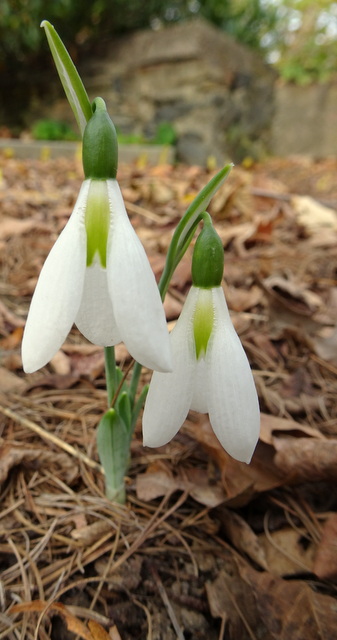 A close up of the lovely two-toned inner mark and the long elegant outer segments.
This graceful snowdrop was given to Elizabeth Strangman at Washfield Nursery in England in 1994 by Peter Gatehouse and named after him. Anne Repnow profiles it on page 87 of her book Some More Snowdrops.
.
 There may be no more perfectly uniform poculiform snowdrop than ‘Poculi Perfect’. Photo March 2020
‘Poculi Perfect’ is a snowdrop that elicits superlatives on sight. It has a large, pure white, perfectly formed poculiform flower, which means all the segments are outers. Generally there is still some size and color variation in poculiforms, but here the inner and outer segments are the exact same size and shape and show no green at all. When he introduced it, Joe Sharman at Monksilver Nursery called it “one of the best Czech poculiforms with exceptionally large flowers.”
.
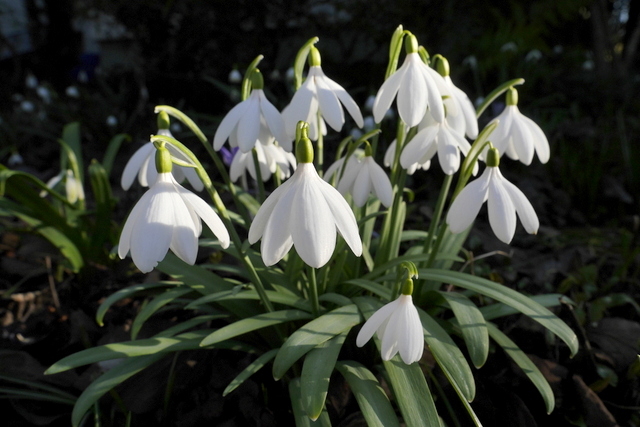 ‘Poculi Perfect’ displays its large flowers very late in the season. Photo March 2025
‘Poculi Perfect’ is a taller cultivar of Galanthus nivalis, the common snowdrop, displaying its large blooms on upright, strong scapes set off by widely splayed, broad, glaucous leaves. It was found in 2009 in the Czech Republic by Pavel Sekerka and named in 2011 by Jānis Rukšāns, the Latvian bulb specialist. Anne Repnow profiles ‘Poculi Perfect’ on page 76 of Some Snowdrops.
.
 Like all snowdrops in the Scharlockii Group, ‘Selina Cords’ is a beautiful bright green. Photo taken at Glenn Chantry 2/12/23
‘Selina Cords’ is similar to other members of the Scharlockii Group of Galanthus nivalis, the common snowdrop, but has lovely and extensive green markings on the outer segments covering the apex and running all the way to the base—a very pleasing look. The slender flowers are incurved and attached to a long pedicel (stem attaching flower to scape) arising from the split spathe (bud sheath) resembling rabbit’s ears that is characteristic of this group.
.
 ‘Selina Cords’ displays its prominent pedicel and leaf-like split spathe.
‘Selina Cords’ is a robust snowdrop, and one of the best ‘Scharlockii’ types originating in Belgium. It was discovered in 2006 by famous German galanthophile Rudi Bauer and named for his granddaughter.
.
Look for another post profiling more new snowdrops (& a Leucojum) soon.
.
Blogs are a lot more fun for everyone, especially the writer, when readers leave comments. Just scroll down to the end of the page to the box where it says “Leave a Comment” and start typing—-it’s easy!
Carolyn
.
Note: Every word that appears in orange on my blog is a link that you can click for more information. If you want to return to my blog’s homepage to access the sidebar information (catalogues, previous articles, etc.) or to subscribe to my blog, just click here.