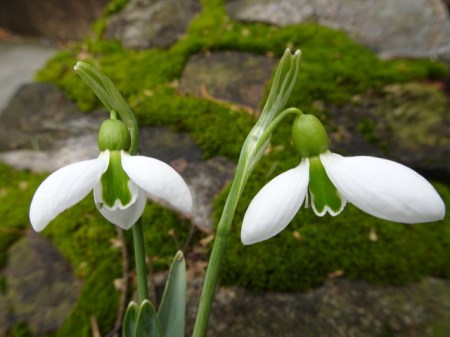
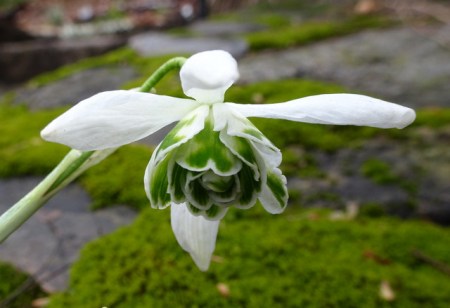
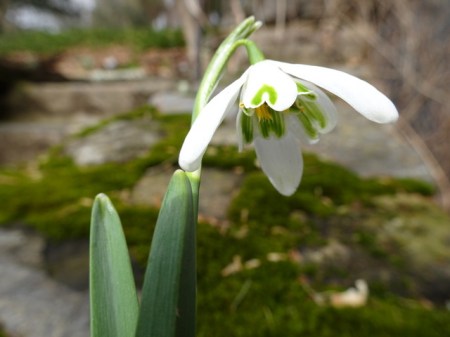
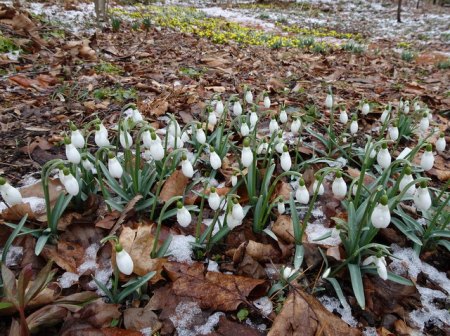
Galanthus bursanus, the newest snowdrop species, blooms earliest in my collection
For our current Snowdrop Catalogue, click here. If you want to be notified about the next snowdrop catalogue, please send your full name, mailing address, and cell number to carolyn@carolynsshadegardens.com, and specify snowdrops.
I really appreciate the appearance of the earliest blooming snowdrops in my garden: Galanthus bursanus and Galanthus reginae-olgae and their cultivars, at the beginning of October. They remind me that the much treasured snowdrop season is starting and will continue through March. However, there are so many other plants performing then with flowers, berries, fall color, and seeds, not to mention all the work we need to do to get our garden ready for winter that I only notice the October snowdrops in passing. Likewise, although I love all my snowdrops that begin flowering in January, which is the early main season for snowdrops, there are so many of them.
It is the snowdrops that reach their peak in December that I most treasure. I realized that I have never done a post featuring those snowdrops so here I will talk about my four favorites plus a peak at a potential newcomer.
Nursery News: Carolyn’s Shade Gardens is a retail nursery located in Bryn Mawr, PA, specializing in showy, colorful, and unusual plants for shade. The only plants that we ship are snowdrops within the US. For catalogues and announcements of local events, please send your full name, mailing address, and cell number to carolyn@carolynsshadegardens.com and indicate whether you are interested in snowdrops. Click here to get to the home page of our website for catalogues and information about our nursery and to subscribe to our blog.
.
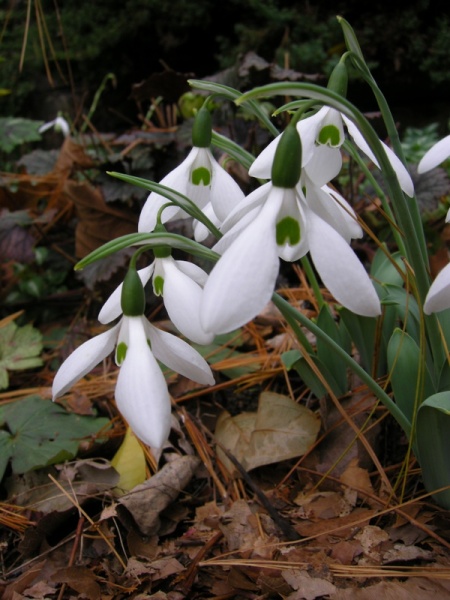 ‘Potter’s Prelude’ is an elegant snowdrop with a bold mark.
‘Potter’s Prelude’, a cultivar of Galanthus elwesii var. monostictus, is a rare American snowdrop selected in the 1960s by Jack Potter, the former Curator of the Scott Arboretum in Swarthmore, Pennsylvania. It was registered in 2004 by noted regional horticulturist Charles Cresson and introduced in 2010 by Carolyn’s Shade Gardens.
.
 This clump of ‘Potter’s Prelude’ is ready for dividing.
‘Potter’s Prelude’ is a free-flowering and vigorous snowdrop with wide, recurving, very blue leaves. Its flowers are large and elegantly formed with a bold dark green mark. They begin blooming in mid-November and continue into January with December being their peak. Be aware that some snowdrops sold under this name are inferior seedlings. International snowdrop expert Alan Street told me that the flowers shown in the top photo, which he much admired, are far superior to the form circulating in England. ‘Potter’s Prelude’ is featured 0n page 77 of Anne Repnow’s book Some Snowdrops, an excellent reference guide.
.
 ‘Standing Tall’
‘Standing Tall’ is an American Galanthus elwesii cultivar selected and named by Charles Cresson. It was introduced for sale for the first time by Carolyn’s Shade Gardens in 2013. Although it can reach 12″ tall, it was primarily named for its very upright habit and unmistakable, commanding presence in the garden. Its name also reflects its ability to flop down when its cold like all snowdrops do and stand back up perfectly straight as if nothing has happened. My unofficial observations also indicate that it remains upright at much lower temperatures than other snowdrops.
.
 ‘Standing Tall’ in the Cresson garden.
‘Standing Tall is at its peak right now, although my main patch was divided last year and does not look as full as most years. However, like all the snowdrops featured in this post, it is very vigorous and will quickly fill back in and look like Charles Cresson’s patch above. It starts blooming between the the last week of November and the first week of December and continues through January. It is featured on Page 83 of Anne Repnow’s excellent book Some Snowdrops.
.. ‘Three Ships’ has the very full outer segments sometimes associated with G. plicatus.
‘Three Ships’ is a cultivar of Galanthus plicatus selected in England by the famous John Morley of North Green Snowdrops in Suffolk in 1984. He named it for the Christmas carol “I Saw Three Ships”.
.
 ‘Three Ships’ multiplies well in my garden.
‘Three Ships’ is quite striking in the garden and cannot be confused with any other snowdrop. It has an ethereal glow that is whiter than white and large, bowl-like and deeply puckered outer segments with a wide and attractive green mark on the inner segments. It blooms reliably about a week after ‘Standing Tall’ in mid-December, although I find that this is location specific. One of my three patches bloomed on November 26 this year, while the other two followed the regular pattern.
.
 ‘Xmas’ has large and elegant flowers with gracefully curved spathes.
‘Xmas’ was selected many years ago by a gardener at the US National Botanic Garden from a patch of normal Galanthus elwesii growing in the parking lot and passed through many hands to me. Carolyn’s Shade Gardens first introduced it for sale as ‘Xmas’ in 2016.
.
 ‘Xmas’ is at least twice the height of ‘Three Ships’, which blooms at the same time. It is shown here with the flowers of fall-blooming camellia ‘Winter’s Joy’.
‘Xmas’ has very large and beautiful flowers with long, bowl-shaped outer segments and a distinct X mark on the inner segments. In the Delaware Valley, it usually comes into flower in mid-December at the same time as ‘Three Ships’ and is fully out around the holidays when there is often a lull in snowdrop activity. It also goes on blooming for about a month after ‘Three Ships’ as its flowers are particularly durable and long lasting. When my dear friend Alan Street saw this photo he was impressed with the height and fullness of the flowers. Unfortunately, he never saw ‘Xmas’ in person as it makes quite an impression when you see it in the garden.
. 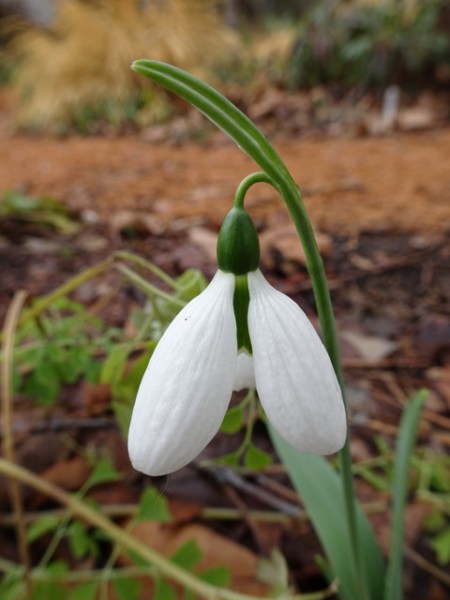 A new December-blooming Galanthus elwesii under consideration.
I have been observing this snowdrop, which appeared in my oldest patch of straight species Galanthus elwesii. It blooms in late November/early December and has lovely, full flowers with a solid green inner mark from apex to base. It will take more years of observation and building up stock before I decide if it merits a name. Meanwhile, I would be grateful if any reader would let me know if they have seen a similar snowdrop blooming in early December.
.
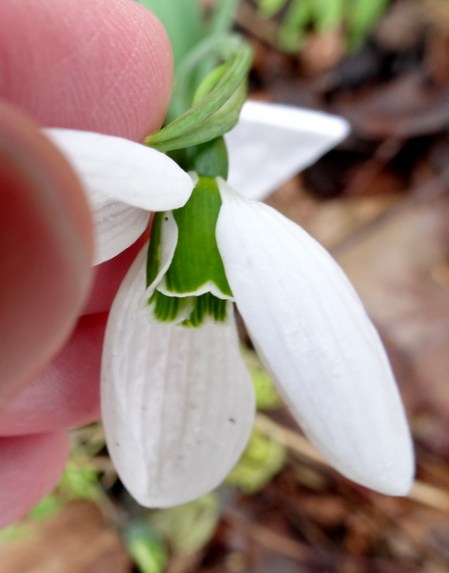 The inner segments are entirely green.
.
The snowdrops profiled here are some of my favorites. I have lined my front walk with large clumps so I can enjoy them every day this time of year, and all four appear in more than the two standard locations in my garden (one for display and one for back up). In fact, ‘Xmas’ is in six locations, ‘Potter’s Prelude’ is in five, while the others are in three.
.
Blogs are a lot more fun for everyone, especially the writer, when readers leave comments. Scroll down to the end of the page to the box where it says “Leave a Reply” and start typing—-it’s easy!
Carolyn
.
Note: Every word that appears in orange on my blog is a link that you can click for more information. If you want to return to my blog’s homepage to access the sidebar information (catalogues, previous articles, etc.) or to subscribe to my blog, just click here.
 An unassuming title for a wonderful book. The snowdrop pictured on the cover is ‘Wol Staines’ from Glen Chantry in England, a nursery that I dream of visiting.
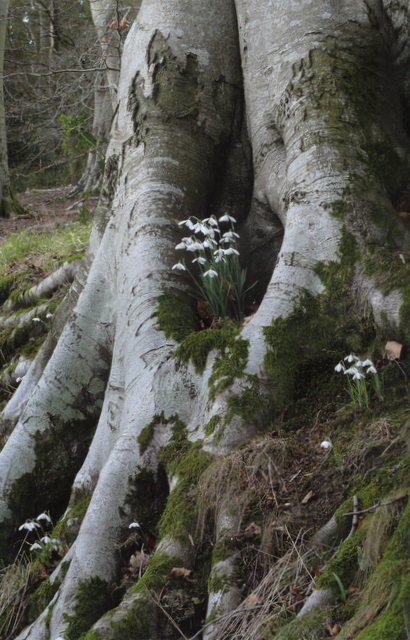 The book starts with some beautiful landscape photos of snowdrops, this one taken at Brechin Castle in Scotland.
 ‘Godfrey Owen’ comes into bloom early in the main season for snowdrops, generally the second half of January in my garden. It is one of my favorites and has received the coveted Royal Horticultural Society Award of Garden Merit.
 ‘Wasp’ is a snowdrop that you would recognize anywhere without a label due to its long, narrow, wing-like outer segments and the striped inner segments resembling a thorax.
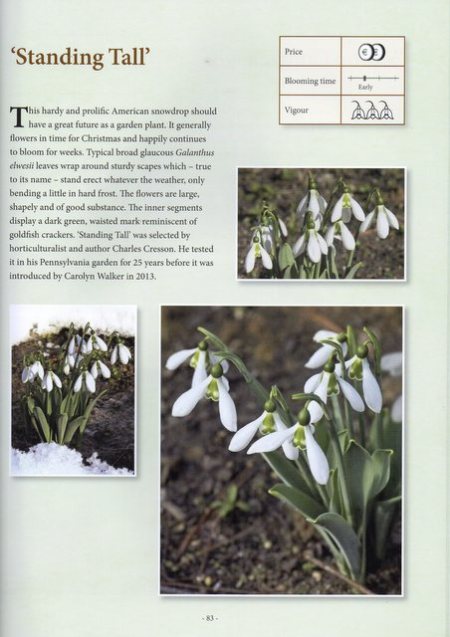 ‘Standing Tall’ is an American snowdrop selected by bulb expert Charles Cresson and introduced exclusively by Carolyn’s Shade Gardens in 2013. Its upright habit, height, and mid-December bloom time make it an outstanding snowdrop.
 ‘Three Ships’ is another favorite available in our 2022 catalogue. Its distinctive, large, round and seersuckered outer segments along with its Christmas bloom time earned it a rare Royal Horticultural Society Award of Garden Merit.