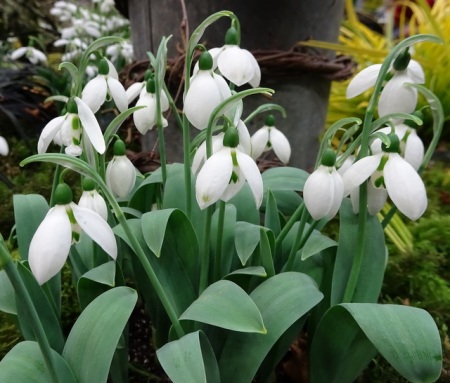
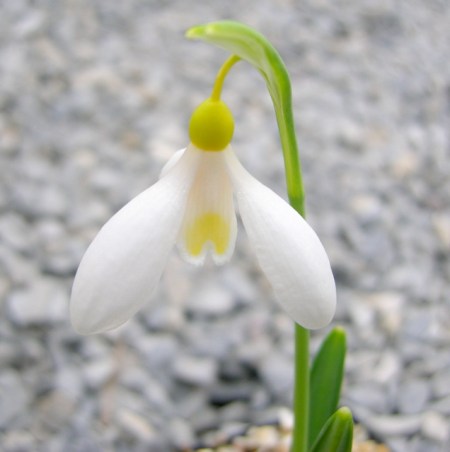
‘Dryad Gold Sovereign’ features beautiful yellow markings and a huge flower.
To access our current snowdrop catalogue, click here.
I have been importing snowdrops from England and growing them on for my customers since 2013. My imports for catalogue sales always focused on the more well known and readily available cultivars, but every year I purchased single bulbs of a small number of rare and expensive cultivars to add to my own collection. I am excited that this year I will finally be selling limited quantities of those choice snowdrops.
As usual, the 2025 Snowdrop Catalogue will be posted on our website in the first half of December. Meanwhile, this post will give everyone an advance look (sorry, no advance orders) at some of the special, new snowdrops that will be available in the catalogue. Enjoy!
Nursery News: Carolyn’s Shade Gardens is a retail nursery located in Bryn Mawr, PA, specializing in showy, colorful, and unusual plants for shade. The only plants that we ship are snowdrops within the US. For catalogues and announcements of local events, please send your full name, mailing address, and cell number to carolyn@carolynsshadegardens.com and indicate whether you are also interested in snowdrops. Click here to get to the home page of our website for catalogues and information about our nursery and to subscribe to our blog.
.
‘Dryad Gold Sovereign’, pictured at the top, resulted from an intentional cross of ‘Wendy’s Gold’ with G. nivalis “Sandersii Group” by expert hybridizer Anne Wright from Dryad Nursery in England. Her aim was to produce vigorous snowdrops with bright yellow flowers. After 12 years of rigorous assessment, Anne selected the yellow snowdrops in the Dryad Gold Group.
‘Dryad Gold Sovereign’ is recognized as the best in the group and, in Anne’s own words, it is “quite simply my favourite of all the snowdrops I grow.” It is early-blooming, before most yellows, and produces large (twice the size of ‘Primrose Warburg’), well-proportioned, long-lasting, bright yellow flowers on sturdy, upright stems. It performs exceptionally well in the garden. You can read Anne’s own description of this elegant snowdrop by clicking here. You can also read Anne Repnow’s profile on page 41 of Some More Snowdrops.
.
 ‘Herzilien’ holds its outer segments wide so you can easily see the little green hearts on the inners.
‘Herzilien’ means little sweetheart in German, referring to the marking on the inner segments and its tendency to bloom on Valentine’s Day. The long claws joining the outer segments to the narrow, conical ovary hold the outer segments wide to display the perfectly shaped heart on the inner segments. On page 55 of Some Snowdrops, Anne Repnow praises this snowdrop for its “astonishing vigor and floriferousness”. It was selected around 2000 by Arthur Winkelmann after growing on seeds he received from a gardening friend in Russia.
. ‘Joe Spotted’ is easily recognized in the garden.
‘Joe Spotted’ has beautiful markings and an excellent habit. The outer segments feature a large olive green diamond, while the inner segments have a big, dark green apical mark and two pale green ‘eyes’ at the base—as I have said before, I am a sucker for a snowdrop with a face! The gorgeously marked flowers are enhanced by the snowdrop’s tall, upright habit.
.
 When the flowers are closed, you especially notice the very upright habit, here at Glen Chantry nursery in England.
‘Joe Spotted’ is praised as a strong grower and very fine plant. Spotted in galanthophile David Bromley’s Shropshire garden by Joe Sharman, the owner of Monksilver Nursery in England. You can read Anne Repnow’s profile on page 60 in Some Snowdrops.
.
 ‘Titania’ features large, double flowers on upright, vigorous plants, pictured here at Colesbourne Park in England, which is the source of my stock.
‘Titania’ is a beautiful and elegant double snowdrop originated prior to 1954 by English plantsman Heyrick Greatorex as part of his famous series of large and vigorous doubles named after characters in Shakespeare’s plays—here the Queen of the Fairies in A Midsummer Night’s Dream. ‘Titania’ is one of the rarer but more easily identifiable Greatorex doubles due to its neat and regular double flowers with a prominent horseshoe mark at the base of the inner segments. As you can see from the photo, it multiplies well in the garden.
.
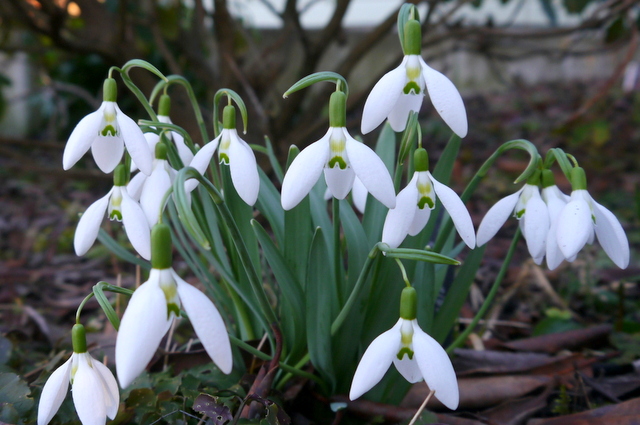 ‘Ingrid Bauer’s’ large flowers have a very unique inner mark.
‘Ingrid Bauer’ has large and elegantly shaped flowers with the long outer segments held wide to reveal a very unique X mark on the inner segments. The mark is composed of a pale green upper part and a very dark green lower part, making this snowdrop instantly recognizable in the garden. An easy and prolific snowdrop selected by the famous German galanthophile Rudi Bauer and named for his wife in 2007.
.
 ‘Null Punkte’ is the whitest spring snowflake.
‘Null Punkte’ is a spring snowflake or Leucojum vernum. Its name means zero points in German and refers to the lack of green or yellow on the tips of the petals (tepals), making it the whitest spring snowflake. The flowers in my garden occasionally have a slight bit of green (see far left of left flower in photo), but they get whiter as they mature.
.
 ‘Null Punkte’ growing under a shrub in Charles Cresson’s Swarthmore, Pennsylvania, garden.
‘Null Punkte’ is a good grower but not fast—I received a plant in 2013 and just have a few to sell now. It was discovered in a park in Schleswig-Holstein, Germany, and named by Ingo Kaczmarek as a reference to point-giving in the Eurovision Song Contest. For more information about Leucojum with descriptions and photos of many cultivars, click here.
.
Look for another post profiling more new snowdrops (& an Eranthis) soon.
.
Blogs are a lot more fun for everyone, especially the writer, when readers leave comments. If you are reading the post in the WordPress email (white background), just reply to the email to comment. If you are reading the post on my blog (black background, better formatting), scroll down to the end of the page to the box where it says “Leave a Reply” and start typing—-it’s easy!
Carolyn
.
Note: Every word that appears in orange on my blog is a link that you can click for more information. If you want to return to my blog’s homepage to access the sidebar information (catalogues, previous articles, etc.) or to subscribe to my blog, just click here.