Archive for Galanthus ‘Xmas’

My Favorite Snowdrops

Posted in bulbs for shade, snowdrops, winter, winter garden, winter interest with tags , , , , , , , , , , , , , , , , , , , , on January 2, 2024 by Carolyn @ Carolyns Shade Gardens

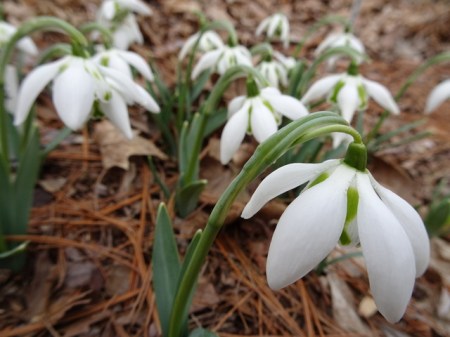
‘Trumps’: has it all—vigorous, unique, beautiful; selected at the nursery of the wonderful John Morley, more here.

For our current Snowdrop Catalogue, click hereIf you want to be notified about the next snowdrop catalogue, please send your full name, mailing address, and cell number to carolyn@carolynsshadegardens.com, and specify snowdrops.

I have considered writing this post many times, but always felt that picking my favorite snowdrop is like choosing your favorite child.  I always tell my three sons that I don’t have a favorite—I love them all equally but for different reasons.  However among my snowdrops, I do have favorites, and I know the reasons, which I will share with you along with photos of some of my most-liked Galanthus.

Nursery News:  Carolyn’s Shade Gardens is a retail nursery located in Bryn Mawr, PA, specializing in showy, colorful, and unusual plants for shade.  The only plants that we ship are snowdrops within the US.  For catalogues and announcements of local events, please send your full name, mailing address, and cell number to carolyn@carolynsshadegardens.com and indicate whether you are interested in snowdrops.  Click here to get to the home page of our website for catalogues and information about our nursery and to subscribe to our blog.

.

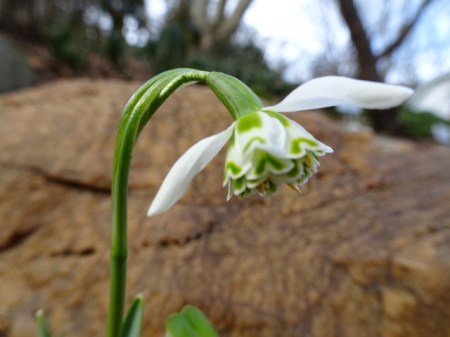
Diggory’:  totally unique flower; beautiful pleated leaves with a stripe; multiplies well.

I have a modest collection of snowdrops by English standards and even compared to many of the larger American collections.  This is intentional—although I have an extensive wish list in my head, I want to build my collection slowly and knowledgeably.  This allows time to care for the existing collection, including dividing, fertilizing, mulching, relocating, disease prevention, record keeping, and labeling, etc.    My current project is to have each snowdrop in two locations in my garden: an heir and a spare so-to-speak.

. ‘Viridapice’:  tall and elegant with beautiful green markings; vigorous and easy.
When Snowdrops: A Monograph of Cultivated Galanthus by Bishop, Davis, and Grimshaw was reprinted in 2006, it covered around 500 named snowdrop cultivars.  It was possible, if you could locate them, to have all these snowdrops in your garden.  When the second edition of A Gardener’s Guide to Snowdrops by Freda Cox was published in 2019, it described 2,400 named cultivars.  Freda Cox’s companion volume More Snowdrops, issued in May 2023, profiles over 700 additional cultivars.  It is not possible, nor do I think it is advisable, to collect all the existing snowdrops.  A collector must be discriminating.  To help you with your choices, I have come up with six reasons why I prize a snowdrop over many other contenders.

.

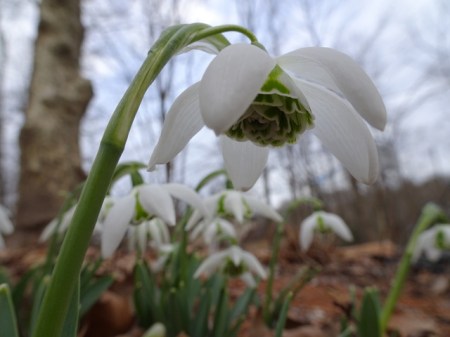
‘Godfrey Owen’: absolutely unique and beautiful from above and below; vigorous and early-blooming; selected by famous galanthophile Margaret Owen and named for her husband.

First, the flower must be beautiful and/or interesting.  Among other characteristics I consider is the flower shape and size.  I am partial to large, rounded flowers with spoon shaped outer segments.  Although I generally prefer single flowers, in peonies for example, I also like double snowdrops—although many galanthophiles look down on them—because they bloom longer and, for me, are more often purely beautiful.  The texture of the outer segments varies, and I am drawn to thick texture, which means the flower lasts longer, and I favor a pleated look.  The color and placement of the marks is very important.  I am partial to yellow snowdrops, dark emerald green marks, two-tone inner marks, and marks on the outer segments, especially virescent (green-shaded) outers.

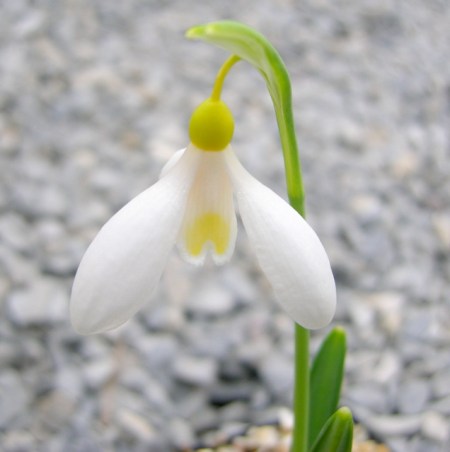
.‘Madelaine’: the best and most vigorous yellow in my garden—there are many yellows but a lot do not multiply well; selected by the famous Joe Sharman at Monksilver Nursery.
Second, every snowdrop on my favorites list must be easy to grow and must multiply vigorously in my garden wherever I decide to place it.  I do not treasure a snowdrop that doesn’t grow well for me no matter how much it thrives in other people’s gardens.  And there will be no coddling of a picky snowdrop no matter how beautiful or rare.  I will, however, move a snowdrop to a new location if it is doing OK but not thriving, if I have time….

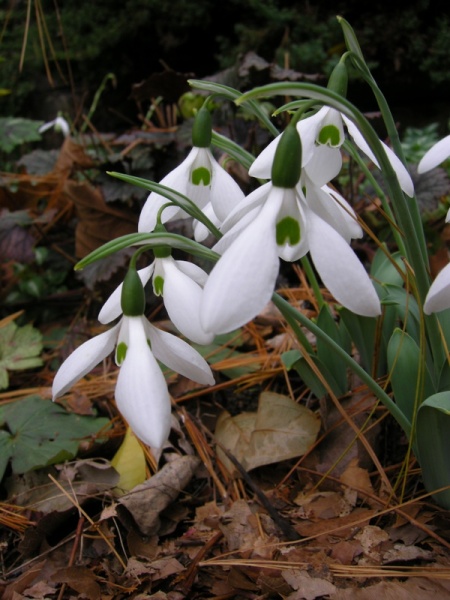
.‘Fly Fishing’: the name chosen by my sadly missed friend Alan Street is perfect; would recognize it anywhere; very vigorous.

Third, I must be able to recognize a favorite snowdrop without looking at the label, not only in my garden but in larger collections.  This is a tall order in a field of over 3,100 named cultivars, many of which have very little to set them apart.  However, through a combination of flower shape and markings, leaves, habit, and bloom time, all my favorites stand out.

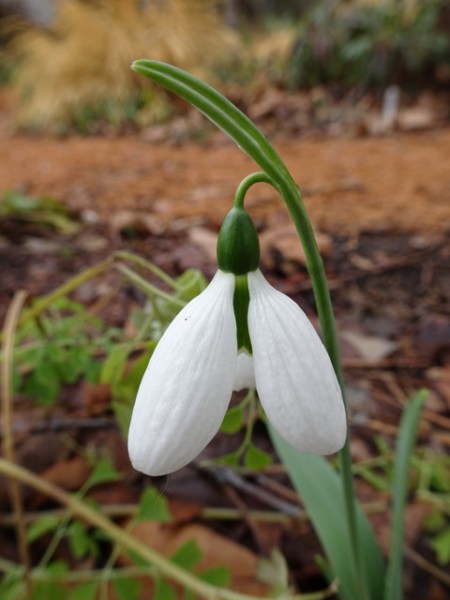
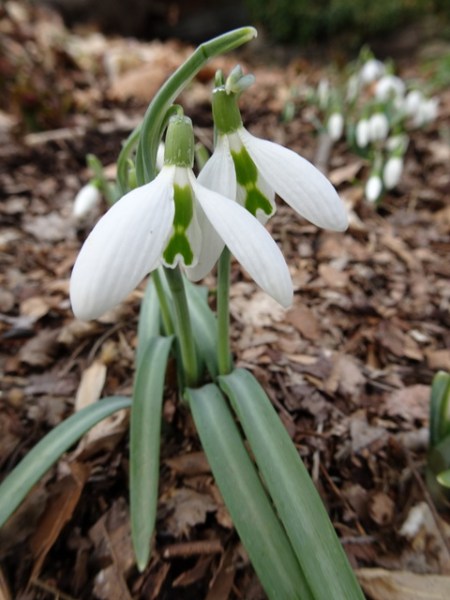
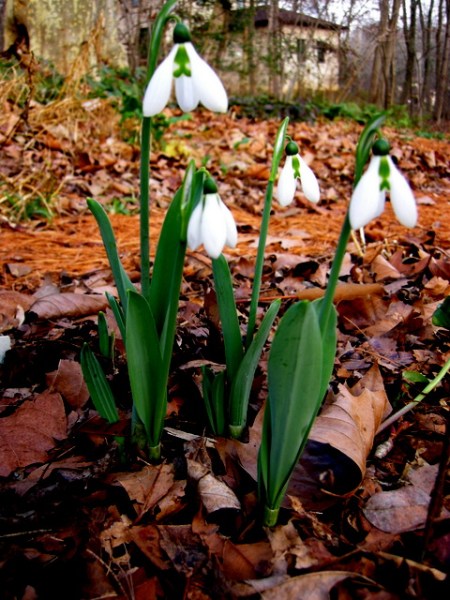
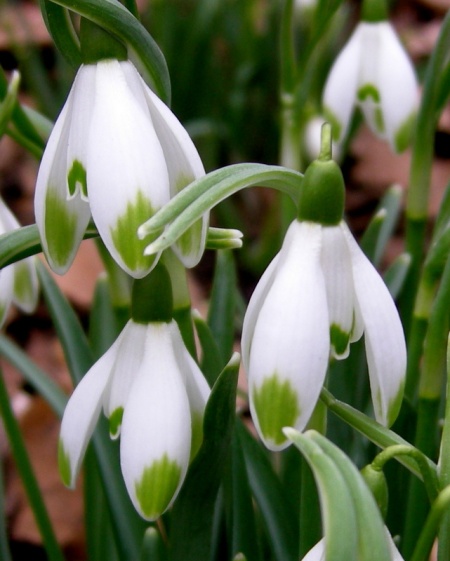
.‘Xmas’: large, elegant, upright flowers with gracefully curved spathes and wide blue leaves; early bloomer; selected at the US Botanic Garden and named by Carolyn’s Shade Gardens.

Fourth, the habit and individual parts of a snowdrop can add greatly to its desirability.  I am partial to tall and upright snowdrops with large flowers held well above the leaves.  My favorite leaves are wide and generally blue, which is characteristic of Galanthus elwesii, but I also love the elegantly pleated foliage of Galanthus plicatus, especially if there is a pronounced white stripe. Ovaries (the little cap above the flower) with pleasing and compatible shapes, spathes (the bud covering) that arch elegantly over the flower, and pedicels (the flower stem) that hold the flower just so can add to a snowdrop’s allure.

.
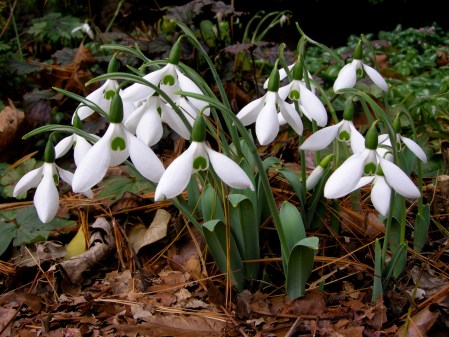
‘Potter’s Prelude’: large and elegant flowers; best November-blooming snowdrop in my garden; named by my dear friend Charles Cresson.

Fifth, I lean toward snowdrops that bloom early, especially in November and December.  As I describe more fully in my post December Blooming Snowdrops, click here to read, this is the time of year when I can most appreciate flowers of all kinds and not many snowdrops bloom then so the ones that do stand out.  I would consider this a purely personal consideration, but it is a preference shared by the majority of my customers so I have to think it is widespread.

.

‘Lady Beatrix Stanley’:  beautiful; no other double has the two elegant dots on the inner segments; multiplies rapidly; grown by Lady Beatrix Stanley (1877-1944) at Sibbertoft Manor.

Finally, I love snowdrops with history behind them: who selected them, where, why?  Unlike most other plants, we can often answer these questions about snowdrops and our relation to the plant is the richer for this added dimension.  That is why I always provide snowdrop history in my catalogue and in blog post profiles of new snowdrops.

.

The snowdrops pictured above were chosen from the favorites in my collection because they illustrate the points I am making and meet most if not all of my criteria.  However, I grow many more snowdrops that qualify as favorites and could have been included here.  And I grow others that don’t make the grade, usually due to their slow growth, but which I still treasure.

.

Blogs are a lot more fun for everyone, especially the writer, when readers leave comments.  Scroll down to the end of the page to the box where it says “Leave a Reply” and start typing—-it’s easy!

Carolyn

.

Note: Every word that appears in orange on my blog is a link that you can click for more information. If you want to return to my blog’s homepage to access the sidebar information (catalogues, previous articles, etc.) or to subscribe to my blog, just click here.

December Blooming Snowdrops

Posted in bulbs for shade, snowdrops, winter, winter garden, winter interest with tags , , , , , , , , , , , , , , , , on December 20, 2023 by Carolyn @ Carolyns Shade Gardens

Galanthus bursanus, the newest snowdrop species, blooms earliest in my collection

For our current Snowdrop Catalogue, click hereIf you want to be notified about the next snowdrop catalogue, please send your full name, mailing address, and cell number to carolyn@carolynsshadegardens.com, and specify snowdrops.

I really appreciate the appearance of the earliest blooming snowdrops in my garden: Galanthus bursanus and Galanthus reginae-olgae and their cultivars, at the beginning of October.  They remind me that the much treasured snowdrop season is starting and will continue through March.  However, there are so many other plants performing then with flowers, berries, fall color, and seeds, not to mention all the work we need to do to get our garden ready for winter that I only notice the October snowdrops in passing.  Likewise, although I love all my snowdrops that begin flowering in January, which is the early main season for snowdrops, there are so many of them. 

It is the snowdrops that reach their peak in December that I most treasure.  I realized that I have never done a post featuring those snowdrops so here I will talk about my four favorites plus a peak at a potential newcomer.

Nursery News:  Carolyn’s Shade Gardens is a retail nursery located in Bryn Mawr, PA, specializing in showy, colorful, and unusual plants for shade.  The only plants that we ship are snowdrops within the US.  For catalogues and announcements of local events, please send your full name, mailing address, and cell number to carolyn@carolynsshadegardens.com and indicate whether you are interested in snowdrops.  Click here to get to the home page of our website for catalogues and information about our nursery and to subscribe to our blog.

.

fall-blooming snowdrop 'Potter's Prelude' at Carolyn's Shade Gardens‘Potter’s Prelude’ is an elegant snowdrop with a bold mark.

‘Potter’s Prelude’, a cultivar of Galanthus elwesii var. monostictus, is a rare American snowdrop selected in the 1960s by Jack Potter, the former Curator of the Scott Arboretum in Swarthmore, Pennsylvania.  It was registered in 2004 by noted regional horticulturist Charles Cresson and introduced in 2010 by Carolyn’s Shade Gardens.

.

This clump of ‘Potter’s Prelude’ is ready for dividing.

‘Potter’s Prelude’ is a free-flowering and vigorous snowdrop with wide, recurving, very blue leaves.  Its flowers are large and elegantly formed with a bold dark green mark.  They begin blooming in mid-November and continue into January with December being their peak.  Be aware that some snowdrops sold under this name are inferior seedlings.  International snowdrop expert Alan Street told me that the flowers shown in the top photo, which he much admired, are far superior to the form circulating in England.  ‘Potter’s Prelude’ is featured 0n page 77 of Anne Repnow’s book Some Snowdrops, an excellent reference guide.

.

‘Standing Tall’

‘Standing Tall’ is an American Galanthus elwesii cultivar selected and named by Charles Cresson.  It was introduced for sale for the first time by Carolyn’s Shade Gardens in 2013.  Although it can reach 12″ tall, it was primarily named for its very upright habit and unmistakable, commanding presence in the garden.  Its name also reflects its ability to flop down when its cold like all snowdrops do and stand back up perfectly straight as if nothing has happened.  My unofficial observations also indicate that it remains upright at much lower temperatures than other snowdrops.

.

‘Standing Tall’ in the Cresson garden.

‘Standing Tall is at its peak right now, although my main patch was divided last year and does not look as full as most years.  However, like all the snowdrops featured in this post, it is very vigorous and will quickly fill back in and look like Charles Cresson’s patch above.  It starts blooming between the the last week of November and the first week of December and continues through January.  It is featured on Page 83 of Anne Repnow’s excellent book Some Snowdrops.

.. ‘Three Ships’ has the very full outer segments sometimes associated with G. plicatus.

‘Three Ships’ is a cultivar of Galanthus plicatus selected in England by the famous John Morley of North Green Snowdrops in Suffolk in 1984.  He named it for the Christmas carol “I Saw Three Ships”.

.

‘Three Ships’ multiplies well in my garden.

‘Three Ships’ is quite striking in the garden and cannot be confused with any other snowdrop. It has an ethereal glow that is whiter than white and large, bowl-like and deeply puckered outer segments with a wide and attractive green mark on the inner segments.  It blooms reliably about a week after ‘Standing Tall’ in mid-December, although I find that this is location specific.  One of my three patches bloomed on November 26 this year, while the other two followed the regular pattern.

.

‘Xmas’ has large and elegant flowers with gracefully curved spathes.

‘Xmas’ was selected many years ago by a gardener at the US National Botanic Garden from a patch of normal Galanthus elwesii growing in the parking lot and passed through many hands to me.  Carolyn’s Shade Gardens first introduced it for sale as ‘Xmas’ in 2016.

.

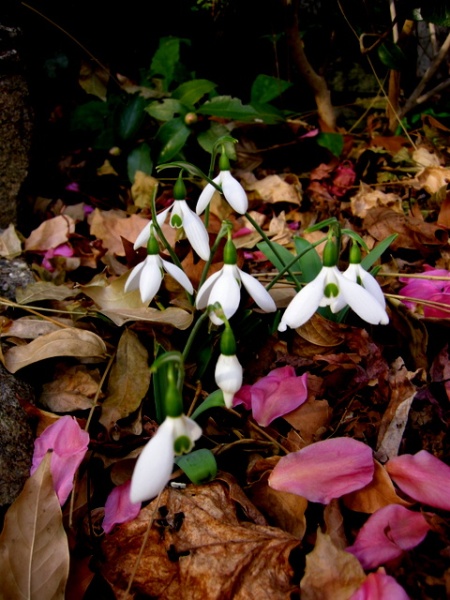
‘Xmas’ is at least twice the height of ‘Three Ships’, which blooms at the same time.  It is shown here with the flowers of fall-blooming camellia ‘Winter’s Joy’.

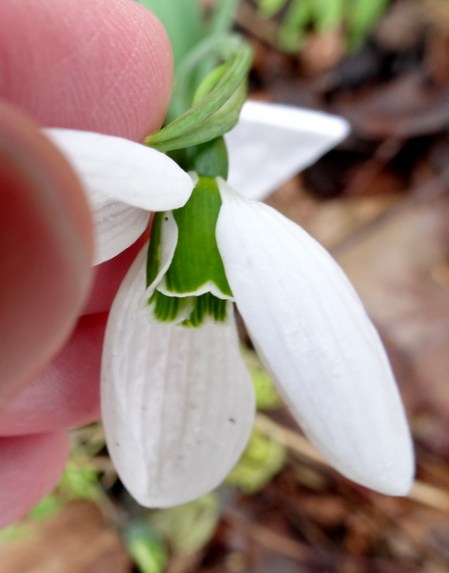
‘Xmas’ has very large and beautiful flowers with long, bowl-shaped outer segments and a distinct X mark on the inner segments.  In the Delaware Valley, it usually comes into flower in mid-December at the same time as ‘Three Ships’ and is fully out around the holidays when there is often a lull in snowdrop activity.  It also goes on blooming for about a month after ‘Three Ships’ as its flowers are particularly durable and long lasting.   When my dear friend Alan Street saw this photo he was impressed with the height and fullness of the flowers.  Unfortunately, he never saw ‘Xmas’ in person as it makes quite an impression when you see it in the garden.

. A new December-blooming Galanthus elwesii under consideration.

I have been observing this snowdrop, which appeared in my oldest patch of straight species Galanthus elwesii.  It blooms in late November/early December and has lovely, full flowers with a solid green inner mark from apex to base.  It will take more years of observation and building up stock before I decide if it merits a name.  Meanwhile, I would be grateful if any reader would let me know if they have seen a similar snowdrop blooming in early December.

.

The inner segments are entirely green.

.

The snowdrops profiled here are some of my favorites.  I have lined my front walk with large clumps so I can enjoy them every day this time of year, and all four appear in more than the two standard locations in my garden (one for display and one for back up).  In fact, ‘Xmas’ is in six locations, ‘Potter’s Prelude’ is in five, while the others are in three.

.

Blogs are a lot more fun for everyone, especially the writer, when readers leave comments.  Scroll down to the end of the page to the box where it says “Leave a Reply” and start typing—-it’s easy!

Carolyn

.

Note: Every word that appears in orange on my blog is a link that you can click for more information. If you want to return to my blog’s homepage to access the sidebar information (catalogues, previous articles, etc.) or to subscribe to my blog, just click here.

Early-Blooming Snowdrops

Posted in bulbs for shade, snowdrops, winter interest with tags , , , , , , , , , , , , , , , , , , , , on October 23, 2019 by Carolyn @ Carolyns Shade Gardens

The species snowdrop Galanthus reginae-olgae blooming in our garden in October with ‘Shell Pink’ lamium.

Our current snowdrop catalogue is on line here.

Around this time every year, I start to get emails from customers and blog readers asking which early-blooming snowdrops will be available for purchase in our catalogue.  When you see the photo above, you can understand why gardeners who appreciate snowdrops are trying to extend their season into early fall.   Early snowdrops are beautiful in their own right but especially appreciated when not surrounded by the many other snowdrop cultivars that flower in the heart of the snowdrop season.  And  this beautiful clump of fresh white flowers is in full bloom when everything around it is going by for the year.

Highlighted in this post are five, early-blooming snowdrops that will be available in the 2020 catalogue.  Keep in mind that exact bloom time is affected by how quickly the soil cools off in the fall and the amount of moisture available to the bulbs—warmer and drier falls seem to equate with later-blooming.

Nursery News:  Carolyn’s Shade Gardens is a retail nursery located in Bryn Mawr, PA, specializing in showy, colorful, and unusual plants for shade.  The only plants that we ship are snowdrops within the US.  For catalogues and announcements of local events, please send your full name, mailing address, and cell number to carolyn@carolynsshadegardens.com and indicate whether you are interested in snowdrops.  Click here to get to the home page of our website for catalogues and information about our nursery and to subscribe to our blog.

.

Galanthus reginae-olgae looks a lot like the common snowdrop, G. nivalis, but it blooms reliably by mid-October in our garden, and it has a more rigidly upright habit.

.

G. reginae-olgae also lasts a long time—here it is looking a little worse for wear on December 3.

.

The G. reginae-olgae that we sell comes from bulb expert Charles Cresson who selected it as a form that thrives in our climate as opposed to the other forms of this species he has trialed.  I too have tried G. reginae-olgae from other sources without success.

.

Galanthus elwesii ‘Potter’s Prelude’ begins to bloom in mid-November in our garden and can often last into January.  It is a rare American snowdrop selected in Swarthmore, Pennsylvania, in the 1960s.

.

fall-blooming snowdrop 'Potter's Prelude' at Carolyn's Shade Gardens‘Potter’s Prelude’s’ flowers are big and beautiful.

.

‘Potter’s Prelude’ is a great companion plant for fall-blooming camellias—here with the petals of ‘Winter’s Joy’.

.

‘Potter’s Prelude’ has beautiful foliage.  The leaves of early-blooming snowdrops come out with or immediately after the flowers, which means that, if we have a hard winter, they can look somewhat battered when it is snowdrop shipping time in late February or early March.

.

Galanthus elwesii ‘Barnes’ is a November-blooming snowdrop so highly regarded in England that it has earned the coveted Award of Garden Merit from the Royal Horticultural Society, one of only 28 snowdrops to do so.

.

‘Barnes’ in our garden

.

‘Barnes’ also remains ornamental for a long period of time.  It still looks great here at the very end of December.

.

Galanthus elwesii ‘Standing Tall’ is a very large and beautiful December-blooming snowdrop selected by bulb expert Charles Cresson in Swarthmore, Pennsylvania, after many years of evaluation.

.

The big flowers have beautiful dark green markings.

.

It is a bold plant that can hold its own among evergreen groundcovers like the Chinese wild ginger in the photo.

.

Galanthus elwesii ‘Xmas’, a December-blooming snowdrop, originated at the United States Botanic Garden in Washington, DC.  I introduced it and named it ‘Xmas’ because it blooms around Christmas and has a distinct X on its inner segments.

.

‘Xmas’ is quite vigorous in my mid-Atlantic garden.

.

Each plant quickly produces two or three flowers.

.

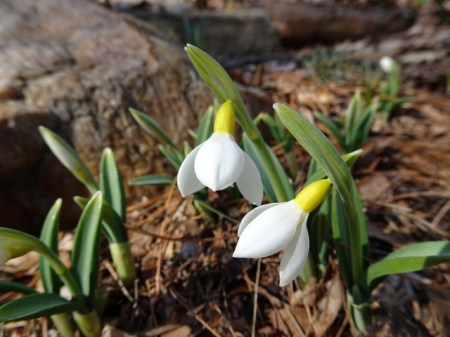
‘Xmas’ is gorgeous on a sunny December day.

.

When you look through our catalogue in December, think about adding some of these beautiful, early snowdrops.

Carolyn

.

Note: Every word that appears in orange on my blog is a link that you can click for more information. If you want to return to my blog’s homepage to access the sidebar information (catalogues, previous articles, etc.) or to subscribe to my blog, just click here.

The 2019 Snowdrop Season Part One

Posted in bulbs for shade, my garden, snowdrops, winter, winter interest with tags , , , , , , , , , , , , , , , , , , , , , , , , on February 20, 2019 by Carolyn @ Carolyns Shade Gardens

‘Lady Beatrix Stanley’ extends her wings.  It has taken me eight years to produce a photo that captures the elegance of this snowdrop.

The heart of the snowdrop season is upon us, and there is nothing I like better than roaming around our garden photographing my collection.  Taking photos forces you to view each snowdrop close up and really focus on the differences that make each one so special.  My snowdrop photographs are frequently praised, and people always ask what camera I use.  But what makes my photos great is not fancy equipment, but knowing the plants intimately and capturing their unique beauty.  One photo here can be preceded by years of attempts to get on film what I know is there.  Here are some of my other recent captures:

Nursery News:  Carolyn’s Shade Gardens is a retail nursery located in Bryn Mawr, PA, specializing in showy, colorful, and unusual plants for shade.  The only plants that we ship are snowdrops and miniature hostas.  For catalogues and announcements of events, please send your full name, location, and cell number (for back up use only) to carolyn@carolynsshadegardens.com.  Click here to get to the home page of our website for catalogues and information about our nursery and to subscribe to our blog.


I took this photo of ‘South Hayes’ at the 2017 Royal Horticultural Society February Spring Show at Vincent Square in London.  It was part of the Avon Bulbs display, which Michael and I helped to set up.  I am very honored that John Morley of North Green Snowdrops in Beccles, England, thought the photo was so good that he used it on the cover of his 2019 Catalogue.  You can view his catalogue here.  When I was profiled in Naomi Slade’s book The Plant Lover’s Guide to Snowdrops, I chose ‘South Hayes’ as my utopia snowdrop.  I highly recommend Naomi’s book for gardeners who want to expand their knowledge of snowdrops beyond the basic forms.  It is available on Amazon here.

.

‘Xmas’ was named at Carolyn’s Shade Gardens for its vigor, bloom time around Christmas, and prominent X mark.  I have over 60 photos of this snowdrop saved on my computer (and those are the ones I saved!) and think this is one of the best.  Snowdrops look wonderful on sunny days with blue sky in the background, but it is very difficult to photograph their best angle then without casting shadows, capturing glare, or having something distracting in the background.

.

Another recent shot of ‘Xmas’.  I was thrilled that ‘Xmas’ was included in the newly published second edition of Freda Cox’s book A Gardener’s Guide to Snowdrops and listed as one of only five notable snowdrops selected in the US.  I highly recommend Freda’s book, which is the most up-to-date encyclopedic snowdrop reference work with profiles and beautiful drawings of over 2,000 snowdrops.  It is available on Amazon here.

.

Yellow snowdrops like ‘Wendy’s Gold are all the rage and rightly so, but it is difficult to capture them looking yellow.  They require sunshine, which has been in short supply this winter, to bring out their yellow color and, in the shade, they look olive.

.

The simple beauty of ‘Robin Hood’ is enhanced for me by the history of the cultivar.  One of the primary reasons that I am obsessed with snowdrops is that almost every cultivar has a story attached.  ‘Robin Hood’ was selected in the later 1800s by James Allen of Shepton Mallet in England, who also selected the iconic cultivars ‘Magnet’ and ‘Galatea’.  The newly published book The Galanthophiles by Jane Kilpatrick and Jennifer Harmer devotes an entire chapter to Allen whom they call the greatest of all galanthophiles.  This wonderful book is available on Amazon here.

.

‘Welshway’ is a petite beauty and treasured all-the-more by me for the memories it evokes.  The British snowdrop world is a small and welcoming place.  When Michael and I traveled to England in February 2017 and 2018, we were invited into the homes and gardens of people whom we had never met due to the longstanding English tradition of garden hospitality.  We visited the garden of Hugh and Hilary Purkess called Welshway Cottage for a wonderful tour and delicious tea and cake.  ‘Welshway’ came from the Purkess’s garden.

.

‘Trymming’ was selected in 2007 by my friend the internationally famous snowdrop expert Alan Street at Avon Bulbs in England.  This photo captures ‘Trymming’s’ bold and bright green splashed outer segments and its ability to produce two scapes when well grown.  I had to move it a few times to get it to do that!

.

Although I welcome them, snowdrop seedlings are rare in my garden.  However, this big beauty recently appeared right in the middle of a large patch of ‘Straffan’.

.

‘Standing Tall’ is another notable American snowdrop profiled in the Cox book.  It was selected in 2013 by my friend and snowdrop mentor Charles Cresson after 25 years of evaluation—he just wanted to be sure it was worth naming!!!  ‘Standing Tall’ blooms in mid-December and grows to be one of the tallest snowdrops in my garden.

.

Galanthus rizehensis is a relatively unknown species snowdrop with a small and perky stature and very dark green leaves.  It will be in our 2020 catalogue.

.

This photo sent to me by my customer Tim Calkins really captures the petite beauty of Galanthus rizehensis, which he purchased from Carolyn’s Shade Gardens.

.

‘Richard Ayres’ is one of my favorite snowdrops due to its vigor, exquisite beauty, and early bloom time.  To capture the beauty of double snowdrops, you must photograph them at an angle that includes the outside and inside at the same time.  This involves some very awkward camera positions and body contortions.  After many years and dozens of attempts, I am happy with this photo.

.

‘Richard Ayres’ also looks lovely photographed from the top.

.

The charms of ‘Lapwing’ also proved hard to get onto film until now, but that doesn’t mean I will not keep trying to do even better.

.

Another favorite snowdrop, the stately ‘Kite’, featuring extra long and elegant outer segments.

.

‘Kite’ is also known for producing two flowers on the same scape.  You can see this in the photo above where two flowers are attached by their pedicels (stems) to the same spathe.  They come out wrinkled from being crushed in together but usually straighten out.

.

‘Anglesey Abbey’ is a unique snowdrop with bright green leaves instead of the usual blue-gray.  Although it is described as being almost poculiform and almost pure white, mine is pretty close if not perfect.  Poculiform means that the inner segments have been replaced by three additional outer segments of equal  length.

.

The plump, upside down hot air balloon shape of ‘Diggory’ is recognizable anywhere but difficult to capture in a photo.  I am very happy with this one as it’s the fattest I have ever seen it.

If you have snowdrops or other winter-blooming plants, I encourage you to visit them regularly with your camera and expand your enjoyment of your garden into the winter months.

Carolyn

Nursery Happenings: You can sign up to receive catalogues and emails about nursery events by sending your full name, location, and cell number (for back up contact use only) to carolyn@carolynsshadegardens.com.  Subscribing to my blog does not sign you up to receive this information.  Please indicate if you will be shopping at the nursery or are mail order only.

Carolyn’s Shade Gardens is a local retail nursery in Bryn Mawr, Pennsylvania, U.S., zone 6b/7a. The only plants that we mail order are snowdrops and miniature hostas and only within the US.

Facebook: Carolyn’s Shade Gardens has a Facebook Page where I post single photos, garden tips, and other information that doesn’t fit into a blog post. You can look at my Facebook page here or click the Like button on my right sidebar here.

Notes: Every word that appears in orange on my blog is a link that you can click for more information. If you want to return to my blog’s homepage to access the sidebar information (catalogues, previous articles, etc.) or to subscribe to my blog, just click here.

Just Relax and Enjoy the Flowers

Posted in bulbs for shade, Camellias, hellebores, my garden, snowdrops, winter, winter interest with tags , , , , , , , , , , , , , , , , , , , on December 29, 2015 by Carolyn @ Carolyns Shade Gardens

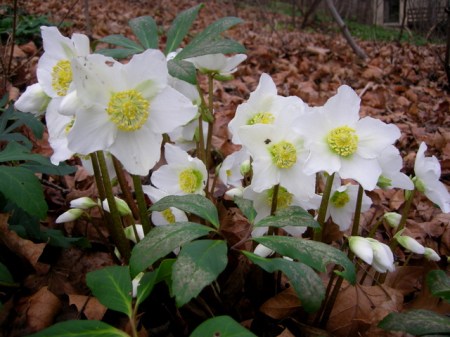
Helleborus niger 'Praecox'Even though praecox means developing early, ‘Praecox’ Christmas rose hellebore is one of the main season varieties that bloom later in January or February.  Here it is in mid-December.

Like much of the country, southeastern Pennsylvania, US, zone 6 to 7, has had unseasonably warm weather for weeks.  There has been no snow, the ground has not frozen, we have only had 2 or 3 real frosts, not enough to set back the acanthus, and it was 70 degrees F on Christmas Day.  It has also been raining for most of two weeks.  Quite a change from the last two falls when it got cold in October and stayed that way.  In 2013 to 2014, we experienced record snowfalls.  In 2014 to 2015, there was not much snow but record low temperatures.

Nursery News: Carolyn’s Shade Gardens is a retail nursery located in Bryn Mawr, PA, specializing in showy, colorful, and unusual plants for shade.  The only plants that we ship are snowdrops and miniature hostas.  For catalogues and announcements of events, please send your full name, location, and phone number (for back up use only) to carolyn@carolynsshadegardens.com.  Click here to get to the home page of our website for catalogues and information about our nursery and to subscribe to our blog.

.

Camellia x 'Winter's Joy'‘Winter’s Joy’ fall-blooming camellia is not blooming early but instead continuing to bloom beyond when its flowers and buds would usually be frozen and done.  It started in October and is about to enter its fourth month.

.

Should we be worried?  As Mark Rylance, playing a Soviet espionage agent accused of treason, says in “Bridge of Spies”, would it help?  Lots of attention needs to be paid to the very serious issue of climate change and what the US in particular can or should do in the face of the incontrovertible evidence of evolutionary temperature changes occurring at faster than evolutionary speeds.  But worrying about the plants in our gardens and neighborhoods won’t accomplish much.  We can’t control the weather so just relax and enjoy the early flowers.  My friend John Lonsdale who is originally from England tells me that if we lived there, this would all be completely normal—the weather and the bloom times.  Here is what is early in my garden:

.

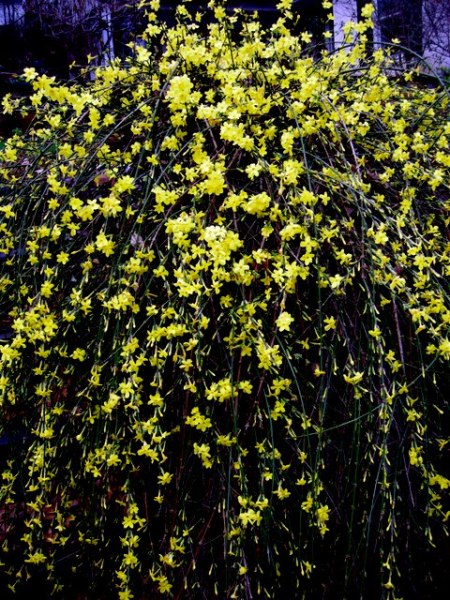
Jasminum nudiflorumWinter jasmine usually sends out a few flowers through out the winter whenever it gets warm.  The whole shrub is in bloom now with not many buds left for later.

.

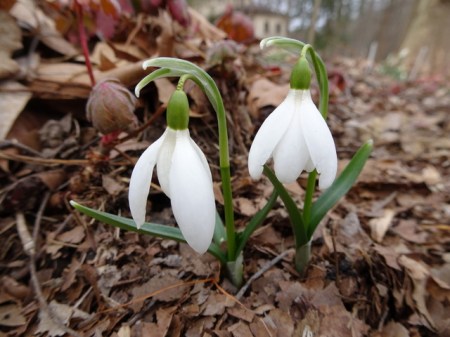
Galanthus 'Xmas' elwesiiThe giant snowdrop ‘Xmas’ does open flowers by Christmas, but right now the whole patch is in bloom and starting to go by.  Last year I had flowers through March.

.

Galanthus 'Standing Tall' elwesiiThe giant snowdrop ‘Standing Tall’ also opens its buds around Christmas.  It was so early this year that its flowers are now completely done.

.

Pulmonaria rubra 'Redstart'February-blooming ‘Redstart’ pulmonaria or lungwort is in full flower all through my gardens.

.

Mahonia japonicaThe lovely, evergreen Japanese mahonia is a late winter bloomer but all my shrubs are in flower.

.

‘Winter’s Song’, whose name has been inexplicably changed to ‘Joker’, is a Christmas rose cross that normally waits until late January or February.

.

DSCN7294Double hybrid hellebores are generally a little later in my garden but this one looks gorgeous today.

.

Narcissus 'Rijnveld's Early Sensation'How about this for a surprise?  On Christmas Day, ‘Rijnveld’s Early Sensation’ opened two flowers.  It is the earliest daffodil that I know of but that’s usually February.

.

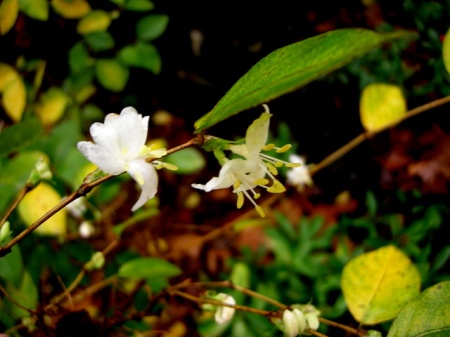
DSCN7296Highly fragrant winter-flowering honeysuckle (Lonicera fragrantissima) is blooming.  It usually flowers slightly before forsythia.

.

DSCN7292‘Blue Lady’ hybrid hellebore decided to put on an early show.

.

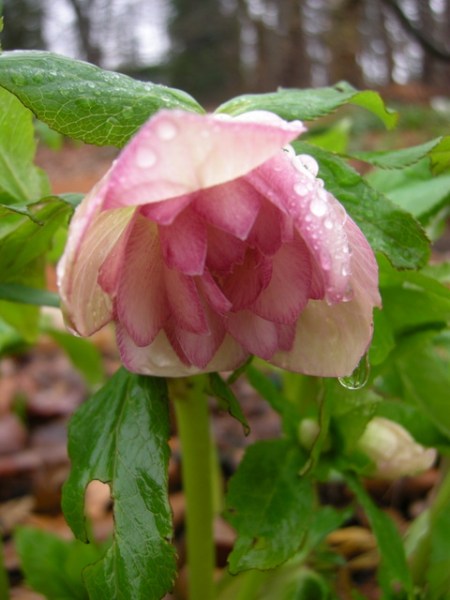
DSCN7268My favorite hellebore form with the little ruffles inside (petaloid) didn’t disappoint me.

.

Geum 'Cooky'Geum ‘Cooky’ has been flowering all fall.

.

Galanthus 'Fly Fishing'One of my favorite snowdrops ‘Fly Fishing’ has been whipping around in all the rain and wind on its extra long, fishing line pedicel (flower stem).

.

Edgeworthia chrysanthaNo open flowers yet, but the edgeworthia flower buds are swelling to form elegant silver tassels.

.

Many people have asked me what will happen in the spring?  Most of the plants that are flowering now are using buds that they formed after they were done flowering last spring.  If every bud opens, they will not form new buds and will not bloom again.  My advice is to enjoy them now!

Carolyn

Nursery Happenings: You can sign up to receive catalogues and emails about nursery events by sending your full name and phone number to carolynsshadegardens@verizon.net.  Subscribing to my blog does not sign you up to receive this information.

Carolyn’s Shade Gardens is a local retail nursery in Bryn Mawr, Pennsylvania, U.S., zone 6b/7a. The only plants that we mail order are snowdrops and miniature hostas and only within the US.

Facebook: Carolyn’s Shade Gardens has a Facebook Page where I post single photos, garden tips, and other information that doesn’t fit into a blog post. You can look at my Facebook page here or click the Like button on my right sidebar here.

Notes: Every word that appears in orange on my blog is a link that you can click for more information. If you want to return to my blog’s homepage to access the sidebar information (catalogues, previous articles, etc.) or to subscribe to my blog, just click here.