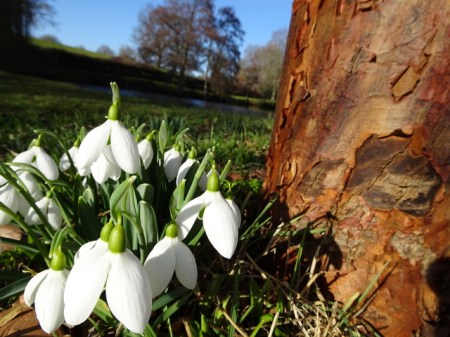
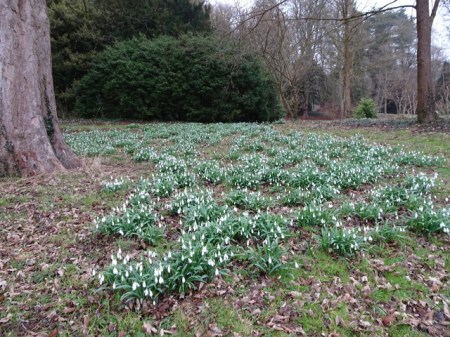
Archive for seeing snowdrops in England

Wandlebury Ring

Posted in garden to visit, snowdrops, winter garden, winter interest with tags , , , , , , , , , , , , , , on November 19, 2023 by Carolyn @ Carolyns Shade Gardens

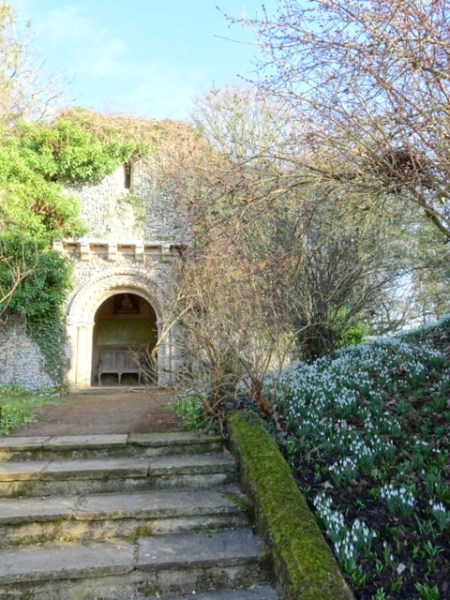
The stable block at Wandlebury Ring was built for James II in the late 17th century and later housed the famous Godolphin Arabian.

On our way back from Bennington Lordship (to read about that garden, click here), Michael and I visited Wandlebury Ring, an Iron Age hillfort outside Cambridge in the Gog Magog Hills, Cambridgeshire.  The hillfort was constructed by an ancient British tribe in 400 BC and later inhabited by the Romans.  In the late 17th century, the inner ramparts and ditch, which circled the fort, were leveled to make way for racing stables for King James II.  A mansion and gardens were also constructed, but all that remains now is the stable block and the fort’s deep, encircling outer ditch.  The site is now a country park owned by Cambridge Past, Present & Future.  For more historical details, click here .

Nursery News:  Carolyn’s Shade Gardens is a retail nursery located in Bryn Mawr, PA, specializing in showy, colorful, and unusual plants for shade.  The only plants that we ship are snowdrops within the US.  For catalogues and announcements of local events, please send your full name, mailing address, and cell number to carolyn@carolynsshadegardens.com and indicate whether you are interested in snowdrops.  Click here to get to the home page of our website for catalogues and information about our nursery and to subscribe to our blog.

.
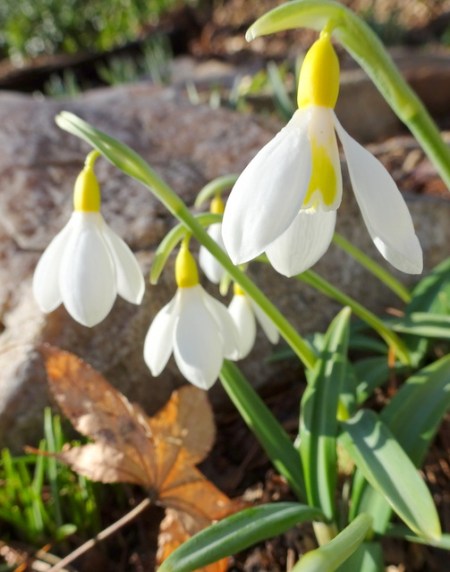
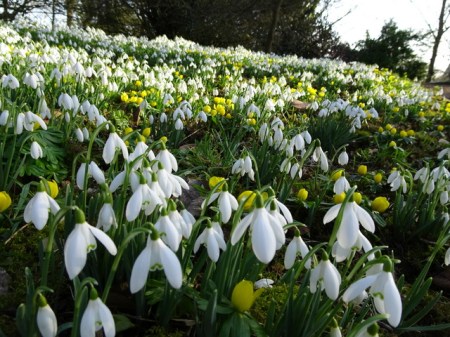
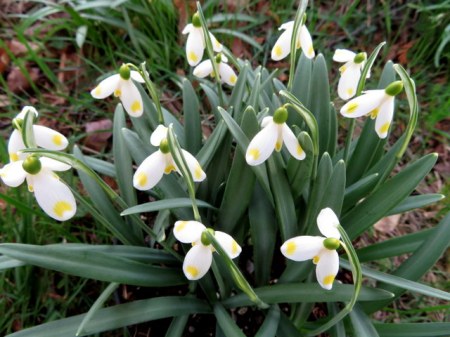
The very famous yellow snowdrop ‘Wendy’s Gold’ was first observed in the park in 1974 by Bill Clark, the Warden of Wandlebury Ring, but wasn’t introduced until the early 1990s.  It is a beautiful, bright yellow in our winter sunshine and vigorous in my garden.

Although the history of Wandlebury Ring is quite interesting, the real reason for our visit was to see the naturalized G. plicatus that thrives inside the Ring.  It is from this population that Bill Clark, the Warden of Wandlebury Ring from 1973 to 1998, selected the iconic ‘Wendy’s Gold’, which is named for his wife.  The famous ‘Wendy’s Gold’ was later followed by further, well known yellow selections: ‘Bill Clark’ and ‘Wandlebury Ring’.

.

‘Bill Clark’ is an even brighter yellow, which colors the scape, spathe, and pedicel.  However, it is not as vigorous as ‘Wendy’s Gold’ in my garden.

.
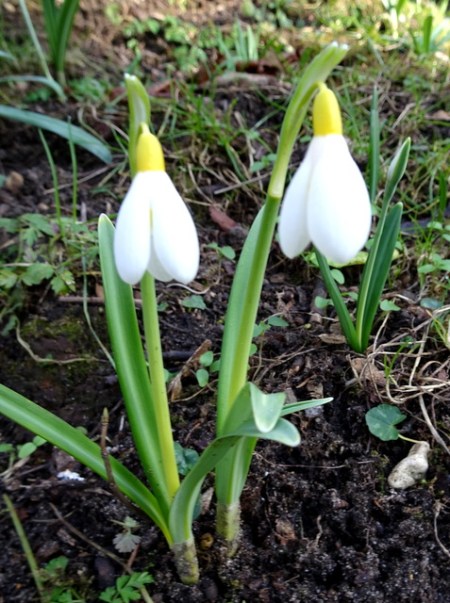
The last of the famous trio, ‘Wandlebury Ring’.  I don’t grow this snowdrop so the photo was taken in England where lack of winter sun often makes yellow snowdrops have an olive caste.

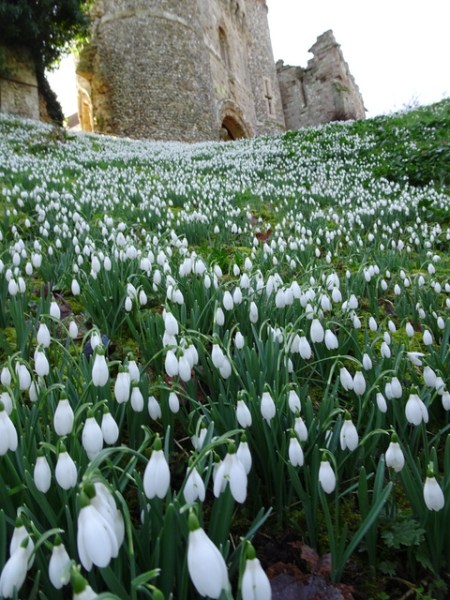
Wandlebury Ring is a beautiful setting in which to view snowdrops, which occur in sweeps around the mature trees inside the walls:

.

Michael stands in a field of Galanthus plicatus with the wall of Wandlebury Ring in the background.

.

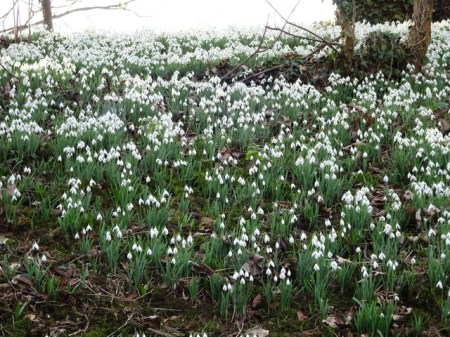
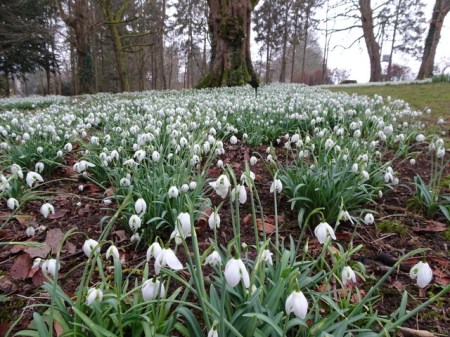
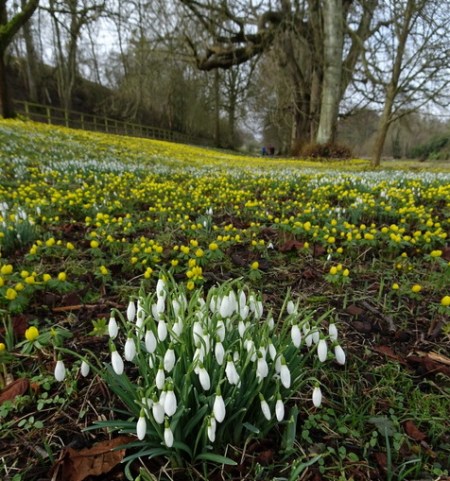
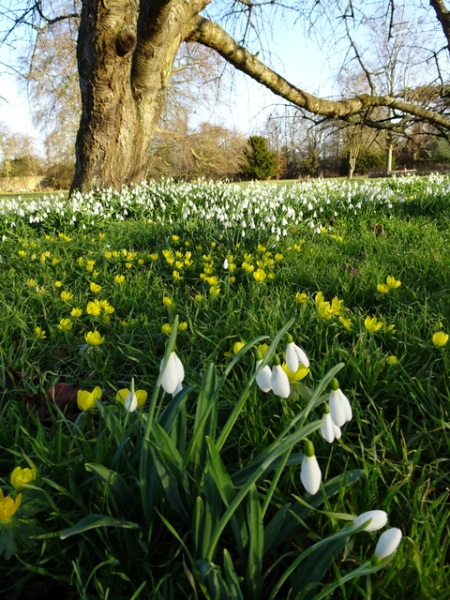
The setting is very natural with thousands upon thousands of snowdrops in among the grass and winter aconites.

.

G. plicatus exhibiting its very distinctive pleated leaves with a whitish center stripe.

.

A large beech surrounded by winter aconite and G. plicatus.

.
.

Bill and Wendy Clark still live at Wandlebury Ring.  I have corresponded with Bill extensively about the history of the yellow G. plicatus at Wandlebury, which is fascinating.  Unfortunately, unforeseen events prevented us from getting together when Michael and I were there.   However, Bill still roams the area looking for unusual snowdrops and sent me photos of his recent discoveries:

.

A snowdrop with four outer segments instead of the usual three.

.

A very elegant snowdrop with twin flowers.

.

A new yellow clone.

Thank you, Bill, for the help you have given me in untangling the origins of the Wandlebury snowdrops—you are an inspiration.  This post is dedicated to you!

.

Blogs are a lot more fun for everyone, especially the writer, when readers leave comments.  Scroll down to the end of the page to the box where it says “Leave a Reply” and start typing—-it’s easy!

Carolyn

.

Note: Every word that appears in orange on my blog is a link that you can click for more information. If you want to return to my blog’s homepage to access the sidebar information (catalogues, previous articles, etc.) or to subscribe to my blog, just click here.

Snowdrops and History at Benington Lordship Gardens

Posted in garden to visit, snowdrops, winter garden, winter interest with tags , , , , , , , , , , on November 11, 2023 by Carolyn @ Carolyns Shade Gardens

Benington Lordship is a Georgian manor house constructed in the 1700s near the ruins of a Norman castle built around 1130.

Michael and I have traveled to England many times for work and pleasure, but we had never been to Cambridge.  In February 2023, we spent four nights there touring the city and visiting snowdrop venues.  It is a wonderful city and a great place to visit gardens.  We packed a lot in, including Benington Lordship Gardens in Benington, East Hertfordshire, which is about 45 minutes from Cambridge.

Nursery News:  Carolyn’s Shade Gardens is a retail nursery located in Bryn Mawr, PA, specializing in showy, colorful, and unusual plants for shade.  The only plants that we ship are snowdrops within the US.  For catalogues and announcements of local events, please send your full name, mailing address, and cell number to carolyn@carolynsshadegardens.com and indicate whether you are interested in snowdrops.  Click here to get to the home page of our website for catalogues and information about our nursery and to subscribe to our blog.

As you come up the drive, the first thing you see is the Folly built in 1832 with snowdrops on the left cascading down the hill to the moat.

Benington Castle was originally built around 1130 by the de Valogne family.  It was destroyed in 1212 leaving only the bottom courses of the keep.  In the 1700s, the Caesar family built a Georgian manor house, Benington Lordship, adjacent to the ruins of the Norman castle keep.  In 1832, the Folly was added to join the manor house to the Norman ruins.  It consists of a neo-Norman two-story gatehouse with an arch and two circular towers plus a wall and a summer house.

.

The Folly joins the manor house—on the right side, you can just see the tower—to the Norman ruins.

.

Looking through the arch towards the interior courtyard.

.

Detail on the arch

.

The gatehouse viewed from inside the courtyard.

.

The summer house—as you can see, snowdrops are everywhere in the gardens.

.

To the untrained eye, the gatehouse looks quite authentic down to the crumbling towers.

.

The actual Norman ruins are in the back left of the snowdrop and aconite bed with the gatehouse peeking out behind them.

There is no brochure explaining the history of Benington Castle so it wasn’t until I researched Benington Lordship that I understood the provenance of all the buildings.  For history buffs, Historic England gives a very detailed account of the site here.

.

After viewing the Folly, we descended some stone steps into the moat.

.

The moat is a narrow path with both of its very steep sides filled to the brim with snowdrops.

.

The snowdrops are mostly G. nivalis, the common snowdrop, and its double form ‘Flore Pleno’.

.

The back wall of the moat.

.

Double common snowdrop, G. nivalis ‘Flore Pleno’

.

There were some beautiful vistas of snowdrops mixed with winter aconite, Eranthis hyemalis.

.

A lovely clump of G. plicatus, sometimes called Crimean snowdrop.

Although there was an area of the garden with named snowdrop cultivars, there was nothing that you won’t see in more impressive collections.  It is the picturesque buildings and the snowdrops lining the moat and surrounding the Norman ruins that made Benington Lordship worth visiting.  For details about visiting during snowdrop season, click here.

.

Blogs are a lot more fun for everyone, especially the writer, when readers leave comments.  Scroll down to the end of the page to the box where it says “Leave a Reply” and start typing—-it’s easy!

Carolyn

.

Note: Every word that appears in orange on my blog is a link that you can click for more information. If you want to return to my blog’s homepage to access the sidebar information (catalogues, previous articles, etc.) or to subscribe to my blog, just click here.

Snowdrops at the Royal Horticultural Society Spring Show

Posted in bulbs for shade, flower show, snowdrops, winter interest with tags , , , , , , , , , , , , , , , , , , on March 15, 2017 by Carolyn @ Carolyns Shade Gardens

The Royal Horticultural Society February Show at Vincent Square in London.

Our current snowdrop catalogue is on line here.

In February, Michael and I went on a two week snowdrop trip to England.  My first two posts on the trip featured cutting edge snowdrops, click here to read it, and our six day stay at Colesbourne Park, click here.  After touring the countryside, we journeyed to London to help Alan Street of Avon Bulbs, one of the most respected snowdrop sellers in the world, “moss up” for the RHS Show at Vincent Square.  When Alan invited us, we weren’t really sure what mossing up involved, but everyone said that it was quite an honor to be asked to participate.  We enjoyed every minute!

Nursery News:  Carolyn’s Shade Gardens is a retail nursery located in Bryn Mawr, PA, specializing in showy, colorful, and unusual plants for shade.  The only plants that we ship are snowdrops to the US only.  For catalogues and announcements of local events, please send your full name, mailing address, and cell number to carolyn@carolynsshadegardens.com and indicate whether you are mail order only.  Click here to get to the home page of our website for catalogues and information about our nursery and to subscribe to our blog.

.

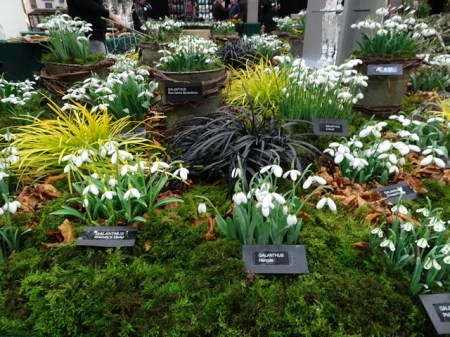
Unfortunately, it was impossible to get one photo of the entire Avon exhibit, but this picture shows about a third of the presentation from one corner.

.

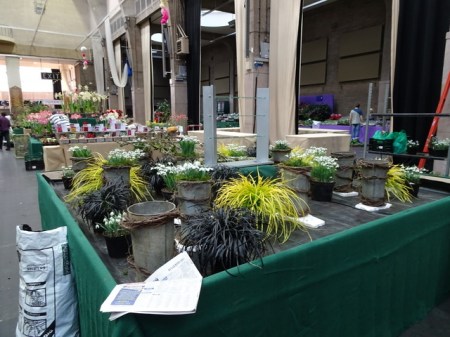
This is what we started with at about 10 am on Monday morning.

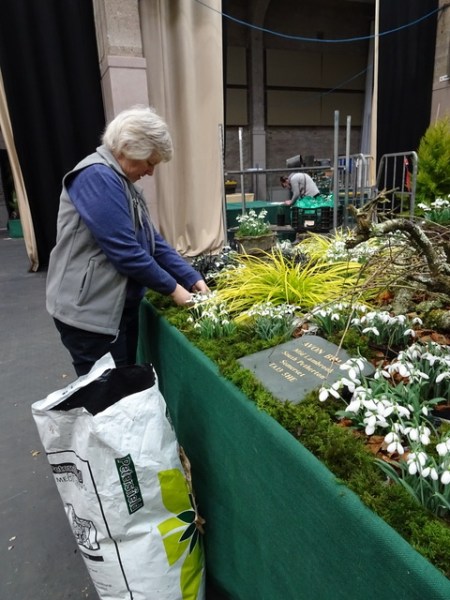
“Mossing up” is how Alan refers to setting up the Avon exhibit for the RHS Show.  Starting with the bare boards above, layer upon layer was slowly and carefully added to achieve the finished look of snowdrops displayed in a natural looking, mossy garden.  Although the snowdrops and the materials, including name tags, pieces of styrofoam, newspaper, used net bulb bags, potted plants, rustic wood, dried leaves, and the centerpiece of crystal glasses hand-etched with snowdrops, couldn’t have been better organized, it still took all day to create the masterpiece that was the display.  Here’s how we did it:

.The process started with the careful placement of the largest elements: the shelf for the crystal, the carex and mondo grass, and the metal buckets wrapped in wreaths of rustic woven vines, using thick styrofoam to elevate them.

.

Next Alan Street, Avon’s Nursery Manager and the creative genius behind the exhibit, placed each pot of snowdrops.

.

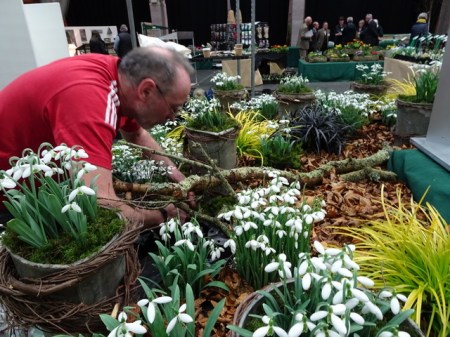
After the snowdrop pots were placed, Micky Little, Nurseryman at Avon, and my husband Michael, elevated the center of the exhibit by stuffing the spaces between the pots with balls of net bulb bags.  Next we all carefully inserted balled up newspaper between the pots along the edges to serve as a base for the moss.

.

True “mossing up” happened next as Maxine Grice, the Office Administrator at Avon, and all the rest of us surrounded the snowdrops on all four sides of the exhibit with bags and bags of moss very carefully inserted between the pots.

.

Dried leaves covered the area around the center and then lichen covered sticks were carefully added.  Only then did every pot get a label, after which the whole exhibit was reviewed for exposed edges and missing labels.  We finished around 4 pm with Michael using a pump sprayer to slowly moisten all the moss.

.

Another view of the finished exhibit.

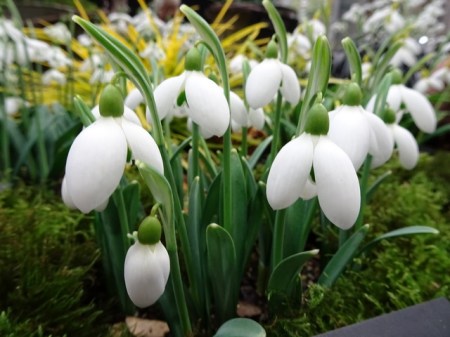
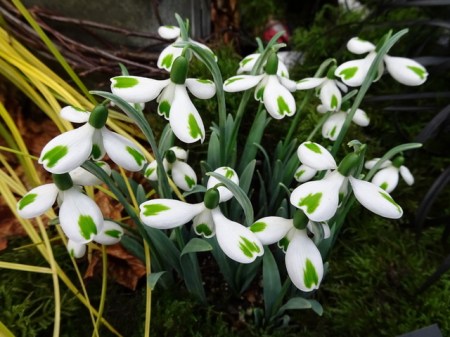
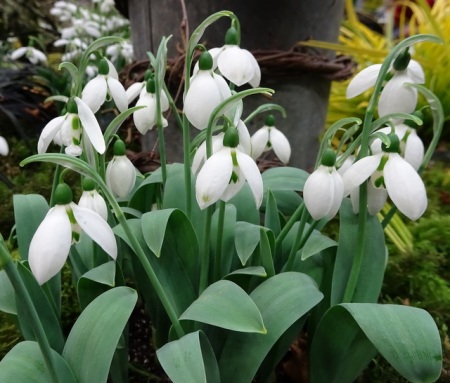
When we were done, we had created Alan’s vision of snowdrops naturalized in a woodland setting.  It was gorgeous to behold and deservedly won a gold medal from the Royal Horticultural Society.  Here are some of the individual snowdrops that I thought were especially beautiful in the exhibit:

I have it in my collection now, but for years ‘South Hayes’ was at the top of my list.

.

‘Grave Concern’ has now migrated to the top of my must have snowdrops.

.

A classic snowdrop, ‘Mighty Atom’, with gorgeous rounded petals, my favorite look.

.

‘Trumps’, a vigorous and eye-catching flower.

.

‘Phantom’ is aptly named.

.

A new must-have, ‘Jonathan’, look at those beautiful leaves and large striking flowers.

.

‘Diggory’ is recognizable anywhere.

.

‘Alan’s Treat’ selected by Alan Street and a play on his name.

.

‘Philippe Andre Meyer’ is gorgeous.

.

Another for the acquisition list, ‘Walker Canada’, so elegant.

.

Alan sent me this photo yesterday of his newest and probably his most exciting snowdrop selection ‘Midas’, a yellow-marked snowdrop with a green ovary (the little cap) and extremely rare yellow markings on the outers.   Keep your eyes open for a record-breaking price!

Next year’s RHS Spring Show is scheduled for February 13 and 14, 2018, and we hope to be there to moss up once again.  Thank you so much to Alan, Maxine, and Micky for allowing us to participate in an unforgettable experience.

Carolyn

.

Note: Every word that appears in orange on my blog is a link that you can click for more information. If you want to return to my blog’s homepage to access the sidebar information (catalogues, previous articles, etc.) or to subscribe to my blog, just click here.

Drifts of Snowdrops at Colesbourne Park

Posted in bulbs for shade, garden to visit, Garden Tour, snowdrops, winter interest with tags , , , , , , , , , , , , , , , , , , , , on March 3, 2017 by Carolyn @ Carolyns Shade Gardens

colesbourne-lake-2-10-2017-5-16-18-amA drift of snowdrops covers the hill above the extraordinarily colored lake at Colesbourne Park.  The amazing blue is caused by light reflecting off naturally deposited clay in the water.  It is worth visiting just to see it.

Our current snowdrop catalogue is on line here.
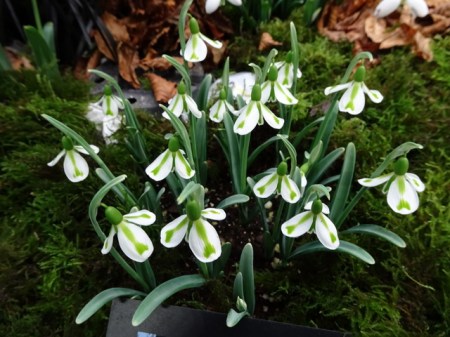
Michael and I just returned from a two week snowdrop trip to England.  For six days we were the guests of Sir Henry and Lady Carolyn Elwes at Colesbourne Park in the Cotswolds.   Colesbourne has been called England’s greatest snowdrop garden, and wandering through the grounds for six days I can see why.  First, the 2,500 acre setting is absolutely magnificent, including the lake pictured above, a church dating back to 1067, and a charming village with a delightful pub, the Colesbourne Inn, serving delicious food.

Nursery News:  Carolyn’s Shade Gardens is a retail nursery located in Bryn Mawr, PA, specializing in showy, colorful, and unusual plants for shade.  The only plants that we ship are snowdrops and miniature hostas.  For catalogues and announcements of events, please send your full name, location, and cell number (for back up use only) to carolyn@carolynsshadegardens.com.  Click here to get to the home page of our website for catalogues and information about our nursery and to subscribe to our blog.
.

Galanthus 'Margaret Owen'This lovely, very large snowdrop ‘Margaret Owen’ is a fitting tribute to its namesake, a renowned galanthophile.

.

Galanthus 'Rodmarton'The double snowdrop ‘Rodmarton’ originated at the nearby Rodmarton Manor, an arts and crafts house featuring its own wonderful snowdrop collection.

Second, you can see many rare and unusual snowdrops, like ‘Margaret Owen’ and ‘Rodmarton’ above, in large clumps instead of singly or in small groups.  Colesbourne Park has over 250 varieties in its collection, and they work hard to develop each into a large stand. 

.

Galanthus 'S. Arnott'Sir Henry Elwes stands in a field of  ‘S. Arnott’ as he entertains a guided tour with tales of Colesbourne and its snowdrops.

Third, if you are lucky enough to go on a tour, you will be taken around by Sir Henry Elwes who grew up at Colesbourne and knows all 2,500 acres intimately.  His great-grandfather was Henry John Elwes, the famous Victorian plant explorer who discovered his namesake snowdrop, Galanthus elwesii, in Turkey in 1874.  During the tour, Sir Henry will tell you about snowdrops, but he will also regale you with fascinating stories about Colesbourne itself.

.

Galanthus 'S. Arnott'A close up of ‘S. Arnott’, called the desert island snowdrop because if galanthophiles could have just one, this would be it!

But for me, the most amazing thing about Colesbourne is the huge drifts of some of the more well known cultivars of snowdrops.  As I have said before, I am not interested in having a collection of hundreds of little groups of rare snowdrops.  I want plants with interesting leaves and habits as well as flowers, that are vigorous and will multiply into large clumps fairly quickly.

.


Galanthus 'Titania'‘Titania’, a Greatorex double snowdrop, which has been intentionally divided and spread out at Colesbourne.

When Sir Henry and Lady Carolyn Elwes took over Colesbourne Park, intervening generations had not tended John Henry Elwes’s collections and many had been sold.  However, some snowdrops remained, and Sir Henry and Lady Carolyn developed the current Colesbourne snowdrop display in the last 25 years.  Colesbourne showed me what you could do with a snowdrop collection and why snowdrops like ‘S. Arnott’ and the others pictured below are so widely grown.  It was a revelation.

.

Galanthus 'Titania'‘Titania’ en masse

Here are some more snowdrops that have been systematically divided to form huge stands at Colesbourne:

.

Galanthus 'Galatea'‘Galatea’, a large and vigorous single snowdrop, called “one of the foundation stones of many collections” by Matt Bishop’s snowdrop book.

.

Galanthus 'Galatea'‘Galatea’ quickly turns into a good sized patch.

.

Galanthus 'Galatea'‘Galatea’ drifts

.

Galanthus 'Ophelia'‘Ophelia’ is my favorite of the many Greatorex doubles and also the most widely grown.

.

Galanthus 'Ophelia'‘Ophelia’ as far as the eye can see.

.

Galanthus 'Mrs. Macnamara'Early-blooming ‘Mrs. Macnamara’, another much admired classic called a “plant of great quality” by the Bishop book.

.

Galanthus 'Mrs. Macnamara'A stand of ‘Mrs. Macnamara’

.

Galanthus 'Hippolyta'‘Hippolyta’, also a Greatorex double

.

Galanthus 'Hippolyta'‘Hippolyta’ spread far and wide.

.

Galanthus 'Colossus' plicatusGalanthus plicatus ‘Colossus’, an early vigorous snowdrop with a beautiful habit and elegant leaves.

.

Galanthus 'Colossus' plicatusStands of ‘Colossus’

I visited some other snowdrop venues that had sweeping drifts but none with the variety found at Colesbourne.  Painswick Rococo Garden is the place where the famous snowdrop ‘Atkinsii’ was first selected in the 1860s.  There are amazing drifts of ‘Atkinsii’, Galanthus nivalis, and ‘Flore Pleno’ there:

.

Galanthus 'Atkinsii' with Galanthus 'Flore PlenoThe very tall and stately ‘Atkinsii’ in the back with ‘Flore Pleno’ in the front at Painswick.

.

Galanthus 'Atkinsii'A hillside of ‘Atkinsii’ at Painswick.
.
Welford Park is awe-inspiring for sheer numbers of snowdrops, which grow in sheets through out their woods.  All of the plants are Galanthus nivalis:
.
 
galanthus-nivalis-welford-park-2-5-2017-7-26-017Galanthus nivalis, the common snowdrop, with winter aconite.
.
galanthus-nivalis-welford-park-2-5-2017-6-50-02-amCommon snowdrops at Welford Park
.
galanthus-nivalis-welford-park-2-5-2017-6-40-38-amIt looks like it just snowed in the woods at Welford Park.

Thank you so much to Sir Henry and Lady Carolyn Elwes for opening their world, both snowdrop and otherwise, to two very grateful visitors from across the pond.

Carolyn

.

Note: Every word that appears in orange on my blog is a link that you can click for more information. If you want to return to my blog’s homepage to access the sidebar information (catalogues, previous articles, etc.) or to subscribe to my blog, just click here.