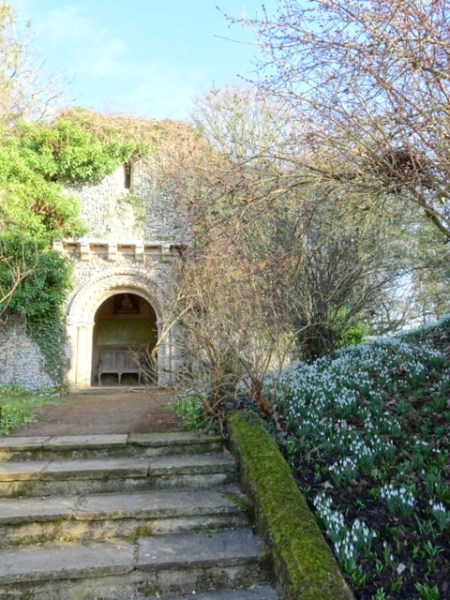
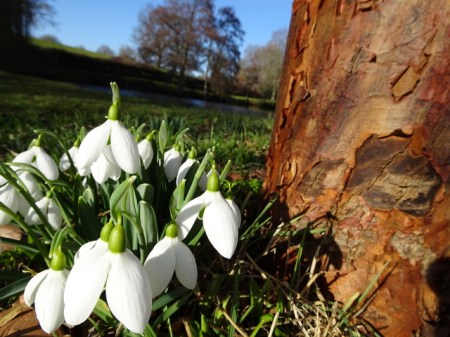
The stable block at Wandlebury Ring was built for James II in the late 17th century and later housed the famous Godolphin Arabian.
On our way back from Bennington Lordship (to read about that garden, click here), Michael and I visited Wandlebury Ring, an Iron Age hillfort outside Cambridge in the Gog Magog Hills, Cambridgeshire. The hillfort was constructed by an ancient British tribe in 400 BC and later inhabited by the Romans. In the late 17th century, the inner ramparts and ditch, which circled the fort, were leveled to make way for racing stables for King James II. A mansion and gardens were also constructed, but all that remains now is the stable block and the fort’s deep, encircling outer ditch. The site is now a country park owned by Cambridge Past, Present & Future. For more historical details, click here .
Nursery News: Carolyn’s Shade Gardens is a retail nursery located in Bryn Mawr, PA, specializing in showy, colorful, and unusual plants for shade. The only plants that we ship are snowdrops within the US. For catalogues and announcements of local events, please send your full name, mailing address, and cell number to carolyn@carolynsshadegardens.com and indicate whether you are interested in snowdrops. Click here to get to the home page of our website for catalogues and information about our nursery and to subscribe to our blog.
.
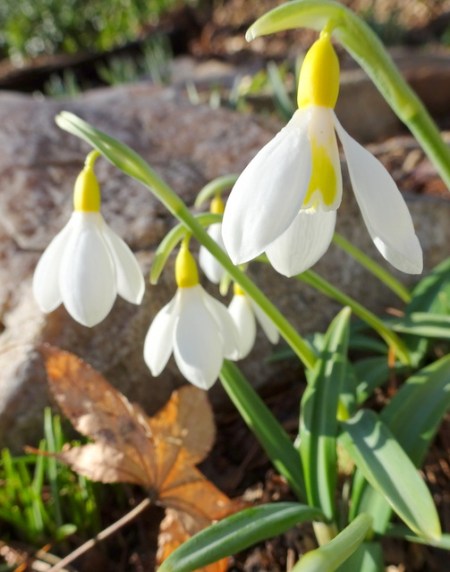 The very famous yellow snowdrop ‘Wendy’s Gold’ was first observed in the park in 1974 by Bill Clark, the Warden of Wandlebury Ring, but wasn’t introduced until the early 1990s. It is a beautiful, bright yellow in our winter sunshine and vigorous in my garden.
Although the history of Wandlebury Ring is quite interesting, the real reason for our visit was to see the naturalized G. plicatus that thrives inside the Ring. It is from this population that Bill Clark, the Warden of Wandlebury Ring from 1973 to 1998, selected the iconic ‘Wendy’s Gold’, which is named for his wife. The famous ‘Wendy’s Gold’ was later followed by further, well known yellow selections: ‘Bill Clark’ and ‘Wandlebury Ring’.
.
 ‘Bill Clark’ is an even brighter yellow, which colors the scape, spathe, and pedicel. However, it is not as vigorous as ‘Wendy’s Gold’ in my garden.
.
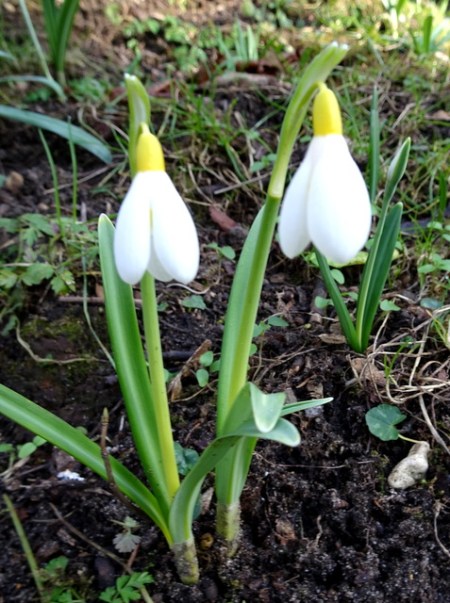 The last of the famous trio, ‘Wandlebury Ring’. I don’t grow this snowdrop so the photo was taken in England where lack of winter sun often makes yellow snowdrops have an olive caste.
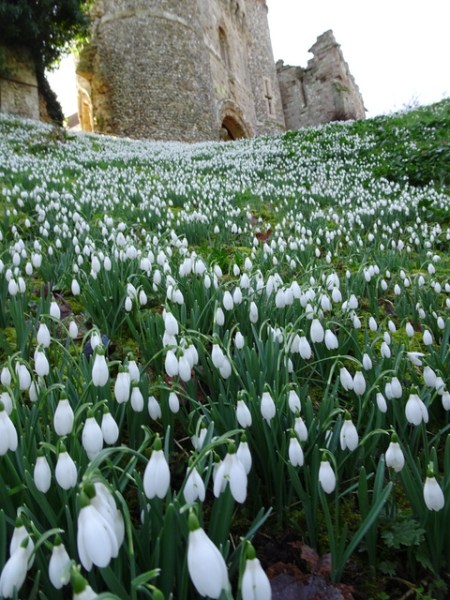
Wandlebury Ring is a beautiful setting in which to view snowdrops, which occur in sweeps around the mature trees inside the walls:
.
 Michael stands in a field of Galanthus plicatus with the wall of Wandlebury Ring in the background.
.
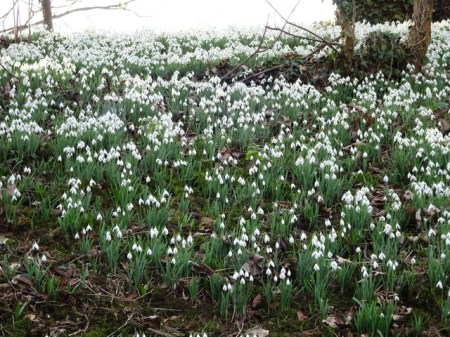
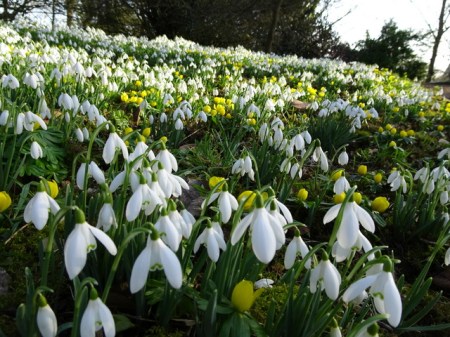
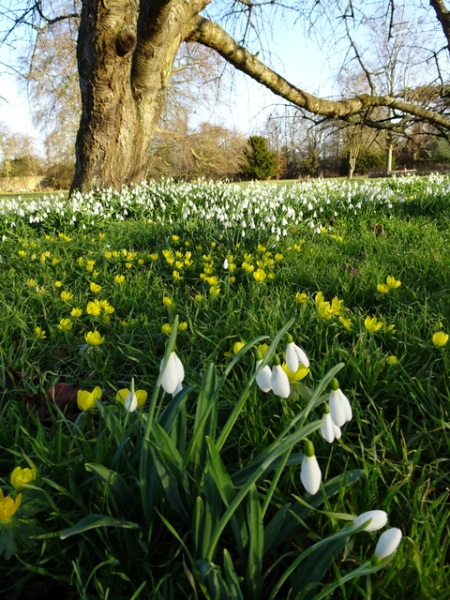
 The setting is very natural with thousands upon thousands of snowdrops in among the grass and winter aconites.
.
 G. plicatus exhibiting its very distinctive pleated leaves with a whitish center stripe.
.
 A large beech surrounded by winter aconite and G. plicatus.
.
 .
.
Bill and Wendy Clark still live at Wandlebury Ring. I have corresponded with Bill extensively about the history of the yellow G. plicatus at Wandlebury, which is fascinating. Unfortunately, unforeseen events prevented us from getting together when Michael and I were there. However, Bill still roams the area looking for unusual snowdrops and sent me photos of his recent discoveries:
.
 A snowdrop with four outer segments instead of the usual three.
.
 A very elegant snowdrop with twin flowers.
.
 A new yellow clone.
Thank you, Bill, for the help you have given me in untangling the origins of the Wandlebury snowdrops—you are an inspiration. This post is dedicated to you!
.
Blogs are a lot more fun for everyone, especially the writer, when readers leave comments. Scroll down to the end of the page to the box where it says “Leave a Reply” and start typing—-it’s easy!
Carolyn
.
Note: Every word that appears in orange on my blog is a link that you can click for more information. If you want to return to my blog’s homepage to access the sidebar information (catalogues, previous articles, etc.) or to subscribe to my blog, just click here.