Archive for the garden to visit Category

Winterthur Part 1: Late Winter 2013

Posted in bulbs for shade, garden to visit, Shade Gardening, Shade Perennials, snowdrops, winter, winter interest with tags , , , , , , , , , , , , , , , on June 22, 2013 by Carolyn @ Carolyns Shade Gardens

Carolyn’s Shade Gardens is a retail nursery located in Bryn Mawr, PA, specializing in showy, colorful, and unusual plants for shade.  The only plants that we ship are snowdrops and miniature hostas.  For catalogues and announcements of events, please send your full name, location, and phone number (for back up use only) to carolyn@carolynsshadegardens.com.  Click here to get to the home page of our website for catalogues and information about our nursery and to subscribe to our blog.

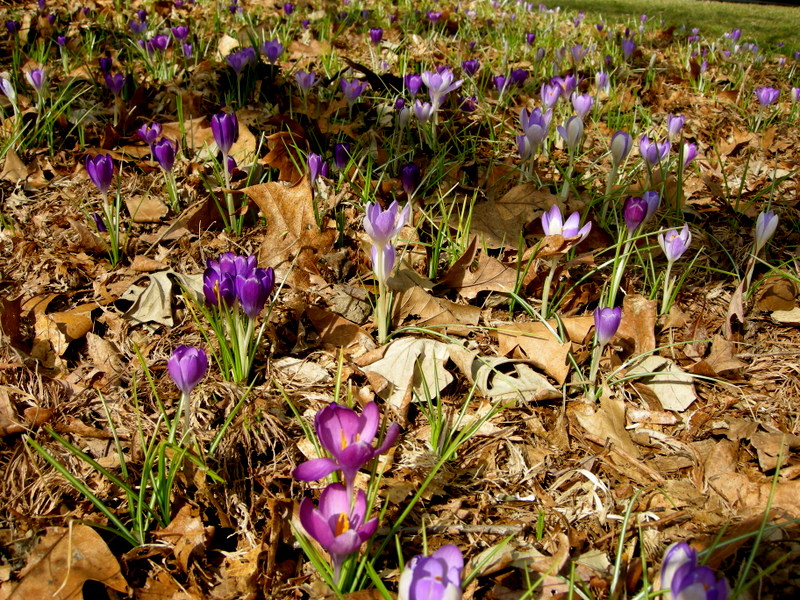
Crocus tomasinianus In early March, the courtyard behind the house at Winterthur is completely filled with snow crocus, C. tomasinianus. It is worth visiting in late winter just to see this sight.

.

Each year I choose an outstanding Philadelphia (Pennsylvania, US) area garden to profile through out the seasons. There are so many amazing gardens in the Delaware Valley that I will never run out of choices. It is more a case of which wonderful garden to choose. In 2011 to 2012, I visited the enchanting pleasure gardens at Chanticleer. To see those posts, click here. In 2012 to 2013, I focused on the diverse and magnificent gardens and conservatories at Longwood. To see those posts, click here. For 2013 to 2014, I have chosen the elegant former estate of collector and horticulturalist Henry Francis du Pont located in Delaware just over the Pennsylvania line and called Winterthur.

.

WinterthurThe Winterthur house holds the premier collection of American decorative art. For scale, look at the two people on the right side of the photo just beyond the path.

Henry Francis du Pont (1880 to 1969) was a voracious collector of American decorative art for his home and of plants from all over the world for his garden. He had a lot of space to work with as the house has 175 rooms and the garden is 1,000 acres, 60 of which he landscaped with naturalistic plantings. About 60 years ago du Pont opened the house and gardens to the public, fulfilling his wish that:

the Museum will be a continuing source of inspiration and education for all time, and that the gardens and grounds will of themselves be a country place museum where visitors may enjoy as I have, not only the flowers, trees and shrubs, but also the sunlit meadows, shady wood paths, and the peace and great calm of a country place which has been loved and taken care of for three generations.

.

WinterthurThe paths leading from the visitor’s center to the house and gardens meander through the magnificent trees.

.

The “peace and great calm of a country place” is what draws me to Winterthur again and again for the garden is not a botanical collection or a display garden in the usual sense. But rather, as the website states, “an artistic composition that captures a significant period in the history of American horticulture.” It is carefully maintained and preserved to allow visitor’s to enjoy the landscaped gardens as Henry du Pont designed them as well as the peaceful vistas that he carefully incorporated into his designs. Yet it does so with none of the rigidity and dated feeling of many historic gardens. The experience is as fresh and enjoyable as if du Pont himself were giving you a tour of his own backyard, albeit a very large one!

.

DSCN9477Another view of the house in winter.

.

This post shows photos from my visit to Winterthur for their annual snowdrop event, this year on March 9 (for more information on that event, click here). I apologize for the delay, but I have been so busy with my nursery that I just found time to sort through these images. I also thought that pictures of snowdrops and other winter bulbs might really stand out right now when other blogs aren’t posting them anymore. Most of the plants shown are in the area of the March Bank at Winterthur, which contains the premier collection of naturalized snowdrops and other winter interest bulbs in the U.S.

.

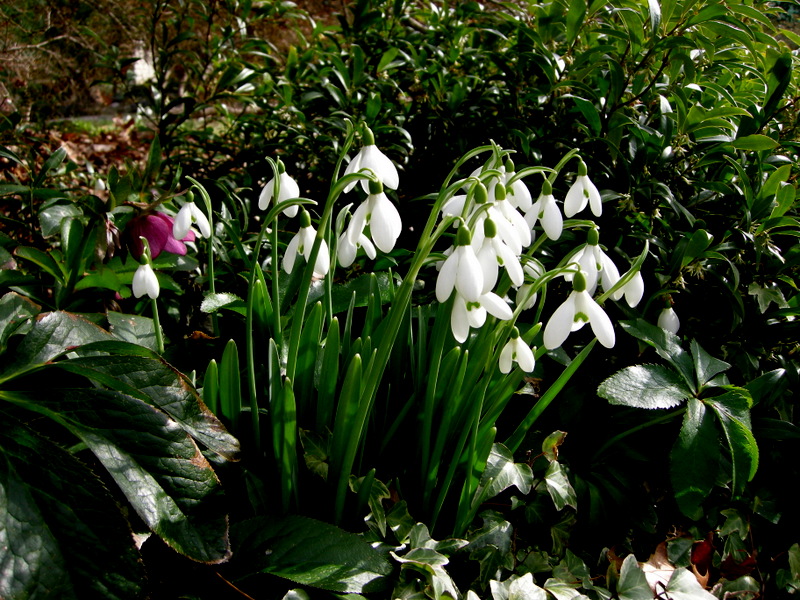
Galanthus at Winterthurnaturalized snowdrops

.

It is very difficult to give readers an idea of the massive amounts of snowdrops, aconite, crocus, glory-of-the-snow, snowflakes, adonis, and other winter bulbs at Winterthur. The plants are so small that once you back up to show a large area, they disappear into the leaf litter (at least using my camera, which is much better for macro shots). You will just have to take my word for it that in person the sweeps of bulbs are breath-taking and unparalleled.

.

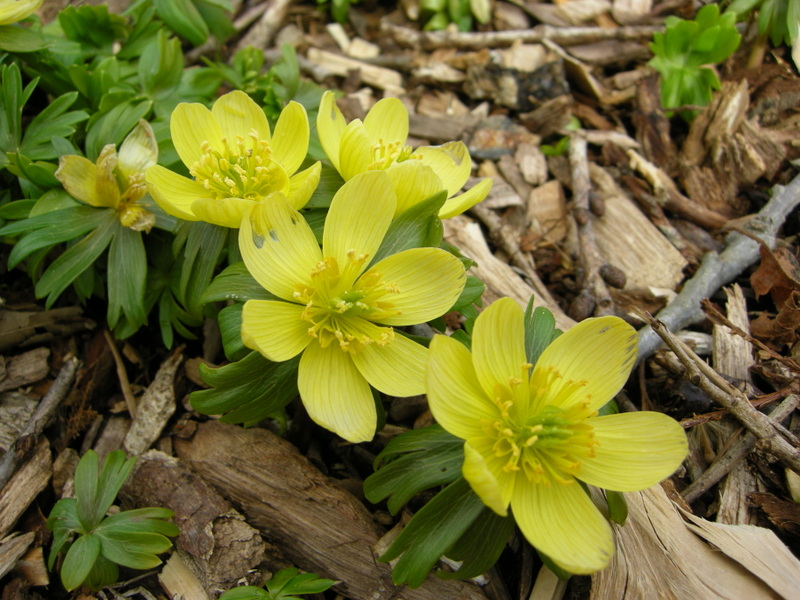
Eranthis hyemalisWinter aconite with snowdrops in the background.

.

Winterthuraconites, snowdrops, and crocus

.

Adonis amurensisAmur adonis

.

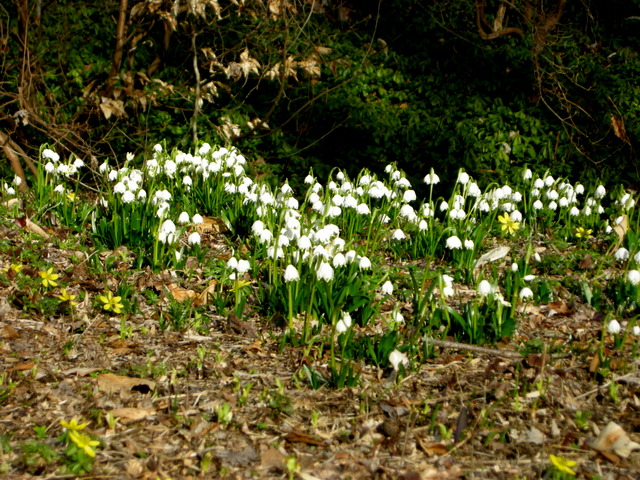
Leucojum vernumspring snowdflake

.

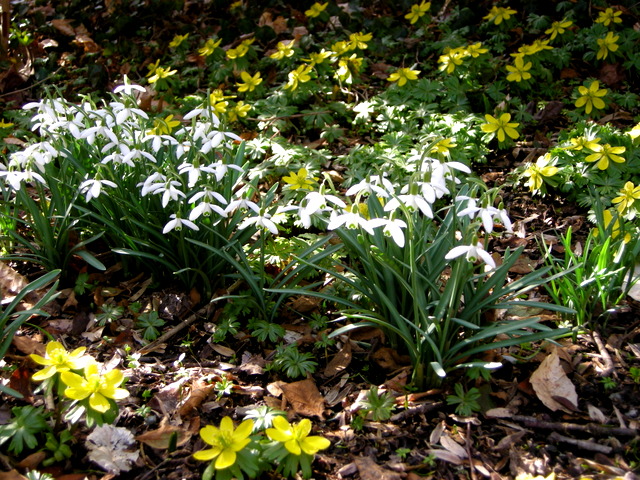
Winterthuraconite, snowdrops, and snowflakes

.

Galanthus and Eranthissnowdrops and aconite

.

Winterthursnowflakes and aconite

.

WinterthurMarch Bank

.

Galanthus elwesiiMost of the naturalized snowdrops are the giant snowdrop, G. elwesii.

.

Galanthus elwesiiA particularly lovely clump of giant snowdrops with many more (plus a photographer) on the March Bank.

.

Galanthus nivalis 'Vidirapice'green-tipped snowdrops

.

Crocus tommasinianusSnow crocus growing in the grass courtyard behind the house.

.

Crocus tommasianusIt is much easier to photograph the snow crocus set off by the grass. However, all the bulbs in this post appear through out Winterthur in the same massive quantities and are just as awe-inspiring as the crocus portrayed here.

.

I hope you enjoyed Part 1 of my year of Winterthur posts, out-of-season though it may be. If you are local, mark your calendars for March 1, 2014, so you can see this wondrous display for yourself. In the meantime, it is finally summer and my nursery is closed. I will be posting on the blog but less frequently. On Thursday I am off to San Francisco for the 2013 Garden Blogger’s Fling. Enjoy your summer.

Carolyn

.

Carolyn’s Shade Gardens is a retail nursery located in Bryn Mawr, Pennsylvania, U.S., zone 6b. The only plants that we mail order are snowdrops and miniature hostas and only within the US.

If you are within visiting distance and would like to receive catalogues and information about customer events, please send your full name and phone number to carolynsshadegardens@verizon.net. Subscribing to my blog does not sign you up to receive this information.

Nursery Happenings: The nursery is closed and will reopen in the fall around September 15. Have a great summer.

Facebook: Carolyn’s Shade Gardens has a Facebook Page where I post single photos, garden tips, and other information that doesn’t fit into a blog post. You can look at my Facebook page here or click the Like button on my right sidebar here.

Notes: Every word that appears in orange on my blog is a link that you can click for more information. If you want to return to my blog’s homepage to access the sidebar information (catalogues, previous articles, etc.) or to subscribe to my blog, just click here.

Longwood Gardens Part 5: Tulips and Natives

Posted in bulbs for shade, garden to visit, groundcover, native plants, Shade Gardening, Shade Perennials with tags , , , , , , , , , , , , , , , , , , , , , , , , , , , , , , , , , , , , , , , , , , , , , , , , , , on May 2, 2013 by Carolyn @ Carolyns Shade Gardens

Carolyn’s Shade Gardens is a retail nursery located in Bryn Mawr, PA, specializing in showy, colorful, and unusual plants for shade.  The only plants that we ship are snowdrops and miniature hostas.  For catalogues and announcements of events, please send your full name, location, and phone number (for back up use only) to carolyn@carolynsshadegardens.com.  Click here to get to the home page of our website for catalogues and information about our nursery and to subscribe to our blog.

. Tulips at LongwoodThis color combination is magnificent for spring.

.

During 2012 to 2013, I have been visiting Longwood Gardens in Kennett Square, Pennsylvania, U.S., every few months and highlighting some aspect of this amazing place (last year I focused on Chanticleer).  Links to my previous four posts are at the end.  There is much to see there with 325 acres open to the public and 20 outdoor gardens. 

On April 18, Michael and I headed out to Longwood with the specific objective of photographing the plants in the native woodland, Peirce’s Woods.  Of course, on the way to the woods, we got sidetracked by the bulb displays out front and along the Flower Garden Walk.  Although masses of tulips and other bulbs are just about polar opposite to native plants naturalized in a woodland, they are still gorgeous so I will show you a few photos as I explain the history of the woodland.

.

Leucojum aestivumSummer snowflake, Leucojum aestivum, is a great plant for massing.  Mine grow and self-sow quite readily in both south-facing and east-facing locations as well as in full deciduous shade in my woodland.

In 1700, a Quaker family named Peirce purchased the area that is now Peirce’s Woods from William Penn to establish a working farm.  In 1798, the Peirces began planting trees to establish an arboretum on the property.  Eventually the area became known as one of the finest collections of trees in the country.  The great industrialist Pierre DuPont (1870 to 1954) purchased the property in 1906 with the specific purpose of preserving the magnificent trees.

.

container at LongwoodYou will find fabulous container gardens throughout Longwood, including this one outside the Visitor’s Center with a large native dogwood underplanted with daffodils.

Peirce’s Woods comprises seven acres planted to showcase the ornamental characteristics of native plants from the eastern U.S. deciduous forest.  The shade trees  are mostly oak, ash, maple, and tulip trees, some over 200 years old.  The understory is native flowering trees and shrubs underplanted with native groundcovers.  All the plants are labeled so it is a great place to visit to get ideas for your own woodland garden.  Before I highlight the plants there, a few more bulb photos:

.

Narcissus Tahiti and Flower DriftNarcissus ‘Tahiti’ and ‘Flower Drift’

.

tulips at Longwood

.

tulips at Longwood.

tulips at Longwood

.

Tulipa 'Yellow Wave'‘Yellow Wave’ tulip

.

Tulipa 'Rococo'‘Rococo’ tulip

.

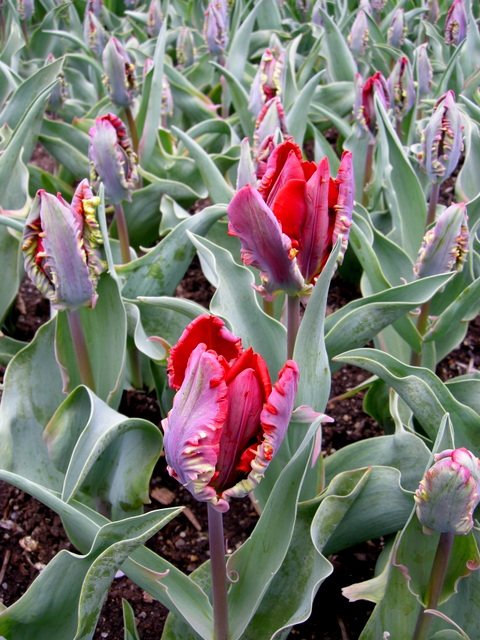
Tulipa 'Rococo'I think this tulip should be called the Little Shop of Horrors tulip—you definitely would not want to stick your finger inside of it.

.

Flower Garden Walk at LongwoodAs we neared the end of the Flower Garden Walk, we were greeted by this magnificent vista.

We came to Longwood with the objective of viewing and photographing Peirce’s Woods.  I fully intended to show scenes of the woods as a whole and close ups of individual native wildflowers.  However, I didn’t realize that because the weather has been so cold this spring, many of the flowers would not be blooming yet.  My own garden is always ahead because it is on a south-facing slope and the soil warms up early.  Also, as soon as we got there and typical for this spring, the sun went in, the wind picked up, it started to rain, and the temperature plummeted.

.

Matteuchia pennsylvanica The only other landscape shot that I got: ostrich ferns by the shore of the lake.  These ferns can be quite tall, 3 to 5′, spread aggressively by runners, and are the source of edible fiddleheads.

Michael and I were both under-dressed with no raincoats so I decided to take photos of the plants that were blooming and come back the following week for the landscape shots and later-blooming plants.  As usual, work at the nursery got in the way, but I wanted to show you the beautiful native plants that I was able to capture on film.  Just picture me kneeling patiently by each plant and snapping the photo in between gusts of wind and bouts of rain:

.

Heuchera villosa 'Miracle' ‘Miracle’ coralbells, Heuchera villosa, is one of my favorite cultivars of this tough eastern native.  The only coralbells I sell at my nursery are offspring of eastern natives H. villosa and H. americana because I find the other types not hardy.

.

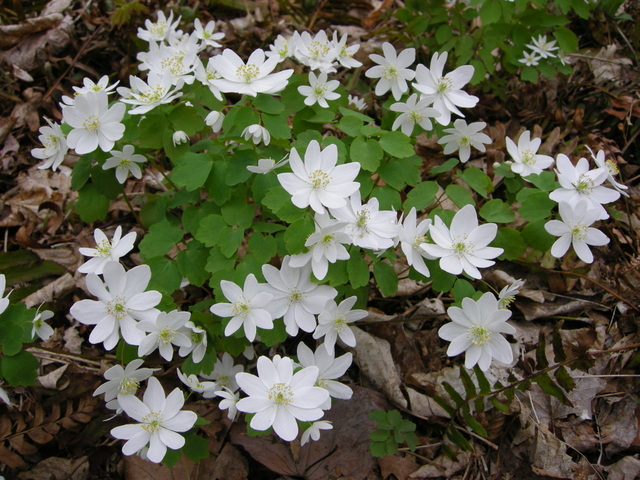
Anemonella thalictroides Rue-anemone, Anemonella thalictroides, is so delicate looking but  thrives and self-sows in dry shade.

.

Trillium grandiflorum‘Quicksilver’ large-flowered trillium, T. grandiflorum, was selected as a rapidly multiplying form of the species by Dr. Richard Lighty, at the Mt. Cuba Center in Delaware.

.

Trillium grandiflorum 'Quicksilver' and Anemonella thalictroides‘Quicksilver’ surrounded by rue-anemone.

.

Trillium luteum, yellow toad trilliumI find yellow toad trillium, T. luteum, quite easy to grow.

.

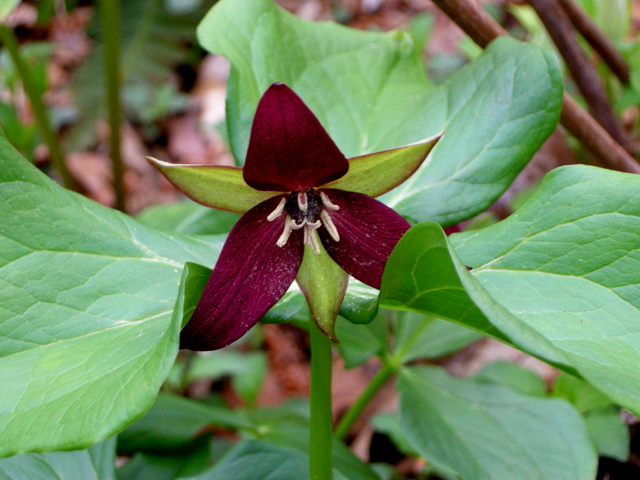
Trillium erectum, purple trilliumpurple trillium, T. erectum

.

Trillium erectum, purple trilliumThe two-tone flowers of purple trillium are gorgeous.

.

Dicentra cucullaria, squirrel cornsquirrel-corn, Dicentra canadensis

.

Caulophyllum thalictroides, blue cohoshBlue cohosh, Caulophyllum thalictroides, has these unprepossessing flowers in the spring followed by bright blue berries.  I love its leaf and stem structure and elegant overall habit.

.

Caulophyllum thalictroides and Dicentra canadensisBlue cohosh can act like a small shrub, here with an underplanting of squirrel-corn.

.

Mertensia virginicaVirginia bluebells, Mertensia virginica, were everywhere just like they are in my own garden where they seed prolifically.

.

Enemion biternatum, eastern false rue-anemoneEastern false rue-anemone, Enemion biternatum, is a new plant to me.  I am going to look for it though because its flowers were lovely perched on reddish stems and it evidently spreads to make an eye-catching patch.

.

stump in Peirce's WoodsI thought what Longwood had done to the stump of a tree that came down was very interesting and actually quite attractive.

.

Erythronium americanum, adder's tongueAdder’s tongue or what I call trout lily, Erythronium americanum, usually produces hundreds of leaves and a few flowers in my garden, but this year it is blooming well everywhere.

.

Polstichum acrostichoidesThe emerging fronds of Christmas fern, Polystichum acrostichoides, look like fairies should be dancing among them.

.

Onoclea sensibilisSensitive fern, Onoclea sensibilis, is a great native fern that is underused in gardens.

.

Onoclea sensibilisSensitive fern looks great in a mass planting.

.

Claytonia virginica, spring-beautyThe wind was roaring when I tried to photograph these spring-beauties, Claytonia virginica, so they are out of focus, but I didn’t want you to miss them.

.

Claytonia virginicaSpring-beauty really has an amazing flower even when blurry.

.

Hydrophyllum macrophyllum, large-leaf waterleafLarge -leaf waterleaf, Hydrophyllum macrophyllum, has very pretty foliage.

.

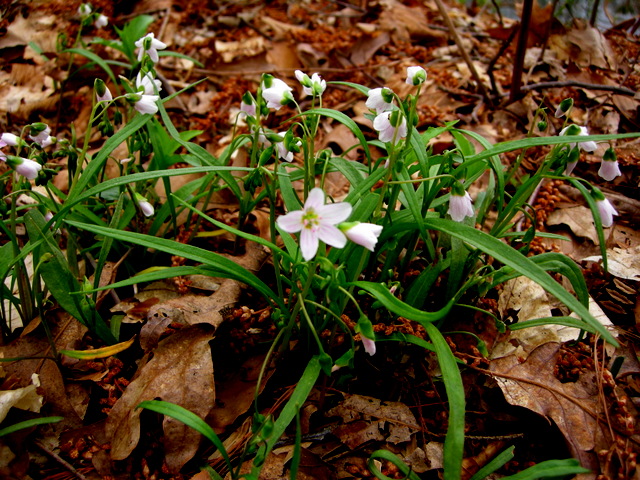
Cardamine concatenata, cutleaf toothwortCutleaf toothwort, Cardamine concatenata, is a spring ephemeral that naturalizes slowly to form a colony in the shade.

.

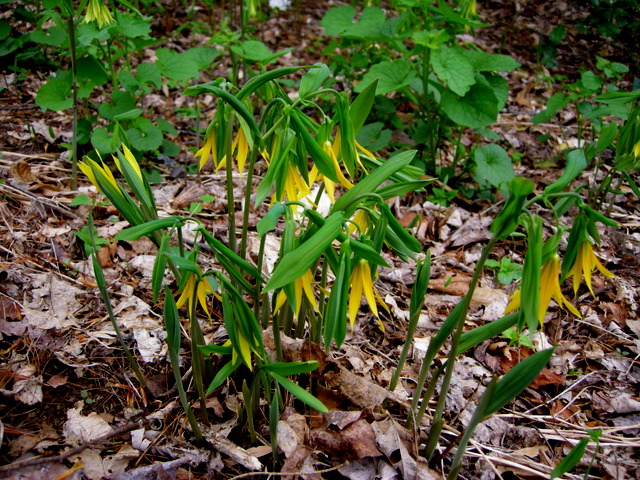
Uvularia grandifloraLarge-flowered bellwort, Uvularia grandiflora, is one of my favorites.  It grows 1 to 2 feet tall, has unusual and elegant yellow flowers, and grows in full, dry shade.  I don’t know why this plant isn’t more popular, but it doesn’t sell well at my nursery even though I have big stands of it in my display gardens.

All the plants profiled are native to Pennsylvania and the East Coast.  If you would like to see if a plant is native to your state, the best place to look is the USDA Natural Resources Conservation Service Plants Database.  All you do is put in the name of the plant and you will be shown a map of where it is native in the U.S.  I also have all these plants in my garden except toothwort and false meadow-rue, and I highly recommend them.

To read more about Longwood Gardens, follow these links:

Groundcovers, Thinking Outside the Box

Longwood Gardens Part 2: At Night

A Longwood New Year’s Eve

Cold Weather Antidote: Longwood’s Orchids

Carolyn

.

Carolyn’s Shade Gardens is a retail nursery located in Bryn Mawr, Pennsylvania, US, zone 6b.  The only plants that we mail order are snowdrops and miniature hostas and only within the US.

If you are within visiting distance and would like to receive catalogues and information about customer events, please send your full name and phone number to carolynsshadegardens@verizon.net.  Subscribing to my blog does not sign you up to receive this information.

Nursery Happenings:  The 2013 Spring Shrub Offer is now in full swing and orders are due May 18.  To read about the plants available and place an order, click here.  The 2013 Miniature Hosta Mail Order Catalogue, containing choice selections of miniatures for shipping all over the US, is now on the right sidebar here, and we are ready to ship.  If you are local, you can use the catalogue to see what miniatures are available at the nursery.

Facebook:  Carolyn’s Shade Gardens has a Facebook Page where I post single photos, garden tips, and other information that doesn’t fit into a blog post.  You can look at my Facebook page here or click the Like button on my right sidebar here.

Notes: Every word that appears in orange on my blog is a link that you can click for more information.  If you want to return to my blog’s homepage to access the sidebar information (catalogues, previous articles, etc.) or to subscribe to my blog, just click here.

2013 Winter Interest Plants

Posted in garden to visit, hellebores, Shade Gardening, snowdrops, winter, winter interest with tags , , , , , , , , , , , , , , , , , , , , , , , , , , , , on March 4, 2013 by Carolyn @ Carolyns Shade Gardens

Carolyn’s Shade Gardens is a retail nursery located in Bryn Mawr, PA, specializing in showy, colorful, and unusual plants for shade.  The only plants that we ship are snowdrops and miniature hostas.  For catalogues and announcements of events, please send your full name, location, and phone number (for back up use only) to carolyn@carolynsshadegardens.com.  Click here to get to the home page of our website for catalogues and information about our nursery and to subscribe to our blog.

Galanthus 'Brenda Troyle'Galanthus ‘Brenda Troyle’ is one of the most robust and fragrant snowdrops in the Cresson garden.

This may be my last post that focuses on snowdrops, and I am sure some readers will rejoice.  I am aware that many gardeners do not share (or understand) my obsession.  However, I want to show photos from the recent Winter Interest Plants Seminars hosted by Charles Cresson for my nursery customers. 

Before I get to that though, I have to tell you about the snowdrop event this weekend at Winterthur, the fabulous garden in Delaware, US.  On Saturday, March 9, at 11 am, Alan Street, the world famous snowdrop expert from Avon Bulbs in England, is presenting the annual Bank to Bend Lecture on snowdrops.  Carolyn’s Shade Gardens will be one of two nurseries selling snowdrops and other winter interest plants at Winterthur.  I hope to see you there.  Here are the details:


winterthur

Join plantsman and snowdrop expert Alan Street of the renowned nursery Avon Bulbs as he offers insight into these precious flowers, sharing how they have become a worldwide phenomenon and how Avon Bulbs brings them to market. Registration includes tours of the March Bank display and access to specialist nurseries selling snowdrops and other winter interest plants. $20 non-members; $10 members.

Call 800.448.3883 to register or find out more.

Bank to Bend includes free admission to the garden, tours of the March Bank and access to specialist nurseries Black Hog Horticulture and Carolyn’s Shade Garden to purchase rare and unusual bulbs and other winter interest plants.

.

Cresson Winter Interest SeminarCharles Cresson talks about his witch hazels, winter aconite, and snowdrops with some die hard winter interest gardeners.

This is the third year that nationally known horticulturalist Charles Cresson has hosted my customers in his Swarthmore, Pennsylvania, garden to view and discuss winter interest plants.  Every year we see different plants, depending on the weather, but every year the group is just as enthusiastic despite the weather.  This year, February (and all winter really) has been cold and dismal, and the seminar days were no exception, but the attendees were enthusiastic and full of questions for Charles.

Cresson Winter Interest SeminarsCharles demonstrates how he protects important plants with plastic boxes if the weather is going to be unseasonably cold.

Plants are “late” to come out this year because it has been so cold.  The emergence of winter interest plants like perennials and bulbs is dependent more on the soil temperature than on the date.  If the soil warms up early, as it did in 2012 when we had no winter, many plants will bloom early.  This year it has been cold and gray, and many plants have yet to bloom or emerge.  Yet, such is the magic of Charles’s garden that there was a lot to see.  Here are some of the highlights in the order in which we saw them:

Narcissus 'Rijnveld's Early Sensation'After seeing this daffodil for many years blooming in Charles’s garden in February, I finally added it to mine this year.  It is called Narcissus ‘Rijnveld’s Early Sensation’.

.

Eratnhis hyemalis (pale yellow form)A rare pale yellow form of winter aconite, Eranthus hyemalis.

.

Crocus tommasinianusThe snow crocus, C. tommasinianus, is my favorite crocus because it blooms now with the snowdrops and multiplies rapidly.

.

Crocus tommasinianus 'Ruby Giant'‘Ruby Giant’ snow crocus is a deeper purple.

.

Crocus tommasinianus 'Taplow Ruby'‘Taplow Ruby’ snow crocus

.

Galanthus 'Atkinsii'Galanthus ‘Atkinsii’ is an old-fashioned and reliable snowdrop that should be part of any collection.

.

Galanthus 'Atkinsii' & Arum italicum 'Pictum'One of my favorite combinations, ‘Atkinsii’ with Italian arum, A. italicum ‘Pictum’.

.

Helleborus x ballardiae 'Pink Frost' with Cotoneaster salicifolius 'Henryi'The leaves of ‘Pink Frost’ hellebore, H. x ballardiae ‘Pink Frost’, pair beautifully with this rare cotoneaster, C. salicifolius ‘Henryi’.

.

Helleborus foetidus & Helleborus x ballardiae 'Pink Frost'‘Pink Frost’ again with bearsfoot hellebore, H. foetidus, in another winning combination.

.

Helleborus x ericsmithii 'Winter's Song'‘Winter’s Song’ hellebore, H. x ericsmithii ‘Winter’s Song’ is very early blooming so it was fully out on this cold February day.

.

Helleborus x 'Ivory Prince'‘Ivory Prince’ hellebore was just starting to open.

.

Iris unguicularis subsp. cretensisThis subspecies is an especially dark colored version of the winter-blooming Algerian iris, Iris unguicularis subsp. cretensis.

.

Galanthus 'Mighty Atom'

Galanthus ‘Mighty Atom’ has one of the best presentations of any snowdrop.

.

Galanthus rizehensisGalanthus rizehensis is a rare and desirable snowdrop species.

.

Galanthus 'Standing Tall'Charles’s newly introduced snowdrop ‘Standing Tall’ continues to stand up to whatever the weather throws at it.  If you didn’t know better you would think it was a daffodil.

.

Galanthus elwesii 'Standing Tall' Cresson photo-001‘Standing Tall’ in full bloom in early January.

.

Galanthus 'Beth Chatto' ‘Beth Chatto’

.

Galanthus 'Godfrey Owen'Charles and I both acquired six-petaled ‘Godfrey Owen’ last year but his was not felled by snow and ice.

.

Galanthus 'Godfrey Owen'‘Godfrey Owen’

.

Galanthus 'Godfrey Owen'The inner segments of ‘Godfrey Owen’ are extraordinary too.  This photo represents to me what galanthophiles are all about.

.

I know the participants enjoyed themselves because even after an hour and a half in the cold, they were still asking Charles questions.  I hope my readers have gotten some vicarious enjoyment.

I you would like to see what was featured during the 2011 and 2012 seminars, follow these links:

2011 Winter Interest Plants

2012 Winter Interest Plants

Carolyn

.

Carolyn’s Shade Gardens is a retail nursery located in Bryn Mawr, Pennsylvania, US, zone 6b.  The only plants that we mail order are snowdrops and miniature hostas and only within the US.

If you are within visiting distance and would like to receive catalogues and information about customer events, please send your full name and phone number to carolynsshadegardens@verizon.net.  Subscribing to my blog does not sign you up to receive this information.

Nursery Happenings:  We are now accepting reservations for our very popular Hellebore Seminars .  The Friday session is full but the session on Monday, March 18, at 10:00 am has nine spaces left.  For details, click here.  The 2013 Snowdrop Catalogue is on the sidebar of the website and orders are being accepted now.  To view the catalogue, click here.  The 2013 General Catalogue is available here.

Facebook:  Carolyn’s Shade Gardens has a Facebook Page where I post single photos, garden tips, and other information that doesn’t fit into a blog post.  You can look at my Facebook page here or click the Like button on my right sidebar here.

Notes: Every word that appears in orange on my blog is a link that you can click for more information.  If you want to return to my blog’s homepage to access the sidebar information (catalogues, previous articles, etc.) or to subscribe to my blog, just click here.

Cold Weather Antidote: Longwood’s Orchids

Posted in garden to visit, winter, winter interest with tags , , , on February 23, 2013 by Carolyn @ Carolyns Shade Gardens

Carolyn’s Shade Gardens is a retail nursery located in Bryn Mawr, PA, specializing in showy, colorful, and unusual plants for shade.  The only plants that we ship are snowdrops and miniature hostas.  For catalogues and announcements of events, please send your full name, location, and phone number (for back up use only) to carolyn@carolynsshadegardens.com.  Click here to get to the home page of our website for catalogues and information about our nursery and to subscribe to our blog.

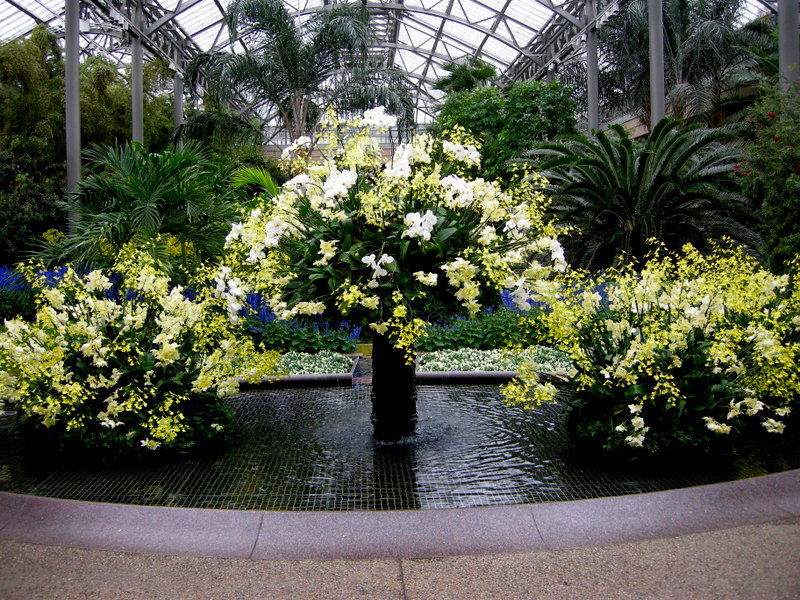
Longwood East conservatoryFor Longwood Garden’s Orchid Extravaganza, the East Conservatory is filled with yellows, blues, creams, and whites—one of my favorite color combinations.

Before I get to my cold weather antidote, I want to mention another upcoming breath of spring:  The Philadelphia Flower Show, the largest indoor flower show in the world.  The theme this year is “Brilliant”, a tribute to the majestic culture and creative gardening tradition of Great Britain.  It runs from March 2 through March 10 at the Philadelphia Convention Center.  I will be giving a presentation on Sunday, March 3, at 5:00 pm in the Gardener’s Studio on “Hellebores for Your Garden: Selection, Maintenance, and Division”—don’t miss it!


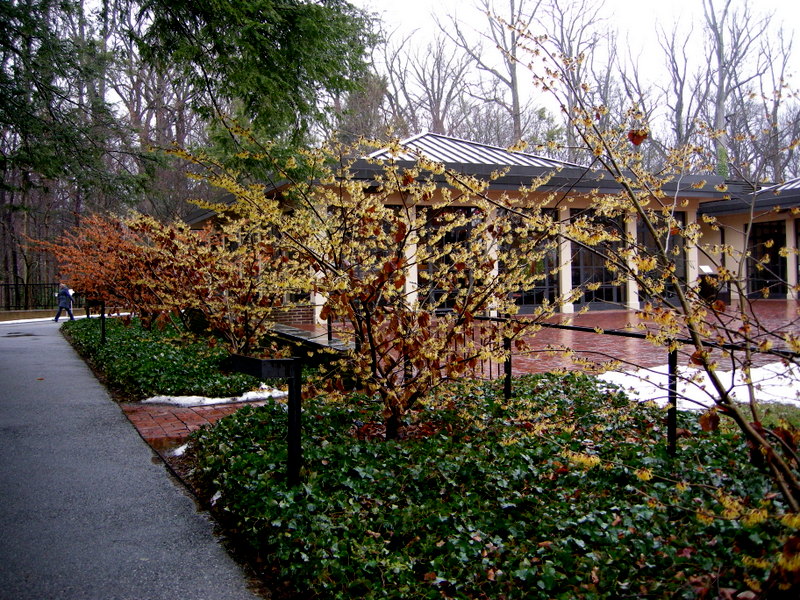
Hamamelis x intermedia 'Jelena'
‘Jelena’ witch hazel outside the Longwood Cafe.  I highly recommend eating there when you visit.  The food is very good, especially the local mushroom soup, and in the winter you can sit by a fire.

.

Hamamelis x intermedia 'Luna'‘Luna’ witch hazel also outside the cafe.

On a recent Friday, my husband and I were suffering from cabin fever and decided to visit Longwood Gardens in Kennett Square, Pennsylvania, US.  For 2012 to 2013, I have been writing posts every couple of months about Longwood (last year I choose Chanticleer), and I will provide links to my posts at the end.  Usually we walk around outside, but it was cold, overcast, and raining so we opted to explore The Orchid Extravaganza in the conservatories instead.  I did photograph some token but gorgeous witch hazels on our mad dash for the cafe, and I have included their photos above to show what braver souls were viewing.

Longwood East ConservatoryThese lovely arrangements of moth orchids greet you as you come through the main entrance into the East Conservatory.


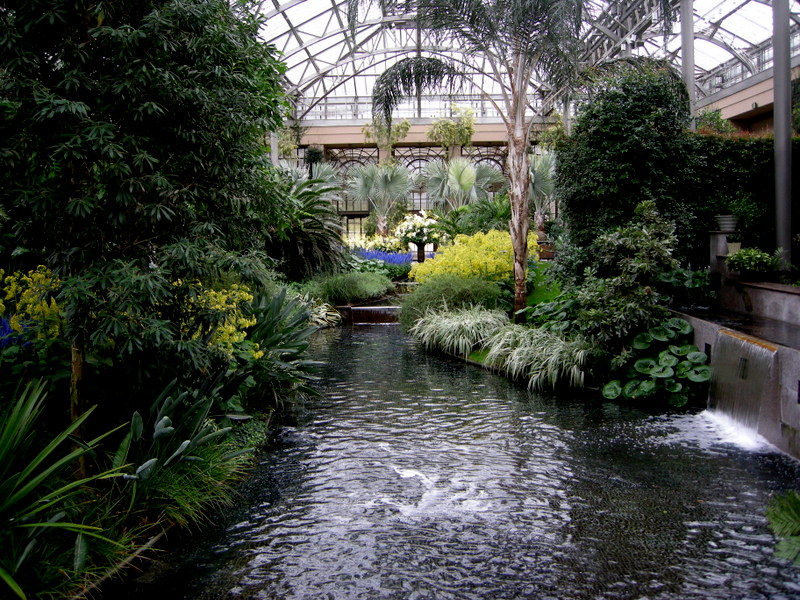
I am not an orchid lover and really know little about them.  But I knew that if Longwood did orchids, they would surpass my wildest expectations, and they did.  Orchids are an over-the-top plant perfect for an over-the-top display, and Longwood is the perfect place to view them.  Longwood has 9,000 orchids in its collection and used 5,000 plants, representing 2,300 species and cultivars, to decorate its four acres of conservatories for the current display.  Breathtaking doesn’t even begin to describe it so I will have to use photographs, beginning with more of the East Conservatory:

Longwood East ConservatoryWhen we entered, a bride and groom were having their wedding pictures taken.

.

Longwood East Conservatory.

Longwood East Conservatory.

Longwood East Conservatory

.

Longwood Velvet Groundsel & Flowering-bush PlectranthusThe yellow-flowered plant on the left is velvet groundsel and the blue on the right is flowering-bush plectranthus.  

.

Longwood East Conservatory.

Longwood East ConservatoryLooking back down the East Conservatory towards the main entrance.

.

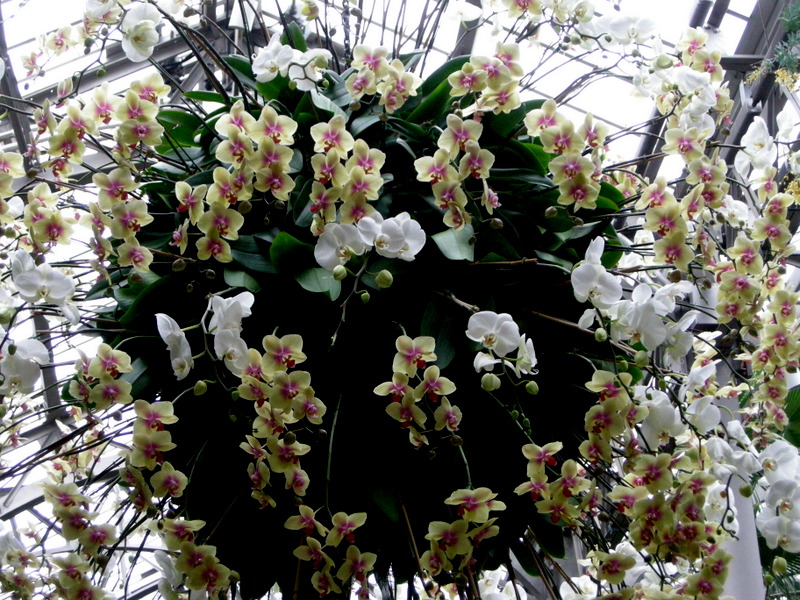
Longwood orchid orbThis orchid orb, at the far end of the East Conservatory, contains 160 0rchids and weighs 200 pounds.  The custom metal frame was constructed by Longwood craftspeople.

.

Longwood orchid orbA close up of the orb.

From the East Conservatory we entered the Exhibition Hall with its sunken and flooded marble floor surrounded by tree ferns:

Longwood Exhibition HallAbove the Exhibition Hall hangs an “orchid chandelier” featuring over 100 yellow Cymbidium orchids, 200 white Phalaenopsis orchids, and Algerian ivy.

.

Longwood Exhibition Hall.

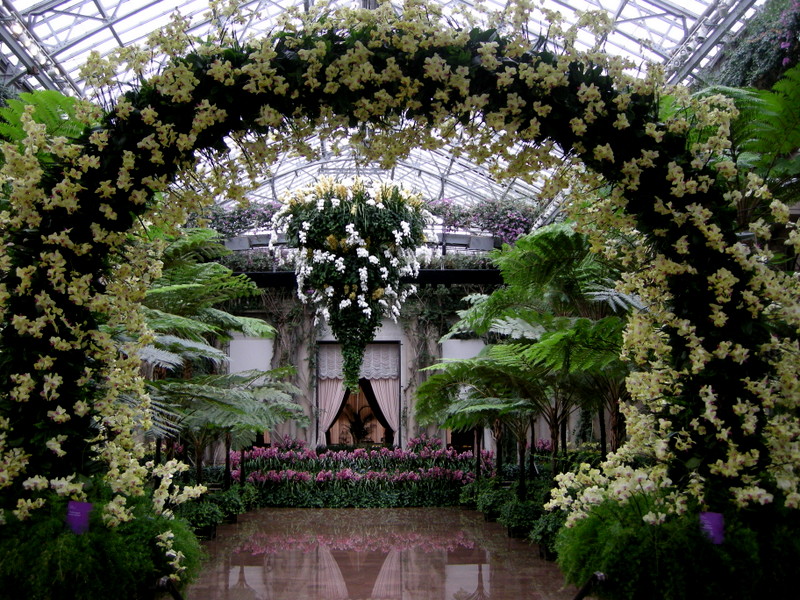
DSCN9176This 13′ tall arch at the other end of the Exhibition Hall is composed of 800 yellow Phalaenopsis orchids and is much prettier in person.

The third huge room in the conservatories is called the Orangery and features colorful displays of a wide range of unusual plants:

Longwood Orangery

Florist’s cyclamen, tulips, and oriental hybrid lilies underplant bronze-leaved clerodendrum.

.

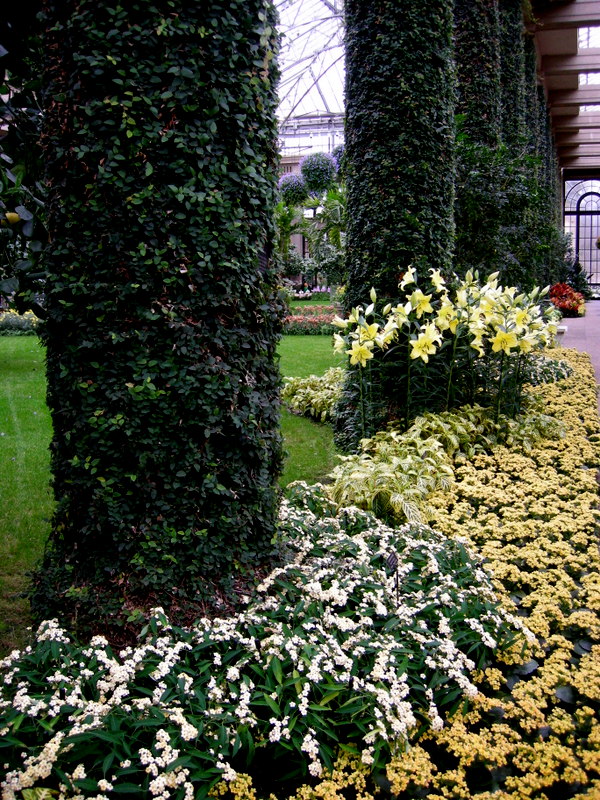
Longwood OrangeryVine-covered pillars line the walk around the edge of the Orangery.

.

Longwood Orangery.

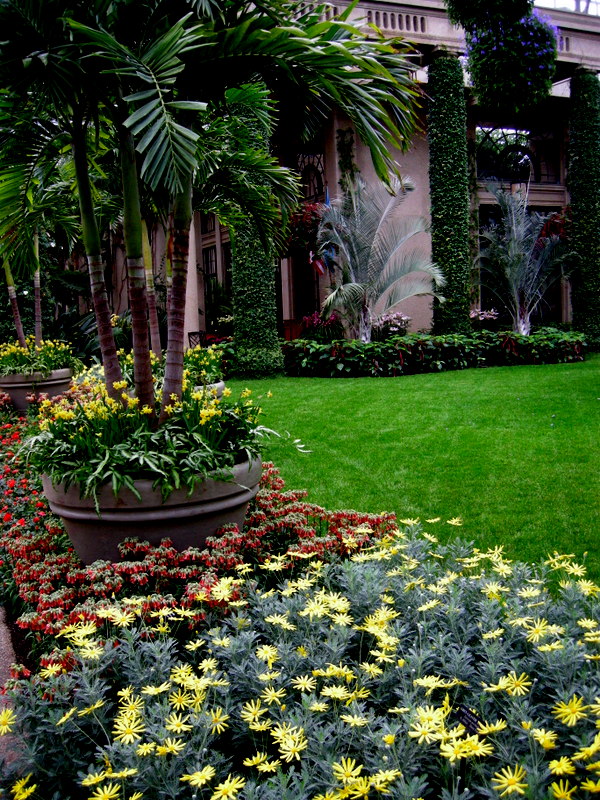
Longwood OrangeryI was particularly taken with this combination of ‘Tete-a-Tete’ narcissus, orange mother-of-thousands, ferns, and orange roses.

No matter what time of year you visit the conservatories, between 200 and 500 orchids are on display in the Orchid House.  The orchids residing there during this special show are the cream of the crop.  I have diligently copied the names off the tags because I know a lot of readers are orchid fans.  But beware, my career as a recorder at the Philadelphia Flower Show receiving the orchid entries was short-lived after trying to deal with their confusing names.  

orchid x Laeliocattleya g. (unnamed) x Laeliocattleya g. (unnamed)

.

orchid no labelOne of my favorites but there was no label.

.

Schomburgkia undulataSchomburgkia undulata

.

x Sophrolaeliocattleya Rosemary Clooney 'Wanre'x Sophrolaeliocattleya Rosemary Clooney ‘Wanre’

.

Miltoniopsis Mary SugiyamaMiltoniopsis Mary Sugiyama

.

x Beallara Pluto's Drummer 'Pacific Pink'x Beallara Pluto’s Drummer ‘Pacific Pink’

.

x Sophrolaeliocattleya g. Jewel Box 'Dark Waters'x Sophrolaeliocattleya g. Jewel Box ‘Dark Waters’

.

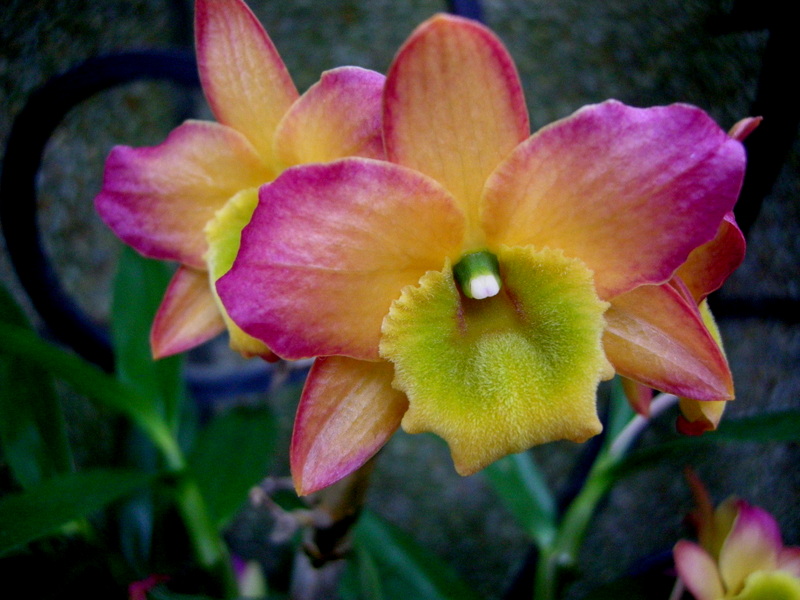
Dendrobium Oriental Smile 'Fantasy'Dendrobium Oriental Smile ‘Fantasy’

Orchids are beautifully incorporated into most of the many gardens in the West Conservatory Complex.  Here are a few of my favorite combinations, but it is well worth a walk through the whole area:

x Bratonia Kauai's ChoiceDozens of this eye-catching orchid, x Bratonia Kauai’s Choice, surround the waterfall in the Cascade Garden designed by Roberto Burle Marx.

.

Orchids with Calathea lancifolia, prayer plantIn the Tropical Terrace, white orchids are planted among this striking prayer plant, Calathea lancifolia.

.

Orchids with 'Moonlight Bay' aglaonema & 'Lutea' elephant's-ear plantAlso in the Tropical Terrace, yellow orchids with ‘Moonlight Bay’ aglaonema and ‘Lutea’ elephant’s-ear plant.

Despite all the grandeur of the big orchid displays, my favorite orchid presentations are found in some of the smaller and narrower gardens.   Perfect specimens from the same orchid family but in varying colors are displayed in containers like majestic houseplants.  If I had orchids this is how I would want to present them:

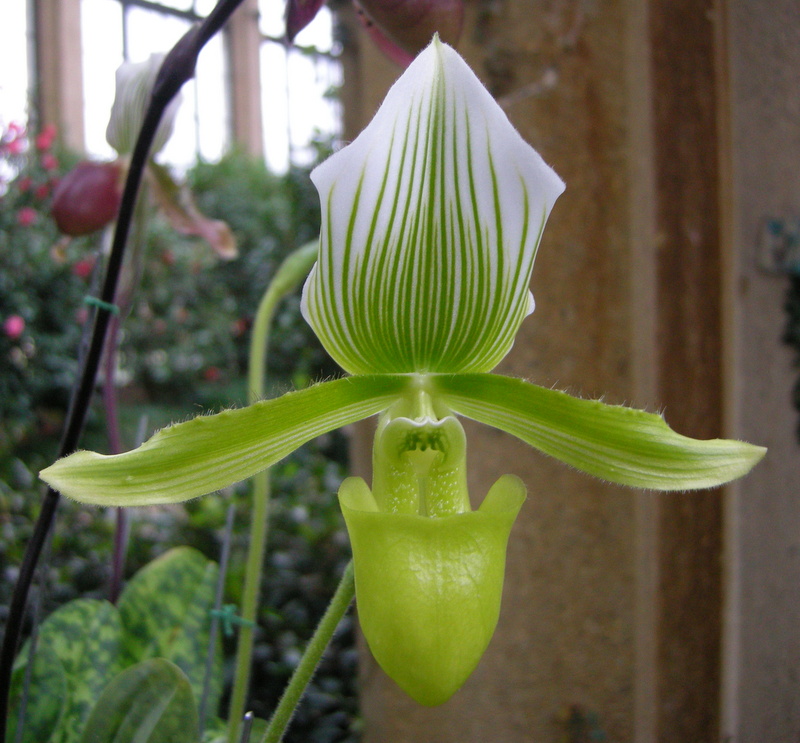
Lady's Slipper OrchidsA small garden, called the Garden Path, on the left side of the East Conservatory was lined with moss planters of lady’s slipper orchids.

.

Lady's Slipper Orchid.

Lady's Slipper Orchid

.

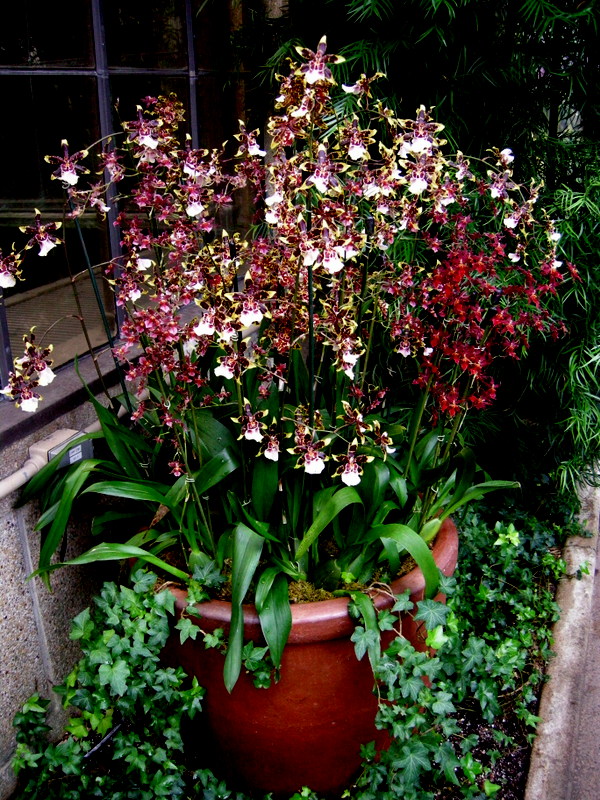
Dancing Ladies OrchidsAlong the Acacia Passage are ceramic containers of dancing ladies orchids.

.

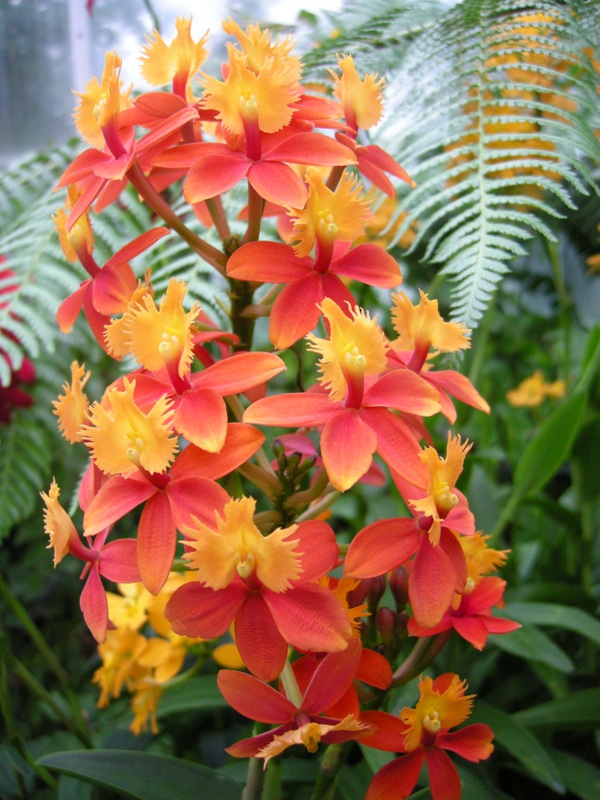
Reed-Stem orchidsPots of reed-stem orchids line the Fern Passage.

.

Reed-Stem orchidsreed-stem orchid

The Longwood Orchid Extravaganza runs through March 24.  If you are coming, check the website because there are lots of special events scheduled.  If you are not in the area, I hope you have enjoyed your virtual tour.

To read more about Longwood Gardens, follow these links:

Groundcovers, Thinking Outside the Box

Longwood Gardens Part 2: At Night

A Longwood New Year’s Eve

Carolyn

I am linking this post to Les’s blog A Tidewater Garden for his annual winter walk-off where bloggers show photos from a winter trip where they did a lot of walking.  Since my husband and I walked Longwood’s conservatories for two hours, Les tells me that this post qualifies.  Follow the link to see Les’s professional quality photos and where other bloggers took their walk.

.

Carolyn’s Shade Gardens is a retail nursery located in Bryn Mawr, Pennsylvania, US, zone 6b.  The only plants that we mail order are snowdrops and miniature hostas and only within the US.

If you are within visiting distance and would like to receive catalogues and information about customer events, please send your full name and phone number to carolynsshadegardens@verizon.net.  Subscribing to my blog does not sign you up to receive this information.

Nursery Happenings:  We are now accepting reservations for our very popular Hellebore Seminars to be held on Friday, March 15 (only 3 spaces left) at 1:30 pm and Monday, March 18, at 10:00 am.  For details, click here.  The 2013 Snowdrop Catalogue is on the sidebar of the website and orders are being accepted now.  To view the catalogue, click here.  The 2013 General Catalogue is available here.

Facebook:  Carolyn’s Shade Gardens has a Facebook Page where I post single photos, garden tips, and other information that doesn’t fit into a blog post.  You can look at my Facebook page here or click the Like button on my right sidebar here.

Notes: Every word that appears in orange on my blog is a link that you can click for more information.  If you want to return to my blog’s homepage to access the sidebar information (catalogues, previous articles, etc.) or to subscribe to my blog, just click here.

St. Lucia’s Diamond Falls Botanical Gardens

Posted in garden to visit with tags , , , , , , , , , , , on February 5, 2013 by Carolyn @ Carolyns Shade Gardens

Carolyn’s Shade Gardens is a retail nursery located in Bryn Mawr, PA, specializing in showy, colorful, and unusual plants for shade.  The only plants that we ship are snowdrops and miniature hostas.  For catalogues and announcements of events, please send your full name, location, and phone number (for back up use only) to carolyn@carolynsshadegardens.com.  Click here to get to the home page of our website for catalogues and information about our nursery and to subscribe to our blog.

St. Lucia Gros PitonThe Petit Piton, one of two volcanic spires unique to St. Lucia, rises over 2,400′ directly from the water on the Caribbean side of the island.

With all the cold weather and snow in the mid-Atlantic US as well as the UK and the rest of Europe, I thought my readers might appreciate a post from a warm climate.  I was recently invited by Donna at Garden Walk Garden Talk to accompany her to her cousin’s home on St. Lucia, an island in the eastern Caribbean.  Who could resist when the only cost was the airfare?  Thanks Donna.

St. Lucia Sandy BeachThe other side of St. Lucia fronts the Atlantic Ocean.  This is a view of the Maria Islands from Sandy Beach in Vieux Fort on the extreme southeastern tip of St. Lucia.

St. Lucia is an island country located in the eastern Caribbean Sea north of Venezuela at about the same latitude as Nicaragua .  It is part of the Lesser Antilles and is surrounded by the islands of St. Vincent, Barbados, and Martinique.  It covers 238 square miles and has a population of 174,000.  St. Lucia was originally colonized by the French, and French influences remain quite strong.  However, it ended up in British hands and gained independence in 1979, although it remains part of the Commonwealth.  Residents speak English and Patois, a dialect of French with some  Caribe and African words.

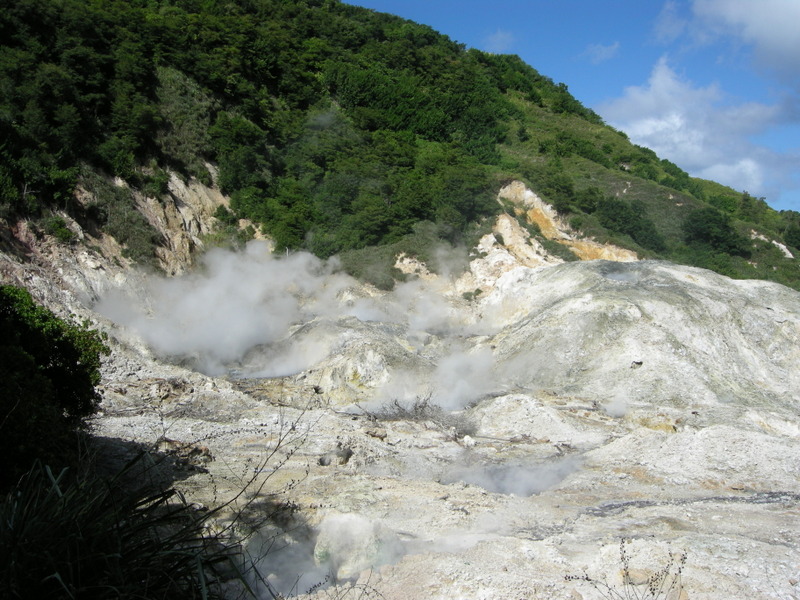
St. Lucia Sulphur SpringsLava more than 1.5 miles underground produces steam and heats the spring water to over 300 degrees F at the Sulphur Springs site outside the town of Soufriere.

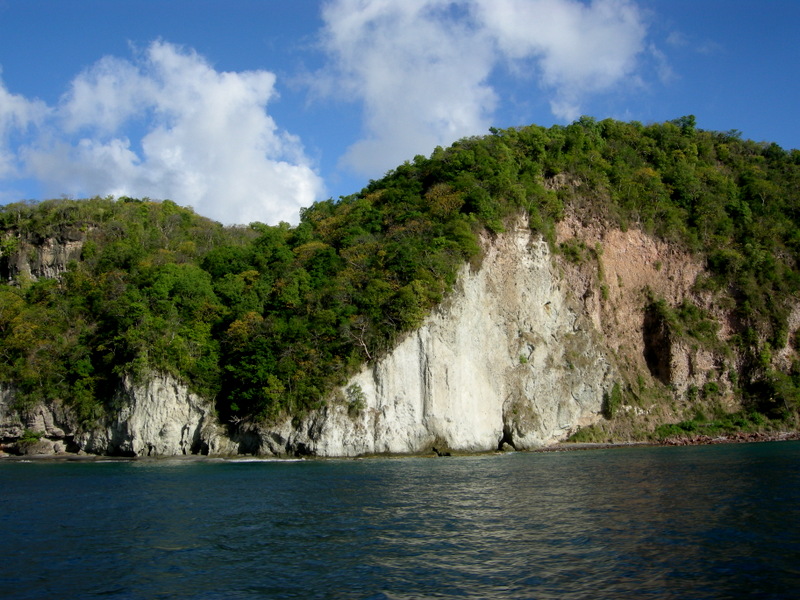
St. Lucia is a volcanic island and is more mountainous than any other Caribbean island, which makes for quite scenic geography.  The area around the southwestern town of Soufriere is a collapsed crater surrounded by dramatic mountain peaks.  Two of these peaks, the Gros and the Petit Pitons along with the ridge between them and the underwater coral reefs in front of them form the Pitons Management Area.  It is a UNESCO World Heritage site and is one of the most dramatic landscapes I have ever visited.  St. Lucia’s climate is tropical although not as hot as other Caribbean islands due to the moderating trade winds.  The predominant vegetation is tropical forest which climbs the steep hills and fills the valleys.

St Lucia Pitons Management AreaA view from the water of the UNESCO World Heritage Site framed on either side by the Pitons.

.

Before we visit the botanical gardens, let me show you a few more views of St. Lucia generally:

.

St. Lucia architecture

.

St Lucia architectureThe local architecture reflects the influences of French colonization.

.

St Lucia Gros PitonA view of the Gros Piton from Sugar Beach.

.

St Lucia SoufriereThe town of Soufriere where the Pirates of the Caribbean was filmed sits in the middle of the volcanic crater with the Pitons behind it.

.

St LuciaEven when the Pitons aren’t in the picture, St. Lucia rises dramatically from the water.

.

St. LuciaEven without the mountains, there is always the gorgeous blue Caribbean to stare at.

.

St. Lucia

.

St LuciaThe sunsets were magnificent every night.

.

St LuciaEspecially when viewed from between the Pitons.

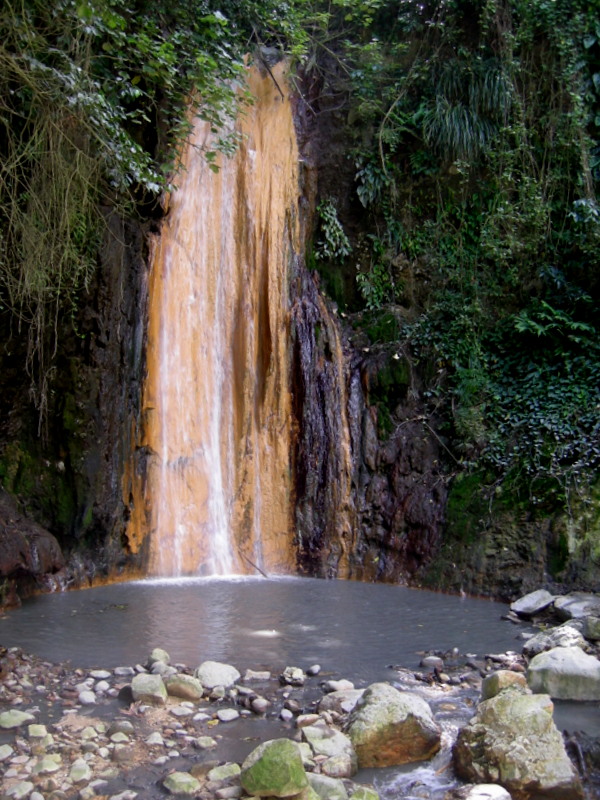
One of the many highlights of the trip was our visit to the Diamond Falls Botanical Gardens in Soufriere.  The gardens are on the site of a 2,000 acre plantation granted by Louis XIII to the Devaux family in 1713 and still owned by the same family.  Empress Josephine was a cousin to the Devauxes and played there as a child.  Mineral springs heated by the underlying volcano were developed in 1784 into a bathing area for the troops of King Louis XVI.  Today, the upper part of the botanical gardens are crowned by the lovely Diamond Falls, and visitors can still bath in the therapeutic mineral waters.

.St Lucia Diamond FallsDiamond Falls

.

St Lucia hot springsSteaming mineral water leaves Diamond Falls on its way to the mineral baths.

The botanical gardens comprise six acres along the gorge formed by the mineral springs.  Although the plantings have been  well established for at least two hundred years, they really came into their own in 1983 when a Devaux descendant decided to develop them as a formal botanical garden.  Although I thoroughly enjoyed my walk around the gardens, I don’t know anything about tropical plants so you are on your own with the photos:

.

St Lucia botanical gardenGravel paths wind through beautifully cared for but dense tropical vegetation.

.

St Lucia botanical gardensLush vines, I believe this is schefflera, climb all the trees.

.

St Lucia botanical gardens.

St Lucia botanical gardens.

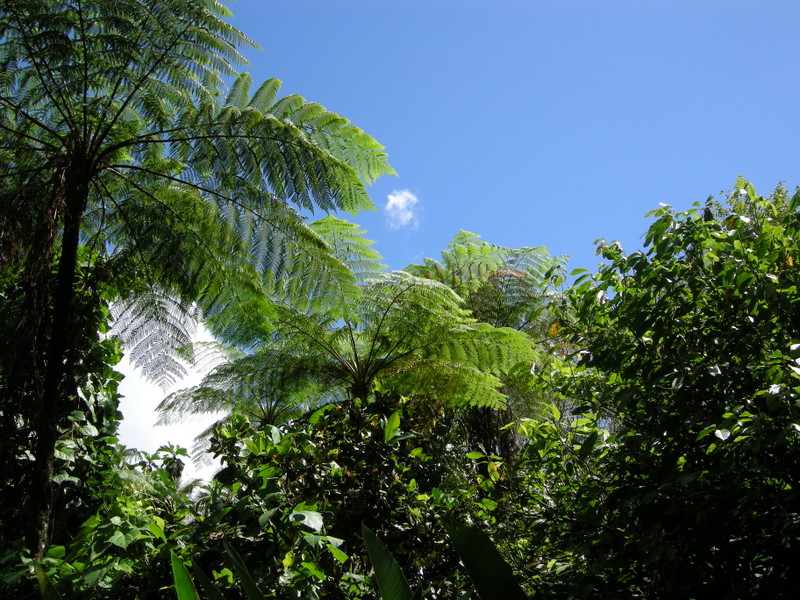
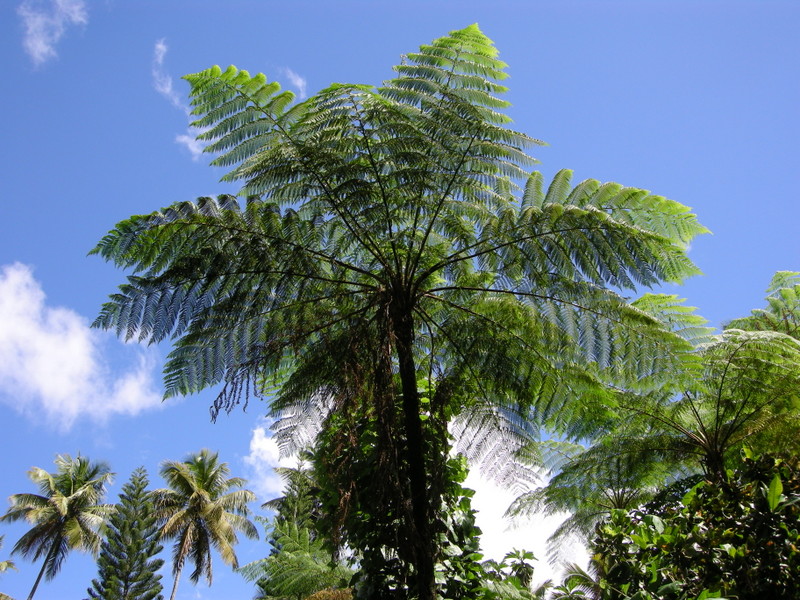
St Lucia botanical gardensTree ferns were everywhere.

.

St Lucia botanical gardens

.

St Lucia botanical gardens

.

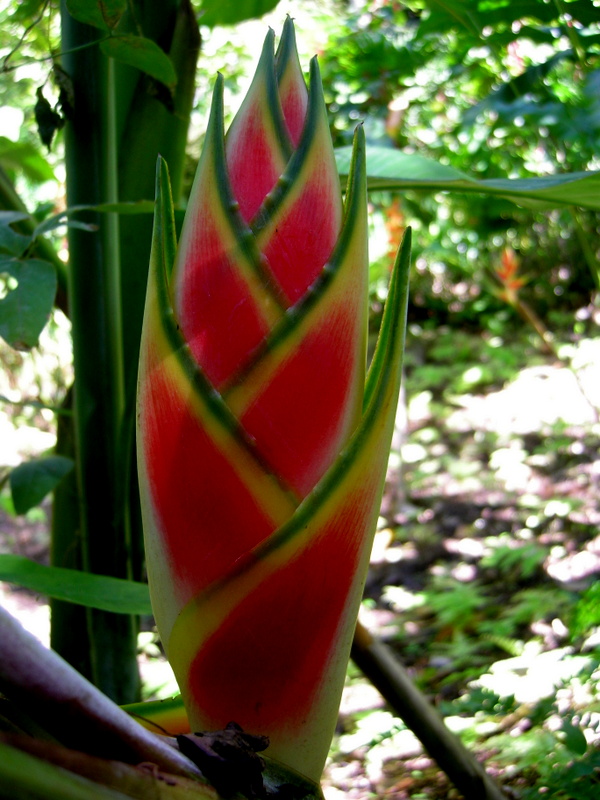
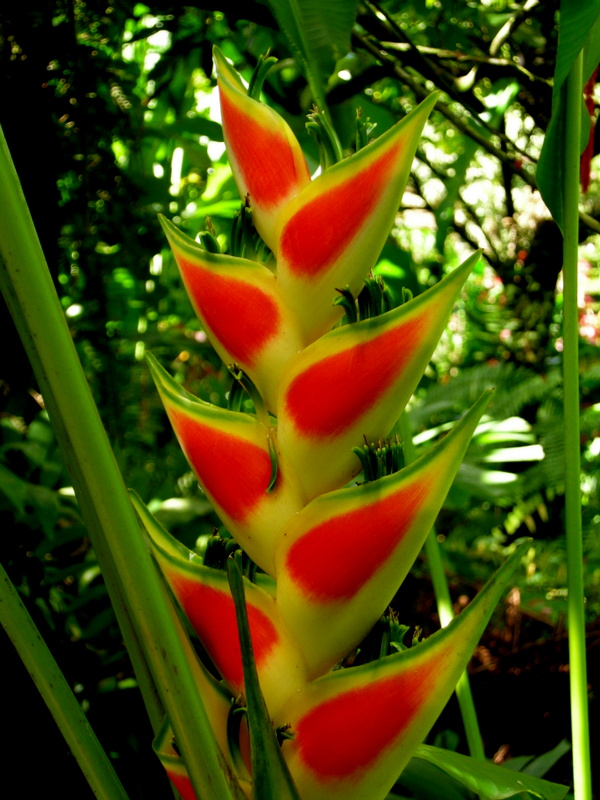
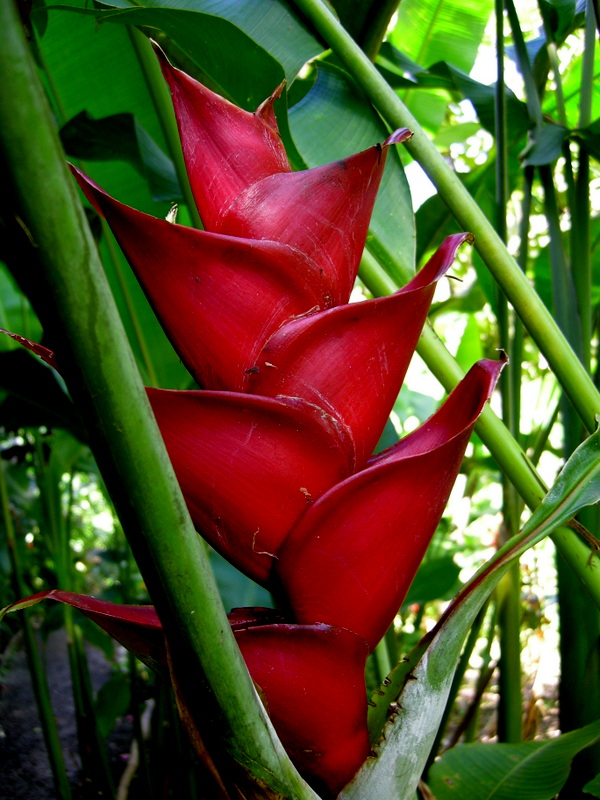
St Lucia botanical gardensI was particularly taken with this flower called lobster-claws in the genus Heliconia.

.

St Lucia botanical gardens

.

St Lucia botanical gardens

.

St Lucia botanical gardensBromeliads and moss colonize a log.

.

St Lucia botanical gardens

.

St Lucia botanical gardensThis tropical begonia looks exactly like Begonia grandis, the perennial begonia hardy in the mid-Atlantic US.

.

St Lucia botanical gardens

* * * * *

I have given you a quick glimpse of the beauties of St. Lucia and a short tour of the botanical gardens.  St Lucia is the most beautiful Caribbean island I have ever been to, and I am so thankful to Donna and her cousin for making my trip possible.

Enjoy, Carolyn

.

Carolyn’s Shade Gardens is a retail nursery located in Bryn Mawr, Pennsylvania, US, zone 6b.  The only plants that we mail order are snowdrops and miniature hostas and only within the US.

If you are within visiting distance and would like to receive catalogues and information about customer events, please send your full name and phone number to carolynsshadegardens@verizon.net.  Subscribing to my blog does not sign you up to receive this information.

Nursery Happenings:  The 2013 Snowdrop Catalogue is on the sidebar of the website and orders are being accepted.  To view the catalogue, click here.  There are a few spaces left in the February 22 session of Charles Cresson’s 2013 Winter Interest Plants Seminar.  To view the brochure and register, click here.

Facebook:  Carolyn’s Shade Gardens has a Facebook Page where I post single photos, garden tips, and other information that doesn’t fit into a blog post.  You can look at my Facebook page here or click the Like button on my right sidebar here.

Notes: Every word that appears in orange on my blog is a link that you can click for more information.  If you want to return to my blog’s homepage to access the sidebar information (catalogues, previous articles, etc.) or to subscribe to my blog, just click here.

A Longwood New Year’s Eve

Posted in garden to visit, winter with tags , , , on January 1, 2013 by Carolyn @ Carolyns Shade Gardens

Carolyn’s Shade Gardens is a retail nursery located in Bryn Mawr, PA, specializing in showy, colorful, and unusual plants for shade.  The only plants that we ship are snowdrops and miniature hostas.  For catalogues and announcements of events, please send your full name, location, and phone number (for back up use only) to carolyn@carolynsshadegardens.com.  Click here to get to the home page of our website for catalogues and information about our nursery and to subscribe to our blog.

Longwood ChristmasPure magic!

For 2012-2013, I choose Longwood Gardens in Kennett Square, Pennsylvania, US, as the garden that I would visit throughout the year and profile.  Longwood is probably the most visited public garden in the US and holds a special place in my heart because I have taken almost 20 courses there, earning two Longwood Certificates of Merit in Ornamental Plants.  My previous posts profiled Longwood’s creative use of groundcovers (click here to read) and Longwood at night, focusing on the Bruce Munro light installation (click here to read).

Longwood conservatory One of the Longwood conservatories decorated for Christmas.

Visiting Longwood anytime of year is a breathtaking experience.  I have been going there for 30 years, and it never fails to delight me.  However, their Christmas display, both indoors and outside, is in a class by itself.  Before I go I always think the magic might have worn off.  But every time I walk out of the visitor’s center and see the lights, I am amazed once again.

.

Longwood ConservatoryA long view of one of the immense indoor spaces.

Because Longwood is so popular at Christmas, it takes a little planning to avoid the crowds.  In previous years, we choose a warm and drizzly night and had the gardens pretty much to ourselves.  This year we thought it might be fun to go on New Year’s Eve when musicians stroll through the gardens entertaining the crowds.  Our timing was perfect as we arrived at 2:15 pm, toured the relatively empty conservatories, ate delicious food in the uncrowded cafe, and escaped out into the garden just as it got dark and the hordes descended.

.

LongwoodOne of the rooms in the conservatories was set up for an immense holiday feast.  It was gorgeous.

The conservatories encompass four acres so there is a lot to see inside from orchids to bonsai to the actual greenhouses where the plants are grown.  All of it is decorated for the holidays.  Here are just a few displays that caught my eye:

.

LongwoodThe maze in the enchanting children’s garden.

.

LongwoodA very unusual color for a poinsettia, perfectly complimented.

.

Longwood

.

Longwood

.

Longwood ChristmasThe camellias were blooming.

.

Longwood Christmas-001The hibiscus were also in full flower.

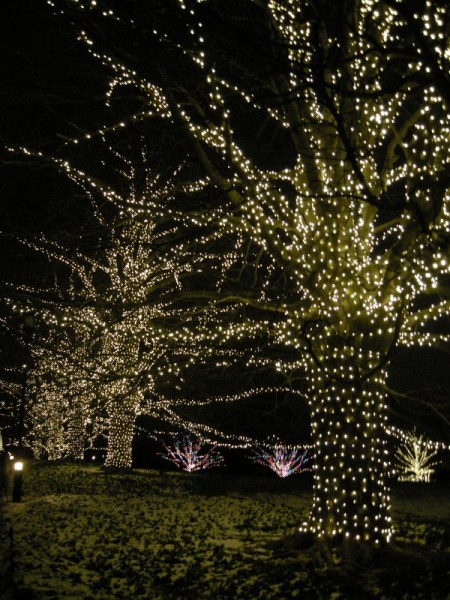
As much as I enjoy the conservatories, the real magic of a Longwood Christmas is outside where half a million lights decorate hundreds of trees.  If you think you have seen it all before, I challenge you to come here and not be in awe.  Panoramic shots would really do the display justice, but holding the camera steady for night shots without a tripod proved difficult at best.  Here is a small sampling of the light extravaganza:

LongwoodA photo at dusk by the Peirce du Pont House

.

LongwoodThe lights show up better in full dark but this effect was kind of surreal.

.

LongwoodThe famous five-acre fountain garden.  It is hard to convey in photos the size and scale of Longwood.

.

LongwoodLooking back inside the conservatories.

.

Longwood

.

Longwood ChristmasThis was my favorite wrapped tree hung with stars and displayed against the ink blue night.

.

Longwood

.

LongwoodMammoth copper beeches completely wrapped.

.

Longwood

.

Longwood

.

Longwood

.

Longwood

If you are in the area, it is well worth a visit.  The display continues through January 6, and timed tickets are required.

HAPPY NEW YEAR

Carolyn


Nursery Happenings:  The 2013 Snowdrop Catalogue is on the sidebar of the website and orders are being accepted.  To view the catalogue, click here.

Carolyn’s Shade Gardens is a retail nursery located in Bryn Mawr, PA.  The only plants that we mail order are snowdrops and miniature hostas.  The nursery is closed until spring 2013.  Thanks for a great year.

If you are within visiting distance and would like to receive catalogues and information about customer events, please send your full name and phone number to carolynsshadegardens@verizon.net.  Subscribing to my blog does not sign you up to receive this information.

Facebook:  Carolyn’s Shade Gardens has a Facebook page where I post single photos, garden tips, and other information that doesn’t fit into a blog post.  You can look at my Facebook page here or click the Like button on my right sidebar here.

Notes: Every word that appears in orange on my blog is a link that you can click for more information.  If you want to return to my blog’s homepage to access the sidebar information (catalogues, previous articles, etc.) or to subscribe to my blog, just click here.


Natural Bridge, Virginia

Posted in garden to visit, native plants with tags , , on November 4, 2012 by Carolyn @ Carolyns Shade Gardens

Carolyn’s Shade Gardens is a retail nursery located in Bryn Mawr, PA, specializing in showy, colorful, and unusual plants for shade.  The only plants that we ship are snowdrops and miniature hostas.  For catalogues and announcements of events, please send your full name, location, and phone number (for back up use only) to carolyn@carolynsshadegardens.com.  Click here to get to the home page of our website for catalogues and information about our nursery and to subscribe to our blog.

Natural Bridge in Virginia

My son Alex is a senior at Roanoke College in Salem, Virginia.  In early October, when we attended parents weekend, we decided to take in some of the local sites.  We had a wonderful visit to the Natural Bridge and the Natural Bridge Caverns just off Interstate 81 about an hour north of Roanoke in the heart of the gorgeous Blue Ridge Mountains.  I highly recommend a stop if you are in the area.

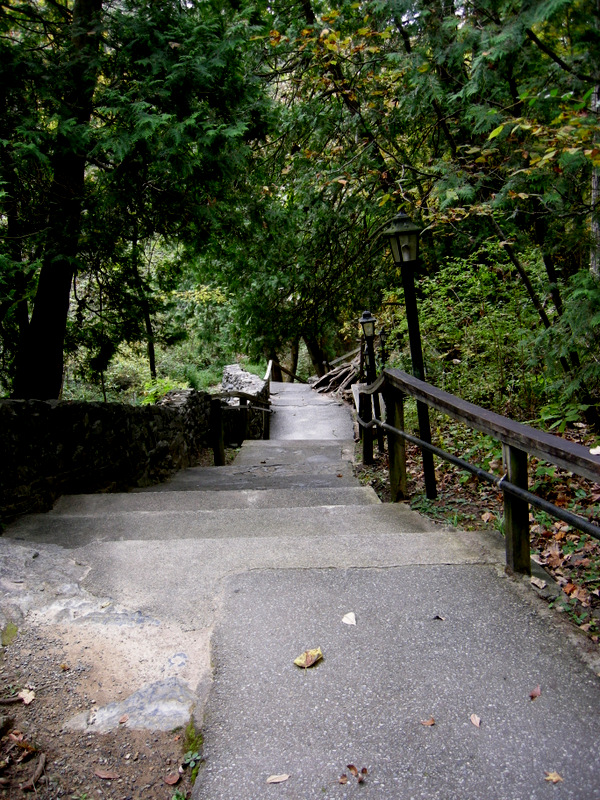
You enter the gorge where the bridge is located down this steep stairway through the woods (or you can take a shuttle bus).

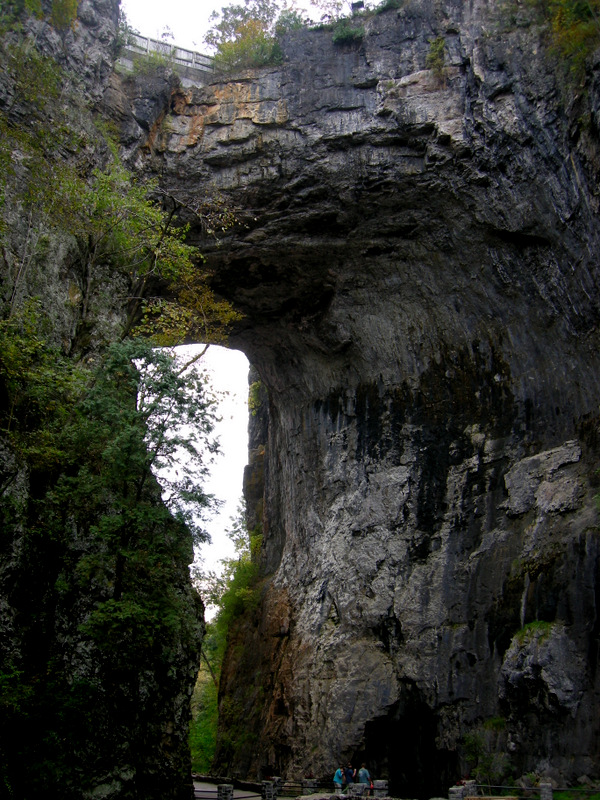
The Natural Bridge was created when an underground cavern, carved by Cedar Creek, a tributary of the James River, collapsed and left behind a span of its rock roof 215 feet high and 90 feet wide.  It is the kind of mammoth natural site that we normally only find in the western US.  The bridge is so big and substantial that Route 11, the state highway, runs across the top of it, and you don’t even notice the road.

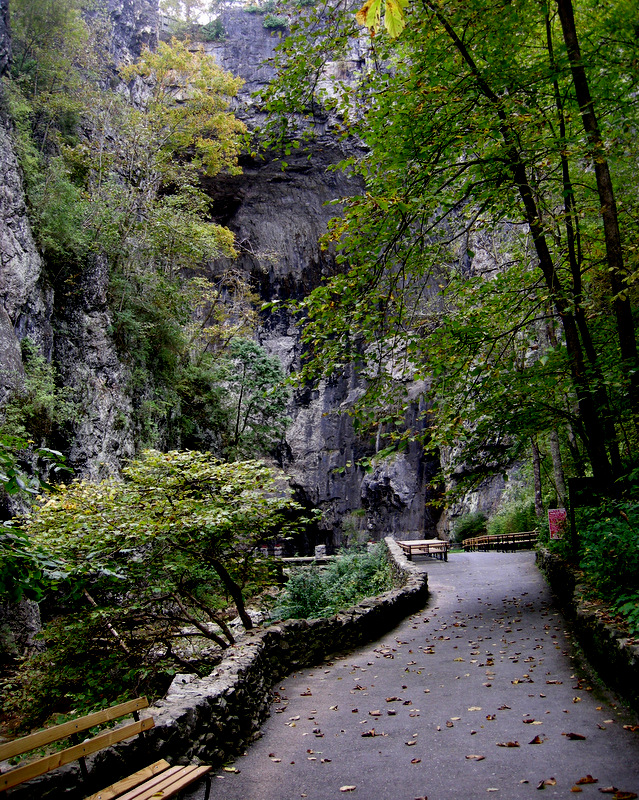
The trail to the bridge is lovely and runs along Cedar Creek, a tributary of the James River.

The Natural Bridge is not only a natural wonder, but it is also a very significant  historic site. It is on the National Register of Historic Places and has been selected from that list of 65,000 to be one of only 2,430 National Historic Landmarks. The Natural Bridge was a sacred site of the Monacan Indians.  In 1750, it was surveyed by George Washington for Lord Fairfax, the owner of the original Virginia land grant of 1649.  In 1774, it was purchased by Thomas Jefferson as part of a 157 acre parcel acquired from King George III for 20 shillings.  Jefferson built a log cabin retreat there and entertained many famous guests.

When you see the Natural Bridge with people in front of it (bottom middle), you get an idea of how gigantic it is.

Like Niagara Falls, the Natural Bridge has been a tourist site since the late 18th century.  An inn was built in 1833, and today there is an on site hotel.  The property has always been privately owned and remains so today.  With tourist dollars a motivation for private owners, the surrounding area is somewhat degraded by unrelated attractions, including a wax museum, live butterfly exhibit, toy museum, and an extensive gift shop.  However the bridge area remains pristine, and the bridge itself is spectacular.  My photos taken on an overcast and dreary day do not do it justice.

Route 11 runs along the top.

The rock walls that line the gorge are very beautiful.

Along the trail we saw a lot of mostly native flora and fauna (I don’t know the exact IDs so no labels except the bird is a great blue heron):


When we were there, we also toured the Natural Bridge Caverns, the deepest caverns on the East Coast.  I didn’t take any photos, but the caverns were as spectacular as the bridge and well worth a visit.

Carolyn


Nursery Happenings:  Carolyn’s Shade Gardens is done for the fall.  Thanks for a great year.  See you in spring 2013.

If you are within visiting distance and would like to receive catalogues and information about customer events, please send your full name and phone number to carolynsshadegardens@verizon.net.  Subscribing to my blog does not sign you up to receive this information.

Facebook:  Carolyn’s Shade Gardens has a Facebook page where I post single photos, garden tips, and other information that doesn’t fit into a blog post.  You can look at my Facebook page here or click the Like button on my right sidebar here.

Notes: Every word that appears in orange on my blog is a link that you can click for more information.  If you want to return to my blog’s homepage to access the sidebar information (catalogues, previous articles, etc.) or to subscribe to my blog, just click here.


Natural Rock Garden Seating

Posted in garden to visit, How to, landscape design with tags , , on August 9, 2012 by Carolyn @ Carolyns Shade Gardens

Carolyn’s Shade Gardens is a retail nursery located in Bryn Mawr, PA, specializing in showy, colorful, and unusual plants for shade.  The only plants that we ship are snowdrops and miniature hostas.  For catalogues and announcements of events, please send your full name, location, and phone number (for back up use only) to carolyn@carolynsshadegardens.com.  Click here to get to the home page of our website for catalogues and information about our nursery and to subscribe to our blog.

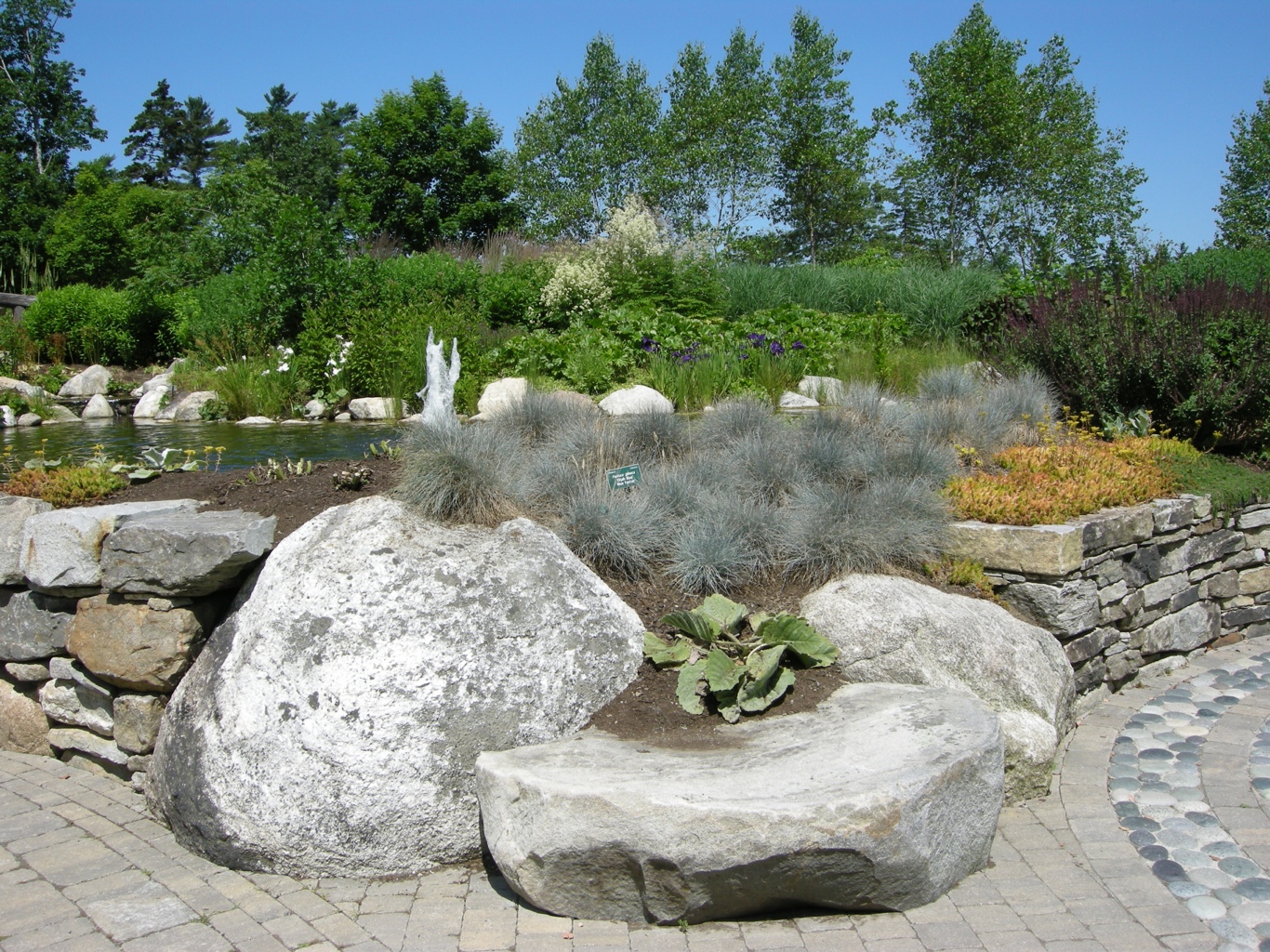
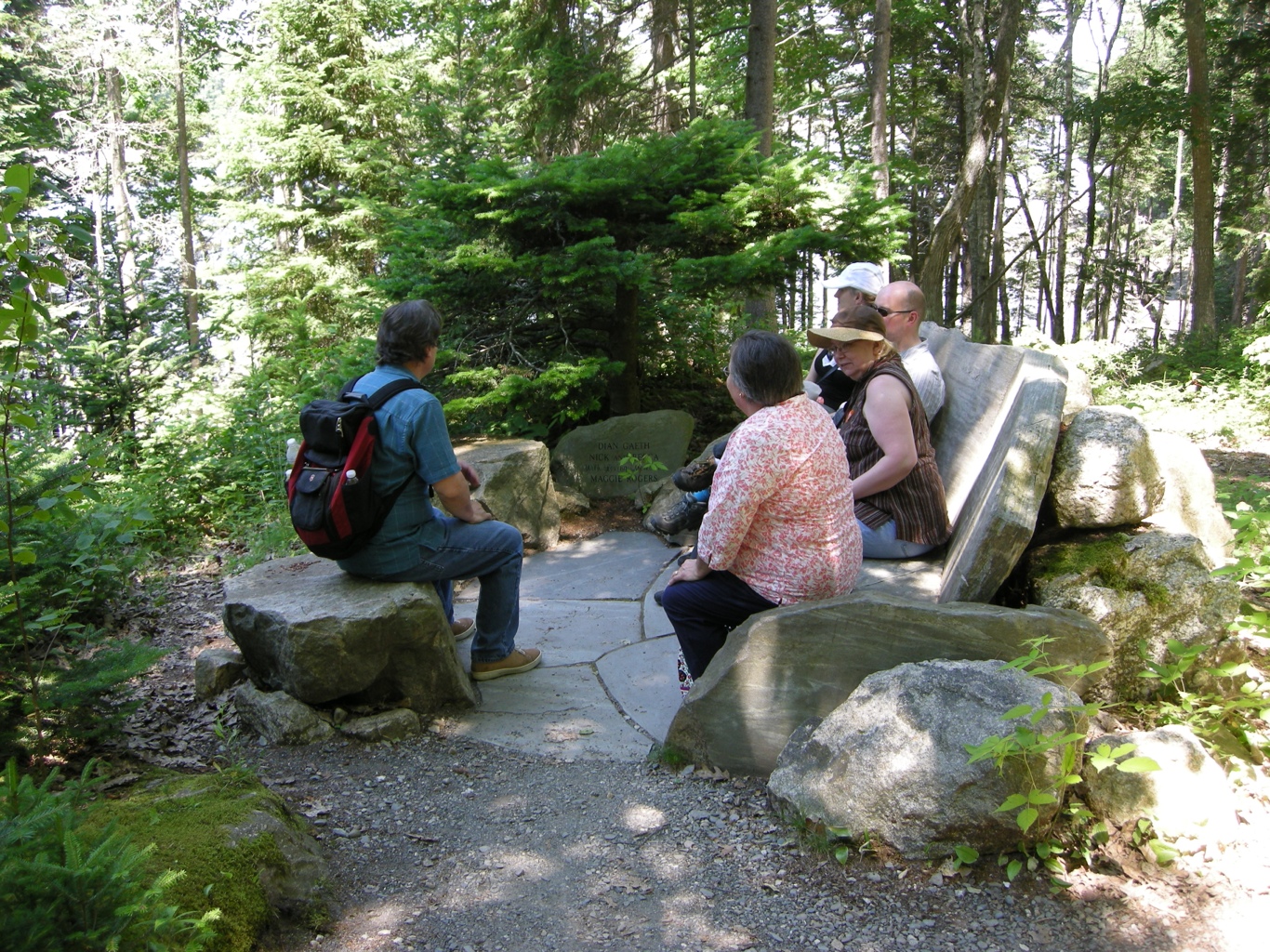
20120805-144035.jpgNatural rock seating in the Rose and Perennial Garden at the Coastal Maine Botanical Gardens.

As I mentioned in my previous post on hydrangeas, I visited the Coastal Maine Botanical Gardens (CMBG) in July with Donna from Garden Walk Garden Talk. This wasn’t my first visit, and if you want to read my original post click here. This visit was more focused because I came with a mission. I am designing an island in a public road and was looking for ideas for natural rock seating.

20120805-150252.jpg
CMBG Lerner Garden of the Five Senses

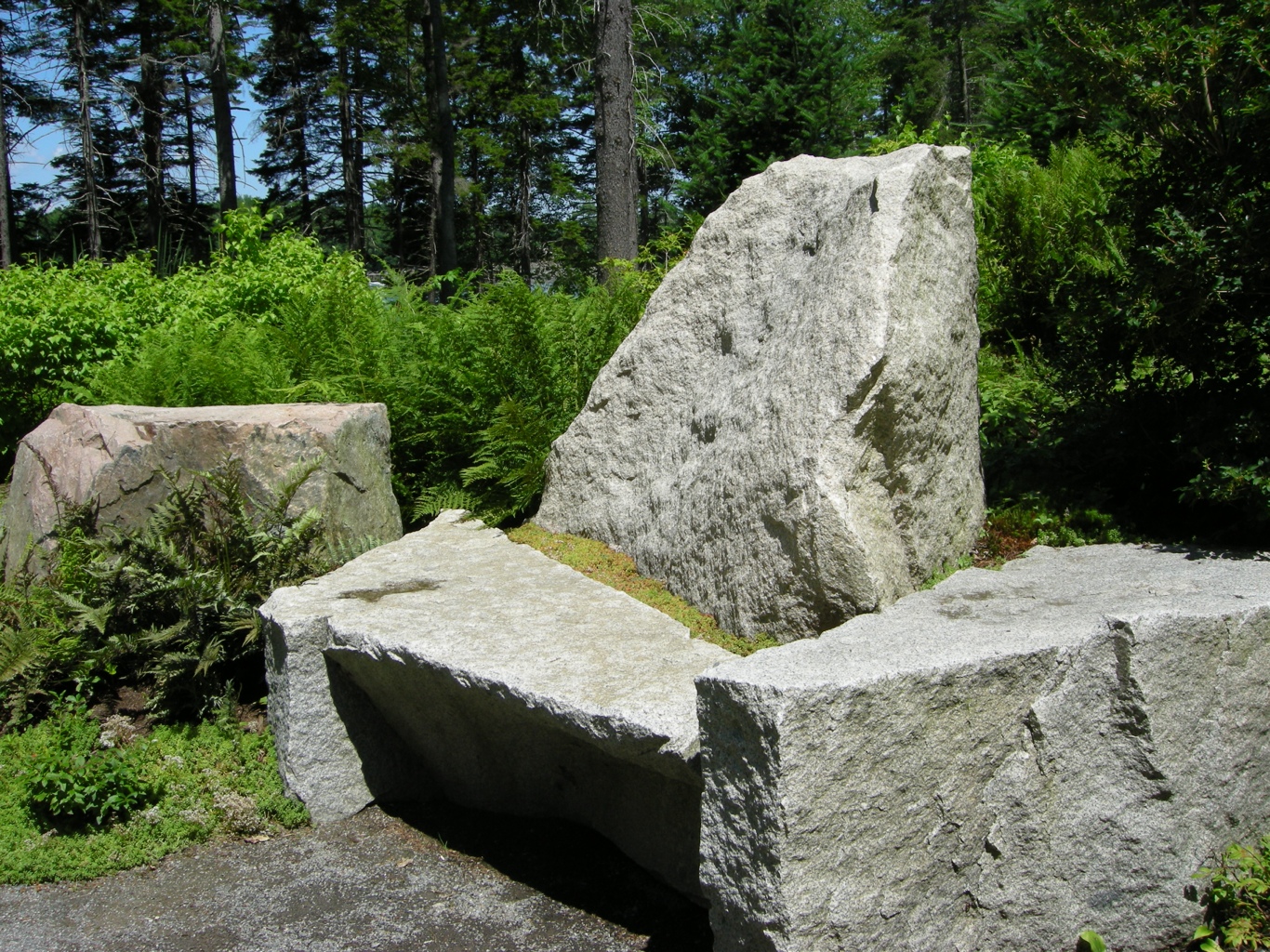
If you are looking for ways to incorporate boulders and rocks into your garden, there is no better place to get design ideas than CMBG. The whole garden is full of gorgeous stones, most of them from Maine quarries and some found on the site. Finding stones on site is easy when you are on the Maine coast—the ground has more rocks than soil. But to create such unusual and well integrated garden seating takes talent. I want to share my photographs with you in case you are looking to create natural seating in your own garden.

20120808-144213.jpg

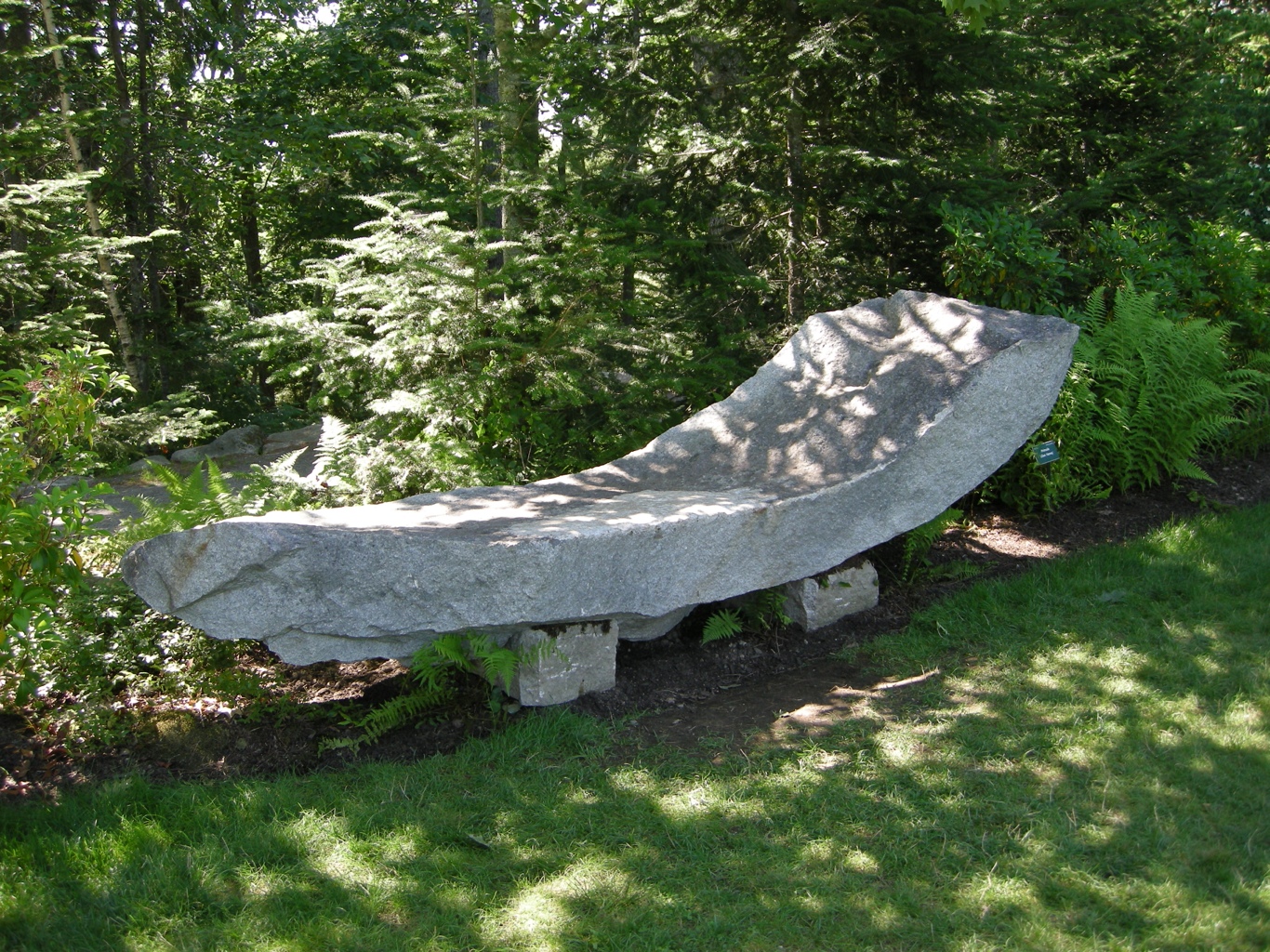
Seating in both public and private gardens should be sited in a way that directs visitors to an important view or encourages them to enjoy a new perspective while they sit. When choosing rock, I am partial to rounded boulders, fully integrated into the landscape to the point where you almost can’t see them. However, this approach would not be appropriate in a public botanical garden where you want tired visitors to be able to easily locate a resting spot. The following photos were all taken at the CMBG and show a variety of ways to use rock as garden seating:

20120808-145304.jpg

20120808-145417.jpg

20120808-145517.jpg

20120808-145621.jpg

20120808-145741.jpg

20120808-145939.jpg

20120808-150040.jpg

20120808-150159.jpg

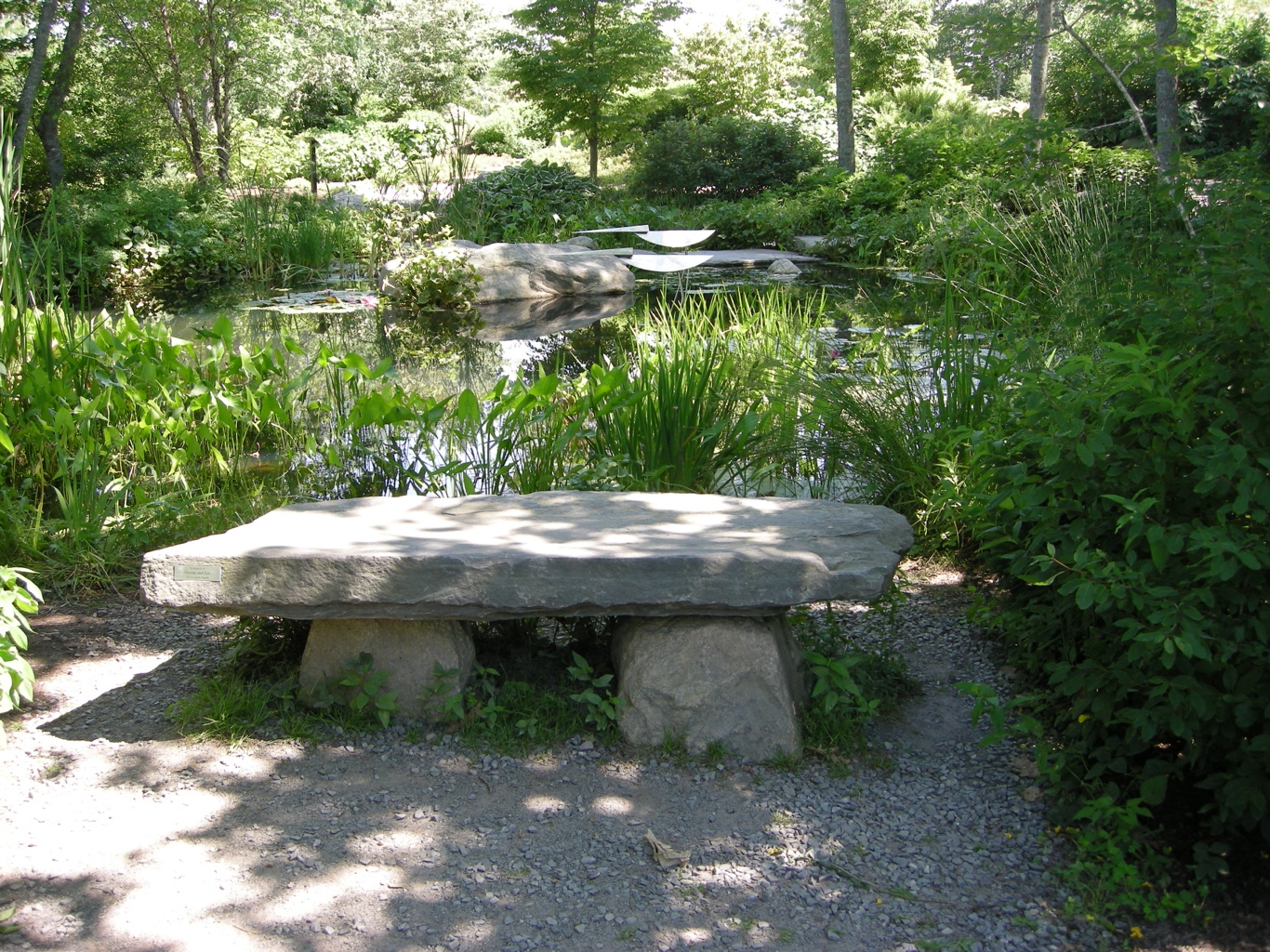
20120808-150327.jpgThis simple bench provides an overlook of the Slater Forest Pond, which was full of frogs and dragonflies.

20120808-150522.jpgThis is a full couch and chairs positioned along the beautiful Shoreland Trail.

All the seating shown above is quite beautiful and appropriate to the site, but I wanted to save some of my favorite designs for last:

20120808-150914.jpgThis single boulder is so well integrated into its site both by the other rocks and the sedum growing around it.

20120808-151144.jpgAgain a boulder that looks like the designers built the other hardscape around it in the Lerner Garden of the Five Senses.

20120808-151422.jpg

20120808-151541.jpg

20120808-151700.jpgWhat a wonderful place to sit and enjoy the water view along the Shoreland Trail.

20120808-152207.jpg

20120808-152328.jpgThe rocks look like they could have just fallen into place to create this obviously comfortable “couch” in the Giles Rhododendron Garden.

20120808-152633.jpgA natural chaise lounge near the Cleaver Event Lawn and Garden.

I came away from my visit to the Coastal Maine Botanical Gardens with some great ideas for my road design project and with renewed respect for this wonderful Maine garden treasure.

Carolyn

Nursery Happenings: The nursery is closed until the fall. Thanks for a great spring season!

If you are within visiting distance and would like to receive catalogues and information about customer events, please send your full name and phone number to carolynsshadegardens@verizon.net. Subscribing to my blog does not sign you up to receive this information.

Facebook: Carolyn’s Shade Gardens has a Facebook page where I post single photos, garden tips, and other information that doesn’t fit into a blog post. You can look at my Facebook page here or click the Like button on my right sidebar here.

Notes: Every word that appears in orange on my blog is a link that you can click for more information. If you want to return to my blog’s homepage to access the sidebar information (catalogues, previous articles, etc.) or to subscribe to my blog, just click here.
Historic Bartram’s Garden

Posted in garden to visit, native plants, Uncategorized with tags , , , , , , , , , , , , , , , , , on July 6, 2012 by Carolyn @ Carolyns Shade Gardens

Carolyn’s Shade Gardens is a retail nursery located in Bryn Mawr, PA, specializing in showy, colorful, and unusual plants for shade.  The only plants that we ship are snowdrops and miniature hostas.  For catalogues and announcements of events, please send your full name, location, and phone number (for back up use only) to carolyn@carolynsshadegardens.com.  Click here to get to the home page of our website for catalogues and information about our nursery and to subscribe to our blog.

John Bartram House, Philadephia, Pennsylvania, US


“Whatsoever whether great or small ugly or handsom sweet or stinking…every thing in the universe in their own nature appears beautifull to mee.”

John Bartram 1740


For Mother’s Day this May, I was surprised with a picnic and visit to Bartram’s Garden in Philadelphia, Pennsylvania, US, the oldest surviving botanic garden in North America.  Prominent Philadelphia Quakers, John Bartram (1699-1777) and his son William (1739-1823) were the most important American plant explorers of the 18th century, traveling south to Florida, west to the Mississippi, and north to Lake Ontario.  They introduced more than 200 native plants into cultivation.  By mid-century, their 102 acre garden (now 45 acres) contained the most extensive collection of North American plants in the world.

Native Bartram oak, Quercus x heterphylla, a rare hybrid between red oak, Quercus rubra, and willow oak, Quercus phellos, discovered by John Bartram.

…the Botanick fire set me in such A flame as is not to be quenched until death or I explore most of the…vegitative treasures in No. America.”

John Bartram 1761


The intrepid Bartrams shared their discoveries with scientists throughout America and Europe, especially England.  John Bartram’s discoveries were considered so important that he was appointed Royal Botanist by King George III.  Bartram founded the American Philosophical Society in Philadelphia with his friend and colleague Benjamin Franklin.  In addition, he started a thriving seed and plant business with his lists appearing in London publications as early as the 1750s.  In 1783, Bartram published the first American nursery catalogue.  [Historical information and quotes courtesy of Bartram’s Garden.]

John Bartram purchased his farm in 1728 and completed this portion of the stone house in 1731.


The house and gardens are a National Historic Landmark and have been well preserved despite their location in a very developed part of Philadelphia. Fortunately, they were acquired by the city in 1891 and became part of the public park system.  The property is on the banks of the Schuylkill River and is a joy to visit both to see the historic buildings and to wander through the peaceful gardens.  I would visit Bartram’s Garden just to see the specimen trees.   I am going to take you on a short photographic tour below, but I highly recommend an actual visit.

This formal façade, which faces the gardens, was added between 1758 and 1770.


Close up of the façade


Carved stone window in the facade


This pristine example of a two-level Pennsylvania bank barn was built in 1775.


Stone watering trough


John Bartram’s first experimental garden


Looking from the house towards the kitchen and stables


Walking along the wooden boardwalk by the river


The foundation of this simple mill based on an ancient European design was carved from the bedrock next to the river.


Apples were crushed in the circular trench by a wooden wheel.


There are some very beautiful wetlands on the shores of the river.


If you love trees, and especially specimen trees as I do, you don’t want to miss seeing the huge mostly native trees at Bartram’s Garden.  I include photos of some of them below, but they are so large that it is hard to get a good photograph.  You have to see them in person to truly appreciate their magnificence.


The oldest ginkgo tree, G. biloba, in North America planted by William Bartram in 1785.


Luckily there was a field below this amazing American yellowwood, Cladrastis kentukea, so I could get a photo of the whole tree.


The house next to the yellowwood gives it some scale.  We were fortunate to catch it in full bloom.


Yellowwood flowers


Under the yellowwood tree


American beech, Fagus grandifolia


Native willow oak, Quercus phellos


Native common hackberry, Celtis occidentalis


Bartram’s Garden is a public park and is open all year for self-guided tours except city-observed holidays.  I hope you have the chance to visit.


Carolyn

Nursery Happenings:  The nursery is closed until the fall.  Thanks for a great spring season!

If you are within visiting distance and would like to receive catalogues and information about customer events, please send your full name and phone number to carolynsshadegardens@verizon.net.  Subscribing to my blog does not sign you up to receive this information.

Facebook:  Carolyn’s Shade Gardens has a Facebook page where I post single photos, garden tips, and other information that doesn’t fit into a blog post.  You can look at my Facebook page here or click the Like button on my right sidebar here.

Notes: Every word that appears in orange on my blog is a link that you can click for more information.  If you want to return to my blog’s homepage to access the sidebar information (catalogues, previous articles, etc.) or to subscribe to my blog, just click here.


Longwood Gardens Part 2: At Night

Posted in garden to visit with tags , , , on June 27, 2012 by Carolyn @ Carolyns Shade Gardens

Carolyn’s Shade Gardens is a retail nursery located in Bryn Mawr, PA, specializing in showy, colorful, and unusual plants for shade.  The only plants that we ship are snowdrops and miniature hostas.  For catalogues and announcements of events, please send your full name, location, and phone number (for back up use only) to carolyn@carolynsshadegardens.com.  Click here to get to the home page of our website for catalogues and information about our nursery and to subscribe to our blog.

One of the light installations by Bruce Munro.

In 2011-2012, I did a series of four posts on Chanticleer, a pleasure garden in Wayne, Pennsylvania, US.  These were very popular, and the second, Chanticleer Part 2: Garden Seating, is my most popular post ever by a large margin.  I intended to profile another local garden this year but have been slow to choose one.  My two recent trips to Longwood Gardens in Kennett Square, Pennsylvania, US, reminded me how much it has to offer so I will be profiling Longwood this year.

The sun was getting lower behind the conservatory as we arrived.

Longwood Gardens is a 1,077 acre public garden with a four-acre indoor conservatory.  The property was originally purchased by the Peirce family from William Penn in 1700 to establish a farm.  In 1906, the farm was purchased by Pierre du Pont, the industrialist and driving force behind the E. I. du Pont de Nemours and Company, primarily to preserve the spectacular trees.  From then into the 1930s, Pierre du Pont created most of what is there today before turning Longwood over to a foundation in 1946.  Almost anything horticultural that you would want to see is found at Longwood: extensive native woodlands, a rose garden, elaborate French inspired fountains with shows set to music, comprehensive teaching gardens, majestic conservatories, an Italian water garden, treehouses—I can’t even list everything.

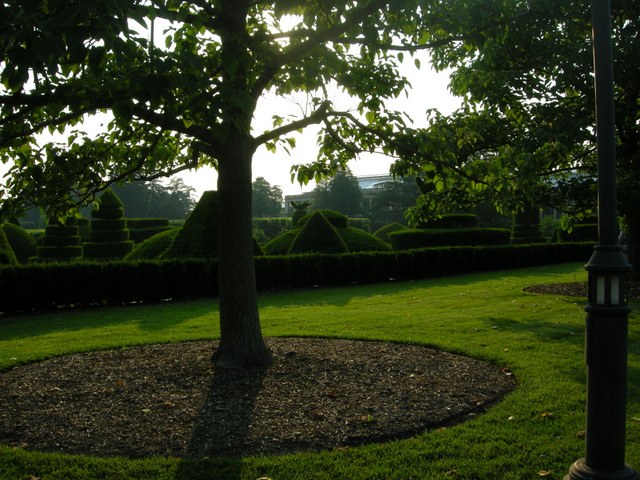
The topiary gardens looked quite elegant with the sun at this angle.

In my first post, Groundcovers, Thinking Outside the Box, I focused on the unusual plants that Longwood masses as groundcovers.  On my second visit, I took my family to see the amazing light displays created at Longwood by British lighting designer and installation artist, Bruce Munro.  We arrived around 7 pm, ate dinner at their lovely cafe with outdoor seating, and toured the gardens as the sun set and it became dark enough to see the Munro installations.

The bridge from the cafe to the conservatories.

I am not going to say much about the Munro installation except that it is fantastic.  It was so much more than I expected, including an entire woodland turned into a painter’s canvas, and I am so glad that I didn’t miss this unique experience.  I apologize to my non-local readers but the only good photos I got were of the small entry installations, and they are included at the beginning and end of this post.

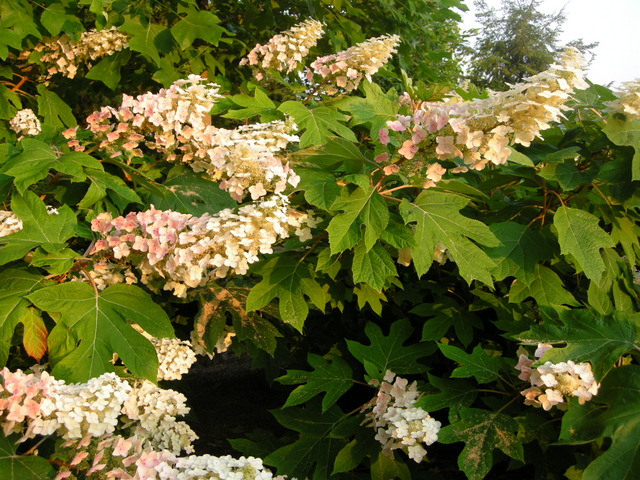
The slanting light of the setting sun on the gorgeous plantings was beautiful: here oakleaf hydrangea.

What I am going to say is that the light exhibit gives visitors a great reason to see Longwood as the sun sets and after dark.  The gardens are open until 11 pm from Wednesday through Saturday during the exhibit. The purchase of special timed entry tickets is required, although the entry fee is unchanged.  This is a magical time in any garden, but it is especially wonderful in a place as expansive as Longwood.  We wandered from one end to the other after dinner as we waited for dark on the longest day of the year.  Here is more of what we saw:

A newly built grass amphitheater.

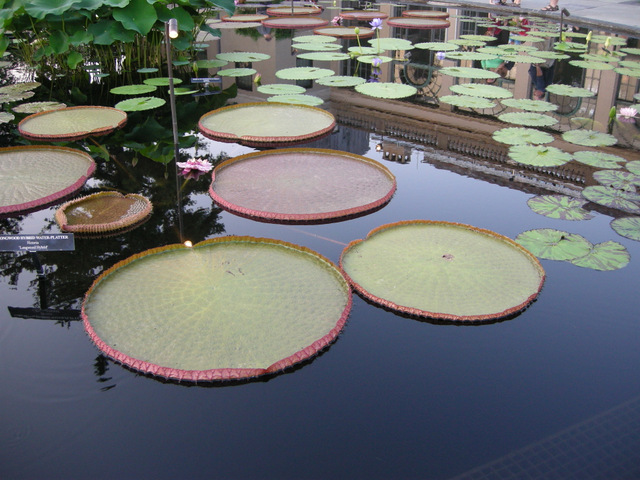
Longwood has elaborate water lily ponds in an outdoor courtyard at the heart of the conservatories.  I think they are best viewed at dusk and we spent a lot of time there.

Another view of the water lily ponds

Victoria water platters have always fascinated my husband and children.  I don’t condone this, but if you lift them up they are covered with spikes on the bottom.

Night-blooming water lily

A different species of water platter.

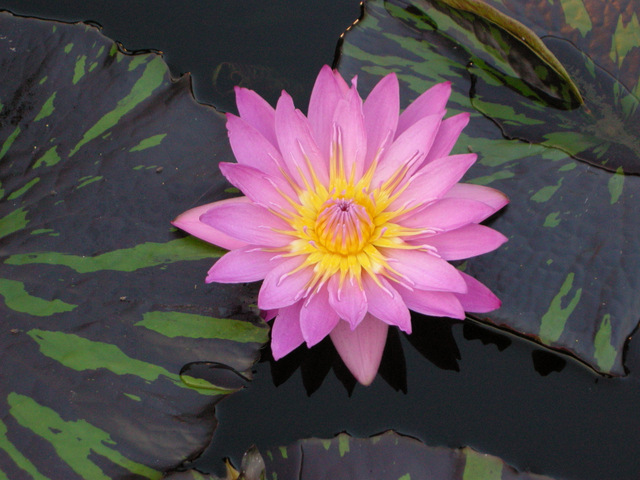
My favorite water lily—look at those leaves.

Sunset over the water lilies

From the water lily pools, we headed to the Idea Gardens which contain large individual areas displaying sun and shade perennials (photo above), annuals, vegetables and fruit, roses, vines, grasses, and groundcovers as well as a charming outdoor children’s garden (there is an amazing indoor children’s garden in the conservatories which should not be missed by children of all ages).

In the evening light, this red hot poker looked like it would burn you if you touched it.

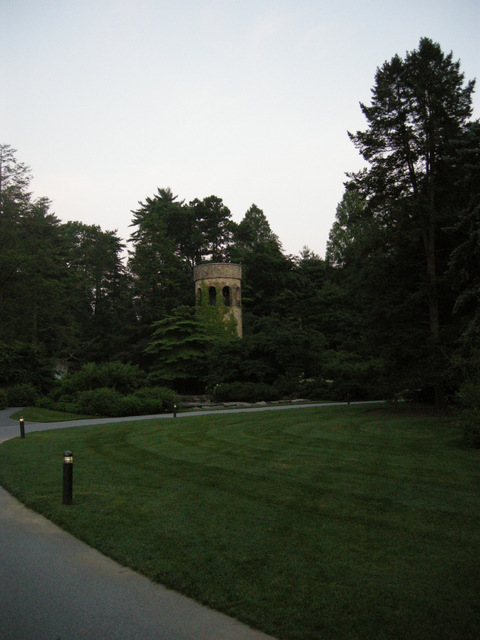
The Chimes Tower which is surrounded by shady woodland plantings and the unusual waterfall called the Eye of Water.

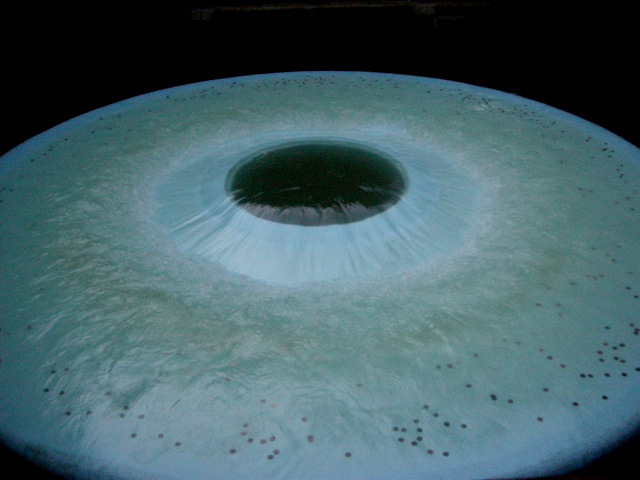
The Eye of Water, the source of the Chimes Tower waterfall, glows at night—no additional lighting required.

A view of the conservatories from a spot near the Eye of Water

It’s almost time to view the light display: the purple martins are returning home for the evening.

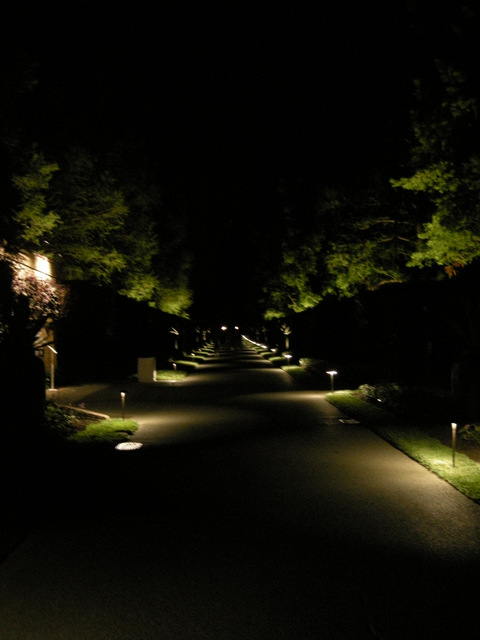
Longwood in the dark

This is my only other photo of the Bruce Munro lighting, and it is of the relatively small but quite lovely sculptural installations by the front entrance.  Some of the other installations cover acres and need to be seen to be believed. 

Although you can see a small part of Longwood at night if you attend a musical event or a fireworks and fountains show, both of which I highly recommend, the Munro exhibition invites you to wander over a major portion of the garden at night.  If you are anywhere near Longwood, you shouldn’t miss it—now until  September 29.


Carolyn

Nursery Happenings:  The nursery is closed until the fall.  Thanks for a great spring season!

If you are within visiting distance and would like to receive catalogues and information about customer events, please send your full name and phone number to carolynsshadegardens@verizon.net.  Subscribing to my blog does not sign you up to receive this information.

Facebook:  Carolyn’s Shade Gardens has a Facebook page where I post single photos, garden tips, and other information that doesn’t fit into a blog post.  You can look at my Facebook page here or click the Like button on my right sidebar here.
Notes: Every word that appears in orange on my blog is a link that you can click for more information.  If you want to return to my blog’s homepage to access the sidebar information (catalogues, previous articles, etc.) or to subscribe to my blog, just click here.