Archive for the landscape design Category

Letting Go Part 1: The Lawn

Posted in garden essay, green gardening, landscape design, organic gardening with tags on May 2, 2011 by Carolyn @ Carolyns Shade Gardens

Carolyn’s Shade Gardens is a retail nursery located in Bryn Mawr, PA, specializing in showy, colorful, and unusual plants for shade.  The only plants that we ship are snowdrops and miniature hostas.  For catalogues and announcements of events, please send your full name, location, and phone number (for back up use only) to carolyn@carolynsshadegardens.com.  Click here to get to the home page of our website for catalogues and information about our nursery and to subscribe to our blog.

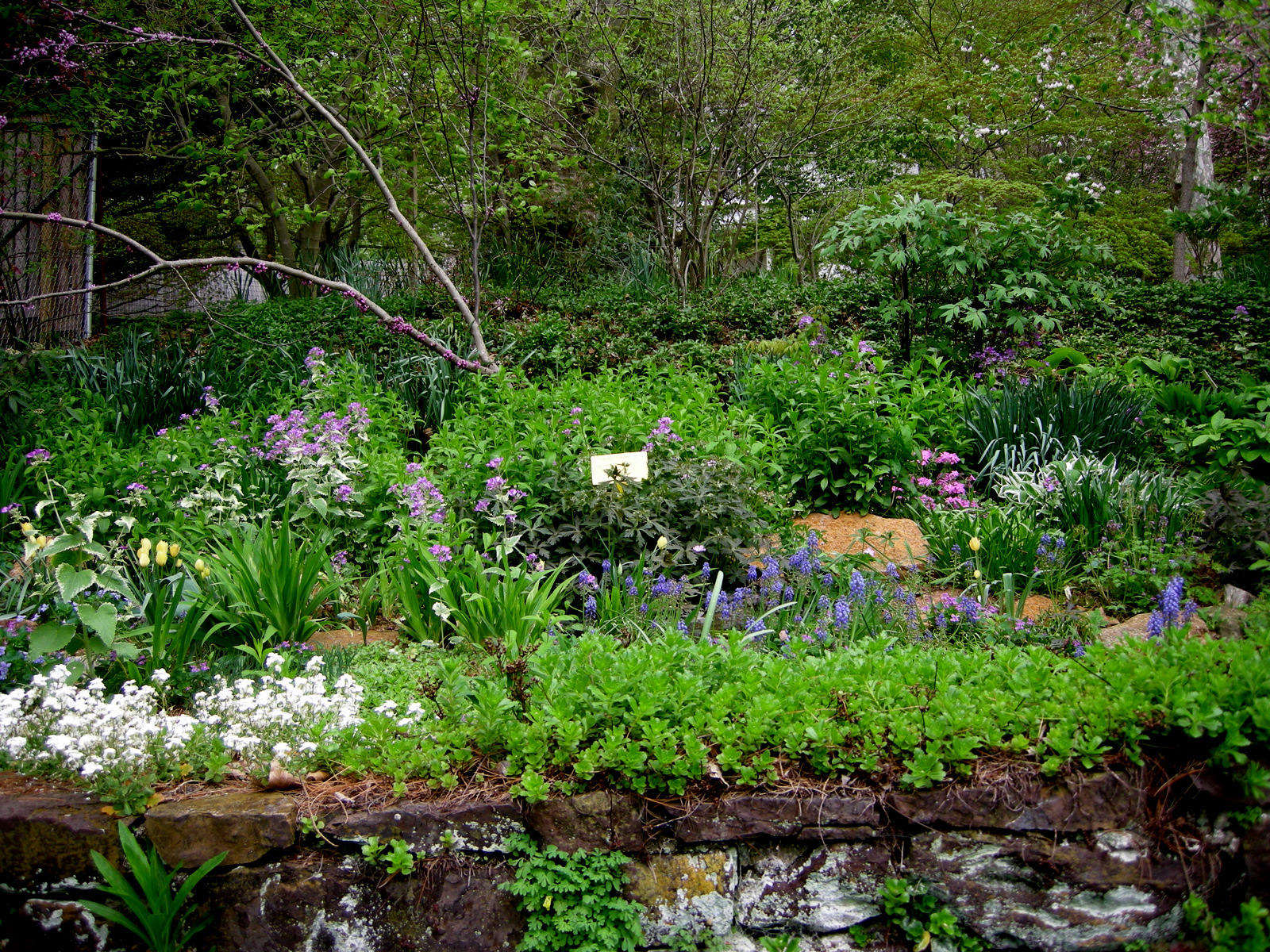
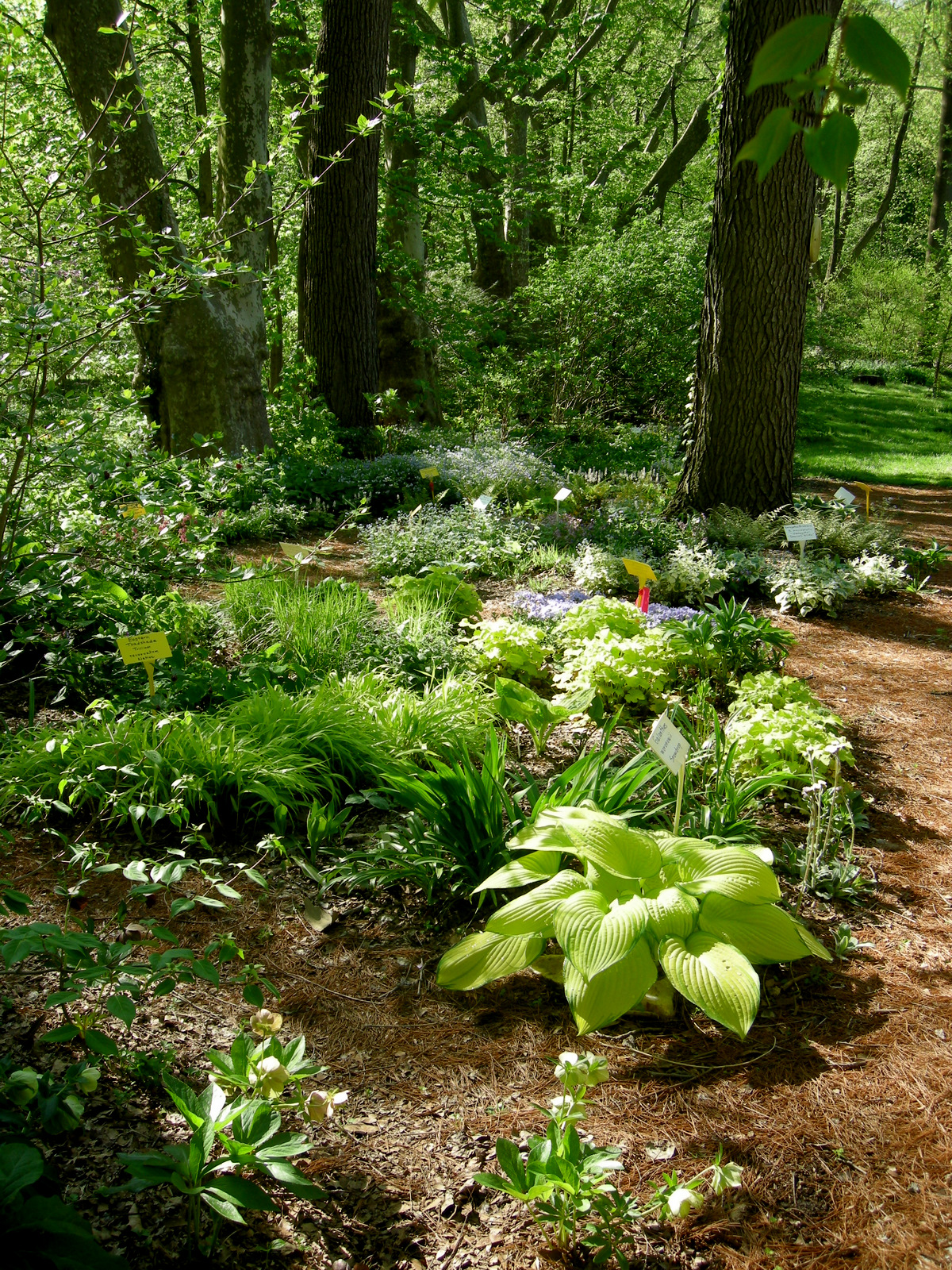
This photo and the next four all show beds created from former lawn at Carolyn’s Shade Gardens.

WARNING:  This post could be hazardous to your lawn or at least your relationship with your spouse.  It contains lawn profanity as well as intense language and strong opinions and recommends graphic violence to your lawn.  Drug use is discussed, and nudity is recommended.  Read at your own risk.

Depending on how you look at it, I was always ahead of the curve on the lawn issue.  When we bought our property in 1983, I already had it in for the lawn, which encompassed most of our 2 acres.  At the time I didn’t know that “advanced” gardeners were supposed to get rid of their lawn.  I just thought it was a ridiculous waste of garden space and resources like water and very high maintenance: it had to go.  Plus there was never any question of using chemicals to keep it green and weed free as we have been organic from day one.

In 2001, I read this tongue-in-cheek discussion between God and St. Francis and renewed my efforts to eliminate our lawn (click to enlarge):

This clever but provocative piece was printed in the Spring 2001 newsletter of The Friends of Casco Bay, Maine.  It also supports my practice of leaving leaves in my garden beds, see my post Fall Clean-Up.

To me, as pointed out by this article, the whole concept of lawn is inherently ridiculous even before you get to the environmental issues.
Then the scientific evidence kicked in.  Chemically treated lawns are a scientifically documented toxic hazard to your pets.  There is lots of information out there about the cancer causing hazards of commonly used lawn chemicals, for example, see The Truth About Cats, Dogs, and Lawn Chemicals.  After reading this would you let any family member, especially your children, walk on a chemically treated lawn?  

This whole hillside was an eroded, chemically dependent lawn when we moved in.

Lawn chemicals are a major contaminant of the Chesapeake Bay, which is the largest and most biologically diverse estuary in the U.S.  For more information, read this article by the Chesapeake Bay Program by clicking here.  A White Paper produced by a diverse group of scientists and policy experts for the Chesapeake Bay Watershed Project outlines the damage being done and recommends encouraging “consumers to question aesthetics-based behaviors (i.e., desire for visually attractive lawns or produce) in lieu of decision-making based on human health and ecological concerns.”  Phrased that way, it is amazing there is any question what the right path is.
The death warrant for my lawn as most Americans know it was sealed in stone in 2007 when I read an article by Doug Tallamy in which he pointed out the dangers of this non-native monoculture to our native flora and fauna.  It is sobering to consider that we have planted 40 million acres of lawn in the U.S. and that every weekend we mow an area eight times the size of New Jersey.  According to the U.S. EPA, “Operating a typical gasoline-powered lawn mower for one hour produces the same amount of smog-forming hydrocarbons as driving an average car almost 200 miles under typical driving conditions.”  Mowing accounts for 5% of air pollution in the U.S (click here for more details).  In Bringing Nature Home, Tallamy explains quite eloquently how our home gardens are the last bastion of space where we can promote biodiversity through planting native plants.  My lawn just did not fit into this scheme.

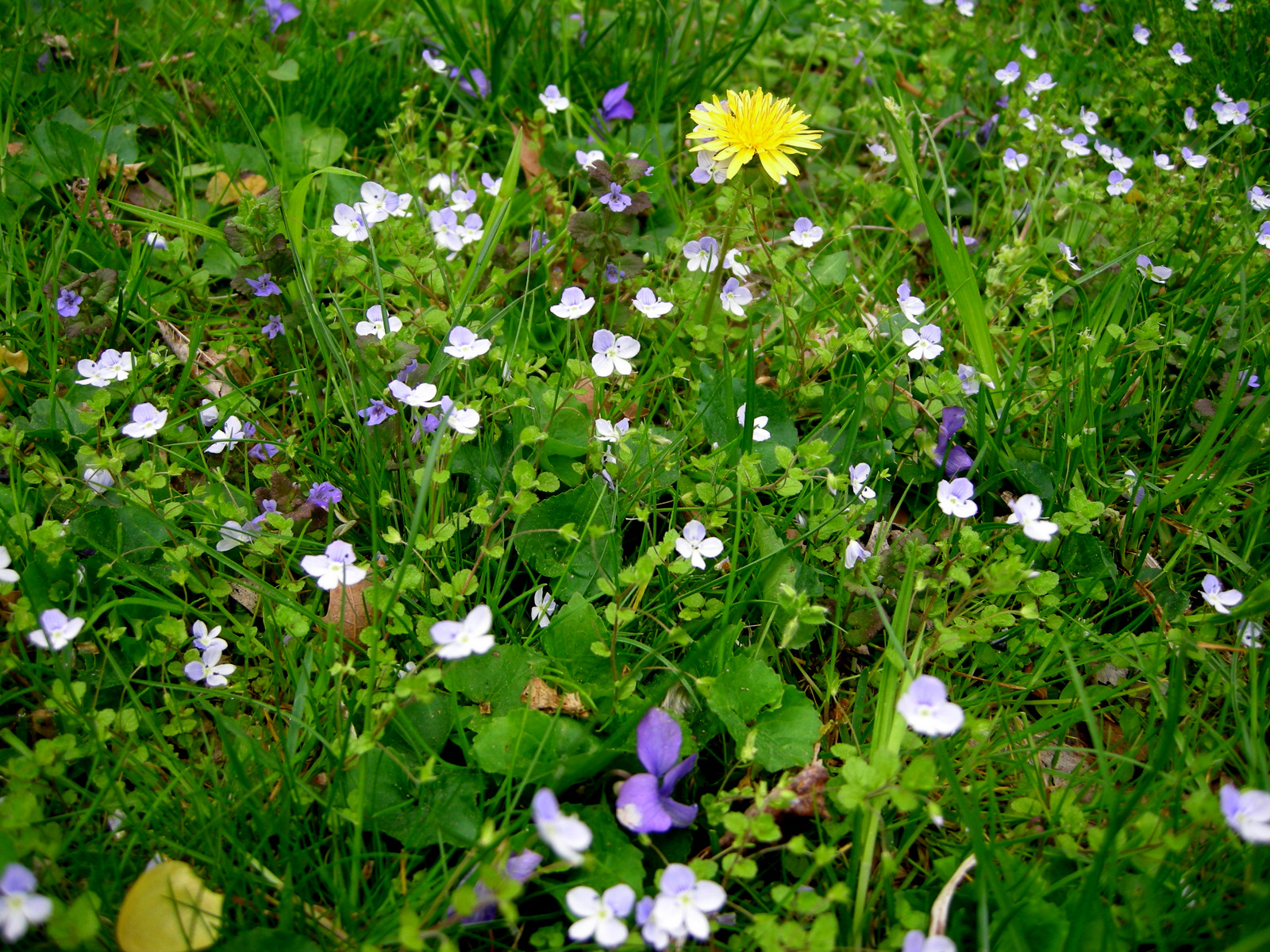
Lawn veronica, Veronica filiformis, grows throughout my lawn.  It is so beautiful that I wish it would completely replace the lawn.

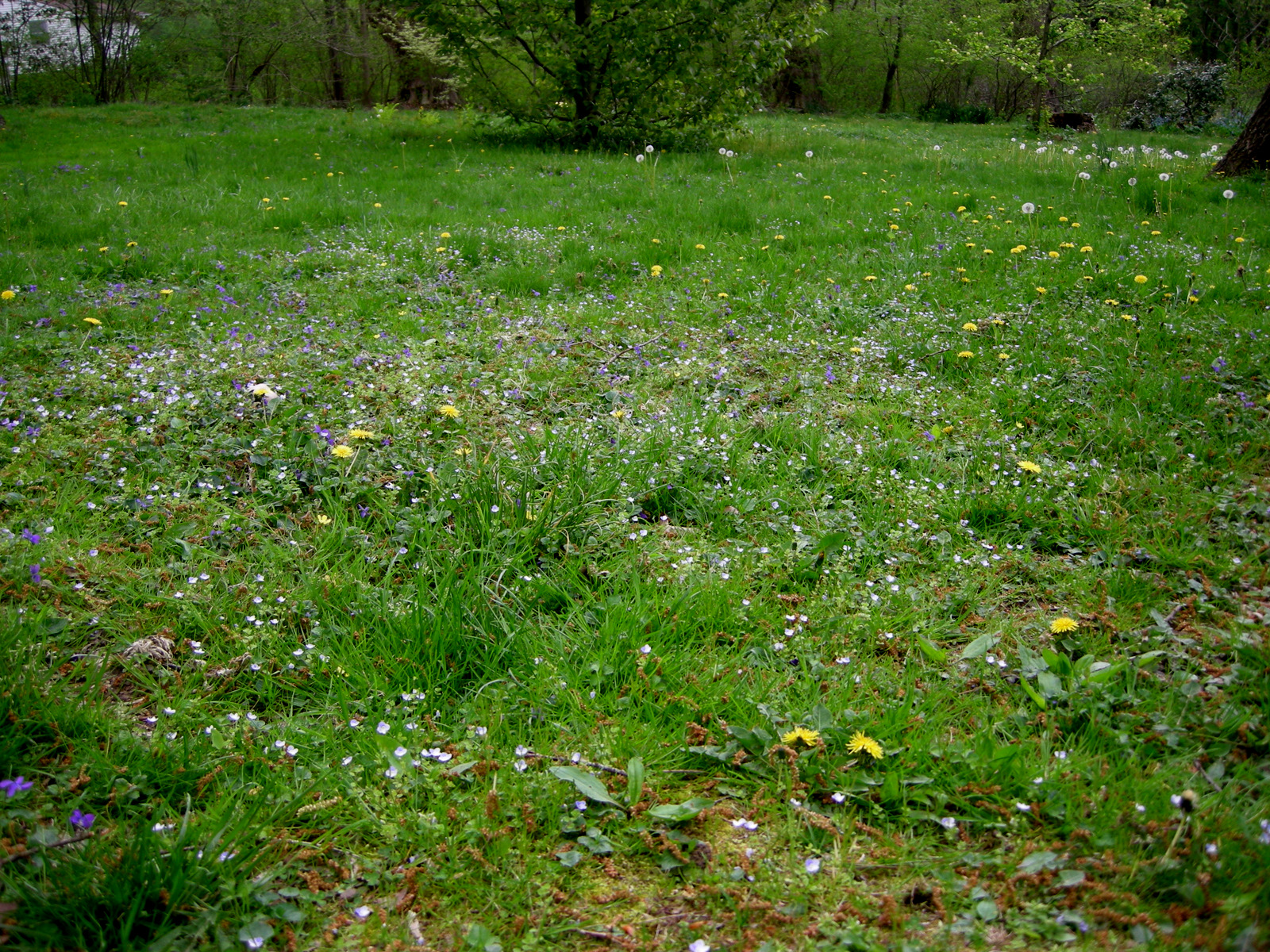
But now that I had eliminated all the lawn I could, what to do about the lawn that remains?  I still have a large grassy area  where my children play, which though not chemically treated is still a monoculture.  This is where the real horror starts: I let it go wild.  I let every “weed” that you are probably trying to remove from your lawn grow there.  And you know what?  It’s beautiful.  All spring, until we mow, it is filled with pretty “wildflowers” covered with bees, butterflies, and beetles, and visited by birds among other local fauna.  Then, when it’s mowed, it is a green expanse like a lawn “should be”.

The photos above and below show some of the “wildflowers” that grow in my lawn:

Common blue violets, Viola papilionacea (sororia)
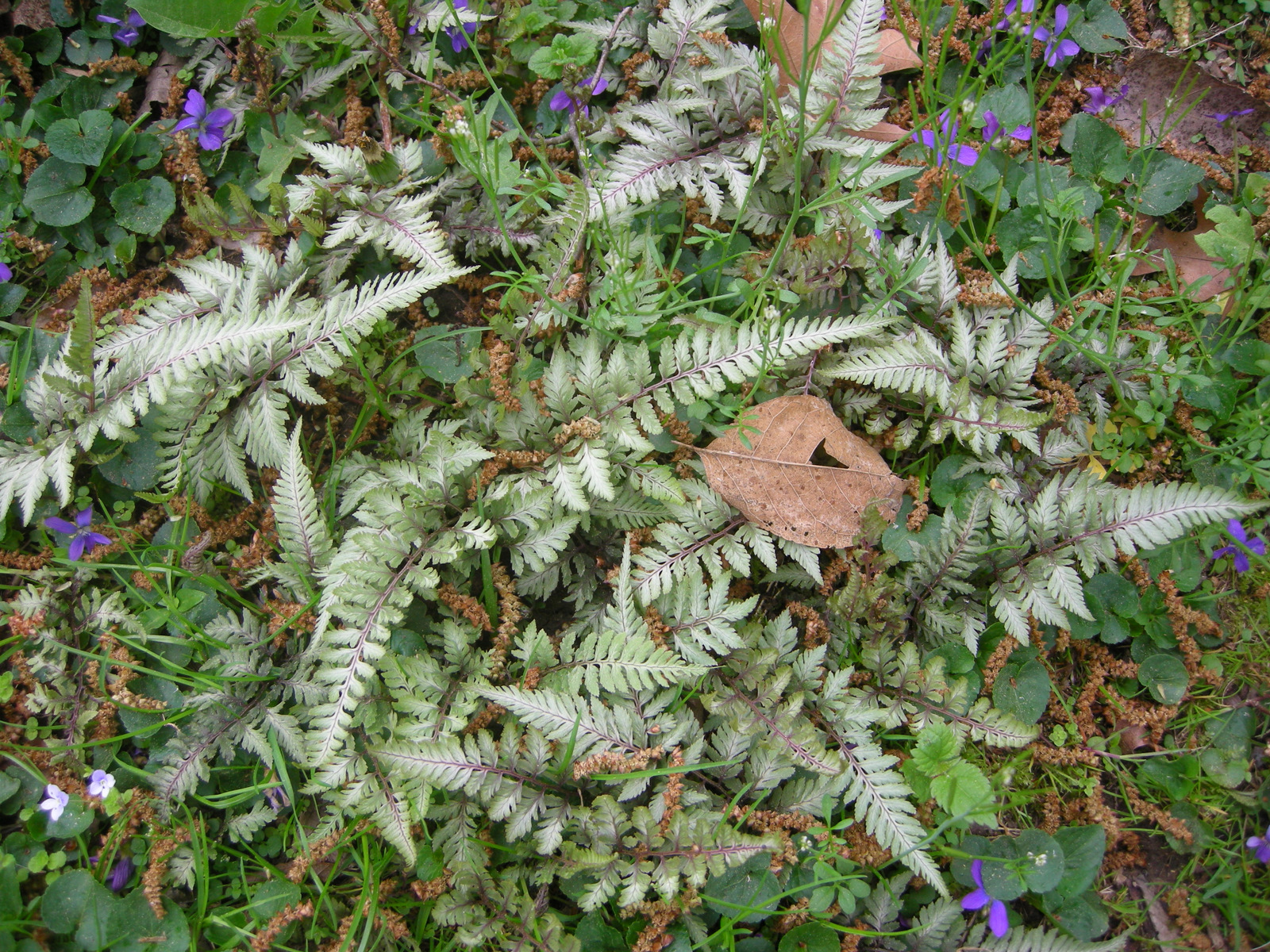

Japanese painted fern, Athyrium niponicum ‘Pictum’


Wild strawberries, Fragaria species


Common snowdrop, Galanthus nivalis


Native PA white violets, Viola striata


Winter aconite, Eranthis hyemalis


Ground ivy, Glechoma hederacea: I consider this a noxious weed when it appears in my beds, but it is very pretty in the lawn.


Dandelion, Taraxacum officinale


Most of the plants in my lawn are not native.  I consider half of them weeds if they appear in garden beds.  But in the lawn they are beautiful.  You probably don’t see them this way–most people don’t.  I have retrained my eye.  When I see an expanse of weed-free bright green grass, I don’t think what a beautiful law, I think toxic wasteland.

Here is what my lawn looks like in early spring:
This next photo is not for the faint-of-heart:

Creating more “wildflowers” in my lawn.


And here is what the same area looks like once it is mowed:
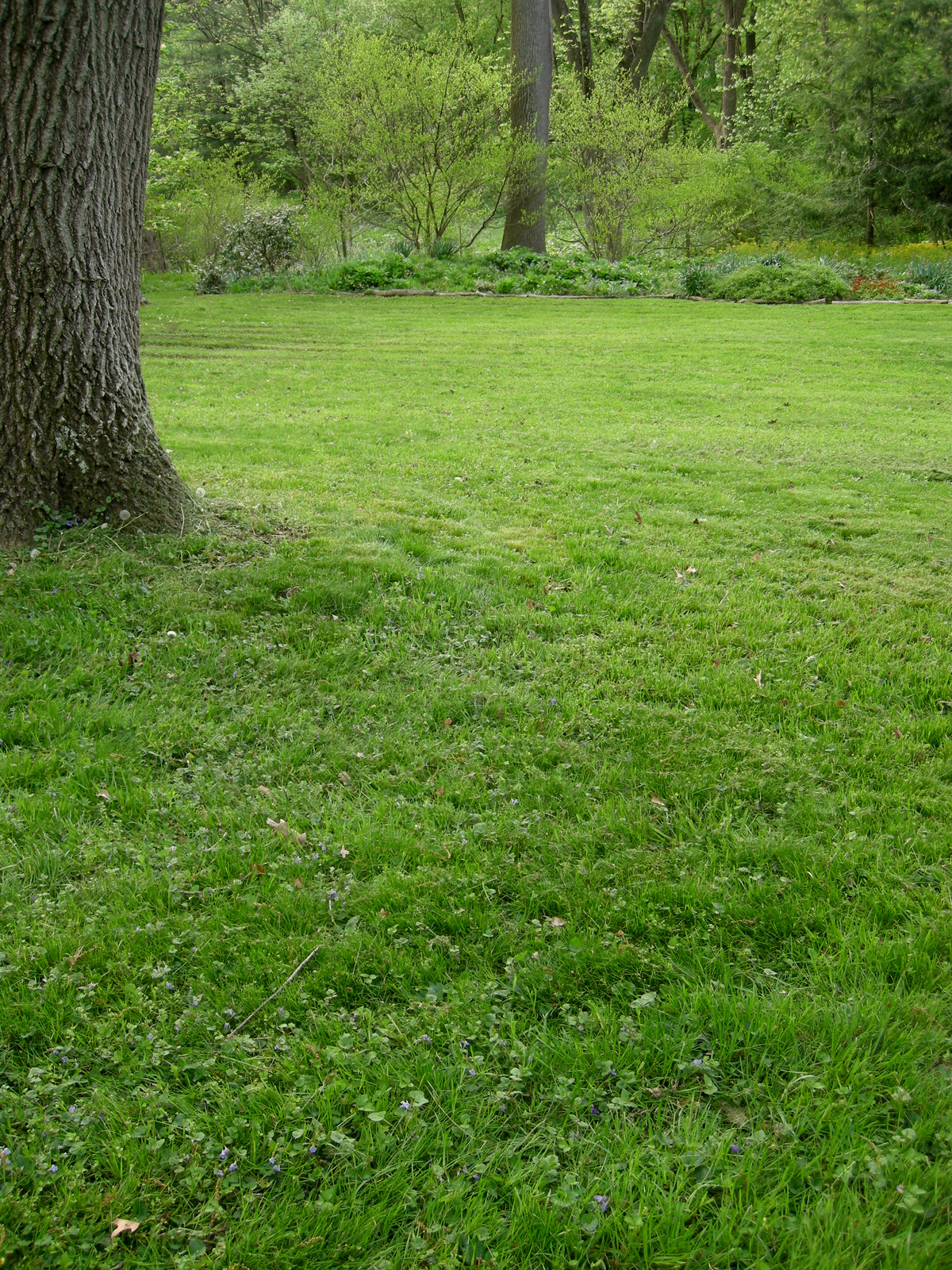
This is all the lawn I need.  Though it is a large area, I think I would do the same thing if my lawn was smaller.

Carolyn

Notes: Every word that appears in orange on my blog is a link that you can click for more information.  If you want to return to my blog’s homepage to access the sidebar information (catalogues, previous articles, etc.), just click here.

Nursery Happenings: Look for Carolyn’s Shade Gardens at the Bryn Mawr Farmer’s Market on Saturday, May 7, from 9 am to 1 pm .  My next open house sale, featuring hostas, ferns, and hardy gernaiums is Saturday, May 14, from 10 am to 3 pm.

Pleasurable Pairings for Spring

Posted in hosta, landscape design, Shade Gardening with tags , , on April 26, 2011 by Carolyn @ Carolyns Shade Gardens

Carolyn’s Shade Gardens is a retail nursery located in Bryn Mawr, PA, specializing in showy, colorful, and unusual plants for shade.  The only plants that we ship are snowdrops and miniature hostas.  For catalogues and announcements of events, please send your full name, location, and phone number (for back up use only) to carolyn@carolynsshadegardens.com.  Click here to get to the home page of our website for catalogues and information about our nursery and to subscribe to our blog.

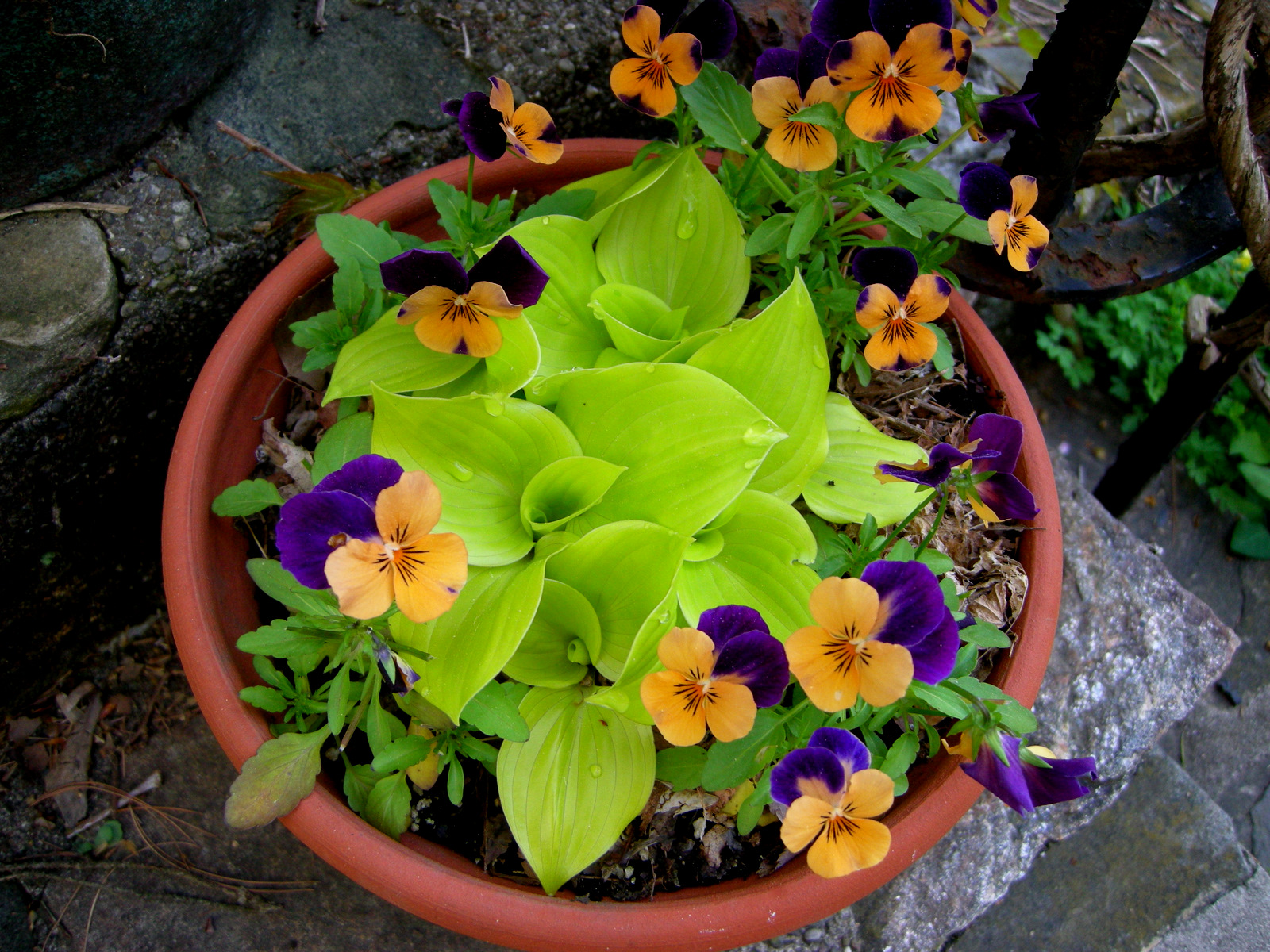
Annual violas and a hosta I selected called “Carolyn’s Malex II” in a glazed strawberry pot that belonged to my grandfather.  There is a different miniature hosta in each of the 16 pockets, and it stays out all winter with no problems for the pot or the hostas.  Don’t you love the little faces on the violas?

Over the years, through trial and error, I have discovered some fail safe pairings for the spring shade garden.  These plant couples look great together while thriving in the same cultural conditions.  Their flower and leaf colors and textures and their habits compliment each other to make pleasing combinations.  Plus they are all easy to grow, requiring no watering, staking, or general fussing after they are established in good organic soil in part to full shade.

Hostas that come up early in the spring, especially miniature hostas, play nicely with almost every plant and are extremely easy to grow:

This pairing is one of my favorite color combinations in the garden.  Hosta montana ‘Aureomarginata’ comes up much earlier than other large hostas.  Its bright green and yellow leaves serve as the perfect backdrop for the orange and yellow flowers of Epimedium x warleyense.


Almost all my miniature hostas come out in time to join the blooming epimediums.  Here is Epimedium grandiflorum ‘Tama No Gempei’ with Hosta ‘Little Wonder’, but you could choose any epimedium and any miniature hosta for a delightful contrast.


A great full shade combination: Hosta ‘Emerald Tiara’ and Japanese woodland primrose, Primula sieboldii (purple form), thrive under my coral bark maple.  Japanese woodland primrose is a mat-forming primrose for full, dry shade not to be confused with Japanese primrose, Primula japonica, which requires moist conditions.


Annual violas and Hosta ‘Crumb Cake’ in a container that stays out all winter.  Small containers are a great way to display choice miniature hostas.


Another plant whose early spring color goes with just about anything is Spiraea japonica ‘Magic Carpet’.  I think I would take this shrub to a dessert island if I had to choose because its deep peach leaves are so gorgeous (and it has fabulous fall color too):

Dwarf spiraea, Spiraea japonica ‘Magic Carpet, with Italian arum, Arum italicum, and PA (Pennsylvania) native coral bells, Heuchera villosa ‘Caramel’.  This is a year round combo because the arum and coral bells remain ornamental through the winter and the spiraea is a solid three-season plant.


‘Magic Carpet’ contrasts nicely with the color and texture of gold-leafed old-fashioned bleeding heart, Dicentra spectabilis ‘Goldheart’.  At first I didn’t like the idea of gold and pink together but with careful pairing ‘Goldheart’ is magnificent.


You can see some of the gold tones starting to emerge in the new leaves on this ‘Magic Carpet’, which is farther from the house.  It looks great with the dark red sedums in this strawberry jar, which also overwinters outside.


‘Magic Carpet’ even pairs well with spider webs.  Every spring I come out one morning to find all the spiraeas covered with webs.


Here are some more great combinations for early spring:

I think that PA native Celandine poppy, Stylophorum diphyllum, goes with everything in spring, but it looks especially beautiful with PA native Virginia bluebells, Mertensia virginica.


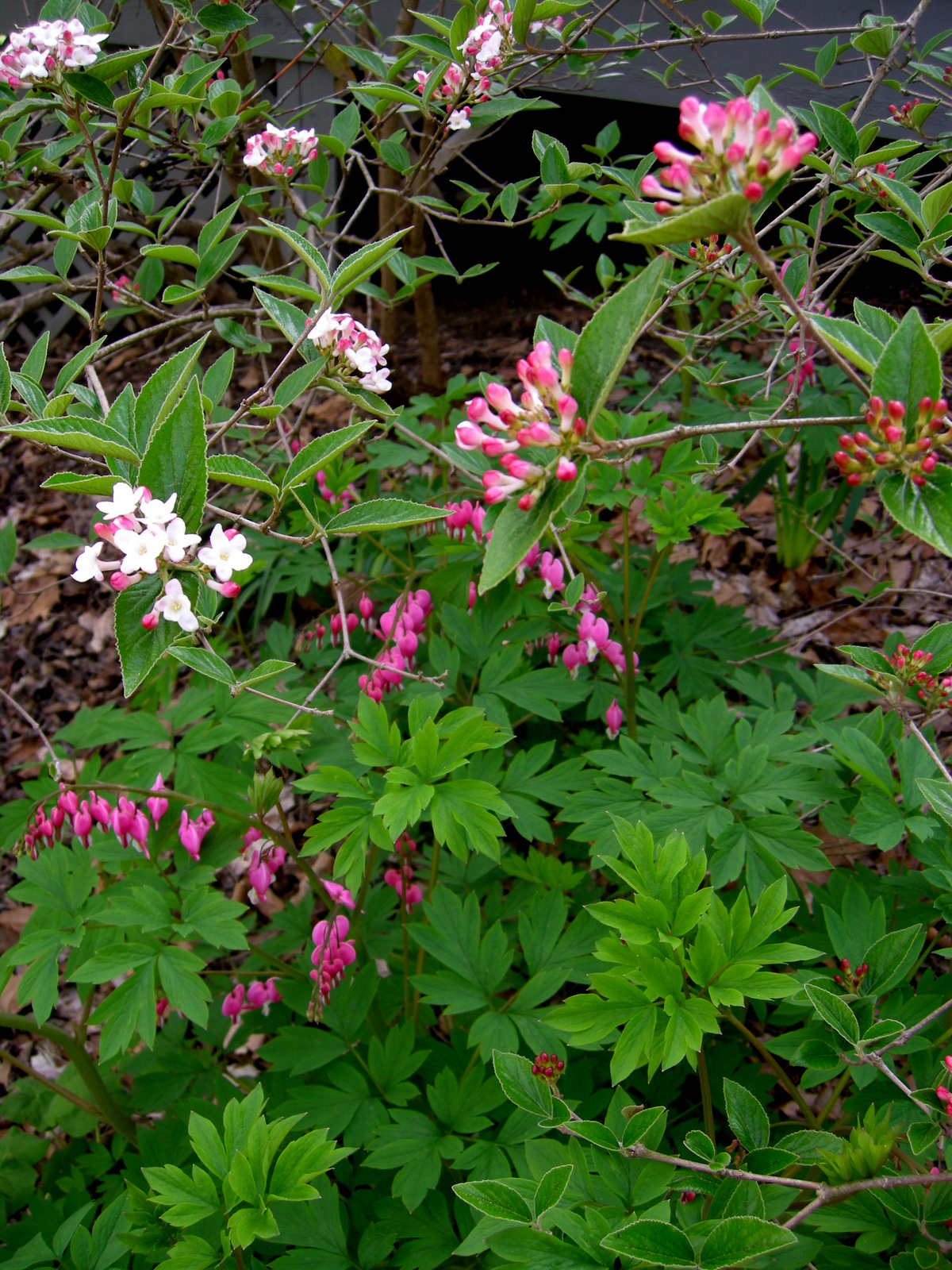
I am always captivated by the color combination of the buds of Burkwood viburnum, V. x burwoodii ‘Mohawk’, and the flowers of old-fashioned bleeding heart, Dicentra spectabilis.  ‘Mohawk’ has fantastic fragrance and spectacular orange-red fall color too.  It is a Pennsylvania Horticultural Society gold medal plant.


The airy bronze foliage and yellow flowers of fern-leafed corydalis, Corydalis cheilanthifolia, perfectly compliment the flower color of this 18th century heirloom primrose, Primula x polyantha ‘Old Brick Reds’.


Pulmonarias (lungwort) go with just about anything too:

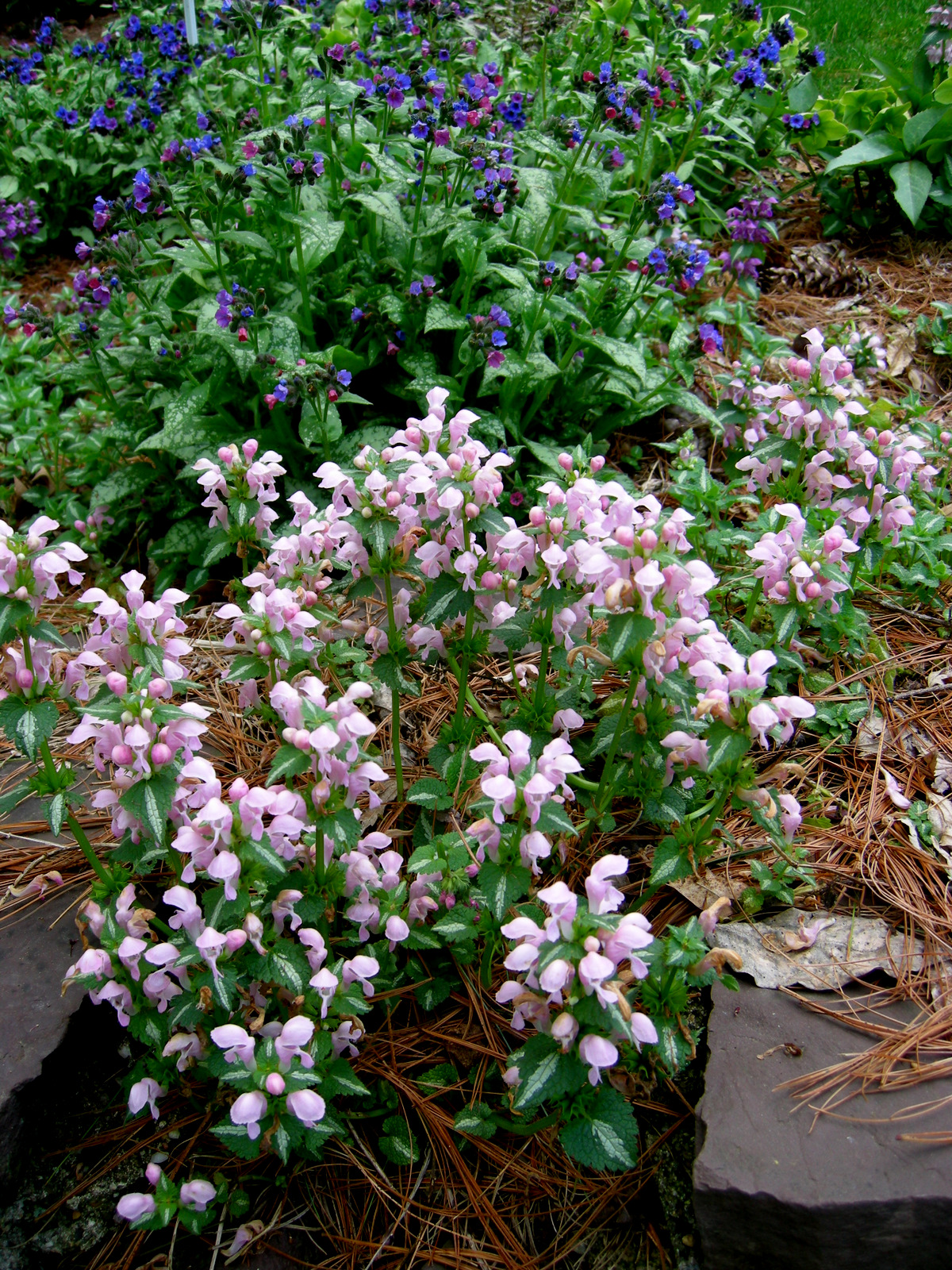
The early blue flowers and narrow silver leaves of Pulmonaria ‘Diana Clare’ with the abundant pink flowers and silver-striped leaves of Lamium maculatum ‘Shell Pink’, which blooms from April until November and has evergreen foliage.  Pulmonarias also keep their beautiful leaves well into the winter.


I have collected over 25 varieties of pulmonaria, but then I let them self sow all over my garden with glorious results.  Above is a pink seedling pulmonaria with very rare Helleborus dumetorum subsp. atrorubens, but any red flowered hybrid hellebore would complete the pair.


More seedling pulmonarias paired with a purple strain of Lamium maculatum ‘Shell Pink’.


PA native wild ginger, Asarum canadense, and PA native dwarf Jacob’s ladder, Polemonium reptans, carpet my woodlands in early spring.  Together they produce a subtle and peaceful beauty.


I never thought of cushion spurge, Euphorbia polychroma, as a shade plant but it actually thrives in quite a bit of shade: here with hybrid hellebore, H. x hybridus ‘Metallic Blue Lady’.  I also love the cushion spurge cultivar ‘Bonfire’ with red leaves.


I think this is one of the most beautiful combinations in my early spring garden, and it took me over 50 attempted photographs to capture it on film!  Siberian bugloss, Brunnera macrophylla,  cowslip primrose, Primula veris, and spring starflower, Ipheion uniflorum.


Same as above with Ajuga reptans ‘Metallica’.


I will finish my spring combinations with something for all you sunny gardeners: white stonecrop, Sedum album, with tulip ‘Little Princess’.


I hope I have given you some ideas for creative combinations to add to your spring garden.  Please leave a comment/reply with some favorite pairs from your own garden.

Carolyn

Notes: Every word that appears in orange on my blog is a link that you can click for more information.  If you want to return to my blog’s homepage to access the sidebar information (catalogues, previous articles, etc.), just click here.

Nursery Happenings: My second annual Great Hosta Blowout is going on right now.  For details, click here.  Look for Carolyn’s Shade Gardens at the Bryn Mawr Farmer’s Market on Saturday, May 7, from 9 am to 1 pm .  My next open house sale is Saturday, May 14, from 10 am to 3 pm.

Chanticleer Part 1: A Pleasure Garden

Posted in garden to visit, landscape design with tags on April 20, 2011 by Carolyn @ Carolyns Shade Gardens

Nursery News:  Carolyn’s Shade Gardens is a retail nursery located in Bryn Mawr, PA, specializing in showy, colorful, and unusual plants for shade.  The only plants that we ship are snowdrops within the US.  For catalogues and announcements of local events, please send your full name, mailing address, and cell number to carolyn@carolynsshadegardens.com and indicate whether you are interested in snowdrops, hellebores, and/or hostas.  Click here to get to the home page of our website for catalogues and information about our nursery and to subscribe to our blog.

Asian mayapple, Podophyllum ‘Spotty Dotty’

I recently visited the gardens at Chanticleer in Wayne, Pennsylvania, U.S., with garden bloggers from out of town.  In March, I went with Jill from Landscape Lover’s Blog, and on Sunday, I returned with Jean from Jean’s Garden and Jan from Thanks for Today.  Although I visit Chanticleer frequently, looking at the gardens through their eyes gave me a renewed appreciation for just how magical and amazing it is.

March color at Chanticleer, clockwise from upper left: paperbush, Edgeworthia chrysantha; Iris species; Sedum ‘Angelina’; spring-blooming hardy cyclamen, Cyclamen coum

Chanticleer calls itself “A Pleasure Garden” and that title perfectly reflects the unique feeling the garden conveys.  Although it is open to the public, it has an intimacy found only in a garden designed by individuals who are both artists and plantspeople.   Plants are used for their pleasing horticultural attributes, but also as objects in design for color and pattern.  Serious garden elements abound, but whimsy and the element of surprise are just as important.  I have been going to Chanticleer since it opened to the public in 1993, and I have never left without numerous ideas for my own gardens.

More March color at Chanticleer, clockwise from upper left: Iris species; Amur adonis, Adonis amurensis; twin-leaf squill, Scilla biflolia; Kuma bamboo grass, Sasa veitchii

Chanticleer was the country estate of pharmaceutical magnate Adolph Rosengarten and his wife Christine.  The Rosengartens built the original house in 1913 and hired landscape architect Thomas Sears to design the terraces surrounding it.  Additional homes were built for their children in the 1930s.  Adoph’s son left the 35 acre property to the public in 1990, and it opened to visitors in 1993.

March view from the Gravel Garden towards the Serpentine Garden showing the willows being trained and woven to resemble ancient olive trees.

The same view as above in April showing the beds that will be filled with a single annual plant to achieve the serpentine pattern visible from several vantage points in the garden.

Although Chanticleer has many amazing features, the primary attraction for me, and something I find unique to this garden, is the incredible attention to detail both in the big picture (see two photos above) and also in the smallest elements (see top photo).  Although you read this about gardens all the time, Chanticleer takes the concept to heights never approached by any public garden I have ever visited.  To give you a sense of the thoughtfulness displayed throughout the garden, I have decided to organize my photos starting with landscape shots and ending with individual plants, from macro to micro.  In doing this, I hope to convey a feeling for what Chanticleer has to offer.

The long views and big picture landscape design at Chanticleer are gorgeous:

The Gravel Garden contains plants that like hot, dry, Mediterranean conditions, and they are allowed to self-seed to give it a natural unkempt look to link it to the adjoining Ruin Garden.

At this time of year, you can see the “bones” of the Pond Garden, which will shortly be obscured by flowers.

Looking back up the hill from the pond area towards the Ruin and Gravel Gardens.

Back terrace of the Chanticleer house

View from the front terrace of the house to Minder Woods.

Individual gardens are equally as enchanting:

The entrance courtyard garden is filled with colorful annuals and bulbs.

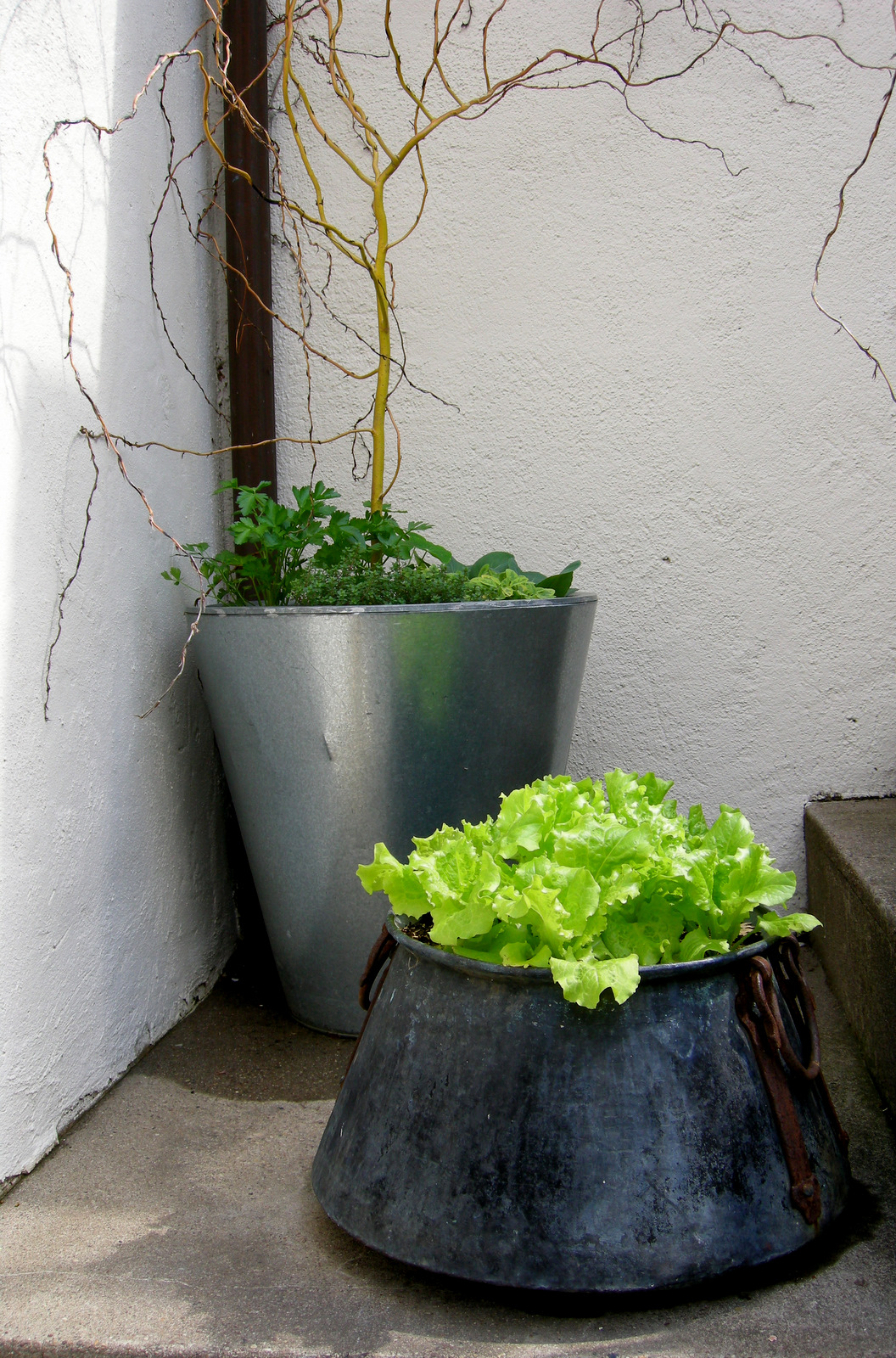
The Teacup Garden is always changing.  Right now it is planted with edible plants, including the different lettuces above used to make blocks of color.

The Gravel Garden extends out to the hill below the ruin and is filled with unusual bulbs.

Spring flowers in the Pond Garden

The gravel in the front courtyard of the Chanticleer house is raked daily to produce a circular pattern, this time of year overlayed with falling cherry blossoms.

The containers at Chanticleer are spectacular:

Entrance courtyard

Teacup Garden

Plantings in the railings leading to the Tennis Court Garden

Some containers display a single plant to perfection, Asian mayapple, Podophyllum ‘Spotty Dotty’.

The artistic elements are very unique, from hardscape to furniture to sculptures:

Marble heads immersed in water in the Ruin Garden

Minimalist containers in the Teacup Garden

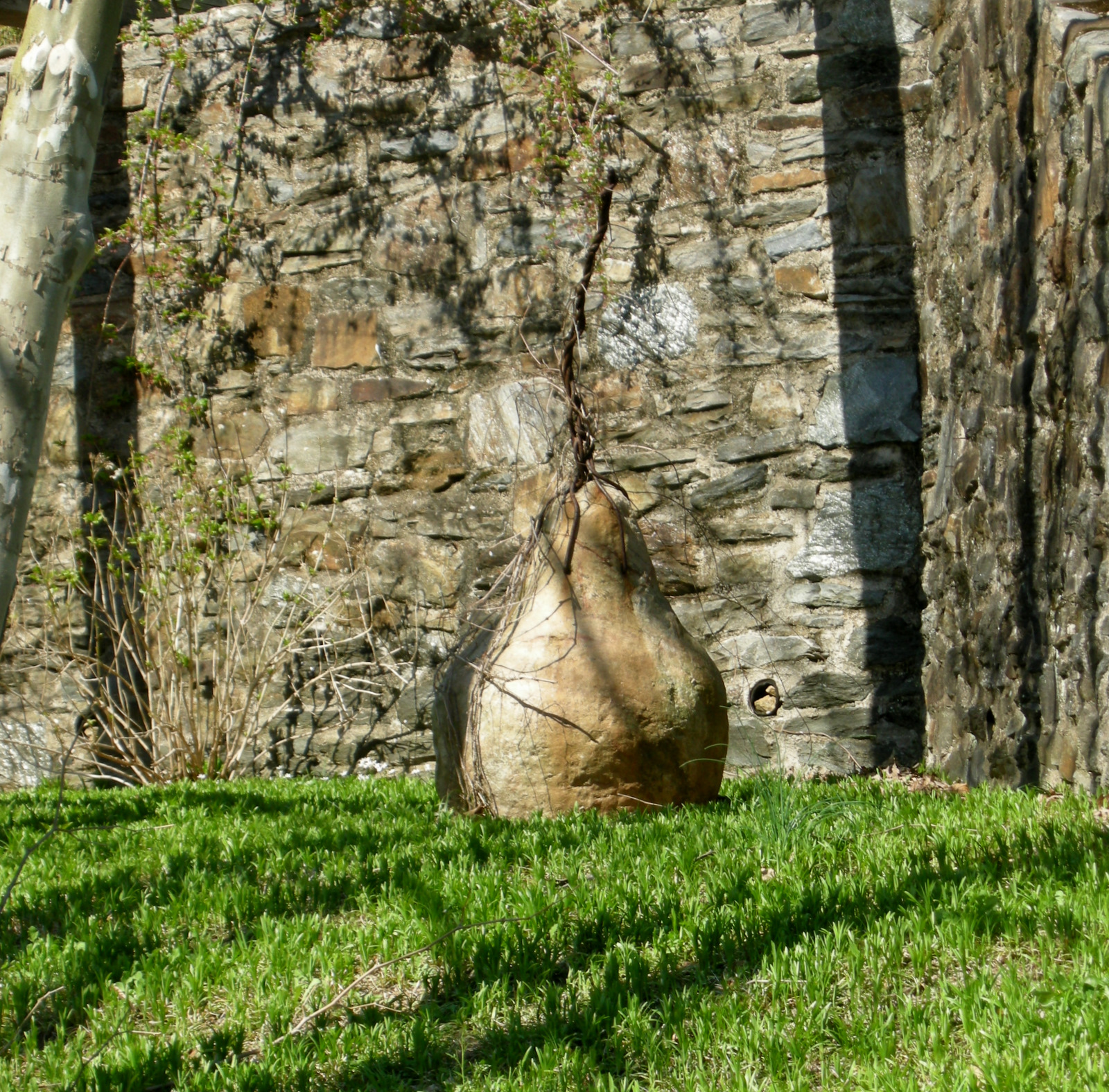
Stone pear in the Pond Garden

Each individual plant is grown and displayed to perfection:

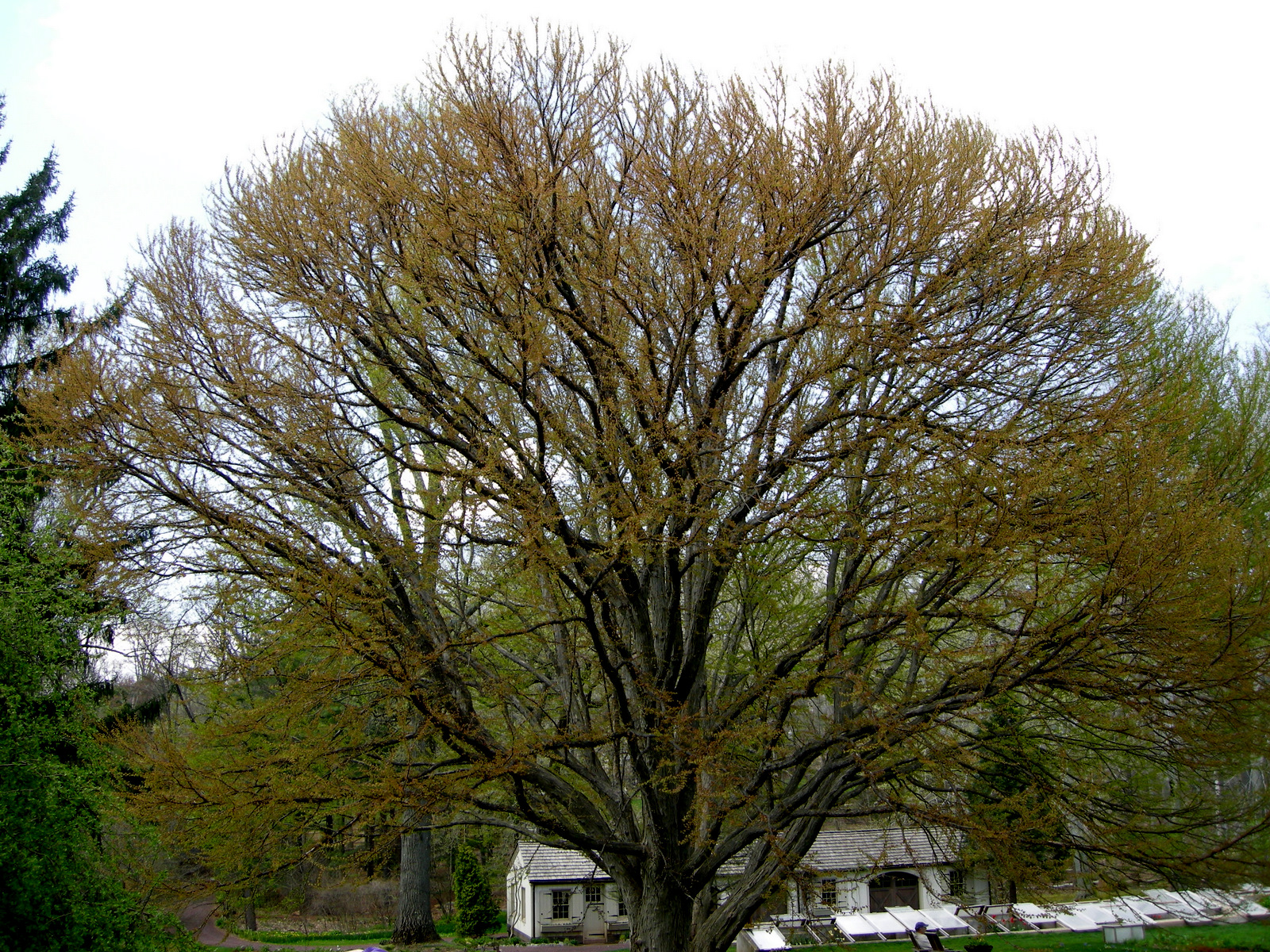
Katsura tree, Cercidiphyllum japonicum, in the Cut Flower Garden

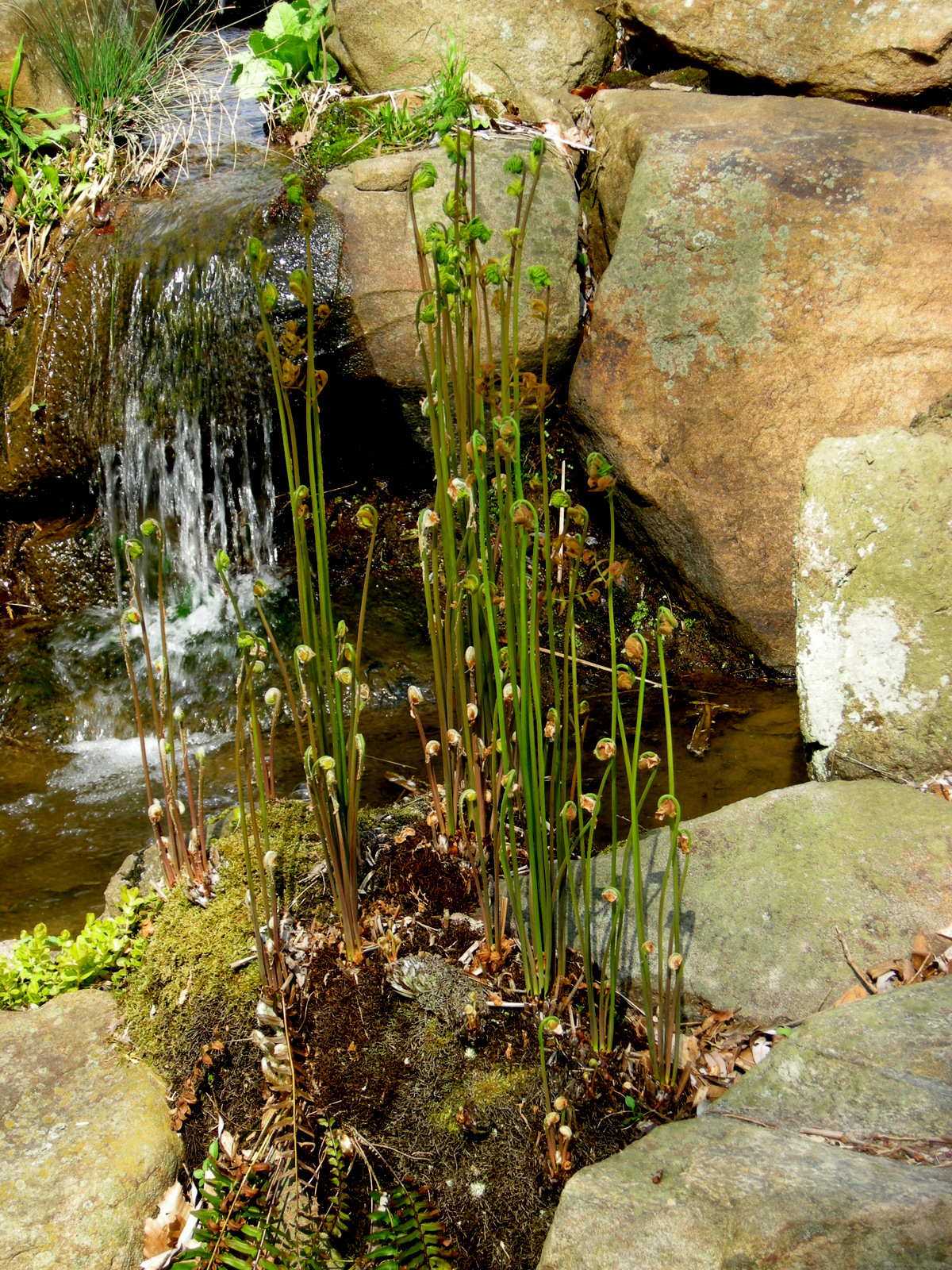
Royal fern, Osmunda regalis, in the Pond Garden

Chanticleer is one of the few gardens I visit where I find shade perennials that I can’t ID.  Jean and Jan stumped me with this one: Chloranthus japonicus (no common name) in the Asian Woods

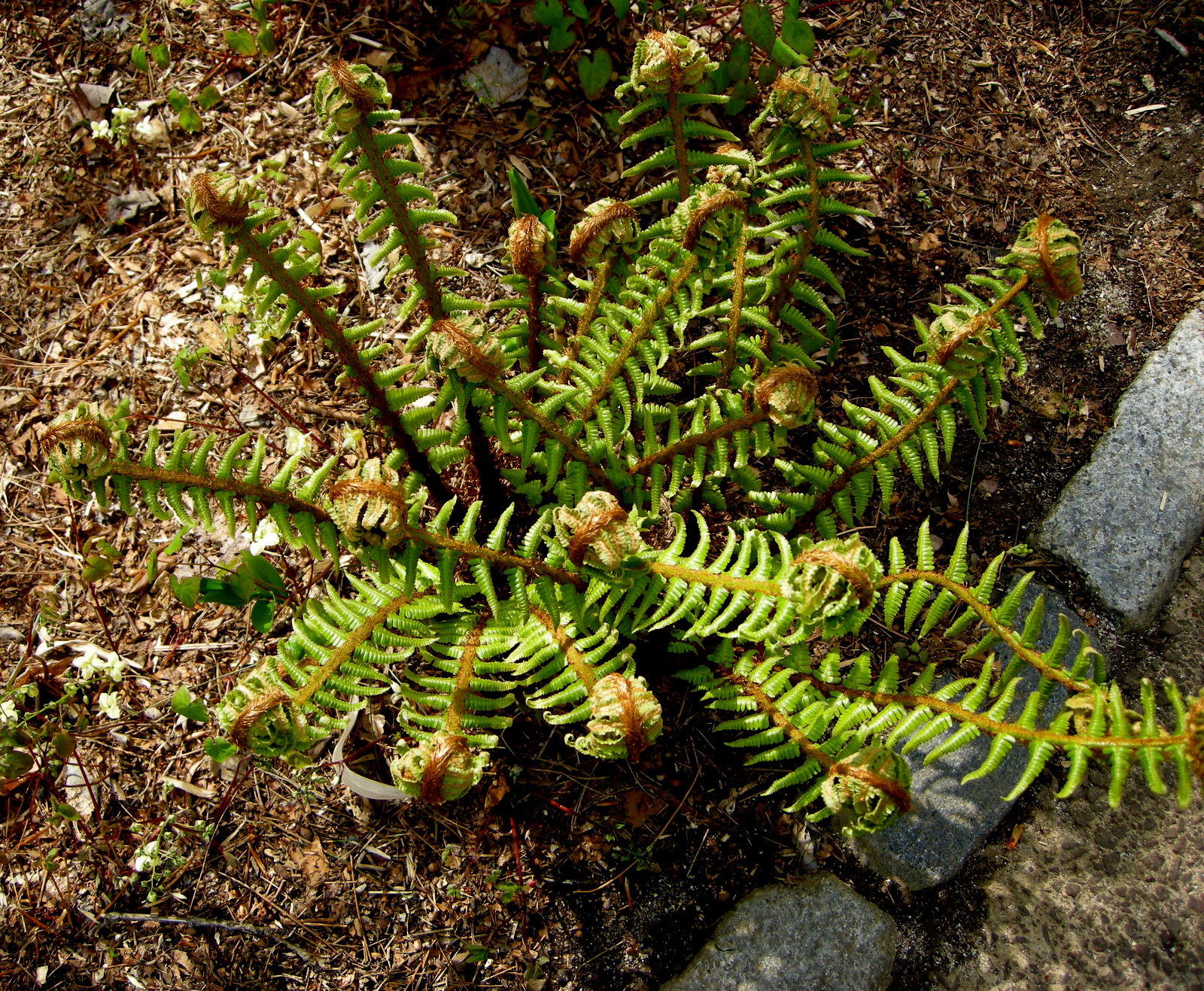
Another plant that stumped me: thick stemmed wood fern, Dryopteris crassirhizoma, in the Asian Woods.  Thanks to Lisa Roper, section gardener for the Asian Woods, for the ID.

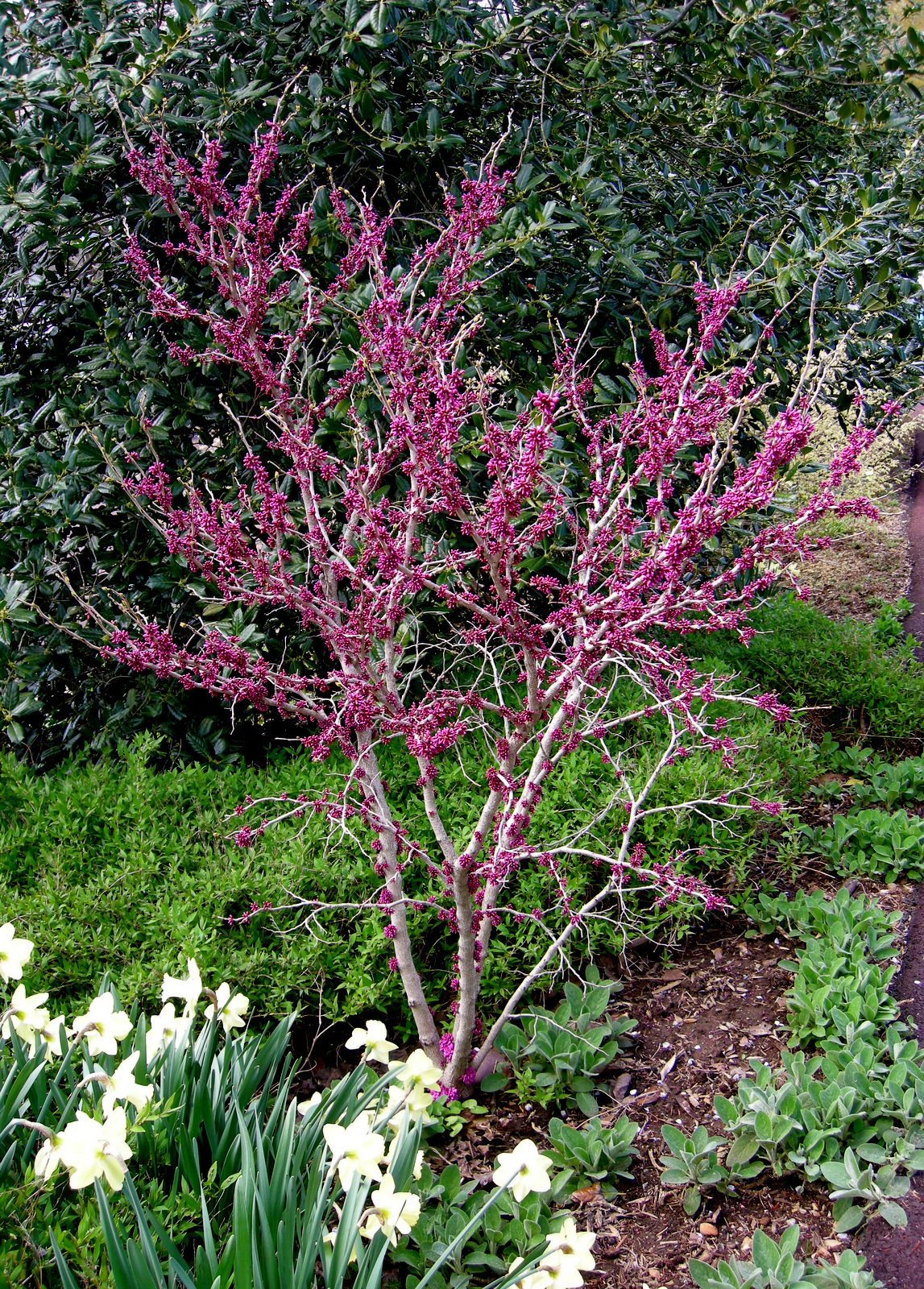
Chinese redbud, Cercis chinensis, along the walk from the parking lot

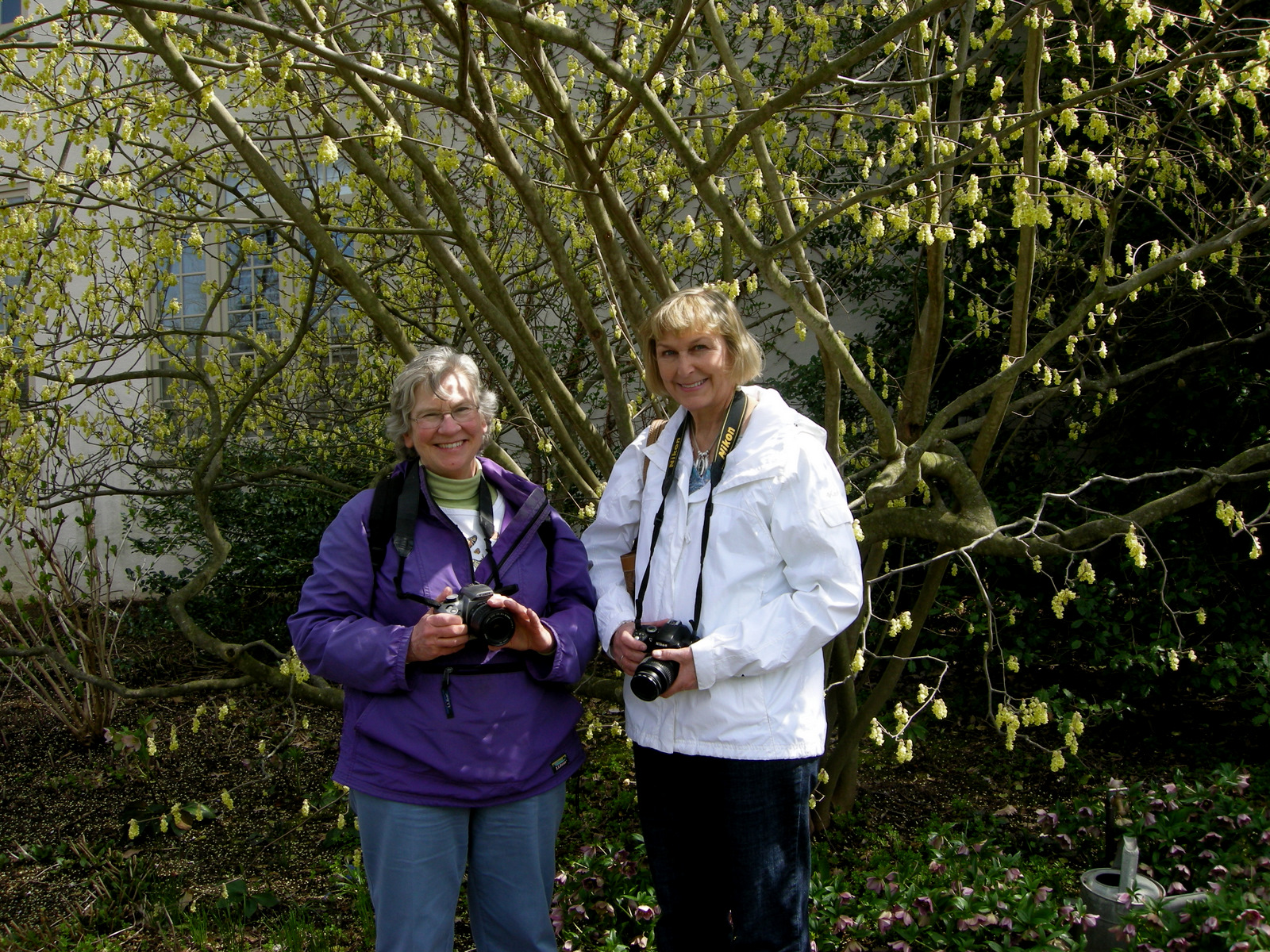
I have tried to give you a sense of how unique this garden is.  I hope to return to Chanticleer monthly and write articles every other month featuring its gardens as they progress through the seasons.  For now I leave you with a photo of my two new friends:

Jean (on the left) and Jan under a winterhazel, Corylopsis, with cameras in hand, of course.

Goodbye for now, Chanticleer, it was indeed a pleasure!

Carolyn

Notes: Every word that appears in orange on my blog is a link that you can click for more information.  If you want to return to my blog’s homepage to access the sidebar information (catalogues, previous articles, etc.), just click here.  I have added Chanticleer to my sidebar under Places to Visit so you will always know where to find it.


2011 Winter Interest Plants

Posted in bulbs for shade, garden to visit, landscape design, Shade Shrubs, snowdrops, winter interest with tags , , , , , , , , , , , , on March 20, 2011 by Carolyn @ Carolyns Shade Gardens

Carolyn’s Shade Gardens is a retail nursery located in Bryn Mawr, PA, specializing in showy, colorful, and unusual plants for shade.  The only plants that we ship are snowdrops and miniature hostas.  For catalogues and announcements of events, please send your full name, location, and phone number (for back up use only) to carolyn@carolynsshadegardens.com.  Click here to get to the home page of our website for catalogues and information about our nursery and to subscribe to our blog.

Japanese flowering apricot, Prunus mume

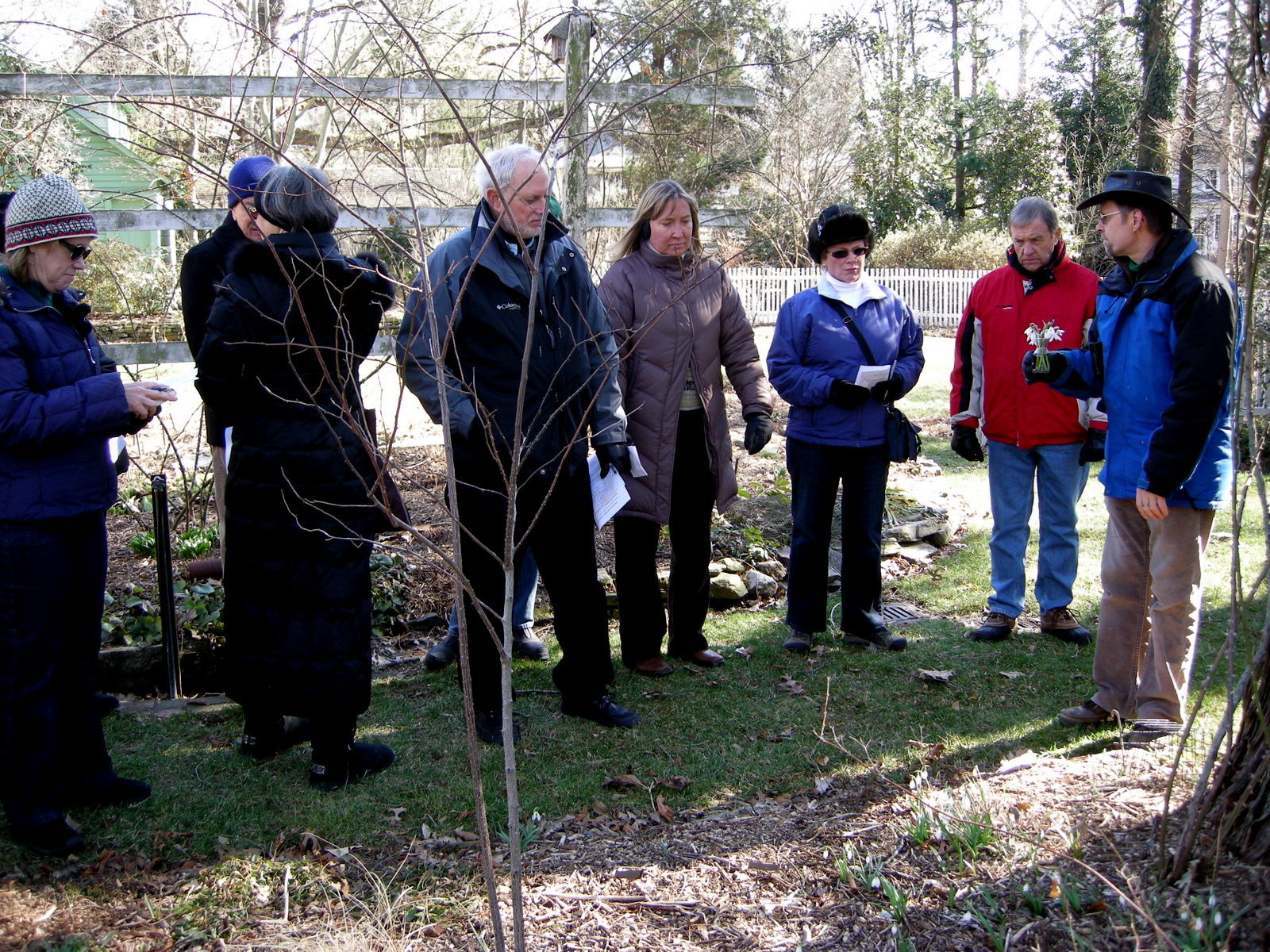
On March 3, 7, and 13, my customers and I attended seminars on Snowdrops and Other Winter Interest Plants given by Charles Cresson at his garden, Hedgleigh Spring in Swarthmore, Pennsylvania (US).  Charles is the instructor for the Longwood Gardens certificate course “Hardy Spring and Fall Bulbs” as well as the author of several gardening books.  He is also a frequent lecturer, most recently at the Planting Fields Arboretum on Long Island and Rare Find Nursery in New Jersey for presentations on “Choosing Hardy Camellias for Spring and Fall”.

Charles Cresson, kneeling to point out plicate leaves on a snowdrop, to seminar attendees.

Charles trained at the Royal Horticultural Society, Wisley, in England and the Kalmthout Arboretum in Belgium, best known for its witch hazel introductions.    He has worked at Meadowbrook Farm, Winterthur, Nemours, and Chanticleer.  His grandfather built the house at Hedgleigh Spring in 1911 and created the garden over the course of 50 years.  Charles has gardened there for  more than 40 years.

Every time we viewed a new snowdrop, no matter how rare, Charles picked two flowers and passed them around so that we could closely examine the markings and experience the fragrance.  He then collected the flowers in a little vase for later comparison.

What a treat Charles’s seminars were.  Even though I attended all three sessions, I learned something new each time and came away with a deep admiration for Charles’s encyclopedic knowledge of plants and the depth of his plant collection, not to mention a wish list of plants for my own gardens.  I also appreciated how each plant was not just deposited in the garden but was carefully incorporated into the overall design.

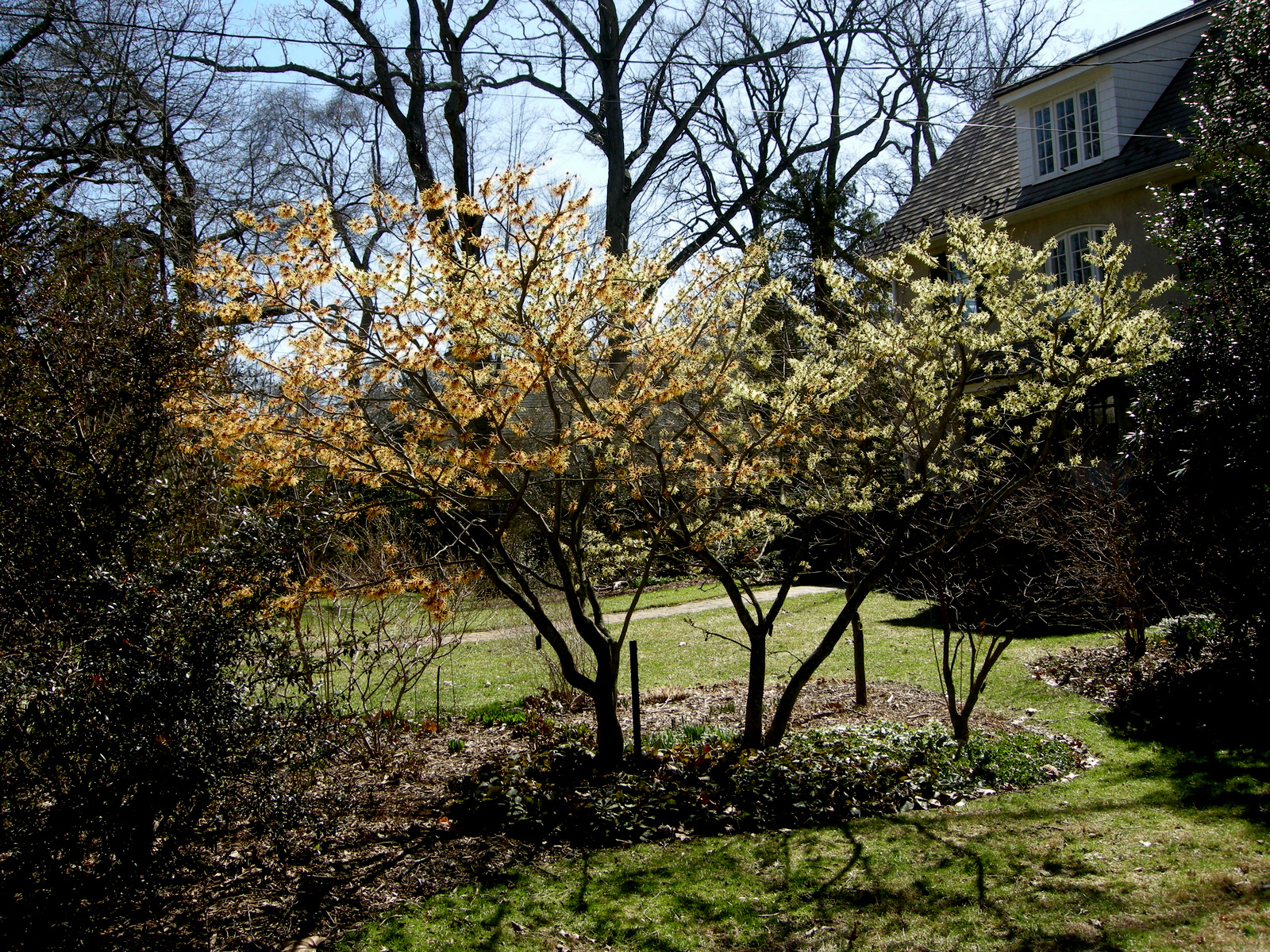
The seminars began in the front garden viewing the hybrid witch hazel cultivars Hamamelis x intermedia ‘Jelena’ (dark orange) and ‘Moonlight’ (pale yellow) underplanted with snowdrops, winter aconite, and various perennials. Charles does not recommend ‘Moonlight’ because it holds its dead leaves.

It would be hard to name another garden with the wealth of unusual plants that Charles has found and nurtured to perfection over the years.  That being said I thought my customers who were unable to attend the seminars and my worldwide blog readers might like to see what we saw.  I have organized the plants by category below with commentary in the caption where relevant.

We crossed a stone bridge to view the meadow where snow crocus and common and giant snowdrops were massed to be succeeded by daffodils, camassia, and then summer and fall blooming flowers.

A narrow path skirts the pond, which is surrounded on all sides by rock gardens full of unusual plants.

The Bulbs

We saw so many rare and unusual bulbs that I can only include a sampling here.

A rare pale yellow form of winter aconite, Eranthis hyemalis

The exquisite buds of the species crocus C. imperati ‘De Jager’

Masses of the rodent resistant and very early blooming snow crocus, Crocus tommasinianus ‘Whitewell Purple’, shadowed by a magnificent Japanese maple.

The very early blooming daffodil Narcissus ‘Rijnveld’s Early Sensation’

A very good form of winter blooming hardy cyclamen, Cyclamen coum

The reticulate iris I. histrioides ‘George’

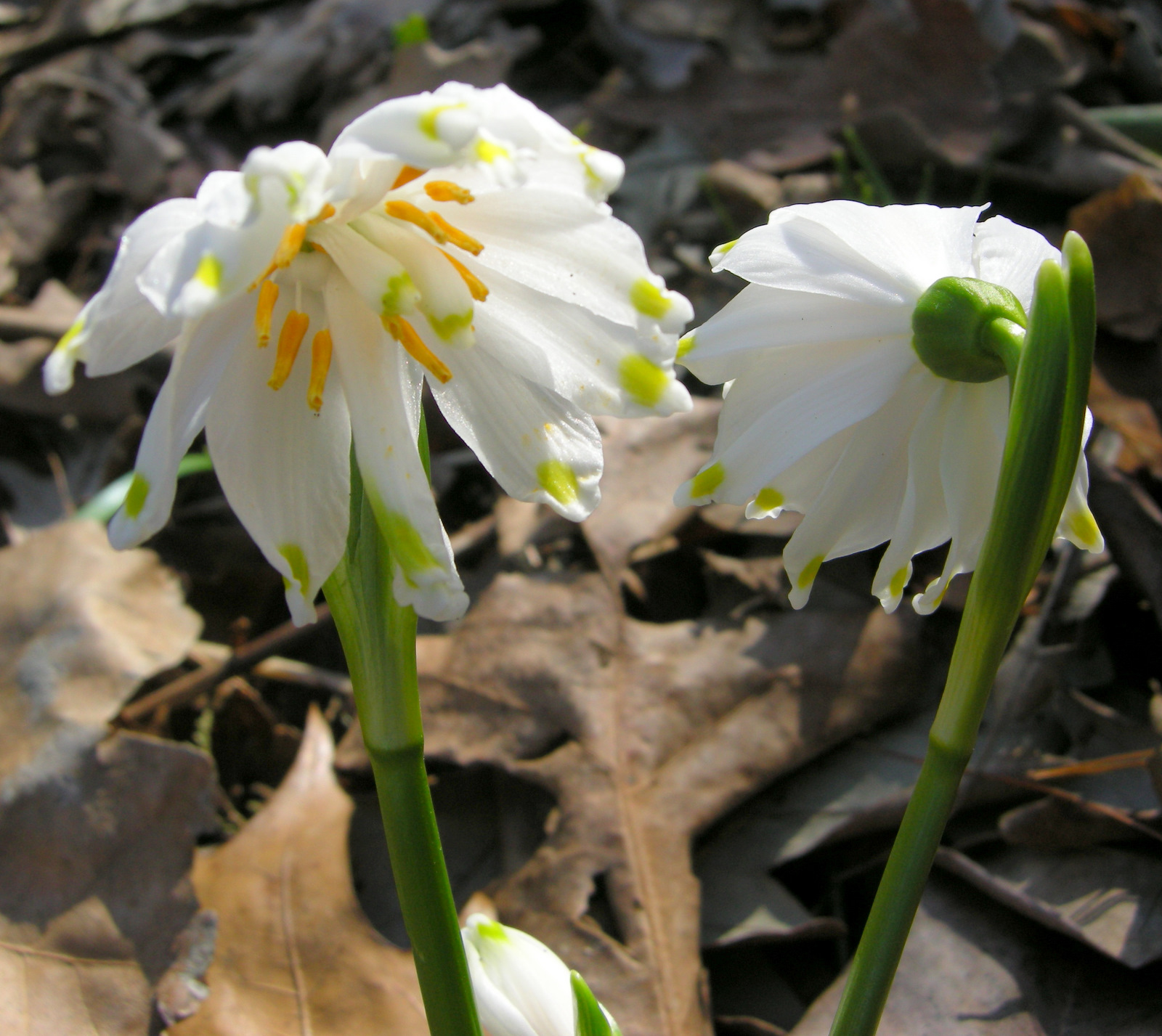
There were large patches of spring snowflake, Leucojum vernum, throughout the garden.

The flower of spring snowflake, Leucojum vernum

We were privileged to see this semi-double form of spring snowflake,  which Charles has named  Leucojum vernum ‘Gertrude Wister’ and registered with the Dutch bulb authority.

The Snowdrops

If you read my blog, you know what a galanthophile I am so with supreme effort I have limited myself to just a few of the many snowdrops we saw.

Clockwise from upper left: G. elwesii var. monostichus, G. ikariae, ‘Jaquenetta’, ‘Straffan’, G. plicatus subsp. byzantinus, ‘Dionysus’

Galanthus ‘Brenda Troyle’, confused in the trade but still quite lovely

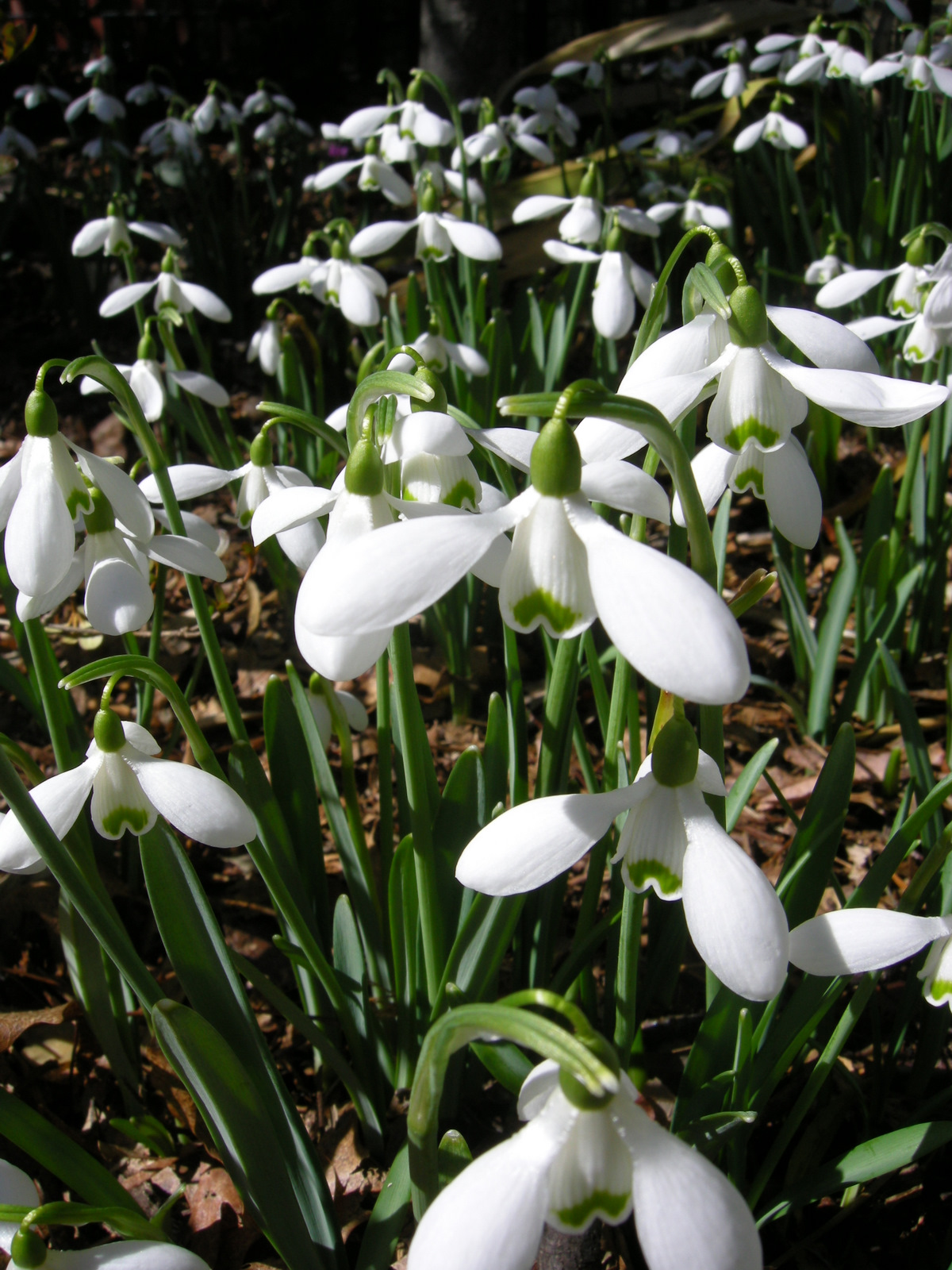
Galanthus plicatus subsp. byzantinus Cresson GardenThe elegant pleated leaves and plump flowers of Galanthus plicatus subsp. byzantinus

The beautiful shiny green leaves of Galanthus woronowii

There were drifts of Galanthus ‘S. Arnott’, called the ‘desert island snowdrop’ because it is the one cultivar many galanthophiles would choose if they were limited to one.

The Perennials

A very rare perennial for shade Amur adonis, A. amurensis ‘Fukuju Kai’

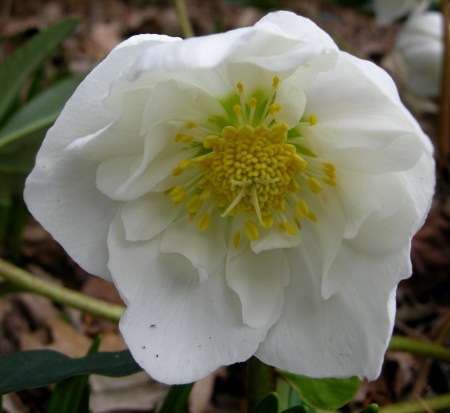
Helleborus niger double form Cresson gardenA semi-double form of Christmas rose, Helleborus niger, which I have only seen at Hedgleigh Spring

The Algerian iris, I. unguicularis, blooming in early March with a beautiful fragrance

The Shrubs

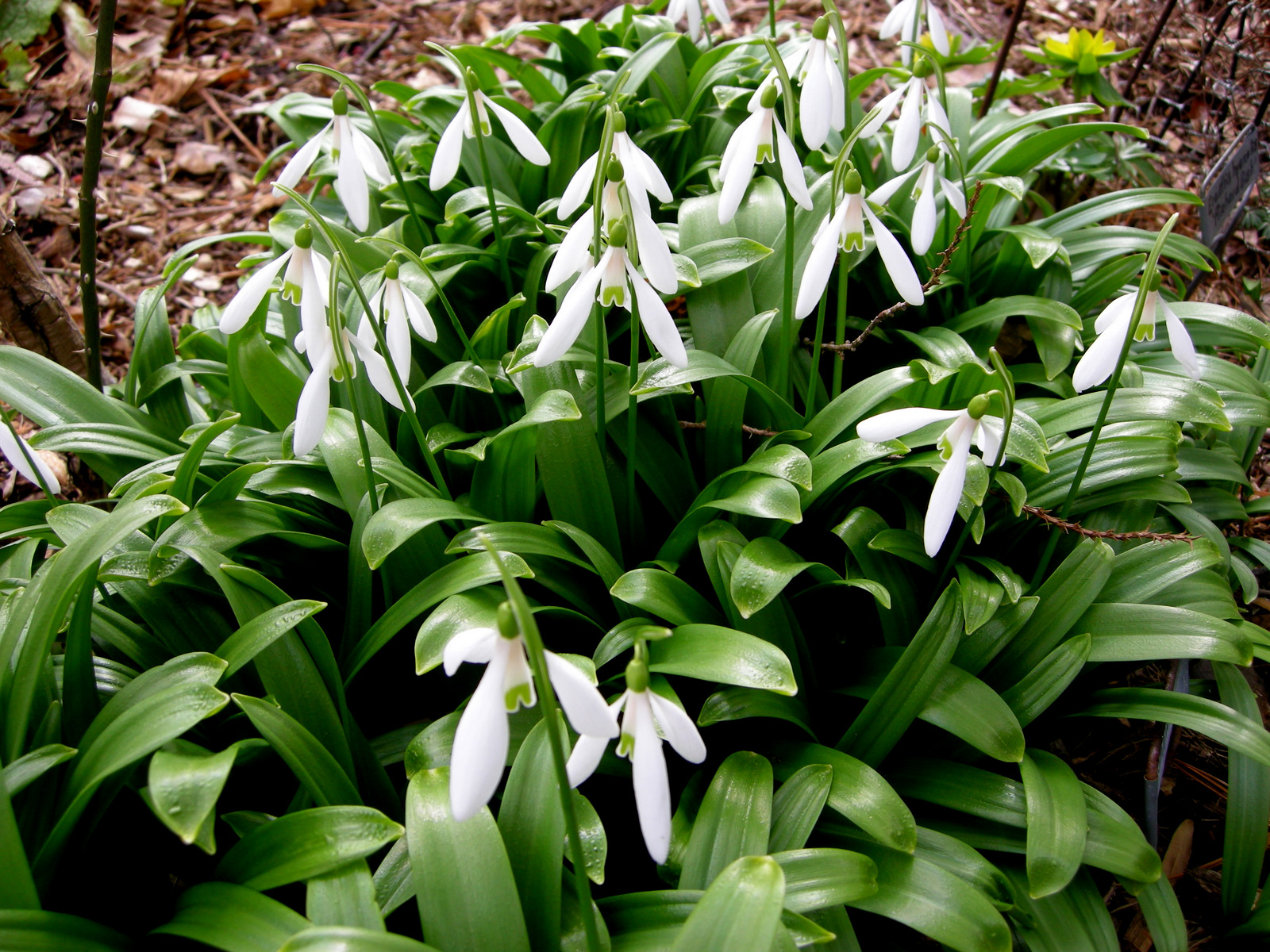
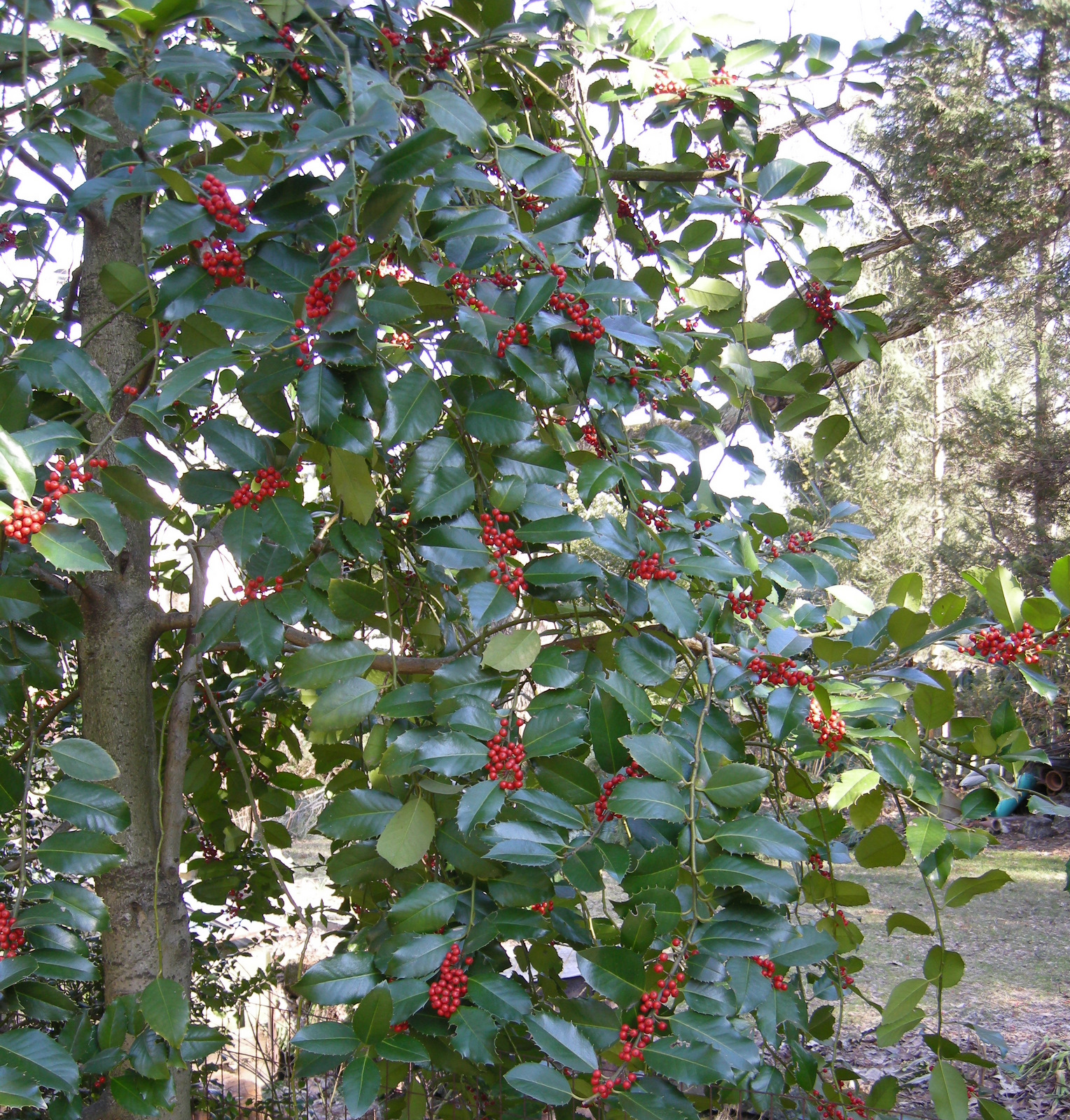
Koehne holly, Ilex x koehneana, looking as fresh and beautiful as it did in the fall

Camellia japonica ‘Spring’s Promise’ was one of several very early spring-blooming camellias that we saw.

Grape holly, Mahonia x media ‘Arthur Menzies’

A highlight for me were the buds on this paperbush, Edgeworthia chrysantha ‘Snow Cream’, which look like the tassels on Victorian cushions

Hybrid witch hazels, Hamamelis x intermedia ‘Jelena’ and ‘Moonlight’

I hope you have enjoyed your virtual seminar.  Please let me know in a comment/reply what your favorite winter interest plant is.

Carolyn

Notes: Every word that appears in orange on my blog is a link that you can click for more information.  If you want to return to my blog’s homepage to access the sidebar information (catalogues, previous articles, etc.), just click here.

Nursery Happenings: My first open house sale is Saturday, March 26, from 10 am to 3 pm, featuring hellebores and other winter and early spring blooming plants for shade (checks and cash only).  For directions and parking information, click here.

New Year’s Resolution to Edit the Garden

Posted in landscape design on December 26, 2010 by Carolyn @ Carolyns Shade Gardens

Carolyn’s Shade Gardens is a retail nursery located in Bryn Mawr, PA, specializing in showy, colorful, and unusual plants for shade.  The only plants that we ship are snowdrops and miniature hostas.  For catalogues and announcements of events, please send your full name, location, and phone number (for back up use only) to carolyn@carolynsshadegardens.com.  Click here to get to the home page of our website for catalogues and information about our nursery and to subscribe to our blog.

Winter at Carolyn’s Shade Gardens

Kartik, my friend and computer wizard extraordinaire, went to India last year with his wife and children to visit his family for three weeks.  When he returned, I was curious to know how he felt about the trip.  He told me he was happy to be home, meaning literally back in his home and also that the trip confirmed that the US is his home.  He then went on to explain how the trip had changed him in basic and important ways.

Although he does not view India through rose-colored glasses, Kartik marveled at the simplicity of life there and how that simplicity allows a truer appreciation of and sharper focus on “the important things”.  With few possessions, little access to travel, and monetary restrictions, his Indian acquaintances focus on their community, their friends, their family, and especially their children.  Food, conversation, time together is more important there without all the distractions of a consumer society.  Although on balance he would rather live in the US, he missed the simplicity of India.

Carolyn’s Shade Gardens Winter 1994

Not one to waste an important lesson, when Kartik returned home, he immediately began paring down his own possessions and lifestyle, ruthlessly eliminating what his family didn’t use or need.  He said it gave him a great feeling of power over our endlessly consumer driven society.  And, as he fixed my computer recently, he pointed out all the technological paraphernalia in my closet that I could do without: keyboards, mice, cables, adapters, manuals, disks, etc., that I was saving “in case I needed them”.  At the end there was an almost empty closet.

After Kartik left, I started to relate his experience in India to my own at my family’s small summer cottage in Maine.  With one big room downstairs and one partitioned room upstairs and no closets, our family is always together and there is no space for “stuff”.  When I return to my much larger, closet-endowed home in PA, I feel overwhelmed by the clutter and more isolated as everyone disperses to the many rooms of our house.

my signature dovecote (see header)

Taking a page from Kartik’s book, I attacked our “stuff’ with a vengeance dispersing mountains of un-needed clutter to the thrift shop, my children’s school, and the local 7-11 parking lot where every item disappeared within a few hours.  I too felt empowered by the process.  Life really is simpler and more enjoyable with less things.

Then I started to think about the garden and how similar principles apply.  I have the same reluctance to edit plants as I have to edit my belongings.  There’s always hope for that half dead shrub, for that ground cover that didn’t fill in, for that perennial that clearly needs more sun.  When the real answer is to move on.  So in 2010 I resolved to tear out all non-performing plants, and the result was a huge improvement.

my son Nicky stuck in a snowbank

A row of boxwoods riddled with phytophthora made way for some beautiful fall-blooming camellias.  Large patches of old hostas were removed to make room for new improved cultivars.  A tangle of privet and wisteria was replaced by a magnificent view of the neighbor’s rose bushes.  And, in many cases, struggling plants made room for more of what was already thriving at the site, adding to the overall impact of the garden.

For New Years, I highly recommend a resolution to edit your garden.  The results will produce satisfaction for all of 2011.

Happy New Year,

Carolyn

Note: Every word that appears in orange on my blog is a link that you can click for more information.  For non-performing trees, I use intimidation before removing them.  I threatened a 15-year-old yellowwood that if it didn’t bloom this year, I would cut it down.  Naturally it was covered with flowers this spring.  I know it doesn’t make sense, but it has worked numerous times for me.

My cats, Otto and Olivia, on Christmas

This collage shows “six closets de-cluttered to help me feel more free.”   December 31, 2010.

Keeping the Shade Garden Going in Late Fall

Posted in Fall, Fall Color, landscape design with tags , , , , , , , on December 1, 2010 by Carolyn @ Carolyns Shade Gardens

Carolyn’s Shade Gardens is a retail nursery located in Bryn Mawr, PA, specializing in showy, colorful, and unusual plants for shade.  The only plants that we ship are snowdrops and miniature hostas.  For catalogues and announcements of events, please send your full name, location, and phone number (for back up use only) to carolyn@carolynsshadegardens.com.  Click here to get to the home page of our website for catalogues and information about our nursery and to subscribe to our blog.

main terrace at Carolyn's Shade Gardens in late fall

Articles on landscape design advocate creating beds that flower through out the gardening season.  This is a lofty goal, and one that is not always worth achieving.  Beds that are designed to accomplish it often look spotty and unfocused because there is no theory behind the design besides bloom time, and the bed never truly peaks.  My woodland gardens, which contain mostly spring ephemerals and are done by June, provide immense satisfaction to me and are thoroughly enjoyed by my customers, even though their ornamental season is limited.  Most of my other gardens also have their season of splendor and then step aside to let other areas shine.

On the other hand, it is important to me that I have at least one prominent garden that is ornamentally interesting all year.  And I realize that most gardeners don’t have the space that I have to indulge in the luxury of letting a garden go by in June.  So, the question is, how do you keep a garden going in late fall before the winter-blooming plants get started?  What plants can you use to create the sense of a garden still growing: a feeling of plant combinations not individual plants?

I want to tell you about the area where I have done this most successfully: the shady end of the terrace outside my front door.  Through silver, purple, pink, and dark green groundcovers, leaves, and flowers, this terrace still has the feeling of a garden in its prime right now in early December.

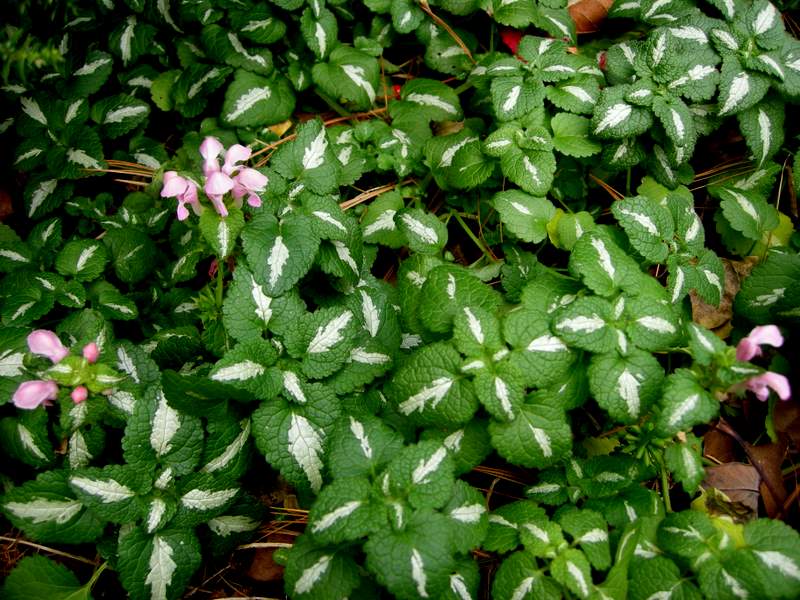
'Shell Pink' lamium at Carolyn's Shade Gardens‘Shell Pink’ Lamium in early December

I think the most important element of a late season border is a flowering evergreen groundcover.  In this bed, I use ‘Shell Pink’ lamium (photo above) because it blooms from April to December (at some times more prolifically than others) and remains evergreen all year.  I have also planted the fall-blooming hardy cyclamen, Cyclamen hederifolium (photo below).  Its pink flowers appear from September into November.  Although dormant for a short time in summer, once its leaves come back in late August, it maintains a fresh pristine appearance through the following June.  It spreads to form a very attractive groundcover and is not picky about the site like the spring-blooming cyclamen.

fall-blooming cyclamen at Carolyn's Shade GardensFall-blooming Hardy Cyclamen

'Diana Clare' pulmonaria at Carolyn's Shade Gardens‘Diana Clare’ Pulmonaria

Foliage is important this time of year.  I chose pulmonarias to fill a big space because their leaves remain ornamental almost until new leaves appear in February.  The solid silver foliage of  ‘Diana Clare’ (photo above) is one of my favorites in my pulmonaria collection.  Equally as important are the dark evergreen leaves of several hellebores: Christmas roses, hybrid hellebores, the H. x ericsmithii cultivars ‘Silvermoon’ and ‘Ivory Prince’ with their silver marbling, and the golden-veined leaves of H. x nigercors ‘Green Corsican’.  Finally, I treasure the almost year round interest of the new cultivars of our native coralbell, Heuchera villosa.  Here I used ‘Frosted Violet’ (photo below), which is deep burgundy-purple with lighter highlights.

'Frosted Violet' native coralbells at Carolyn's Shade GardensNative Coralbell ‘Frosted Violet’

Christmas Rose 'Jacob' at Carolyn's Shade GardensFall-blooming Christmas rose ‘Jacob’

For the final element of flowers, in addition to the pink blooms of the lamium, I added the fall-blooming Christmas roses, Helleborus niger ‘Jacob’ (photo above) and ‘Josef Lemper’.  ‘Jacob’, the shorter and more compact of the two, is sending up buds now.  ‘Josef’ will begin flowering in a few weeks.  Both cultivars continue to produce new blossoms into May.  I have also added lots of the fall-blooming snowdrop ‘Potter’s Prelude’ (photo below).  This exceedingly robust snowdrop will produce its lovely white flowers for the next month.

fall-blooming snowdrop 'Potter's Prelude' at Carolyn's Shade GardensFall-blooming Snowdrop ‘Potter’s Prelude’

Main terrace at Carolyn's Shade GardensTerrace in late November

So that’s it: groundcover, foliage, and flowers through mid-January when the winter-blooming perennials and bulbs take over.  Not the abundance of late spring, but certainly ornamental.

Carolyn

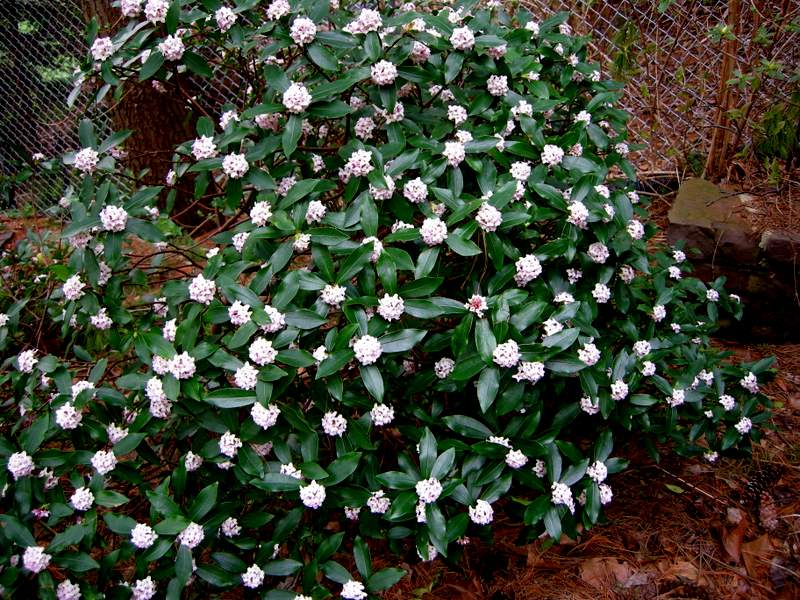
Notes:  All photos in this post were taken at Carolyn’s Shade Gardens in late November. Flowering evergreen shrubs are an important part of any late fall garden.  For all of you who have been to Carolyn’s Shade Gardens, you may wonder why I didn’t mention the semi-circle of large fragrant daphnes (Daphne odora) that lined this bed.  Unfortunately, they were killed last winter by falling white pine branches.  I hope to replace them.

fragrant daphne odora at Carolyn's Shade GardensFragrant Daphne, gone but not forgotten!