Archive for the Shade Gardening Category

Winterthur Part 1: Late Winter 2013

Posted in bulbs for shade, garden to visit, Shade Gardening, Shade Perennials, snowdrops, winter, winter interest with tags , , , , , , , , , , , , , , , on June 22, 2013 by Carolyn @ Carolyns Shade Gardens

Carolyn’s Shade Gardens is a retail nursery located in Bryn Mawr, PA, specializing in showy, colorful, and unusual plants for shade.  The only plants that we ship are snowdrops and miniature hostas.  For catalogues and announcements of events, please send your full name, location, and phone number (for back up use only) to carolyn@carolynsshadegardens.com.  Click here to get to the home page of our website for catalogues and information about our nursery and to subscribe to our blog.

Crocus tomasinianus In early March, the courtyard behind the house at Winterthur is completely filled with snow crocus, C. tomasinianus. It is worth visiting in late winter just to see this sight.

.

Each year I choose an outstanding Philadelphia (Pennsylvania, US) area garden to profile through out the seasons. There are so many amazing gardens in the Delaware Valley that I will never run out of choices. It is more a case of which wonderful garden to choose. In 2011 to 2012, I visited the enchanting pleasure gardens at Chanticleer. To see those posts, click here. In 2012 to 2013, I focused on the diverse and magnificent gardens and conservatories at Longwood. To see those posts, click here. For 2013 to 2014, I have chosen the elegant former estate of collector and horticulturalist Henry Francis du Pont located in Delaware just over the Pennsylvania line and called Winterthur.

.

WinterthurThe Winterthur house holds the premier collection of American decorative art. For scale, look at the two people on the right side of the photo just beyond the path.

Henry Francis du Pont (1880 to 1969) was a voracious collector of American decorative art for his home and of plants from all over the world for his garden. He had a lot of space to work with as the house has 175 rooms and the garden is 1,000 acres, 60 of which he landscaped with naturalistic plantings. About 60 years ago du Pont opened the house and gardens to the public, fulfilling his wish that:

the Museum will be a continuing source of inspiration and education for all time, and that the gardens and grounds will of themselves be a country place museum where visitors may enjoy as I have, not only the flowers, trees and shrubs, but also the sunlit meadows, shady wood paths, and the peace and great calm of a country place which has been loved and taken care of for three generations.

.

WinterthurThe paths leading from the visitor’s center to the house and gardens meander through the magnificent trees.

.

The “peace and great calm of a country place” is what draws me to Winterthur again and again for the garden is not a botanical collection or a display garden in the usual sense. But rather, as the website states, “an artistic composition that captures a significant period in the history of American horticulture.” It is carefully maintained and preserved to allow visitor’s to enjoy the landscaped gardens as Henry du Pont designed them as well as the peaceful vistas that he carefully incorporated into his designs. Yet it does so with none of the rigidity and dated feeling of many historic gardens. The experience is as fresh and enjoyable as if du Pont himself were giving you a tour of his own backyard, albeit a very large one!

.

DSCN9477Another view of the house in winter.

.

This post shows photos from my visit to Winterthur for their annual snowdrop event, this year on March 9 (for more information on that event, click here). I apologize for the delay, but I have been so busy with my nursery that I just found time to sort through these images. I also thought that pictures of snowdrops and other winter bulbs might really stand out right now when other blogs aren’t posting them anymore. Most of the plants shown are in the area of the March Bank at Winterthur, which contains the premier collection of naturalized snowdrops and other winter interest bulbs in the U.S.

.

Galanthus at Winterthurnaturalized snowdrops

.

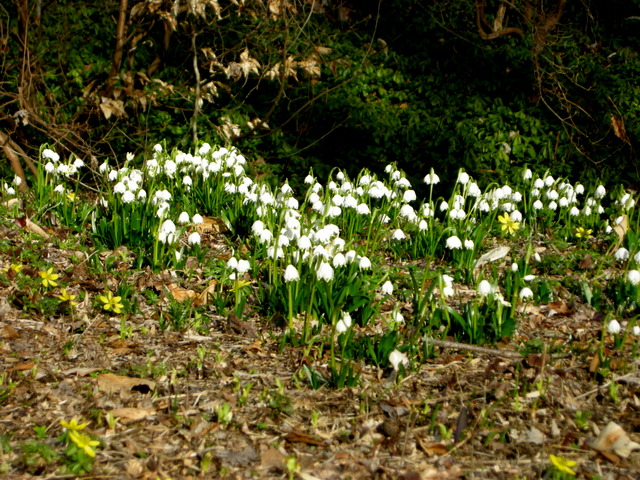
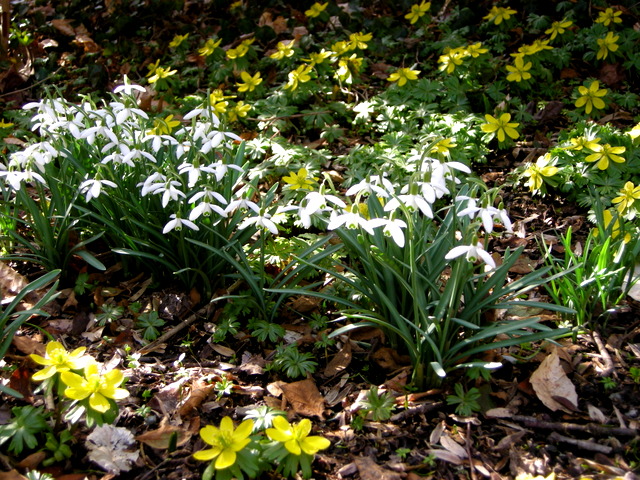
It is very difficult to give readers an idea of the massive amounts of snowdrops, aconite, crocus, glory-of-the-snow, snowflakes, adonis, and other winter bulbs at Winterthur. The plants are so small that once you back up to show a large area, they disappear into the leaf litter (at least using my camera, which is much better for macro shots). You will just have to take my word for it that in person the sweeps of bulbs are breath-taking and unparalleled.

.

Eranthis hyemalisWinter aconite with snowdrops in the background.

.

Winterthuraconites, snowdrops, and crocus

.

Adonis amurensisAmur adonis

.

Leucojum vernumspring snowdflake

.

Winterthuraconite, snowdrops, and snowflakes

.

Galanthus and Eranthissnowdrops and aconite

.

Winterthursnowflakes and aconite

.

WinterthurMarch Bank

.

Galanthus elwesiiMost of the naturalized snowdrops are the giant snowdrop, G. elwesii.

.

Galanthus elwesiiA particularly lovely clump of giant snowdrops with many more (plus a photographer) on the March Bank.

.

Galanthus nivalis 'Vidirapice'green-tipped snowdrops

.

Crocus tommasinianusSnow crocus growing in the grass courtyard behind the house.

.

Crocus tommasianusIt is much easier to photograph the snow crocus set off by the grass. However, all the bulbs in this post appear through out Winterthur in the same massive quantities and are just as awe-inspiring as the crocus portrayed here.

.

I hope you enjoyed Part 1 of my year of Winterthur posts, out-of-season though it may be. If you are local, mark your calendars for March 1, 2014, so you can see this wondrous display for yourself. In the meantime, it is finally summer and my nursery is closed. I will be posting on the blog but less frequently. On Thursday I am off to San Francisco for the 2013 Garden Blogger’s Fling. Enjoy your summer.

Carolyn

.

Carolyn’s Shade Gardens is a retail nursery located in Bryn Mawr, Pennsylvania, U.S., zone 6b. The only plants that we mail order are snowdrops and miniature hostas and only within the US.

If you are within visiting distance and would like to receive catalogues and information about customer events, please send your full name and phone number to carolynsshadegardens@verizon.net. Subscribing to my blog does not sign you up to receive this information.

Nursery Happenings: The nursery is closed and will reopen in the fall around September 15. Have a great summer.

Facebook: Carolyn’s Shade Gardens has a Facebook Page where I post single photos, garden tips, and other information that doesn’t fit into a blog post. You can look at my Facebook page here or click the Like button on my right sidebar here.

Notes: Every word that appears in orange on my blog is a link that you can click for more information. If you want to return to my blog’s homepage to access the sidebar information (catalogues, previous articles, etc.) or to subscribe to my blog, just click here.

Pleasurable Pairings for Early Summer Part 2

Posted in hosta, miniature hosta, my garden, native plants, Shade Gardening, Shade Perennials with tags , , , , , , , , , , , , , , , , , , , , , , , , , , , , , , on June 14, 2013 by Carolyn @ Carolyns Shade Gardens

Carolyn’s Shade Gardens is a retail nursery located in Bryn Mawr, PA, specializing in showy, colorful, and unusual plants for shade.  The only plants that we ship are snowdrops and miniature hostas.  For catalogues and announcements of events, please send your full name, location, and phone number (for back up use only) to carolyn@carolynsshadegardens.com.  Click here to get to the home page of our website for catalogues and information about our nursery and to subscribe to our blog.

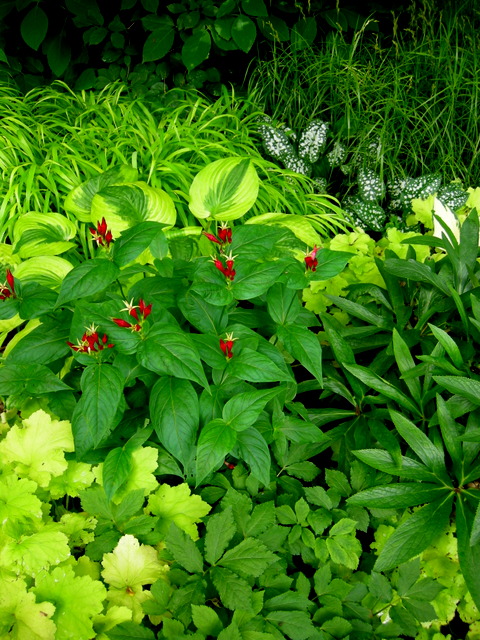
Spigelia marilandica Indian pink, Spigelia marilandica, is one of the highlights of my garden in June.  I would like to have a field of this wonderful, hummingbird-attracting native.

.

My post Pleasurable Pairings for Spring profiles plant combinations in my garden in April 2011.  To read it, click here.  I am continuing this theme with two posts on pleasing plant pairs for early summer.  My house is on a south-facing slope, and the first post showed the gardens on the west side of the house.  To read it, click here.  Combinations from the east side of the house are in this post.

.

Carolyn's Shade GardensThe view up the slope on the east side of the house.  All the grass has been removed and replaced by garden beds and pine needle paths.

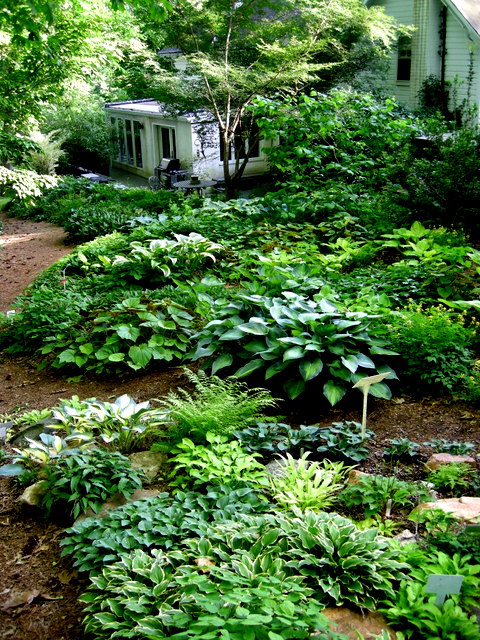
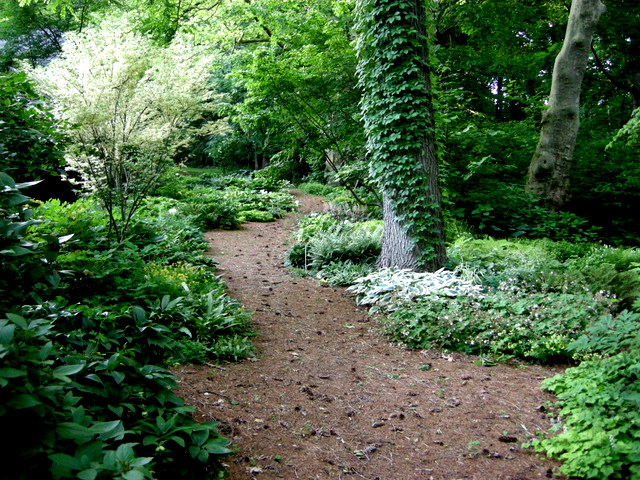
The gardens on the east side are fairly colorful when all the hellebores, snowdrops, primroses, pulmonarias, and other early perennials are blooming.  However, by late spring, they become a much more subtle tapestry composed mainly of the leaves of hostas, epimediums, hellebores, and ferns.  I love it, but it is more difficult to capture in photos than the colorful flowers on the west side.  I wish you could all see it in person, but here is my best shot.

.

Carolyn's Shade GardensThe view down the slope.

.

Carolyn's Shade GardensLooking into the woods through the upper entrance with ‘Jimmy Crack Corn’ hosta on the left.

.

Hosta El NinoIvory and blue ‘El Nino’ hosta really brightens up the shade, here with white bigleaf hardy geranium.

.

Brunnera 'Dawson's White', Heuchera 'Green Spice', Hosta TopazMore plants in my silver and blue garden, clockwise from upper left: hellebores, ‘Topaz’ hosta, native ‘Green Spice’ coralbells, and ‘Dawson’s White’ brunnera.

.

Hosta 'Krossa Regal'‘Krossa Regal’ hosta’s frosty blue leaves and vase-shaped habit set it apart from other hostas.

.

Hosta 'Sum and Substance', Podophyllum peltatum‘Sum and Substance’ hosta in the woodland with mayapples and golden groundsel.

.

Spigelia marilandica, Hosta Summer Lovin', Haknoechloa 'All Gold'This shows how I use the native Indian pink featured at the start of the post.  Clockwise from upper left: ‘All Gold’ Japanese hakone grass, ‘Little Blue’ pulmonaria, native sedge, hellebores, Hylomecon japonicum (no common name), ‘Citronelle’ coralbells, Indian pink, and ‘Summer Lovin’ hosta.

.

Hosta 'summer Lovin', Hakonechloa 'All Gold'‘Summer Lovin’ hosta and ‘All Gold’ Japanese hakone grass make a great pair.

.

Hosta 'Eye Declare', Heuchera 'Stained Glass'Hosta ‘Eye Declare’ and ‘Stainless Steel’ coralbells, one of the brighter combinations on the east side of the house at this time of year.

.

Aruncus aethusifolius, Hosta JuneFerny-leafed dwarf goatsbeard with ‘June’ hosta

.

Hosta 'Guacamole', Hosta 'Blue Angel'Customers often ask me which hostas go together, and my answer is they all do: ‘Guacamole’ and ‘Blue Angel’.

.

miniature hosta rock gardenLooking down the hill over my newest installation, a miniature hosta rock garden.  I needed a dedicated area to display my collection.

.

miniature hosta rock gardenA view of the miniature hosta rock garden from below.

.

lady fern, Hosta 'Teaspoon', Hosta 'Remember Me'Dwarf lady fern, ‘Teaspoon’ hosta, and ‘Remember Me’ hosta on the right.

.

DSCN0404‘Pixie Vamp’ hosta with Sedum lydium and ‘Rock Prince’ hosta.

.

Hosta 'Blonde Elf', lady fern, Hosta 'Blue Mouse Ears'‘Blonde Elf’ hosta, dwarf lady fern, and ‘Blue Mouse Ears’ hosta

.

I hope you enjoyed Part 2.

Carolyn

.

Carolyn’s Shade Gardens is a retail nursery located in Bryn Mawr, Pennsylvania, U.S., zone 6b.  The only plants that we mail order are snowdrops and miniature hostas and only within the US.

If you are within visiting distance and would like to receive catalogues and information about customer events, please send your full name and phone number to carolynsshadegardens@verizon.net.  Subscribing to my blog does not sign you up to receive this information.

Nursery Happenings:  The nursery closes for the summer on June 15 and will reopen in the fall around September 15.  Have a great summer.

Facebook:  Carolyn’s Shade Gardens has a Facebook Page where I post single photos, garden tips, and other information that doesn’t fit into a blog post.  You can look at my Facebook page here or click the Like button on my right sidebar here.

Notes: Every word that appears in orange on my blog is a link that you can click for more information.  If you want to return to my blog’s homepage to access the sidebar information (catalogues, previous articles, etc.) or to subscribe to my blog, just click here.
Pleasurable Pairings for Early Summer Part 1

Posted in hosta, my garden, Shade Gardening, Shade Perennials with tags , , , , , , , , , , , , , , , , , , , , , , , , on June 5, 2013 by Carolyn @ Carolyns Shade Gardens

Carolyn’s Shade Gardens is a retail nursery located in Bryn Mawr, PA, specializing in showy, colorful, and unusual plants for shade.  The only plants that we ship are snowdrops and miniature hostas.  For catalogues and announcements of events, please send your full name, location, and phone number (for back up use only) to carolyn@carolynsshadegardens.com.  Click here to get to the home page of our website for catalogues and information about our nursery and to subscribe to our blog.

Rosa 'Westerland', 'Delta Jazz' crape myrtleWesterland’ rose and Lagerstroemia ‘Delta Jazz’, a new crapemyrtle with beautiful burgundy leaves and pink flowers which I am trialing for the Southern Living Plant Collection.

.

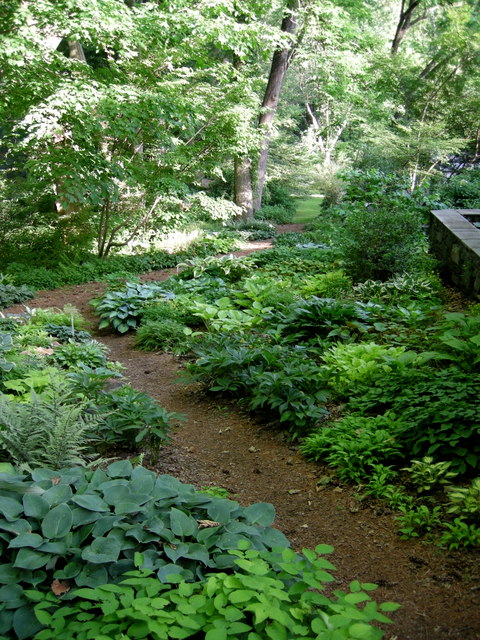
One of the most satisfying posts I have written is called Pleasurable Pairings for Spring and profiles plant combinations in my garden in April 2011.  To read it, click here.  It has taken me over two years to find the time to do a similar article for another season, but this post and the next will show pleasing plant pairs for early summer.  I have also included some long views of the gardens to give readers a sense of place.  My house is on a south-facing slope, and this post includes the gardens on the west side in the order in which you would encounter them.  The east side is in Part 2. 

.

view down the front stepsLooking down the front steps on the west side of the house across two of the three terraces to the dovecote at the bottom.

.

miniature hostas in strawberry jarAs you walk down the steps, you pass my many miniature hosta containers, including this strawberry jar with 16 different hostas—one for each pocket.  Miniature hostas are available mail order.  To see the catalogue, click here.

.

Hostas 'Shiro Kabitan', 'Dew Drop', 'Hi Ho Silver', 'Country Mouse'This is a new container that sits on the steps to the side door.  Clockwise from upper left: Hosta ‘Shiro Kabitan’, ‘Dew Drop’, ‘Hi Ho Silver’, and ‘Country Mouse’.

.

main perennial bedThe main perennial bed by the front door on the middle terrace.

.

view from the front doorLooking from the front door towards the dovecote: ‘Minnie Pearl’ phlox, ‘Goldheart’ bleeding-heart, and ‘Caradonna’ salvia.

.

view from the front doorA longer view of the main perennial bed.

.

DSCN0415The other end of the main perennial bed: yellow corydalis, allium, ‘Magic Carpet’ spiraea, and ‘Caramel’ coralbells.

.

Geranium 'Katherine Adele', Corydalis lutea, Campanula 'Blue Waterfall'The right side of the steps to the lower terrace: ‘Katherine Adele’ hardy geranium, yellow corydalis, and ‘Blue Waterfall’ campanula.

.

entrance to orange and purple gardenThe left side of the steps to the lower terrace.

.

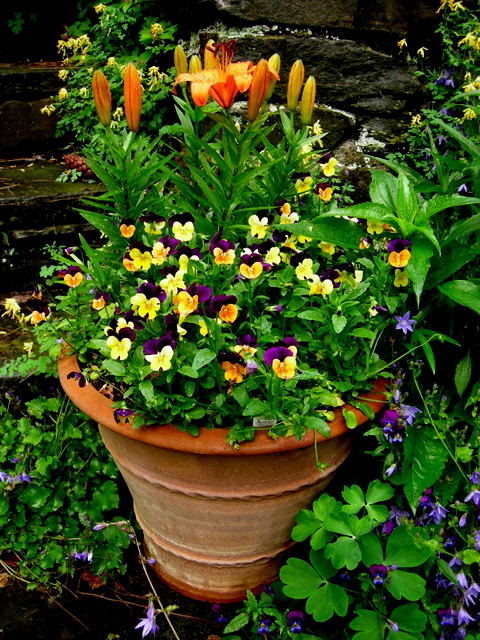
container in orange and purple gardenA close up of the container on the left side of the steps with dwarf orange lilies and violas, which have been in full bloom with no dead-heading since mid-March.

.

Digitalis 'Goldcrest'Yellow corydalis in the wall with ‘Goldcrest’ foxglove surrounded by ‘Blue Waterfall’ campanula and sedums in bloom.

.

Hosta 'Whirlwind', fernJust below the lower terrace: ‘Whirlwind’ hosta and a self-sown fern.

.

hornbeam gardenIn a very dry and shady garden below the dovecote, clockwise from upper left: Japanese painted fern, ‘Sparkler’ native jack-in-the-pulpit, pulmonaria, and black sedge.

.

Leucosceptrum japonicum, Pulmonaria 'Leopard', Carex 'Oehme'In another very dark area, Japanese shrub mint in back, ‘Leopard’ pulmonaria (one of my favorites for its giant spots), and native sedge.

.

Ligularia 'Othello', Hosta 'Paradigm'Along the fence line on the west side of the property, ‘Othello’ ligularia and ‘Paradigm’ hosta.

.

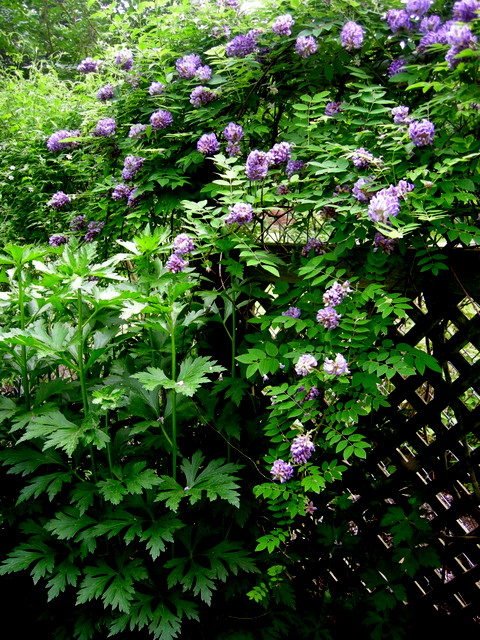
Wisteria frutescens 'Amethyst Falls', Aconitum speciesAlso along the fence, ‘Ametyst Falls’ American wisteria, which I think is just as beautiful as the Asian varieties, and monkshood.

.

Primula japonica, astilbes, fernsAt the very bottom of the property in the only moist garden we have, Japanese primroses, which self-sow with abandon, are succeeded by astilbes and ferns.

.

Magnolia asheiFor Larry with best wishes for good health, the first flower on my native Magnolia ashei, a close relative of native bigleaf magnolia.

I hope you enjoyed the tour.  Stay tuned for Part 2, the shadier east side of the house.

Carolyn

.

Carolyn’s Shade Gardens is a retail nursery located in Bryn Mawr, Pennsylvania, U.S., zone 6b.  The only plants that we mail order are snowdrops and miniature hostas and only within the US.

If you are within visiting distance and would like to receive catalogues and information about customer events, please send your full name and phone number to carolynsshadegardens@verizon.net.  Subscribing to my blog does not sign you up to receive this information.

Nursery Happenings:  We are having the final spring open hours at the nursery on Friday, June 7, from 10 am to 4 pm,  Saturday, June 8, from 9 am to 2 pm, and Sunday, June 9, from 1 to 3 pm.  Customers will get an email with the details shortly.  Appointments are available through June 15 when we close for the summer, reopening in the fall around September 15.  The 2013 Miniature Hosta Mail Order Catalogue, containing over 35 choice selections of miniatures for shipping all over the US, is on the right sidebar here, and we are still shipping.  If you are local, you can use the catalogue to see what miniatures are still available at the nursery.

Facebook:  Carolyn’s Shade Gardens has a Facebook Page where I post single photos, garden tips, and other information that doesn’t fit into a blog post.  You can look at my Facebook page here or click the Like button on my right sidebar here.

Notes: Every word that appears in orange on my blog is a link that you can click for more information.  If you want to return to my blog’s homepage to access the sidebar information (catalogues, previous articles, etc.) or to subscribe to my blog, just click here.
2013 Larger Hostas

Posted in hosta, Shade Gardening, Shade Perennials with tags , , , , , , , , , , , , , , on May 27, 2013 by Carolyn @ Carolyns Shade Gardens

Carolyn’s Shade Gardens is a retail nursery located in Bryn Mawr, PA, specializing in showy, colorful, and unusual plants for shade.  The only plants that we ship are snowdrops and miniature hostas.  For catalogues and announcements of events, please send your full name, location, and phone number (for back up use only) to carolyn@carolynsshadegardens.com.  Click here to get to the home page of our website for catalogues and information about our nursery and to subscribe to our blog.

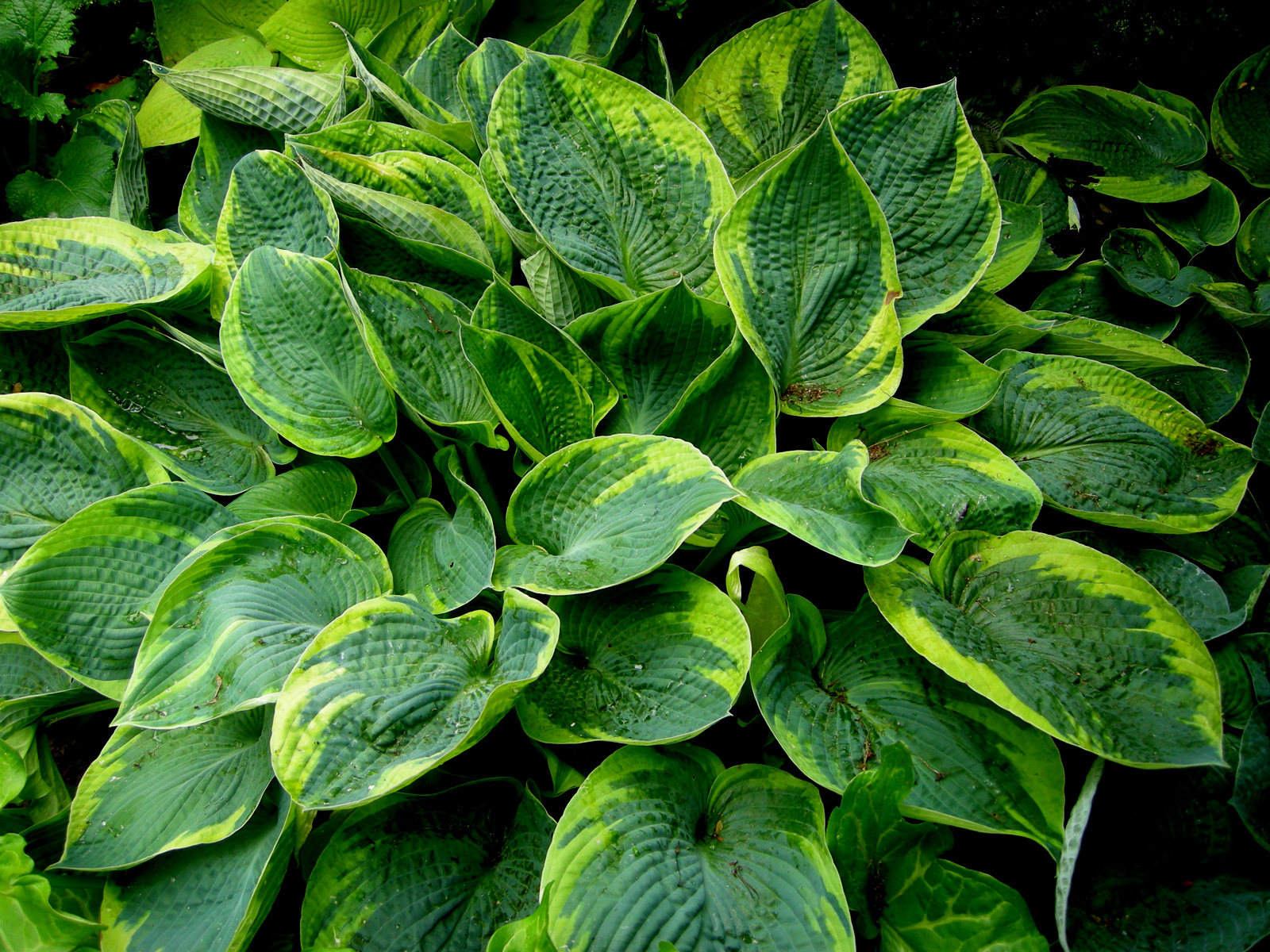
Hosta 'Stirptease'Although miniature hostas are versatile, cute, and fun, it is the larger hostas that provide the bold statement and beautiful colors in shade gardens.  Here clockwise from top: ‘Blue Angel’, ‘Flavocircinalis’, ‘Gold Bullion’, and ‘Striptease’.

.

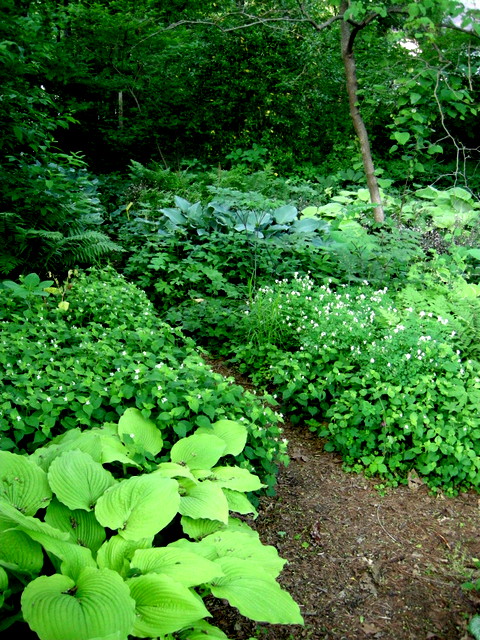
I have explained in previous posts how my hosta addiction has progressed and focused on little hostas.  However, that doesn’t mean that I neglect the larger hostas.  I have my definite favorites there too.  In fact, some of them are such favorites that, when I couldn’t buy them to sell to my customers, I decided to grow them myself just so they would be available for sale at Carolyn’s Shade Gardens.  In this post, I am going to profile seven of those hostas, all of which I consider stars of the shade garden.  Be sure to look at the mature specimens in my garden when you visit.

.

Hosta 'Rainforest Sunrise'‘Rainforest Sunrise’ with ‘Frosted Violet’ coralbells

.

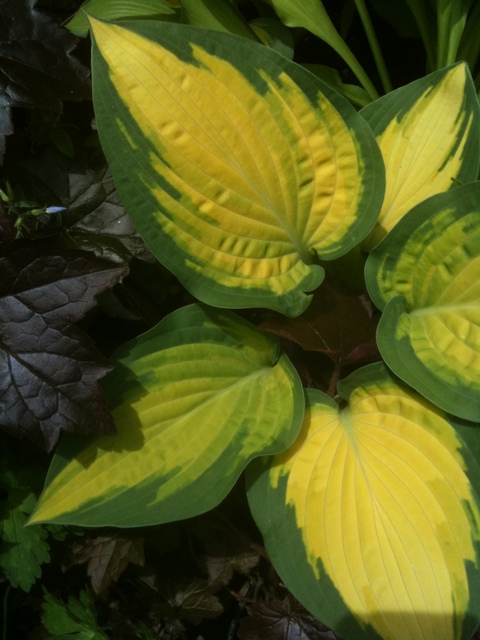
‘Rainforest Sunrise’ is the 2013 Hosta of the Year, a prestigious award bestowed yearly by the American Hosta Growers Association on only one of the 8,000 cultivars in existence.  For beautiful photos of all the yearly winners, click here.  It forms a small mound 10″ high and 25″ wide—very useful in smaller shade gardens and smaller spaces.  Its cupped and corrugated bright gold leaves with a sharply contrasting dark green margin are 6″ long and 5″ wide and really stand out in the shade.  ‘Rainforest Sunrise’ has lovely near white flowers in July.

.

Hosta 'Dream Queen'‘Dream Queen’ with maidenhair fern and ‘All Gold’ Japanese forest grass (Hakonechloa).

.

‘Dream Queen’ is an offshoot of ‘Great Expectations’ with the same gorgeous leaves and habit but much bluer foliage.   It forms an upright and spreading mound 24″ high and supposedly 50″ wide at maturity, although I have had mine for years and it is not that wide.  The 12″ long by 10″ wide round leaves have a narrow yellow center stripe surrounded by deep blue.  They are heavily corrugated and have thick, slug-deterring substance.  ‘Dream Queen’ produces near white flowers from late June into early August.

.

Hosta 'Pineapple Upside Down Cake'‘Pineapple Upsidedown Cake’ with hellebores and Japanese holly fern

.

‘Pineapple Upsidedown Cake’ makes a tremendous specimen in my garden with its unusual look and habit.  It forms a fast-growing mound 18″ high and up to 50″ wide, although my mature specimen is about half that size.  The narrow, rippled, bright gold leaves with dark green margins are 9″ long and 3″ wide.  Unlike most hostas, they become more gold as the season progresses.  It produces lavender flowers in August.

.

Hosta 'Orange Marmalade'‘Orange Marmalade’  with ‘Blackout’ coralbells

.

‘Orange Marmalade’ is a striking addition to my yellow and gold garden with its bright gold-orange centers throughout spring.  It forms a mound 20″ high by 45″ wide at maturity.  The prominent blue-green margin on the 7″ long by 5″ wide leaves sets off perfectly the orangey centers.  It produces lavender flowers from mid-July into early August.  ‘Orange Marmalade’ is an off-shoot of ‘Paul’s Glory’ with all the wonderful attributes of that 1999 hosta of the year but a brighter center color.

.

Hosta 'Tick Tock'‘Tick Tock’ has a starring role in my little hosta rock garden.

.

‘Tick Tock’ is another beautiful hosta suitable for smaller spaces.  It forms an elegant symmetrical mound 10″ high by 18″ wide.  Its thick 4″ by 2″ gold leaves are set off by wide blue-green margins.  It produces lavender flowers in July.  What ‘Tick Tock’ most resembles is a mini ‘June’ for smaller gardens.

.

Hosta 'Summer Lovin'‘Summer Lovin’ with clockwise from top: ‘All Gold’ Japanese forest grass, pulmonarias, native ‘Citronelle’ coralbells, hellebores, and native Indian pink (Spigelia).

.

Hosta 'Summer Lovin'‘Summer Lovin’ in bloom

.

‘Summer Lovin’ is the star of my yellow and gold garden, pulling together all the various hues and textures as you can see in the top photo.  It forms a mound 18″ high and 40″ wide.  What is so special about it is the way the unusually wide gold margins contrast with the dark green center—very unique.  The leaves are 7″ long and 6″ wide and have thick, slug-resisting substance.  It produces compact and attractive pale lavender flowers in July.

.

Hosta tokudama 'Flavocircinalis' at Carolyn's Shade Gardens‘Flavocircinalis’ makes a wonderful specimen.

.

Hosta tokudama 'Flavocircinalis' at Carolyn's Shade Gardens‘Flavocircinalis’ leaf close up

.

‘Flavocircinalis’, not exactly a user friendly name, means the well-rounded hosta and is a cultivar of my favorite hosta species Hosta tokudama.  Although Mark Zilis, author of the definitive hosta reference book The Hostapedia, calls it “one of the greatest hosta cultivars ever introduced”, it is hard to find and expensive when you do find it.  Wholesale growers don’t like it because it grows slowly in pots.  I grew it myself this year so I could sell it to my customers at a reasonable price.

‘Flavocircinalis’ forms a mound 17″ high and 48″ wide at maturity.  Its 9″ by 7″ blue-green leaves have a wide gold margin.  They are heavily corrugated, wavy, and have thick substance.  The attractive white flowers bloom from mid-June into early July.

.

Those are just some of the new larger hostas available at Carolyn’s Shade Gardens this year.  If you would like to read more about the larger hostas available for sale, click on any of the following links:

Larger Hostas explains how large leaf hostas take a year to produce mature leaves, gives ideas for using them, and profiles ‘Flavocircinalis’, ‘Earth Angel’, ‘Great Expectations’, and ‘First Frost’.

Larger Hostas Get the Spotlight profiles ‘Blue Angel’, ‘Sagae’, and ‘Great Expectations’ with photos of how I have use them in my garden.

Hostas for Fall profiles hostas that hold up to the heat and slugs to look beautiful in fall, including ‘Stained Glass’, ‘Frances Williams’, ‘Blue Angel’, ‘Sum and Substance’, ‘Halcyon’, and ‘Praying Hands’, all available this year at Carolyn’s Shade Gardens.

Carolyn

.

Carolyn’s Shade Gardens is a retail nursery located in Bryn Mawr, Pennsylvania, U.S., zone 6b.  The only plants that we mail order are snowdrops and miniature hostas and only within the US.

If you are within visiting distance and would like to receive catalogues and information about customer events, please send your full name and phone number to carolynsshadegardens@verizon.net.  Subscribing to my blog does not sign you up to receive this information.

Nursery Happenings:  The 2013 Miniature Hosta Mail Order Catalogue, containing over 35 choice selections of miniatures for shipping all over the US, is now on the right sidebar here, and we are ready to ship.  If you are local, you can use the catalogue to see what miniatures are available at the nursery.  Next up is the final open house sale of the season on Saturday, June 1, from 10 am to 3 pm rain or shine, and featuring summer- and fall-blooming shade plants.  If you are a customer, expect an email shortly with all the details.

Facebook:  Carolyn’s Shade Gardens has a Facebook Page where I post single photos, garden tips, and other information that doesn’t fit into a blog post.  You can look at my Facebook page here or click the Like button on my right sidebar here.

Notes: Every word that appears in orange on my blog is a link that you can click for more information.  If you want to return to my blog’s homepage to access the sidebar information (catalogues, previous articles, etc.) or to subscribe to my blog, just click here.

2013 New Miniature and Small Hostas

Posted in container gardening, containers for shade, hosta, miniature hosta, Shade Gardening, Shade Perennials with tags , , , , , , , , , , , , , , , , , on May 20, 2013 by Carolyn @ Carolyns Shade Gardens

Carolyn’s Shade Gardens is a retail nursery located in Bryn Mawr, PA, specializing in showy, colorful, and unusual plants for shade.  The only plants that we ship are snowdrops and miniature hostas.  For catalogues and announcements of events, please send your full name, location, and phone number (for back up use only) to carolyn@carolynsshadegardens.com.  Click here to get to the home page of our website for catalogues and information about our nursery and to subscribe to our blog..

miniature hosta toolbox 2My latest container for mini hostas is an old handymans’s toolbox that was hanging around.  In it are clockwise from upper left: ‘Thumbelina’, ‘Teaspoon’, dwarf Solomon’s seal, sedum, ‘Rock Prince’, ‘Cherish’, dwarf lady fern, and ‘Regal Tot’.  the surface is covered by moss collected from my roof.  More about containers at the end of the post.

.

My nursery, Carolyn’s Shade Gardens, specializes in miniature and small hostas.  I even have a mail order business shipping miniature hostas all over the U.S.  For mail order details or, if you are local, a list of the over 35 miniature and small hostas available at the nursery, click here.  I have also written extensively about minis and links to the articles are at the end of this post.  Now I want to profile some of the new little hostas available this year.

.

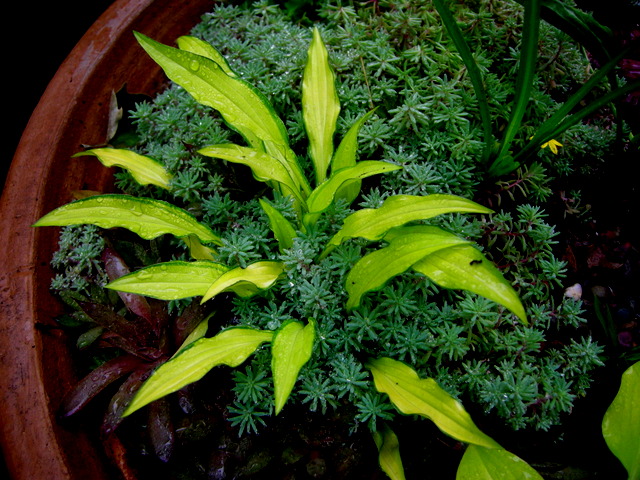
Hosta 'Dragon Tails'‘Dragon Tails’ is one of my new favorites, and if you use your imagination you can see why it was named that.  It forms an arching, tight clump  7″ tall and 14 ” wide at maturity.  Its golden leaves are 5″ long and 1″ wide, lance-shaped, heavily rippled, and tapering to a point.    It is supposed to look great draping over the edge of a trough.

.

Hosta 'Green Eyes'‘Green Eyes’ is a seedling of ‘Kabitan’, another wonderful little hosta.  It is 5″ tall and 12 ” wide at maturity.  Its leaves are pale yellow with a narrow green margin and 3″ long and 1″ wide.  They are lance-shaped, rippled, and tapering.    It is said to be sun tolerant.

.

Hosta 'Hi Ho Silver'I would grow ‘Hi Ho Silver’ for the name alone.  It is 8″ tall and 12″ wide at maturity.  Its lance-shaped leaves are medium green with a wide, bright white margin that extends down the leaf stalk, and 6″ long and 2″ wide.  It forms a loose clump and needs shade.

.

Hosta 'Little Treasure'‘Little Treasure’  is  6” tall and 16” wide at maturity.  Its leaves, which are 4 ½” long by 2” wide, have a very striking, blue margin with a creamy white center.  The leaves twist for a unique overall look.  Although it is a standout in my garden, it is one of those hostas that doesn’t look like much in a nursery pot.

.

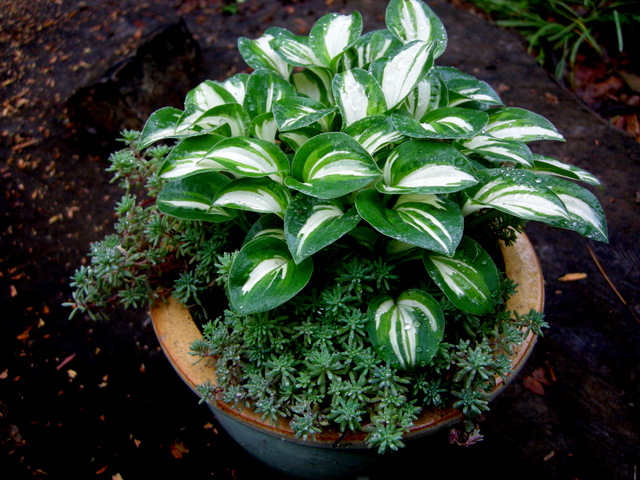
Hosta 'Pandora's Box'‘Pandora’s Box’ is a very beautiful and unique miniature hosta.  It forms a striking, tight clump reaching 8″ high and 19″ wide at maturity.  Its heart-shaped, bright white leaves have an irregular blue-green margin and are 2 1/2″ long and 2″ wide.  It is an offshoot of ‘Baby Bunting’ and will occasionally form all blue-green leaves which should be removed.  Its only drawback is that it is more difficult to grow than the average mini due to all the white in its leaves which reduces photosynthesis.  It is said to do much better in a container and should not be planted in the ground.

.

Hosta 'Regal Tot'‘Regal Tot’ forms a neat and compact mound 5 ½” tall by 17” wide.  Its elegant cupped and corrugated leaves are 4” long by 3” wide.  Unlike most hostas, which age to green, it is chartreuse when it comes out and becomes more and more gold as the season progresses.  A truly regal form of ‘Shining Tot’, its dark green parent.

.

Hosta 'Ruffled Mouse Ears'‘Ruffled Mouse Ears’ is the latest addition to the “mouse ears” clan of hostas, my favorite minis.  An off shoot of ‘Blue Mouse Ears’, it has the same round, thick, rubbery leaves 2 3/4″ long and 2 1/2″ wide but with rippled and frilled margins.   It was introduced this year so I only have the photo of my own immature plant above to show you.  However, all the mouse ears cultivars are excellent plants with a very unique look.  At maturity, it forms a mound 6″ high and 14″ wide.  If you would like to read more about mouse ears hostas, click here for my post entitled I LOVE Mice.

.

Hosta 'Shiro Kabitan'‘Shiro Kabitan’ (often sold as ‘Haku Chu Chan’) really brightens up the shade with its bright white foliage with a narrow green margin.  The slightly twisted, ribbon-like leaves are 4 1/2″ long and 1 1/2″ wide.  Despite all the white, it spreads quickly to form a small dense mound 6″ high and 18″ wide at maturity.  It makes a very colorful edging and prefers dappled shade.

.

Hosta 'Stiletto'‘Stiletto’ is another small hosta that can’t be mistaken for any other.  Its shiny dark green leaves with a narrow yellow to creamy white margin are 5 1/2″ long and 1 1/2″ wide.  They are noticeably rippled and wavy.  This fast-growing, adaptable hosta forms a mound 12″ high and 24″ wide at maturity.  It is great for edging and forms a dense mini-hedge along a path or border.

.

Hosta 'Teaspoon'‘Teaspoon’ is a hosta that stands out from the crowd with its unique cupped, bright green leaves that look, yes, like a teaspoon.  The almost completely round leaves are 2 3/4″ long and 2 1/2″ wide.  It forms a dense and neat mound 11″ high and 24″ wide at maturity.  It is fast-growing and makes an outstanding specimen.

.

Hosta 'Woodland Elf'‘Woodland Elf’  grows quickly to form a compact mound 5″ high and 15” wide at maturity.  The waved and cupped leaves are 2 ¼” long and 1 ½” wide.  They are medium green with a white margin.  ‘Woodland Elf’ has a  beautiful upright habit and is great in troughs and excellent for edging.

.

Those are just some of the new little hostas available at Carolyn’s Shade Gardens this year.  Many of them are excellent plants for the front of the border or for edging paths.  However, the real minis look best when they are specially displayed in an area of the garden set aside for them with suitable sized companion plants like smaller epimediums, dwarf ferns, sedums, hens and chicks, or dwarf Solomon’s seal.  I have a special rock garden just for my minis—don’t miss it when you visit next.

.

DSCN0193Another view of the new mini garden featured at the start of this post.

.

The other way to display miniature hostas is in a container.  If the container can take freezing, you can leave it outside, minis and all, for the whole winter with no special protection.  That’s what we do with all our containers at Carolyn’s Shade Gardens.  As I explained in detail in my post Hosta Containers and Companions (to read it click here), you don’t need to go out and spend a fortune buying a fancy pot for your hostas.  Any old object collecting dust in your attic can be converted to a mini hosta container garden.  We have used everything from the toolbox above to the oil can below.

.

Hosta I made this container last year, and you should see how beautiful it is this spring after being out all winter.

.

If you would like to read more about little hostas, click on any of the following links:

Miniature (& Small) Hostas

I LOVE Mice

Beyond Mice

Hostas Containers and Companions

Carolyn

.

Carolyn’s Shade Gardens is a retail nursery located in Bryn Mawr, Pennsylvania, US, zone 6b.  The only plants that we mail order are snowdrops and miniature hostas and only within the US.

If you are within visiting distance and would like to receive catalogues and information about customer events, please send your full name and phone number to carolynsshadegardens@verizon.net.  Subscribing to my blog does not sign you up to receive this information.

Nursery Happenings: The 2015 Miniature Hosta Mail Order Catalogue, containing over 35 choice selections of miniatures for shipping all over the US, is now on the right sidebar here, and we are ready to ship.

Facebook:  Carolyn’s Shade Gardens has a Facebook Page where I post single photos, garden tips, and other information that doesn’t fit into a blog post.  You can look at my Facebook page here or click the Like button on my right sidebar here.

Notes: Every word that appears in orange on my blog is a link that you can click for more information.  If you want to return to my blog’s homepage to access the sidebar information (catalogues, previous articles, etc.) or to subscribe to my blog, just click here.

Longwood Gardens Part 5: Tulips and Natives

Posted in bulbs for shade, garden to visit, groundcover, native plants, Shade Gardening, Shade Perennials with tags , , , , , , , , , , , , , , , , , , , , , , , , , , , , , , , , , , , , , , , , , , , , , , , , , , on May 2, 2013 by Carolyn @ Carolyns Shade Gardens

Carolyn’s Shade Gardens is a retail nursery located in Bryn Mawr, PA, specializing in showy, colorful, and unusual plants for shade.  The only plants that we ship are snowdrops and miniature hostas.  For catalogues and announcements of events, please send your full name, location, and phone number (for back up use only) to carolyn@carolynsshadegardens.com.  Click here to get to the home page of our website for catalogues and information about our nursery and to subscribe to our blog.

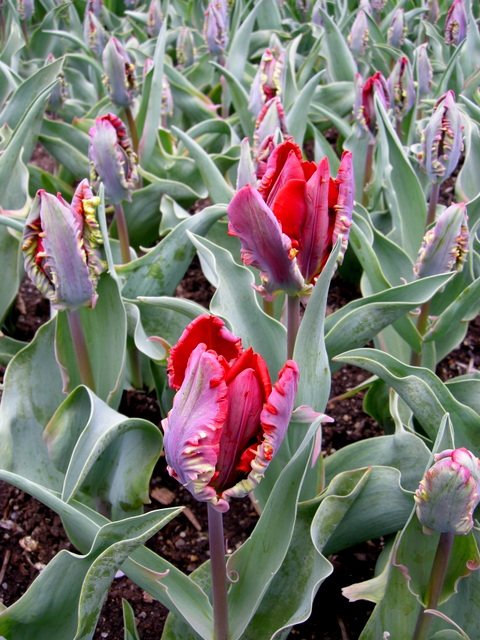
. Tulips at LongwoodThis color combination is magnificent for spring.

.

During 2012 to 2013, I have been visiting Longwood Gardens in Kennett Square, Pennsylvania, U.S., every few months and highlighting some aspect of this amazing place (last year I focused on Chanticleer).  Links to my previous four posts are at the end.  There is much to see there with 325 acres open to the public and 20 outdoor gardens. 

On April 18, Michael and I headed out to Longwood with the specific objective of photographing the plants in the native woodland, Peirce’s Woods.  Of course, on the way to the woods, we got sidetracked by the bulb displays out front and along the Flower Garden Walk.  Although masses of tulips and other bulbs are just about polar opposite to native plants naturalized in a woodland, they are still gorgeous so I will show you a few photos as I explain the history of the woodland.

.

Leucojum aestivumSummer snowflake, Leucojum aestivum, is a great plant for massing.  Mine grow and self-sow quite readily in both south-facing and east-facing locations as well as in full deciduous shade in my woodland.

In 1700, a Quaker family named Peirce purchased the area that is now Peirce’s Woods from William Penn to establish a working farm.  In 1798, the Peirces began planting trees to establish an arboretum on the property.  Eventually the area became known as one of the finest collections of trees in the country.  The great industrialist Pierre DuPont (1870 to 1954) purchased the property in 1906 with the specific purpose of preserving the magnificent trees.

.

container at LongwoodYou will find fabulous container gardens throughout Longwood, including this one outside the Visitor’s Center with a large native dogwood underplanted with daffodils.

Peirce’s Woods comprises seven acres planted to showcase the ornamental characteristics of native plants from the eastern U.S. deciduous forest.  The shade trees  are mostly oak, ash, maple, and tulip trees, some over 200 years old.  The understory is native flowering trees and shrubs underplanted with native groundcovers.  All the plants are labeled so it is a great place to visit to get ideas for your own woodland garden.  Before I highlight the plants there, a few more bulb photos:

.

Narcissus Tahiti and Flower DriftNarcissus ‘Tahiti’ and ‘Flower Drift’

.

tulips at Longwood

.

tulips at Longwood.

tulips at Longwood

.

Tulipa 'Yellow Wave'‘Yellow Wave’ tulip

.

Tulipa 'Rococo'‘Rococo’ tulip

.

Tulipa 'Rococo'I think this tulip should be called the Little Shop of Horrors tulip—you definitely would not want to stick your finger inside of it.

.

Flower Garden Walk at LongwoodAs we neared the end of the Flower Garden Walk, we were greeted by this magnificent vista.

We came to Longwood with the objective of viewing and photographing Peirce’s Woods.  I fully intended to show scenes of the woods as a whole and close ups of individual native wildflowers.  However, I didn’t realize that because the weather has been so cold this spring, many of the flowers would not be blooming yet.  My own garden is always ahead because it is on a south-facing slope and the soil warms up early.  Also, as soon as we got there and typical for this spring, the sun went in, the wind picked up, it started to rain, and the temperature plummeted.

.

Matteuchia pennsylvanica The only other landscape shot that I got: ostrich ferns by the shore of the lake.  These ferns can be quite tall, 3 to 5′, spread aggressively by runners, and are the source of edible fiddleheads.

Michael and I were both under-dressed with no raincoats so I decided to take photos of the plants that were blooming and come back the following week for the landscape shots and later-blooming plants.  As usual, work at the nursery got in the way, but I wanted to show you the beautiful native plants that I was able to capture on film.  Just picture me kneeling patiently by each plant and snapping the photo in between gusts of wind and bouts of rain:

.

Heuchera villosa 'Miracle' ‘Miracle’ coralbells, Heuchera villosa, is one of my favorite cultivars of this tough eastern native.  The only coralbells I sell at my nursery are offspring of eastern natives H. villosa and H. americana because I find the other types not hardy.

.

Anemonella thalictroides Rue-anemone, Anemonella thalictroides, is so delicate looking but  thrives and self-sows in dry shade.

.

Trillium grandiflorum‘Quicksilver’ large-flowered trillium, T. grandiflorum, was selected as a rapidly multiplying form of the species by Dr. Richard Lighty, at the Mt. Cuba Center in Delaware.

.

Trillium grandiflorum 'Quicksilver' and Anemonella thalictroides‘Quicksilver’ surrounded by rue-anemone.

.

Trillium luteum, yellow toad trilliumI find yellow toad trillium, T. luteum, quite easy to grow.

.

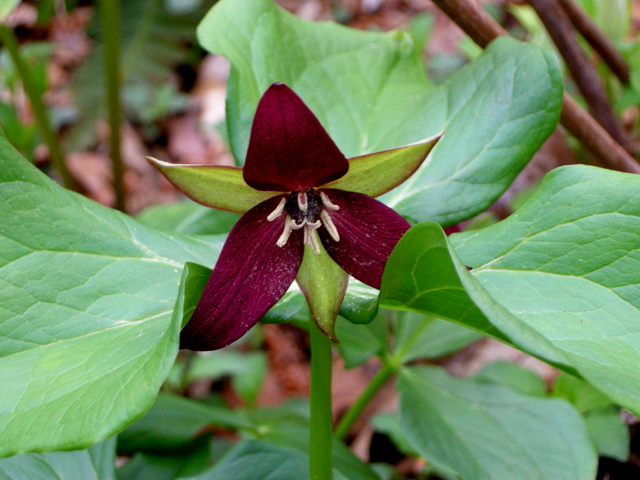
Trillium erectum, purple trilliumpurple trillium, T. erectum

.

Trillium erectum, purple trilliumThe two-tone flowers of purple trillium are gorgeous.

.

Dicentra cucullaria, squirrel cornsquirrel-corn, Dicentra canadensis

.

Caulophyllum thalictroides, blue cohoshBlue cohosh, Caulophyllum thalictroides, has these unprepossessing flowers in the spring followed by bright blue berries.  I love its leaf and stem structure and elegant overall habit.

.

Caulophyllum thalictroides and Dicentra canadensisBlue cohosh can act like a small shrub, here with an underplanting of squirrel-corn.

.

Mertensia virginicaVirginia bluebells, Mertensia virginica, were everywhere just like they are in my own garden where they seed prolifically.

.

Enemion biternatum, eastern false rue-anemoneEastern false rue-anemone, Enemion biternatum, is a new plant to me.  I am going to look for it though because its flowers were lovely perched on reddish stems and it evidently spreads to make an eye-catching patch.

.

stump in Peirce's WoodsI thought what Longwood had done to the stump of a tree that came down was very interesting and actually quite attractive.

.

Erythronium americanum, adder's tongueAdder’s tongue or what I call trout lily, Erythronium americanum, usually produces hundreds of leaves and a few flowers in my garden, but this year it is blooming well everywhere.

.

Polstichum acrostichoidesThe emerging fronds of Christmas fern, Polystichum acrostichoides, look like fairies should be dancing among them.

.

Onoclea sensibilisSensitive fern, Onoclea sensibilis, is a great native fern that is underused in gardens.

.

Onoclea sensibilisSensitive fern looks great in a mass planting.

.

Claytonia virginica, spring-beautyThe wind was roaring when I tried to photograph these spring-beauties, Claytonia virginica, so they are out of focus, but I didn’t want you to miss them.

.

Claytonia virginicaSpring-beauty really has an amazing flower even when blurry.

.

Hydrophyllum macrophyllum, large-leaf waterleafLarge -leaf waterleaf, Hydrophyllum macrophyllum, has very pretty foliage.

.

Cardamine concatenata, cutleaf toothwortCutleaf toothwort, Cardamine concatenata, is a spring ephemeral that naturalizes slowly to form a colony in the shade.

.

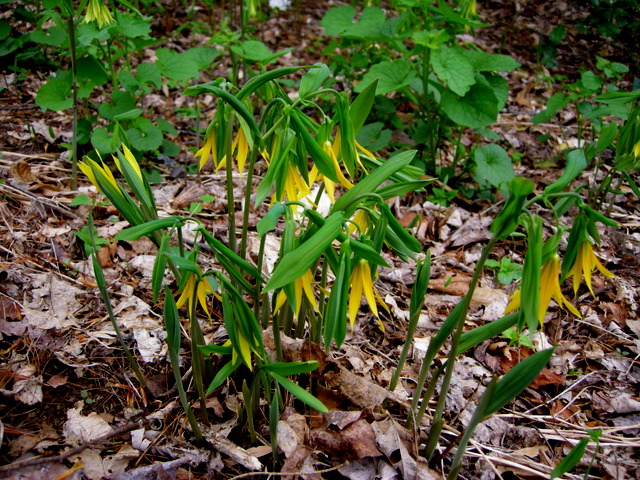
Uvularia grandifloraLarge-flowered bellwort, Uvularia grandiflora, is one of my favorites.  It grows 1 to 2 feet tall, has unusual and elegant yellow flowers, and grows in full, dry shade.  I don’t know why this plant isn’t more popular, but it doesn’t sell well at my nursery even though I have big stands of it in my display gardens.

All the plants profiled are native to Pennsylvania and the East Coast.  If you would like to see if a plant is native to your state, the best place to look is the USDA Natural Resources Conservation Service Plants Database.  All you do is put in the name of the plant and you will be shown a map of where it is native in the U.S.  I also have all these plants in my garden except toothwort and false meadow-rue, and I highly recommend them.

To read more about Longwood Gardens, follow these links:

Groundcovers, Thinking Outside the Box

Longwood Gardens Part 2: At Night

A Longwood New Year’s Eve

Cold Weather Antidote: Longwood’s Orchids

Carolyn

.

Carolyn’s Shade Gardens is a retail nursery located in Bryn Mawr, Pennsylvania, US, zone 6b.  The only plants that we mail order are snowdrops and miniature hostas and only within the US.

If you are within visiting distance and would like to receive catalogues and information about customer events, please send your full name and phone number to carolynsshadegardens@verizon.net.  Subscribing to my blog does not sign you up to receive this information.

Nursery Happenings:  The 2013 Spring Shrub Offer is now in full swing and orders are due May 18.  To read about the plants available and place an order, click here.  The 2013 Miniature Hosta Mail Order Catalogue, containing choice selections of miniatures for shipping all over the US, is now on the right sidebar here, and we are ready to ship.  If you are local, you can use the catalogue to see what miniatures are available at the nursery.

Facebook:  Carolyn’s Shade Gardens has a Facebook Page where I post single photos, garden tips, and other information that doesn’t fit into a blog post.  You can look at my Facebook page here or click the Like button on my right sidebar here.

Notes: Every word that appears in orange on my blog is a link that you can click for more information.  If you want to return to my blog’s homepage to access the sidebar information (catalogues, previous articles, etc.) or to subscribe to my blog, just click here.
European Wood Anemone, My Collection

Posted in bulbs for shade, groundcover, Shade Gardening, Shade Perennials with tags , , , , , , , , , , , , , , , , , , , , on April 26, 2013 by Carolyn @ Carolyns Shade Gardens

Carolyn’s Shade Gardens is a retail nursery located in Bryn Mawr, PA, specializing in showy, colorful, and unusual plants for shade.  The only plants that we ship are snowdrops and miniature hostas.  For catalogues and announcements of events, please send your full name, location, and phone number (for back up use only) to carolyn@carolynsshadegardens.com.  Click here to get to the home page of our website for catalogues and information about our nursery and to subscribe to our blog.

. Anemone nemorosa 'Vestal'European wood anemone ‘Vestal’, Anemone nemorosa

.

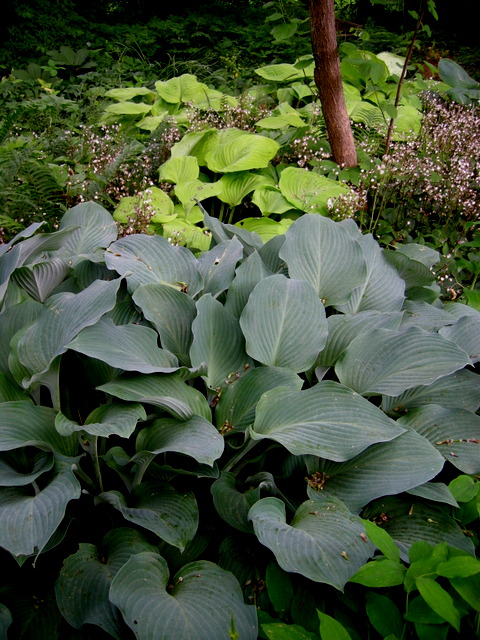
My last post highlighting my epimedium collection was very popular.  It set a new record for views in a single day.  It was also quite helpful in allowing me to document the collection in photographs.  That has inspired me to do a similar post introducing another relatively obscure group of plants blooming right now, European wood anemones or Anemone nemorosa.  I first saw them in Charles Cresson’s garden in 1995, and he gave me five cultivars to take home.  I have since increased that number to 13 (15 if you count the two that died).  I want to share this special plant with you and discuss its culture and garden uses.

.

Anemone nemorosa 'Vestal'‘Vestal’ is a moderate spreader.

European wood anemone is what is often called a bulb ally.  It springs from skinny, stick-like rhizomes that spread through  leaf litter to form patches of beautiful flowers and leaves.  You can buy the dried rhizomes in the fall like other bulbs or you can buy growing plants in the spring from Carolyn’s Shade Gardens or other specialty nurseries.  Wood anemones grow in part to full shade and like woodland soil with lots of organic matter. I have never watered them, but I do mulch them with a covering of ground leaves in the fall.  The various cultivars spread at different rates in my woods from slow to fast.  I will indicate what type of spreader each one is in my garden, but it may depend entirely on my conditions and where each variety is planted

.

A. nemorosa 'Robinsoniana'‘Robinsoniana’ is a gorgeous blue but a slow grower in my garden.

European wood anemones are a spring ephemeral.  They take advantage of the sunlight before the woody plants leaf out and then go dormant when it gets hot and shade prevails.  Although they disappear, they are still a good groundcover because the rhizomes are so thickly matted that no weeds can grow.  Just plant later emerging plants like ferns or hostas around them if the hole will bother you after they disappear.

.

Anemone nemorosa 'Leeds Variety'‘Leed’s Variety’ spreads moderately.

.

Anemone nemorosa 'Leed's Variety'‘Leed’s Variety’ has the biggest flowers, about 2″ wide, of any of my cultivars.

.

European wood anemones bloom in the mid-Atlantic for the whole month of April and sometimes into May, depending on the weather.  Their plentiful flowers are 1 to 2″ wide and generally white, blue, and pink and can be double or semi-double.  Many of the cultivars are very similar in appearance.  The Royal Horticultural Society’s plant finder lists almost 100 varieties.  There are some closely related yellow-flowered forms as well as some weird green-flowered varieties, ‘Virescens’ and ‘Green Fingers’, both of which I have killed.  Wood anemones’ leaves are an attractive dark green with three deeply incised segments.  They form compact mounds about 6 to 8″ tall.

.
Anemone nemorosa 'Wyatt's Pink'‘Wyatt’s Pink‘ is a moderate grower.

.

Anemone nemorosa 'Wyatt's Pink'‘Wyatt’s Pink’

.

A patch of wood anemones really lights up a woodland opening, and I like to let mine develop as big a swathe as they can manage.  They are native to the woodlands and shady banks of western Asia and the northern temperate zones of central Europe, including England where many cultivars have been selected.  According to the RHS, they are hardy to zone 5 and another source says zones 5 to 9, but you should do your own research before planting them if you are not in the mid-Atlantic.

.

Anemone nemorosa 'Bractiata'‘Bracteata’ is a fast grower.

.

Anemone nemorosa 'Bractiata'‘Bracteata’ is an unusual and very elegant form with the white flower color extending into the leafy bracts.

.

European wood anemones are quite easy to grow and well worth adding to your garden if you can find them.  Here are some of my other cultivars:

.

Anemone ranunculoidesYellow wood anemone, A. ranunculoides, is closely related to A. nemorosa.  It is the first to come into bloom and spreads quickly but not aggressively, even self-sowing.

.

Anemone ranunculoidesYellow wood anemone

.

Anemone nemorosa 'Lychette' ‘Lychette’ is a moderate spreader.

.

Anemone nemorosa 'Allenii' ‘Allenii’ is similar to ‘Robinsoniana’ but more silvery blue in color.  It is a moderate spreader.

.

Anemone nemorosa 'Alba' ‘Alba’ spreads slowly for me.

.

Anemone nemorosa pink formI acquired this Anemone nemorosa from the old Heronswood Nursery in Washington with the name “pink form”.  It is a moderate grower.

.

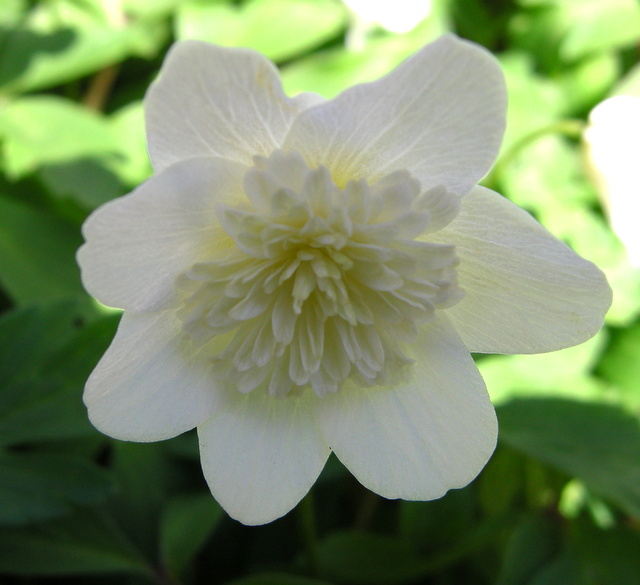
Anemone nemorosa 'Alba Plena'‘Alba Plena’ is very similar to ‘Vestal’ but it is a faster spreader.

.

Anemone nemorosa 'Alba Plena'‘Alba Plena’

.

Anemone x seemaniiAnemone x seemanii is a cross between A. ranunculoides and A. nemorosa, producing this lovely pale yellow flower.  It is a moderate grower.

.

Anemone x seemaniiAnemone x seemanii

.

Anemone nemorosa 'Blue Eye'I will end the profiles of my cultivars with this photo of the absolutely exquisite ‘Blue Eyes’, which I also got from Heronswood.

.

Most of the plants in my woodland are allowed to form large patches for a natural look, and European wood anemone fits right in.  Here are some photos of how I use it:

.

Anemone ranunculoidesYellow wood anemone filling a large area in front of Virginia bluebells and Celandine poppy.

.

Anemone nemorosa 'Bracteata'‘Bracteata’ edging a path with hellebores and checkered lily, Fritillaria meleagris, another self-seeder in my woods.

.

Anemone nemorosa 'Lychette'‘Lychette’ on a shady slope with Celandine poppy.

.

Anemone nemorrosa 'Vestal' and Anemone ranunculoides‘Vestal’ and Anemone ranunculoides edge a woodland path with ‘Alba’ across the way to the right of the Virginia bluebells.

.

European wood anemones are for sale at Carolyn’s Shade Gardens.  If you are not local or you want some of the really special cultivars,  you can order them from Arrowhead Alpines in Michigan, a great mail order nursery for unusual woodland plants.

Carolyn

.

Carolyn’s Shade Gardens is a retail nursery located in Bryn Mawr, Pennsylvania, US, zone 6b.  The only plants that we mail order are snowdrops and miniature hostas and only within the US.

If you are within visiting distance and would like to receive catalogues and information about customer events, please send your full name and phone number to carolynsshadegardens@verizon.net.  Subscribing to my blog does not sign you up to receive this information.

Nursery Happenings:  The 2013 Miniature Hosta Mail Order Catalogue, containing choice selections of miniatures for shipping all over the US, is now on the right sidebar here, and we are ready to ship. Next up locally is our hosta, fern, and hardy geranium open house sale on May 11—look for an email if you are on my customer email list (different than a blog subscription).

Facebook:  Carolyn’s Shade Gardens has a Facebook Page where I post single photos, garden tips, and other information that doesn’t fit into a blog post.  You can look at my Facebook page here or click the Like button on my right sidebar here.

Notes: Every word that appears in orange on my blog is a link that you can click for more information.  If you want to return to my blog’s homepage to access the sidebar information (catalogues, previous articles, etc.) or to subscribe to my blog, just click here.

Epimediums, My Collection

Posted in evergreen, groundcover, Shade Gardening, Shade Perennials with tags , , , , , , , , , , , , , , , , , , , , , , , , , on April 18, 2013 by Carolyn @ Carolyns Shade Gardens

Carolyn’s Shade Gardens is a retail nursery located in Bryn Mawr, PA, specializing in showy, colorful, and unusual plants for shade.  The only plants that we ship are snowdrops and miniature hostas.  For catalogues and announcements of events, please send your full name, location, and phone number (for back up use only) to carolyn@carolynsshadegardens.com.  Click here to get to the home page of our website for catalogues and information about our nursery and to subscribe to our blog.

. Epimedium pinnatum subsp. colchicumEpimedium pinnatum subsp. colchicum, evergreen.

.

Nan Ondra at the fabulous blog Hayfield recently praised my blog saying: “If you want to see how beautiful a spring garden can look here in southeastern Pennsylvania, I highly recommend popping over to Carolyn Walker’s blog, Carolyn’s Shade Gardens. It’s where I go when I need a good dose of primroses, spring phlox, and other early-blooming beauties.”   A lot of Nan’s readers took her advice and visited my blog.  I have been trying to think of what I could do to thank Nan, not just for the recommendation, but for her advice when I started my blog and numerous consultations on selling my photos.  I decided that if she needs a dose of spring flowers, then epimediums are what she should have.  Nan, this post is for you!

.

Epimedium x rubrumEpimedium x rubrum spreads at a moderate pace and can be used as a groundcover, leaves flushed red in the spring.

I try not to let myself collect too many types of plants because it can interfere with good garden design.  But epimediums, also known as barrenwort, bishop’s hat, fairy wings, horny goat weed, and rowdy lamb herb, are a plant I love so much that I collect them.  According to my records, I have almost 30 varieties.  That might seem like a lot, but there are actually hundreds of types of epimediums.

.

Epimedium x versicolor 'Sulphureum'Epimedium x versicolor ‘Sulphureum’ is the fastest spreading epimedium I have and makes an excellent groundcover, semi-evergreen.

Epimediums are native to Asia, Europe, and North Africa.  They are long-lived and easy to grow in part to full shade and are a great plant for dry shade.  Some of the more available varieties like ‘Sulphureum’, E. x rubrum, E. x warleyense, and ‘Frohnleiten’ spread readily but not quickly to form an attractive groundcover.  I grow mine all over my garden but mostly as specimens on the steep hill  in back between all my hostas (yes, I collect those too).  Their flowers are small but quite beautiful, elegant, and abundant.  Epimediums are a plant that needs to be viewed close up.  This time of year I walk around mesmerized by their beauty.

.

Epimedium cantabrigienseEpimedium x cantabrigiense, semi-evergreen.

Epimediums bloom in April and May, and their flowers are breathtaking as you can see from the photos.  However, their leaves are just as beautiful with their elegant, unusual shapes.  They often come out flushed with bright colors in the spring, and many varieties have great fall color too.  Some are semi-evergreen to evergreen.  Epimediums range in height from 8 to 16″.

.
Epimedium pubigerumEpimedium pubigerum, semi-evergreen.

Epimediums are perfectly suited to our mid-Atlantic climate, especially our new hotter, drier, drought prone climate.  A quick survey of the epimediums listed in the Missouri Botanical Garden Plant Finder indicates that they are hardy from zones 4 or 5 to 8 or 9, but you should do your own research if you are not in the mid-Atlantic.  I usually choose a well-drained location because like hellebores they don’t tolerate poor drainage, and add compost at planting.  They are great under shallow-rooted trees and are deer resistant.

.

Epimedium x warleyenseEpimedium x warleyense, spreading, from Miss Wilmott’s garden Warley Place, England, evergreen.

I sell up to 10 different types of epimediums at Carolyn’s Shade Gardens depending on the year.  There are seven for sale right now and now is the best time to view them in my garden.  But if you get hooked, then you need to know about Garden Vision Epimediums in Templeton, Massachusetts, 978-249-3863, epimediums@earhtlink.net.  Their catalogue lists at least a 150 epimediums and is encyclopedic with comprehensive descriptions and color photos plus zone information for each variety.  A visit to their Open Nursery Weekends, this year May 3 to 5 and 10 to 12, from 10 am to 4 pm, is a magical experience.

.

Epimedium x perralchicum 'Frohnleiten'Epimedium x perralchicum ‘Frohnleiten’, tough and shiny evergreen leaves.

All the photos in this post were taken in my garden today.  I hope that you too will come to love this wonderful genus:

.

Epimdium x versicolor 'Cupreum'Epimedium x versicolor ‘Cupreum, look at those gorgeous leaves, semi-evergreen.

.

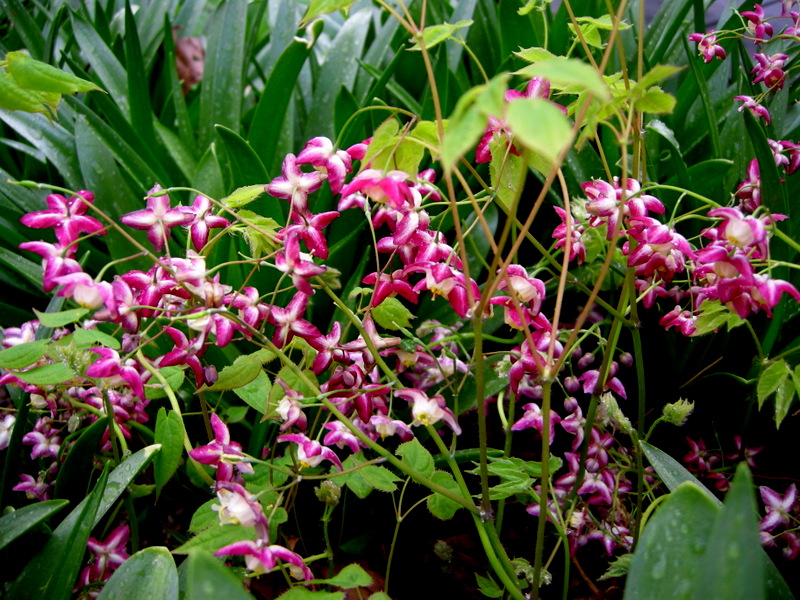
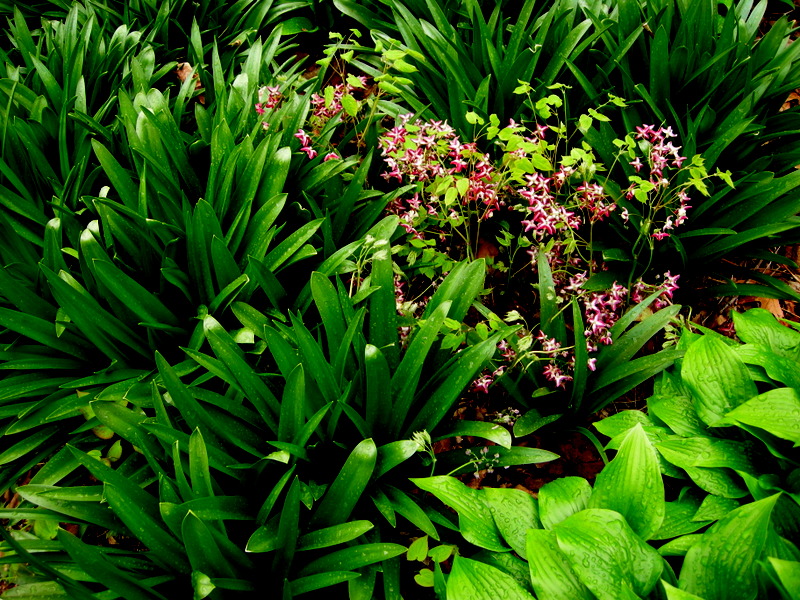
Epimedium x 'Kaguyahime'Epimedium x ‘Kaguyahime’, probably my favorite epimedium for its lovely two-tone purple flowers and dagger-like, purple-mottled leaves, evergreen.

.

Epimedium grandiflorum 'Yubae'Epimedium grandiflorum ‘Yubae’, produces a second flush of leaves and flowers.

.

Epimedium stellultum "Long Leaf Form"Epimedium stellulatum “Narrow Leaf Forms”, the first to bloom in my garden like a “flurry of small stars suspended above the spiny evergreen foliage”, Garden Vision catalogue.

.

Epimedium x rubrum 'Sweetheart'Epimedium x rubrum ‘Sweetheart’, later-blooming, notice the red rim around the semi-evergreen leaves.

.

Epimedium grandiflorum 'Tama No Genpei'Epimedium grandiflorum ‘Tama No Genpei’, I love this one too, re-blooming.

.

Epimedium x versicolor 'Cherry Tart'Epimedium x versicolor ‘Cherry Tart’, semi-evergreen.

.

Epimedium grandiflorum var. violaceumEpimedium grandiflorum var. violaceum, chocolate leaves in the spring.

.

Epimedium grandiflorum 'Album'Epimedium grandiflorum ‘Album’, large pristine white flowers.

.

Epimdium grandiflorum var. higoense 'Bandit'Epimedium grandiflorum var. higoense ‘Bandit’, later blooming but I had to show it, white flowers and tiny leaves rimmed with a dark purple band.

.

Epimedium alpinum 'Shrimp Girl'Epimedium alpinum ‘Shrimp Girl’, I love the name and the coral-orange color on this diminutive but spreading cultivar, semi-evergreen.

.

Epimedium x warleyense 'Orange Queen'Epimedium x warleyense ‘Orange Queen’, evergreen, here with Pulmonaria ‘Benediction’.

Here are some shots of mature patches of epimediums so you can get an idea of what they look like in the landscape:

Epimedium x versicolor 'Sulphureum'‘Sulphureum’ just coming into bloom.  The leaves are just emerging too and will get much larger.

.

Epimdium x rubrumEpimedium x rubrum with Spanish bluebells and early emerging Hosta lancifolia.

.

Seven varieties of epimediums will be for sale at Carolyn’s Shade Gardens’ open hours this weekend: Friday, April 19, 10 am to 4 pm, and Saturday, April 20, from 10 am to 2 pm.  If you are not local or you want some of the really special cultivars,  you can order them from Garden Vision Epimediums.

Carolyn

.

Carolyn’s Shade Gardens is a retail nursery located in Bryn Mawr, Pennsylvania, US, zone 6b.  The only plants that we mail order are snowdrops and miniature hostas and only within the US.

If you are within visiting distance and would like to receive catalogues and information about customer events, please send your full name and phone number to carolynsshadegardens@verizon.net.  Subscribing to my blog does not sign you up to receive this information.

Nursery Happenings:  The Miniature Hosta Mail Order Catalogue, containing choice selections of miniatures for shipping all over the US, is now on my right sidebar here, and we are ready to ship. Next up locally is our hosta, fern, and hardy geranium open house sale on May 11—look for an email if you are on my customer email list (different than a blog subscription).

Facebook:  Carolyn’s Shade Gardens has a Facebook Page where I post single photos, garden tips, and other information that doesn’t fit into a blog post.  You can look at my Facebook page here or click the Like button on my right sidebar here.

Notes: Every word that appears in orange on my blog is a link that you can click for more information.  If you want to return to my blog’s homepage to access the sidebar information (catalogues, previous articles, etc.) or to subscribe to my blog, just click here.
Primroses That Live

Posted in Shade Gardening, Shade Perennials with tags , , , , , , , , , , , , , , , , , , , , on April 10, 2013 by Carolyn @ Carolyns Shade Gardens

Carolyn’s Shade Gardens is a retail nursery located in Bryn Mawr, PA, specializing in showy, colorful, and unusual plants for shade.  The only plants that we ship are snowdrops and miniature hostas.  For catalogues and announcements of events, please send your full name, location, and phone number (for back up use only) to carolyn@carolynsshadegardens.com.  Click here to get to the home page of our website for catalogues and information about our nursery and to subscribe to our blog.

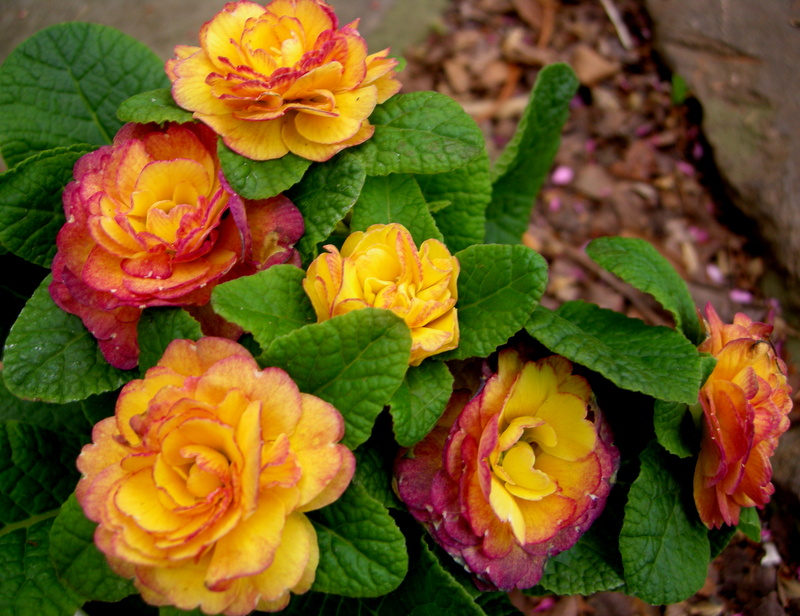
Primula 'Belarina Nectarine'‘Belarina Nectarine’ double primrose

.

This weekend Carolyn’s Shade Gardens is holding its second open house sale of the season, and one of the featured plants is primroses.  Primroses are a hard sell to gardeners because, as my customers always tell me, they’ve tried primroses and they don’t come back.  I usually begin my defense of the hardiness of primroses by asking if they bought the brightly colored varieties often sold in supermarkets and other big box type stores in early spring.  We have all done it, who can resist?  Unfortunately, those primroses are not suited to our climate and really shouldn’t be marketed as perennials.  There are, however, many lovely primroses that come back every year.  Here are just a few:

.

Primula verisCowslip primroses are very easily grown in part shade and average soil without supplemental watering.  They produce a 6 to 12″ stem topped by nodding, fragrant, lemon-yellow flowers in midspring.

.

Ipheion uniflorum, Primula veris, Brunnera macrophylla at Carolyn's Shade GardensCowslip primrose, Primula veris, with spring starflower and perennial forget-me-not.

.

Primula x polyantha 'Old Brick Reds', Corydalis cheilanthifloia at Carolyn's Shade GardensEnglish primrose ‘Old Brick Reds’, P. x polyantha, is very easy to grow in average soil and part shade, multiplying rapidly.  The scarlet red flowers with a yellow eye can appear as early as the end of March and last into May.  The rosette of wintergreen leaves is bright green. ‘Old Brick Reds’ is a 17th century heirloom primrose given to me by one of my classmates at the Barnes Arboretum.  Paired here with fern-leafed corydalis, C. cheilanthifolia.

.
Primula kisoanaPrimula kisoana is so rare that it does not appear to have a common name, but that doesn’t mean it is hard to grow.  It spreads by underground runners to form patches of velvety, unusually shaped leaves topped by many bright pink flowers in April and May.  It doesn’t mind dry soil and has creeped out of the amended beds where I planted it to colonize the edges of the rocks along my woodland path.

.

Primula kisoana 'Alba'Even rarer is the white-flowered form, P. kisoana ‘Alba’.

.

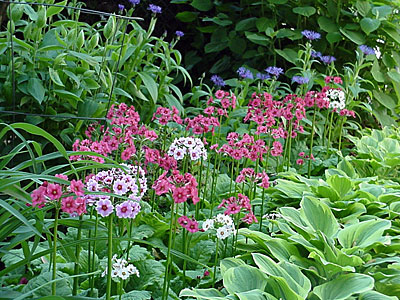
Primula japonicaJapanese primroses, P. japonica, come in many different shades from pure white to dark magenta held on 20″ stems and set off beautifully by their 10″ long bright green leaves.  The flowers are candelabra form which means that they bloom successively in tiers one over the other for a long period of time in May and June.  They are very easy to grow and self-sow readily as long as you plant them in a moist or wet area.  They will grow in average soil but will die as soon as you have a drought.  I am not sure where I got this photo or I would give proper credit.

.

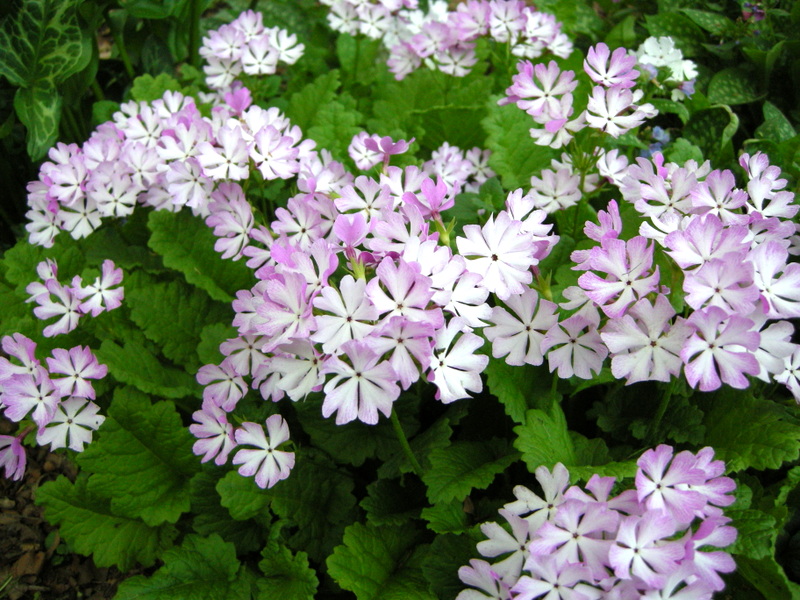
Primula sieboldiiOne of the many forms of Japanese woodland primroses, P. sieboldii, that I have collected over the years.

Japanese woodland primroses (not to be confused with the Japanese primroses described above) are a wonderful addition to the garden because they grow in full dry shade but also thrive in average or even moist soil.  They are from Asia and have been cultivated in Japan since the 16th century but are rare in the US.  Reportedly over 500 cultivars have been named, and I see how they can become addictive because I keep adding new forms to my garden.  They bloom in April and May in colors from white to pink to purple and everything in between.  The crinkly green leaves form large patches and effectively block weeds even though they go dormant when it gets hot out.

.

Primula sieboldiiThe flowers of Japanese woodland primrose often have a different color “reverse” (back), here white with lavender pink.

.

Primula sieboldiiThey also can have filigreed edges kind of like a doily for a lovely dainty effect.

.

Primula sieboldii 'Snowflake'The earliest to bloom in my garden is pure white ‘Snowflake’.

.

Primula sieboldiiThis is the straight species and is one of my favorites.  Local readers should make an effort to see Japanese woodland primrose blooming in my garden because the photos don’t do justice to their beauty.  They are located under the tree below the birdhouse.

.

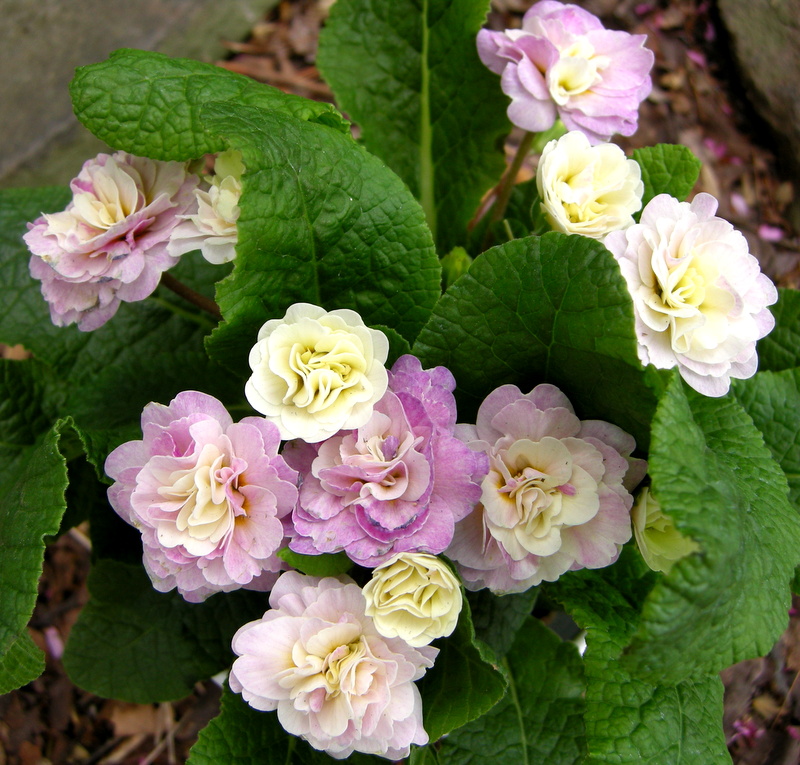
Primula 'Belarina Valentine'‘Belarina Valentine’ double primrose

Even though they look delicate, the Belarina Series of double primroses has proven to be reliably perennial in my garden.  They bloom in late April and May, and the leaves are just emerging right now.  I have sited them in an east-facing location between stepping stones under a Japanese maple.  The soil probably does not dry out because of the stones and the heavy mulch of leaves and pine needles.  If you are looking for a colorful primrose like the non-hardy grocery store varieties, these showy double primroses are just what you want.

.

Primula 'Belarina Pink Ice'‘Belarina Pink Ice’ double primrose

.

Primula 'Belarina Cobalt Blue'‘Belarina Cobalt Blue’ double primrose

.

Primula 'Belarina Nectarine'‘Belarina Nectarine’ double primrose

.

Many of these primroses will be available at the open house sale at Carolyn’s Shade Gardens this Saturday, April 13, from 10 am to 3 pm.  The rest will be for sale as they come up because I grow most of them myself.  Readers who are not local now know which reliably perennial primroses to ask for at their local nursery.

Carolyn

.

Carolyn’s Shade Gardens is a retail nursery located in Bryn Mawr, Pennsylvania, US, zone 6b.  The only plants that we mail order are snowdrops and miniature hostas and only within the US.

If you are within visiting distance and would like to receive catalogues and information about customer events, please send your full name and phone number to carolynsshadegardens@verizon.net.  Subscribing to my blog does not sign you up to receive this information.

Nursery Happenings:  Our open house sale featuring early spring-blooming shade plants takes place this Saturday, April 13, from 10 am to 3 pm.  If you are a customer, you should have gotten an email with all the details. If you can’t come to an event, just email to schedule an appointment to shop.  Coming up next is our Great Hosta Blowout where we sell desirable hostas at bargain prices—look for an email.

Facebook:  Carolyn’s Shade Gardens has a Facebook Page where I post single photos, garden tips, and other information that doesn’t fit into a blog post.  You can look at my Facebook page here or click the Like button on my right sidebar here.

Notes: Every word that appears in orange on my blog is a link that you can click for more information.  If you want to return to my blog’s homepage to access the sidebar information (catalogues, previous articles, etc.) or to subscribe to my blog, just click here.

Native Plants 2013

Posted in groundcover, native plants, Shade Gardening, Shade Perennials with tags , , , , , , , , , , , , , , , , , , , , , , , , , , , , , , , , , , , , , , , , , , , , , , on April 3, 2013 by Carolyn @ Carolyns Shade Gardens

Carolyn’s Shade Gardens is a retail nursery located in Bryn Mawr, PA, specializing in showy, colorful, and unusual plants for shade.  The only plants that we ship are snowdrops and miniature hostas.  For catalogues and announcements of events, please send your full name, location, and phone number (for back up use only) to carolyn@carolynsshadegardens.com.  Click here to get to the home page of our website for catalogues and information about our nursery and to subscribe to our blog.

Stylophorum diphyllum & Mertensia virginicaThis photo is one of my favorite shots of my native woodland which has huge swathes of some of the native plants that are particularly good spreaders, including Virginia bluebells, Mertensia virginica, and Celandine poppy, Stylophorum diphyllum.  For more photos of my woods and information on the natives I grow there click here.

.

This weekend Carolyn’s Shade Gardens is holding its second annual Native Wildflower Weekend on Friday from 10 am to 4 pm and Saturday from 10 am to 2 pm.  This event is my seventh annual native plant event and is timed to coincide with my native woodland coming into bloom.  However, this is the coldest spring that I have experienced since starting Carolyn’s Shade Gardens 21 years ago.  The timetable for my events is the same but the plants in the ground and in the pots are on a totally different schedule—they didn’t get the memo, they think it’s early March.

.

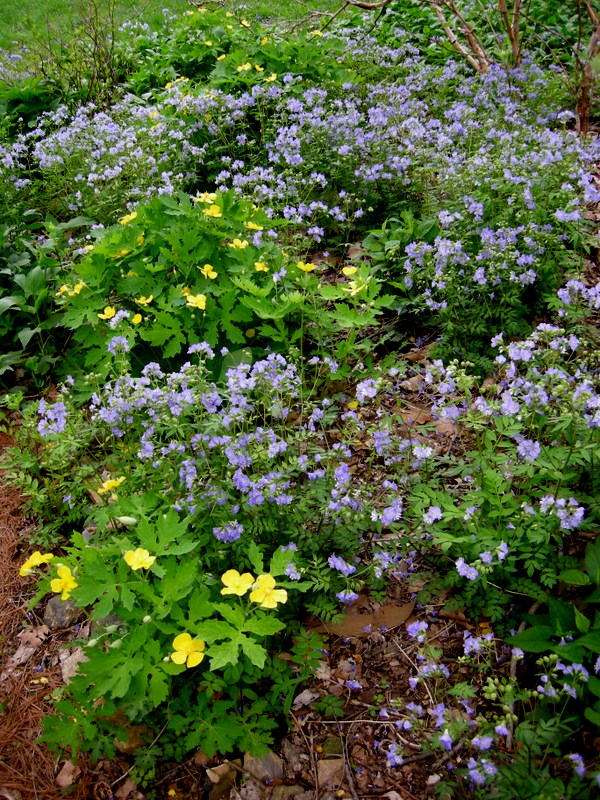
Polemonium reptansAnother shot of what my woods should look like with dwarf Jacob’s ladder, Polemonium reptans, in the foreground and native wild-ginger, Asarum canadense, in the background.  The Jacob’s ladder is visible right now, but the ginger has not even emerged from the mulch of ground leaves.

Normally I write a blog post around this time featuring native plants. That process usually involves heading out to the garden to take a lot of photos of my native plants to use in the article.  However, the only plants blooming right now are hellebores, pulmonarias, and many beautiful non-native bulbs—all my winter-blooming shade plants.  So I thought I would use some of my existing photos to show you what spring usually looks like and to highlight some native favorites.

.

Senecio aureusThe woodland with golden groundsel, Senecio aureus, and Virginia bluebells.  Golden grounsel is a wonderful native plant with fragrant yellow flowers and wintergreen leaves.  It spreads aggressively to form an impermeable groundcover and should only be planted in places where its habit can be accommodated.  It is a wonderful replacement for pachysandra, vinca, or ivy.

.
Phlox stolonifera 'Home Fires'‘Home Fires’ creeping phlox, P. stolonifera, is actually blooming in the pots for sale at my nursery.  You have to admire its courage!

.

Phlox stolonifera 'Sherwood Purple'‘Sherwood Purple’ creeping phlox is the best spreader for use in a shady woodland.  Creeping phlox should not be confused with moss phlox, P. subulata, which is also native but prefers part shade.

.

Heuchera villosa 'Citronelle'Lemon coral bells, Heuchera villosa ‘Citronelle’, keep their color all winter as do all the coral bells native to our area.  They are also tough as nails compared to the coral bells derived from western natives that don’t work here.

.

Heuchera 'Green Spice' Terra Nova photo‘Green Spice’ coral bells have beautifully patterned leaves all winter.

.

Spigelia marilandicaIndian pink, Spigelia marilandica, is a very flashy native that blooms in May and June and attracts hummingbirds.  It is dormant in the garden and in the pots right now.

.

Phlox divaricata 'Blue Moon'The lovely fragrant flowers of ‘Blue Moon’ wild sweet William, Phlox divaricata, are a great spreading addition to the woodland edge.

.

Phlox divaricata 'May Breeze'‘May Breeze’ wild sweet William is a steely white.

.

Lobelia cardinalisOne of my all time favorite native plants, cardinal flower, Lobelia cardinalis, blooms in the fall and is a hummingbird magnet.

.

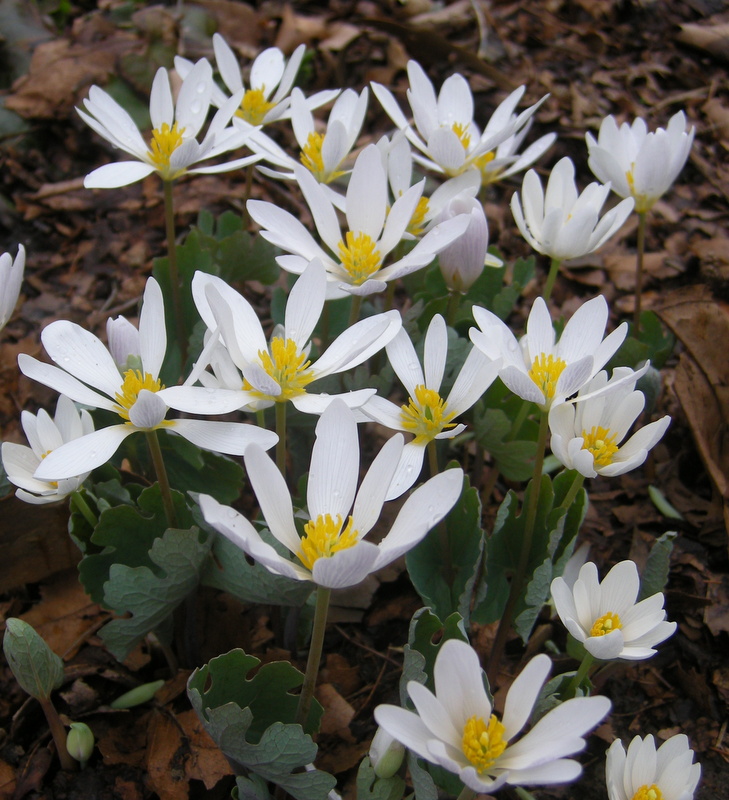
Sanguinaria canadensisNo garden should be without bloodroot, Sanguinaria canadensis.

.

Polemonium reptansDwarf Jacob’s ladder and Celandine poppy are equally vigorous and combine well.

.

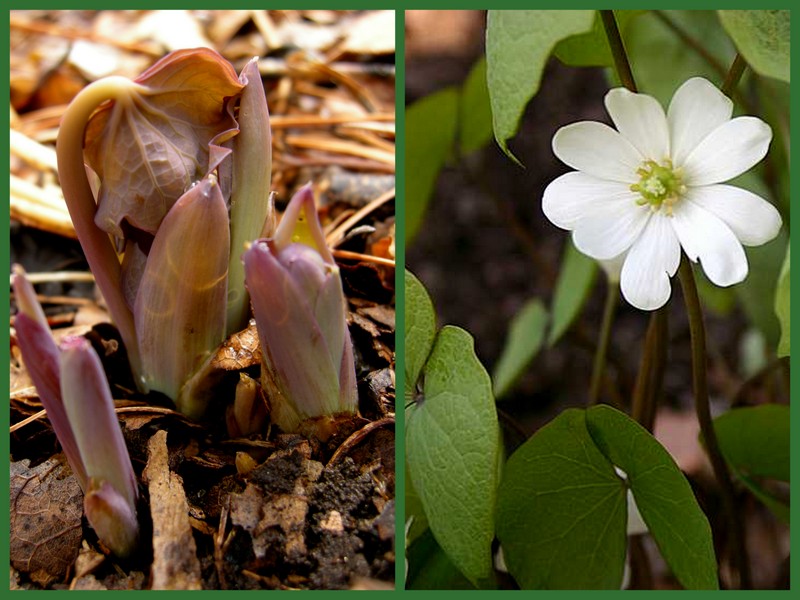
Podophyllum peltatumThe elegant leaf pattern of our native mayapple, Podophyllum peltatum, is under-appreciated.

.

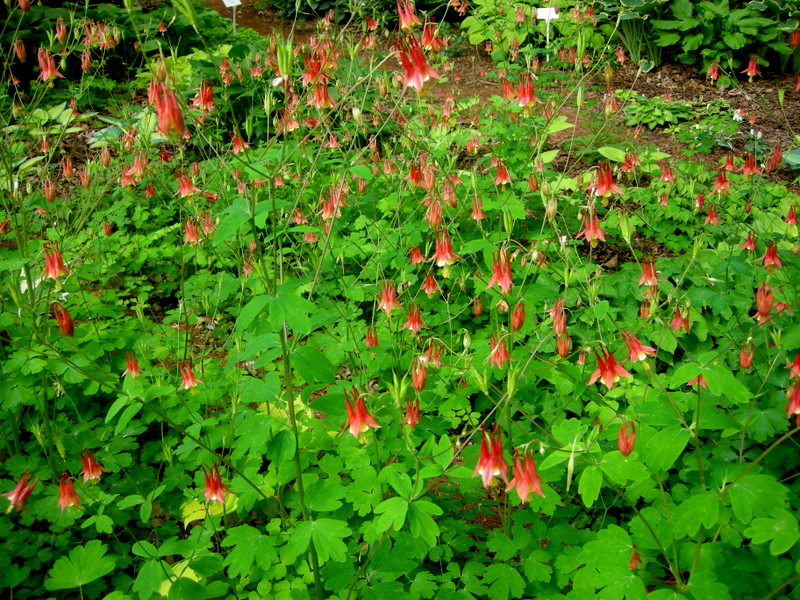
Aquilegia canadensisAnother hummingbird attractor, wild columbine, Aquilegia canadensis, needs very good drainage.

.

Asarum caudatumIf you like the shiny leaf of European ginger, the native long-tailed ginger, Asarum caudatum, from the west coast is a nice alternative.  It grows faster and is less picky about siting.
.

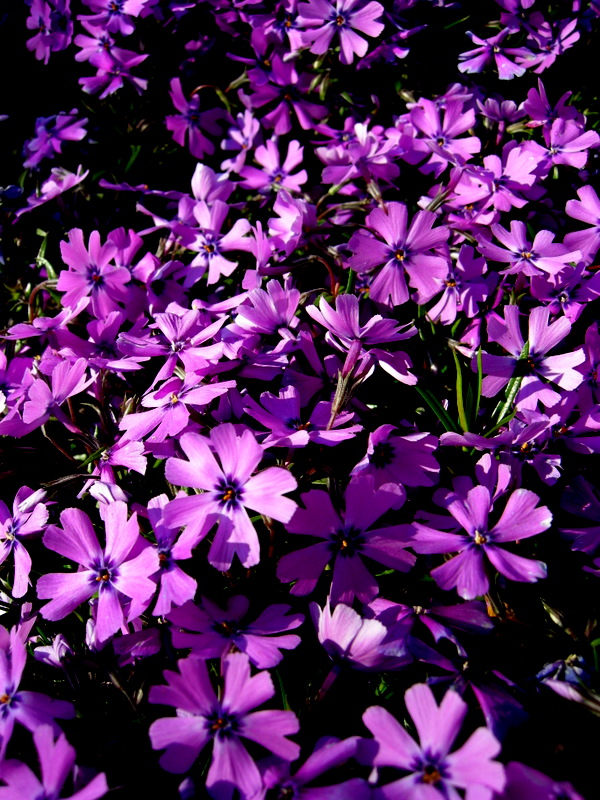
Phlox subulata 'Purple Beauty'‘Purple Beauty’ moss phlox, P. subulata, is one of seven different colors that I will be selling this season.  Moss phlox is often seen in quite a bit of sun but it also thrives in part shade locations.  It likes to be well-drained.

.

Jeffersonia diphyllaA treasured native, twin-leaf, Jeffersonia diphylla, has not even started to emerge yet.

.

Camassia leichtlinii 'Coerulea'Another native of western US, ‘Caerulea’ camassia, C. leichtlinii, grows in the full shade of my woodland and in the sunny areas beside my lawn.

.

Erythronium 'Pagoda'‘Pagoda’ dogtooth violets, Erythronium ‘Pagoda’, are so happy in my woods that they have self-sowed all over.

.

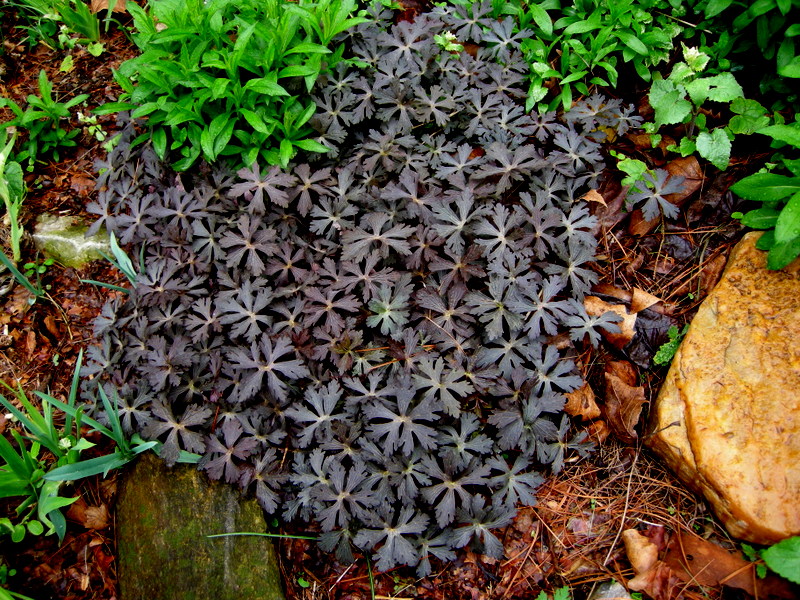
Geranium maculatum 'Espresso'My favorite time of year for the purple-leafed native geranium ‘Espresso’, G. maculatum, is when it first emerges in the spring.

.

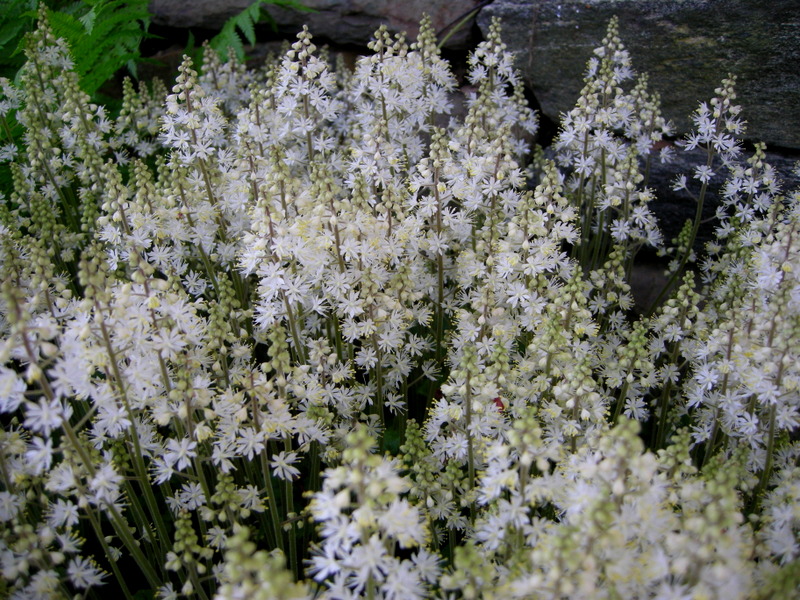
Tiarella cordifolia 'Brandywine'Foamflowers, Tiarella cordifolia, are a wonderful Pennsylvania native.  This is the spreading form ‘Brandywine’.

.

Iris cristataIn well-drained locations, blue dwarf crested iris, I. cristata, spreads to make large colonies.

.

Every photo in this post was taken in my garden.  If you live in the area, I hope you can visit when the plants are in bloom.  Meanwhile, if you want them in your garden, this weekend is your chance to acquire them.

Carolyn

.

Carolyn’s Shade Gardens is a retail nursery located in Bryn Mawr, Pennsylvania, US, zone 6b.  The only plants that we mail order are snowdrops and miniature hostas and only within the US.

If you are within visiting distance and would like to receive catalogues and information about customer events, please send your full name and phone number to carolynsshadegardens@verizon.net.  Subscribing to my blog does not sign you up to receive this information.

Nursery Happenings:  Our Native Wildflower Weekend takes place this Friday, April 5, from 10 am to 4 pm, and Saturday, April 6, from 10 am to 2 pm.  If you are a customer, you should have gotten an email with all the details. If you can’t come to an event, just email to schedule an appointment to shop.  If you wish to order shrubs, I will be doing a second order within the next week for customers who missed the deadline. 

Facebook:  Carolyn’s Shade Gardens has a Facebook Page where I post single photos, garden tips, and other information that doesn’t fit into a blog post.  You can look at my Facebook page here or click the Like button on my right sidebar here.

Notes: Every word that appears in orange on my blog is a link that you can click for more information.  If you want to return to my blog’s homepage to access the sidebar information (catalogues, previous articles, etc.) or to subscribe to my blog, just click here.