Archive for the winter Category

Snowdrops at Thenford Gardens

Posted in bulbs for shade, snowdrops, winter, winter garden, winter interest with tags , , , , , , , , , , , , on December 13, 2025 by Carolyn @ Carolyns Shade Gardens


Thenford Gardens and Arboretum

To access our mail order snowdrop catalogue, click here.  We are currently taking orders, and there are still a lot of great varieties left.

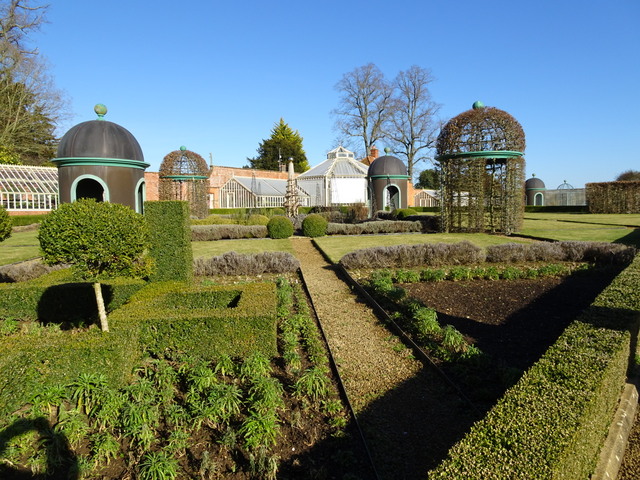
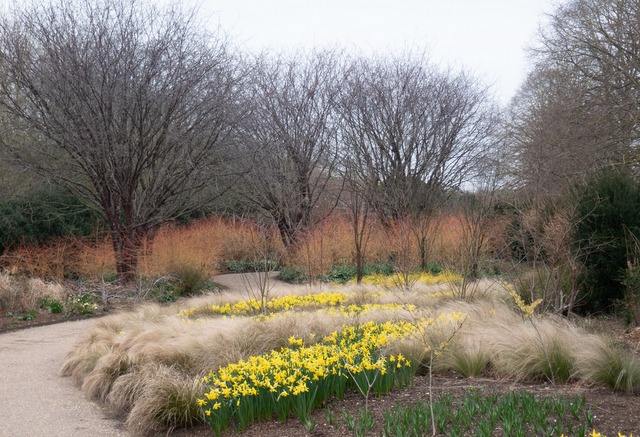
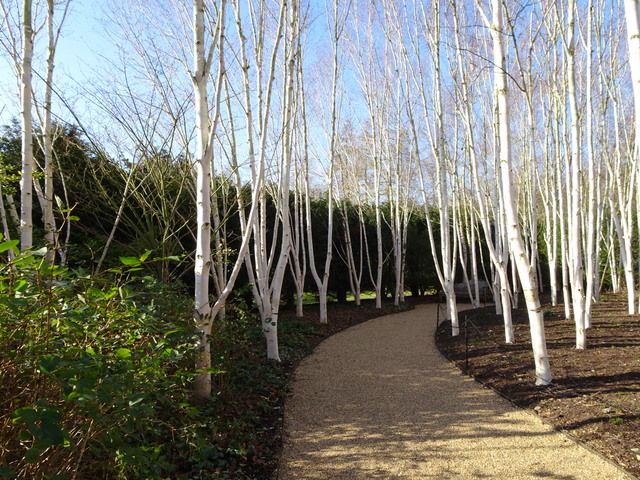
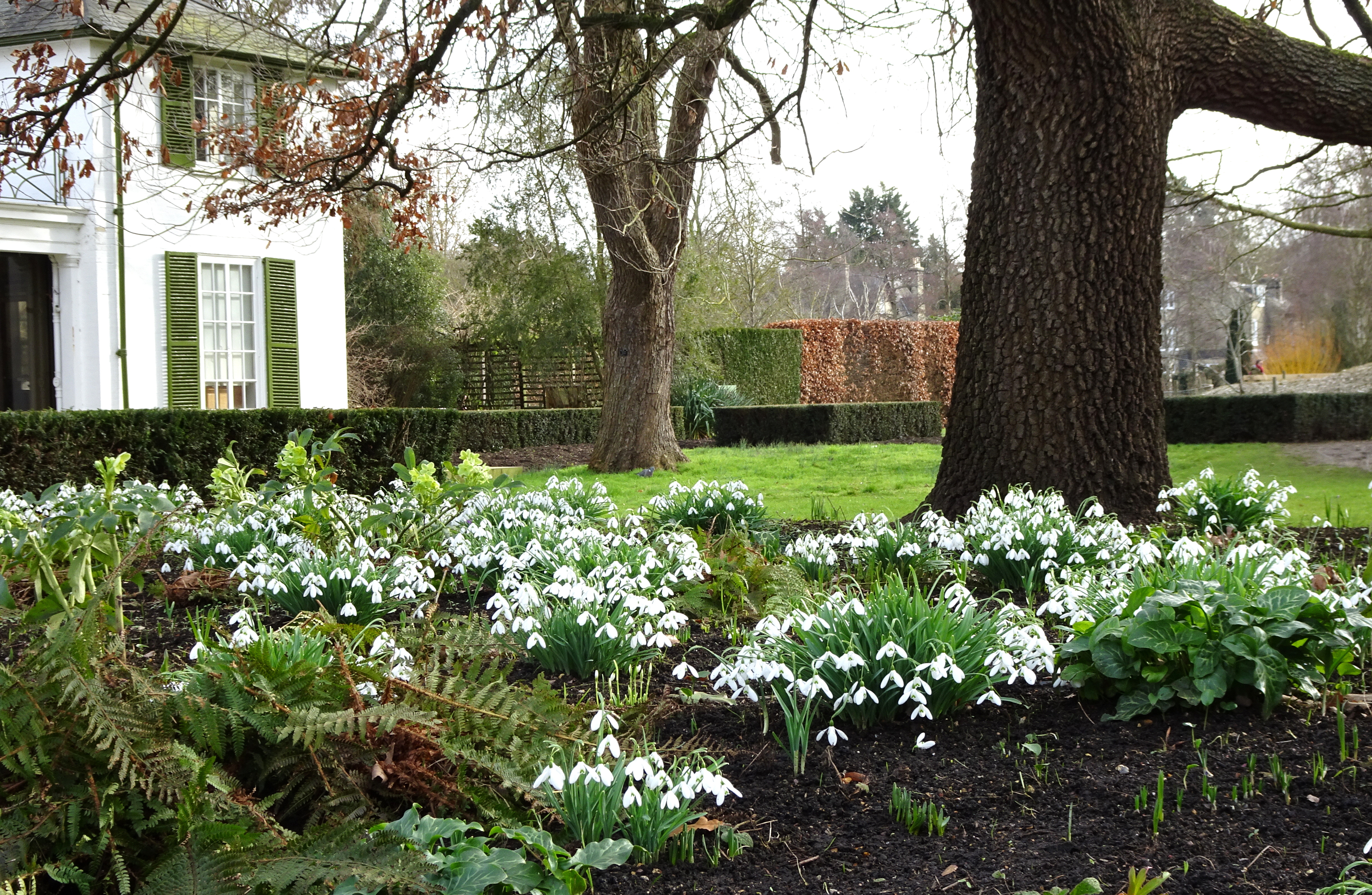
.The winter landscape at Thenford is classically beautiful.

In February of 2023, we had the great good fortune to be invited by Deputy Head Gardener Emma Thick for a private tour of the snowdrops at Thenford Gardens and Arboretum located in Thenford, Near Banbury, Oxfordshire, England.  Thenford is a 70 acre arboretum created by Michael and Anne Hesseltine, beginning in 1976 when they purchased the property.  Their initial focus was a 40 acre woodland that required extensive renovations to the woods themselves and various structures and water features, including a walled garden, a rill, water gardens, and a sculpture garden.  Thenford now has over 3,000 different trees and shrubs.

Nursery News:  Carolyn’s Shade Gardens is a retail nursery located in Bryn Mawr, PA, specializing in showy, colorful, and unusual plants for shade.  The only plants that we ship are snowdrops within the US.  For catalogues and announcements of local events, please send your full name, mailing address, and cell number to carolyn@carolynsshadegardens.com and indicate whether you are interested in snowdrops.  Click here to get to the home page of our website for catalogues and information about our nursery and to subscribe to our blog.

.Another beautiful vista at Thenford.

In the 1990s Henry and Carolyn Elwes, whose gardens at Colesbourne Park are a premier snowdrop destination, encouraged the Hesseltines to focus on adding snowdrops to Thenford’s collection.  In 2014, snowdrop expert Emma Thick was hired to oversee the snowdrops, and in 2016, the garden began opening for snowdrop walks.  Today there are over 1,000 snowdrop cultivars and species in the collection, which was awarded National Collection status by Plant Heritage in June 2023.  The current focus is dividing and spreading the snowdrops more widely through out the grounds.

.The walled garden.

You can visit Thenford by purchasing tickets in advance here.  The snowdrop open days for 2026 are January 28 and February 14, 20, and 24.  Tickets are £14.00.

.My husband Michael with Emma Thick in the walled garden.

As you can see from the photos above, the day we visited Thenford was bright and sunny with not a cloud in the sky.  These are not ideal conditions for taking photos of snowdrops, which get washed out in bright sunlight and look awful when partially in full shade and partially in full sun.  However, I did get a few decent shots. 

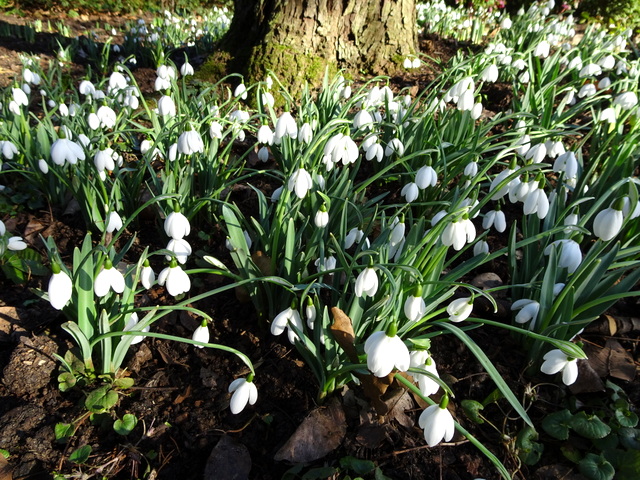
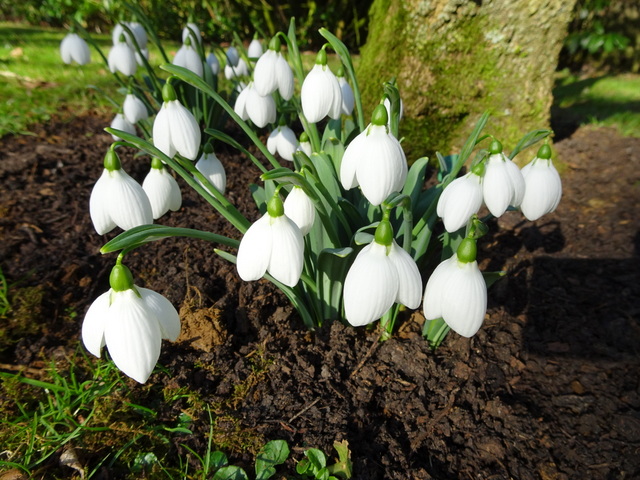
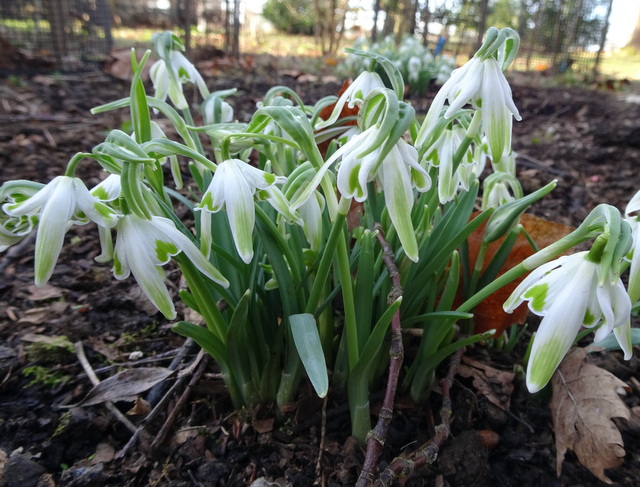
First, here are some of the amazing sweeps of snowdrops that blanket the gardens:

.

‘Godfrey Owen’

.

‘Primrose Warburg’

.

‘Lapwing’

.

‘Mrs. Thompson’

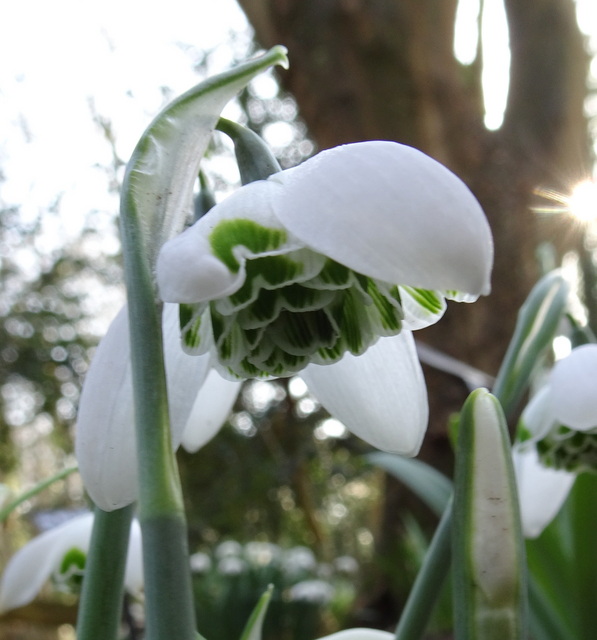
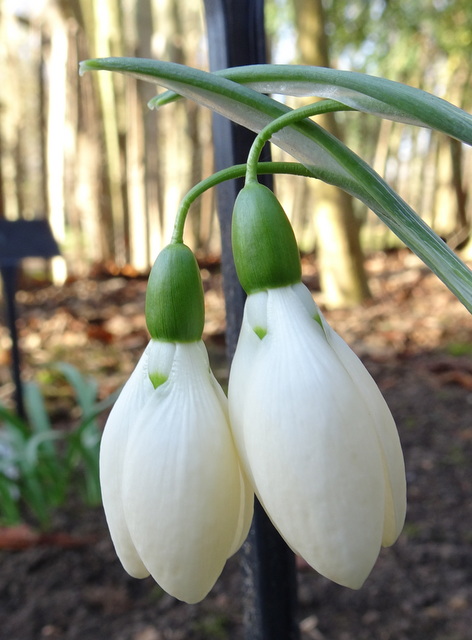
Here are some of the individual snowdrops that I admired:

.

‘Bill Bishop’

.

‘Moses Basket’ dutifully making its basket

.

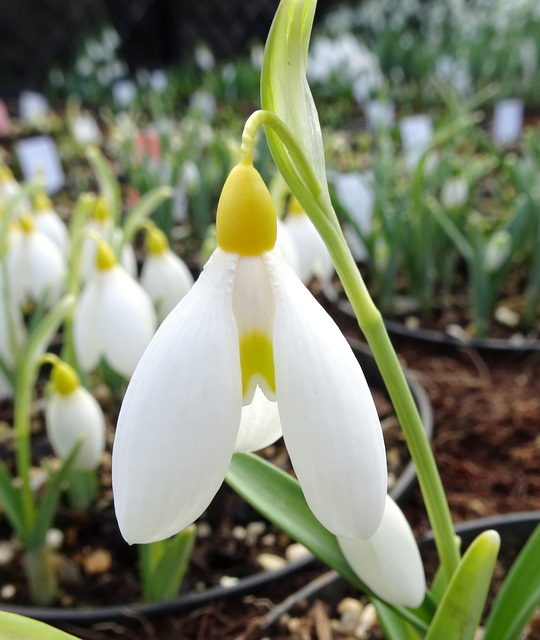
‘Fatty Puff’

.

‘Walrus’

.

‘Walter’s Double’

.

A cross between ‘Fatty Puff’ and G. gracilis ‘Yamandar’, which I found quite intriguing.

.

Thanks, Emma, for a wonderful visit!

.

Blogs are a lot more fun for everyone, especially the writer, when readers leave comments.  If you are reading this post in the WordPress email (white background), just reply to the email to comment.  If you are reading the post on my blog (black background, recommended for better viewing), scroll down to the end of the page to the box where it says “Leave a Comment” and start typing—-it’s easy!

Carolyn

.

Note: Every word that appears in orange on my blog is a link that you can click for more information. If you want to return to my blog’s homepage to access the sidebar information (catalogues, previous articles, etc.) or to subscribe to my blog, just click here.

New Snowdrops for 2026: Part Three

Posted in bulbs for shade, snowdrops, winter, winter garden, winter interest with tags , , , , , , , , , , , , , , , , , , , , on December 3, 2025 by Carolyn @ Carolyns Shade Gardens

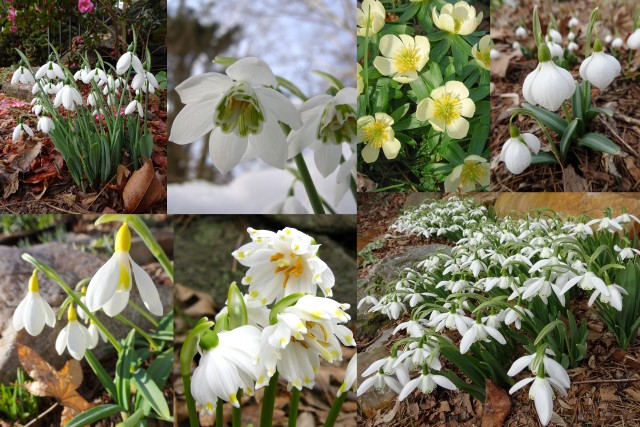
These plants will be in the 2026 catalogue coming out this Saturday, December 6: clockwise from upper left, tall & elegant ‘Xmas’ blooming with fall camellias, very unusual 6-petaled ‘Godfrey Owen’, pale yellow aconite ‘Schwefelglanz’, very unique ‘Diggory’, double-flowered & vigorous ‘Lady Beatrix Stanley’, rare semi-double leucojum ‘Gertrude Wister’, and yellow-flowered ‘Wendy’s Gold’

To access our current snowdrop catalogue when its available, click here.

One of the many benefits of buying snowdrops as plants rather than as bulbs is that WE grow the bulbs on to plants and assume the risks of the bulb being the wrong cultivar, suffering from disease, and/or under-performing by producing plants too small to sell.   When you buy a dried or dormant bulb, you will not know if any of these issues will be a problem.  If you buy a growing plant from us,  you will know that it is the right cultivar, disease-free, and blooming-size.  If any of these problem conditions exist, we will not sell the plant to you.

.

When we purchased dormant bulbs, we received ‘Sprite’ (lovely in its own right) when we were expecting ‘Spindlestone Surprise’.

The downside for us is that we have to cancel a few snowdrops that we intended to offer when we see them emerging in late fall or cancel orders for plants in February around shipping time.  Although this is inconvenient and growing plants instead of selling the bulbs is much more time-consuming for us, we think it is worth it in order to make the highest quality snowdrops available to our customers.  We would rather have a snowdrop underperform in our garden than yours!

.

These ‘Walker Canada’ bulbs purchased in the fall proved to be diseased when we dug them the following February to sell.  Note that the leaves of these plants look perfectly normal so that, if they were planted as dormant bulbs directly in your garden, you would not know they were diseased.  Meanwhile they would be spreading disease through out your snowdrop collection.  That is why we recommend that you never plant dried or dormant snowdrop bulbs directly in your garden.

Three cultivars profiled in our new offering posts, click here and here to read, are now obviously too small to sell in the 2026 catalogue.  They are ‘Early Bird’, ‘Poculi Perfect, and ‘Selina Cords’, all snowdrops from species with smaller bulbs that may have been adversely affected by the drought.  This post is part three of a three-part series on our new snowdrop offerings and will profile ‘B and B Duncan’, ‘Clare Blakeway-Phillips’, and ‘Frank Lebsa’, all being offered by us for the first time.

.

‘Early Bird’ is very healthy but too small to sell this year.

The 2026 Snowdrop Catalogue will be posted on our website on December 6, 2025, at 11 am EST, and details will be sent to our snowdrop customer email list at that time.  Meanwhile, this post will give everyone an advance look (sorry, no advance orders) at three more special, new snowdrops that will be available for order on December 6.  Enjoy!

Nursery News:  Carolyn’s Shade Gardens is a retail nursery located in Bryn Mawr, PA, specializing in showy, colorful, and unusual plants for shade.  The only plants that we ship are snowdrops within the US.  For catalogues and announcements of local events, please send your full name, mailing address, and cell number to carolyn@carolynsshadegardens.com and indicate whether you are interested in snowdrops.  Click here to get to the home page of our website for catalogues and information about our nursery and to subscribe to our blog.

.

The flowers of ‘B and B Duncan’ have an elegant shape.

‘B and B Duncan’ is a late-blooming cultivar of the giant snowdrop, G. elwesii. It has large, rounded outer segments held out like spoons on the long claws, which join the outers to the ovary. There are faint basal marks on the inners, looking like eyes.  It is late blooming and grows prolifically.  It is especially prized for its beautiful scent.

.

‘B and B Duncan’ has a very upright habit.

‘B and B Duncan’ was originally discovered by well known Irish garden designer and lecturer Helen Dillon.  She passed it to Altamont Gardens in County Carlow, Ireland, where it was evaluated for over 25 years.  Robert Miller, Altamont’s owner,  named it for Brian Duncan, an RHS and American Daffodil Society award-winning daffodil breeder, and his wife Betty.  It was introduced at the 2024 Annual Irish Snowdrop Gala.

. ‘Clare Blakeway-Phillips’ has an almost solid green inner mark.

‘Clare Blakeway-Phillips’ is a floriferous G. plicatus hybrid.  It has large, rounded outer segments and an almost fully green inner mark.  The shiny, bright lime-green ovary (the cap above the bloom) makes the flower very distinct.  Its widely splayed, very glaucous leaves perfectly display this vigorous snowdrop.

.

‘Clare Blakeway-Phillips’ was collected from the Herfordshire garden of Angela Marchant in the early 1970s by snowdrop enthusiast Reverend Richard Blakeway-Phillips.  He named it after his daughter, and it received an RHS Award of Merit in 1976.  Our stock, as verified by beloved snowdrop expert Alan Street, originated from the garden of Veronica Cross not far from her well known “island”

.

‘Frank Lebsa’ is just beautiful.

‘Frank Lebsa’ is a cultivar of G. elwesii var. monostictus.  It could be the earliest blooming member of the Hiemalis Group in my garden, starting to bloom in October right after G. reginae-olgae.  It has gorgeous markings with a dark green inner mark covering more than half the segment and a bold, lighter green patch on the outer segments.  It really stands out in the fall when most snowdrops are just white, beautiful as they may be!

.

‘Frank Lebsa’ is very noticeable in the fall garden.

‘Frank Lebsa’ was discovered in 1999 by Elisabeth Lebsa in a pot of giant snowdrops at the Dresden flower market.  It was named by her son, snowdrop expert Jörg Lebsa, for his brother.  Anne Repnow profiles it on page 40 of Some Snowdrops.

.

Blogs are a lot more fun for everyone, especially the writer, when readers leave comments.  If you are reading this post in the WordPress email (white background), just reply to the email to comment.  If you are reading the post on my blog (black background, recommended for better viewing), scroll down to the end of the page to the box where it says “Leave a Reply” and start typing—-it’s easy!

Carolyn

.

Note: Every word that appears in orange on my blog is a link that you can click for more information. If you want to return to my blog’s homepage to access the sidebar information (catalogues, previous articles, etc.) or to subscribe to my blog, just click here.

New Snowdrops (& a Leucojum) for 2026: Part Two

Posted in bulbs for shade, snowdrops, winter, winter garden, winter interest with tags , , , , , , , , , , , , , , , , , , , , , , on November 16, 2025 by Carolyn @ Carolyns Shade Gardens

‘Treasure Island’ is the most beautiful yellow snowdrop I have ever seen.

To access our current snowdrop catalogue, click here.

Seeing the green tips of emerging snowdrops in our garden every fall never gets old.  The anticipation and promise that those tips represent propel me happily through fall garden chores.  Right now, several varieties are finished while ‘Barnes’ and ‘Peter Gatehouse’ are in full glorious bloom.

This is part two of a two-part post on the new snowdrops plus a new leucojum that will be offered in our 2026 Snowdrop Catalogue.  To read part one, click here.  The catalogue will be posted on our website in the first half of December, and details will be sent to our snowdrop customer list soon.  Meanwhile, this post will give everyone an advance look (sorry, no advance orders) at four more special, new snowdrops and a leucojum that will be available for order in December.  Enjoy!

Nursery News:  Carolyn’s Shade Gardens is a retail nursery located in Bryn Mawr, PA, specializing in showy, colorful, and unusual plants for shade.  The only plants that we ship are snowdrops within the US.  For catalogues and announcements of local events, please send your full name, mailing address, and cell number to carolyn@carolynsshadegardens.com and indicate whether you are interested in snowdrops.  Click here to get to the home page of our website for catalogues and information about our nursery and to subscribe to our blog.

.

A close up of ‘Treasure Island’s’ gorgeous yellow flower.  Photo taken at Avon Bulbs on 2/2/23

‘Treasure Island’ is probably the largest flowered yellow snowdrop available in the trade.  It is impossible to overstate how impressive and beautiful this snowdrop is.  Descriptions often say that it has the stature and substance of ‘Mighty Atom’, which is true, although I cannot determine if it is actually a descendant of that still sought after cultivar.  When I saw it en mass at Avon Bulbs in England in 2017, I couldn’t believe how big the flowers were, what a stunning yellow it was, or the elegance of the whole plant.

.

My first view of ‘Treasure Island’ in 2017—look at the size of those flowers compared to the cultivar in the pot right behind it!  Photo taken at Avon Bulbs on 2/9/17

Famous galanthophile Veronica Cross in Herefordshire had an area of her garden called Treasure Island where she told everyone she “kept her treasures”.  Many fine snowdrops originated there so I can only surmise that this one was the best as it received the name ‘Treasure Island”.  It was introduced in 2015. For me it is very vigorous, producing five flowers the year after I planted it.  Anne Repnow profiles it on page 104 of Some More Snowdrops.

.

‘Lord Lieutenant’ proudly displays its big flowers and bold markings.

‘Lord Lieutenant’ has the big, rounded flowers and the beautiful, pleated leaves characteristic of G. plicatus.  The blooms are held at a sharp angle by the short pedicel (flower stem), looking like they are standing at attention.  The bold, dark green, X mark on the inner segments is quite attractive.

.

You can see the lieutenant-like stance even more clearly when the flowers are closed, here at Colesbourne Park in England on 2/10/17. 

‘Lord Lieutenant’ was selected by our dear friend Lady Carolyn Elwes at Colesbourne Park, the magnificent snowdrop destination in England where this photo was taken.  She named it in 1999 for her husband Sir Henry Elwes’s long-standing position as the Queen’s representative in Gloucestershire or Lord Lieutenant.  Anne Repnow profiles it on page 66 of Some Snowdrops.

.

‘Elfenkind’s’ little face is clearly visible.

‘Elfenkind’ means elfin child and refers to the adorable elf-like face peeking out from the inner segments.  When the plant is settled the outer segments have green tips.  It is a prolific multiplier and easy to grow, blooming around the New Year.  Mine bloomed on December 19 in 2024.   It was discovered in a batch of bulk Galanthus elwesii  in 2018.

.‘Prestwood White’ displays its beautiful poculiform shape.  Photo 3/1/2016 at Carolyn’s Shade Gardens.

‘Prestwood White’ is a tiny and rare cultivar of Galanthus nivalis.  It is a poculiform snowdrop meaning all the segments are outers and approximately the same length.  It is pure white, although occasionally it has a green dot on the apex of the inners.  It is a carefree and vigorous grower.

.

‘Prestwood White’, photo at Carolyn’s Shade Gardens 2/23/22

‘Prestwood White’ was found by the famous John Massey of Ashwood Nurseries in Kingswinford, England, about four miles along the canal from the nursery in a wild population of common snowdrops.  It was originally called “John’s Poculiformis” but later named ‘Prestwood White’.  John gave some to Marietta O’Byrne of Northwest Garden Nursery in Eugene, Oregon, and her husband, Ernie, passed one to me in 2013.

.

Carpathian snowflakes have yellow spots instead of the typical green.

Leucojum vernum var. carpathicum, the Carpathian snowflake, is one of two established varieties of Leucojum vernum, the spring snowflake.   The other, var. vernum with green spots, is more commonly available but still rare.  Carpathian snowflakes have beautiful yellow marks on their tepals (petals).  They grow naturally in the Carpathian Mountains, which spread from Austria in an arc to Romania. 

.

A clump of Carpathian snowflakes is truly magical!

.

Blogs are a lot more fun for everyone, especially the writer, when readers leave comments.  If you are reading this post in the WordPress email (white background), just reply to the email to comment.  If you are reading the post on my blog (black background, recommended for better viewing), scroll down to the end of the page to the box where it says “Leave a Reply” and start typing—-it’s easy!

Carolyn

.

Note: Every word that appears in orange on my blog is a link that you can click for more information. If you want to return to my blog’s homepage to access the sidebar information (catalogues, previous articles, etc.) or to subscribe to my blog, just click here.

A Special Tour of Anglesey Abbey

Posted in bulbs for shade, snowdrops, winter, winter garden, winter interest with tags , , , , , , , , , , , , , , , , , , on December 14, 2024 by Carolyn @ Carolyns Shade Gardens


The house at Anglesey Abbey was originally built in 1600 on the ruins of a priory dissolved by Henry VIII in 1536.  Photo David Boughey

To access our current snowdrop catalogue, click here.  There are still a lot of great snowdrops left.

In February of 2023, Michael and I visited the magnificent winter gardens at Anglesey Abbey in Lode, England, about five miles outside of Cambridge.  We came at the invitation of the wonderful David Boughey, National Trust Service Assistant, who arranged a private tour of Anglesey’s snowdrop collection for us.  David is also a professional photographer and supplied many of the photographs for this post.  Thank you, David!

.

Nursery News:  Carolyn’s Shade Gardens at Whitehall Farm is a retail nursery in Norristown, PA, U.S., zone 6b/7a. If you are interested in shopping here, send us an email with your full name, mailing address, and cell number to carolyn@carolynsshadegardens.com and indicate if you are interested in shopping at the nursery and/or snowdrops (mail order only). Current catalogues, hours/contact information , and directions are under Pages on the right sidebar. The only plants we ship are snowdrops to US customers. Click here to get to the home page of our website for catalogues and information about our nursery and to subscribe to our blog.

.

The Anglesey Abbey grounds include Lode Mill, a completely functional corn mill, originally purchased and restored by Lord Fairhaven in 1934 but probably in existence prior to 1086.  Photo David Boughey

Our tour was conducted by very knowledgeable Senior Gardener David Jordan, who guided us through the winter gardens and the Specialist Collection of Snowdrops.  Anglesey Abbey has over 500 varieties of snowdrops so it is a great place for galanthophiles.  But before I get to the snowdrops, I want to show you the stunning winter gardens.  The following photos were taken by David Boughey.

..

.

.

.

.

.

Now for the snowdrops……

.

Anglesey Abbey has had to limit access to the snowdrop collection after a series of snowdrop thefts so the Specialist Collection is only accessible with advance booking of a guided tour.  The tours take place in January and February and sell out quickly.  The 2025 tour schedule was not available at the time of this post, but click here to check for updates.

.

We passed this sculptural birch grove on the way to the snowdrops.

.

There were also many naturalized snowdrops in the woods and gardens outside the special collection.

The snowdrop collection featured so many amazing and notable cultivars that it would be impossible to do it justice—you just have to visit.  In the meantime, I will show nine snowdrops that were discovered and selected at Anglesey Abbey:

.

‘Ailwyn’, a RHS Award of Garden Merit-winning snowdrop discovered by the famous Richard Nutt in 1994 and named for Lord Fairhaven, the owner of Anglesey Abbey who donated it to the National Trust in 1966.

.

‘Anglesey Orange Tip’ was discovered at Anglesey Abbey by our guide Senior Gardener David Jordan.  Its buds are a lovely apricot color, which fades to a glow on the tips when the flowers open.

.

‘Anglesey Orange Tip’ in bud at Colesbourne Park.

.

‘Anglesey Abbey’, though variable, is, at its best, a pure white poculiform snowdrop with glossy green leaves found by famous horticulturist Graham Thomas in the abbey gardens.

.

The beautiful double ‘Lady Fairhaven’ appeared at the abbey in 1998 and is considered very similar to ‘Ailwyn’.

.

‘Anglesey Candlelight’ was discovered by Senior Gardener David Jordan around 2014 and given its name due to the orange glow on the inner segments.

.


‘Huttlestone’ was discovered in the abbey gardens in 1992 by Joe Sharman, the owner of Monksilver Nursery.  It is named for the first Lord Fairhaven.  Look at those leaves!

.

‘Anglesey Cloudgazer’ was found in the abbey gardens by now retired Head Gardener Richard Todd and named by Michael and Ann Broadhurst at Rainbow Farm Snowdrops for a stargazing structure at the abbey designed by Todd.

.

The beautiful and vigorous ‘Richard Ayres’ was found at Anglesey Abbey in 1987 by famous galanthophile Richard Nutt and named for a former Head Gardener.

.

As recounted by then Head Gardener Richard Ayres, ‘Melanie Broughton’ was discovered at Anglesey Abbey during the 1998 Galanthus Gala and later named for Lord Fairhaven’s youngest daughter.  It is still available in our 2025 Snowdrop Catalogue.

.

Blogs are a lot more fun for everyone, especially the writer, when readers leave comments.  If you are reading this post in the WordPress email (white background), just reply to the email to comment.  If you are reading the post on my blog (black background, recommended for better viewing), scroll down to the end of the page to the box where it says “Leave a Reply” and start typing—-it’s easy!

Carolyn

.

Note: Every word that appears in orange on my blog is a link that you can click for more information. If you want to return to my blog’s homepage to access the sidebar information (catalogues, previous articles, etc.) or to subscribe to my blog, just click here.

Cambridge Botanic Garden in Winter

Posted in bulbs for shade, snowdrops, winter, winter garden, winter interest with tags , , , , , , , , , , , , , , on December 7, 2024 by Carolyn @ Carolyns Shade Gardens


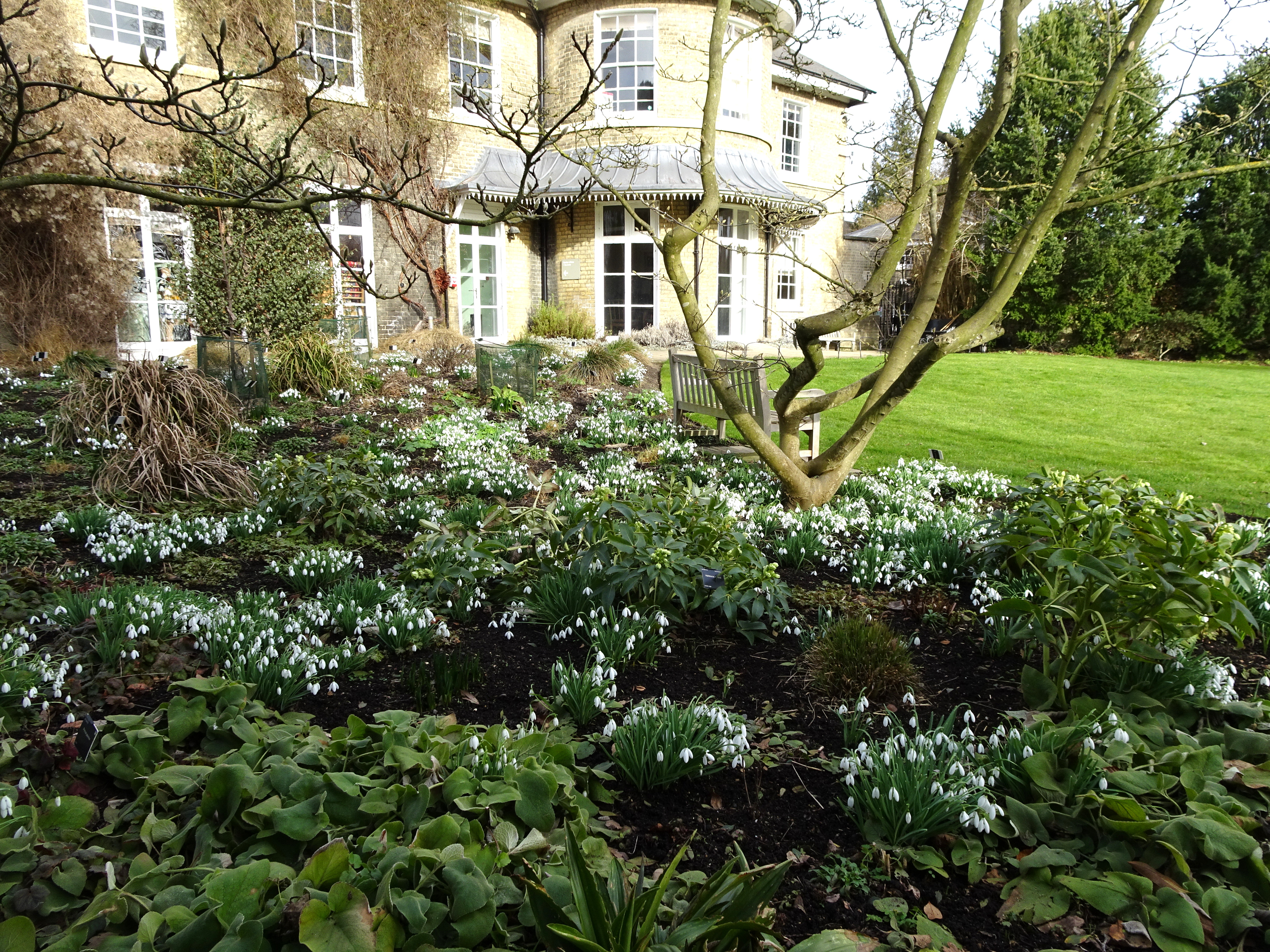
The winter landscape at Cambridge Botanic Garden features stunning displays of snowdrops in February.

To access our current snowdrop catalogue, click here.

We posted our 2025 Snowdrop Catalogue on Sunday to a very enthusiastic response from our wonderful snowdrop customers all over the country.  Our limited supply of the rare and special snowdrops included in our catalogue always sell out in the first few hours.  However, in this post, I want to sing the praises of the more ‘ordinary’ (if you can say that about a Galanthus) snowdrops that should be the backbone of any winter garden while showing you the beautiful winter landscape at the Cambridge University Botanic Garden.

.

The bright white of the award-winning snowdrop ‘Magnet’ is a welcome addition to all parts of a winter garden.

What snowdrops am I talking about?  The easiest way to find them in our catalogue is by looking at the prices.  Snowdrops that multiply easily and rapidly in almost any conditions are less expensive because we have more of them available.  Snowdrops like ‘S. Arnott’, the so-called desert island snowdrop, which galanthophiles would choose if they could only have one.  Or ‘Straffan’, brought back to England by a soldier from the Crimean War.  Or ‘Mrs. Macnamara’, a very early bloomer selected by Dylan Thomas’s mother-in-law.  Or ‘Trumps’, the most vigorous and beautiful pagoda-shaped (inverse poculiform) snowdrop.

Nursery News:  Carolyn’s Shade Gardens is a retail nursery located in Bryn Mawr, PA, specializing in showy, colorful, and unusual plants for shade.  The only plants that we ship are snowdrops within the US.  For catalogues and announcements of local events, please send your full name, mailing address, and cell number to carolyn@carolynsshadegardens.com and indicate whether you are interested in snowdrops.  Click here to get to the home page of our website for catalogues and information about our nursery and to subscribe to our blog.

.

Number one rated ‘S. Arnott’ with hellebores and a winter-blooming iris.

Another way to find them is to look for the designation RHS AGM at the end of the plant descriptions in our catalogue.  This means the snowdrop has received a prestigious Award of Garden Merit from the Royal Horticultural Society in England.  The Society gives AGMs to help “gardeners choose plants that have been tried and tested by experts [and] …  are likely to perform and are excellent for ordinary use.”  Snowdrop AGMs are awarded after extensive trials and judging by snowdrop experts.

.

‘Magnet’ was used throughout Cambridge Botanic Garden, here massed by the pond.

Of the over 2,500 named snowdrops, only 28 have been awarded the RHS AGM.  In addition to the four briefly described above (‘S. Arnott’, ‘Straffan’, Mrs. Macnamara’, and ‘Trumps’), we also sell ‘Magnet’ (in the photo above), ‘Augustus’ with beautiful quilted flowers and striped leaves, ‘Barnes’ a vigorous fall-bloomer, very large-flowered ‘Bertram Anderson’, and the common snowdrop Galanthus nivalis, which has multiplied throughout our garden.  To see photos and detailed descriptions of all of them, click here.

.

Snowdrops offer a bright contrast to plants with purple, red, and gold winter colors.

.

The yellow flowers of winter aconite, Eranthis hyemalis, weave in among silver grasses, bergenia, and heather.  We also sell it in our catalogue.

.

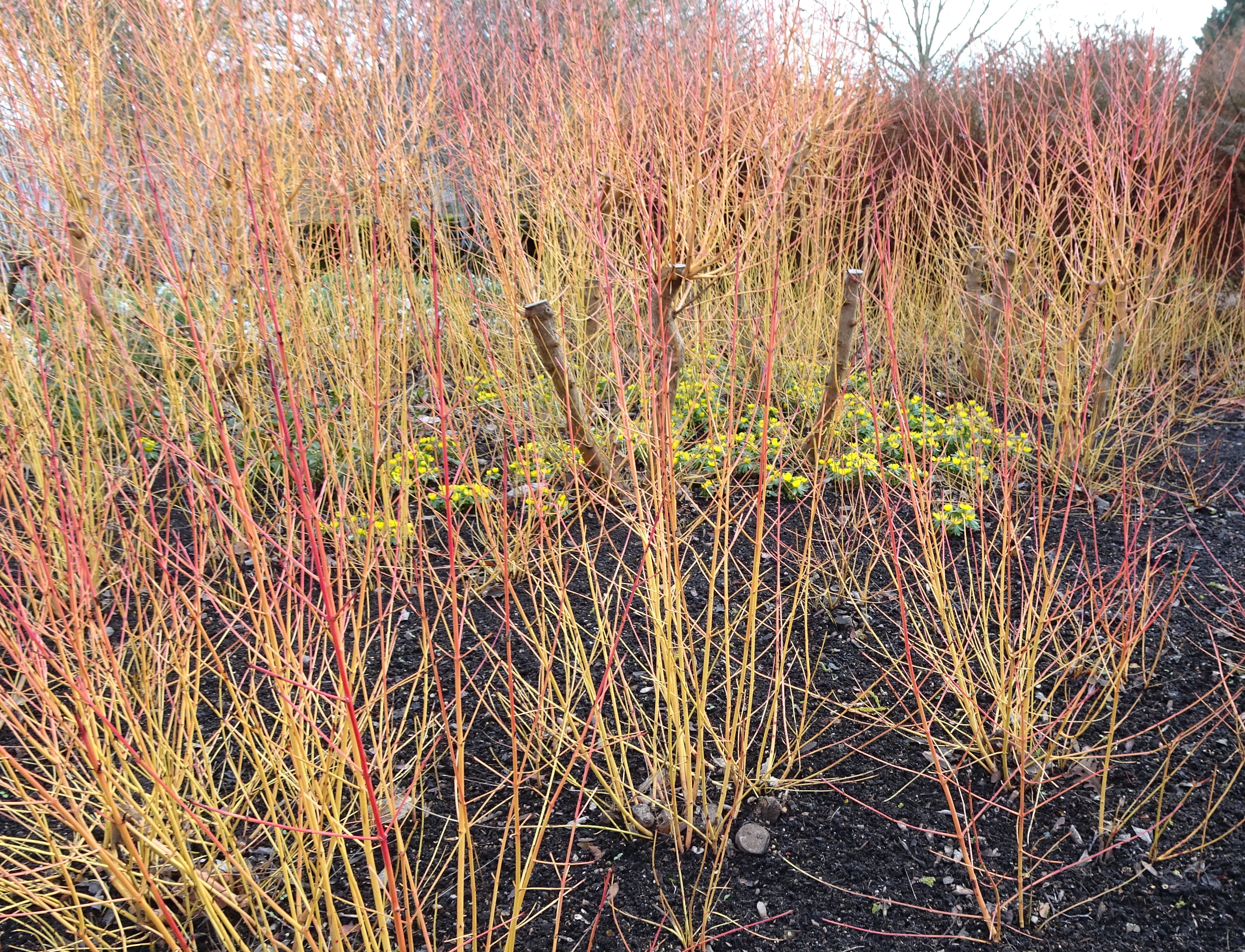
Yellow winter aconite brings out the gold in brightly-stemmed dogwood.

.

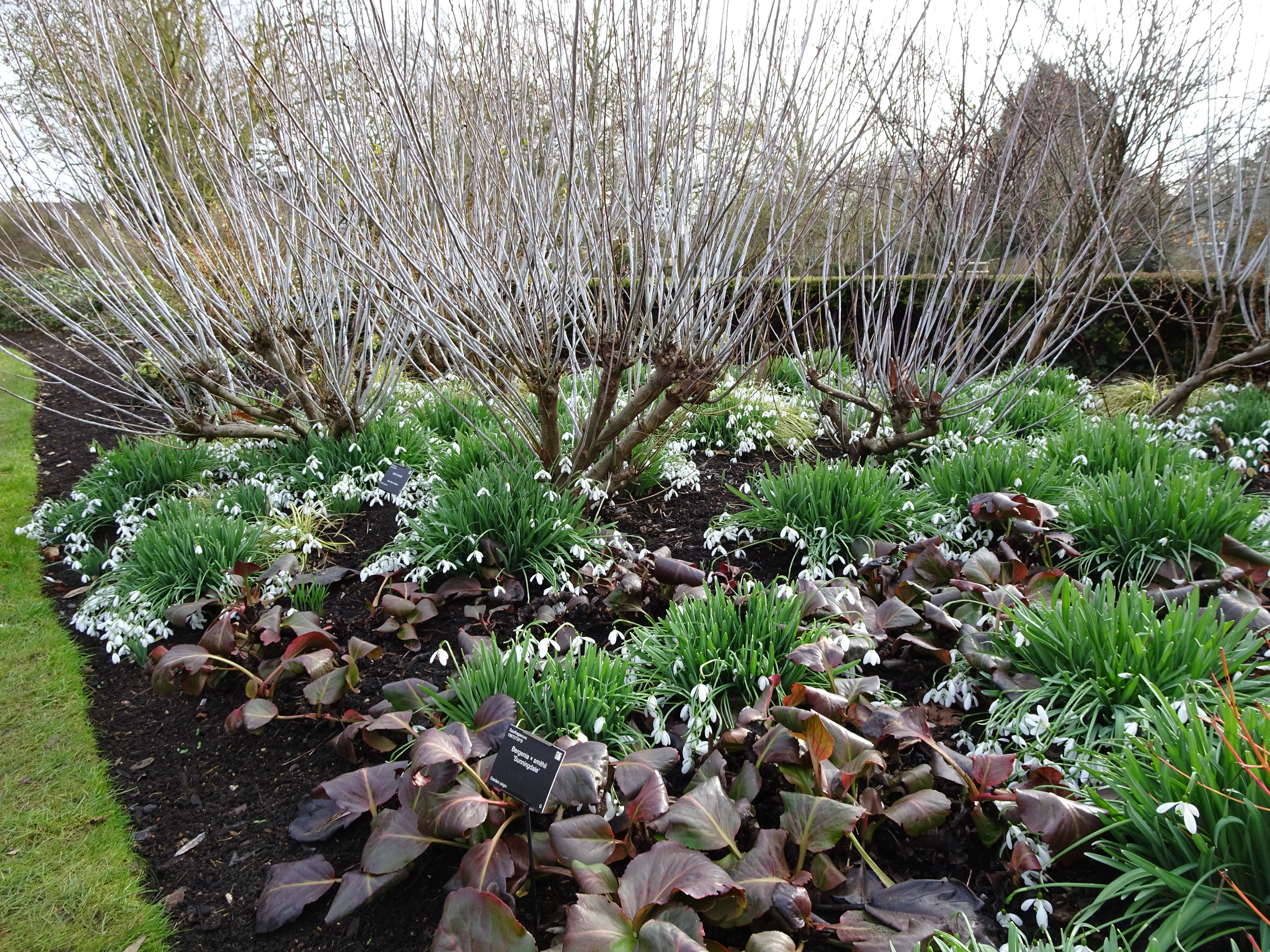
A more subtle but elegant combination, blue-stem willow, Salix irrorata, with snowdrops.

.

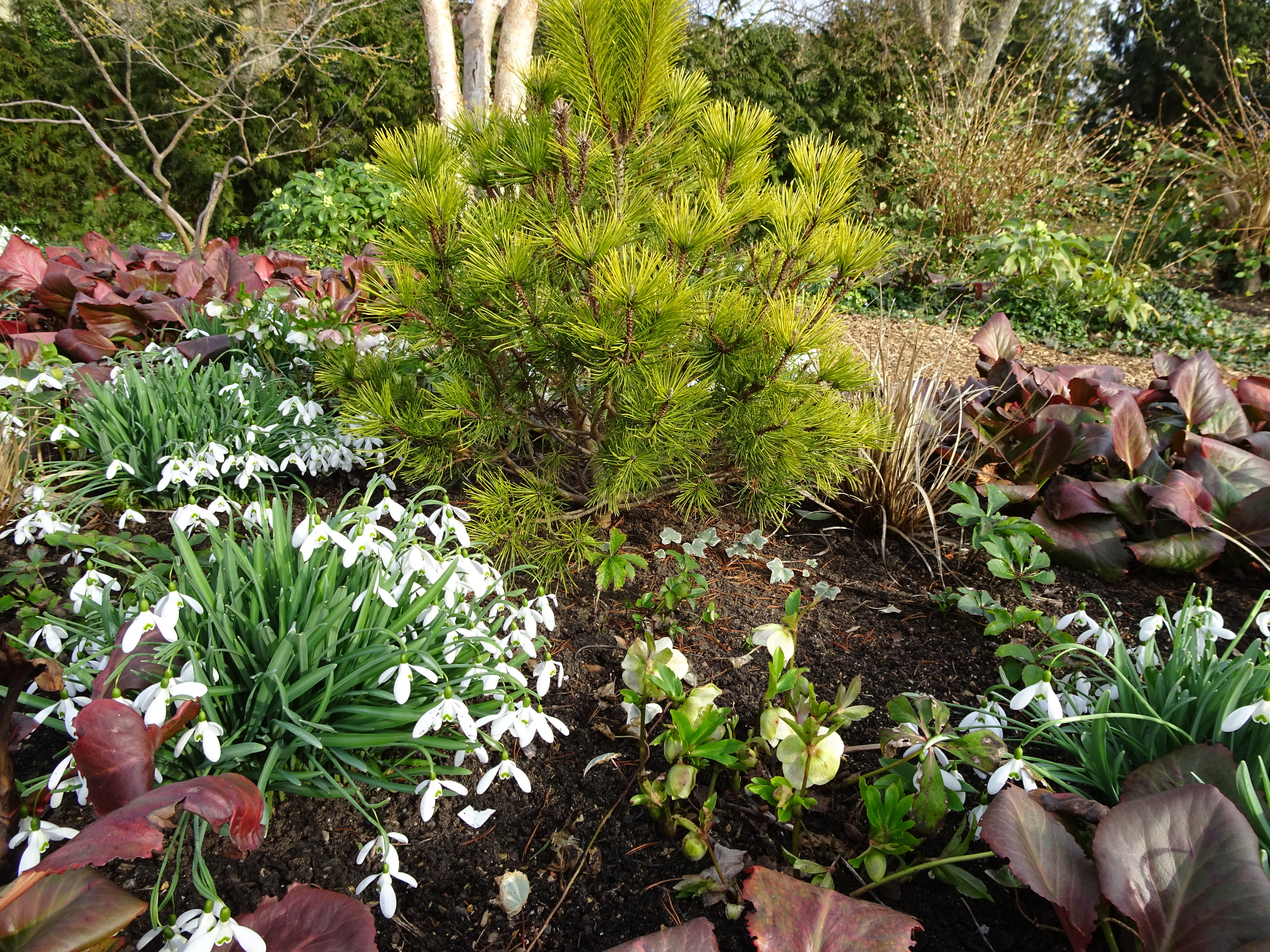
And then there is this eye-popping pairing of snowdrops with bergenia, heather, and bright red-stemmed dogwood backed by golden conifers.

.

Snowdrops look lovely here and in my garden in February with Narcissus ‘Rijnveld’s Early Sensation‘—yes, it does bloom that early!

.

The ways to use snowdrops in masses in your winter landscape are not limited by space considerations as they go dormant after they bloom and can be planted around other plants or in the backs of your beds.

.

I could write a whole post on how much we loved visiting Cambridge.  You can walk everywhere, and it has excellent museums, restaurants, scenery, walking tours, and gardens.  The colleges within the university are gorgeous and the evensong music of their choirs is heavenly.   

We stayed at the Duke House right in downtown Cambridge, whose very friendly and welcoming owner provided lovely accommodations, excellent breakfasts, and parking on site so we could abandon our car while we were there.  In addition to the Cambridge Botanic Garden, when we were in the Cambridge area, we also visited Benington Lordship Gardens, Anglesey Abbey, and Wandlebury Ring, all of which were amazing.

.

Blogs are a lot more fun for everyone, especially the writer, when readers leave comments.  If you are reading this post in the WordPress email (white background), just reply to the email to comment.  If you are reading the post on my blog (black background, recommended for better viewing), scroll down to the end of the page to the box where it says “Leave a Reply” and start typing—-it’s easy!

Carolyn

.

Note: Every word that appears in orange on my blog is a link that you can click for more information. If you want to return to my blog’s homepage to access the sidebar information (catalogues, previous articles, etc.) or to subscribe to my blog, just click here.

New Snowdrops (& an Eranthis) for 2025: Part Two

Posted in bulbs for shade, snowdrops, winter, winter garden, winter interest with tags , , , , , , , , , , , , , , , on November 24, 2024 by Carolyn @ Carolyns Shade Gardens


‘Richard Bish’ is a very rare and stunning double winter aconite or Eranthis (photo taken 2/14/24 at Carolyn’s Shade Gardens).

Seeing the emerging green tips appearing in almost every snowdrop location in our garden never gets old.  The anticipation and promise that those tips represent propel me happily through fall garden chores.  In addition, ‘Standing Tall’ celebrated the emerging season by coming into bloom three weeks early on November 17.

This is part two of a two-part post on the new snowdrops plus a leucojum and an eranthis that will be offered in our 2025 Snowdrop Catalogue.  To read part one, click here.  The catalogue will be posted on our website on December 1, 2024, and details will be sent to our snowdrop customer list shortly.  Meanwhile, this post will give everyone an advance look (sorry, no advance orders) at four more special, new snowdrops and an eranthis/winter aconite that will be available for order in December.  Enjoy!

Nursery News:  Carolyn’s Shade Gardens is a retail nursery located in Bryn Mawr, PA, specializing in showy, colorful, and unusual plants for shade.  The only plants that we ship are snowdrops within the US.  For catalogues and announcements of local events, please send your full name, mailing address, and cell number to carolyn@carolynsshadegardens.com and indicate whether you are interested in snowdrops.  Click here to get to the home page of our website for catalogues and information about our nursery and to subscribe to our blog.

.

When ‘Richard Bish’s’ flowers are closed you can clearly see the green stripes on the outer petals.

Eranthis hyemalis ‘Richard Bish’ is a very rare, winter aconite cultivar.  It has beautiful double-flowers with elegant rounded petals (technically sepals) as you can see from the photo at the beginning of this post.  The inner petals are a warm bright yellow while the outer row has intriguing green stripes (see photo directly above).  I received seeds from bulb expert Charles Cresson in 2018 and finally have a few to sell.  ‘Richard Bish’ was found by Karl Kristensen in the English garden of Richard Bish and named in his honor.

.

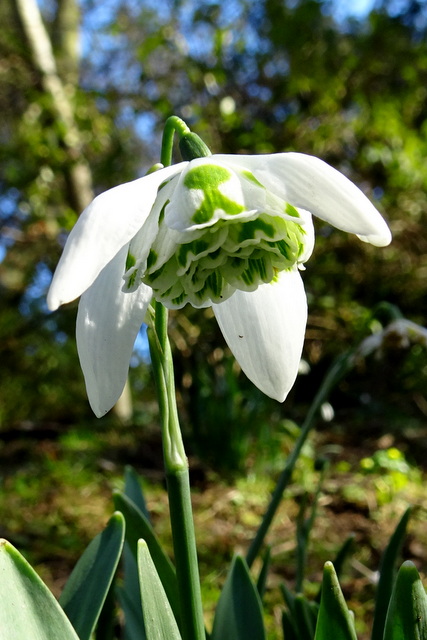
‘Dodo Norton has one of the largest snowdrop flowers.

‘Dodo Norton’ has huge, thickly textured flowers on long pedicels (the stem attaching the flower to the scape) but short scapes—it looks like a very dwarf ‘Mighty Atom.  The cupped outer segments are puckered to produce a seersucker effect, and the inners are boldly marked.  It was found in the famous ditch in the former garden of well known horticulturist Margery Fish at East Lambrook Manor and named in 2000 for a previous owner of the property.  Anne Repnow profiles it on page 31 of Some Snowdrops.

.

‘Kildare’, a virescent or green-shaded snowdrop, is one of the most elegant flowers in my garden (photos taken 3/6/22 at Carolyn’s Shade Gardens).

‘Kildare’ is an unmistakable snowdrop with long, tapering and pointed outer segments marked with lovely pale green lines extending halfway to the base (top of the flower).  The inner segments are almost entirely bright green fading toward the base.  It is usually one of the last snowdrops to bloom in my garden.

.

‘Kildare’ has gorgeous markings.

‘Kildare is a hybrid cross discovered by the famous snowdrop hunters Ruby and David Baker in 1995 when they got lost in County Kildare on a snowdrop tour of Ireland.  Anne Repnow profiles it on page 63 of Some Snowdrops.

.

‘Bitter Lemons’ joins an august group of rare inverse poculiform yellow snowdrops (photo from RB Snowdrops and used with the permission of Richard Bashford).

‘Bitter Lemons’ is one of the few yellow snowdrops, along with ‘Midas’ and ‘Golden Fleece’, that has yellow markings on both the inner and outer segments.  It is a so-called ‘color change’ snowdrop like ‘Blonde Inge’, opening a lemony lime and aging to lemony yellow.  It blooms one month before ‘Midas’.  International snowdrop expert Alan Street discovered ‘Bitter Lemons’ in the famous copse at Avon Bulbs and introduced it in 2019.  Anne Repnow profiles it on page 21 of Some Snowdrops

.

‘White Swan displays its elegant double flowers against the bright blue winter sky at Carolyn’s Shade Gardens.

‘White Swan’ is a large and elegant double snowdrop originated prior to 1954 by English plantsman Heyrick Greatorex who crossed Galanthus plicatus, with the double common snowdrop, Galanthus nivalis ‘Flore Pleno’.  It is the rarest of the resulting doubles with the largest flowers on very tall stems.  It increases vigorously in my garden, especially with regular division.

.

We were very impressed by the large stand of ‘White Swan’ at Thenford Arboretum in England where the wonderful Emma Thick gave us a private tour.  You can see its bold mark and neat and regular flower.

.

Blogs are a lot more fun for everyone, especially the writer, when readers leave comments.  If you are reading this post in the WordPress email (white background), just reply to the email to comment.  If you are reading the post on my blog (black background, recommended for better viewing), scroll down to the end of the page to the box where it says “Leave a Reply” and start typing—-it’s easy!

Carolyn

.

Note: Every word that appears in orange on my blog is a link that you can click for more information. If you want to return to my blog’s homepage to access the sidebar information (catalogues, previous articles, etc.) or to subscribe to my blog, just click here.

Snowdrops: Live Radio Interview

Posted in bulbs for shade, snowdrops, winter, winter garden, winter interest with tags , , , , , , , , , , , , , on March 20, 2024 by Carolyn @ Carolyns Shade Gardens

This beautiful yellow snowdrop, ‘Spindlestone Surpise’, will be available in the 2025 Snowdrop Catalogue—no advance orders please.

For our current Snowdrop Catalogue, click here.  If you want to be notified about the next snowdrop catalogue, please send your full name, mailing address, and cell number to carolyn@carolynsshadegardens.com, and specify snowdrops.

.

Nursery News:  Carolyn’s Shade Gardens is a retail nursery located in Bryn Mawr, PA, specializing in showy, colorful, and unusual plants for shade.  The only plants that we ship are snowdrops within the US.  For catalogues and announcements of local events, please send your full name, mailing address, and cell number to carolyn@carolynsshadegardens.com and indicate whether you are interested in snowdrops, hellebores, and/or hostas.  Click here to get to the home page of our website for catalogues and information about our nursery and to subscribe to our blog.

The final snowdrop shipment of the 2024 season was sent out on Saturday. Now we turn to preparing all the wonderful snowdrop cultivars that will appear in the 2025 catalogue, including ‘Spindlestone Surprise’ above.

.

The very rare snowflake, Leucojum ‘Null Punkte’ will also be offered next year.

I have found that for the health of the plants, all dividing and transplanting must occur before April 1. Plants dug up after that date do not fare well. The weather in the midAtlantic is perfect right now with very cool nights and highs in the mid-40s.

.

I finally have enough of the double winter aconite, Eranthis ‘Richard Bish’, which I grew from seed, to include it in 2025.

On February 21, I did a live radio interview on snowdrops for a regional radio show called “Into the Garden”. You can listen to the interview here, which provides useful information on snowdrops and even covers hellebores and Carolyn’s Shade Gardens.

The lovely fall-blooming snowdrop, ‘Peter Gatehouse’, will also be available next year.

Thanks to all of you who ordered snowdrops this year, we had the most successful snowdrop sales in the history of our business. As always, your support of our small, family-owned and -operated business is very much appreciated.

.

Blogs are a lot more fun for everyone, especially the writer, when readers leave comments.  Scroll down to the end of the page to the box where it says “Leave a Comment” and start typing—-it’s easy!

Carolyn

.

Note: Every word that appears in orange on my blog is a link that you can click for more information. If you want to return to my blog’s homepage to access the sidebar information (catalogues, previous articles, etc.) or to subscribe to my blog, just click here.

My Favorite Snowdrops

Posted in bulbs for shade, snowdrops, winter, winter garden, winter interest with tags , , , , , , , , , , , , , , , , , , , , on January 2, 2024 by Carolyn @ Carolyns Shade Gardens

‘Trumps’: has it all—vigorous, unique, beautiful; selected at the nursery of the wonderful John Morley, more here.

For our current Snowdrop Catalogue, click hereIf you want to be notified about the next snowdrop catalogue, please send your full name, mailing address, and cell number to carolyn@carolynsshadegardens.com, and specify snowdrops.

I have considered writing this post many times, but always felt that picking my favorite snowdrop is like choosing your favorite child.  I always tell my three sons that I don’t have a favorite—I love them all equally but for different reasons.  However among my snowdrops, I do have favorites, and I know the reasons, which I will share with you along with photos of some of my most-liked Galanthus.

Nursery News:  Carolyn’s Shade Gardens is a retail nursery located in Bryn Mawr, PA, specializing in showy, colorful, and unusual plants for shade.  The only plants that we ship are snowdrops within the US.  For catalogues and announcements of local events, please send your full name, mailing address, and cell number to carolyn@carolynsshadegardens.com and indicate whether you are interested in snowdrops.  Click here to get to the home page of our website for catalogues and information about our nursery and to subscribe to our blog.

.

Diggory’:  totally unique flower; beautiful pleated leaves with a stripe; multiplies well.

I have a modest collection of snowdrops by English standards and even compared to many of the larger American collections.  This is intentional—although I have an extensive wish list in my head, I want to build my collection slowly and knowledgeably.  This allows time to care for the existing collection, including dividing, fertilizing, mulching, relocating, disease prevention, record keeping, and labeling, etc.    My current project is to have each snowdrop in two locations in my garden: an heir and a spare so-to-speak.

. ‘Viridapice’:  tall and elegant with beautiful green markings; vigorous and easy.

When Snowdrops: A Monograph of Cultivated Galanthus by Bishop, Davis, and Grimshaw was reprinted in 2006, it covered around 500 named snowdrop cultivars.  It was possible, if you could locate them, to have all these snowdrops in your garden.  When the second edition of A Gardener’s Guide to Snowdrops by Freda Cox was published in 2019, it described 2,400 named cultivars.  Freda Cox’s companion volume More Snowdrops, issued in May 2023, profiles over 700 additional cultivars.  It is not possible, nor do I think it is advisable, to collect all the existing snowdrops.  A collector must be discriminating.  To help you with your choices, I have come up with six reasons why I prize a snowdrop over many other contenders.

.

‘Godfrey Owen’: absolutely unique and beautiful from above and below; vigorous and early-blooming; selected by famous galanthophile Margaret Owen and named for her husband.

First, the flower must be beautiful and/or interesting.  Among other characteristics I consider is the flower shape and size.  I am partial to large, rounded flowers with spoon shaped outer segments.  Although I generally prefer single flowers, in peonies for example, I also like double snowdrops—although many galanthophiles look down on them—because they bloom longer and, for me, are more often purely beautiful.  The texture of the outer segments varies, and I am drawn to thick texture, which means the flower lasts longer, and I favor a pleated look.  The color and placement of the marks is very important.  I am partial to yellow snowdrops, dark emerald green marks, two-tone inner marks, and marks on the outer segments, especially virescent (green-shaded) outers.

.‘Madelaine’: the best and most vigorous yellow in my garden—there are many yellows but a lot do not multiply well; selected by the famous Joe Sharman at Monksilver Nursery.

Second, every snowdrop on my favorites list must be easy to grow and must multiply vigorously in my garden wherever I decide to place it.  I do not treasure a snowdrop that doesn’t grow well for me no matter how much it thrives in other people’s gardens.  And there will be no coddling of a picky snowdrop no matter how beautiful or rare.  I will, however, move a snowdrop to a new location if it is doing OK but not thriving, if I have time….

.‘Fly Fishing’: the name chosen by my sadly missed friend Alan Street is perfect; would recognize it anywhere; very vigorous.

Third, I must be able to recognize a favorite snowdrop without looking at the label, not only in my garden but in larger collections.  This is a tall order in a field of over 3,100 named cultivars, many of which have very little to set them apart.  However, through a combination of flower shape and markings, leaves, habit, and bloom time, all my favorites stand out.

.‘Xmas’: large, elegant, upright flowers with gracefully curved spathes and wide blue leaves; early bloomer; selected at the US Botanic Garden and named by Carolyn’s Shade Gardens.

Fourth, the habit and individual parts of a snowdrop can add greatly to its desirability.  I am partial to tall and upright snowdrops with large flowers held well above the leaves.  My favorite leaves are wide and generally blue, which is characteristic of Galanthus elwesii, but I also love the elegantly pleated foliage of Galanthus plicatus, especially if there is a pronounced white stripe. Ovaries (the little cap above the flower) with pleasing and compatible shapes, spathes (the bud covering) that arch elegantly over the flower, and pedicels (the flower stem) that hold the flower just so can add to a snowdrop’s allure.

.

‘Potter’s Prelude’: large and elegant flowers; best November-blooming snowdrop in my garden; named by my dear friend Charles Cresson.

Fifth, I lean toward snowdrops that bloom early, especially in November and December.  As I describe more fully in my post December Blooming Snowdrops, click here to read, this is the time of year when I can most appreciate flowers of all kinds and not many snowdrops bloom then so the ones that do stand out.  I would consider this a purely personal consideration, but it is a preference shared by the majority of my customers so I have to think it is widespread.

.

‘Lady Beatrix Stanley’:  beautiful; no other double has the two elegant dots on the inner segments; multiplies rapidly; grown by Lady Beatrix Stanley (1877-1944) at Sibbertoft Manor.

Finally, I love snowdrops with history behind them: who selected them, where, why?  Unlike most other plants, we can often answer these questions about snowdrops and our relation to the plant is the richer for this added dimension.  That is why I always provide snowdrop history in my catalogue and in blog post profiles of new snowdrops.

.

The snowdrops pictured above were chosen from the favorites in my collection because they illustrate the points I am making and meet most if not all of my criteria.  However, I grow many more snowdrops that qualify as favorites and could have been included here.  And I grow others that don’t make the grade, usually due to their slow growth, but which I still treasure.

.

Blogs are a lot more fun for everyone, especially the writer, when readers leave comments.  Scroll down to the end of the page to the box where it says “Leave a Reply” and start typing—-it’s easy!

Carolyn

.

Note: Every word that appears in orange on my blog is a link that you can click for more information. If you want to return to my blog’s homepage to access the sidebar information (catalogues, previous articles, etc.) or to subscribe to my blog, just click here.

December Blooming Snowdrops

Posted in bulbs for shade, snowdrops, winter, winter garden, winter interest with tags , , , , , , , , , , , , , , , , on December 20, 2023 by Carolyn @ Carolyns Shade Gardens

Galanthus bursanus, the newest snowdrop species, blooms earliest in my collection

For our current Snowdrop Catalogue, click hereIf you want to be notified about the next snowdrop catalogue, please send your full name, mailing address, and cell number to carolyn@carolynsshadegardens.com, and specify snowdrops.

I really appreciate the appearance of the earliest blooming snowdrops in my garden: Galanthus bursanus and Galanthus reginae-olgae and their cultivars, at the beginning of October.  They remind me that the much treasured snowdrop season is starting and will continue through March.  However, there are so many other plants performing then with flowers, berries, fall color, and seeds, not to mention all the work we need to do to get our garden ready for winter that I only notice the October snowdrops in passing.  Likewise, although I love all my snowdrops that begin flowering in January, which is the early main season for snowdrops, there are so many of them. 

It is the snowdrops that reach their peak in December that I most treasure.  I realized that I have never done a post featuring those snowdrops so here I will talk about my four favorites plus a peak at a potential newcomer.

Nursery News:  Carolyn’s Shade Gardens is a retail nursery located in Bryn Mawr, PA, specializing in showy, colorful, and unusual plants for shade.  The only plants that we ship are snowdrops within the US.  For catalogues and announcements of local events, please send your full name, mailing address, and cell number to carolyn@carolynsshadegardens.com and indicate whether you are interested in snowdrops.  Click here to get to the home page of our website for catalogues and information about our nursery and to subscribe to our blog.

.

fall-blooming snowdrop 'Potter's Prelude' at Carolyn's Shade Gardens‘Potter’s Prelude’ is an elegant snowdrop with a bold mark.

‘Potter’s Prelude’, a cultivar of Galanthus elwesii var. monostictus, is a rare American snowdrop selected in the 1960s by Jack Potter, the former Curator of the Scott Arboretum in Swarthmore, Pennsylvania.  It was registered in 2004 by noted regional horticulturist Charles Cresson and introduced in 2010 by Carolyn’s Shade Gardens.

.

This clump of ‘Potter’s Prelude’ is ready for dividing.

‘Potter’s Prelude’ is a free-flowering and vigorous snowdrop with wide, recurving, very blue leaves.  Its flowers are large and elegantly formed with a bold dark green mark.  They begin blooming in mid-November and continue into January with December being their peak.  Be aware that some snowdrops sold under this name are inferior seedlings.  International snowdrop expert Alan Street told me that the flowers shown in the top photo, which he much admired, are far superior to the form circulating in England.  ‘Potter’s Prelude’ is featured 0n page 77 of Anne Repnow’s book Some Snowdrops, an excellent reference guide.

.

‘Standing Tall’

‘Standing Tall’ is an American Galanthus elwesii cultivar selected and named by Charles Cresson.  It was introduced for sale for the first time by Carolyn’s Shade Gardens in 2013.  Although it can reach 12″ tall, it was primarily named for its very upright habit and unmistakable, commanding presence in the garden.  Its name also reflects its ability to flop down when its cold like all snowdrops do and stand back up perfectly straight as if nothing has happened.  My unofficial observations also indicate that it remains upright at much lower temperatures than other snowdrops.

.

‘Standing Tall’ in the Cresson garden.

‘Standing Tall is at its peak right now, although my main patch was divided last year and does not look as full as most years.  However, like all the snowdrops featured in this post, it is very vigorous and will quickly fill back in and look like Charles Cresson’s patch above.  It starts blooming between the the last week of November and the first week of December and continues through January.  It is featured on Page 83 of Anne Repnow’s excellent book Some Snowdrops.

.. ‘Three Ships’ has the very full outer segments sometimes associated with G. plicatus.

‘Three Ships’ is a cultivar of Galanthus plicatus selected in England by the famous John Morley of North Green Snowdrops in Suffolk in 1984.  He named it for the Christmas carol “I Saw Three Ships”.

.

‘Three Ships’ multiplies well in my garden.

‘Three Ships’ is quite striking in the garden and cannot be confused with any other snowdrop. It has an ethereal glow that is whiter than white and large, bowl-like and deeply puckered outer segments with a wide and attractive green mark on the inner segments.  It blooms reliably about a week after ‘Standing Tall’ in mid-December, although I find that this is location specific.  One of my three patches bloomed on November 26 this year, while the other two followed the regular pattern.

.

‘Xmas’ has large and elegant flowers with gracefully curved spathes.

‘Xmas’ was selected many years ago by a gardener at the US National Botanic Garden from a patch of normal Galanthus elwesii growing in the parking lot and passed through many hands to me.  Carolyn’s Shade Gardens first introduced it for sale as ‘Xmas’ in 2016.

.

‘Xmas’ is at least twice the height of ‘Three Ships’, which blooms at the same time.  It is shown here with the flowers of fall-blooming camellia ‘Winter’s Joy’.

‘Xmas’ has very large and beautiful flowers with long, bowl-shaped outer segments and a distinct X mark on the inner segments.  In the Delaware Valley, it usually comes into flower in mid-December at the same time as ‘Three Ships’ and is fully out around the holidays when there is often a lull in snowdrop activity.  It also goes on blooming for about a month after ‘Three Ships’ as its flowers are particularly durable and long lasting.   When my dear friend Alan Street saw this photo he was impressed with the height and fullness of the flowers.  Unfortunately, he never saw ‘Xmas’ in person as it makes quite an impression when you see it in the garden.

. A new December-blooming Galanthus elwesii under consideration.

I have been observing this snowdrop, which appeared in my oldest patch of straight species Galanthus elwesii.  It blooms in late November/early December and has lovely, full flowers with a solid green inner mark from apex to base.  It will take more years of observation and building up stock before I decide if it merits a name.  Meanwhile, I would be grateful if any reader would let me know if they have seen a similar snowdrop blooming in early December.

.

The inner segments are entirely green.

.

The snowdrops profiled here are some of my favorites.  I have lined my front walk with large clumps so I can enjoy them every day this time of year, and all four appear in more than the two standard locations in my garden (one for display and one for back up).  In fact, ‘Xmas’ is in six locations, ‘Potter’s Prelude’ is in five, while the others are in three.

.

Blogs are a lot more fun for everyone, especially the writer, when readers leave comments.  Scroll down to the end of the page to the box where it says “Leave a Reply” and start typing—-it’s easy!

Carolyn

.

Note: Every word that appears in orange on my blog is a link that you can click for more information. If you want to return to my blog’s homepage to access the sidebar information (catalogues, previous articles, etc.) or to subscribe to my blog, just click here.

New Snowdrops for 2024: Part Three

Posted in bulbs for shade, snowdrops, winter, winter garden, winter interest with tags , , , , , , , , , , , , , , , on December 3, 2023 by Carolyn @ Carolyns Shade Gardens

It was this view of a sweeping stand of ‘Marjorie Brown’ at Glen Chantry Nursery in England that made it a must for my collection (photo taken at Glen Chantry 2/2023).

Our current snowdrop catalogue is on line here.

Seeing the emerging green tips appearing in almost every snowdrop location in our garden never gets old.  The anticipation and promise that those tips represent propel me happily through fall garden chores.  In addition, ‘Three Ships’ celebrated the emerging season by “sailing in” almost three weeks early on November 26.

This is part three of a three-part post on the new snowdrops that will be offered in our 2024 Snowdrop Catalogue.  To read part one, click here, and part two, click here.  As usual, the catalogue will be posted on our website in the first half of December.  Meanwhile, this post will give everyone an advance look (sorry, no advance orders) at five more special, new snowdrops that will be available for order in December.  Enjoy!

Nursery News:  Carolyn’s Shade Gardens is a retail nursery located in Bryn Mawr, PA, specializing in showy, colorful, and unusual plants for shade.  The only plants that we ship are snowdrops within the US.  For catalogues and announcements of local events, please send your full name, mailing address, and cell number to carolyn@carolynsshadegardens.com and indicate whether you are interested in snowdrops.  Click here to get to the home page of our website for catalogues and information about our nursery and to subscribe to our blog.
.

‘Marjorie Brown’ has large, well-rounded flowers and very blue leaves (photo taken at Winterthur 3/2019).

‘Marjorie Brown’ is a G. elwesii cultivar with clear white, large, round, well-proportioned flowers.  It is late-blooming and vigorous, forming large bulbs.  Its leaves are wide with a very distinct bluish tinge compared to other giant snowdrops, G. elwesii.  According to Snowdrops, which calls it “highly garden-worthy” (Snowdrops: A Monograph of Cultivated Galanthus by Matt Bishop, Aaron Davis, and John Grimshaw Timber Press 2006, page 176), Ruby Baker found it in a flower arrangement entered in a March 1987 flower show.  The exhibitor, Marjorie Brown, told Ruby that the flowers were from bulbs purchased in 1958 from Van Tubergen.

.

‘Fenstead End’ in a snowstorm at North Green Snowdrops (taken 2/2017)

I first saw ‘Fenstead End’ when I visited John Morely at North Green Snowdrops during a snowstorm in February 2017.  I admired its long, tapering outer segments and bright green coloring, but the flowers weren’t open (to read about that visit, click here).

. ‘Fenstead End’ puts a smile on my face every time I see it (photo taken at the RHS Show 2/2017)

Later that month, at the RHS Show in London, I saw it with its outer segments raised up to reveal the lovely, white-edged bright green skirt underneath (see the flower in the upper left of the photo for the full effect).  I had to have it for my collection!  It was discovered by Charles Grey-Wilson in Fenstead End, Suffolk, in 1987.

.

‘Trumpolute’ is rarely offered for sale (photo taken at Anglesey Abbey 2/2023).

‘Trumpolute’ has large, boldly marked and gracefully recurved outer segments.  The bright green outer markings are repeated on the inner segments.  It has the classic pagoda shape of an inverse poculiform snowdrop (all the segments are inners) and resulted from a cross between G. plicatus ‘Trym’ and G. elwesii.  It was found at North Green Snowdrops in 2001 by John Morley who gave it its name because the flowers look like ‘Trumps’ and the leaves are convolute (wrapped around each other, also called supervolute).

.

‘Big Eyes’ peer out from between the outer segments (photo from Chris Ireland-Jones).

‘Big Eyes’ has beautifully rounded, balloon-like flowers, reminding me of one of my favorites, ‘Melanie Broughton’.  Because the outers are spoon-shaped with long claws (claws attach the outer segments to the ovary), you can see the two large eyes looking out with the down-turned mouth below. 

.

‘Big Eyes’ (photo from Chris Ireland-Jones)

When my dear friend Alan Street saw it for the first time he proclaimed “what big eyes you have!” just like Little Red Riding Hood and so it was named.  It is a hybrid between the common snowdrop, G. nivalis, and the Crimean snowdrop, G. plicatus.  Alan found it in a naturalized colony in Berkshire around 2000.

.‘John Gray’s’ outstandingly large flowers (photo taken at Colesbourne Park 2/2023)

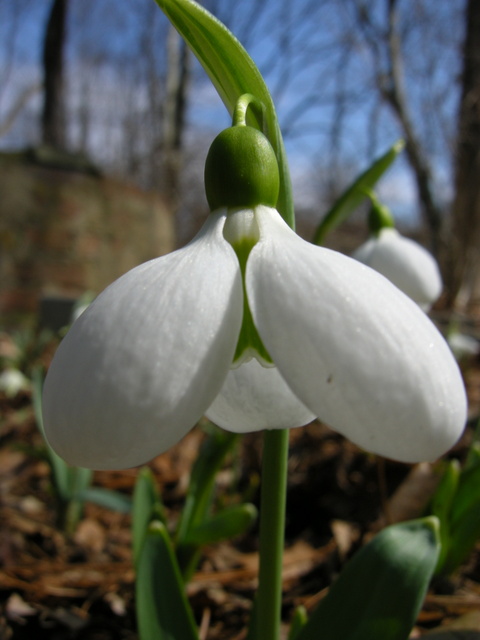
‘John Gray’ is a member of the much sought after Mighty Atom Group.  It has huge flowers on widely arching pedicels (flower stems), causing it to dip towards the ground.  This very beautiful, early-blooming snowdrop was selected by famous horticulturist E.B. Anderson for its “outstandingly large flower” from the Benhall, Suffolk, garden of John Gray in 1951 (Seven Years or Sixty Years of Gardening by E.B. Anderson, Joseph Publishing 1973).  It was first offered for sale by the Giant Snowdrop Company in 1967.  It is one of only 28 snowdrops to receive an Award of Garden Merit from the Royal Horticultural Society. 

.

Blogs are a lot more fun for everyone, especially the writer, when readers leave comments.  Scroll down to the end of the page to the box where it says “Leave a Reply” and start typing—-it’s easy!

Carolyn

.

Note: Every word that appears in orange on my blog is a link that you can click for more information. If you want to return to my blog’s homepage to access the sidebar information (catalogues, previous articles, etc.) or to subscribe to my blog, just click here.