Archive for the winter Category

Top 25 Snowdrops Part One

Posted in bulbs for shade, Shade Perennials, snowdrops, winter, winter interest with tags , , , , , , , , , , , , , , on January 27, 2014 by Carolyn @ Carolyns Shade Gardens

Carolyn’s Shade Gardens is a retail nursery located in Bryn Mawr, PA, specializing in showy, colorful, and unusual plants for shade.  The only plants that we ship are snowdrops to the US only.  For catalogues and announcements of local events, please send your full name, mailing address, and cell number to carolyn@carolynsshadegardens.com and indicate whether you are mail order only.  Click here to get to the home page of our website for catalogues and information about our nursery and to subscribe to our blog.

Galanthus nivalis 'Blewbury Tart'Number 25: ‘Blewbury Tart’, for a profile of this wonderful double snowdrop selected by Alan Street at Avon Bulbs, click here.  Available in 2019 CSG catalogue.

Our current snowdrop catalogue is on line here.

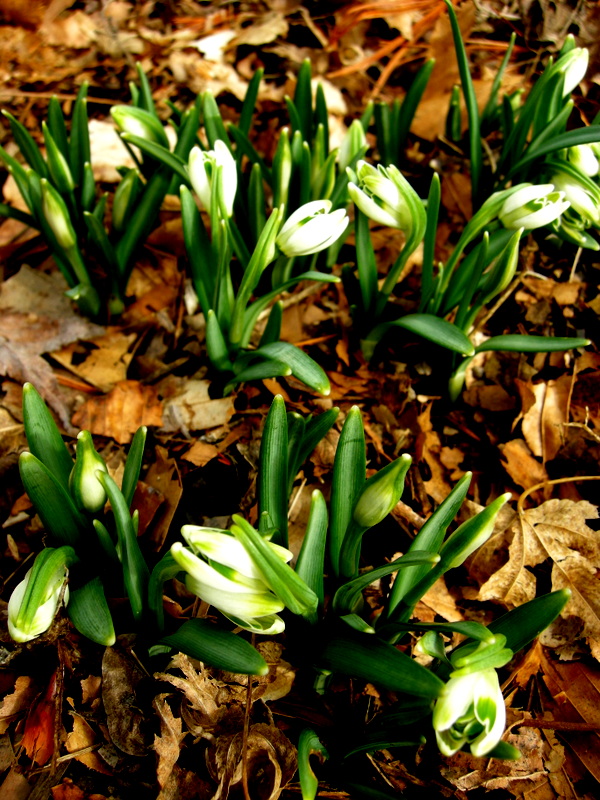
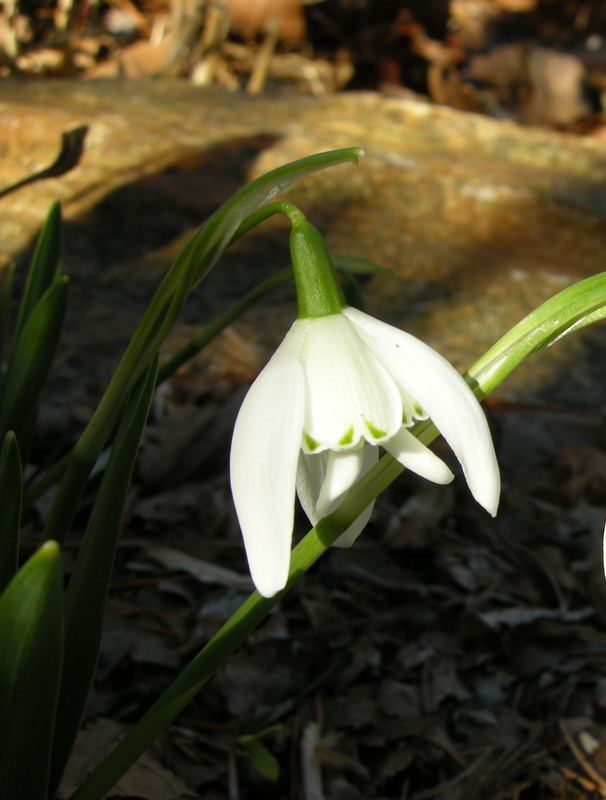
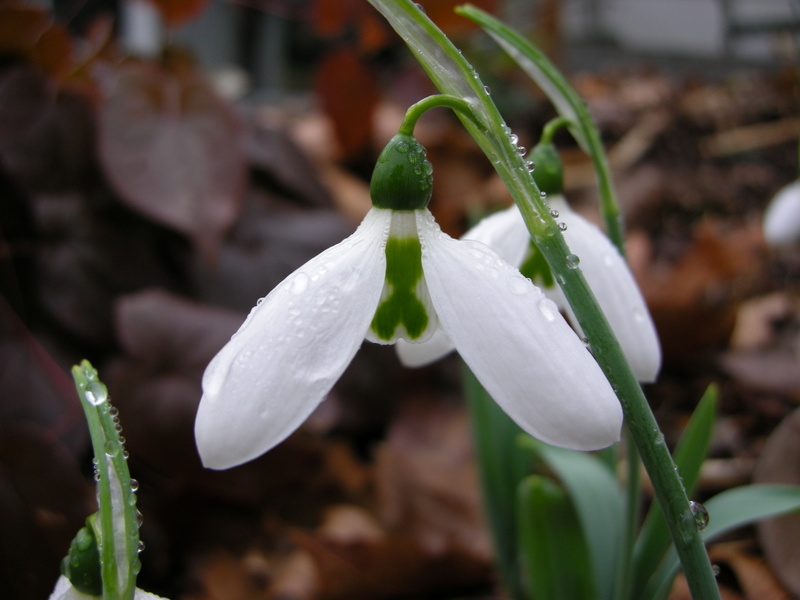
Snowdrops plants generally feature a little white flower with green marks on the inner segments (petals).  Sometimes the marks are yellow or nonexistent or on the outside and inside, sometimes the flower is mostly green, and sometimes the flower is double or spiky or otherwise aberrant.  The leaves can be gray-green or bright green or pleated.  Although that is definitely an oversimplification, from those few characteristics, sharp eyed galanthophiles have selected and named over 1,000 cultivars of snowdrop plants, some say as many as 1,500.

.
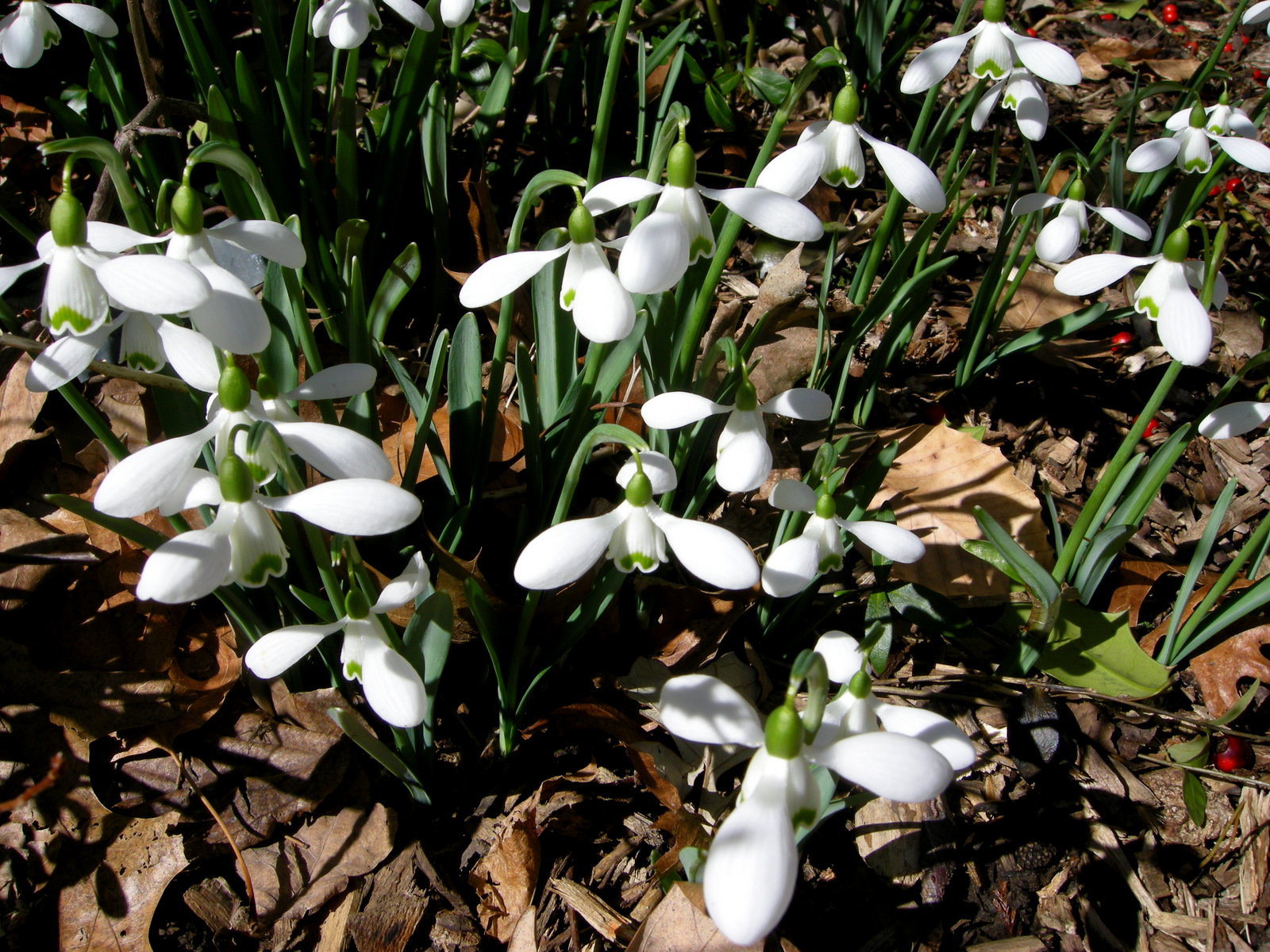
Galanthus 'Brenda Troyle' Cresson gardenNumber 24: ‘Brenda Troyle’, a vigorous older variety from the 1930s grown for its cupped outer segments and strong honey fragrance, profiled here.

Many people believe, myself included, that there are way too many named snowdrop cultivars, and a lot of them are virtually indistinguishable.  But ‘it is what it is’ as the saying goes, and collectors just have to deal with the plethora of choices.  However, making choices just became a whole lot easier for me when I discovered that the well-respected British snowdrop nursery Avon Bulbs conducted a survey among its customers to rank their 25 favorite snowdrops.  Alan Street from Avon has graciously allowed me to use the survey.  I want to thank Julian Wormald at the Welsh blog thegardenimpressionists for giving me the idea for this post.

.
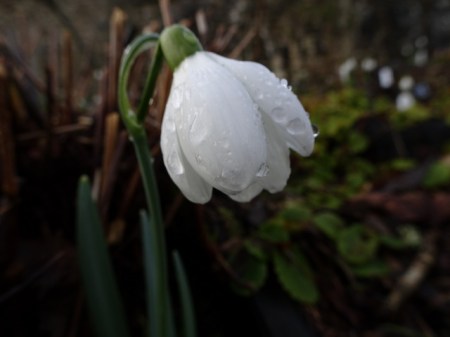
Galanthus 'Mrs. Thompson'Number 23:  ‘Mrs. Thompson’, selected in the 1950s, produces desirable mutations often with 5 outer segments.

.
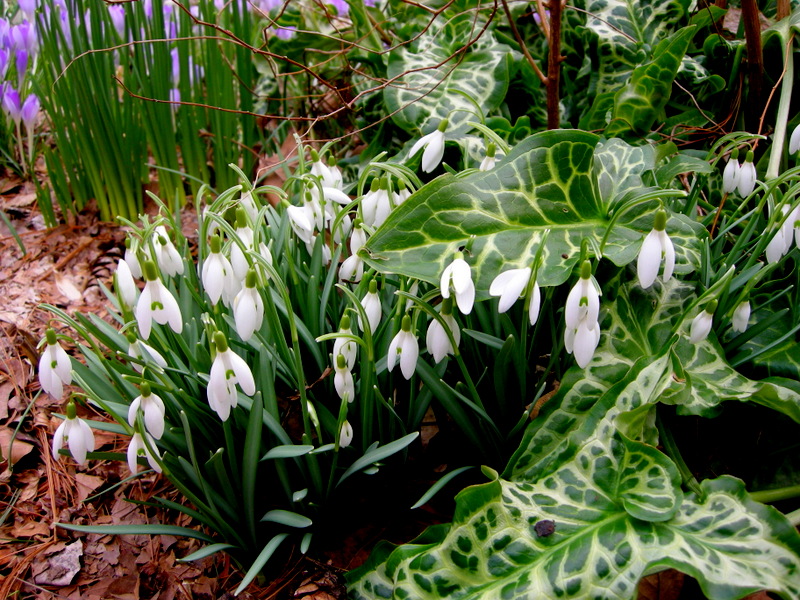
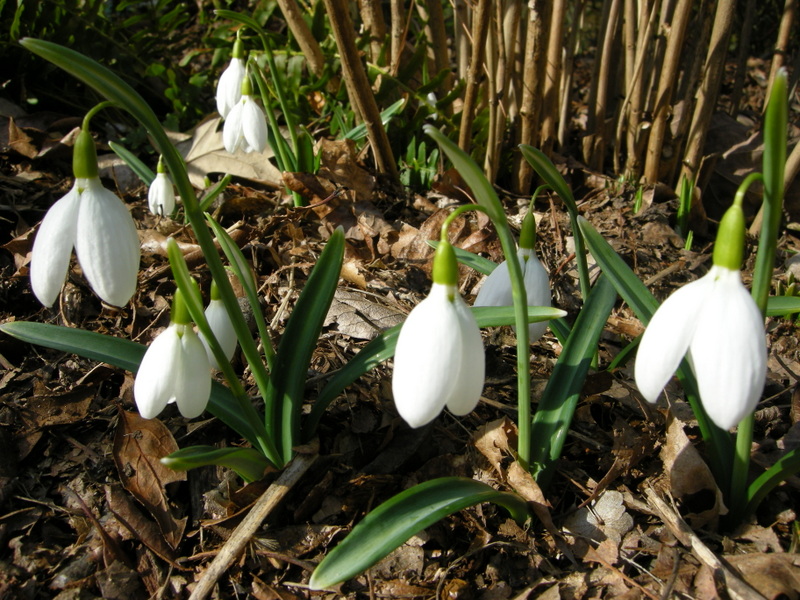
Galanthus nivalis & Arum italicum 'Pictum'Number 22:  Galanthus nivalis, a straight species, the common snowdrop is a great naturalizer, profiled here.  Available in 2019 CSG catalogue.

Snowdrop plants are covered by CITES, the Convention on the International Trade in Endangered Species.  CITES prevents shipment of snowdrop bulbs over international borders without expensive and time-consuming permitting.  CITES has curtailed the availability of a wide range of snowdrop plants in the U.S.  Carolyn’s Shade Gardens is working to increase the choices, and I have added “available CSG” to indicate which plants from the Avon ranking we sell or have sold (although many are sold out).  Unlike U.S. galanthophiles, Avon’s customers throughout the European Union have access to the full range of snowdrop bulbs available, both through purchase from bulb companies and by trading with fellow enthusiasts.

.

Galanthus 'Straffan' by Jonathan ShawNumber 21: ‘Straffan’, an indestructible Irish snowdrop selected in the late 1800s and the third oldest snowdrop still being sold, photo Jonathan Shaw.

Avon asked all their customers ordering in 2012 and 2013 to pick their top three snowdrops.  From their answers, Avon compiled a weighted ranking of the top 25 choices.  The snowdrop plants that made the list all have beautiful and sometimes unusual flowers.  However, it is clear from the list that Avon’s customers valued vigorous garden plants, no matter how long they have been around, over the newest and most sought after cultivars.  In this post I will profile Numbers 13 through 25, providing a short description and a photo (or a link to a photo on the wonderful website Judy’s Snowdrops).  In the next post, I will cover 1 through 12.

.Galanthus 'Hippolyta' photo Paddy TobinNumber 20: ‘Hippolyta’, a lovely Greatorex double snowdrop selected in the first half of the 20th century.

.

Galanthus 'Anglesey Abbey'Number 19:  ‘Anglesey Abbey’, a highly variable form, sometimes almost pure white with the inner and outer segments the same length (poculiform).

  .

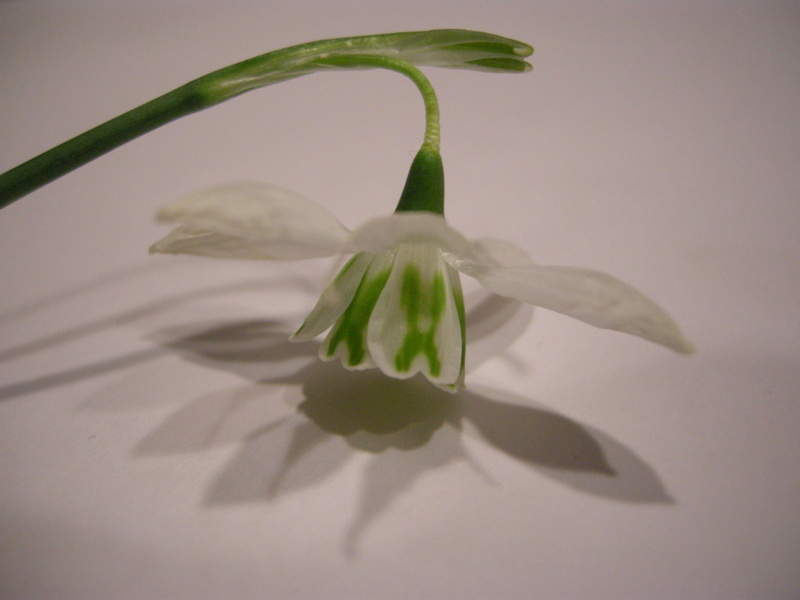
Robin HoodNumber 18: ‘Robin Hood’, first mentioned in 1891, large flowers with an X-shaped mark.  Available in 2019 CSG catalogue.

.
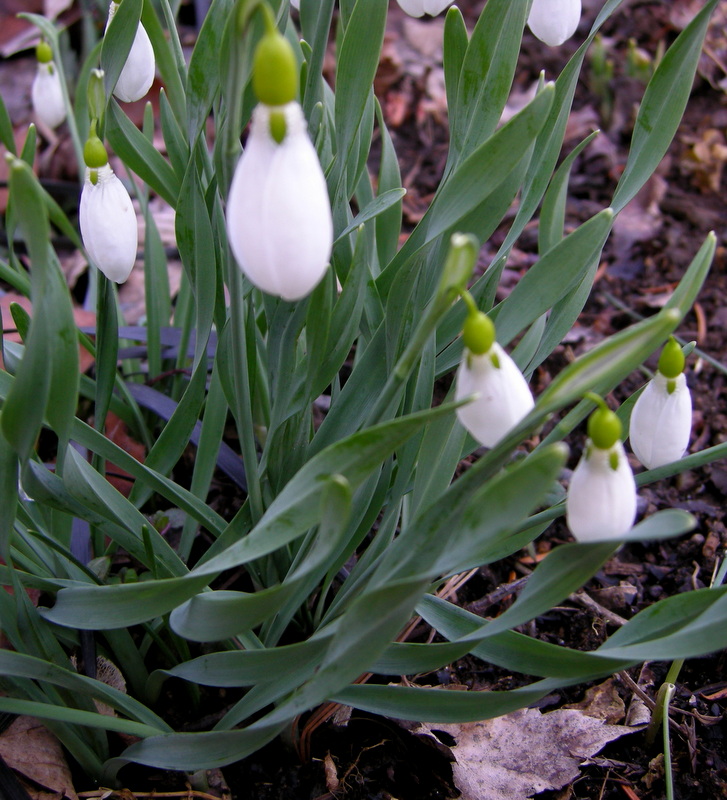
Galanthus gracilisNumber 17: Galanthus gracilis, a species snowdrop with unusual twisted leaves and elegant markings on the flower.

.
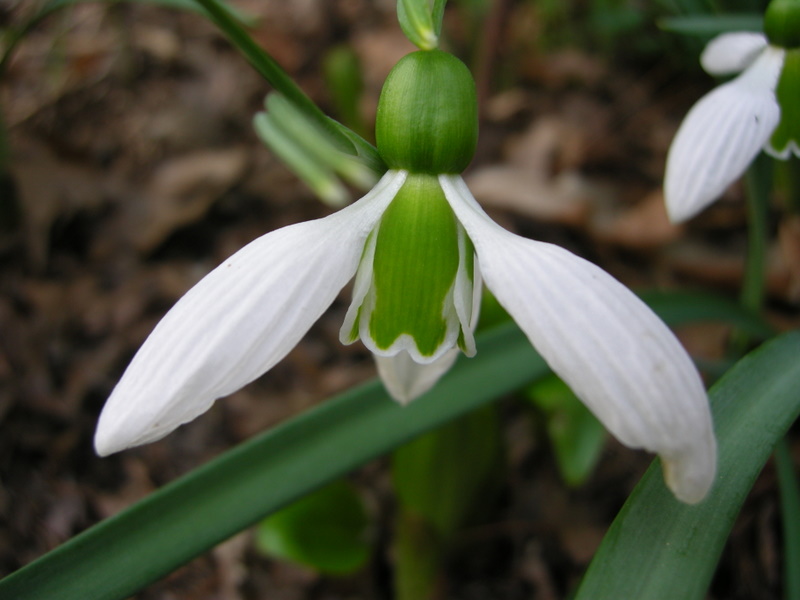
Galanthus 'Merlin' in Cresson gardenNumber 16: ‘Merlin’, an old variety from the 1890s with a solid green inner mark.  Available in 2019 CSG catalogue.

.

Galanthus 'Cowhouse Green'Number 15: ‘Cowhouse Green’, lovely virescent (greenish) snowdrop with a pale green wash on the outer segments.

.

Galanthus 'Colossus' plicatusNumber 14: ‘Colossus’, a very early flowering form of the Crimean snowdrop, G. plicatus, with large flowers and beautiful dark green, pleated, glaucous leaves.

.

Galanthus 'Lady Beatrix Stanley'Number 13:  ‘Lady Beatrix Stanley’, an elegant double snowdrop that multiplies quickly, named in the 1980s but distributed since the 1950s.  Available in 2019 CSG catalogue.

Although it is entertaining to read about single snowdrop bulbs selling for almost $1,200 on eBay, it is nice to know that when it comes right down to it, gardeners value the tried and true plants that have withstood the test of time.

Carolyn

.

Note: Every word that appears in orange on my blog is a link that you can click for more information. If you want to return to my blog’s homepage to access the sidebar information (catalogues, previous articles, etc.) or to subscribe to my blog, just click here.

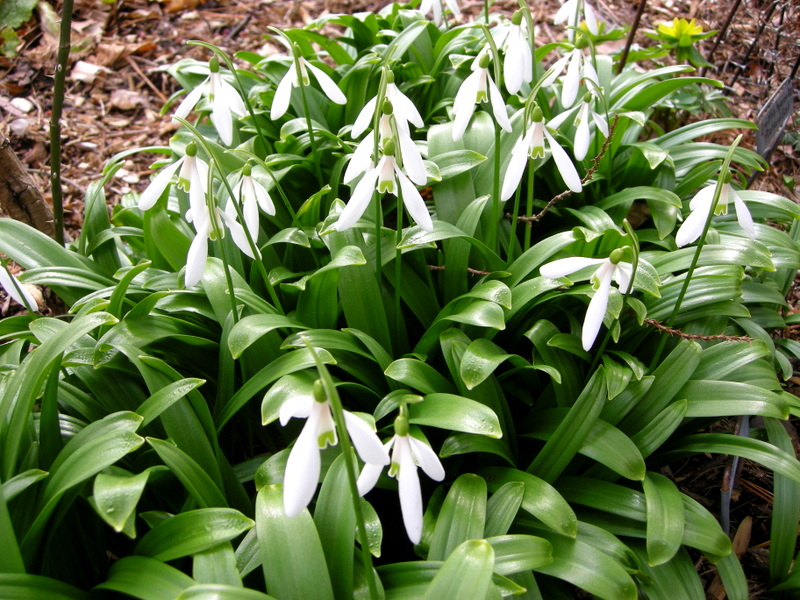
The Sochi Snowdrop

Posted in bulbs for shade, Shade Perennials, snowdrops, winter, winter interest with tags , , , , , , , , , , , , , , , , , , , on January 16, 2014 by Carolyn @ Carolyns Shade Gardens

Carolyn’s Shade Gardens is a retail nursery located in Bryn Mawr, PA, specializing in showy, colorful, and unusual plants for shade.  The only plants that we ship are snowdrops to the US only.  For catalogues and announcements of local events, please send your full name, mailing address, and cell number to carolyn@carolynsshadegardens.com and indicate whether you are mail order only.  Click here to get to the home page of our website for catalogues and information about our nursery and to subscribe to our blog.

Galanthus woronowii Cresson GardenGalanthus woronowii

Our current snowdrop catalogue is on line here.

The over 1,000 types of cultivated snowdrops all originated from just 20 snowdrop species found in the wild and making up the genus Galanthus. This post is the second in a series of posts profiling the important  snowdrop species, which are all great garden plants in their own right. 

In the first post I discussed the common snowdrop, G. nivalis, and you can read that post by clicking here.  I have written a lot of other articles about snowdrops, covering among other topics their ornamental characteristics, fascinating history, the importance of provenance, and profiling many cultivars.  For links to all my previous snowdrop posts, click here.  In this post, I will discuss G. woronowii.

Much of the information in this post comes from Snowdrops: A Monograph of Cultivated Galanthus by Matt Bishop et al. (Griffin Press 2006) which is absolutely indispensable if you are researching or collecting snowdrops.  I have also used documents produced by Kew Gardens and the Tbilisi Botanical Garden in the Country of Georgia.

.

Galanthus woronowii Cresson GardenGalanthus woronowii

Although a few sources have randomly assigned the common names green snowdrop, Russian snowdrop, and Woronow’s snowdrop to G. woronowii, it really has no regularly used common name.  So why am I calling it the Sochi snowdrop?  Because in the early 20th century, Russian botanist A.S. Losina-Losinskaya collected a new species of snowdrop in southern Russia around Sochi on the eastern shore of the Black Sea.  In 1935, he named these snowdrops Galanthus woronowii in honor of Georg Jurii Nikolaewitch Woronow (1874-1931).  Several sources confirm that G. woronowii is still abundant in the mountains and forests above Sochi, the resort town on the Black Sea where Russia is hosting the 2014 Winter Olympics beginning February 7.

.

G. woronowii CressonG. woronwii‘s glossy, bright green leaves sparkle in the rain.

G. woronowii is found in northeastern Turkey, Georgia, and southern Russia mainly around the eastern part of the Black Sea.  For a map of its range, click here for a report by Georgia’s Tbilisi Botanical Garden.  It grows in an extraordinary variety of habitats from deciduous and even evergreen woods to rocky slopes, cliff ledges, and river banks.  It thrives in both shallow rocky soil and deep organic loam in areas with cold winters and abundant precipitation.  According to Kew Gardens, Georgia harvests 15 million G. woronowii bulbs every year for export to the western European horticultural trade.  Kew along with Tbilisi and the CITES* authorities have been monitoring this harvest from wild populations and cultivated sites, click here.

*Convention on International Trade in Endangered Species, which covers snowdrops.

.Galanthus woronowiiG. woronowii flower showing the small mark on the inner segment

G. woronowii is grown for its beautiful, glossy green leaves and lovely white flowers.  It is the only commonly available snowdrop to have bright green leaves as opposed to the blue-gray leaves of the other common species.  The leaves persist longer than other snowdrop foliage and form a lovely but temporary, thick and attractive groundcover.  The flowers, which have a small green mark covering one third or less of the inner segments, are the last snowdrops to bloom in my garden in late March and early April.  I really appreciate the way they extend the end of the snowdrop season. 

..

Galanthus woronowiiThe fold in the center of the leaf is clearly visible in this photo.

The identification of G. woronowii is confused in the horticultural trade where it is often called G. ikariae, a much less common snowdrop from the Aegean Islands of Greece.  However, while G. woronowii has light, glossy green leaves folded in the center and a small green mark on the flower, G. ikariae has dark, matt green leaves and a mark covering more than half the inner segment.  I have been told that all the G. ikariae sold in the U.S. is actually G. woronowii.

  .

Galanthus woronowiiClose up of G. woronowii flower.  I always recognize G. woronowii by the pollen glowing through the top half of the translucent white inner segments, although I don’t know if this is unique.

Unlike the other three more common snowdrop species, G. nivalis, G. elwesii, and G. plicatus, not many cultivated plants have been selected from G. woronowii, possibly because it only became available in large numbers in the 1990s.  Snowdrops lists only ‘Green Flash’ selected for its green marks on its outer as well as its inner segments.  Other sources add ‘Cider with Rosie’, ‘Green Woodpecker’, and ‘Boschhoeve’, all with green marks on their outers. 

Nevertheless, a cultivar of G. woronowii has caused more excitement than any other snowdrop when, on February 16, 2012, one bulb sold for 725 pounds ($1,185) on eBay, surpassing the previous record of around 360 pounds ($508).  G. woronowii ‘Elizabeth Harrison’ appeared as a seedling in a Scottish garden and is named after the owner.  It is considered so special because instead of the usual green ovary (the “cap” to which the petals are attached) and segment marks, ‘Elizabeth Harrison’s’ are an intense yellow, looking beautiful with the bright green leaves.  For the U.K. Telegraph story on ‘Elizabeth Harrison’ and a photo, click here; for today’s story in the Telegraph about another snowdrop, ‘Humpty Dumpty’, reaching 195 pounds, click here

I won’t be adding ‘Elizabeth Harrison’ to my collection anytime soon, but I do treasure the patch of G. woronowii in my garden.

Carolyn

.

Note: Every word that appears in orange on my blog is a link that you can click for more information. If you want to return to my blog’s homepage to access the sidebar information (catalogues, previous articles, etc.) or to subscribe to my blog, just click here.

The Un-Common Snowdrop

Posted in bulbs for shade, Shade Perennials, snowdrops, winter, winter interest with tags , , , , , , , , , , , , , , , , , , , , , , on January 5, 2014 by Carolyn @ Carolyns Shade Gardens

Carolyn’s Shade Gardens is a retail nursery located in Bryn Mawr, PA, specializing in showy, colorful, and unusual plants for shade.  The only plants that we ship are snowdrops to the US only.  For catalogues and announcements of local events, please send your full name, mailing address, and cell number to carolyn@carolynsshadegardens.com and indicate whether you are mail order only.  Click here to get to the home page of our website for catalogues and information about our nursery and to subscribe to our blog.

Hybrid hellebore & G. 'Brenda Troyle'All snowdrops are great companions for hellebores.

Our current snowdrop catalogue is on line here.

I have written a lot of articles about snowdrops, covering among other topics their ornamental characteristics, fascinating history, the importance of provenance, and profiling many cultivars.  For links to all my previous snowdrop posts, click here.  I have never, however, talked in detail about any of the snowdrop species from which cultivated snowdrops, now numbering over 1,000, have been selected.  I hope this post will be the first in a series discussing each of the more important snowdrop species.

Much of the information in this post comes from Snowdrops: A Monograph of Cultivated Galanthus by Matt Bishop et al. (Griffin Press 2006) which is absolutely indispensable if you are researching or collecting snowdrops.

.

Galanthus nivalis & Arum italicum 'Pictum'Common snowdrops pair well with snow crocus (just visible in the background) and really bring out the silver patterning on the leaves of Italian arum, which look fresh all winter.

.

G. nivalis and C. coum 'Rose'Common snowdrops are a wonderful companion for the leaves and flowers of winter-blooming hardy cyclamen.

.

Galanthus nivalis & Heuchera 'Creme Brulee'Common snowdrops look great paired with native coral bells, many of which keep their bright leaf colors all winter.

Brian Capon in his very handy book Botany for Gardeners defines a species as a “group of individuals sharing many characteristics and interbreeding freely.”  Generally these individuals are growing in the wild and have a defined native range.  There are 20 types of snowdrops that meet this definition and constitute the genus Galanthus, but only three of them have given rise to most of the named snowdrops: G. nivalis, G. elwesii, and G. plicatus

Here I want to discuss Galanthus nivalis otherwise known as the common snowdrop although it is by no means common in any sense of the word and would be one of the first snowdrops I would add to my collection if I had to start over.  In fact, it has received a coveted Award of Garden Merit from the Royal Horticultural Society.

.

G. nivalis CressonCommon snowdrops naturalize quickly in the mid-Atlantic U.S. generally by producing bulb offsets.

.

The common snowdrop has the largest native range of any snowdrop species and is the species most widely grown by gardeners.  It is native to western, central, and southern Europe from France to the part of Turkey in Europe.  It was first mentioned in print in the 16th century when it was already being grown as an ornamental plant. 

Linnaeus named it Galanthus nivalis in 1753.  According to another fascinating book, Plant Names Explained (Horticulture 2005), gala means milk, -anthus means -flowered, and nivalis means snowy or snow-like.  Common snowdrops fill our gardens here at Carolyn’s Shade Gardens, which is part of an old estate called Wayside dating back to the 1600s (we live in Wayside Cottage which formerly housed the gardener).

.

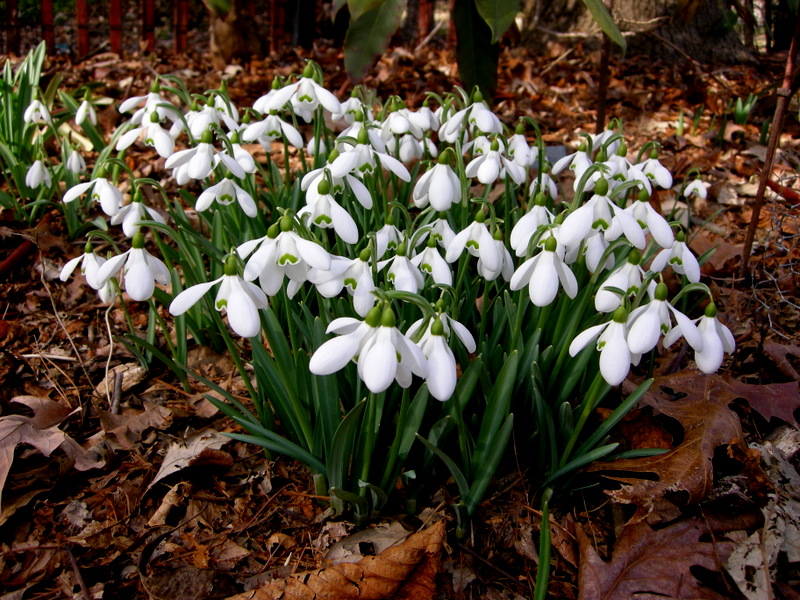
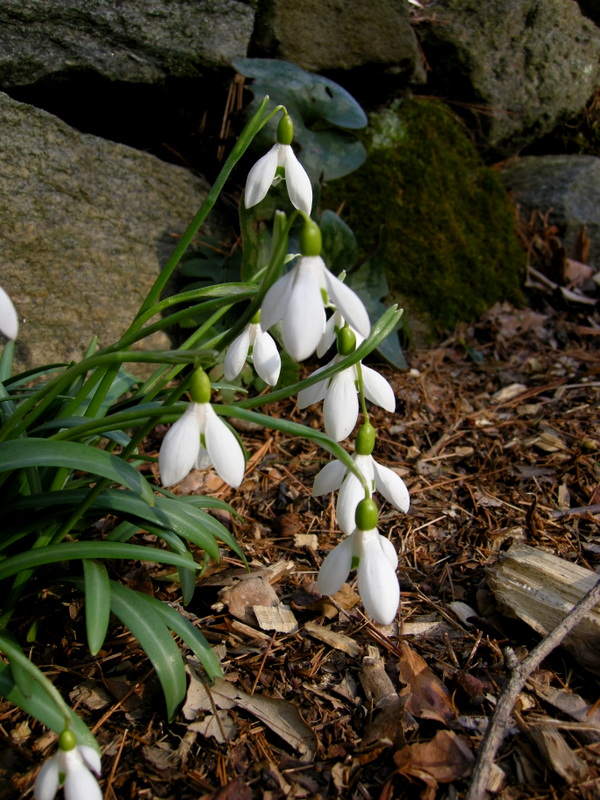
Galanthus nivalis/Common SnowdropGalanthus nivalis, the common snowdrop

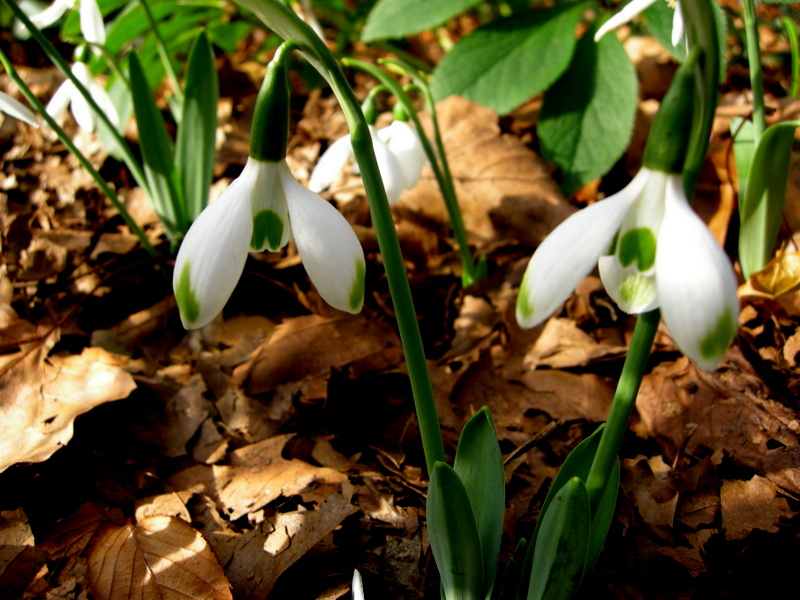
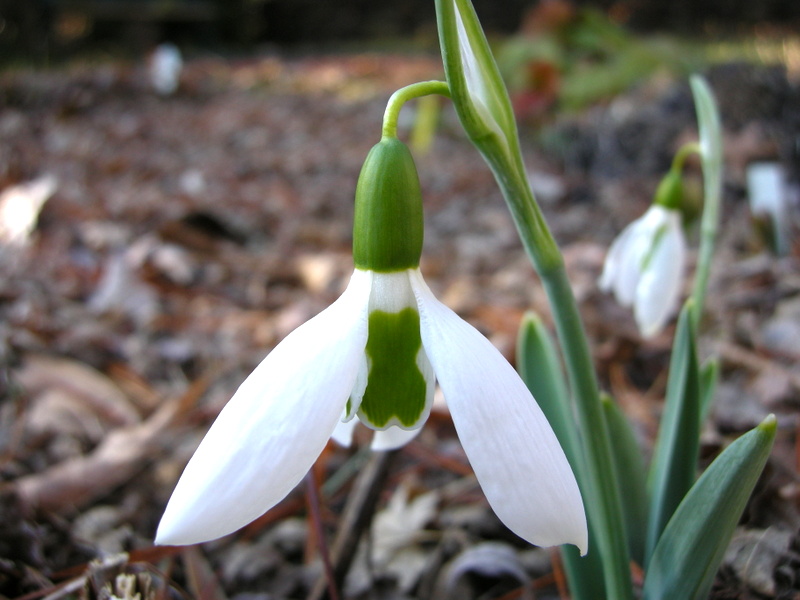
Common snowdrops are generally 4 to 6 inches tall.  The narrow, straplike leaves are green with a glaucous center stripe giving an overall gray-blue appearance.  The flowers have three outer petal-like segments and three smaller inner segments.  They are pure white with a bright green v-shaped mark around the notch (called a sinus) on the apex of the inner segments. 

Common snowdrops flower here in February and March no matter what the weather and prefer moist deciduous woods with deep organic soil.  However, they are not picky about cultural conditions and will naturalize freely in a wide range of garden settings, including the dry woods of Carolyn’s Shade Gardens.  They pair beautifully with native coral bells, snow crocus, Italian arum, hardy cyclamen, and hellebores.

.

Galanthus nivalisA natural mutation at Carolyn’s Shade Gardens, if you look closely these flowers have four outer segments (petals).

Because common snowdrops generally spread through bulb offsets rather than seed, the flowers in colonies are theoretically identical.  However, natural variations occur as you can see from the photo above where the flowers have four outer segments.  Often these mutations are not stable and do not persist as was the case with the flowers pictured.  However, sometimes ornamentally interesting and stable changes occur, and, if they are noticed by a sharp-eyed galanthophile, they enter cultivated gardens and even become a named cultivar available for sale.

  .

G. 'Flore Pleno'A clump of double common snowdrops

.

Galanthus nivalis 'Flore Pleno'double common snowdrop

I want to highlight three cultivars of the common snowdrop to give you an idea of the range available.  The double common snowdrop, Galanthus nivalis ‘Flore Pleno’ (or sometimes G. n. f. pleniflorus ‘Flore Pleno’), is the oldest known snowdrop cultivar, first illustrated in 1703 and described in a prominent gardener’s dictionary in 1731.  Although it is sterile, it spreads vigorously from bulb offsets and is tolerant of a wide range of cultural conditions.  I have been told that in England it is often more abundant than the straight species. 

‘Flore Pleno’ has a lovely flower and has the advantage of being less expensive than the rest of the double snowdrops available so it is great for naturalizing.  It is the parent with G. plicatus of the Greatorex double series of snowdrops to which ‘Dionysus’, ‘Hippolyta’, ‘Ophelia’, and several other double snowdrops belong.  ‘Flore Pleno’ was also given an Award of Garden Merit by the RHS.

.

G. 'Viridapice'the green-tipped snowdrop ‘Viridapice

.

G. 'Viridiapice'‘Viridiapice’

One of my favorite snowdrops is the green-tipped common snowdrop, Galanthus nivalis ‘Viridapice’.  It was originally found near an old farmhouse in northern Holland by a member of the Hoog family, owners of the venerable but now defunct Dutch bulb nursery Van Tubergen.  It is a vigorous and large-flowered snowdrop characterized by a beautiful and strikingly prominent green marking on the apex of the outer segments and a large single mark on the inner segments. 

Unfortunately,  the name ‘Viridapice’ was applied over the years to a number of different green-tipped common snowdrops, some of which are quite inferior.  I acquired my strain from the old Heronswood Nursery in Kingston, Washington, and I am happy to report that it is a superior strain and one of the best naturalizers in my garden.

.

Galanthus nivalis 'Blewbury Tart'the double common snowdrop ‘Blewbury Tart’

.

Galanthus nivalis 'Blewbury Tart'‘Blewbury Tart’

Finally, I want to highlight a newer cultivar of the common snowdrop, because I love it and because it was discovered by the only person I know who is more excited about snowdrops than me, Alan Street of Avon Bulbs in England.  In 1975, Alan noticed ‘Blewbury Tart’ in a churchyard in the village of Blewbury in Oxfordshire, England, where he grew up, and collected it with the permission of  Vicar Hugh Pickles. The famous galanthophile Primrose Warburg helped to name it because she called it Blewbury Muffin when Alan gave it to her, thus inspiring the name ‘Blewbury Tart’.  

I asked Alan if there was a special anecdote that I could relate here.  He told me that when he first exhibited it in 1985, a prominent British journalist said it looked like a “squashed fly on a windscreen”.   Nevertheless Avon offered it for sale in 1992.  It is an unruly double with an outward-facing dark green inner rosette encircled by three narrow outer segments.  It looks like it is having a bad hair day and always makes me smile when I see it.  Alan relates that another prominent British galanthophile, Ruby Baker, considers it a favorite.

*   *   *

Although I don’t expect most gardeners to share my obsession, whenever I write about snowdrops I hope to communicate some of the enthusiasm that snowdrops arouse.  Maybe you will add them to your garden this year!  All four snowdrops profiled are available from Carolyn’s Shade Gardens.

Carolyn

.

Note: Every word that appears in orange on my blog is a link that you can click for more information. If you want to return to my blog’s homepage to access the sidebar information (catalogues, previous articles, etc.) or to subscribe to my blog, just click here.

Longwood Christmas and a Surprise

Posted in garden to visit, winter, winter interest with tags , , , on December 29, 2013 by Carolyn @ Carolyns Shade Gardens

Nursery News: Carolyn’s Shade Gardens is a retail nursery located in Bryn Mawr, PA, specializing in showy, colorful, and unusual plants for shade.  The only plants that we ship are snowdrops and miniature hostas.  For catalogues and announcements of events, please send your full name, location, and phone number (for back up use only) to carolyn@carolynsshadegardens.com.  Click here to get to the home page of our website for catalogues and information about our nursery and to subscribe to our blog.

Snow storm 12-10-2013 12-10-2013 4-14-049Carolyn’s Shade Gardens in the snow

Starting in late November this year, we had five snow storms before Christmas.  I like snow but was already feeling a little cabin crazy when an email arrived from Longwood Gardens offering a great deal on a renewal of my long-expired membership.  We usually visit Longwood for a special event, but it struck me that the Longwood Gardens conservatories are a great place to go for a walk in the winter.  Renewal was easy, and Michael and I headed to Longwood bright and early the next day to test out our new indoor walking venue.

.

Longwood Xmas 2013 12-19-2013 1-34-24 PM.

Longwood Xmas 2013 12-19-2013 11-17-49 AMTopiary Garden

.

Longwood Xmas 2013 12-19-2013 1-41-01 PMGreat use of dried hydrangea flowers along the front entrance gate.  I almost got killed taking the photo so I wouldn’t recommend stopping there.

.

Longwood Xmas 2013 12-19-2013 1-28-14 PMCreative containers outside the cafe where we ate lunch.  The food is very good, especially the soups and chilis, and members get a discount.

There is plenty to see outside at Longwood even in the winter as you can tell from the above photos.  However, it was quite cold that day so we headed for the four acres of indoor conservatories.  We intend to go back in January in the late afternoon and evening to see the outdoor Christmas display.  If you haven’t done that, you are in for a treat.  For photos of the lights at night and tips for visiting, read my post A Longwood New Year’s Eve.

Mid-morning on a bright and sunny day turned out to be a bad time to photograph the conservatories so I don’t have as many photos to show you.  You will have to go yourself to see all the sights:

  .

Longwood Xmas 2013 12-19-2013 11-24-51 AM.

Longwood Xmas 2013 12-19-2013 11-28-33 AM.

Longwood Xmas 2013 12-19-2013 11-27-55 AM.

Longwood Xmas 2013 12-19-2013 12-50-47 PM.

Longwood Xmas 2013 12-19-2013 11-47-08 AM.

Longwood Xmas 2013 12-19-2013 11-46-57 AM

.

Longwood Xmas 2013 12-19-2013 11-44-22 AM.

Longwood Xmas 2013 12-19-2013 11-44-11 AM

.

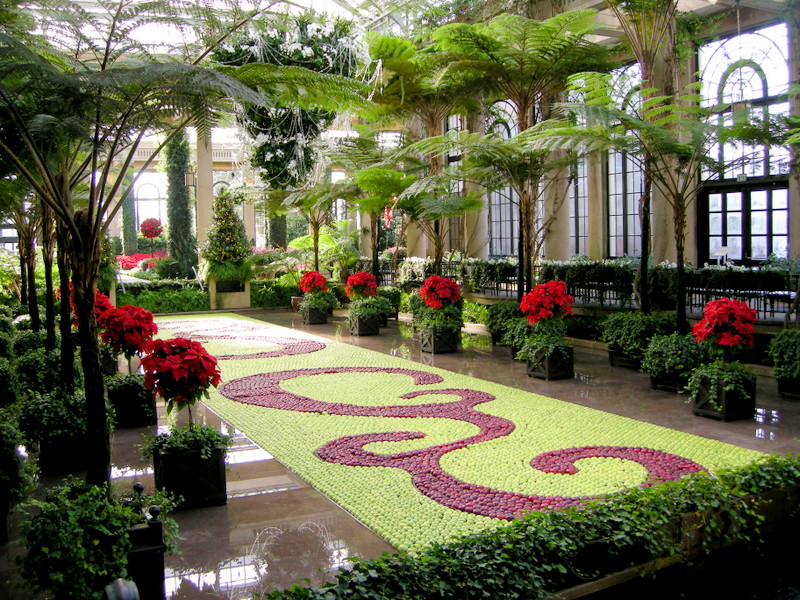
Longwood Xmas 2013 12-19-2013 11-33-20 AMThe Exhibition Hall featured an elaborate and beautiful tapestry composed of 18,540 Granny Smith and Rome apples floating in 4″ of water and kept in place by a hidden structural form fabricated in house.

.

Longwood Xmas 2013 12-19-2013 11-40-21 AM Christmas rose hellebores lined the edges of the floor.

.

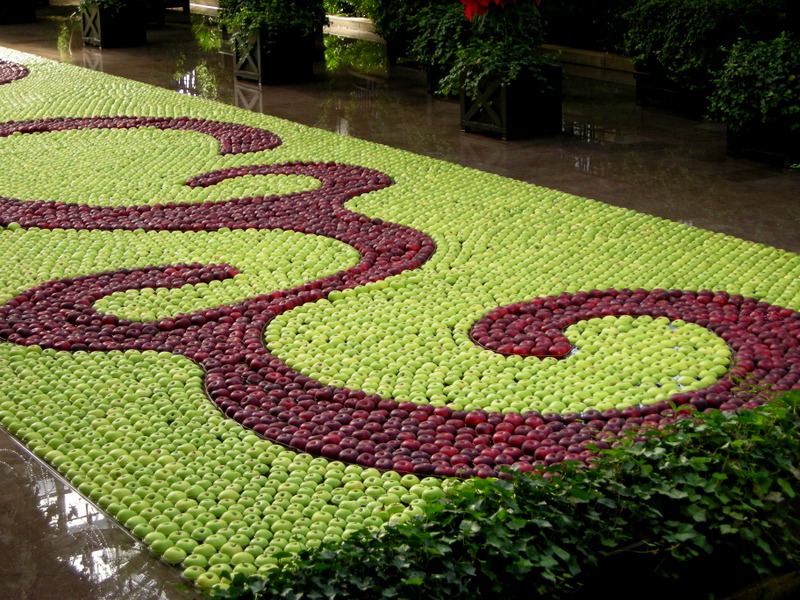
Longwood Xmas 2013 12-19-2013 11-33-51 AMA close up of the apples, which came from a local grower and will be donated to a local farm for cattle feed.

.

Longwood Xmas 2013 12-19-2013 11-51-08 AM

.

Longwood Xmas 2013 12-19-2013 12-41-31 PM.

Longwood Xmas 2013 12-19-2013 11-55-15 AM

.

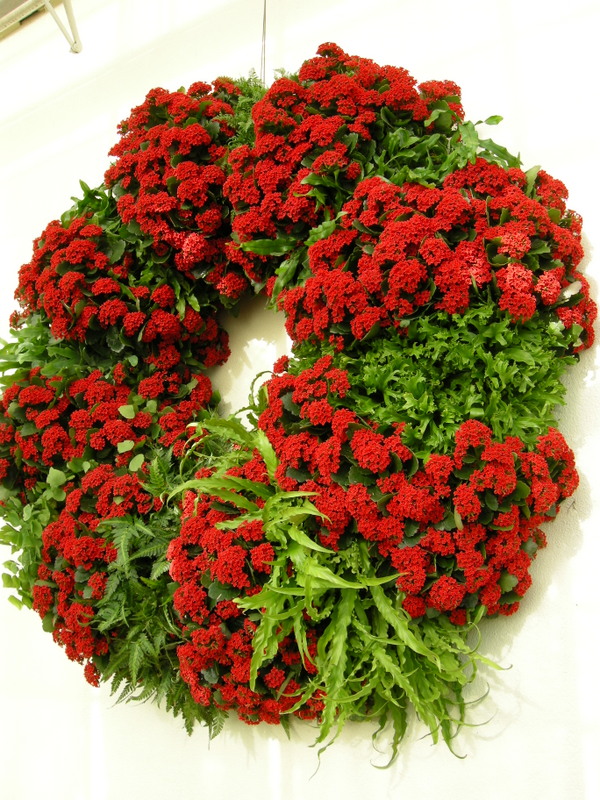
Our surprise occurred as we were admiring this wreath in the back corridor of the greenhouses.  We ran into our friend Scottie Pennett who works at Longwood as a grower for the conservatories.  She is in charge of several of the antique glass greenhouses actually used by the DuPont family and offered us an impromptu behind the scenes tour.

.

Longwood Xmas 2013 12-19-2013 12-03-59 PMScottie in one of her greenhouses.  On the left you can see a standard she is growing for a future display.  Weights have been tied to the branches to make them cascade down.

The attention to detail that is required for these plants is amazing.  Each one is individually groomed and manipulated to achieve the desired effect.  Plants are started as long as three to five years before the time that the actual display for which they are intended appears in the conservatory.  Scottie also trials plants that she thinks will be effective additions to future displays and presents them to the designers for consideration.  It is amazing to think that a plant that you breeze by in the conservatories might have begun from a cutting in Scottie’s greenhouse five years before.

.

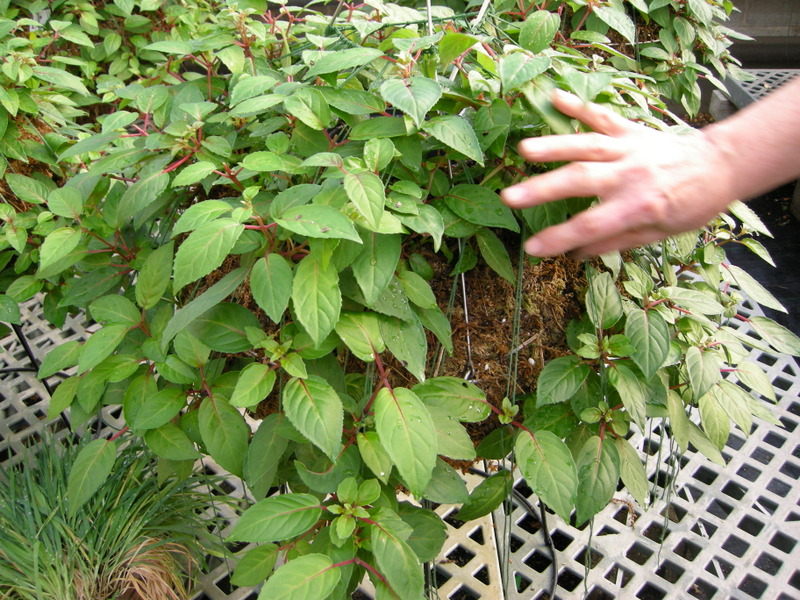
Longwood Xmas 2013 12-19-2013 11-59-36 AMA fuchsia basket where each branch needs to be tied down with string to give it the proper shape.

.

Longwood Xmas 2013 12-19-2013 12-04-18 PMAnother plant being tied to a frame to give it the proper look.

.

Thanks, Scottie, after our tour we had a much deeper appreciation for your work and that of all the other Longwood employees who produce such a gorgeous show in the conservatories year after year.  The Longwood Christmas display will continue through January 12.

Happy New Year,

Carolyn

.

Carolyn’s Shade Gardens is a local retail nursery in Bryn Mawr, Pennsylvania, U.S., zone 7a. The only plants that we mail order are snowdrops and miniature hostas and only within the US.

If you are within visiting distance and would like to receive catalogues and information about customer events, please send your full name and phone number to carolynsshadegardens@verizon.net. Subscribing to my blog does not sign you up to receive this information.

Nursery Happenings: The 2014 Snowdrop Catalogue, featuring snowdrops and other winter interest plants like cyclamen and hellebores, is on the sidebar, and we are taking orders.  To access the catalogue, please click here.  Please visit my Etsy Shop to purchase photo note cards suitable for all occasions by clicking here.

Facebook: Carolyn’s Shade Gardens has a Facebook Page where I post single photos, garden tips, and other information that doesn’t fit into a blog post. You can look at my Facebook page here or click the Like button on my right sidebar here.

Notes: Every word that appears in orange on my blog is a link that you can click for more information. If you want to return to my blog’s homepage to access the sidebar information (catalogues, previous articles, etc.) or to subscribe to my blog, just click here.

Fall 2013 Snowdrops and Camellias

Posted in Camellias, evergreen, Fall, Shade Shrubs, snowdrops, winter, winter interest with tags , , , , , , , , , , , , , , on December 11, 2013 by Carolyn @ Carolyns Shade Gardens

Nursery Happenings: Carolyn’s Shade Gardens is a retail nursery located in Bryn Mawr, PA, specializing in showy, colorful, and unusual plants for shade.  The only plants that we ship are snowdrops and miniature hostas.  For catalogues and announcements of events, please send your full name, location, and phone number (for back up use only) to carolyn@carolynsshadegardens.com.  Click here to get to the home page of our website for catalogues and information about our nursery and to subscribe to our blog.

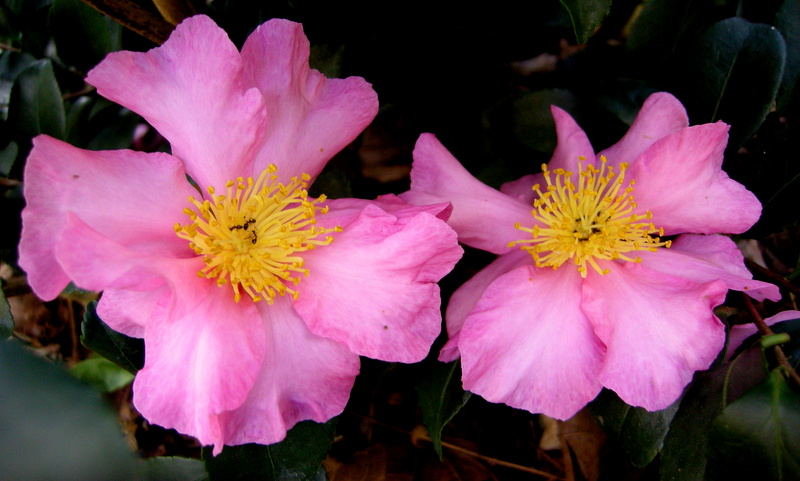
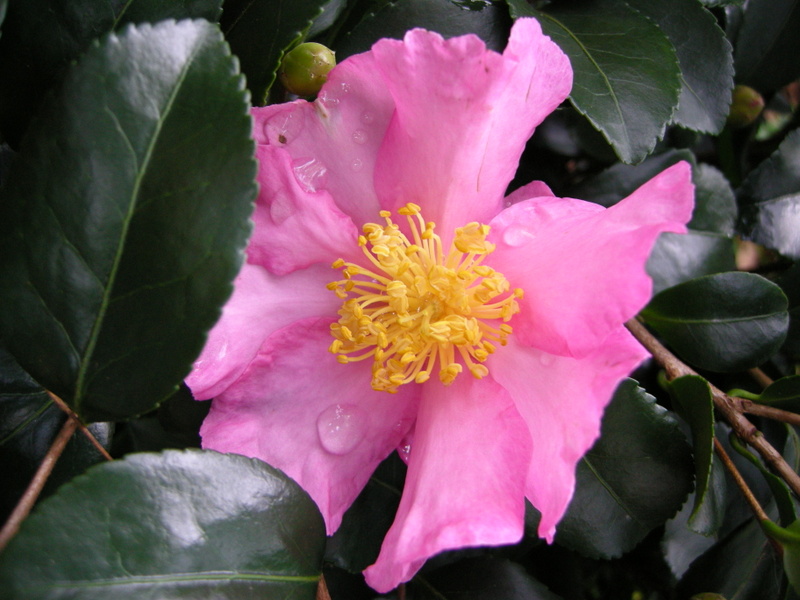
Camellia x 'Long Island Pink'‘Long Island Pink’ fall-blooming hardy camellia

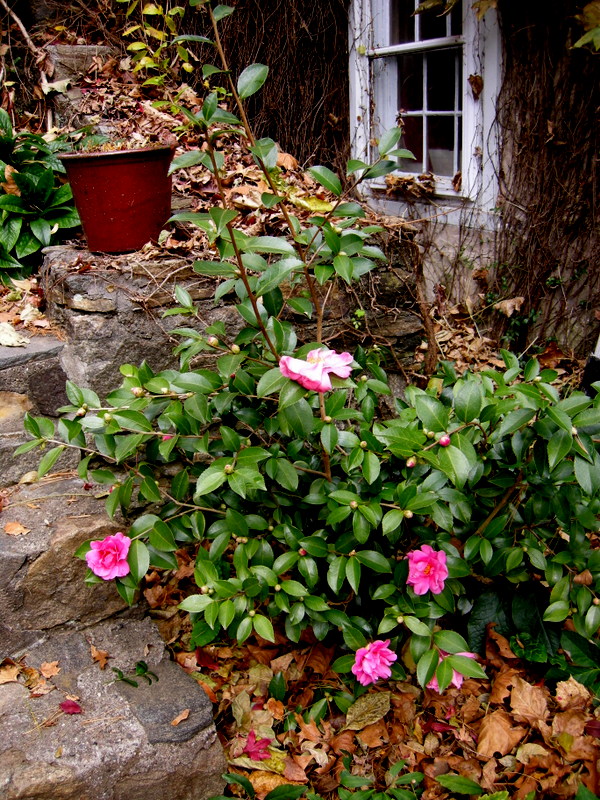
As my garden begins to quiet down in the second half of fall, two of my favorite plants come into their full glory.  One is fall-blooming hardy camellias, and the other is fall-blooming snowdrops.  Both are quite rare, at least in the U.S., but both are quite easy to grow and look wonderful together.  And the key to my appreciation of them is that late fall, November and December, is their main season.  When other plants are succumbing to frost, camellias and snowdrops begin their show with a fresh and pristine look.

.

Galanthus elwesii Hiemalis GroupThis fall-blooming form of the giant snowdrop selected at Carolyn’s Shade Gardens began flowering on November 1 this year and will be offered in the 2014 Snowdrop Catalogue.  Technically it is called Galanthus elwesii var. monstictus Hiemalis Group CSG-01, what a mouthful.

.

Galanthus elwesii Novemnber bloomingAnother shot of my fall-blooming snowdrops showing how they are nestled in among evergreen hellebores and Japanese holly ferns to highlight the pure white flowers.

I readily admit that I am a snowdrop addict—a galanthophile.  And I can even understand how some gardeners fail to get excited about these little white flowers in the spring.  However, in November and December when even the hardy cylcamen are done, snowdrops are so bright and cheerful that the winter doldrums disappear the minute I see them.  You can even have flowers beginning in mid-October by planting the earliest blooming species Galanthus reginae-olgae.  For more on fall-blooming snowdrops, click here.

  .

Galanthus elwesii green-tippedAnother fall-blooming giant snowdrop selected here at Carolyn’s Shade Gardens for it’s early November bloom time and green-tipped outer segments.  It received high praise recently when I posted photos on the Scottish Rock Garden Club Galanthus Forum, even the UK galanthophiles with access to hundreds of cultivars were impressed.  Hopefully it will multiply quickly and someday I can offer it for sale.

I am working on the 2014 Snowdrop Catalogue right now and will have it posted on the website before January 1.  There are a lot of exciting cultivars available for 2014, but unfortunately they are in very short supply so if you are interested, order early.  I have written quite a few blog posts and articles about snowdrops.  You can find them all compiled in the post New Feature Article on Snowdrops by clicking here.

.

Camellia Winter's Snowman‘Winter’s Snowman’ fall-blooming camellia has gorgeous, shiny, dark evergreen leaves.

.

Camellia Winter's Snowman‘Winter’s Snowman’ produces two types of flowers on the same plant: the anemone-form flowers on the right and the more open semi-double flowers on the left.

Like the snowdrops above, fall-blooming camellias are outstanding in November and December when their large and colorful flowers are shown off to perfection by their shiny evergreen leaves.  However, they bring even more to the garden because unlike the ephemeral snowdrops, camellias are shrubs that provide the beauty of their evergreen leaves and lovely habit year round.

.

Camellia sasanqua Nokoriko‘Nokoriko’ is new to my garden this year, and I love its unusual flower color.  Although it is said to be hardy in zone 6, it is a selection from the species Camellia sasanqua, which is not always hardy in our area.  Only time will tell.

.

I have written a lot about fall-blooming camellias and featured photos of dozens of plants that are hardy in zones 6 and 7.  All my articles are compiled in the blog post New York Times Photos where I provided a link to my camellia photos that appeared in that newspaper.   To see those photos and read more about camellias, click here. If you are looking for information about or photos of a particular hardy camellia cultivar, type the name into the Search My Website area on the sidebar of my home page (if the sidebar is not on the right, click here).

.

Camellia Arctic SnowThis photo of  ‘Arctic Snow’ gives an idea of how many buds each camellia can produce.

.

Camellia Arctic Snow‘Arctic Snow’ flower

The one drawback to fall-blooming camellias is that if we have unseasonably cold weather, below 25 degrees F (-3.8 C) or so, any open flowers can be frozen and ruined.  This happened this year during the last week of November when the temperature dropped to an official 21 degrees F (-6 C) but was actually 18 degrees in my garden and as low as 12 degrees elsewhere.  However, the unopened buds on my plants didn’t freeze, and the flowers continued to open.  We are now experiencing another bout of colder than normal weather, and I am not sure the buds will make it through unscathed this time.

.

Camellia Long Island Pink ‘Long Island Pink’

.

Camellia x 'Long Island Pink'A close up of ‘Long Island Pink’ and its beautiful leaves.

.

Usually I visit other gardens to show you camellias.  However, this year I am highlighting the cultivars that I grow myself.  Enjoy the photos and keep warm during the extra chilly weather we are experiencing.

.

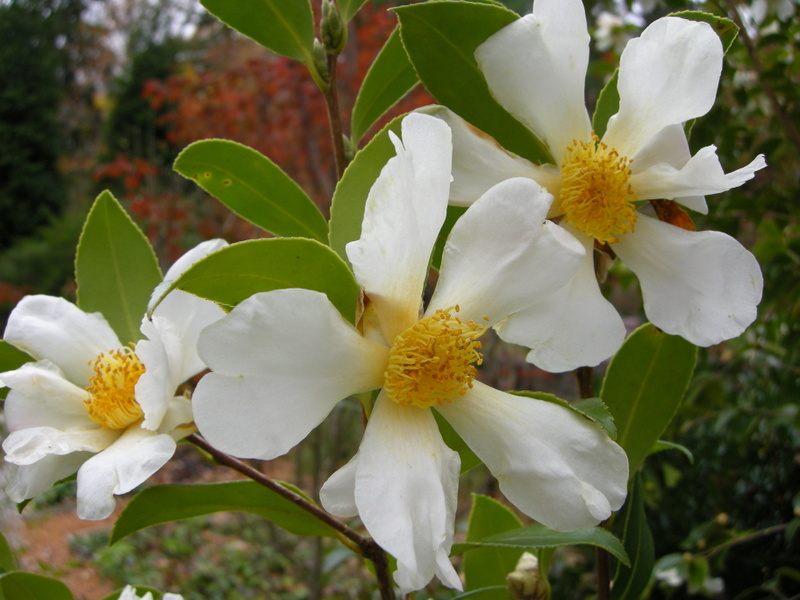
Camellia olifera Lu Shan SnowThe oldest camellia in my garden is ‘Lu Shan Snow’, a Camellia oleifera cultivar and the hardy camellia used by Dr. Ackerman at the US National Arboretum to develop many modern hardy camellia cultivars.

.

Camellia olifera Lu Shan Snow‘Lu Shan Snow’

.

Camellia Winter's Joy‘Winter’s Joy’ is one of my favorites because it produces so many buds and flowers.

.

Camellia Winter's Joy‘Winter’s Joy’

.

Camellia Winter's Star White‘Winter’s Star White’

.

Camellia x 'Winter's Darling'‘Winter’s Darling’

.

Camellia x 'Elaine Lee'‘Elaine Lee’

Carolyn

.

Carolyn’s Shade Gardens is a local retail nursery in Bryn Mawr, Pennsylvania, U.S., zone 6b. The only plants that we mail order are snowdrops and miniature hostas and only within the US.

If you are within visiting distance and would like to receive catalogues and information about customer events, please send your full name and phone number to carolynsshadegardens@verizon.net. Subscribing to my blog does not sign you up to receive this information.

Facebook: Carolyn’s Shade Gardens has a Facebook Page where I post single photos, garden tips, and other information that doesn’t fit into a blog post. You can look at my Facebook page here or click the Like button on my right sidebar here.

Notes: Every word that appears in orange on my blog is a link that you can click for more information. If you want to return to my blog’s homepage to access the sidebar information (catalogues, previous articles, etc.) or to subscribe to my blog, just click here.
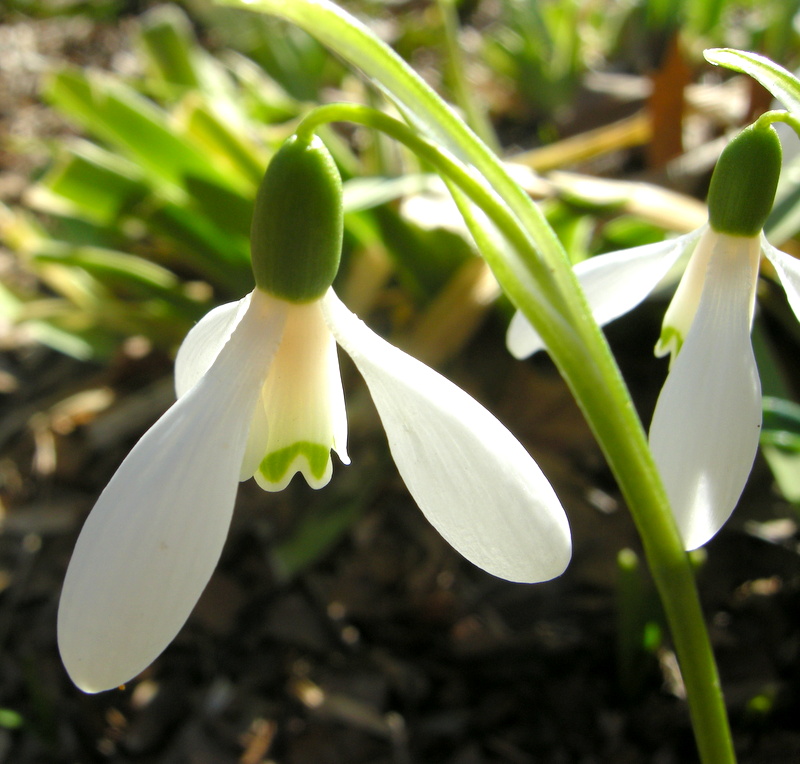
Winterthur Part 1: Late Winter 2013

Posted in bulbs for shade, garden to visit, Shade Gardening, Shade Perennials, snowdrops, winter, winter interest with tags , , , , , , , , , , , , , , , on June 22, 2013 by Carolyn @ Carolyns Shade Gardens

Carolyn’s Shade Gardens is a retail nursery located in Bryn Mawr, PA, specializing in showy, colorful, and unusual plants for shade.  The only plants that we ship are snowdrops and miniature hostas.  For catalogues and announcements of events, please send your full name, location, and phone number (for back up use only) to carolyn@carolynsshadegardens.com.  Click here to get to the home page of our website for catalogues and information about our nursery and to subscribe to our blog.

Crocus tomasinianus In early March, the courtyard behind the house at Winterthur is completely filled with snow crocus, C. tomasinianus. It is worth visiting in late winter just to see this sight.

.

Each year I choose an outstanding Philadelphia (Pennsylvania, US) area garden to profile through out the seasons. There are so many amazing gardens in the Delaware Valley that I will never run out of choices. It is more a case of which wonderful garden to choose. In 2011 to 2012, I visited the enchanting pleasure gardens at Chanticleer. To see those posts, click here. In 2012 to 2013, I focused on the diverse and magnificent gardens and conservatories at Longwood. To see those posts, click here. For 2013 to 2014, I have chosen the elegant former estate of collector and horticulturalist Henry Francis du Pont located in Delaware just over the Pennsylvania line and called Winterthur.

.

WinterthurThe Winterthur house holds the premier collection of American decorative art. For scale, look at the two people on the right side of the photo just beyond the path.

Henry Francis du Pont (1880 to 1969) was a voracious collector of American decorative art for his home and of plants from all over the world for his garden. He had a lot of space to work with as the house has 175 rooms and the garden is 1,000 acres, 60 of which he landscaped with naturalistic plantings. About 60 years ago du Pont opened the house and gardens to the public, fulfilling his wish that:

the Museum will be a continuing source of inspiration and education for all time, and that the gardens and grounds will of themselves be a country place museum where visitors may enjoy as I have, not only the flowers, trees and shrubs, but also the sunlit meadows, shady wood paths, and the peace and great calm of a country place which has been loved and taken care of for three generations.

.

WinterthurThe paths leading from the visitor’s center to the house and gardens meander through the magnificent trees.

.

The “peace and great calm of a country place” is what draws me to Winterthur again and again for the garden is not a botanical collection or a display garden in the usual sense. But rather, as the website states, “an artistic composition that captures a significant period in the history of American horticulture.” It is carefully maintained and preserved to allow visitor’s to enjoy the landscaped gardens as Henry du Pont designed them as well as the peaceful vistas that he carefully incorporated into his designs. Yet it does so with none of the rigidity and dated feeling of many historic gardens. The experience is as fresh and enjoyable as if du Pont himself were giving you a tour of his own backyard, albeit a very large one!

.

DSCN9477Another view of the house in winter.

.

This post shows photos from my visit to Winterthur for their annual snowdrop event, this year on March 9 (for more information on that event, click here). I apologize for the delay, but I have been so busy with my nursery that I just found time to sort through these images. I also thought that pictures of snowdrops and other winter bulbs might really stand out right now when other blogs aren’t posting them anymore. Most of the plants shown are in the area of the March Bank at Winterthur, which contains the premier collection of naturalized snowdrops and other winter interest bulbs in the U.S.

.

Galanthus at Winterthurnaturalized snowdrops

.

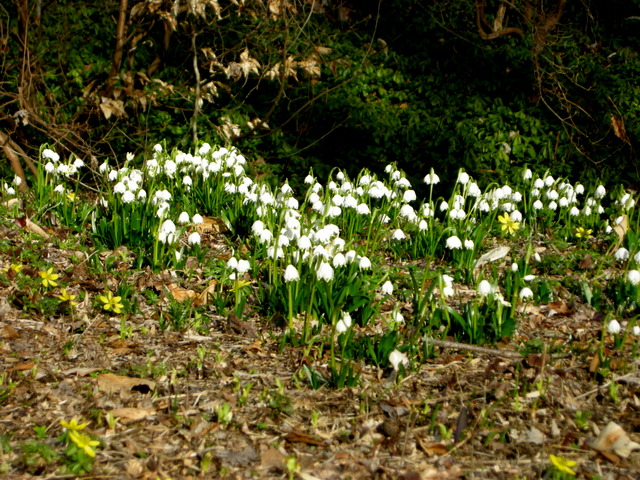
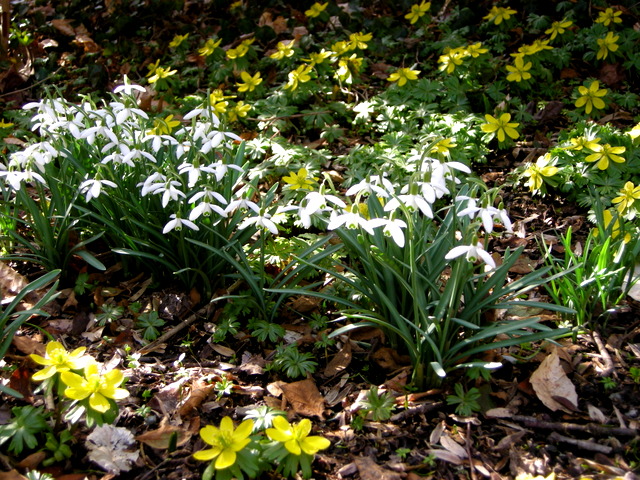
It is very difficult to give readers an idea of the massive amounts of snowdrops, aconite, crocus, glory-of-the-snow, snowflakes, adonis, and other winter bulbs at Winterthur. The plants are so small that once you back up to show a large area, they disappear into the leaf litter (at least using my camera, which is much better for macro shots). You will just have to take my word for it that in person the sweeps of bulbs are breath-taking and unparalleled.

.

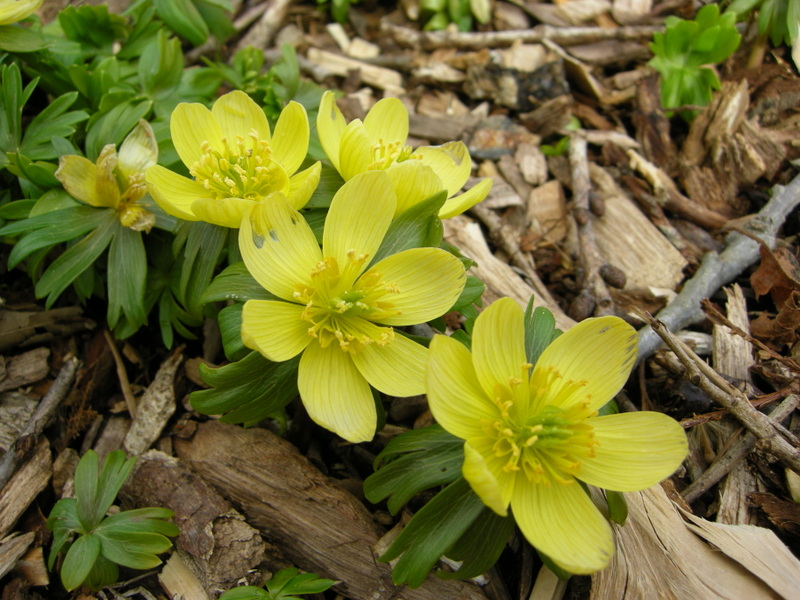
Eranthis hyemalisWinter aconite with snowdrops in the background.

.

Winterthuraconites, snowdrops, and crocus

.

Adonis amurensisAmur adonis

.

Leucojum vernumspring snowdflake

.

Winterthuraconite, snowdrops, and snowflakes

.

Galanthus and Eranthissnowdrops and aconite

.

Winterthursnowflakes and aconite

.

WinterthurMarch Bank

.

Galanthus elwesiiMost of the naturalized snowdrops are the giant snowdrop, G. elwesii.

.

Galanthus elwesiiA particularly lovely clump of giant snowdrops with many more (plus a photographer) on the March Bank.

.

Galanthus nivalis 'Vidirapice'green-tipped snowdrops

.

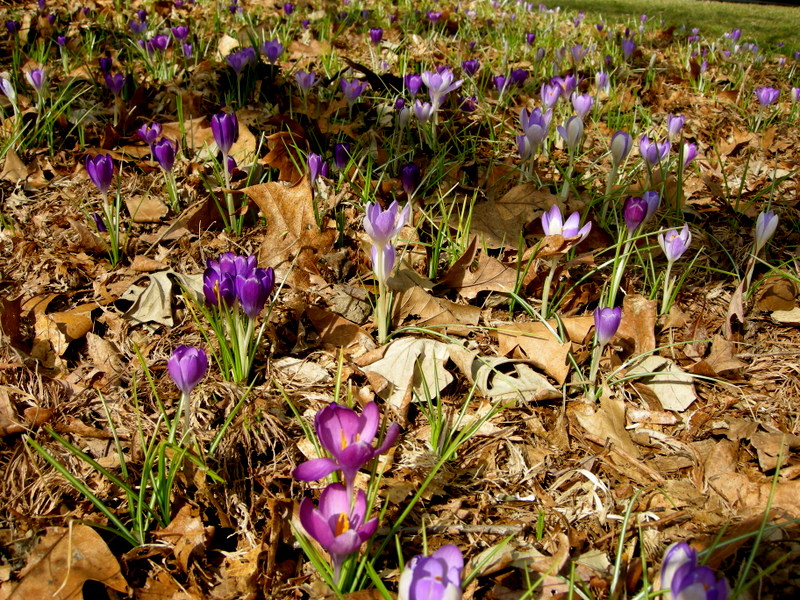
Crocus tommasinianusSnow crocus growing in the grass courtyard behind the house.

.

Crocus tommasianusIt is much easier to photograph the snow crocus set off by the grass. However, all the bulbs in this post appear through out Winterthur in the same massive quantities and are just as awe-inspiring as the crocus portrayed here.

.

I hope you enjoyed Part 1 of my year of Winterthur posts, out-of-season though it may be. If you are local, mark your calendars for March 1, 2014, so you can see this wondrous display for yourself. In the meantime, it is finally summer and my nursery is closed. I will be posting on the blog but less frequently. On Thursday I am off to San Francisco for the 2013 Garden Blogger’s Fling. Enjoy your summer.

Carolyn

.

Carolyn’s Shade Gardens is a retail nursery located in Bryn Mawr, Pennsylvania, U.S., zone 6b. The only plants that we mail order are snowdrops and miniature hostas and only within the US.

If you are within visiting distance and would like to receive catalogues and information about customer events, please send your full name and phone number to carolynsshadegardens@verizon.net. Subscribing to my blog does not sign you up to receive this information.

Nursery Happenings: The nursery is closed and will reopen in the fall around September 15. Have a great summer.

Facebook: Carolyn’s Shade Gardens has a Facebook Page where I post single photos, garden tips, and other information that doesn’t fit into a blog post. You can look at my Facebook page here or click the Like button on my right sidebar here.

Notes: Every word that appears in orange on my blog is a link that you can click for more information. If you want to return to my blog’s homepage to access the sidebar information (catalogues, previous articles, etc.) or to subscribe to my blog, just click here.
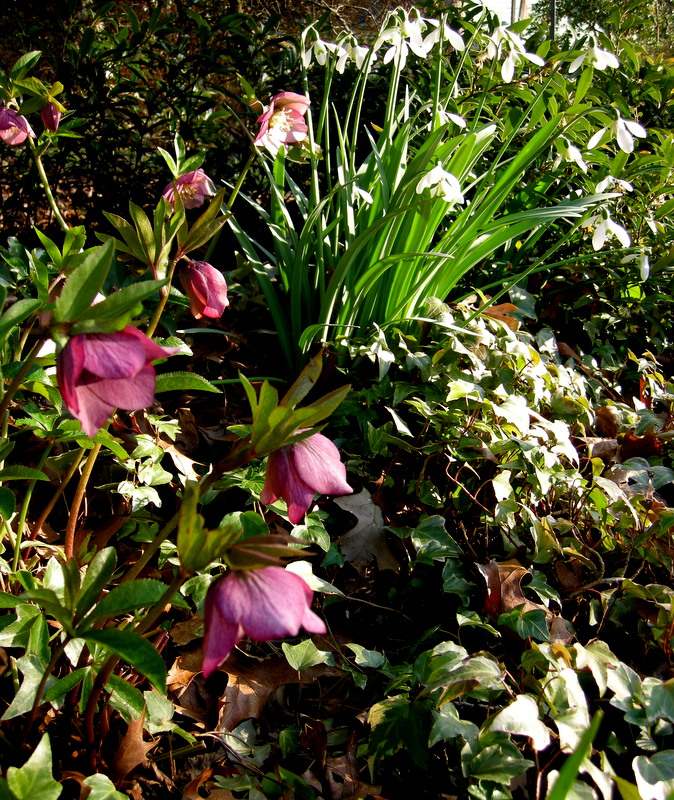
March 2013 GBBD: Hellebores on Parade Again

Posted in container gardening, containers for shade, Garden Blogger's Bloom Day, hellebores, Shade Perennials, winter, winter interest with tags , , , , , , , , , , , , , , , , , , , on March 14, 2013 by Carolyn @ Carolyns Shade Gardens

Carolyn’s Shade Gardens is a retail nursery located in Bryn Mawr, PA, specializing in showy, colorful, and unusual plants for shade.  The only plants that we ship are snowdrops and miniature hostas.  For catalogues and announcements of events, please send your full name, location, and phone number (for back up use only) to carolyn@carolynsshadegardens.com.  Click here to get to the home page of our website for catalogues and information about our nursery and to subscribe to our blog.

hellebores at Davoid Culp'sMy friend David Culp had this lovely bowl of hellebore flowers on his porch when I visited his garden Brandywine Cottage recently.  This is an elegant way to display your hellebores and gives a feeling for the range of colors and forms available.  For more gorgeous photos of David’s garden, check out his book The Layered Garden.

It is the middle of the month and time to participate in Garden Blogger’s Bloom Day (GBBD) hosted by May Dreams Gardens (link available on the 15th of the month) where gardeners from all over the world publish photos each month of what’s blooming in their gardens.  I participate because it is fun and educational for me to identify what plants make my gardens shine at different times of the year.  I am calling this post Hellebores on Parade Again because for GBBD in January 2012 I also put my hellebores on parade (click here to read it).

This month I am using this opportunity to profile the hellebores that will be available at my upcoming Hellebore Extravaganza Sale at my nursery on Saturday, March 23, from 10 am to 3 pm.  All photos are of hellebores blooming in my garden right now.

My garden is located in Bryn Mawr (outside Philadelphia), Pennsylvania, U.S., in zone 6B.


Helleborus x 'Pink Frost'
‘Pink Frost’ is my favorite of the Christmas rose crosses.  Its blue leaves set off the bright pink flowers beautifully, and the flowers fade to a gorgeous rose-red for an extremely long season of interest.

.

hellebore pink frost at David Culp's‘Pink Frost’ also works quite well in a container where its beauty can be examined up close (Culp garden).

.

Helleborus niger‘There is nothing like the pure white, outward-facing flowers of Christmas rose, Helleborus niger, to stop you in your tracks.  A mature clump can have dozens of flowers.

.

Helleborus niger 'Double Fantasy'The double Christmas rose ‘Double Fantasy’ is quite striking.

.

Helleborus x 'Mary Lou'Hellebore ‘Mary Lou’ has huge flowers and a wide pink border surrounding a bold maroon spotted “face”.

.

Helleborus x 'Warbler'The late afternoon sun shines through the early-blooming, yellow hellebore ‘Warbler’, whose flowers continue to be very ornamental even when they have technically “gone by”.  As you can see though, new buds are on the way.

.

Helleborus x 'Warbler'Here is a close up of ‘Warbler’ that I have posted before.

.

Helleborus x 'Phoebe'The double pink hellebore ‘Phoebe’ is just coming into bloom in my garden.

.

Helleborus x 'Phoebe'A close up of ‘Phoebe’.  

.

Helleborus x 'Painted Bunting'‘Painted Bunting’ is the first hybrid hellebore to bloom in my garden and isn’t fazed by all the cold weather we have been having.

.

Helleborus x 'Painted Bunting'‘Painted Bunting’s’ picotee markings with the maroon center flaring out to outline the pure white petals makes it very special.

.

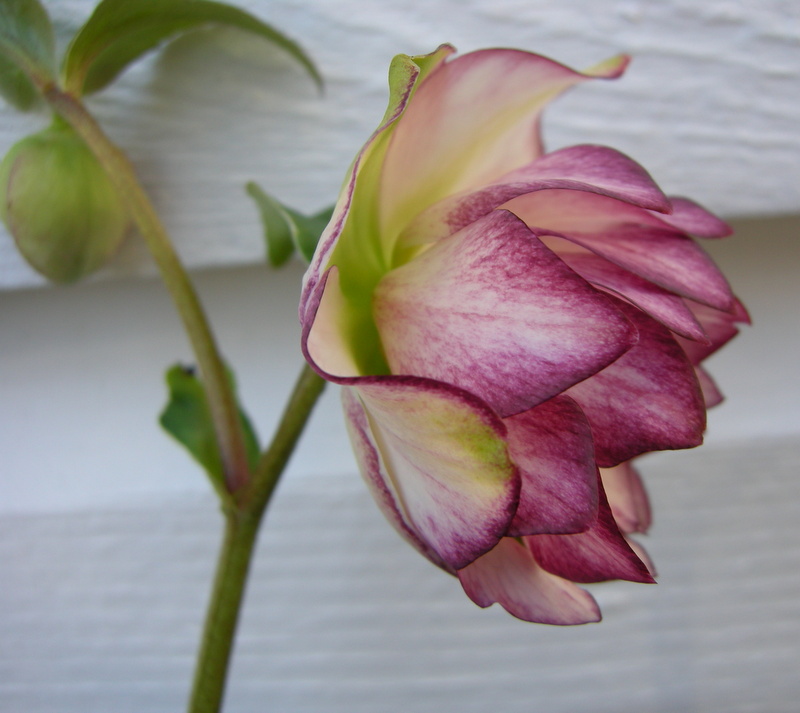
Helleborus x 'Elegance White'‘Elegance White’ is another lovely double hellebore.

.Helleborus purpurascensThe species hellebore H. purpurascens has a very unique slate purple color not found in any other hellebore.

.

Helleborus purpurascensA close up of Helleborus purpurascens.

.

Helleborus odorusFragrant hellebore, H. odorus, adds a bright note to the winter garden and looks gorgeous paired with red hellebores like ‘Red Lady’.

.

Helleborus odorusA close up of fragrant hellebore.

.

Helleborus x 'Red Lady'‘Red Lady’ hellebore

.

Helleborus x ballardiae 'HGC Cinnamon Snow'Another early-blooming Christmas rose cross, ‘Cinnamon Snow’.

.

Helleborus x ballardiae 'Cinnamon Snow'A close up of ‘Cinnamon Snow’.

.

Helleborus x 'Black'This black hybrid hellebore grabs the attention of every garden visitor I have.

.

Helleborus x 'First Cuckoo'The double hellebore ‘First Cuckoo’ is new to me this year.

.

Helleborus x sahinii 'Winter Bells,This very unusual flower belongs to the first ever cross between bearsfoot hellebore, H. foetidus, and Christmas rose, H. niger, called H. x sahinii ‘Winter Bells’.  It is new for me this year but looks quite promising for flowers and foliage interest.

.

Two more hellebore container ideas from David Culp:

hellenores David Culp'sDouble black hellebores paired with their favorite companion, snowdrops.

.

hellebores David CulpAn enchanting combination of cream-colored hellebores and pussy willows, a shrub I may offer in my upcoming woody plant offer.

.

Enjoy, Carolyn

.

Carolyn’s Shade Gardens is a retail nursery located in Bryn Mawr, Pennsylvania, US, zone 6b.  The only plants that we mail order are snowdrops and miniature hostas and only within the US.

If you are within visiting distance and would like to receive catalogues and information about customer events, please send your full name and phone number to carolynsshadegardens@verizon.net.  Subscribing to my blog does not sign you up to receive this information.

Nursery Happenings:  The nursery is open and fully stocked.  If you can’t come to an event, just email to schedule an appointment–we are available this weekend.  My Hellebore Extravaganza open house sale is Saturday, March 23, from 10 am to 3 pm.  If you are a customer, expect an email shortly with all the details.  There are still a few spaces left in the hellebore seminar on Monday, March 18, at 10 am.  For details click here.  The 2013 Snowdrop Catalogue is on the sidebar of the website and orders are being accepted now.  To view the catalogue, click here.  The 2013 General Catalogue is available here.

Facebook:  Carolyn’s Shade Gardens has a Facebook Page where I post single photos, garden tips, and other information that doesn’t fit into a blog post.  You can look at my Facebook page here or click the Like button on my right sidebar here.

Notes: Every word that appears in orange on my blog is a link that you can click for more information.  If you want to return to my blog’s homepage to access the sidebar information (catalogues, previous articles, etc.) or to subscribe to my blog, just click here.
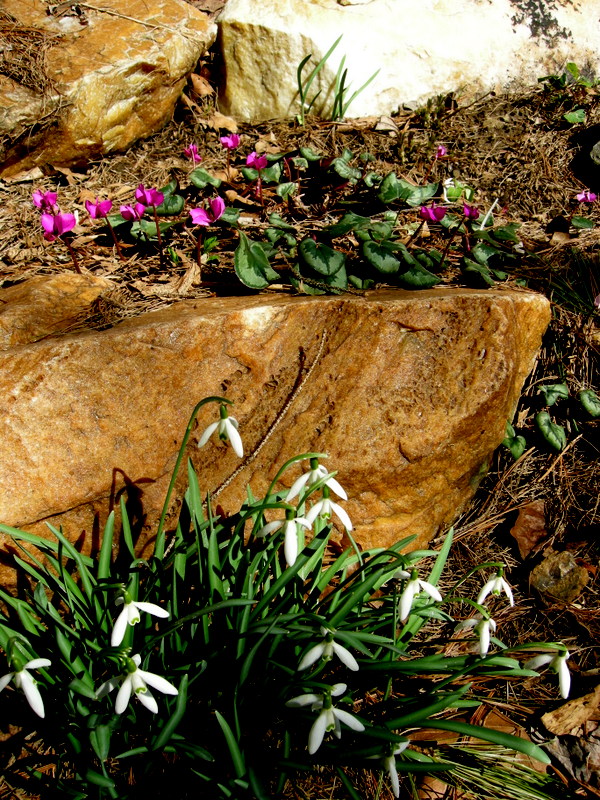
2013 Winter Interest Plants

Posted in garden to visit, hellebores, Shade Gardening, snowdrops, winter, winter interest with tags , , , , , , , , , , , , , , , , , , , , , , , , , , , , on March 4, 2013 by Carolyn @ Carolyns Shade Gardens

Carolyn’s Shade Gardens is a retail nursery located in Bryn Mawr, PA, specializing in showy, colorful, and unusual plants for shade.  The only plants that we ship are snowdrops and miniature hostas.  For catalogues and announcements of events, please send your full name, location, and phone number (for back up use only) to carolyn@carolynsshadegardens.com.  Click here to get to the home page of our website for catalogues and information about our nursery and to subscribe to our blog.

Galanthus 'Brenda Troyle'Galanthus ‘Brenda Troyle’ is one of the most robust and fragrant snowdrops in the Cresson garden.

This may be my last post that focuses on snowdrops, and I am sure some readers will rejoice.  I am aware that many gardeners do not share (or understand) my obsession.  However, I want to show photos from the recent Winter Interest Plants Seminars hosted by Charles Cresson for my nursery customers. 

Before I get to that though, I have to tell you about the snowdrop event this weekend at Winterthur, the fabulous garden in Delaware, US.  On Saturday, March 9, at 11 am, Alan Street, the world famous snowdrop expert from Avon Bulbs in England, is presenting the annual Bank to Bend Lecture on snowdrops.  Carolyn’s Shade Gardens will be one of two nurseries selling snowdrops and other winter interest plants at Winterthur.  I hope to see you there.  Here are the details:


winterthur

Join plantsman and snowdrop expert Alan Street of the renowned nursery Avon Bulbs as he offers insight into these precious flowers, sharing how they have become a worldwide phenomenon and how Avon Bulbs brings them to market. Registration includes tours of the March Bank display and access to specialist nurseries selling snowdrops and other winter interest plants. $20 non-members; $10 members.

Call 800.448.3883 to register or find out more.

Bank to Bend includes free admission to the garden, tours of the March Bank and access to specialist nurseries Black Hog Horticulture and Carolyn’s Shade Garden to purchase rare and unusual bulbs and other winter interest plants.

.

Cresson Winter Interest SeminarCharles Cresson talks about his witch hazels, winter aconite, and snowdrops with some die hard winter interest gardeners.

This is the third year that nationally known horticulturalist Charles Cresson has hosted my customers in his Swarthmore, Pennsylvania, garden to view and discuss winter interest plants.  Every year we see different plants, depending on the weather, but every year the group is just as enthusiastic despite the weather.  This year, February (and all winter really) has been cold and dismal, and the seminar days were no exception, but the attendees were enthusiastic and full of questions for Charles.

Cresson Winter Interest SeminarsCharles demonstrates how he protects important plants with plastic boxes if the weather is going to be unseasonably cold.

Plants are “late” to come out this year because it has been so cold.  The emergence of winter interest plants like perennials and bulbs is dependent more on the soil temperature than on the date.  If the soil warms up early, as it did in 2012 when we had no winter, many plants will bloom early.  This year it has been cold and gray, and many plants have yet to bloom or emerge.  Yet, such is the magic of Charles’s garden that there was a lot to see.  Here are some of the highlights in the order in which we saw them:

Narcissus 'Rijnveld's Early Sensation'After seeing this daffodil for many years blooming in Charles’s garden in February, I finally added it to mine this year.  It is called Narcissus ‘Rijnveld’s Early Sensation’.

.

Eratnhis hyemalis (pale yellow form)A rare pale yellow form of winter aconite, Eranthus hyemalis.

.

Crocus tommasinianusThe snow crocus, C. tommasinianus, is my favorite crocus because it blooms now with the snowdrops and multiplies rapidly.

.

Crocus tommasinianus 'Ruby Giant'‘Ruby Giant’ snow crocus is a deeper purple.

.

Crocus tommasinianus 'Taplow Ruby'‘Taplow Ruby’ snow crocus

.

Galanthus 'Atkinsii'Galanthus ‘Atkinsii’ is an old-fashioned and reliable snowdrop that should be part of any collection.

.

Galanthus 'Atkinsii' & Arum italicum 'Pictum'One of my favorite combinations, ‘Atkinsii’ with Italian arum, A. italicum ‘Pictum’.

.

Helleborus x ballardiae 'Pink Frost' with Cotoneaster salicifolius 'Henryi'The leaves of ‘Pink Frost’ hellebore, H. x ballardiae ‘Pink Frost’, pair beautifully with this rare cotoneaster, C. salicifolius ‘Henryi’.

.

Helleborus foetidus & Helleborus x ballardiae 'Pink Frost'‘Pink Frost’ again with bearsfoot hellebore, H. foetidus, in another winning combination.

.

Helleborus x ericsmithii 'Winter's Song'‘Winter’s Song’ hellebore, H. x ericsmithii ‘Winter’s Song’ is very early blooming so it was fully out on this cold February day.

.

Helleborus x 'Ivory Prince'‘Ivory Prince’ hellebore was just starting to open.

.

Iris unguicularis subsp. cretensisThis subspecies is an especially dark colored version of the winter-blooming Algerian iris, Iris unguicularis subsp. cretensis.

.

Galanthus 'Mighty Atom'

Galanthus ‘Mighty Atom’ has one of the best presentations of any snowdrop.

.

Galanthus rizehensisGalanthus rizehensis is a rare and desirable snowdrop species.

.

Galanthus 'Standing Tall'Charles’s newly introduced snowdrop ‘Standing Tall’ continues to stand up to whatever the weather throws at it.  If you didn’t know better you would think it was a daffodil.

.

Galanthus elwesii 'Standing Tall' Cresson photo-001‘Standing Tall’ in full bloom in early January.

.

Galanthus 'Beth Chatto' ‘Beth Chatto’

.

Galanthus 'Godfrey Owen'Charles and I both acquired six-petaled ‘Godfrey Owen’ last year but his was not felled by snow and ice.

.

Galanthus 'Godfrey Owen'‘Godfrey Owen’

.

Galanthus 'Godfrey Owen'The inner segments of ‘Godfrey Owen’ are extraordinary too.  This photo represents to me what galanthophiles are all about.

.

I know the participants enjoyed themselves because even after an hour and a half in the cold, they were still asking Charles questions.  I hope my readers have gotten some vicarious enjoyment.

I you would like to see what was featured during the 2011 and 2012 seminars, follow these links:

2011 Winter Interest Plants

2012 Winter Interest Plants

Carolyn

.

Carolyn’s Shade Gardens is a retail nursery located in Bryn Mawr, Pennsylvania, US, zone 6b.  The only plants that we mail order are snowdrops and miniature hostas and only within the US.

If you are within visiting distance and would like to receive catalogues and information about customer events, please send your full name and phone number to carolynsshadegardens@verizon.net.  Subscribing to my blog does not sign you up to receive this information.

Nursery Happenings:  We are now accepting reservations for our very popular Hellebore Seminars .  The Friday session is full but the session on Monday, March 18, at 10:00 am has nine spaces left.  For details, click here.  The 2013 Snowdrop Catalogue is on the sidebar of the website and orders are being accepted now.  To view the catalogue, click here.  The 2013 General Catalogue is available here.

Facebook:  Carolyn’s Shade Gardens has a Facebook Page where I post single photos, garden tips, and other information that doesn’t fit into a blog post.  You can look at my Facebook page here or click the Like button on my right sidebar here.

Notes: Every word that appears in orange on my blog is a link that you can click for more information.  If you want to return to my blog’s homepage to access the sidebar information (catalogues, previous articles, etc.) or to subscribe to my blog, just click here.
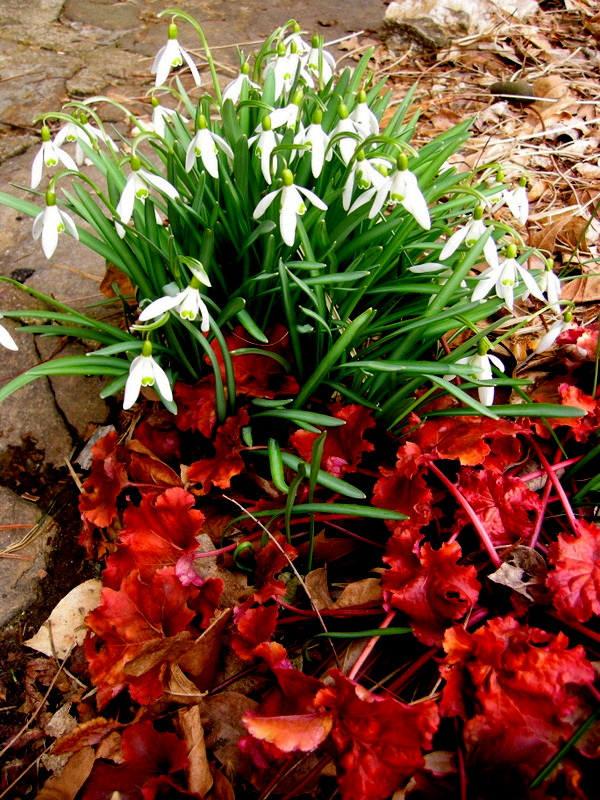
Cold Weather Antidote: Longwood’s Orchids

Posted in garden to visit, winter, winter interest with tags , , , on February 23, 2013 by Carolyn @ Carolyns Shade Gardens

Carolyn’s Shade Gardens is a retail nursery located in Bryn Mawr, PA, specializing in showy, colorful, and unusual plants for shade.  The only plants that we ship are snowdrops and miniature hostas.  For catalogues and announcements of events, please send your full name, location, and phone number (for back up use only) to carolyn@carolynsshadegardens.com.  Click here to get to the home page of our website for catalogues and information about our nursery and to subscribe to our blog.

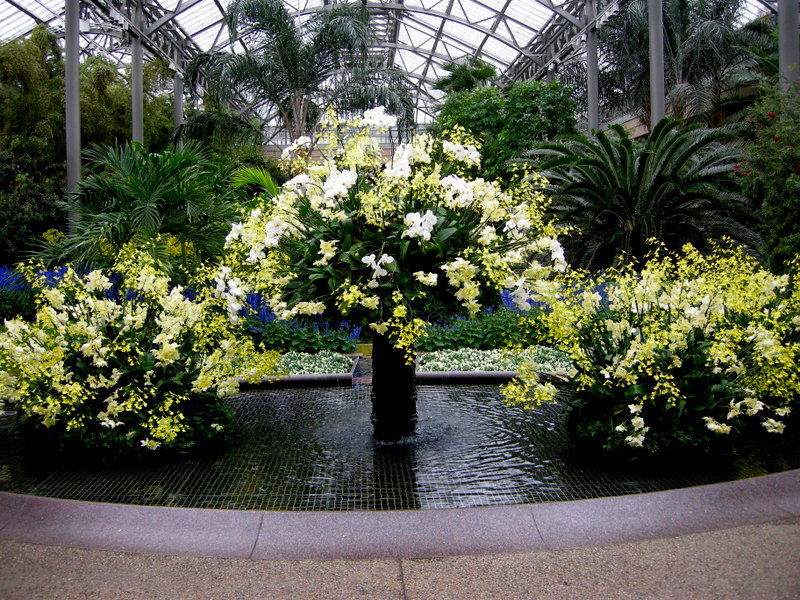
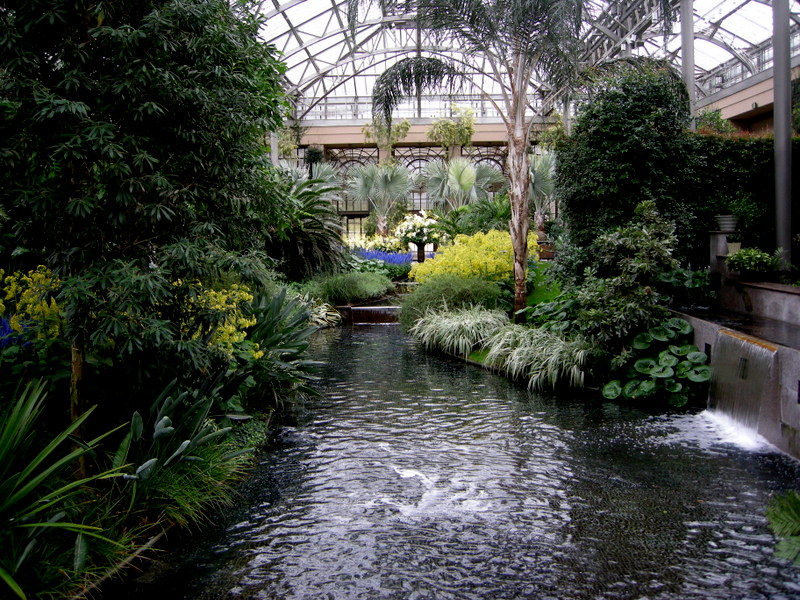
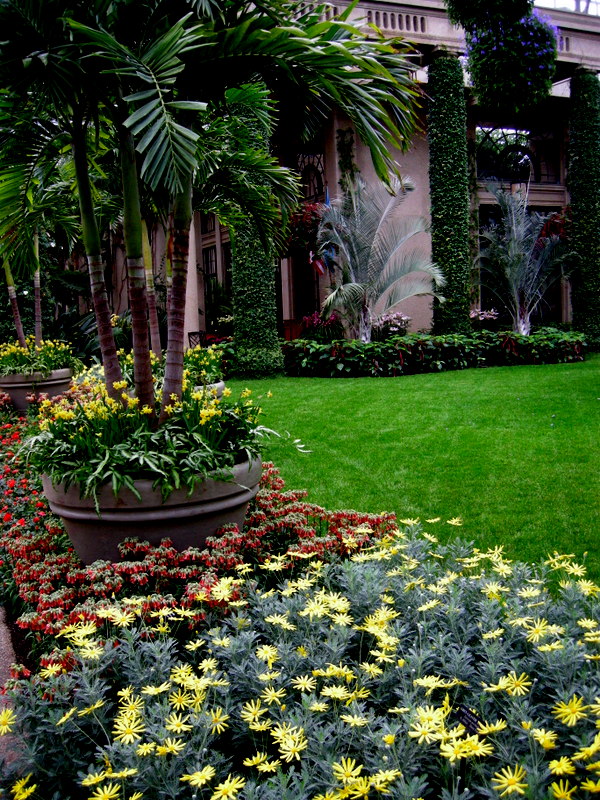
Longwood East conservatoryFor Longwood Garden’s Orchid Extravaganza, the East Conservatory is filled with yellows, blues, creams, and whites—one of my favorite color combinations.

Before I get to my cold weather antidote, I want to mention another upcoming breath of spring:  The Philadelphia Flower Show, the largest indoor flower show in the world.  The theme this year is “Brilliant”, a tribute to the majestic culture and creative gardening tradition of Great Britain.  It runs from March 2 through March 10 at the Philadelphia Convention Center.  I will be giving a presentation on Sunday, March 3, at 5:00 pm in the Gardener’s Studio on “Hellebores for Your Garden: Selection, Maintenance, and Division”—don’t miss it!


Hamamelis x intermedia 'Jelena'
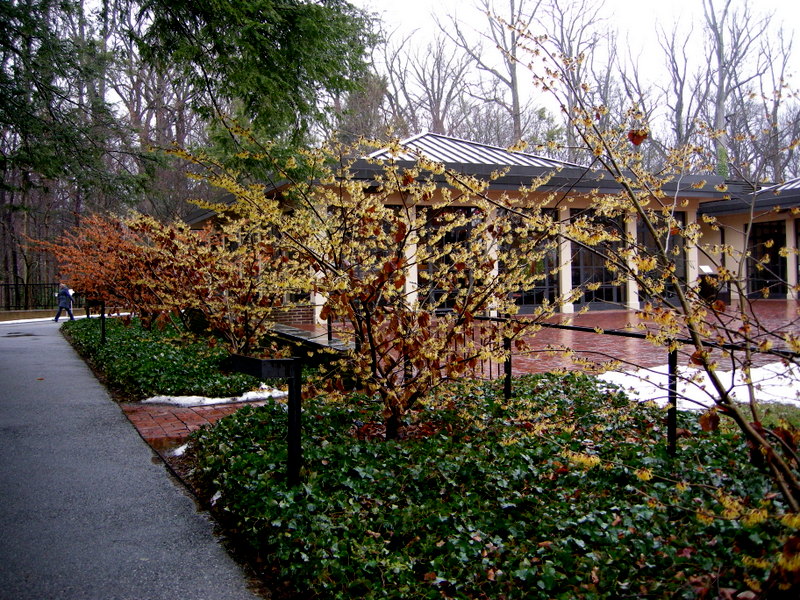
‘Jelena’ witch hazel outside the Longwood Cafe.  I highly recommend eating there when you visit.  The food is very good, especially the local mushroom soup, and in the winter you can sit by a fire.

.

Hamamelis x intermedia 'Luna'‘Luna’ witch hazel also outside the cafe.

On a recent Friday, my husband and I were suffering from cabin fever and decided to visit Longwood Gardens in Kennett Square, Pennsylvania, US.  For 2012 to 2013, I have been writing posts every couple of months about Longwood (last year I choose Chanticleer), and I will provide links to my posts at the end.  Usually we walk around outside, but it was cold, overcast, and raining so we opted to explore The Orchid Extravaganza in the conservatories instead.  I did photograph some token but gorgeous witch hazels on our mad dash for the cafe, and I have included their photos above to show what braver souls were viewing.

Longwood East ConservatoryThese lovely arrangements of moth orchids greet you as you come through the main entrance into the East Conservatory.


I am not an orchid lover and really know little about them.  But I knew that if Longwood did orchids, they would surpass my wildest expectations, and they did.  Orchids are an over-the-top plant perfect for an over-the-top display, and Longwood is the perfect place to view them.  Longwood has 9,000 orchids in its collection and used 5,000 plants, representing 2,300 species and cultivars, to decorate its four acres of conservatories for the current display.  Breathtaking doesn’t even begin to describe it so I will have to use photographs, beginning with more of the East Conservatory:

Longwood East ConservatoryWhen we entered, a bride and groom were having their wedding pictures taken.

.

Longwood East Conservatory.

Longwood East Conservatory.

Longwood East Conservatory

.

Longwood Velvet Groundsel & Flowering-bush PlectranthusThe yellow-flowered plant on the left is velvet groundsel and the blue on the right is flowering-bush plectranthus.  

.

Longwood East Conservatory.

Longwood East ConservatoryLooking back down the East Conservatory towards the main entrance.

.

Longwood orchid orbThis orchid orb, at the far end of the East Conservatory, contains 160 0rchids and weighs 200 pounds.  The custom metal frame was constructed by Longwood craftspeople.

.

Longwood orchid orbA close up of the orb.

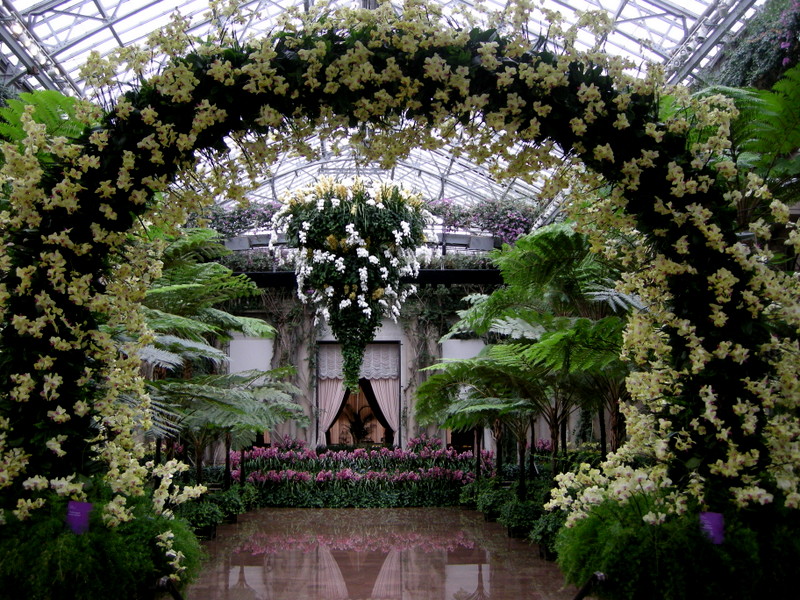
From the East Conservatory we entered the Exhibition Hall with its sunken and flooded marble floor surrounded by tree ferns:

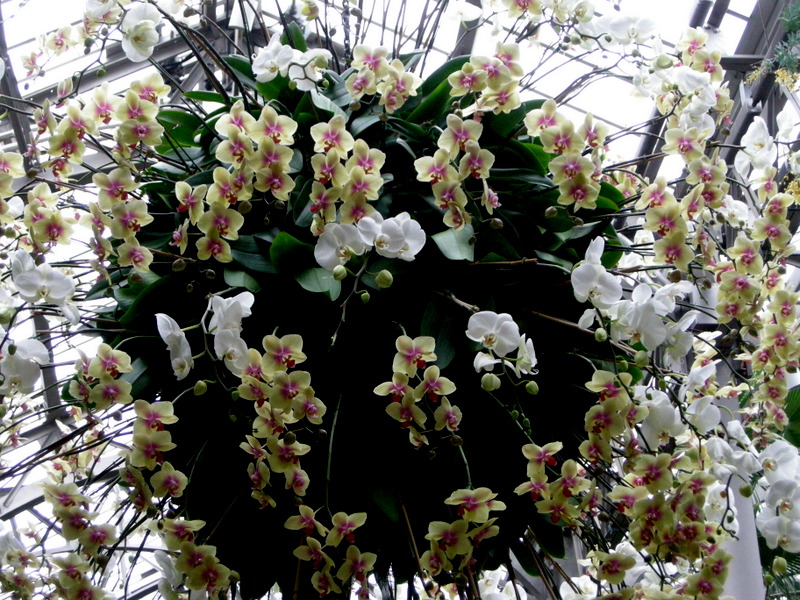
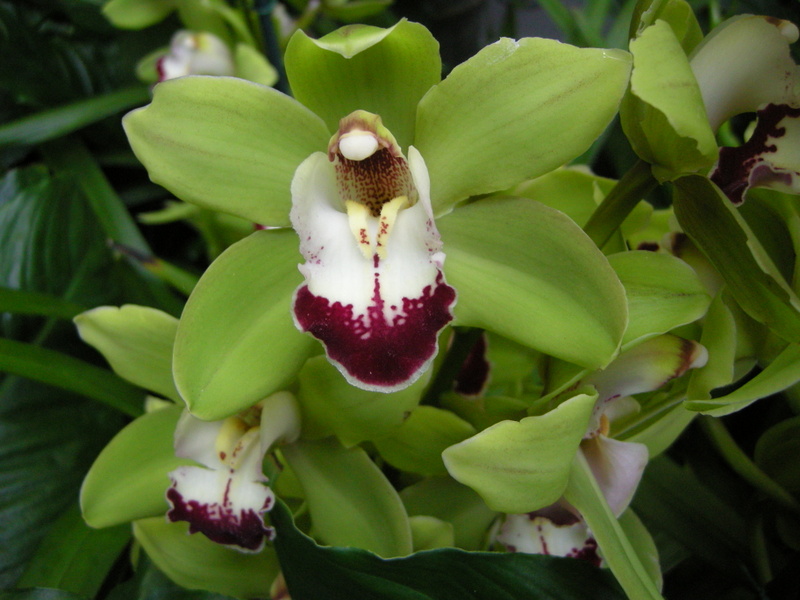
Longwood Exhibition HallAbove the Exhibition Hall hangs an “orchid chandelier” featuring over 100 yellow Cymbidium orchids, 200 white Phalaenopsis orchids, and Algerian ivy.

.

Longwood Exhibition Hall.

DSCN9176This 13′ tall arch at the other end of the Exhibition Hall is composed of 800 yellow Phalaenopsis orchids and is much prettier in person.

The third huge room in the conservatories is called the Orangery and features colorful displays of a wide range of unusual plants:

Longwood Orangery

Florist’s cyclamen, tulips, and oriental hybrid lilies underplant bronze-leaved clerodendrum.

.

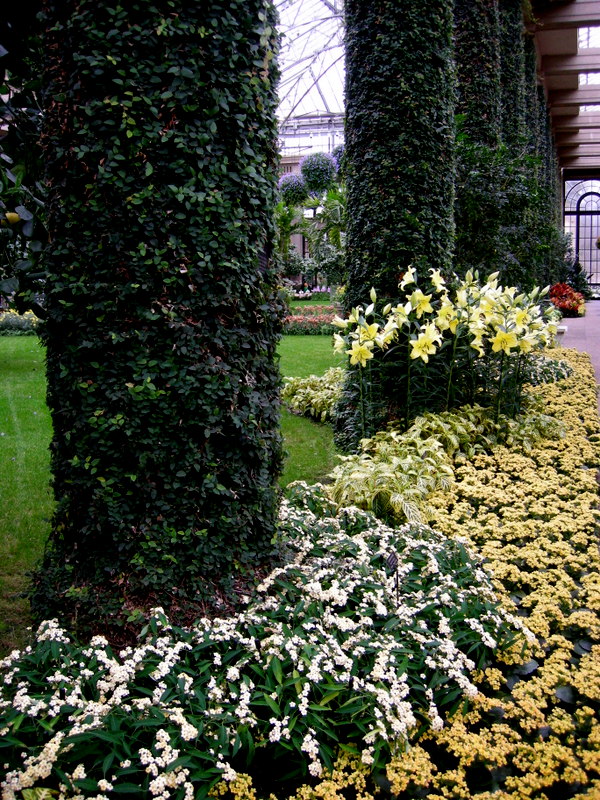
Longwood OrangeryVine-covered pillars line the walk around the edge of the Orangery.

.

Longwood Orangery.

Longwood OrangeryI was particularly taken with this combination of ‘Tete-a-Tete’ narcissus, orange mother-of-thousands, ferns, and orange roses.

No matter what time of year you visit the conservatories, between 200 and 500 orchids are on display in the Orchid House.  The orchids residing there during this special show are the cream of the crop.  I have diligently copied the names off the tags because I know a lot of readers are orchid fans.  But beware, my career as a recorder at the Philadelphia Flower Show receiving the orchid entries was short-lived after trying to deal with their confusing names.  

orchid x Laeliocattleya g. (unnamed) x Laeliocattleya g. (unnamed)

.

orchid no labelOne of my favorites but there was no label.

.

Schomburgkia undulataSchomburgkia undulata

.

x Sophrolaeliocattleya Rosemary Clooney 'Wanre'x Sophrolaeliocattleya Rosemary Clooney ‘Wanre’

.

Miltoniopsis Mary SugiyamaMiltoniopsis Mary Sugiyama

.

x Beallara Pluto's Drummer 'Pacific Pink'x Beallara Pluto’s Drummer ‘Pacific Pink’

.

x Sophrolaeliocattleya g. Jewel Box 'Dark Waters'x Sophrolaeliocattleya g. Jewel Box ‘Dark Waters’

.

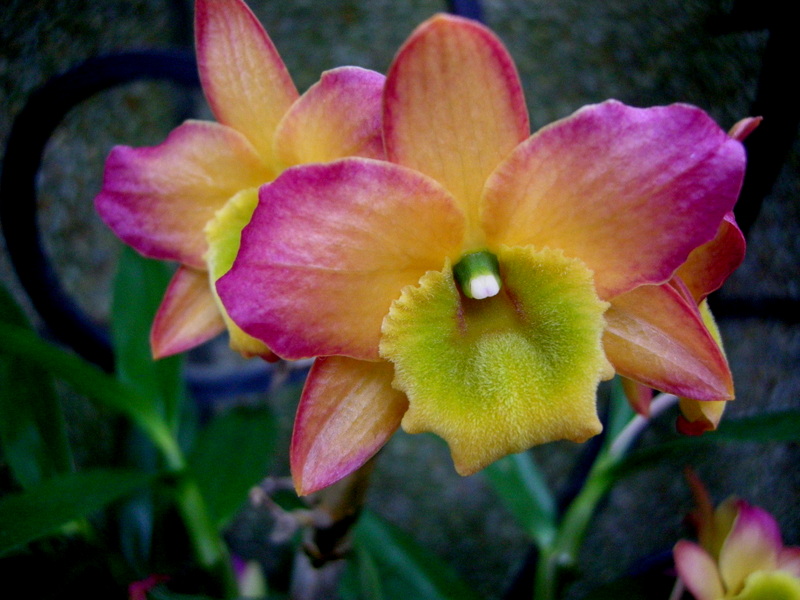
Dendrobium Oriental Smile 'Fantasy'Dendrobium Oriental Smile ‘Fantasy’

Orchids are beautifully incorporated into most of the many gardens in the West Conservatory Complex.  Here are a few of my favorite combinations, but it is well worth a walk through the whole area:

x Bratonia Kauai's ChoiceDozens of this eye-catching orchid, x Bratonia Kauai’s Choice, surround the waterfall in the Cascade Garden designed by Roberto Burle Marx.

.

Orchids with Calathea lancifolia, prayer plantIn the Tropical Terrace, white orchids are planted among this striking prayer plant, Calathea lancifolia.

.

Orchids with 'Moonlight Bay' aglaonema & 'Lutea' elephant's-ear plantAlso in the Tropical Terrace, yellow orchids with ‘Moonlight Bay’ aglaonema and ‘Lutea’ elephant’s-ear plant.

Despite all the grandeur of the big orchid displays, my favorite orchid presentations are found in some of the smaller and narrower gardens.   Perfect specimens from the same orchid family but in varying colors are displayed in containers like majestic houseplants.  If I had orchids this is how I would want to present them:

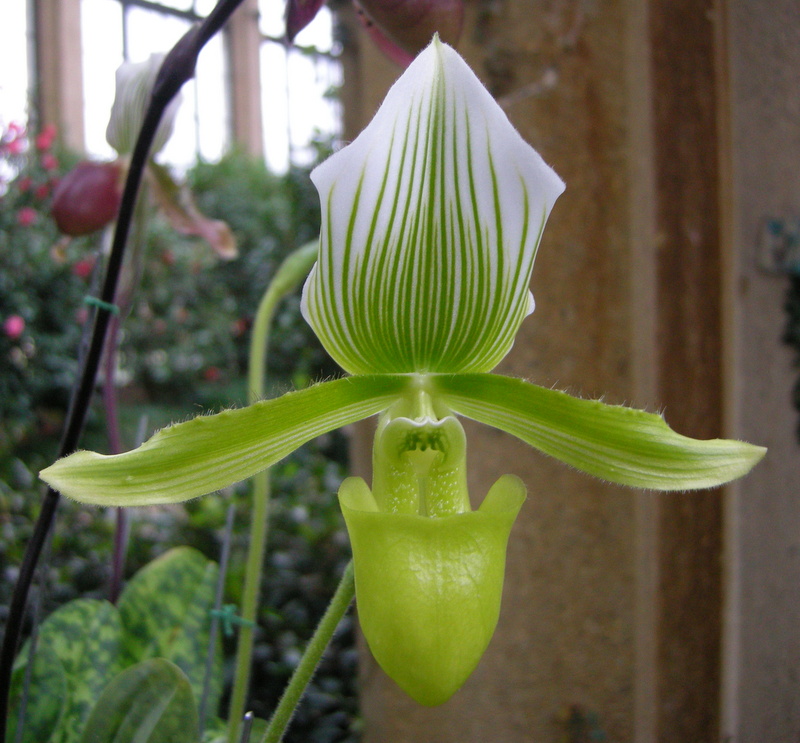
Lady's Slipper OrchidsA small garden, called the Garden Path, on the left side of the East Conservatory was lined with moss planters of lady’s slipper orchids.

.

Lady's Slipper Orchid.

Lady's Slipper Orchid

.

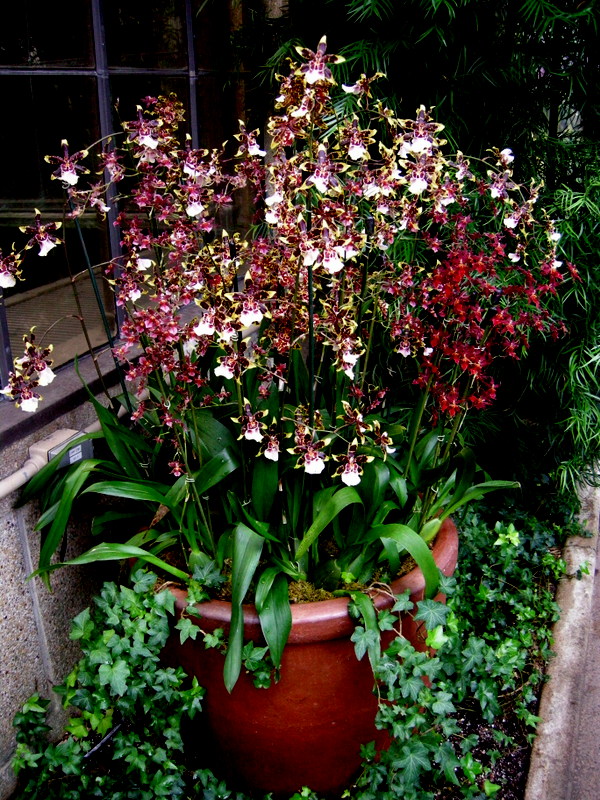
Dancing Ladies OrchidsAlong the Acacia Passage are ceramic containers of dancing ladies orchids.

.

Reed-Stem orchidsPots of reed-stem orchids line the Fern Passage.

.

Reed-Stem orchidsreed-stem orchid

The Longwood Orchid Extravaganza runs through March 24.  If you are coming, check the website because there are lots of special events scheduled.  If you are not in the area, I hope you have enjoyed your virtual tour.

To read more about Longwood Gardens, follow these links:

Groundcovers, Thinking Outside the Box

Longwood Gardens Part 2: At Night

A Longwood New Year’s Eve

Carolyn

I am linking this post to Les’s blog A Tidewater Garden for his annual winter walk-off where bloggers show photos from a winter trip where they did a lot of walking.  Since my husband and I walked Longwood’s conservatories for two hours, Les tells me that this post qualifies.  Follow the link to see Les’s professional quality photos and where other bloggers took their walk.

.

Carolyn’s Shade Gardens is a retail nursery located in Bryn Mawr, Pennsylvania, US, zone 6b.  The only plants that we mail order are snowdrops and miniature hostas and only within the US.

If you are within visiting distance and would like to receive catalogues and information about customer events, please send your full name and phone number to carolynsshadegardens@verizon.net.  Subscribing to my blog does not sign you up to receive this information.

Nursery Happenings:  We are now accepting reservations for our very popular Hellebore Seminars to be held on Friday, March 15 (only 3 spaces left) at 1:30 pm and Monday, March 18, at 10:00 am.  For details, click here.  The 2013 Snowdrop Catalogue is on the sidebar of the website and orders are being accepted now.  To view the catalogue, click here.  The 2013 General Catalogue is available here.

Facebook:  Carolyn’s Shade Gardens has a Facebook Page where I post single photos, garden tips, and other information that doesn’t fit into a blog post.  You can look at my Facebook page here or click the Like button on my right sidebar here.

Notes: Every word that appears in orange on my blog is a link that you can click for more information.  If you want to return to my blog’s homepage to access the sidebar information (catalogues, previous articles, etc.) or to subscribe to my blog, just click here.
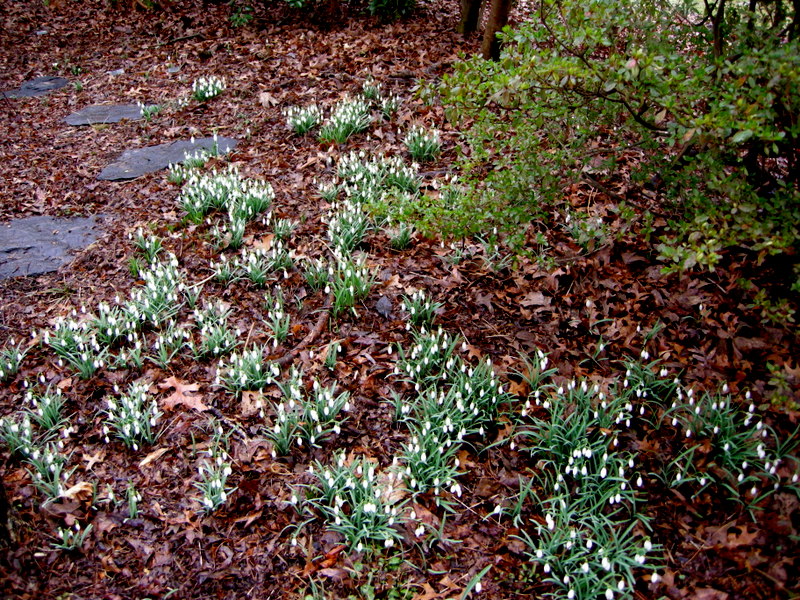
February GBBD: Hellebores and Snowdrops

Posted in Garden Blogger's Bloom Day, hellebores, Shade Perennials, snowdrops, winter, winter interest with tags , , , , , , , , , , , , , , , , , , , , on February 13, 2013 by Carolyn @ Carolyns Shade Gardens

Carolyn’s Shade Gardens is a retail nursery located in Bryn Mawr, PA, specializing in showy, colorful, and unusual plants for shade.  The only plants that we ship are snowdrops and miniature hostas.  For catalogues and announcements of events, please send your full name, location, and phone number (for back up use only) to carolyn@carolynsshadegardens.com.  Click here to get to the home page of our website for catalogues and information about our nursery and to subscribe to our blog.

Helleborus x 'Warbler'This is just one of the many gorgeous hellebores that will be for sale at my nursery this spring.  ‘Warber’ is a lovely creamy yellow and is blooming in a pot for me right now.

It is the middle of the month and time to participate in Garden Blogger’s Bloom Day (GBBD) hosted by May Dreams Gardens (link available on February 15) where gardeners from all over the world publish photos each month of what’s blooming in their gardens.  I participate because it is fun and educational for me to identify what plants make my gardens shine at different times of the year.  Several nursery customers have mentioned wanting to have color in late winter so I hope they will get some ideas for plants to add to their own gardens to extend their season.

My garden is located in Bryn Mawr (outside Philadelphia), Pennsylvania, U.S., in zone 6B.


Helleborus x 'First Cuckoo'
‘First Cuckoo’ is a double  hellebore with white petals shading to pink with deep raspberry edges.  It is also blooming in a pot and will be for sale this year.

Things really change from year to year.  In February 2011, my hellebores and other winter interest plants were barely emerging from under the ice and snow (to see photos click here).  In February 2012 when we had an extremely warm winter, all my hellebores were in full bloom (to see photos click here). 

This year, my early plants are up and blooming, but most of my hellebores are just starting to send up flowers.  That makes me appreciate the early-blooming varieties even more.  But it is the snowdrops that really steal the show right now.  They give me a reason to walk through the garden every day.  So enjoy the photos and keep warm until spring.  Note: For the benefit of my customers, I will indicate which hellebores will be for sale at Carolyn’s Shade Gardens (CSG) this spring.

.

Helleborus x ballardiae 'Pink Frost'

.

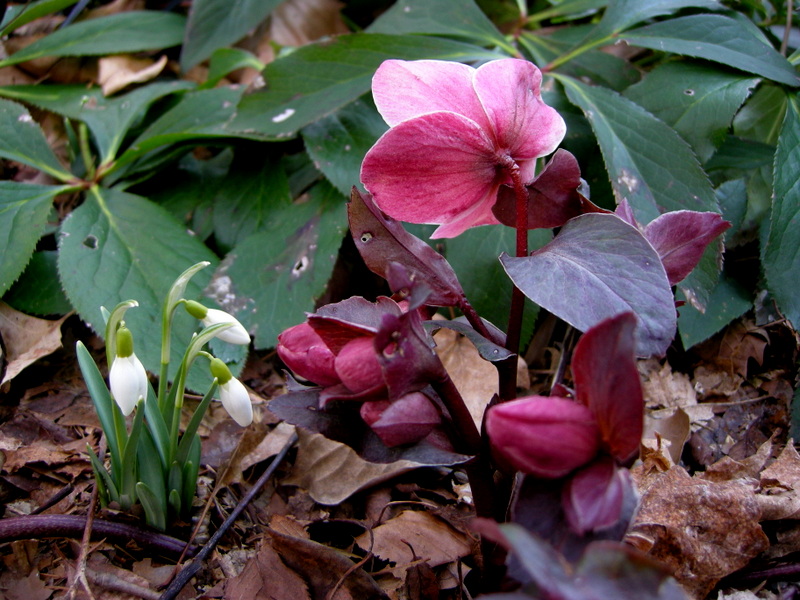
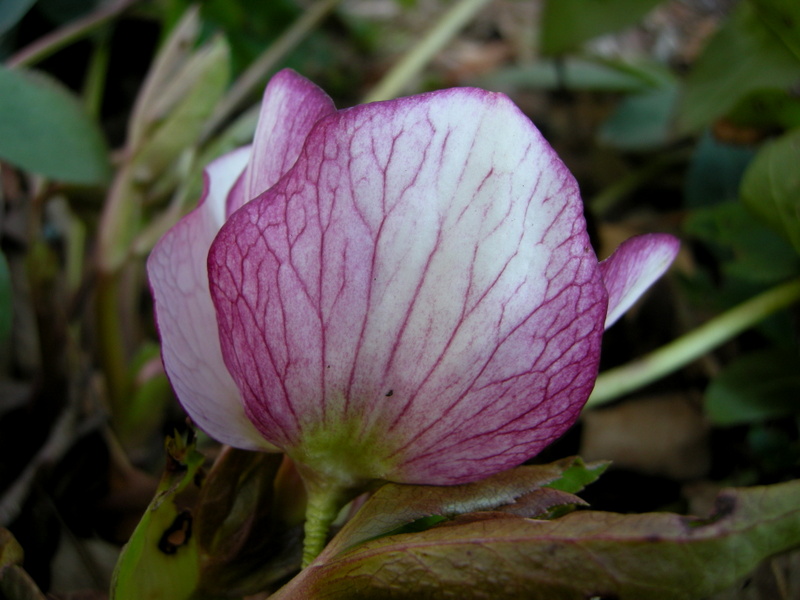
Helleborus x ballardiae 'Pink Frost'‘Pink Frost, pictured here with common snowdrops,’ is an early blooming hellebore coveted for its flowers and blue leaves with burgundy highlights.   I can’t decide if the front or the back of the flowers is prettier (for sale at CSG).

.

Helleborus x ballardiae 'Cinnamon Snow'‘Cinnamon Snow’ is a close relative of ‘Pink Frost’—they both resulted from crosses between Christmas rose and a hellebore species from Majorca.  ‘Cinnamon Snow’s’ creamy flowers flushed with cinnamon pink are very elegant (for sale at CSG).

.

Helleborus dumetorum subsp. atrorubensThis hellebore is so rare it has no common name but its botanical name is Helleborus dumetorum subsp. atrorubens (for sale at CSG).

.

Helleborus niger 'Praecox'

.

Helleborus niger 'Praecox'Christmas roses bloom continually in my garden from October through April.  ‘Praecox’ is the showiest right now but I also love ‘Jacob’, ‘Josef Lemper’, and ‘Potter’s Wheel’ (for sale at CSG).  

.

Helleborus x 'Old Early Purple'‘Old Early Purple’ is always one of the first hybrid hellebores to burst into bloom.

.

Helleborus x 'Snow White'This flower on ‘Snow White’ opened so long ago that it is already fading to green from its original pristine white color.

.

Helleborus x 'Painted Bunting'

.

Helleborus x 'Painted Bunting'

.

Helleborus x 'Painted Bunting'‘Painted Bunting’ is always one of the first hybrid hellebores to bloom in my garden.  The bold burgundy red central central star spreads outward along the veins and edges the delicate petals.  Again the back of the flower is quite beautiful (for sale at CSG).

I managed to limit myself to eight snowdrops, all of which I think are very special. 

Galanthus 'S. Arnott'‘S. Arnott’, a classic early snowdrop.

.

Galanthus 'Ophelia'The fat, rounded flowers and heart-shaped markings of ‘Ophelia’, a double snowdrop in the Greatorex group.

.

Galanthus plicatus 'Wendy's Gold'Even non-galanthophiles admire ‘Wendy’s Gold’, a rare yellow snowdrop.

.

Galanthus elwesii 'Kite'I fell in love with the extra long petals of ‘Kite’ when I saw it in a fellow galanthophile’s garden in 2010, and she kindly gave me a plant.  Now there are five with four flowers.

.

Galanthus 'Blewbury Tart'‘Blewbury Tart’ is just waiting for a warm sunny day to explode into bloom.  You can feel the pent up energy.  Unfortunately sunny days are few and far between right now.

.

Galanthus 'Lady Beatrix Stanley'The refined elegance of the double snowdrop ‘Lady Beatrix Stanley’ makes her one of my favorites.

.

Galanthus elwesii with X markI got this unnamed giant snowdrop, Galanthus elwesii, in trade from a customer.  It has very large flowers with a distinctive X marking and starts blooming before Christmas, a very desirable trait.  It is still blooming now.

.

Galanthus elwesii 'Godfrey Owen'‘Godfrey Owen’ is the snowdrop that I was most looking forward to this year.  It is very unusual for having 6 outer segments instead of the usual three.  When it opens, the petals form a completely symmetrical whorl.  Unfortunately, the flower was flattened by ice immediately upon opening, bending the stem, and then an insect ate away parts of the petals, ruining the whorl.  Isn’t that always the way?  I tried to prop it up unsuccessfully but then bit the bullet and brought it inside.

There are many other plants blooming right now, but it has been so hard to get photos.   The flowers are always closed because the sun refuses to shine, or waterlogged with the never ending rain and snow.  In fact, three of these photos are from previous years, but I decided to use them because they depict the plants as they look today:

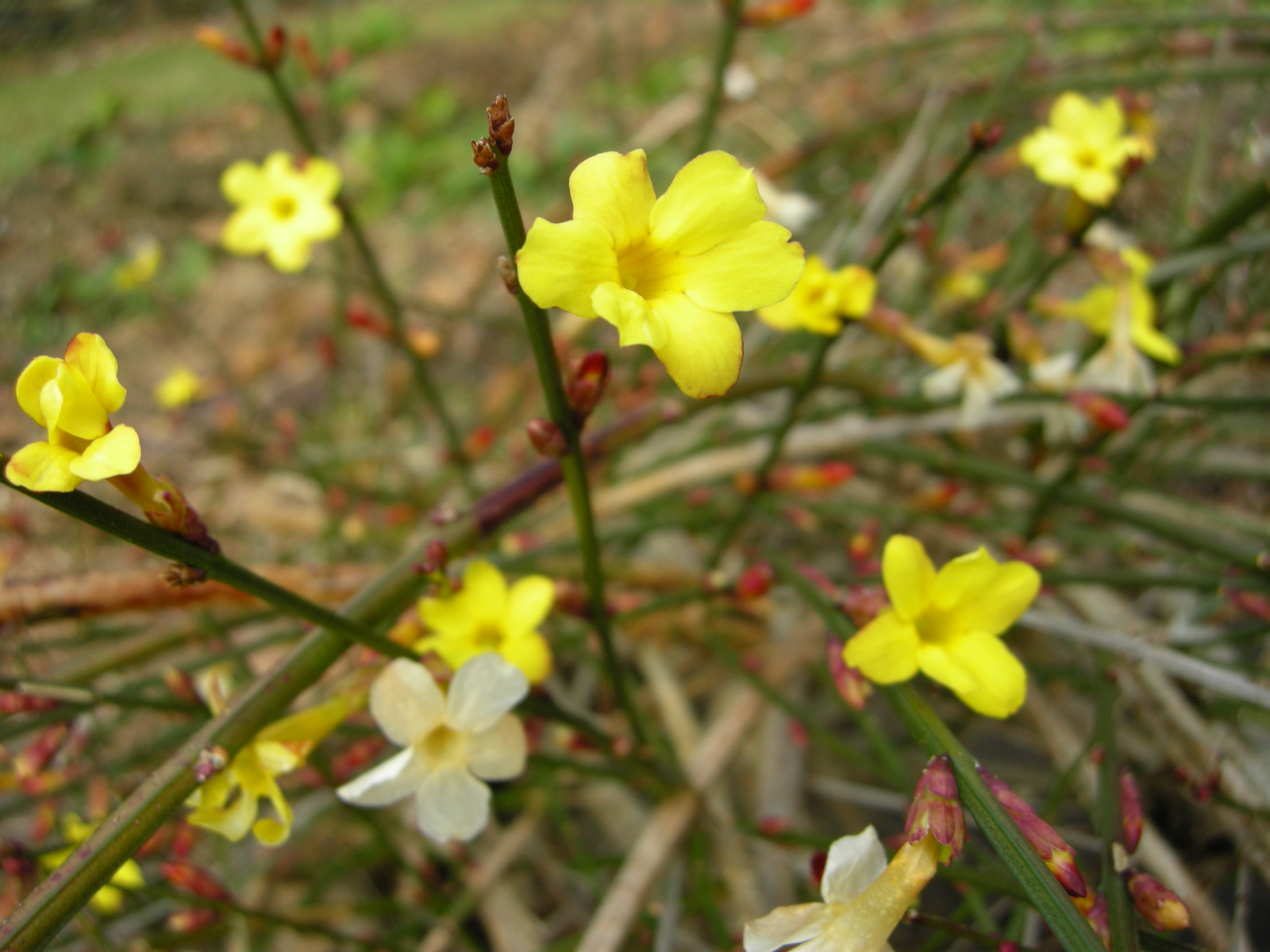
Whenever the weather warms up winter jasmine, Jasminum nudiflorum, opens some flowers.

.

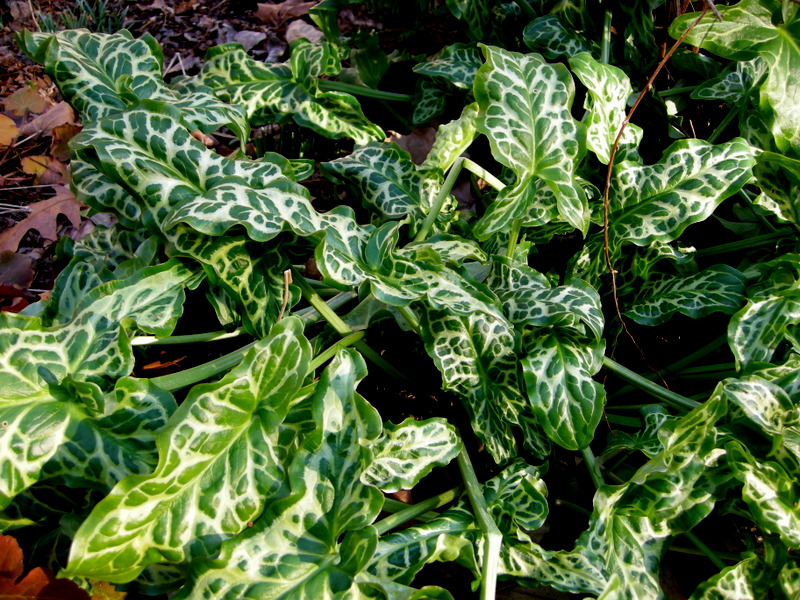
Arum italicum 'Pictum'Italian arum always looks great.

.

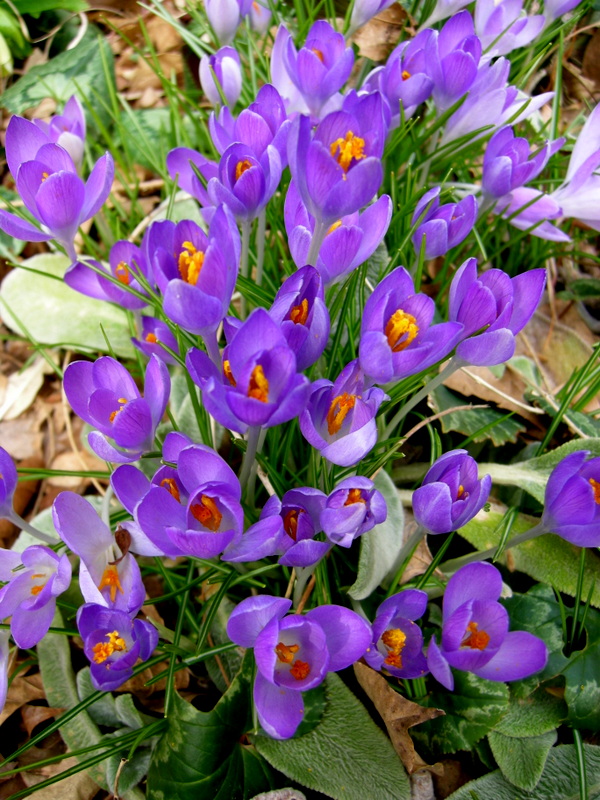
Crocus tommasinianusSnow crocus, C. tommasinianus, is the earliest crocus in my garden and is a great companion plant for hellebores and snowdrops.

.

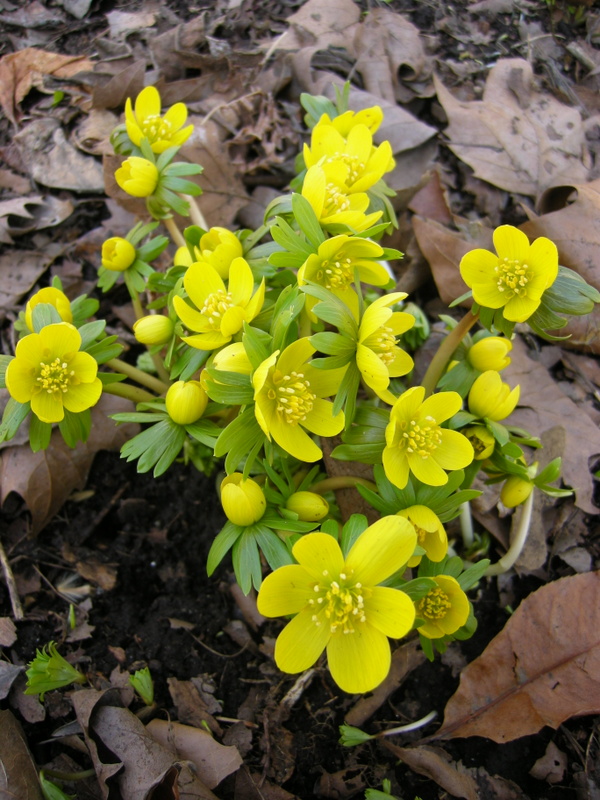
Eranthis hyemalisI am always surprised by how quickly winter aconite appears in the garden.  Monday there was no sign of it and Tuesday it was carpeting my woods.

.

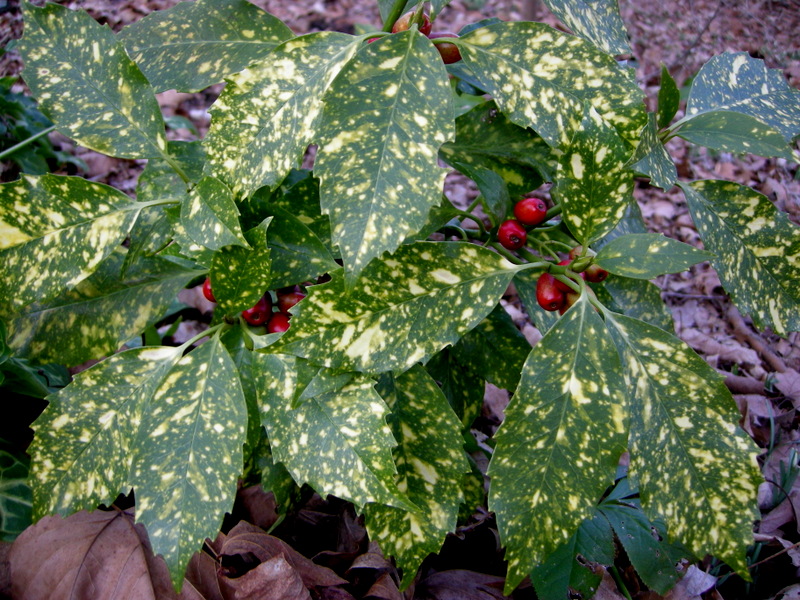
Aucuba japonica 'Gold Dust'‘Gold Dust’ Japanese aucuba is one of the best shrubs for lighting up full shade.  If you can find male and female plants, it produces these large berries which ripen now.

.

Cyclamen coumThe first winter-blooming cyclamen, C. coum, peak through the leaves.  Hardy cyclamen is another great companion for snowdrops and hellebores.

.

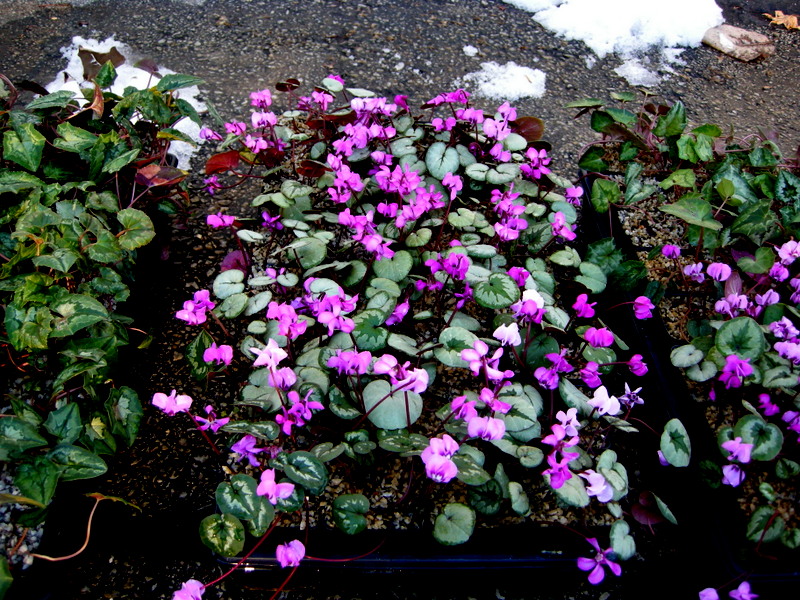
Cyclamen at Carolyn's Shade GardensPots of hardy cyclamen waiting to find homes with my nursery customers.

Enjoy, Carolyn

.

Carolyn’s Shade Gardens is a retail nursery located in Bryn Mawr, Pennsylvania, US, zone 6b.  The only plants that we mail order are snowdrops and miniature hostas and only within the US.

If you are within visiting distance and would like to receive catalogues and information about customer events, please send your full name and phone number to carolynsshadegardens@verizon.net.  Subscribing to my blog does not sign you up to receive this information.

Nursery Happenings:  The 2013 Snowdrop Catalogue is on the sidebar of the website and orders are being accepted now.  To view the catalogue, click here.  The 2013 General Catalogue is available here.  Look for a brochure for my very popular hellebore seminars very soon.
Facebook:  Carolyn’s Shade Gardens has a Facebook Page where I post single photos, garden tips, and other information that doesn’t fit into a blog post.  You can look at my Facebook page here or click the Like button on my right sidebar here.

Notes: Every word that appears in orange on my blog is a link that you can click for more information.  If you want to return to my blog’s homepage to access the sidebar information (catalogues, previous articles, etc.) or to subscribe to my blog, just click here.