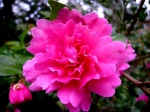
Archive for the winter Category

New York Times Photos

Posted in Camellias, evergreen, Fall, Fall Color, Shade Shrubs, winter, winter interest with tags , , , , , on January 29, 2013 by Carolyn @ Carolyns Shade Gardens

Carolyn’s Shade Gardens is a retail nursery located in Bryn Mawr, PA, specializing in showy, colorful, and unusual plants for shade.  The only plants that we ship are snowdrops and miniature hostas.  For catalogues and announcements of events, please send your full name, location, and phone number (for back up use only) to carolyn@carolynsshadegardens.com.  Click here to get to the home page of our website for catalogues and information about our nursery and to subscribe to our blog.

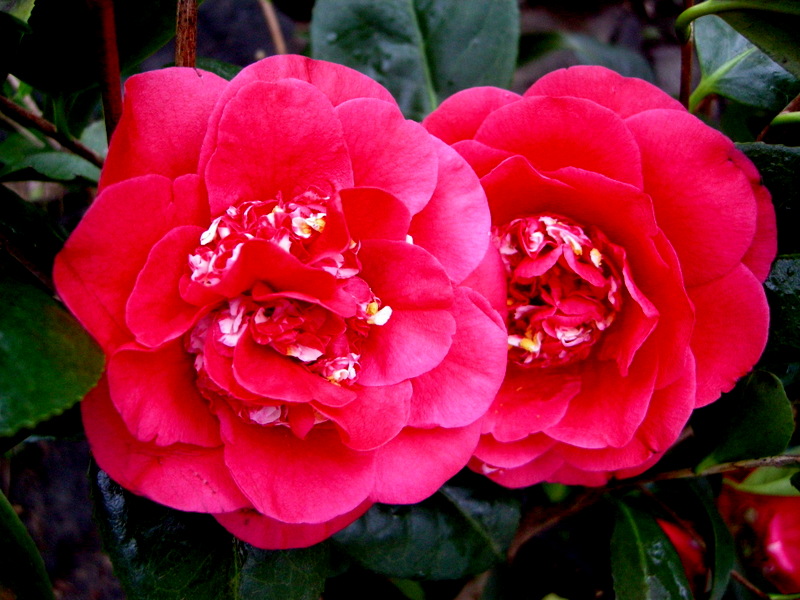
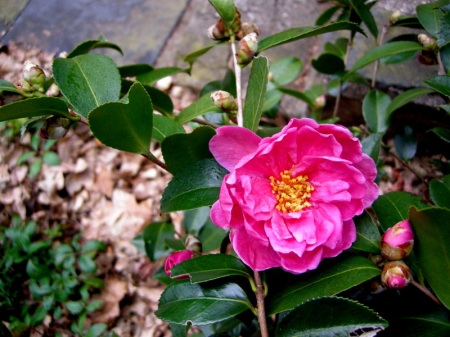
Camellia x 'Autumn Spirit'‘Autumn Spirit’ (fall blooming), the lead photo in the NYT article.

Readers will soon tire of me featuring myself in my posts, especially since the recent snowdrop post did just that.  However, I am bursting with excitement and will explode if I can’t do it one more time.  I was recently hired by the New York Times as a free lance photographer to provide the photos for a camellia article interviewing camellia expert Charles Cresson.  The print article “Camellias Ready for a Cold Snap” appeared on January 17, 2013.  One photo is on the cover of the Home section with the full article on page D4.  If you read the small print you will see my name.  You can find the on line version here.  Be sure and click through the slide show.

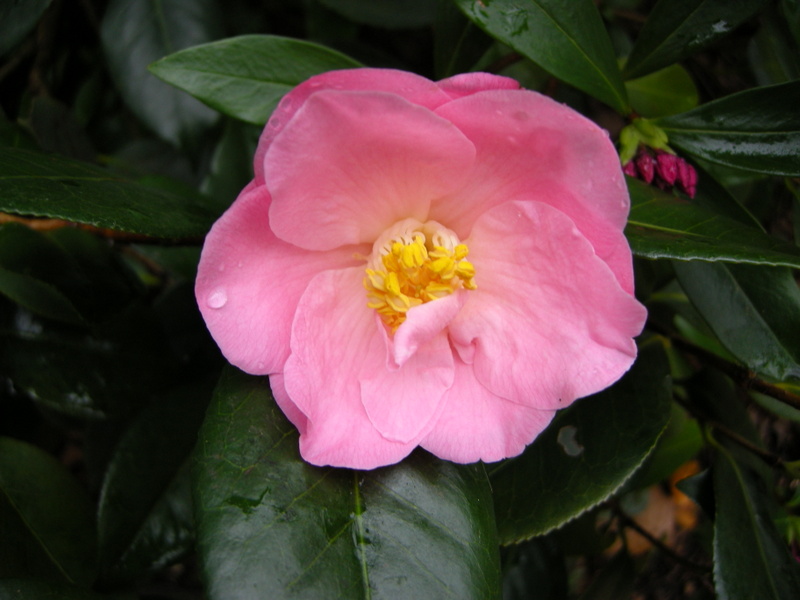
Camellia "Wax Lips"Unnamed Korean Camellia japonica seedling (spring blooming)

.

Camellia japonica 'Berenice Boddy' Cresson Garden‘Berenice Boddy’ (spring blooming)

.

While letting you know about the New York Times article, I thought this post would be a good place to list helpful articles on cold hardy camellias for easy reference.  I did this in the snowdrop post, and it has already proved invaluable to me.  I have interspersed the article names and links with some of my favorite camellia photos to keep the attention of those of you who don’t want to read up on camellias.  I am also going to list the camellias covered in each article in case a reader is interested in a particular cultivar.

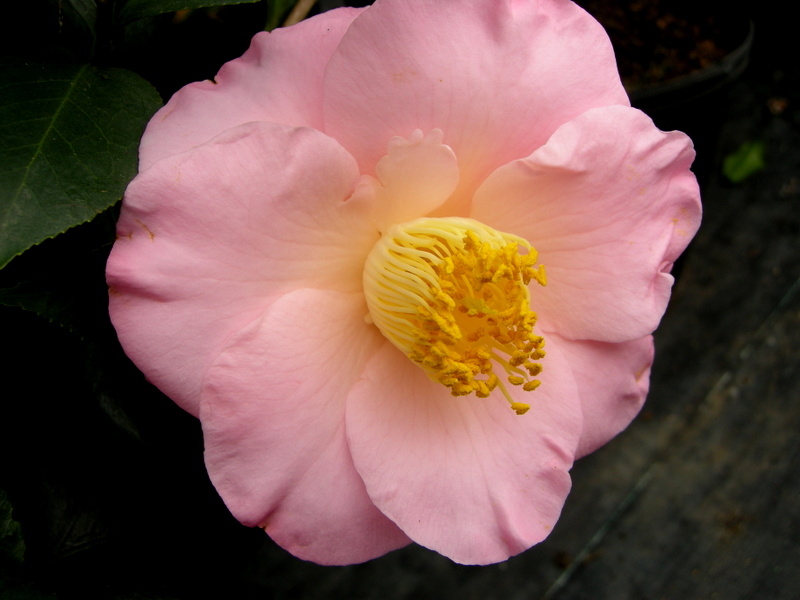
Camellia 'April Tryst'‘April Tryst’ (spring blooming)

.

Camellia x (Ackerman seedling)Unnamed Ackerman Seedling (fall blooming)

December 8, 2010

“Fall-blooming Camellias Part 1”

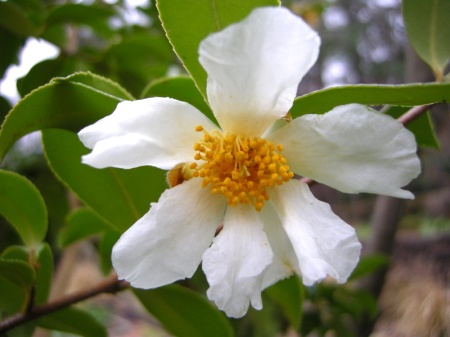
Camellia oleifera, Elaine Lee, Winter’s Darling

click here to read

Camellia x 'Moon Festival'‘Moon Festival’ (fall blooming), not hardy in zone 6.

.

Camellia x 'Winter's Interlude'‘Winter’s Interlude’ (fall blooming)

December 17, 2010

“Fall-blooming Camellias Part 2”

Snow Flurry, Winter’s Dream, Autumn Spirit, Winter’s Snowman, Winter’s Charm, Scented Snow, Winter’s Beauty

click here to read

Camellia x 'April Rose'‘April Rose’ (spring blooming)

.

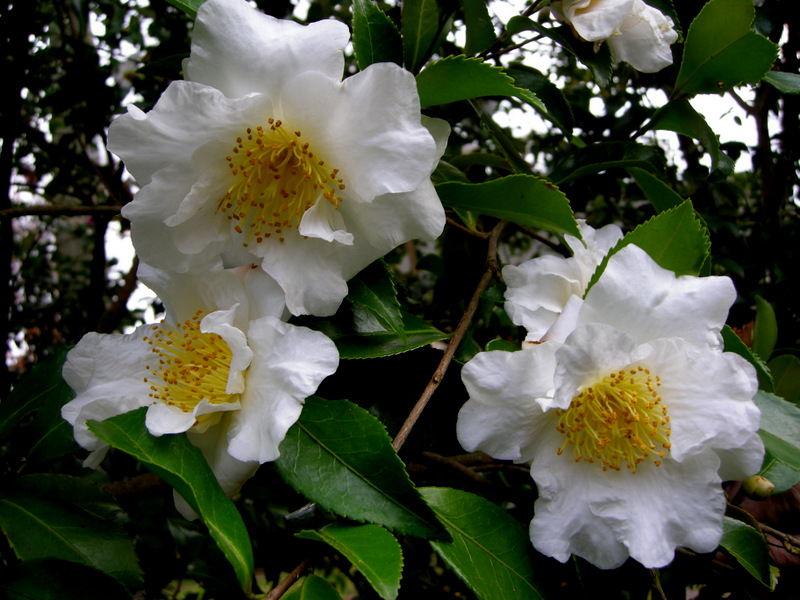
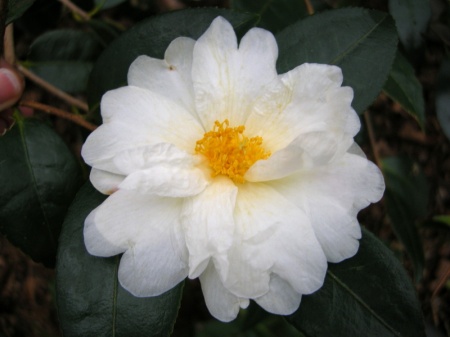
Camellia x 'Winter's Snowman'‘Winter’s Snowman’ (fall blooming)

November 10, 2011

“Fall-blooming Camellias Part 3”

Snow Flurry, Winter’s Snowman, Winter’s Star, Winter’s Interlude, Moon Festival, Carolina Moonmist

click here to read

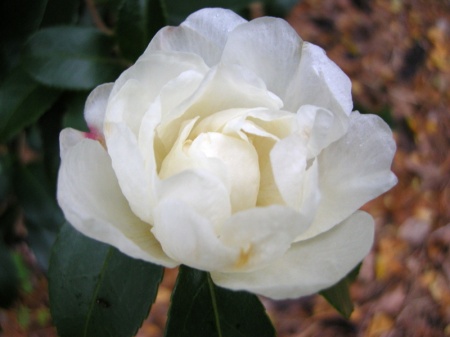
Camellia x 'Elaine Lee'‘Elaine Lee’ (fall blooming)

.

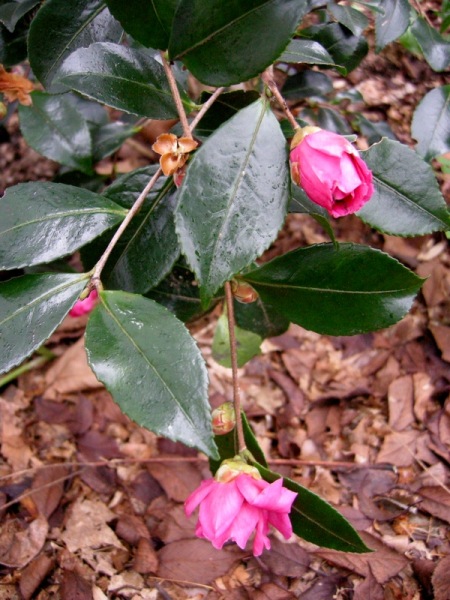
Camellia x 'Pink Icicle'‘Pink Icicle’ (spring blooming)

December 2, 2012

“2012 Fall-blooming Camellias”

Winter’s Joy, Winter’s Snowman, Snow Flurry, Autumn Spirit, Survivor, Long Island Pink, Polar Ice, Ashton’s Ballet, Winter’s Rose, Winter’s Fire

click here to read

Camellia x 'April Blush'‘April Blush’ (spring blooming)

January 2006

“Camellias for Cold Climates” by William L. Ackerman

details Dr. Ackerman’s cold hardy camellia breeding at the US National Arboretum in Washington, DC, and describes each cultivar’s ornamental attributes and hardiness

click here to read

Camellia x 'Winter's Beauty'‘Winter’s Beauty’ (fall blooming)

January 17, 2013

The New York Times

‘Camellias Ready for a Cold Snap” by Anne Raver

excellent article profiling cold hardy camellias for the mid-Atlantic and discussing many additional cultivars not mentioned in my articles

click here to read


* * * * *

I hope that this post will act as a central reference point where I can collect information on cold hardy camellias for the mid-Atlantic.  I intend to add titles and links as I discover more information about one of my favorite topics.  I can see already that I have neglected spring-blooming camellias in favor of the fall-blooming varieties.

Enjoy, Carolyn

.

Carolyn’s Shade Gardens is a retail nursery located in Bryn Mawr, Pennsylvania, US, zone 6b.  The only plants that we mail order are snowdrops and miniature hostas and only within the US.

If you are within visiting distance and would like to receive catalogues and information about customer events, please send your full name and phone number to carolynsshadegardens@verizon.net.  Subscribing to my blog does not sign you up to receive this information.

Nursery Happenings:  The 2013 Snowdrop Catalogue is on the sidebar of the website and orders are being accepted.  To view the catalogue, click here.  There are a few spaces left in both sessions of Charles Cresson’s 2013 Winter Interest Plants Seminar.  To view the brochure and register, click here.

Facebook:  Carolyn’s Shade Gardens has a Facebook Page where I post single photos, garden tips, and other information that doesn’t fit into a blog post.  You can look at my Facebook page here or click the Like button on my right sidebar here.

Notes: Every word that appears in orange on my blog is a link that you can click for more information.  If you want to return to my blog’s homepage to access the sidebar information (catalogues, previous articles, etc.) or to subscribe to my blog, just click here.

Snowdrop Articles on Carolyn’s Shade Gardens Blog

Posted in bulbs for shade, snowdrops, winter, winter interest with tags , , , , , , , , , , , , , , , , , , , on January 15, 2013 by Carolyn @ Carolyns Shade Gardens

Carolyn’s Shade Gardens is a retail nursery located in Bryn Mawr, PA, specializing in showy, colorful, and unusual plants for shade.  The only plants that we ship are snowdrops.  For catalogues and announcements of local events, please send your full name, mailing address, and cell number to carolyn@carolynsshadegardens.com and indicate whether you are mail order only.  Click here to get to the home page of our website for catalogues and information about our nursery and to subscribe to our blog.

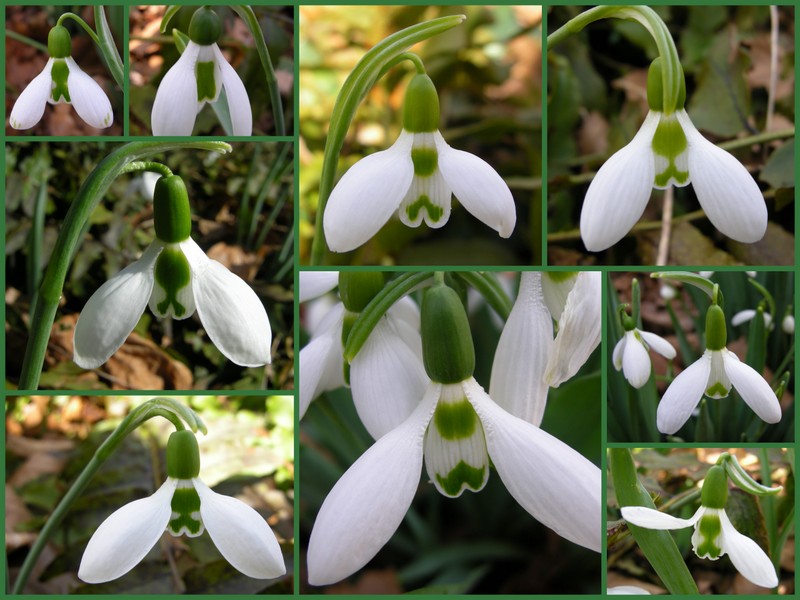
Galanthus elwesiiEvery photo in this collage is of a giant snowdrop, Galanthus elwesii, in my garden.  The differences in the markings are caused by the natural variation in the species.  None of them have been selected and given a cultivar name, although many plants like them have been named, probably too many.  Yet I find this variation fascinating.

Our current snowdrop catalogue is on line here.

To be put on the special snowdrop email list, please send your full name, cell number, and mailing address to carolyn@carolynsshadegardens.com and indicate that you are interested in snowdrops.

In this post you will find links to and descriptions of every post I have written on snowdrops.  The original purpose of this post was to let readers know that The Hardy Plant Society Mid-Atlantic Group honored me by asking me to write an article on snowdrops for their newsletter. It is called “Confessions of a Galanthophile” and is the Feature Article for the January 2013 Newsletter.  You can access the on line version by clicking here.
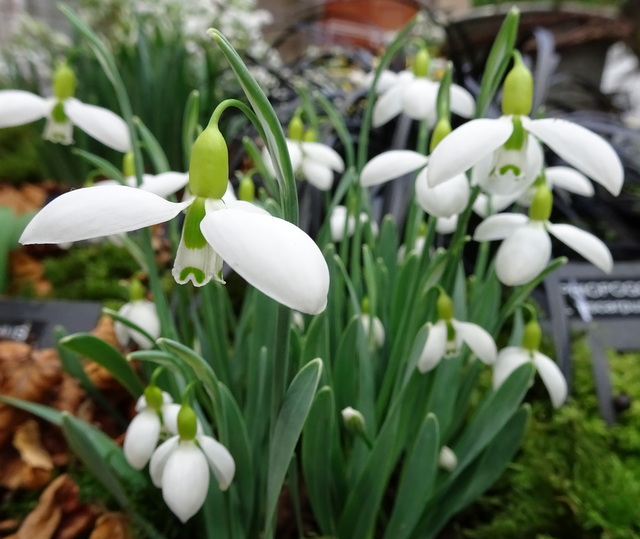
Galanthus gracilis, an elegant species snowdrop.

While letting you know about the Hardy Plant Society article, which makes use of parts of some of my previous blog posts, I thought this post would be a good place to list all the articles that I have written on snowdrops for easy reference.  I have interspersed the article names and links with photos of some of my favorite snowdrops.
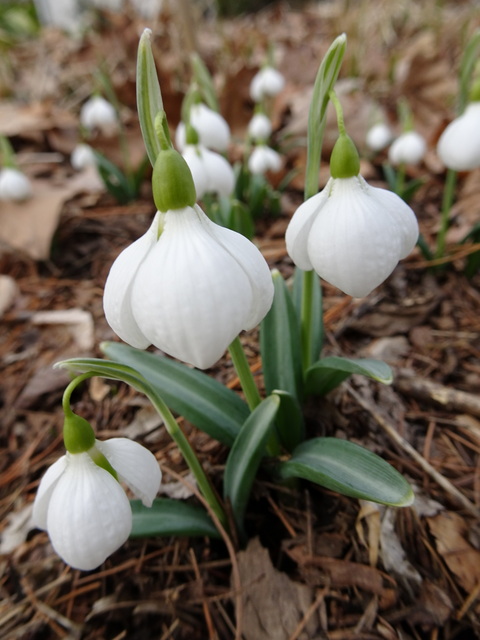
A very unusual and pricey newer snowdrop with squared off outer segments, ‘Diggory’.

November 22, 2010

“Snowdrops or the Confessions of a Galanthophile”

origins of galanthomania, fall-blooming snowdrops

profiles G. reginae-olgae and ‘Potter’s Prelude’

click here to read

Galanthus reginae-olgae, Lamium 'Shell Pink'G. reginae-olgae blooms in the fall with ‘Shell Pink’ lamium.

January 22, 2011

“Snowdrops: Further Confessions of a Galanthophile”

fascinating history of snowdrop cultivars

short profiles of 16 snowdrop cultivars

click here to read

Galanthus rizehensisGalanthus rizehensis, a species snowdrop.

February 9, 2011

“Are Snowdrops Thermogenic?”

discusses plants that produce their own heat

click here to read

Galanthus woronowii Cresson Garden The shiny bright green leaves of the species snowdrop G. woronowii.

January 19, 2012

“New Snowdrops for 2012”

importance of provenance in snowdrop collecting

profiles ‘Brenda Troyle’, ‘Tiny’, ‘Hippolyta’, ‘Dionysus’, and G. plicatus subsp. byzantinus

click here to read
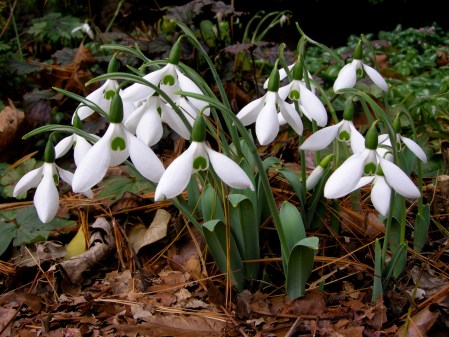
Galanthus 'Potter's Prelude'The lovely American, fall-blooming snowdrop ‘Potter’s Prelude’.

January 7, 2013

‘New Snowdrops for 2013″

where to find information on snowdrops

profiles ‘Wendy’s Gold’, ‘Standing Tall’, ‘Mighty Atom’, and ‘Scharlockii’

click here to read
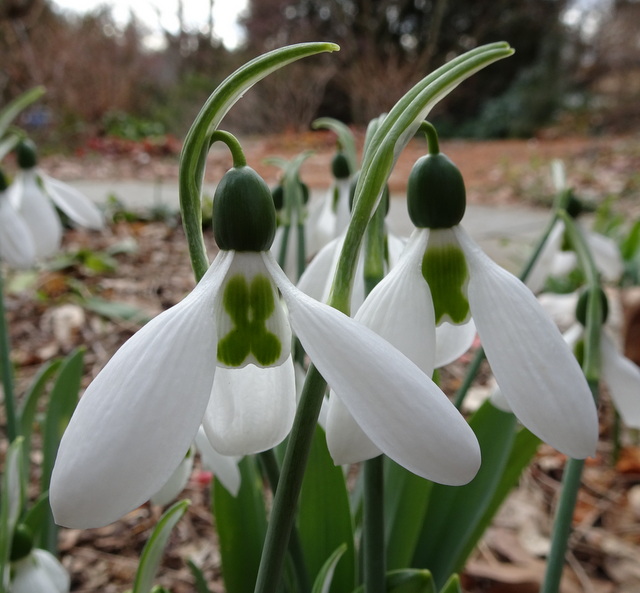
A new American snowdrop introduced by Carolyn’s Shade Gardens, Galanthus elwesii ‘Xmas’

The Hardy Plant Society Mid-Atlantic Group

January 2013 Newsletter

“Confessions of a Galanthophile”

why gardeners collect snowdrops

click here to read

'Straffan' by Jonathan Shaw‘Straffan’, photo by Jonathan Shaw

January 5, 2014

“The Un-Common Snowdrop”

the common snowdrop and its cultivars

profiles G. nivalis, ‘Flore Pleno’, ‘Viridapice’, and ‘Blewbury Tart’

click here to read

My favorite single classic snowdrop, ‘Magnet’.

January 16, 2014

“The Sochi Snowdrop”

G. woronowii and its cultivars

profiles G. woronowii and ‘Elizabeth Harrison’

click here to read

‘Kite’, very early-blooming with extremely long outer segments.

.

Galanthus elwesii 'Kite' twp scapes‘Kite’ can have twin flowers on one flower stalk.

January 27, 2014

“Top 25 Snowdrop Plants Part One”

UK ranking of top 25 all-time favorite snowdrops

profiles and photos of snowdrops ranked 13 to 25

click here to read

‘Godfrey Owen’ has six outer segments.

 February 4, 2014

“Top 25 Snowdrop Plants Part Two”

UK ranking of top 25 all-time favorite snowdrops

profiles and photos of snowdrops ranked 1 to 12

click here to read
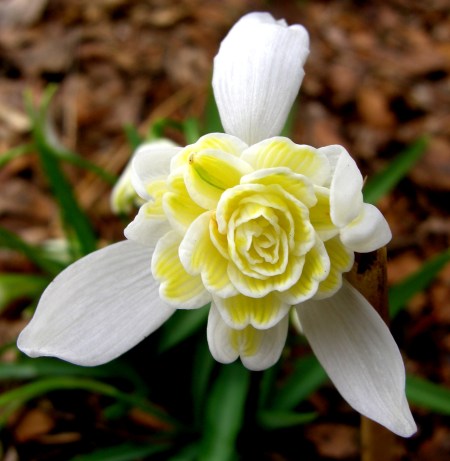
Galanthus nivalis 'Lady Elphinstone' CadwaladerThe gorgeous double yellow snowdrop ‘Lady Elphinstone’

December 2, 2014

“Do All Snowdrops Look Alike?”

shows the many very different types of snowdrops available

  photos of 14 strikingly different cultivars

click here to read

Galanthus 'Viridapice'Although considered ordinary by some, ‘Viridapice’ remains one of my favorite snowdrops.

December 9, 2014

“New Snowdrops for 2015”

  profiles ‘Blonde Inge’, ‘Diggory’, ‘Walrus’, and ‘Wasp’

click here to read

‘Cowhouse Green’ is a lovely part virescent snowdrop.

January 5, 2015

“Companion Plants for Snowdrops”

snowdrops are great alone but look even better with other winter interest plants

  profiles 10 winter-blooming plants to pair with snowdrops

click here to read

‘Walrus’ is ranked number 12 in all-time favorite snowdrops.

January 14, 2015

“New Snowdrop Book”

Kew Gardens A Plant Lover’s Guide to Snowdrops

review with images from the book

click here to read
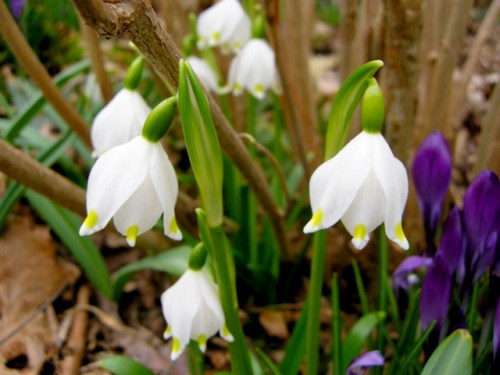
Leucojum vernum var. carpathicumAn unusual form of spring snowflake with yellow markings, Leucojum vernum var. carpathicum.

March 17, 2016

“Snowflakes (Leucojum) Continue the Snowdrop Season”

profiles many unusual forms of snowflakes, a close relative of snowdrops

click here to read

2017-catalogue-collage-11-26-2016-12-14-18-pm-11-26-2016-12-14-18-pmSome of my special snowdrops that I want to keep well marked.

December 6, 2016

“Curating a Plant Collection: Snowdrops or Otherwise”

how to keep track of your growing snowdrop collection

click here to read

The naturally blue lake at Colesborne Park below a hillside of snowdrops.

March 3, 2017

“Drifts of Snowdrops at Colesbourne Park”

photos and descriptions of our February 2017 trip to the famous English snowdrop venues

click here to read

March 15, 2017

“Snowdrops at the Royal Horticultural Society Spring Show”

setting up the Avon Bulbs snowdrop exhibit at the February 2017 show in London

click here to read

‘Fly Fishing’

November 18, 2017

“New Snowdrops for 2018”

profiles of ‘Ailwyn’, ‘Angelique’, ‘Bertram Anderson’, ‘Greenish’, ‘Fly Fishing’, and ‘Colossus’

click here to read

‘South Hayes’

November 28, 2017

“New Snowdrops for 2018 Part Two”

profiles of ‘Jonathan’, ‘Madelaine’, ‘Mrs. Macnamara’, ‘Welshway’, ‘South Hayes’, and ‘Titania’

click here to read
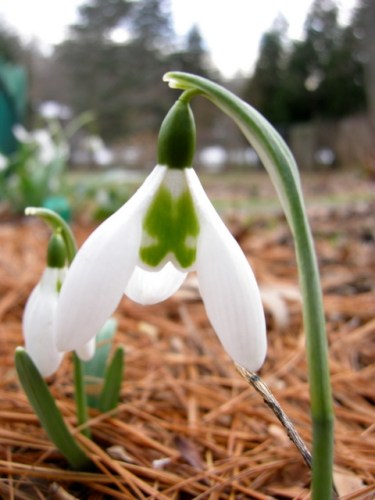
Galanthus 'Lapwing'‘Lapwing’ has a great mark and is a vigorous multiplier.

December 5, 2017

“Fine Gardening Feature Article on Snowdrops”

reprint of my cover article for the February 2016 issue of Fine Gardening

click here to read

Snowdrops and hellebores along the path to a folly at Painswick.

December 29, 2017

“Painswick Rococo Garden”

tour of winter garden and snowdrops at Painswick Rococo Gardens

click here to read
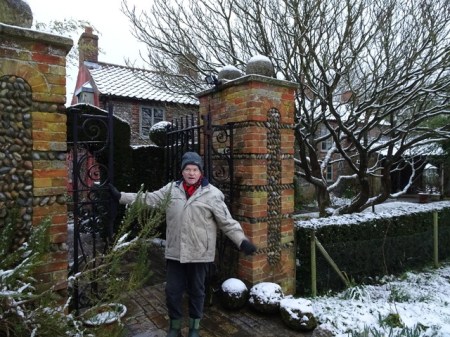
John Morley welcomes us to the gardens at North Green Snowdrops.

January 15, 2018

“North Green Snowdrops”

tour of the snowdrop garden at North Green Snowdrops

click here to read

 The best place to see snowdrops in England is Colesbourne Park in the Cotswolds.

March 7, 2018

“Exceptional Snowdrops and Gardens, England February 2018”

highlights of winter gardens and snowdrops in England

click here to read

Rodmarton Manor has an extensive snowdrop collection in its Arts and Crafts garden.

March 20, 2018

“Rodmarton Manor Garden”

tour of Rodmarton Manor’s winter garden and snowdrop collection

click here to read
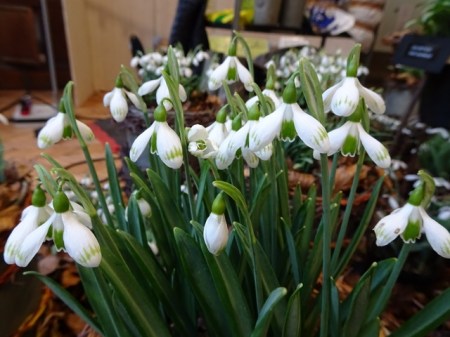
‘Sprite’ is a beautiful and distinct snowdrop selected at Avon Bulbs.

March 25, 2018

“A Day in the Life of an Avon Bulbs Snowdrop”

introduction of new snowdrops at Avon Bulbs in England

click here to read

‘Art Nouveau’ has a unique and elegant look.

November 13, 2018

“New Snowdrops for 2019: Part One”

profiles of ‘Godfrey Owen’, ‘Barnes’, ‘Art Nouveau’, ‘Armine’, ‘Puck’, and ‘Sprite’

click here to read

‘Richard Ayres’ is a large and vigorous double.

November 27, 2018

“New Snowdrops for 2019: Part Two”

profiles of ‘Richard Ayres’, ‘Green Brush’, ‘Faringdon Double’, ‘Merlin’, ‘Trym’, and ‘Starling’

click here to read

‘Three Ships’ is a gorgeous G. plicatus that blooms around Christmas.

December 11, 2018

“Your February 2019 Snowdrop Trip to England”

planning a trip to England during snowdrop season

click here to read
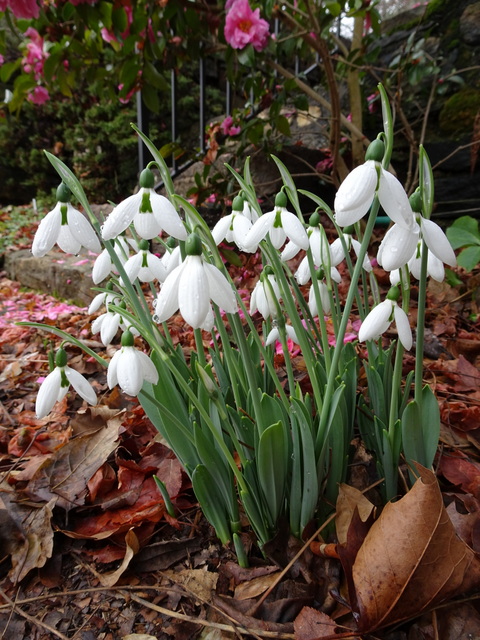
‘Xmas’ was selected, named, and introduced by Carolyn’s Shade Gardens.

October 23, 2019

“Early-Blooming Snowdrops”

profiles G. reginae olgae, ‘Potter’s Prelude’, ‘Barnes’, ‘Standing Tall’, and ‘Xmas’

click here to read

‘S. Arnott’ is the favorite snowdrop of galanthophiles everywhere.

November 2, 2020

“Classic Snowdrops”

profiles ‘Atkinsii’, ‘S. Arnott’, ‘Merlin’, ‘Hill Poe’, and ‘Scharlockii’

click here to read

‘One Drop or Two?’ is a rare twin-flowered snowdrop.

November 14, 2020

“New Snowdrops for 2021”

profiles ‘Beth Chatto’, ‘Bill Clark’, ‘Bagpuize Virginia’, ‘Fieldgate Prelude’, ‘Natalie Garton’, ‘Pom Pom’, and ‘One Drop or Two?’

click here to read

‘Sarah Dumont’ has gorgeous yellow markings.

November 21, 2020

“New Snowdrops for 2021: Part 2”

profiles ‘Sarah Dumont’, G. nivalis subsp. poculiformis, ‘Green Arrow’, ‘Moortown Mighty’, ‘Wonston Double’, and ‘Trympostor’

click here to read

Galanthus EA Bowles‘E.A. Bowles’ looks like a white miniature daffodil.

November 13, 2021

“New Snowdrops for 2022: Part 1”

profiles ‘E.A. Bowles’, ‘The Wizard’, ‘Mrs. Thompson’, ‘Cordelia’, and ‘Phantom’

click here to read

img032New snowdrop reference book

November 17, 2022

“Some Snowdrops: A photographic Ramble by Anne Repnow”

profiles ‘Three Ships’, ‘Standing Tall’, ‘Wasp’, and ‘Godfrey Owen’ and reviews a wonderful new snowdrop book

click here to read

Galanthus Midas‘Midas’ is a color breakthrough for snowdrops.

November 20, 2021

“New Snowdrops for 2022: Part 2”

profiles ‘Midas’, ‘Augustus’, ‘Cowhouse Green’, ‘Desdemona’, ‘Moses Basket’, and ‘Rodmarton Arcturus’

click here to read
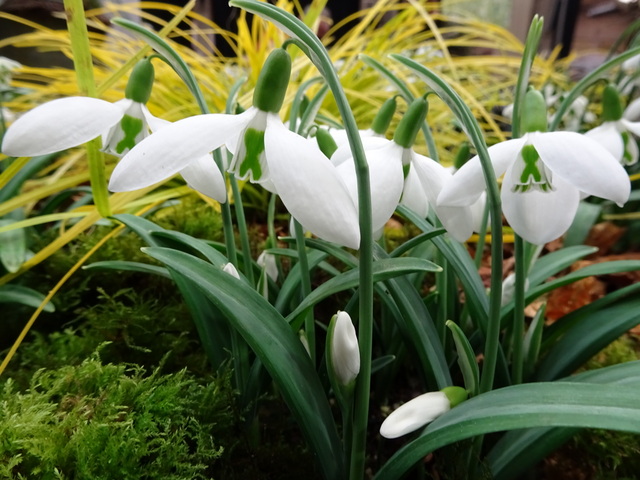
‘Walker Canada’ is big and beautiful.

November 19, 2022

“New Snowdrops for 2023: Part 1”

profiles ‘June Boardman’, G. reginae-olgae, ‘Rodmarton’, ‘Scissors’, and ‘Walker Canada’

click here to read
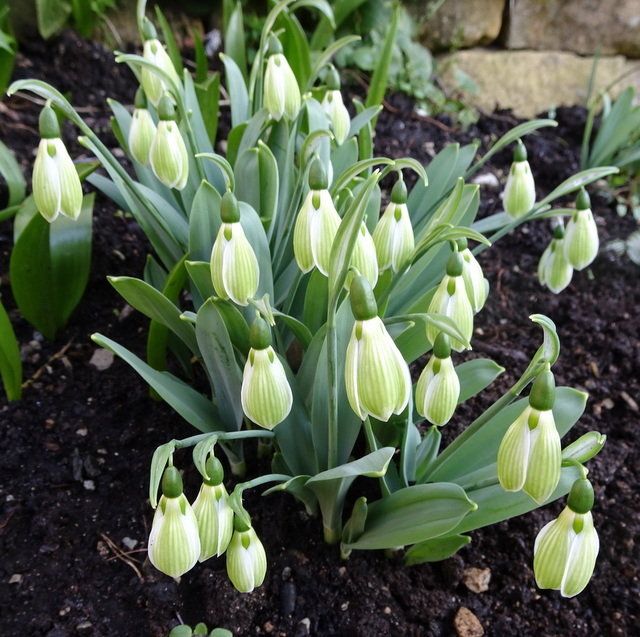
‘Rosemary Burnham’, an elegant virescent snowdrop

November 26, 2023

“New Snowdrops for 2023: Part 2”

profiles ‘Rosemary Burnham’, ‘Cambridge’, ‘Colossus’, ‘Betty Hansell’, and ‘Warwickshire Gemini’

click here to read
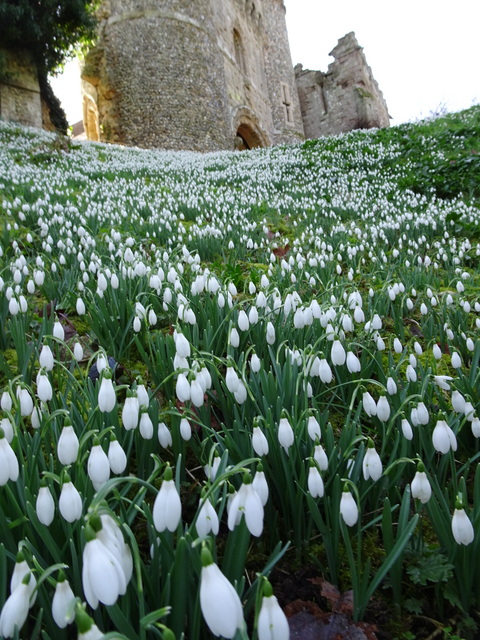
The moat at Benington Lordship Castle

November 11, 2023

“Snowdrops and History at Benington Lordship Gardens”

A 12th century castle near Cambridge, England, with a moat full of snowdrops

click here to read

The walls of Wandlebury Ring enclose tens of thuosands of G. plicatus.

November 19, 2023

“Wandlebury Ring”

An iron age hillfort outside of Cambridge, England, with a naturalized population of G. plicatus

click here to read
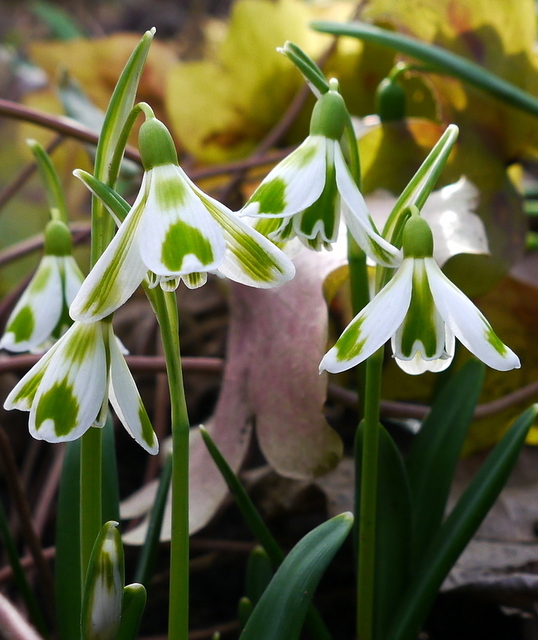
‘Phil Cornish’ may be the most beautiful inverse poculiform snowdrop.

November 26, 2023

“New Snowdrops for 2024: Part 1

profiles ‘Anglesey Candlelight’, ‘Phil Cornish’, ‘Daphne’s Scissors’, ‘Franz Josef’, and ‘George Elwes’

click here to read
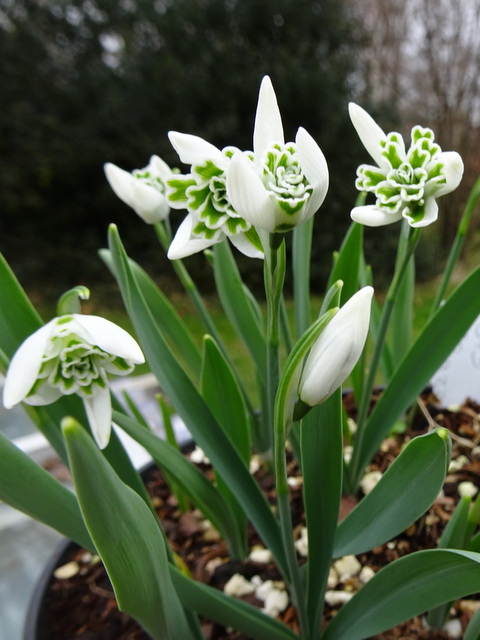
‘Miss Prissy’ is a very full and neat double that faces outward.

November 28, 2023

“New Snowdrops for 2024: Part 2

profiles ‘Miss Prissy’, ‘Excelsis’, ‘Big Bertha’, ‘Washfield Colesbourne’, and ‘Ivy Cottage Corporal’

click here to read
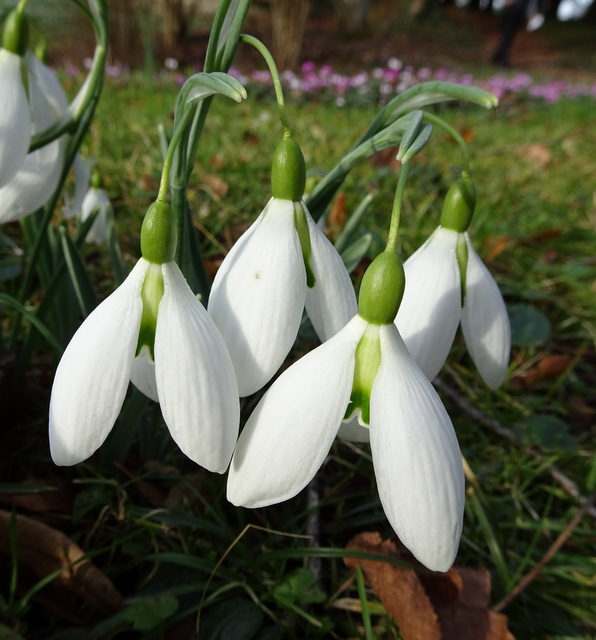
‘John Gray’ is an outstanding member of the “Might Atom” group of snowdrops

December 3, 2023

“New Snowdrops for 2024: Part 3”

profiles ‘Marjorie Brown’, ‘Fenstead End’, Trumpolute’, ‘Big Eyes’, and ‘John Gray’

click here to read
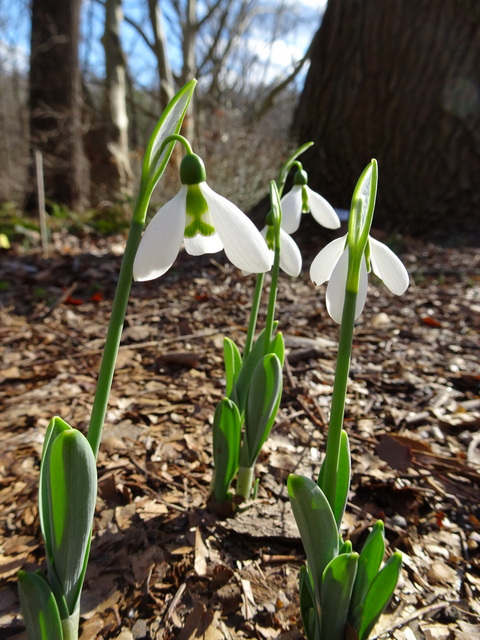
‘Standing Tall’ is an American selection with a distinct habit.

December 20, 2023

“December Blooming Snowdrops”

profiles ‘Potter’s Prelude’, Standing Tall’, ‘Three Ships’, and ‘Xmas’

click here to read

‘Lady Beatrix Stanley’ is elegant and vigorous.

January 2, 2024

“My Favorite Snowdrops” 

profiles ‘Diggory’, ‘Viridapice’, ‘Godfrey Owen’, ‘Madelaine’, ‘Fly Fishing’, ‘Xmas’, ‘Potter’s Prelude’, and ‘Lady Beatrix Stanley’ 

click here to read

‘Spindlestone Surprise’ is a lovely yellow.

March 20, 2024

“Snowdrops: Live Radio Interview”

live interview of Carolyn with a lot of information about snowdrops

click here to listen

A must-have snowdrop reference!

November 17, 2024 

“Some More Snowdrops by Anne Repnow”

profiles ‘Dryad Gold Sovereign’, ‘Jonathan’, and ‘Mrs. Macnamara’ and reviews a wonderful new snowdrop book 

click here to read

‘Joe Spotted’ was my favorite new snowdrop from 2025.

November 20, 2024

“New Snowdrops (& a Leucojum) for 2025: Part One 

profiles ‘Dryad Gold Sovereign’, ‘Herzilien’, ‘Joe Spotted’, ‘Titania’, ‘Ingrid Bauer’, and Leucojum ‘Null Punkte

click here to read

‘Kildare’ is a beautiful Irish snowdrop.

November 24, 2024

“New Snowdrops (& an Eranthis) for 2025: Part Two 

profiles Eranthis ‘Richard Bish’, ‘Dodo Norton’, ‘Kildare’, ‘Bitter Lemons’, and ‘White Swan’

click here to read

The winter color in Cambridge Botanic Garden is amazing.

December 7, 2024

“Cambridge Botanic Garden in Winter”

lots of photos of this extremely colorful winter garden

click here to read

The winter garden is on fire at Anglesey Abbey.

December 14, 2024 

“A Special Tour of Anglesey Abbey”

visit to this renowned snowdrop destination and winter garden 

click here to read

‘Early Bird’ is an early blooming, inverse poculiform, G. woronowii cultivar.

November 12, 2025

“New Snowdrops for 2026: Part One”

profiles ‘Early Bird’, ‘Peter Gatehouse’, ‘Poculi Perfect’, and ‘Selina Cords’

click here to read

‘Treasure Island’ might be the most vigorous yellow

November 16, 2025

“New Snowdrops (& a Leucojum) for 2026: Part Two”

profiles ‘Treasure Island’, ‘Lord Lieutenant’, ‘Elfenkind’, ‘Prestwood White’, and Leucojum carpathicum

click here to read

‘Frank Lebsa’ is a gorgeous fall-blooming snowdrop

December 3, 2025

“New Snowdrops for 2026: Part Three”

discusses the advantages of buying snowdrops in the green

profiles ‘B and B Duncan’, ‘Clare Blakeway-Phillips’, and ‘Frank Lebsa’

click here to read
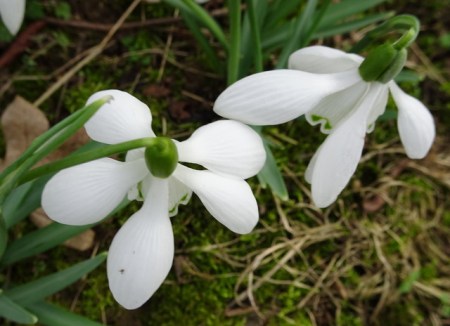
Galanthus Mrs. Thompson‘Mrs. Thompson’s’ erratic flowers are a plus.

2026 Snowdrop Catalogue

Over 35 varieties of snowdrops and snowflakes plus winter aconite for sale mail order in the US

click here to access

Galanthus nivalis 'Blonde Inge'‘Blonde Inge’ is breathtaking in a mass and bulks up quickly.

* * * * *

All the posts as well as the catalogue itself, provide interesting and informative reading on subjects ranging from the origins of galanthomania, the fascinating history of snowdrops, their provenance, how to research them, and even whether they produce their own heat.  I intend to add titles and links through the years as I write more about one of my favorite topics.

Enjoy, Carolyn

.

Note: Every word that appears in orange on my blog is a link that you can click for more information.  If you want to return to my blog’s homepage to access the sidebar information (catalogues, previous articles, etc.) or to subscribe to my blog, just click here.

New Snowdrops for 2013

Posted in New Plants, Shade Perennials, snowdrops, winter, winter interest with tags , , , , , , , , , , , , , , , , , , , , , , , , on January 7, 2013 by Carolyn @ Carolyns Shade Gardens

Carolyn’s Shade Gardens is a retail nursery located in Bryn Mawr, PA, specializing in showy, colorful, and unusual plants for shade.  The only plants that we ship are snowdrops to the US only.  For catalogues and announcements of local events, please send your full name, mailing address, and cell number to carolyn@carolynsshadegardens.com and indicate whether you are mail order only.  Click here to get to the home page of our website for catalogues and information about our nursery and to subscribe to our blog.

Snowdrops O through Z-001Some of the snowdrops available from Carolyn’s Shade Gardens in 2013.

.

Our current snowdrop catalogue is on line here.

.

This post includes photographs and colorful descriptions of the 4 new snowdrops I am offering for sale in my 2013 Snowdrop Catalogue.  There were three more new cultivars offered, but they sold out within two days of the catalogue being posted on my website.  For entertaining descriptions of most of the remaining 13 varieties offered, click here.

Galanthus 'Hippolyta' photo Paddy TobinThe Greatorex double snowdrop ‘Hippolyta’ was new in 2012.  For background on the Greatorex doubles, a discussion of snowdrop provenance,  and information about ‘Hippolyta’, click here.  Photo by Paddy Tobin.  We are also offering the early flowering Greatorex double ‘Ophelia’.

In Snowdrops or The Confessions of a Galanthophile, I described my transition from someone who grows snowdrops to someone who is obsessed with them.  In Snowdrops: Further Confessions of a Galanthophile, I explained that most snowdrop cultivars can be appreciated as much for their colorful history as for their ornamental characteristics.  That history is contained in Snowdrops: A Monograph of Cultivated Galanthus by Matt Bishop, Aaron Davis, and John Grimshaw (Griffin Press 2006), commonly called the “snowdrop bible”.

Galanthus 'Potter's Prelude'Potter’s Prelude’ is a vigorous and beautiful snowdrop that blooms in the fall.  This year it started in mid-November and still has some fresh flowers today (1/6/13).  For more information on fall-blooming snowdrops, click here.

Whenever I obtain a new snowdrop or offer one in my catalogue, I always research it thoroughly both for fun and to make sure that what I am offering is the genuine article.  The first place that I go is to the “snowdrop bible” to review the detailed description and history of the species or cultivar in question.  This year I was also able to consult a new snowdrop book, Snowdrops by Gunter Waldorf (Frances Lincoln Limited 2012).  What it lacks in detail, it makes up for with 300 photographs accompanied by short descriptions highlighting the salient characteristics of the snowdrops profiled.  It also contains no nonsense advice about growing and collecting snowdrops.

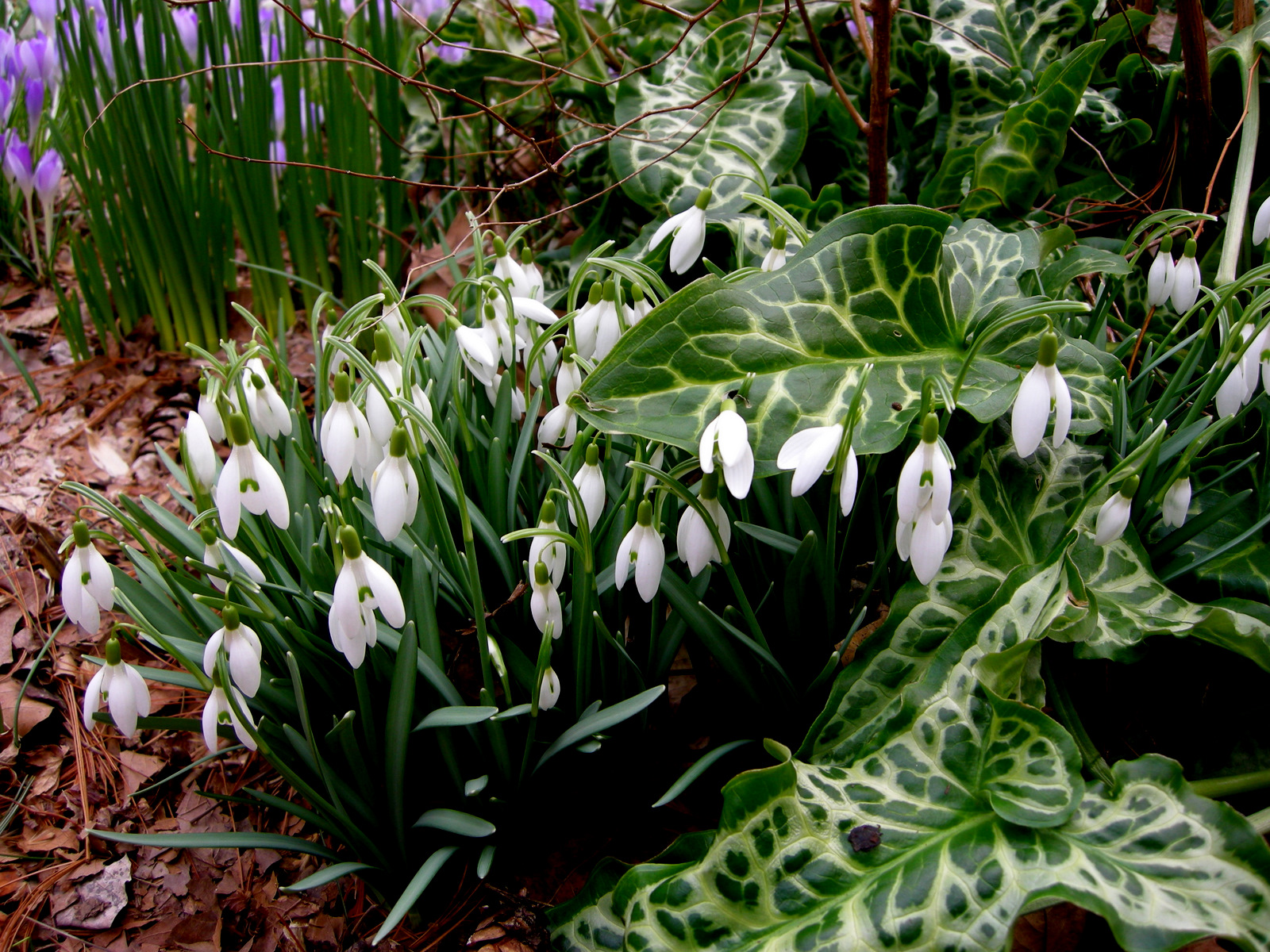
Although the common snowdrop, G. nivalis, pictured above with Italian arum and snow crocus, is the most prevalent snowdrop in gardens, it is by no means common in the ordinary sense of the word.  In fact, it is the best choice for gardeners who want to naturalize snowdrops in masses.

After hitting the books, I search the internet and read everything that has been written about the new snowdrop.  The available material is mostly the catalogues of all the big UK snowdrop sellers like Avon Bulbs, Harveys Garden Plants, and Monksilver Nursery, among others, but sometimes I come across fun historical or informational articles.  I also consult the Scottish Rock Garden Club Forum Galanthus thread where galanthophiles from all over the world meet to obsess.  After that, I look at photo galleries of snowdrops, particularly the Galanthus Gallery  and the new snowdrop photos on the Dryad Nursery website.

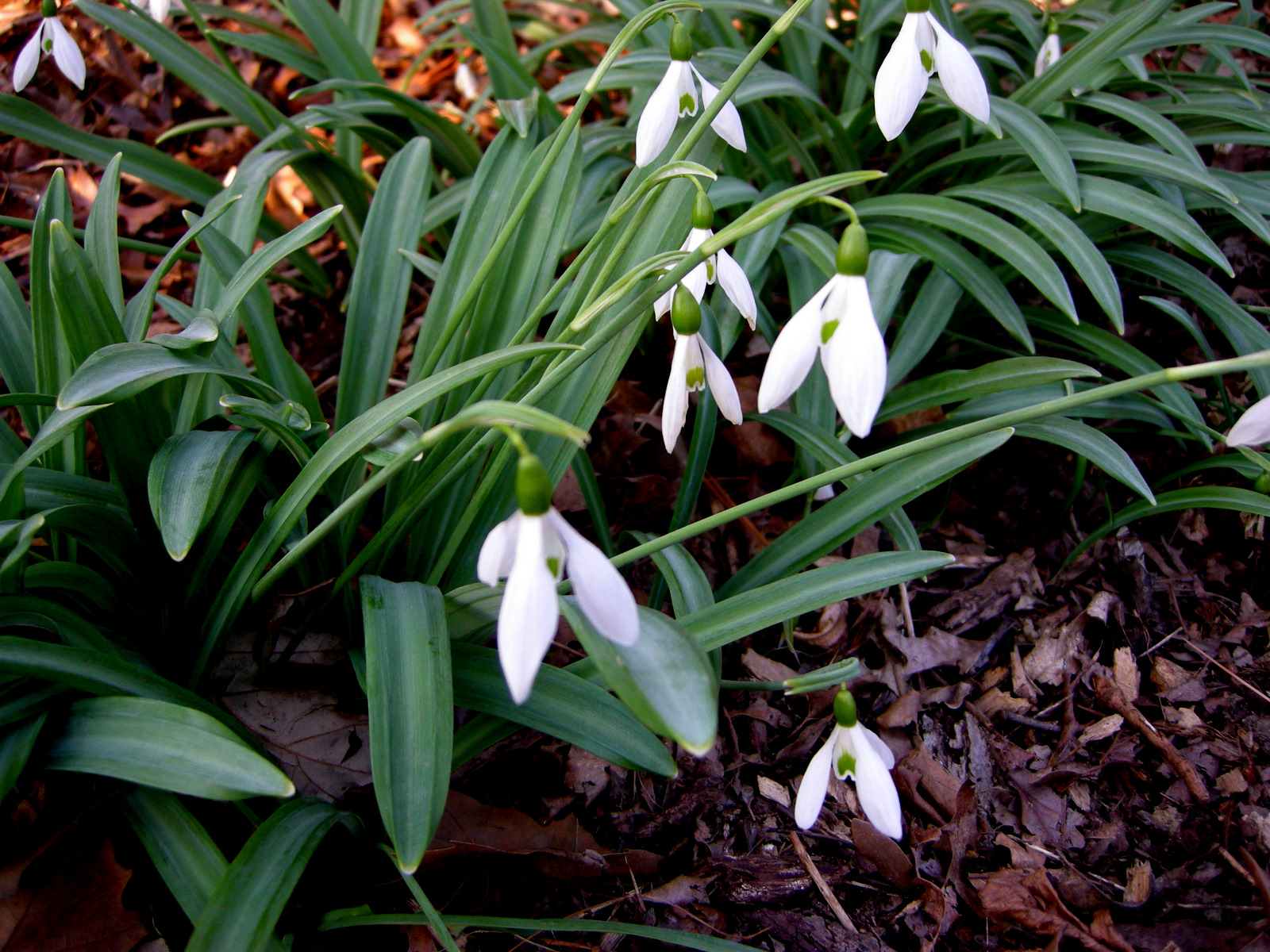
Galanthus elwesiiThe giant snowdrop, G. elwesii, is also a vigorous spreader.  This is the species massed at Winterthur.

Finally, as much as possible, I research the provenance of the snowdrop I am adding to my catalogue or collection.  Provenance is the history of a snowdrop’s ownership, documenting the authenticity of the actual bulbs being sold.  It is important that snowdrops come from a reputable source and be carefully tracked by subsequent owners.  With over 500, and some say 1,000, snowdrop cultivars circulating among collectors, it is easy to make mistakes.  For more information on provenance, click here.  With that background, on to the new snowdrops.

Galanthus plicatus 'Wendy's Gold' The very rare yellow snowdrop ‘Wendy’s Gold’.

I am thrilled to offer a yellow snowdrop for the first time, and not just any yellow, but ‘Wendy’s Gold’, the cream of the crop. Not only is this snowdrop much sought after even in England, but it easily refutes the oft made claim that all snowdrops look alike.  It was discovered in 1974 by Bill Clark, the Warden of the UK National Trust property Wandlebury Ring near Cambridge.  Ten years later, with some prodding, he realized how rare it was and decided to name it after his wife Wendy.  All the bulbs except three were then sold to a Dutch bulb company where they subsequently died,  Luckily, the remaining bulbs proved robust, and we have ‘Wendy’s Gold’ today.

Galanthus 'Wendy's Gold'


‘Wendy’s Gold’ is a superb and vigorous snowdrop with a yellow ovary (the “cap” above the petal-like segments) and a large and vivid yellow mark on the inner segments.  Its G. plicatus parentage gives it beautiful wide pleated leaves with folded margins, serving as a gorgeous backdrop for the striking flowers.

.

Galanthus elwesii 'Standing Tall' Cresson photo-001‘Standing Tall’ is a very impressive snowdrop.

In 1988, regional horticulturist Charles Cresson began evaluating a G. elwesii snowdrop known until this year as 88-1.  Over the years of testing it in various conditions in his garden, he discovered that 88-1 is a remarkable snowdrop.  Its 12″ height, about as tall as snowdrops get, and very upright habit give it a commanding presence in the garden.  However, as it turns out, 88-1 doesn’t have much competition from other snowdrops because it starts blooming right before Christmas and continues through the month of January, a time period when few other snowdrops bloom.

Galanthus elwesii 'Standing Tall' Cresson photo-005A close up of ‘Standing Tall’s’ flower.

Luckily, I was able to convince Charles that 25 years was long enough to evaluate a snowdrop, and he should introduce this absolutely outstanding new selection.  Charles decided to name it ‘Standing Tall’ to reflect its height, very upright habit, and ability to stand up to whatever the season brings, lying down in very cold weather and popping right back up as if nothing had happened.  Charles is in the process of registering it with the KAVB, the international registration authority for bulb cultivars in the Netherlands.  In the meantime, Carolyn’s Shade Gardens is thrilled to be chosen to introduce it for sale.

.

Galanthus 'Mighty Atom' Cresson GardenThe large and elegant flowers of ‘Mighty Atom’.

‘Mighty Atom’ is a beautiful snowdrop with very large, rounded, bright white flowers—the biggest flowers in the catalogue—with a bold, deep green mark on the inner segments.  Its habit is short, compact, and even making an exceptional overall presentation.  I have admired it for years and urged Charles to offer it, but he was reluctant due to its somewhat confused history. 

British snowdrop legend EB Anderson inherited the original ‘Mighty Atom’ from John Gray in 1952 and subsequently named it.  However, in later years, Snowdrops states that Anderson distributed a group of distinct but excellent clones, now known as the ‘Mighty Atom’ complex, under this name.  Charles’s stock came from plantsman Don Hackenberry who can trace its lineage directly back to EB Anderson, although it is not an offset of what is believed to be Gray’s “original” clone.  This member of the ‘Mighty Atom’ complex has proven to be reliable, vigorous, and trouble-free.

.

Galanthus nivalis 'Scharlockii' Cresson‘Scharlockii’ is characterized by the “rabbit ear’s” formed by its spathe (flower covering).

The final member of the four new snowdrops in my 2013 Snowdrop Catalogue is ‘Scharlockii’, a cultivar of the common snowdrop, G. nivalisIt is a charming and distinctive snowdrop with boldly marked green tips on its outer segments but most notable for the rabbit ears (see photo) formed when its spathe splits into two prominently upright, leaf-like halves.  It was discovered in 1818 by Herr Julius Scharlock of Grandenz, Germany, and named in 1868.  Charles got his stock from Winterthur, known for its amazing snowdrop display, when he worked there in the early 1990s.

.

Obviously, I find everything about snowdrops fascinating and hope I have communicated some of my infatuation to you.  If you are in the U.S. and want to order from the catalogue, just follow the directions for mail order.

Carolyn

Note: Every word that appears in orange on my blog is a link that you can click for more information.  If you want to return to my blog’s homepage to access the sidebar information (catalogues, previous articles, etc.) or to subscribe to my blog, just click here.


A Longwood New Year’s Eve

Posted in garden to visit, winter with tags , , , on January 1, 2013 by Carolyn @ Carolyns Shade Gardens

Carolyn’s Shade Gardens is a retail nursery located in Bryn Mawr, PA, specializing in showy, colorful, and unusual plants for shade.  The only plants that we ship are snowdrops and miniature hostas.  For catalogues and announcements of events, please send your full name, location, and phone number (for back up use only) to carolyn@carolynsshadegardens.com.  Click here to get to the home page of our website for catalogues and information about our nursery and to subscribe to our blog.

Longwood ChristmasPure magic!

For 2012-2013, I choose Longwood Gardens in Kennett Square, Pennsylvania, US, as the garden that I would visit throughout the year and profile.  Longwood is probably the most visited public garden in the US and holds a special place in my heart because I have taken almost 20 courses there, earning two Longwood Certificates of Merit in Ornamental Plants.  My previous posts profiled Longwood’s creative use of groundcovers (click here to read) and Longwood at night, focusing on the Bruce Munro light installation (click here to read).

Longwood conservatory One of the Longwood conservatories decorated for Christmas.

Visiting Longwood anytime of year is a breathtaking experience.  I have been going there for 30 years, and it never fails to delight me.  However, their Christmas display, both indoors and outside, is in a class by itself.  Before I go I always think the magic might have worn off.  But every time I walk out of the visitor’s center and see the lights, I am amazed once again.

.

Longwood ConservatoryA long view of one of the immense indoor spaces.

Because Longwood is so popular at Christmas, it takes a little planning to avoid the crowds.  In previous years, we choose a warm and drizzly night and had the gardens pretty much to ourselves.  This year we thought it might be fun to go on New Year’s Eve when musicians stroll through the gardens entertaining the crowds.  Our timing was perfect as we arrived at 2:15 pm, toured the relatively empty conservatories, ate delicious food in the uncrowded cafe, and escaped out into the garden just as it got dark and the hordes descended.

.

LongwoodOne of the rooms in the conservatories was set up for an immense holiday feast.  It was gorgeous.

The conservatories encompass four acres so there is a lot to see inside from orchids to bonsai to the actual greenhouses where the plants are grown.  All of it is decorated for the holidays.  Here are just a few displays that caught my eye:

.

LongwoodThe maze in the enchanting children’s garden.

.

LongwoodA very unusual color for a poinsettia, perfectly complimented.

.

Longwood

.

Longwood

.

Longwood ChristmasThe camellias were blooming.

.

Longwood Christmas-001The hibiscus were also in full flower.

As much as I enjoy the conservatories, the real magic of a Longwood Christmas is outside where half a million lights decorate hundreds of trees.  If you think you have seen it all before, I challenge you to come here and not be in awe.  Panoramic shots would really do the display justice, but holding the camera steady for night shots without a tripod proved difficult at best.  Here is a small sampling of the light extravaganza:

LongwoodA photo at dusk by the Peirce du Pont House

.

LongwoodThe lights show up better in full dark but this effect was kind of surreal.

.

LongwoodThe famous five-acre fountain garden.  It is hard to convey in photos the size and scale of Longwood.

.

LongwoodLooking back inside the conservatories.

.

Longwood

.

Longwood ChristmasThis was my favorite wrapped tree hung with stars and displayed against the ink blue night.

.

Longwood

.

LongwoodMammoth copper beeches completely wrapped.

.

Longwood

.

Longwood

.

Longwood

.

Longwood

If you are in the area, it is well worth a visit.  The display continues through January 6, and timed tickets are required.

HAPPY NEW YEAR

Carolyn


Nursery Happenings:  The 2013 Snowdrop Catalogue is on the sidebar of the website and orders are being accepted.  To view the catalogue, click here.

Carolyn’s Shade Gardens is a retail nursery located in Bryn Mawr, PA.  The only plants that we mail order are snowdrops and miniature hostas.  The nursery is closed until spring 2013.  Thanks for a great year.

If you are within visiting distance and would like to receive catalogues and information about customer events, please send your full name and phone number to carolynsshadegardens@verizon.net.  Subscribing to my blog does not sign you up to receive this information.

Facebook:  Carolyn’s Shade Gardens has a Facebook page where I post single photos, garden tips, and other information that doesn’t fit into a blog post.  You can look at my Facebook page here or click the Like button on my right sidebar here.

Notes: Every word that appears in orange on my blog is a link that you can click for more information.  If you want to return to my blog’s homepage to access the sidebar information (catalogues, previous articles, etc.) or to subscribe to my blog, just click here.


A White Christmas

Posted in winter, winter interest with tags , , on December 24, 2012 by Carolyn @ Carolyns Shade Gardens

Carolyn’s Shade Gardens is a retail nursery located in Bryn Mawr, PA, specializing in showy, colorful, and unusual plants for shade.  The only plants that we ship are snowdrops and miniature hostas.  For catalogues and announcements of events, please send your full name, location, and phone number (for back up use only) to carolyn@carolynsshadegardens.com.  Click here to get to the home page of our website for catalogues and information about our nursery and to subscribe to our blog.

DSCN2269The London plane tree over my nursery sales area.

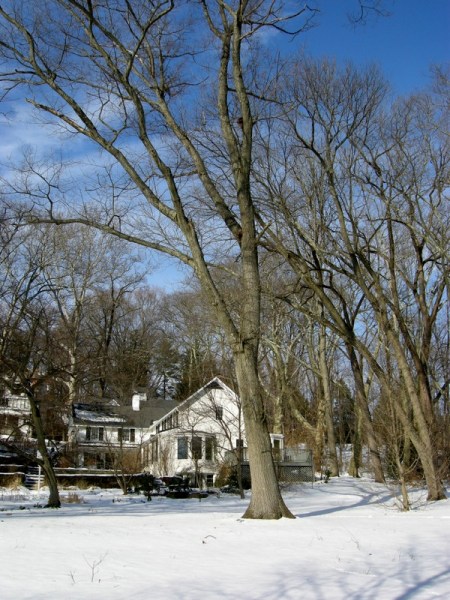
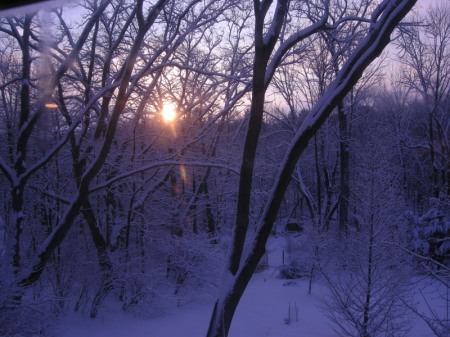
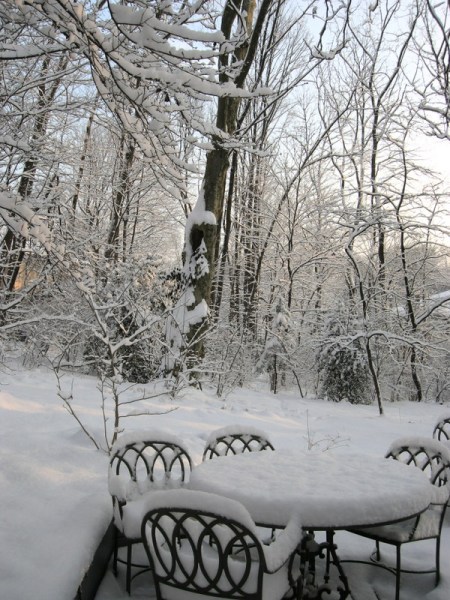
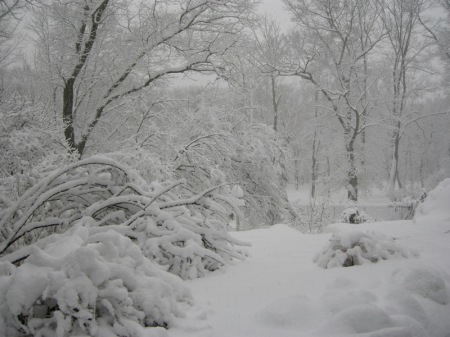
I was hoping for a white Christmas, but it is not to be so I guess I will have to make my own.  The winters of 2010 and 2011 provided more than enough photographic material.  Enjoy Carolyn’s Shade Gardens in the snow:

DSCN2205 A winter dawn in my main terrace garden.

.

DSCN2210Our dovecote engulfed in snow.

.

DSCN1075during a snowstorm

.

DSCN2170Looking up from the  production beds towards the house and terraces.

.

DSCN2202Dawn on the back side of the house.

.

DSCN2207The patio in winter.

.

DSCN2270More of our gigantic plane trees outlined in snow.

.

DSCN1070A snowy long view.

.

DSCN1088The carriage house nursery building in winter.

Happy Holidays, Merry Christmas, and Happy New Year

to all my readers, customers, and garden blogging friends.

Carolyn

P.S.  As I finished this post it began to snow!


Nursery Happenings:  The 2013 Snowdrop Catalogue is on the sidebar of the website and orders are being accepted.  To view the catalogue, click here.

Carolyn’s Shade Gardens is a retail nursery located in Bryn Mawr, PA.  The only plants that we mail order are snowdrops and miniature hostas.  The nursery is closed until spring 2013.  Thanks for a great year.

If you are within visiting distance and would like to receive catalogues and information about customer events, please send your full name and phone number to carolynsshadegardens@verizon.net.  Subscribing to my blog does not sign you up to receive this information.

Facebook:  Carolyn’s Shade Gardens has a Facebook page where I post single photos, garden tips, and other information that doesn’t fit into a blog post.  You can look at my Facebook page here or click the Like button on my right sidebar here.

Notes: Every word that appears in orange on my blog is a link that you can click for more information.  If you want to return to my blog’s homepage to access the sidebar information (catalogues, previous articles, etc.) or to subscribe to my blog, just click here.


December 2012 Garden Bloggers Bloom Day

Posted in bulbs for shade, Camellias, hellebores, Shade Gardening, Shade Shrubs, winter, winter interest with tags , , , , , , , , on December 17, 2012 by Carolyn @ Carolyns Shade Gardens

Carolyn’s Shade Gardens is a retail nursery located in Bryn Mawr, PA, specializing in showy, colorful, and unusual plants for shade.  The only plants that we ship are snowdrops and miniature hostas.  For catalogues and announcements of events, please send your full name, location, and phone number (for back up use only) to carolyn@carolynsshadegardens.com.  Click here to get to the home page of our website for catalogues and information about our nursery and to subscribe to our blog.

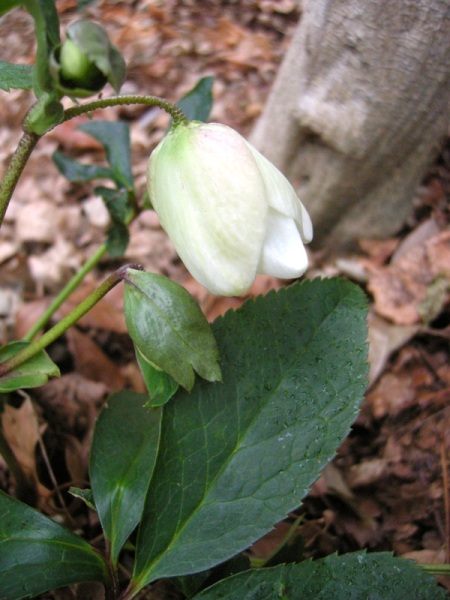
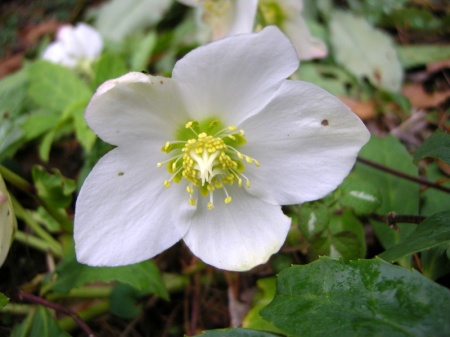
DSCN8663The first of my hybrid hellebores is just about to bloom: Helleborus x ‘Snow White’ (aka ‘Snow Bunting’).

I am two days late for the official Garden Blogger’s Bloom Day.  On the fifteenth of each month garden bloggers from all over the world post photos of what’s blooming in their gardens, and their posts are collected by Carol at May Dreams Gardens.  Nevertheless, I thought it would be fun to see which plants are pretty enough to get me outside in December on a somewhat warm but dreary, rainy day.  I also wanted to add a new twist by allowing myself only one pass through the garden for photos instead of the numerous trips required by a normal post.

Not surprisingly if you read my blog, Italian arum, hellebores, snowdrops, camellias, hardy cyclamen, and coral bells are hogging the show this time of year accompanied by a few others.  Let’s see what we have:

DSCN8642 Fall-blooming camellia ‘Winter’s Snowman’ has been blooming since October and still has buds waiting to open.

My late fall garden has been immensely improved by the addition of fall-blooming hardy camellias.  All five of mine are blooming now and have plenty of buds left.  For more information on fall-bloomimg camellias, click here.

DSCN8641‘Winter’s Joy’

.

DSCN8650‘Lu Shan Snow’

.

DSCN8656‘Winter’s Darling’

.

DSCN8655‘Elaine Lee’

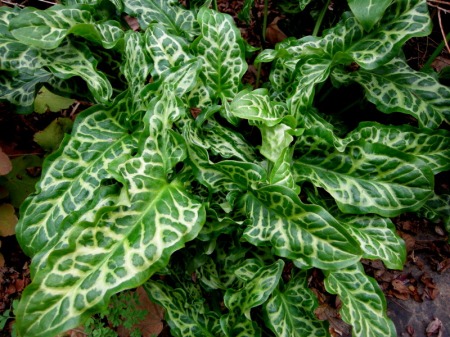
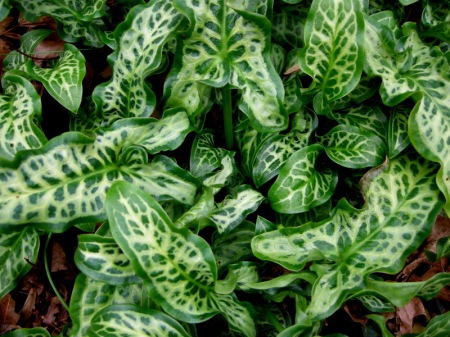
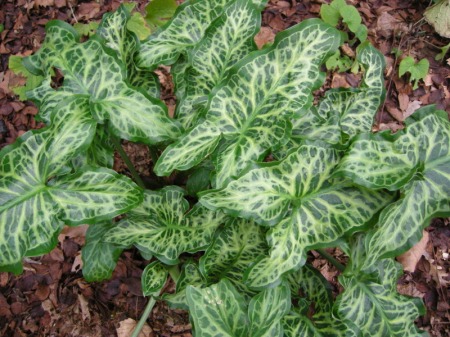
Italian arum is always a highlight this time of year after its fresh foliage emerges from dormancy in early fall:

DSCN8645‘Pictum’ Italian arum

.

DSCN8659dwarf Italian arum ‘Tiny Tot’

.

DSCN8654‘Gold Rush’ Italian arum, my favorite

Hellebores are just about to take over as the stars of the garden for the next few months.  For more information on hellebores, click here and follow the links at the end of the post.  If it wouldn’t violate my parameter for this post, I would run out and photograph bearsfoot hellebore and ‘Praecox’ Christmas rose, which are both almost open.  As it is, I have these two hellebores for you:

DSCN8662Another shot of the first flower on ‘Snow White’.

.

DSCN8643After blooming in October, ‘Josef Lemper’ Christmas rose is at it again and will continue to bloom into spring.

.

My favorite coral bells or heucheras are the cultivars that give me 365 days of colorful foliage, some of which are pictured below.  If I could go back outside, I would add ‘Frosted Violet’ and ‘Bronze Wave’.  I would also include some photographs of pulmonarias, especially ‘Diana Clare’:

DSCN8646‘Caramel’ heuchera continues to change from one beautiful hue to the next through out the winter.

.

DSCN8652Green Spice’ is new to my garden this year and looks like a winner.

.

DSCN8653‘Citronelle’ is a customer favorite for brightening dark corners.

You know I couldn’t resist showing you a few snowdrops:

DSCN8640  ‘Potter’s Prelude’, a fall-bloomimg snowdrop cultivar, is getting to the end of its bloom period which began in mid-November.

.

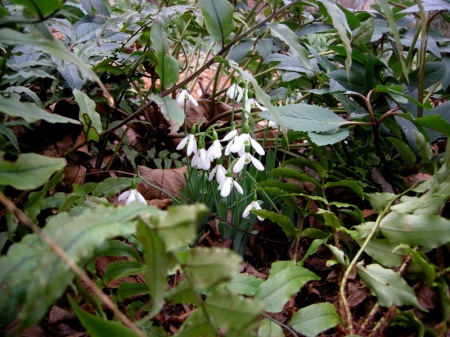
DSCN8658A clump of early blooming giant snowdrops, Galanthus elwesii, hides in the Japanese holly ferns and hellebores.

Except during the heart of the summer when they are dormant, hardy cyclamen are stars in my garden.  I find their highly variable leaf patterns endlessly fascinating.  For more information on hardy cyclamen, click here.

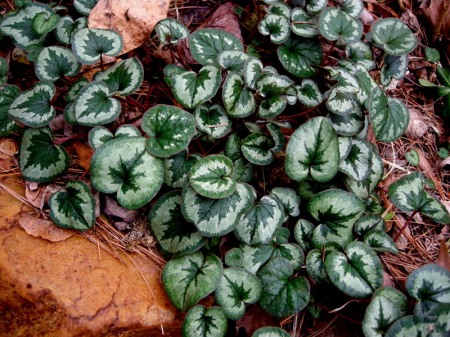
DSCN8660The last few blooms on fall-blooming hardy cyclamen, C. hederifolium, which began blooming at the end of August.

.

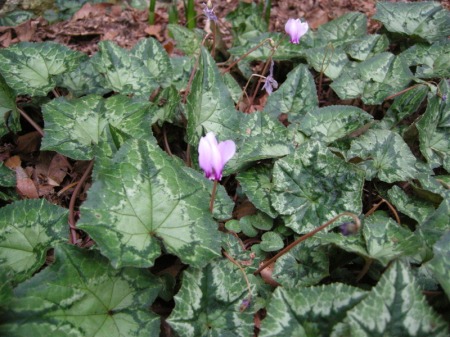
DSCN8661Spring-blooming hardy cyclamen, C. coum, doesn’t need flowers to attract attention.

Here are some more late fall stars that might surprise you:

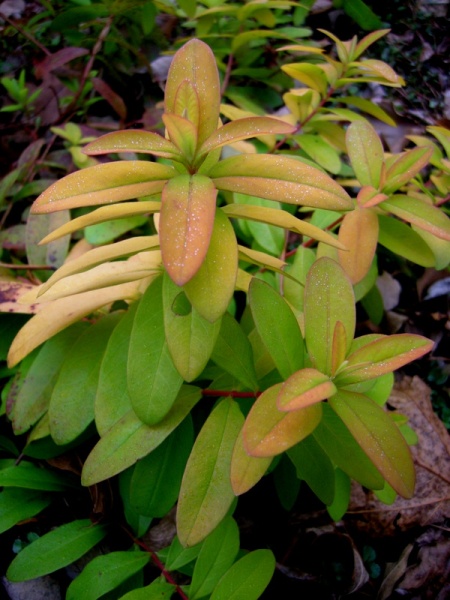
DSCN8639‘Brigadoon’ St. John’s wort always takes on this lovely peach color for the winter.

.

DSCN8644This new mahonia called ‘Soft Caress’ was given to me by the breeders at the Southern Living Plant Collection to trial in my garden.  It is evergreen, blooms now, and is hardy to zone 7.  For more information, click here.  I have high hopes for it because I have since seen it in two other local gardens.

.

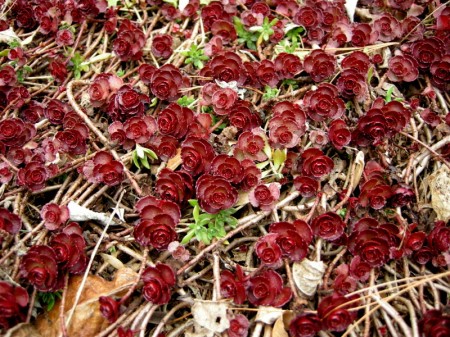
DSCN8648This sedum always turns a lovely burgundy in the fall.  Unfortunately, I don’t know its exact name.

.

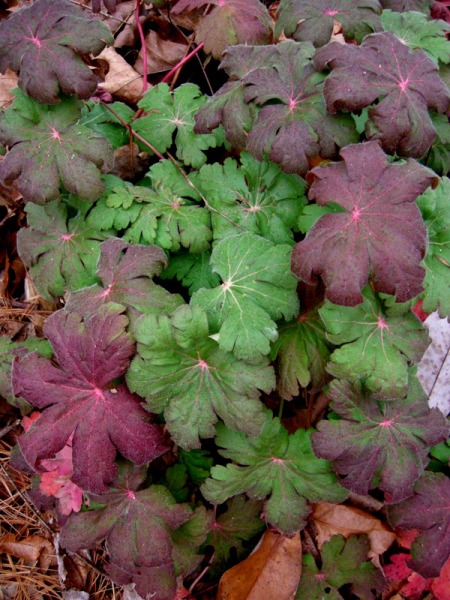
DSCN8651Bigroot geranium, G. macrorrhizum, takes on red and pink tones for the winter.

.

DSCN8649‘Black Scallop’ ajuga has quickly become one of my favorite groundcovers because its dark purple leaves remain shiny and beautiful through the winter.

You may be wondering why I would limit myself to one trip outside for photos for this post.  Every article that you read here takes me at least a full day to compose, including the photography, the research, the writing, and the editing.  I wanted to see if I could cut that back to a few hours and still produce a quality product, and I believe I have been largely successful.  It would only work for a post like this though where no significant supporting research was required. 

Enjoy, Carolyn


Nursery Happenings:  Carolyn’s Shade Gardens is a retail nursery located in Bryn Mawr, PA.  The only plants that we mail order are snowdrops and miniature hostas.  The nursery is closed until spring 2013.  Thanks for a great year.

If you are within visiting distance and would like to receive catalogues and information about customer events, please send your full name and phone number to carolynsshadegardens@verizon.net.  Subscribing to my blog does not sign you up to receive this information.

Facebook:  Carolyn’s Shade Gardens has a Facebook page where I post single photos, garden tips, and other information that doesn’t fit into a blog post.  You can look at my Facebook page here or click the Like button on my right sidebar here.

Notes: Every word that appears in orange on my blog is a link that you can click for more information.  If you want to return to my blog’s homepage to access the sidebar information (catalogues, previous articles, etc.) or to subscribe to my blog, just click here.


A Shrub for All Seasons: Edgeworthia

Posted in Fall, Shade Shrubs, winter, winter interest with tags , , , on December 10, 2012 by Carolyn @ Carolyns Shade Gardens

Carolyn’s Shade Gardens is a retail nursery located in Bryn Mawr, PA, specializing in showy, colorful, and unusual plants for shade.  The only plants that we ship are snowdrops and miniature hostas.  For catalogues and announcements of events, please send your full name, location, and phone number (for back up use only) to carolyn@carolynsshadegardens.com.  Click here to get to the home page of our website for catalogues and information about our nursery and to subscribe to our blog.

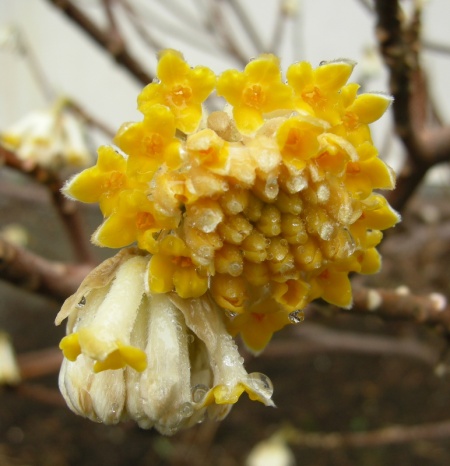
Edgeworthia chrysantha 'Snow Cream' Cresson gardenI love edgeworthia in all its manifestations, but late winter when the buds start to swell has to be my favorite.

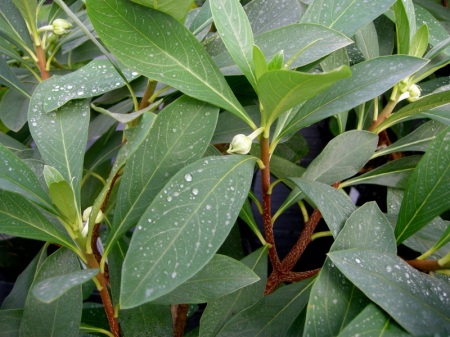
Edgeworthia chrysantha also known as paper bush is a collector’s plant.  That means it is rarely seen in public and private gardens and is hard to find at nurseries.  However, I have been able to offer it to my customers in fall 2011 and fall 2012 because my wholesale shrub supplier carries beautiful specimens of it.  I have grown it in my own garden for three years so I decided it was time for a full blown profile of what has become one of my favorite shrubs.

[Note:Carolyn’s Shade Gardens is retail nursery located in Bryn Mawr, PA.  The only plants that we mail order are snowdrops and miniature hostas.]

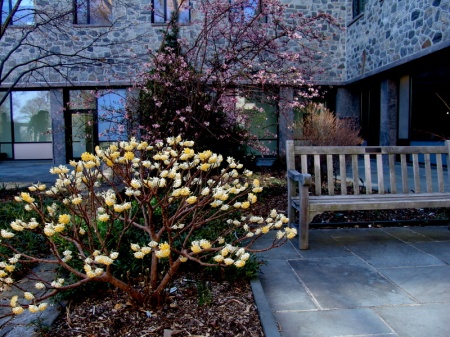
Edgeworthia chrysantha My photos of the whole plant do not do justice to how gorgeous it is, but as I reviewed the on-line literature, I realized that everyone has this problem.  This edgeworthia is pictured in mid-April on the terrace of the main house at Chanticleer gardens in Wayne, Pennsylvania.

Edgeworthia is native to China and was named for Michael Edgeworth (1812 to 1881), a plant collector for the East India Company.  It arrived fairly recently in the US.  My 1990 edition of Michael Dirr’s Manual of Woody Landscape Plants contains no mention of it, and it was not covered in my 1994 Longwood course, Deciduous Flowering Shrubs II.  Although articles state that its common name is paper bush, I have never heard anyone who actually grows it call it anything but edgeworthia.  In China, its bark is used to produce very high quality paper and for various medicinal purposes.  Here it is an unusual and elegant four season ornamental notable for its leaves, buds, flowers, and habit.

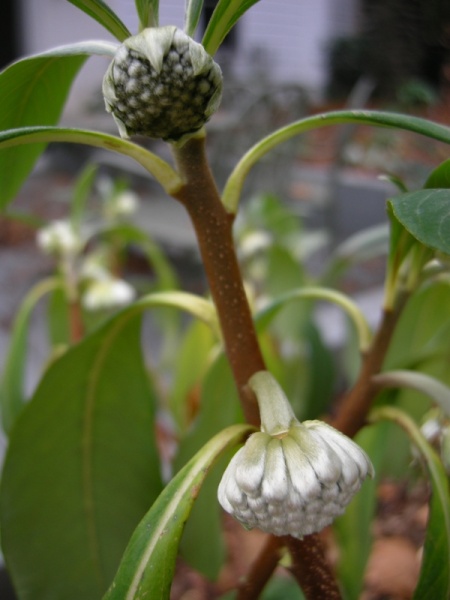
Edgeworthia chrysanthaEdgeworthia’s leaves are large and tropical, and its bark is an unusual reddish-brown.  This photo was taken in September and the highly ornamental buds have formed but have not yet expanded.

Edgeworthia is in the same family as daphne and has even occasionally been called yellow daphne.  It is deciduous and  has large and distinctive leaves.  They are 5 to 6″ long and about 2″ wide, blue-green on the top and silvery green on the bottom.  Although they can turn yellow in fall, you wouldn’t grow edgeworthia for fall color.  The leaves cluster at the tips of the branches giving the shrub a decidedly lush and tropical appearance that really stands out in the garden.  When the leaves drop, they reveal the slender and pliable reddish-brown bark seen above.

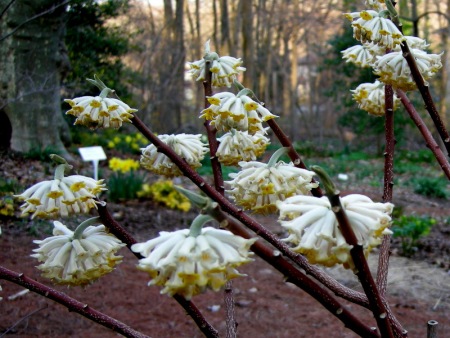
Edgeworthia chrysanthaEdgeworthia buds in November as they start to expand.

.

Edgeworthia chrysantha 'Snow Cream' Cresson gardenEdgeworthia buds as they appear through the heart of the winter.

.

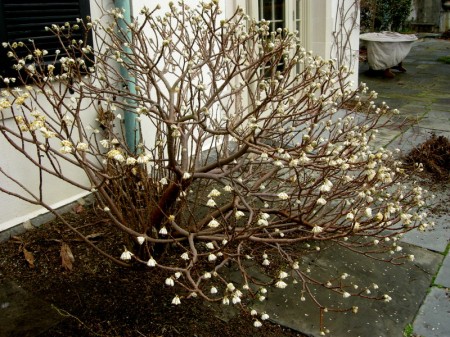
Edgeworthis chrysanthaPlease use your imagination to envision how gorgeous this shrub must be covered with hundreds of the silky silver buds shown in the preceding photo.  This edgeworthia is pictured at the very end of January and is in the Isabelle Cosby Courtyard at the Scott Arboretum at Swarthmore College, Pennsylvania.

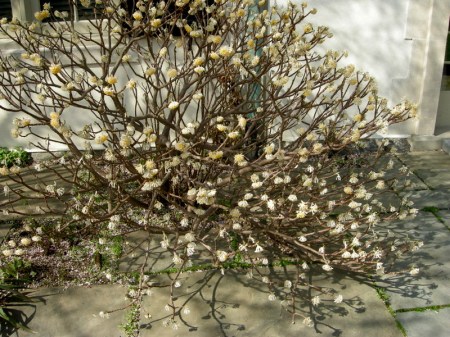
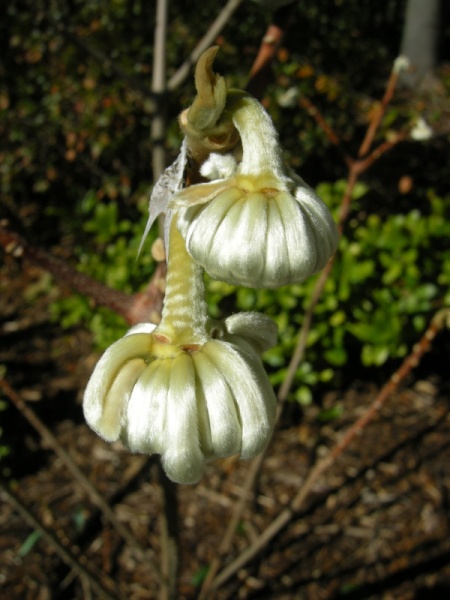
My favorite season for edgeworthia is winter when the leaves drop to reveal the buds which form in late summer or early fall depending on where you live.  Each 1″ plus bud resembles an intricately designed tassel on the corner of an elegant Victorian pillow.  The silky hairs glow in the light, and the plant looks like it is covered with hundreds of silver flowers–simply breathtaking.  The falling leaves also reveal edgeworthia’s striking architectural habit.  It is a multi-stemmed shrub that forms an almost perfectly rounded umbrella shape of cinnamon colored branches.

Edgeworthia chrysanthaEdgeworthia’s buds start to open at the beginning of March in our area and as early as January in the south.

.

Edgeworthia chrysanthaEdgeworthia’s flowers starting to open.

.

Edgeworthia chrysanthaFully open flowers in my garden in mid-March 2012.  I wish blog posts could include a fragrance button!

Blooming begins in our area in early March and can continue through April.  Each bud expands to reveal 25 to 35 tubular flowers with a silky silver exterior and a bright yellow interior.  That would be ornamental enough but the fragrance is amazing.  I can’t describe it—you will just have to find a specimen and experience it for your self.

Edgeworthia chrysanthaEdgeworthia blooming at the Scott Arboretum (photo taken by Rhoda Maurer and used with the permission of the Scott Arboretum).

I am going to give cultural information for edgeworthia with the caveat that I don’t think the plant has been grown long enough for it to be definitive.  Most sources say that edgeworthia grows in light to partial shade and requires moist, fertile, well-drained organic soil with supplemental water in summer.  I grow mine in an east-facing location with very high shade, but edgeworthias at the Scott Arboretum and Chanticleer are in the sun while Charles Cresson has a relatively old plant in full shade.  My edgeworthias have organic soil but are in a dry location.  This causes the leaves to go limp when it’s hot but doesn’t seem to harm the plants, time will tell.

Zone information is also variable, and the only thing I can guarantee is that specimens have been growing successfully in the Delaware Valley area of Pennsylvania for some time.  If you garden north of here, I suggest you try the plant anyway because we really don’t know how much cold it can take.  Planting in a protected location is often recommended, and all the plants I have seen are in protected spots, but I don’t know if this is necessary.  Mine are more exposed than other local plants so we will see. 

Finally, height and width estimates range all over the place with a consensus probably being 6′ by 6′.  However, the Chanticleer specimen in the sun is much lower and tighter while Charles Cresson’s shady specimen is taller and looser.  One thing is clear though: you won’t regret adding edgeworthia to your garden.

If you are growing edgeworthia, please leave a comment describing your experience with it, especially if you are from an area north of the Delaware Valley.

Carolyn

If you would like more information on edgeworthias, please read my more recent post, Edgworthia Update, and the very helpful reader comments, by clicking here.


Nursery Happenings:  Carolyn’s Shade Gardens is a retail nursery located in Bryn Mawr, PA, specializing in showy, colorful, and unusual plants for shade.  The only plants that we ship are snowdrops and miniature hostas.  For catalogues and announcements of events, please send your full name, location, and phone number (for back up use only) to carolyn@carolynsshadegardens.com.  Click here to get to the home page of our website for catalogues and information about our nursery and to subscribe to our blog.

Facebook:  Carolyn’s Shade Gardens has a Facebook page where I post single photos, garden tips, and other information that doesn’t fit into a blog post.  You can look at my Facebook page here or click the Like button on my right sidebar here.

Notes: Every word that appears in orange on my blog is a link that you can click for more information.  If you want to return to my blog’s homepage to access the sidebar information (catalogues, previous articles, etc.) or to subscribe to my blog, just click here.


2012 Winter Interest Plants

Posted in bulbs for shade, Camellias, evergreen, garden to visit, hellebores, landscape design, Shade Perennials, Shade Shrubs, snowdrops, winter, winter interest with tags , , , , , , , , , , , , , , , , , on February 29, 2012 by Carolyn @ Carolyns Shade Gardens

Carolyn’s Shade Gardens is a retail nursery located in Bryn Mawr, PA, specializing in showy, colorful, and unusual plants for shade.  The only plants that we ship are snowdrops within the US.  For catalogues and announcements of local events, please send your full name, mailing address, and cell number to carolyn@carolynsshadegardens.com and indicate whether you are interested in snowdrops, hellebores, and/or hostas.  Click here to get to the home page of our website for catalogues and information about our nursery and to subscribe to our blog.

Camellia japonica ‘Berenice Boddy’ in full bloom in February in the Cresson garden.

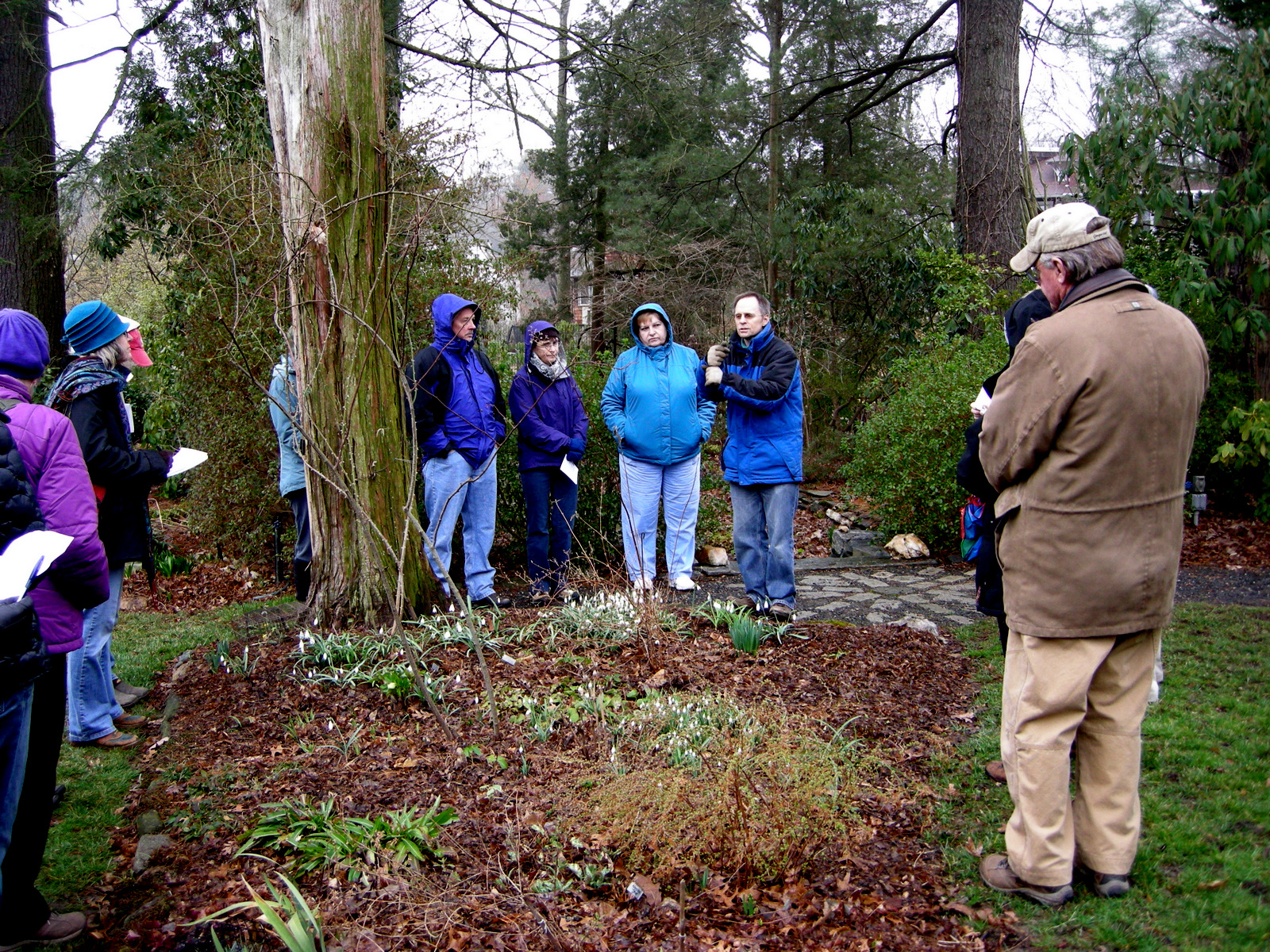
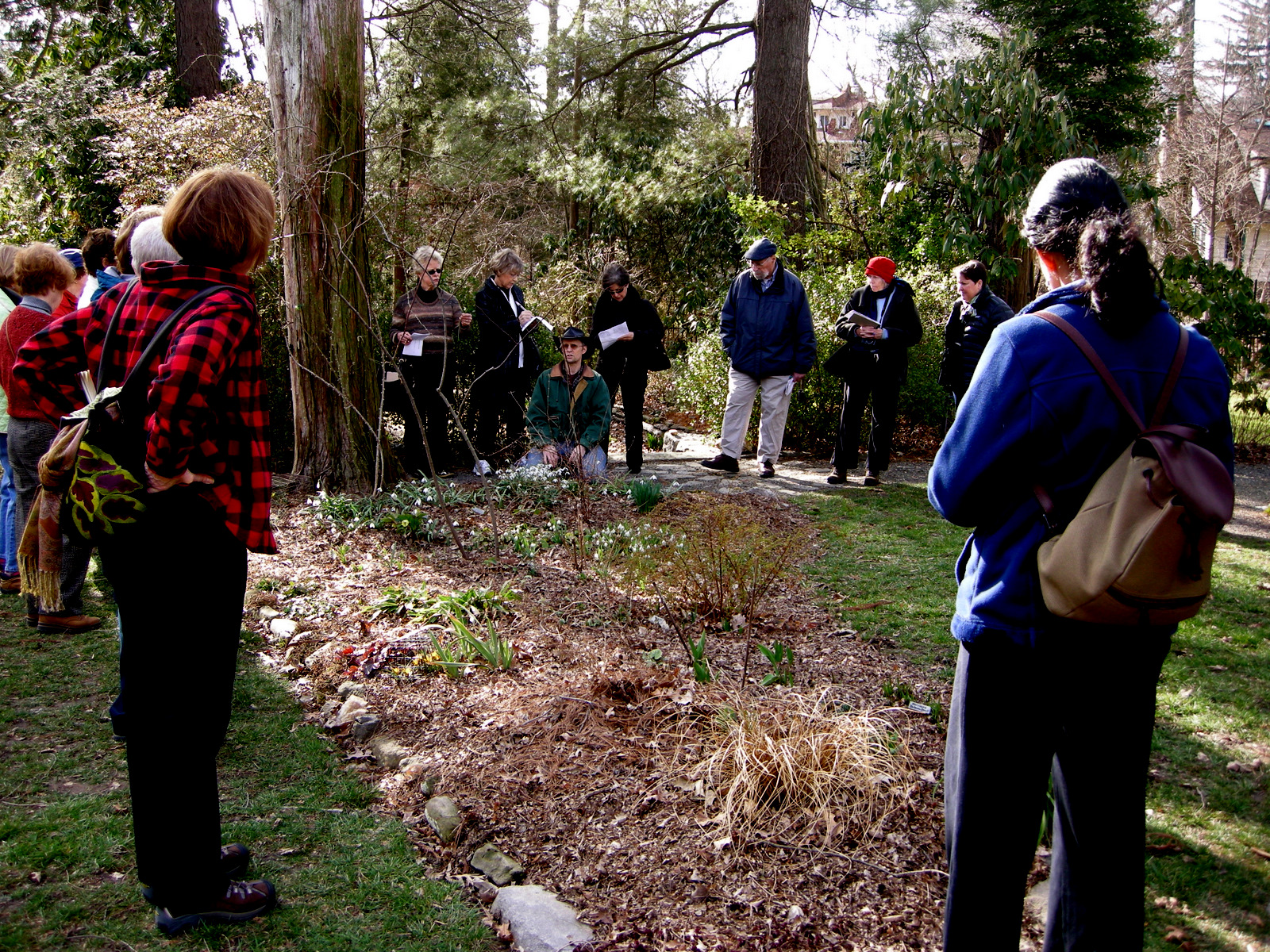
On Friday, February 24, and Monday, February 27, Charles Cresson presented the second annual Winter Interest Plant Seminars for my customers in his beautiful garden located in Swarthmore, Pennsylvania, US.  I did a post on the seminars last year (to read it click here) and thought I had covered the topic.  However, our very warm winter meant that many different plants were in bloom so I want to show you what we saw.


The weather was cold and rainy on Friday, but participants didn’t let it stop them from enjoying Charles’s presentation.

Monday was warm and sunny which allowed more time for dawdling in the garden.  The snowdrops were a big hit.

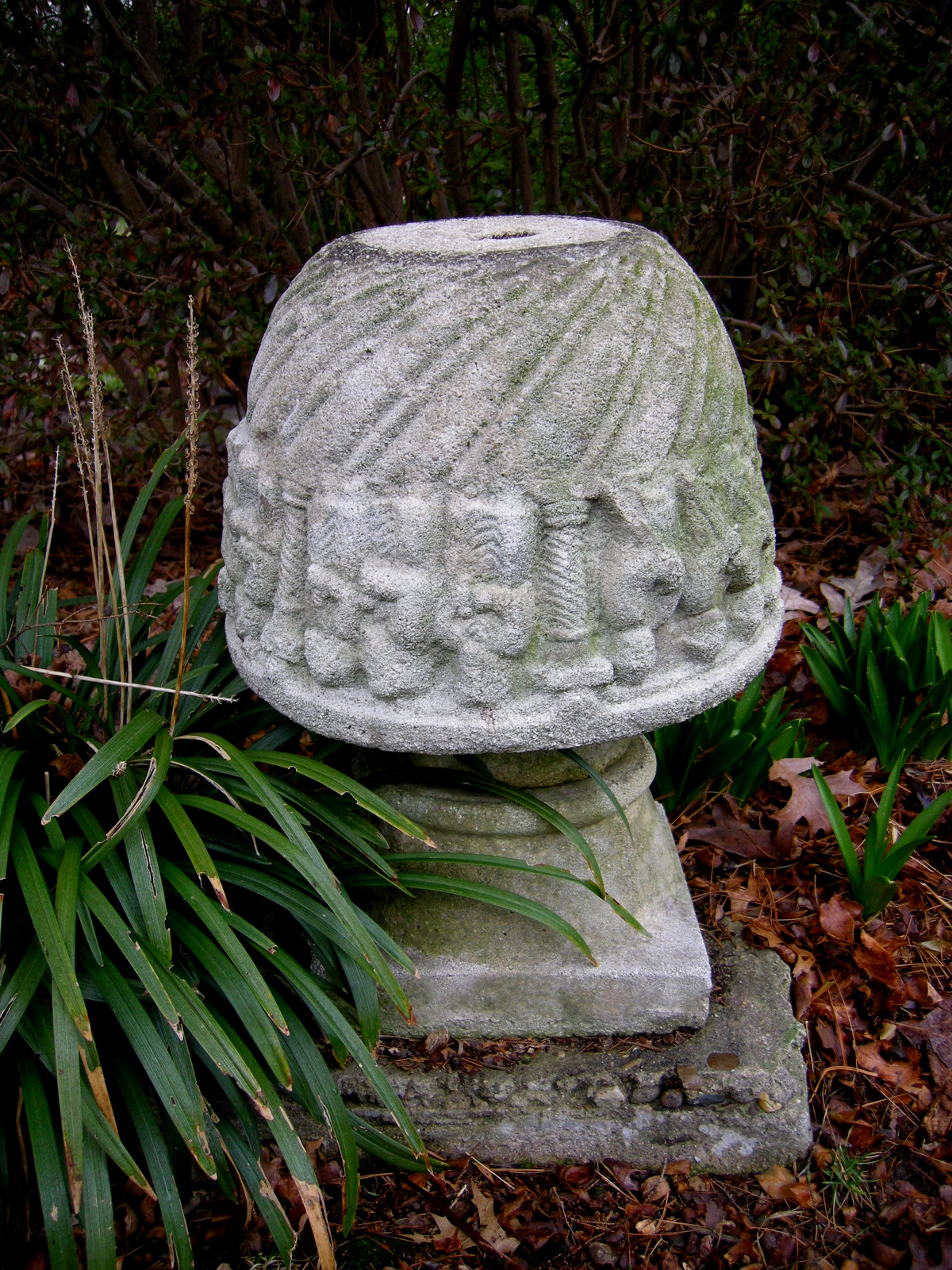
The attention to detail in Charles’s garden is amazing.  I thought I would show you some of the “hardscape” features, many of which Charles built himself:


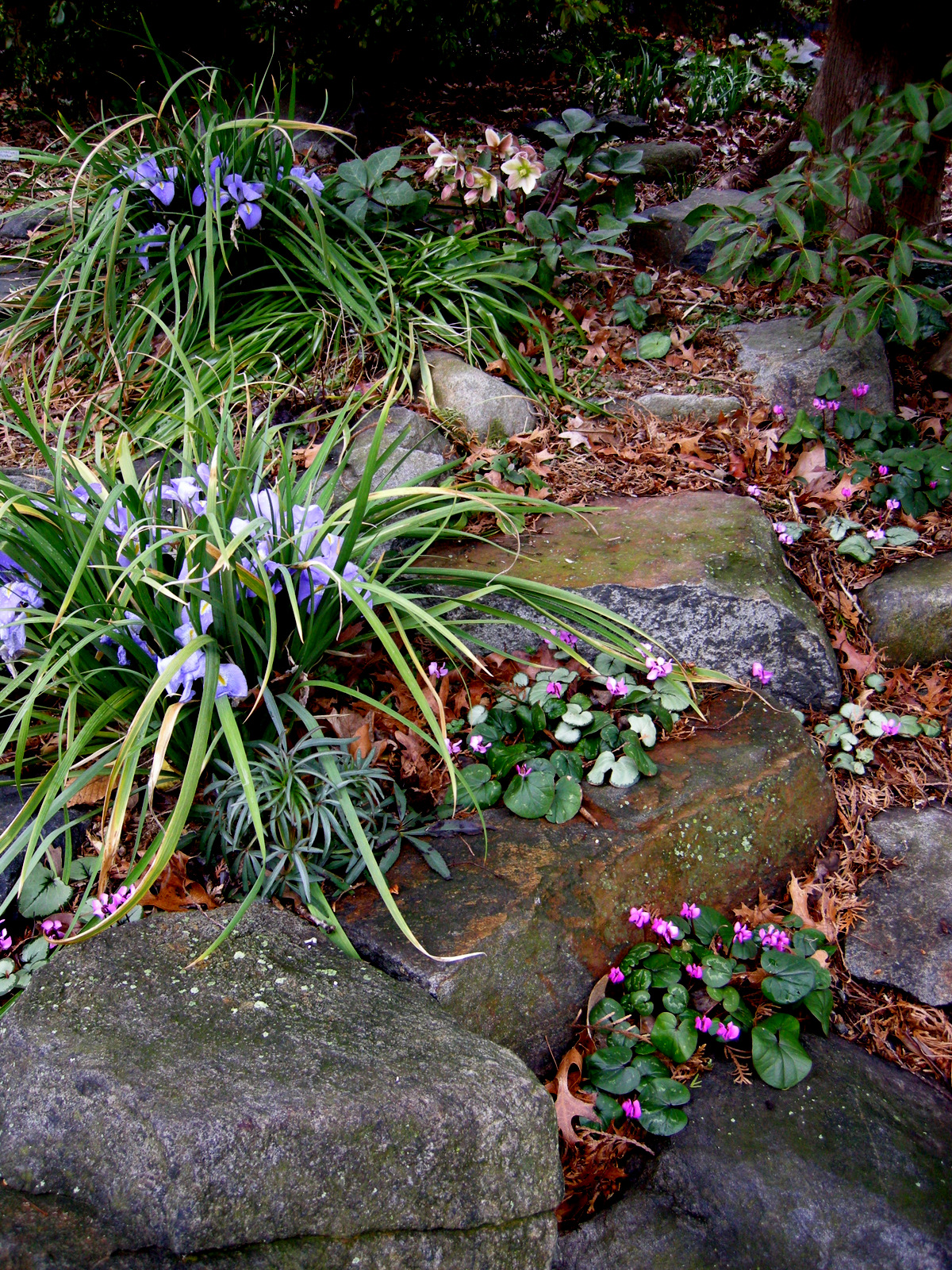
The rock garden with hellebores, Algerian iris, and spring-blooming hardy cyclamen.

Garden shed with the original green roof.

Winter jasmine, Jasminum nudiflorum, photo by seminar participant Lucretia Robbins.

Charles has a spectacular collection of winter-blooming shrubs, many of which are fragrant.  We were all surprised by which one was the most fragrant at that time of year:


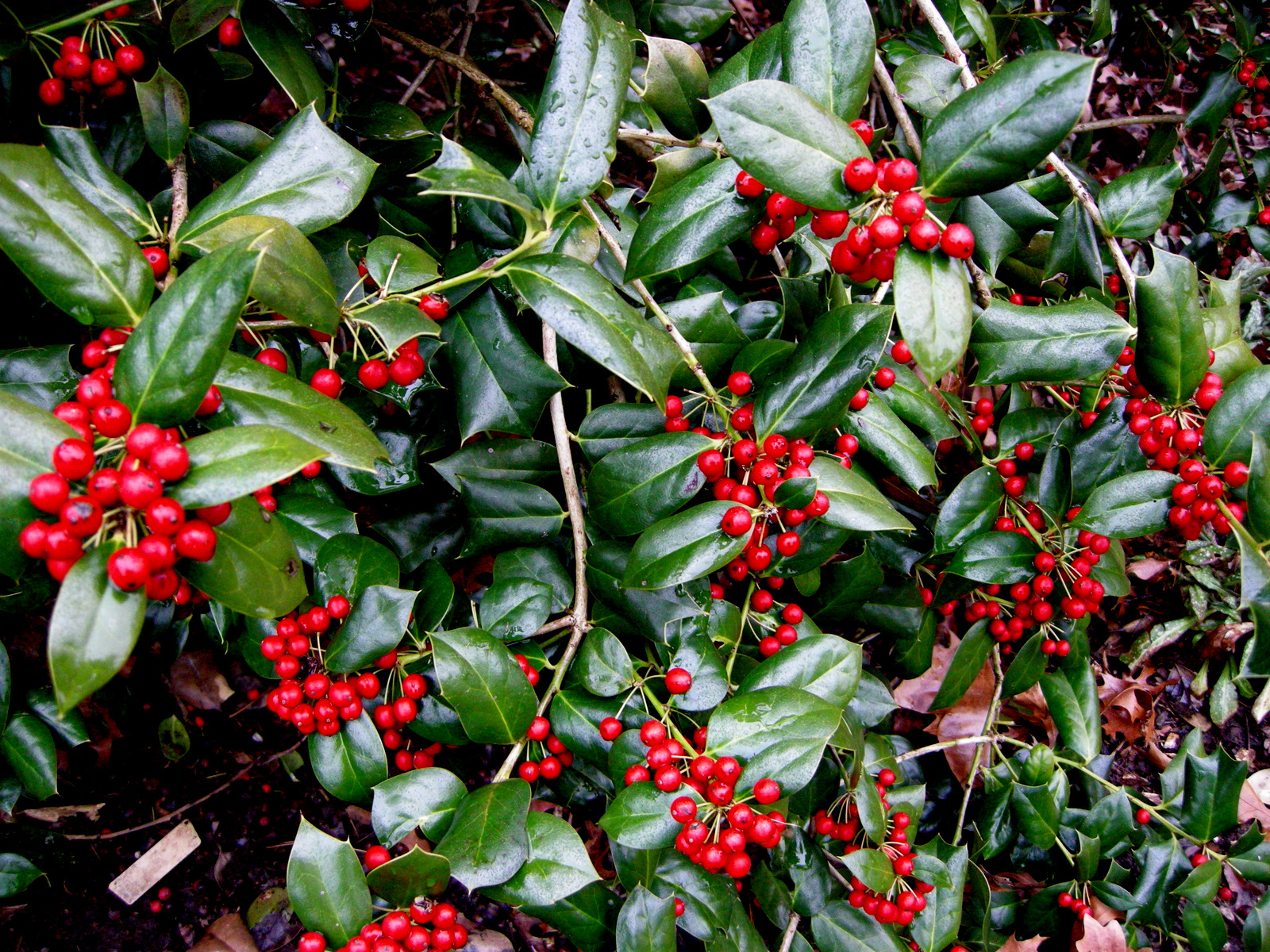
Chinese holly, Ilex cornuta, retains its berries through the winter.


Sweetbox, Sarcococca hookeriana var. digyna ‘Purple Stem’, adds the additional feature of ornamental stems to sweetbox’s many desirable attributes.


Bodnant viburnum, V. bodnantense ‘Dawn’, is very fragrant.


Flower of Bodnant viburnum


The adult form of English ivy, Hedera helix ‘Poetica Arborea’, produces beautiful berries but is also considered very invasive.


Camellia x ‘April Tryst’ is blooming early.


I like the male flowers of Japanese skimmia, S. japonica, as much as the berries on the female plants.


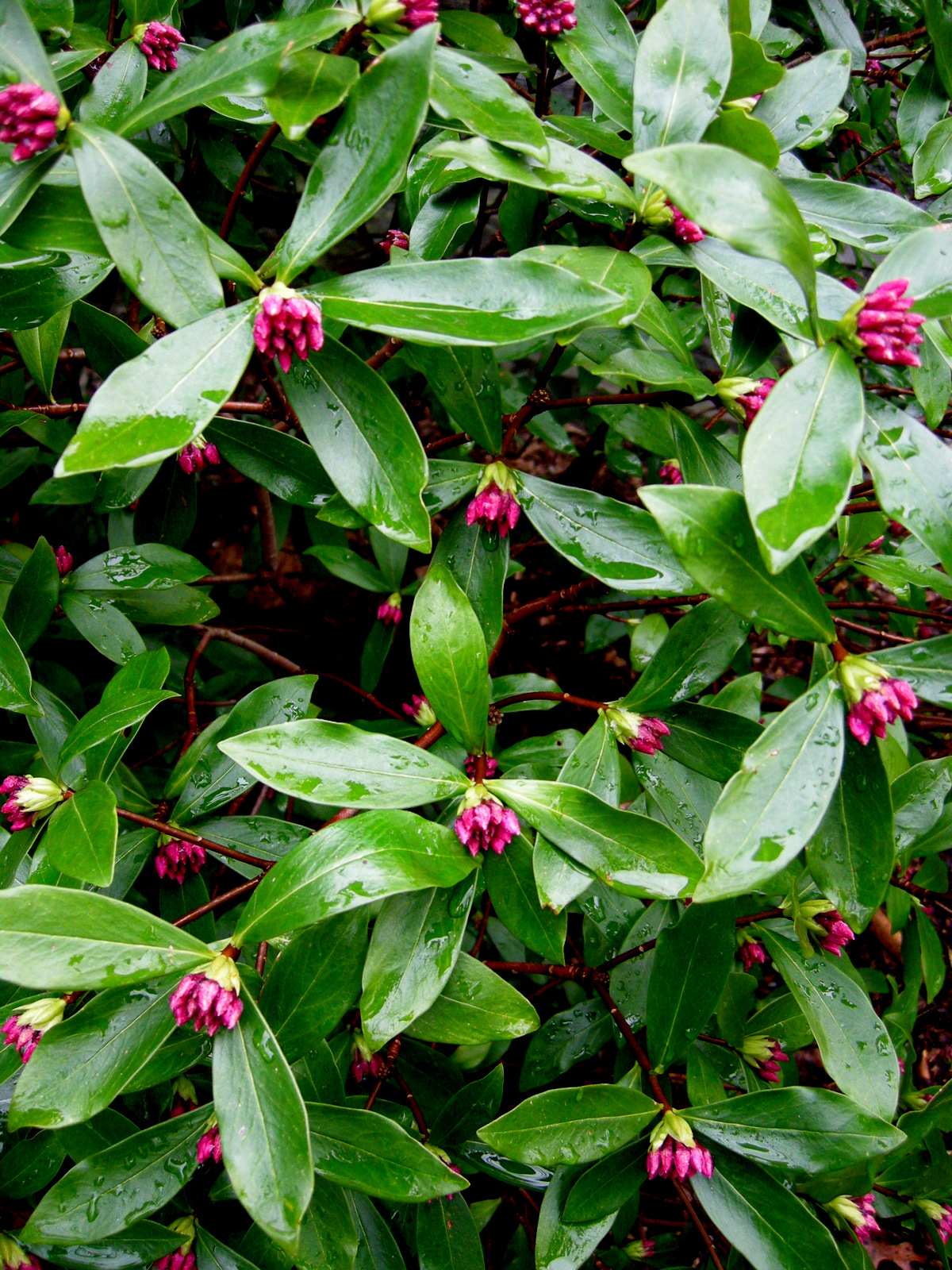
Winter daphne, D. odora, is one of my favorite shrubs because of its wonderful fragrance, excellent habit, evergreen leaves, and lovely flowers.


And the winner is….  Yes, Japanese mahonia, M. japonica, was the most fragrant plant in Charles’s garden even with all the excellent competition above.

Winter-blooming herbaceous perennials were also well represented:

The pink flowers and evergreen leaves of heath, Erica x darleyensis ‘Furzey’.

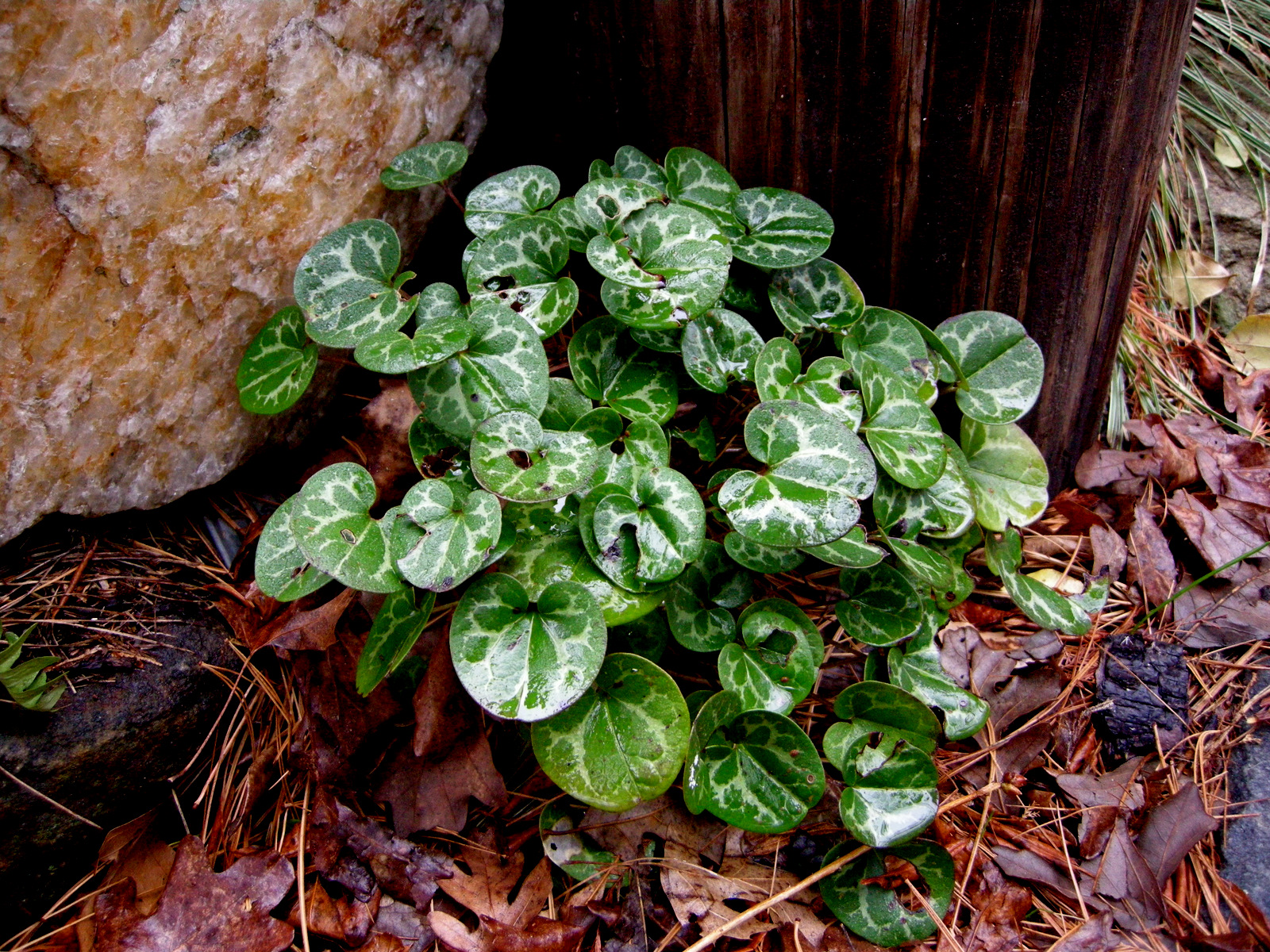
Evergreen heart leaf ginger, Asarum virginicum

Fragrant Algerian iris, I. unguicularis, was a big hit.

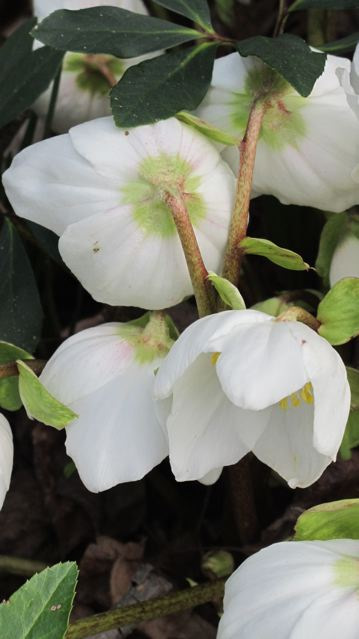
Christmas rose, Helleborus niger, photo Lucretia Robbins

A gorgeous anemone-flowered (ruffle around the center of the flower) hybrid hellebore—my favorite type of hellebore flower.

The most evergreen hellebore of them all, bearsfoot hellebore, H. foetidus.

Helleborus x ericsmithii ‘Winter’s Song’

Hybrid hellebore with the very robust and extremely fragrant snowdrop ‘Brenda Troyle’.

The tour included a wonderful selection of winter-blooming bulbs, including choice snowdrop cultivars.  Here are just a few:

Seeing this large patch of the very fragrant snowdop ‘S. Arnott’ sent participants back to add it to their purchases for the day.

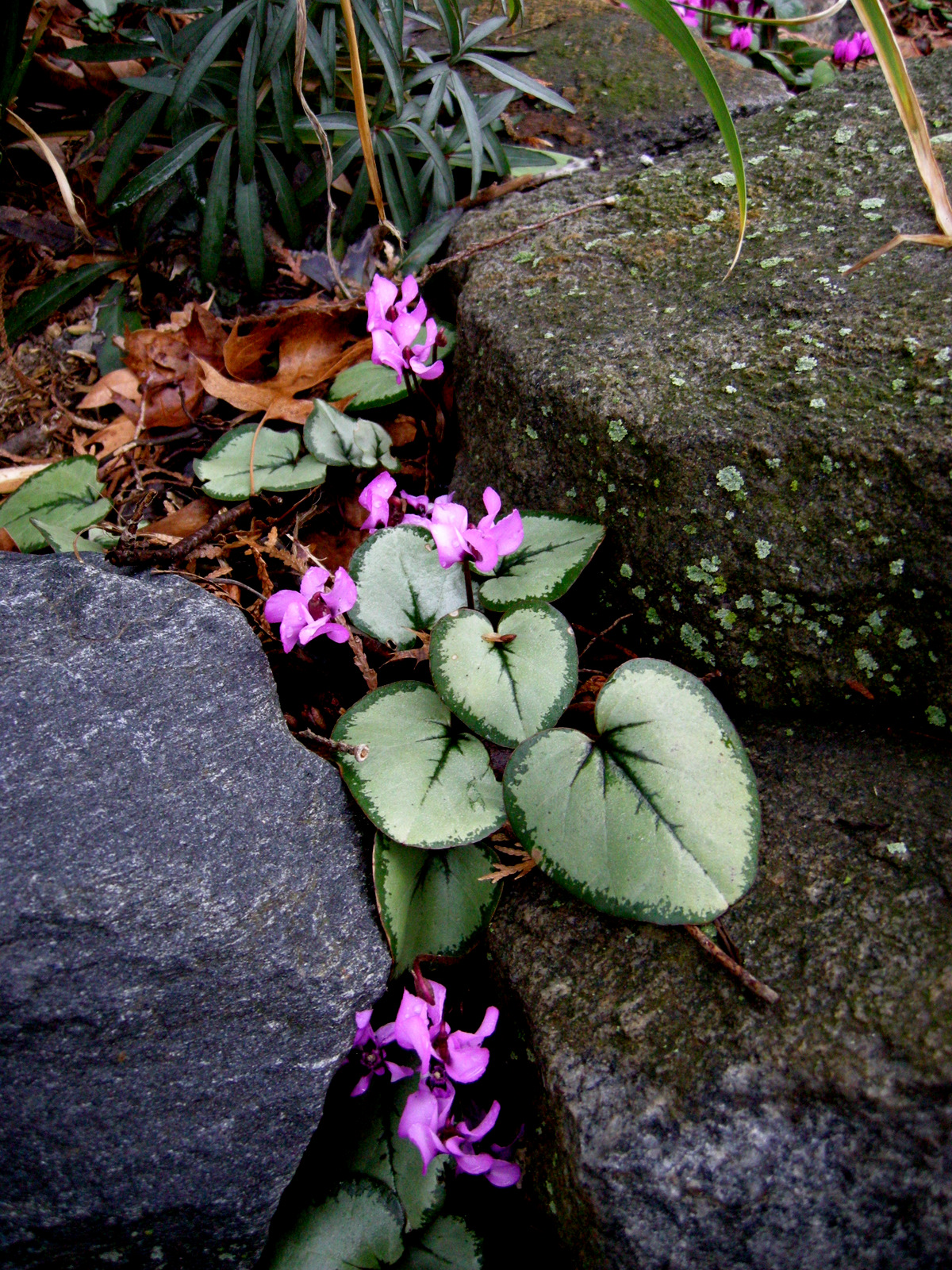
Spring-blooming hardy cyclamen, C. coum

The common snowdrop, Galanthus nivalis, multiplies quickly and looks great when massed.

Evergreen leaves of fall-blooming hardy cyclamen, C. hederifolium

A single bulb of a rare yellow-flowered cultivar of the species snowdrop, G. woronowii, just sold for $1,145 on UK eBay.

A silver-leafed form of spring-blooming hardy cyclamen.

The species snowdrop Galanthus plicatus has been in cultivation since the 16th century and comes from Russia and Turkey.  It has beautiful leaves with a unique folded (explicative) pattern.

For all of you who couldn’t actually attend Charles’s seminars, I hope you have enjoyed your virtual tour.

Carolyn

Notes: Every word that appears in orange on my blog is a link that you can click for more information.  If you want to return to my blog’s homepage to access the sidebar information (catalogues, previous articles, etc.) or to subscribe to my blog, just click here.

A Wonder of Nature

Posted in bulbs for shade, garden to visit, Shade Perennials, winter, winter interest with tags , , , on February 21, 2012 by Carolyn @ Carolyns Shade Gardens

Carolyn’s Shade Gardens is a retail nursery located in Bryn Mawr, PA, specializing in showy, colorful, and unusual plants for shade.  The only plants that we ship are snowdrops within the US.  For catalogues and announcements of local events, please send your full name, mailing address, and cell number to carolyn@carolynsshadegardens.com and indicate whether you are interested in snowdrops, hellebores, and/or hostas.  Click here to get to the home page of our website for catalogues and information about our nursery and to subscribe to our blog.

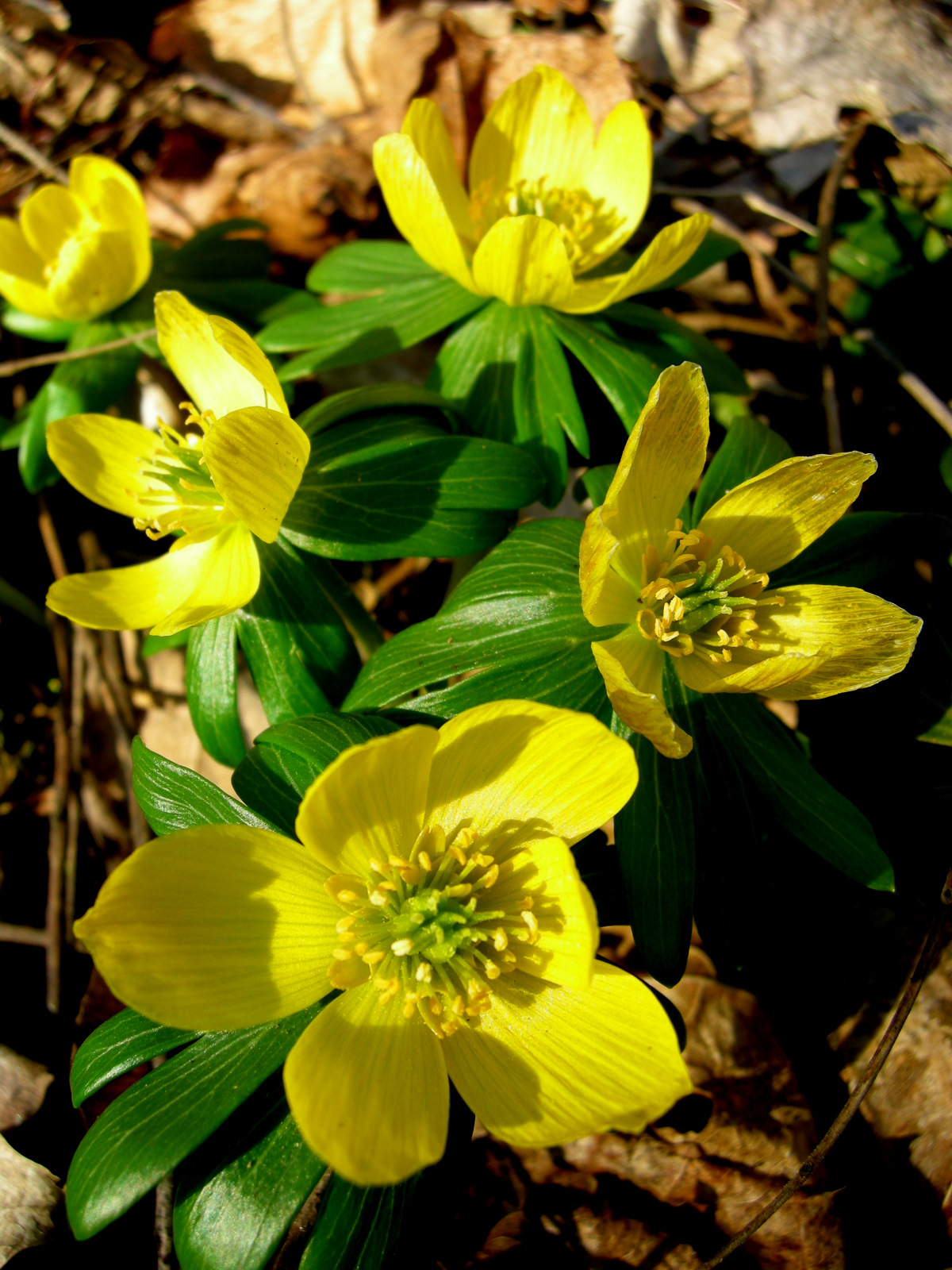
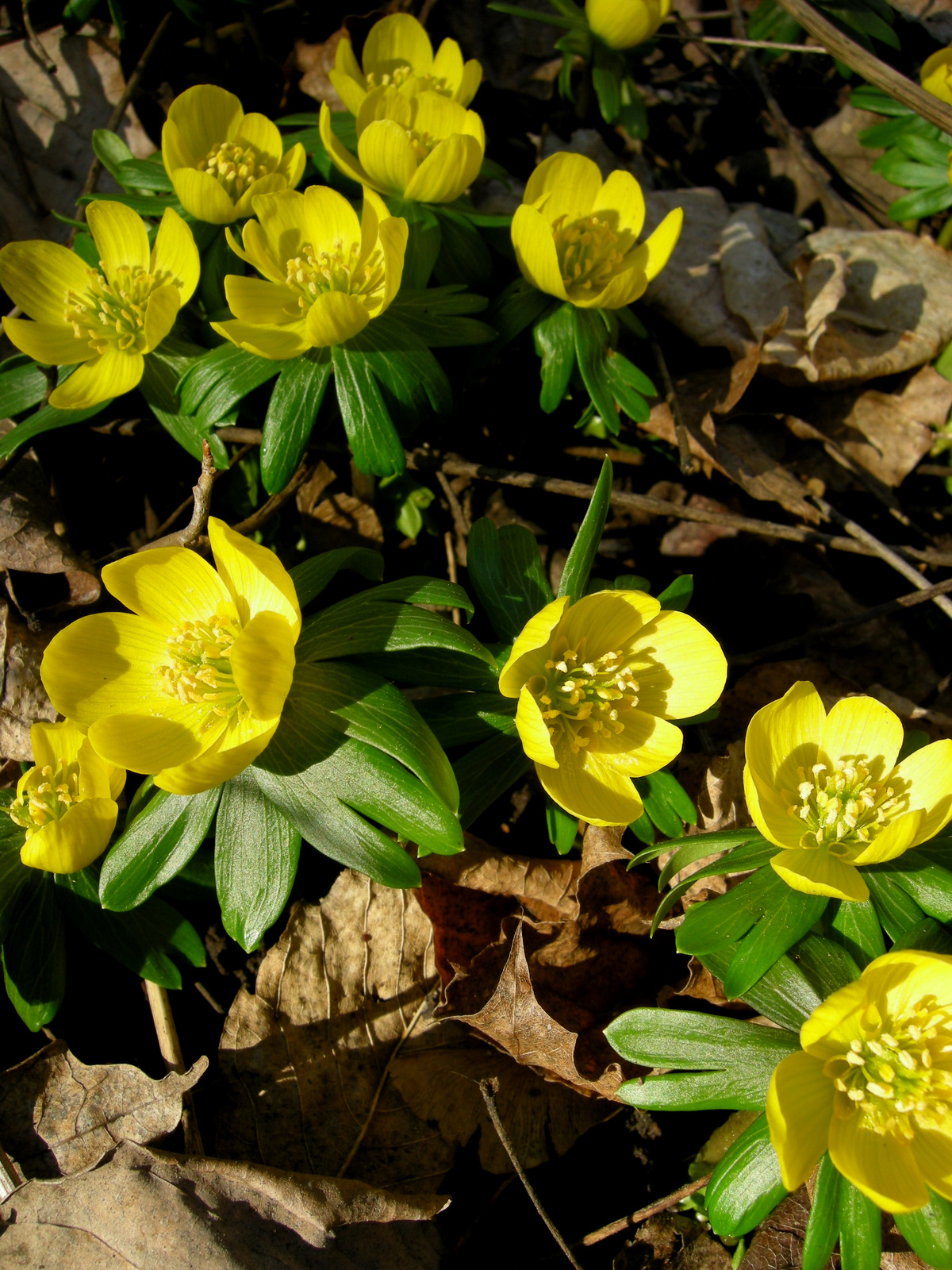
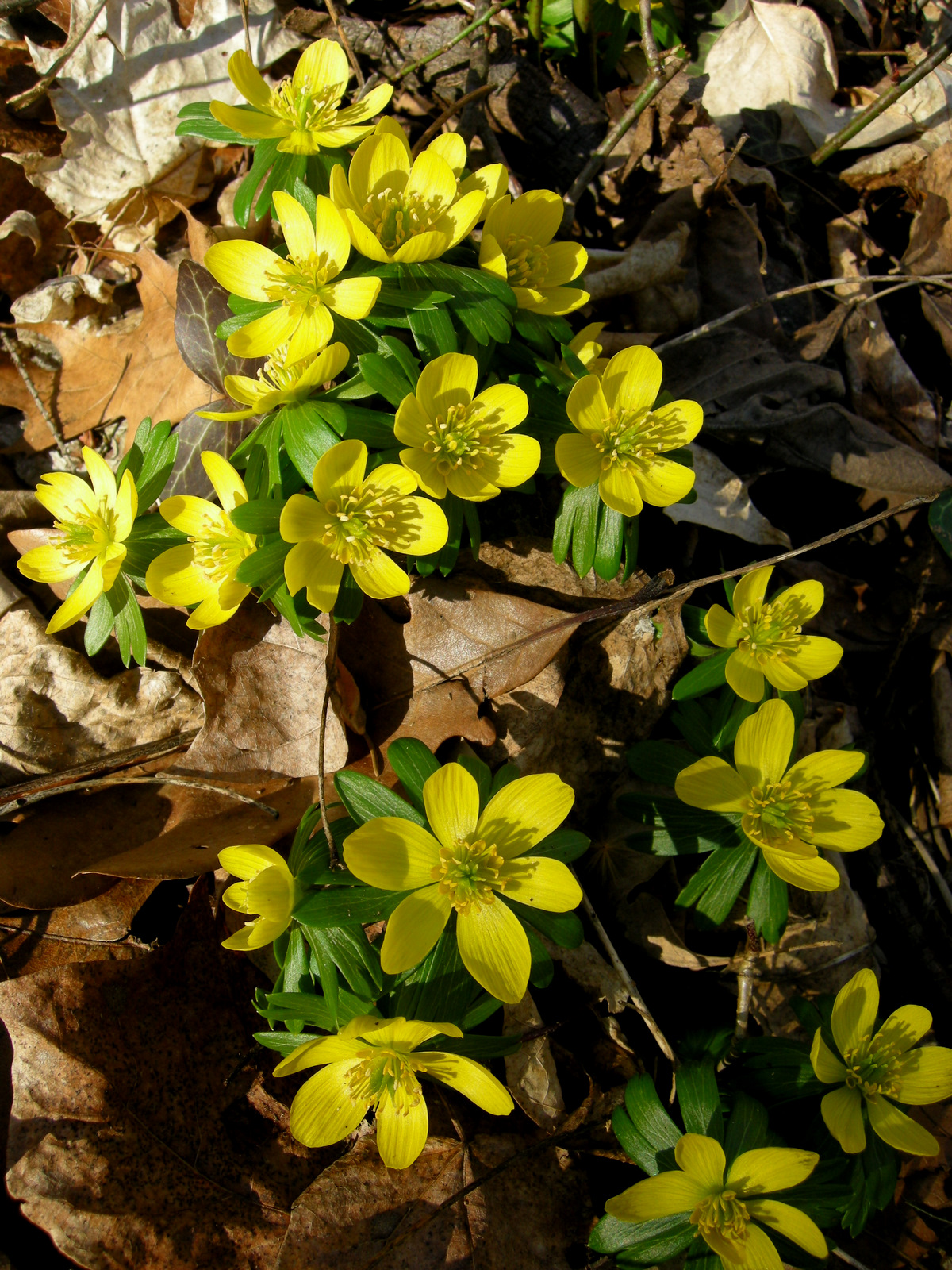
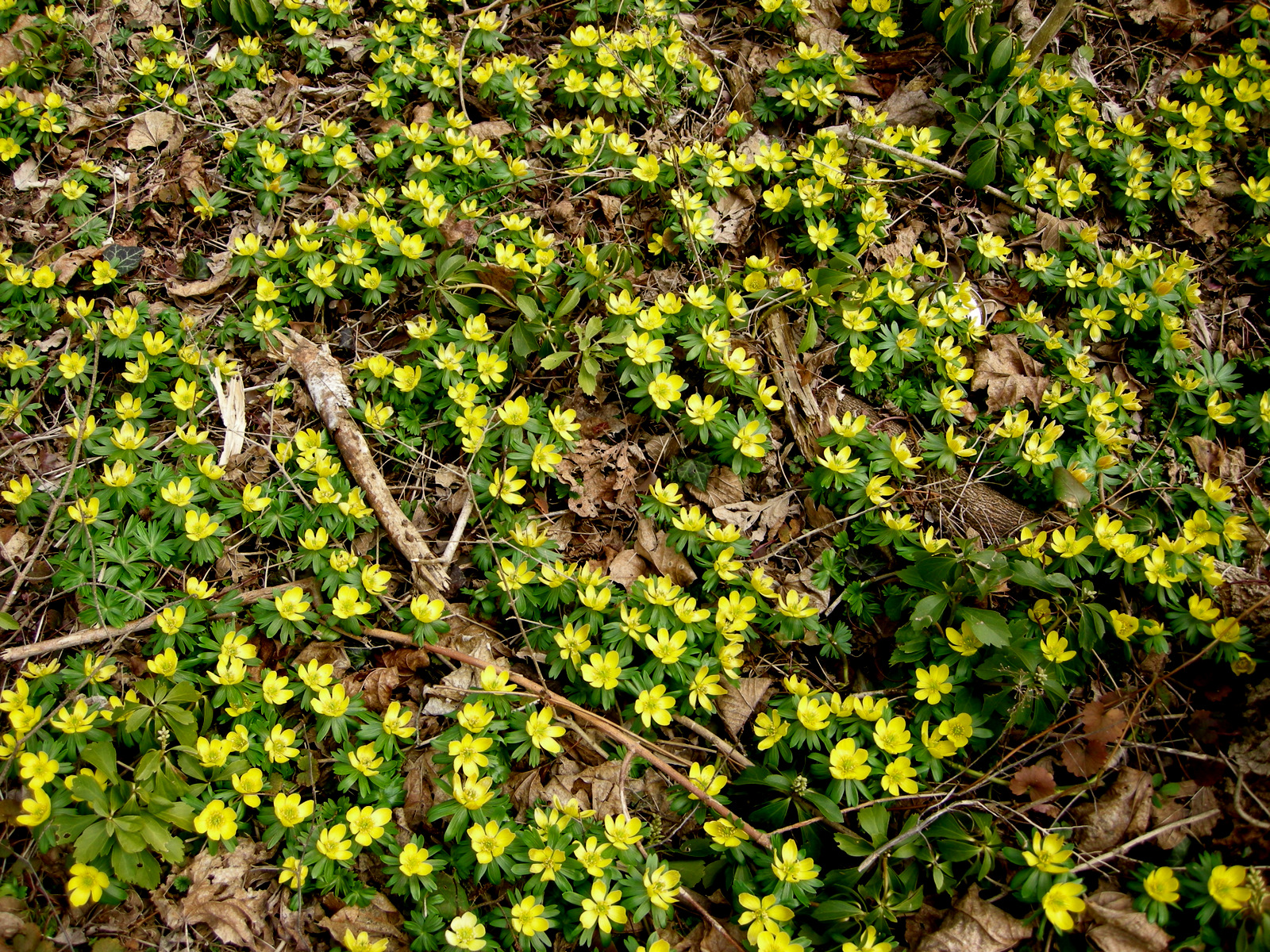
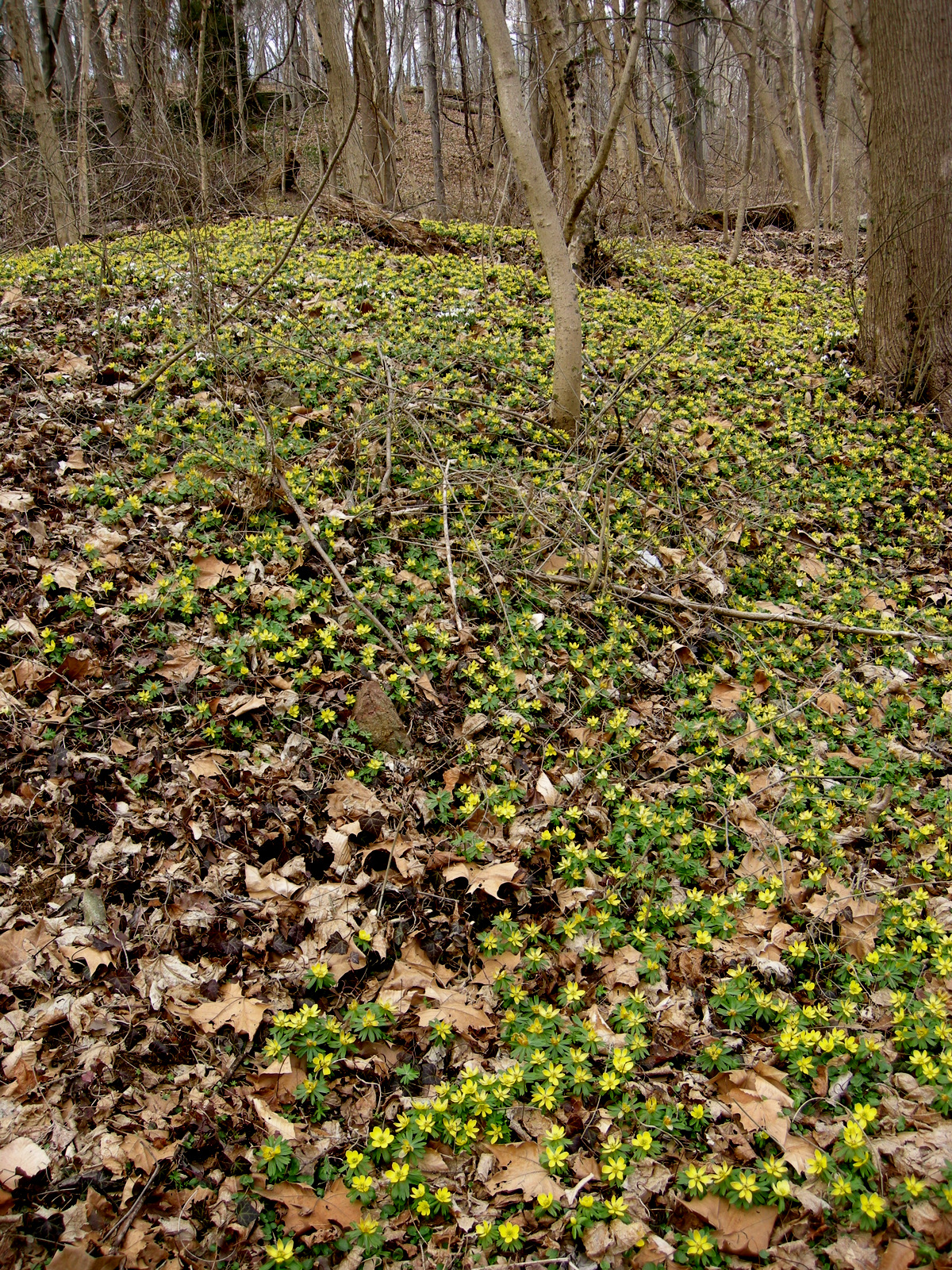
Winter aconite, Eranthis hyemalis

One of the first plants to bloom in my garden is winter aconite.  It usually starts blooming in February and continues into March.  I treasure its cheery yellow flowers with their shiny green collars because they brighten what can otherwise be a cold and dreary time of year.


When my original winter aconite plants got this big, I was thrilled.

Winter aconite is in the buttercup family and is native to Europe.  It is about four inches tall and prefers woodland soil in deciduous shade.  It wants to be cool in the summer but not too dry, and it will not tolerate wet soil.  It grows in zones 3 to 7.  Winter aconite is a bulb (technically a tuberous rhizome) and goes dormant when the weather gets hotter.  Some sources state that it is poisonous to humans, but there have been no reported incidents.  It is deer resistant and black walnut tolerant.


When the patch started to fill in like this one I was ecstatic.

You can order winter aconite as a dried bulb.  It is recommended that the bulbs be soaked overnight to increase success.  Despite soaking, I never got more than one or two bulbs to grow into plants.  I tried several times.  Then a friend of mine gave me some growing plants (thanks Julie!), and my little patch of winter aconite began in earnest.


After several years, my patch looked like this.

Winter aconite naturalizes well once you get the initial plants going.  The best way to spread it is to collect the seeds and sprinkle them where you want them.  If you don’t collect the seeds, they tend to germinate around the base of the mother plant.  My winter aconite has been so successful that, after ten years,  I was able to sell growing plants in my snowdrop catalogue (although next year I need to give the patch a “rest”). 


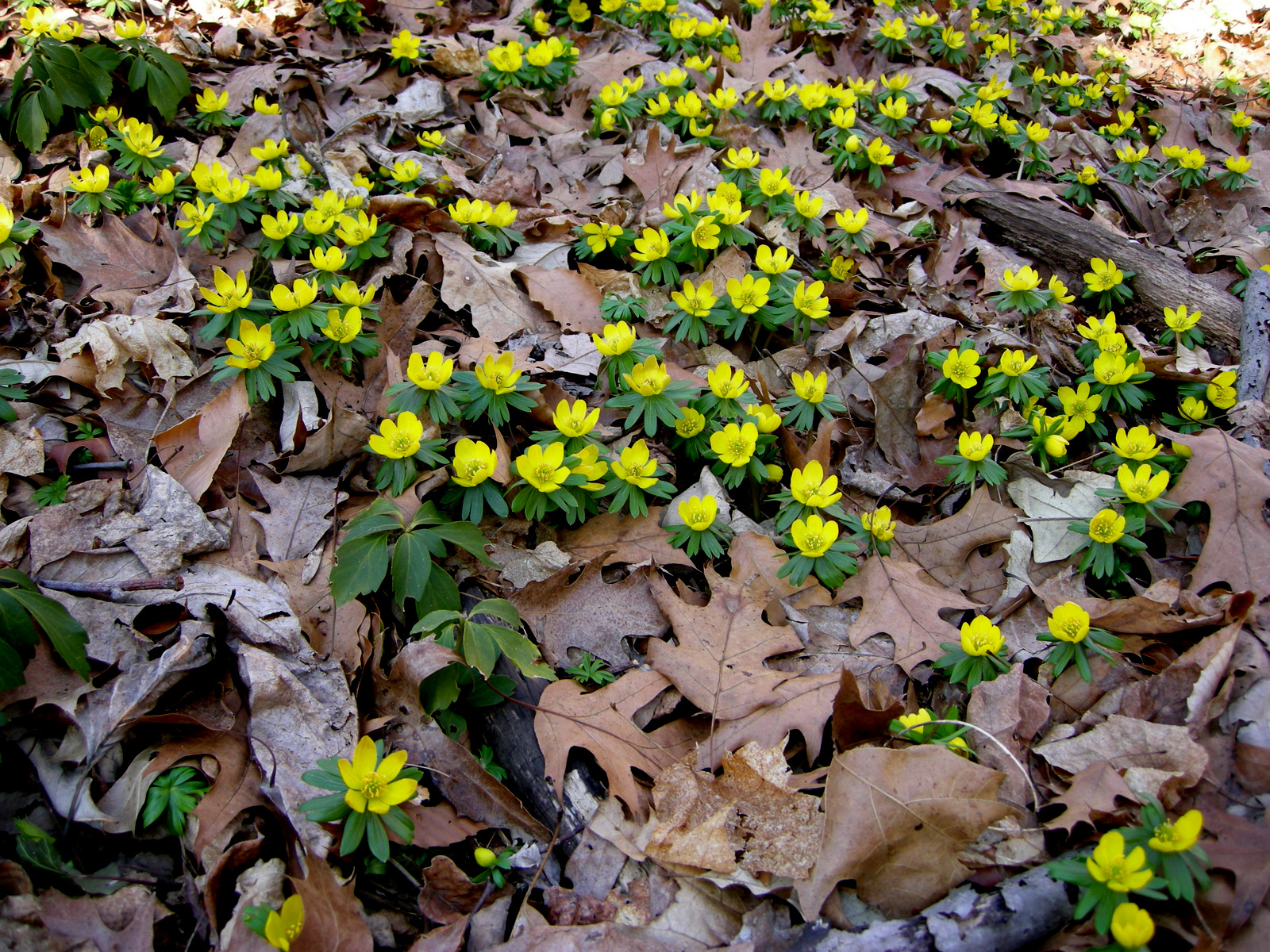
Winter aconite covers this much ground in my woodland.

Now we get to the “wonder of nature” part.  Right down the street from my plant nursery is a public park owned by Radnor Township (Pennsylvania, US) called Ithan Valley Park.  The property was originally an old Main Line estate.  During the early 1900s, it was owned by the botanist John Evans, and he maintained an arboretum of exotic plants there.  Evidently his collection was amazing, but today few of the original plants remain.


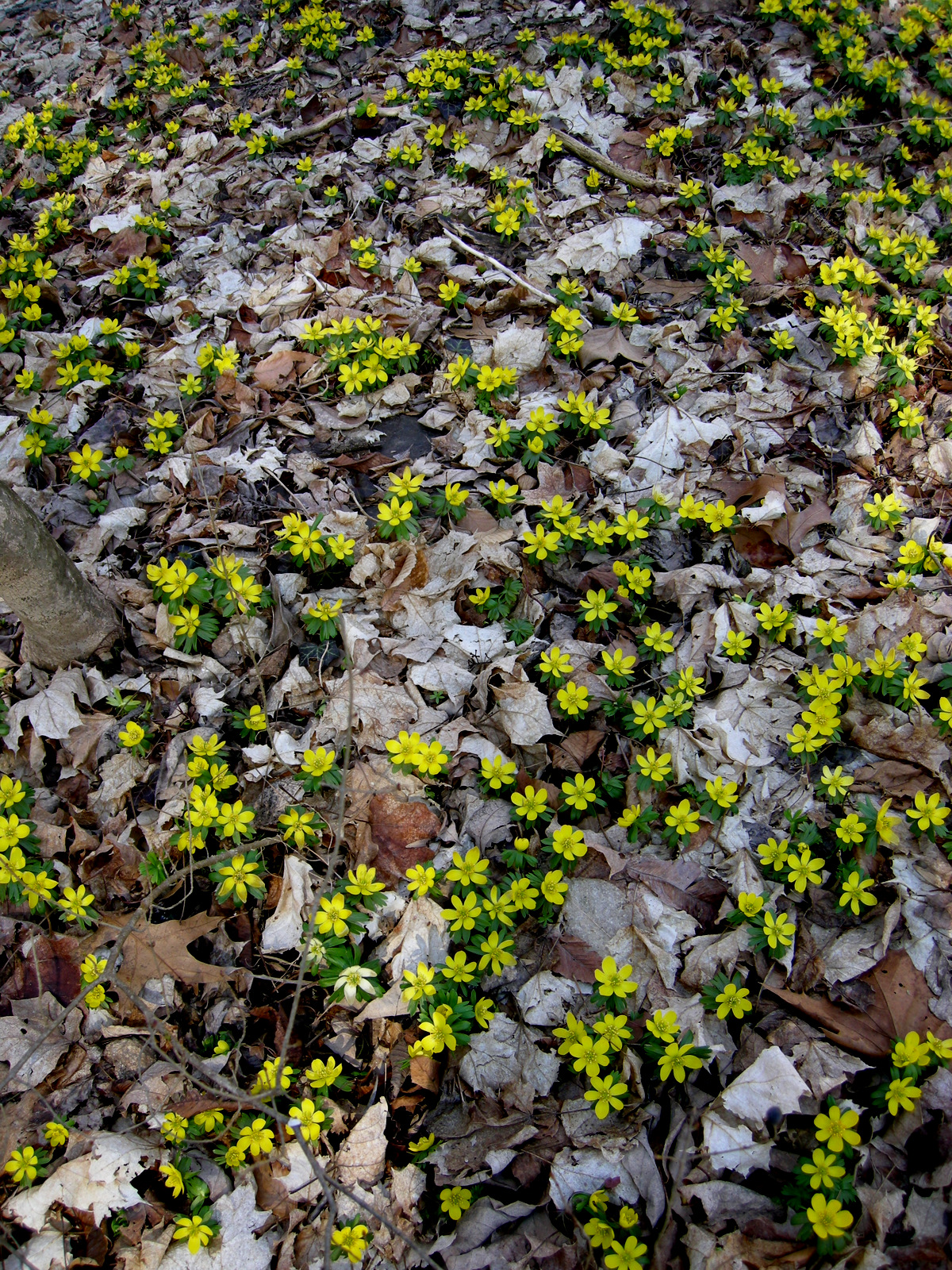
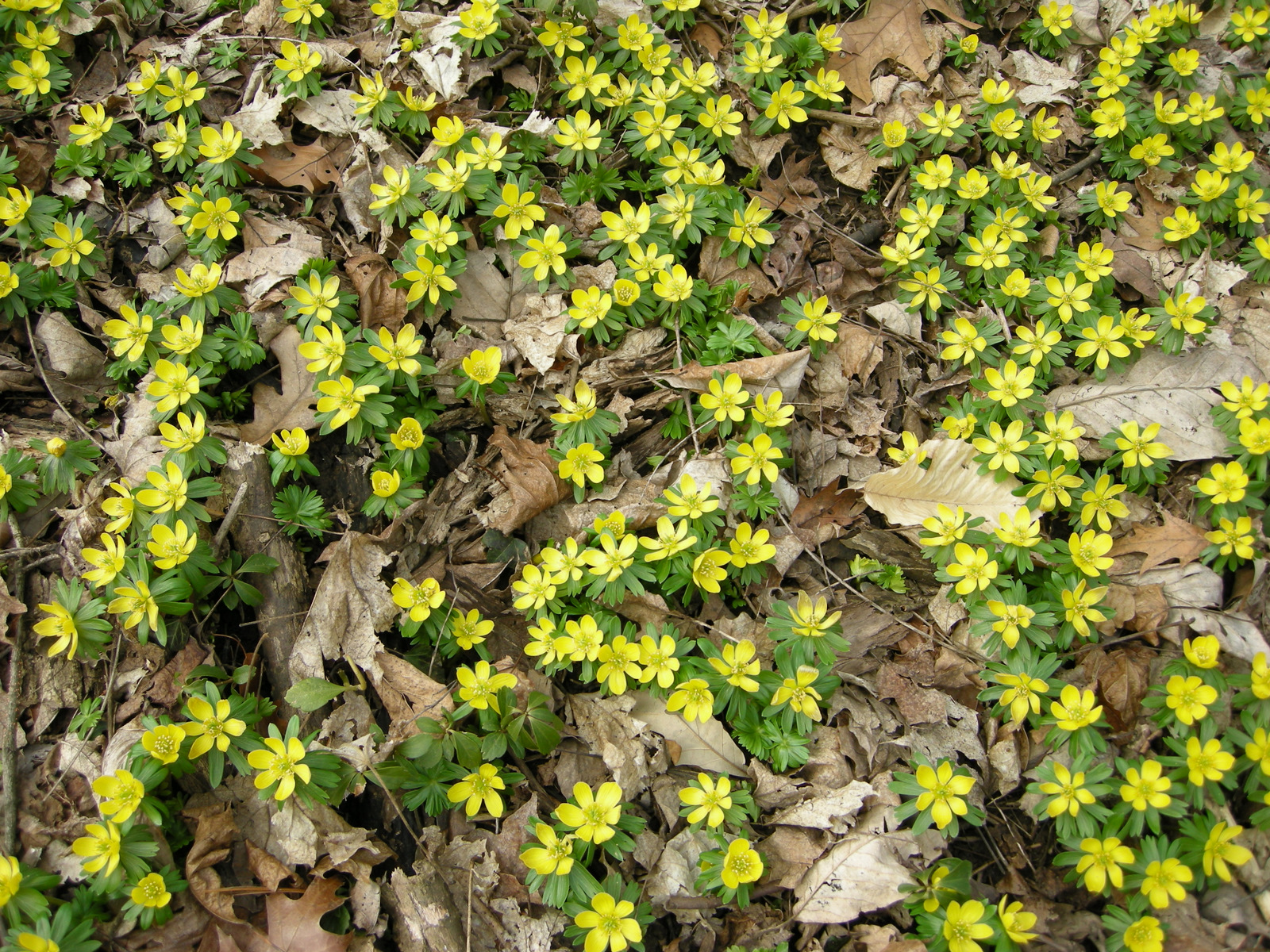
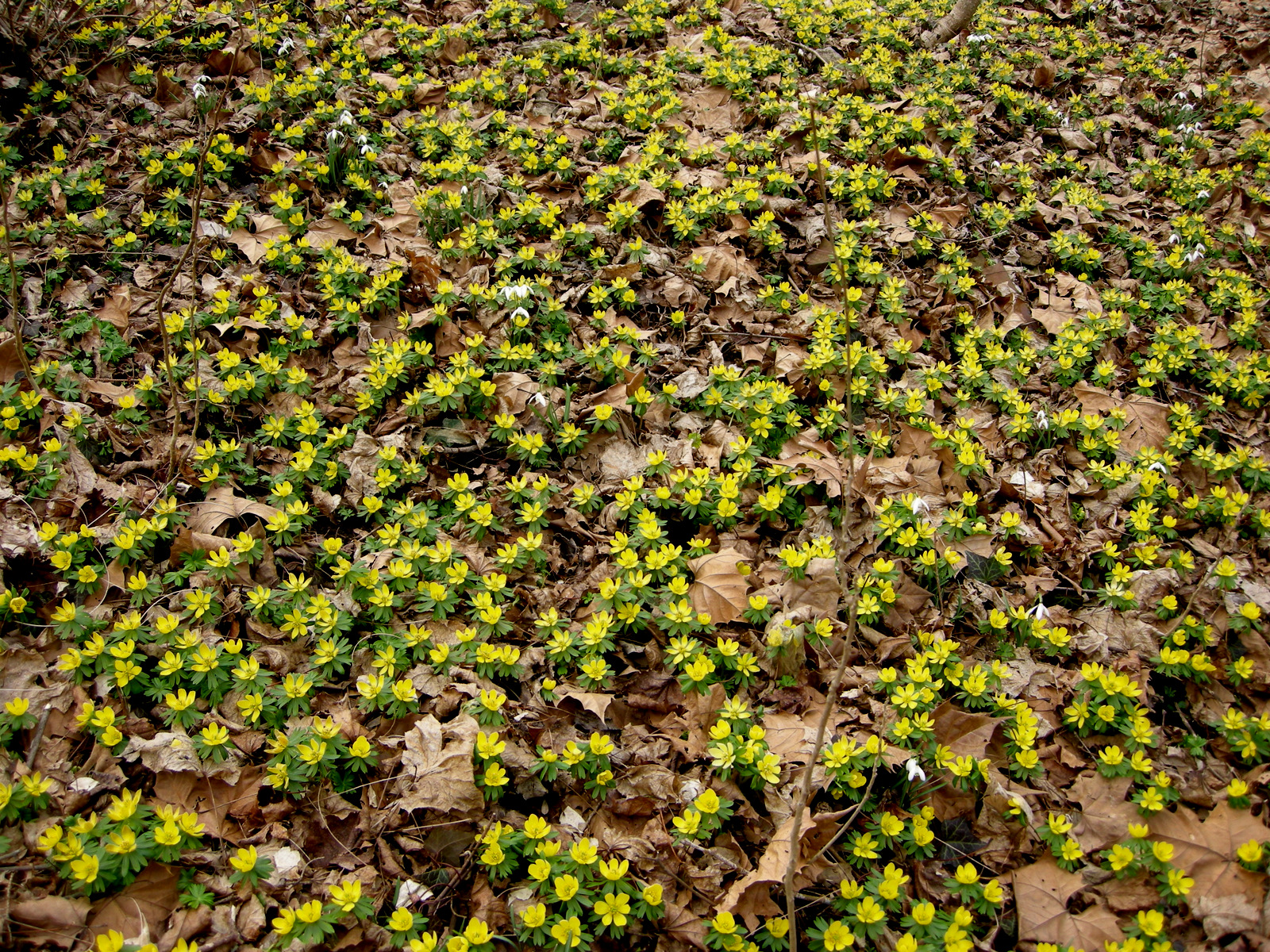
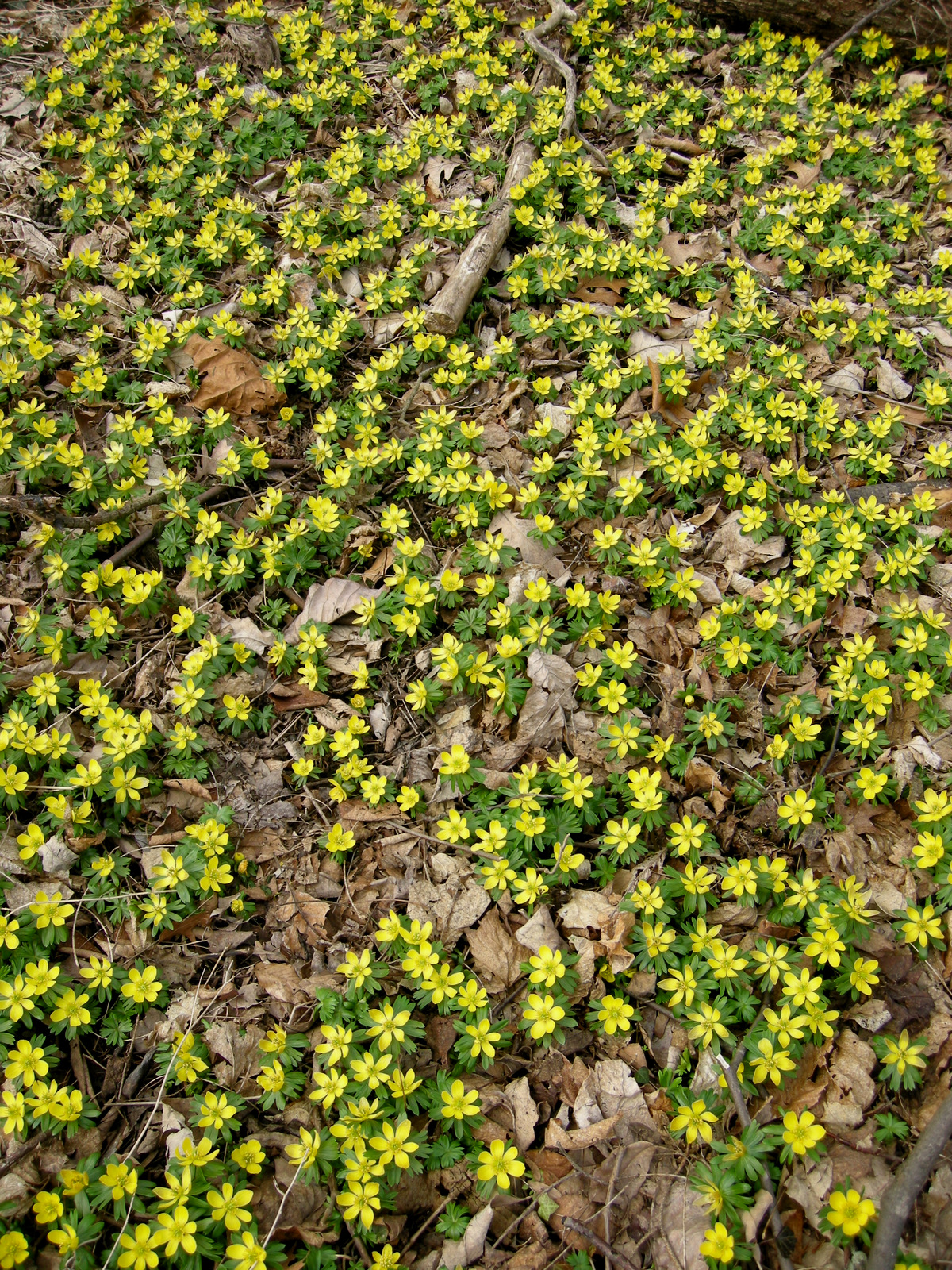
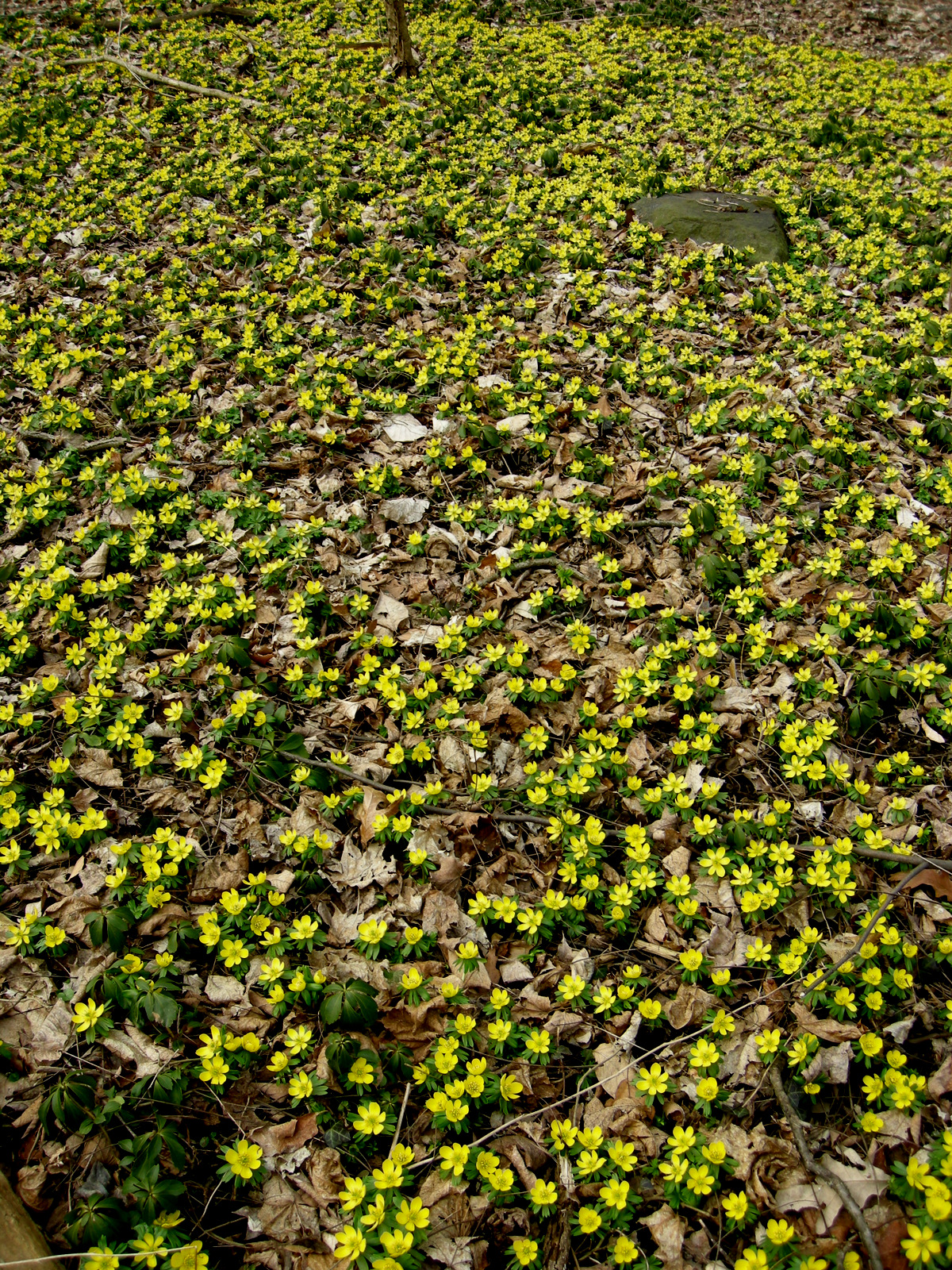
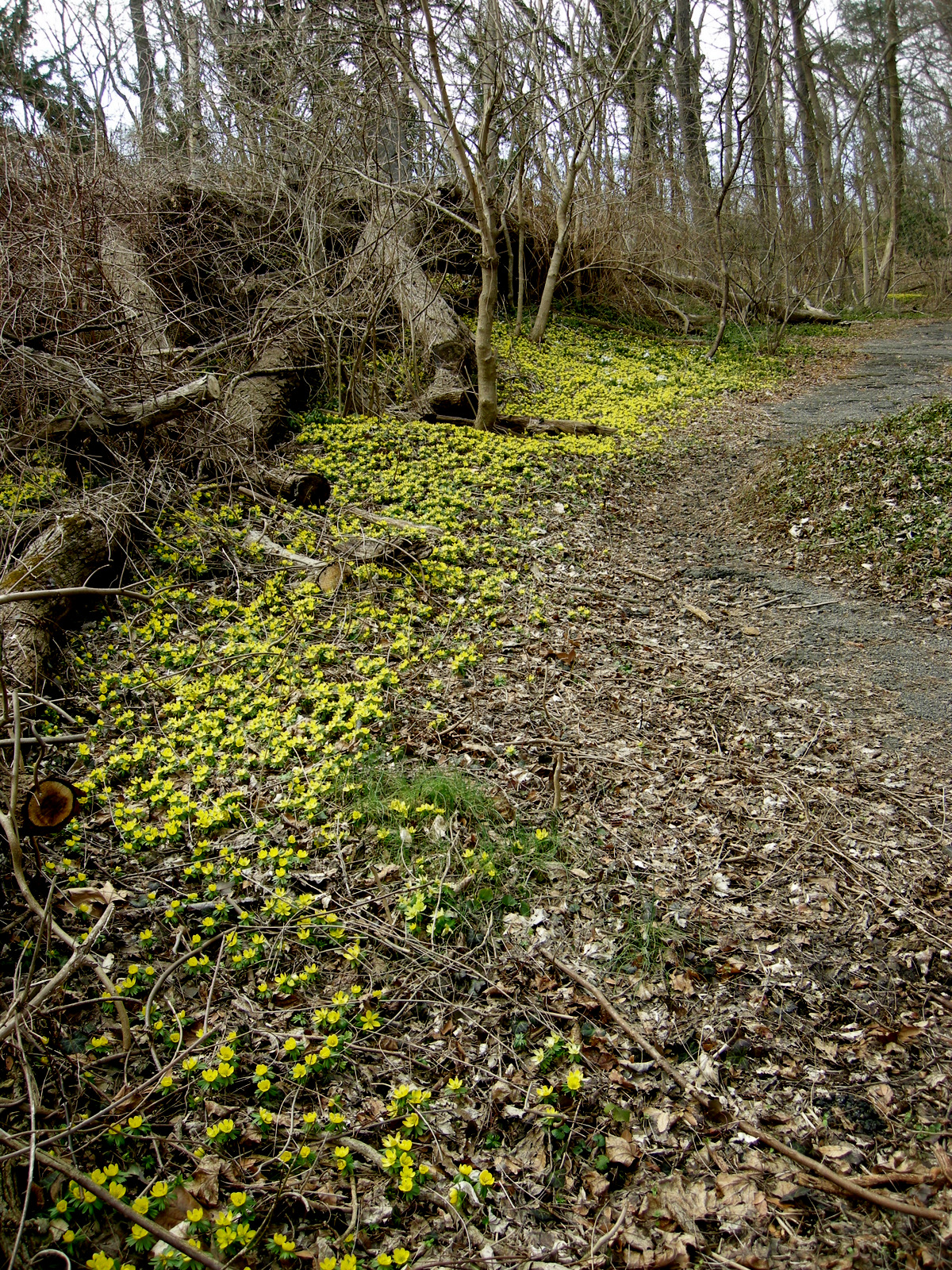
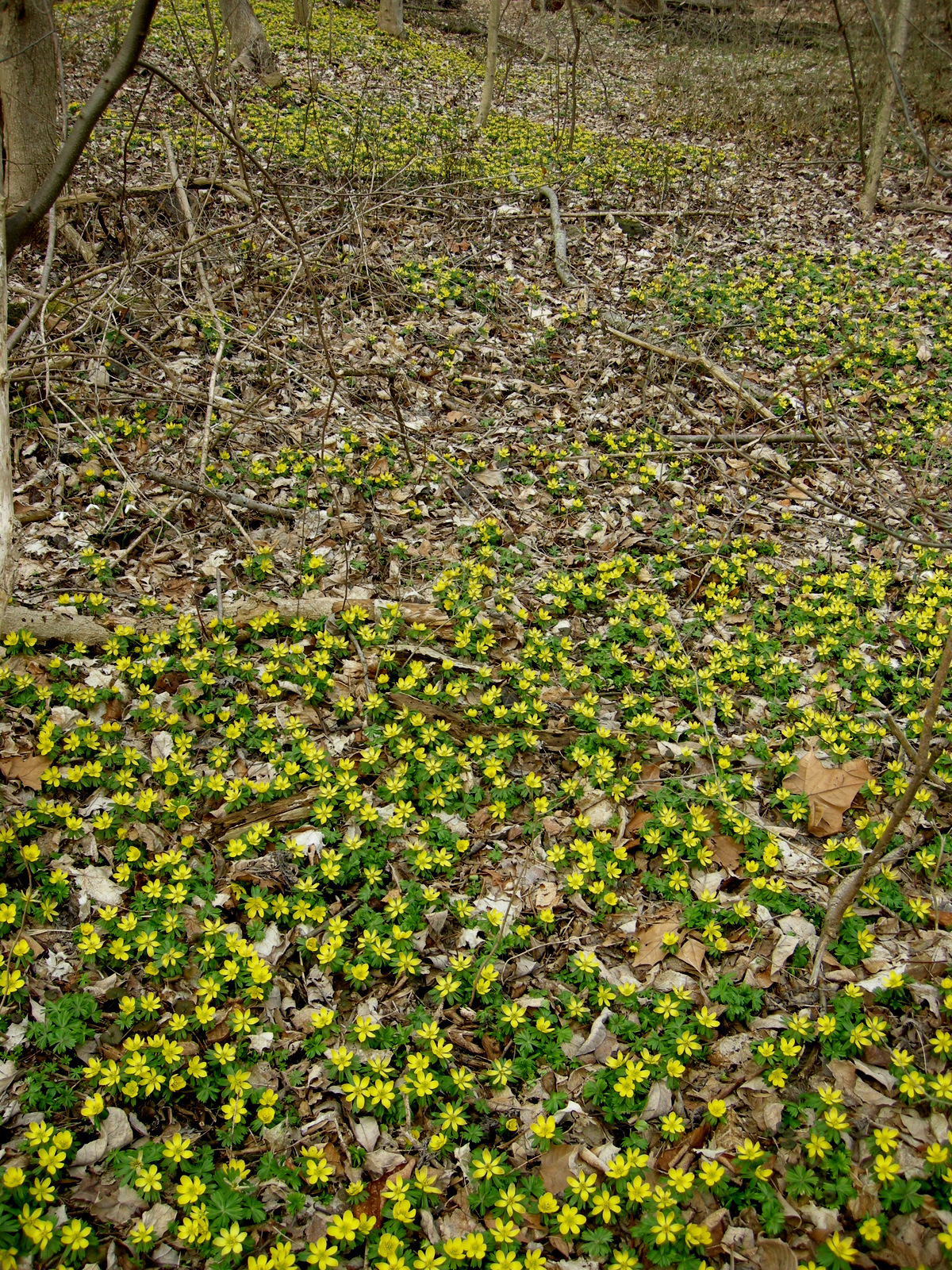
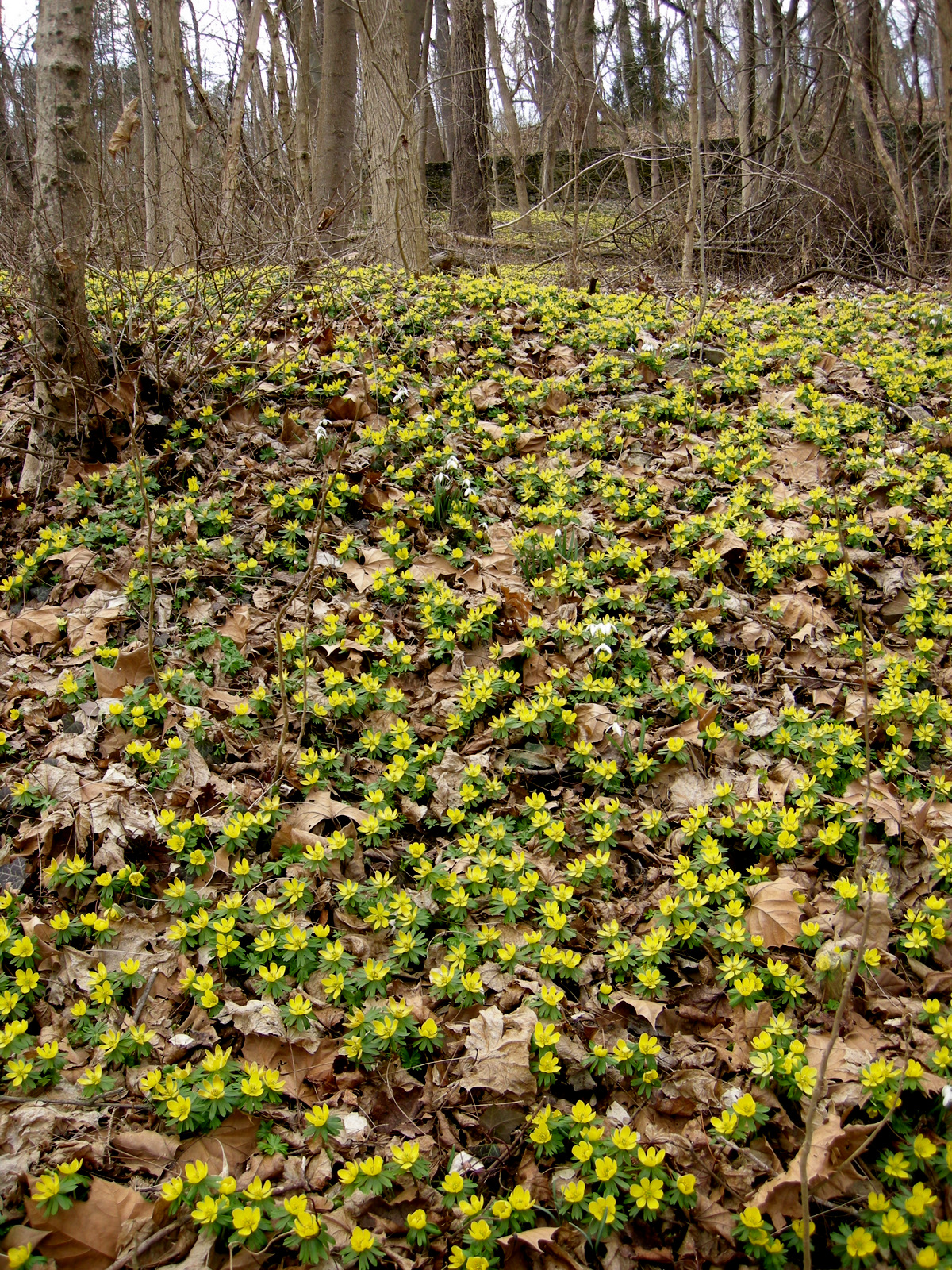
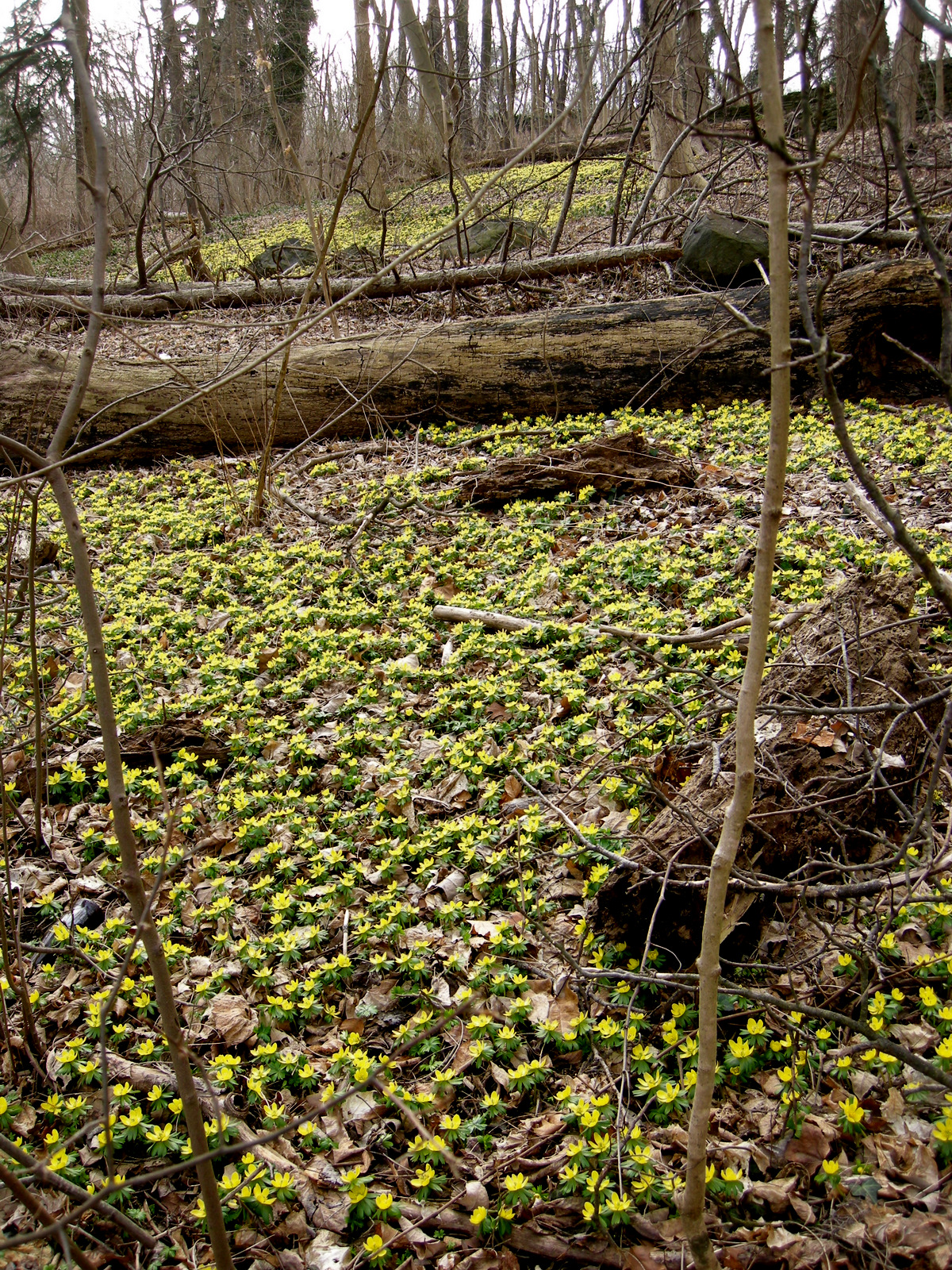
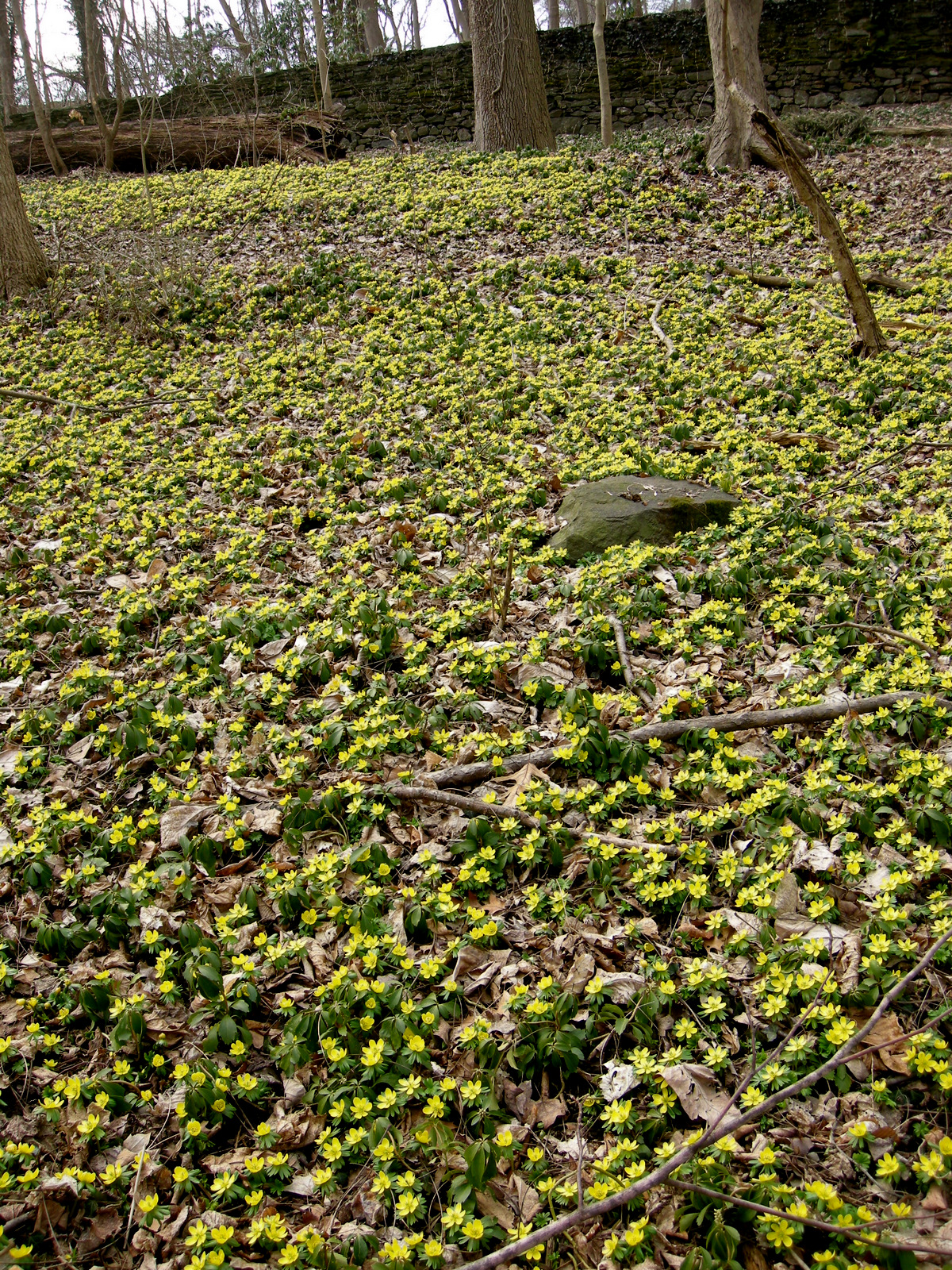
Winter aconite in Ithan Valley Park

At some point John Evans planted winter aconite on his property.  The conditions there proved to be ideal with the cool, moist woodland soil and deciduous shade that winter aconite loves.  Today Ithan Valley Park is covered with sheets of winter aconite every February and March.  There is so much yellow that I think it must be visible from outer space.  It truly is a wonder of nature that I want to share with you.


The winter aconite in the park grows thickly.


Trail entrance, Ithan Valley Park


The stone wall of the old estate is in the background.


To truly appreciate the spectacle, you need to visit in person (I apologize to my non-local readers).  Ithan Valley Park is located at 642 South Ithan Avenue, Bryn Mawr, PA  19010, at the intersection of South Ithan and South Roberts Roads.  Time is of the essence because the winter aconite will only be blooming for a few more days.

I am linking this post to the Winter Walk-off 2012, which is a challenge by Les at A Tidewater Garden to share what can be seen within walking (or biking) distance of your home.  Every photo in this post was taken at Ithan Valley Park, 8/10 of a mile from my house.

Carolyn

Notes: Every word that appears in orange on my blog is a link that you can click for more information.  If you want to return to my blog’s homepage to access the sidebar information (catalogues, previous articles, etc.) or to subscribe to my blog, just click here.

February GBBD: New Hellebores for 2012

Posted in evergreen, Garden Blogger's Bloom Day, hellebores, Shade Perennials, winter, winter interest with tags , , , , , , , , , , , , , , , on February 12, 2012 by Carolyn @ Carolyns Shade Gardens

Carolyn’s Shade Gardens is a retail nursery located in Bryn Mawr, PA, specializing in showy, colorful, and unusual plants for shade.  The only plants that we ship are snowdrops within the US.  For catalogues and announcements of local events, please send your full name, mailing address, and cell number to carolyn@carolynsshadegardens.com and indicate whether you are interested in snowdrops, hellebores, and/or hostas.  Click here to get to the home page of our website for catalogues and information about our nursery and to subscribe to our blog.

‘Phoebe’ is a beautiful double hellebore selected by Dan Hinkley formerly of Heronswood Nursery in Kingston, WA, as were most of the hellebores pictured here.  They are all superior forms.

It is the middle of the month and time to participate in Garden Blogger’s Bloom Day (“GBBD”) hosted by May Dreams Gardens (link available on February 15) where gardeners from all over the world publish photos of what’s blooming in their gardens.  I participate because it is fun and educational for me to identify what plants make my gardens shine at different times of the year.  This month I hope that my nursery customers and blog readers will get excited about adding colorful hellebores to their own shade gardens to extend the garden season through winter.
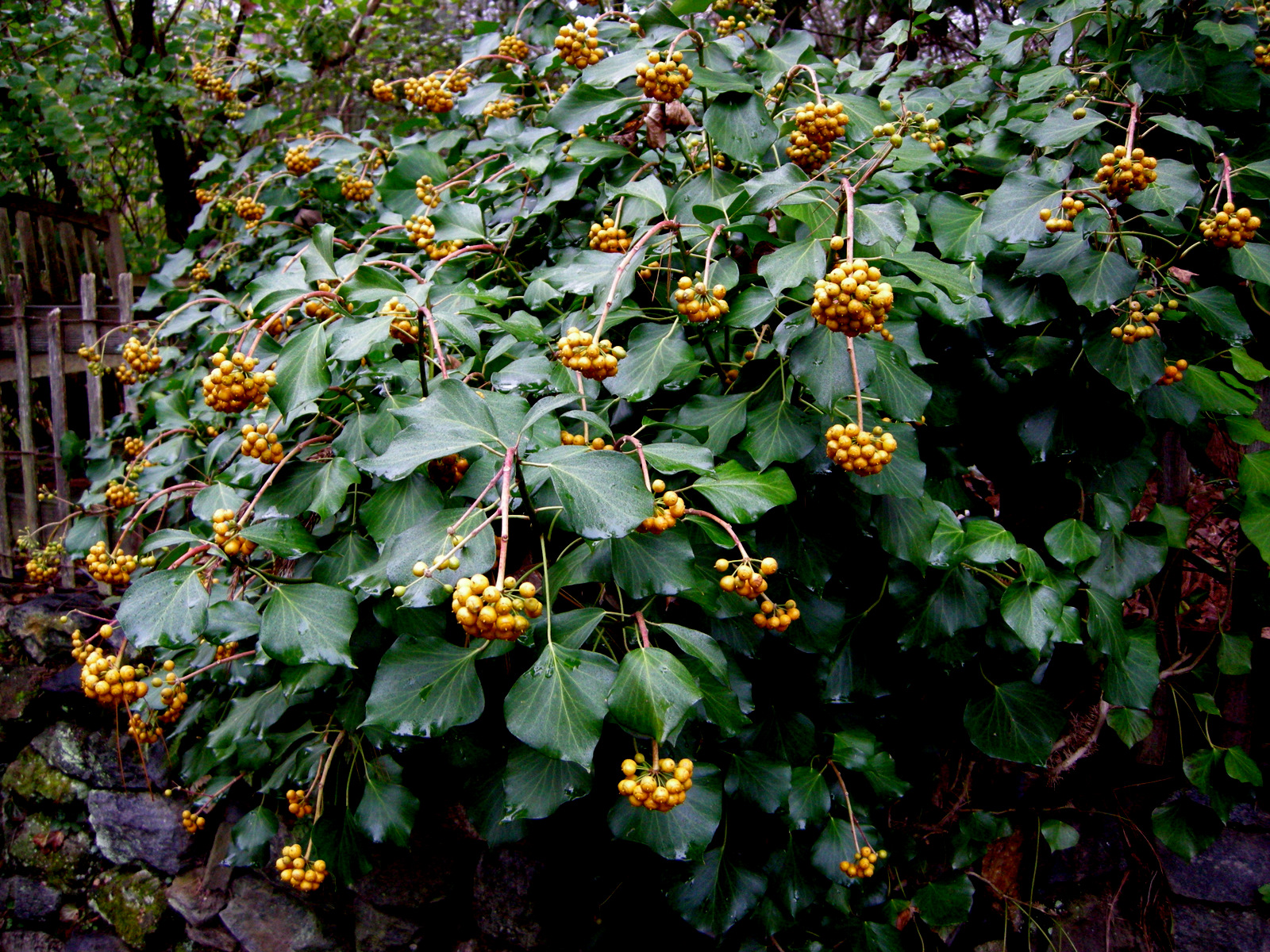
My garden is located in Bryn Mawr (outside Philadelphia), Pennsylvania, U.S., in zone 7A (old 6B).


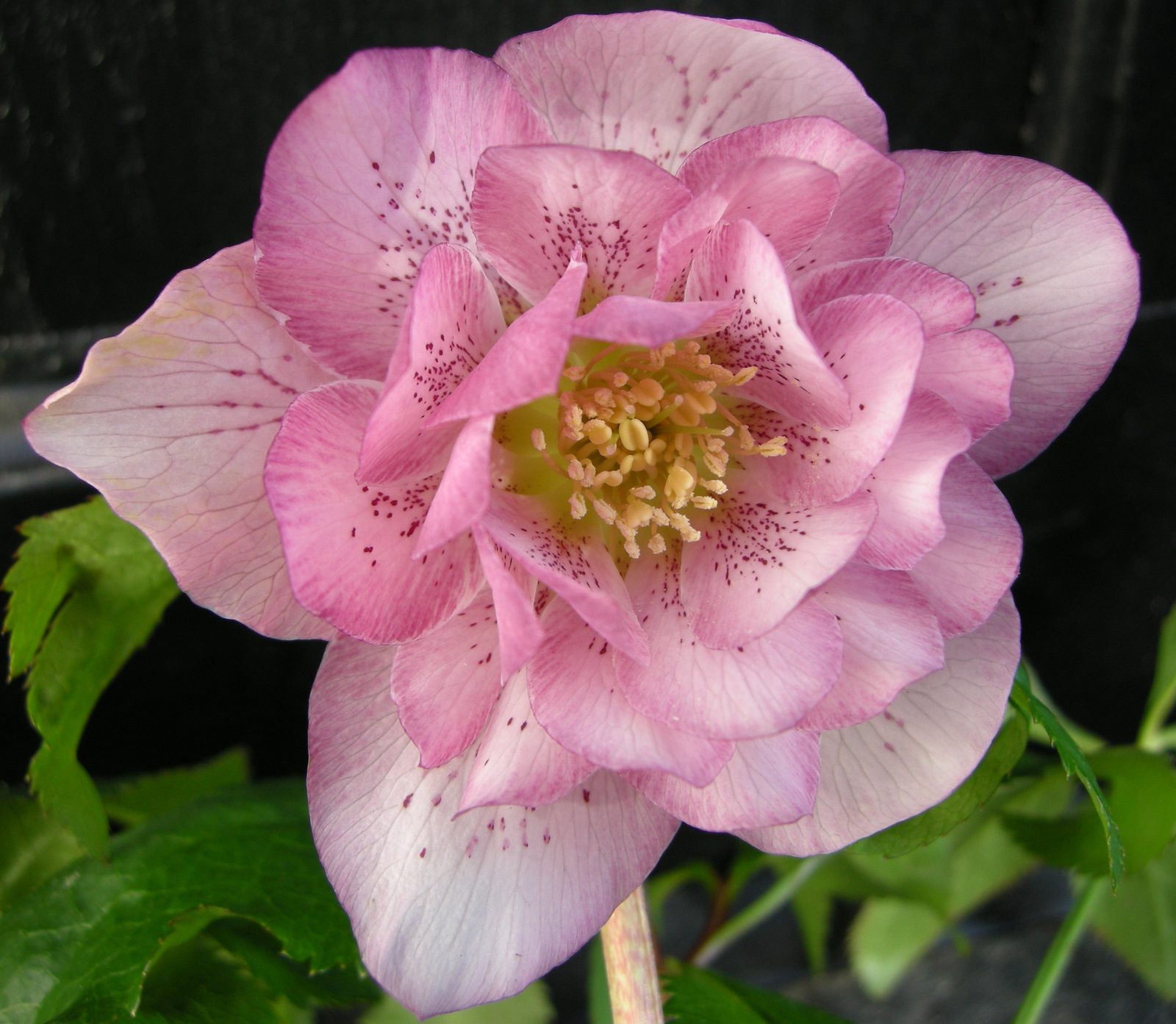
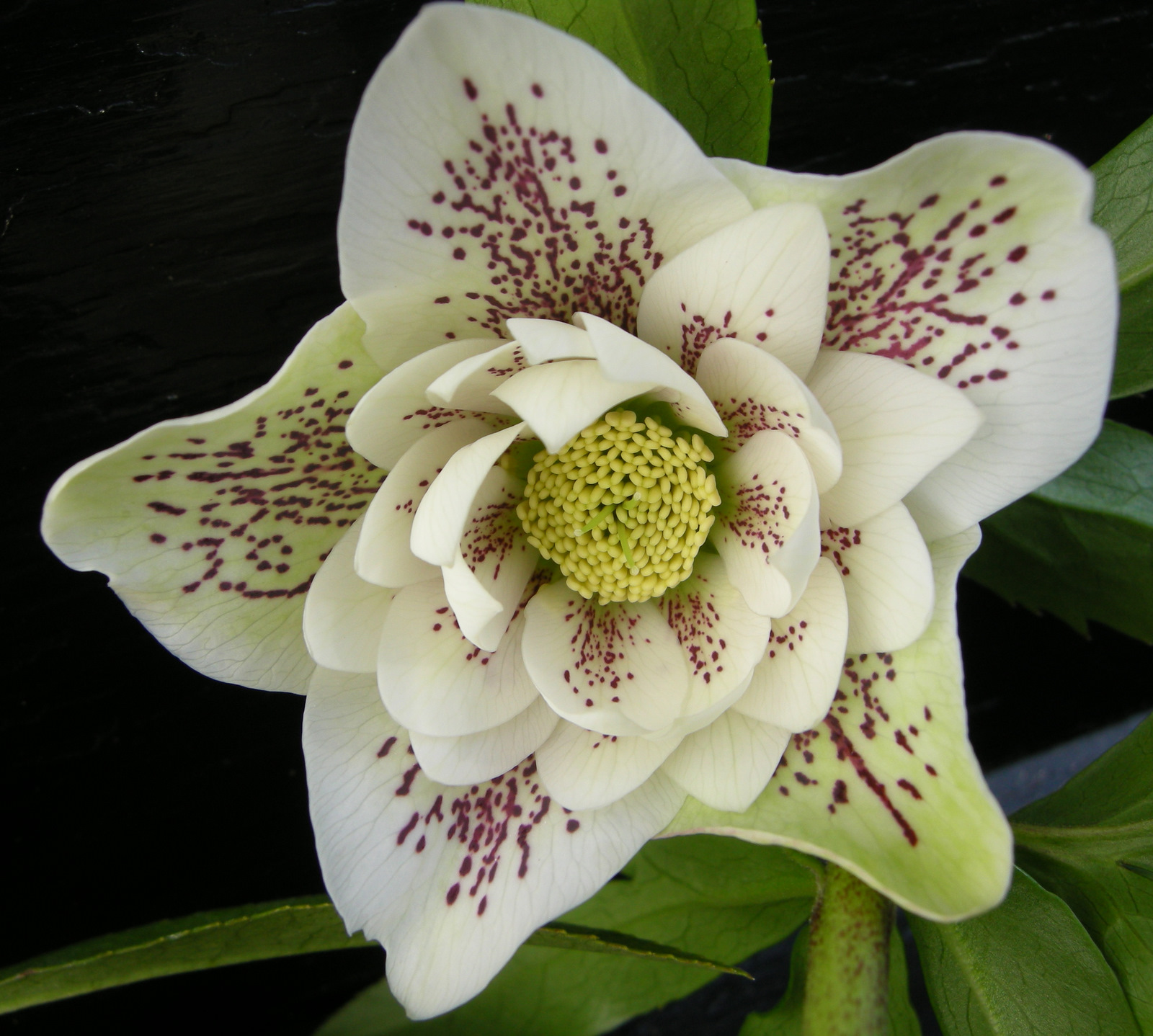
I grow the double ‘Elegance White’ for its distinct reddish purple spots and its symmetrical pointed leaves.

Because of the mild weather, I am overwhelmed with work at my nursery and behind on blogging.  So I am combining my GBBD post with a post on all the gorgeous new hybrid hellebores I will be offering this spring at my snowdrop and hellebore seminars and at my Hellebore Extravaganza on March 24.  They are coming into bloom right now so they definitely qualify for GBBD.  I will save the new species hellebores for a later post.

I decided to start with the doubles because, although I generally prefer single flowers, I love double hellebores.  Their flowers last for months.  In addition to the two above, I offer:


Hybrid hellebore “Double Rose”


Helleborus x "Double Purple"Hybrid hellebore “Double Purple”

My absolute favorite type of hybrid hellebore is known as anemone-flowered.  In this form, the nectaries around the center of the flower create a ruffle of mini petals matching the color of the flower.  I collect anemone-flowered hellebores (those of you who bought my calendar can see one in the February collage) but have never found them for sale.  I am thrilled to be able to offer one this spring:


The ruffle in the middle of this anemone-flowered hellebore picks up the beautiful colors of the larger petals (actually sepals).  Slate is also a very desirable hellebore color, and ‘Slate Anemone’ is similar to ‘Starling’, another Hinkley-selected hellebore.

I am also excited about the nine new single hybrid hellebores that Carolyn’s Shade Gardens will carry this spring representing every color of the rainbow.  I don’t know if I can pick a favorite:


‘Gold Finch’ has rounded petals of buttery yellow spotted with red flecks.


‘Black’ has striking near black flowers with a perfect rounded shape.


Helleborus x 'Pink Tea Cup'‘Pink Tea Cup’ is early-blooming with soft blush pink flowers reminiscent of cherry blossoms.

‘Raspberry Mousse’ has two-tone pale rose flowers with creamy white veins, and dark rose edges and reverse (the back of the flower).

‘Phoenix’ has apple green flowers edged in burgundy and with a burgundy center.


Slate gray petals with a metallic sheen and burgundy highlights in the center and veins make ‘Slate’ very desirable.


‘Painted Bunting’ has white flowers with a bold burgundy red central star, radiating red veins, and red picotee edges.


‘Velvet Lips’ has bright wine-red flowers with a soft creamy-yellow center and a shiny darker reverse.  I would buy this beautiful hellebore for the name alone.

The Yokoyama nursery in Japan has achieved the first ever cross between Christmas rose and hybrid hellebores to produce ‘Snow White’, this gorgeous early-blooming pure white hellebore with large, flat, outward-facing flowers; easy to grow like all the hybrids but easy to see the flowers too!

I tested all these hellebores in Spring 2011 by planting them in my garden.  This year I am being rewarded with big healthy plants loaded with flowers.  Stop by and see for yourself after I open on March 15.

Carolyn

Notes: Every word that appears in orange on my blog is a link that you can click for more information.  If you want to return to my blog’s homepage to access the sidebar information (catalogues, previous articles, etc.) or to subscribe to my blog, just click here.