Powered by Compost

Posted in green gardening, How to, organic gardening, Shade Gardening with tags , on June 5, 2011 by Carolyn @ Carolyns Shade Gardens

Carolyn’s Shade Gardens is a retail nursery located in Bryn Mawr, PA, specializing in showy, colorful, and unusual plants for shade.  The only plants that we ship are snowdrops and miniature hostas.  For catalogues and announcements of events, please send your full name, location, and phone number (for back up use only) to carolyn@carolynsshadegardens.com.  Click here to get to the home page of our website for catalogues and information about our nursery and to subscribe to our blog.

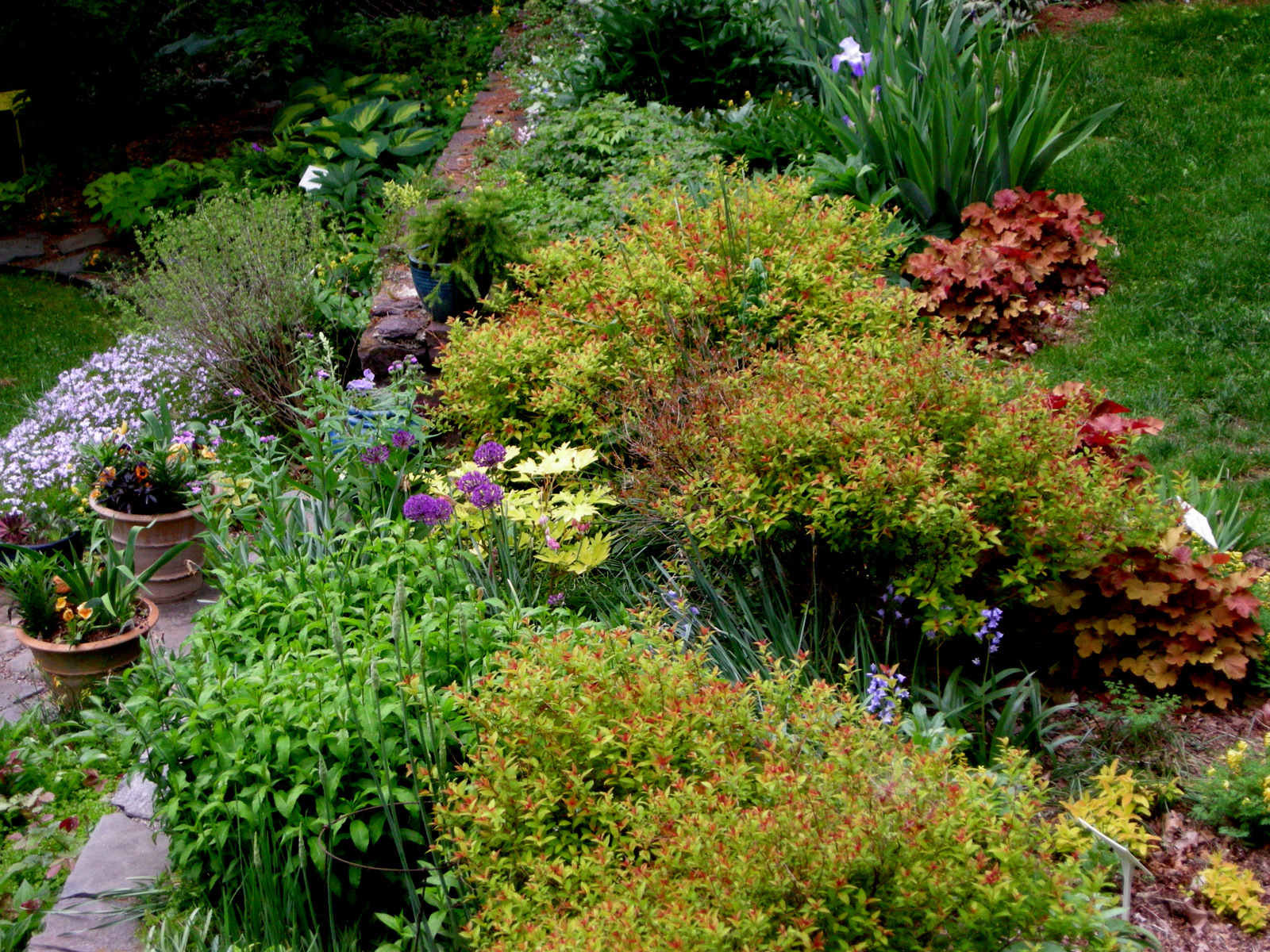
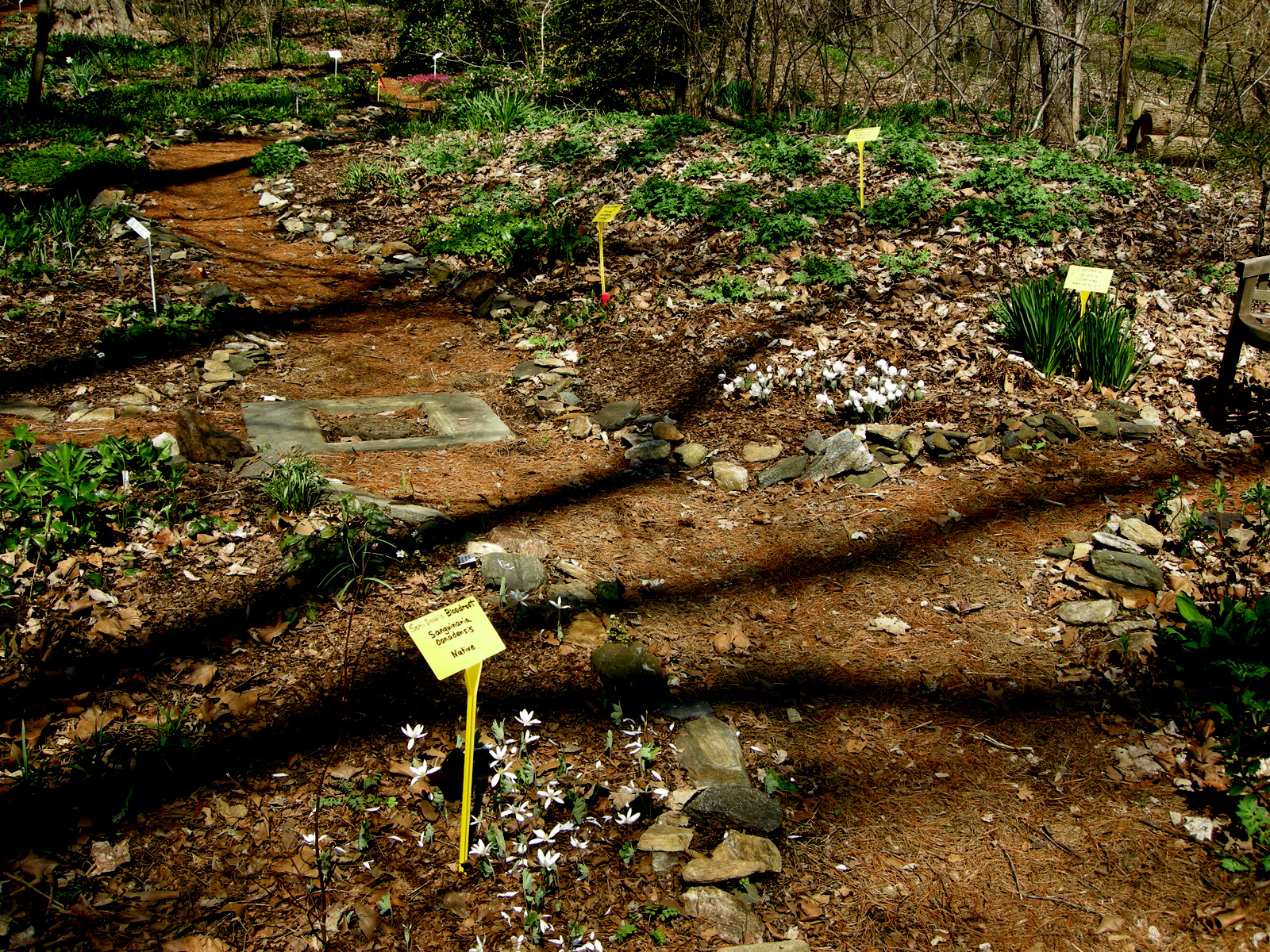
Some of my gardens powered by compost.

Compost is king in my garden.  It is the only thing I use: no other soil amendments and no fertilizers.  All the beautiful plants and lush growth are powered by compost.  I am frequently asked where I get my compost and how I use it.  This post will answer those questions and highlight an exciting compost-centered event taking place in my gardens this Sunday.

The soil at the top is from my back slope ruined by erosion caused by misguided lawn attempts and chemicals.  The soil at the bottom is from the undisturbed woods less than 10′ away.

The pre-existing soil at Carolyn’s Shade Gardens is (was) terrible (see top photo above).  I am on the side of a hill where the previous owners had tried to grow grass for years.  The soil was hard and depleted by the use of lawn chemicals and by erosion.  Terraces were constructed down one side of the house and filled with rocky infertile soil.  Construction rubble from additions to the house in the 1950s and 1960s was dumped in what is now my woodland garden.  The soil in the beds on the back side of the house was compacted by their former use as a carriage path.  Finally, the whole property was used as a dump (pre-trash collection) by the estate of which it was formerly a part so the beds are full of glass, old slate from roof replacements, refuse from coal burning furnaces, and miscellaneous trash.  Digging can be quite an adventure!

This is a photo from 1995 showing the debris that came out of one relatively small planting hole at Carolyn’s Shade Gardens.  Click on any photo to enlarge.

Given the deplorable condition of the existing soil, compost is essential.  It reaches my plants in four different ways.  First, whenever I create a new bed in my gardens, I spread 4 to 6 inches of compost on top of the soil and dig it into the bed, removing all the rocks and debris.  I use the rocks to line the paths in my woodland garden.  One visitor asked me where I got my rocks, and, finding out they came from the beds, told me how lucky I was.  I feel about as lucky as the early farmers in New England must have felt when they built all those rock walls around their fields.

The rocks lining the paths in the woodland garden.

Second, even though the beds are prepared with compost, I add compost to the hole every time I plant a plant.  I mix the existing soil half and half with compost.  Third, as explained in Fall Clean-up, I grind all the leaves in the fall and use them to mulch my beds.  This mulch breaks down over the course of the year to make a thick compost layer on top of the existing soil.  Leaves that fall on the lawn are ground up in place and left there to fertilize the grass as described in Leaves on the Lawn. Finally, I don’t clean the leaves out of most of my beds: they are left there to act as mulch and form more compost.

The current state of the depleted back slope.

I use a lot of compost because I also need it to pot all the plants that I grow to sell at my nursery.  Where does it all come from?  We produce a lot of it ourselves in a simple, easy, and nontechnical way.  I get frustrated with the articles written about composting because they make it sound like you need to follow complex procedures and buy expensive equipment to produce compost.  All those procedures and equipment merely speed the process up (and possibly make it neater), but all you need to produce compost is a pile.  It helps if you turn it occasionally, but even that is not necessary if you are willing to wait for it to break down naturally.

The path to our compost pit.

Our “garage” is really the carriage house and the stable for the estate that used to be here.   There is even a metal grain bin on the second floor with chutes and levers to bring the grain to the first floor.  The horses that pulled the carriages produced manure (no surprise there), which was deposited in a manure pit behind the stable.  Back then, they built everything to last so the manure pit is a 12 foot square enclosure surrounded on four sides by 7 foot tall stone walls.
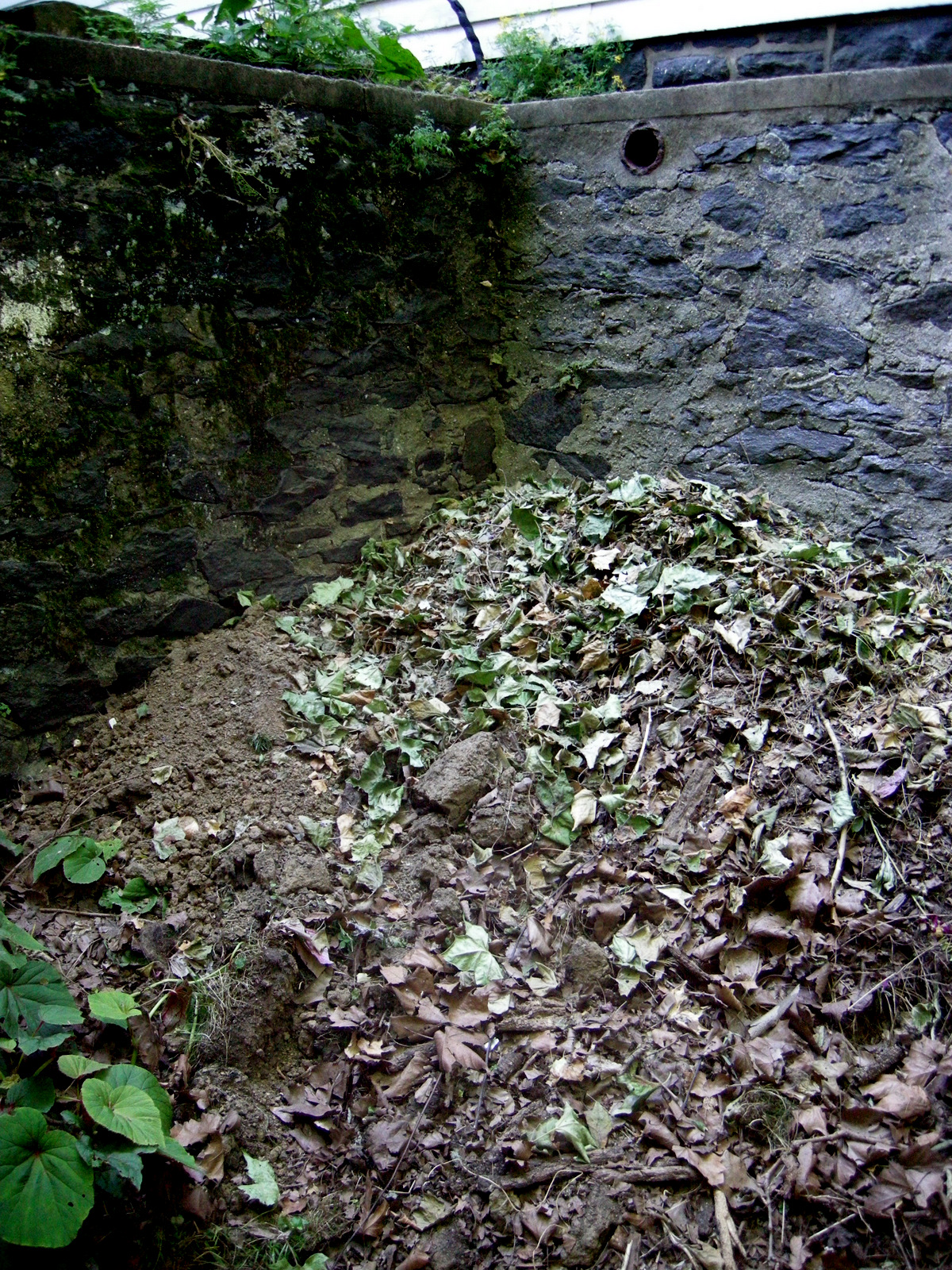
The left side of the compost pit where we are currently throwing kitchen and garden refuse.

We throw all our garden and kitchen refuse into this pit, including leaves, sod, noninvasive weeds, ashes, small sticks, etc.  There is no organized layering process–whenever there’s something to go in, it’s thrown on top of the pile, hopefully, but not always, on the side of the pile currently being built up.  The other side contains the compost being used.  My husband turns the pile thoroughly about three times a year, and that’s it: no complicated procedures or equipment required!
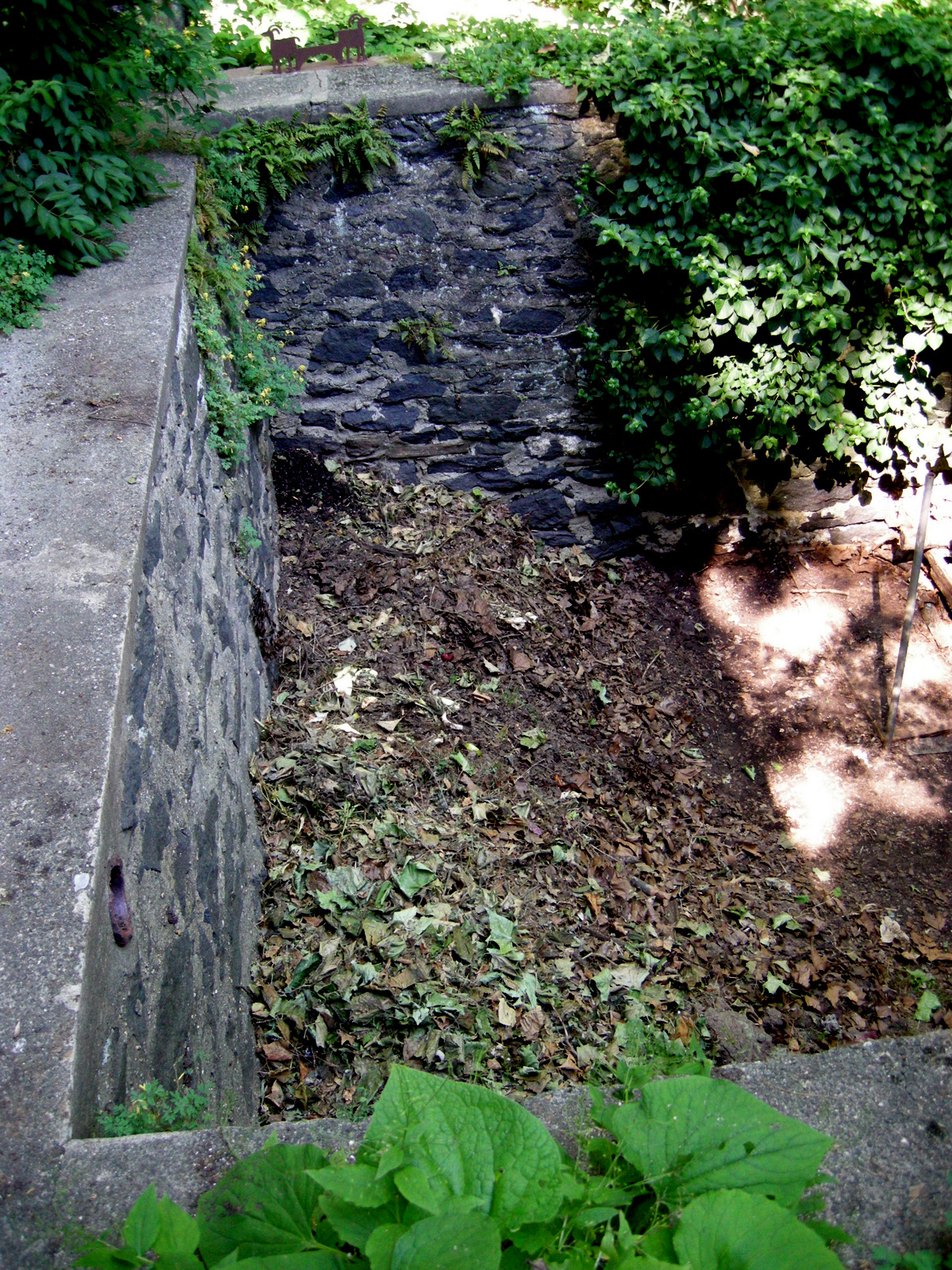
Top view of the manure pit we use for producing compost.  It is “decorated” with self-sown fern-leafed and yellow corydalis and a large climbing hydrangea.

However, despite the size of this operation, it does not produce nearly enough compost for Carolyn’s Shade Gardens.  We are very fortunate that our township produces excellent compost from the leaves that residents put by the side of the road in the fall to be removed.  Personally, I think removing the leaves from your property is crazy, but for selfish reasons I am glad people do it.  We get truckloads of the township’s beautiful compost to supplement our own.
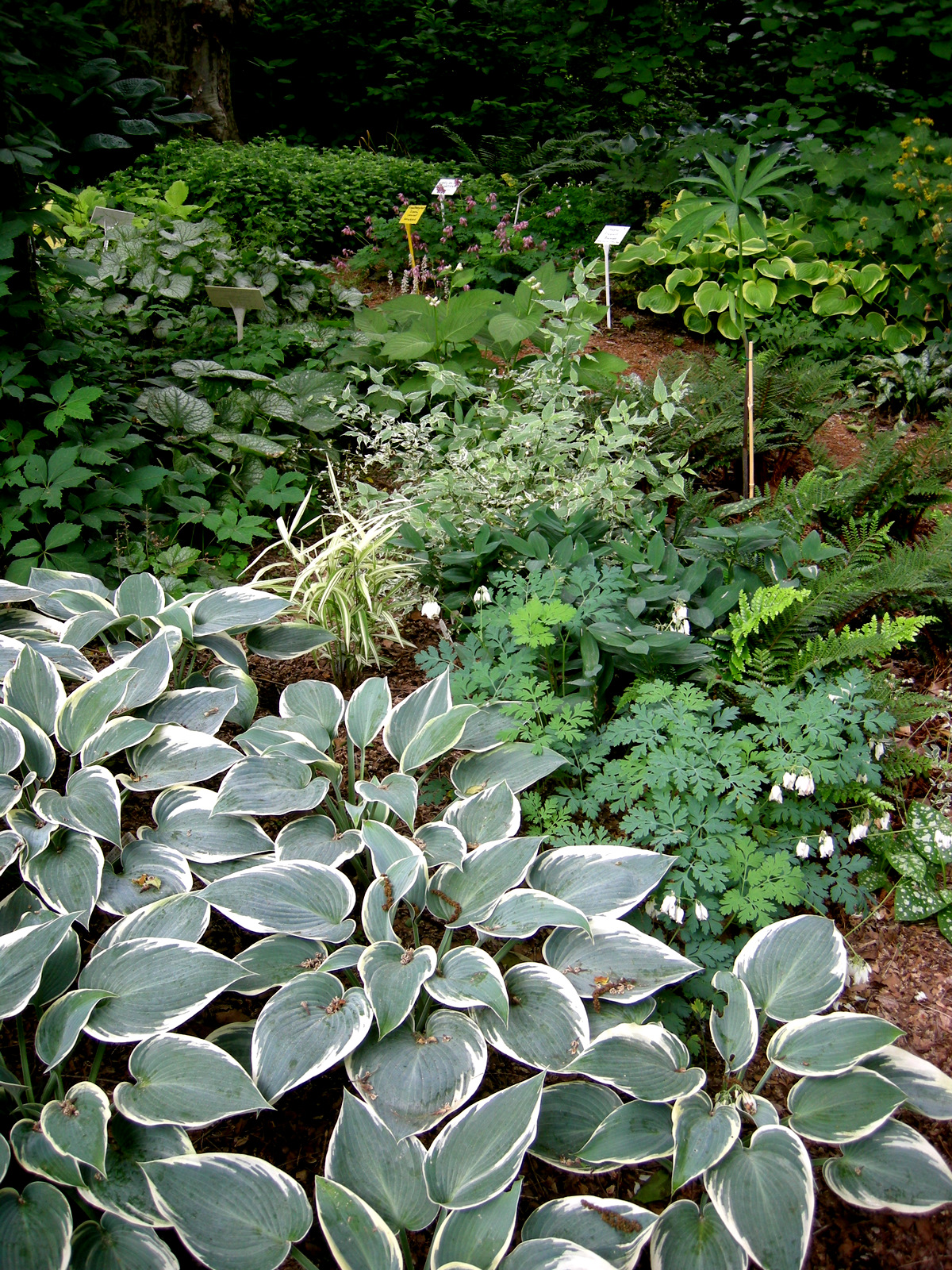
One of the newest beds powered by compost.

As I explained in Supporting Sustainable Living, I am uniquely placed to encourage sustainable gardening practices as I promote and sell native plants at my nursery,  answer my customers’ requests for advice, and give tours of my gardens to horticultural groups.  Sustainable living is very important to me as I described in My Thanksgiving Oak Forest.  So when the Radnor Conservancy, dedicated to promoting open space in my township,  asked me to speak, I thought why not go farther and offer my gardens as a venue for a fund raising and educational event.

Rose and peony beds

The creative people at the Conservancy came up with the theme “Dirt … lots of it!”, an afternoon devoted to educating people about compost on Sunday, June 12, from 3 to 5 pm at Carolyn’s Shade Gardens.  Here is the flyer:

If you come, and I hope you will, you will find various “stations” throughout my gardens staffed by knowledgeable Master Gardeners able to answer any question you have about composting.  They will demonstrate outdoor composting, indoor composting with worms, composting equipment and tools, grinding leaves for mulch, and how to transport township compost easily and cleanly to your home.  You will be able to order discount compost bins, and information on lyme disease and its prevention will be provided.

Main perennial border

As you find out everything you ever wanted to know about composting, you can stroll through my beautiful gardens and shop for plants in my nursery area.  And best of all, delicious refreshments will be provided.  As directed in the flyer above,  if possible, please register  in advance for the event with the Conservancy by calling them at 610-688-8202 or emailing them at radnor.conservancy@comcast.net.  You can also show up without registering.  The event is open to everyone, not just Radnor Township residents.  I hope to see you there.

Carolyn

Just a note to say thanks to John at Macgardens and his wife Beth who visited Carolyn’s Shade Gardens during my open house on Saturday.  Meeting fellow garden bloggers is so fun because they immediately feel like old friends.  If any other garden bloggers are in the area, please stop by.

Notes: Every word that appears in orange on my blog is a link that you can click for more information.  If you want to return to my blog’s homepage to access the sidebar information (catalogues, previous articles, etc.), just click here.

Nursery Happenings: I will have my traditional closing weekend open hours this Saturday, June 11, from 9 am to 3 pm and Sunday, June 12, from 10 am to noon.  You don’t need to make an appointment, and you can park in the driveway.  You can also shop for plants during the Radnor Conservancy  event on Sunday, June 12, from 3 to 5 pm.  But remember you can make an appointment to shop 24/7 by sending me an email at carolynsshadegardens@verizon.net.  There is  still a great selection of hostas, ferns, astilbes, hardy geraniums, and summer and fall blooming shade plants available.
Larger Hostas

Posted in container gardening, hosta, Shade Gardening, Shade Perennials with tags , , , , , , , , , , , , on May 30, 2011 by Carolyn @ Carolyns Shade Gardens

Carolyn’s Shade Gardens is a retail nursery located in Bryn Mawr, PA, specializing in showy, colorful, and unusual plants for shade.  The only plants that we ship are snowdrops and miniature hostas.  For catalogues and announcements of events, please send your full name, location, and phone number (for back up use only) to carolyn@carolynsshadegardens.com.  Click here to get to the home page of our website for catalogues and information about our nursery and to subscribe to our blog.

.

Hosta Teeny-weeny Bikini' at Carolyn's Shade GardensHosta ‘Teeny-weeny Bikini’: I couldn’t resist including one more miniature.

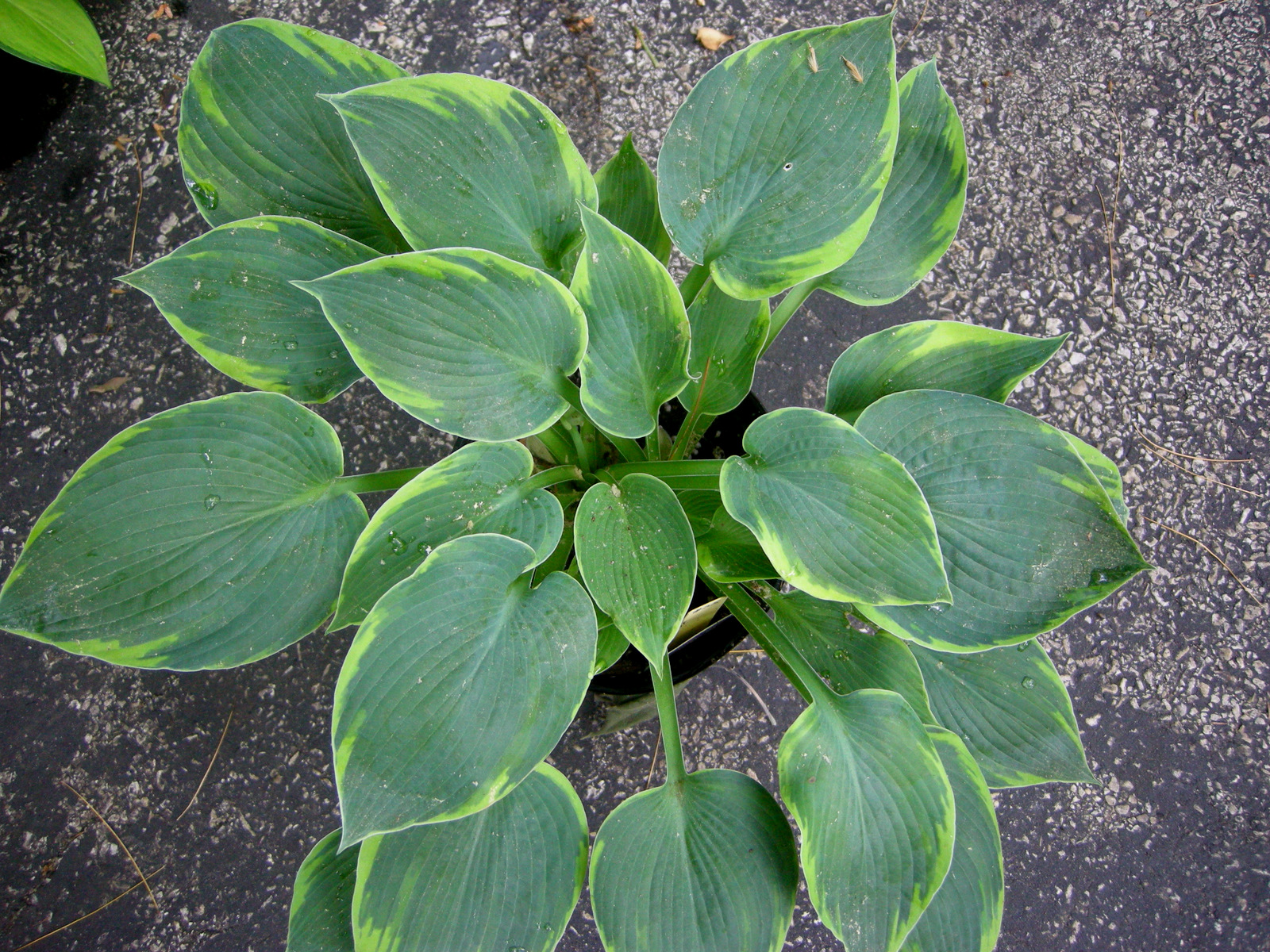
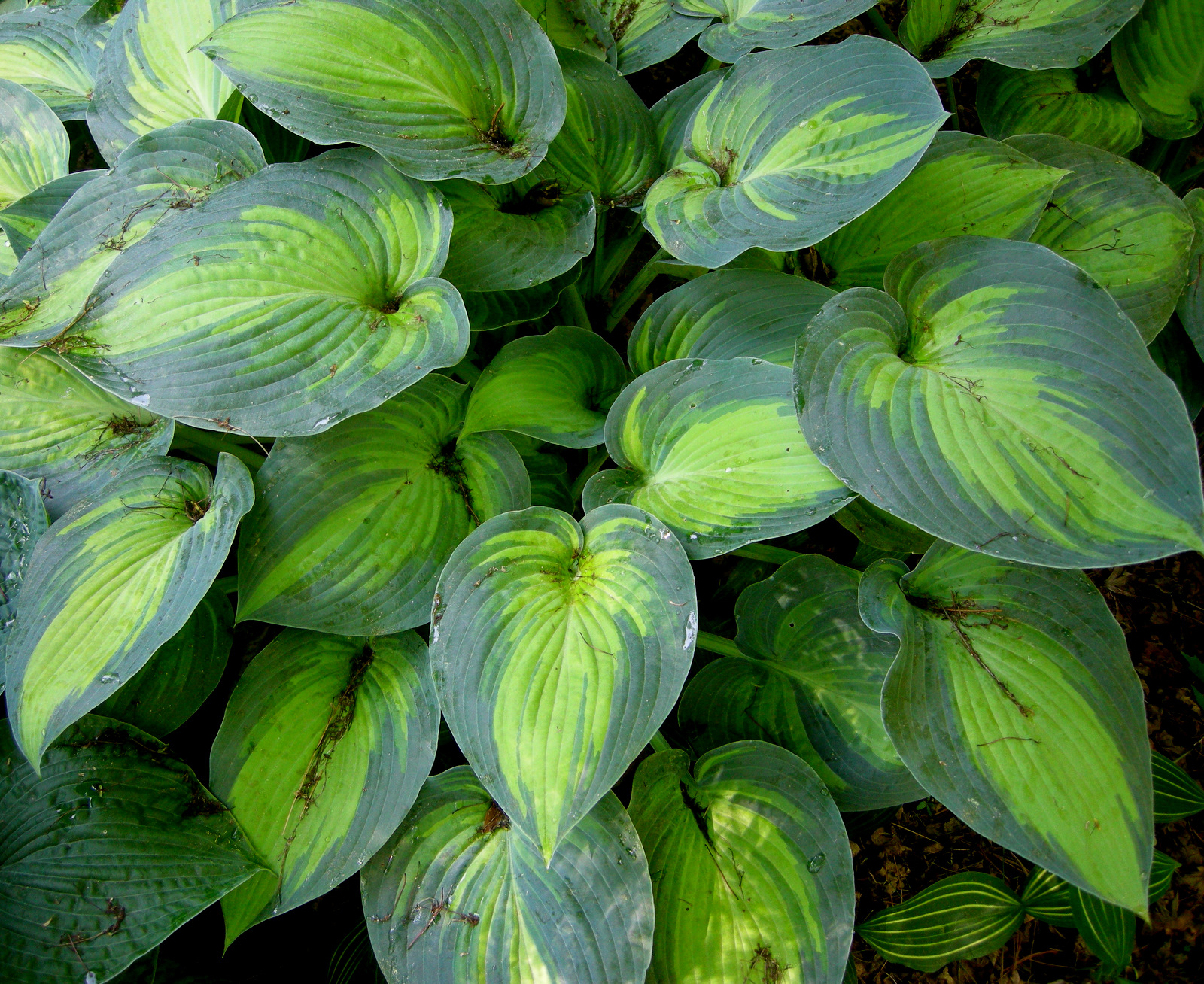
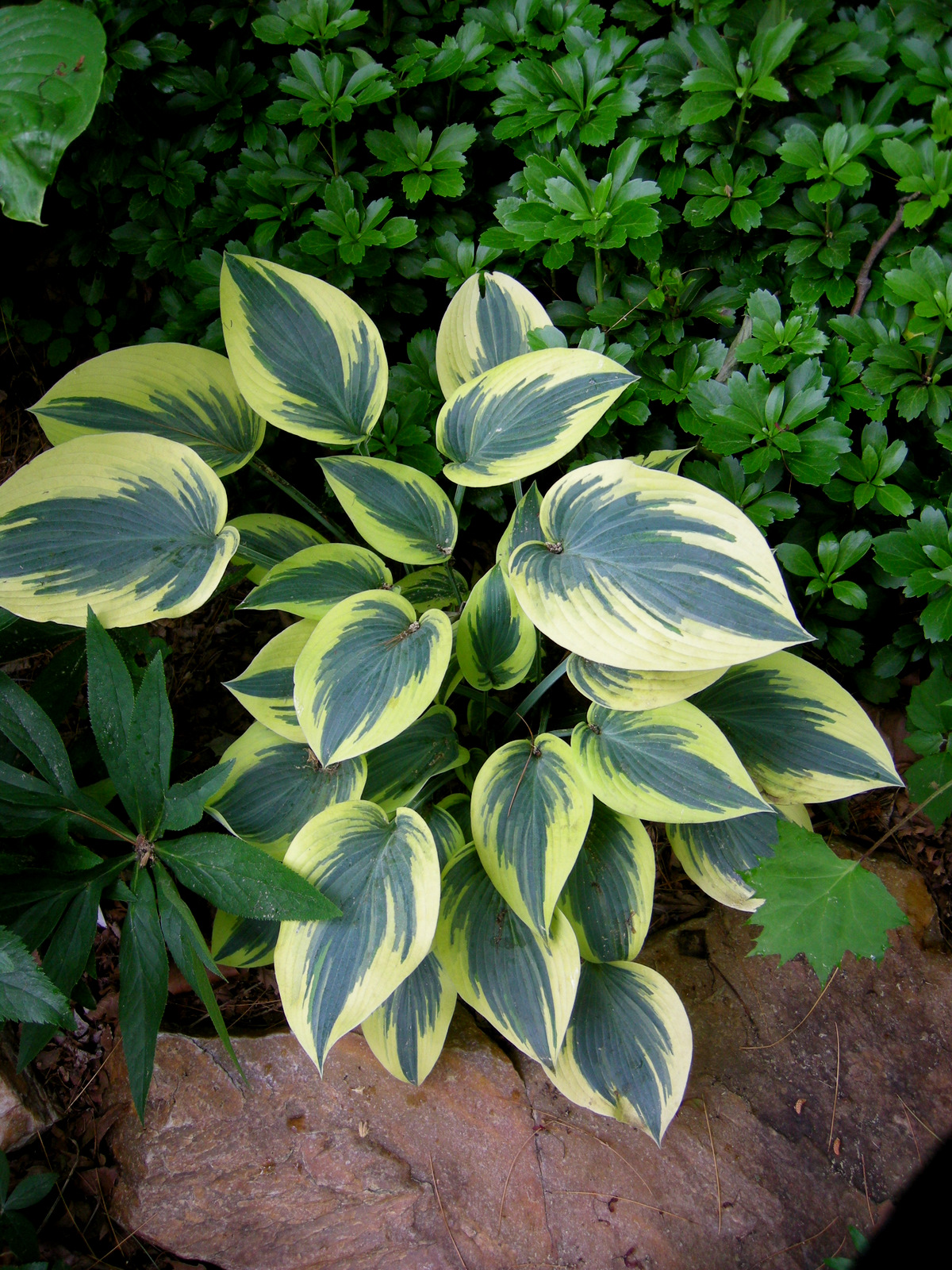
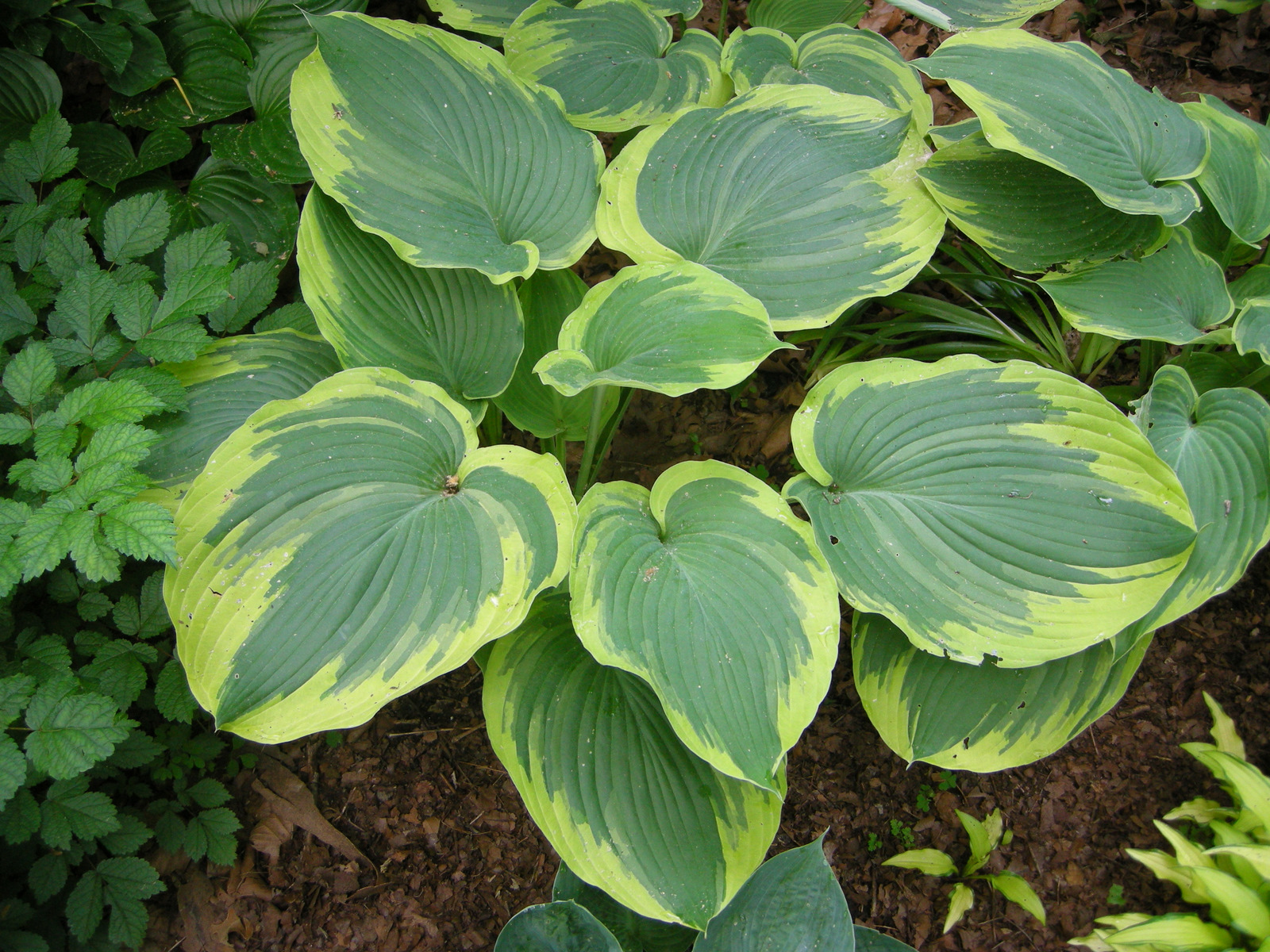
In my recent article Miniature (& Small) Hostas, I explained my evolving relationship with hostas and how my collecting tendencies had led me to miniature hostas for space reasons.  I display these little treasures in special ways in containers, in my rock garden, or as groundcover in order to highlight their small stature.  However, for specimen plants and variety of leaf color, there is nothing like a larger hosta.  They come in an an infinite number of combinations of colors, heights, widths, leaf shapes, flowers, and habits.  There is a medium to large hosta for every garden condition, both as the star of the show and a lovely backdrop for your other perennials and shrubs.  In this article, I want to highlight some of my favorite larger hostas as well as some cultivars that are new to me.

Mature Hosta tokudama ‘Flavocircinalis

Leaf of mature ‘Flavocircinalis’

Before I get to the plants, however, I want to explain something that took me a while to figure out.  Larger leaf hostas do not look like themselves in a nursery pot because they take one to two years to mature and reach their full size and coloration.  Immature plants will have different shaped leaves, usually pointed, and will not display the intricate color patterns that you can expect on the plant in your garden.   Compare the photos of Hosta tokudama ‘Flavocircinalis’ above and below. That is why at Carolyn’s Shade Gardens, I always encourage customers to look at the mature hostas in the display gardens before making their choices.

Immature plant of ‘Flavocircinalis’

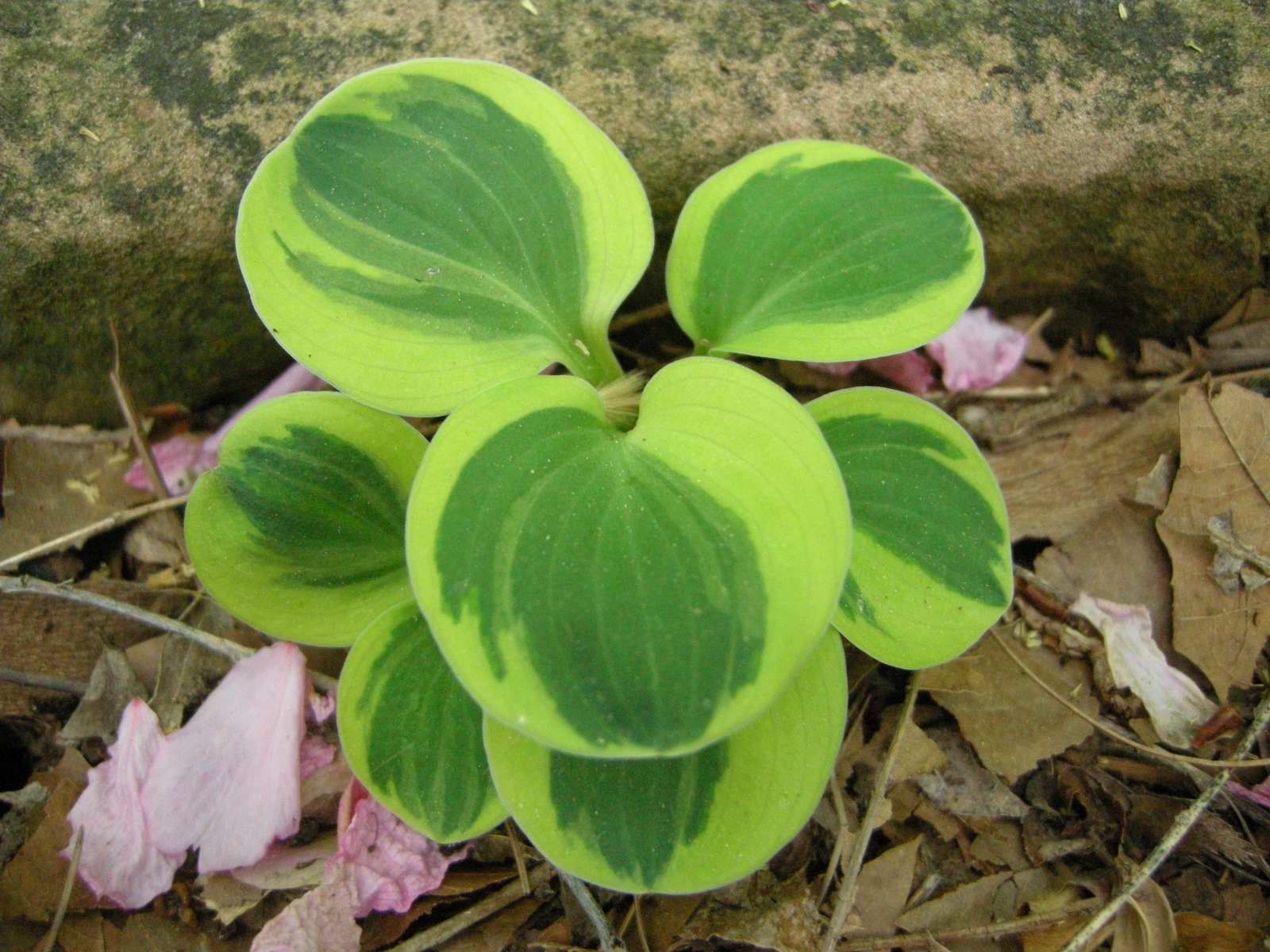
Immature leaf of ‘Flavocircinalis’

Here is a taste of some of my favorite and best-selling larger hostas.  You can view well established specimens of these cultivars in my display gardens:

Hosta ‘June’ was the American Hosta Growers Association 2001 Hosta of the Year with good reason and is the most popular hosta with my customers.

The beautiful leaf coloration of ‘June’.

‘First Frost’ is the 2010 Hosta of the Year.

The leaves of ‘First Frost’ emerge with bright yellow leaf margins, which age to cream (in photo above) and set off its very blue center.

‘Great Expectaions’ is my second biggest selling hosta and has one of the most beautiful habits of any large hosta.

The elegant leaf coloration of ‘Great Expectations’.

‘Earth Angel’ is the 2009 Hosta of the Year and is as large and glorious as its parent ‘Blue Angel’ but with a cream margin.

‘Earth Angel’ is the first giant blue hosta with a contrasting border.  The leaves can reach 18″ x 12″ and a specimen can be 5′ wide.

Hosta tokudama is my favorite of all species hostas and ‘Aureonebulosa’ is my favorite cultivar of the many tokudama offspring.

The cupped and heavily puckered texture of  ‘Aureonebulosa’ is typical of the tokudama group.

‘Fragrant Bouquet’ is the 1998 Hosta of the Year and has fragrant flowers.

‘Fragrant Bouquet’s’ light green leaves really stand out in the shade, and it retains its yellow margins all season.

When I visit hosta collections and displays, some plants always stand out.  I look for these plants in the trade to add to my own gardens and offer to my customers.  Here are some of the cultivars I was able to add this year:

‘Touch of Class’ is a close relative of ‘June’ but with a wide blue border enclosing a central gold stripe.  It has an excellent habit and great slug resistance.

‘Liberty’ is the Hosta of the Year for 2012.  You can see both the yellow coloration of its new leaves and the wide cream margins of its older leaves in the photo above.  For a great shot of its coloration, see both the header and wordless Wednesday photo at Pat and Jim’s Gardening Adventure.

‘Paradigm’ is the 2007 Hosta of the Year.  For a much better photo of its leaves and habit, check out these photos of all the Hostas of the Year, by clicking here.  The American Hosta Growers Association has only picked 17 hostas to be Hosta of the Year out of an estimated 6,000 hosta cultivars in the trade so this accolade is quite a meaningful honor.

‘Fragrant Queen’ is a fragrant hosta boasting very substantial rounded leaves with wide white margins.

I have coveted ‘Brother Stefan’ every time I have seen it.  For a much better photo, showing its coloration, texture, and habit, click here.

Just a few ideas for using larger hostas in your garden:

Left to right: ‘Flavocircinalis’, the species H. tokudama, and ‘June’ massed in front of a Japanese holly.

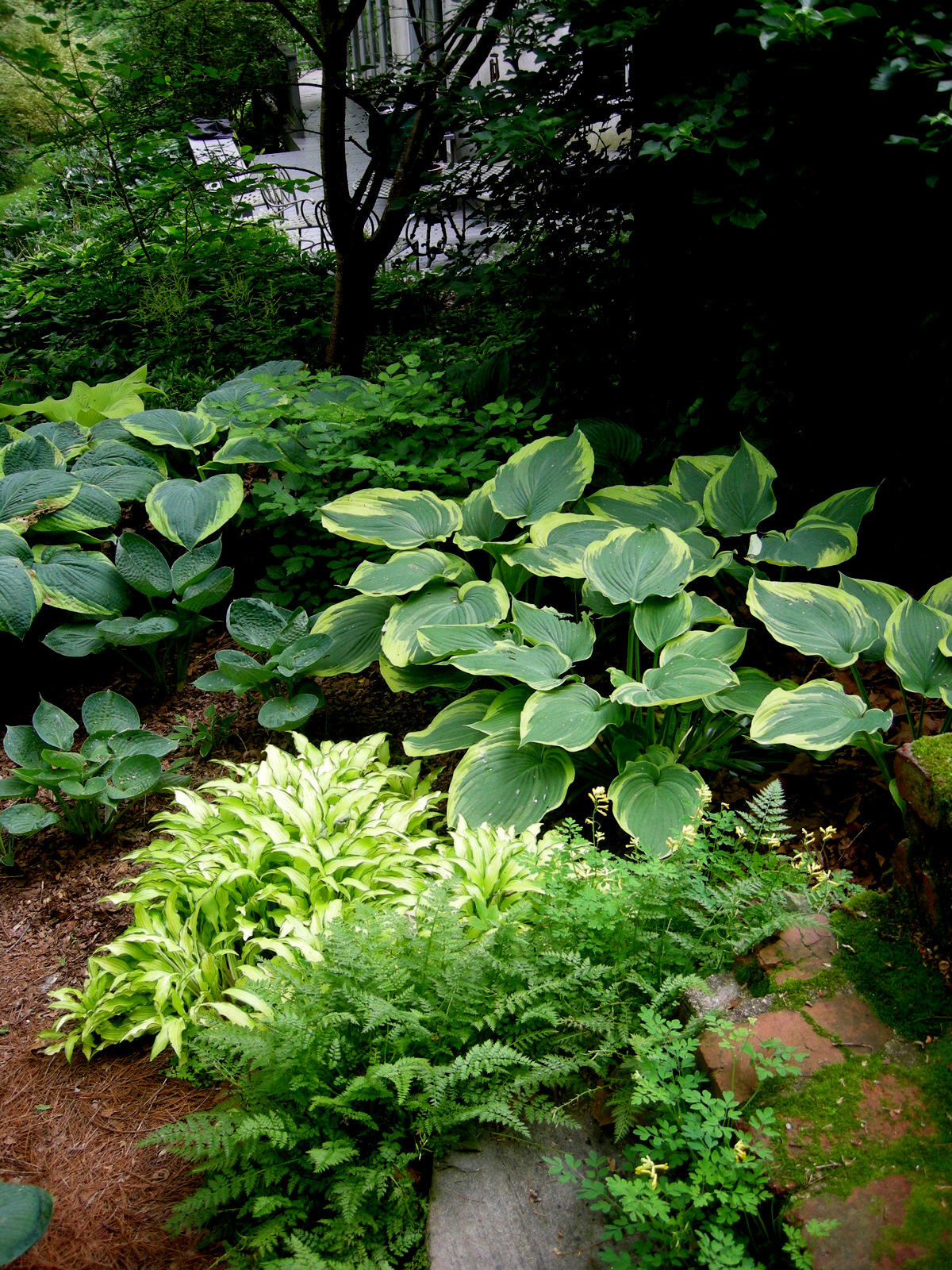
Left to right: ‘Frances Williams’, ‘Abiqua Drinking Gourd’, ‘Kabitan’, and ‘Earth Angel’.

‘Great Expectations’ displayed as a specimen with other hostas, ferns, epimediums, violets, and hardy geraniums.

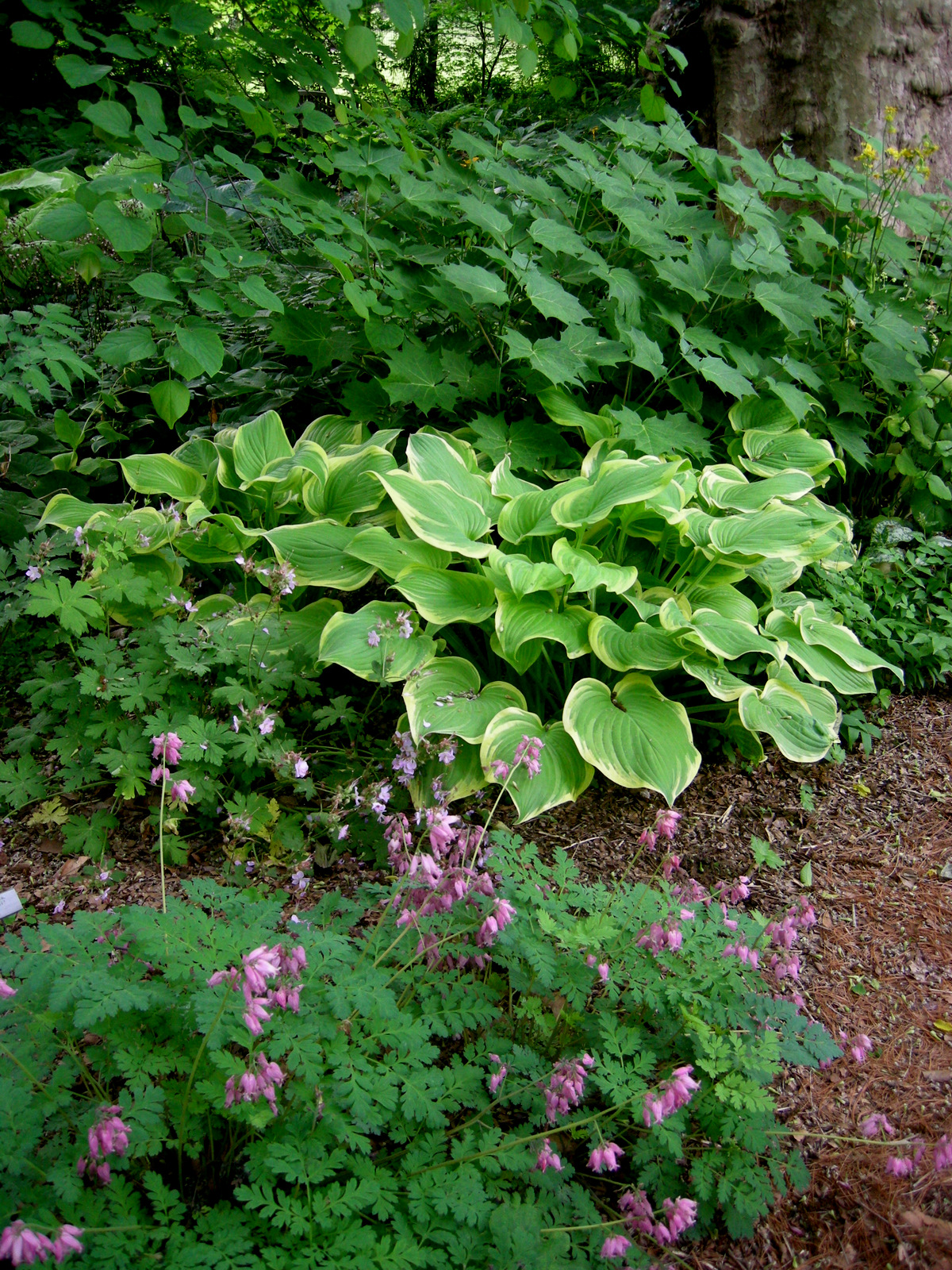
A specimen ‘Fragrant Bouquet’ with yellow waxbells, hardy gernaium, and ‘Luxuriant’ bleeding-heart.

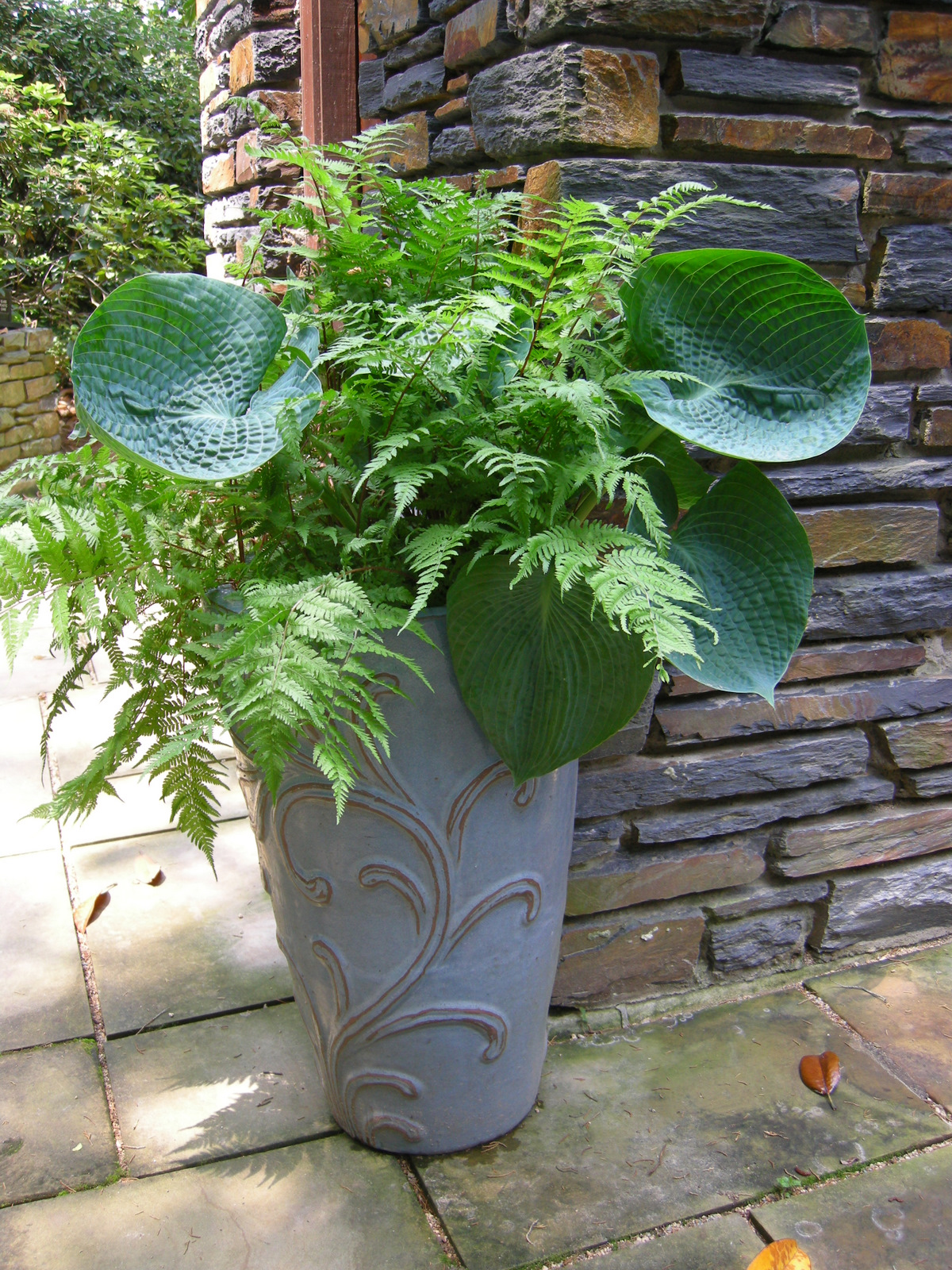
A simple but elegant container planting at Duke Gardens in Durham, North Carolina.

A rare Hosta tokudama by itself in a container on my front porch.

Colorful foliage is a fun and essential part of the shade garden.  I hope I have introduced you to some new and intriguing larger hostas that you can add to your shade.

Carolyn

For two more articles on hostas, click here:

Miniature (& Small) Hostas

Hostas for Fall

Notes: Every word that appears in orange on my blog is a link that you can click for more information.  If you want to return to my blog’s homepage to access the sidebar information (catalogues, previous articles, etc.) or to subscribe to my blog, just click here. 

When I want information about hostas, I go to the Hosta Library and My Hosta Database to find photos and comprehensive written descriptions.  I have added both these sites to my sidebar under Plant Information so you will always be able to find them.

Woody Plants for Shade Part 2

Posted in landscape design, native plants, New Plants, Shade Shrubs with tags , , , , , , , , , , , , , , , , on May 23, 2011 by Carolyn @ Carolyns Shade Gardens

Carolyn’s Shade Gardens is a retail nursery located in Bryn Mawr, PA, specializing in showy, colorful, and unusual plants for shade.  The only plants that we ship are snowdrops and miniature hostas.  For catalogues and announcements of events, please send your full name, location, and phone number (for back up use only) to carolyn@carolynsshadegardens.com.  Click here to get to the home page of our website for catalogues and information about our nursery and to subscribe to our blog.

The very showy flowers of redvein enkianthus, Enkianthus campanulatus ‘Princeton Red Bells’.

My nursery specializes in herbaceous flowering plants for shade.   However, although no shade garden is complete without trees, shrubs, and vines, our local nurseries seem to ignore woody plants for shade.  To fill this gap, I offer shade-loving woodies from a wholesale grower whose quality meets my exacting standards.  To view the catalogue, click here.   As in Woody Plants for Shade Part One, I thought my blog readers who are not customers might be interested in learning about the woody plants that I would recommend they add to their shade gardens.  And doing an article in addition to the catalogue allows me to add more information so customers might be interested also.

Included in my offering are six shrubs and two vines.  Of the eight plants I have chosen, five are native.  Please read my article My Thanksgiving Oak Forest to see why I think planting native plants is crucial to our environment.  My article New Native Shade Perennials for 2011 explains why I think native cultivars are valuable native plants.  With that introduction, here are the plants I am highlighting:

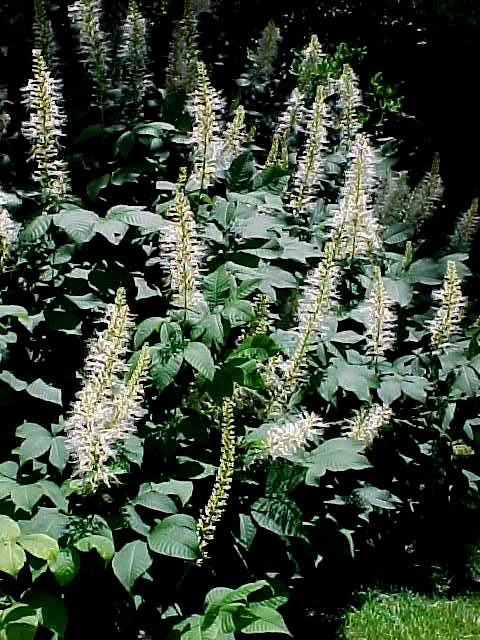
Native bottlebrush buckeye, Aesculus parviflora

Native bottlebrush buckeye is a wonderful shrub for making a majestic stand in full shade.  I grow it deep in my woods, and it performs beautifully.   It grows to 10’ tall in  full sun to full shade in any location and soil type.  It is also deer resistant.  The  creamy white flowers on long upright brush-like panicles in early summer and the bold textured leaves give it a dramatic tropical look.  It has excellent yellow fall color and attracts hummingbirds.

The lovely yellow fall color of bottlebrush buckeye.

Bottlebrush buckeye is native to parts of the eastern US, including Pennsylvania.  It is a Pennsylvania Horticultural Society Gold Medal Plant, click here for details.  It is also a Missouri Botanical Garden Plant of Merit, click here  for details (photos courtesy of the Missouri Botanical Garden Plant Finder).


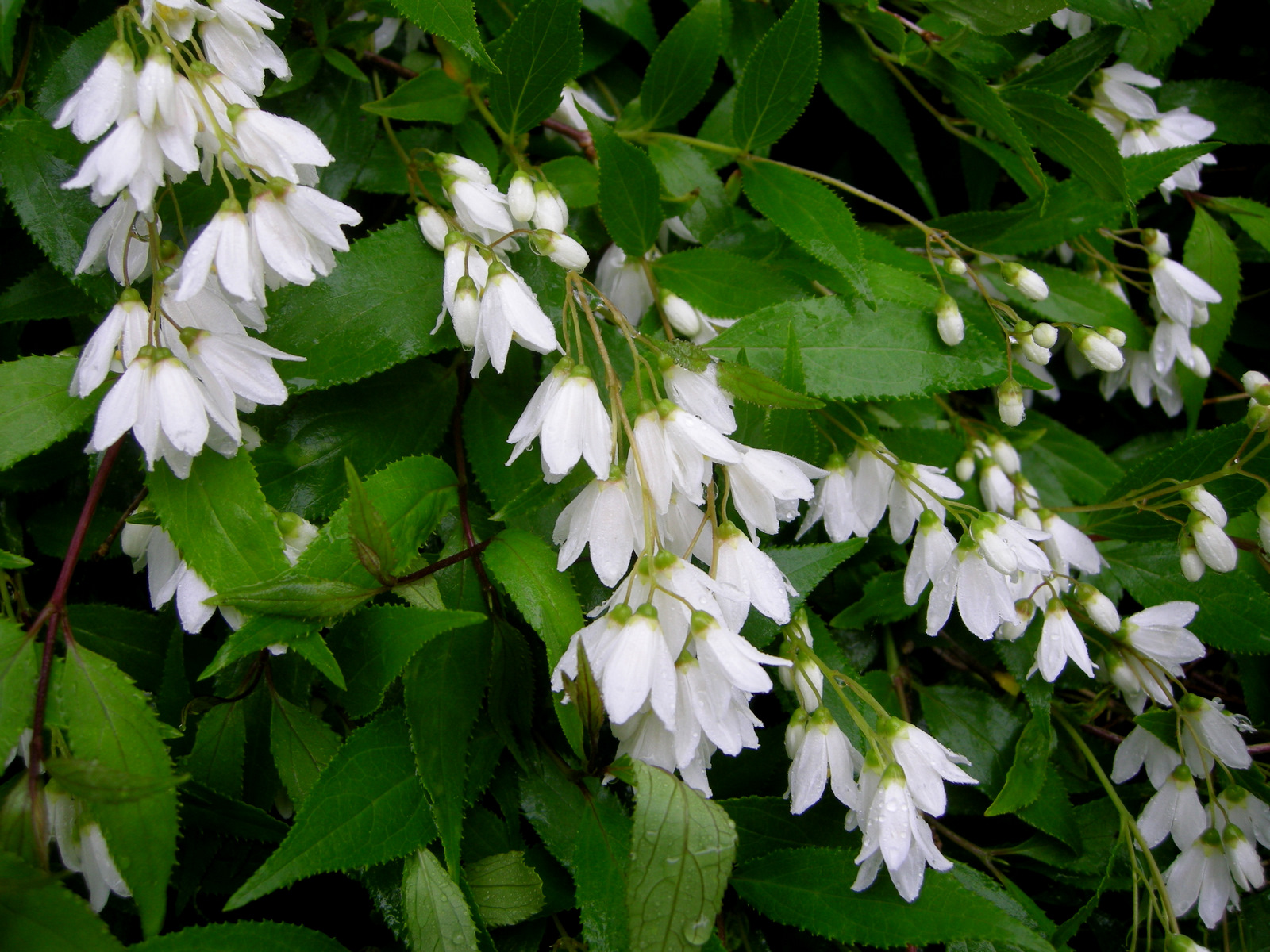
 Dwarf slender deutzia, Deutzia gracilis ‘Nikko’

‘Nikko’ dwarf slender deutzia is another shrub that can grow anywhere from  full sun to full shade and is deer resistant.  In April and May, it is covered with delicate white flowers, and the fine-textured and neat green leaves turn purple in the fall.  This deutzia makes an excellent specimen, growing 2’ tall by 5’ wide, or a superior flowering groundcover for shade.  I grow it in full shade at the base of my winterberry hollies.  It is native to Japan and is a Pennsylvania Horticultural Society Gold Medal Plant, click here for details.

I use ‘Nikko’ dwarf slender deutzia as a groundcover in full shade under winterberry hollies.


Redvein enkianthus, Enkianthus campaulatus ‘Princeton Red Bells’

In May ‘Princeton Red Bells’ redvein enkianthus is covered with a multitude of spectacular deep red, pendant bell-like flowers.  Its elegantly arranged blue-green leaves turn an excellent dark red in the fall.  It has a very unique and graceful habit (see photo of species below) and grows to 8’ tall by 4’ wide in full sun to full shade.  It is deer resistant and likes average to moist soil, although I grow it in my dry woodland.  It is native to Japan.  For more information about the species, click here.

This photo of the straight species of redvein enkianthus growing in my woodland shows its elegant habit and abundance of flowers.  The flowers of ‘Princeton Red Bells’ are much more eye-catching.


The amazing flowers of native smooth hydrangea, Hydrangea arborescens ‘Annabelle’.

Native ‘Annabelle’ smooth hydrangea has won numerous awards for its very showy, huge (up to 1’) snowball flowers, which appear from June into September.  It grows 5’ tall by 5’ wide in part to full shade (full sun is not recommended).  It is supposed to be deer resistant for a hydrangea.  A gentle pruning in late spring produces optimum growth.

‘Annabelle’ produces copious, long lasting flowers.

Smooth hydrangea is native to the eastern U.S., including Pennsylvania.  It is a Pennsylvania Horticultural Society Gold Medal Plant, click here for details.  It is also a Missouri Botanical Garden Plant of Merit, click here for details (photos courtesy of the Missouri Botanical Garden Plant Finder).


The gorgeous and delicious fruit of native northern highbush blueberry, Vaccinium corymbosum ‘Jersey’.

Gardeners might not think of northern highbush blueberry as an ornamental, but it has everything you could want in a shrub.   Its pretty bell-shaped white flowers appear in May and are followed by delicious and beautiful powder blue fruit in summer.  It has excellent scarlet fall color and is native and wet site tolerant.  What more could you ask for?  It grows to 6’ tall in full sun to part shade.

The flowers of northern highbush blueberry

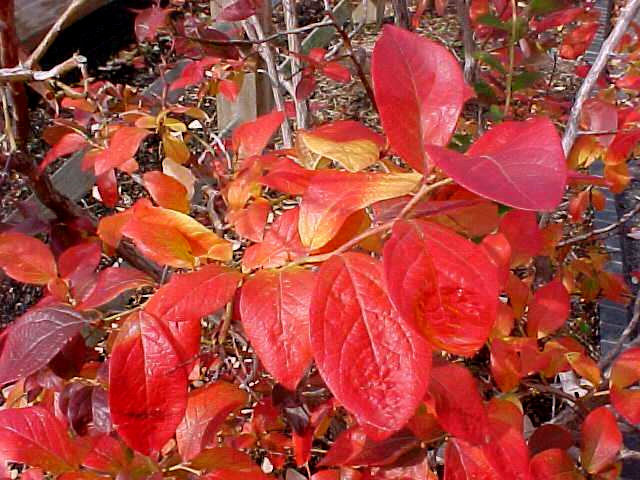
Northern highbush blueberry is native to all of eastern North America, including Pennsylvania.  I am offering two cultivars: ‘Jersey’ is an early midseason producer, and ‘Berkley’ is late midseason.  Planting two different cultivars produces better fruit.  For more information, click here  (photos of berries and fall color courtesy of the Missouri Botanical Garden PlantFinder).

The fall color of northern highbush blueberry.


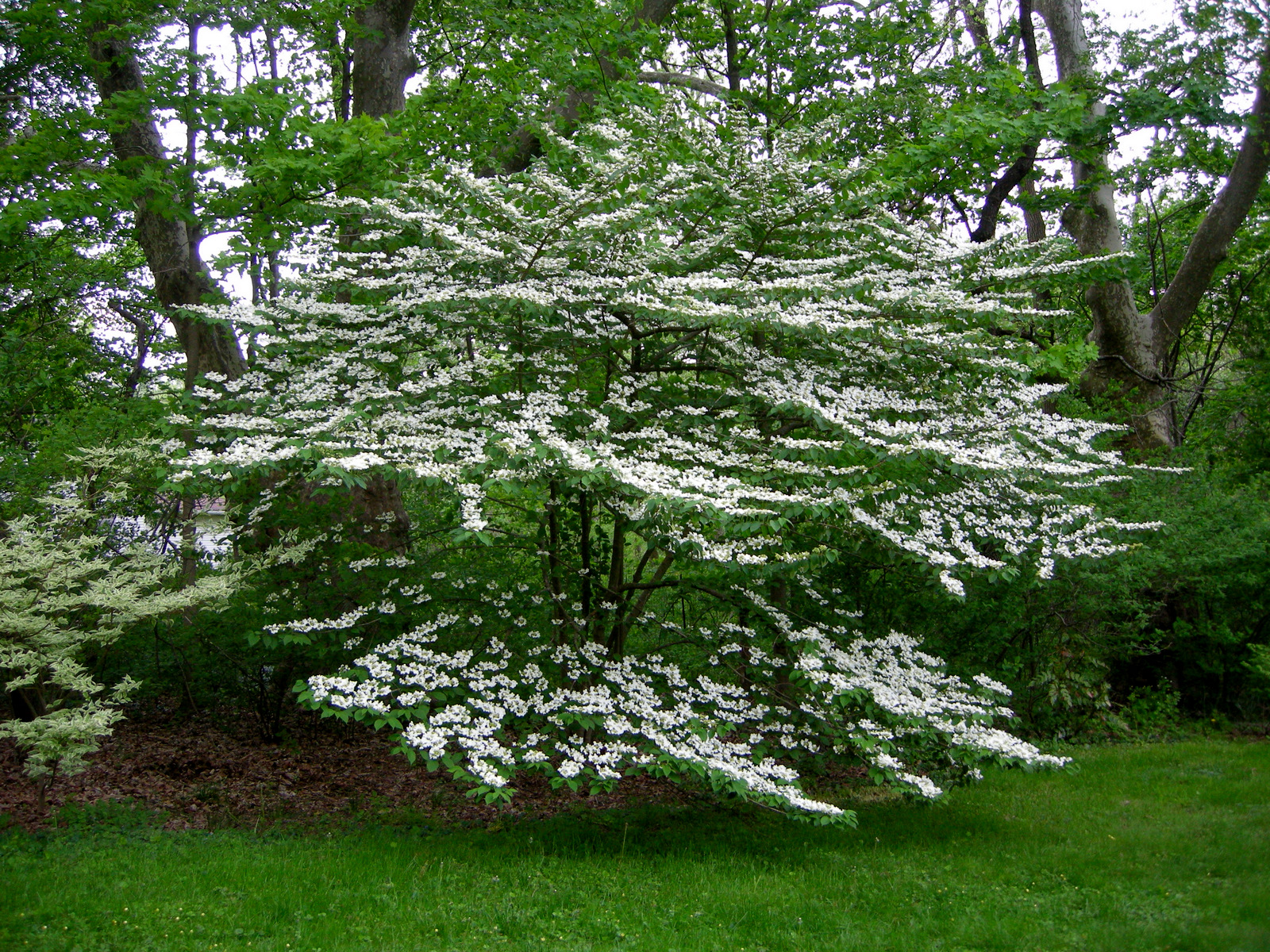
Doublefile viburnum, Viburnum plicatum var. tomentosum

My doublefile viburnum, pictured above, is one of the showiest and most talked about plants in my display gardens.  ‘Mariesii’ is a superior cultivar of doublefile viburnum.  Its large, white lacecap flowers in May and June and elegant, pleated medium green leaves are an unbeatable combination.  It grows quickly up to 12’ tall and 10’ wide in part to full shade and is deer resistant.   It is native to China and Japan.  For more information, click here.

The flowers of doublefile viburnum.


Native trumpet honeysuckle, Lonicera sempervirens ‘Crimson Cascade’

Native ‘Crimson Cascade’ trumpet honeysuckle produces bright coral red tubular flowers that invite hummingbirds from miles around in late spring and reblooms through fall.  Its shiny dark green leaves with red stems remain attractive through the season.  It is native to all of eastern North America, including Pennsylvania.  I grow mine mixed with my wisteria on my front porch and in an even shadier location along my front stairs.

Trumpet honeysuckle climbs my Chinese wisteria and blooms before, during, and after the wisteria is done.


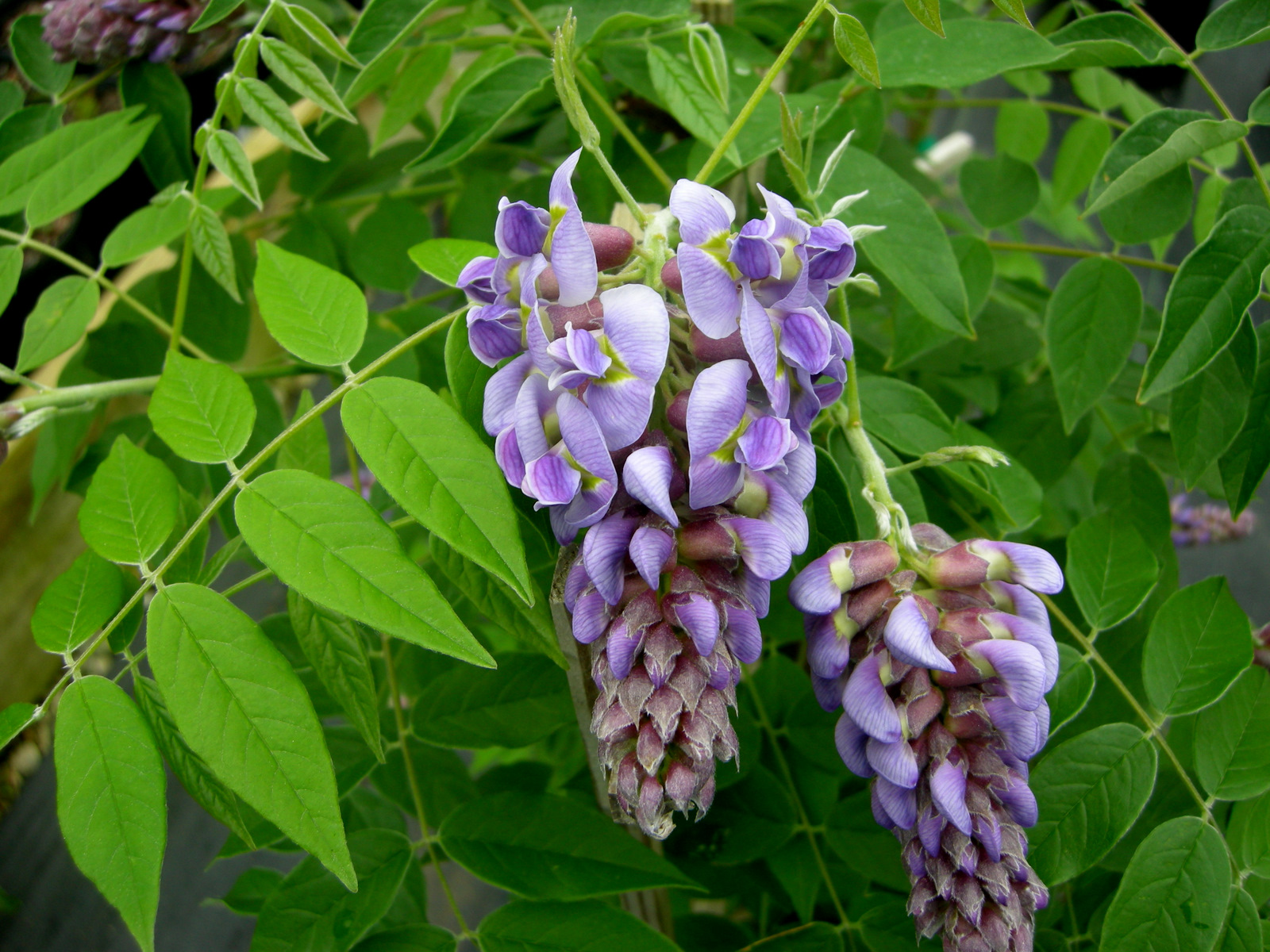
Native American wisteria, Wisteria frutescens ‘Amethyst Falls’

The copious fragrant, lavender-blue flower clusters of  ‘Amethyst Falls’ American wisteria are almost as beautiful in bud as in bloom from June to August.  This wisteria has fine-textured attractive foliage and is less rampant than Asian wisteria.  It grows to 20′ at maturity in full sun to part sun (it is technically not a shade plant).  It is native to the eastern U.S., including Pennsylvania.  ‘Amethyst Falls’ is a Pennsylvania Horticultural Society Gold Medal Plant,  click here for details.

The flowers and foliage of American wisteria.


I grow every one of these shrubs and vines in my gardens so I know you can’t go wrong by adding them to yours!  If you are a customer, you have until May 25 to place an order by clicking here.  If not, now you have some plants to ask for at your local independent nursery.

Carolyn


Notes: Every word that appears in orange on my blog is a link that you can click for more information.  If you want to return to my blog’s homepage to access the sidebar information (catalogues, previous articles, etc.), just click here.

Nursery Happenings: Orders for woody shade plants will be accepted until  noon on Wednesday, May 25.  We will have our traditional open hours over Memorial Day Weekend on Saturday from 9 am to noon and Sunday from noon to 3pm.  You don’t need an appointment, just show up.  But remember you can make an appointment to shop 24/7 by sending me an email at carolynsshadegardens@verizon.net.  There is  still a great selection of hostas, ferns, and hardy geraniums.

May GBBD: An Embarrassment of Riches

Posted in Garden Blogger's Bloom Day, Gardening Gone Wild Photo Contest, landscape design, native plants, Shade Shrubs with tags , , , , , , on May 15, 2011 by Carolyn @ Carolyns Shade Gardens

Carolyn’s Shade Gardens is a retail nursery located in Bryn Mawr, PA, specializing in showy, colorful, and unusual plants for shade.  The only plants that we ship are snowdrops and miniature hostas.  For catalogues and announcements of events, please send your full name, location, and phone number (for back up use only) to carolyn@carolynsshadegardens.com.  Click here to get to the home page of our website for catalogues and information about our nursery and to subscribe to our blog.

English primrose, Primula x polyantha ‘Cherry Pinwheels’, from Garden Vision Epimediums, one of my favorite nurseries.

Spring is with us in all its glory, and we have reached the middle of the month when I encourage each of you to walk around your garden and assess what you need to add to make mid-spring an exciting time in your landscape.  Do you need more flowering trees, shrubs, and vines to give you a reason to stroll in your garden?  Could your garden benefit from more flowers that bloom in May?

Late-blooming European wood anemone, Anemone nemorosa ‘Blue Eyes’: can you see its blue eye peeking out?

Make a list and take photographs so that when you are shopping for plants you know what you need and where it should go.  It’s beautiful outside, and you never know what you might find hiding in your garden like the cheerful English primrose (photo at top), which I discovered during my own  inventory.  Come visit Carolyn’s Shade Gardens to find even more inspiring ideas!

Whipporwill flower, Trillium cuneatum

Today is Garden Blogger’s Bloom Day for May when gardeners around the world show photos of what’s blooming in their gardens (follow the link to see  photographs from other garden bloggers assembled by Carol at May Dreams Gardens).  Here are  some more highlights from my mid-May stroll through Carolyn’s Shade Gardens, but to see it all you will have to visit.

Japanese roof iris, Iris tectorum, in my gold garden.

Readers really enjoyed my photos of trees and shrubs on April’s GBBD so I have been photographing every woody plant that has come into bloom since then.  Some have finished blooming now, but most are in bloom.  Let’s start with the trees:

Saucer magnolia, Magnolia x soulanginana: this magnolia was done blooming in the beginning of May, but magnolias are my favorite tree so I had to include it!

Flower of saucer magnolia


Ornamental crabapple, Malus species: this is my only ornamental crabapple and was here when we moved in so I am not sure of the variety.


Flower of the ornamental crabapple (also done now)


Kwanzan cherry, Prunus serrulata ‘Kwanzan’: also here when we moved in.

Flower of Kwanzan cherry (done flowering)


Native Carolina silverbell, Halesia caroliniana ‘Rosea’: a beautiful small flowering tree with amazing orange-streaked bark.


Native flowering dogwood, Cornus florida ‘Cherokee Brave’

Flower of ‘Cherokee Brave’ flowering dogwood


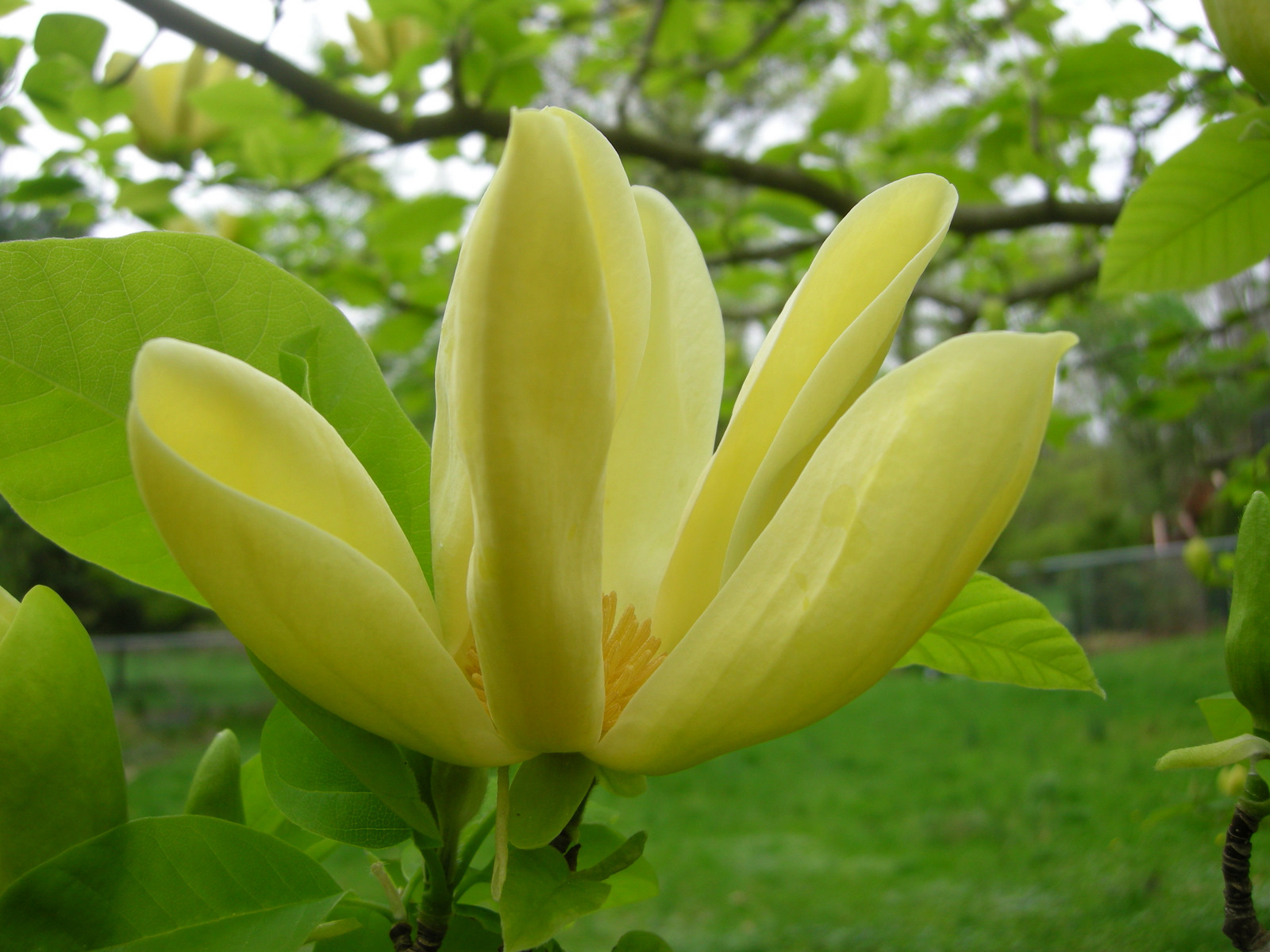
Native cucumber magnolia, Magnolia acuminata ‘Yellow Bird’

Flower of ‘Yellow Bird’ cucumber magnolia


Native green hawthorn, Crataegus viridis ‘Winter King’: I thought it would be fun to see what this tree looks like from inside our house.

Flower of ‘Winter King’ hawthorn: it also has beautiful red berries.


Native pagoda dogwood, Cornus alternifolia ‘Golden Shadows’, with native vine Carolina jessamine, Gelsemium sempervirens ‘Margarita’, and native (to the U.S.) camassia, Camassia leichtlinii ‘Caerulea’.


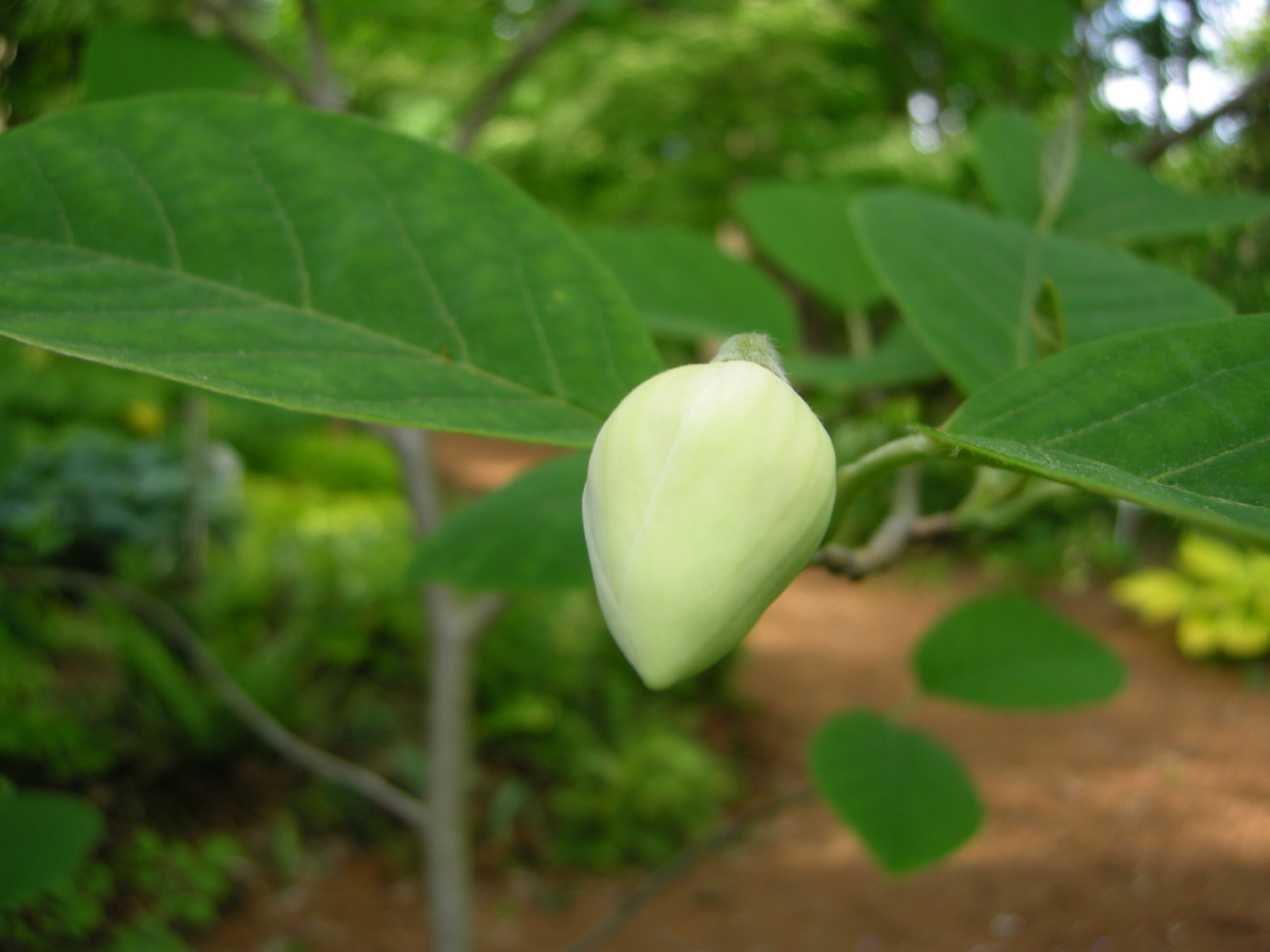
Wilson’s magnolia, Magnolia wilsonii: a real favorite because it grows and flowers in the shade.  I can’t show you the whole tree because a London plane tree branch fell on it and destroyed its shape.


Oyama magnolia, Magnolia sieboldii, has flowers similar to M. wilsonii but does not tolerate as much shade and blooms later.  Both trees should be planted so that you can view the flowers from below.

I love the buds of both these magnolias: they look like eggs hanging on the tree.


Are you ready for a few shrubs?

This is the biggest doublefile viburnum, Viburnum plicatum var. tomentosum, I have ever seen, and it started as a 3″ sprig.

Flower of doublefile viburnum


Dwarf Korean lilac, Syringa meyeri ‘Palibin’, with ‘Winter King’ hawthorn in the background.

Flower of ‘Palibin’ dwarf Korean lilac


Old-fashioned weigelas, Weigela florida ‘My Monet’ and ‘Variegata’, with Hosta ‘Stained Glass’

Flower of old-fashioned weigela ‘Variegata’


Tree peonies, Paeonia suffruticosa, take more shade than herbaceous peonies.  These plants did not come with names other than the color.


How about some vines?

My husband’s dedication to training this Chinese wisteria, Wisteria sinensis, across our front porch has really paid off.  I have  a native wisteria too, but it isn’t in bloom yet.

We grow the Chinese wisteria entwined with native honeysuckle, Lonicera sempervirens ‘Blanch Sandman’, and they both reach the second story.  This photo is for Tina at In the Garden who also has this combination.


The view out our dining room window of the pink anemone clematis, Clematis montana var.  rubens, growing on the deck railing.  This is a very vigorous and long-blooming clematis that does well in part shade.

The flowers of pink anemone clematis start out pale pink (above) and deepen in color as they age.


A few scenes of the flower beds in mid-May:

The garden surrounding our deck with Spanish bluebells, Scilla campanulata ‘Excelsior’, variegated Solomon’s seal, Polygonatum odoratum ‘Variegatum’, and white old-fashioned bleeding-heart, Dicentra spectabilis ‘Alba’, in bloom.


The view from upstairs of our main perennial border by the front door.


The woodland garden in mid-May with native hybrid sweetshrub, Calycanthus raulstonii ‘Hartlage Wine’ in bloom in the upper left.


This post is dedicated to my husband, Michael, who plants most of the plants and does all the dirty jobs at Carolyn’s Shade Gardens.


Please let me know in a comment/reply what flowers are blooming in your spring garden.  If you participated in GBBD, please provide a link so my nursery customers can read your post.

Carolyn

Notes: Every word that appears in orange on my blog is a link that you can click for more information.  If you want to return to my blog’s homepage to access the sidebar information (catalogues, previous articles, etc.), just click here.

Nursery Happenings: We expect to have our traditional open hours over Memorial Day Weekend, but remember you can make an appointment to shop 24/7 by sending me an email at carolynsshadegardens@verizon.net.  Saturday was one of my best open houses ever (thanks to everyone who came), but there is  still a great selection of hostas, ferns, and hardy geraniums.

Miniature (& Small) Hostas

Posted in hosta, How to, landscape design with tags , , , , , , , , , , , , , , , , , , , , , , , , , , , , , , , , , , , , on May 9, 2011 by Carolyn @ Carolyns Shade Gardens

Carolyn’s Shade Gardens is a retail nursery located in Bryn Mawr, PA, specializing in showy, colorful, and unusual plants for shade.  The only plants that we ship are snowdrops within the US.  For catalogues and announcements of local events, please send your full name, mailing address, and cell number to carolyn@carolynsshadegardens.com and indicate whether you are interested in snowdrops, hellebores, and/or hostas.  Click here to get to the home page of our website for catalogues and information about our nursery and to subscribe to our blog.

.

'Holy Mouse Ears'‘Holy Mouse Ears’: the miniature hostas in the mouse ears series are my favorites.

I am in stage four of my relationship with hostas.  I have noticed that many of my customers go through these stages too.  Stage one was when I was a new gardener.  I discovered hostas and loved them because they are easy to grow and to divide to make more.  I had the green one, the green and white one, the blue one, the variegated one, and the gold one.  If you know hostas, you can probably guess fairly easily which varieties I had.  I still love these hostas and have large patches of them in my gardens.

‘Lakeside Cupcake’ was a new small hosta for me in 2010 and is a strong grower.

During stage two, I became more “sophisticated”.  Hostas were too easy to grow, too ordinary, and multiplied too quickly for my control-oriented gardening style.  Besides I wanted flowers, flowers, and more flowers, and hostas just didn’t fit the bill.  I didn’t like them anymore.  How could people collect such a boring and ordinary plant?

“Carolyn’s Gold”: I selected this miniature hosta from a chance seedling that appeared in my gardens.  It is the brightest gold I have ever seen.

I rediscovered hostas in stage three when I got beyond flowers and realized how important foliage is to the garden, especially the shade garden.  I learned that hostas did not come in just the five basic varieties but in an infinite number of combinations of colors, heights, widths, leaf shapes, flowers, and habits.  Somewhere I read that there are 6,000 hosta cultivars.  I wanted them all so I began to collect hostas. 

‘Blue Mouse Ears’ is the miniature hosta that started the mouse ears family.  Not only is it shaped like a mouse ear, but it feels like one too (all in my imagination because I have never felt a mouse ear).  It was designated the 2008 Hosta of the Year by the American Hosta Growers Association–a very high honor.

I entered stage four about the time that my hosta acquisitions topped 100 cultivars.  This is just a modest assemblage because you really aren’t considered a hosta collector until you have over 500 varieties in your garden.  But I was running out of room.  Besides I am not a true collector of any group of plants because I am not satisfied with one of any perennial in my garden.  I need at least five, but preferably seven, of any plant to make an impact.  Many hostas are quite large, and five ‘Blue Angel’, ‘Sum and Substance’, or ‘Sagae’, which are favorites of mine, with six foot wide clumps and 15″ leaves, take up a lot of room.  Were my collecting days over?

Clockwise from upper left: small ‘Blonde Elf’  and miniatures ‘Little Wonder’, ‘Rock Princess’, and a hosta sold to me as ‘Little Blue’.

That’s when I discovered miniature hostas.  The American Hosta Society defines  miniature hostas as having a leaf no larger than 4 sq. in.   The discovery of miniature hostas allowed me to indulge my passion for collecting hostas, which only got worse in stage four, without taking up all the space in my garden.  And they are so incredibly cute and have such adorable names: ‘Holy Mouse Ears’, ‘Pixie Vamp’, ‘Blonde Elf’, ‘Mighty Mouse’, ‘Alakazaam’, ‘Cookie Crumbs’, ‘Rock Princess’.  How can you resist?

‘Mighty Mouse’ is one of the newer members of the mouse ears family.

I remain firmly mired in stage four and don’t know what comes after it, maybe Hostas Anonymous.  But in the meantime, I want to show you some of my favorite miniatures (see photos above and below) and suggest some ideas for displaying miniature and small hostas.

‘Little Treasure’ is new to me this year and has a unique leaf shape and blue-green color.

Because they are so little, most miniature and small hostas can’t be thrown into the garden willy-nilly but benefit from some planning to show them off.  Many also require specialized growing conditions, but those cultivars don’t survive at Carolyn’s Shade Gardens where nothing gets fussed over.  I display my absolute favorite miniature hostas in their own container to really highlight them.  An added benefit is that  hostas multiply more rapidly in containers:

I have shown this photo of ‘Crumb Cake’ before, but it demonstrates how a single unusual plant in a container can be so pleasing.  ‘Crumb Cake’ and all the other hostas pictured in containers in this post also do well in the ground–a requirement for inclusion at Carolyn’s Shade Gardens.


‘Pixie Vamp’: This miniature has elegant mahogany-colored flower scapes that match this container.  I leave all these pots outside all winter.  Hostas overwinter fine as long as their containers can be left outside without cracking.


I think ‘Praying Hands’, the 2011 Hosta of the Year, looks best in a container.  It reminds me of pitcher plants without the hassle of creating a bog.  Pictured here with dwarf Solomon’s seal, Polygonatum humile, another plant that thrives over the winter in containers.


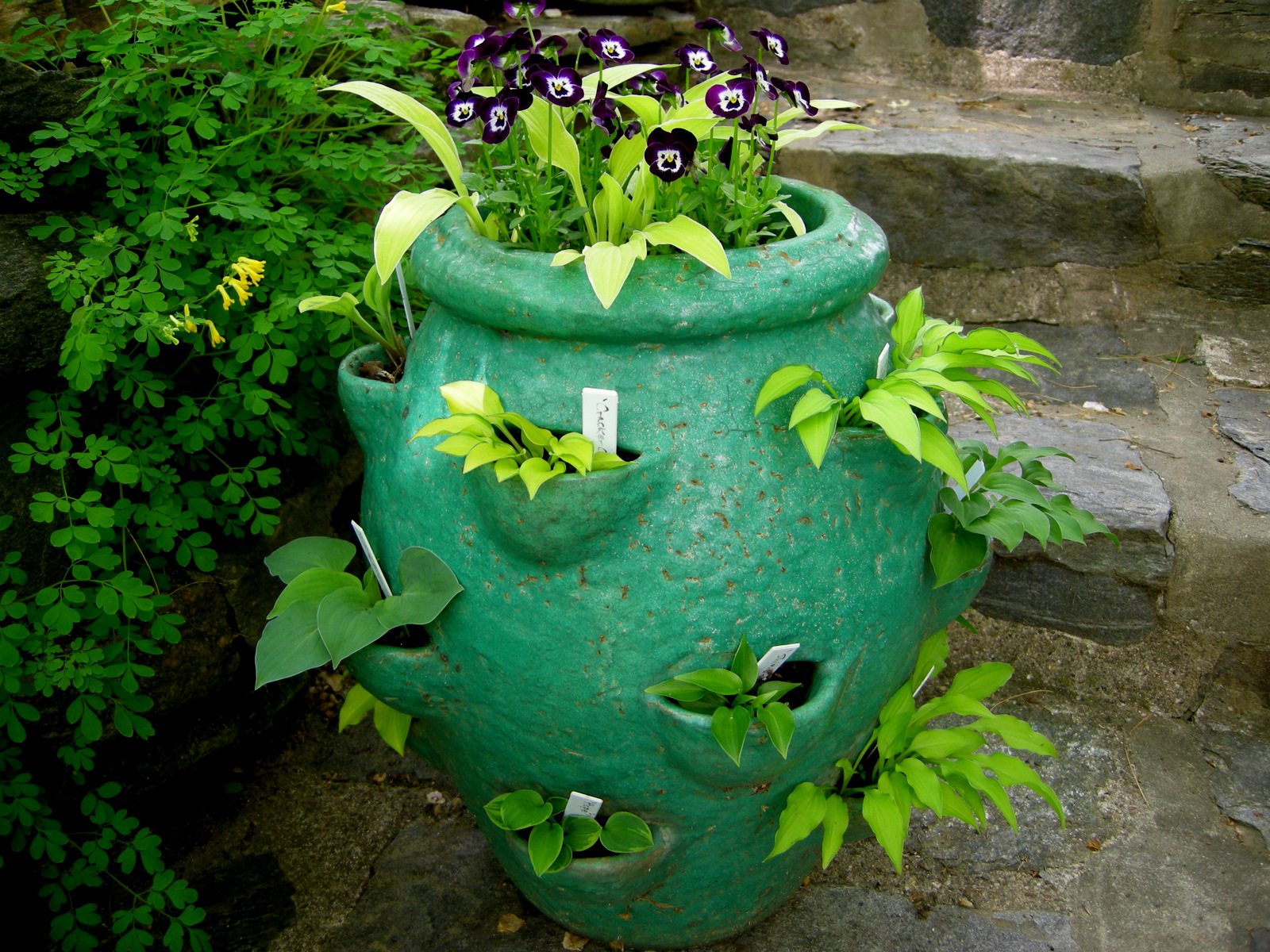
“Carolyn’s Malex Two” is another hosta I selected that grows so slowly in the ground that I have never sold it.  Its position in the top of my antique strawberry pot highlights its delicate coloring and allows it to multiply faster than it would in the ground.


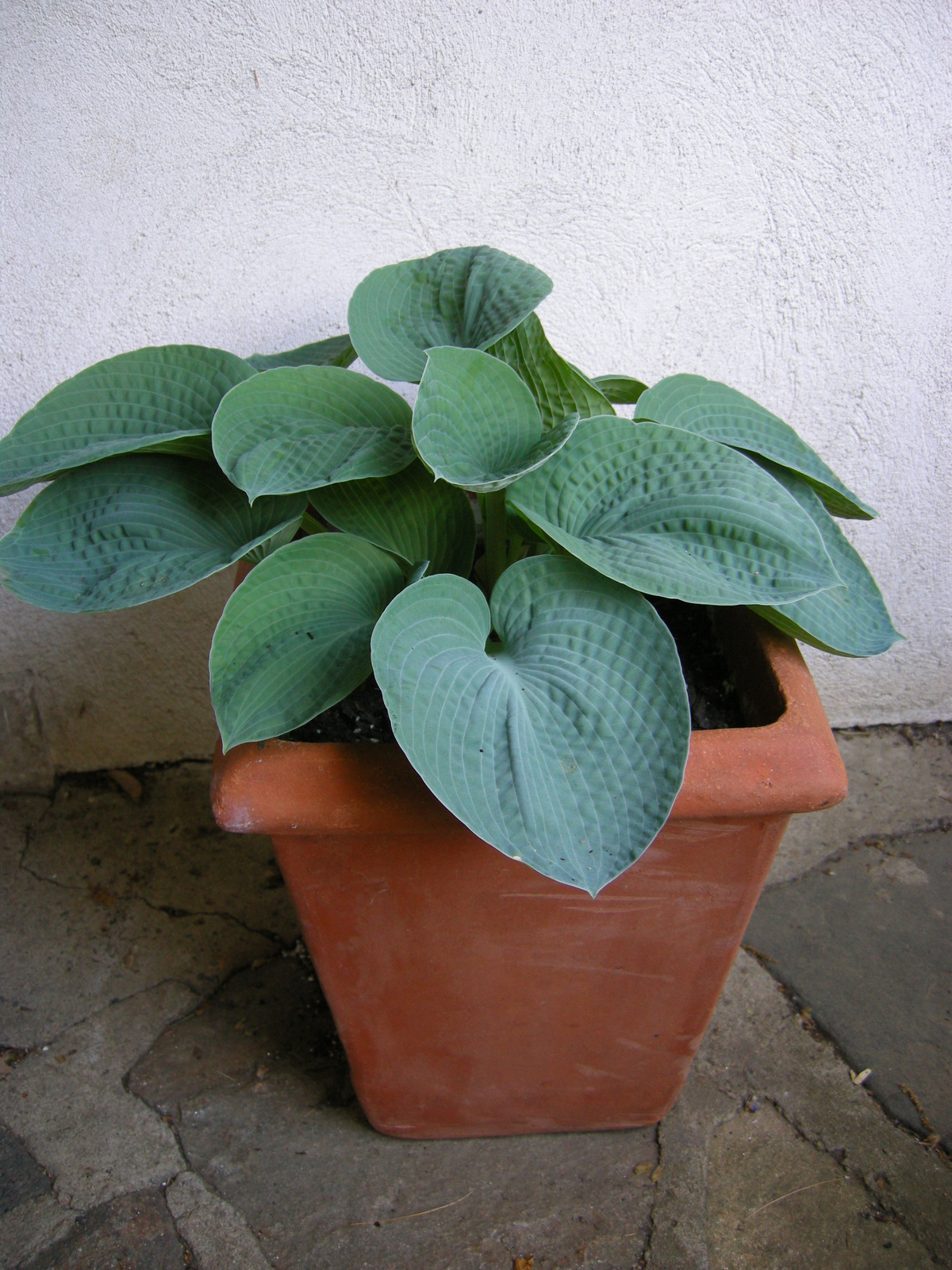
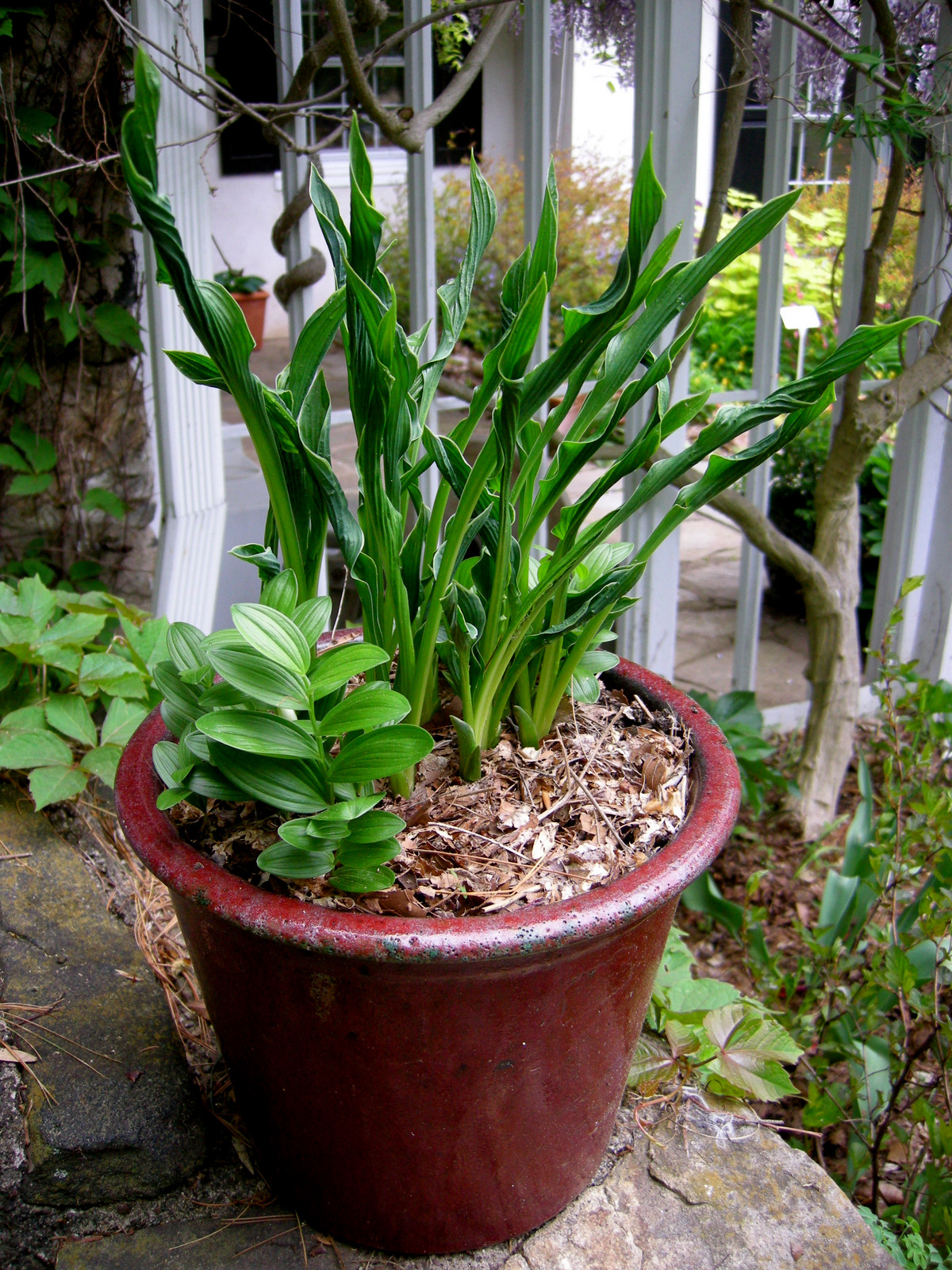
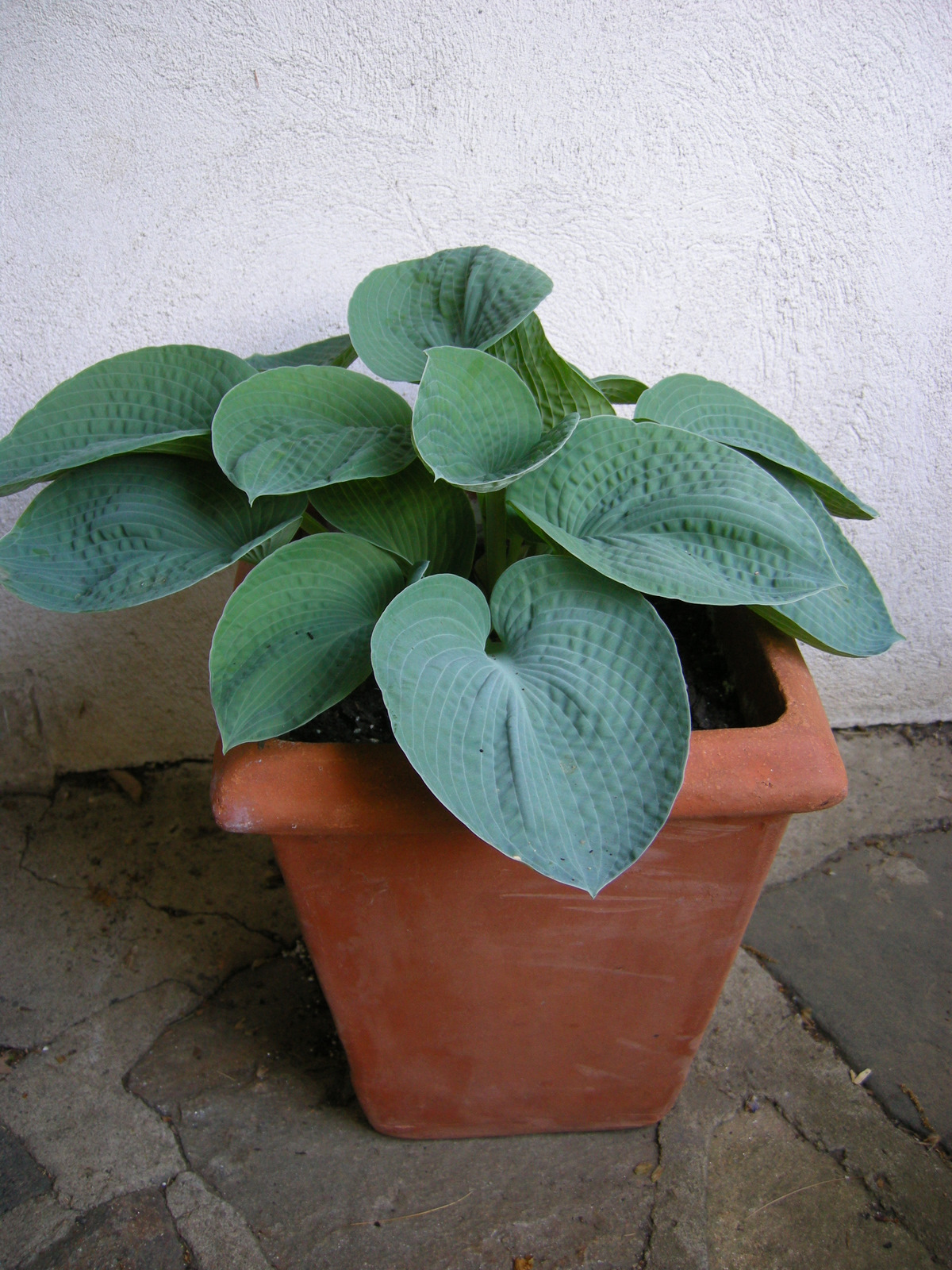
The straight species Hosta tokudama has the bluest leaves of any hosta and lives in this terra cotta container on my porch.


You don’t necessarily have to buy containers for your hostas.  ‘Hanky Panky’, a very unusually colored small hosta, has grown for years in my old dogwood stump.


‘Alakazaam’ has found a home in the chiseled out knot hole of a weathered sycamore branch.  My youngest son crafted this “container” for me for Mother’s Day.


Several miniature hostas can be combined in a larger container:

This dish, which I leave out all winter even though it is terra cotta (don’t do this at home!), contains the miniatures  (clockwise from upper left) ‘Cracker Crumbs’, ‘Shiny Penny’, and ‘Shining Tot’ with ‘Praying Hands’, sedum, hens and chicks, rosularia, and miniature dianthus.


My antique strawberry pot has 16 pockets with a different miniature hosta in each one.  Pictured are (top row left to right) ‘Cameo’, ‘Cracker Crumbs’, and ‘Twist of Lime’, (middle row) ‘Little Blue’, ‘Shining Tot’, and ‘Porter’, and (bottom row) ‘Shiny Penny’, ‘Hope, and “Carolyn’s Tiny Gold”.


My husband gave me this antique trough for our anniversary.  It is a perfect setting for my mouse ears collection.  Pictured are (front left to right) ‘Holy Mouse Ears’ and ‘Mouse Trap’, (center) ‘Blue Mouse Ears’, and (back) ‘Green Mouse Ears’, ‘Mighty Mouse’, and ‘Frosted Mouse Ears’, all with dwarf Solomon’s seal.


Hostas thrive between rocks and in rock gardens:

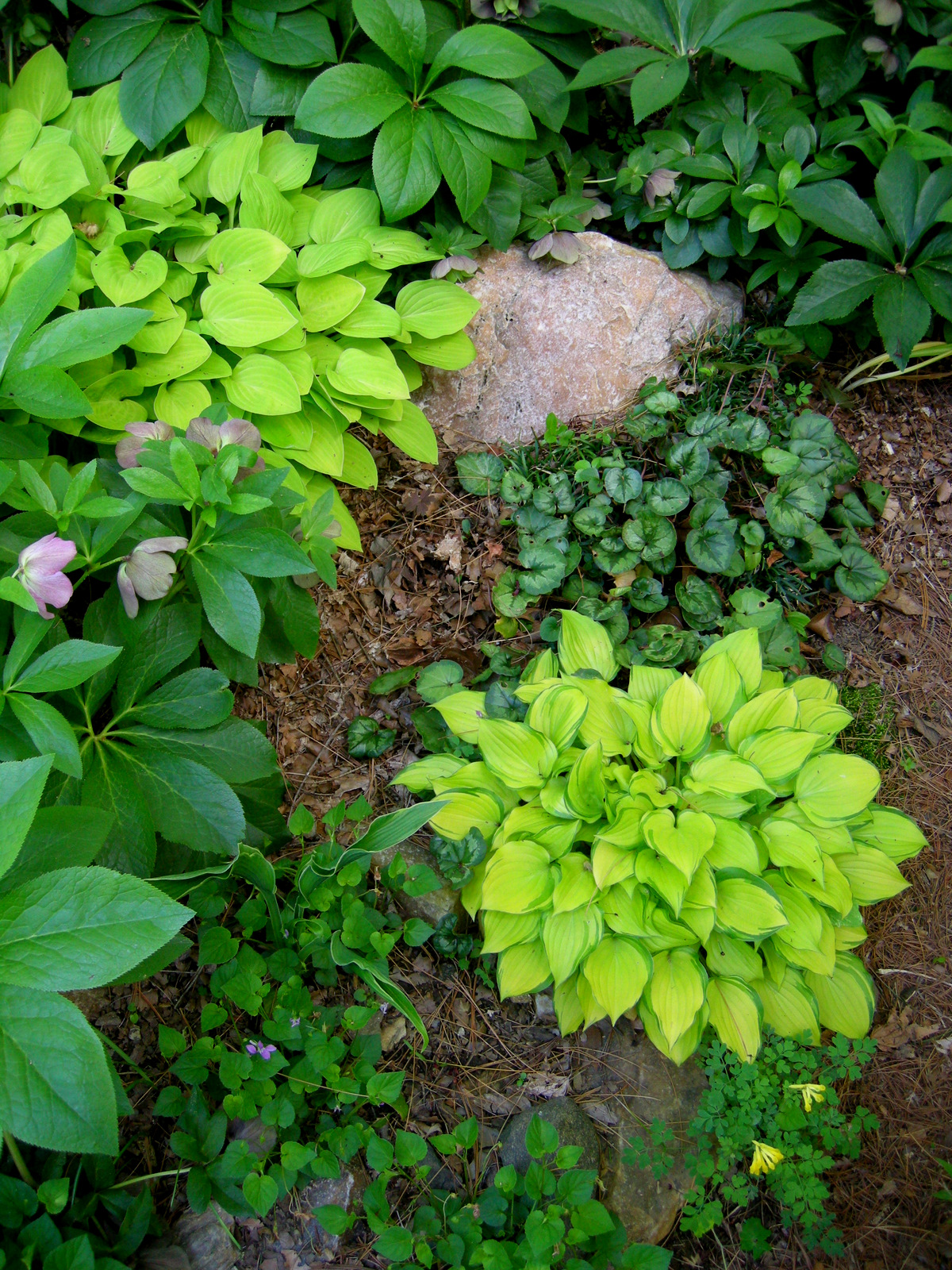
The 2010 Hosta of the Year ‘First Frost’ in my rock garden with (left to right) variegated money plant (Lunaria annua ‘Alba Variegata’), Helleborus cyclophyllus, and yellow wax-bells (Kirengoshoma palmata).


‘Little Aurora’ (upper left) and ‘Cookie Crumbs’ (lower right) in my rock garden with (left to right) ‘Red Lady’ hellebores (Helleborus x hybridus ‘Red Lady’), pink violets (Viola species), and spring-blooming hardy cyclamen (Cyclamen coum).


Miniature and small hostas can be massed for maximum effect and to create groundcover:

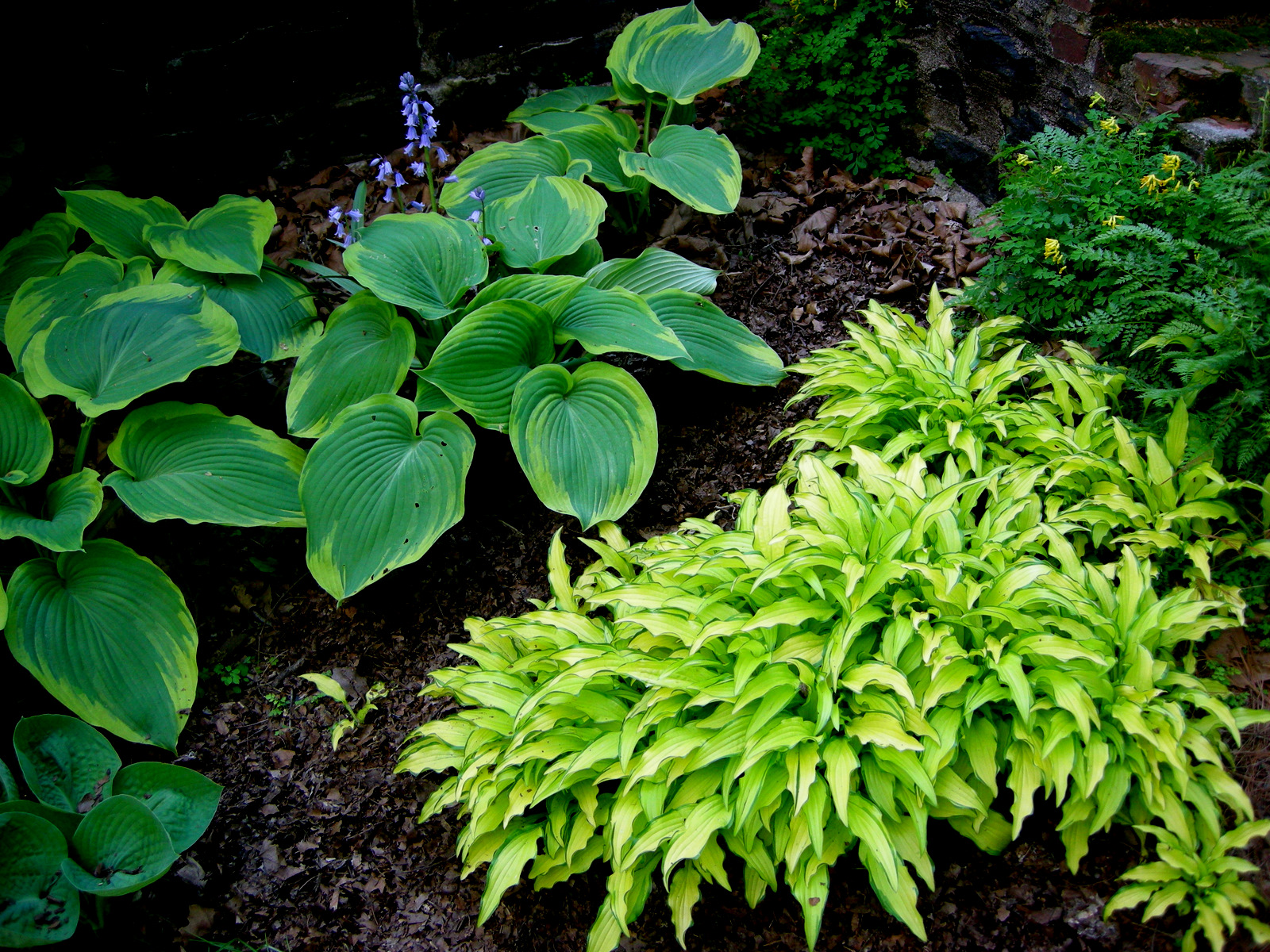
‘Kabitan’ (lower right) massed with (left to right) ‘Abiqua Drinking Gourd’, 2009 Hosta of the Year ‘Earth Angel’, Spanish bluebells (Scilla campanulata ‘Excelsior’), yellow corydalis (Corydalis lutea), and fern-leafed corydalis (Corydalis cheilanthifolia).


“Carolyn’s Gold” (lower left) and ‘Lemon Lime’ (upper right) used as groundcover.


‘Twist of Lime’ (lower right) massed with (left to right) sweet violet (Viola odorata), red epimedium (Epimedium x rubrum), and ‘Fantasy Island’.


I hope I have given you some good ideas for using miniature and small hostas in your garden.  I would be very interested to hear in a comment/reply which miniatures you like and how you use them.

Carolyn

For two more articles on hostas, click here:

Larger Hostas

Hostas for Fall


Notes: Every word that appears in orange on my blog is a link that you can click for more information.  If you want to return to my blog’s homepage to access the sidebar information (catalogues, previous articles, etc.) or to subscribe to my blog, just click here.

Letting Go Part 1: The Lawn

Posted in garden essay, green gardening, landscape design, organic gardening with tags on May 2, 2011 by Carolyn @ Carolyns Shade Gardens

Carolyn’s Shade Gardens is a retail nursery located in Bryn Mawr, PA, specializing in showy, colorful, and unusual plants for shade.  The only plants that we ship are snowdrops and miniature hostas.  For catalogues and announcements of events, please send your full name, location, and phone number (for back up use only) to carolyn@carolynsshadegardens.com.  Click here to get to the home page of our website for catalogues and information about our nursery and to subscribe to our blog.

This photo and the next four all show beds created from former lawn at Carolyn’s Shade Gardens.

WARNING:  This post could be hazardous to your lawn or at least your relationship with your spouse.  It contains lawn profanity as well as intense language and strong opinions and recommends graphic violence to your lawn.  Drug use is discussed, and nudity is recommended.  Read at your own risk.

Depending on how you look at it, I was always ahead of the curve on the lawn issue.  When we bought our property in 1983, I already had it in for the lawn, which encompassed most of our 2 acres.  At the time I didn’t know that “advanced” gardeners were supposed to get rid of their lawn.  I just thought it was a ridiculous waste of garden space and resources like water and very high maintenance: it had to go.  Plus there was never any question of using chemicals to keep it green and weed free as we have been organic from day one.

In 2001, I read this tongue-in-cheek discussion between God and St. Francis and renewed my efforts to eliminate our lawn (click to enlarge):

This clever but provocative piece was printed in the Spring 2001 newsletter of The Friends of Casco Bay, Maine.  It also supports my practice of leaving leaves in my garden beds, see my post Fall Clean-Up.

To me, as pointed out by this article, the whole concept of lawn is inherently ridiculous even before you get to the environmental issues.

Then the scientific evidence kicked in.  Chemically treated lawns are a scientifically documented toxic hazard to your pets.  There is lots of information out there about the cancer causing hazards of commonly used lawn chemicals, for example, see The Truth About Cats, Dogs, and Lawn Chemicals.  After reading this would you let any family member, especially your children, walk on a chemically treated lawn?  

This whole hillside was an eroded, chemically dependent lawn when we moved in.

Lawn chemicals are a major contaminant of the Chesapeake Bay, which is the largest and most biologically diverse estuary in the U.S.  For more information, read this article by the Chesapeake Bay Program by clicking here.  A White Paper produced by a diverse group of scientists and policy experts for the Chesapeake Bay Watershed Project outlines the damage being done and recommends encouraging “consumers to question aesthetics-based behaviors (i.e., desire for visually attractive lawns or produce) in lieu of decision-making based on human health and ecological concerns.”  Phrased that way, it is amazing there is any question what the right path is.

The death warrant for my lawn as most Americans know it was sealed in stone in 2007 when I read an article by Doug Tallamy in which he pointed out the dangers of this non-native monoculture to our native flora and fauna.  It is sobering to consider that we have planted 40 million acres of lawn in the U.S. and that every weekend we mow an area eight times the size of New Jersey.  According to the U.S. EPA, “Operating a typical gasoline-powered lawn mower for one hour produces the same amount of smog-forming hydrocarbons as driving an average car almost 200 miles under typical driving conditions.”  Mowing accounts for 5% of air pollution in the U.S (click here for more details).  In Bringing Nature Home, Tallamy explains quite eloquently how our home gardens are the last bastion of space where we can promote biodiversity through planting native plants.  My lawn just did not fit into this scheme.

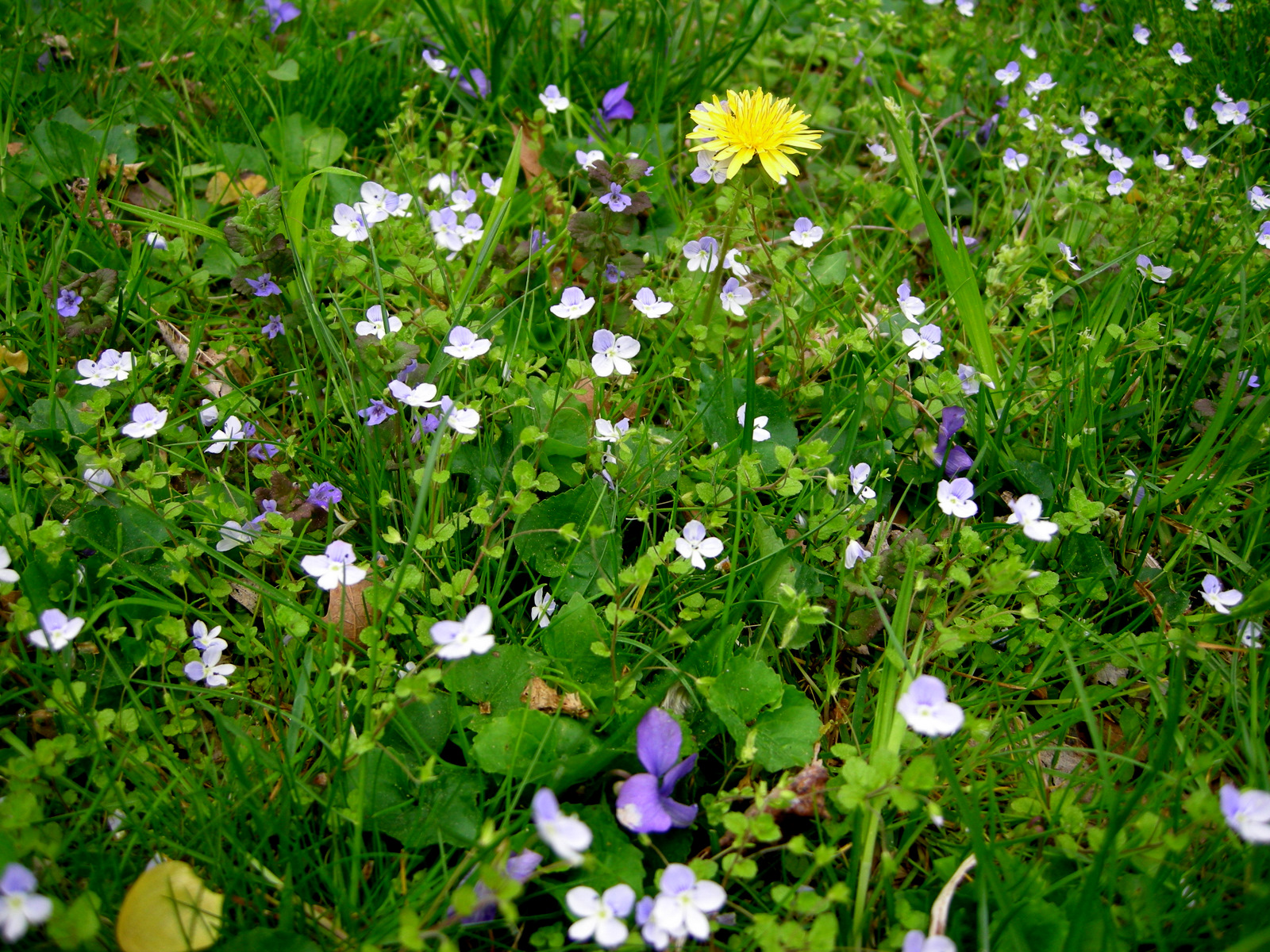
Lawn veronica, Veronica filiformis, grows throughout my lawn.  It is so beautiful that I wish it would completely replace the lawn.

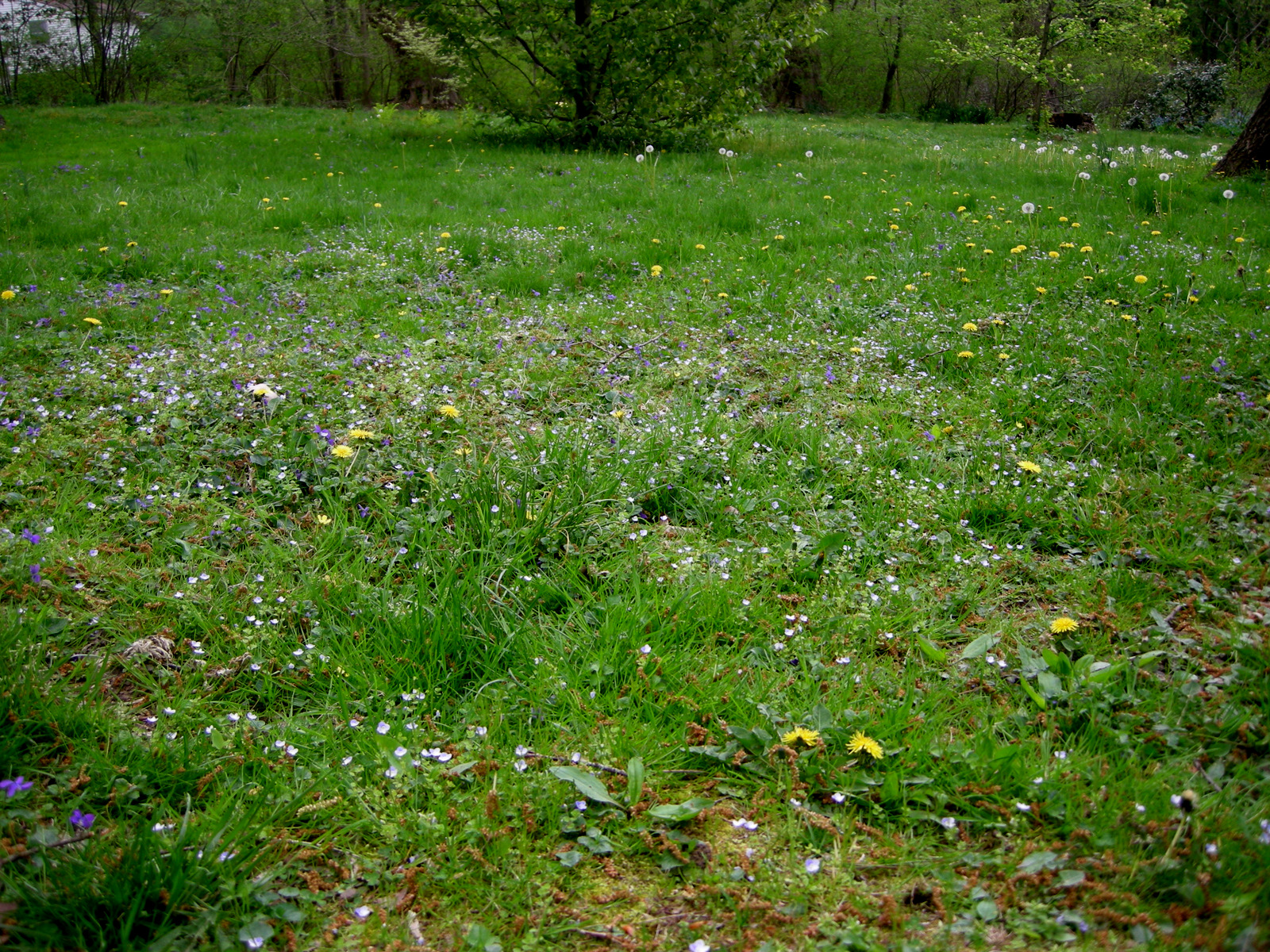
But now that I had eliminated all the lawn I could, what to do about the lawn that remains?  I still have a large grassy area  where my children play, which though not chemically treated is still a monoculture.  This is where the real horror starts: I let it go wild.  I let every “weed” that you are probably trying to remove from your lawn grow there.  And you know what?  It’s beautiful.  All spring, until we mow, it is filled with pretty “wildflowers” covered with bees, butterflies, and beetles, and visited by birds among other local fauna.  Then, when it’s mowed, it is a green expanse like a lawn “should be”.

The photos above and below show some of the “wildflowers” that grow in my lawn:

Common blue violets, Viola papilionacea (sororia)


Japanese painted fern, Athyrium niponicum ‘Pictum’


Wild strawberries, Fragaria species


Common snowdrop, Galanthus nivalis


Native PA white violets, Viola striata


Winter aconite, Eranthis hyemalis


Ground ivy, Glechoma hederacea: I consider this a noxious weed when it appears in my beds, but it is very pretty in the lawn.


Dandelion, Taraxacum officinale


Most of the plants in my lawn are not native.  I consider half of them weeds if they appear in garden beds.  But in the lawn they are beautiful.  You probably don’t see them this way–most people don’t.  I have retrained my eye.  When I see an expanse of weed-free bright green grass, I don’t think what a beautiful law, I think toxic wasteland.

Here is what my lawn looks like in early spring:

This next photo is not for the faint-of-heart:

Creating more “wildflowers” in my lawn.


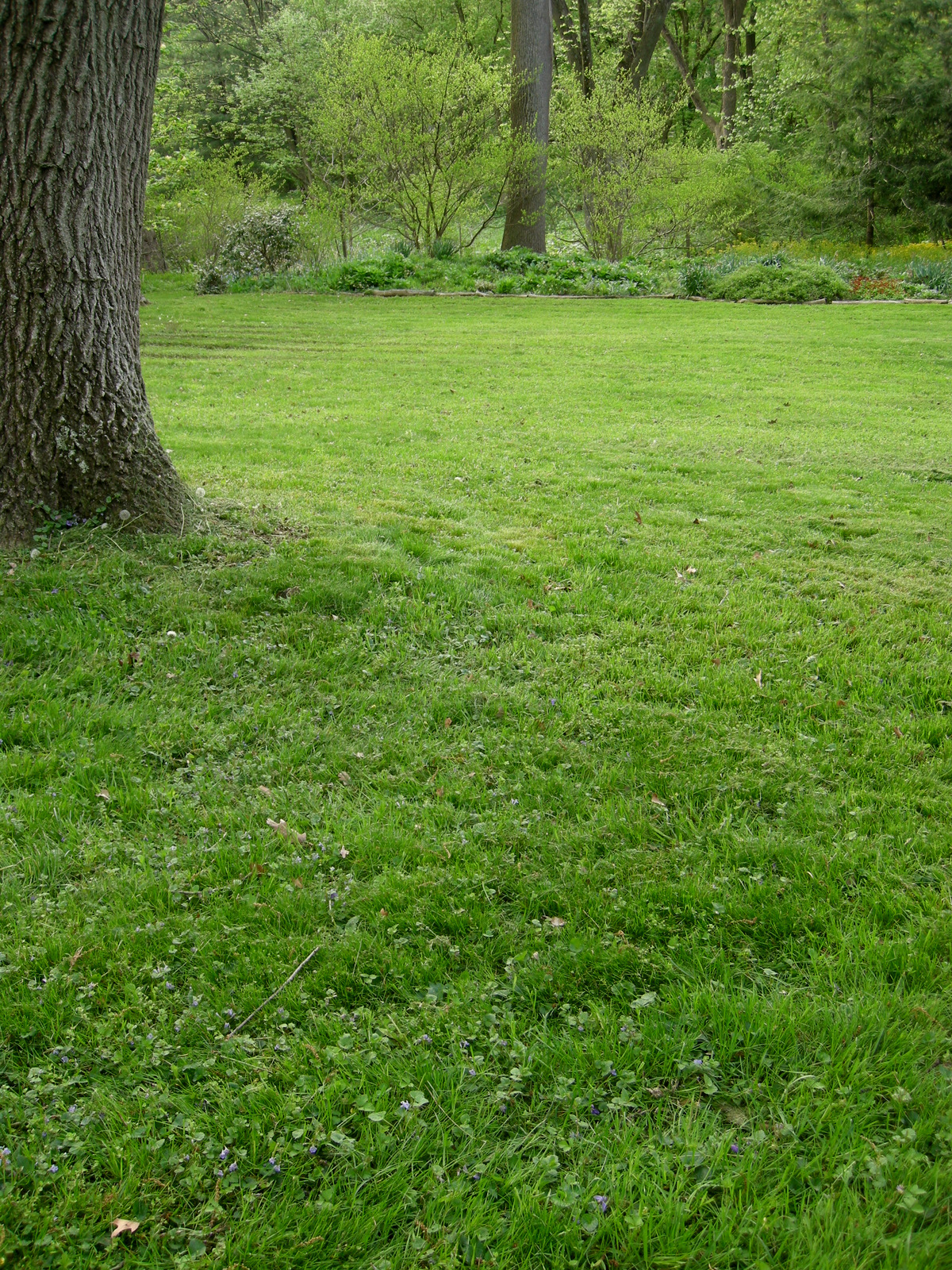
And here is what the same area looks like once it is mowed:

This is all the lawn I need.  Though it is a large area, I think I would do the same thing if my lawn was smaller.

Carolyn

Notes: Every word that appears in orange on my blog is a link that you can click for more information.  If you want to return to my blog’s homepage to access the sidebar information (catalogues, previous articles, etc.), just click here.

Nursery Happenings: Look for Carolyn’s Shade Gardens at the Bryn Mawr Farmer’s Market on Saturday, May 7, from 9 am to 1 pm .  My next open house sale, featuring hostas, ferns, and hardy gernaiums is Saturday, May 14, from 10 am to 3 pm.

Pleasurable Pairings for Spring

Posted in hosta, landscape design, Shade Gardening with tags , , on April 26, 2011 by Carolyn @ Carolyns Shade Gardens

Carolyn’s Shade Gardens is a retail nursery located in Bryn Mawr, PA, specializing in showy, colorful, and unusual plants for shade.  The only plants that we ship are snowdrops and miniature hostas.  For catalogues and announcements of events, please send your full name, location, and phone number (for back up use only) to carolyn@carolynsshadegardens.com.  Click here to get to the home page of our website for catalogues and information about our nursery and to subscribe to our blog.

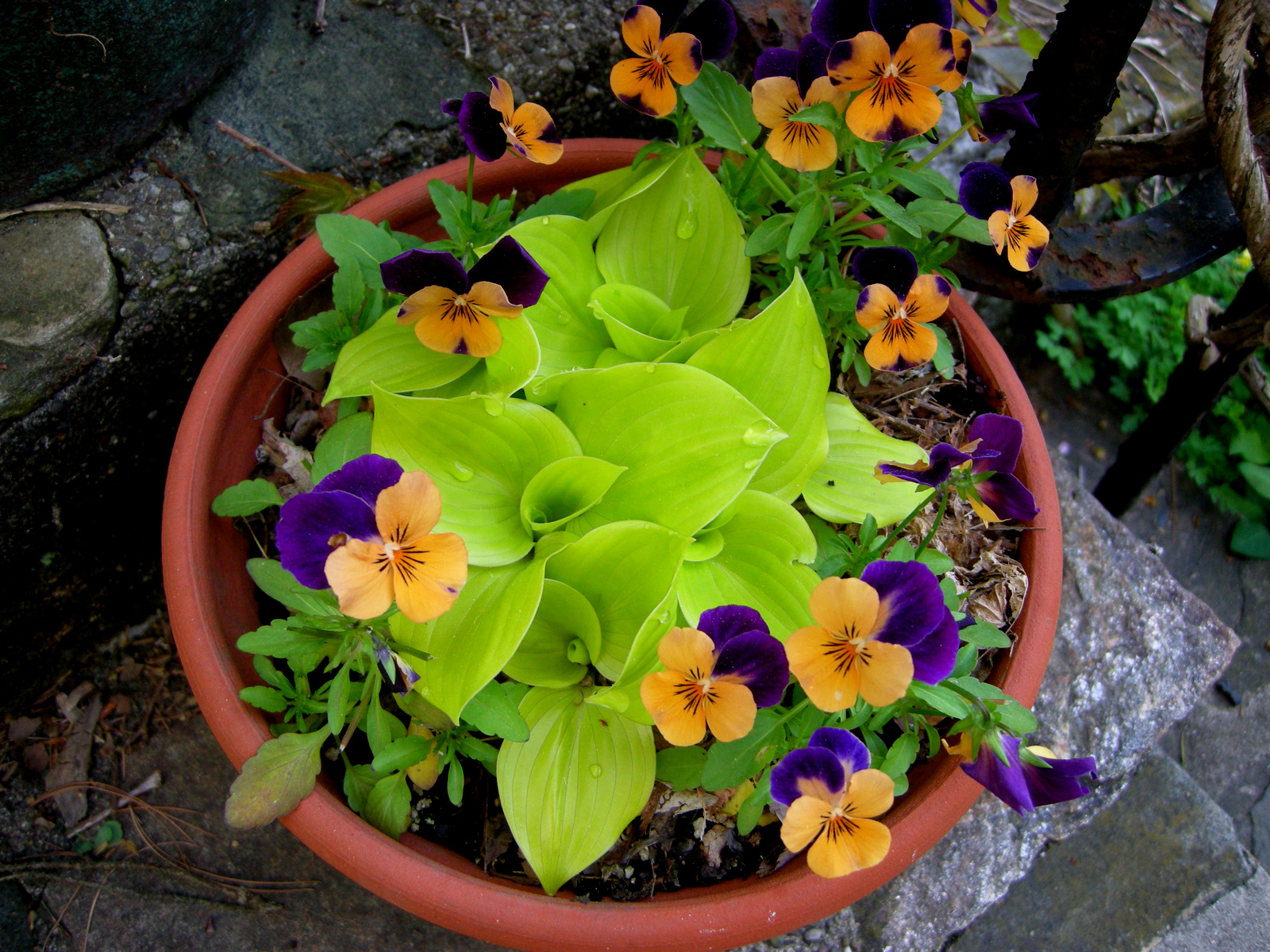
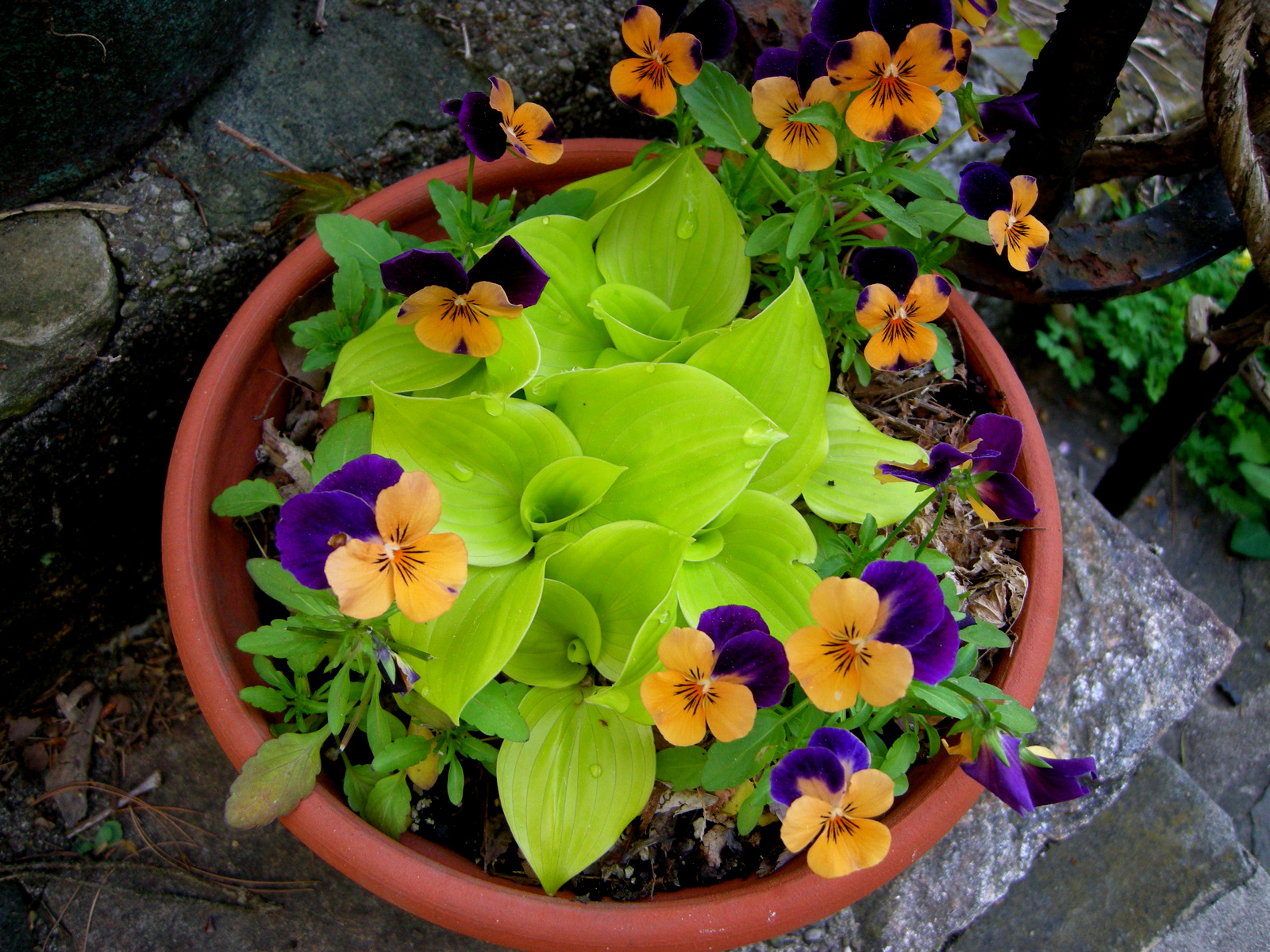
Annual violas and a hosta I selected called “Carolyn’s Malex II” in a glazed strawberry pot that belonged to my grandfather.  There is a different miniature hosta in each of the 16 pockets, and it stays out all winter with no problems for the pot or the hostas.  Don’t you love the little faces on the violas?

Over the years, through trial and error, I have discovered some fail safe pairings for the spring shade garden.  These plant couples look great together while thriving in the same cultural conditions.  Their flower and leaf colors and textures and their habits compliment each other to make pleasing combinations.  Plus they are all easy to grow, requiring no watering, staking, or general fussing after they are established in good organic soil in part to full shade.

Hostas that come up early in the spring, especially miniature hostas, play nicely with almost every plant and are extremely easy to grow:

This pairing is one of my favorite color combinations in the garden.  Hosta montana ‘Aureomarginata’ comes up much earlier than other large hostas.  Its bright green and yellow leaves serve as the perfect backdrop for the orange and yellow flowers of Epimedium x warleyense.


Almost all my miniature hostas come out in time to join the blooming epimediums.  Here is Epimedium grandiflorum ‘Tama No Gempei’ with Hosta ‘Little Wonder’, but you could choose any epimedium and any miniature hosta for a delightful contrast.


A great full shade combination: Hosta ‘Emerald Tiara’ and Japanese woodland primrose, Primula sieboldii (purple form), thrive under my coral bark maple.  Japanese woodland primrose is a mat-forming primrose for full, dry shade not to be confused with Japanese primrose, Primula japonica, which requires moist conditions.


Annual violas and Hosta ‘Crumb Cake’ in a container that stays out all winter.  Small containers are a great way to display choice miniature hostas.


Another plant whose early spring color goes with just about anything is Spiraea japonica ‘Magic Carpet’.  I think I would take this shrub to a dessert island if I had to choose because its deep peach leaves are so gorgeous (and it has fabulous fall color too):

Dwarf spiraea, Spiraea japonica ‘Magic Carpet, with Italian arum, Arum italicum, and PA (Pennsylvania) native coral bells, Heuchera villosa ‘Caramel’.  This is a year round combo because the arum and coral bells remain ornamental through the winter and the spiraea is a solid three-season plant.


‘Magic Carpet’ contrasts nicely with the color and texture of gold-leafed old-fashioned bleeding heart, Dicentra spectabilis ‘Goldheart’.  At first I didn’t like the idea of gold and pink together but with careful pairing ‘Goldheart’ is magnificent.


You can see some of the gold tones starting to emerge in the new leaves on this ‘Magic Carpet’, which is farther from the house.  It looks great with the dark red sedums in this strawberry jar, which also overwinters outside.


‘Magic Carpet’ even pairs well with spider webs.  Every spring I come out one morning to find all the spiraeas covered with webs.


Here are some more great combinations for early spring:

I think that PA native Celandine poppy, Stylophorum diphyllum, goes with everything in spring, but it looks especially beautiful with PA native Virginia bluebells, Mertensia virginica.


I am always captivated by the color combination of the buds of Burkwood viburnum, V. x burwoodii ‘Mohawk’, and the flowers of old-fashioned bleeding heart, Dicentra spectabilis.  ‘Mohawk’ has fantastic fragrance and spectacular orange-red fall color too.  It is a Pennsylvania Horticultural Society gold medal plant.


The airy bronze foliage and yellow flowers of fern-leafed corydalis, Corydalis cheilanthifolia, perfectly compliment the flower color of this 18th century heirloom primrose, Primula x polyantha ‘Old Brick Reds’.


Pulmonarias (lungwort) go with just about anything too:

The early blue flowers and narrow silver leaves of Pulmonaria ‘Diana Clare’ with the abundant pink flowers and silver-striped leaves of Lamium maculatum ‘Shell Pink’, which blooms from April until November and has evergreen foliage.  Pulmonarias also keep their beautiful leaves well into the winter.


I have collected over 25 varieties of pulmonaria, but then I let them self sow all over my garden with glorious results.  Above is a pink seedling pulmonaria with very rare Helleborus dumetorum subsp. atrorubens, but any red flowered hybrid hellebore would complete the pair.


More seedling pulmonarias paired with a purple strain of Lamium maculatum ‘Shell Pink’.


PA native wild ginger, Asarum canadense, and PA native dwarf Jacob’s ladder, Polemonium reptans, carpet my woodlands in early spring.  Together they produce a subtle and peaceful beauty.


I never thought of cushion spurge, Euphorbia polychroma, as a shade plant but it actually thrives in quite a bit of shade: here with hybrid hellebore, H. x hybridus ‘Metallic Blue Lady’.  I also love the cushion spurge cultivar ‘Bonfire’ with red leaves.


I think this is one of the most beautiful combinations in my early spring garden, and it took me over 50 attempted photographs to capture it on film!  Siberian bugloss, Brunnera macrophylla,  cowslip primrose, Primula veris, and spring starflower, Ipheion uniflorum.


Same as above with Ajuga reptans ‘Metallica’.


I will finish my spring combinations with something for all you sunny gardeners: white stonecrop, Sedum album, with tulip ‘Little Princess’.


I hope I have given you some ideas for creative combinations to add to your spring garden.  Please leave a comment/reply with some favorite pairs from your own garden.

Carolyn

Notes: Every word that appears in orange on my blog is a link that you can click for more information.  If you want to return to my blog’s homepage to access the sidebar information (catalogues, previous articles, etc.), just click here.

Nursery Happenings: My second annual Great Hosta Blowout is going on right now.  For details, click here.  Look for Carolyn’s Shade Gardens at the Bryn Mawr Farmer’s Market on Saturday, May 7, from 9 am to 1 pm .  My next open house sale is Saturday, May 14, from 10 am to 3 pm.

Chanticleer Part 1: A Pleasure Garden

Posted in garden to visit, landscape design with tags on April 20, 2011 by Carolyn @ Carolyns Shade Gardens

Nursery News:  Carolyn’s Shade Gardens is a retail nursery located in Bryn Mawr, PA, specializing in showy, colorful, and unusual plants for shade.  The only plants that we ship are snowdrops within the US.  For catalogues and announcements of local events, please send your full name, mailing address, and cell number to carolyn@carolynsshadegardens.com and indicate whether you are interested in snowdrops, hellebores, and/or hostas.  Click here to get to the home page of our website for catalogues and information about our nursery and to subscribe to our blog.

Asian mayapple, Podophyllum ‘Spotty Dotty’

I recently visited the gardens at Chanticleer in Wayne, Pennsylvania, U.S., with garden bloggers from out of town.  In March, I went with Jill from Landscape Lover’s Blog, and on Sunday, I returned with Jean from Jean’s Garden and Jan from Thanks for Today.  Although I visit Chanticleer frequently, looking at the gardens through their eyes gave me a renewed appreciation for just how magical and amazing it is.

March color at Chanticleer, clockwise from upper left: paperbush, Edgeworthia chrysantha; Iris species; Sedum ‘Angelina’; spring-blooming hardy cyclamen, Cyclamen coum

Chanticleer calls itself “A Pleasure Garden” and that title perfectly reflects the unique feeling the garden conveys.  Although it is open to the public, it has an intimacy found only in a garden designed by individuals who are both artists and plantspeople.   Plants are used for their pleasing horticultural attributes, but also as objects in design for color and pattern.  Serious garden elements abound, but whimsy and the element of surprise are just as important.  I have been going to Chanticleer since it opened to the public in 1993, and I have never left without numerous ideas for my own gardens.

More March color at Chanticleer, clockwise from upper left: Iris species; Amur adonis, Adonis amurensis; twin-leaf squill, Scilla biflolia; Kuma bamboo grass, Sasa veitchii

Chanticleer was the country estate of pharmaceutical magnate Adolph Rosengarten and his wife Christine.  The Rosengartens built the original house in 1913 and hired landscape architect Thomas Sears to design the terraces surrounding it.  Additional homes were built for their children in the 1930s.  Adoph’s son left the 35 acre property to the public in 1990, and it opened to visitors in 1993.

March view from the Gravel Garden towards the Serpentine Garden showing the willows being trained and woven to resemble ancient olive trees.

The same view as above in April showing the beds that will be filled with a single annual plant to achieve the serpentine pattern visible from several vantage points in the garden.

Although Chanticleer has many amazing features, the primary attraction for me, and something I find unique to this garden, is the incredible attention to detail both in the big picture (see two photos above) and also in the smallest elements (see top photo).  Although you read this about gardens all the time, Chanticleer takes the concept to heights never approached by any public garden I have ever visited.  To give you a sense of the thoughtfulness displayed throughout the garden, I have decided to organize my photos starting with landscape shots and ending with individual plants, from macro to micro.  In doing this, I hope to convey a feeling for what Chanticleer has to offer.

The long views and big picture landscape design at Chanticleer are gorgeous:

The Gravel Garden contains plants that like hot, dry, Mediterranean conditions, and they are allowed to self-seed to give it a natural unkempt look to link it to the adjoining Ruin Garden.

At this time of year, you can see the “bones” of the Pond Garden, which will shortly be obscured by flowers.

Looking back up the hill from the pond area towards the Ruin and Gravel Gardens.

Back terrace of the Chanticleer house

View from the front terrace of the house to Minder Woods.

Individual gardens are equally as enchanting:

The entrance courtyard garden is filled with colorful annuals and bulbs.

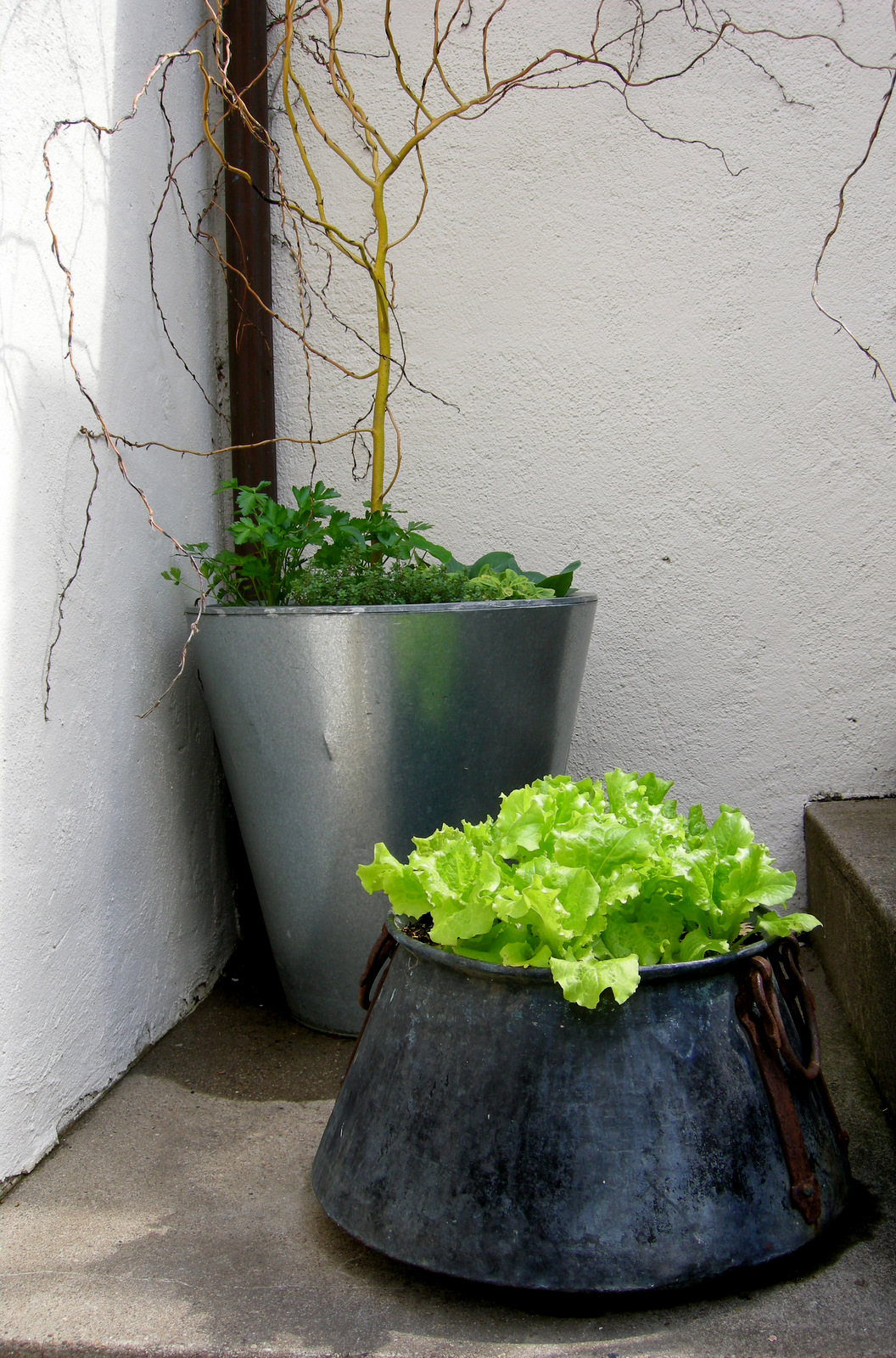
The Teacup Garden is always changing.  Right now it is planted with edible plants, including the different lettuces above used to make blocks of color.

The Gravel Garden extends out to the hill below the ruin and is filled with unusual bulbs.

Spring flowers in the Pond Garden

The gravel in the front courtyard of the Chanticleer house is raked daily to produce a circular pattern, this time of year overlayed with falling cherry blossoms.

The containers at Chanticleer are spectacular:

Entrance courtyard

Teacup Garden

Plantings in the railings leading to the Tennis Court Garden

Some containers display a single plant to perfection, Asian mayapple, Podophyllum ‘Spotty Dotty’.

The artistic elements are very unique, from hardscape to furniture to sculptures:

Marble heads immersed in water in the Ruin Garden

Minimalist containers in the Teacup Garden

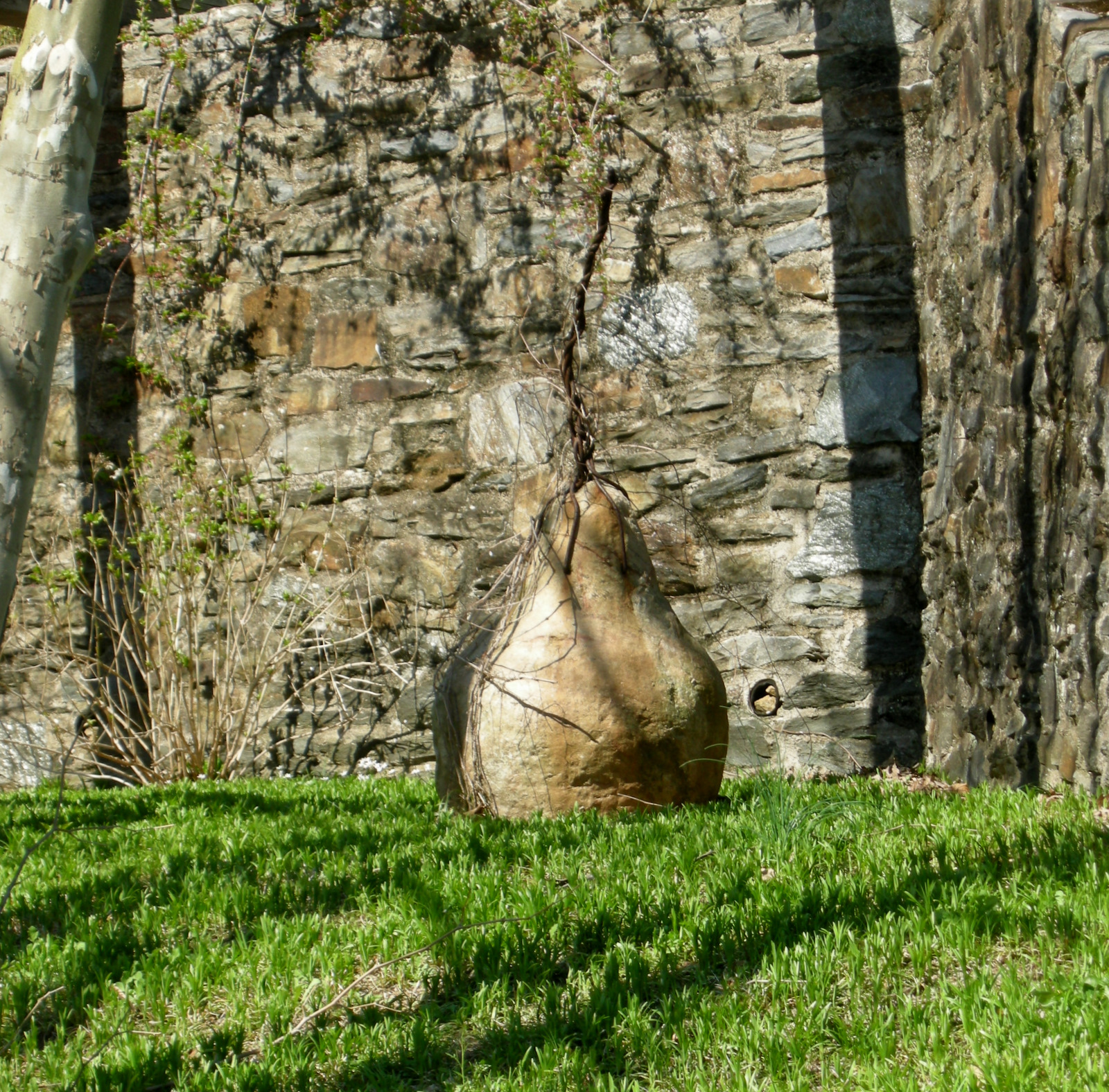
Stone pear in the Pond Garden

Each individual plant is grown and displayed to perfection:

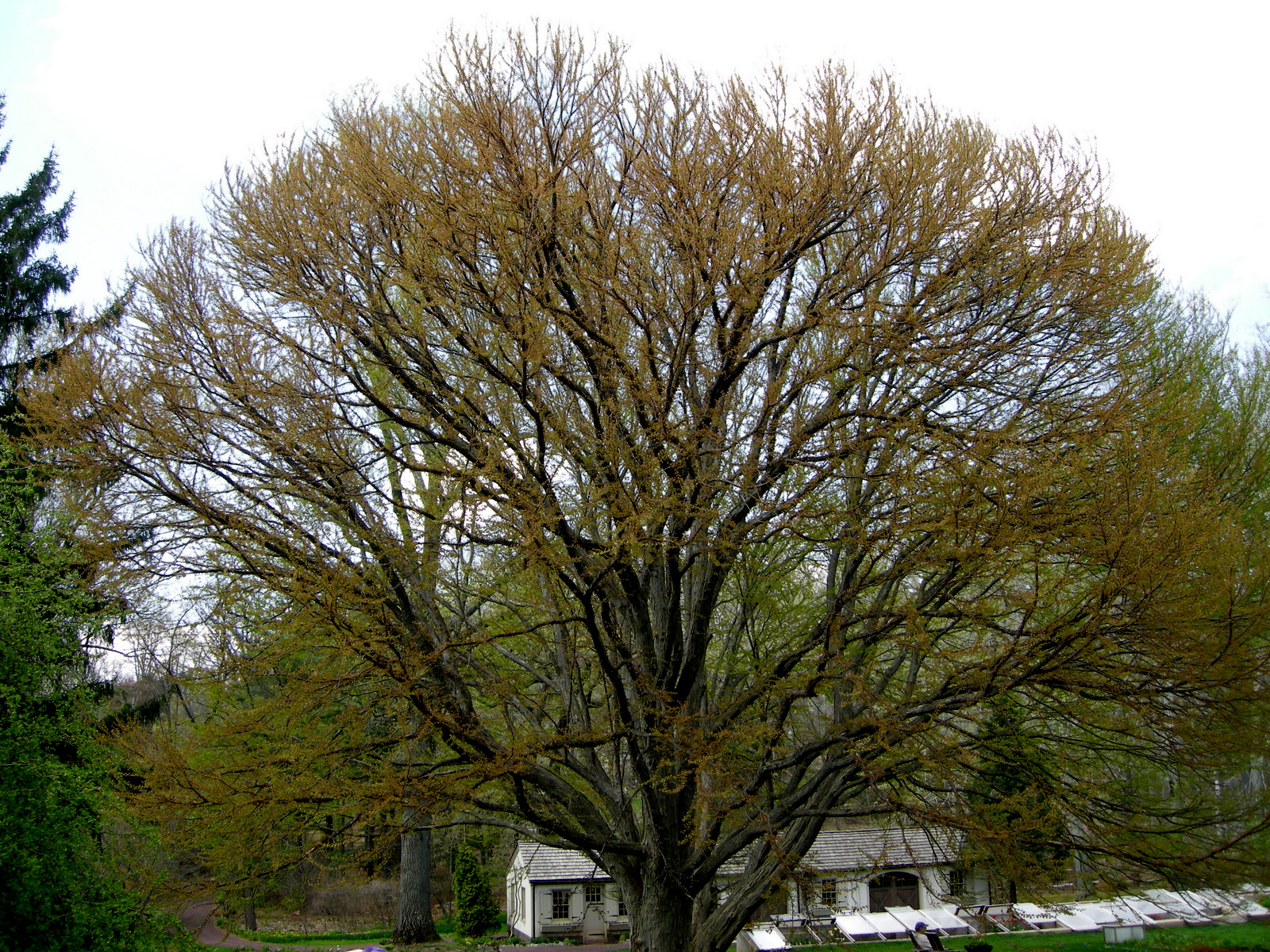
Katsura tree, Cercidiphyllum japonicum, in the Cut Flower Garden

Royal fern, Osmunda regalis, in the Pond Garden

Chanticleer is one of the few gardens I visit where I find shade perennials that I can’t ID.  Jean and Jan stumped me with this one: Chloranthus japonicus (no common name) in the Asian Woods

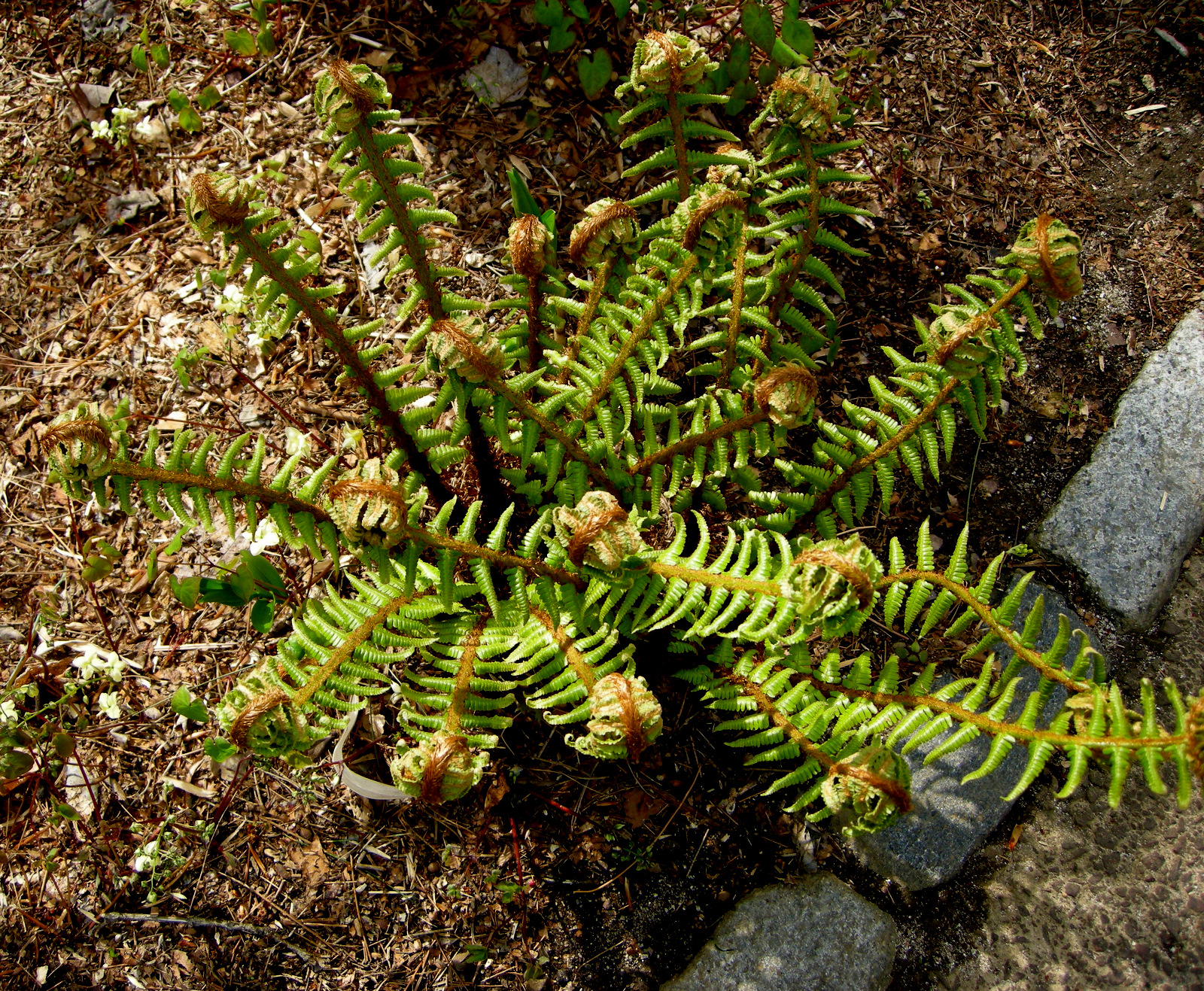
Another plant that stumped me: thick stemmed wood fern, Dryopteris crassirhizoma, in the Asian Woods.  Thanks to Lisa Roper, section gardener for the Asian Woods, for the ID.

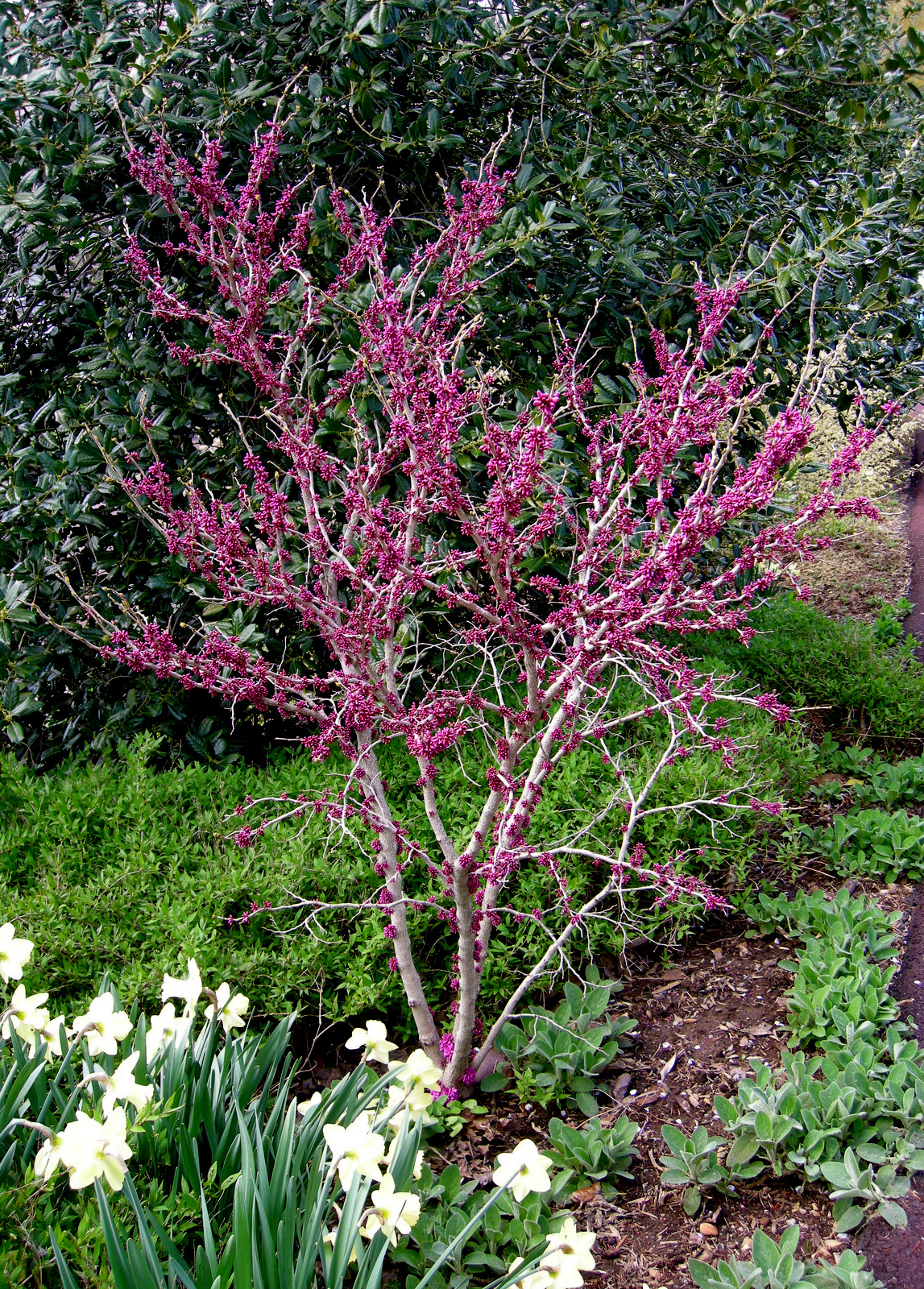
Chinese redbud, Cercis chinensis, along the walk from the parking lot

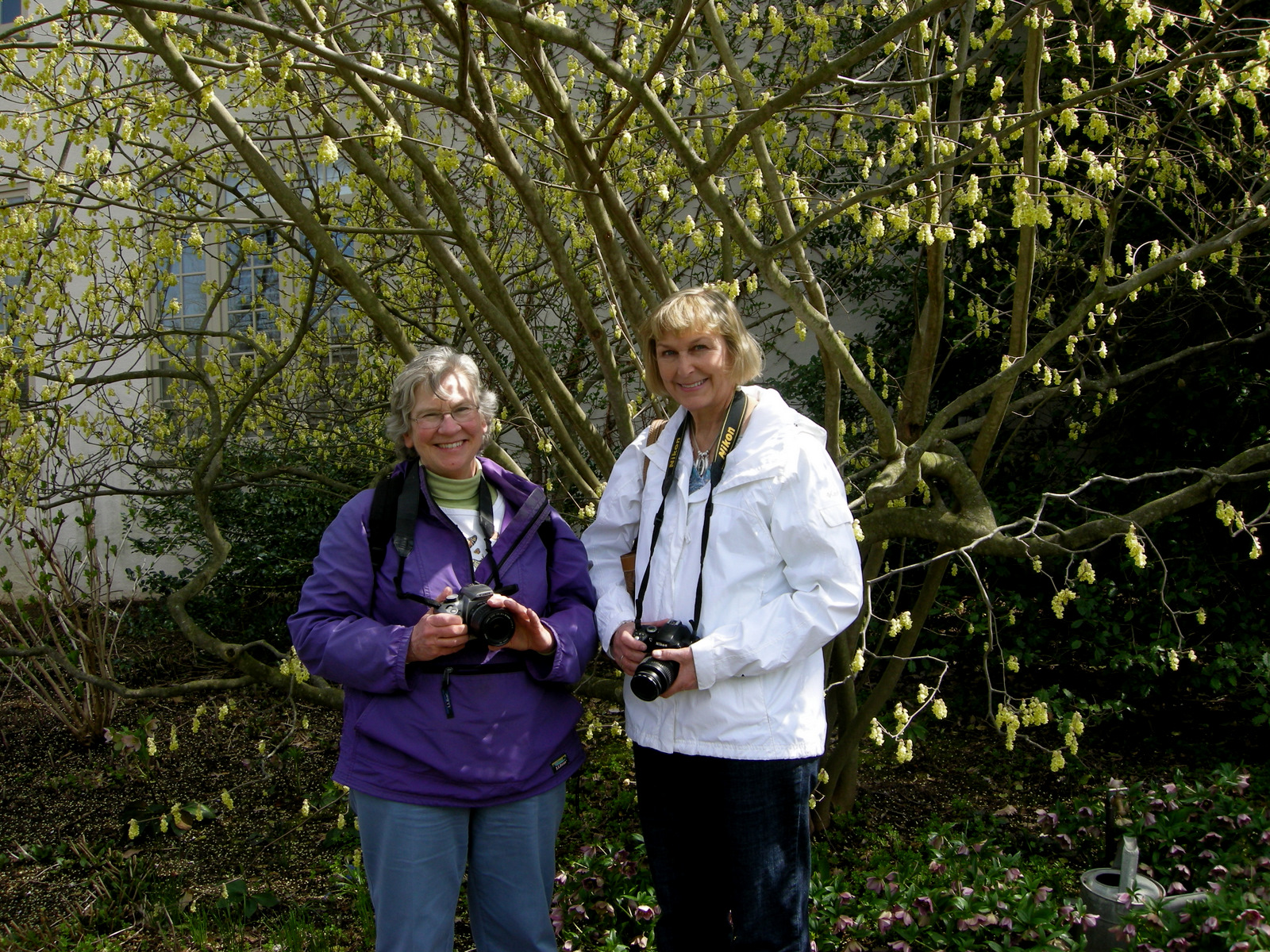
I have tried to give you a sense of how unique this garden is.  I hope to return to Chanticleer monthly and write articles every other month featuring its gardens as they progress through the seasons.  For now I leave you with a photo of my two new friends:

Jean (on the left) and Jan under a winterhazel, Corylopsis, with cameras in hand, of course.

Goodbye for now, Chanticleer, it was indeed a pleasure!

Carolyn

Notes: Every word that appears in orange on my blog is a link that you can click for more information.  If you want to return to my blog’s homepage to access the sidebar information (catalogues, previous articles, etc.), just click here.  I have added Chanticleer to my sidebar under Places to Visit so you will always know where to find it.


April GBBD: How to Choose

Posted in bulbs for shade, Garden Blogger's Bloom Day, hellebores, native plants, Shade Perennials, Uncategorized with tags , , , , , , , , , , , on April 14, 2011 by Carolyn @ Carolyns Shade Gardens

Carolyn’s Shade Gardens is a retail nursery located in Bryn Mawr, PA, specializing in showy, colorful, and unusual plants for shade.  The only plants that we ship are snowdrops and miniature hostas.  For catalogues and announcements of events, please send your full name, location, and phone number (for back up use only) to carolyn@carolynsshadegardens.com.  Click here to get to the home page of our website for catalogues and information about our nursery and to subscribe to our blog.

Time is just flying by, and we have reached the middle of the month when I encourage each of you to walk around your garden and assess what you need to add to make early spring an exciting time in your landscape.  Do you need more early flowering trees like magnolias and cherries to give you a reason to stroll in your garden?  Could your garden benefit from flowers that bloom in early April like native spring ephemerals, bulbs, pulmonarias, and hellebores?

Make a list and take photographs so that when you are shopping this spring you know what you need and where it should go.  It’s beautiful outside, and you never know what you might find hiding in your garden like this ethereal double-flowered hellebore (pictured above), which I discovered during my own  inventory.  Usually I recommend a local garden to visit for inspiration, but I have to say Carolyn’s Shade Gardens is pretty inspiring right now!

Flowering quince, Chaenomeles x superba ‘Texas Scarlet’, with ‘White Lady’ hybrid hellebore

Today is Garden Blogger’s Bloom Day for April when gardeners around the world show photos of what’s blooming in their gardens (follow the link to see  photographs from other garden bloggers assembled by Carol at May Dreams Gardens).  Here are  some more highlights from my mid-April stroll through Carolyn’s Shade Gardens, but to see it all you will have to visit as Jean from Jean’s Garden and Jan from Thanks for Today are doing this Sunday.

My early magnolias are in full bloom.  Magnolias are my favorite flowering trees, and I want to share these early-blooming varieties with you:

Northern Japanese Magnolia, Magnolia kobus ‘Wada’s Memory’, has the most beautiful form of any magnolia.  The branches curve upwards to form an elongated pyramid, which is maintained even on mature plants.

‘Wada’s Memory’ flower

Star magnolia, Magnolia stellata, blooms so early that it often gets damaged by frost, but amazingly the flowers are magnificent this year.

Star magnolia flowers

I have waited over 15 years for my Yulan magnolia, Magnolia denudata, to bloom, but once I saw mature trees at Longwood Gardens, I had to have one!  It was worth the wait.

My ingenious 13-year-old son used a grappling hook to pull a branch down and clip a Yulan magnolia flower for me to photograph.

There are so many beautiful hellebores in bloom that I made collages of my favorite flowers so that this whole post wasn’t dedicated to hellebores:

Clockwise from upper left: seedling double hybrid hellebore, ‘Mrs. Betty Ranicar’, ‘Velvet Lips’ (don’t you love that name?), ‘Painted Bunting’

Clockwise from upper left: seedling petaloid hybrid hellebore, ‘Blue Lady’, Helleborus x nigercors ‘Green Corsican’ (cross between Corsican hellebore and Christmas rose), seedling in ‘Double Melody’ strain

Clockwise from upper left: double from ‘Golden Lotus’ seed strain, ‘Raspberry Mousse’, ‘Goldfinch’, seedling petaloid hybrid hellebore

I could dedicate the whole post to epimediums too so here are more collages:

Clockwise from upper left: ‘Yubae’, Epimedium x rubra, ‘Cherry Tart’, ‘Sweetheart’

Clockwise from upper left: ‘Shrimp Girl’, ‘Orange Queen’, Epimedium x warleyense, ‘Cupreum’

I have a collection of about 15 varieties of European wood anemones, and April is their time to shine.  They are very easy to grow in shaded woodland conditions:

Left to right from upper left: Anemone nemorosa pink form; Anemone x seemanii; ‘Alba Plena’; ‘Leed’s Variety’; ‘Bractiata’; ‘Allenii’; ‘Vestal’; Anemone ranunculoides; ‘Wyatt’s Pink’

European wood anemones spread to form a sizable and eye-catching patch even in dry shade, photo above of the yellow flowers of Anemone ranunculoides.

I want to share so many exciting blooming plants with you that I don’t know how to choose the photographs to include, hence the title of this post.  Here are other plants that made the cut:

Red lungwort, Pulmonaria rubra ‘Redstart’, is a very unusual pulmonaria with green fuzzy leaves.

Winterhazel, Corylopsis species, unfortunately for the first time ever our late freezes damaged most of the flowers.

Obviously not a bloom, but I wanted to show you the early color of native variegated dwarf Jacob’s ladder, Polemonium reptans ‘Stairway to Heaven’.

Native rue anemone, Anemonella thalictroides double pink form

I planted a mixture of daffodils in the middle of my raised beds, and this lovely seedling appeared in the path.

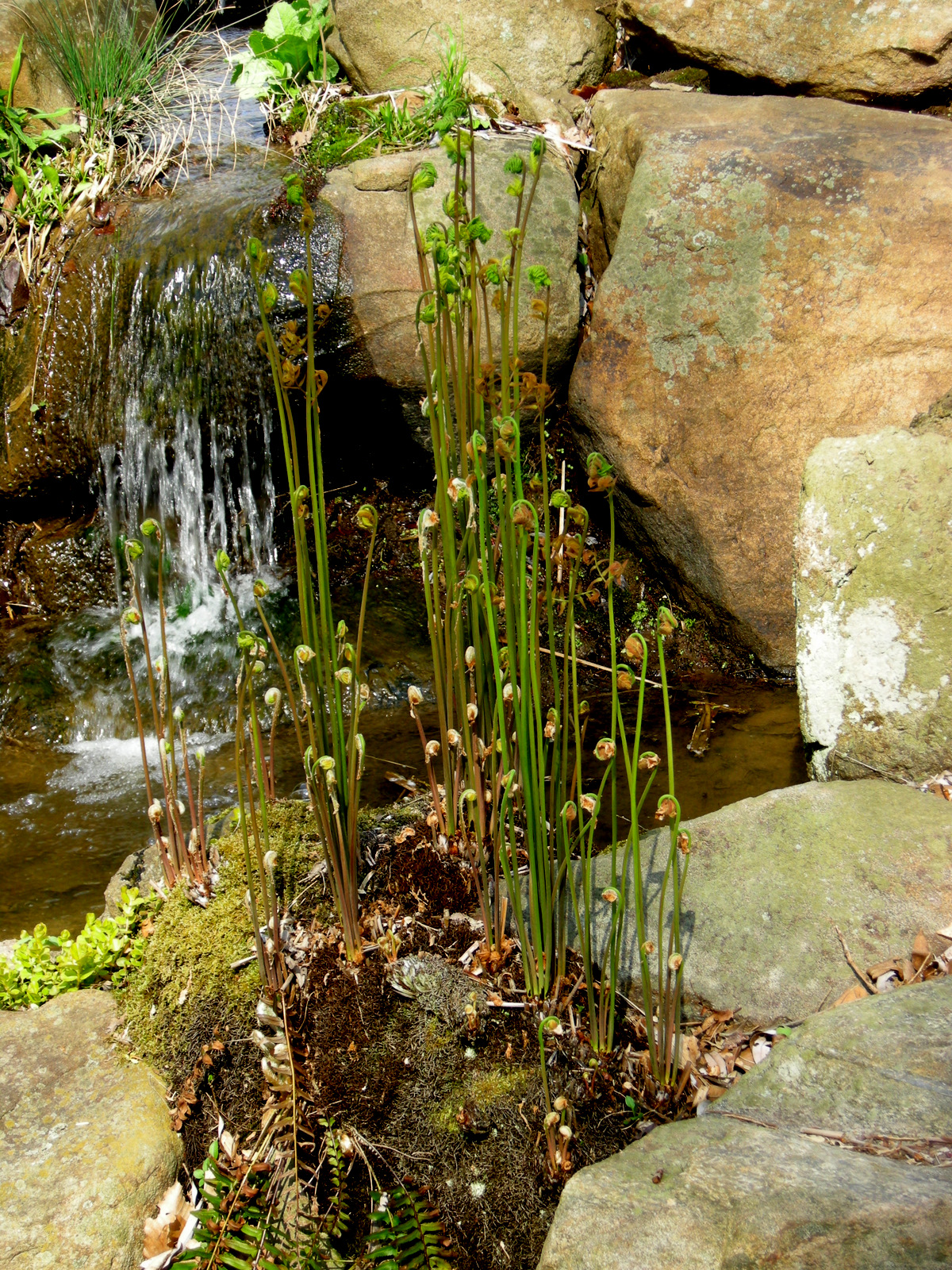
Native cinnamon fern, Osmunda cinnamomea, is gorgeous as it unfurls.

A seedling Helleborus multifidus underplanted with the spring ephemeral  Cardamine quinquefolia.

The many colors of Corydalis solida when allowed to seed.  I am planning an article on this plant in the future.

Who could have planned this combination?  Native coral bells, Heuchera villosa ‘Caramel’, with a seedling glory-of-the-snow, Chionodoxa forbesii.

The new leaves and flowers of Japanese coral bark maple, Acer palmatum ‘Sango-kaku’, are breathtaking in early spring.  For the full story on this four season tree, read my article Coral Bark Maple.

My latest spring-blooming camellia addition, Camellia x ‘April Rose’, a formal double.


For breath-taking beauty in early spring you can’t beat cherry trees:

A very mature Yoshino cherry, Prunus x yedoensis, that came with our property.  I love the fleeting nature of the flowers and look forward to the day every spring when it rains petals in my nursery.  Its orange fall color is spectacular.

My favorite cherry (at least for today), Prunus x incam ‘Okame’, dominates my courtyard garden in early spring.


I will end with a heart full of cherry blossoms because I love early spring!

Please let me know in a comment/reply what flowers are blooming in your early spring garden.  If you participated in GBBD, please provide a link so my nursery customers can read your post.

Carolyn


Notes: Every word that appears in orange on my blog is a link that you can click for more information.  If you want to return to my blog’s homepage to access the sidebar information (catalogues, previous articles, etc.), just click here.

Nursery Happenings: My second open house sale is this Saturday, April 16, from 10 am to 3 pm, featuring early spring-blooming plants for shade.

Supporting Sustainable Living: Part One

Posted in garden essay, green gardening, native plants, organic gardening with tags , , , , , , , , , , , , , , , , , , , , on April 7, 2011 by Carolyn @ Carolyns Shade Gardens

Carolyn’s Shade Gardens is a retail nursery located in Bryn Mawr, PA, specializing in showy, colorful, and unusual plants for shade.  The only plants that we ship are snowdrops and miniature hostas.  For catalogues and announcements of events, please send your full name, location, and phone number (for back up use only) to carolyn@carolynsshadegardens.com.  Click here to get to the home page of our website for catalogues and information about our nursery and to subscribe to our blog.

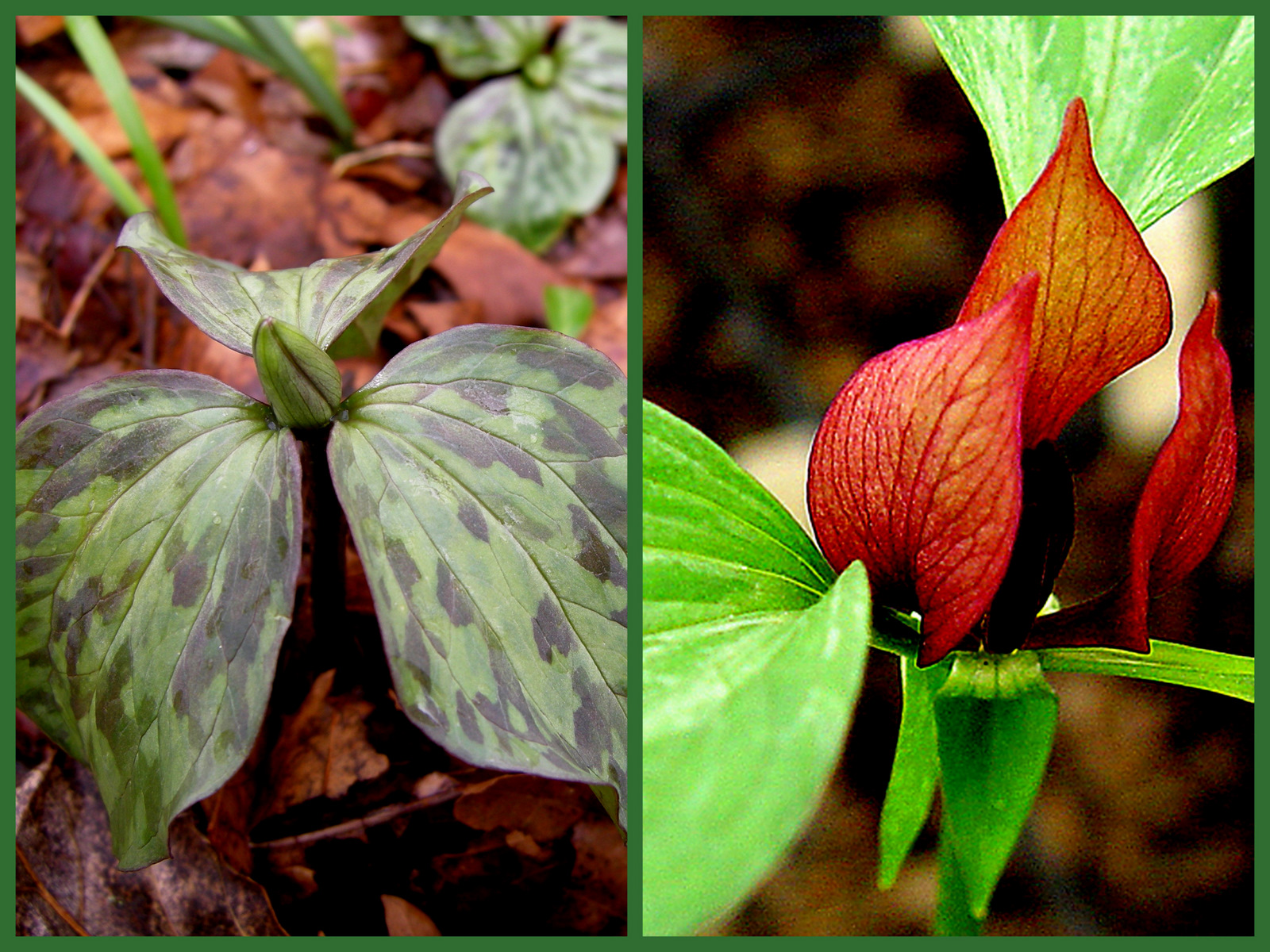
PA native bloody butcher (attractive common name!), Trillium recurvatum, is just forming its buds now and will produce its beautiful flower shortly (photo on right Arrowhead Alpines).

All photos in this article are of plants native to Pennsylvania (PA) available at “Bulb and Native Wildflower Day” on April 9 at my nursery.  Single photos and the left photo in collages show the plants in my garden today.

Jan who writes the garden blog Thanks for Today is doing something wonderful, and  I want all my readers, subscribers, and customers to participate in Jan’s project.  Jan has started the Gardeners’ Sustainable Living Project, which celebrates Earth Day  by encouraging gardeners to get together and share the big and small things that they are doing anywhere in their lives to support sustainable living.  If you read my blog, you know that this is an important topic for me.

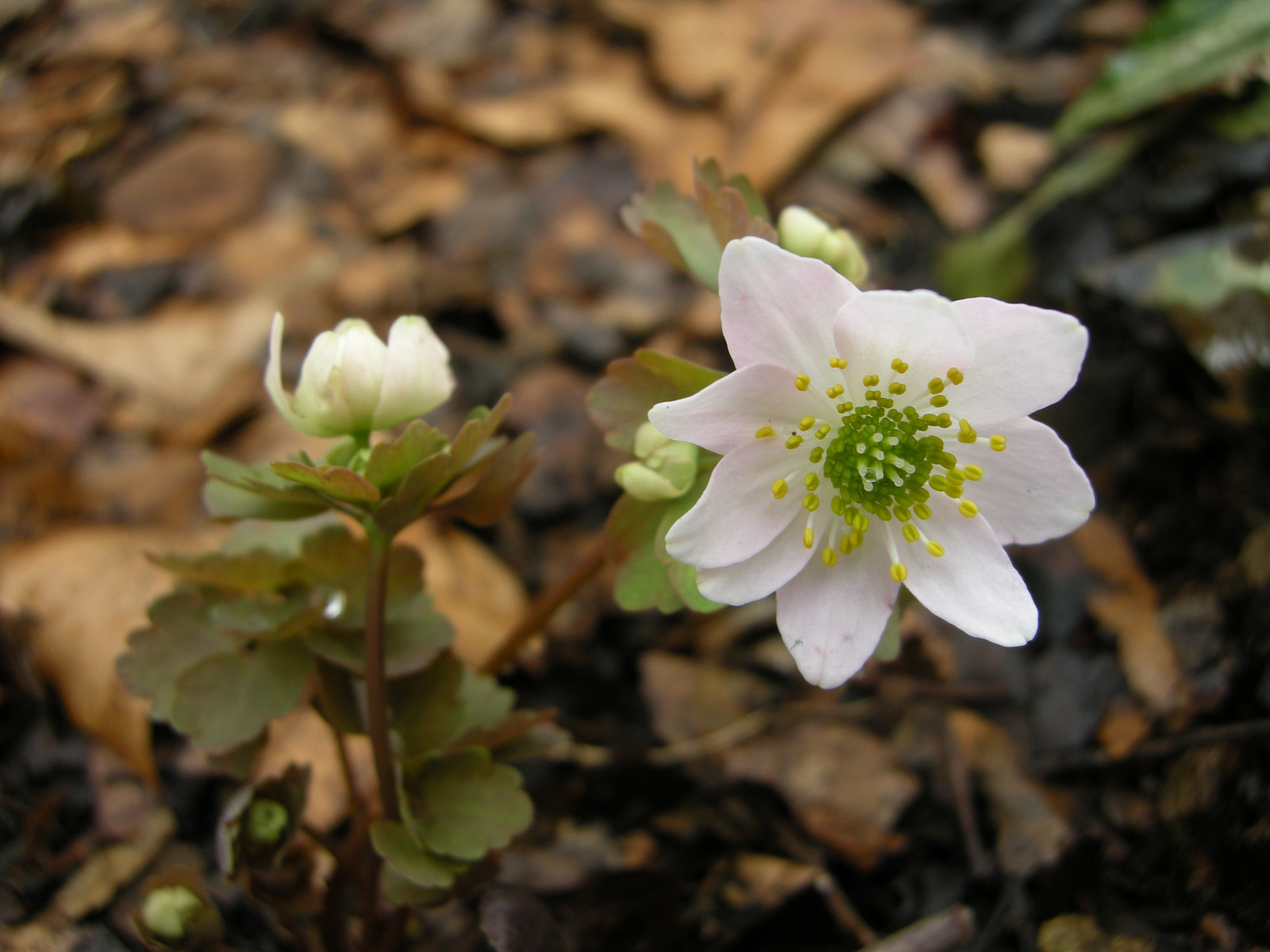
PA native rue-anemone, Anemonella thalictroides, is a dainty woodlander in full bloom right now.

To participate in the project, all you have to do is click on the Gardeners’ Sustainable Living Project link below and leave a comment describing a few of your own sustainable living practices.  If you are a garden blogger, you can write a post about your efforts, but Jan only requires a comment.  If you participate by April 15, you become eligible to receive all kinds of fun prizes.  I got so excited about the project, I decided to contribute a prize of my own: a snowdrop collection.  For prize details, click here.

The buds of PA native Celandine poppy, Stylophorum diphyllum, are just starting to show color, and the flowers will cover the plant for at least six weeks (photo on right Missouri Botanical Garden PlantFinder).

While you are leaving your comment, you can read all the posts written by garden bloggers telling you what they are doing to promote sustainability.  Donna at Gardens Eye View in her article  on “Trust” points out that we have been entrusted with the earth and we should leave it the way we found it.  She tells us about her efforts to do that.  Jean at Jean’s Garden explains how she has “come to understand how my plant choices can affect ecological systems and environmental balance.”

PA native twinleaf, Jeffersonia diphylla, is just pushing out of the ground in my garden (photo on right Missouri Botanical Gardens PlantFinder).

Pam at Pam’s English Cottage Garden was inspired by Barbara Kingsolver’s book Animal, Vegetable, Miracle: A Year of Food Life to “be more mindful of my carbon footprint by eating locally grown foods that are in season, and by supporting local farmers.”  Allan at allanbecker.gardenguru describes a wide range of “respectful grass roots initiatives that influence both consumer behavior and the agendas of local officials” while  promoting sustainability.  You can get a lot of great ideas by reading these thoughtful articles and all the others linked there.

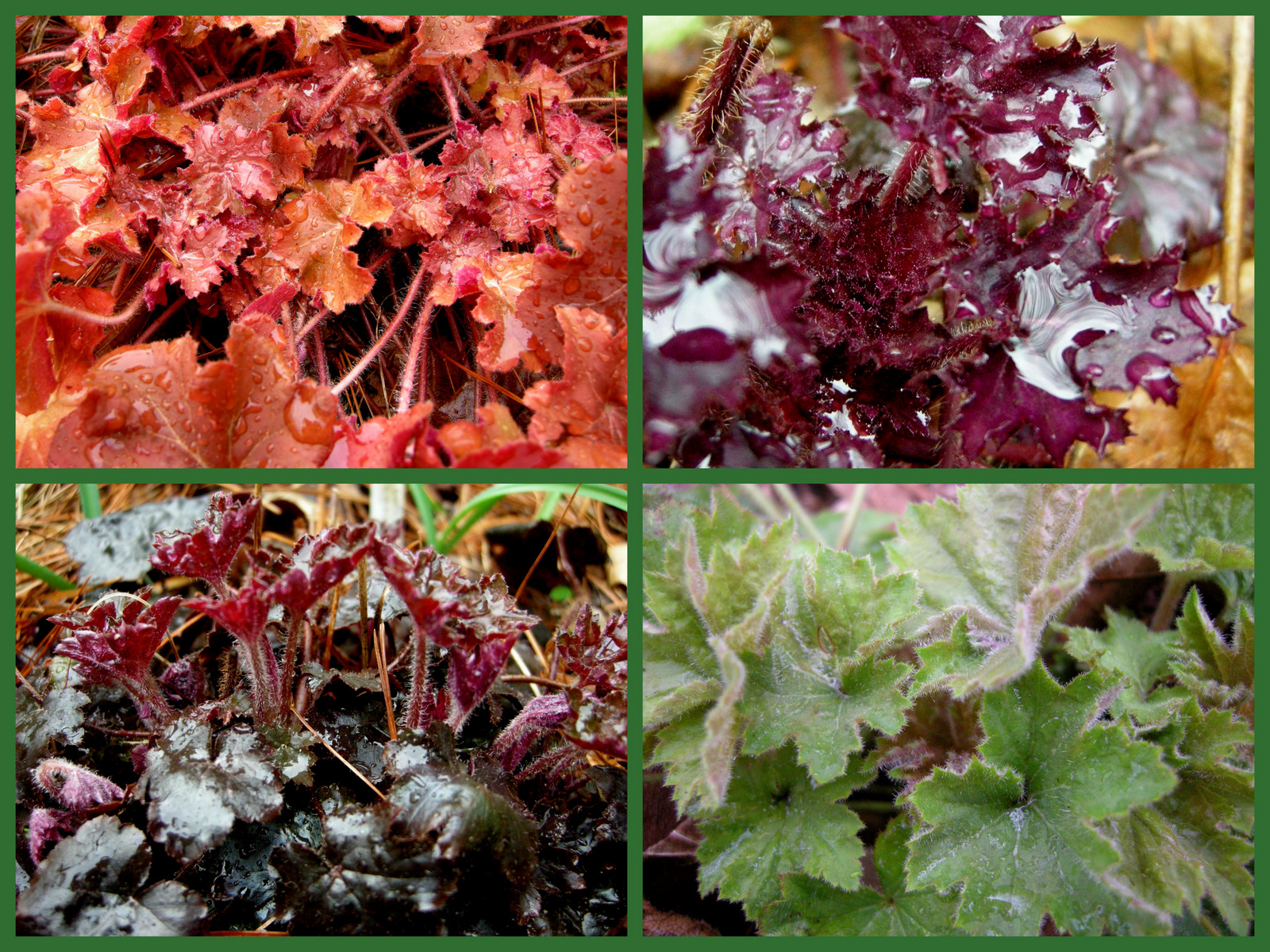
I love the early spring colors of emerging PA native coral-bell leaves.  Clockwise from upper left: Heuchera villosa ‘Caramel’, ‘Frosted Violet’, ‘Autumn Bride’, ‘Blackout’.

So what am I doing to promote sustainability?  For my whole gardening life, I have been organic, not using any herbicides, pesticides, or chemical fertilizers.  I don’t water except to establish new plants and, by following gardening practices like grinding my leaves (seeFall Clean-up and Leaves on the Lawn) and composting, I have restored the soil to its former pristine state.  I have gotten rid of almost an acre of lawn and replaced it with large areas of plants native to Pennsylvania.  In Maine, I founded and continue to run a community based invasive plant removal program whose goal is to eliminate all invasive plants from the small island where we vacation.

PA native Virginia bluebells, Mertensia virginica, is just about to come into full bloom in my garden.

Several years ago, though, I realized that I am uniquely placed to have an even larger impact in this area through my nursery.  As my customers ask me for advice and as I talk to the horticultural groups touring my display gardens, I emphasize sustainable practices and demonstrate how they work in my own gardens.  Instead of being lectured to in a darkened room, these gardeners are seeing  living proof that the sustainable methods I advocate have worked to create beautiful gardens.

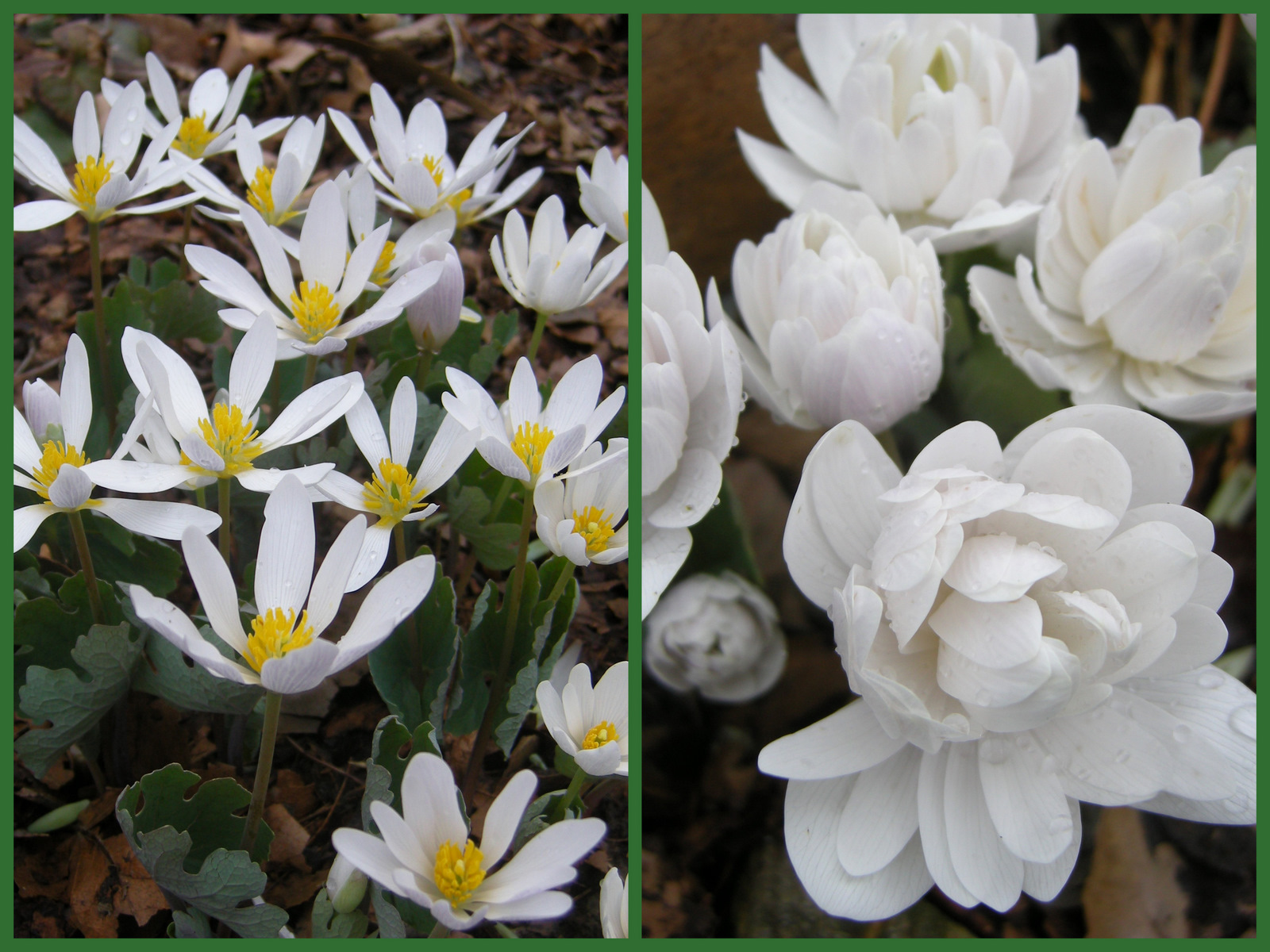
PA native bloodroot, Sanguinaria canadensis, is in full bloom right now.  The rare double form ‘Multiplex’, pictured on the right, is much longer blooming.

Reading Doug Tallamy’s book Bringing Nature Home: How You Can Sustain Wildlife with Native Plants was a turning point for me.  I finally understood why planting native plants is not just a “good thing”, but absolutely crucial to our survival.  I wrote about this in My Thanksgiving Oak Forest,  and I hope you will read my article.  Now I give out a synopsis of the book to the hundreds of customers who attend events at my nursery each year in hopes that they too will be inspired.

My new yellow signs boldly demonstrate which plants are native in my woodland garden.

As a result of my new understanding, I increased my emphasis on native plants at the nursery.  Native plants appear in green print in my catalogue.  I purchased new signage for the garden and the nursery so natives could have their own special yellow signs (see photo above) while non-natives have white.  I am about to have my sixth annual native wildflower day on April 9 during which customers can shop for a wide assortment of almost 40 native perennials, not including the native ferns that will be offered at my fern sale.
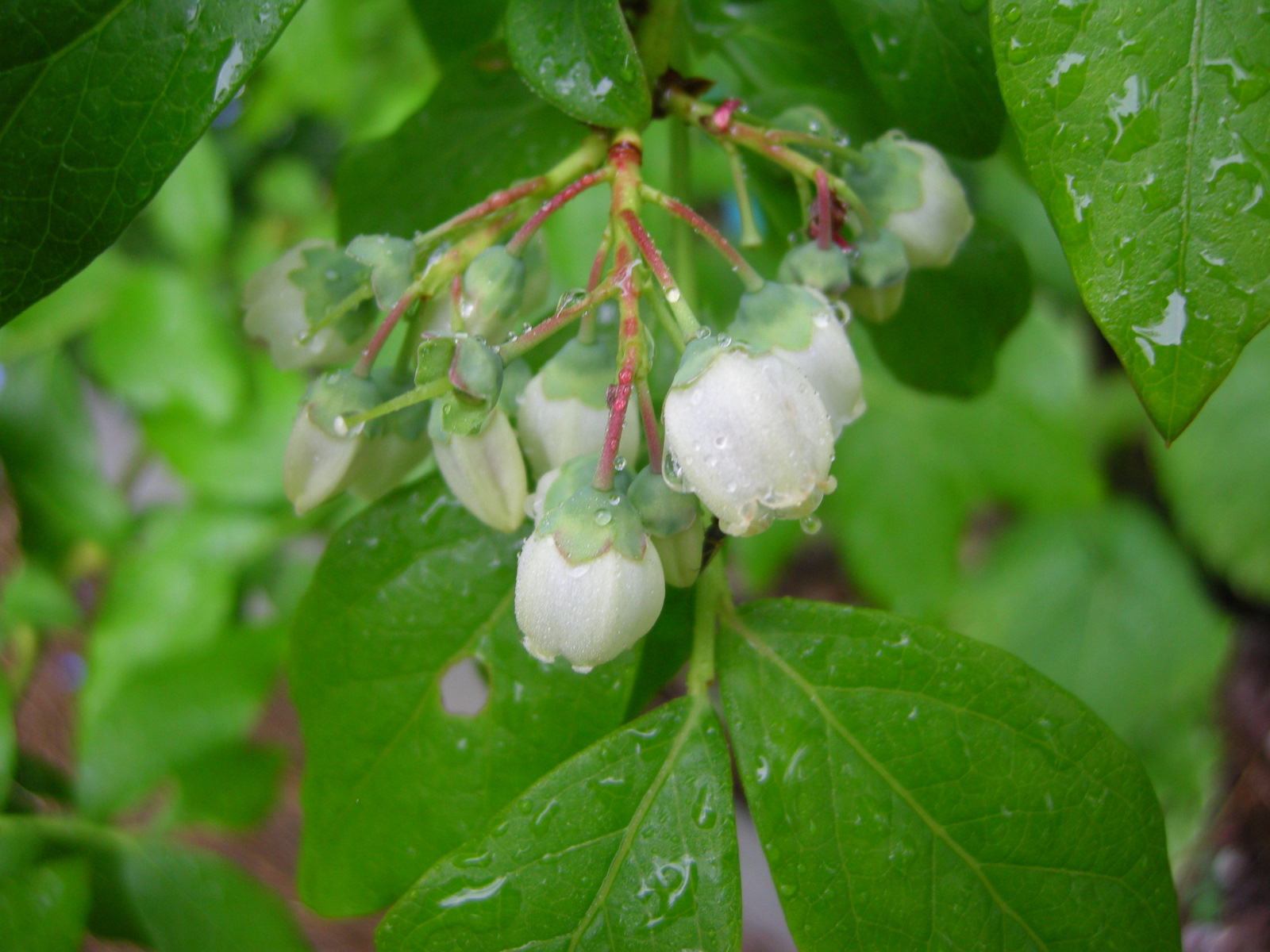
The foliage of PA native dwarf Jacob’s ladder, Polemonium reptans ‘Blue Pearl’, is evergreen, and the plants are covered with buds right now.

My two acres of display gardens demonstrate how desirable non-native plants can be incorporated into the sweeps of native plants that dominate my landscape.  And I have used my blog with its 450 customer-subscribers and 26,000 views since November to promote the planting of natives (see, for example, My Thanksgiving Oak Forest, New Native Shade Perennials for 2011, and Woody Plants for Shade).
The early leaves of PA native wild columbine, Aquilegia canadensis, are a beautiful deep blue-green and are followed by lovely flowers in April and May.

So now, what do I want you to do?  Please go to http://thanksfor2day.blogspot.com/2011/03/gardeners-sustainable-living-2011-win.html and leave a comment describing a few of your own sustainable practices.  I know many of my customers are reading my blog because almost everyone who has visited this year has said “I love your blog”.  Now you can thank me by supporting Jan’s project and mentioning in your comment that you came from Carolyn’s Shade Gardens.

Carolyn

Notes: Every word that appears in orange on my blog is a link that you can click for more information.  If you want to return to my blog’s homepage to access the sidebar information (catalogues, previous articles, etc.), click here.

Nursery Happenings: My next nursery event is Bulb and Native Wildflower Day on Saturday, April 9, from 9 am to 3 pm.  My next open house sale features early spring-blooming shade plants and is Saturday, April 16, from 10 am to 3 pm.  For details and directions, click here.