Archive for Carolyn’s Shade Gardens

Woody Plants for Shade Part 7

Posted in Camellias, evergreen, Fall Color, native plants, Shade Shrubs, shade vines, winter interest with tags , , , , , , , , , , , , , , , , , , , , , , on March 25, 2013 by Carolyn @ Carolyns Shade Gardens

Carolyn’s Shade Gardens is a retail nursery located in Bryn Mawr, PA, specializing in showy, colorful, and unusual plants for shade.  The only plants that we ship are snowdrops and miniature hostas.  For catalogues and announcements of events, please send your full name, location, and phone number (for back up use only) to carolyn@carolynsshadegardens.com.  Click here to get to the home page of our website for catalogues and information about our nursery and to subscribe to our blog.

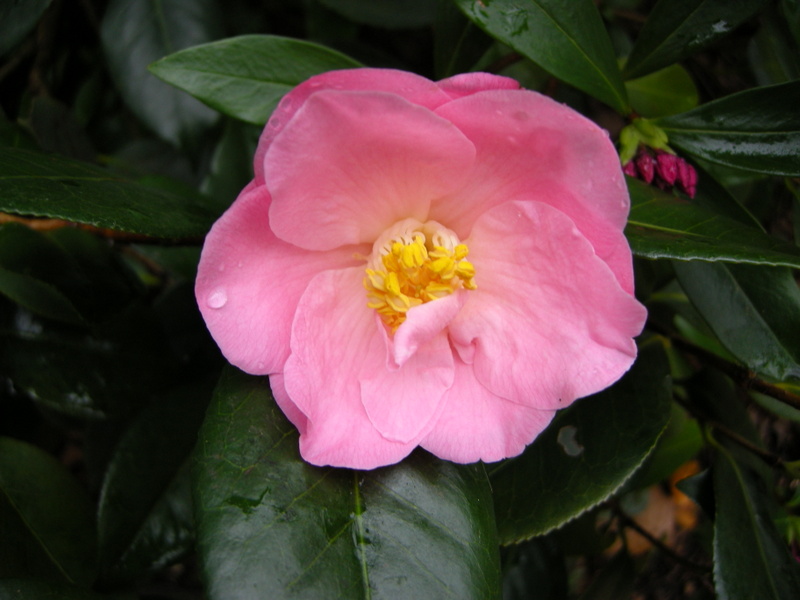
Camellia x 'Spring's Promise'Spring-blooming camellia ‘Spring’s Promise’ is available in the current offer but was profiled in a previous woody plant post so I am not describing it here.  However, it is a favorite of mine, and I wanted to include a photo.  For a full write up of this plant,  go to Woody Plants for Shade Part 1.

.

My nursery, Carolyn’s Shade Gardens, specializes in perennials for shade with an emphasis on hellebores, unusual bulbs especially snowdrops, hostas particularly miniature hostas, native plants, and ferns.  However, a satisfying shade garden does not consist of just perennials but includes trees, shrubs, and vines.  I provide a quality source for these plants by doing a special offer three times a year. 

I have just sent my first 2013 list to my customers.  To view the catalogue, click here.   However, I thought my blog readers who are not customers might be interested in learning about the woody plants that I would recommend they add to their shade gardens.  And doing an article allows me to add more information and explain why I chose the plants I included so customers might be interested also.

.

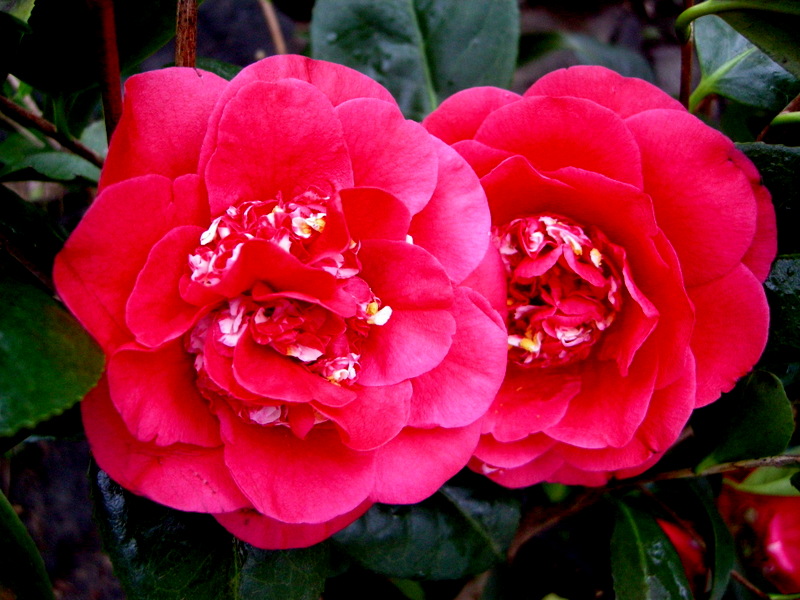
Camellia japonica 'Korean Fire'Spring-blooming camellia ‘Korean Fire’ has the most beautiful leaves of any camellia.

The offer focuses on winter- and early spring-blooming plants, evergreens and winter interest, native plants, and fragrance.  Included are four camellias, six other shrubs, and one vine.  Six of the plants I have chosen are evergreen, and seven bloom off season, in fall or late winter/early spring.   This reflects  my desire to see gardeners expand their gardens’ season beyond spring and summer to become a year round paradise for them to enjoy.  With that introduction, here are the plants I am highlighting:

Camellia japonica 'Korean Fire'‘Korean Fire’


I included four hardy camellias for their spectacular early (or late) season flowers and elegant evergreen leaves. These camellias, along with many other cultivars, have been selected to be fully cold hardy in the mid-Atlantic U.S, zones 6B and 7A.  Nevertheless all camellias benefit from being sited to shelter them from winter wind, which comes from the northwest.  They also maintain their lustrous dark green leaves in better shape if they are sheltered from winter sun.

‘Korean Fire’ is a Camellia japonica cultivar hardy in our area because it was selected from the most northern range of the species.  It has very showy bright red single flowers in April and May and glossy dark evergreen leaves.  It grows to 10′ tall and 6′ wide in part to full shade.  It was introduced by Barry Yinger of Asiatica Nursery from plants collected in Korea in 1984 and has received the Pennsylvania Horticultural Society Gold Medal Award for outstanding plants for our area.

.
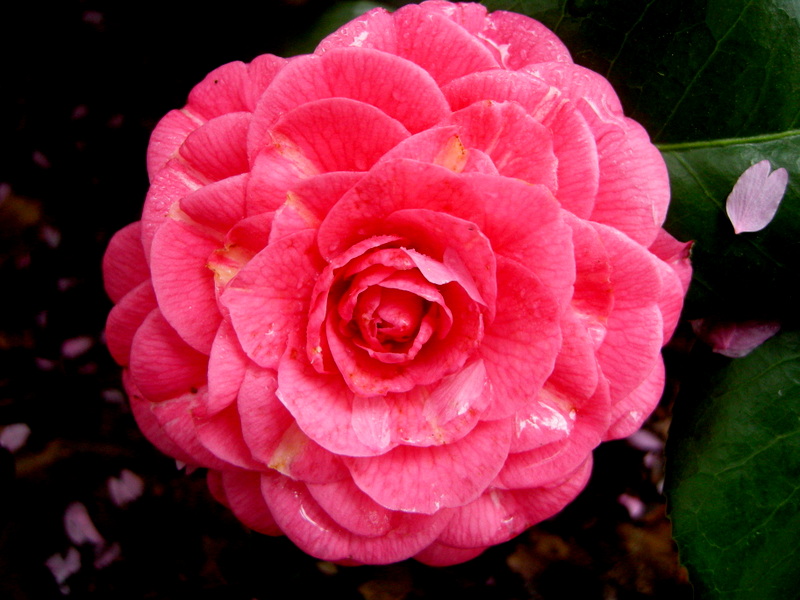
Camellia x 'April Rose'‘April Rose’ spring-blooming camellia

Camellia x ‘April Rose’ is a spring-blooming hardy camellia with gorgeous plump buds opening to formal double rose-pink flowers in April and May.  It has large glossy dark evergreen leaves.  It is 5’ tall and 4′ wide, growing in part to full shade.  It is part of the April series of exceptionally cold hardy camellias developed by Dr. Clifford Parks of North Carolina.

.
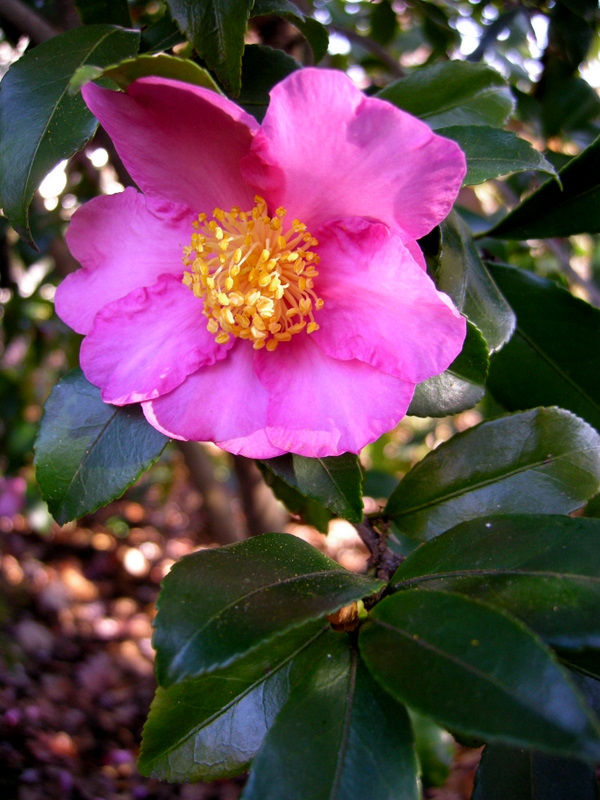
Camellia x 'Winter's Star'Fall-blooming camellia ‘Winter’s Star’

‘Winter’s Star’ is a fall-blooming, cold hardy camellia with single pink flowers in October and November and glossy evergreen leaves.  It is a vigorous plant with an upright habit, reaching 6′ tall and 5′ wide at maturity and sporting lustrous dark evergreen leaves in part to full shade.  It was selected for cold hardiness by Dr. William Ackerman at the U.S. National Arboretum in Washington, DC.

.
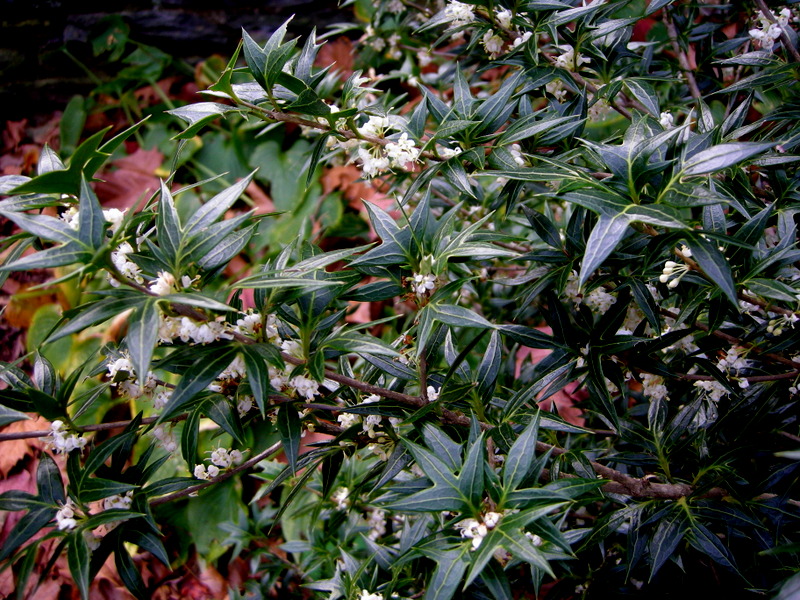
Osmanthus heterophyllus 'Sasaba'‘Sasaba’ holly osmanthus (also known as holly tree olive), O. heterophyllus, blooms in the fall and is beautifully fragrant.

Fall-blooming holly osmanthus‘Sasaba’  is the fifth evergreen in the offer, and I would grow it just for its dramatic, deeply incised dark evergreen leaves.  Its delicious fragrance perfumes my whole hillside in November when it blooms: if you are visiting you can see it on the back hill.  Its prickly foliage repels deer.  It grows 6’ tall and 4’ wide in full sun to full shade.

.

Japanese mahonia, Mahonia japonica, is the sixth evergreen in the offer.  It was previously profiled here, but I am including it again because I think it is the most fragrant and best all round mahonia species.

.

There are four deciduous shrubs in the offer:

Chaenomeles speciosa 'Texas Scarlet'‘Texas Scarlet’ flowering quince, Chaenomeles x superba, is another repeat.  This compact selection gives you the wonderful early flowers of quince without the lethal thorns and out-of-control growth habit of normal quinces.  For a complete profile, click here.

.
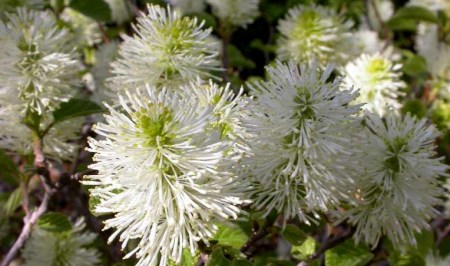
Fothergilla MOBOTThe lovely fragrant flowers of fothergilla.

.

Fothergilla gardeniiThis is a photo of my unselected fothergilla so I can only imagine what ‘Red Licorice’ must look like in the fall.

.

Native ‘Red Licorice’ fothergilla has honey-scented, white bottlebrush flowers in April and May.  It is a new fothergilla cultivar selected for its spectacular cherry red fall color.  It grows to 6’ tall and 5’ wide in full sun to full shade.  It is wet site tolerant,  deer resistant, and attracts butterflies.  It is native to the southeastern US.

.

Kerria japonica Golden Guinea_DK‘Golden Guinea’ Japanese kerria, Kerria japonica, produces copious amounts of large, bright gold flowers.

.
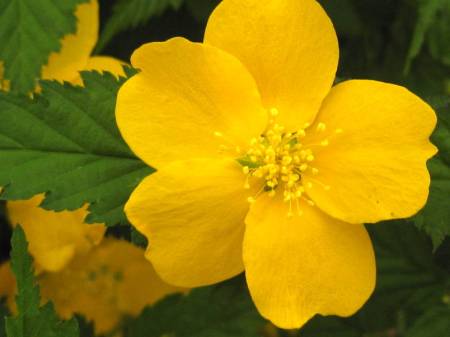
Kerria japonica Golden Guinea2 apr_LS (1)A close up of ‘Golden Guinea’

.

‘Golden Guinea’ Japanese kerria is covered with 2 ½” yellow flowers  in April and May and then reblooms sporadically.  It has delicate, bright green pointed leaves, and its graceful stems are a vibrant green providing great winter interest.  It grows to 5’ tall and 4’ wide in part sun to almost full shade (full sun bleaches the flowers).  Kerria grows in average garden soils, is tough and adaptable, and resists deer.

.

Rhododendron arborescens 1-15-13_LS (1)The lovely buds of native sweet azalea, Rhododendron arborescens.

.

Rhododendron arborescens 4-27-12_LS (2)The fragrant flowers of sweet azalea.

.

Native sweet azalea’s very attractive buds, which are on the plant right now, produce light pink to white very fragrant flowers with showy red stamens from May to June.  Its lustrous green leaves turn a stunning orange to red in fall.  It can grow to 10’ tall and 7’ wide in full sun to almost full shade but is usually smaller.  Sweet azalea is wet site tolerant and is one of Pennsylvania’s hardiest native deciduous azaleas.  It was first described by John Bartram in 1814.

.
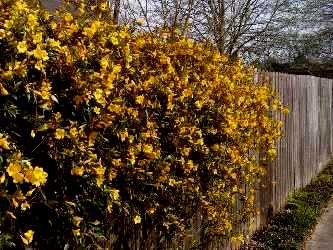
Gelsemium sempervirens 'Margarita'Carolina jessamine ‘Margarita’, Gelsemium sempervirens, is a vine that I have offered before but its many fragrant, bright yellow flowers, semi-evergreen leaves, and the fact that it is native to the southeastern US make it a very desirable plant.  For a complete profile, click herePhoto courtesy of the Missouri Botanical Garden PlantFinder.

.

I grow most of these plants in my gardens so I know you can’t go wrong by adding them to yours!  If you are a customer, see Nursery Happenings below for details on how to order these wonderful shade plants by noon on March 30.  If not, now you have some plants to ask for at your local independent nursery.

Carolyn

.

Carolyn’s Shade Gardens is a retail nursery located in Bryn Mawr, Pennsylvania, US, zone 6b.  The only plants that we mail order are snowdrops and miniature hostas and only within the US.

If you are within visiting distance and would like to receive catalogues and information about customer events, please send your full name and phone number to carolynsshadegardens@verizon.net.  Subscribing to my blog does not sign you up to receive this information.

Nursery Happenings:  The nursery is open and fully stocked.  If you can’t come to an event, just email to schedule an appointment to shop.  If you wish to order shrubs, everything you need to know is in the catalogue, which can be accessed here.   The deadline for shrub orders is noon on March 30.  Our Native Wildflower Weekend takes place on Friday, April 5, from 10 am to 4 pm, and Saturday, April 6, from 10 am to 2 pm.  If you are a customer, expect an email shortly with all the details.

Facebook:  Carolyn’s Shade Gardens has a Facebook Page where I post single photos, garden tips, and other information that doesn’t fit into a blog post.  You can look at my Facebook page here or click the Like button on my right sidebar here.

Notes: Every word that appears in orange on my blog is a link that you can click for more information.  If you want to return to my blog’s homepage to access the sidebar information (catalogues, previous articles, etc.) or to subscribe to my blog, just click here.

March 2013 GBBD: Hellebores on Parade Again

Posted in container gardening, containers for shade, Garden Blogger's Bloom Day, hellebores, Shade Perennials, winter, winter interest with tags , , , , , , , , , , , , , , , , , , , on March 14, 2013 by Carolyn @ Carolyns Shade Gardens

Carolyn’s Shade Gardens is a retail nursery located in Bryn Mawr, PA, specializing in showy, colorful, and unusual plants for shade.  The only plants that we ship are snowdrops and miniature hostas.  For catalogues and announcements of events, please send your full name, location, and phone number (for back up use only) to carolyn@carolynsshadegardens.com.  Click here to get to the home page of our website for catalogues and information about our nursery and to subscribe to our blog.

hellebores at Davoid Culp'sMy friend David Culp had this lovely bowl of hellebore flowers on his porch when I visited his garden Brandywine Cottage recently.  This is an elegant way to display your hellebores and gives a feeling for the range of colors and forms available.  For more gorgeous photos of David’s garden, check out his book The Layered Garden.

It is the middle of the month and time to participate in Garden Blogger’s Bloom Day (GBBD) hosted by May Dreams Gardens (link available on the 15th of the month) where gardeners from all over the world publish photos each month of what’s blooming in their gardens.  I participate because it is fun and educational for me to identify what plants make my gardens shine at different times of the year.  I am calling this post Hellebores on Parade Again because for GBBD in January 2012 I also put my hellebores on parade (click here to read it).

This month I am using this opportunity to profile the hellebores that will be available at my upcoming Hellebore Extravaganza Sale at my nursery on Saturday, March 23, from 10 am to 3 pm.  All photos are of hellebores blooming in my garden right now.

My garden is located in Bryn Mawr (outside Philadelphia), Pennsylvania, U.S., in zone 6B.


Helleborus x 'Pink Frost'
‘Pink Frost’ is my favorite of the Christmas rose crosses.  Its blue leaves set off the bright pink flowers beautifully, and the flowers fade to a gorgeous rose-red for an extremely long season of interest.

.

hellebore pink frost at David Culp's‘Pink Frost’ also works quite well in a container where its beauty can be examined up close (Culp garden).

.

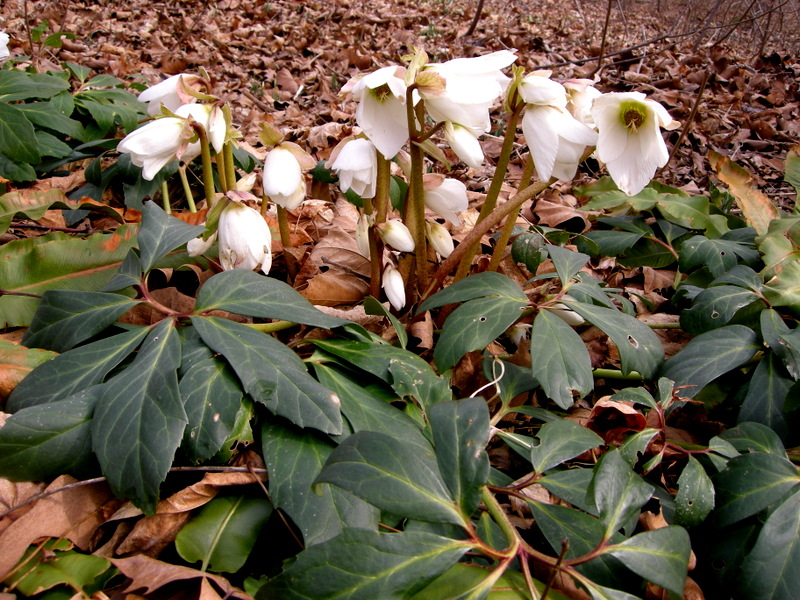
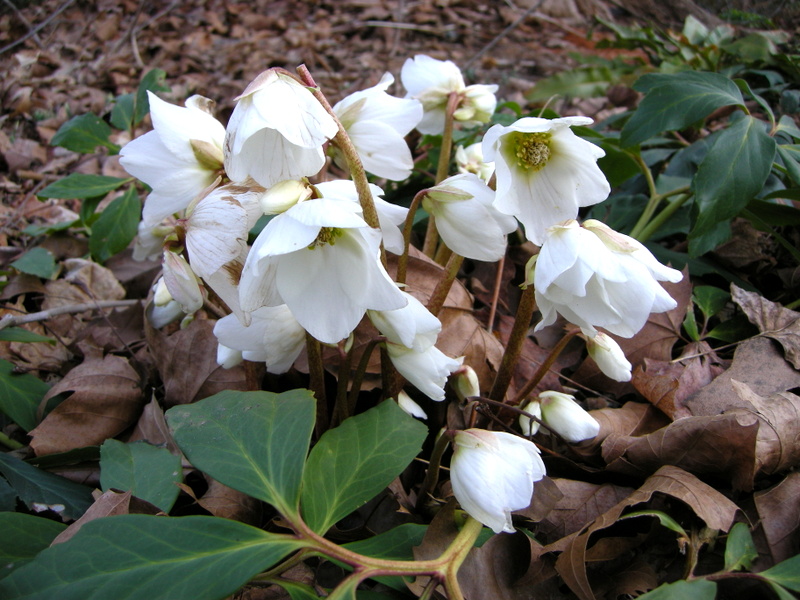
Helleborus niger‘There is nothing like the pure white, outward-facing flowers of Christmas rose, Helleborus niger, to stop you in your tracks.  A mature clump can have dozens of flowers.

.

Helleborus niger 'Double Fantasy'The double Christmas rose ‘Double Fantasy’ is quite striking.

.

Helleborus x 'Mary Lou'Hellebore ‘Mary Lou’ has huge flowers and a wide pink border surrounding a bold maroon spotted “face”.

.

Helleborus x 'Warbler'The late afternoon sun shines through the early-blooming, yellow hellebore ‘Warbler’, whose flowers continue to be very ornamental even when they have technically “gone by”.  As you can see though, new buds are on the way.

.

Helleborus x 'Warbler'Here is a close up of ‘Warbler’ that I have posted before.

.

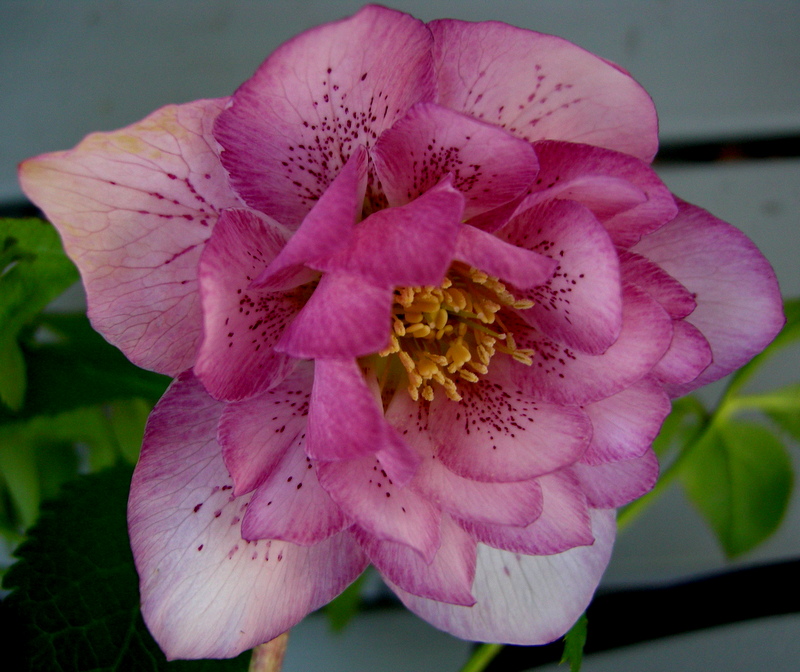
Helleborus x 'Phoebe'The double pink hellebore ‘Phoebe’ is just coming into bloom in my garden.

.

Helleborus x 'Phoebe'A close up of ‘Phoebe’.  

.

Helleborus x 'Painted Bunting'‘Painted Bunting’ is the first hybrid hellebore to bloom in my garden and isn’t fazed by all the cold weather we have been having.

.

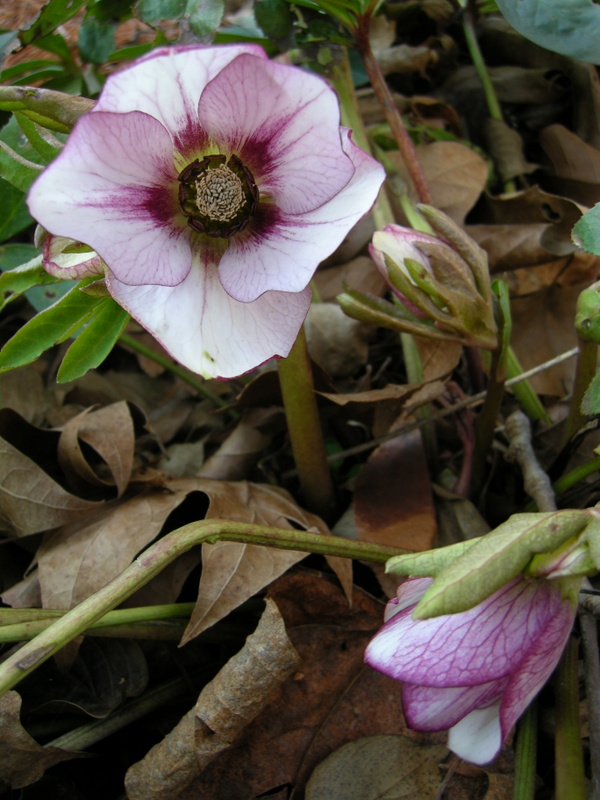
Helleborus x 'Painted Bunting'‘Painted Bunting’s’ picotee markings with the maroon center flaring out to outline the pure white petals makes it very special.

.

Helleborus x 'Elegance White'‘Elegance White’ is another lovely double hellebore.

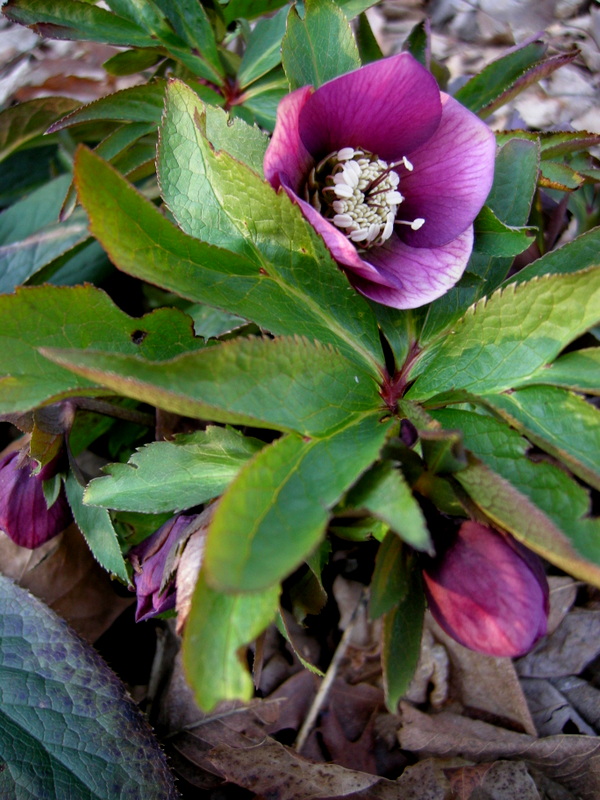
.Helleborus purpurascensThe species hellebore H. purpurascens has a very unique slate purple color not found in any other hellebore.

.

Helleborus purpurascensA close up of Helleborus purpurascens.

.

Helleborus odorusFragrant hellebore, H. odorus, adds a bright note to the winter garden and looks gorgeous paired with red hellebores like ‘Red Lady’.

.

Helleborus odorusA close up of fragrant hellebore.

.

Helleborus x 'Red Lady'‘Red Lady’ hellebore

.

Helleborus x ballardiae 'HGC Cinnamon Snow'Another early-blooming Christmas rose cross, ‘Cinnamon Snow’.

.

Helleborus x ballardiae 'Cinnamon Snow'A close up of ‘Cinnamon Snow’.

.

Helleborus x 'Black'This black hybrid hellebore grabs the attention of every garden visitor I have.

.

Helleborus x 'First Cuckoo'The double hellebore ‘First Cuckoo’ is new to me this year.

.

Helleborus x sahinii 'Winter Bells,This very unusual flower belongs to the first ever cross between bearsfoot hellebore, H. foetidus, and Christmas rose, H. niger, called H. x sahinii ‘Winter Bells’.  It is new for me this year but looks quite promising for flowers and foliage interest.

.

Two more hellebore container ideas from David Culp:

hellenores David Culp'sDouble black hellebores paired with their favorite companion, snowdrops.

.

hellebores David CulpAn enchanting combination of cream-colored hellebores and pussy willows, a shrub I may offer in my upcoming woody plant offer.

.

Enjoy, Carolyn

.

Carolyn’s Shade Gardens is a retail nursery located in Bryn Mawr, Pennsylvania, US, zone 6b.  The only plants that we mail order are snowdrops and miniature hostas and only within the US.

If you are within visiting distance and would like to receive catalogues and information about customer events, please send your full name and phone number to carolynsshadegardens@verizon.net.  Subscribing to my blog does not sign you up to receive this information.

Nursery Happenings:  The nursery is open and fully stocked.  If you can’t come to an event, just email to schedule an appointment–we are available this weekend.  My Hellebore Extravaganza open house sale is Saturday, March 23, from 10 am to 3 pm.  If you are a customer, expect an email shortly with all the details.  There are still a few spaces left in the hellebore seminar on Monday, March 18, at 10 am.  For details click here.  The 2013 Snowdrop Catalogue is on the sidebar of the website and orders are being accepted now.  To view the catalogue, click here.  The 2013 General Catalogue is available here.

Facebook:  Carolyn’s Shade Gardens has a Facebook Page where I post single photos, garden tips, and other information that doesn’t fit into a blog post.  You can look at my Facebook page here or click the Like button on my right sidebar here.

Notes: Every word that appears in orange on my blog is a link that you can click for more information.  If you want to return to my blog’s homepage to access the sidebar information (catalogues, previous articles, etc.) or to subscribe to my blog, just click here.

2013 Winter Interest Plants

Posted in garden to visit, hellebores, Shade Gardening, snowdrops, winter, winter interest with tags , , , , , , , , , , , , , , , , , , , , , , , , , , , , on March 4, 2013 by Carolyn @ Carolyns Shade Gardens

Carolyn’s Shade Gardens is a retail nursery located in Bryn Mawr, PA, specializing in showy, colorful, and unusual plants for shade.  The only plants that we ship are snowdrops and miniature hostas.  For catalogues and announcements of events, please send your full name, location, and phone number (for back up use only) to carolyn@carolynsshadegardens.com.  Click here to get to the home page of our website for catalogues and information about our nursery and to subscribe to our blog.

Galanthus 'Brenda Troyle'Galanthus ‘Brenda Troyle’ is one of the most robust and fragrant snowdrops in the Cresson garden.

This may be my last post that focuses on snowdrops, and I am sure some readers will rejoice.  I am aware that many gardeners do not share (or understand) my obsession.  However, I want to show photos from the recent Winter Interest Plants Seminars hosted by Charles Cresson for my nursery customers. 

Before I get to that though, I have to tell you about the snowdrop event this weekend at Winterthur, the fabulous garden in Delaware, US.  On Saturday, March 9, at 11 am, Alan Street, the world famous snowdrop expert from Avon Bulbs in England, is presenting the annual Bank to Bend Lecture on snowdrops.  Carolyn’s Shade Gardens will be one of two nurseries selling snowdrops and other winter interest plants at Winterthur.  I hope to see you there.  Here are the details:


winterthur

Join plantsman and snowdrop expert Alan Street of the renowned nursery Avon Bulbs as he offers insight into these precious flowers, sharing how they have become a worldwide phenomenon and how Avon Bulbs brings them to market. Registration includes tours of the March Bank display and access to specialist nurseries selling snowdrops and other winter interest plants. $20 non-members; $10 members.

Call 800.448.3883 to register or find out more.

Bank to Bend includes free admission to the garden, tours of the March Bank and access to specialist nurseries Black Hog Horticulture and Carolyn’s Shade Garden to purchase rare and unusual bulbs and other winter interest plants.

.

Cresson Winter Interest SeminarCharles Cresson talks about his witch hazels, winter aconite, and snowdrops with some die hard winter interest gardeners.

This is the third year that nationally known horticulturalist Charles Cresson has hosted my customers in his Swarthmore, Pennsylvania, garden to view and discuss winter interest plants.  Every year we see different plants, depending on the weather, but every year the group is just as enthusiastic despite the weather.  This year, February (and all winter really) has been cold and dismal, and the seminar days were no exception, but the attendees were enthusiastic and full of questions for Charles.

Cresson Winter Interest SeminarsCharles demonstrates how he protects important plants with plastic boxes if the weather is going to be unseasonably cold.

Plants are “late” to come out this year because it has been so cold.  The emergence of winter interest plants like perennials and bulbs is dependent more on the soil temperature than on the date.  If the soil warms up early, as it did in 2012 when we had no winter, many plants will bloom early.  This year it has been cold and gray, and many plants have yet to bloom or emerge.  Yet, such is the magic of Charles’s garden that there was a lot to see.  Here are some of the highlights in the order in which we saw them:

Narcissus 'Rijnveld's Early Sensation'After seeing this daffodil for many years blooming in Charles’s garden in February, I finally added it to mine this year.  It is called Narcissus ‘Rijnveld’s Early Sensation’.

.

Eratnhis hyemalis (pale yellow form)A rare pale yellow form of winter aconite, Eranthus hyemalis.

.

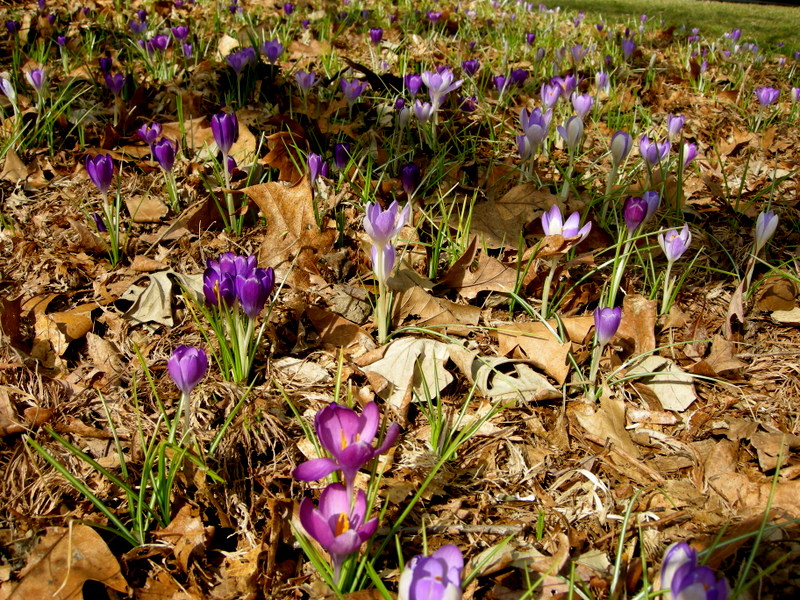
Crocus tommasinianusThe snow crocus, C. tommasinianus, is my favorite crocus because it blooms now with the snowdrops and multiplies rapidly.

.

Crocus tommasinianus 'Ruby Giant'‘Ruby Giant’ snow crocus is a deeper purple.

.

Crocus tommasinianus 'Taplow Ruby'‘Taplow Ruby’ snow crocus

.

Galanthus 'Atkinsii'Galanthus ‘Atkinsii’ is an old-fashioned and reliable snowdrop that should be part of any collection.

.

Galanthus 'Atkinsii' & Arum italicum 'Pictum'One of my favorite combinations, ‘Atkinsii’ with Italian arum, A. italicum ‘Pictum’.

.

Helleborus x ballardiae 'Pink Frost' with Cotoneaster salicifolius 'Henryi'The leaves of ‘Pink Frost’ hellebore, H. x ballardiae ‘Pink Frost’, pair beautifully with this rare cotoneaster, C. salicifolius ‘Henryi’.

.

Helleborus foetidus & Helleborus x ballardiae 'Pink Frost'‘Pink Frost’ again with bearsfoot hellebore, H. foetidus, in another winning combination.

.

Helleborus x ericsmithii 'Winter's Song'‘Winter’s Song’ hellebore, H. x ericsmithii ‘Winter’s Song’ is very early blooming so it was fully out on this cold February day.

.

Helleborus x 'Ivory Prince'‘Ivory Prince’ hellebore was just starting to open.

.

Iris unguicularis subsp. cretensisThis subspecies is an especially dark colored version of the winter-blooming Algerian iris, Iris unguicularis subsp. cretensis.

.

Galanthus 'Mighty Atom'

Galanthus ‘Mighty Atom’ has one of the best presentations of any snowdrop.

.

Galanthus rizehensisGalanthus rizehensis is a rare and desirable snowdrop species.

.

Galanthus 'Standing Tall'Charles’s newly introduced snowdrop ‘Standing Tall’ continues to stand up to whatever the weather throws at it.  If you didn’t know better you would think it was a daffodil.

.

Galanthus elwesii 'Standing Tall' Cresson photo-001‘Standing Tall’ in full bloom in early January.

.

Galanthus 'Beth Chatto' ‘Beth Chatto’

.

Galanthus 'Godfrey Owen'Charles and I both acquired six-petaled ‘Godfrey Owen’ last year but his was not felled by snow and ice.

.

Galanthus 'Godfrey Owen'‘Godfrey Owen’

.

Galanthus 'Godfrey Owen'The inner segments of ‘Godfrey Owen’ are extraordinary too.  This photo represents to me what galanthophiles are all about.

.

I know the participants enjoyed themselves because even after an hour and a half in the cold, they were still asking Charles questions.  I hope my readers have gotten some vicarious enjoyment.

I you would like to see what was featured during the 2011 and 2012 seminars, follow these links:

2011 Winter Interest Plants

2012 Winter Interest Plants

Carolyn

.

Carolyn’s Shade Gardens is a retail nursery located in Bryn Mawr, Pennsylvania, US, zone 6b.  The only plants that we mail order are snowdrops and miniature hostas and only within the US.

If you are within visiting distance and would like to receive catalogues and information about customer events, please send your full name and phone number to carolynsshadegardens@verizon.net.  Subscribing to my blog does not sign you up to receive this information.

Nursery Happenings:  We are now accepting reservations for our very popular Hellebore Seminars .  The Friday session is full but the session on Monday, March 18, at 10:00 am has nine spaces left.  For details, click here.  The 2013 Snowdrop Catalogue is on the sidebar of the website and orders are being accepted now.  To view the catalogue, click here.  The 2013 General Catalogue is available here.

Facebook:  Carolyn’s Shade Gardens has a Facebook Page where I post single photos, garden tips, and other information that doesn’t fit into a blog post.  You can look at my Facebook page here or click the Like button on my right sidebar here.

Notes: Every word that appears in orange on my blog is a link that you can click for more information.  If you want to return to my blog’s homepage to access the sidebar information (catalogues, previous articles, etc.) or to subscribe to my blog, just click here.

Cold Weather Antidote: Longwood’s Orchids

Posted in garden to visit, winter, winter interest with tags , , , on February 23, 2013 by Carolyn @ Carolyns Shade Gardens

Carolyn’s Shade Gardens is a retail nursery located in Bryn Mawr, PA, specializing in showy, colorful, and unusual plants for shade.  The only plants that we ship are snowdrops and miniature hostas.  For catalogues and announcements of events, please send your full name, location, and phone number (for back up use only) to carolyn@carolynsshadegardens.com.  Click here to get to the home page of our website for catalogues and information about our nursery and to subscribe to our blog.

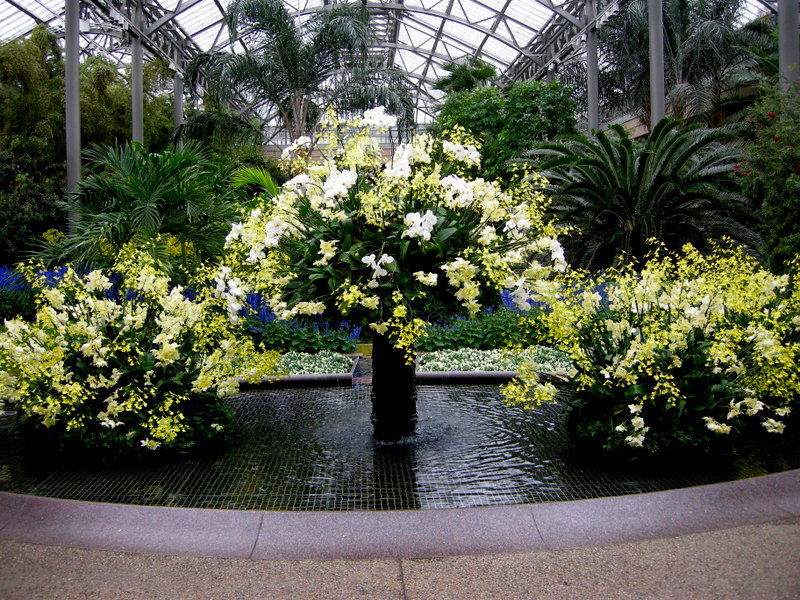
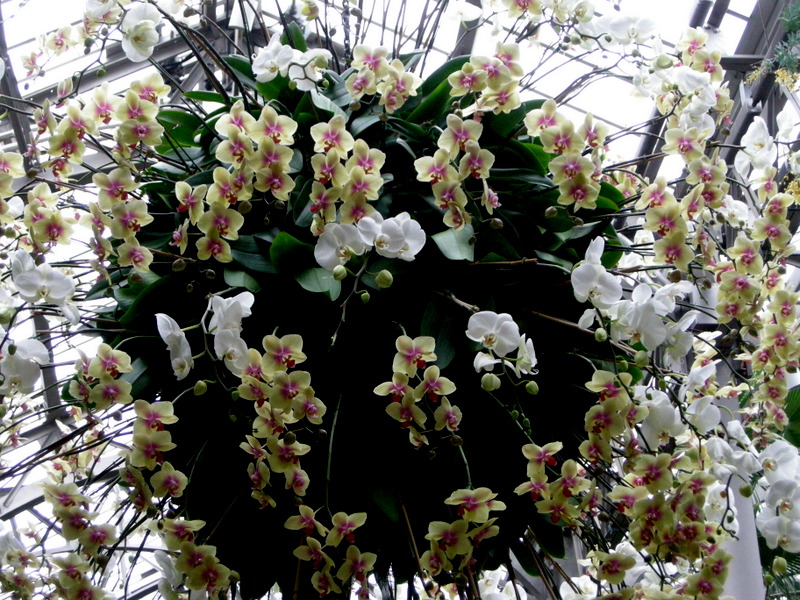
Longwood East conservatoryFor Longwood Garden’s Orchid Extravaganza, the East Conservatory is filled with yellows, blues, creams, and whites—one of my favorite color combinations.

Before I get to my cold weather antidote, I want to mention another upcoming breath of spring:  The Philadelphia Flower Show, the largest indoor flower show in the world.  The theme this year is “Brilliant”, a tribute to the majestic culture and creative gardening tradition of Great Britain.  It runs from March 2 through March 10 at the Philadelphia Convention Center.  I will be giving a presentation on Sunday, March 3, at 5:00 pm in the Gardener’s Studio on “Hellebores for Your Garden: Selection, Maintenance, and Division”—don’t miss it!


Hamamelis x intermedia 'Jelena'
‘Jelena’ witch hazel outside the Longwood Cafe.  I highly recommend eating there when you visit.  The food is very good, especially the local mushroom soup, and in the winter you can sit by a fire.

.

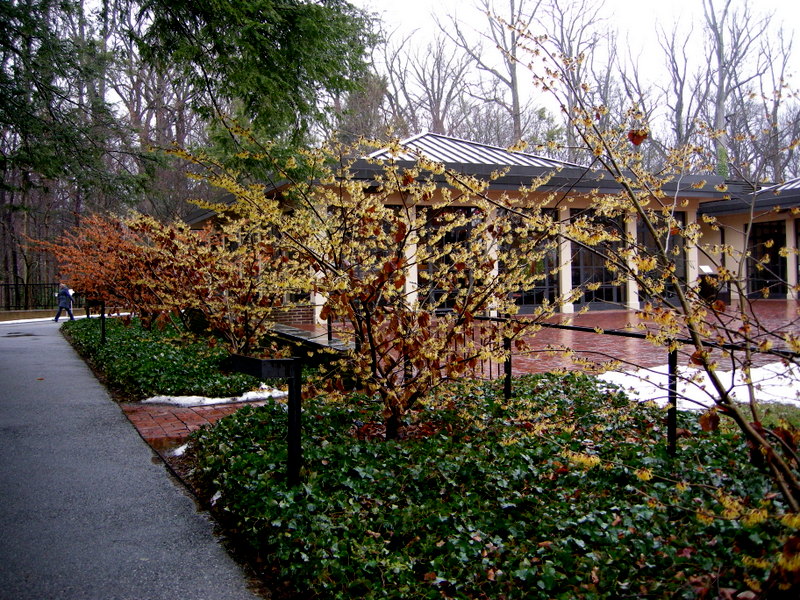
Hamamelis x intermedia 'Luna'‘Luna’ witch hazel also outside the cafe.

On a recent Friday, my husband and I were suffering from cabin fever and decided to visit Longwood Gardens in Kennett Square, Pennsylvania, US.  For 2012 to 2013, I have been writing posts every couple of months about Longwood (last year I choose Chanticleer), and I will provide links to my posts at the end.  Usually we walk around outside, but it was cold, overcast, and raining so we opted to explore The Orchid Extravaganza in the conservatories instead.  I did photograph some token but gorgeous witch hazels on our mad dash for the cafe, and I have included their photos above to show what braver souls were viewing.

Longwood East ConservatoryThese lovely arrangements of moth orchids greet you as you come through the main entrance into the East Conservatory.


I am not an orchid lover and really know little about them.  But I knew that if Longwood did orchids, they would surpass my wildest expectations, and they did.  Orchids are an over-the-top plant perfect for an over-the-top display, and Longwood is the perfect place to view them.  Longwood has 9,000 orchids in its collection and used 5,000 plants, representing 2,300 species and cultivars, to decorate its four acres of conservatories for the current display.  Breathtaking doesn’t even begin to describe it so I will have to use photographs, beginning with more of the East Conservatory:

Longwood East ConservatoryWhen we entered, a bride and groom were having their wedding pictures taken.

.

Longwood East Conservatory.

Longwood East Conservatory.

Longwood East Conservatory

.

Longwood Velvet Groundsel & Flowering-bush PlectranthusThe yellow-flowered plant on the left is velvet groundsel and the blue on the right is flowering-bush plectranthus.  

.

Longwood East Conservatory.

Longwood East ConservatoryLooking back down the East Conservatory towards the main entrance.

.

Longwood orchid orbThis orchid orb, at the far end of the East Conservatory, contains 160 0rchids and weighs 200 pounds.  The custom metal frame was constructed by Longwood craftspeople.

.

Longwood orchid orbA close up of the orb.

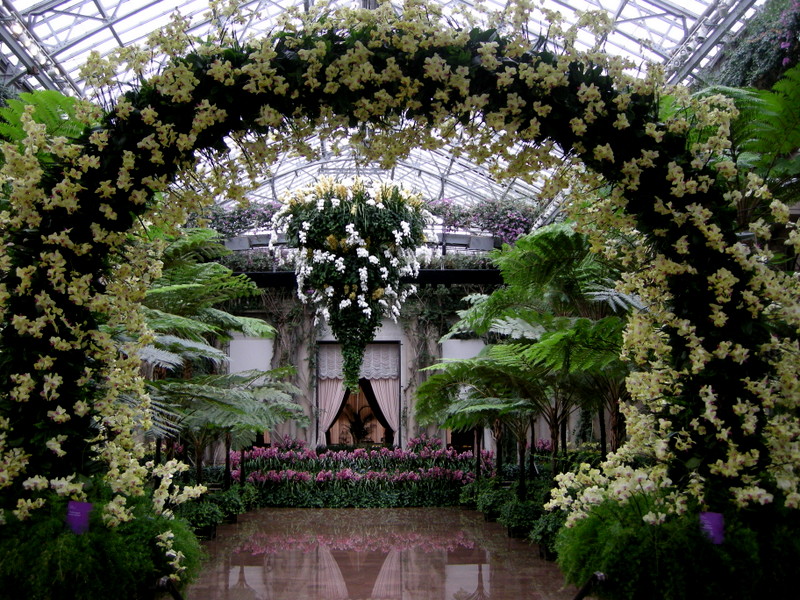
From the East Conservatory we entered the Exhibition Hall with its sunken and flooded marble floor surrounded by tree ferns:

Longwood Exhibition HallAbove the Exhibition Hall hangs an “orchid chandelier” featuring over 100 yellow Cymbidium orchids, 200 white Phalaenopsis orchids, and Algerian ivy.

.

Longwood Exhibition Hall.

DSCN9176This 13′ tall arch at the other end of the Exhibition Hall is composed of 800 yellow Phalaenopsis orchids and is much prettier in person.

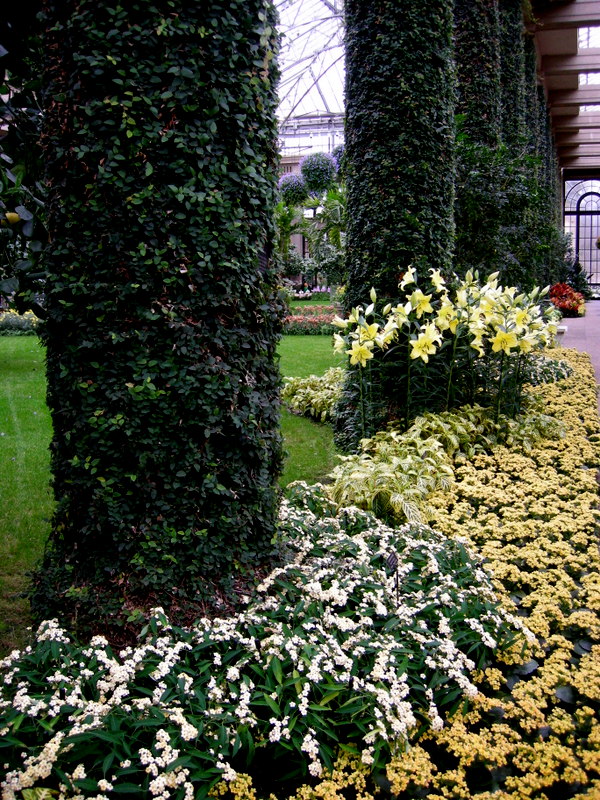
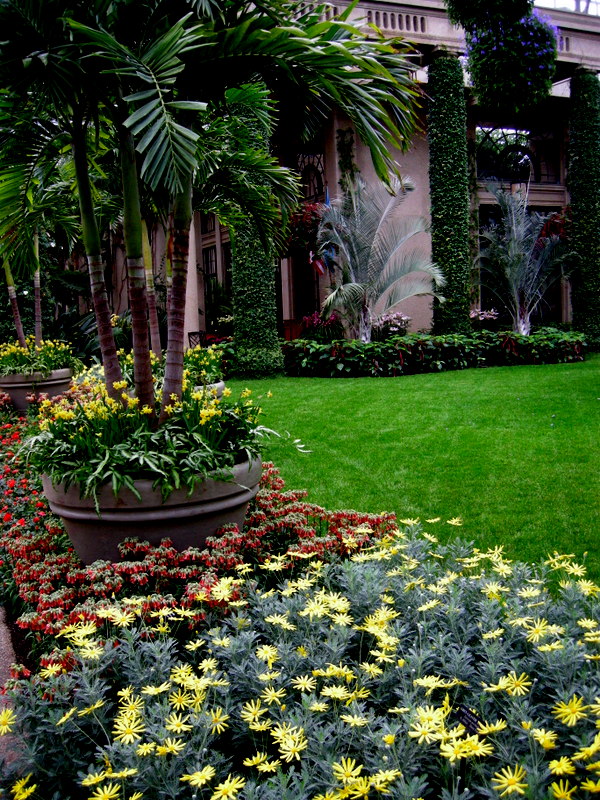
The third huge room in the conservatories is called the Orangery and features colorful displays of a wide range of unusual plants:

Longwood Orangery

Florist’s cyclamen, tulips, and oriental hybrid lilies underplant bronze-leaved clerodendrum.

.

Longwood OrangeryVine-covered pillars line the walk around the edge of the Orangery.

.

Longwood Orangery.

Longwood OrangeryI was particularly taken with this combination of ‘Tete-a-Tete’ narcissus, orange mother-of-thousands, ferns, and orange roses.

No matter what time of year you visit the conservatories, between 200 and 500 orchids are on display in the Orchid House.  The orchids residing there during this special show are the cream of the crop.  I have diligently copied the names off the tags because I know a lot of readers are orchid fans.  But beware, my career as a recorder at the Philadelphia Flower Show receiving the orchid entries was short-lived after trying to deal with their confusing names.  

orchid x Laeliocattleya g. (unnamed) x Laeliocattleya g. (unnamed)

.

orchid no labelOne of my favorites but there was no label.

.

Schomburgkia undulataSchomburgkia undulata

.

x Sophrolaeliocattleya Rosemary Clooney 'Wanre'x Sophrolaeliocattleya Rosemary Clooney ‘Wanre’

.

Miltoniopsis Mary SugiyamaMiltoniopsis Mary Sugiyama

.

x Beallara Pluto's Drummer 'Pacific Pink'x Beallara Pluto’s Drummer ‘Pacific Pink’

.

x Sophrolaeliocattleya g. Jewel Box 'Dark Waters'x Sophrolaeliocattleya g. Jewel Box ‘Dark Waters’

.

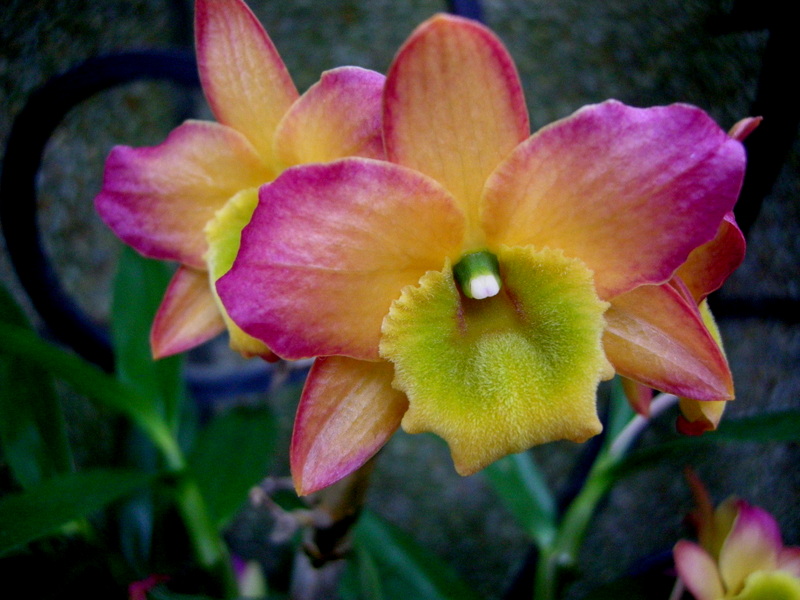
Dendrobium Oriental Smile 'Fantasy'Dendrobium Oriental Smile ‘Fantasy’

Orchids are beautifully incorporated into most of the many gardens in the West Conservatory Complex.  Here are a few of my favorite combinations, but it is well worth a walk through the whole area:

x Bratonia Kauai's ChoiceDozens of this eye-catching orchid, x Bratonia Kauai’s Choice, surround the waterfall in the Cascade Garden designed by Roberto Burle Marx.

.

Orchids with Calathea lancifolia, prayer plantIn the Tropical Terrace, white orchids are planted among this striking prayer plant, Calathea lancifolia.

.

Orchids with 'Moonlight Bay' aglaonema & 'Lutea' elephant's-ear plantAlso in the Tropical Terrace, yellow orchids with ‘Moonlight Bay’ aglaonema and ‘Lutea’ elephant’s-ear plant.

Despite all the grandeur of the big orchid displays, my favorite orchid presentations are found in some of the smaller and narrower gardens.   Perfect specimens from the same orchid family but in varying colors are displayed in containers like majestic houseplants.  If I had orchids this is how I would want to present them:

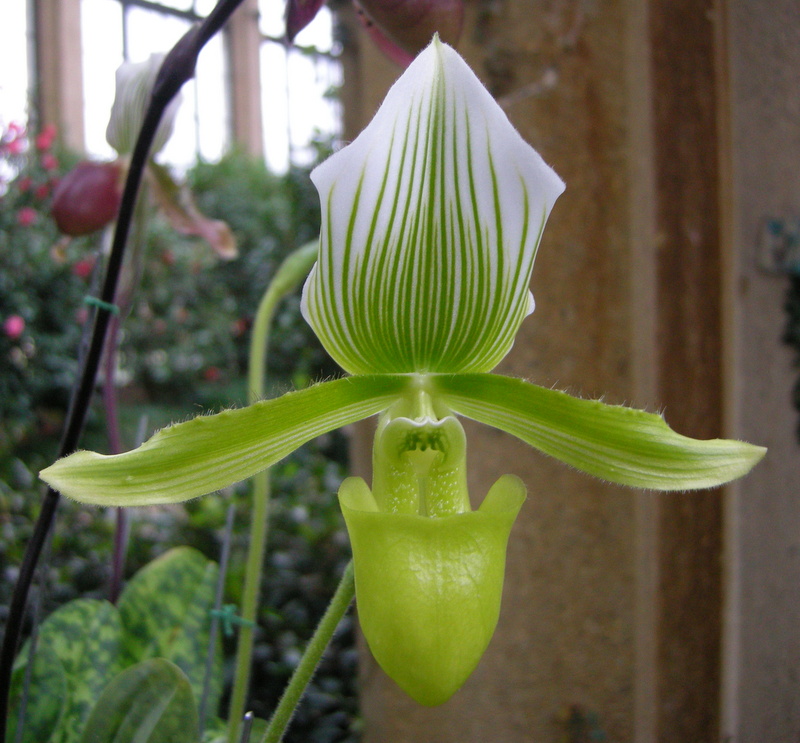
Lady's Slipper OrchidsA small garden, called the Garden Path, on the left side of the East Conservatory was lined with moss planters of lady’s slipper orchids.

.

Lady's Slipper Orchid.

Lady's Slipper Orchid

.

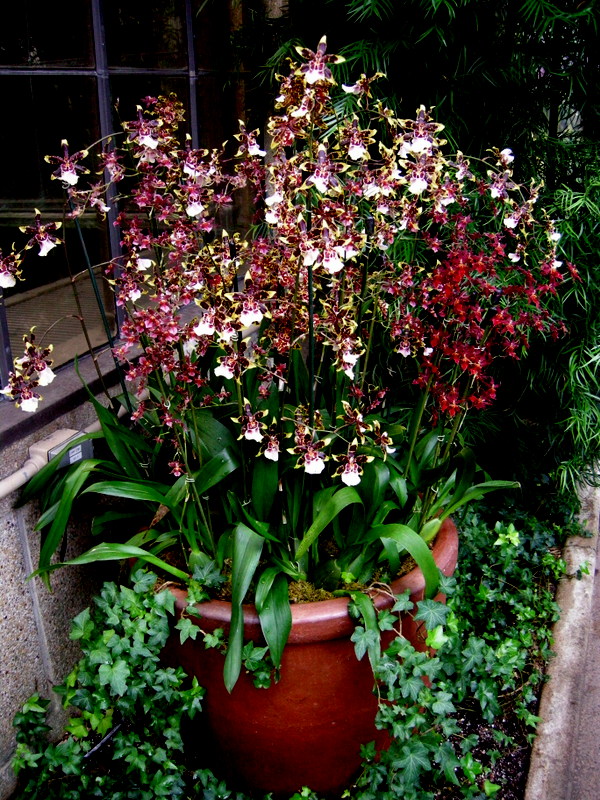
Dancing Ladies OrchidsAlong the Acacia Passage are ceramic containers of dancing ladies orchids.

.

Reed-Stem orchidsPots of reed-stem orchids line the Fern Passage.

.

Reed-Stem orchidsreed-stem orchid

The Longwood Orchid Extravaganza runs through March 24.  If you are coming, check the website because there are lots of special events scheduled.  If you are not in the area, I hope you have enjoyed your virtual tour.

To read more about Longwood Gardens, follow these links:

Groundcovers, Thinking Outside the Box

Longwood Gardens Part 2: At Night

A Longwood New Year’s Eve

Carolyn

I am linking this post to Les’s blog A Tidewater Garden for his annual winter walk-off where bloggers show photos from a winter trip where they did a lot of walking.  Since my husband and I walked Longwood’s conservatories for two hours, Les tells me that this post qualifies.  Follow the link to see Les’s professional quality photos and where other bloggers took their walk.

.

Carolyn’s Shade Gardens is a retail nursery located in Bryn Mawr, Pennsylvania, US, zone 6b.  The only plants that we mail order are snowdrops and miniature hostas and only within the US.

If you are within visiting distance and would like to receive catalogues and information about customer events, please send your full name and phone number to carolynsshadegardens@verizon.net.  Subscribing to my blog does not sign you up to receive this information.

Nursery Happenings:  We are now accepting reservations for our very popular Hellebore Seminars to be held on Friday, March 15 (only 3 spaces left) at 1:30 pm and Monday, March 18, at 10:00 am.  For details, click here.  The 2013 Snowdrop Catalogue is on the sidebar of the website and orders are being accepted now.  To view the catalogue, click here.  The 2013 General Catalogue is available here.

Facebook:  Carolyn’s Shade Gardens has a Facebook Page where I post single photos, garden tips, and other information that doesn’t fit into a blog post.  You can look at my Facebook page here or click the Like button on my right sidebar here.

Notes: Every word that appears in orange on my blog is a link that you can click for more information.  If you want to return to my blog’s homepage to access the sidebar information (catalogues, previous articles, etc.) or to subscribe to my blog, just click here.

February GBBD: Hellebores and Snowdrops

Posted in Garden Blogger's Bloom Day, hellebores, Shade Perennials, snowdrops, winter, winter interest with tags , , , , , , , , , , , , , , , , , , , , on February 13, 2013 by Carolyn @ Carolyns Shade Gardens

Carolyn’s Shade Gardens is a retail nursery located in Bryn Mawr, PA, specializing in showy, colorful, and unusual plants for shade.  The only plants that we ship are snowdrops and miniature hostas.  For catalogues and announcements of events, please send your full name, location, and phone number (for back up use only) to carolyn@carolynsshadegardens.com.  Click here to get to the home page of our website for catalogues and information about our nursery and to subscribe to our blog.

Helleborus x 'Warbler'This is just one of the many gorgeous hellebores that will be for sale at my nursery this spring.  ‘Warber’ is a lovely creamy yellow and is blooming in a pot for me right now.

It is the middle of the month and time to participate in Garden Blogger’s Bloom Day (GBBD) hosted by May Dreams Gardens (link available on February 15) where gardeners from all over the world publish photos each month of what’s blooming in their gardens.  I participate because it is fun and educational for me to identify what plants make my gardens shine at different times of the year.  Several nursery customers have mentioned wanting to have color in late winter so I hope they will get some ideas for plants to add to their own gardens to extend their season.

My garden is located in Bryn Mawr (outside Philadelphia), Pennsylvania, U.S., in zone 6B.


Helleborus x 'First Cuckoo'
‘First Cuckoo’ is a double  hellebore with white petals shading to pink with deep raspberry edges.  It is also blooming in a pot and will be for sale this year.

Things really change from year to year.  In February 2011, my hellebores and other winter interest plants were barely emerging from under the ice and snow (to see photos click here).  In February 2012 when we had an extremely warm winter, all my hellebores were in full bloom (to see photos click here). 

This year, my early plants are up and blooming, but most of my hellebores are just starting to send up flowers.  That makes me appreciate the early-blooming varieties even more.  But it is the snowdrops that really steal the show right now.  They give me a reason to walk through the garden every day.  So enjoy the photos and keep warm until spring.  Note: For the benefit of my customers, I will indicate which hellebores will be for sale at Carolyn’s Shade Gardens (CSG) this spring.

.

Helleborus x ballardiae 'Pink Frost'

.

Helleborus x ballardiae 'Pink Frost'‘Pink Frost, pictured here with common snowdrops,’ is an early blooming hellebore coveted for its flowers and blue leaves with burgundy highlights.   I can’t decide if the front or the back of the flowers is prettier (for sale at CSG).

.

Helleborus x ballardiae 'Cinnamon Snow'‘Cinnamon Snow’ is a close relative of ‘Pink Frost’—they both resulted from crosses between Christmas rose and a hellebore species from Majorca.  ‘Cinnamon Snow’s’ creamy flowers flushed with cinnamon pink are very elegant (for sale at CSG).

.

Helleborus dumetorum subsp. atrorubensThis hellebore is so rare it has no common name but its botanical name is Helleborus dumetorum subsp. atrorubens (for sale at CSG).

.

Helleborus niger 'Praecox'

.

Helleborus niger 'Praecox'Christmas roses bloom continually in my garden from October through April.  ‘Praecox’ is the showiest right now but I also love ‘Jacob’, ‘Josef Lemper’, and ‘Potter’s Wheel’ (for sale at CSG).  

.

Helleborus x 'Old Early Purple'‘Old Early Purple’ is always one of the first hybrid hellebores to burst into bloom.

.

Helleborus x 'Snow White'This flower on ‘Snow White’ opened so long ago that it is already fading to green from its original pristine white color.

.

Helleborus x 'Painted Bunting'

.

Helleborus x 'Painted Bunting'

.

Helleborus x 'Painted Bunting'‘Painted Bunting’ is always one of the first hybrid hellebores to bloom in my garden.  The bold burgundy red central central star spreads outward along the veins and edges the delicate petals.  Again the back of the flower is quite beautiful (for sale at CSG).

I managed to limit myself to eight snowdrops, all of which I think are very special. 

Galanthus 'S. Arnott'‘S. Arnott’, a classic early snowdrop.

.

Galanthus 'Ophelia'The fat, rounded flowers and heart-shaped markings of ‘Ophelia’, a double snowdrop in the Greatorex group.

.

Galanthus plicatus 'Wendy's Gold'Even non-galanthophiles admire ‘Wendy’s Gold’, a rare yellow snowdrop.

.

Galanthus elwesii 'Kite'I fell in love with the extra long petals of ‘Kite’ when I saw it in a fellow galanthophile’s garden in 2010, and she kindly gave me a plant.  Now there are five with four flowers.

.

Galanthus 'Blewbury Tart'‘Blewbury Tart’ is just waiting for a warm sunny day to explode into bloom.  You can feel the pent up energy.  Unfortunately sunny days are few and far between right now.

.

Galanthus 'Lady Beatrix Stanley'The refined elegance of the double snowdrop ‘Lady Beatrix Stanley’ makes her one of my favorites.

.

Galanthus elwesii with X markI got this unnamed giant snowdrop, Galanthus elwesii, in trade from a customer.  It has very large flowers with a distinctive X marking and starts blooming before Christmas, a very desirable trait.  It is still blooming now.

.

Galanthus elwesii 'Godfrey Owen'‘Godfrey Owen’ is the snowdrop that I was most looking forward to this year.  It is very unusual for having 6 outer segments instead of the usual three.  When it opens, the petals form a completely symmetrical whorl.  Unfortunately, the flower was flattened by ice immediately upon opening, bending the stem, and then an insect ate away parts of the petals, ruining the whorl.  Isn’t that always the way?  I tried to prop it up unsuccessfully but then bit the bullet and brought it inside.

There are many other plants blooming right now, but it has been so hard to get photos.   The flowers are always closed because the sun refuses to shine, or waterlogged with the never ending rain and snow.  In fact, three of these photos are from previous years, but I decided to use them because they depict the plants as they look today:

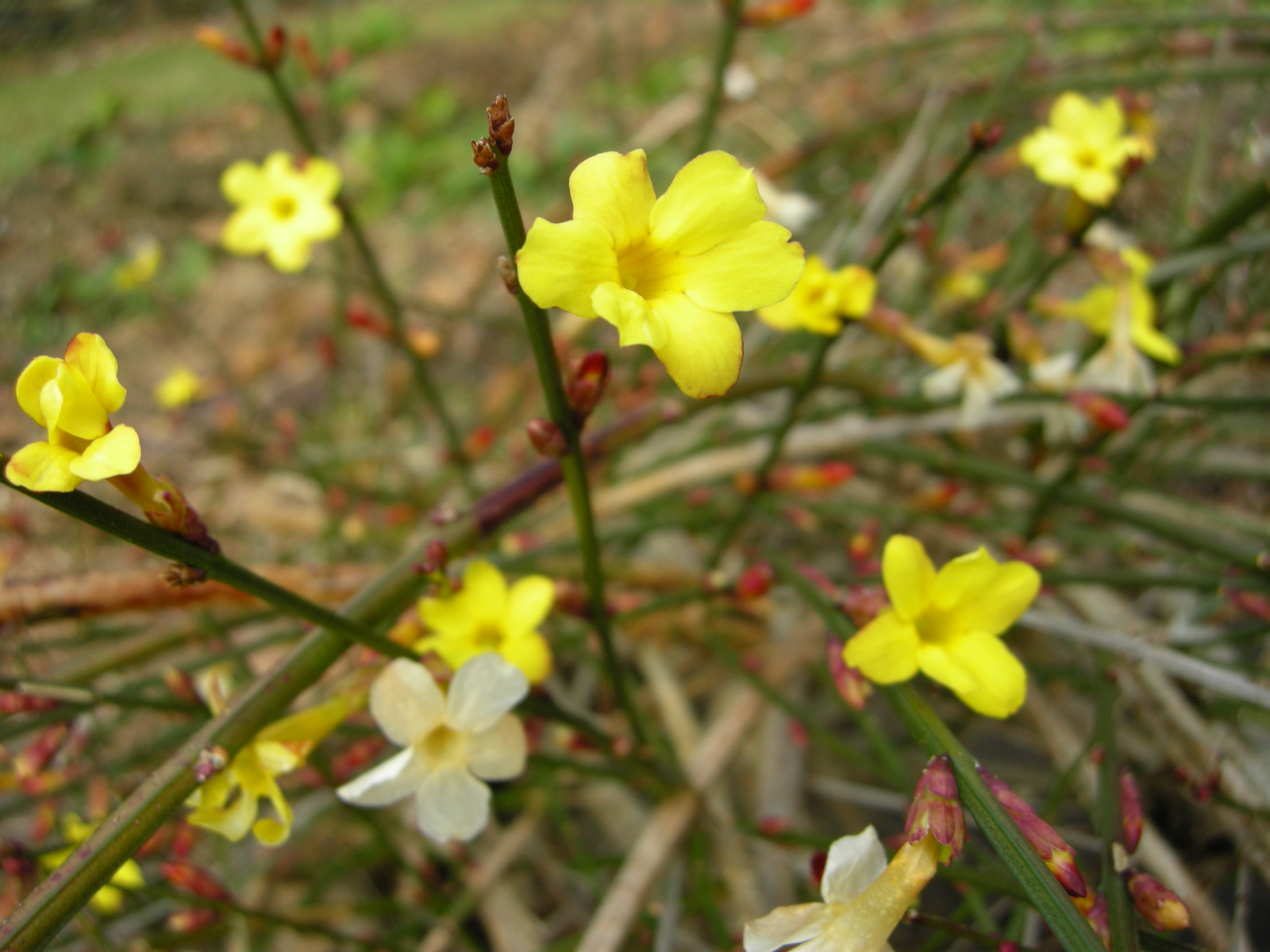
Whenever the weather warms up winter jasmine, Jasminum nudiflorum, opens some flowers.

.

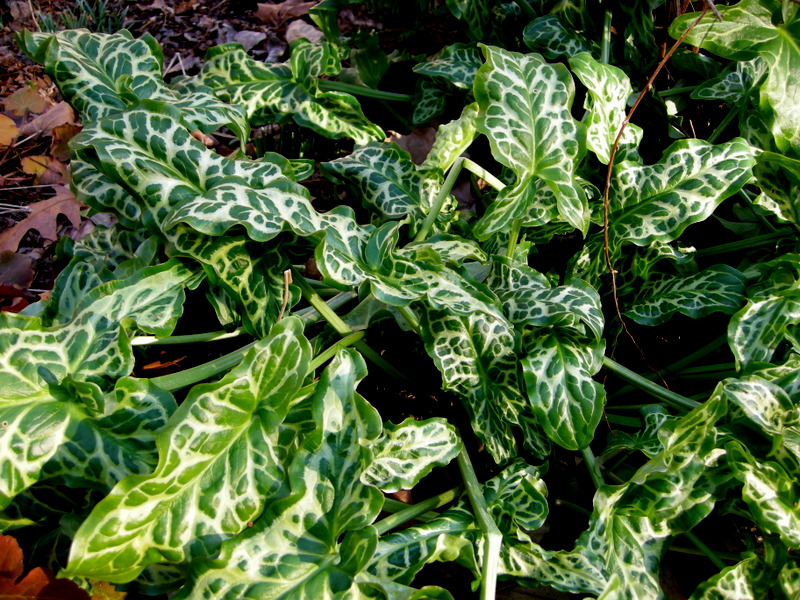
Arum italicum 'Pictum'Italian arum always looks great.

.

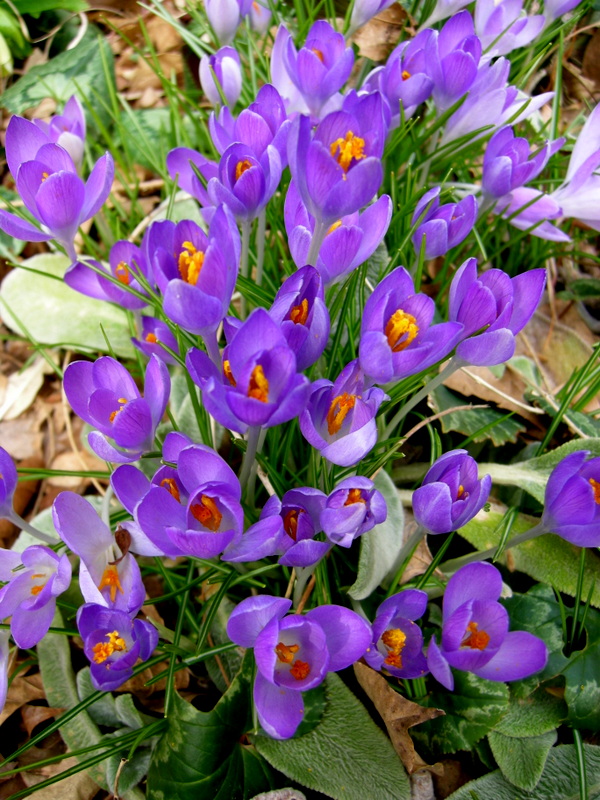
Crocus tommasinianusSnow crocus, C. tommasinianus, is the earliest crocus in my garden and is a great companion plant for hellebores and snowdrops.

.

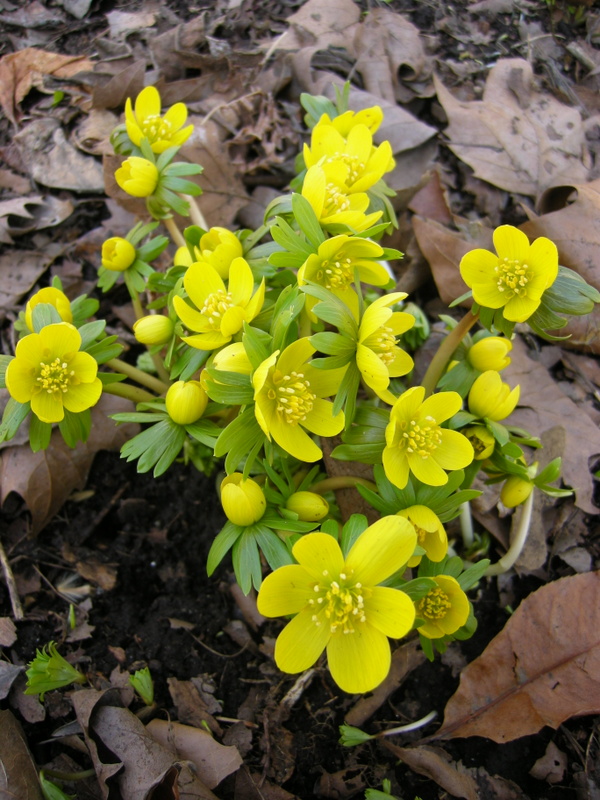
Eranthis hyemalisI am always surprised by how quickly winter aconite appears in the garden.  Monday there was no sign of it and Tuesday it was carpeting my woods.

.

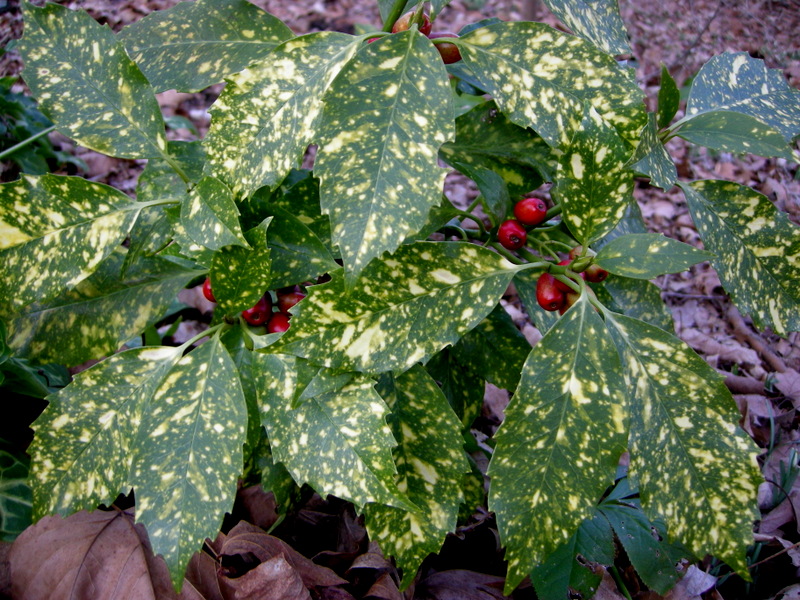
Aucuba japonica 'Gold Dust'‘Gold Dust’ Japanese aucuba is one of the best shrubs for lighting up full shade.  If you can find male and female plants, it produces these large berries which ripen now.

.

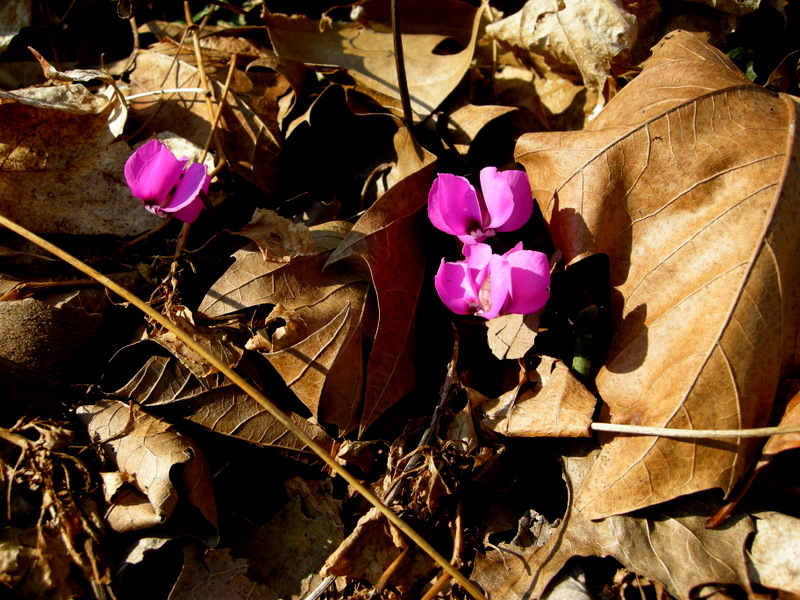
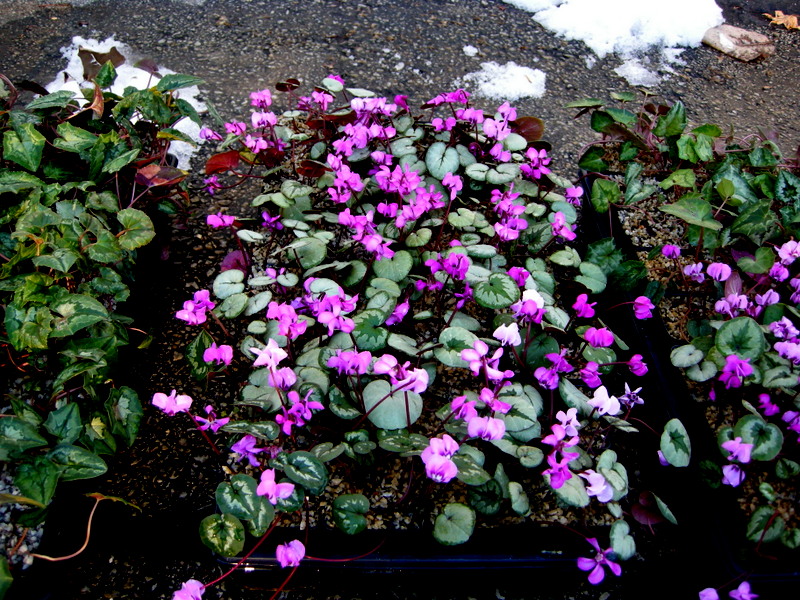
Cyclamen coumThe first winter-blooming cyclamen, C. coum, peak through the leaves.  Hardy cyclamen is another great companion for snowdrops and hellebores.

.

Cyclamen at Carolyn's Shade GardensPots of hardy cyclamen waiting to find homes with my nursery customers.

Enjoy, Carolyn

.

Carolyn’s Shade Gardens is a retail nursery located in Bryn Mawr, Pennsylvania, US, zone 6b.  The only plants that we mail order are snowdrops and miniature hostas and only within the US.

If you are within visiting distance and would like to receive catalogues and information about customer events, please send your full name and phone number to carolynsshadegardens@verizon.net.  Subscribing to my blog does not sign you up to receive this information.

Nursery Happenings:  The 2013 Snowdrop Catalogue is on the sidebar of the website and orders are being accepted now.  To view the catalogue, click here.  The 2013 General Catalogue is available here.  Look for a brochure for my very popular hellebore seminars very soon.

Facebook:  Carolyn’s Shade Gardens has a Facebook Page where I post single photos, garden tips, and other information that doesn’t fit into a blog post.  You can look at my Facebook page here or click the Like button on my right sidebar here.

Notes: Every word that appears in orange on my blog is a link that you can click for more information.  If you want to return to my blog’s homepage to access the sidebar information (catalogues, previous articles, etc.) or to subscribe to my blog, just click here.

St. Lucia’s Diamond Falls Botanical Gardens

Posted in garden to visit with tags , , , , , , , , , , , on February 5, 2013 by Carolyn @ Carolyns Shade Gardens

Carolyn’s Shade Gardens is a retail nursery located in Bryn Mawr, PA, specializing in showy, colorful, and unusual plants for shade.  The only plants that we ship are snowdrops and miniature hostas.  For catalogues and announcements of events, please send your full name, location, and phone number (for back up use only) to carolyn@carolynsshadegardens.com.  Click here to get to the home page of our website for catalogues and information about our nursery and to subscribe to our blog.

St. Lucia Gros PitonThe Petit Piton, one of two volcanic spires unique to St. Lucia, rises over 2,400′ directly from the water on the Caribbean side of the island.

With all the cold weather and snow in the mid-Atlantic US as well as the UK and the rest of Europe, I thought my readers might appreciate a post from a warm climate.  I was recently invited by Donna at Garden Walk Garden Talk to accompany her to her cousin’s home on St. Lucia, an island in the eastern Caribbean.  Who could resist when the only cost was the airfare?  Thanks Donna.

St. Lucia Sandy BeachThe other side of St. Lucia fronts the Atlantic Ocean.  This is a view of the Maria Islands from Sandy Beach in Vieux Fort on the extreme southeastern tip of St. Lucia.

St. Lucia is an island country located in the eastern Caribbean Sea north of Venezuela at about the same latitude as Nicaragua .  It is part of the Lesser Antilles and is surrounded by the islands of St. Vincent, Barbados, and Martinique.  It covers 238 square miles and has a population of 174,000.  St. Lucia was originally colonized by the French, and French influences remain quite strong.  However, it ended up in British hands and gained independence in 1979, although it remains part of the Commonwealth.  Residents speak English and Patois, a dialect of French with some  Caribe and African words.

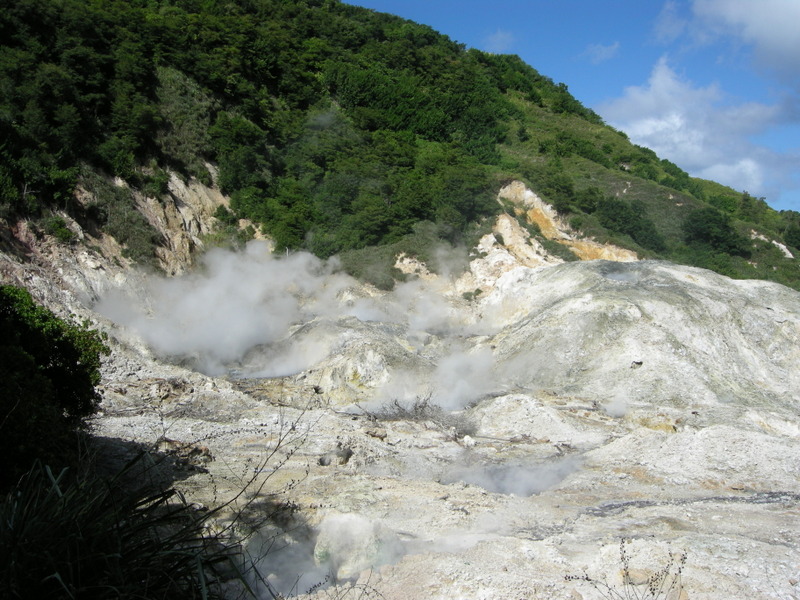
St. Lucia Sulphur SpringsLava more than 1.5 miles underground produces steam and heats the spring water to over 300 degrees F at the Sulphur Springs site outside the town of Soufriere.

St. Lucia is a volcanic island and is more mountainous than any other Caribbean island, which makes for quite scenic geography.  The area around the southwestern town of Soufriere is a collapsed crater surrounded by dramatic mountain peaks.  Two of these peaks, the Gros and the Petit Pitons along with the ridge between them and the underwater coral reefs in front of them form the Pitons Management Area.  It is a UNESCO World Heritage site and is one of the most dramatic landscapes I have ever visited.  St. Lucia’s climate is tropical although not as hot as other Caribbean islands due to the moderating trade winds.  The predominant vegetation is tropical forest which climbs the steep hills and fills the valleys.

St Lucia Pitons Management AreaA view from the water of the UNESCO World Heritage Site framed on either side by the Pitons.

.

Before we visit the botanical gardens, let me show you a few more views of St. Lucia generally:

.

St. Lucia architecture

.

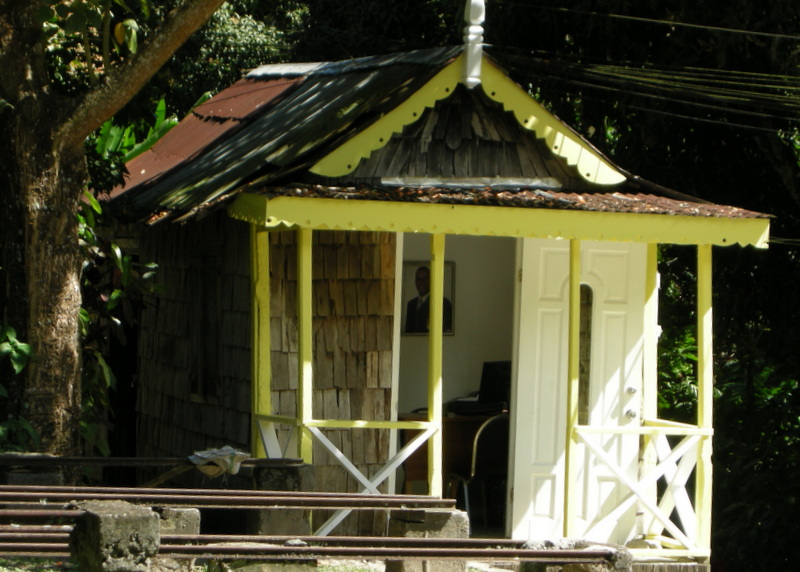
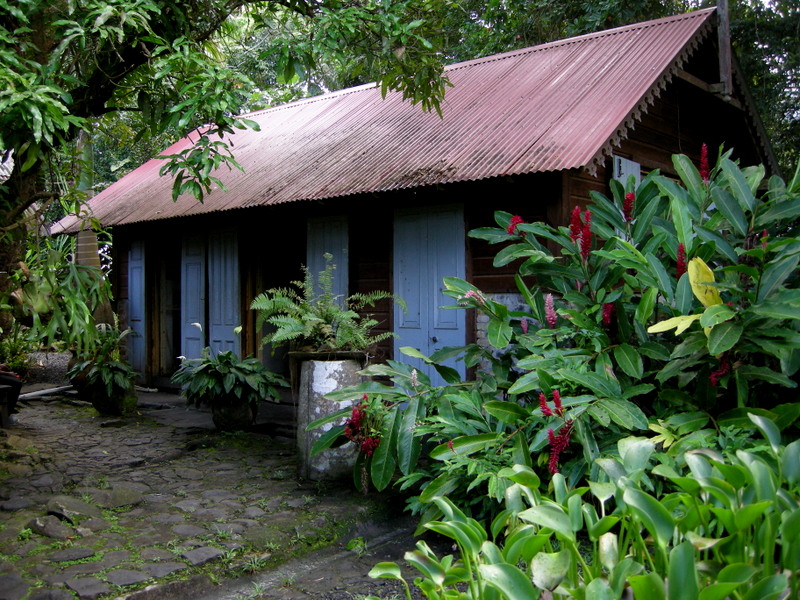
St Lucia architectureThe local architecture reflects the influences of French colonization.

.

St Lucia Gros PitonA view of the Gros Piton from Sugar Beach.

.

St Lucia SoufriereThe town of Soufriere where the Pirates of the Caribbean was filmed sits in the middle of the volcanic crater with the Pitons behind it.

.

St LuciaEven when the Pitons aren’t in the picture, St. Lucia rises dramatically from the water.

.

St. LuciaEven without the mountains, there is always the gorgeous blue Caribbean to stare at.

.

St. Lucia

.

St LuciaThe sunsets were magnificent every night.

.

St LuciaEspecially when viewed from between the Pitons.

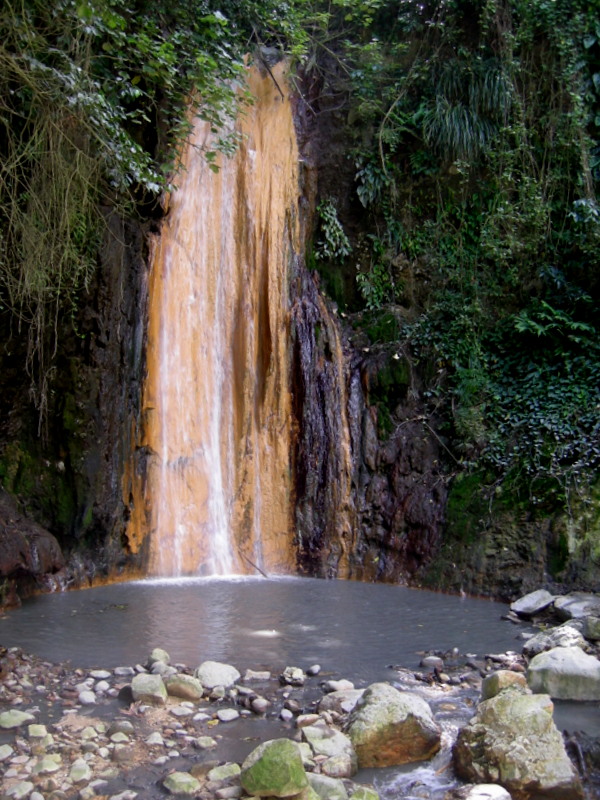
One of the many highlights of the trip was our visit to the Diamond Falls Botanical Gardens in Soufriere.  The gardens are on the site of a 2,000 acre plantation granted by Louis XIII to the Devaux family in 1713 and still owned by the same family.  Empress Josephine was a cousin to the Devauxes and played there as a child.  Mineral springs heated by the underlying volcano were developed in 1784 into a bathing area for the troops of King Louis XVI.  Today, the upper part of the botanical gardens are crowned by the lovely Diamond Falls, and visitors can still bath in the therapeutic mineral waters.

.St Lucia Diamond FallsDiamond Falls

.

St Lucia hot springsSteaming mineral water leaves Diamond Falls on its way to the mineral baths.

The botanical gardens comprise six acres along the gorge formed by the mineral springs.  Although the plantings have been  well established for at least two hundred years, they really came into their own in 1983 when a Devaux descendant decided to develop them as a formal botanical garden.  Although I thoroughly enjoyed my walk around the gardens, I don’t know anything about tropical plants so you are on your own with the photos:

.

St Lucia botanical gardenGravel paths wind through beautifully cared for but dense tropical vegetation.

.

St Lucia botanical gardensLush vines, I believe this is schefflera, climb all the trees.

.

St Lucia botanical gardens.

St Lucia botanical gardens.

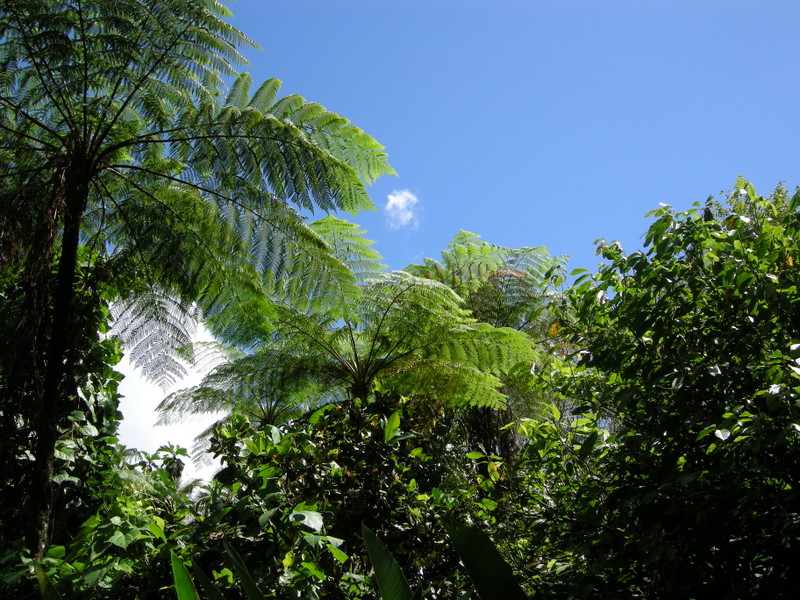
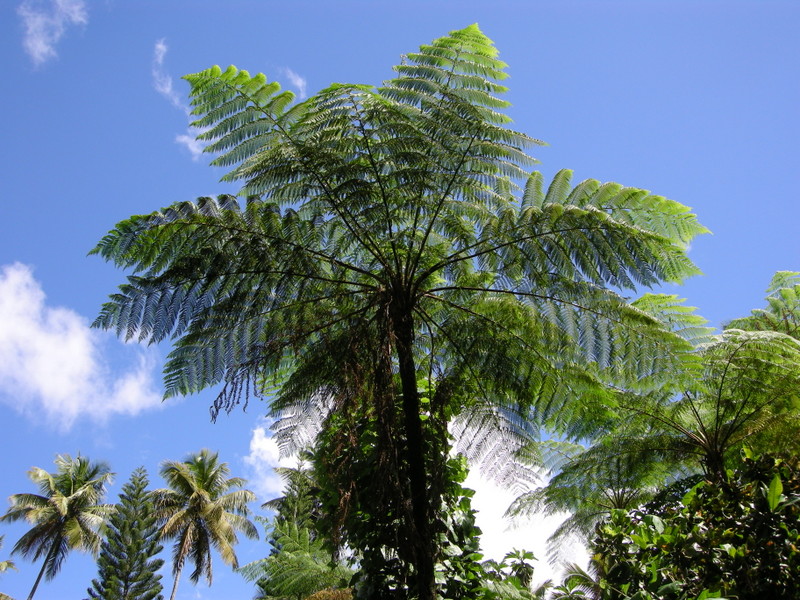
St Lucia botanical gardensTree ferns were everywhere.

.

St Lucia botanical gardens

.

St Lucia botanical gardens

.

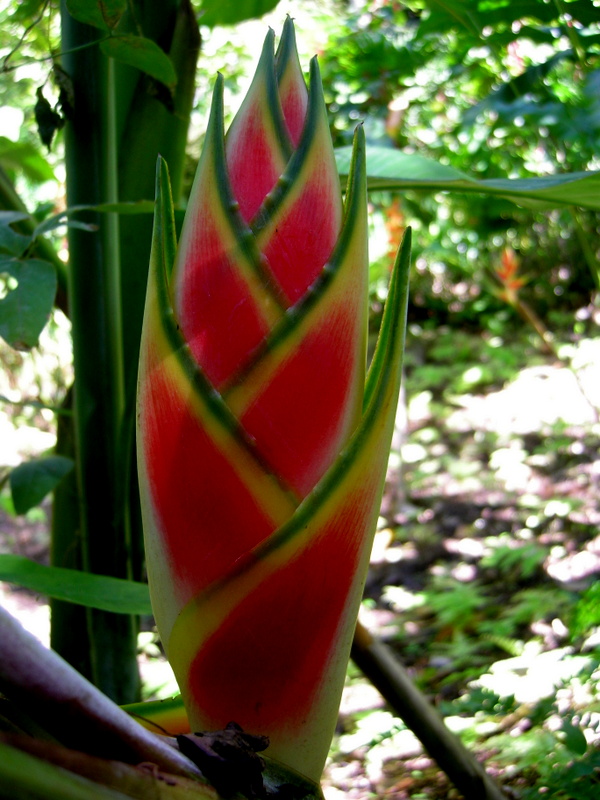
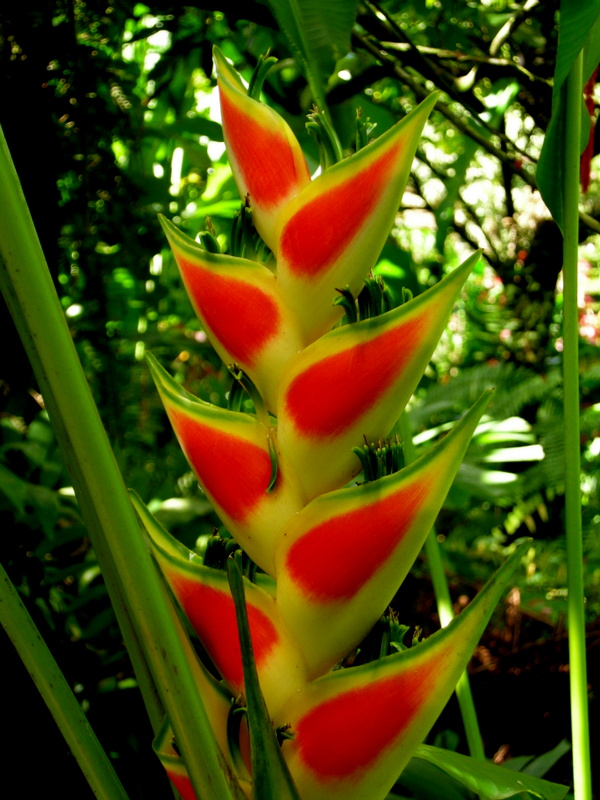
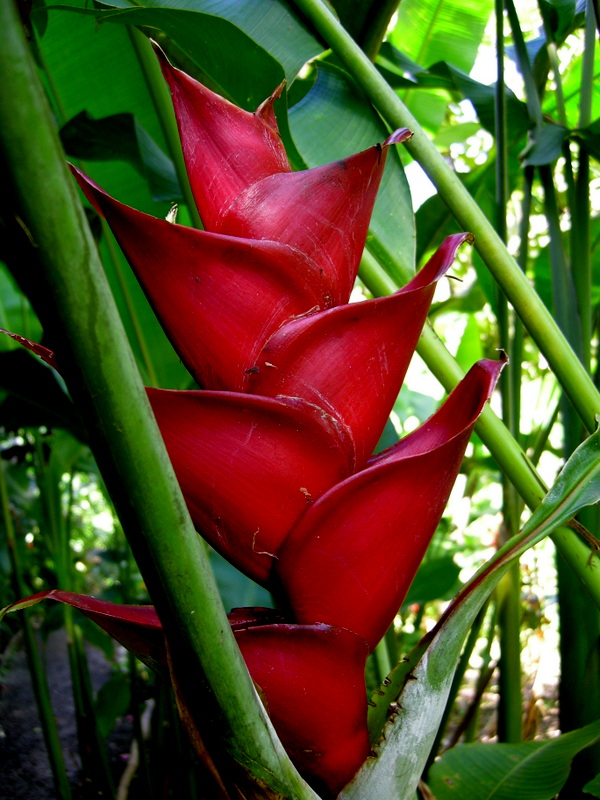
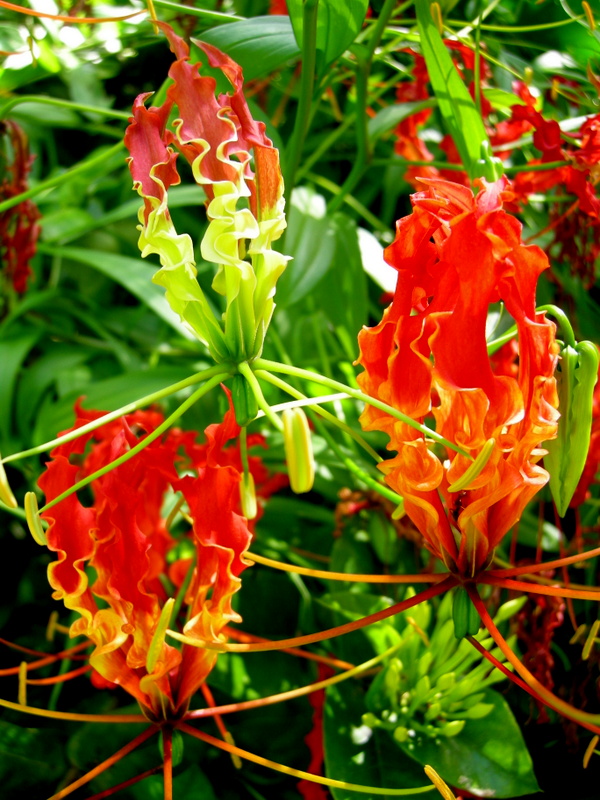
St Lucia botanical gardensI was particularly taken with this flower called lobster-claws in the genus Heliconia.

.

St Lucia botanical gardens

.

St Lucia botanical gardens

.

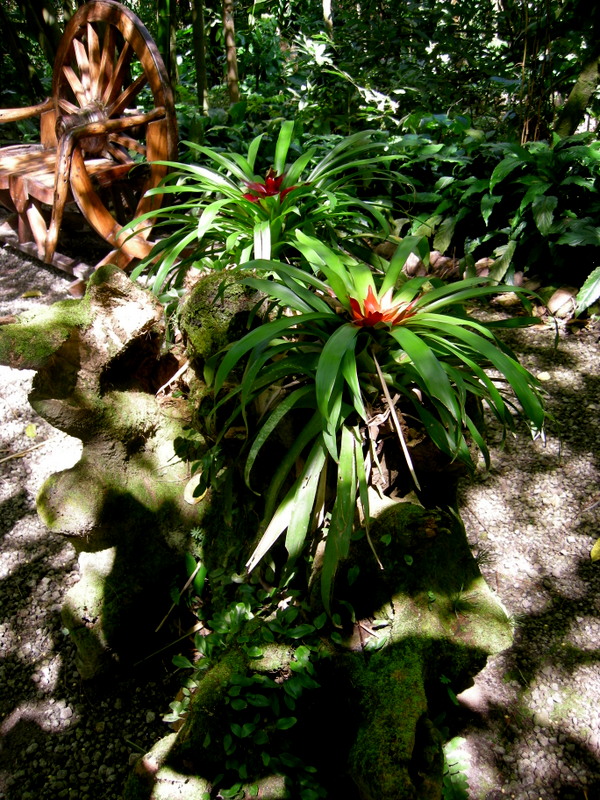
St Lucia botanical gardensBromeliads and moss colonize a log.

.

St Lucia botanical gardens

.

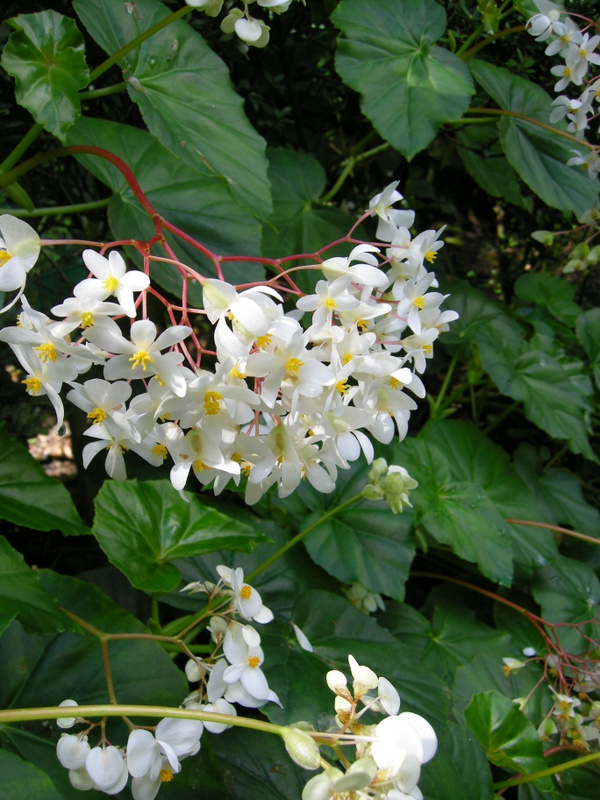
St Lucia botanical gardensThis tropical begonia looks exactly like Begonia grandis, the perennial begonia hardy in the mid-Atlantic US.

.

St Lucia botanical gardens

* * * * *

I have given you a quick glimpse of the beauties of St. Lucia and a short tour of the botanical gardens.  St Lucia is the most beautiful Caribbean island I have ever been to, and I am so thankful to Donna and her cousin for making my trip possible.

Enjoy, Carolyn

.

Carolyn’s Shade Gardens is a retail nursery located in Bryn Mawr, Pennsylvania, US, zone 6b.  The only plants that we mail order are snowdrops and miniature hostas and only within the US.

If you are within visiting distance and would like to receive catalogues and information about customer events, please send your full name and phone number to carolynsshadegardens@verizon.net.  Subscribing to my blog does not sign you up to receive this information.

Nursery Happenings:  The 2013 Snowdrop Catalogue is on the sidebar of the website and orders are being accepted.  To view the catalogue, click here.  There are a few spaces left in the February 22 session of Charles Cresson’s 2013 Winter Interest Plants Seminar.  To view the brochure and register, click here.

Facebook:  Carolyn’s Shade Gardens has a Facebook Page where I post single photos, garden tips, and other information that doesn’t fit into a blog post.  You can look at my Facebook page here or click the Like button on my right sidebar here.

Notes: Every word that appears in orange on my blog is a link that you can click for more information.  If you want to return to my blog’s homepage to access the sidebar information (catalogues, previous articles, etc.) or to subscribe to my blog, just click here.

New York Times Photos

Posted in Camellias, evergreen, Fall, Fall Color, Shade Shrubs, winter, winter interest with tags , , , , , on January 29, 2013 by Carolyn @ Carolyns Shade Gardens

Carolyn’s Shade Gardens is a retail nursery located in Bryn Mawr, PA, specializing in showy, colorful, and unusual plants for shade.  The only plants that we ship are snowdrops and miniature hostas.  For catalogues and announcements of events, please send your full name, location, and phone number (for back up use only) to carolyn@carolynsshadegardens.com.  Click here to get to the home page of our website for catalogues and information about our nursery and to subscribe to our blog.

Camellia x 'Autumn Spirit'‘Autumn Spirit’ (fall blooming), the lead photo in the NYT article.

Readers will soon tire of me featuring myself in my posts, especially since the recent snowdrop post did just that.  However, I am bursting with excitement and will explode if I can’t do it one more time.  I was recently hired by the New York Times as a free lance photographer to provide the photos for a camellia article interviewing camellia expert Charles Cresson.  The print article “Camellias Ready for a Cold Snap” appeared on January 17, 2013.  One photo is on the cover of the Home section with the full article on page D4.  If you read the small print you will see my name.  You can find the on line version here.  Be sure and click through the slide show.

Camellia "Wax Lips"Unnamed Korean Camellia japonica seedling (spring blooming)

.

Camellia japonica 'Berenice Boddy' Cresson Garden‘Berenice Boddy’ (spring blooming)

.

While letting you know about the New York Times article, I thought this post would be a good place to list helpful articles on cold hardy camellias for easy reference.  I did this in the snowdrop post, and it has already proved invaluable to me.  I have interspersed the article names and links with some of my favorite camellia photos to keep the attention of those of you who don’t want to read up on camellias.  I am also going to list the camellias covered in each article in case a reader is interested in a particular cultivar.

Camellia 'April Tryst'‘April Tryst’ (spring blooming)

.

Camellia x (Ackerman seedling)Unnamed Ackerman Seedling (fall blooming)

December 8, 2010

“Fall-blooming Camellias Part 1”

Camellia oleifera, Elaine Lee, Winter’s Darling

click here to read

Camellia x 'Moon Festival'‘Moon Festival’ (fall blooming), not hardy in zone 6.

.

Camellia x 'Winter's Interlude'‘Winter’s Interlude’ (fall blooming)

December 17, 2010

“Fall-blooming Camellias Part 2”

Snow Flurry, Winter’s Dream, Autumn Spirit, Winter’s Snowman, Winter’s Charm, Scented Snow, Winter’s Beauty

click here to read

Camellia x 'April Rose'‘April Rose’ (spring blooming)

.

Camellia x 'Winter's Snowman'‘Winter’s Snowman’ (fall blooming)

November 10, 2011

“Fall-blooming Camellias Part 3”

Snow Flurry, Winter’s Snowman, Winter’s Star, Winter’s Interlude, Moon Festival, Carolina Moonmist

click here to read

Camellia x 'Elaine Lee'‘Elaine Lee’ (fall blooming)

.

Camellia x 'Pink Icicle'‘Pink Icicle’ (spring blooming)

December 2, 2012

“2012 Fall-blooming Camellias”

Winter’s Joy, Winter’s Snowman, Snow Flurry, Autumn Spirit, Survivor, Long Island Pink, Polar Ice, Ashton’s Ballet, Winter’s Rose, Winter’s Fire

click here to read

Camellia x 'April Blush'‘April Blush’ (spring blooming)

January 2006

“Camellias for Cold Climates” by William L. Ackerman

details Dr. Ackerman’s cold hardy camellia breeding at the US National Arboretum in Washington, DC, and describes each cultivar’s ornamental attributes and hardiness

click here to read

Camellia x 'Winter's Beauty'‘Winter’s Beauty’ (fall blooming)

January 17, 2013

The New York Times

‘Camellias Ready for a Cold Snap” by Anne Raver

excellent article profiling cold hardy camellias for the mid-Atlantic and discussing many additional cultivars not mentioned in my articles

click here to read


* * * * *

I hope that this post will act as a central reference point where I can collect information on cold hardy camellias for the mid-Atlantic.  I intend to add titles and links as I discover more information about one of my favorite topics.  I can see already that I have neglected spring-blooming camellias in favor of the fall-blooming varieties.

Enjoy, Carolyn

.

Carolyn’s Shade Gardens is a retail nursery located in Bryn Mawr, Pennsylvania, US, zone 6b.  The only plants that we mail order are snowdrops and miniature hostas and only within the US.

If you are within visiting distance and would like to receive catalogues and information about customer events, please send your full name and phone number to carolynsshadegardens@verizon.net.  Subscribing to my blog does not sign you up to receive this information.

Nursery Happenings:  The 2013 Snowdrop Catalogue is on the sidebar of the website and orders are being accepted.  To view the catalogue, click here.  There are a few spaces left in both sessions of Charles Cresson’s 2013 Winter Interest Plants Seminar.  To view the brochure and register, click here.

Facebook:  Carolyn’s Shade Gardens has a Facebook Page where I post single photos, garden tips, and other information that doesn’t fit into a blog post.  You can look at my Facebook page here or click the Like button on my right sidebar here.

Notes: Every word that appears in orange on my blog is a link that you can click for more information.  If you want to return to my blog’s homepage to access the sidebar information (catalogues, previous articles, etc.) or to subscribe to my blog, just click here.
New Snowdrops for 2013

Posted in New Plants, Shade Perennials, snowdrops, winter, winter interest with tags , , , , , , , , , , , , , , , , , , , , , , , , on January 7, 2013 by Carolyn @ Carolyns Shade Gardens

Carolyn’s Shade Gardens is a retail nursery located in Bryn Mawr, PA, specializing in showy, colorful, and unusual plants for shade.  The only plants that we ship are snowdrops to the US only.  For catalogues and announcements of local events, please send your full name, mailing address, and cell number to carolyn@carolynsshadegardens.com and indicate whether you are mail order only.  Click here to get to the home page of our website for catalogues and information about our nursery and to subscribe to our blog.

Snowdrops O through Z-001Some of the snowdrops available from Carolyn’s Shade Gardens in 2013.

.

Our current snowdrop catalogue is on line here.

.

This post includes photographs and colorful descriptions of the 4 new snowdrops I am offering for sale in my 2013 Snowdrop Catalogue.  There were three more new cultivars offered, but they sold out within two days of the catalogue being posted on my website.  For entertaining descriptions of most of the remaining 13 varieties offered, click here.

Galanthus 'Hippolyta' photo Paddy TobinThe Greatorex double snowdrop ‘Hippolyta’ was new in 2012.  For background on the Greatorex doubles, a discussion of snowdrop provenance,  and information about ‘Hippolyta’, click here.  Photo by Paddy Tobin.  We are also offering the early flowering Greatorex double ‘Ophelia’.

In Snowdrops or The Confessions of a Galanthophile, I described my transition from someone who grows snowdrops to someone who is obsessed with them.  In Snowdrops: Further Confessions of a Galanthophile, I explained that most snowdrop cultivars can be appreciated as much for their colorful history as for their ornamental characteristics.  That history is contained in Snowdrops: A Monograph of Cultivated Galanthus by Matt Bishop, Aaron Davis, and John Grimshaw (Griffin Press 2006), commonly called the “snowdrop bible”.

Galanthus 'Potter's Prelude'Potter’s Prelude’ is a vigorous and beautiful snowdrop that blooms in the fall.  This year it started in mid-November and still has some fresh flowers today (1/6/13).  For more information on fall-blooming snowdrops, click here.

Whenever I obtain a new snowdrop or offer one in my catalogue, I always research it thoroughly both for fun and to make sure that what I am offering is the genuine article.  The first place that I go is to the “snowdrop bible” to review the detailed description and history of the species or cultivar in question.  This year I was also able to consult a new snowdrop book, Snowdrops by Gunter Waldorf (Frances Lincoln Limited 2012).  What it lacks in detail, it makes up for with 300 photographs accompanied by short descriptions highlighting the salient characteristics of the snowdrops profiled.  It also contains no nonsense advice about growing and collecting snowdrops.

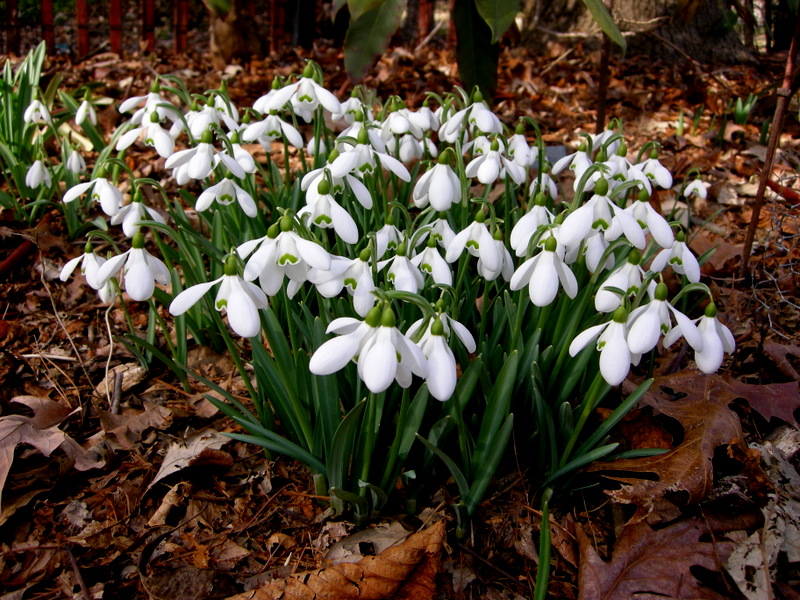
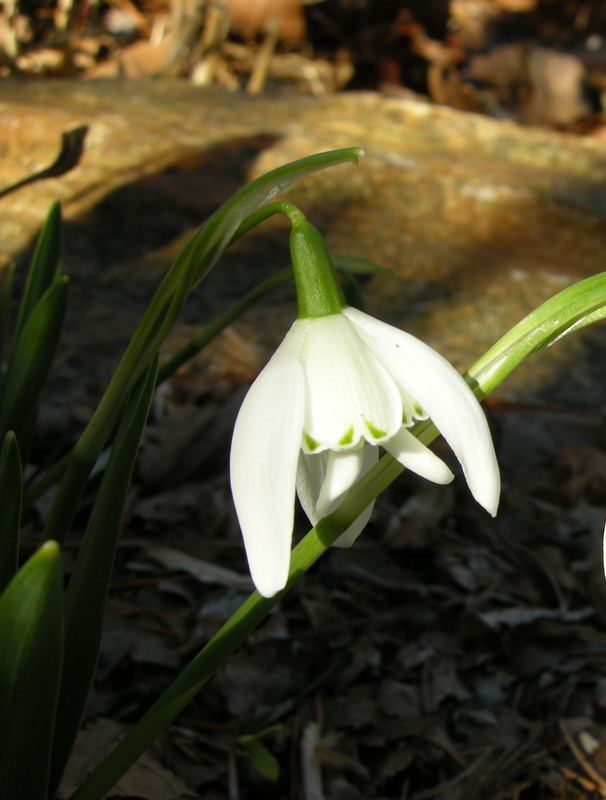
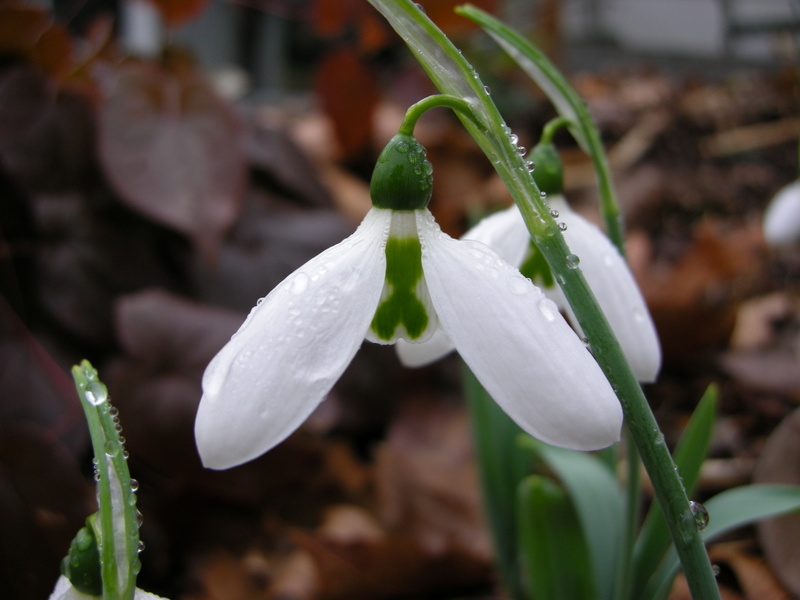
Although the common snowdrop, G. nivalis, pictured above with Italian arum and snow crocus, is the most prevalent snowdrop in gardens, it is by no means common in the ordinary sense of the word.  In fact, it is the best choice for gardeners who want to naturalize snowdrops in masses.

After hitting the books, I search the internet and read everything that has been written about the new snowdrop.  The available material is mostly the catalogues of all the big UK snowdrop sellers like Avon Bulbs, Harveys Garden Plants, and Monksilver Nursery, among others, but sometimes I come across fun historical or informational articles.  I also consult the Scottish Rock Garden Club Forum Galanthus thread where galanthophiles from all over the world meet to obsess.  After that, I look at photo galleries of snowdrops, particularly the Galanthus Gallery  and the new snowdrop photos on the Dryad Nursery website.

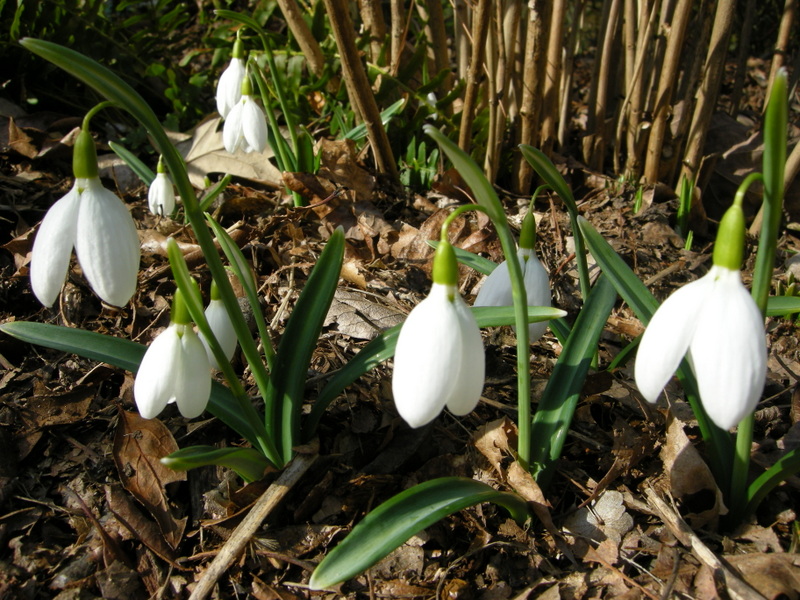
Galanthus elwesiiThe giant snowdrop, G. elwesii, is also a vigorous spreader.  This is the species massed at Winterthur.

Finally, as much as possible, I research the provenance of the snowdrop I am adding to my catalogue or collection.  Provenance is the history of a snowdrop’s ownership, documenting the authenticity of the actual bulbs being sold.  It is important that snowdrops come from a reputable source and be carefully tracked by subsequent owners.  With over 500, and some say 1,000, snowdrop cultivars circulating among collectors, it is easy to make mistakes.  For more information on provenance, click here.  With that background, on to the new snowdrops.

Galanthus plicatus 'Wendy's Gold' The very rare yellow snowdrop ‘Wendy’s Gold’.

I am thrilled to offer a yellow snowdrop for the first time, and not just any yellow, but ‘Wendy’s Gold’, the cream of the crop. Not only is this snowdrop much sought after even in England, but it easily refutes the oft made claim that all snowdrops look alike.  It was discovered in 1974 by Bill Clark, the Warden of the UK National Trust property Wandlebury Ring near Cambridge.  Ten years later, with some prodding, he realized how rare it was and decided to name it after his wife Wendy.  All the bulbs except three were then sold to a Dutch bulb company where they subsequently died,  Luckily, the remaining bulbs proved robust, and we have ‘Wendy’s Gold’ today.

Galanthus 'Wendy's Gold'


‘Wendy’s Gold’ is a superb and vigorous snowdrop with a yellow ovary (the “cap” above the petal-like segments) and a large and vivid yellow mark on the inner segments.  Its G. plicatus parentage gives it beautiful wide pleated leaves with folded margins, serving as a gorgeous backdrop for the striking flowers.

.

Galanthus elwesii 'Standing Tall' Cresson photo-001‘Standing Tall’ is a very impressive snowdrop.

In 1988, regional horticulturist Charles Cresson began evaluating a G. elwesii snowdrop known until this year as 88-1.  Over the years of testing it in various conditions in his garden, he discovered that 88-1 is a remarkable snowdrop.  Its 12″ height, about as tall as snowdrops get, and very upright habit give it a commanding presence in the garden.  However, as it turns out, 88-1 doesn’t have much competition from other snowdrops because it starts blooming right before Christmas and continues through the month of January, a time period when few other snowdrops bloom.

Galanthus elwesii 'Standing Tall' Cresson photo-005A close up of ‘Standing Tall’s’ flower.

Luckily, I was able to convince Charles that 25 years was long enough to evaluate a snowdrop, and he should introduce this absolutely outstanding new selection.  Charles decided to name it ‘Standing Tall’ to reflect its height, very upright habit, and ability to stand up to whatever the season brings, lying down in very cold weather and popping right back up as if nothing had happened.  Charles is in the process of registering it with the KAVB, the international registration authority for bulb cultivars in the Netherlands.  In the meantime, Carolyn’s Shade Gardens is thrilled to be chosen to introduce it for sale.

.

Galanthus 'Mighty Atom' Cresson GardenThe large and elegant flowers of ‘Mighty Atom’.

‘Mighty Atom’ is a beautiful snowdrop with very large, rounded, bright white flowers—the biggest flowers in the catalogue—with a bold, deep green mark on the inner segments.  Its habit is short, compact, and even making an exceptional overall presentation.  I have admired it for years and urged Charles to offer it, but he was reluctant due to its somewhat confused history. 

British snowdrop legend EB Anderson inherited the original ‘Mighty Atom’ from John Gray in 1952 and subsequently named it.  However, in later years, Snowdrops states that Anderson distributed a group of distinct but excellent clones, now known as the ‘Mighty Atom’ complex, under this name.  Charles’s stock came from plantsman Don Hackenberry who can trace its lineage directly back to EB Anderson, although it is not an offset of what is believed to be Gray’s “original” clone.  This member of the ‘Mighty Atom’ complex has proven to be reliable, vigorous, and trouble-free.

.

Galanthus nivalis 'Scharlockii' Cresson‘Scharlockii’ is characterized by the “rabbit ear’s” formed by its spathe (flower covering).

The final member of the four new snowdrops in my 2013 Snowdrop Catalogue is ‘Scharlockii’, a cultivar of the common snowdrop, G. nivalisIt is a charming and distinctive snowdrop with boldly marked green tips on its outer segments but most notable for the rabbit ears (see photo) formed when its spathe splits into two prominently upright, leaf-like halves.  It was discovered in 1818 by Herr Julius Scharlock of Grandenz, Germany, and named in 1868.  Charles got his stock from Winterthur, known for its amazing snowdrop display, when he worked there in the early 1990s.

.

Obviously, I find everything about snowdrops fascinating and hope I have communicated some of my infatuation to you.  If you are in the U.S. and want to order from the catalogue, just follow the directions for mail order.

Carolyn

Note: Every word that appears in orange on my blog is a link that you can click for more information.  If you want to return to my blog’s homepage to access the sidebar information (catalogues, previous articles, etc.) or to subscribe to my blog, just click here.


A Longwood New Year’s Eve

Posted in garden to visit, winter with tags , , , on January 1, 2013 by Carolyn @ Carolyns Shade Gardens

Carolyn’s Shade Gardens is a retail nursery located in Bryn Mawr, PA, specializing in showy, colorful, and unusual plants for shade.  The only plants that we ship are snowdrops and miniature hostas.  For catalogues and announcements of events, please send your full name, location, and phone number (for back up use only) to carolyn@carolynsshadegardens.com.  Click here to get to the home page of our website for catalogues and information about our nursery and to subscribe to our blog.

Longwood ChristmasPure magic!

For 2012-2013, I choose Longwood Gardens in Kennett Square, Pennsylvania, US, as the garden that I would visit throughout the year and profile.  Longwood is probably the most visited public garden in the US and holds a special place in my heart because I have taken almost 20 courses there, earning two Longwood Certificates of Merit in Ornamental Plants.  My previous posts profiled Longwood’s creative use of groundcovers (click here to read) and Longwood at night, focusing on the Bruce Munro light installation (click here to read).

Longwood conservatory One of the Longwood conservatories decorated for Christmas.

Visiting Longwood anytime of year is a breathtaking experience.  I have been going there for 30 years, and it never fails to delight me.  However, their Christmas display, both indoors and outside, is in a class by itself.  Before I go I always think the magic might have worn off.  But every time I walk out of the visitor’s center and see the lights, I am amazed once again.

.

Longwood ConservatoryA long view of one of the immense indoor spaces.

Because Longwood is so popular at Christmas, it takes a little planning to avoid the crowds.  In previous years, we choose a warm and drizzly night and had the gardens pretty much to ourselves.  This year we thought it might be fun to go on New Year’s Eve when musicians stroll through the gardens entertaining the crowds.  Our timing was perfect as we arrived at 2:15 pm, toured the relatively empty conservatories, ate delicious food in the uncrowded cafe, and escaped out into the garden just as it got dark and the hordes descended.

.

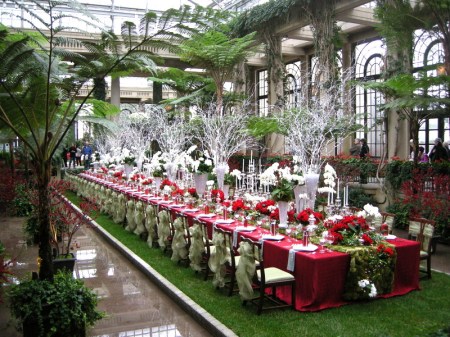
LongwoodOne of the rooms in the conservatories was set up for an immense holiday feast.  It was gorgeous.

The conservatories encompass four acres so there is a lot to see inside from orchids to bonsai to the actual greenhouses where the plants are grown.  All of it is decorated for the holidays.  Here are just a few displays that caught my eye:

.

LongwoodThe maze in the enchanting children’s garden.

.

LongwoodA very unusual color for a poinsettia, perfectly complimented.

.

Longwood

.

Longwood

.

Longwood ChristmasThe camellias were blooming.

.

Longwood Christmas-001The hibiscus were also in full flower.

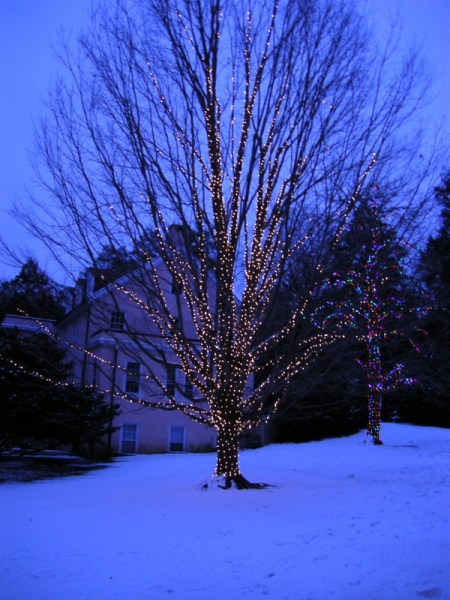
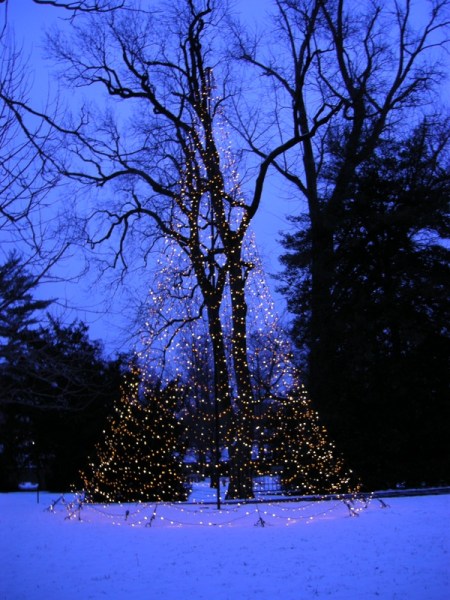
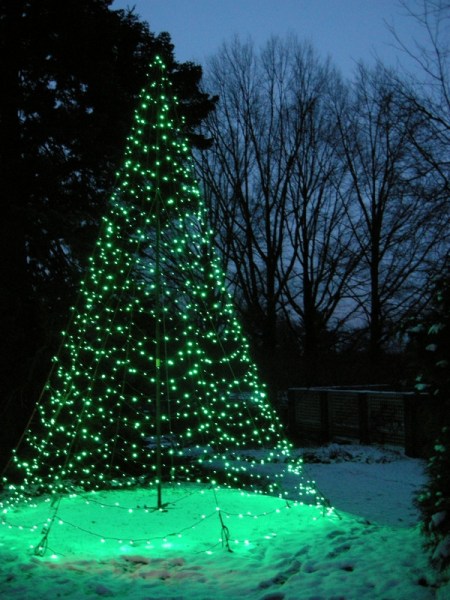
As much as I enjoy the conservatories, the real magic of a Longwood Christmas is outside where half a million lights decorate hundreds of trees.  If you think you have seen it all before, I challenge you to come here and not be in awe.  Panoramic shots would really do the display justice, but holding the camera steady for night shots without a tripod proved difficult at best.  Here is a small sampling of the light extravaganza:

LongwoodA photo at dusk by the Peirce du Pont House

.

LongwoodThe lights show up better in full dark but this effect was kind of surreal.

.

LongwoodThe famous five-acre fountain garden.  It is hard to convey in photos the size and scale of Longwood.

.

LongwoodLooking back inside the conservatories.

.

Longwood

.

Longwood ChristmasThis was my favorite wrapped tree hung with stars and displayed against the ink blue night.

.

Longwood

.

LongwoodMammoth copper beeches completely wrapped.

.

Longwood

.

Longwood

.

Longwood

.

Longwood

If you are in the area, it is well worth a visit.  The display continues through January 6, and timed tickets are required.

HAPPY NEW YEAR

Carolyn


Nursery Happenings:  The 2013 Snowdrop Catalogue is on the sidebar of the website and orders are being accepted.  To view the catalogue, click here.

Carolyn’s Shade Gardens is a retail nursery located in Bryn Mawr, PA.  The only plants that we mail order are snowdrops and miniature hostas.  The nursery is closed until spring 2013.  Thanks for a great year.

If you are within visiting distance and would like to receive catalogues and information about customer events, please send your full name and phone number to carolynsshadegardens@verizon.net.  Subscribing to my blog does not sign you up to receive this information.

Facebook:  Carolyn’s Shade Gardens has a Facebook page where I post single photos, garden tips, and other information that doesn’t fit into a blog post.  You can look at my Facebook page here or click the Like button on my right sidebar here.

Notes: Every word that appears in orange on my blog is a link that you can click for more information.  If you want to return to my blog’s homepage to access the sidebar information (catalogues, previous articles, etc.) or to subscribe to my blog, just click here.
 

A White Christmas

Posted in winter, winter interest with tags , , on December 24, 2012 by Carolyn @ Carolyns Shade Gardens

Carolyn’s Shade Gardens is a retail nursery located in Bryn Mawr, PA, specializing in showy, colorful, and unusual plants for shade.  The only plants that we ship are snowdrops and miniature hostas.  For catalogues and announcements of events, please send your full name, location, and phone number (for back up use only) to carolyn@carolynsshadegardens.com.  Click here to get to the home page of our website for catalogues and information about our nursery and to subscribe to our blog.

DSCN2269The London plane tree over my nursery sales area.

I was hoping for a white Christmas, but it is not to be so I guess I will have to make my own.  The winters of 2010 and 2011 provided more than enough photographic material.  Enjoy Carolyn’s Shade Gardens in the snow:

DSCN2205 A winter dawn in my main terrace garden.

.

DSCN2210Our dovecote engulfed in snow.

.

DSCN1075during a snowstorm

.

DSCN2170Looking up from the  production beds towards the house and terraces.

.

DSCN2202Dawn on the back side of the house.

.

DSCN2207The patio in winter.

.

DSCN2270More of our gigantic plane trees outlined in snow.

.

DSCN1070A snowy long view.

.

DSCN1088The carriage house nursery building in winter.

Happy Holidays, Merry Christmas, and Happy New Year

to all my readers, customers, and garden blogging friends.

Carolyn

P.S.  As I finished this post it began to snow!


Nursery Happenings:  The 2013 Snowdrop Catalogue is on the sidebar of the website and orders are being accepted.  To view the catalogue, click here.

Carolyn’s Shade Gardens is a retail nursery located in Bryn Mawr, PA.  The only plants that we mail order are snowdrops and miniature hostas.  The nursery is closed until spring 2013.  Thanks for a great year.

If you are within visiting distance and would like to receive catalogues and information about customer events, please send your full name and phone number to carolynsshadegardens@verizon.net.  Subscribing to my blog does not sign you up to receive this information.

Facebook:  Carolyn’s Shade Gardens has a Facebook page where I post single photos, garden tips, and other information that doesn’t fit into a blog post.  You can look at my Facebook page here or click the Like button on my right sidebar here.

Notes: Every word that appears in orange on my blog is a link that you can click for more information.  If you want to return to my blog’s homepage to access the sidebar information (catalogues, previous articles, etc.) or to subscribe to my blog, just click here.