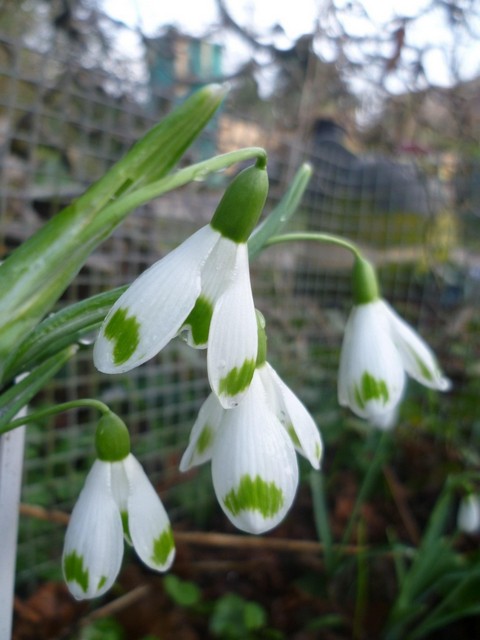
 Emma Thick supplied this lovely closeup of her namesake snowdrop.
To see last year’s snowdrop catalogue, click here.
Seeing the green tips of emerging snowdrops in our garden every fall never gets old. The anticipation and promise that those tips represent propel me happily through fall garden chores. Right now, several varieties are finished while many midfall-blooming snowdrops are in full glorious bloom.
This is part two of a three-part post on the new snowdrops that will be offered in our 2027 Snowdrop Catalogue. To read part one, click here. The catalogue will be posted on our website in the first half of December, and details will be sent to our snowdrop customer list soon. Meanwhile, this post will give everyone an advance look (sorry, no advance orders) at four more special, new snowdrops that will be available for order in December. Enjoy!
Nursery News: Carolyn’s Shade Gardens is a specialty nursery located in Bryn Mawr, PA. The only plants that we ship are snowdrops within the US. All other plants are available locally by preorder from catalogues. For catalogues and announcements, please send your full name, mailing address, and cell number to carolyn@carolynsshadegardens.com and indicate you are interested in snowdrops. Click here to get to the home page of our website for catalogues and information about our nursery and to subscribe to our blog.
‘Emma Thick’ (photo above) is a cross between G. nivalis and G. plicatus (G. x valentinei) and has the hybrid vigor that often results from this cross. A galanthophile friend of mine says its multiplication rate is “quite breathtaking”. It is a tall snowdrop and its flowers have a lovely bell-like shape reminiscent of an inverse poculiform, although it is not one. The apple green chevron on the outer segments is very beautiful, and the inner segments feature a large mark too.
.
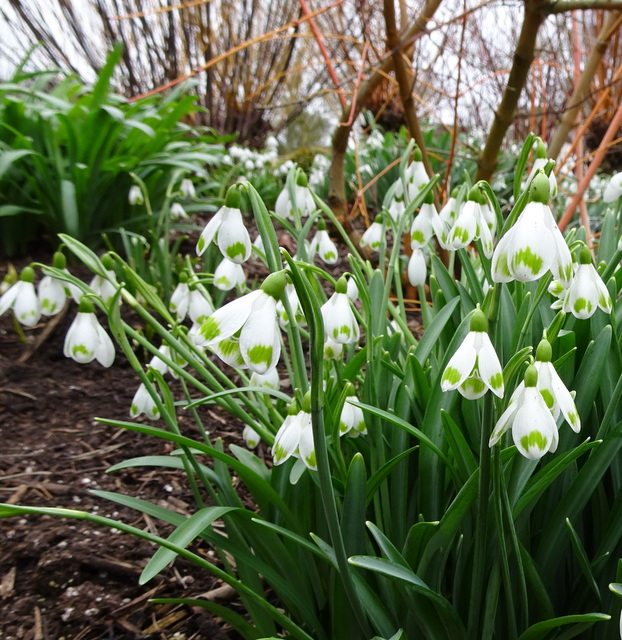 ‘Emma Thick’ is a very robust snowdrop. Photo taken at Glen Chantry during our visit in 2023.
Emma Thick oversees the National Collection of Snowdrops at Thenford Gardens in England, which has well over 1,000 different varieties in its 40-acre grounds. In 2023, Michael and I were invited by Emma for a private tour of Thenford’s snowdrop collection. To read more about the tour, click here. Emma has supplied all the information here about her namesake snowdrop and its origins, which involve a number of snowdrop luminaries in addition to her.
.
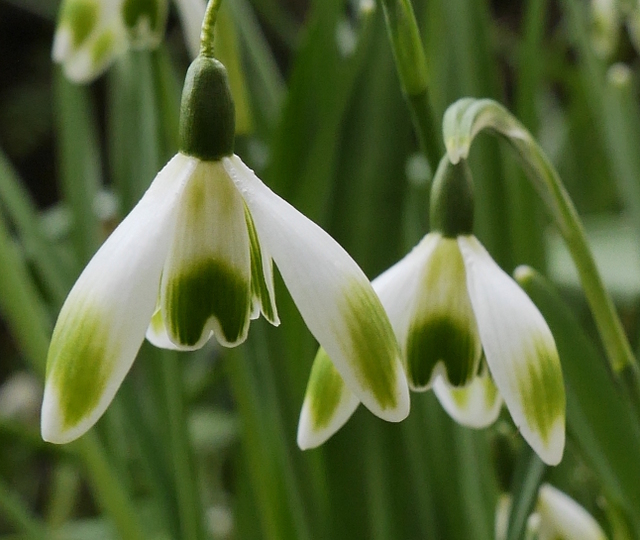 ‘Envy’ is a very green, vigorous snowdrop.
‘Envy’ is a cultivar of the common snowdrop species, Galanthus nivalis. It is easy to recognize because of its prominent green markings both inside and out. Its outer segments feature a broad green half moon encircling a pure white oval on the apex. The mark on the inner segments is dark emerald green usually fading towards the base leaving two “eyes”. ‘Envy’ features an upright habit with distinctly vertical leaves. It was selected by Dutch snowdrop expert Gert Jan van der Kolk and named circa 2003.
.
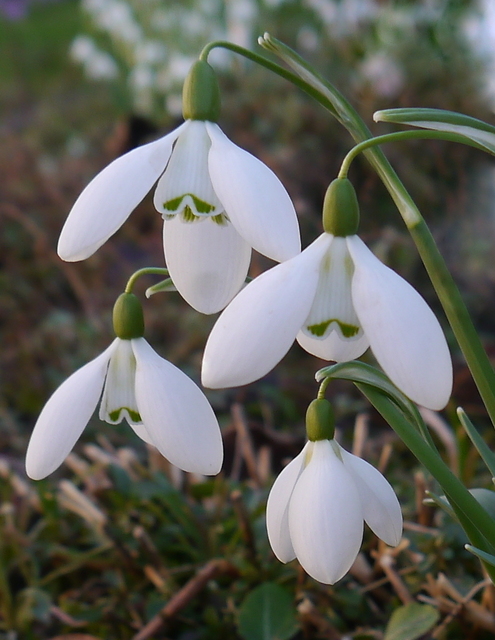 ‘Ketton’ has elegant proportions.
‘Ketton’ is a classic snowdrop introduced by the legendary plantsman E.A. Bowles around 1950 and originally found in the village of Ketton, East Midlands, England. The flower has lovely proportions and is held well above the slender, upright leaves. The outer segments are elegantly rounded and smooth with a unique quality that Matt Bishop’s book calls “crystalline”. The inner segments have two green dots around the sinus similar to ‘Lady Beatrix Stanley’ and two very faint green “eyes” at the base. ‘Ketton’ grows into a vigorous clump. It received an award from the RHS in 1996, recognizing that, even after almost 50 years in the trade, it was still a very desirable snowdrop.
.
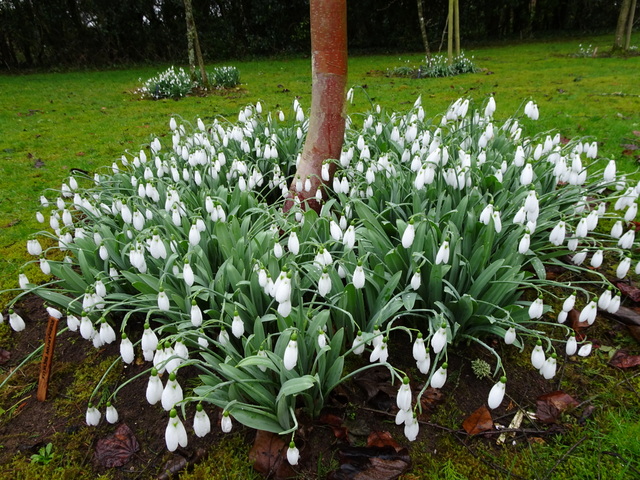 It is very difficult to portray in a photo the sheer size and magnificence of ‘Rodmarton Regulus’, but here is a large stand around the base of a paperbark maple at Rodmarton Manor, taken during our 2018 visit. The plants dwarf the large wooden stake in the lower left corner even though they were being beaten down by the pouring rain.
‘Rodmarton Regulus’ is a magnificent snowdrop, inspiring a string of superlatives. Its flowers are bigger, both in length and breadth, than any other snowdrop in my garden. The heavy flower has long, ridged outers, which are boat-shaped, and a wide dark green X marking two-thirds of the inner segments. It is a very tall plant with broad blue-green leaves. It multiplies well and has excellent resilience to the the weather.
.
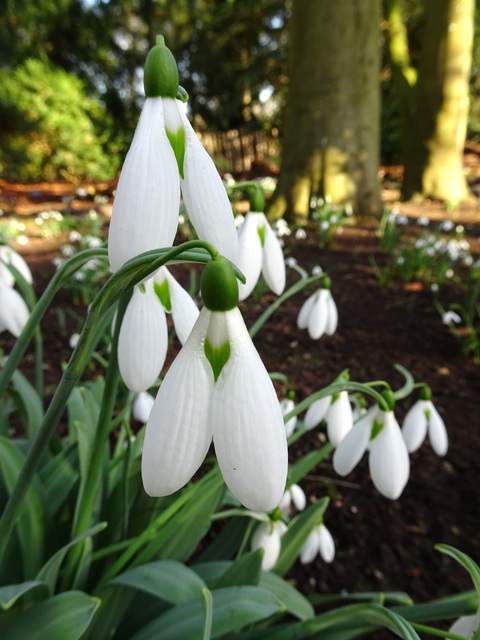 A close up of Rodmarton Regulus taken during our 2023 visit to the special snowdrop collection at Anglesey Abbey. For more photos from that visit, click here.
‘Rodmarton Regulus’ was selected by Simon Biddulph at Rodmarton Manor, the amazing Arts and Crafts house and garden in Gloucestershire, England, where he grew up. He named it after the star Regulus, which is the brightest star in the constellation Leo and the 21st-brightest star in the night sky. For more photos from our trip to this unique and wonderful garden, click here.
.
 Simon Biddulph shows off the snowdrop he discovered and named.
.
Look for another post profiling more new snowdrops for 2027.
.
Blogs are a lot more fun for everyone, especially the writer, when readers leave comments. Just scroll down to the end of the page to the box where it says “Leave a Comment” and start typing—-it’s easy!
Carolyn
.
Note: Every word that appears in orange on my blog is a link that you can click for more information. If you want to return to my blog’s homepage to access the sidebar information (catalogues, previous articles, etc.) or to subscribe to my blog, just click here.