Historic Bartram’s Garden

Posted in garden to visit, native plants, Uncategorized with tags , , , , , , , , , , , , , , , , , on July 6, 2012 by Carolyn @ Carolyns Shade Gardens

Carolyn’s Shade Gardens is a retail nursery located in Bryn Mawr, PA, specializing in showy, colorful, and unusual plants for shade.  The only plants that we ship are snowdrops and miniature hostas.  For catalogues and announcements of events, please send your full name, location, and phone number (for back up use only) to carolyn@carolynsshadegardens.com.  Click here to get to the home page of our website for catalogues and information about our nursery and to subscribe to our blog.

John Bartram House, Philadephia, Pennsylvania, US


“Whatsoever whether great or small ugly or handsom sweet or stinking…every thing in the universe in their own nature appears beautifull to mee.”

John Bartram 1740


For Mother’s Day this May, I was surprised with a picnic and visit to Bartram’s Garden in Philadelphia, Pennsylvania, US, the oldest surviving botanic garden in North America.  Prominent Philadelphia Quakers, John Bartram (1699-1777) and his son William (1739-1823) were the most important American plant explorers of the 18th century, traveling south to Florida, west to the Mississippi, and north to Lake Ontario.  They introduced more than 200 native plants into cultivation.  By mid-century, their 102 acre garden (now 45 acres) contained the most extensive collection of North American plants in the world.
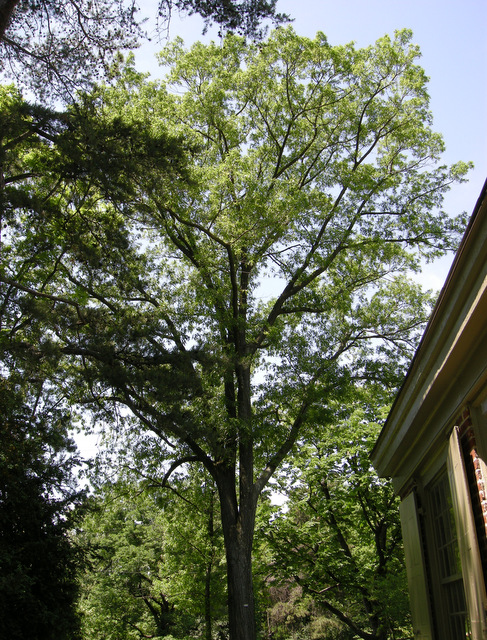
Native Bartram oak, Quercus x heterphylla, a rare hybrid between red oak, Quercus rubra, and willow oak, Quercus phellos, discovered by John Bartram.

…the Botanick fire set me in such A flame as is not to be quenched until death or I explore most of the…vegitative treasures in No. America.”

John Bartram 1761


The intrepid Bartrams shared their discoveries with scientists throughout America and Europe, especially England.  John Bartram’s discoveries were considered so important that he was appointed Royal Botanist by King George III.  Bartram founded the American Philosophical Society in Philadelphia with his friend and colleague Benjamin Franklin.  In addition, he started a thriving seed and plant business with his lists appearing in London publications as early as the 1750s.  In 1783, Bartram published the first American nursery catalogue.  [Historical information and quotes courtesy of Bartram’s Garden.]
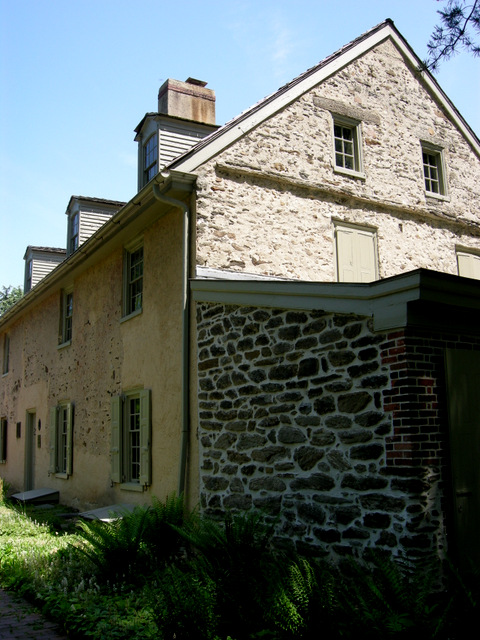
John Bartram purchased his farm in 1728 and completed this portion of the stone house in 1731.


The house and gardens are a National Historic Landmark and have been well preserved despite their location in a very developed part of Philadelphia. Fortunately, they were acquired by the city in 1891 and became part of the public park system.  The property is on the banks of the Schuylkill River and is a joy to visit both to see the historic buildings and to wander through the peaceful gardens.  I would visit Bartram’s Garden just to see the specimen trees.   I am going to take you on a short photographic tour below, but I highly recommend an actual visit.
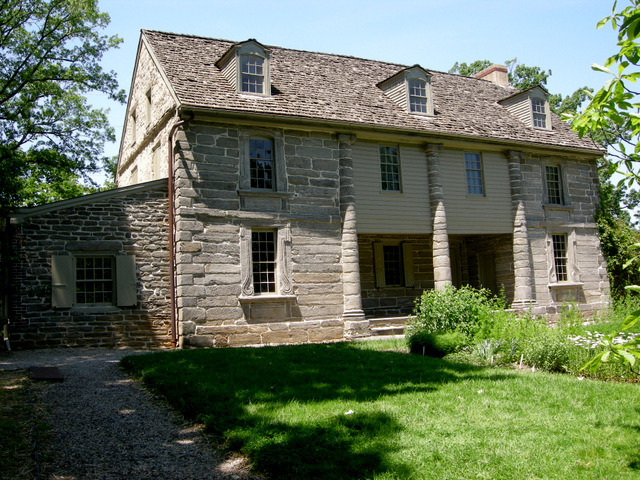
This formal façade, which faces the gardens, was added between 1758 and 1770.


Close up of the façade


Carved stone window in the facade


This pristine example of a two-level Pennsylvania bank barn was built in 1775.


Stone watering trough


John Bartram’s first experimental garden


Looking from the house towards the kitchen and stables


Walking along the wooden boardwalk by the river


The foundation of this simple mill based on an ancient European design was carved from the bedrock next to the river.


Apples were crushed in the circular trench by a wooden wheel.
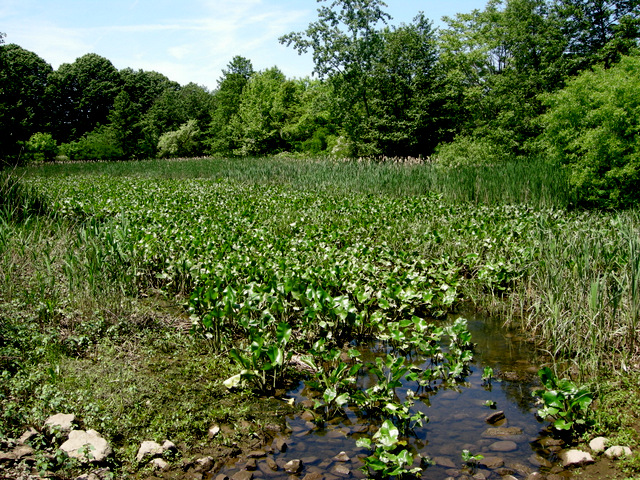


There are some very beautiful wetlands on the shores of the river.


If you love trees, and especially specimen trees as I do, you don’t want to miss seeing the huge mostly native trees at Bartram’s Garden.  I include photos of some of them below, but they are so large that it is hard to get a good photograph.  You have to see them in person to truly appreciate their magnificence.


The oldest ginkgo tree, G. biloba, in North America planted by William Bartram in 1785.
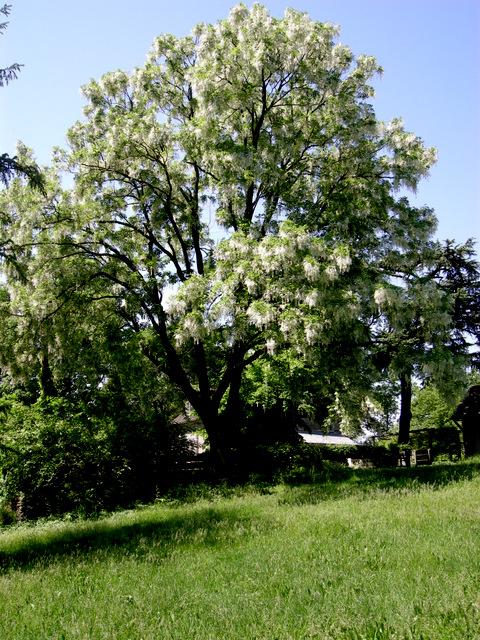


Luckily there was a field below this amazing American yellowwood, Cladrastis kentukea, so I could get a photo of the whole tree.


The house next to the yellowwood gives it some scale.  We were fortunate to catch it in full bloom.


Yellowwood flowers


Under the yellowwood tree


American beech, Fagus grandifolia


Native willow oak, Quercus phellos


Native common hackberry, Celtis occidentalis


Bartram’s Garden is a public park and is open all year for self-guided tours except city-observed holidays.  I hope you have the chance to visit.


Carolyn

Nursery Happenings:  The nursery is closed until the fall.  Thanks for a great spring season!

If you are within visiting distance and would like to receive catalogues and information about customer events, please send your full name and phone number to carolynsshadegardens@verizon.net.  Subscribing to my blog does not sign you up to receive this information.

Facebook:  Carolyn’s Shade Gardens has a Facebook page where I post single photos, garden tips, and other information that doesn’t fit into a blog post.  You can look at my Facebook page here or click the Like button on my right sidebar here.

Notes: Every word that appears in orange on my blog is a link that you can click for more information.  If you want to return to my blog’s homepage to access the sidebar information (catalogues, previous articles, etc.) or to subscribe to my blog, just click here.

 

Longwood Gardens Part 2: At Night

Posted in garden to visit with tags , , , on June 27, 2012 by Carolyn @ Carolyns Shade Gardens

Carolyn’s Shade Gardens is a retail nursery located in Bryn Mawr, PA, specializing in showy, colorful, and unusual plants for shade.  The only plants that we ship are snowdrops and miniature hostas.  For catalogues and announcements of events, please send your full name, location, and phone number (for back up use only) to carolyn@carolynsshadegardens.com.  Click here to get to the home page of our website for catalogues and information about our nursery and to subscribe to our blog.

One of the light installations by Bruce Munro.

In 2011-2012, I did a series of four posts on Chanticleer, a pleasure garden in Wayne, Pennsylvania, US.  These were very popular, and the second, Chanticleer Part 2: Garden Seating, is my most popular post ever by a large margin.  I intended to profile another local garden this year but have been slow to choose one.  My two recent trips to Longwood Gardens in Kennett Square, Pennsylvania, US, reminded me how much it has to offer so I will be profiling Longwood this year.

The sun was getting lower behind the conservatory as we arrived.

Longwood Gardens is a 1,077 acre public garden with a four-acre indoor conservatory.  The property was originally purchased by the Peirce family from William Penn in 1700 to establish a farm.  In 1906, the farm was purchased by Pierre du Pont, the industrialist and driving force behind the E. I. du Pont de Nemours and Company, primarily to preserve the spectacular trees.  From then into the 1930s, Pierre du Pont created most of what is there today before turning Longwood over to a foundation in 1946.  Almost anything horticultural that you would want to see is found at Longwood: extensive native woodlands, a rose garden, elaborate French inspired fountains with shows set to music, comprehensive teaching gardens, majestic conservatories, an Italian water garden, treehouses—I can’t even list everything.

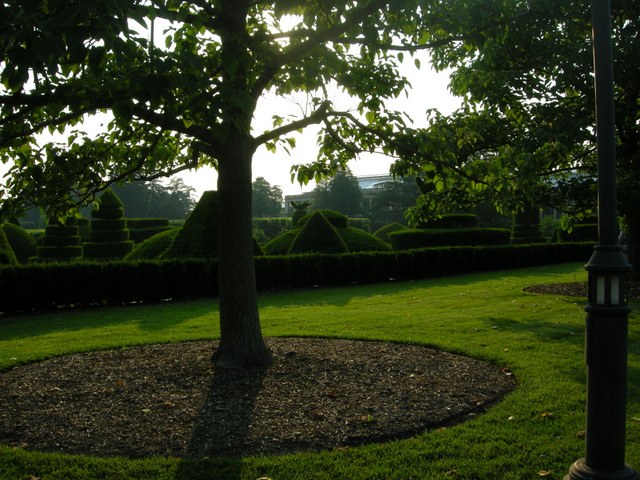
The topiary gardens looked quite elegant with the sun at this angle.

In my first post, Groundcovers, Thinking Outside the Box, I focused on the unusual plants that Longwood masses as groundcovers.  On my second visit, I took my family to see the amazing light displays created at Longwood by British lighting designer and installation artist, Bruce Munro.  We arrived around 7 pm, ate dinner at their lovely cafe with outdoor seating, and toured the gardens as the sun set and it became dark enough to see the Munro installations.

The bridge from the cafe to the conservatories.

I am not going to say much about the Munro installation except that it is fantastic.  It was so much more than I expected, including an entire woodland turned into a painter’s canvas, and I am so glad that I didn’t miss this unique experience.  I apologize to my non-local readers but the only good photos I got were of the small entry installations, and they are included at the beginning and end of this post.

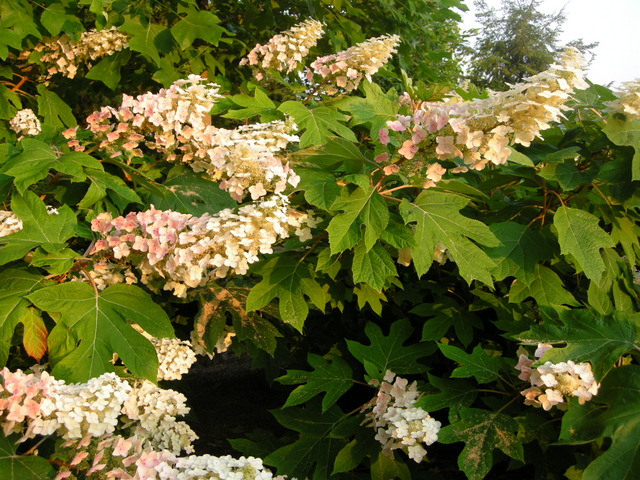
The slanting light of the setting sun on the gorgeous plantings was beautiful: here oakleaf hydrangea.

What I am going to say is that the light exhibit gives visitors a great reason to see Longwood as the sun sets and after dark.  The gardens are open until 11 pm from Wednesday through Saturday during the exhibit. The purchase of special timed entry tickets is required, although the entry fee is unchanged.  This is a magical time in any garden, but it is especially wonderful in a place as expansive as Longwood.  We wandered from one end to the other after dinner as we waited for dark on the longest day of the year.  Here is more of what we saw:

A newly built grass amphitheater.

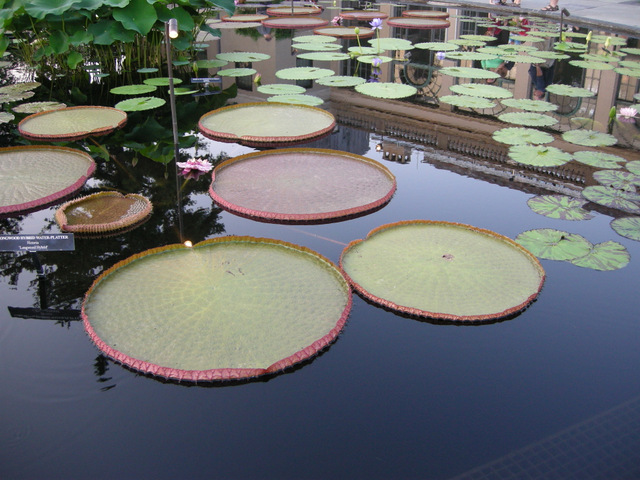
Longwood has elaborate water lily ponds in an outdoor courtyard at the heart of the conservatories.  I think they are best viewed at dusk and we spent a lot of time there.

Another view of the water lily ponds

Victoria water platters have always fascinated my husband and children.  I don’t condone this, but if you lift them up they are covered with spikes on the bottom.

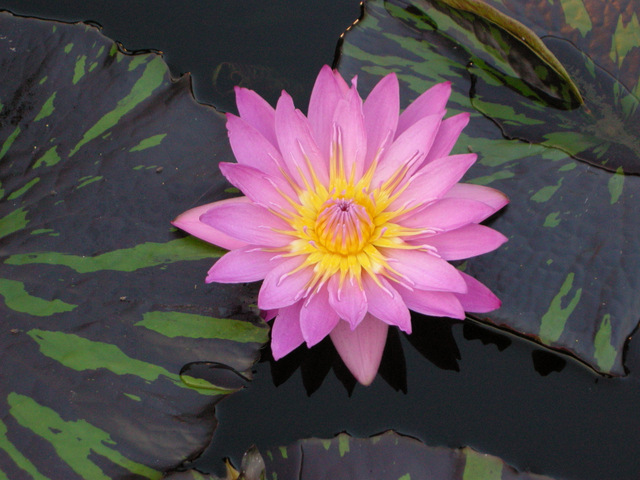
Night-blooming water lily

A different species of water platter.

My favorite water lily—look at those leaves.

Sunset over the water lilies

From the water lily pools, we headed to the Idea Gardens which contain large individual areas displaying sun and shade perennials (photo above), annuals, vegetables and fruit, roses, vines, grasses, and groundcovers as well as a charming outdoor children’s garden (there is an amazing indoor children’s garden in the conservatories which should not be missed by children of all ages).

In the evening light, this red hot poker looked like it would burn you if you touched it.

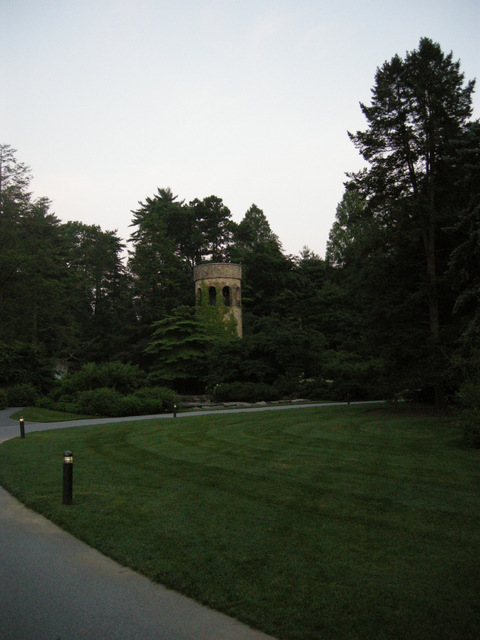
The Chimes Tower which is surrounded by shady woodland plantings and the unusual waterfall called the Eye of Water.

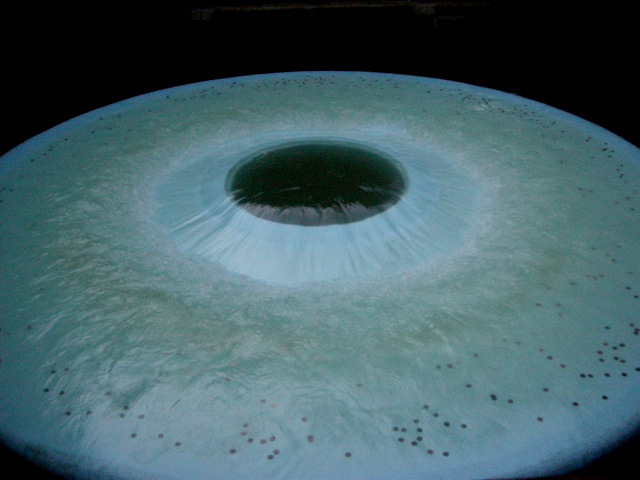
The Eye of Water, the source of the Chimes Tower waterfall, glows at night—no additional lighting required.

A view of the conservatories from a spot near the Eye of Water

It’s almost time to view the light display: the purple martins are returning home for the evening.

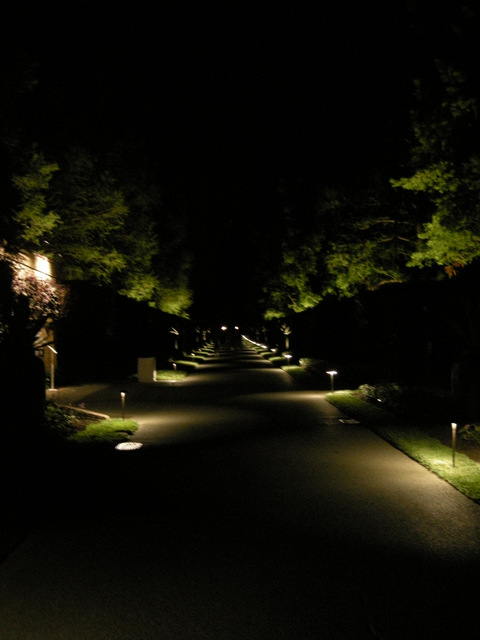
Longwood in the dark

This is my only other photo of the Bruce Munro lighting, and it is of the relatively small but quite lovely sculptural installations by the front entrance.  Some of the other installations cover acres and need to be seen to be believed. 

Although you can see a small part of Longwood at night if you attend a musical event or a fireworks and fountains show, both of which I highly recommend, the Munro exhibition invites you to wander over a major portion of the garden at night.  If you are anywhere near Longwood, you shouldn’t miss it—now until  September 29.


Carolyn

Nursery Happenings:  The nursery is closed until the fall.  Thanks for a great spring season!

If you are within visiting distance and would like to receive catalogues and information about customer events, please send your full name and phone number to carolynsshadegardens@verizon.net.  Subscribing to my blog does not sign you up to receive this information.

Facebook:  Carolyn’s Shade Gardens has a Facebook page where I post single photos, garden tips, and other information that doesn’t fit into a blog post.  You can look at my Facebook page here or click the Like button on my right sidebar here.

Notes: Every word that appears in orange on my blog is a link that you can click for more information.  If you want to return to my blog’s homepage to access the sidebar information (catalogues, previous articles, etc.) or to subscribe to my blog, just click here.

You Asked for the Long View Part 2

Posted in landscape design, my garden, Shade Gardening with tags , , , , , on June 20, 2012 by Carolyn @ Carolyns Shade Gardens

Carolyn’s Shade Gardens is a retail nursery located in Bryn Mawr, PA, specializing in showy, colorful, and unusual plants for shade.  The only plants that we ship are snowdrops and miniature hostas.  For catalogues and announcements of events, please send your full name, location, and phone number (for back up use only) to carolyn@carolynsshadegardens.com.  Click here to get to the home page of our website for catalogues and information about our nursery and to subscribe to our blog.

Looking down the hill through the gardens on the back side of the house.  The ‘Butterfly’ Japanese maple is like a torch.

This is the sequel to the post You Asked for the Long View Part 1 in which I showed you all the gardens along the front side of the house.  I wrote that post to satisfy all my readers who have been asking to see the big picture of my garden.  I took the photos for both posts using my recently purchased “new iPad”, which has a highly acclaimed camera function.  After experimenting with it, I have concluded that the iPad does take decent photos but a lot of the reason they look so good is because the screen resolution on the new iPad is amazing.  Once I downloaded the photos to my PC, they didn’t look so fabulous.  The new iPad will not be replacing my camera anytime soon.

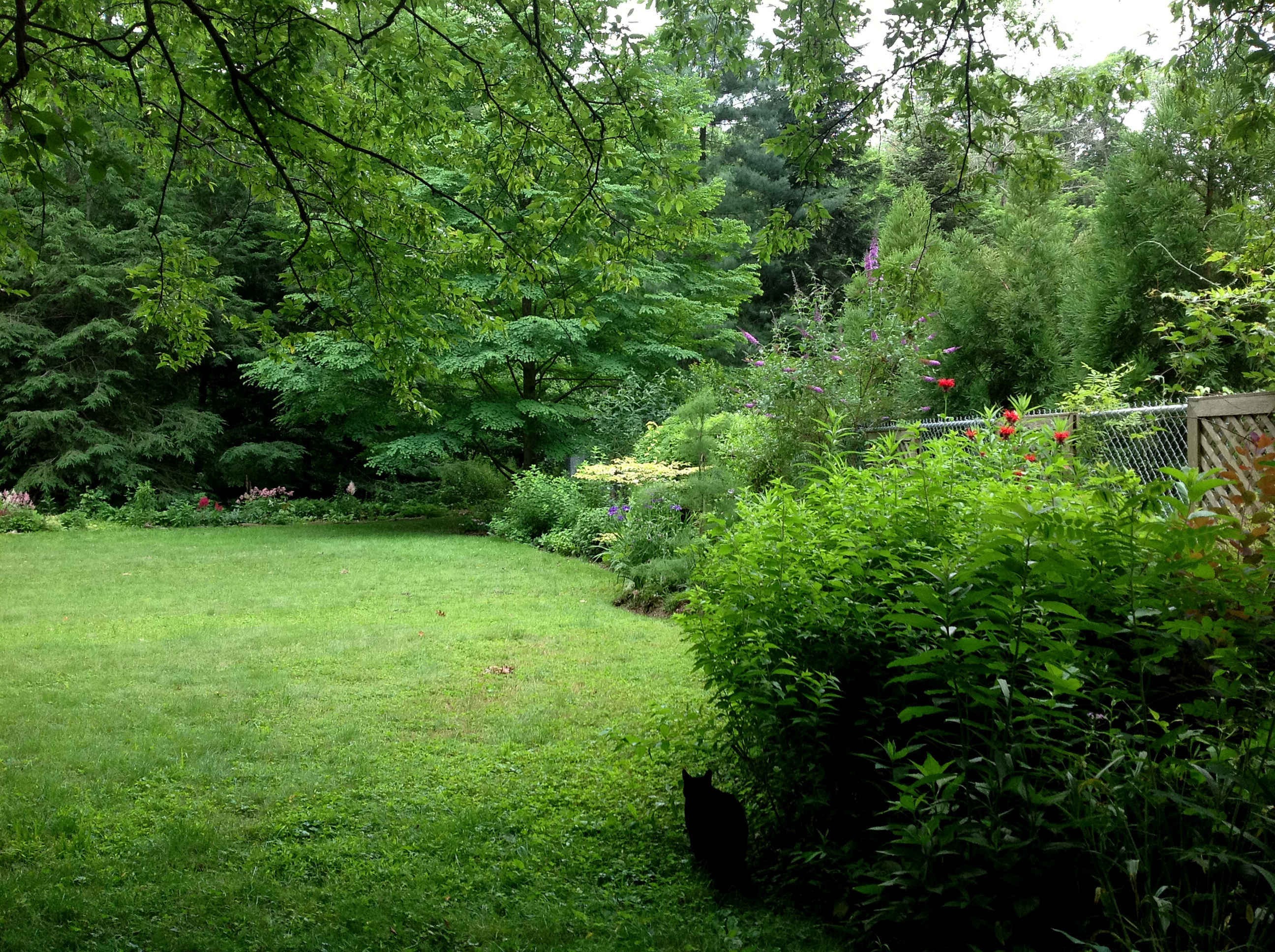
The view from my dry shade garden across the lawn to my production beds.  The gardens on the right were planted in the last two years to hide the neighbor’s hideous chain link fence.

Before we begin the second half of the tour, I want to comment on the odd gardening season.  Because the ground never froze this winter and March was so warm, everything started blooming a month early.  I kept wondering when this was going to catch up with us, and the answer is now.  There is not much blooming in my garden because it all bloomed early and later-flowering plants have gone back to their regular schedule.  If you want to see what the gardens looked like when everything bloomed together, view the amazing photographs in Julie’s Carolyn’s Shade Gardens post on her blog Wife, Mother, Gardener.

The production beds at the bottom of the lawn where I grow plants to sell at my nursery, mostly primroses, pulmonarias, and hellebores.


The tour starts at my dry shade garden where we left off in the last post and continues down the hill to my production beds (see two photos above).  From there, we turn to the left and loop up behind the house.  One route branches off to the right to meander through the woodland garden and the other goes straight up the hill past our deck.  It is hard to explain how it all fits together, but I will do my best.

The production beds are behind us, to the left is the water garden, which stays moist most of the year, and ahead is the back side of the house and the deck.  The lower entrance to the woodland garden is hidden just ahead on the right.

A closer view walking towards the deck.

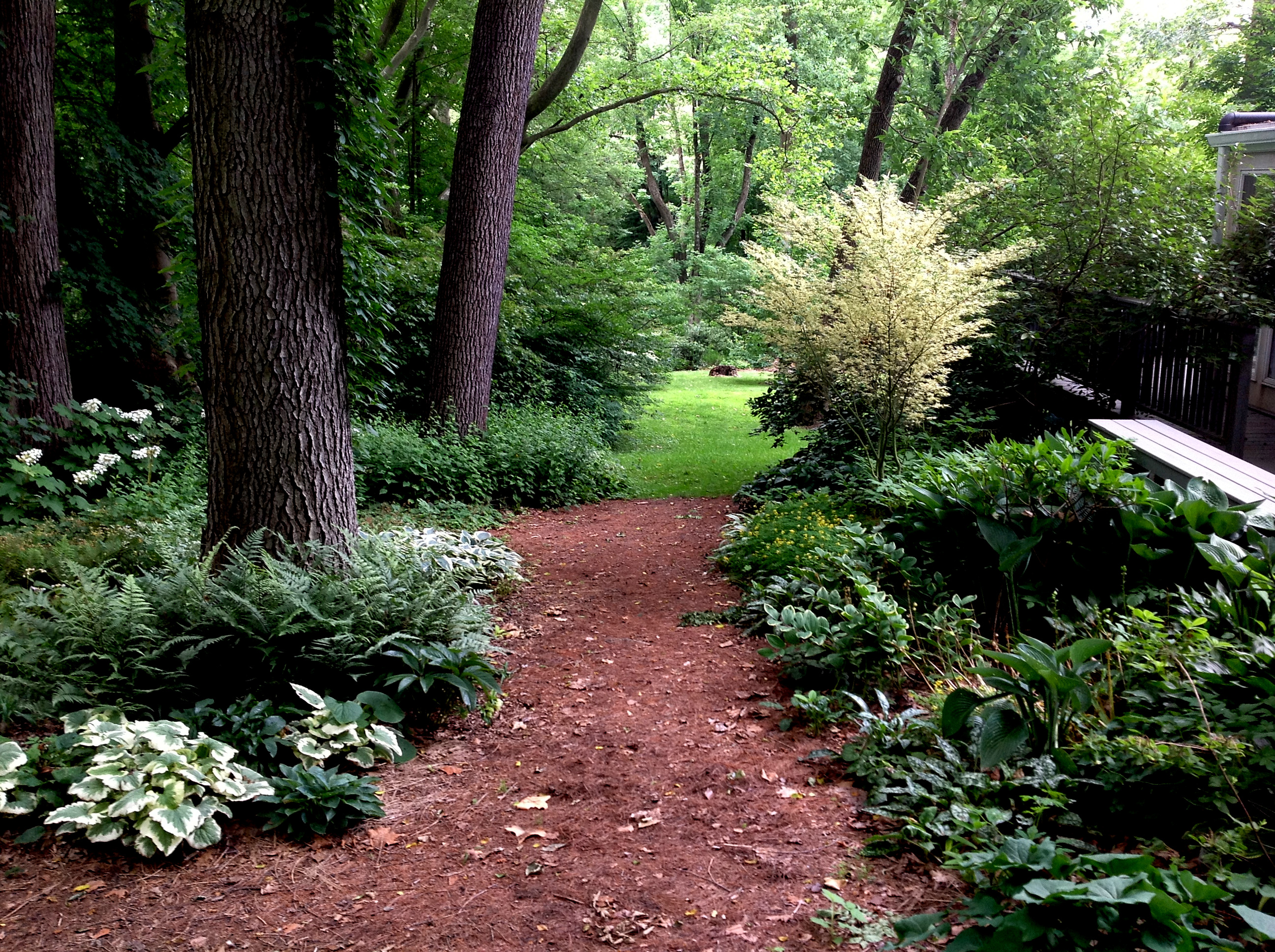
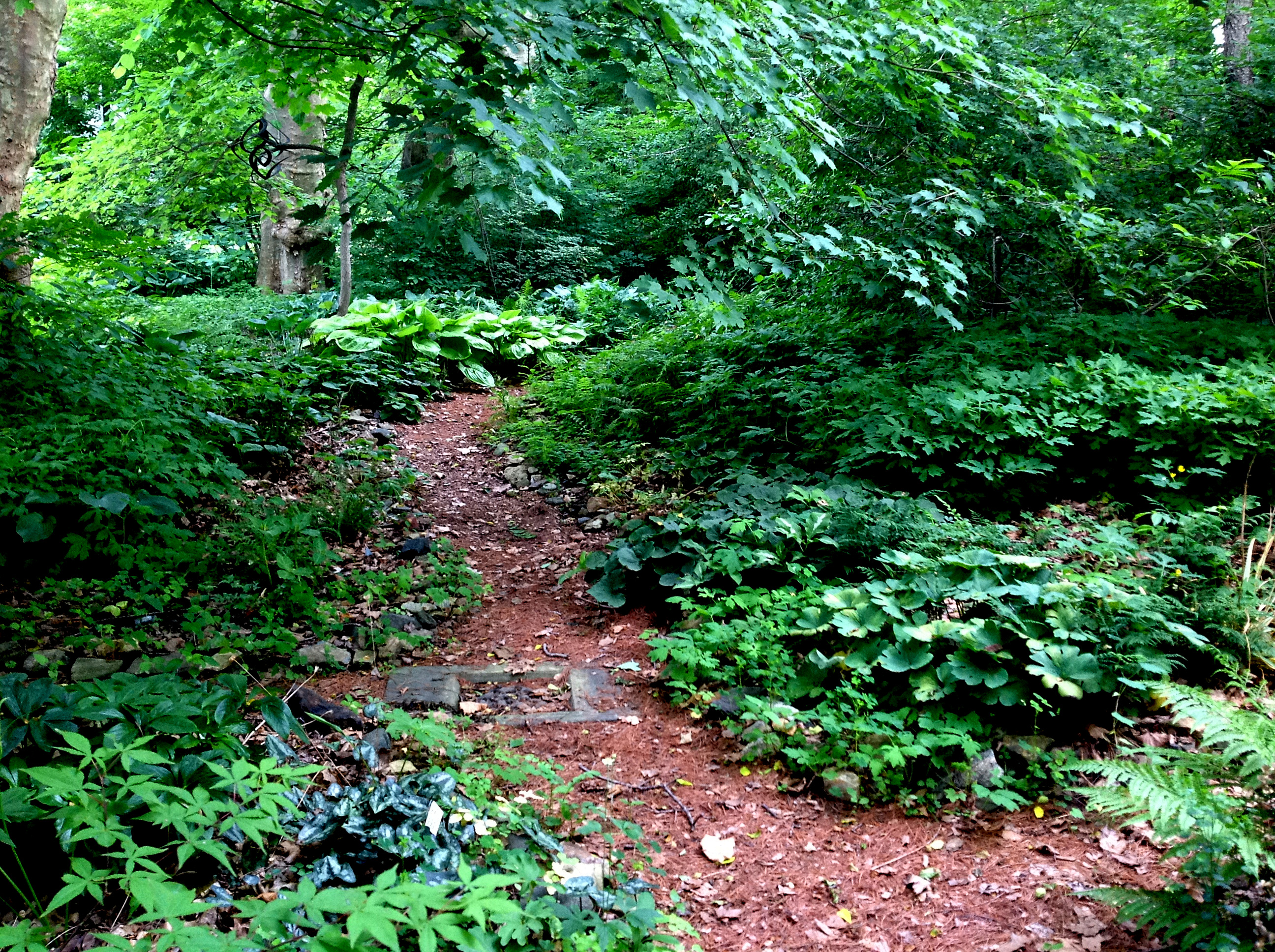
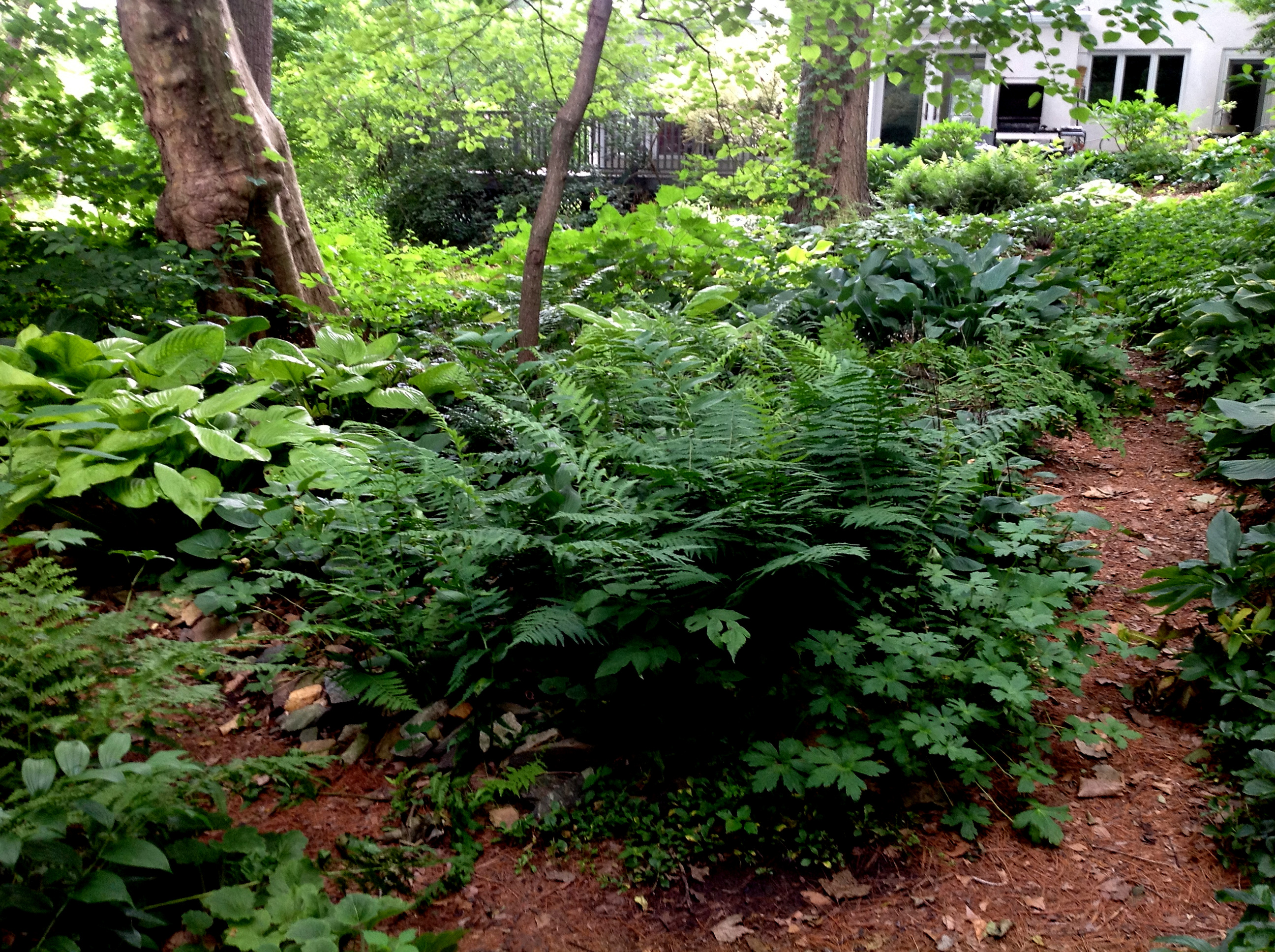
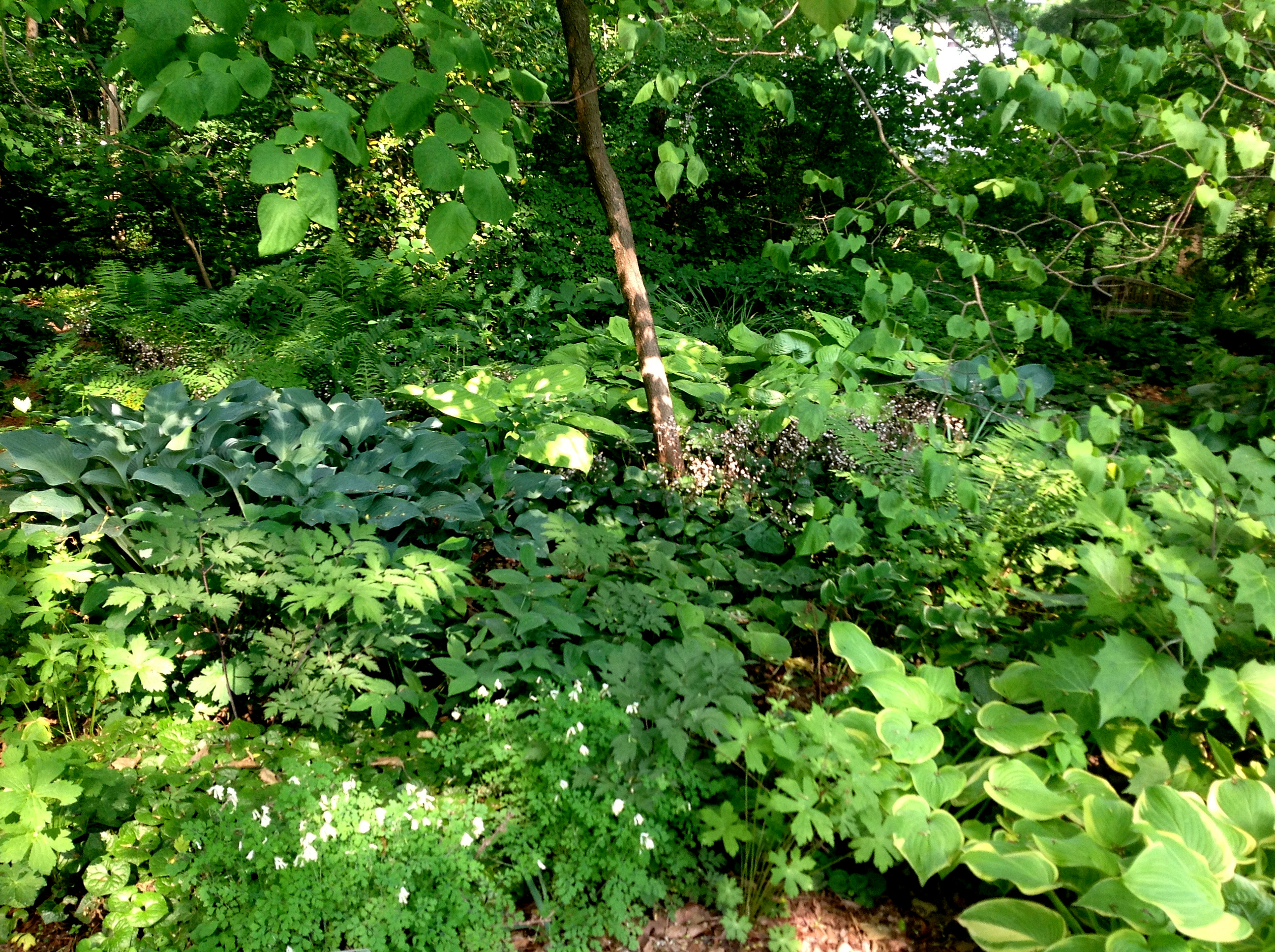
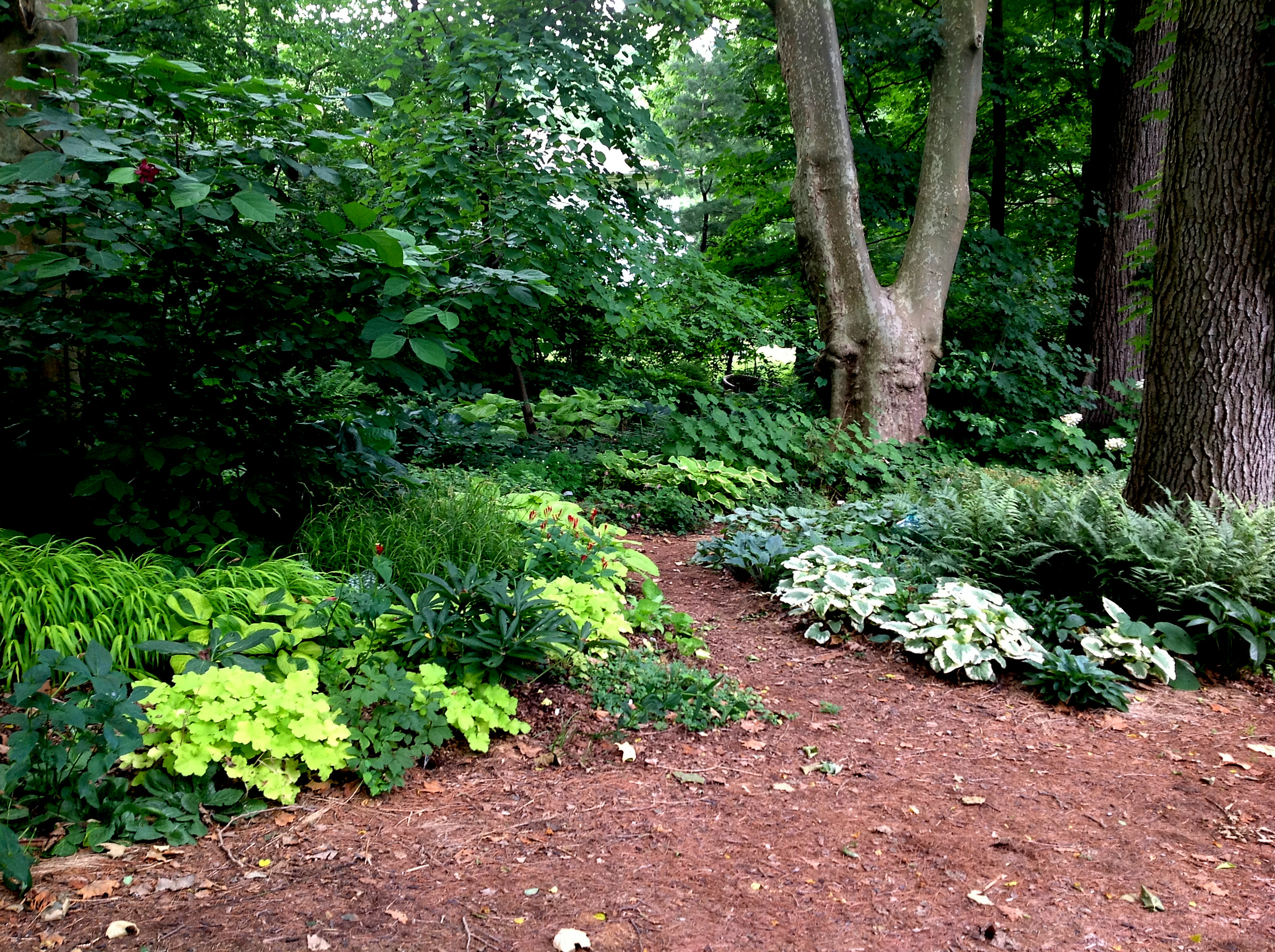
We headed off into the woods.  This is the upper half of the fully shaded woodland garden.  All the paths are covered in white pine needles.

A closer view of the woodland garden: it peaks in early spring but Hosta ‘Sum and Substance’ is making a splash right now.

Still in the woodland but turning the corner to exit out the top entrance.

Standing outside the top entrance and looking back into the woodland.

Looking back from the patio towards the top entrance of the woodland with the yellow and gold garden on the left and the silver and blue garden on the right.

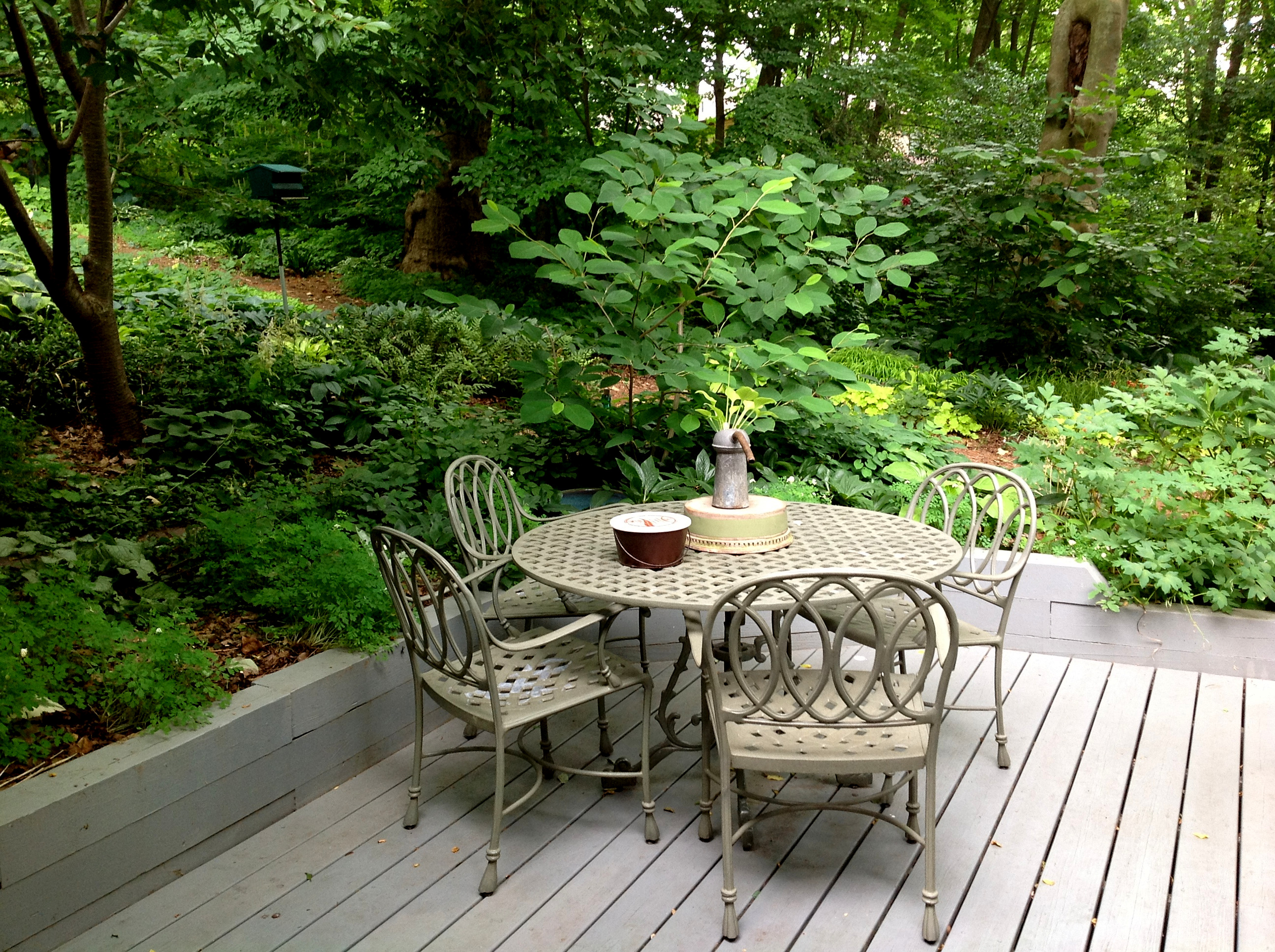
A slight detour to show you the patio.  You can see the yellow and gold garden behind the magnolia.

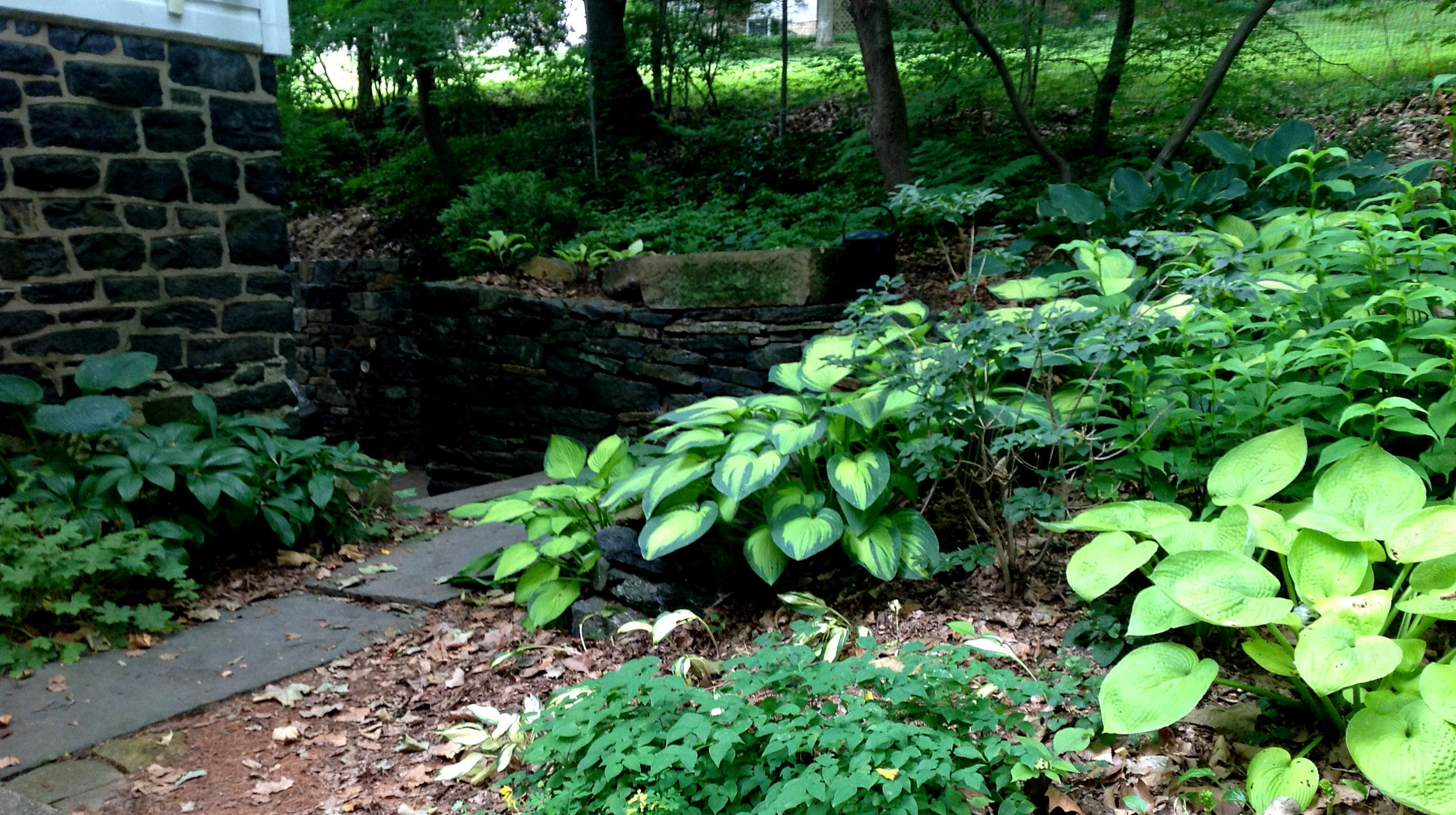
Looking from the patio towards the stone room where we make compost and store firewood.  Our garage was the carriage house for an estate, and the compost area was the manure pit for the stables .

We have backtracked to walk up the hill by the deck without detouring into the woodland.  The silver and blue garden is on the right and the deck/patio is on the left.

Passing the upper entrance to the woodland.

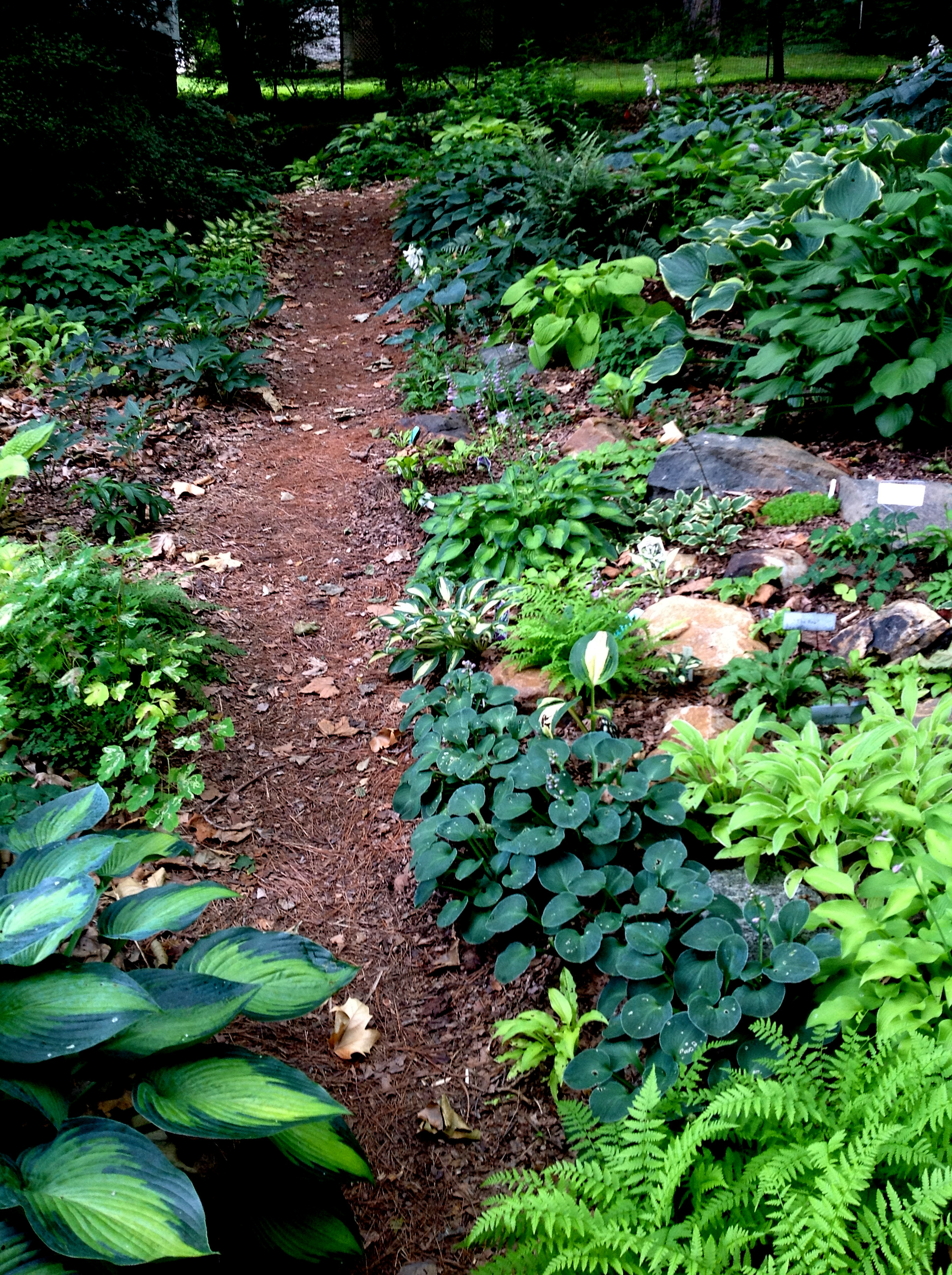
We call this hosta hill because we used hostas to colonize the eroded slope and get rid of the grass.

The upper half of hosta hill.

Passing the miniature hosta rock garden.

Looking down hosta hill from the top.

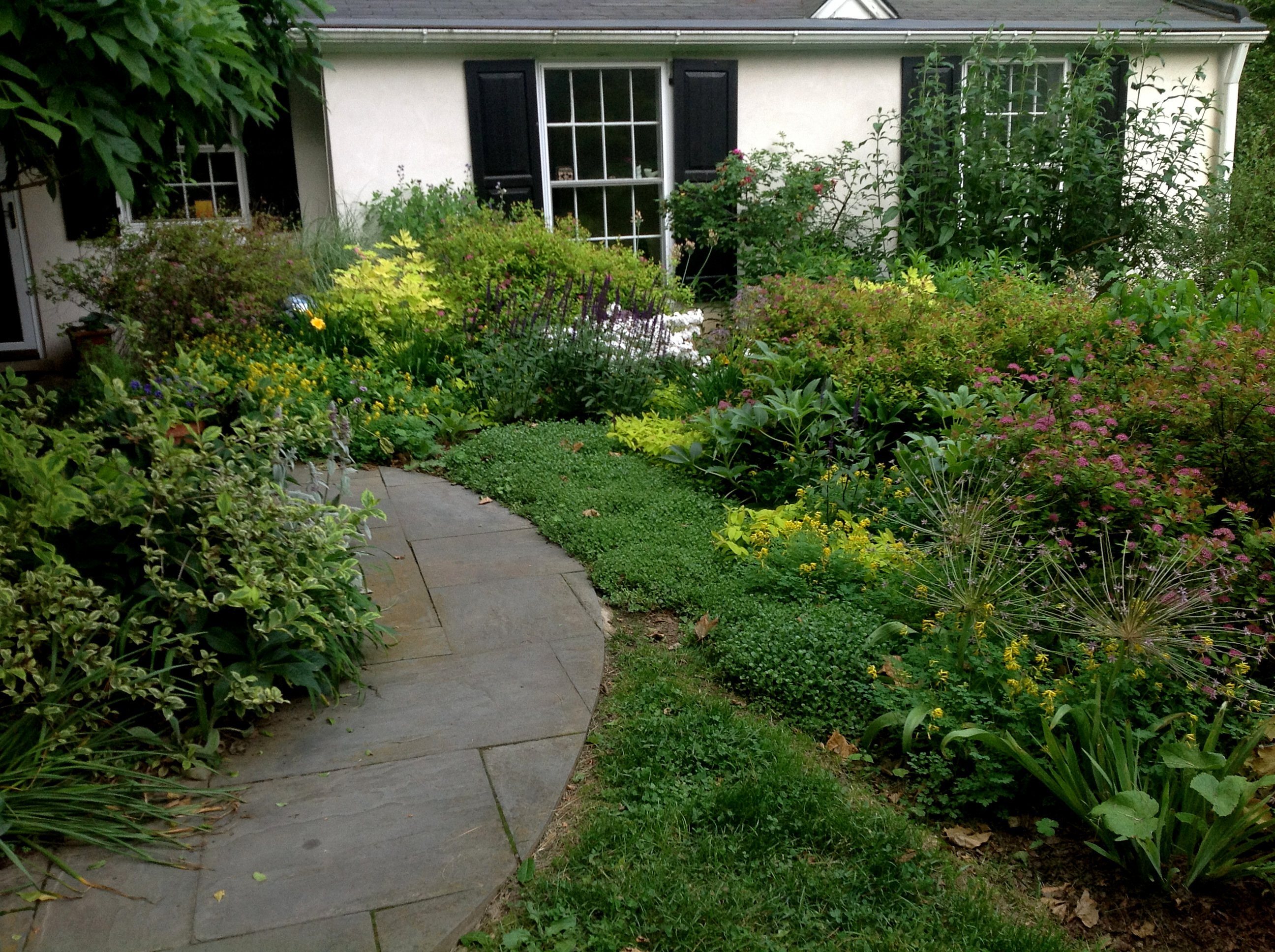
Turning towards the carriage house at the top of hosta hill.

Heading back out to the driveway where we started in the  first post.

I hope you have enjoyed the “big picture” tour of the gardens on the east side of the house.  Stay tuned for a series of posts on all the wonderful gardens I have visited in the last few months.

Carolyn

Nursery Happenings:  The nursery is closed until the fall.  Thanks for a great spring season!

If you are within visiting distance and would like to receive catalogues and information about customer events, please send your full name and phone number to carolynsshadegardens@verizon.net.  Subscribing to my blog does not sign you up to receive this information.

Facebook:  Carolyn’s Shade Gardens has a Facebook page where I post single photos, garden tips, and other information that doesn’t fit into a blog post.  You can look at my Facebook page here or click the Like button on my right sidebar here.

Notes: Every word that appears in orange on my blog is a link that you can click for more information.  If you want to return to my blog’s homepage to access the sidebar information (catalogues, previous articles, etc.) or to subscribe to my blog, just click here.

Groundcovers, Thinking Outside the Box

Posted in garden to visit, groundcover, How to, landscape design, native plants, Shade Gardening, Shade Perennials, Shade Shrubs with tags , , , , , , , , , , , , , , , , , , , , , , , , , , , , , , , on June 11, 2012 by Carolyn @ Carolyns Shade Gardens

Carolyn’s Shade Gardens is a retail nursery located in Bryn Mawr, PA, specializing in showy, colorful, and unusual plants for shade.  The only plants that we ship are snowdrops and miniature hostas.  For catalogues and announcements of events, please send your full name, location, and phone number (for back up use only) to carolyn@carolynsshadegardens.com.  Click here to get to the home page of our website for catalogues and information about our nursery and to subscribe to our blog.

Part of the Idea Garden at Longwood Gardens

I recently visited Longwood Gardens in Kennett Square, Pennsylvania.  I have no hesitancy in saying that Longwood is one of the premier gardens in the world and should be on everyone’s life list.  However, there is so much there that it is difficult to post about it.  Also, “familiarity breeds contempt.”  I hold two Certificates in Ornamental Horticulture from Longwood and have taken a total of 18 courses to earn them.  Each course involved a minimum of 8 visits to the gardens so you can see that I have spent a lot of time there.  If you are local, these courses are the absolute best plant education available.

Italian Water Garden, viewed while resting in the shade.

Because I have spent so much time at Longwood, I didn’t photograph the usual sights or even visit the fabulous four acre indoor conservatory (with one exception mentioned below).  As a shade gardener I headed straight for Peirce’s Woods, which is seven acres devoted to shady plants native to the eastern U.S. deciduous forest.  I hoped to augment my library of photographs and get some ideas of plants to sell at the nursery and add to my own gardens.  I wasn’t disappointed.

The straight species of smooth hydrangea, H. arborescens, lined the very shady paths by the lake.  I think it is more appropriate to a woodland garden than the cultivated forms like ‘Annabelle’.

Smooth hydrangea has a lovely flower whose size is in keeping with other native woodland plants.

While walking through Peirce’s Woods, I returned to the thoughts I have been having lately about groundcovers.  This time of year, with the weeds running rampant, my customers are more interested in groundcovers.  But it is clear from their questions that they mean plants that form runners to creep and cover the ground.  The classic examples are vinca, ivy, and pachysandra.  However, my definition of groundcover is much broader than this and includes any plant massed to effectively choke out weeds.

Native maidenhair fern, Adiantum pedatum


When you look at the masses of native maidenhair fern above, you are probably thinking that’s all very nice that Longwood uses masses of these fairly pricey, non-creeping plants as groundcover, but I could never afford that quantity of plants.  However, think of the alternative: weeds and the hours if not days it takes to remove them, not to mention how their presence detracts from the look of your garden as well as your satisfaction with it.  Your time is valuable, and you wouldn’t be reading my blog if the look of your garden wasn’t important to you.

Native semi-evergreen coralbells, Heuchera villosa, often sold as the cultivar ‘Autumn Bride’, has gorgeous white flowers in the fall.

Yes, you can use mulch to keep down the weeds.  However, commercial shredded hardwood mulch is not attractive, is generally not produced sustainably, and requires a significant time investment to apply it.  Most importantly, it requires a monetary outlay every year because it must be re-applied every spring.  Perennial plants are initially more expensive to buy and plant but once they are there, you never have to do anything again.  It is kind of like buying a compact fluorescent light bulb versus the bulbs we grew up with.

Here are some more plants that Longwood uses in masses to make effective groundcovers:

Mexican feather grass, Nassella tenuissima


Native evergreen Christmas fern, Polystichum acrostichoides

Native semi-evergreen coralbells, Heuchera villosa purple form.

Shredded umbrella-plant, Syneilesis aconitifolia: I can only dream of achieving this in my garden, and, yes, it is very expensive.

Native hay-scented fern, Dennstaedtia punctiloba, creeps to fill in large areas.

This bellflower, Campanula takesimana, was growing and apparently self-sowing in dense shade on the hillside near the Chimes Tower.

Fall-blooming yellow waxbells, Kirengoshoma palmata, is more like a shrub than a perennial but it dies to the ground ever year.

Native coralbells, Heuchera villosa ‘Caramel’, is my favorite heuchera and retains its lovely color 365 days a year.

Giant butterbur, Petasites japonicus, grows in dense shade and covers a lot of ground.

Lavender mist meadow-rue, Thalictrum rochebrunianum

Native sensitive fern, Onoclea sensibilis, does creep.

Shrubs can be used as groundcover also, two examples from Longwood:

The straight species of oakleaf hydrangea, H. quecifolia, gets quite large and spreading.

Native southern bush honeysuckle, Diervilla sessifolia, suckers to form a colony.

Lastly, I want to show you why I briefly visited the conservatories:  groundcover for walls, the new fern wall at Longwood.  It is worth a visit just to see it:

This is a beautiful hallway containing individual restrooms, and the walls are totally covered in ferns.

Some of the ferns are quite large, and all are healthy and beautiful.

I hope I have convinced you to think outside the box and mass all kinds of unusual plants as groundcovers.  You will have more time to enjoy a better looking garden and save money in the long run.

Carolyn

Nursery Happenings:  This coming weekend we will have our final open hours at the nursery on Saturday, June 16, from 9 am to 2 pm, and Sunday, June 17, from 11 am to 1 pm.  We close on June 17 until September.  Customers on my email list will receive an email with details.

If you are within visiting distance and would like to receive catalogues and information about customer events, please send your full name and phone number to carolynsshadegardens@verizon.net.  Subscribing to my blog does not sign you up to receive this information.

Facebook:  Carolyn’s Shade Gardens has a Facebook page where I post single photos, garden tips, and other information that doesn’t fit into a blog post.  You can look at my Facebook page here or click the Like button on my right sidebar here.

Notes: Every word that appears in orange on my blog is a link that you can click for more information.  If you want to return to my blog’s homepage to access the sidebar information (catalogues, previous articles, etc.) or to subscribe to my blog, just click here.
You Asked for the Long View Part 1

Posted in landscape design, my garden, Shade Gardening with tags , , , , , on June 4, 2012 by Carolyn @ Carolyns Shade Gardens

Carolyn’s Shade Gardens is a retail nursery located in Bryn Mawr, PA, specializing in showy, colorful, and unusual plants for shade.  The only plants that we ship are snowdrops and miniature hostas.  For catalogues and announcements of events, please send your full name, location, and phone number (for back up use only) to carolyn@carolynsshadegardens.com.  Click here to get to the home page of our website for catalogues and information about our nursery and to subscribe to our blog.

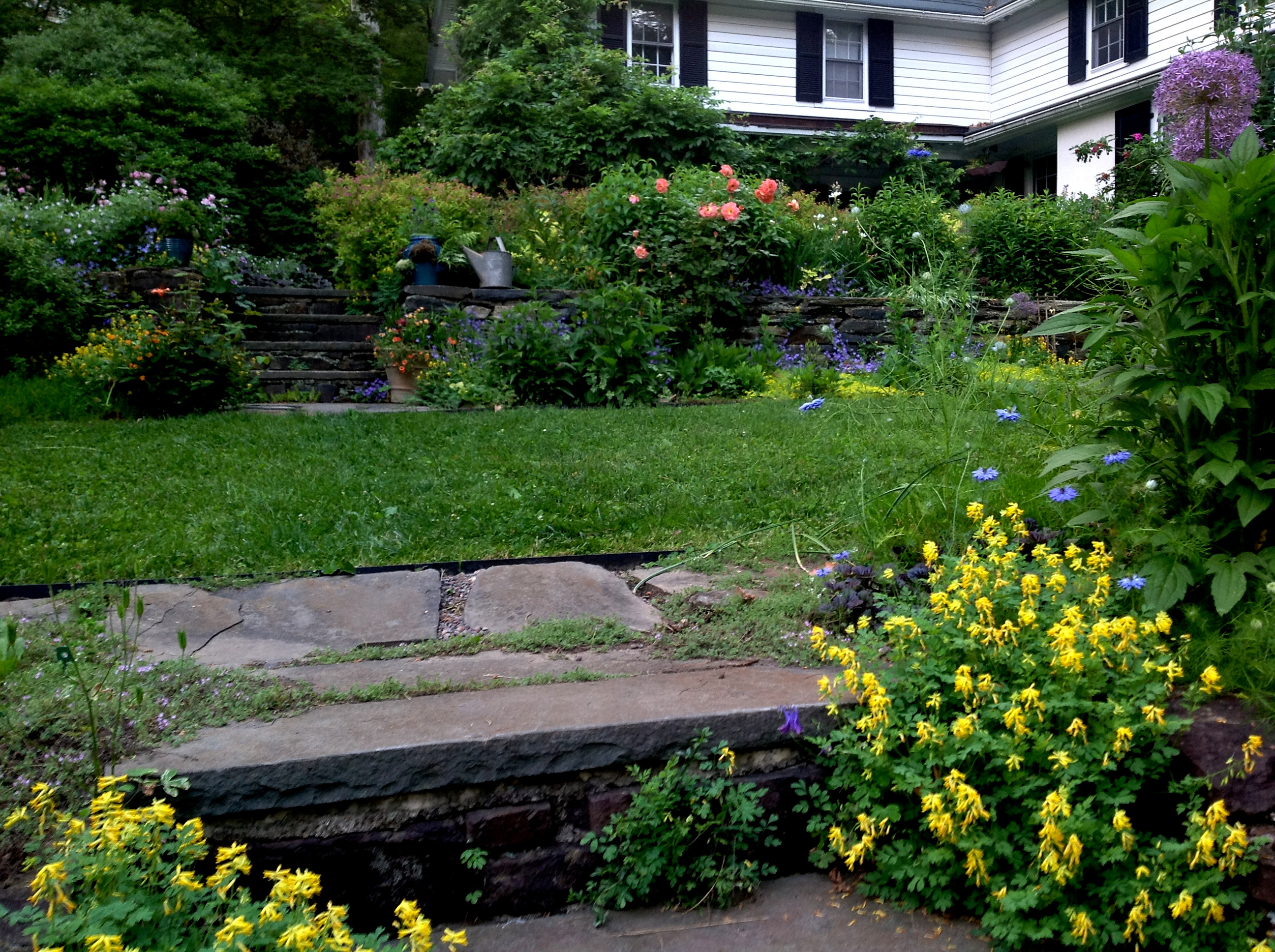
The entrance to the gardens from the nursery is down these stone stairs because a lot of the property is on the side of a south-facing hill.

I haven’t posted in a while due to technical difficulties.  I recently bought a “new iPad” and was very excited about using it to compose a post with long shots of my garden.  My current camera is great for macro shots but not very good for landscape photos.  The new iPad reportedly has a very good camera so I thought I would take a lot of long shots to satisfy all my readers who have been asking to see the big picture of my garden.  Unfortunately I have found the WordPress app that is supposed to coordinate the iPad with WordPress to be challenging—at least for this technologically unsavvy blogger.

A view of the bed along the steps from the nursery to the main terrace.

Giving up on the idea of actually posting from the iPad, I downloaded the iPad photos to my PC.  Another touted feature of the new iPad is even higher quality screen resolution.  That means, as I discovered, that the photos look fabulous on my iPad but pretty ordinary on my PC.  But having come this far, I am going ahead with the long view garden tour.  I hope you are all viewing it on an iPad and will think I am an incredible photographer.  For those of you on a “normal” computer, please don’t tell.

On the way down the stairs, we passed by the rock garden terrace and landed on the main terrace by the front door.  You are looking to the left towards the door.

Looking from the front door out towards the same beds.

Looking to the right towards the other end of the main terrace.

A wider view of the right end of the main terrace by the front door.

Looking from the main terrace back up the hill towards the rock garden terrace, which really shines in early spring but still looks nice now.

The view from the main terrace down to the bottom terrace and beyond.

The stairs from the main terrace to the bottom terrace.  Most of the flowers on this level are orange and purple.

The left side of the bottom terrace.

The right side of the bottom terrace.

Another view of the right side of the bottom terrace.

A closer view

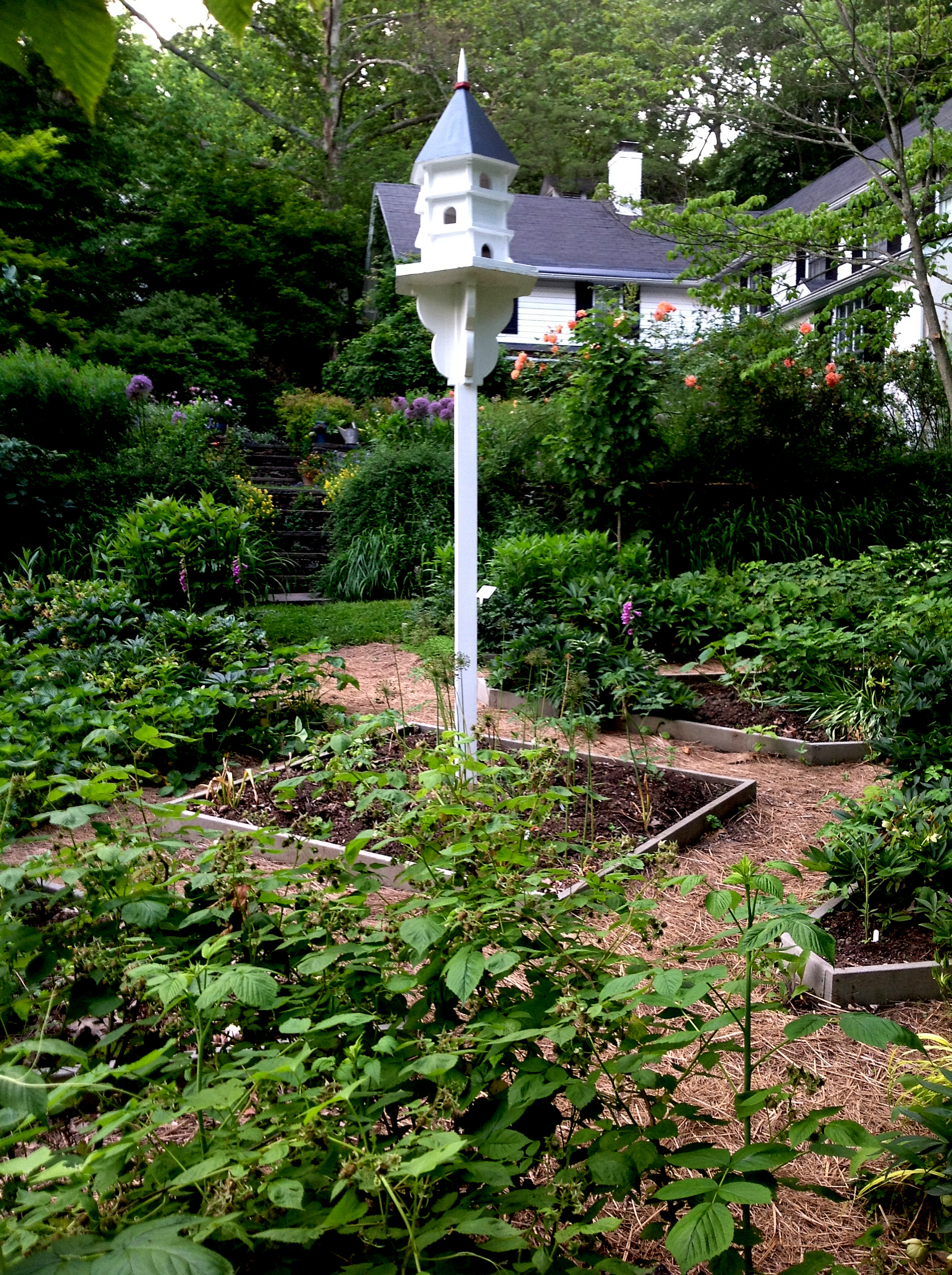
The view from the bottom terrace down to the raised bed area where the birdhouse resides.

The stairs down to the next level.

The raised bed area was built as a vegetable garden but converted to hellebore beds when deer overran our property.  It is currently being reclaimed for fruit and vegetables now that we have a deer fence.

Below the raised beds is what we call the dry shade garden under an American hornbeam.  It is filled with roots and not much rain gets through the leaves.  Beyond this garden is lawn until you get to my production beds where I grow plants to sell at the nursery.

A close up of the dry shade garden.

Looking from the dry shade garden back up the hill.

That’s the tour of the gardens going down the hill on the west side of the house.  It is the sunniest area of my property—the real shade gardens are in the back.  You will have to wait for part two to see those.

Carolyn

Nursery Happenings:  We will be at the Bryn Mawr Farmer’s Market this Saturday, June 9, from 9 am to 1 pm.  The following weekend we will have our final open hours at the nursery.  We close on June 17 until September.  Customers on my email list will receive an email with details.  If you are interested in receiving miniature hostas mail order, click here.

If you are within visiting distance and would like to receive catalogues and information about customer events, please send your full name and phone number to carolynsshadegardens@verizon.net.  Subscribing to my blog does not sign you up to receive this information.

Facebook:  Carolyn’s Shade Gardens has a Facebook page where I post single photos, garden tips, and other information that doesn’t fit into a blog post.  You can look at my Facebook page here or click the Like button on my right sidebar here.

Notes: Every word that appears in orange on my blog is a link that you can click for more information.  If you want to return to my blog’s homepage to access the sidebar information (catalogues, previous articles, etc.) or to subscribe to my blog, just click here.

Large Hostas Get the Spotlight

Posted in hosta, hosta, landscape design, Shade Gardening, Shade Perennials with tags , , , , , , , , , , , , , on May 25, 2012 by Carolyn @ Carolyns Shade Gardens

Carolyn’s Shade Gardens is a retail nursery located in Bryn Mawr, PA, specializing in showy, colorful, and unusual plants for shade.  The only plants that we ship are snowdrops and miniature hostas.  For catalogues and announcements of events, please send your full name, location, and phone number (for back up use only) to carolyn@carolynsshadegardens.com.  Click here to get to the home page of our website for catalogues and information about our nursery and to subscribe to our blog.

.

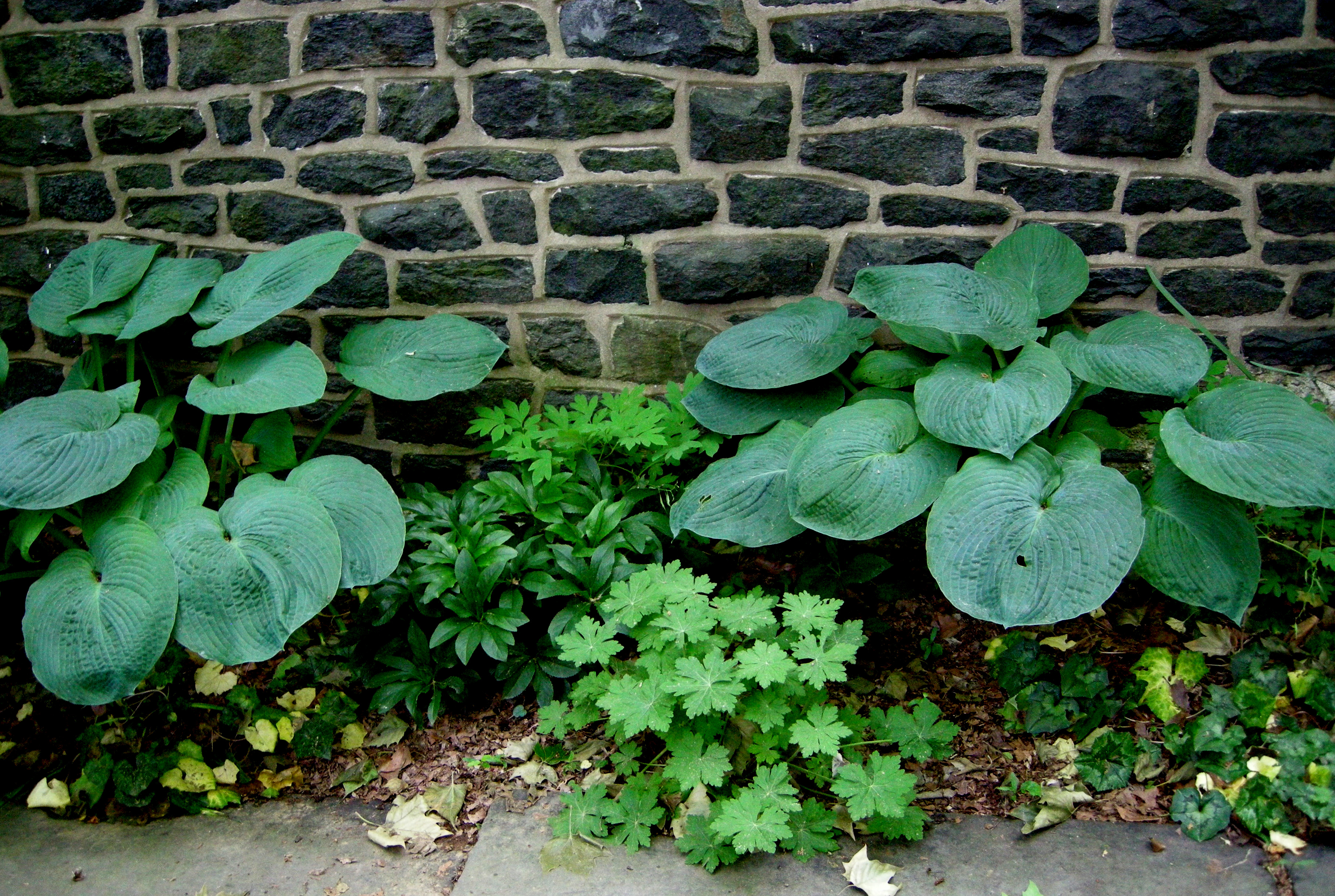
Hosta 'Blue Angel'Hosta ‘Blue Angel’ used as a shrub.

After writing three posts on miniature and small hostas, I thought large hostas deserved their place in the sun (or shade).  Although I love miniature hostas, large hostas are also dear to my heart and plentiful in my landscape.  I use them both as specimen plants and also for massing with other hostas to fill shady areas.  There are so many hosta cultivars out there, over 8,000,  that I thought I would share some of my favorites with you.  I have included some close ups of their beautiful leaves as well as photos of how I use them in the garden.

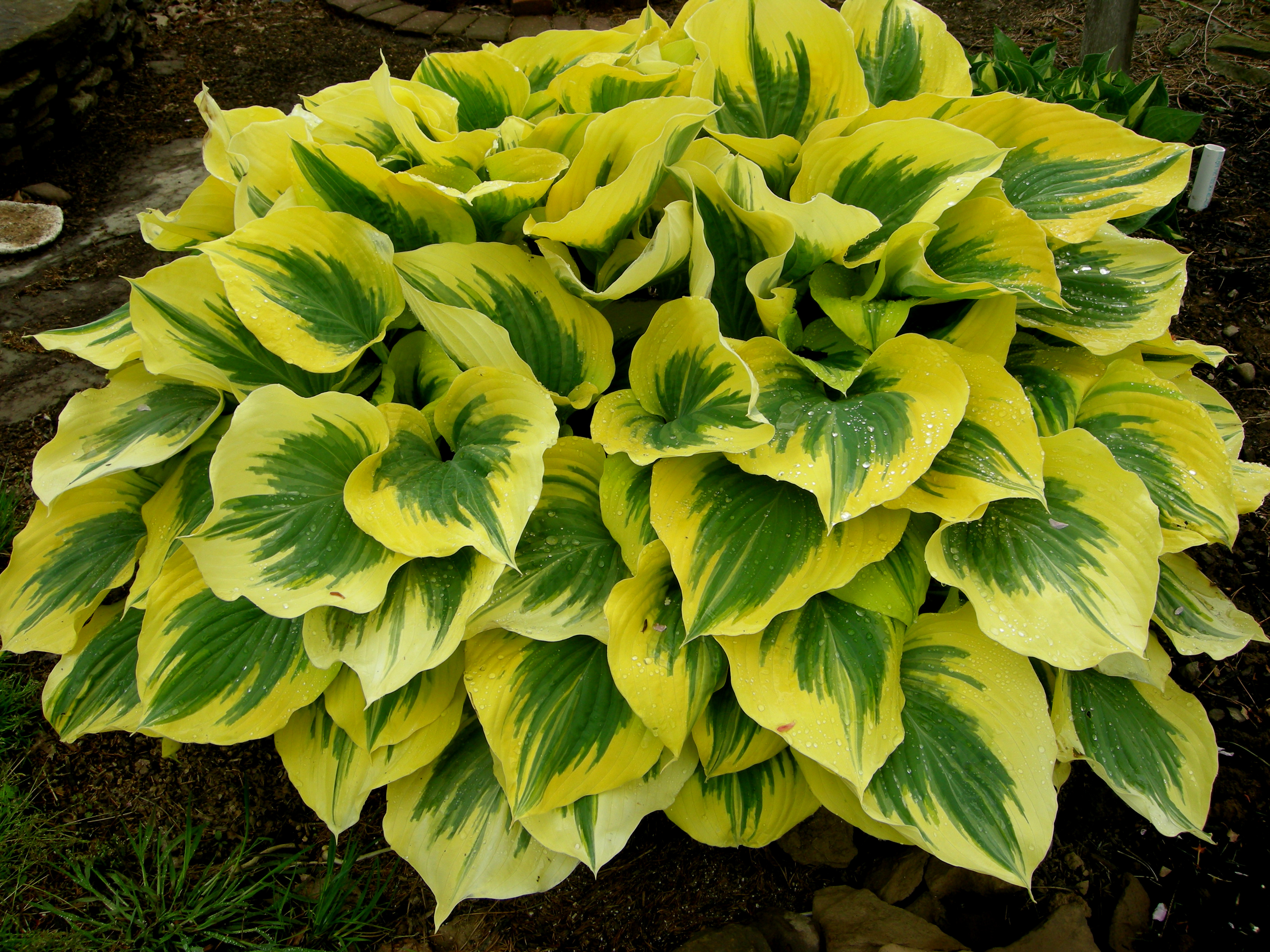
My Hosta ‘Liberty’ was planted last year so it has not reached its true size and coloring, but its leaves are still gorgeous.

A full grown ‘Liberty’ in a local garden.

‘Liberty’ with my husband Michael for scale.

I wanted to start with ‘Liberty’ because it was chosen by the American Hosta Grower’s Association as the 2012 Hosta of the Year.  This is a great honor bestowed on only 18 of the over 8,000 hosta cultivars (to see other winners, click here), and I make a point of selling them and growing them in my garden.  ‘Liberty’ is a sport (off shoot) of  ‘Sagae’ with the same vase-shaped habit but much wider creamy yellow margins.  It reaches 2′ tall and 5′ wide with 10″ leaves.


A close up of a leaf of Hosta ‘Striptease’ shows the very unusual “lightening strike” of white running around and through the lime green center.

Three ‘Striptease’ plants make a sizable clump.

‘Striptease’ massed with ‘Blue Angel’ above and H. tokudama ‘Gold Bullion’ and ‘Flavocircinalis’ right.

‘Striptease’ was the Hosta of the Year for 2005.  The white streaks on its leaves really make it stand out—the pattern is rare in the hosta world where many plants look alike.  It is a sport of the old favorite ‘Gold Standard’.  At maturity, it is 20″ high and 4′ wide with 8″ leaves.

leaf of Hosta ‘Paradigm’

Again my ‘Paradigm’ is not mature and does not display its true beauty but when I saw a mature plant I had to have one.

Yes, ‘Paradigm’ is another Hosta of the Year, this time for 2007.  Its leaves are gold-centered and heavily corrugated (textured), a quality I love in the hostas that display it.  Its near white flowers are also quite lovely.  At maturity, it is 2′ high by 4′ wide with almost 12″ leaves.  I can’t wait.


 leaf of Hosta ‘Sagae’

A close up of the vase-shaped (upright) habit of ‘Sagae’

‘Sagae’ planted at the top of a wall to show off its gorgeous habit, with native ‘Forest Pansy’ redbud

I first fell in love with this hosta at Longwood gardens, and it was labeled H. fluctuans ‘Variegata’.  I wrote down the name and searched for it for years before I figured out its name was changed to ‘Sagae’.  Of course, ‘Sagae’ was chosen to be a Hosta of the Year for 2000.  Its upright mounding habit makes it a perfect specimen.  At maturity, it reaches 31″ high by 70″ wide with 13″ leaves.

pollen-covered leaf of Hosta ‘Fried Green Tomatoes’

 mature clump of ‘Fried Green Tomatoes’

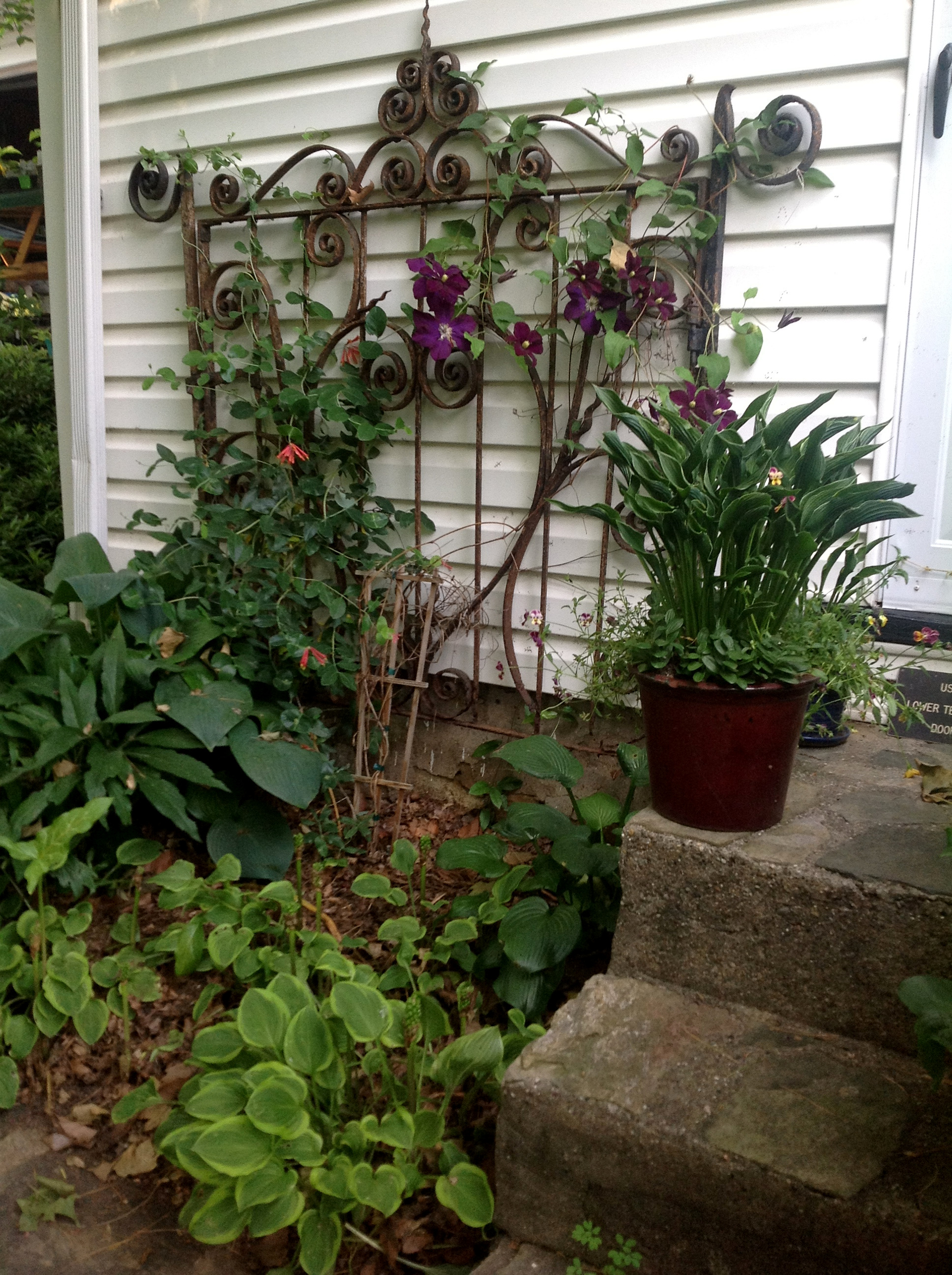
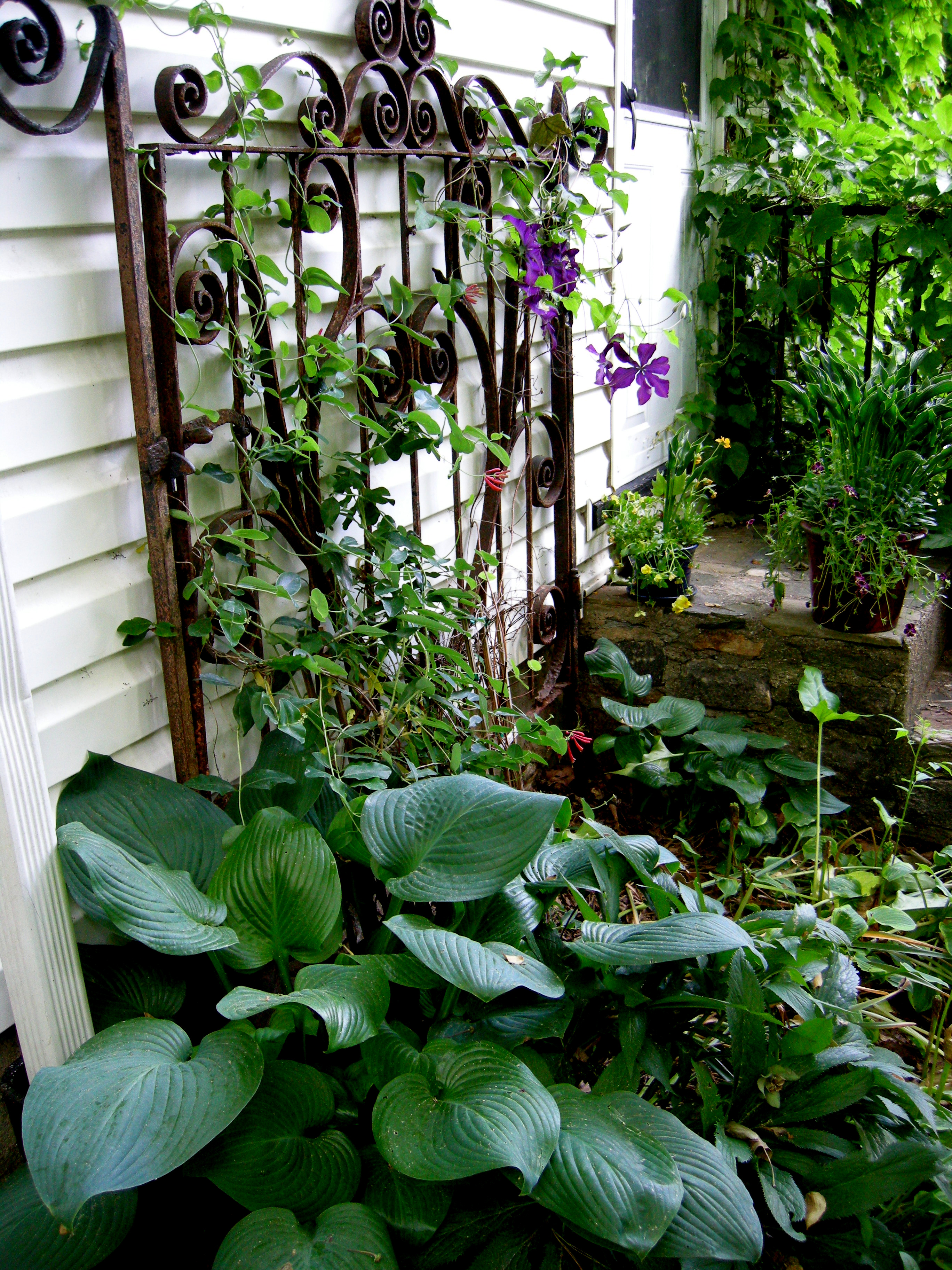
‘Fried Green Tomatoes’ in front of an antique church gate covered with clematis and native honeysuckle.

It is hard to explain why I like ‘Fried Green Tomatoes’ so much.  Perhaps it is the substantial blue-green leaves or the neat and even habit or the lovely fragrant flowers or just its clever name.  ‘Fried Green Tomatoes’ is not a hosta of the year, but it is the sport of one, ‘Guacamole’, the 2002 Hosta of the Year, and it is considered an exceptional cultivar.  It reaches 2′ high by 5′ wide with 11″ leaves.

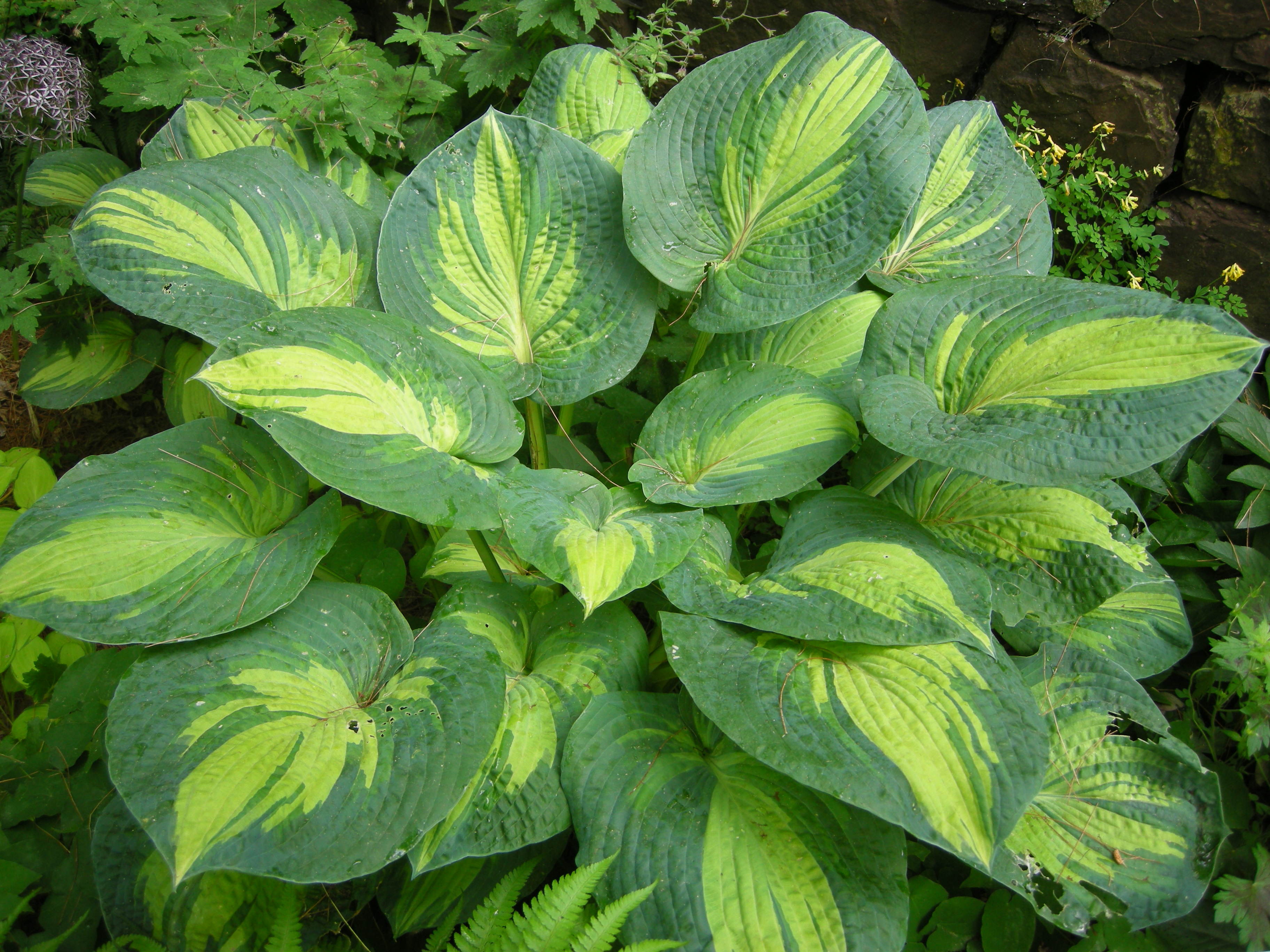
leaf of Hosta ‘Great Expectations’

   ‘Great Expectations’ makes a gorgeous clump.

‘Great Expectations’ in a very shady area under a Japanese maple with ‘Emerald Tiara’ hosta.

Finally, a hosta that is not a hosta of the year (or a relative of one), but, as far as I’m concerned, it should be.  One of my favorites and a bestseller at my nursery, ‘Great Expectations’ forms a large but not overwhelming mound of heavily corrugated, creamy yellow-centered leaves with wide blue-green margins.  Its near white flowers in June and July are beautiful.  A mutation of ‘Elegans’, it reaches 2′ high by 4′ wide at maturity with 12″ leaves.


leaf of Hosta ‘Fragrant Bouquet’


‘Fragrant Bouquet’ makes a nice mound.

‘Fragrant Bouquet’ with yellow waxbells, leopard’s bane, and pulmonaria.

It is not surprising that ‘Fragrant Bouquet’ was the 1998 Hosta of the Year.  It is a very useful hosta in the shady landscape because of its overall light-colored leaves, which are pale chartreuse with creamy yellow edges—it looks great with yellow flowers.  I also love its fragrant blooms and manageable size.  At maturity it is supposed to reach 22″ high by 4′ wide with 10″ leaves but mine are not that big.


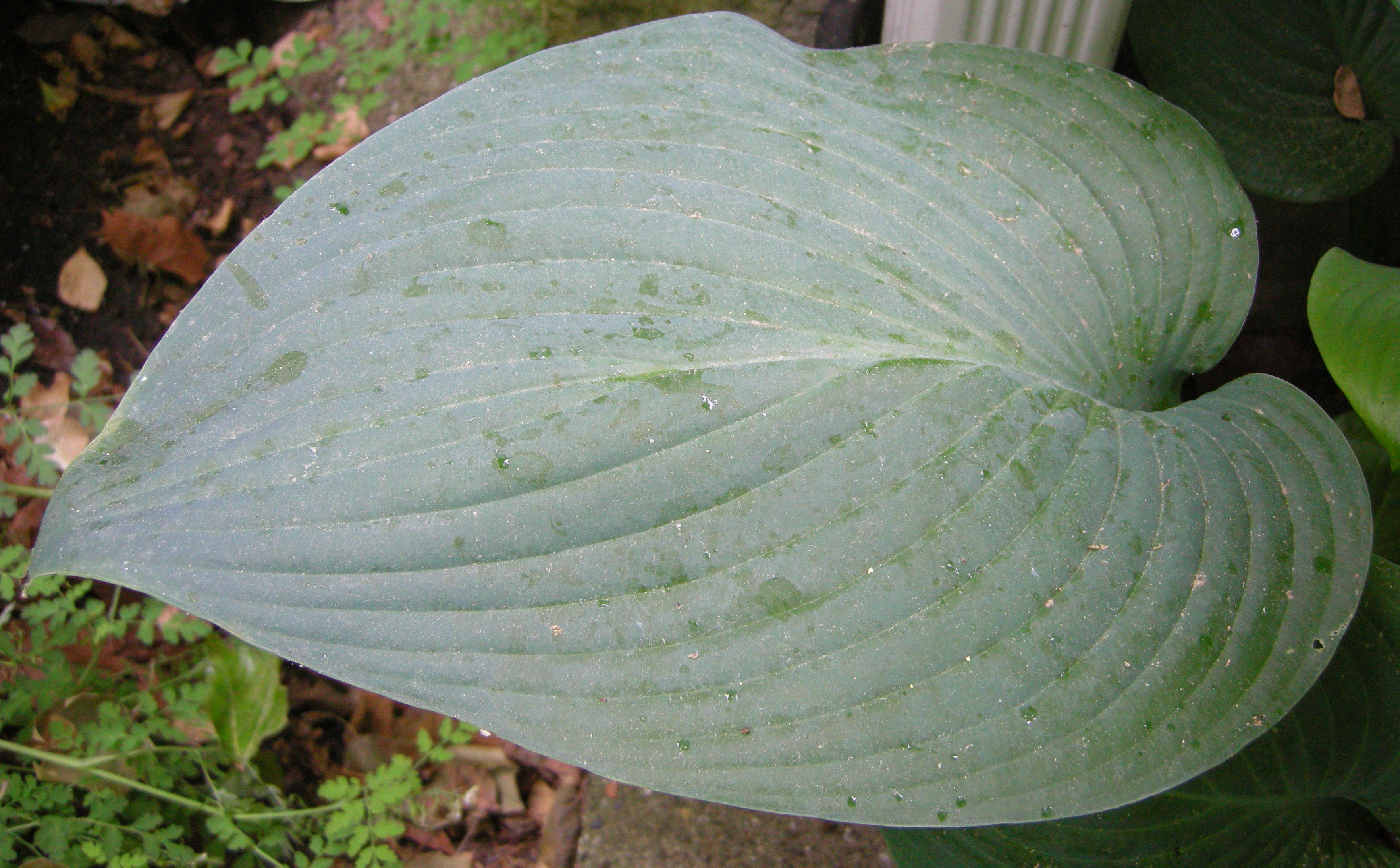
 leaf of Hosta ‘Blue Angel’


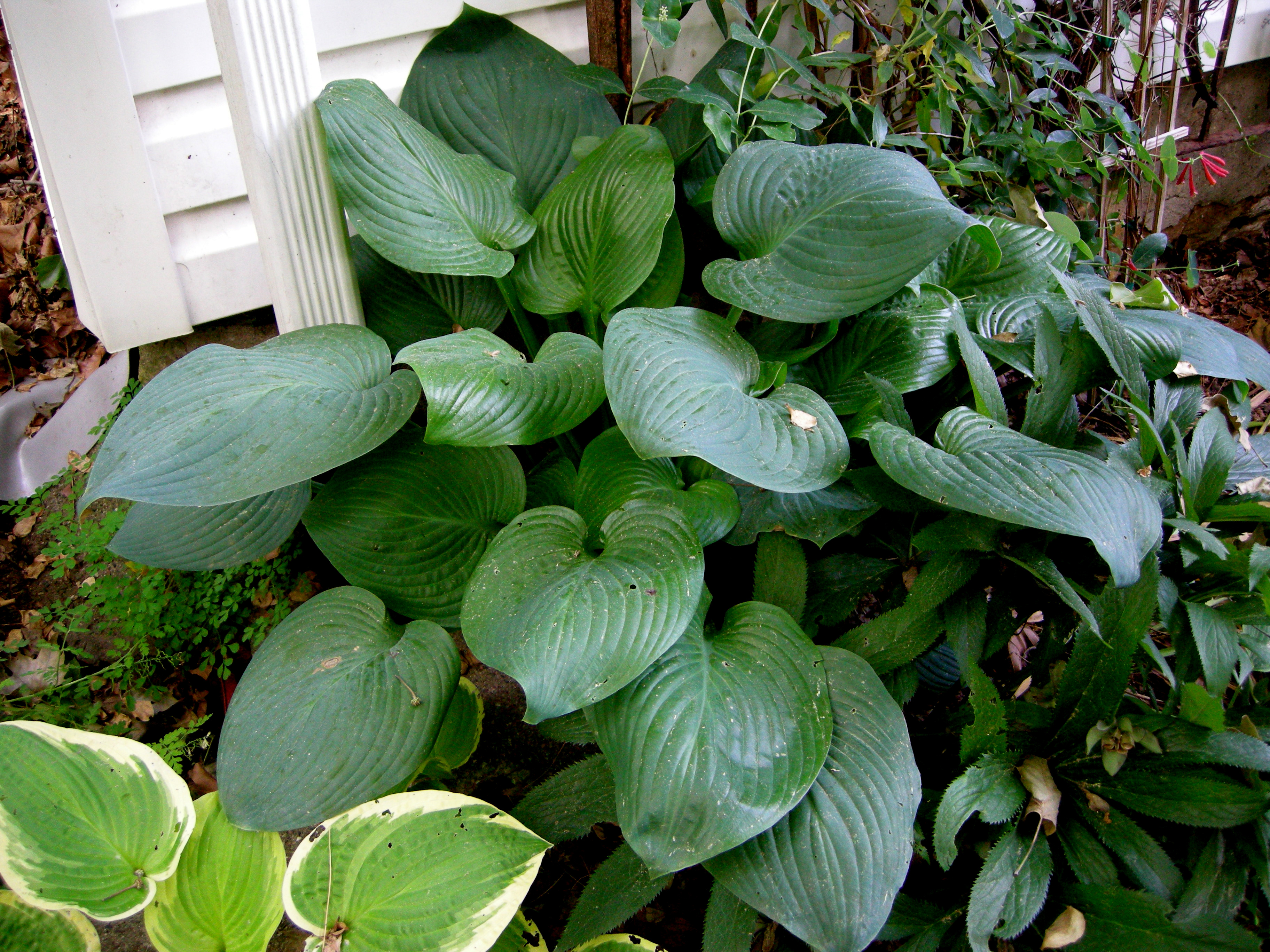
‘Blue Angel’ used as a specimen shrub with hellebores, hardy geranium, and old-fashioned bleeding-heart (see the photo at the very top too).


 ‘Blue Angel’ massed with ‘Blue Cadet’ and ‘Guacamole’ hostas and ‘Ghost’ fern  (see also the photo with ‘Striptease’).

‘Blue Angel’ is not a hosta of the year, but it would be the absolute top of the list of my choices.  Hostas of the year should be tried and true and the best in their class and that is what ‘Blue Angel’ is.  Do you hear me AHGA?  It is simply the premier large blue hosta in existence, excellent as a specimen and in masses with other hostas.  It is stunning in June and July when topped by its near white flowers and gorgeous throughout the fall with its heavily corrugated, substantial blue leaves.  At maturity, ‘Blue Angel’ reaches 32″ high by 70″ wide with 16″ leaves.


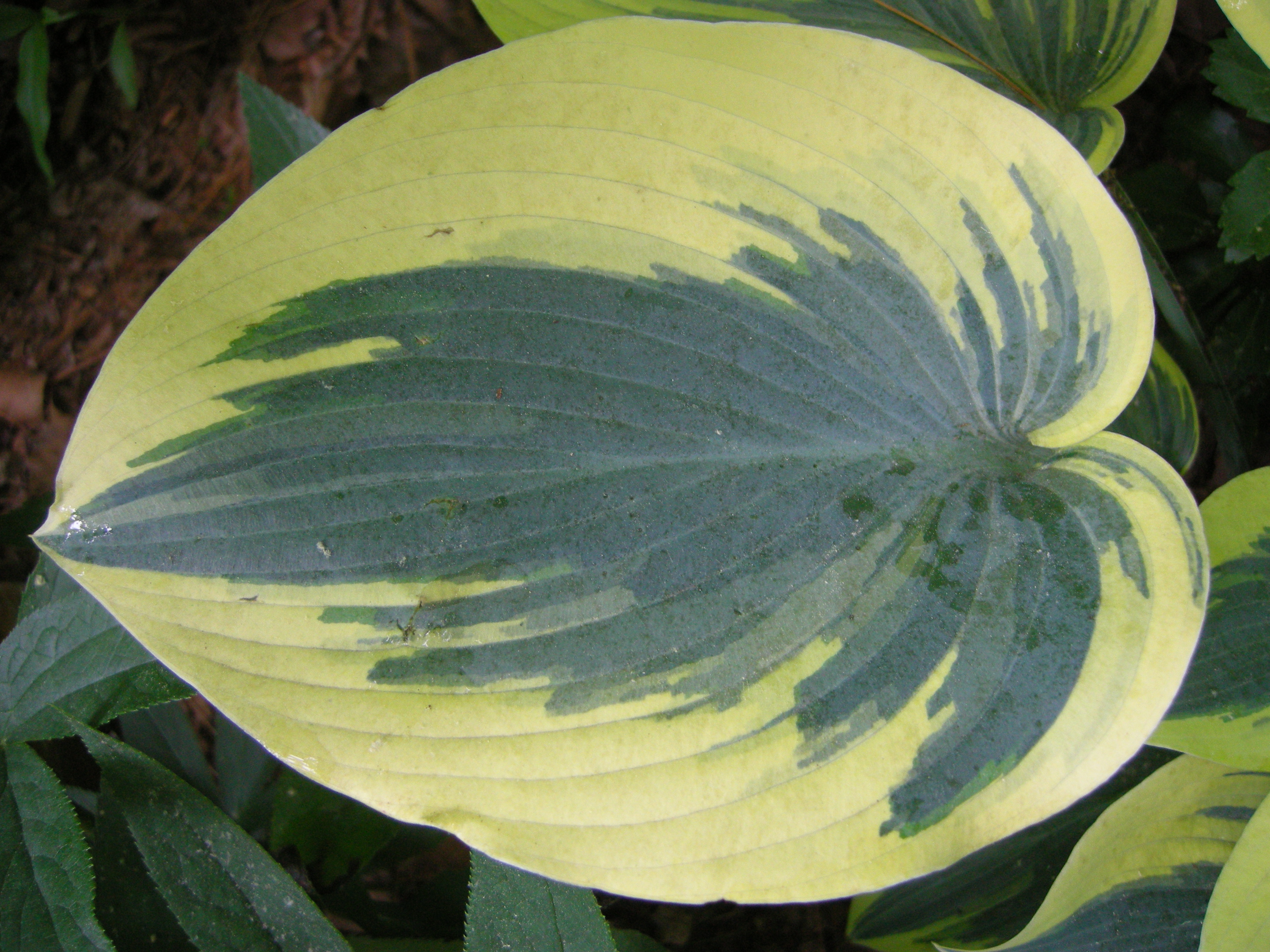
leaf of Hosta ‘First Frost’

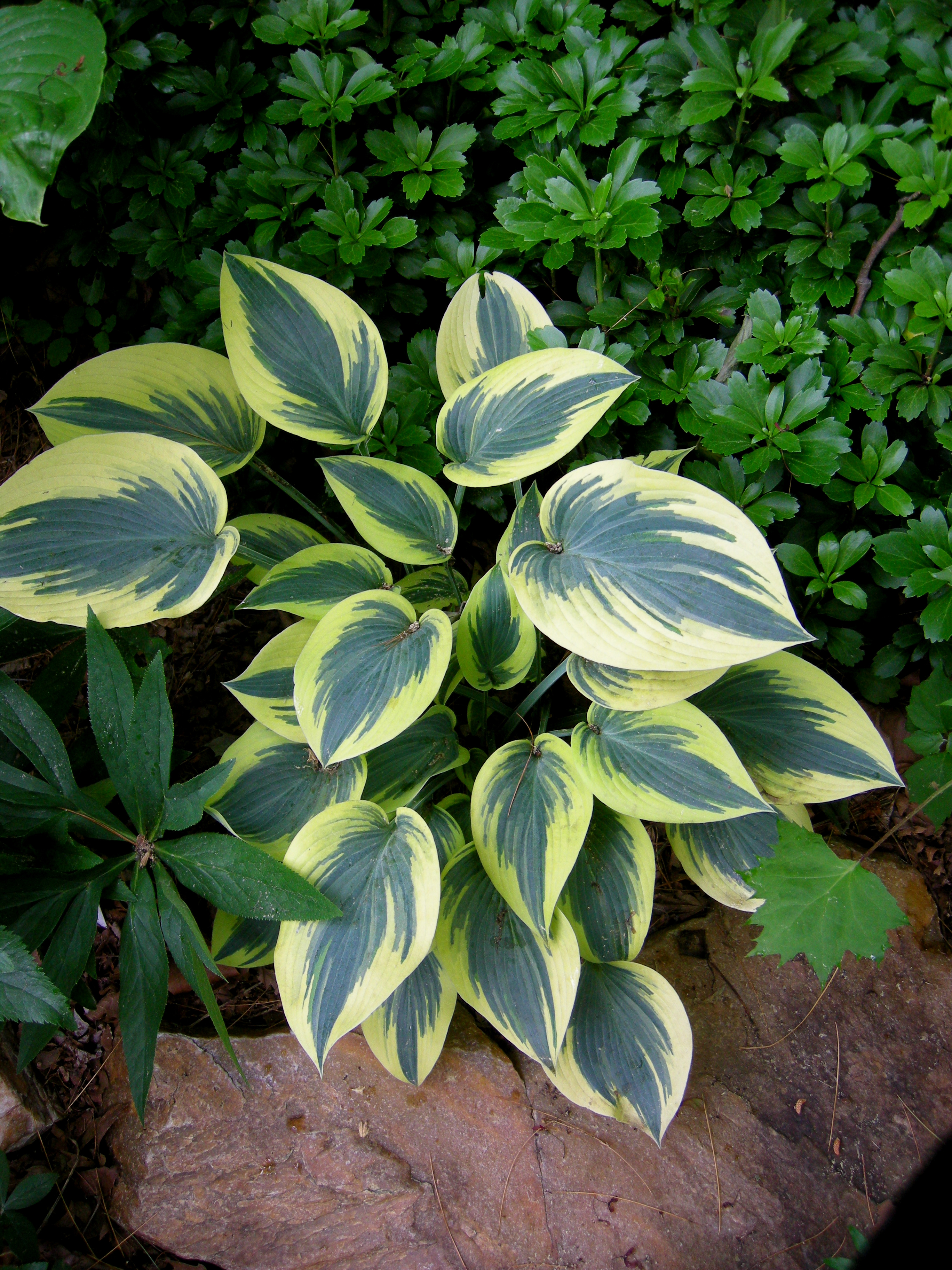
‘First Frost’ in my rock garden

I will close with the 2010 Hosta of the Year ‘First Frost’.  When it comes out in the spring, the combination of the very blue leaves with the decidedly yellow and very wide margins is unusual and elegant.  The leaves have thick substance and turn dark green with a cream edge in summer.  ‘First Frost’ is also a “smaller” large hosta and easy to use in the landscape.  It is a sport of the wonderful ‘Halycon’.  At maturity, it reaches 14″ high by 3′ wide with 7″ leaves.

Carolyn

Nursery Happenings:  Our final open house sale of the spring will be a two-day event on Friday, June 1, from 10 am to 4 pm, and Saturday, June 2, from 10 am to 2 pm.  Customers on my email list should have received an email with details.  We are getting more woody plants so if you missed the deadline send me an email with your order.  If you are interested in receiving miniature hostas mail order, click here.

If you are within visiting distance and would like to receive catalogues and information about customer events, please send your full name and phone number to carolynsshadegardens@verizon.net.  Subscribing to my blog does not sign you up to receive this information.

Facebook:  Carolyn’s Shade Gardens has a Facebook page where I post single photos, garden tips, and other information that doesn’t fit into a blog post.  You can look at my Facebook page here or click the Like button on my right sidebar here.

Notes: Every word that appears in orange on my blog is a link that you can click for more information.  If you want to return to my blog’s homepage to access the sidebar information (catalogues, previous articles, etc.) or to subscribe to my blog, just click here.

Woody Plants for Shade Part 5

Posted in Fall Color, landscape design, native plants, Shade Gardening, Shade Shrubs, shade vines, winter interest with tags , , , , , , , , , , , , , , , , , , , , on May 17, 2012 by Carolyn @ Carolyns Shade Gardens

Carolyn’s Shade Gardens is a retail nursery located in Bryn Mawr, PA, specializing in showy, colorful, and unusual plants for shade.  The only plants that we ship are snowdrops and miniature hostas.  For catalogues and announcements of events, please send your full name, location, and phone number (for back up use only) to carolyn@carolynsshadegardens.com.  Click here to get to the home page of our website for catalogues and information about our nursery and to subscribe to our blog.

The bright rose flowers of ‘Wine & Roses’ old-fashioned weigela.

Shade gardens are not composed solely of perennials so two years ago I branched out to offer high quality shrubs, vines, and trees to my customers.  In my second Spring 2012 Woody Plant Offer, details here,  I have focused on plants that are late spring or summer blooming and native to our area.  I thought my blog readers who are not customers might be interested in learning about the plants that I would recommend they add to their shade gardens.  And doing an article allows me to add more information and explain why I chose the plants I included so customers might be interested also.

When it blooms in late spring, our native fringe tree is covered with elegant, fragrant flowers.

Fringe tree is a lovely small flowering tree or a large shrub.

I saw native fringe tree, Chionanthus virginicus, in full bloom in the shady woods of Bartram’s Garden in Philadelphia recently, and it reminded me of how gorgeous this native tree is.   It is loaded with generous amounts of creamy white, fragrant flowers in May and June.  Its medium green leaves turn a good yellow in the fall.  It may produce showy grape-like fruit attractive to birds.  Fringe tree grows to 12 to 20’ tall and 12 to 20’ wide in sun to part shade, although the tree in Bartram’s Garden was in a very shady site.  It is wet site tolerant, hardy to zone 4, and native to the eastern US, including PA.  It is a  Missouri Botanical Garden Plant of Merit (photos courtesy of MOBOT).


 Our native dwarf summersweet is loaded with fragrant white flowers in summer.

I have seen stands of summersweet growing wild in New England, and it is a beautiful sight.  However, the species gets quite large and suckers into colonies so the native dwarf summersweet ‘Hummingbird’Clethra alnifolia ‘Hummingbird’, is better for most home gardens.  It has very fragrant, bottlebrush, white flowers in June and July that attract butterflies.  Its  lustrous bright green leaves turn a clear yellow in the fall.  It has an excellent compact habit and produces more flowers than the species.

Dwarf summersweet’s habit is much more compact and attractive than the species, and it produces more flowers.

Dwarf summersweet grows to 2 to 4’ tall and 3’ wide in sun to full shade.  It is hardy to zone 4, deer resistant, wet site and salt tolerant, and native to the eastern US, including PA.  It is a Pennsylvania Horticultural Society Gold Medal Plant,  click here for details (photos courtesy of the MOBOT Plant Finder, for more information click here).


 ‘Nikko’ dwarf slender deutzia is loaded with white flowers in late spring.

‘Nikko’ lining my rock garden path in full shade.

I have offered ‘Nikko’ dwarf slender deutzia, D. gracilis ‘Nikko’, before, but it is such a useful plant that I couldn’t help including it again.  It is covered with delicate white flowers in April and May.  Its fine-textured and neat green leaves turn an attractive burgundy in the fall.  It is an excellent specimen or flowering groundcover for shade.  I grow it in full shade as a groundcover to edge the path at the base of my winterberry hollies.  ‘Nikko’ grows to 1 to 2’ tall and 2 to 5’ wide in full sun to full shade.  It is hardy to zone 4 and deer resistant.  It is a PHS Gold Medal Plant (for more information click here).


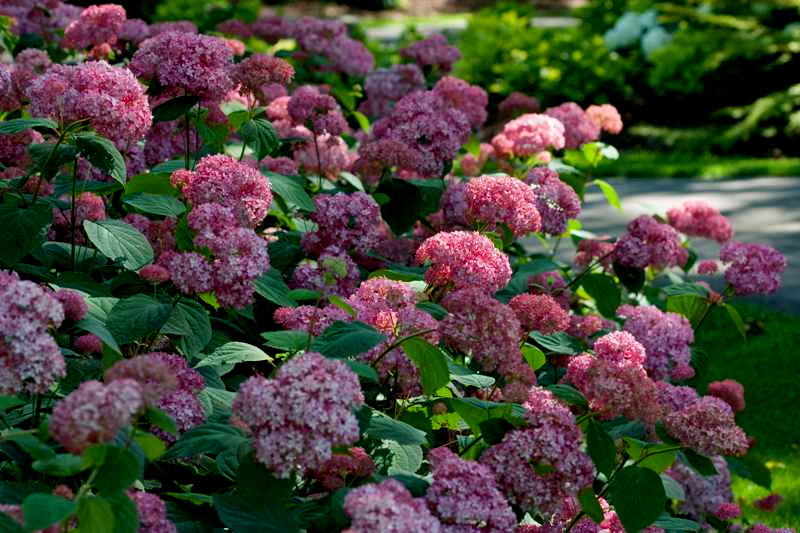
 ‘Invincibelle Spirit’ is a color breakthrough for our native smooth hydrangea.

Native ‘Invincibelle Spirit’ smooth hydrangea, H. arborescens ‘Invincibelle Spirit’, is  a pink-flowered version of the wonderful ‘Annabelle’.  It has very showy large pink snowball flowers that continue to bloom from June into the fall.  ‘Invincibelle Spirit’ grows to 3 to 4’ tall by 3 to 4’ wide in part to full shade.  It is hardy to zone 4, tolerant of a wide range of soil conditions, deer resistant, and native to the eastern US, including PA.  It should be gently pruned in late spring for optimum growth (photo courtesy of the MOBOT Plant Finder, for more information click here).                    

A close up of the large and beautiful flowers and leaves of oakleaf hydrangea.

   Native oakleaf hydrangea in my woodland garden at the base of a black walnut.

The fall color of oakleaf hydrangea.

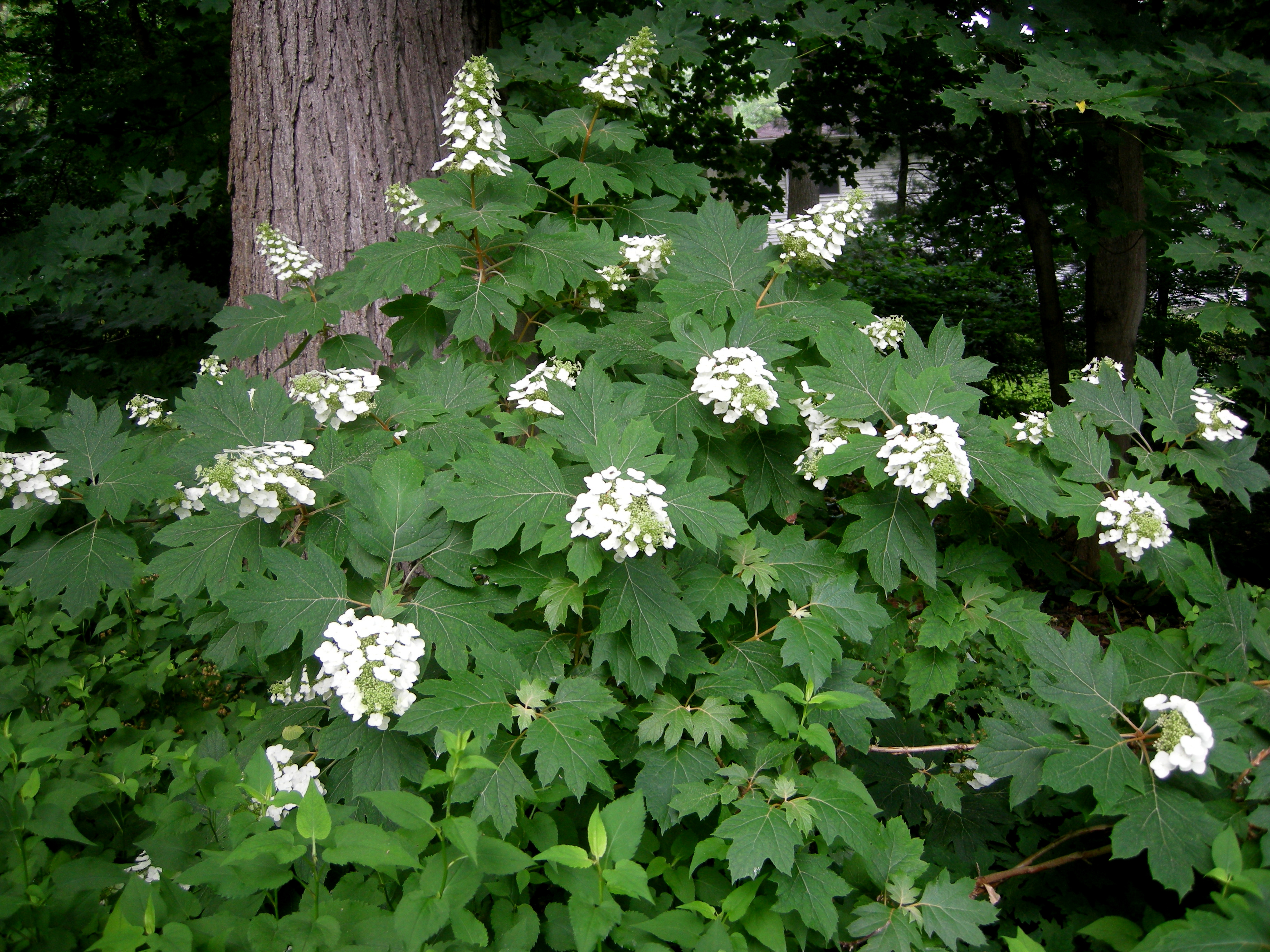
Our native oakleaf hydrangea, H. quercifolia, is the best all round shrub for shade—everyone should have at least one!  Huge, long-lasting, upright pyramids of white flowers bloom from May through July and change to pink for even longer interest.  It has bold-textured leaves with heart-stopping burgundy-red fall color, and cinnamon-colored exfoliating bark—a true four season plant.  I am offering ‘Alice’ native oakleaf hydrangea, a superior form that has larger flowers, better fall color, and very disease resistant leaves.  It grows to 5 to 8’ tall and 5 to 8’ wide in sun to full shade.  It is hardy to zone 5, walnut and drought tolerant, and native to the southeastern US.  For more information, click here.


The pink mophead flowers of ‘Preziosa’ age to a dark maroon.

‘Preziosa’s’ leaves are gorgeous, here they are starting to turn burgundy in the fall.

‘Preziosa’ sawtooth hydrangea, H. serrata ‘Preziosa’, is now my favorite “fancy” hydrangea for full shade so I am offering it again.  I planted mine in the shade of a white pine under a cherry laurel behind a Japanese maple, and it is thriving and loaded with buds right now.  This wonderful hydrangea produces lovely pink mophead flowers from June to August, which darken with age to a gorgeous maroon.  But I may like the elegant leaves more, especially their beautiful burgundy fall color.   The leaves, deep red stems, flowers, and habit of ‘Preziosa’ are all superior to most other hydrangeas.  ‘Preziosa’ grows to 3 to 4’ tall and 3 to 4’ wide in part to full shade.  It is very tolerant of cold temperatures and hardy to zone 5.  For more information, click here.


 The elegant leaves and flowers of native ‘Blue Muffin’ arrowwood viburnum.

Native ‘Blue Muffin’ arrowwood viburnum, V. dentatum ‘Blue Muffin’,  has lovely flat-topped white flowers in May and June that attract butterflies.  Lots of pea-sized very blue berries appear in late summer and attract birds.  The shiny dark green leaves are beautiful all season and turn attractive shades of orange to burgundy in the fall.  ‘Blue Muffin’ has an excellent and useful narrow, upright habit.  The branches are so straight that the Native Americans used them for arrows. 

‘Blue Muffin’s’ blueberry-like fruit.

‘Blue Muffin’ grows to 5 to 8’ tall and 3 to 4’ wide in sun to part shade.  It is deer resistant and grows in a wide range of soils.  It tolerates salt, drought, and walnuts.  ‘Blue Muffin’ is hardy to zone 3 and native to the eastern US, including PA (fruit photo courtesy of MOBOT, for more information click here).

 The flowers of ‘Wine & Roses’ weigela.

‘Wine & Roses’ old-fashioned weigela, W. florida ‘Wine & Roses’, has copious amounts of eye-catching rose-red flowers in May and June that attract hummingbirds.   The flowers are set off to perfection by the glossy deep burgundy leaves whose color intensifies in the fall.  ‘Wine & Roses’ has an excellent habit—you can prune it immediately after flowering to fit any location.  It grows to 4 to 5’ tall and 4 to 5’ wide in sun to part shade.  Although I recommend some direct sun for better flowers, I have seen weigela blooming in full shade.  It is hardy to zone 4, deer resistant, and tolerant of a wide range of soils.  ‘Wine & Roses’ is a PHS Gold Medal Plant, for details click here.


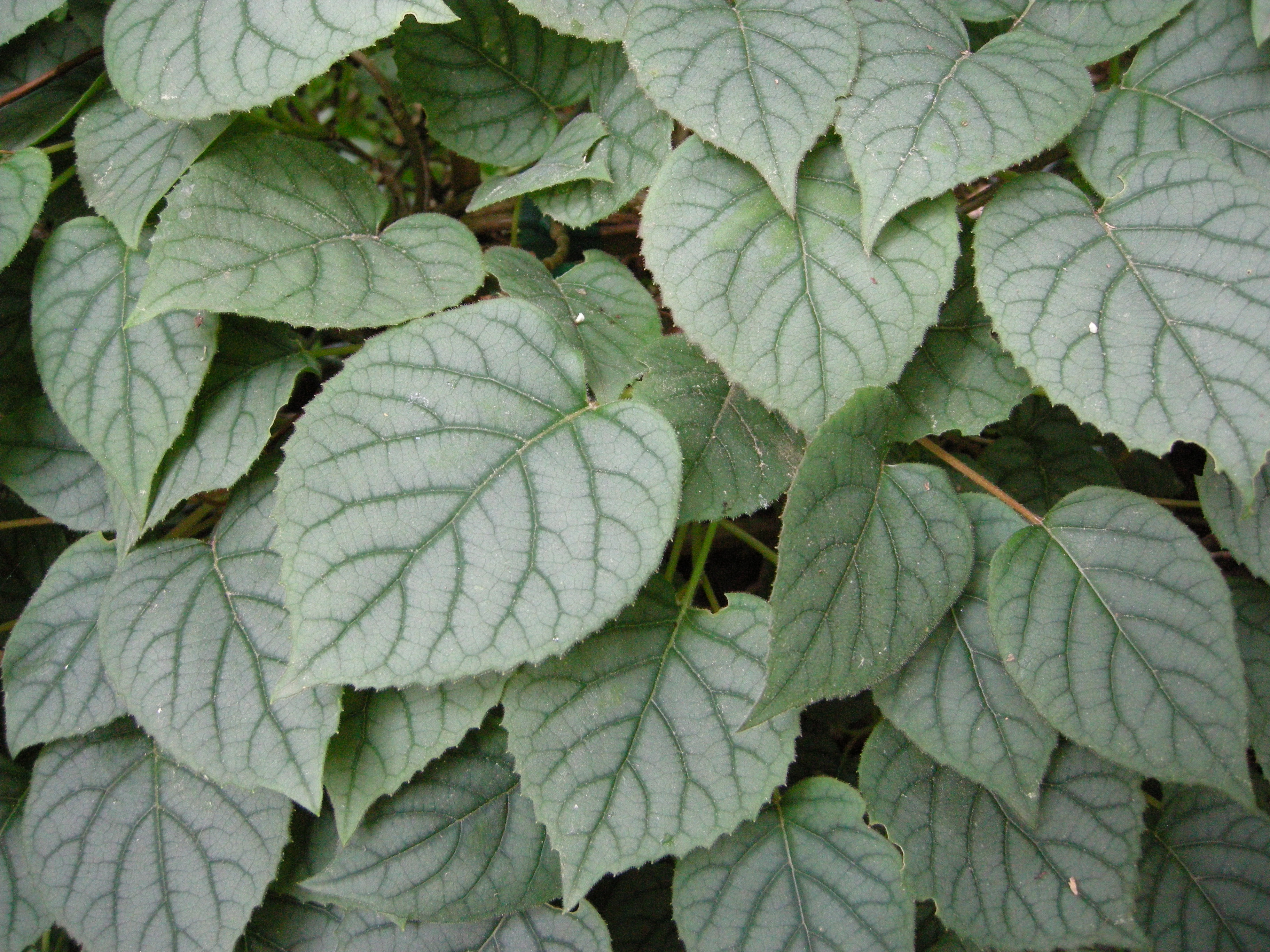
The silver leaves of ‘Moonlight’ Japanese climbing hydrangea.

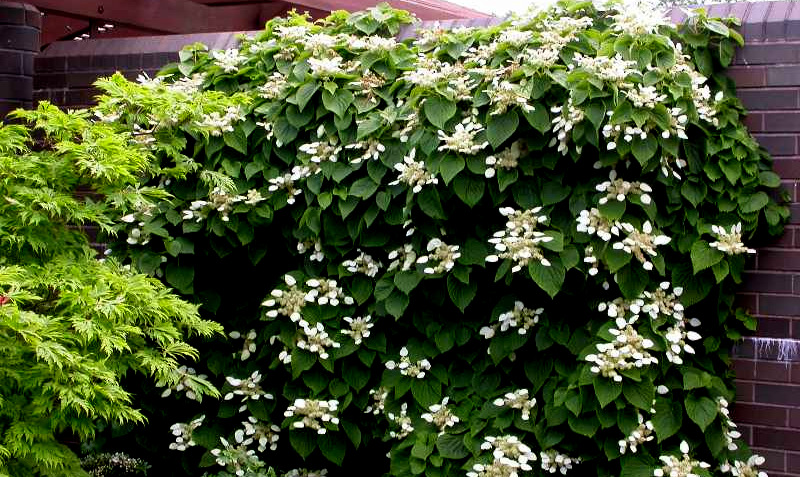
The flowers of Japanese climbing hydrangea—here the straight species.

‘Moonlight’ Japanese hydrangea vine, Schizophragma hydrangeoides ‘Moonlight’, has very showy 8 to 10” wide white lacecap flowers  in midsummer.  But I really grow it for its elegant silver-painted dark green leaves, which turn yellow in the fall.  ‘Moonlight’ is a self-attaching vine that covers the surface it grows on with silvery leaves.  It reaches 20 to 30’ at maturity in part to full shade—mine is in deep shade.  It is a PHS Gold Medal Plant, for details click here (photo of flowers courtesy of the MOBOT Plant Finder click here).

I hope I have inspired you to order some of these wonderful plants in my offer or search them out at your local independent nursery.  To read the previous posts on woody plants for shade, click one, two, three, and four.

Carolyn

Nursery Happenings: Customers can pre-order woody plants through noon on May 22.  Click here for details.  We have added a third session of our seminar, The Secrets of a Low Maintenance Garden, on Sunday, May 20.  Click here for details. If you are interested in receiving miniature hostas mail order, click here.

If you are within visiting distance and would like to receive catalogues and information about customer events, please send your full name and phone number to carolynsshadegardens@verizon.net.  Subscribing to my blog does not sign you up to receive this information.

Facebook:  Carolyn’s Shade Gardens has a Facebook page where I post single photos, garden tips, and other information that doesn’t fit into a blog post.  You can look at my Facebook page here or click the Like button on my right sidebar here.

Notes: Every word that appears in orange on my blog is a link that you can click for more information.  If you want to return to my blog’s homepage to access the sidebar information (catalogues, previous articles, etc.) or to subscribe to my blog, just click here.

Hosta Containers and Companions

Posted in container gardening, containers for shade, hosta, miniature hosta, Shade Gardening, Shade Perennials with tags , , , , , , , , , , , , , , , , , , , , , , on May 10, 2012 by Carolyn @ Carolyns Shade Gardens

Carolyn’s Shade Gardens is a retail nursery located in Bryn Mawr, PA, specializing in showy, colorful, and unusual plants for shade.  The only plants that we ship are snowdrops and miniature hostas.  For catalogues and announcements of events, please send your full name, location, and phone number (for back up use only) to carolyn@carolynsshadegardens.com.  Click here to get to the home page of our website for catalogues and information about our nursery and to subscribe to our blog.

.

Hosta When finding containers for your hostas you have to think outside the box: “Carolyn’s Gold” hosta in an antique kerosene can.

This is the third post in a three-part series on small hostas.  My nursery specializes in miniature hostas, and I have over 30 varieties available right now, both at the nursery and mail orderIn I LOVE Mice, I raved about the mouse ears series of hostas.  In Beyond Mice, I highlighted some of my favorite non-mouse ears hostas.  My 2011 post Miniature (& Small) Hostas also gives an overview of little hostas and how to use them in the garden.  Now I want to focus on the containers you might use to hold your hostas and the plants that will keep them company.


Probably my favorite medium sized hosta, the straight species Hosta tokudama.

Why would you want to grow hostas in a container?  One reason I do it is to highlight a hosta’s very special ornamental attributes.  I think Hosta tokudama (photo above) is gorgeous so I grow it in a pot outside my front door.  Here are some other hostas that I think merit their own container (read my previous hosta posts for photos of other single hosta containers):


Hosta ‘Little Miss Sunshine’ has bright gold leaves and deep red stems that look like rhubarb.  I placed its pot on a wall by my front walk so I can admire the stems up close.


The elegant hosta ‘Hanky Panky’ grows in an old dogwood stump, also along my front walk.

I love the very unusual hosta ‘Praying Hands’ and have it in three different containers, here with violas.


There is no other miniature hosta that looks like ‘Sparkler’ so I gave it its own spot in an antique metal pitcher salvaged from the dump.

Small hostas can get lost when planted in perennial borders unless they are massed.  Growing special miniature hostas in containers brings them up to eye level.  Here are 16 miniatures in my strawberry pot:

It also allows you to pair them with other miniature plants to create a tiny garden.  My previous posts contain many photos of my containers of little hostas.  However, I thought I would show you some of the planters I have recently created to give my customers ideas and to sell at my upcoming hosta open house:


All these containers were purchased inexpensively at flea markets and antique stores or were salvaged from the dump at the bottom of our property.  You probably have a suitable pot, pan, or other hosta garden holder gathering dust in your attic right now.


Hosta gardens waiting at Carolyn’s Shade Gardens for a new home.

Choosing tiny companion plants to go with your miniature hostas is another fun part of growing them in containers or in a rock garden.  Plant collecting urges are satisfied by all the plants that can be crammed into a small area.  In the planters above, I used violas, sedums, hens and chicks, ‘Heartthrob’ violet, ‘Tiny Rubies’ dianthus, and pasque flower (Pulsatilla).  Here are some more combinations:

Hostas ‘Shiny Penny’, ‘Green Eyes’, and ‘Itsy Bitsy Spider’ paired with sedum, hens and chicks, and rosularia in my dish garden.

Mouse ears hostas with dwarf Solomon’s seal, Polygonatum humile, in my stone trough.

Hostas ‘Blue Mouse Ears’ and ‘Blonde Elf’ with miniature lady fern, Athyrium filix-femina ‘Minutissimum’, in the rock garden.

Hostas ‘Little Blue’, ‘Blonde Elf’, and ‘Little Wonder’ with a small epimedium in the rock garden.


Gardening with tiny plants and salvaged containers is so much fun.  I hope you will give it a try.

Carolyn

Nursery Happenings:  If you are interested in receiving miniature hostas mail order, click here.

If you are within visiting distance and would like to receive catalogues and information about customer events, please send your full name and phone number to carolynsshadegardens@verizon.net.  Subscribing to my blog does not sign you up to receive this information.

Facebook:  Carolyn’s Shade Gardens has a Facebook page where I post single photos, garden tips, and other information that doesn’t fit into a blog post.  You can look at my Facebook page here or click the Like button on my right sidebar here.

Notes: Every word that appears in orange on my blog is a link that you can click for more information.  If you want to return to my blog’s homepage to access the sidebar information (catalogues, previous articles, etc.) or to subscribe to my blog, just click here.

Beyond Mice

Posted in container gardening, containers for shade, hosta, miniature hosta, Shade Gardening, Shade Perennials with tags , , , , , , , , , , , , on May 3, 2012 by Carolyn @ Carolyns Shade Gardens

Carolyn’s Shade Gardens is a retail nursery located in Bryn Mawr, PA, specializing in showy, colorful, and unusual plants for shade.  The only plants that we ship are snowdrops and miniature hostas.  For catalogues and announcements of events, please send your full name, location, and phone number (for back up use only) to carolyn@carolynsshadegardens.com.  Click here to get to the home page of our website for catalogues and information about our nursery and to subscribe to our blog.

.

Hosta 'Crumb Cake'I have used this photo of hosta ‘Crumb Cake’ emerging in spring before, but to me it epitomizes the beauty of a miniature hosta in a container.

My nursery specializes in miniature hostas, and I have over 25 varieties available right now, both at the nursery and mail order.  My 2011 post Miniature (& Small) Hostas gives an overview of little hostas and how to use them in the garden.  In my most recent post, I LOVE Mice, I raved about the mouse ears series of hostas.  But there are many desirable miniature hostas “beyond mice” so I thought I would highlight some special favorites.


‘Cracker Crumbs’ is pictured here in my dish garden (full photo below) surrounded by a tiny gray-blue sedum.  It is a miniature hosta 5” tall by 19” wide with leaves 2 1/2” long by 1 1/2” wide.  ‘Cracker Crumbs’ has shiny gold leaves with a bright green wavy margin and pale purple flowers in July.  It quickly forms a dense and rounded mound and makes a great trough or rock garden plant.


‘Itsy Bitsy Spider’ is also pictured in my dish garden (full photo below) with the same sedum and some hens and chickens.  It is a miniature hosta 2 ½” tall by 6” wide with leaves 1 ¾” long by 1 1/4″ wide.  ‘Itsy Bitsy Spider’ has narrow leaves with thick substance and a distinct blue-gray color, and pale lavender flowers in July.  It forms a tight low mound.  This adorable and rare plant is the smallest hosta in my collection.


‘Pixie Vamp’ in my rock garden—what a great name!

‘Pixie Vamp’ is pictured here in a container with violas.  It is a miniature hosta 7” tall by 16” wide with leaves 3 ½” long by 2 ½” wide.  ‘Pixie Vamp’ has bright green heart-shaped leaves bordered by gold in the spring changing to creamy white.  Its gorgeous mahogany colored stems hold purple flowers in July.  It is excellent in containers.


The very unusual hosta ‘Crumb Cake’ in my rock garden.


‘Crumb Cake’ is pictured here fully emerged in the same container featured in the first photo in this post.  It is a miniature hosta 5” high by 14” wide with leaves 3” long by 3” wide.  ‘Crumb Cake’ is a recent introduction with very bright honey-gold leaves, which are round with wavy margins.  It is a very unusual looking hosta forming a flat, dense, brightly colored mound.  It has elegant mahogany-colored leaf and flower stems and lavender flowers in July.  It makes an excellent container plant.


‘Alakazaam’ in my rock garden.


‘Alakazaam’ is pictured here in a container made for me by my son.  It is a miniature hosta 5″ tall by 10″ wide with leaves 6 1/2″ long and 3/4″ wide.  ‘Alakazaam’ has bright green leaves with gold ruffled margins changing to creamy white, and lavender flowers in late summer.  Its unusual spiky habit makes it stand out from the crowd no matter where you place it.


‘Surfer Girl’ is pictured here in my rock garden.  It is a miniature hosta 6” tall by 18” wide with leaves 2” long by 1” wide.  ‘Surfer Girl’ has dark green, sharply pointed, deeply rippled leaves reminiscent of ocean waves, and purple flowers in July.  It creeps to fill in a wide area and is excellent for edging the front of a border.  I use it in containers to contrast with gold-leafed minis.


‘Little Sunspot’ in my rock garden. 

‘Little Sunspot’ is pictured here in my strawberry pot.  It is a small hosta 12″ tall by 12″ wide with leaves 3″ long and 2″ wide.  It has sharply contrasting variegated gold leaves with a wide  dark green margin and purple-striped white flowers in summer.  ‘Little Sunspot’ is great for a rock garden, border, or a container.


‘Twist of Lime’ in my rock garden.

‘Twist of Lime’ is pictured here massed in front of epimediums.  It is a miniature hosta 6” tall by 10” wide with leaves 3” long by 1” wide.  ‘Twist of Lime’ has bright gold leaves with a narrow, dark blue-green wavy margin and many deep violet-striped flowers in July.  It has a beautiful upright habit and is a very fast grower—a favorite of my customers.

‘Praying Hands’ is pictured here in a container with violas and dwarf Solomon’s seal.  It is a small hosta 16″ tall by 30″ wide with leaves 7″ long and 2″ wide.  ‘Praying Hands’ has waxy and prominently ridged dark emerald green leaves with a narrow gold edge.  It is the most unusual hosta on the market with its folded leaves and vertical, twisty habit reminiscent of a pitcher plant.  It thrives in containers with my plant doubling in size each year.  ‘Praying Hands’ received the prestigious Hosta of the Year Award in 2011.

‘Praying Hands’ provides a vertical accent in my dish garden with miniature hostas ‘Shiny Penny’, ‘Itsy Bitsy Spider’, ‘Cracker Crumbs’, and ‘Shining Tot’ and various companion plants.

Miniature hostas are so much fun.  My next post will be on my new miniature hosta rock garden and feature companion plants to use in containers with your little hostas.

Carolyn

Nursery Happenings: If you are interested in receiving miniature hostas mail order, click here.

If you are within visiting distance and would like to receive catalogues and information about customer events, please send your full name and phone number to carolynsshadegardens@verizon.net.  Subscribing to my blog does not sign you up to receive this information.

Facebook:  Carolyn’s Shade Gardens has a Facebook page where I post single photos, garden tips, and other information that doesn’t fit into a blog post.  You can look at my Facebook page here or click the Like button on my right sidebar here.

Notes: Every word that appears in orange on my blog is a link that you can click for more information.  If you want to return to my blog’s homepage to access the sidebar information (catalogues, previous articles, etc.) or to subscribe to my blog, just click here.

I LOVE Mice

Posted in container gardening, containers for shade, hosta, miniature hosta, Shade Gardening, Shade Perennials with tags , , , , , , , , , on April 25, 2012 by Carolyn @ Carolyns Shade Gardens

Carolyn’s Shade Gardens is a retail nursery located in Bryn Mawr, PA, specializing in showy, colorful, and unusual plants for shade.  The only plants that we ship are snowdrops and miniature hostas.  For catalogues and announcements of events, please send your full name, location, and phone number (for back up use only) to carolyn@carolynsshadegardens.com.  Click here to get to the home page of our website for catalogues and information about our nursery and to subscribe to our blog.

.

'Holy Mouse Ears'It is very hard for me to pick a favorite mouse ears hosta, but I think ‘Holy Mouse Ears’ is it.  The colors in the leaves are magical.

My post Miniature (& Small) Hostas is the most popular article I have ever written for my blog.  In that post, I described how, when I discovered miniature hostas, I reached a new level of hosta addiction.  I try not to purchase (five of) every new miniature hosta I can get my hands on, but it’s a struggle.  Luckily my nursery allows me to mask this addiction as “business development”.  Now I specialize in miniature hostas, and mail order them all over the US.


Hosta ‘Blue Mouse Ears’ is the parent of all the miniature hostas in the mouse ears clan.  It is so special that in 2008, the American Hosta Growers Association named it the Hosta of the Year.

The miniature hosta that really took me over the edge was ‘Blue Mouse Ears’.  It was definitely love at first sight.  I fell for the very blue, very round, very rubbery leaves and the perfectly symmetrical habit.  When ‘Blue Mouse Ears’ emerges from the ground, it is in a cluster so tight it looks like a rose.  It reaches about 6″ in height and scoffs at the idea of slugs as do all the mouse ears hostas.  Most days I stop on my garden ramble to touch its thick leaves.  To me they feel like mouse ears, not that I have ever felt one.

‘Blue Mouse Ears’ emerging in the spring.


‘Blue Mouse Ears’ is a descendant of ‘Blue Cadet’, which is a beautiful small blue hosta with very clean leaves and an elegant habit.  Boy was I in trouble though, because ‘Blue Mouse Ears’ was only the beginning.    As is the nature of hostas, ‘Blue Mouse Ears’ has given rise to a whole family of little mice.  All of them are between 5 and 8″ tall and form a clump about 12″ wide.  Technically, some of them get slightly larger than what the “authorities” consider mini.  Their unique characteristics are their very round rubbery leaves and their symmetrical habits.  However, I may be prejudiced by my love of mice, but I think these little gems have some of the best leaf colors of any hostas on the market.

‘Mouse Trap’ is one of the newer mice to hit the market.  Its bright white leaves with a blue-green border are striking.

Naturally I had to have all the mouse ears hostas in my collection, and my quest began.  I now have seven mice and have located a source for two more, ‘Royal Mouse Ears’ and ‘Calico Mouse Ears’, which I will be ordering shortly.  While researching this post, I found a Rutgers University site with the hysterical name of Hosta Garden Mouse Index.  The photos are not very good, but it seems to list all the mouse ears hostas available.  Apparently my quest will last a while longer.

Photos of three of my mice appear above, and here are the remaining four:

I think ‘Mighty Mouse’ has the cutest name in the mouse ears series.


This early spring photo of ‘Frosted Mouse Ears’ does not do it justice.  It matures to a dark green leaf with a wide white margin.


‘Green Mouse Ears’ is the smallest in the family with very shiny, thick bright green leaves.  Don’t you want to touch it?


‘Mouse Tracks’ is my latest acquisition, and I love its tie dye swirls of yellow, green, and blue.  It is a child of ‘Mighty Mouse’ and very rare.

I haven’t mentioned one of the wonderful features of the mouse ears hostas, their flowers.  Instead of having the long, dangly, out-of-proportion flowers that are produced by some miniatures, the mice have short, fat flowers in proportion to their size as illustrated by the photo below.  I grow them for their flowers too, which is something I can’t say about most hostas.

.

‘Holy Mouse Ears’ in bloom

Of course my mice deserved a special place in the garden where touring customers could view them up close and admire their cuteness (is that a word?).  What better place than the trough that my husband gave me for our anniversary.  My mice nest happily there:

‘Green Mouse Ears’ upper left, ‘Blue Mouse Ears’ middle, ‘Mighty Mouse’ middle right, ‘Mouse Trap’ lower left, ‘Frosted Mouse Ears’ lower right.  The companion plants are dwarf Solomon’s seal and miniature lady fern.


The whole mouse ears family.

It is easy to add mice to your garden, and they will bring a smile to your face for the whole season.

Carolyn’s Shade Gardens specializes in miniature hostas.  I have 25 varieties available at my nursery right now.  I am thinking of starting a mail order business for miniatures.  If you would like to mail order some this year and help me test out my plan, click here (US only).

Carolyn

Nursery Happenings:  If you are interested in receiving miniature hostas mail order, click here.

If you are within visiting distance and would like to receive catalogues and information about customer events, please send your full name and phone number to carolynsshadegardens@verizon.net.  Subscribing to my blog does not sign you up to receive this information.

Facebook:  Carolyn’s Shade Gardens has a Facebook page where I post single photos, garden tips, and other information that doesn’t fit into a blog post.  You can look at my Facebook page here or click the Like button on my right sidebar here.

Notes: Every word that appears in orange on my blog is a link that you can click for more information.  If you want to return to my blog’s homepage to access the sidebar information (catalogues, previous articles, etc.) or to subscribe to my blog, just click here.